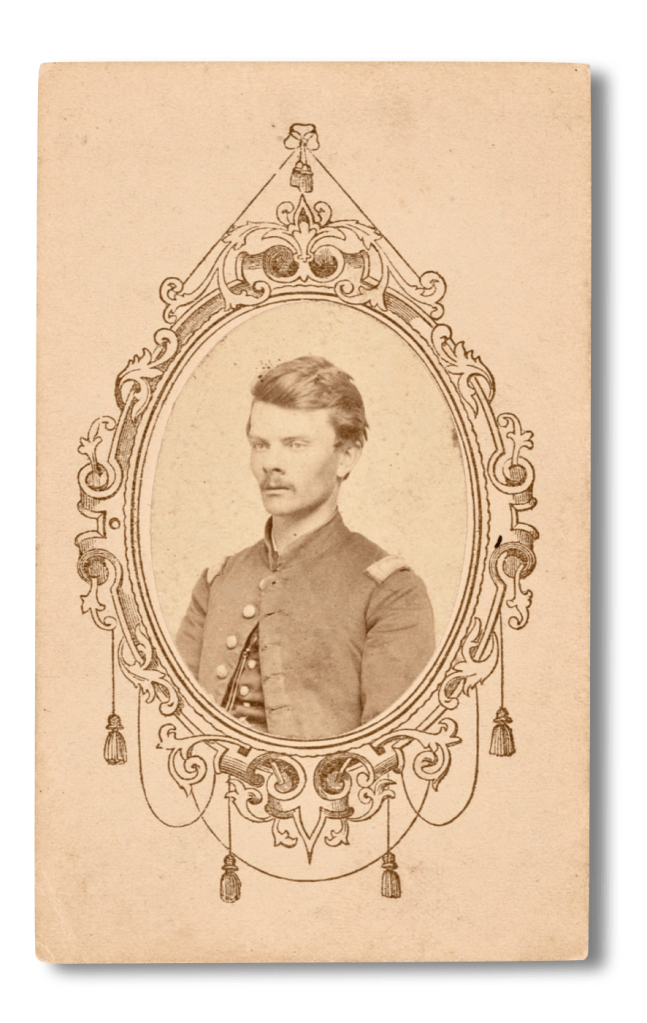
I could not find an image of David but here is one of Daniel S. Hazelton of Co. C, 179th New York Infantry (CW Photo Sleuth)
The following letter was written by David H. Shepard (1836-1864) who was mustered into Co. A (the “Horseheads Company”), 179th New York Infantry on 5 April 1864. At the time of his entry into the service, he was described a 5 ft. 4 in. tall, blue-eyed, light haired 28 year-old farmer. According to his muster roll records, David was wounded in the Battle of the Crater on 30 July 1864 and died of his wounds on 14 November 1864 while on furlough from St. Mary’s Hospital in Rochester, New York. David was the son of Miles Shepard (1812-1883) and Maria Underwood (1816-1876) of Van Etten, Chemung county, New York.
As documented in his letter, the 179th New York Infantry was among the first regiments deployed by Brig. Gen. James H. Ledlie into the crater following the mine explosion in the early hours of July 30, 1864. They were preceded solely by the 2nd Pennsylvania Provisional Heavy Artillery and the 14th New York Artillery. The 3rd line of battle consisted of four companies from the 3rd Maryland and seven companies from the 79th New York, all part of the 2nd Brigade of the 1st Division. It was nearly three hours after the mine explosion before Ledlie ordered in the Black USCT soldiers of the 4th Division, and when their efforts proved as unsuccessful as those of the previous white soldiers, they were unjustly designated as scapegoats for the failed assault. After action investigations of the battle subsequently laid the blame more properly on the Union commanders.
T R A N S C R I P T I O N
City Point July 31, 1864
Dear Father and mother,
By the grace of God I am yet alive and well with the exception of a little mark I got the 29th, but I thought my time was close at hand. But God see fit to spare my life for some reason unless it was because I asked Him to spare my life. We had a very hard fight. We fight for [our] life. We blowed up their fort and took their breastworks. We thought we had the Johnnies in our hands. Then the niggers was going to make charge. They charged but they let the rebs drive them back to us. We drove them back again. They made another charge but they came back again. We was in the rebs breastworks [when] the niggers jump onto us so we could not fight and they would not fight. I know that to be so. So we had to retreat.
They took a good many of our men. A good many of my regiment was taken but I made my escape. I expect[ed] to be shot when [I] climbed over the breastworks but I did not. I took my heels down across the lot. I expected to fall [with] every step. I seen the boys fall on every side of me, sure enough I did. I never expected to raise my head again. I don’t know how long I laid there but I don’t think I laid there long [before] I came to myself again. I thought I would try my luck again. They didn’t put only three holes through my old cap. There didn’t only one ball strike my head but I wagged along till I got to the wagon. They loaded me in and took me to the hospital but it was a long time before they got my wound dressed.
I stayed there till the next day. Then they took me to City Point. I am where they take good care of me. I have a good bed to sleep and enough to eat. I think I shall be to the regiment in a little while if nothing happens to me.
I shall have to bring my letter to a close. I have not received no letter from you in four weeks. I got a letter from Jim Fish. So goodbye. — D. H. Shepard
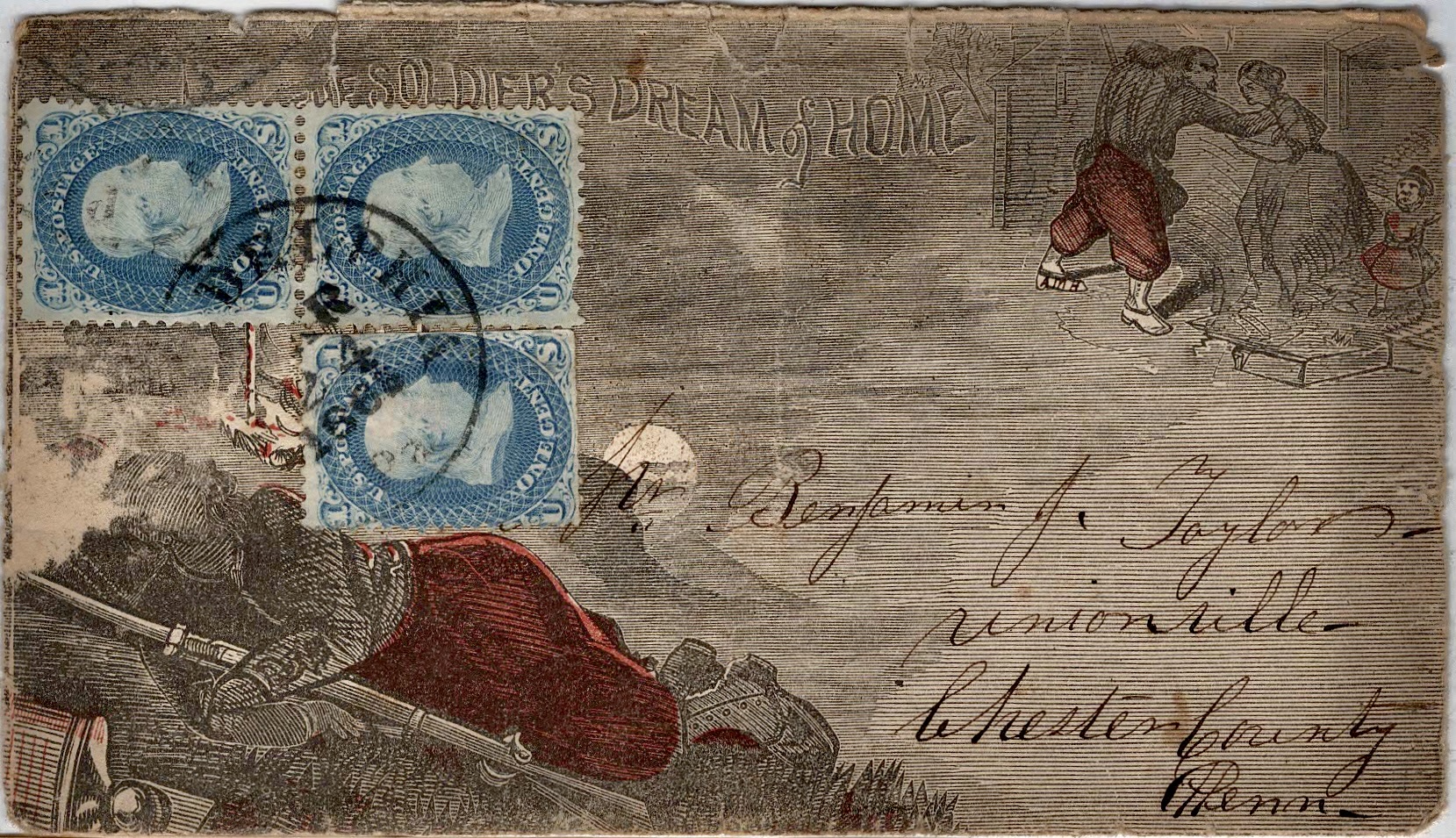
The following letter was written by William Taylor (b. 1807 in Penn.), the husband of Hannah (Price) Taylor (b. 1825 in Penn.)—both Mulattos—who were residents of Unionville, Chester county, Pennsylvania at the time of the 1860 US Census. William wrote the letter to his oldest son, Benjamin Jones Taylor (1842-1899) who was enumerated in the 1860 Census with his siblings, William (b. 1844), Hebert (b. 1848), Elizabeth (b. 1850), Mary A. (b. 1851), and Esther (b. 1856). I don’t know William penned the letter but since the postmark was Philadelphia, I’m going to assume he was working there at the time. I cannot find any record that his son Benjamin ever volunteered to serve in the U. S. Colored Troops (USCT).
Benjamin married Anna Frances Davis of Providence, Rhode Island, and in the 1870 US Census, he was enumerated in Providence working as a coachman. By 1880, Benjamin was working as a hosier, his home located at 379 Fountain Street. Benjamin’s son, Charles (1877-1942) served in Co. H, 9th US Cavalry—a Buffalo soldier.
It’s curious that William concluded his letter by writing, “It is very requisite that we as a combined body should make the best of everything from the fact that prejudice is raging rapidly.” This statement is further evidence of a noticeable rise in racial tensions and hostility towards Black Americans in certain areas—particularly in New York City where the military draft stoked fears and sparked racial violence.
T R A N S C R I P T I O N
Addressed to Mr. Benjamin J. Taylor, Unionville, Chester county, Penn.
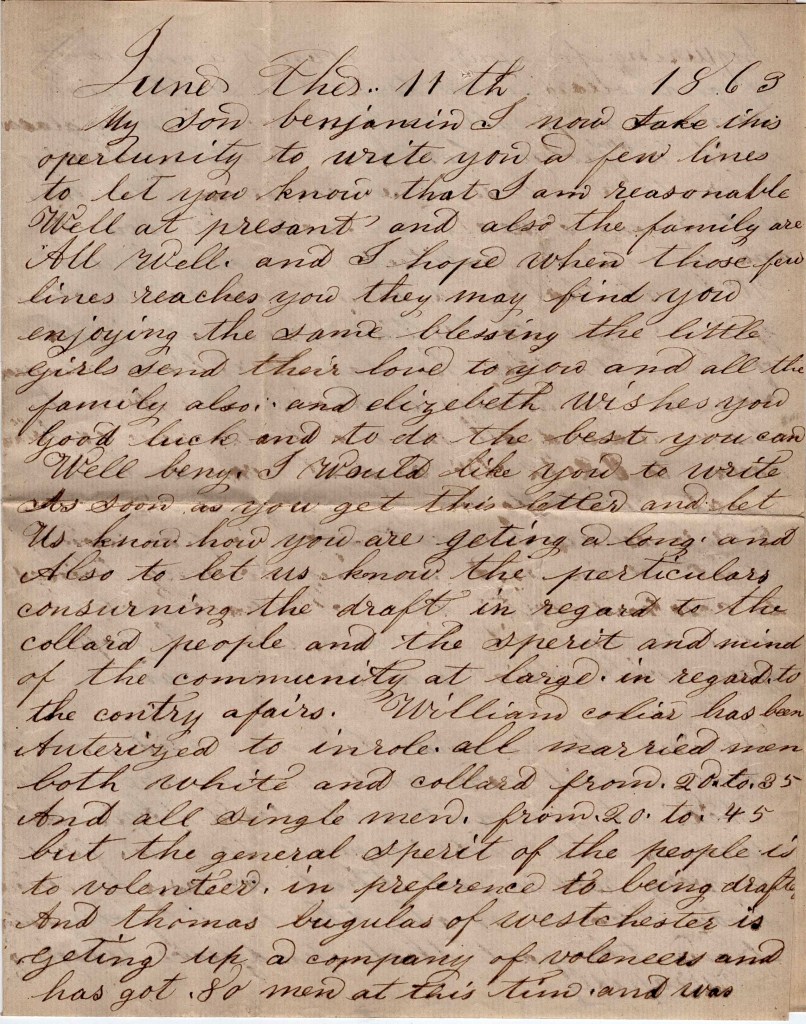
[Philadelphia, Pa.] June 11, 1863
My son Benjamin,
I now take this opportunity to write you a few lines to let you know that I am reasonable well at present and also the family are all well and I hope when those few lines reaches you, they may find you enjoying the same blessing. The little girls send their love to you and all the family also. And Elizabeth wishes you good luck and to do the best you can.
Well, Benj, I would like you to write as soon as you get this letter and let us know how you are getting along and also to let us know the particulars concerning the draft, in regard to the colored people and the spirit and mind of the community at large, in regard to the country affairs. William Collier has been authorized to enroll all married men, both white and colored, from 20 to 35, and all single men from 20 to 45. But the general spirit of the people is to volunteer in preference to being drafted and Thomas Bugulas [?] of West Chester is getting up a company of volunteers and has got 80 men at this time and was inquiring for you. He wants a company of good colored men to march with him as soon as possible.
And Aunt Mary Glasco got a letter from her son London for he has not received neither wages nor bounty and is entirely destitute of money. He was well at that time and is now in South Carolina. 1
Give our love to William Green and enquire of him whether he saw William Shirley’s son for he wishes to know. Well, Benj., I have reduced all my old debts from 14 dollars down to $2.72 cents and it would be a great relief to me if you could send me 5 or 6 dollars. I must make a portion of rent soon and having so many things to contend with that I shall not be able to raise it in due time. I hope you will oblige me if you can.
Lovina Means and Tilman and family and David Carr and family are middling well at present and send their well wishes and best respects to you for it is very requisite that we as a combined body should make the best of everything from the fact that prejudice is raging rapidly.
I must now close by saying our respects to you all together. No more at present. From your father, — William Taylor
1 London Glasco (1841-1863), mulatto, was the son of Robert Glasco (1797-1877) and Mary (Taylor) Brown (1803-Aft1870) of Unionville, Chester county, Pennsylvania. London served in Co. B of the 54th Massachusetts Infantry and was killed in the assault on Fort Wagner on 18 July 1863. London was listed in the Company Descriptive Book record as single, 22 years of age, 5 feet 6 inches tall.
1st Lt. John W. Barr, 46th Illinois Infantry; later the 6th USCHA(Library of Congress)
The author of this letter was previously unidentified but I have been able to attribute it to Charlotte K. (Davis) Barr (1840-1880), the wife of 1st Lt. John W. Barr (1840-1918), 6th US Colored Heavy Artillery (6th USCHA). Before accepting a commission with the regiment, John served in Co. B, 46th Illinois Infantry, working his way up from private of Co. B to 1st Lieutenant of Co. I. Lottie was the daughter of Horatio G. Davis (1796-1849) and Sarah Lord (1802-1841) of Stephenson county, Illinois. Lottie and John were married in Stephenson county in 1861.
She wrote the letter from Natchez in late March 1864 while visiting her husband shortly after assuming his role as an officer in the 5th USC Heavy Artillery. The white officers had been promoted from other units, such as 1st Missouri Light Artillery, where they been NCO’s. Most of the officers had no combat experience but John had previously been commissioned and had seen combat experience in the 46th Illinois. He was wounded at the Battle of Shiloh in April 1862.
This regiment was first organized from the 2nd Mississippi Heavy Artillery (African Descent) and designated the 5th USC Heavy Artillery on 11 March 1864. Six weeks later, they were re-designated the 6th US Colored Heavy Artillery and served at Nachez. Three or four companies of the 6th USCHA were later assigned to garrison duty at Fort Pillow near Memphis and many members of that regiment were killed in the Fort Pillow Massacre on 12 April 1864.
Transcription
Natchez [Mississippi] March 21st 1864
Dear Brother,
I received your very kind note with much pleasure and was very much pleased to know that you sometimes thought of me. I am very much obliged to you for your kindness with regard to those taxes but I think there must be some mistake as I have paid the taxes for the last three years and have the receipts. I have the receipt for this year with me; the other two are at home. Let me know what year they claim the taxes not to be paid and I will furnish you the receipt and if that does not explain the mistake, I will send you the money.
I arrived here safe after a journey of thirteen days and found John well and very well pleased with his new position. The negroes make fine-looking soldiers and they are very easily disciplined. They have been mustered into the regular army and are now the fifth regiment of United States Artillery.
The weather is very pleasant here—about the same that you have there the first of June. The people here have suffered immensely by this war. They are glad to sell their clothing or anything else to buy food.
Our men have a little skirmish every few days with guerrillas. They come up and fire on our pickets and then run. There is deserters coming in almost every day.
Let me hear from you soon. John send his best wishes. With much love, — Lottie
The following letters and diary track the movements of Pvt. Gustavis (“Gus”) Davis Bates (1823-1903) of Plymouth, Massachusetts, who enlisted in Co. D, 38th Massachusetts Infantry. He was discharged from the University Hospital in New Orleans, Louisiana, for disability on 5 August 1863.
Gus was well educated—an 1850 graduate of Brown University—and was enumerated in the 1850 US Census as a lawyer in Plymouth, Massachusetts but in August 1862 when he enlisted to serve his country he was a 38 year-old county school teacher. His regiment was transported to Louisiana in the Bank’s’ Expedition and fought at Fort Brisland in March 1863, where a large contingent from the regiment were captured and briefly held as prisoners of war. “Gus” was admitted to University Hospital at New Orleans on April 9, 1863 and remained there until medically discharged from the army on Aug. 5, 1863. His diary entries from May and June 1863 suggest that though he might have been marginally capable of being returned to service in the field, his doctors found his nursing skills to be of greater value to the military and so he was kept at University Hospital until his discharge.
Gus was the son of Comfort Bates III (1791-1876) and Elizabeth Pierce (1792-1878) of Plymouth, Massachusetts. Gus was married in 1848 to Nancy Doten Finney (1828-1896) and had at least three boys living at the time of his enlistment—Charles Hubbard Bates (1849-1918), Josiah Finney Bates (1851-1918), and Alfred Merton Bates (1858-1933). After the war, Gus returned to teaching school in Plymouth.
There are four documents in this archive: A letter dated 19 November 1862 written from Fortress Monroe enroute to Louisiana; a diary fragment from the passage from Baltimore to New Orleans; a letter dated from New Orleans on January 7, 1863; and a diary fragment written at University Hospital in New Orleans in May and June 1864 during the fighting at Port Hudson.
1
Adams Express Co. Fortress Monroe, Va. November 19th 1862
Dear Wife,
I have sent you $15 (fifteen dollars) by Adams Express. As soon as you get this, send directly over to Rich & Westars or other express in town & get it. Carry the paper I send you with you. I received $23.40.
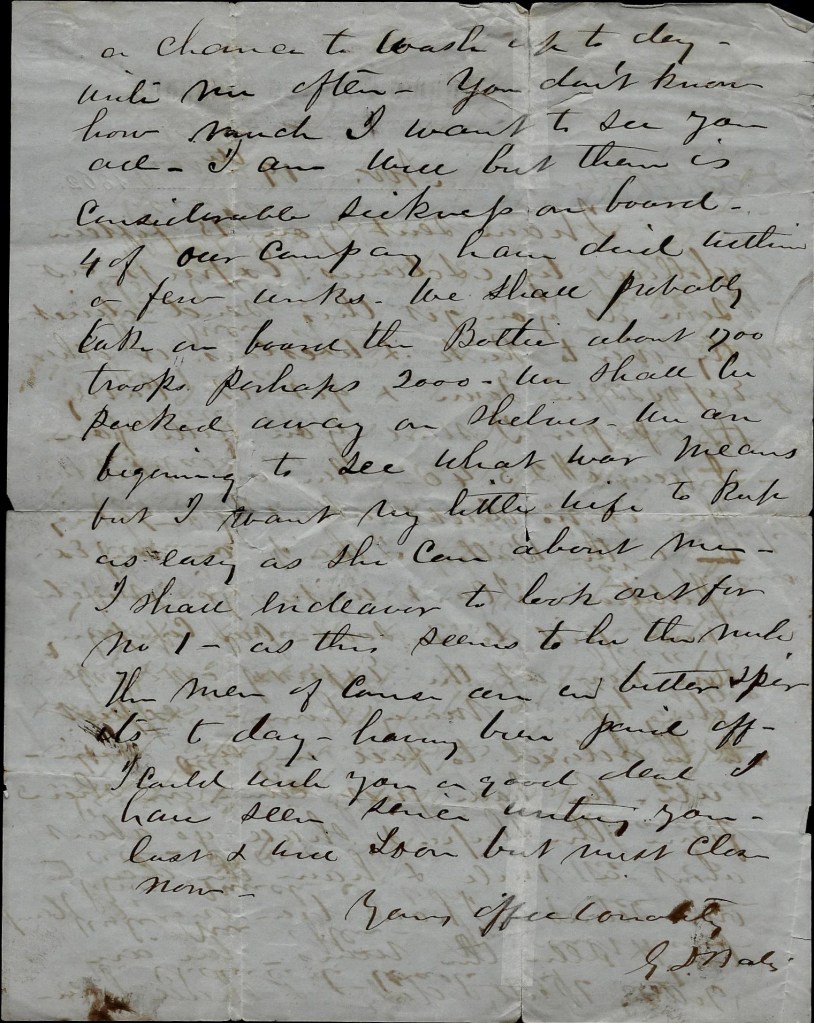
We are still here. There is no doubt about our going in the Baltic, I think on an expedition. I can’t write you much now. Will do so soon. Our company are now at the Express Office sending their money home. Expect to be ordered to fall in any minute. We have just come on here from the ship & shall go about a mile to hair the day to ourselves. I have been over to Hampton and also the rivers. We are getting pretty dirty & shall have a chance to wash up today. Write me often. You don’t know how much I want to see you all. I am well but there is considerable sickness on board. Four of our company have died within a few weeks.
We shall probably take on board the Baltic about 1700 troops—perhaps 2,000. We shall be packed away on shelves. We are beginning to see what war means but I want my little wife to keep as easy as she can about me. I shall endeavor to look out for No. 1 as this seems to be the rule.
The men of course are in better spirits today having been paid off. I could write you a good deal I have seen since writing you last & will soon but must close now. Yours affectionately, — G. D. Bates
2
The U.S.S. Steam Ship Baltic
Steam Ship Baltic, Fort Monroe
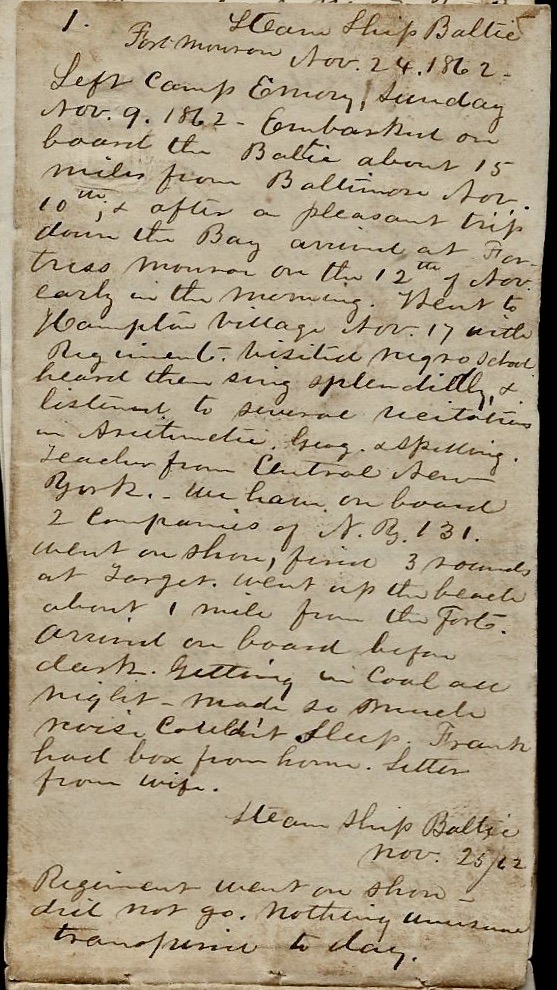
November 24, 1862—Left Camp Emory Sunday November 9, 1862. Embarked on board the Baltic about 15 miles from Baltimore November 10th; and after a pleasant trip down the Bay, arrived at Fortress Monroe on the 12th of November early in the morning. Went to Hampton Village Nov. 17th with regiment.
Visited Negro School. Heard them sing splendidly & listed to several recitations in Arithmetic, Geography, & Spelling. Teacher from Central New York.
We have on board two companies of New York 131st. Went on shore. Fired three rounds at target. Went up the beach about 1 mile from the fort. Arrived on board before dark. Getting in coal all night. Made so much noise, couldn’t sleep. Frank [Bates] had box from home. Letter from wife.
Steamship Baltic—November 25, 1862—Regiment went on shore. Did not go. Nothing unusual transpired today.
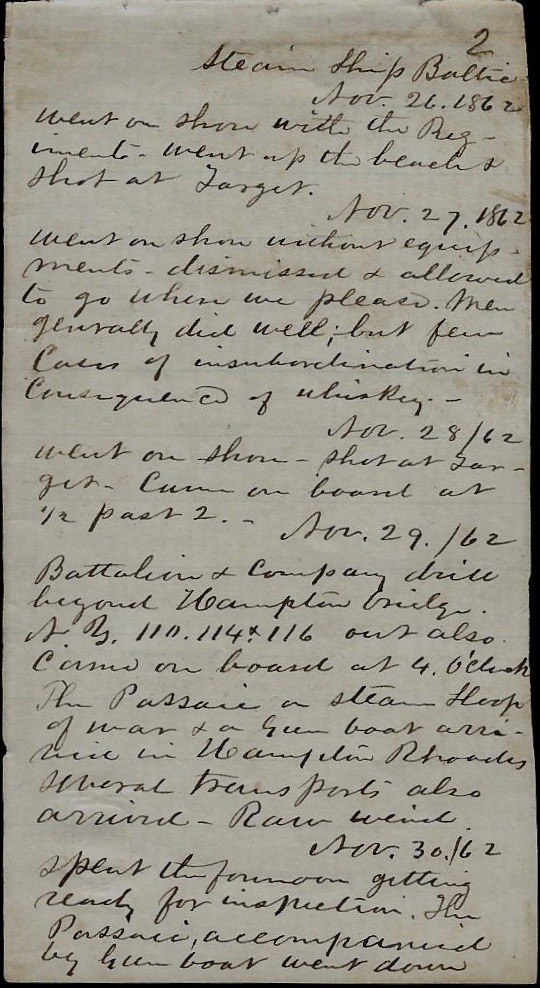
November 26, 1862—Went on shore with the regiment. Went up the beach and shot at target.
November 27, 1862—Went on shore without equipments—dismissed and allowed to go where we please. Men generally did well, but few cases of insubordination in consequence of whiskey.
November 28, 1862—Went on shore. Shot at target. Came on board at half past 2.
November 29, 1862—Battalion & Company drill beyond Hampton bridge. New York 110th, 114th, and 116th [regiments] out also. Came on board at 4 o’clock. The Passaic—a steam sloop of war, & a gunboat arrived in Hampton Roads. Several transports also arrived. Raw wind.
November 30, 1862—Spent the forenoon getting ready for inspection. The Passaic accompanied by gunboat went down the Bay about noon. Quite a stir among the gunboats.
December 1, 1862—Inspection this forenoon. Very Pleasant.
December 2, 1862—On board all day. Indian rubber blankets delivered to the regiments this afternoon. 80 rebel prisoners arrived from Baltimore [who] were well dressed. Gave up cartridges today. Commenced raining about noon. General inspection of quarters by physician. Complaints made & remedies promised. Member of company buried.
Steam ship Baltic, Fort Monroe—December 3, 1862—On board all day. Rainy. The fleet ordered to be in readiness to sail and are making preparations to go to sea.
December 4, 1862—A. S. Russell came on board. Fleet got under way this morning. Men securely fastened & preparations are being made for the coming storm.
Steam Ship Baltic at Sea
December 5, 1862—Wind dead ahead. Ship labors hard. Deck very wet. Spray covered the forward part of the ship blowing a gale. A great deal of seasickness on board. Off Hatteras, encountered a severe gale. The sea breaking completely over the starboard wheelhouse & drenching the men forward, accompanied with vivid lightening & crashing thunder. The rain poured down in torrents & at one time the ship was in great peril—the ship running very high and ship straining every timber to keep on her course.
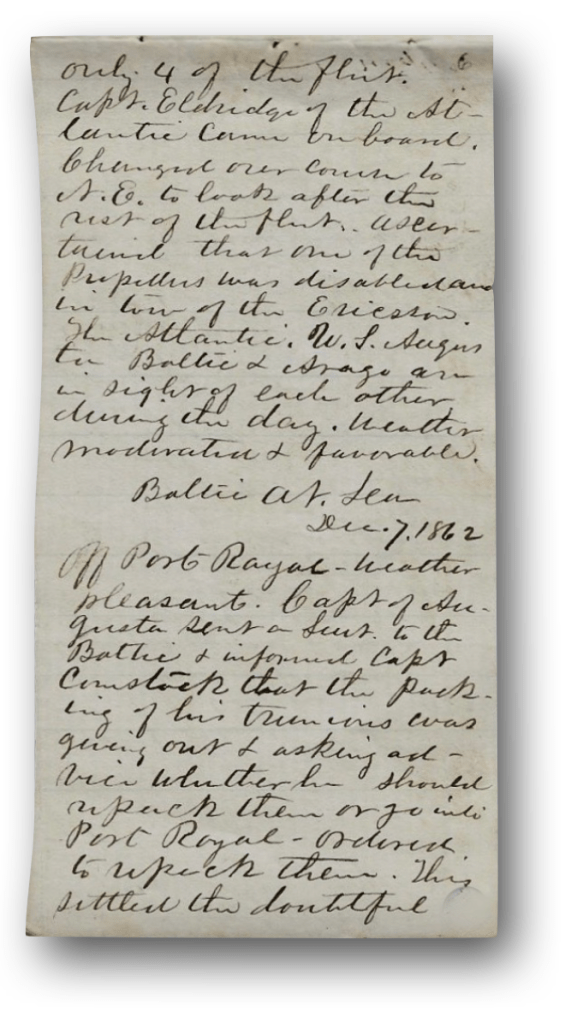
December 6, 1862—At sea. In the morning signaled only 4 of the fleet [in sight]. Capt. Eldridge of the Atlantic came on board. Changed our course to northeast to look after the rest of the fleet. Ascertained that one of the propellers was disabled and in tow of the Ericsson. The Atlantic, U. S. Augusta, Baltic & Arago are in sight of each other during the day. Weather moderated & favorable.
Baltic at Sea
December 7th 1862—Off Port Royal—weather pleasant. Capt. of Augusta sent a Lieutenant to the Baltic & informed Capt. Comstock that the packing of his trunchions [?] was giving out & asking advice whether he should repack them or go into Port Royal. Ordered to unpack them. This settled the doubtful point whether we were going into Port Royal or not. Sent up rockets in the night. Several responses. Having pleasant view. The living on board is very poor & our accommodations are very contracted. The men are scattered over the deck reading, writing, playing cards & chattering together, most of them having recovered from sea sickness & being in good spirits.
At Sea on Baltic
December 8, 1862—Weather fine. Course S. S. W. The remainder of the fleet do not come up. general inspection aft. Inspection of men took off right boot & stocking. Saw three sail towards night. off St. Augustine towards night.
[Page missing, December 9-11, 1862]
At Sea, December. 12, 1862—Warm and pleasant. Fine run last night & today. Nothing unusual has occurred.
At Sea. December 11 [should be 13th], 1862. The Baltic hove to above 4 o’clock in the night. saw the land early in the morning. Arrived at Ship Island at 1 o’clock today. Atlantic went over the bar first. Baltic struck heavily on the bar going in. Gunboat Augusta came in soon after the Baltic. The U. S. Arago, S. R. Spaulding, arrived before us. Some 15 or 20 sail were in port. The U. S. left soon after we arrived. Mataras [?] arrived at 2 o’clock p.m. Capt of Augusta came on board & accompanied General Emory on shore. S. R. Spaulding left in the afternoon. Several vessels left and several arrived during the day.
Ship Island
December 14th, 1862—Commenced going on shore this afternoon. General Banks with the 41st Massachusetts left in the North Star at noon. On board the Baltic all night.
41st Massachusetts soldiers on board the North Star while anchored at Ship Island in December 1862
December 16, 1862—Ship Island. Went on shore this morning in boats ay Ship Island. Encamped about half mile from the wharf on the sand. 23rd Connecticut encamped here. 16th New York and two companies of 13th Maine doing garrison duty. There are about 50 rebel prisoners here. Drew rations of coffee & sugar. Went down the beach and got a good stove. Saw Robert Finny of The Kensington.
From December 16 to 27 [1862]—At Ship Island drilling, Had frequent conversations with rebel prisoners, most of whom were anxious to have the war brought to a close & join the Union. Others would settle on [nothing] but recognition. Six men from each company was detailed to cut wood on the Island about 4 miles from camp. Israel Thrasher 1 of our company went.
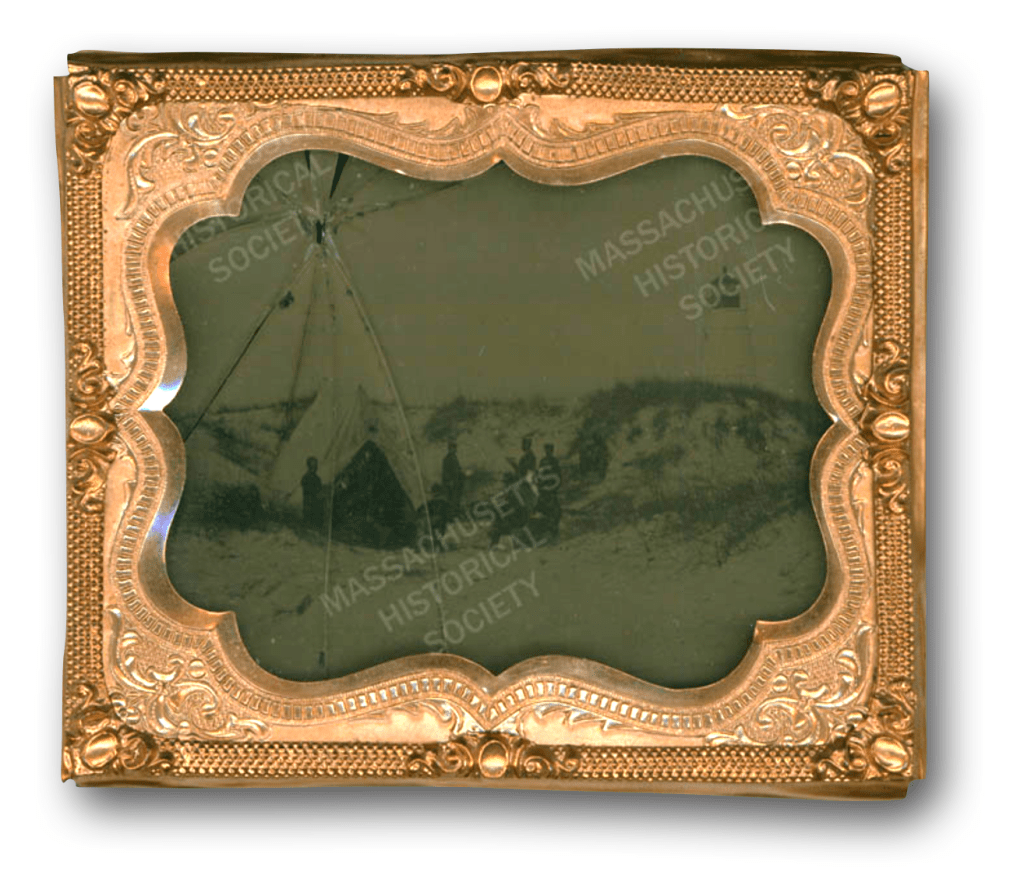
This ambrotype depicts members of the 38th Massachusetts Volunteer Infantry Regiment at camp on the beach of Ship Island, Miss. during the Civil War. The photograph was taken in Dec. 1862 by an unknown photographer and probably was owned by Francis William Loring, a lieutenant with the regiment; an inscription on the verso of the image reads, “Field & Staff 38th M.V. FW Loring Ship Island, Miss. Dec. 25, 1862.” Photo. 2.97 Removed from the Francis William Loring papers[Digital Commonwealth, Massachusetts Collection On Line]
Ship Island, December 27, 1862—Went up the beach with Israel Thrasher, gathered shells & visited the graveyard. Most of the names were between 18 and 25 year old. Mostly from Maine. Indiana, Wisconsin, Connecticut, Vermont, New Hampshire, & Massachusetts were represented among the dead.
Ship Island—December 29, 1862—The North Star, Northern Light, & Illinois came in this morning. Had orders to move. Went on board the Northern Light about 12 o’clock at night.
Steamship Northern Light
December 30, 1862—After some delay in getting off, left Ship Island this morning at 8 o’clock in the Northern Light. Quartered in the forehold. Better accommodations than in the Baltic. Several cases of measles on board. Had a fine run all day & during the night.
Steam Ship Northern Light, Mississippi River. December 31, 1862—Entered the [river] about 9 o’clock this morning. Had a good passage up the river and arrived at New Orleans not far from 7 o’clock in the evening.
1 Israel H. Thrasher was also from Plymouth. He died on 29 June 1863 at New Orleans from wounds received in the fighting at Port Hudson on 14 June 1863.
3
Camp Kearney At Greenville near New Orleans January 7, 1862 [should be 1863]
Dear Wife,
I send you within $20 (twenty dollars) by Adams Express. I can’t write you much now. Shall write you by mail. We are encamped here 4 miles from the city and about 8 by the river. We like the camp better than any camp we have been in. The weather here is pleasant most of the time, not comfortably cool night, so that I am not cold with overcoat & blanket.
We have three days rations ordered to be cooked & 10 days on hand all the time. I think I can send you 4 or 5 dollars now. Shall do so in my letters. It costs 65 cents to send this to Plymouth. I received two letters from you dated 7th and 16th of December. Your Uncle Henry is right, I think about the wood. Pay it.
Lt. Col. David K. Wardwell—“When Wardwell went, the fighting talent went also.”
We arrived here last Thursday, laid over one night in the city, and came up here next day. Whether we shall go up or down the river is uncertain. I shall endeavor to write you once a week about Sunday. If we move, I shall write about the time of moving. Should anything unusual take place, I shall let you know. I think the Colonel will try to have us stay at New Orleans. Col. [Timothy] Ingraham is acting as Brigadier General and the 38th is commanded by Lieut. Col. [William L.] Rodman. When [David Kilburn] Wardwell went, the fighting talent went also.
But I must close. Frank [Bates] 1 and I are well. Tom Savery 2 is sick with the measles [which are] prevalent in camp.
Your affectionate husband, — G. D. Bates
1 Francis (“Frank”) Bates was also from Plymouth. He served as a musician in Co. D, 38th Mass., until 30 January 1864 when he was discharged at Baton Rouge for disability.
2 Thomas G. Savery of Plymouth survived his bout with the measles only to be wounded at Port Hudson on 14 June 1863 and discharged at Boston for disability on 28 December 1863.
4
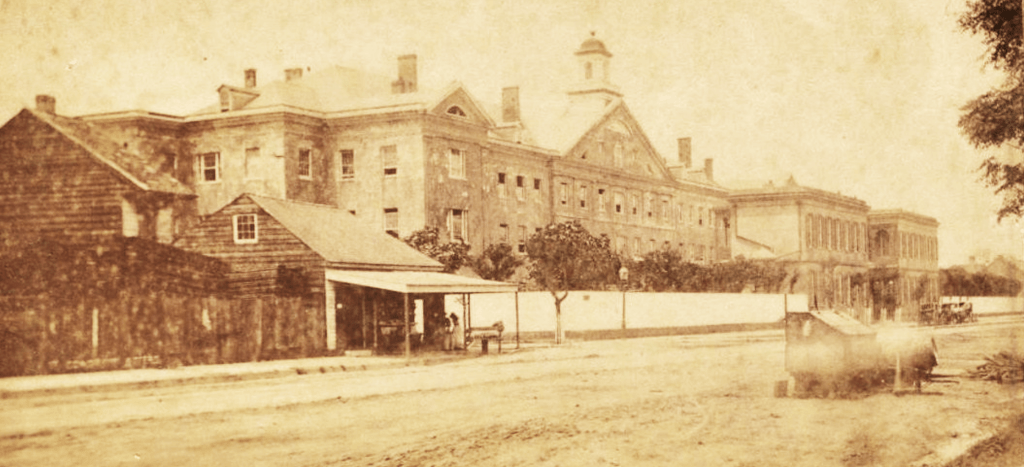
The remaining diary entries were all penned in the University Hospital at New Orleans
University Hospital, New Orleans
May 27, 1863—About 150 men from this hospital ordered away to their respective regiments. Packing up in the afternoon. Showers during the day.
Thursday, [May] 28th, 1863—Packed my knapsack & put things in readiness to go to the regiment. All the men were ordered into the front hall to answer to their names. No questions were asked me by [Asst. Surgeon] Dr. [Samuel H.] Orton but he ordered me back to room. Unpacked knapsack & put things in [ ] for a further sojourn at this institution. Removal into another war. Saw several wounded pass the hospital. Among them General [Thomas W.] Sherman. Reported also that Neal Dow is killed & General [Christopher C.] Augur wounded at Port Hudson. Several doctors came round at 10 o’clock in the eve and took names to send off. About 120 went today. Papers contain accounts from rebel sources of fights at Port Hudson & Vicksburg. Sent letter home, No. 12. Fletcher, Nye & Laws of the 38th in Ward K went off today. [George H.] Fish of Co. D & H[oratio] Sears of Co. G. [George W.] Belcher of [Co. A], 38th [Mass.] sent back. [Albion] Leavitt of 26th Massachusetts went off also who was in Ward K. Become acquainted with Mr. Burbeck of East Abington.
Friday, May 29th, 1863—Rained last night. Pleasant this morning. Became acquainted with George Bates of Worcester, Co. 130. Wounded, came from Baton Rouge. [Was] on the fight at Port Hudson. Heard of the death of Lt. Col. [William L.] Rodman of the 38th [Massachusetts]. No one could be found to take charge of the regiment. Rumored death of Gen. Paine. Shower in the afternoon accompanied with thunder and lightning. About 70 men left the hospital this afternoon. Joe Loring, Otis Foster, & Israel H. Thrasher went off [back to the regiment] today. Only one left of Co. D in this hospital. Seven transported in the evening.
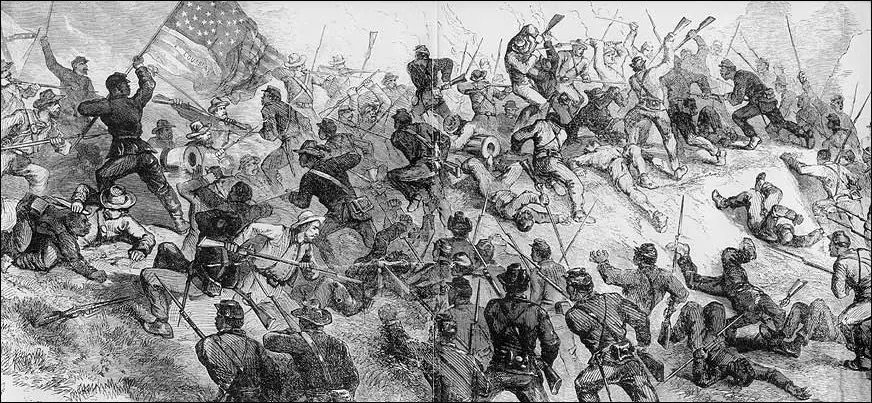
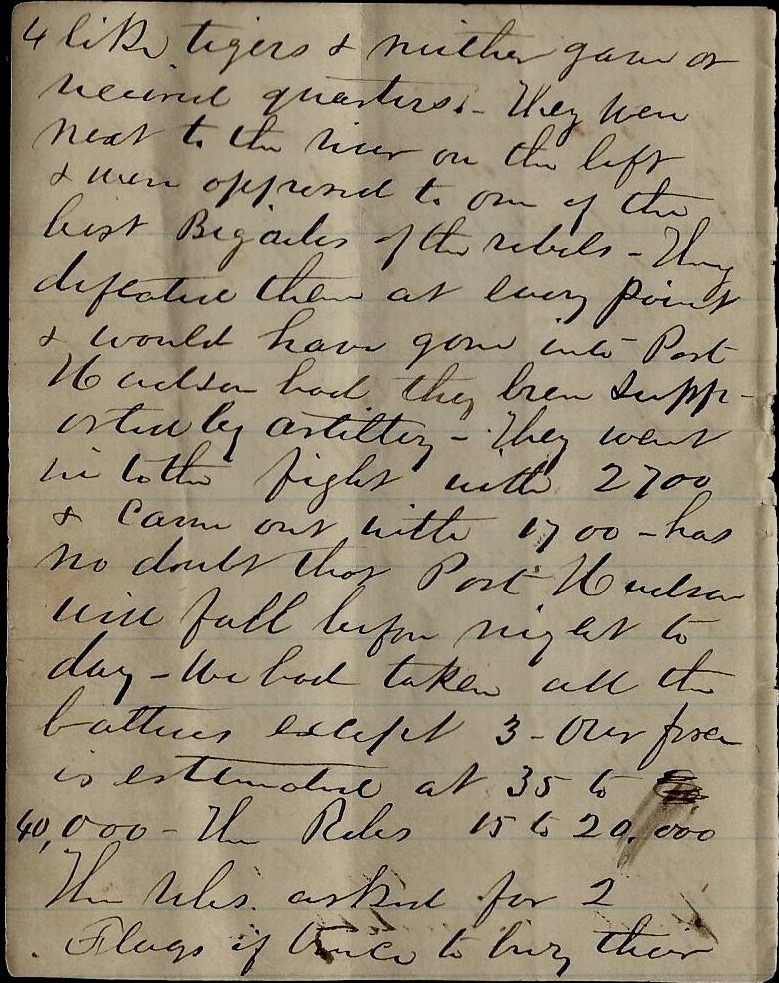
Saturday, May 30th 1863—Hard thunder and rain this morning. Talked with wounded sergeant of 131st New York. 1 Thinks when he left [Port Hudson] there were 3,000 killed & wounded on our side. Represents the fighting as the most desperate of the war. The Negro Brigade fought like tigers & neither gave or received quarters. They were near to the river on the left & were opposite to one of the best brigades of the rebels. They defeated them at every point & would have gone into Port Hudson had they been supported by artillery. They went into the fight with 2700 and came out with 1700.
1 The wounded sergeant was probably one of four men: 22 year old Hector Sears of New York City was 1st Sergeant of Co. I. He was wounded in the fighting at Port Hudson on 27 May 1863; 23 year-old Sgt. Paulis Van Version of Co. F thought the date of his wound was not given; 27 year-old Sgt. James Devlin of Co. F, who was wounded at Port Hudson; or 31 year-old Sgt. William Boxberger of Co. D who was wounded on 27 May 1863 at Port Hudson. One of them would have been the source of the information provided Bates about the “the Negro Brigade.” See poem by John A. Morgan entitled, The Black Brigade at Port Hudson.
“In May 1863, the 1st and 3d Corps D’Afrique attacked the Confederate stronghold of Port Hudson, Louisiana. After previous units failed to break through the Confederate defenses, Brig. Gen. William Dwight ordered the African American units to attack a strong point along the western edge of the Confederate line. The units crossed a short bridge, bordered on their right by the Mississippi River and on their left by entrenched enemy sharpshooters and cannons. The Louisiana troops, led by freedman Capt. Andre Cailloux, assaulted the position under withering fire. Cailloux, wounded twice, led his soldiers until mortally wounded by a cannon ball just outside the breastworks. The assault withdrew and successfully laid siege to the Confederate garrison until it’s surrender six weeks later. Cailloux’s gallantry under fire became a rallying cry for African American and white Soldiers alike throughout the rest of the war.“
Black troops attack the Confederate line at Port Hudson
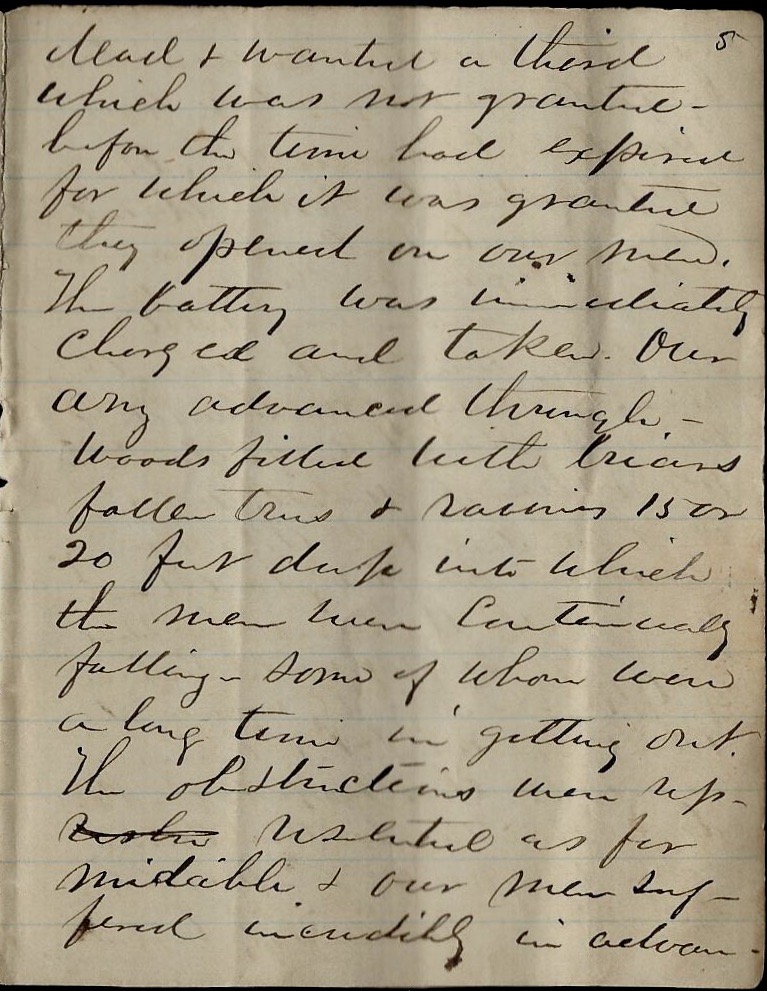
Has no doubt that Port Hudson will fall before night today. We had taken all the batteries except three. Our force is estimated at 35 to 40,000. The Rebs at 15 to 20,000. The Rebs asked for two flags of truce to bury their dead and wanted a third which was not granted. Before the time had expired for which it was granted, they opened on our men. The battery was immediately charged and taken. Our army advanced through woods filled with briars, fallen trees, ad ravines 15 or 20 feet deep in which the men were continually falling—some of who, were a long time in getting out. The obstructions were represented as formidable & our men suffered incredibly in advancing on the enemy who are strongly posted in every advantageous position, commanding the approaches to Port Hudson. No doctor came round today. Warm and pleasant.
Sunday, May 31, 1863—The tables were full again this morning, many of the wounded being well enough to go down. Went through wards where the wounded are this morning. Saw but one very bad case wounded in the head—looked very bad. Talked with [Corp. Lewis M.] Bailey of Co. G, 38th [Mass.] [who was] slightly wounded [at Port Hudson]. About 200 wounded have arrived at this hospital. Hot day. Dr. McLellan came round—No. 452, Ward E, 3rd Story, University building.
University Hospital—June 1, 1863, New Orleans. Hot day. Siege of Port Hudson still going on. General Banks receiving reinforcements. All the wounded men concur in the opinion that Port Hudson must fall soon. Dr. Conner in charge of the Hospital, having returned from Baton Rouge. Quince arrived 26 days from New York.
June 2, 1863—Continues hot. Letter from home [dated] May 17th. A few wounded continue to arrive from Port Hudson.
January 3rd 1863—Warm and pleasant. Letters from home [dated] April 26th, also April 30th. B. F. Hathaway called.
June 4th 1863—Wrote letter No. 13 home. Hot day. Nothing unusual. Papers contain nothing.
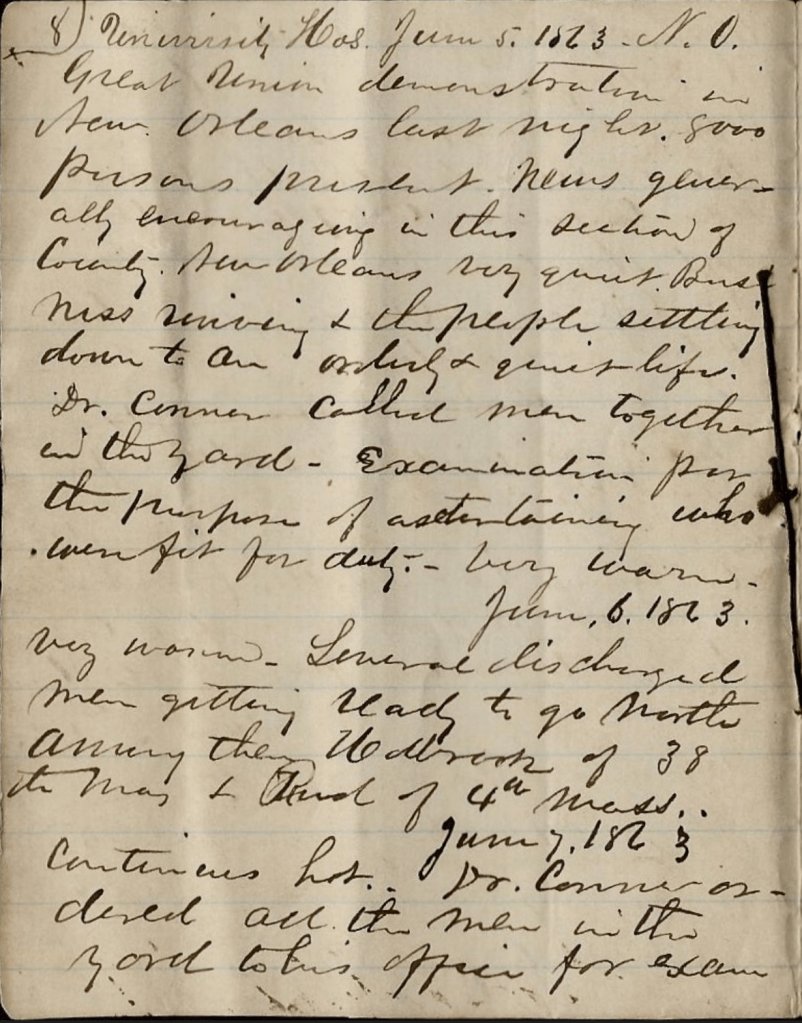
University Hospital, June 5, 1863, New Orleans. Great Union demonstration in New Orleans last night. 8,000 persons present. News generally encouraging I this section of the county. New Orleans very quiet. Business reviving and the people settling down to an orderly & quiet life. Dr. Conner called men together in the yard. Examination for the purpose of ascertaining who were city for duty. Very warm.
June 6th, 1863—Very warm. Several discharged men getting ready to go North. Among them [Corp. Nathaniel O.] Holbrook of [Co. C], 38th Mass. and [Jedediah M.] Bird of the 4th Mass.
June 7th, 1863—Continues hot. Dr. Conner ordered all the men in the yard to his office for examination. 15 or 20 men from the hospital North discharged.
Monday, June 8th 1863—Very hot. 40 or 50 men discharged to regiment today. All the men at supper table ordered to Dr. Conner’s office after supper. Went. Was told to go back to Ward & keep quiet. Took a large number of names for regiment & for light duty about the hospital.
Tuesday, June 9th 1863—Continues hot & dry. Sixty men packed up to leave for regiments. Ordered back & remained over night. Doctor did not come round until after supper.
University Hospital, June 10th, 1863—Continues very warm. 40 or 50 men left this morning for up the river. General Wentzel’s Division defeats the Rebs in rear of our forces at Port Hudson & droves them to Liberty.
June 10th 1863—Cooler. Nothing of importance.
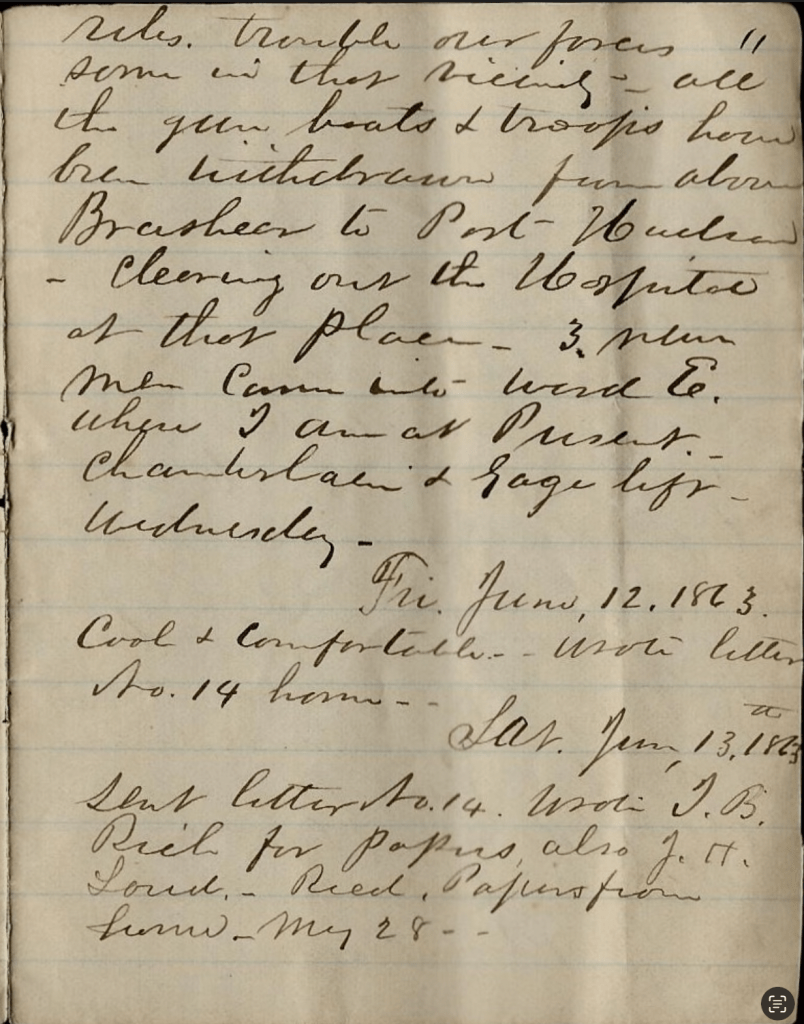
June 11th 1863—Showery. Cooler. Some thunder. Put up cistern in the hospital. Fifty men arrived at hospital from Brashear City. Learn from them that the Rebs trouble our forces some in that vicinity. All the gunboats and troops have been withdrawn from above Brashear to Port Hudson. Clearing out the hospital of that place. Three new men came into Ward E where I am at present. Chamberlain and Gage left Wednesday.
Friday June 12th, 1863—Cool and comfortable. wrote letter No. 14 home.
Saturday, June 13th 1863—Sent letter No. 14. Wrote T. B. Rich for papers. Also J. H. Loud. Received papers from home date May 28th.
University Hospital, June 14, 1863—Comfortable weather. Dr. Conner came round this morning and notified several that he was going to send them home. Said but little to me. Was accompanied by Dr. McLellan who is now practicing in Ward E where I am at present. Had a talk with Quince. Informed me that Israel H. Thrasher & Foster had left Barracks Hospital. Col. [Timothy] Ingraham went home [to New Bedford] today. Several came to the hospital from Brashear City. Had a long talk with Petra of Co, B, 38th [Mass.] Read the scriptures most of the day. Place my dependence on God and try to do my duty & be reconciled to my situation.
Monday, June 15th 1863—Shower in the afternoon. Some thunder. Quite comfortable. Read New York Herald‘s first account of fight at Port Hudson. Some chill today. Received letter from wife of May 31st.
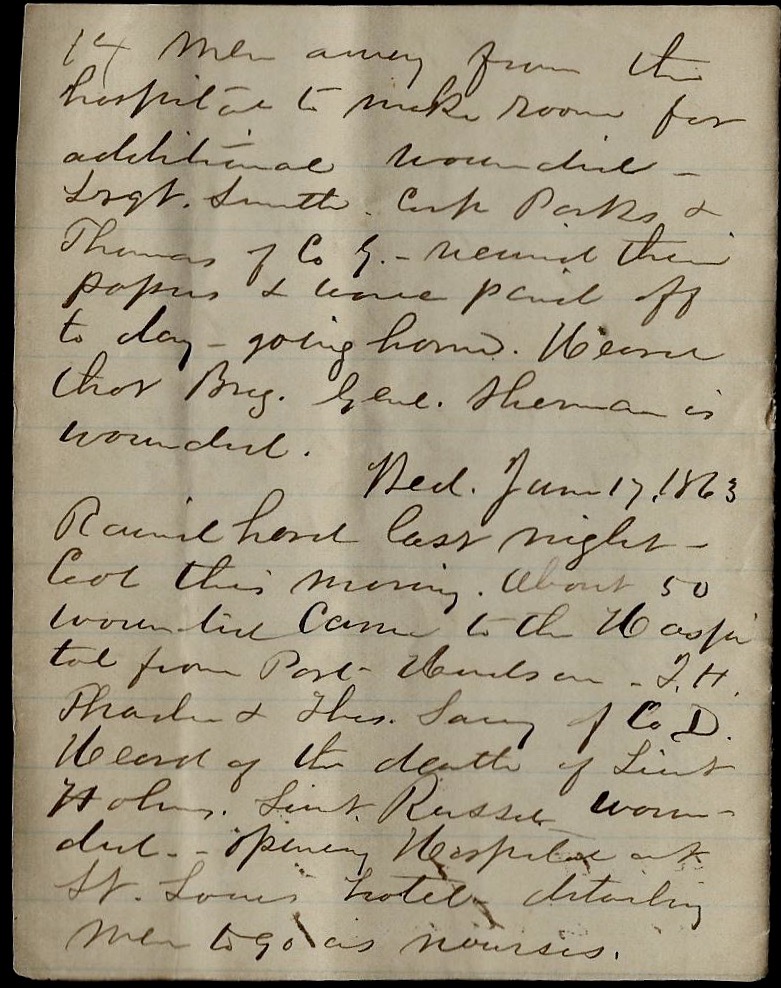
Tuesday, June 16th 1863—Cool this morning. Exciting news from Port Hudson. Few particulars. Sent letter No. 15 home. Rained hard in the eve. Some thunder and lightning. Exciting rumors from Port Hudson. 4th Wisconsin Infantry entirely used up. Talking about sending men away from the hospital to make room for additional wounded. Sergt. [Joseph] Smith, Corp. Parks, & [George W.] Thomas of Co. G received their papers & leave, paid off today & going home. Heard that Brig. General Sherman is wounded.
Wed., June 17th 1863—Rained hard last night. Cool this morning. About 50 wounded came to the hospital from Port Hudson [including] Israel H. Thrasher & Thomas Savery of Co. D. Heard of the death of Lieut. Holmes, Lieut. [George B.] Russell wounded. Opening hospital at St. Louis Hotel. Detailing men to go as nurses.
University Hospital, June 18th 1863—Clear, hot day. About 60 wounded from Port Hudson came to hospital yesterday and today. Thirty or more discharged men left in Matensas for the North, among them [George W.] Thomas of Co. G, and Sergt. [Joseph] Smith of the 38th Mass. Several men left to go as nurses at the St. Louis Hospital. Doctor did not come round today. Reinforcements from Key West, 26th and 47th Mass, went up the river to Port Hudson. Papers contain nothing of movements, successes or reverses in this department. All the information to be had is derived from wounded men whose stories differ so much that but little can be relied on them. Weitzel had has got within fortification at Port Hudson & holds his position.
Friday, June 19th, 1863—Hot day, Several men detailed for St, Louis Hospital. Sent for in the morning by Dr. Conner. Wished me to send down my cord [?] which I did. [George W.] Belcher & [John] Peters were also sent for by the Doctor.
Saturday, June 20th 1863—Sent letter No. 16. Received letter from home [dated] May 24th. Rumors of the Rebs burning 4 or 5 steamers on the Bayou Plaquemine. Heard firing Thursday night up the river. Boats going up the river take on board guns and protect themselves with plating around the pilot house.
I could not find an image of West, but here’s a cdv of Capt. James A. McCampbell who also served in the 20th Kentucky Infantry
This letter was written by 26 year-old Charles R. West of Nicholasville, Kentucky, who enlisted as a sergeant in Co. K, 20th Kentucky Infantry in October 1861 at Lexington. He was appointed 1st Sergeant in the spring of 1862 and then commissioned a 1st Lieutenant in October 1862—his commission received directly by the Governor of Kentucky. He received extra pay in the spring of 1863 for commanding the company in the absence of the captain, and then was finally named the captain of Co. K with his commission back-dated to 7 February 1863. He served in that capacity and was with the regiment until mustering out at war’s end in 1865
Charles’ parents were Wilson Hunt West (1812-1877) and Stella Elizabeth Overstreet (1815-1889) of Nicholasville, Jessamine county, Kentucky.
[Transcribed by Stacy Cookenour; researched & edited by Griff.]
Transcription
Lebanon, Kentucky May 26, 1863
Mr. James Overstreet Dear Sir,
Your letter of the 16th came to hand today. I was glad to hear from you and to hear that all of my friends are all well. I regret to hear that Uncle James is dead but I hope that when we are called to go, that we may be as well prepared as he was. You wish to know if I have received my mess chest. I have, and am well pleased with it. There is nothing worth writing about at this time for you see the papers and they keep you posted as to what the army is doing. The news from Vicksburg is good for Grant has whipped the rebels badly.
What do you think of the administration raising Negroes to fight? I will give you my view on the subject. The administration will raise the Negro regiments and try them. They will soon find out that the Negro will not fight then they will muster them out of the service and carry on the war on conservative principles. Then we will soon whip the South.
You wrote that you had some papers for General Carter to sign. The General is out front at this time on the Cumberland River. If you will send the papers to me, I will send them to Gen. Carter and have him to sign them. Then I will return them to you. Do you think that would be safe way to do? You can direct them—that is, if you send them, [to] Capt. C. R. West, Co K, 20th Kentucky Vol. Infantry, Lebanon, Kentucky. I will forward them to Carter and when he signs them, return the papers to you.
I would like to spend a week with you this summer very much but will have to forego that pleasure but if I shall come home, will visit you. I will ask you to write to me. I will take pleasure in answering your letters. It is late so I will close. Give my love to all my friends and remember me kindly. Have the kindness to excuse the many mistakes in this.






















 Spared & Shared 23