Category Archives: Buchanan Administration

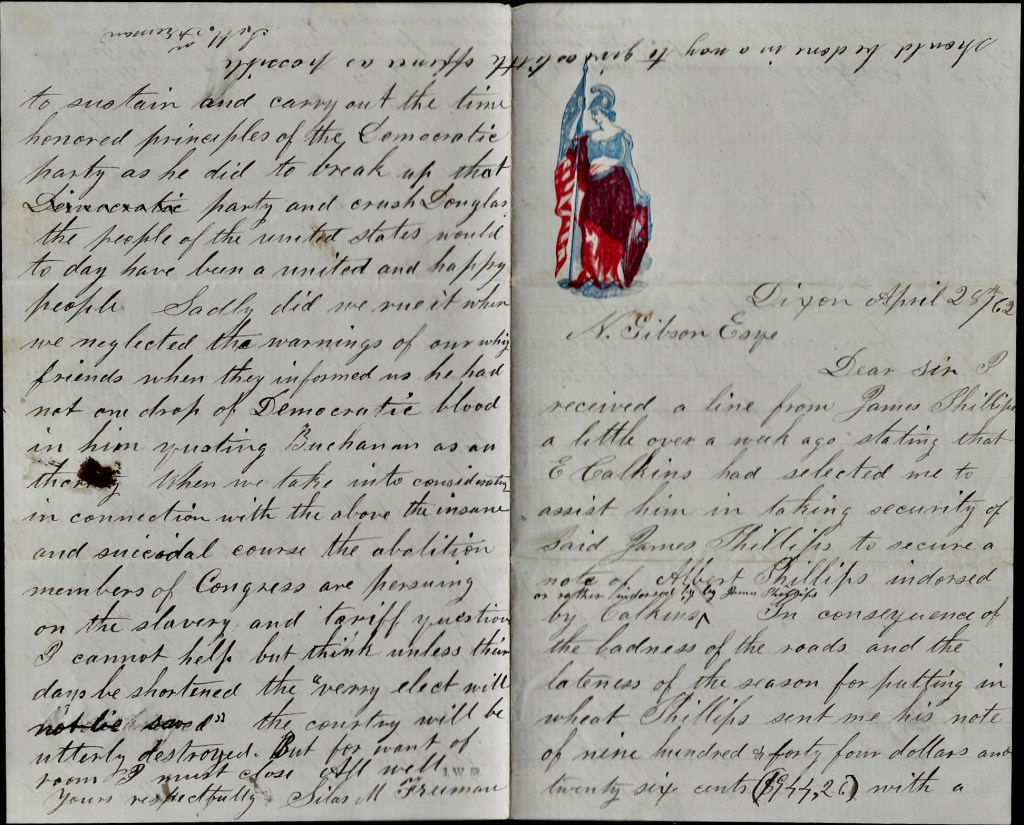
1862: Silas Martin Freeman to N. Gibson

The following letter was written by Silas Martin Freeman (1816-1899), the son of James Freeman (1778-1869) and Lois M. Martin (1782-1866) of Berkshire county, Massachusetts. Silas was married in 1840 to Maryette Dowd (1821-1852) but he was a widower when he penned this letter from Dixon, Illinois, in 1862. He was married a second time in May, 1864 to Mary Hollister Cook, the widow of Orrin C. Cook. Silas began his occupational career as a cooper in the Berkshire mountains of Western, Massachusetts. In the 1850s he relocated to Dixon where he took up farming. By 1870, he had relocated to Rockford and labored as a carpenter. By 1880, he was farming again in Palmyra, Otoe county, Nebraska, where he and his 2nd wife lived out the remainder of their lives.

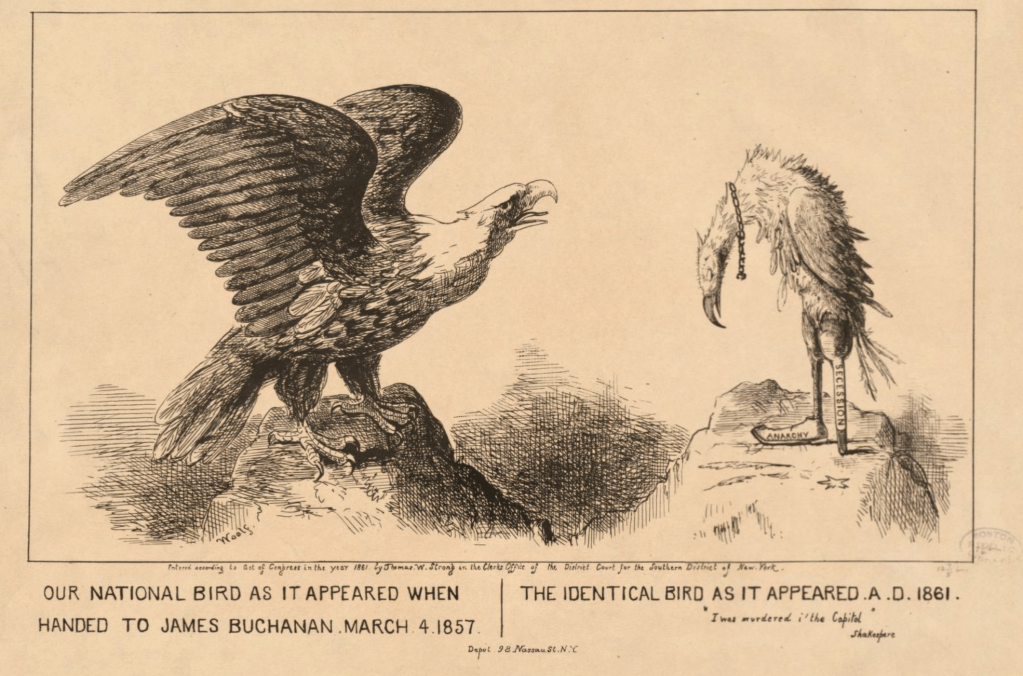
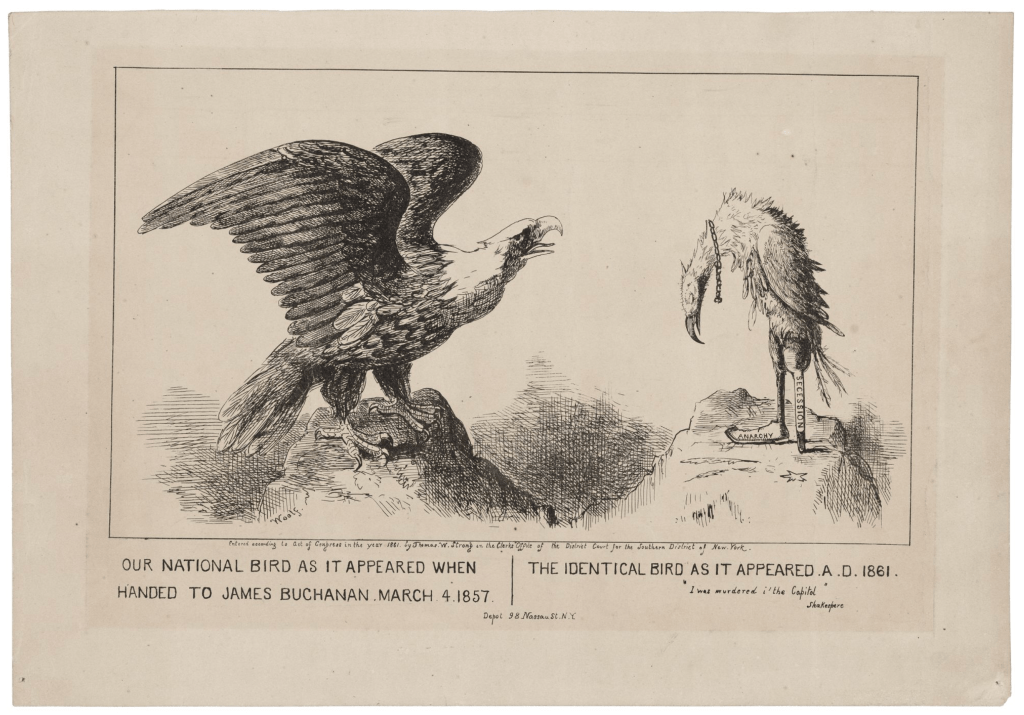
The first paragraph pertains to a business matter that would be of little interest to most readers but the second paragraph is a vilification of the Buchanan Administration—placing blame squarely on James Buchanan for the “deplorable condition” of the county as depicted in the following political cartoon.
Transcription

Dixon [Illinois]
April 28, 1862

N. Gibson, Esq.,

Dear sir. I received a line from James Phillips a little over a week ago stating that E. Calkins had selected me to assist him in taking security of said James Phillips to secure a note of Albert Phillips endorsed by Calkins, or rather endorsed by James Phillips. In consequence of the badness of he roads and the lateness of the season for putting in wheat, Phillips sent me his note of nine hundred & forty-four dollars and twenty-six cents (944.26) with a mortgage on two eighties or one hundred and sixty acres as security for the note a few days ago. I have waited to hear from Calkins or you but have received no letter. Before I make any move on this business, I would like to be better informed how matters stand, how much there is due on the notes, or up to what date the interest has been paid so as to spend no more time than is actually necessary. Perhaps if I should see Phillips, I might get all the information that was necessary. But it is some sixteen miles from home to Phillips and I would rather not make but one trip out to do the business. I have a good deal of confidence in James Phillips and think probably his note and mortgage is all right but as his land borders on the Winnebago Swamp and part of his farm is rather low land, it would be better to see the pieces he offers as security before accepting them. Please see Calkins and if he wishes me to do anything for him, let me know immediately.

In your letters of November last, you wrote of the distracted state of our country and the causes which brought the country to its present deplorable condition, but you failed to mention one cause which in my mind stands first in the damnable black catalogue. When the Chief Magistrate of this Nation comes down from the high station of his office to become a dabster in party politics thereby neglecting his duties he had sworn faithfully to perform to gratify a little private revenge, then may we well tremble for our country. Had Buchanan labored one half as hard to sustain and carry out the time honored principles of the Democratic party as he did to break up that party and crush Douglass, the people of the United States would today have been a united and happy people. Sadly did we rue it when we neglected the warnings of our Whig friends when they informed us he had not one drop of Democratic blood in him quoting Buchanan as authority. When we take into consideration in connection with the above the insane and suicidal course the abolition members of Congress are pursuing on the slavery and tariff question, I cannot help but think unless their days be shortened, the “very elect will not be saved”—the country will be utterly destroyed. But for want of room, I must close, All well. Yours respectfully, — Silas M. Freeman

Phillips writes to me, “I have no security from Albert and think that Mr. Calkins is slightly selfish in requiring of me ample security. If he was in no way connected with Albert, it would be quite a different affair” hence I think the business should be done in a way to give as little offense as possible. — S. M. Freeman
1861: Levi Clark to Charles M. Heaton

This letter was written by Levi Clark (1799-1862) of Newark, New Jersey, who was married to Eliza Crane (1801-1834). Levi wrote the letter to his brother-in-law, Charles M. Heaton (1805-1899), of South Bend, Indiana. Charles was married in 1833 to Ann Crane (1810-1899), a milliner. In politics, Charles threw his support behind fellow South Bend editor, journalist, and politician Schuyler Colfax who rewarded him with a good position in the government land office at Washington in 1860 where he remained for the next twenty years.

Due to his friendship with Colfax and his appointment to the Land Office in Washington D. C., Levi requests a letter of introduction from Charles to enable him to meet with Colfax, attempt to resolve his land title issues in Kansas, and hopefully also land himself an appointment in and Land Office in Kansas or with the Indian Bureau under the new Lincoln Administration. City directories suggest that Levi remained in Newark until his death in January 1862, less than a year after this letter was written.

Though it was no doubt painful to Levi, his tirade against the corruption of the former Buchanan Administration is almost comical to read. The letter was written on 4 March 1861—the very day of Lincoln’s inauguration and day Levi hoped Lincoln would begin to “turn out to the last one the most corrupt set of unmitigated scoundrels there is in this or any other country ever produced.”

“The iconic national bird, representing the Union, is strong and healthy at the beginning of Democrat James Buchanan’s administration, but by the time Republican Abraham Lincoln assumed the Presidency, it is gaunt and emaciated reflecting the secession of 11 southern states from the Union. This political cartoon highlights the rising tensions over states’ rights during the antebellum period and the ultimate dissolution of the Union in 1861. The fact that Buchanan’s administration was riddled with corruption and charges of bribery and graft, only worsened the toll that years fighting over slavery and states’ rights had taken on the nation’s vitality.”
Artist: M. A. Woolf

Transcription

Newark, Essex County, New Jersey
March 4, 1861

Dear Sir,

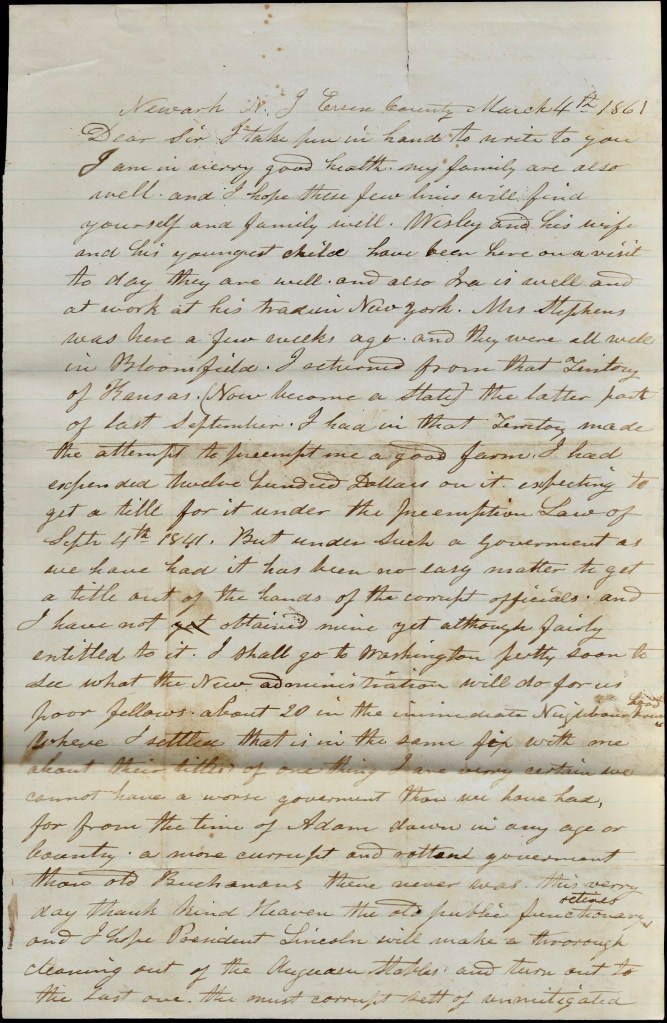
I take pen in hand to write to you. I am in very good health. My family are also well and I hope these few lines will find yourself and family well. [My son] Wesley and his wife and his youngest child have been here on a visit today. They are well and also [my son] Ira is well and at work at his trade in New York. Mrs. Stephens was here a few weeks ago and they were all well at Bloomfield.

I returned from that Territory of Kansas (now become a State) the latter part of last September. I had in that Territory made an attempt to preempt me a good farm. I had expended twelve hundred dollars on it expecting to get a title for it under the Preemption Law of September 4th 1841. But under such a government as we have had, it has been no easy matter to get a title out of the hands of the corrupt officials and I have not obtained mine yet although fairly entitled to it.

I shall go to Washington pretty soon to see what the new [Lincoln] Administration will do for us poor fellows—about twenty in the immediate neighborhood where I settled that is in the same fix with me about their titles. Of one thing I am very certain, we cannot have a worse government than we have had for from the time of Adam down in any age or country, a more corrupt and rotten government than Old Buchanan’s there never was. This very day, thank kind Heaven, the old public functionaries actives and I hope President Lincoln will make a thorough cleaning out of the Augean Stable and turn out to the last one the most corrupt set of unmitigated scoundrels there is in this or any other country ever produced.

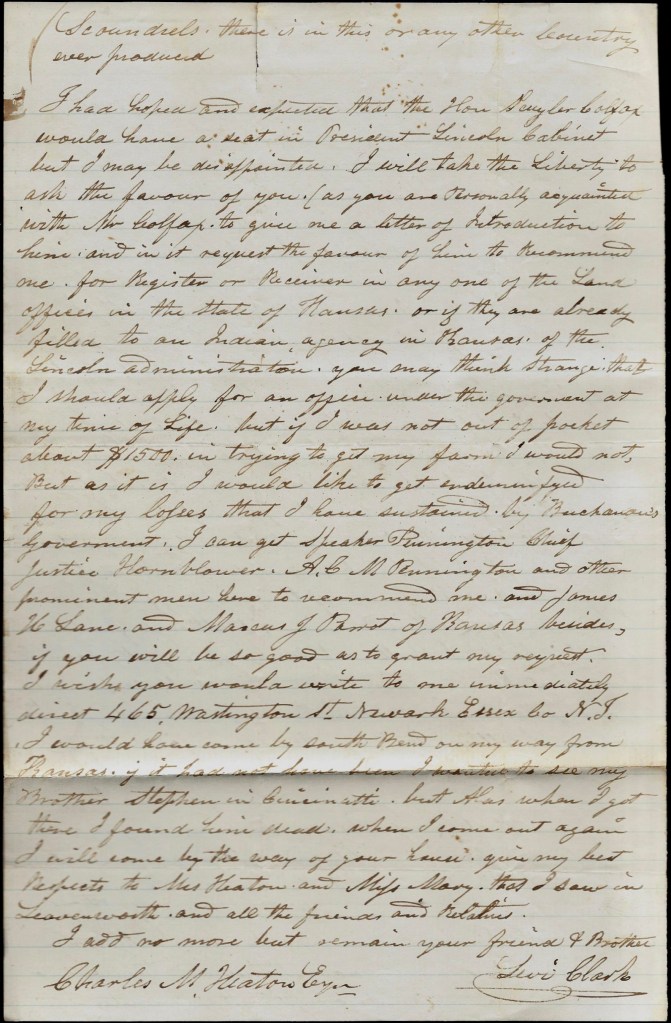
I had hoped and expected that the Hon. Schuyler Colfax would have a seat in President Lincoln’s Cabinet but I may be disappointed. I will take the liberty to ask the favor of you (as you are personally acquainted with Mr. Colfax) to give me a letter of introduction to him and in it request the favor of him to recommend me for Register or Receiver in anyone of the Land Offices in the State of Kansas, or if they are already filled, to an Indian Agency in Kansas of the Lincoln Administration. You may think strange that I should apply for an office under the government at my time of life, but if I was not out of pocket about $1500 in try to get my farm, I would not. But as it is, I would like to get indemnified for my losses that I have sustained by Buchanan’s government. I can get Speaker Pennington, Chief Justice Hornblower, A. C. M. Pennington and other prominent men here to recommend me and James H. Lane and Marcus J. Parrot of Kansas besides, if you will be so good as to grant my request.

I wish you would write to me immediately. Direct to 465 Washington Street, Newark, Essex County, New Jersey. I would have come by South Bend on my way home to see my brother Stephen in Cincinnati, but alas! when I got there I found him dead. When I come out again, I will come by the way of your house. Give my best respects to Mrs. Heaton and Miss Mary that I saw in Leavenworth, and all the friends and relatives.

I add no more but remain your friend & brother, — Levi Clark

to Charles M. Heaton