
The following letter was written by Henry C. Hartman (1830-1884), the son of John Henry Hartman (1798-1877) and Catherine Maria Benedum (1798-1866) of Findlay, Hancock county, Ohio. Henry wrote the letter to his sister Delilah Hartman (1835-1919). From municipal records we learn that Henry was married in March 1853 to Philabena Shyer (1833-1885) in Hancock county, Ohio, and the couple had one daughter named Lorie S. Hartman, born in 1859.
In the 1860 US Census the Hartmans were enumerated in Deepwater, Henry county, Missouri, where Henry was employed as a store clerk. We learn from the letter that Henry’s brother, Samuel Hartman (1832-1924) was living in the same vicinity as Henry with his family too. In the 1870 US Census, Henry’s family was enumerated in Des Moines, Iowa where he supported his family as a “country merchant.” In 1880, he and Philabena were farming in Sheldahl, Story county, Iowa. Henry and his wife are buried in Madrid, Boone county, Iowa.
This letter is significant as it alludes to the destruction of the town of Osceola, Missouri, where Henry had settled his family in 1861. When Henry moved his family to Osceola, he must have imagined that he had located himself in a town with great promise for growth, sited as it was on the Osage river. But there were a significant number of secessionists who lived in the town and who were beginning to make life miserable for those who did not share their views. Believing the town to be populated entirely with secessionists, James S. Lane led his Jayhawkers into the town on a Sunday in September 1861 and left Osceola in “a heap of smoldering ruins. Well over two thousand people were left homeless and perhaps the fairest city in Missouri had been utterly wiped from the face of the earth.” Lane’s army “left Osceola with all their plunder and headed for Kansas, leaving old age, and helpless innocents to keep vigil over the dead and wounded, and life blood and tears marked the spot which only a few short hours before had been peaceful, contented, happy homes.”
From Henry’s letter we learn that it was not just the secessionists who suffered, but Union supporters like the Hartman’s as well who left the state entirely. “Lane was severely criticized for his actions in Osceola, most severely by General Henry Halleck, Commander of the Department of Missouri, who believed that the attacks made by Lane and Colonel Charles Jennison aggravated anti-Union sentiments in Missouri and intensified resistance to federal authority in the state. Of their actions, he would state: “The course pursued by those under Lane and Jennison has turned against us many thousands who were formerly Union men. A few more such raids will make this State unanimous against us.” [Legends of America]

Transcription

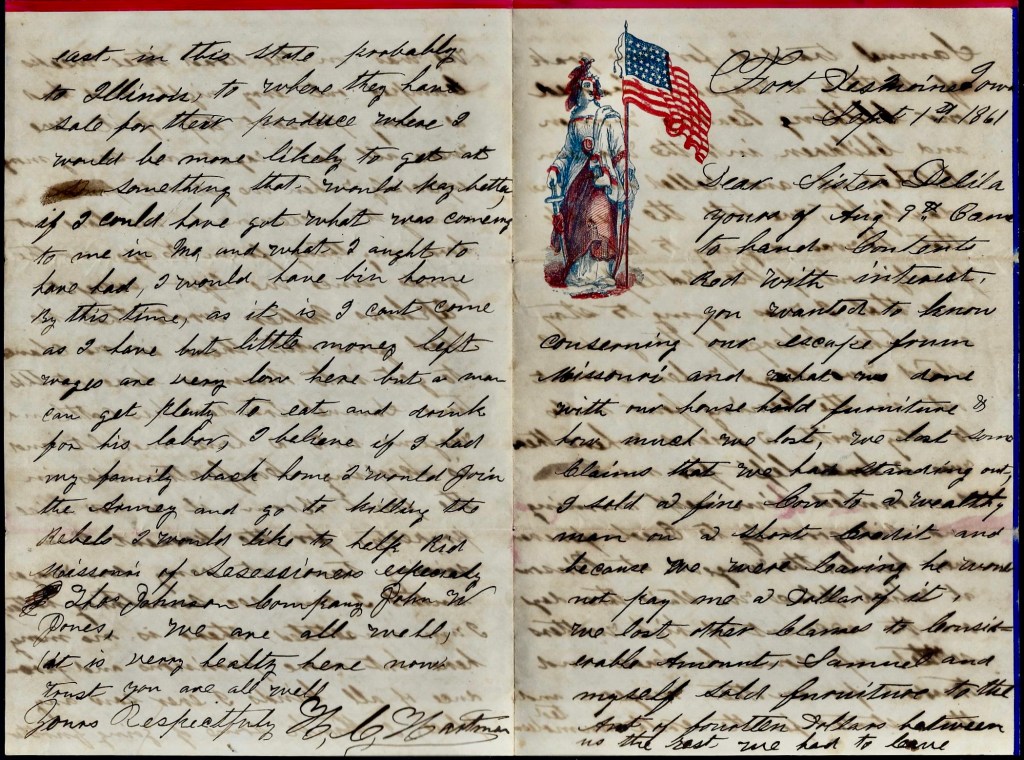
Fort Des Moines, Iowa
September 1st 1861
Dear Sister Delila,
Yours of August 9th came to hand—contents read with interest. You wanted to know concerning our escape from Missouri and what was dine with our household furniture & how much we lost. We lost some claims that we had standing out; I sold a fine cow to a wealthy man on a short credit, and because we were leaving he would not pay me a dollar of it. We lost other claims to considerable amount. Samuel and myself sold furniture to the amount of fourteen dollars between us. The rest we had to leave.
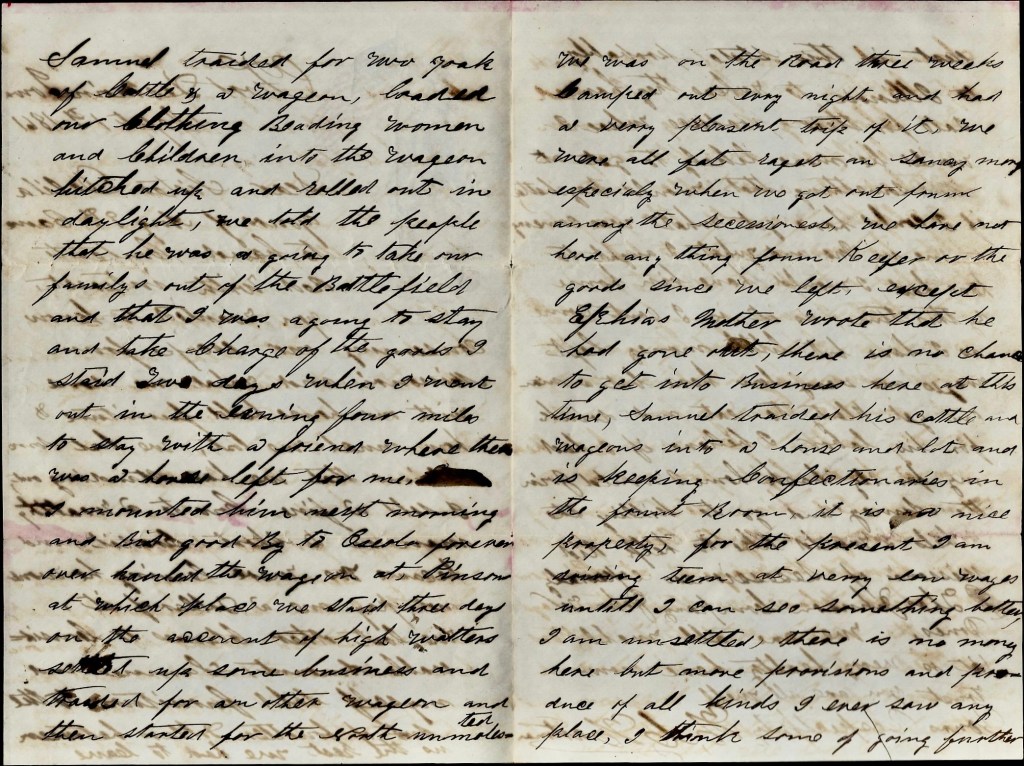
Samuel traded for two yoke of cattle and a wagon, loaded our clothing, bedding, women and children into the wagon, hitched up, and rolled out in daylight. We told the people that he was a going to take our families out of the battlefield and that I was a going to stay and take charge of the goods. I stayed two days when I went out in the evening four miles to stay with two friends where there was a horse left for me. I mounted him next morning and bid goodbye to Osceola forever, overhauled the wagon at Pinson’s at which place we stayed three days on the account of high waters, settled up some business and traded for another wagon and then started for the North unmolested.
We was on the road three weeks, camped out every night, and had a very pleasant trip of it. We were all fat, ragged, and sassy—more especially when we got out from among the secessionists. We have not heard anything from Keifer or the goods since we left except Ezekias’s mother wrote that he had gone out. There is no chance to get into business here at this time. Samuel traded his cattle and wagon into a house and lot and is keeping confectionaries in the front room. It is a nice property for the present. I am driving team at very low wages until I can see something better.
I am unsettled. There is no money here but more provisions and produce of all kinds I ever saw any place. I think some of going further east in the state—probably to Illinois to where they have sale for their produce where I would be more likely to get at something that would pay better. If I could have got what was coming to me in Missouri and what I ought to have had, I would have been home by this time. As it is, I can’t come as I have but little money left. Wages are very low here but a man can get plenty to eat and drink for his labor. I believe if I had my family back home I would join the army and go to killing the Rebels. I would like to help rid Missouri of secessionists—especially Thomas Johnson’s Company, John W. Jones.
We are all well. It is very healthy here now. Trust you are all well. Yours respectfully, — H. C. Hartman
Delila, I think before I write again I will get a new pen. I will give the prices—-corn 15 cents per bushel, wheat 30, potatoes 30, flour 100 to 1.59 hundred, bacon 5 to 9 cents per pound, butter 10, eggs 4 to 5 per dozen, green apples 75 to 100 and have been as high as 200 per bushel, wild plums 30 cents per bushel. I paid 10 cents for 3 common peaches last week.
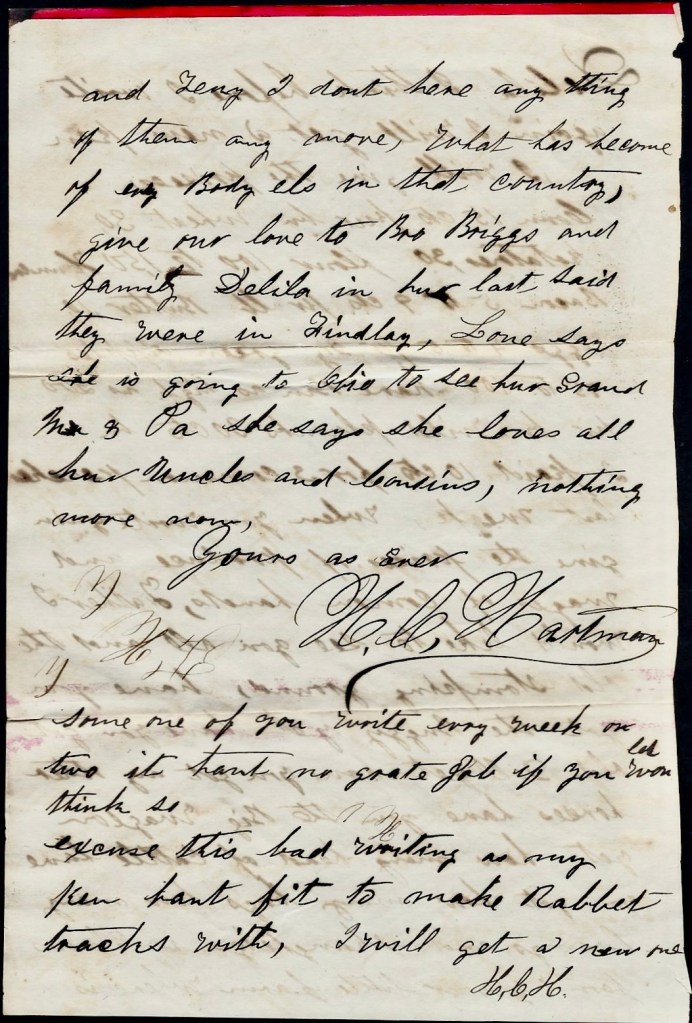
When you write again, give the prices of produce and wages of common hands. Father, I would like to see you all and the old stomping grounds. Have you got the buggy yet? Have you got Old Doll yet? Have you got any other horses? Have you the big wagon yet? How many head of cattle have you got? How many hogs? How many Bramys and Shanghigh’s? Is Elmer farming your little farm? Where is [ ] and Teny? I don’t hear anything of them anymore. What has become of anybody else in that country?
Give our love to Brother Briggs and family. Delila in her last said they were in Findlay. Lorie says she is going to Ohio to see her Grandma & Pa. She says she loves all her uncles and cousins. Nothing more now.
Yours as ever, — H. C. Hartman
Some of you write every week or two. It ain’t no great job if you would think so, Excuse this bad writing as my pen hain’t fit to make rabbit tracks with. I will get a new one. — H. C. H.

 Spared & Shared 23