
These letters were written by Western Berkley Thomas, Jr. (1835-1863), the son of Western Berkley Thomas (1799-1836) and Emmeline Few Thomas (1807-1882) of Augusta, Richmond county, Georgia. In 1859 and 1860 he is enumerated among the students at Cambridge in the Harvard Law School. In the 1860 US Census, he is identified as a lawyer working in Augusta.
Western served the Confederacy as 1st Lieutenant in Co. K (“Davis Musketeers”), 10th Georgia Regiment. He enlisted at Richmond, Virginia, on July 7, 1861. In March 1862, Co. K of the 10th Regiment was transferred into artillery. Three months later, Lt. Thomas was suffering so severely from the “stricture of urethra & unstable condition of the bladder” that surgeons judged him unfit for duty. On June 6th, 1862, Western submitted his resignation from the service to Hon. George W. Randolph, Secretary of War. Western died on 14 February 1863 at Chickamauga, Walker county, Georgia.
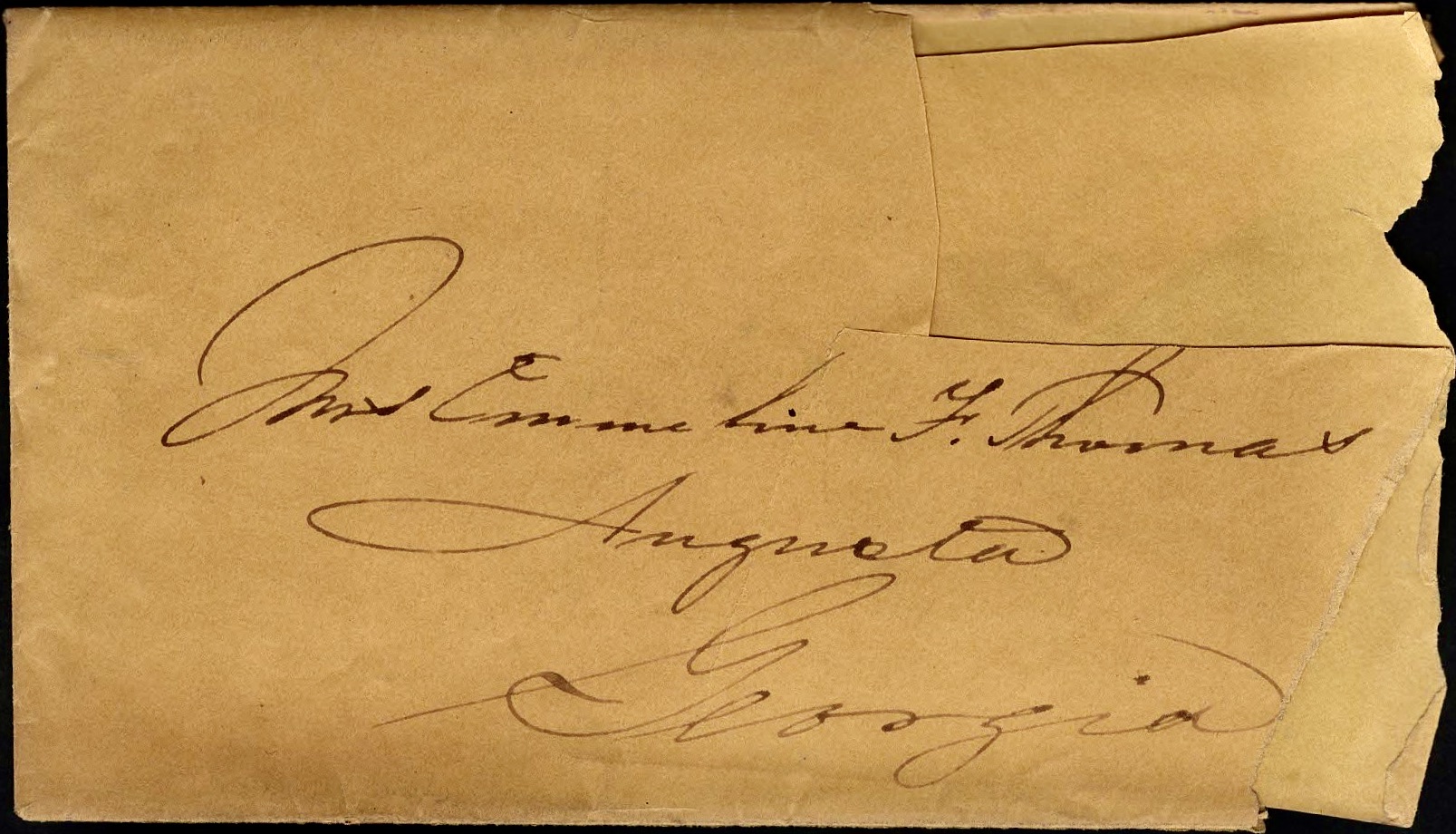
Western wrote these letters early in 1862 while the Davis Musketeers were manning a battery at Pig Point in Suffolk county near the mouth of the Nansemond river overlooking Hampton Roads.

Letter 1
Pig Point 1
January 13, 1862
Dear Mother,
I should have answered your letter long ago but the chills have had me again. I cannot write on my chill day and the intervening day I feel worn out and weary. I hope by the use of quinine to escape tomorrow. It is certainly strange that we should be afflicted with the disease at this season of the year but I suppose it is the same attack I had before as it has been about twenty days since my last. I will watch this time and take quinine as you directed at each period but. so long as we have nothing worse, I shall be satisfied for we have been very fortunate. Other corps are suffering around us with typhoid fever, pneumonia, and other fatal diseases while we have not yet lost a man. I believe I am the only man in the company who has chills now. 2
The box arrived about three days since and we eat one side of the breast of the turkey before it advanced too far. The ham was fine but it is all gone as we are great ham eaters here. The men will be very thankful for the comforters. I have not yet given them out as it is very warm and I will wait till I get the others which are in my other box with the overcoat at the express Office in Norfolk.
I have nothing to write you about as it is very stupid here. We have been watching for the Burnside Expedition here for a long time but it has not come and from the changes in the fleet off Fortress Monroe, I think it has gone further south. If this is so, we shall soon hear of it. As I write, I hear very heavy guns up the James river for which I cannot account as it is too rough for practice—probably some little skirmish.
I see no prospect of peace at present and no hope of anything but Pig Point and chills until the war closes. Has Aunty heard anything from sister or from Kentucky? I fear poor Aunt Luesa’s nerves will be sadly shocked by the presence of the Federal and Confederate forces in the blue grass country. I feel very sorry for the people of Kentucky. It is bad enough. to have a friendly army in the country but it must be very sad to have two hostile forces and the people divided too.
I said we had no sick in the company but while I write, William D’Antonac has been attacked by his chill and is now shaking the whole house and we have four men with chills.
I hope I shall hear from you soon. We have three men at home now on leave of absence. I told them to go to the house thinking you might like to hear something of how we get on. There is nothing I want now so you can send me nothing. I wish you would find my bank book in the drawer of the wardrobe (I think) and send it to the bank to be balanced. If you cannot find it, you can find out at the bank how much I have there and let me know too how much interest is now due me on my bonds as I may take that money with what I have here and buy Confederate bonds. They are as good as anything else now and will be better after the war. Write soon. Affectionately, — your son.
January 15th 1862
I succeeded in breaking the chill yesterday and hope to avoid them in future. your letter came last night and I will send you the money to invest if you think the State Bonds are better than Confederate. The latter are free you know from the war tax which is half percent and unless the State Bonds are free from state tax (in which case they are better), they are worth less than Confederates since the former will bring only 7.5 percent after deducting the war tax while the latter which are not subject to it are at 8 percent. I shall not be able to send you more than $800 from here as I can not collect all that is owing me and as I shall need something to live on till next payday which will be March 1st. I think there are, however, coupons enough due on my bonds to make up the sum of $1000. If not, let me know how much I have in deposit at the bank and I will send you a check.
That old German told a falsehood. He has made nearly $70 out of the Confederacy with his clothes adn food six months and has done only one or two days duty since he was enlisted. He is mad because we would not let him swindle the government out of commutation money for clothing. You have doubtless by this time seen three or one of the two men now at home on leave and you will find no better clothed troops in the service. You can send the dog by one of these. John Rodle whom I told to go and see you is the safest to send him by unless you see Booker. But whomever you give him to, tell the others if you see them. If none of them come to the house, Dr. Steiner (to whom remember me the most sincerely) can tell you where John Rodle, formerly Marcellus Hammond’s cook, lives. Send the dog to Bowen (gunsmith) and tell him to fit it a nice collar on him with the enclosed information on the plate and send the key with the dog. Pay for the collar or tell. Bowen to charge it to me. I will pay when we meet. I am sorry my dear Mother to give you so much trouble. Adieu. Your affectionate son, — W. B. T.
1 When secessionists seized the Gosport Navy Yard, they obtained more than 1200 heavy guns and 300,000 pounds of gunpowder at Fortress Norfolk. Several of these large guns were deployed at Pig Point. The shoreline was indeed formidable but Confederates had to withdraw from these fortifications to defend Richmond when McClellan threatened in the spring of 1862.
2 Thomas was obviously suffering from malaria based not only only symptoms but his treatment with quinine. It was often refered to a Ague or “the shakes” because of paroxysmal attacks.


Letter 2

Pig Point
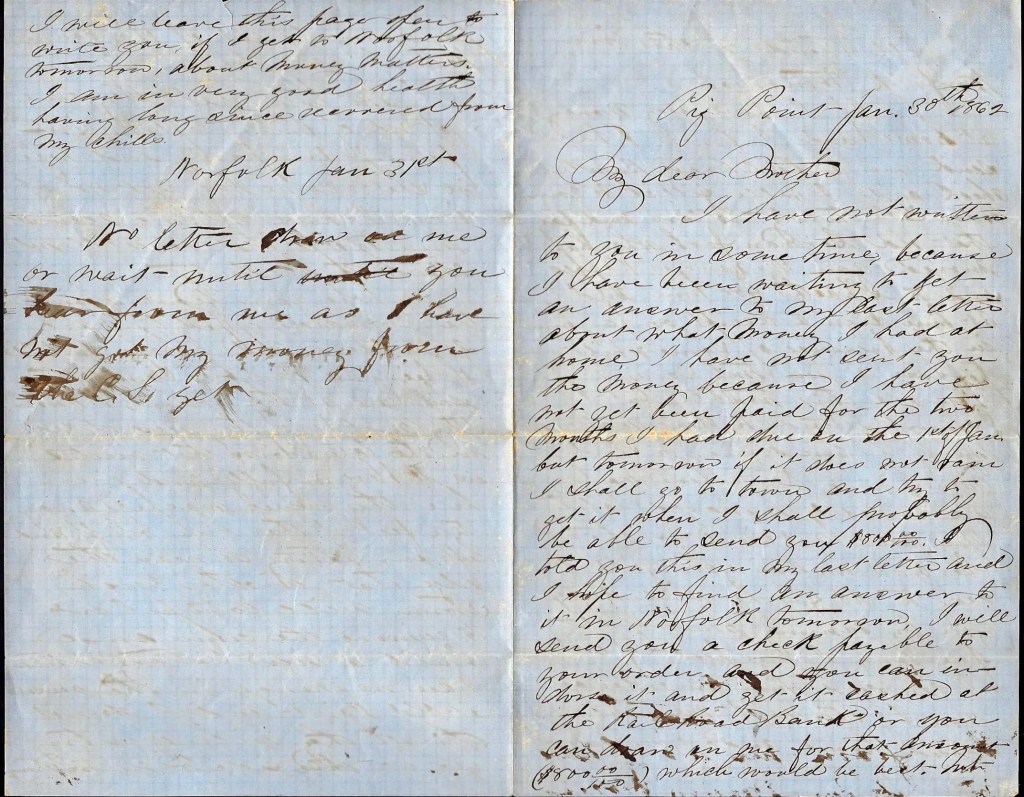
January 30th 1862
My Dear Mother,
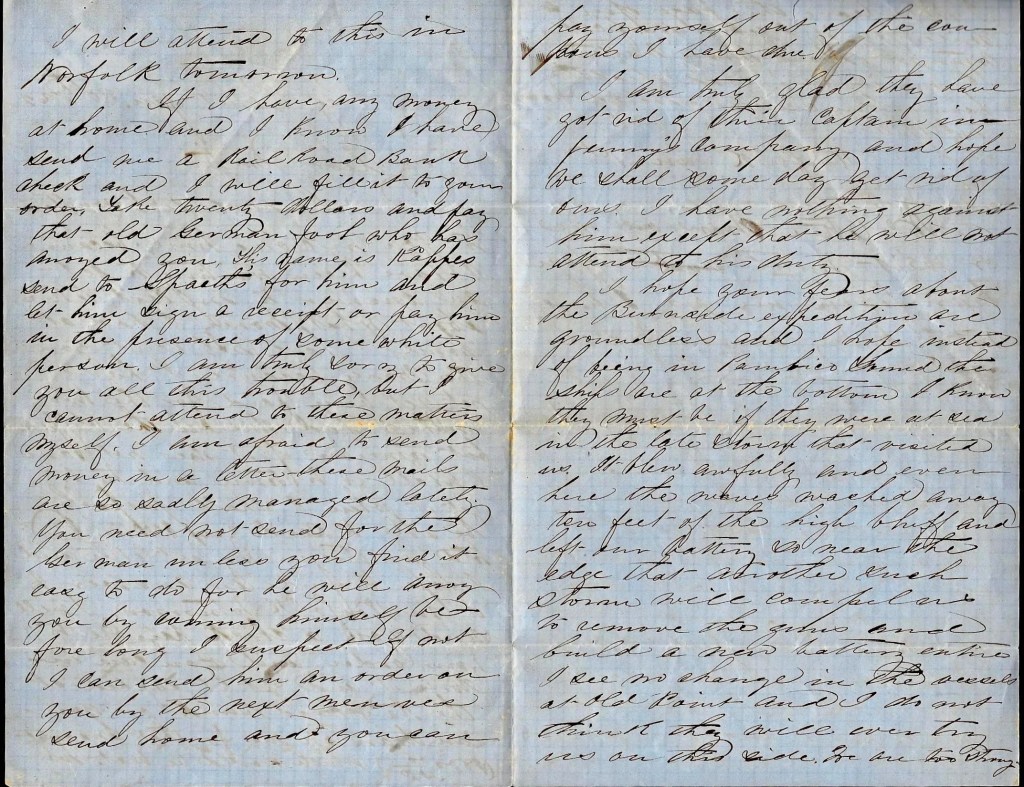
I have not written to you in some time because I have been waiting to get an answer to my last letter about what money I had at home. I have not sent you the money because I have not yet been paid for the two months I had due me on the 1st of January. But tomorrow, if it does not rain, I shall go to town and try to get it when I shall probably be able to send you $800.00. I told you this in my last letter and I hope to find an answer to it in Norfolk tomorrow. I will send you a check payable to your order and you can endorse it and get it cashed at the Railroad Bank or you can draw on me for that amount ($800) which would be best. I will attend to this in Norfolk tomorrow.
If I have any money at home and I know I have, send me a Railroad Bank check and I will fill it to your order. Take twenty dollars and pay that old German fool who has annoyed you. His name is Rappes. Send to Spaeth’s 1 for him and let him sign a receipt or pay him in the presence of some white person. I am truly sorry to give you all this trouble but I cannot attend to these matters myself. I am afraid to send money in a letter. These mails are so sadly managed lately. You need not send for the German unless you find it easy to do for he will annoy you by coming himself before long I suspect. If not, I can send him an order on you by the next man we send home and you can pay yourself out of th coupons I have due.
I am truly glad they have got rid of their captain in Jimmy’s Company and hope we shall some day get rid of ours [Theodore C. Cone]. I have nothing against him except that he will not attend to his duty.
I hope your fears about the Burnside Expedition are groundless and I hope instead of being in Pamlico Sound, the ships are at the bottom. I know they must be if they were at sea in the late storm that visited us. It blew awfully and even here the waves washed away ten feet of the high bluff and left our battery so near the edge that another such storm will compel us to remove the guns and build a new battery entire[ly]. I see no change in the vessels at Old Point and I do not think they will ever try us on this side. We are too strong.
I will leave this page open to write you if I get to Norfolk tomorrow, about money matters. I am in very good health having long since recovered from my chills.
Norfolk, January 31st
No letter for me or visit until you hear from me as I have not got my money from the C[onfederate] S[tates] yet.
1 Charles Spaeth (b. 1829 in Germany) kept a grocery in Augusta.
Letter 3
Pig Point [on Nansemond River opposite Newport News, Va.]
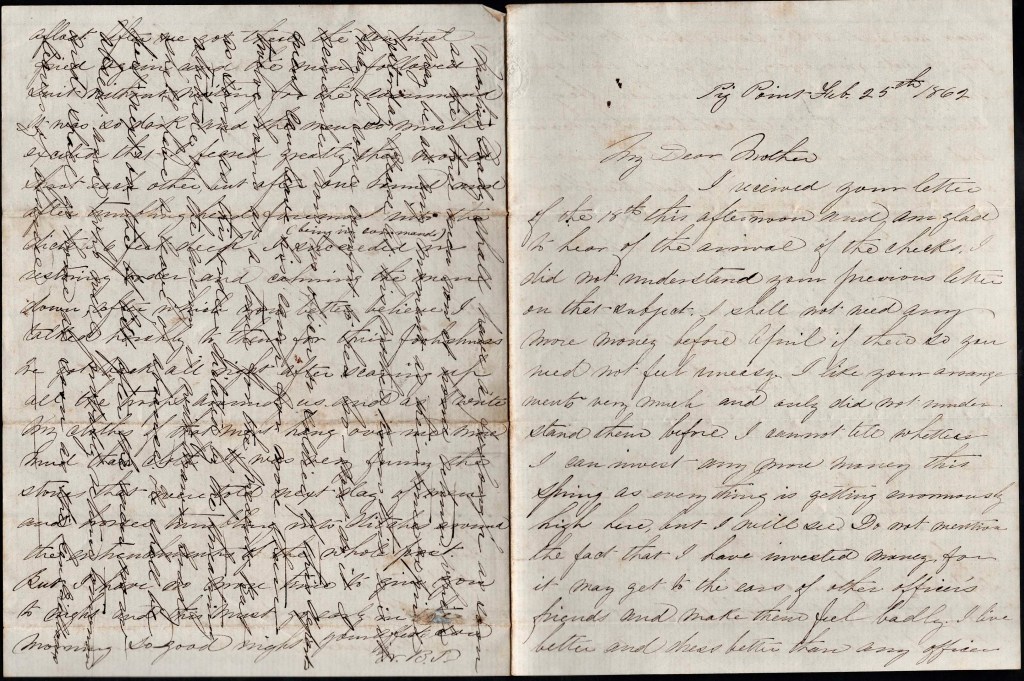
February 25th 1862
My dear Mother,
I received your letter of the 18th this afternoon and am glad to hear of the arrival of the checks. I did not understand your previous letter on that subject. I shall not need any more money before April, if then, so you need not feel uneasy. I like your arrangements very much and only did not understand them before. I cannot tell whether I can invest any more money this spring as everything is getting enormously high here but I will see. Do not mention the fact that I have invested money for it may get to the ears of the officer’s friends and make them feel badly. I live better and Mess better than any officer near me, and at the same time do what they do not=give away. And yet I live on my pay and owe no debts which they cannot say. This is the solution. Bar rooms and gambling houses or parties never see my face or my money. Both the officers of this company owe me money and this is what induced me to invest when I had the money. It was hard to refuse, and as long as I had it, I was a dependence. What matter how much was lost or wasted, there was Thomas always to fall back on.
So when I came from home in November having $400 in my pocket, I put it in the Bank of Norfolk, came to camp, and gave it out that I wished to raise a thousand dollars by January 1st and how much do you think I got after relying on promise that I should have the whole—sixty dollars from one party and nothing from the other. I did this because I saw these debts were increasing and would never be paid if allowed to become large. I have men owing me $98 from one party and $60 from the other. This last is Cane’s debt who let me say, for he needs a good word on that score, has always been strictly honorable in his dealings with me; borrowing but seldom and never disappointing me when I have needed pay. But enough. We can talk these things over when we meet,
The enemy have made no new demonstrations in this quarter lately and that is about the only subject of interest here at present. A few night since we had a grand alarm. The sentinel on our battery fired at what he supposed to be a man approaching the magazine who would not halt at his challenge and so into the battery we went. It was the darkest night I ever saw—foggy too, and raining. The battery was like a fish pond all afloat. After we got there the sentinel fired again and the men followed suit without waiting for the command. It was so dark and the men so much excite that I feared greatly they would shoot each other, but after one round and after tumbling head forward into the ditch 6 feet deep, I (being in command) succeeded in restoring order and calming the men down, after which you better believe I talked harshly to them for this foolishness.
We got back all right after scaring up all the troops around us and as I write, my clothes of that night hang over me more mud than cloth. It was very funny the stories that were told next day of men and horses tumbling into ditches around the entrenchments of the whole post. But I have no more time to give you tonight and this must go early in the morning so good night. Your affectionate son, — W. B. T.
Martin Grady shall have a furlough as soon as the three men now at home return which may be at any moment as their time expired yesterday. Please let his mother know this as it may be some comfort to her. No, don’t do it. I remember now. No officer or soldier of this department can leave his camp for more than twelve hours at a time for the present. But as soon as this order dictated by the threatening attitude of the enemy is withdrawn, Grady shall have a leave of absence. He shall be kept next on the list after the men now absent and who will probably return tomorrow and shall go home as soon as the General allows leaves of absence.






 Spared & Shared 23