
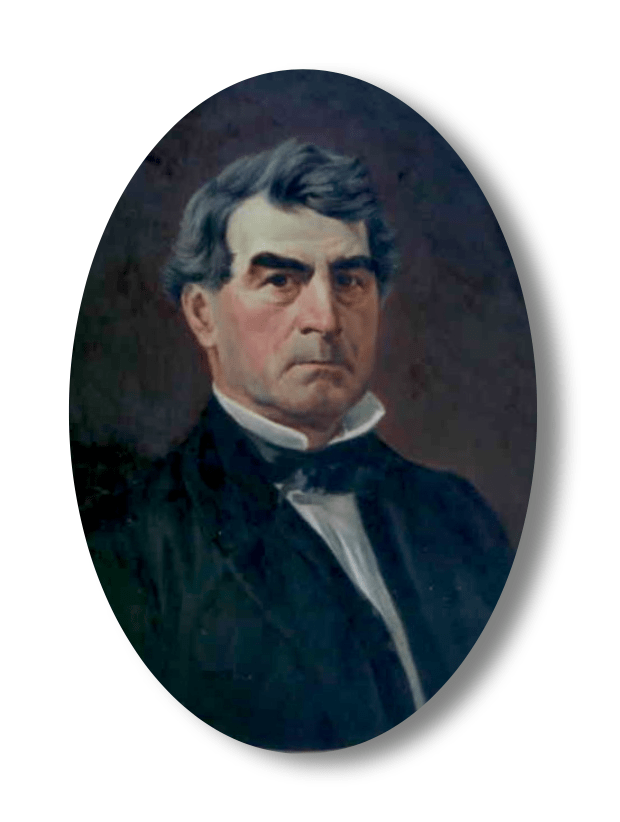
The following letter was written by 33 year-old Elisha Bell (1806-Aft1860), a native of Mississippi, who appears to have been the overseer of a Mississippi sugar cane plantation at Honey Island on the Yazoo River some 75 miles northeast of Vicksburg. Elisha was the son of John Purver Bell, Jr. (1761-1824) and Elizabeth Hunter (1775-1828) of Wilkinson county, Mississippi. By 1850, Elisha had his own plantation in Tchula, Holmes county, Mississippi, and owned as many as 47 slaves. By 1860, his slave count had dropped to 27.
Elisha addressed the letter to Dr. Lloyd Warfield (1799-1872) who was either his employer or his partner in the Honey Island plantation. Lloyd was the son of Elisha Warfield (1744-1818) and Ruth Burgess (1763-1835). Lloyd was a physician in Lexington, Kentucky. By 1850, his estate in Fayette county, was valued at $23,500 which included as many as 10 slaves. By 1860, it was valued at $60,000 (over $2 million dollars today). Dr. Warfield was married to Mary Barr and they had several children. Three of their sons served in the Confederate army. Lloyd and Edward ride with General Forrest, and Henry with General John H. Morgan.
Elisha’s letter speaks of the hard times in Mississippi in 1839, as it was across the whole of the United States following the Panic of 1837. He discusses the need to purchase more slaves for the work on the plantation that appears to have been the raising and milling of sugar cane, along with the auxiliary business of making rope from the baggasse. Elisha’s spelling is typical of a limited opportunity education.
Transcription

Postmarked Tchula, Mississippi
Honey Island
April 2nd, 1839
Dear Sir,
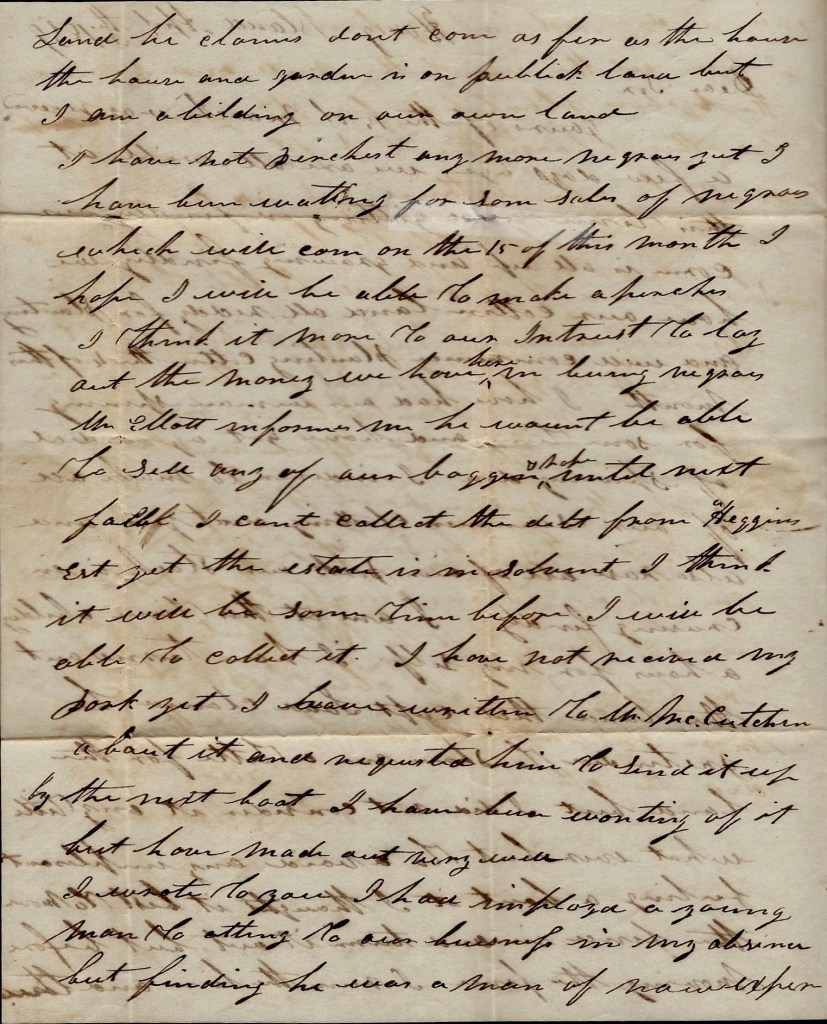
Yours of the 15th of March was received a few days ago. We are all well at this time and getting on finely. Our corn is all up and growing finely. We have our cotton land all ready for planting and will commence planting cotton the 4th of this month. I have had our woman spinning for some time and have got a good deal of spinning done. I endeavor to make all of our summer clothing next year and also raise all of our pork. Our stock is in [ ] finally.
I am at this time a building a house for myself. I have turned out the land that Capt. Lord claimed. He pretended to shave me a little for the land but I did not consider it any little whatever but to avoid any unpleasant feeling about it, I thought it best to move the fence in and turn it out but before moving the fence, I run the line and their land, he claims, don’t come as far as the house. The house and garden is on public land but I am a building on our own land.
I have not purchased any more negroes but I have been waiting for sales of negroes which will come on the 15th of this month. I hope I will be able to make a purchase. I think it more to your interest to lay out the money we have here in buying negroes. Mr. Elliott informs me he won’t be able to sell any of our baggasse & rope until next fall. I can’t collect the debt from Heggins jest yet—the estate is insolvent. I think it will be some time before I will be able to collect it. I have not received my pork yet. I have written to Mr. McCutchen about it and requested him to send it up by the next boat. I have been wanting of it but have made out very well.
I wrote to you I had employed a young man to attend to our business in my absence by finding he was a man of no experience, I did not employ him.
I have got the use of the mill and gin on the Archer’s Plantation for this year. No other charge than to keep it in order. It will be a fine thing for us this year as we would not be able to build before next spring and then we will be able to build.
It is very distressing times in Mississippi at this time with regard to money matters. I heard of a great many planters being broke up after having their plantations in order for a crop. The negroes drove off by the sheriff and sold. They was some very cheap sales on yesterday in our county but I did not hear of them until too late. But I am in hopes I will be able to purchase two or three more on much better terms than we did the others.
Yours truly, — Elisha Bell


 Spared & Shared 23