
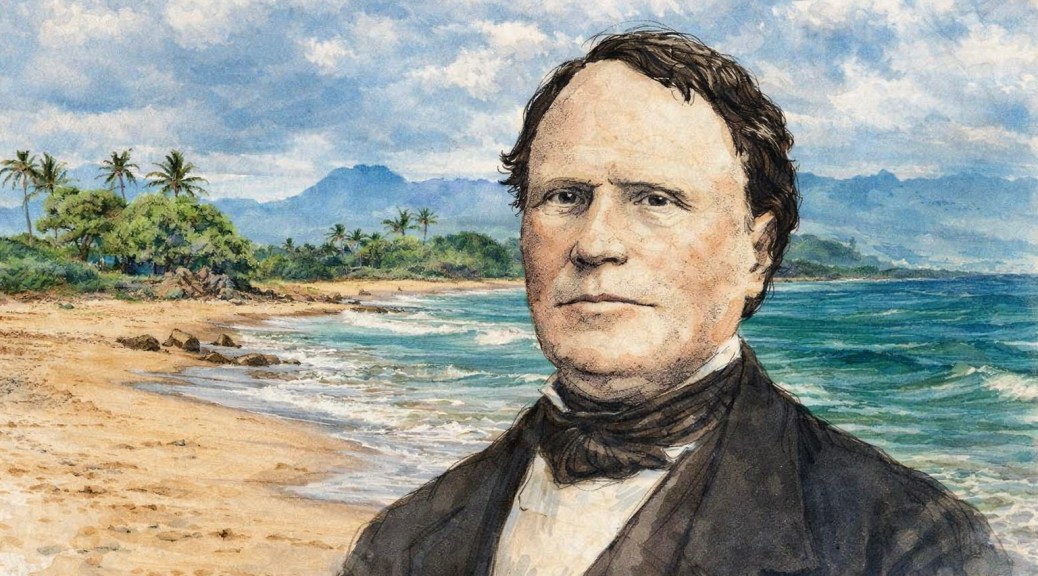
The following letter was written by Rev. Artemas Bishop (1795-1872), an 1819 graduate of Union College in New York State, who with his wife Elizabeth (Edwards) Bishop (1796-1828) were among the Second Company of missionaries arriving in the Sandwich Islands (Hawaii) on 27 April 1823. Their first station was at Kailua on the Kona coast of the big island. After his first wife died in Hawaii in 1828, Artemas married Delia Stone (1800-1875) who came with the 3rd company of missionaries. Artemas wrote this letter to his son, Sereno Edwards Bishop, who was born in Hawaii in 1827. Artemas also mentions his daughter, Jane Elizabeth Bishop (1825-1904) who married Hermann Hillebrand in 1860. Artemas died at the age of 77, having spent 50 years as a missionary in Hawaii. He is credited with leading the effort to translate the Hawaiian Bible.
Bishop’s letter offers an extensive examination of the disruptive effects on Hawaii’s economy resulting from the announcement of gold discovery in California. He expresses grave concerns that this event may lead to a significant decline in religious practice throughout the nation and hinder the advancement of civilization in Hawaii particularly.
T R A N S C R I P T I O N
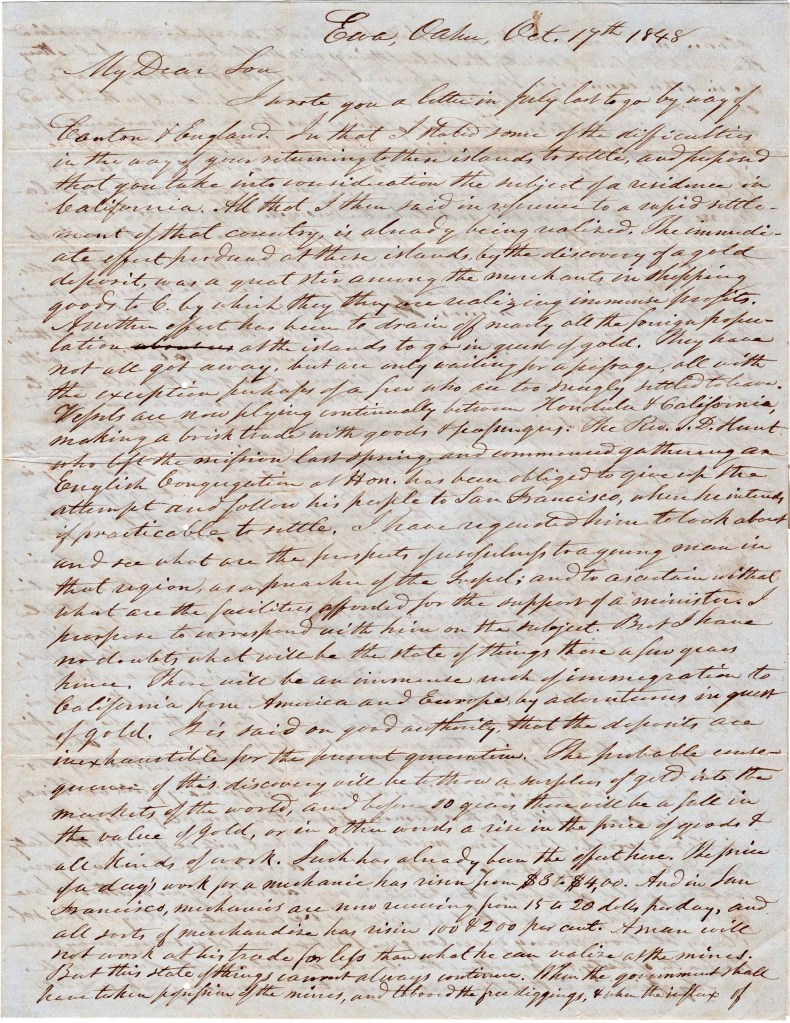
Ewa, Oahu
October 17, 1848
My dear son,
I wrote a letter in July last to go by way of Canton & England. In that I stated some of the difficulties in the way of your returning to these islands to settle, and proposed that you take into consideration the subject of a residence in California. All that I then said in reference to a rapid settlement of that country is already being realized. The immediate effect produced at these islands, by the discovery of a gold deposit, was a great stir among the merchants in shipping goods to California by which they are realizing immense profits. Another effect has been to drain off nearly all the foreign population at the islands to go in quest of gold. They have not all got away, but are only waiting for a passage, all with the exception perhaps of a few who are too snugly settled to leave. Vessels are now plying continually between Honolulu & California, making a brisk trade with goods & passengers.
The Rev. T. D. [Timothy Dwight] Hunt 1 who left the mission last spring and commenced gathering an English congregation at Honolulu has been obliged to give up the attempt and follow his people to San Francisco where he intends, if practicable, to settle. I have requested him to look about and see what are the prospects of usefulness to a young man in that region as a preacher of the Gospel, and to ascertain withal what are the facilities afforded for the support of a minister. I propose to correspond with him on the subject, But I have no doubts what will be the state of things there a few years hence. There will be an immense rush of immigration to California from America and Europe by adventurers in quest of gold. It is said on good authority that the deposits are inexhaustible for the present generation.
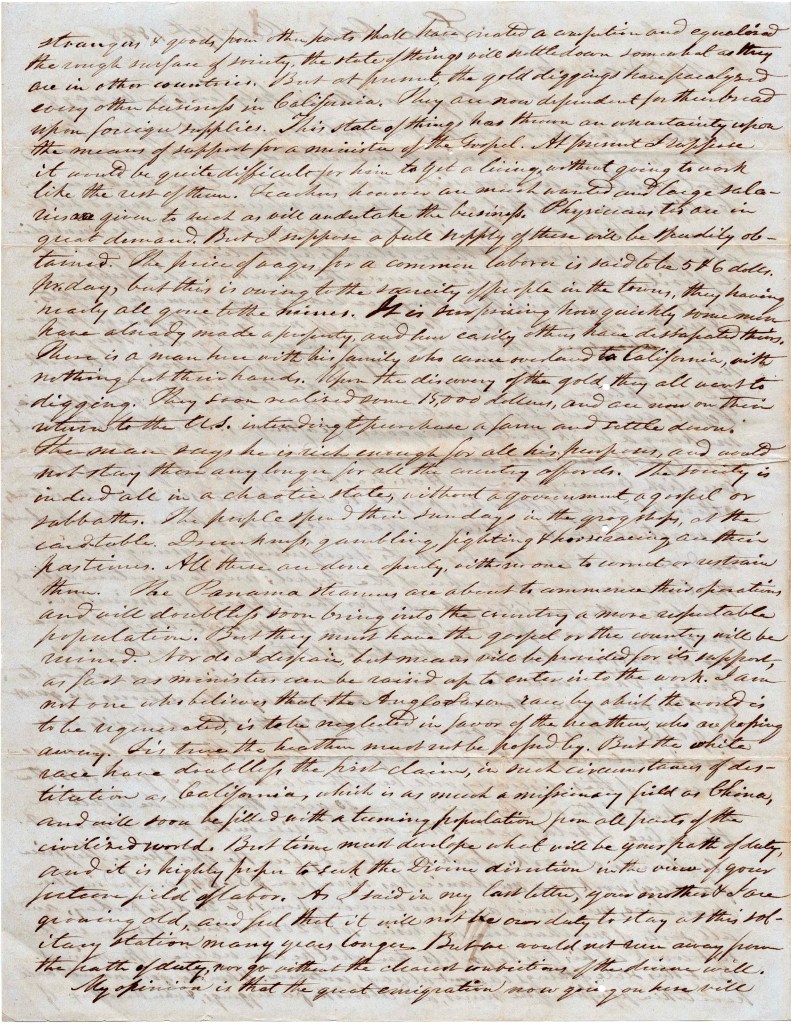
The probable consequence of this discovery will be to throw a surplus of gold into the markets of the world and before 10 years there will be a fall in the value of gold, or in other words, a rise in the price of goods & all kinds of work. Such has already been the effect here. The price of a day’s work for a mechanic has risen from $3 to $4. And in San Francisco, mechanics are now receiving 15 to 20 dollars per day, and all sorts of merchandise has risen 100 and 200 percent. A man will not work at his trade for less than what he can realize at the mines. But this state of things cannot always continue. When the government shall have taken possession of the mines and [ ] the free diggings, and when the influx of strangers & goods from other ports shall have created a competition and equalized the rough surface od society, the state of things will settle down somewhat as they are in other countries. But at present, the gold diggings have paralyzed every other business in California. They are now dependent for their bread upon foreign supplies. This tate of things has thrown an uncertainty upon the means of support fora minister of the Gospel.
At present I suppose it would be quite difficult for him to get a living without going to work like the rest of them. Teachers, however, are much wanted and large salaries given to such as will undertake the business. Physicians are in great demand. But I suppose a full supply of these will be splendidly obtained. The price of wages for a common laborer is said to be 5 and 6 dollars per day, but this is owing to the scarcity of people in the towns, they having nearly all gone to the mines. It is surprising how quickly some men have already made a property and how easily others have dissipated theirs. There is a man here with his family who came overland to California with nothing but their hands. Upon the discovery of the gold, they all went to digging. they soon realized some 15,000 dollars and are now on their return to the U. S. intending to purchase a farm and settle down. The man says he is rich enough for all his purposes and would not stay there any longer for all the country affords. The society is indeed all in a chaotic state, without a government, a gospel, or Sabbaths. The people spend their Sundays in the grog shops at the card table. Drunkenness, gambling, fighting & horse racing are their pastimes. All these are done openly with no one to correct or restrain them.
The Panama steamers are about to commence their operations and will doubtless soon bring into the country a more respectable population. But they must have the gospel or the country will be ruined. Nor do I despair, but means will be provided for its support as fast as ministers can be raised up to enter into the work. I am not one who believes that the Alglo-Saxon race by which the world is to be regenerated is to be neglected in favor of the heathen who are passing away. Tis time the heathen must not be passed by. But the white race have doubtless the first claim in such circumstances of destitution as California, which is as much a missionary field as China, and will soon be filled with a teeming population from all parts of the civilized world. But time must develop what will be your path of duty and it is highly proper to seek the Divine direction in the view of your future field of labor. As I said in my last letter, your mother and I are growing old and feel that it will not be our duty to stay at this solitary station many years longer. But we would not run away from the path of duty, nor go without the clearest convictions of the Divine will.
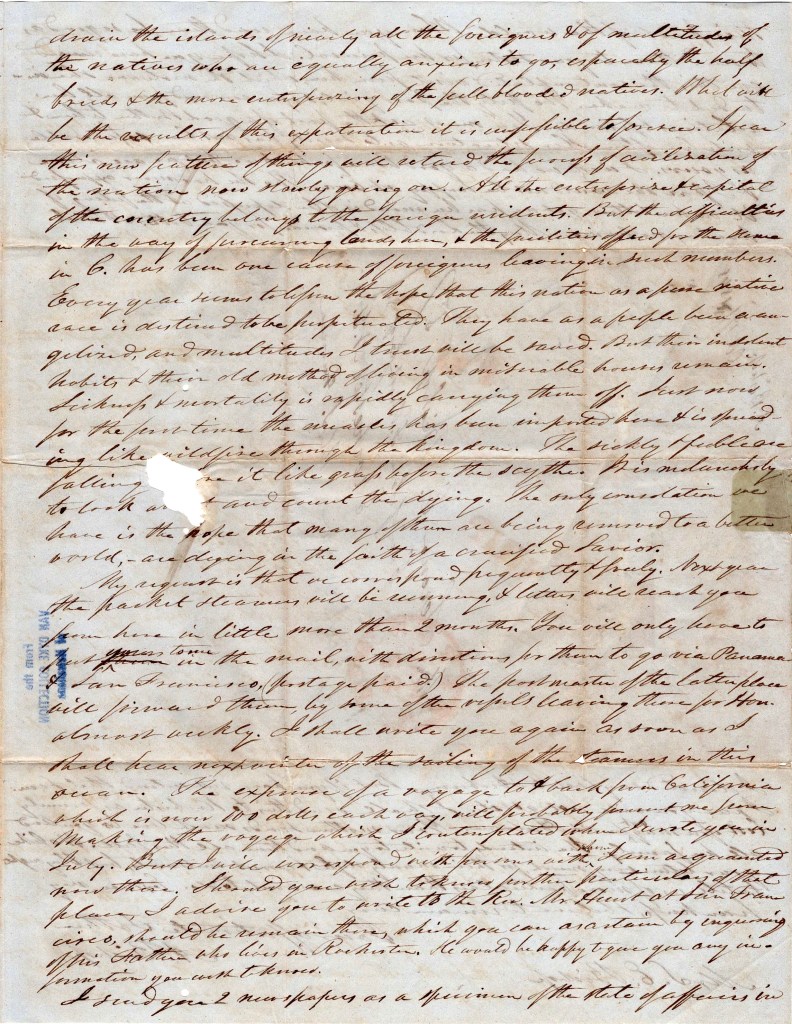
My opinion is that the great emigration now going on here will drain the islands of nearly all the foreigners & of multitudes of the natives who are equally anxious to go—especially the half breeds & the more enterprising of the full blooded natives. What will be the results of this expatriation, it is impossible to predict. I fear this new feature of things will retard the progress of civilization of the nation now slowly going on. All the enterprise & capital of the country belongs to the foreign residents. But the difficulties in the way of procuring lands here, and the facilities offered for the same in California has been one cause of foreigners leaving in such numbers. Every year seems to lessen the hope that this nation as a whole will [ ] native race is destined to be perpetuated. They have as a people been anglicized [?] and multitudes, I trust , will be saved. But their indolent habits & their old method of living in miserable houses remain. Sickness and mortality is rapidly carrying them off. Just now, for the first time, the measles has been imported here and is spreading like wildfire through the Kingdom. The sickly & feeble are falling before it like grass before the scythe. Tis melancholy to look on it and count the dying. The only consolation we have is the hope that many of them are being removed to a better world—are dying in the faith of a crucified Savior.
My request is that we correspond frequently & freely. Next year the packet steamers will be running & letters will reach you from here in little more than two months. You will only have to put yours to me in the mail with directions for them to go via Panama & San Francisco (postage paid). The postmaster of the latter place will forward them by some of the vessels leaving there for Honolulu almost weekly. I shall write you again as soon as I shall hear next winter of the sailing of the steamers in this ocean. The expense of a voyage to & back from California which is now 100 dollars each way will probably prevent me from making the voyage which I contemplated when I wrote you in July. But I will correspond with persons with whom I am acquainted now there. Should you wish to know further particulars of that place, I advise you to write to the Rev. Mr. Hunt at San Francisco, should he remain there, which you can ascertain by enquiring of his father who lives in Rochester. He would be happy to give you any information you wish to know.
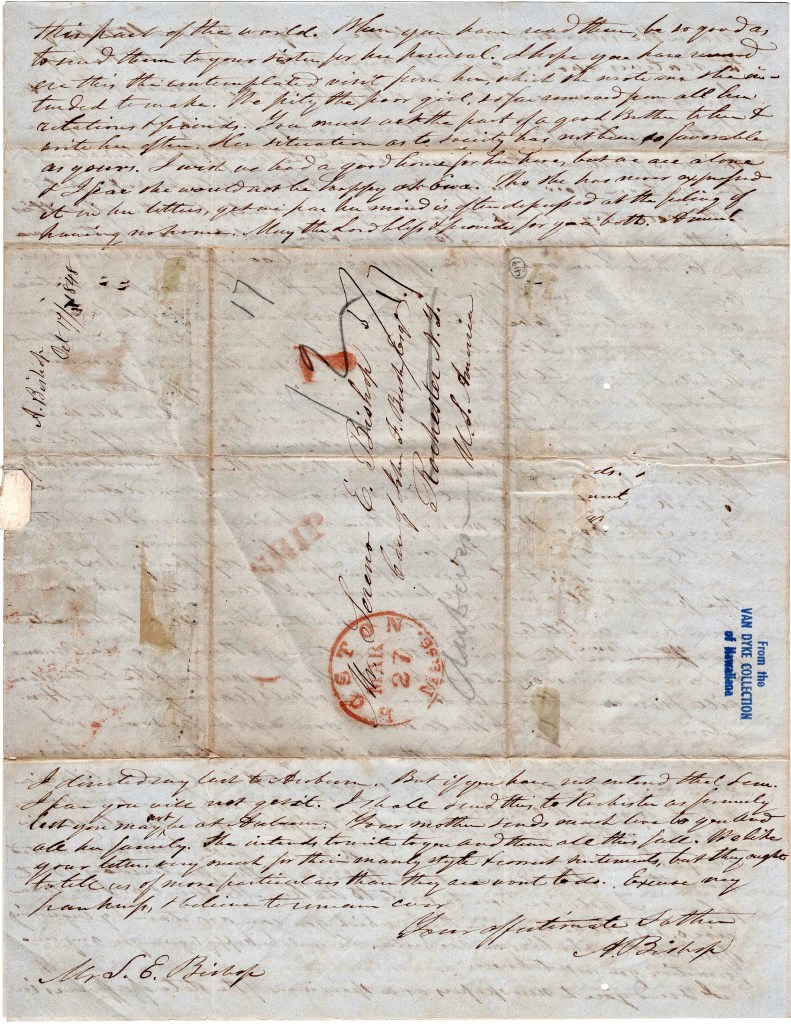
I send you two newspapers as a specimen of the state of affairs in this part of the world. When you have read them, be so good as to send them to your sister for her perusal. I hope you have received ere this the contemplated visit from her which she wrote me she intended to make. We pity the poor girl so far removed from all her relations and friends. You must act the part of a good brother to her and write her often. Her situation as to society has not been so favorable as yours. I wish we had a good home for her here but we are alone & I fear she would not be happy at Ewa. Though she has never expressed it in her letters, yet we fear her mind is often depressed at the feeling of having no home. May the Lord bless & provide for you both. Amen!
I directed my last to Auburn. But if you have not entered that Seminary, I fear you will not get it. I shall send this to Rochester as formerly lest you may not be at Auburn. Your mother sends much love to you and all her family. She intends to write to you and them all this fall. We like your letters very much for their manly style & [ ] sentiments, but they ought to tell us of more particulars than they arewont to do. Excuse my frankness & believe to remain your affectionate father, — A. Bishop
to Mr. S. E. Bishop
1 Timothy Dwight Hunt was born in Rochester, New York on March 10, 1821. Hunt attended Yale (graduating in 1840) and completed his degree at Auburn Seminary in 1843. Ordained by the Presbytery of Genesee, he and his wife sailed to Hawaii as missionaries. After four years, he and his family sailed to San Francisco, arriving on October 28, 1848. Hunt, a New School Presbyterian, is believed to have been the first full-time Protestant minister to settle in California. He held his first communion service at the “Public Institute” in Portsmouth Square, San Francisco on November 5, 1848. The congregation included different denominations. He was elected chaplain of San Francisco for two years. He organized the First Congregational Church in July 1849. Hunt became its minister on June 26, 1850. He also was one of three ministers who were part of the Presbytery in San Francisco in September 21 for Monterrey. The other ministers were Samuel H Wiley and John Waldo Douglas. Hunt left San Francisco in 1857, becoming the minister for First Presbyterian Church in Ithaca. He died February 7, 1895, leaving behind a significant legacy of journals, letters and church registers.
 Spared & Shared 23