

This letter was written in the spring of 1863 by 30 year-old Sarah Plummer (Young) Merwin (1833-1920), the wife of Samuel Hubble Merwin (1826-1898) of Sacramento, California. Sarah was born and raised in Gray, Cumberland county, Maine. Her parents were Nathaniel Young (1788-1863) and Hannah Plummer (1802-1872). Sarah wrote the letter to her sister Francis (“Frank”) H. (Young) Merrill, the wife of John Tappan Merrill (1822-1910), a house carpenter in Gray, Maine.
We learn from the letter that Sarah and Samuel were residing with Samuel’s older sister, Orpha (Merwin) Massol (1815-1905), and her husband, Florian Augustus Massol (1810-1890) just outside of Sacramento where her husband and her brother-in-law were partners in the Massol, Merwin & Co. (pack train business). We know that Samuel had another sister living in California also named Sarah (Merwin) Barkley (1828-1885) who was the wife of John Henry Barkley (1825-1892). This couple apparently resided in Dutch Flat in 1863 for Sarah describes the journey to visit them just prior to this letter.
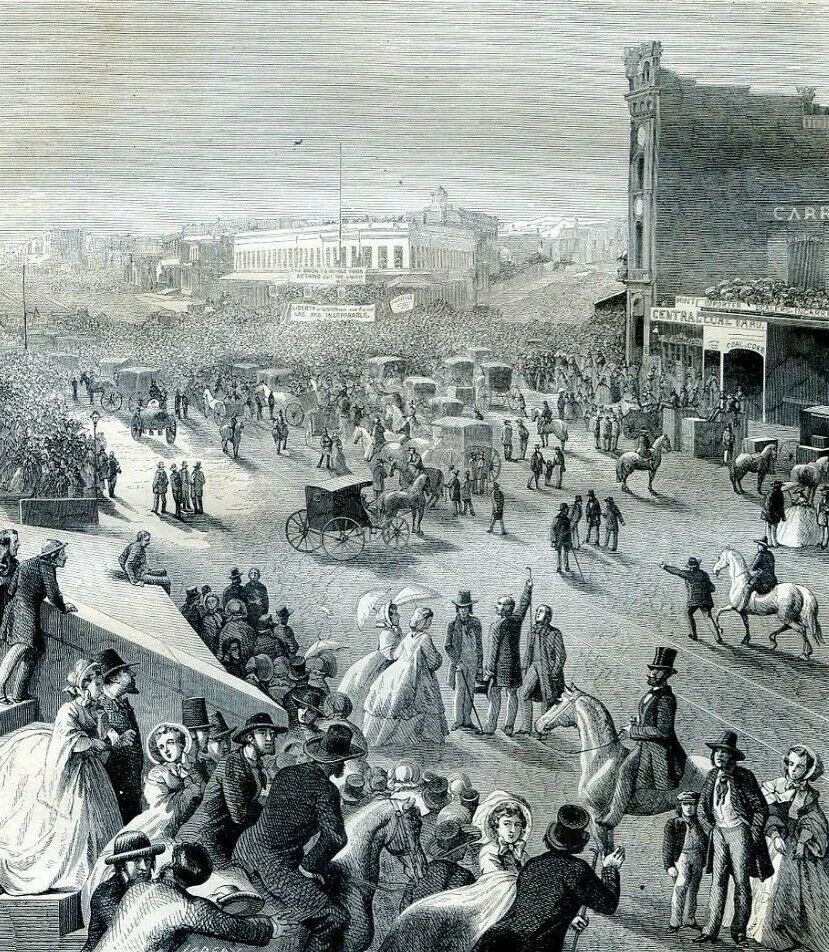
Though Sarah’s narration of the journey to Dutch Flat and return was itself captivating, the most interesting part of the letter comes when Sarah picks up her pen to resume her writing on May 11th and describes the celebration in Sacramento on 9 May 1863 upon receiving the news (though false) that Richmond had fallen to Union troops. Doubts of the validity of this news must have crept into everyone’s mind by the time the Sacramento Daily Union published their morning paper on 12 May 1863 which begged to know, “Has Richmond been taken by General Keyes? That’s the question of the hour.”
Transcription

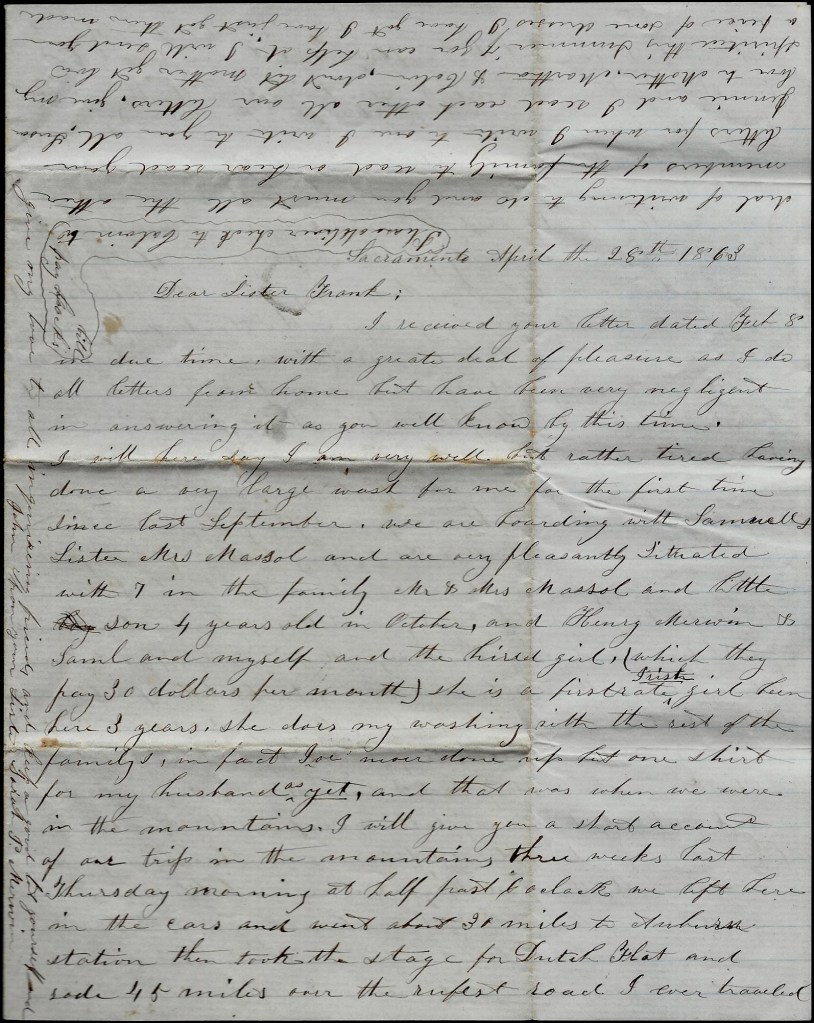
Sacramento, [California]
April 28, 1863
Dear Sister Frank,
I received your letter dates February 8th in due time, with a great deal of pleasure as I do all letter from home but have been very negligent in answering it as will know by this time. I will here say I am very well but rather tired having done a very large wash for me for the first time since last September. We are boarding with Samuel’s sister, Mrs. Massol and are very pleasantly situated with 7 in the family—Mr. and Mrs. Massol and little son 4 years old in October, and Henry Merwin & Samuel and myself and the hired girl (which they pay 30 dollars per month). She is a first rate Irish girl. Been here three years. She does my washing with the rest of the family’s. In fact, I’ve never done up but one shirt for my husband as yet, and that was when we were in the mountains.
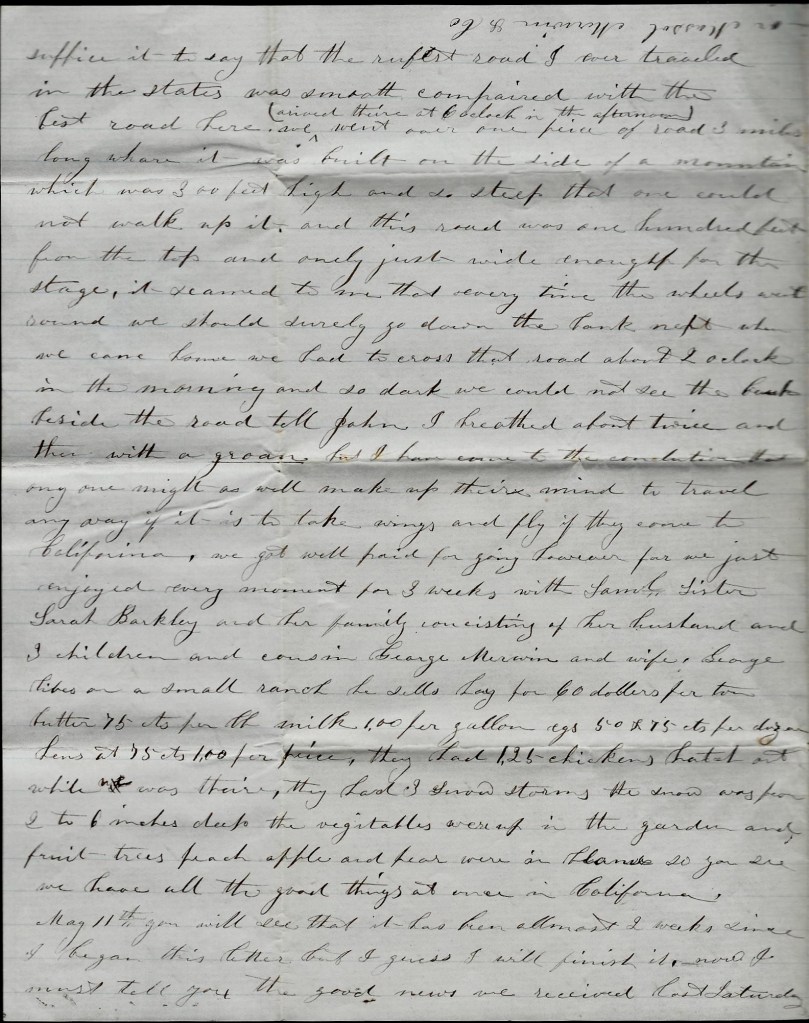
I will give you a short account of our trip in the mountains. Three weeks last Thursday at half past 6 o’clock, we left here in the cars and went about 30 miles to Auburn Station. Then took the stage for Dutch Flat and rode 45 miles over the roughest road I ever traveled. Suffice it to say that the roughest road I ever traveled in the States was smooth compared with the best road here. We arrived there at 6 o’clock in the afternoon, and went over one piece of road 3 miles long where it was built on the side of a mountain which was 300 feet high and so steep that one could not walk up it, and this road was one hundred feet from the top and only just wide enough for the stage. It seemed to me that every time the wheels went round we should surely go down the bank next. When we came home, we had to cross that road about 2 o’clock in the morning and so dark we could not see the bank beside the road. Tell John I breathed about twice and then with a groan, but I have come to the conclusion that anyone might as well make up their mind to travel anyway if it is to take wings and fly if they come to California. 1
We got well paid for going, however, for we just enjoyed every moment for three weeks with Samuel’s sister, Sarah Barkley, and her family consisting of her husband and 3 children and cousin George Merwin and wife. George lives on a small ranch. He sells hay for 60 dollars per ton, butter 75 cents per lb., milk $1 per gallon, eggs 50 and 75 cents per dozen, hens at 75 cents to $1 apiece. They had 1.25 chickens hatch out while we was there. They had 3 snow storms. The snow was from 2 to 6 inches deep. The vegetables were up in the garden and fruit trees—peach, apple, and pear—were in bloom so you see we have all the good things at once in California.
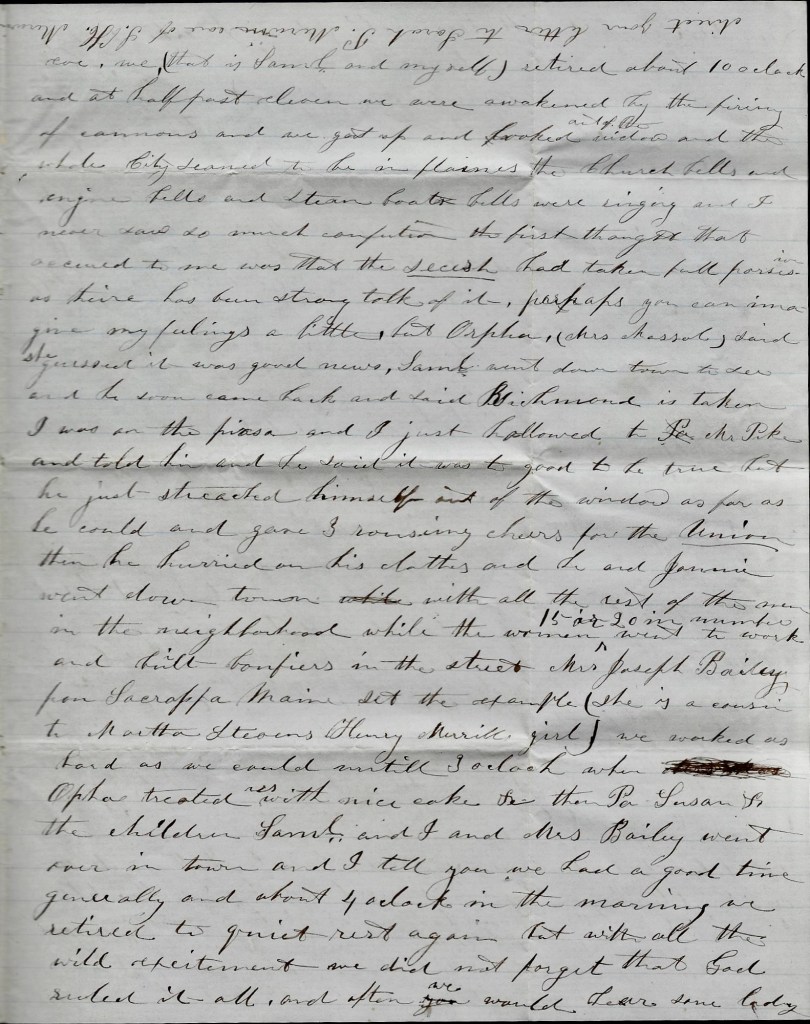
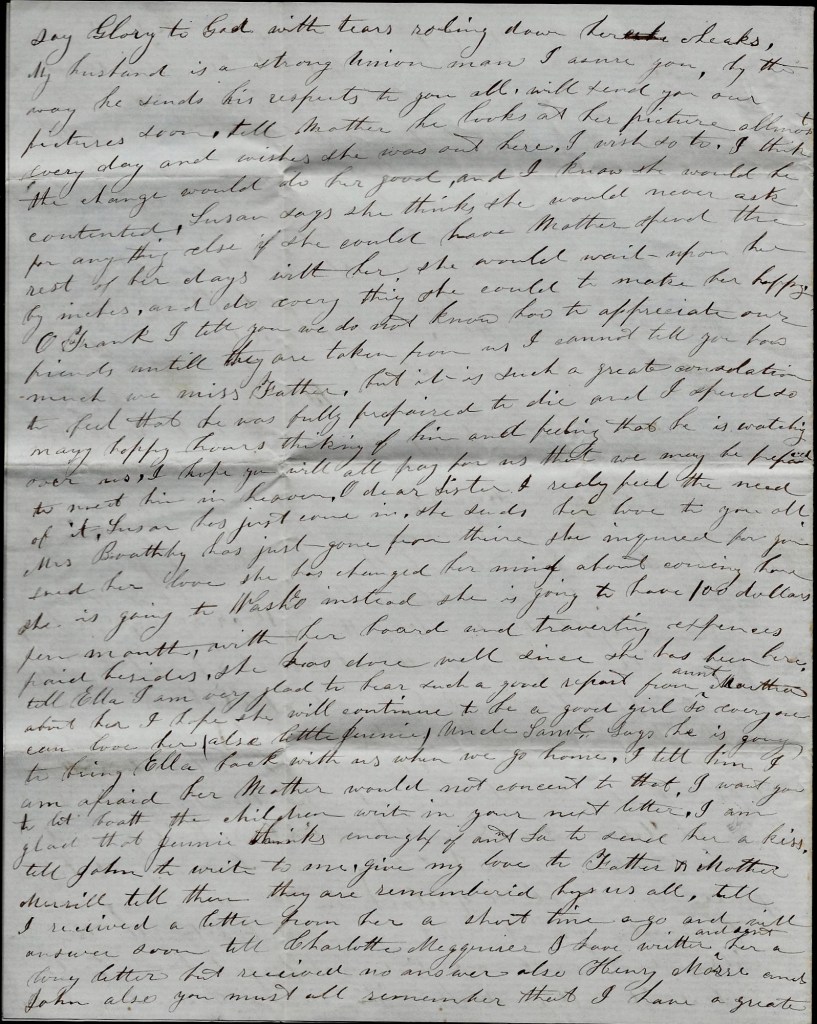
May 11th. You will see that it has been almost two weeks since I began this letter but I guess I will finish it. Now I must tell you the good news we received last Saturday eve. We (that is, Samuel and myself) retired about 10 o’clock and at half past eleven we were awakened by the firing of cannons and we got up and looked out of the window and the whole city seemed to be in flames. The church bells and engine bells and steam boat bells were ringing and I never saw so much confusion. The first thought that occurred to me was that the secesh had taken full possession as there has been strong talk of it. Perhaps you can imagine my feelings a little. But Orpha (Mrs. Massol) said she guessed it was good news. Samuel went down town to see and he soon came back and said Richmond is taken. I was on the piazza and I just hallowed to Mr. Pike and told him and he said it was too good to be true but he just stretched himself out of the window as far as he could and gave three rousing cheers for the Union. Then he hurried on his clothes and he and Johnnie went down town with all the rest of the men in the neighborhood while the women, 15 or 20 in number, went to work and built bonfires in the street. Mrs. Joseph Bailey from Saccarappa, Maine, set the example (she is a cousin to Martha Stevens, Henry Merrill’s girl). We worked as hard as we could until 3 o’clock when Orpha treated us with nice cake & then Pa, Susan, & the children, Samuel and I, and Mrs. Bailey went over in town and I tell you we had a good time generally and about 4 o’clock in the morning we retired to quiet rest again. But with all the wild excitement, we did not forget that God ruled it all and often we would hear some lady say, “Glory to God,” with tears rolling down her cheeks.
My husband is a strong Union man, I assure you. By the way, he sends his respects to you all. Will send you our pictures soon. Tell Mother he looks at her picture almost every day and wishes she was out here. I wish so too. I think the change would do her good and I know she would be contented. Susan says she thinks she would never ask for anything else if she could have Mother spend the rest of her days with her. She would wait upon her by inches, and do everything she could to make her happy.
Oh Frank, I tell you, we do not know how to appreciate our friends until they are taken from us. I cannot tell you how much we miss Father, but it is such a great consolation to feel that he was fully prepared to die and I spend so many happy hours thinking of him and feeling that he is watching over us. I hope you will all pray for us that we may be prepared to meet him in heaven. Oh dear sister, I really feel the need of it. Susan has just come in. She sends her love to you all. Mrs. Boothly has just gone from there. She enquired for you and sends her love. She has changed her mind about coming here. She is going to Washeo instead. She is going to have 100 dollars per month with her board and traveling expenses paid besides. She has done well since she has been here.
Tell Ella I am very glad to hear such a good report from Aunt Martha about her. I hope she will continue to be a good girl so everyone can love her (also little Jennie). Uncle Samuel says he is going to bring Ella back with us when we go home. I tell him I am afraid her mother would not consent to that. I want you to let both the children write in your next letter. I am glad that Jennie think enough of Aunt Sarah to send her a kiss. Tell John to write to me. Give my love to Father and Mother Merrill. Tell them they are remembered by us all. Tell her I received a letter from her a short time ago and will answer soon. Tell Charlotte Megguier I have written and sent her a long letter but received no answer. Also Henry Morse and John also. You must all remember that I have a great deal of writing to do and you must [tell] all the other members of the family to read or hear read your letters for when I write to one, I write to you all. Susan, Jennie, and I read each other all our letters. Give my love to Mother, Martha & Calvin. Don’t let Mother get low-spirited this summer if you can help it. I will send you a piece of some dresses I have got. I have just got them made.
Give my love to all enquiring friends and keeo a good lot yourself and John. From your sister, — Sarah P. Merwin
Direct your letter to Sarah P. Merwin, care of S. H. Merwin or Massol, Merwin & Co.
1 Unbeknownst to Sarah at the time, this route between Auburn and Dutch Flat, as rough as it was, turned out to be the best route over the Sierra Mountains that was selected for the Central Pacific Railroad. It became known as the “Auburn and Illinoistown, Dutch Flat and Donner Pass” route.



 Spared & Shared 23