The following letter was written by various members of the Floyd family. We learn from the letter that Enoch Floyd (1808-1855) and Sarah Ingersoll (Harvey) Floyd (1816-1889) made the overland journey from the Great Salt Lake over the Sierra Mountains to the vicinity of Sacramento in the spring of 1856 with their family of five children. They were Enoch Harvey Floyd (1834-1860), Lyman Floyd (1837-1863), Leonard Floyd (1837-1916), Sarah Elizabeth Floyd (1841-1866) and Julia Ann Floyd (1852-1860). Two of their youngest daughters, Martha and Lucy died within days on each other in 1853 probably from some childhood disease. The family resided in Newbury, Essex county, Massachusetts, before making the overland journey.
Transcription
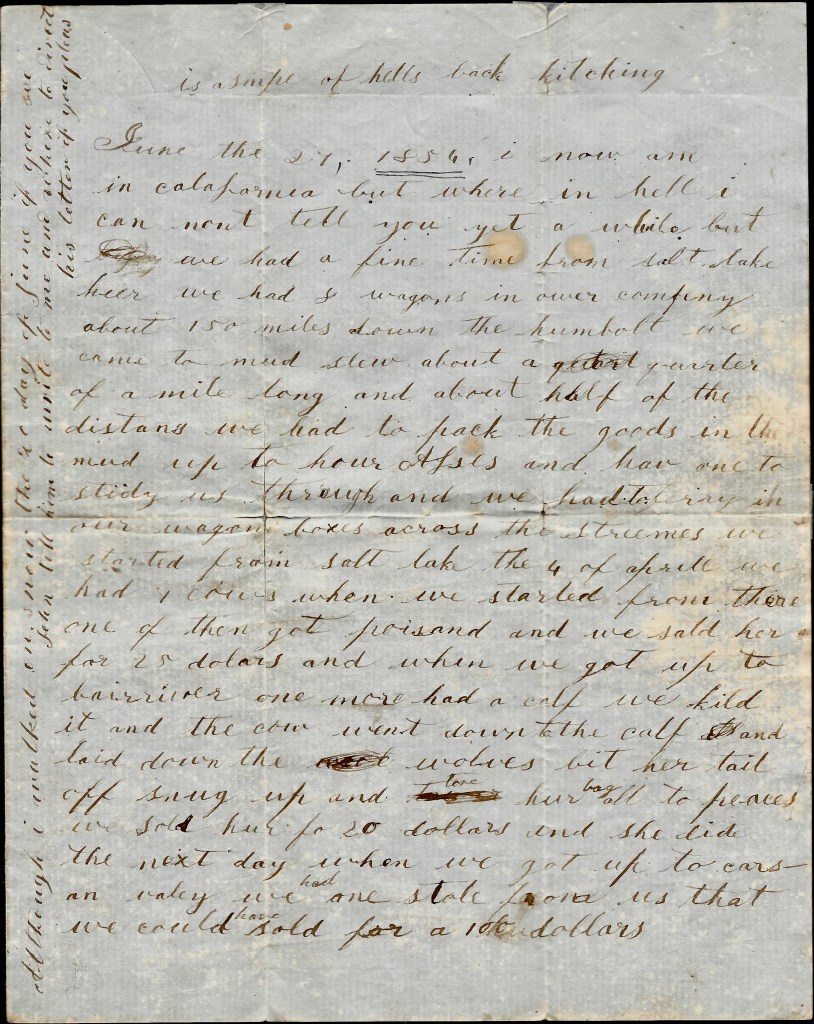
June 27, 1854
i now am in california but where in hell i can nont tell you yet a while but we had a fine time from salt lake heer we had 8 wagons in ower compeny about 150 miles down the humbolt we came to mud slew about a quarter of a mile long and about half of the distans we had to pack the goods in the mud up to hour asses and have ont to stidy us through and we had to ferry in our wagon boxes across the steemes we started from salt lake the 4 of aprill we had 7 cows when we started frome there one of them got poisand and we sold her for 25 doars and when we got up to bairriver one more had a calf and laid down the wolves bit her tail off snug up and tore hur bag all to peaces we sold hur for 20 dollars and she dide the next day when we got up to carsan valey we had one stray from us that we could have sold for a 100 dollars
we are now in prairie sitty all well at this time Enoch is in hangtown to work in the mines for 60 dollars a moth and his board lyman and i have not got enny work yet they are agoin to opin a new mine here and we think taking up a claim or tow and see how we can makit i don’t know of enny thing more to writ
from your obedident servant—Leonard Floyd
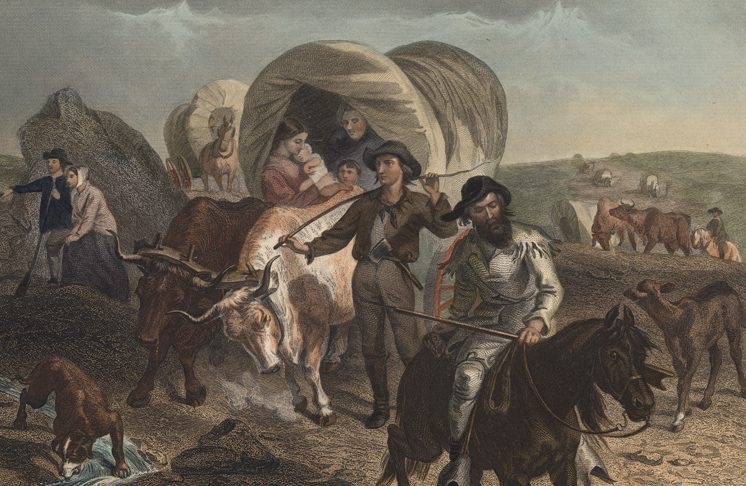
Dear frien i will write a few lines i have not got rested enough yet to write or do much else we have had a very tedious journey from Salt Lake here we was from the 4 of April to the 25 of june geting to hangtown or placerville 800 miles from Salt Lake i had rather come from kanesville to Salt Lake 4 times than to come from there here once we are all well but about tired out crosing the siera nevada mountains is enough to kill anybody or thing that ever stood on feet we were one whole day climbing one mountain one and a half miles it is like going up and down the roof of a house with the exception of the sharp edge and rocks in the road as high as the wagon bodys the rocky mountains is nothing to compare to these.
Enoch has kept a journal of Our journey and some time some of us will will write it enoch is 30 miles from us now.
[in a different hand]
if you read this you will do well write as soon as you get this and direct it to sacramento we are 20 miles north of it but where we shall stop i do not know but we shall get the letter When we had all of the goods out of our wagon we had on nine yoke of Oxen to our wageon that would girt from 6 to 7 ft and we spird and sashed them til the blud run their sides to take the empty [wagons] over the siinavada Mountain. Enoch Floyd, Jr.
July 1 since the above was writen we have moved within 5 miles of sacramento Leonard and Lyman are at work for two dollars per day for A short time and their board board is from 6 to 9 dollars per week for constant boarders transient ones more when we got to Carson valley we expected to wait for the snow to go of the carson route so Enoch came on ahead of us he had to pay 11 dollars A week but he got work and i hope will do well but we came the joHnson cut off this road is worse than the other but no snow in the road.
this is A mixed up letter but never mind as long as we know how better in hangtown they have up bets so i am told as high as fifteen hundred dollars to see who will go down to Carson valley and steal the most cattle from emigrants the whites are A great deal worse than the indians the indians seldom troubel any companies unless they are as small as from 5 to 8 men than they will steal their cattle and sometimes fire upon the men but where there is from 15 to 25 men there is no trouble we had 22 men Mr Silas Barn[e]s from Boston with his family came through with us from Salt Lake he lived there two years and A half 1 and Mr. William Paterson formily of haverhill Mass.
We had no serious sickness in our family or company nor Deaths little Julia is cuting Double teeth and it makes her rather cross but she is a good littl girl Sarah send her love to grandmother and grandfather and all the rest of the folks if you could see the style that i write in you would say it is time to say good by till A more conveint time. so good by — Sarah I. Floyd
1Silas P. Barnes was born in Deering, New Hampshire in 1805. He moved to Boston as a young man and married Olive Chapman. In 1851, he settled up his business in Boston and embracing the doctrines taught by Joseph Smith, made his way with his family of nine children to Council Bluffs, Iowa, where they joined a caravan of 60 wagons to journey to Salt Lake City. They lived near Dry Creek until Indian troubles threatened danger and in so they decided in April 1854 to go to California. After a three month’s journey they reached the Golden State and settled in Yolo county. Silas died there in 1888.
The following letters were written by William Newell Brainard (1823-1894), the son of Jonathan Brainard (1794-1856) and Sarah Gage (1797-1867 of De Ruyter, New York. William went to California as a gold seeker in 1850. He mined on the North Fork of the American River and then went to Sacramento where he engaged in the produce commission business with Morehouse. While there, he was elected city treasurer. He returned to Chicago in the spring of 1858 and engaged in the grain trade.
William wrote the letters to Ransom Morehouse (b. 1827) who, with his brother William Henry Morehouse (1832-1901) were partners with Brainard in the firm Morehouse & Brainard. The Morehouse brothers were from Kane county, Illinois.
William was married to Melinda B. Coley (1826-1908) on 3 May 1853 in Syracuse, New York. The couple had at least three children—Hattie Belle Brainard (1855-1855), William Vallejo Brainard (1857-1886), and Frances Marion Brainard (1863-1894).
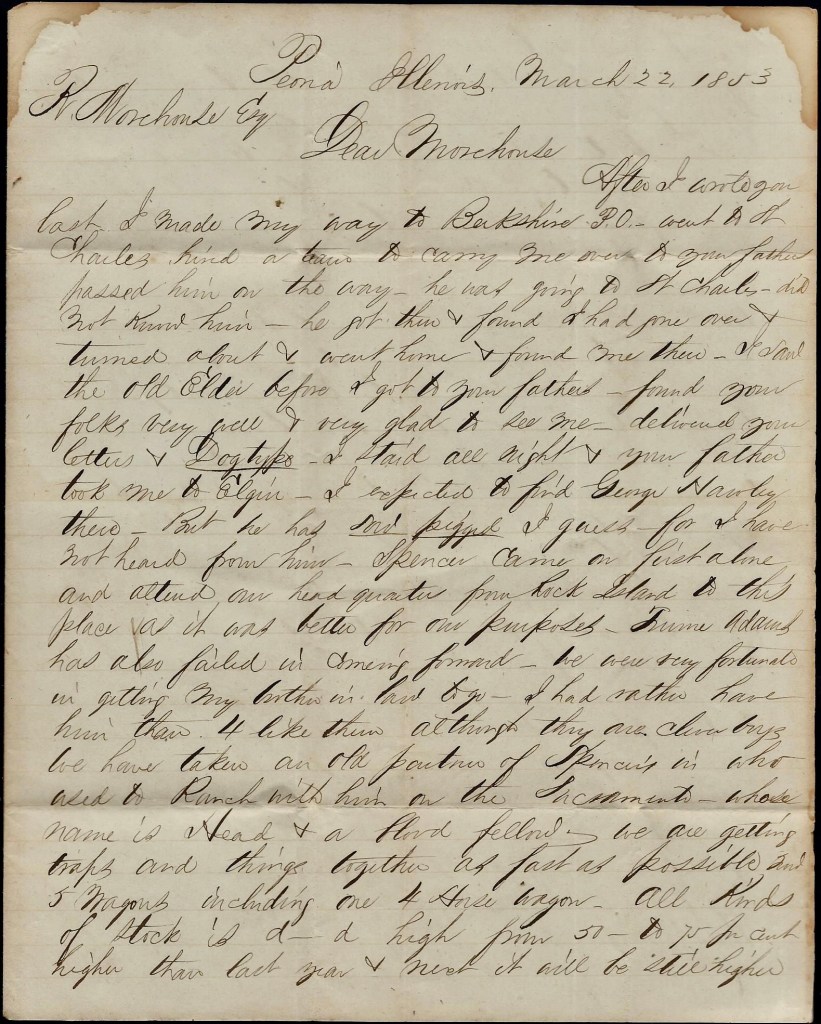
Dear Morehouse, after I wrote you last, I made my way to Berkshire P. O., went to St. Charles, hired a team to carry me over to your father’s, passed him on the way—he was going to St. Charles—did not know him—he got there and found I had gone over & turned about & went home & found me there. I saw the old Elder before I got to your father’s—found your folks very well & very glad to see me—delivered your letters & Dogtype [daguerreotype]. I staid all night & your father took me to Elgin. I expected to find George Hawley there but he has sow pigged I guess for I have not heard from him. Spence came on first alone and attend our headquarters from Rock Island to this place as it was better for our purposes. Triune Adams has also failed in coming forward. We were very fortunate in getting my brother-in-law to go. I had rather have him than 4 like then although they are clever boys.
We have taken an old partner of Spencer’s in who used to ranch with him on the Sacramento whose name is Head & a blood fellow. We are getting traps and things together as fast as possible and five wagons including one 4-horse wagon. All kinds of stock is damned high—from 50 to 75 percent higher than last year & next it will be still higher.
The company have bought 7 horses costing about $120 each and rousing horses too. I have also bought a dray horse for our own use & going over on our own hook. He is a buster—17 hands high, coal black, and weighs 1500. He will take down anything in California. He is green as grass. I bought him of the man who raised him. 6 years old. I paid $150 & I could sell him in Chicago, I’ll bet, for $300. [Lewis W.] Walker 1 has on his own hook a French mare for his wife to ride. Spencer’s wife is on the ground all right.
We mean to leave here April 4th. We have about all our work oxen bought. We calculate on 16 yoke cattle. 4 wagons & 4 yoke to each wagon. We have also some cows bought up and the boys all out now buying. I have just come in town—have been out buying. Good cows will cost us on an average $20 & cattle for yoke $75. We shall start and buy along the road till the money gives out.
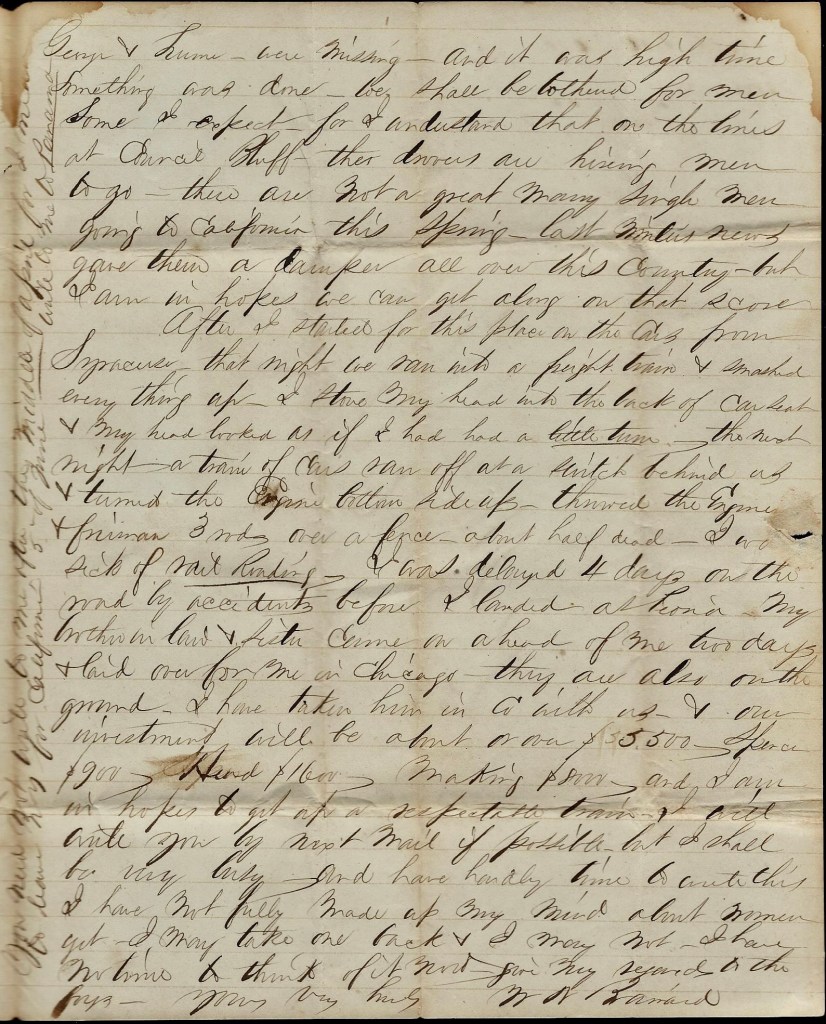
Your father paid me $275 & I wrote him to send me the balance he could make out to this place for as George has failed me, we cannot operate any up in Kane county & did not see Bill Smith. I sent and to him but he did not come up & did not see John McClelland & told your father about his & George’s affairs. I saw Ed Hucley. His father was away. I had quite a visit with the old Elder. He is all right. I was in a devil of a hurry when I was there, having learned that George & Lum were missing—and it was high time something was done. We shall be bothered for men some, I expect, for I understand that on the lines at Council Bluff their drovers are hiring men to go. There are not a great many single men going to California this spring. Last winter’s news gave them a damper all over this country, but I am in hopes we can get along on that score.
After I started for this place on the cars from Syracuse, that night we ran into a freight train & smashed everything up. I stove my head into the back of a car seat & my head looked as if I had had a little turn. The next night a train of cars ran off at a switch behind us & turned the engine bottom side up, thrower the engine and fireman 3 rods over a fence about half dead. I was sick of railroading & was delayed 4 days on the road by accidents before I landed at Peoria. My brother-in-law and sister came on ahead of me two days and laid over for me in Chicago. They are also on the ground. I have taken him in company with us & our investments will be about or over $5,500. Spence $900, Head $1600, making $8,000, and I am in hopes to get up a respectable train.
I will write you by next mail if possible but I shall be very busy and have hardly time to write this. I have not fully made up my mind about women yet. I may take one back & I may not. I have no time to think it now. Give my regards to the boys. Yours very hasty, — W. N. Brainard
You must not write to me after the middle of April for I mean to leave N. Y. for California 5th of June. Write to me to Panama.
1 Lewis W. Walker (b. 1825) was married to Lydia Jane Brainard (b. 1826). The couple made it to California on the overland trail in the summer of 1853 and Lewis took a farm in Petaluma.
Letter 2
Dowagiac, Michigan April 14, 1853
R. Morehouse, Esq. Sacramento, California
Dear Morehouse, I have got so far on my way back to New York and stopped here a few days to see some of my friends and am now waiting for the cars to come along and thus shall continue my way back home, and thought I would write you now for I don’t know when I shall have the opportunity to do so & get the letter in the mail that leaves New York the 20th inst. and I don’t know that this will be in but hope so.
Well, to commence where I left off in my last, we—the “New York California Co.” left Peoria April 4th with the 4 ox wagons & one 4-horse wagon, got in our loose stock about there & went over to Farmington & collected in the next day what I had bought about there and went on toward Burlington, Iowa. April 9th we crossed the Mississippi with 170 cows and heifers and steer, some 20 yoke of oxen, 7 horses belonging to the company, one of our own, one more belonging to my brother-in-law, and myself for my sister to ride, and 20 other horse belonging to two men in the train making 11 horses in all. The outfit was all about the wagons excepting flour, sugar, and bacon which they are to take in at Council Bluffs. And we have got O entire to say as good a lot of stock as will start this year from the states. I had rather have our 200 or more head than double the number of any stock I have seen start. The company consists of Spencer, Head & Walker with Spencer’s wife and my sister and 12 men besides. Some of the men paid in $50, some less, and some nothing, and are good men, I guess, as can generally be got together. The capital stock included is $7825 and I have invested on our account $4250, besides the dray horse and charges on him for shoeing & keeping him $160 and my expense going out and back will be not far from $100.
I left the company Burlington & they had some $1500 left for expenses & to invest in stock in trade across the plains or otherwise as needed and that will make as large a drove as is well to drive in one company. I did not go to your father’s on my way back for my time would not admit of it. Just before I started I had a letter from your father & one from George Hawley who had got out there but he was sick and of no account as to going across the plains. I got only the $275 of your money at home. Your father wrote me that he could not collect in the rest and it is just as well.
I have pledged the boys that you will meet them on the desert & you must if I should be cast away or go down to the bottom on my way back. I wish you would make some suitable enquiries as to where we can drive the stock after we get there into California. Perhaps we can make some arrangements with Jim & Alex McCane to drive them onto their ranch and I should like to have Alex or Jim go over to Carson Valley with you and buy stock in company & meet our train. Broach the matter to them in time for them to prepare for it and also as regards our business there.
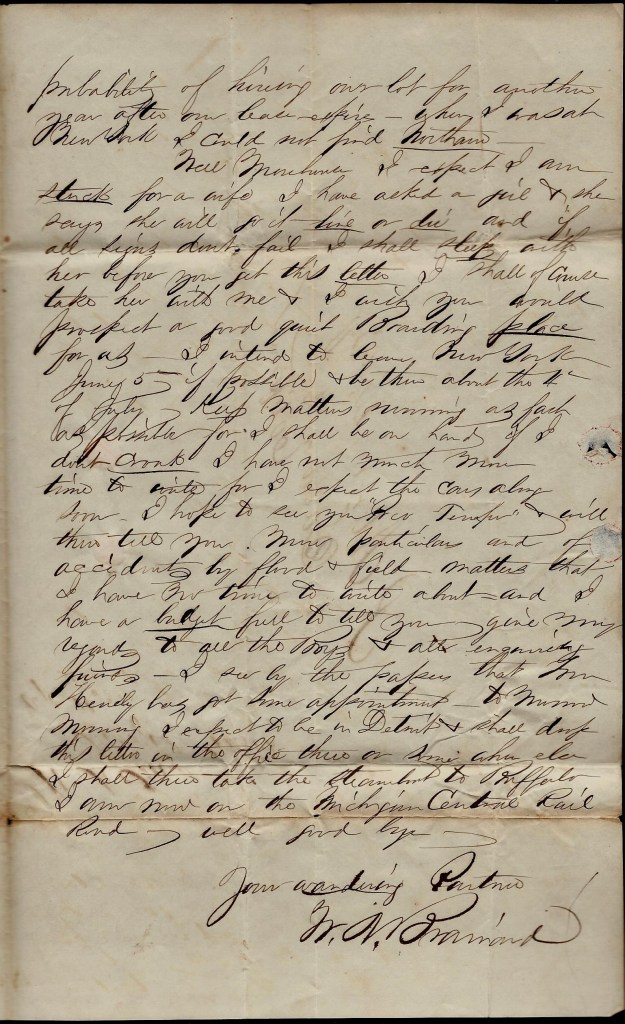
You have as yet not wrote me how you are doing or how much or hoe much trade you have been having & I can form no idea about it & can’t advice. I have received your letter up to February 14. I think you had best try on [ ] as to the probability of hiring out lot for another year after our lease expires. When I was at New York I could not find Wortham.
Well, Morehouse, I expect I am stuck for a wife. I have asked a girl and she says she will go it live or die and if all signs don’t fail, I shall sleep with her before you get this letter. I shall of course take her with me & I wish you would prospect a good, quiet boarding place for us. I intend to leave New York June 5th if possible & be there about the 4th of July. Keep matters running as fast as possible for I shall be on hand if I don’t croak.
I have not much more time to write for I expect the cars along soon. I hope to see you “Prev Tempor” & will then tell you more particulars and of accidents by flood & field—matters that I have no time to write about. And I have a budget full to tell you. Give my regards to all the boys and all enquiring friends. I see by the papers that Tom Hendly has got some appointment. Tomorrow morning I expect to be in Detroit & shall drop this letter there, then take the steamboat to Buffalo. I am now on the Michigan Central Railroad. Well, goodbye.
These pre-war letters were written by Francis Henry West (1825-1896), an American businessman, politician, and Wisconsin pioneer. He was a member of the Wisconsin Legislature for three years, and served as a Union Army officer during the American Civil War, earning an honorary brevet to brigadier general.
West was born in Charlestown, New Hampshire. He moved to the Wisconsin Territory in 1845, eventually settling in Monroe, in Green County, in 1846. In Green County, he worked in the lumber industry. In 1853, he was elected as a Democrat to represent Green County in the Wisconsin State Senate for the 1854 and 1855 sessions. In 1855, he was the Republican nominee for Bank Comptroller, but was not successful. In 1859 and 1860, West led two parties of migrants to California as part of a speculative venture to make money selling eastern horses to the California market. His first trip to California in 1859 was a complete bust, losing most of his livestock to anthrax enroute. His second trip was more successful but hardly worth the risk of the journey and the time away from his family. Among the 180 horses driven to California in 1860 were several blooded race horses he hoped to get top dollar for but they did not handle the trip very well and were impossible to sell.
We arrived here all right yesterday morning and I was greatly disappointed in not getting a letter from you—especially as most of my boys got letters from home. I am getting very anxious to hear from you and the “varnish Lads & Lasses.”
The trip so far agrees with me first rate. I had the sick headache two days the first of the week since which I have never been better in my life (except the poison I wrote you about). I have slept in camp all but two nights since I started. I am now, however, stopping at a first class hotel by way of a slight change. I sold my land warrant yesterday to Mr. [Dexter Chamberlain] Bloomer, husband of the celebrated Mrs. [Amelia Jenks] Bloomer who resides here. I am getting along with my matters on the trip first rate. If you was a little better provided for at home, I should feel fine. You must rely upon your friends. You can get anything you want at Mr. Chinoweth’s store if George has not got it. You must apply to Fred for money.
I have written Fred a long letter containing all the news. He will show it to you. So. I shall write you no more. Call Lutie and Carry and Eddy and Billy and little sharp-nosed, bright-eyed George up to you and tell them about their Papa.
Affectionately yours, — Frank
Letter 2
Fort Laramie June 10, 1859
My Dear Wife,
We arrived here last night after tramping up the monotonous Platte Valley for nearly four weeks without the slightest variation in scenery. I have been very anxious to reach here for some time in hopes of hearing from home. I paid a dollar to cross the river on a raft last night and run a great risk of being drowned to get to the Post Office and then found neither letter or paper since which I have felt like crying and swearing alternately. I see no way of hearing from you until next fall. If you receive this by the Fourth of July, write immediately and direct to Placerville (Hangtown) and the letter will get there by the time I do. If you do not receive it so soon, direct to Marysville.
My company are all in first rate health. If you see any of Mr. Shrake’s folks, tell them he is enjoying himself finely. He is out after antelope today. We have scarcely seen an Indian yet. They keep entirely away from the road. Game is also very scarce. I have had but one good says hunt which I will tell you about. Seeing some buffalo on the sand hills about six miles from the road, one morning just as the train was starting out, I sent the train on and with Mr. Shrake and two others and two horses, we started after them expecting to overtake the train at noon. We followed the buffalo back for about ten miles when we cane in sight of an immense herd of at least one thousand. We partly surrounded them and made a charge, shooting in every direction and wounding many but did not succeed in bringing down but one—an immense fellow that would weight two thousand pounds. We then dressed him and loaded our horses with meat and started for the road. By the time we got back to the road, it was nearly night and our train was twenty-five miles ahead. We were hungry and very thirsty—the day being warm and not a drop of water had we seen. We went to the river, took a good drink, and “pulled foot” for camp which we reached at daylight next morning, pretty well used up. You may be assured I have had very little disposition to hunt since.
It seems as though the whole world was on the way to California. There is no end to the big droves of cattle that are going across and three-fourths of all the Pike’s Peak people are going through.
These plains are subject to the most violent storms of any part of the world. We have frequently had to rope down our loaded wagons to keep them from blowing over. We are now in sight of the snow capped peaks of the Rocky Mountains and the remainder of the way I hope there will be diversity of scenery enough to make up for the monotony of the plains. I shall have to go by way of Salt Lake to get provisions. I want to get there the Fourth of July, if possible. We now lack about one hundred miles of being half way from Monroe [Wisconsin] to Hangtown.
I just took a look at my cake for the first time and finding it all right, I put it away again. I shall keep it until I get past Salt Lake. If I could see you and the “Kinder” one in the while, I should enjoy myself first rate. Mrs. Ball get along with her children first rate. You may depend upon it that I shall hurry back as fast as my legs will carry me after I get. through.
Your affectionate, — Frank
Letter 3
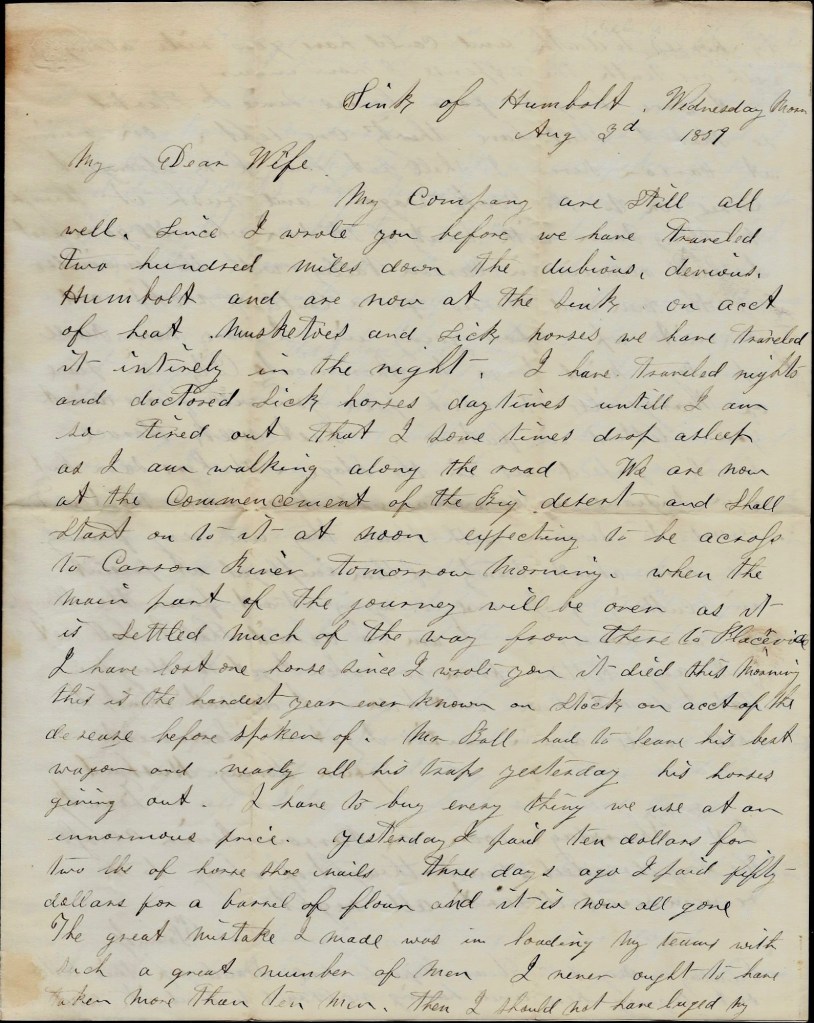
Sink of Humboldt 1 Wednesday morn, August 3rd 1859
My Dear Wife,
My company are still all well. Since I wrote you before, we have traveled two hundred miles down the dubious, devious, Humboldt [river] and are now at the sink. On account of heat, mosquitoes, and sick horses, we have traveled it entirely in the night. I have traveled nights and doctored sick horses daytimes until I am so tired out that I sometimes drop asleep as I am walking along the road.
We are now at the commencement of the Big Desert and shall start on to it at noon, expecting to be across to Carson River tomorrow morning when the main part of the journey will be over as it is settled much of the way from there to Placerville. I have lost one horse since I wrote you. It died this morning. This is the hardest year ever known on stock on account of the disease before spoken of. Mr. Ball had to leave his best wagon and nearly all his traps yesterday—his horses giving out. I have to buy everything we use at an enormous price. Yesterday I paid ten dollars for two pounds of horse shoe nails. Three days ago I paid fifty dollars for a barrel of flour and it is now all gone. The great mistake I made was in loading my teams with such a good number of men. I never ought to have taken more than ten men. Then I should not have lugged my horses to death and could have gone right along with one tenth the expense I now incur.
I have bought four horses since I started so that I still have thirty-one left. On arriving at Carson river, I shall put four of my strongest horses onto the cook wagon and rush it through to Hangtown with twenty of the men who will go on foot. I shall remain in Carson Valley with the remainder of the men and horses for a couple of weeks and recruit up before going in. I have now made up my mind to go to Sacramento City in place of Marysville to which place you will please direct your letters in future.
Last week Horace Greeley passed us in the stage. We have seen but few Indians until we arrived here where the country seems to swarm with them. They are very friendly. We have about twenty of them employed at present in cutting grass and bringing it out from the sloughs for our horses. I am so afraid that I shall not get any letters from you when I get to Hangtown that I do not know what to do. I do not think I shall write again until I get to Sacramento.
Your loving husband, — Frank
P. S. Thursday noon on Carson River across the long dreaded, much thought of, long to be remembered desert all right.
Sunday, August 7th. Dear wife, I had sealed up this letter but laying here and having no chance to send it, and having the blues pretty bad, and not being able to think of anything but you and home, I have torn it open again.
We are now on Carson River, one hundred and fifty miles from Hangtown. My horses are too weak to go on and it is death to them to stay here. The disease spoke of before (called “swelled neck”) 2 rages terribly all the way from here to California. It is a blue time for emigrants, Some have lost all of their teams and all have lost more or less. On an average fully one half of all the animals on the road have died. Mr. Ball has lost one half of his horses (five). Last night one of the sorrels that I have had so long died in ten minutes after he was taken sick. I have still got thirty horses but everyone says I will lose half of them before I get through. I can only hope that I will not. I am taking every precaution possible to save them. Mr. Shrake with seventeen of the men have gone on while nine remain with me. We shall probably stay here a week or two. My expenses are enormous at present and will. be for a long time until I can get through and get my horses fit for work and earn something.
My bright and cherished vision of being able to get out of debt once more (and for which I was willing to endure everything) has nearly vanished. Still I may not come out so bad after all. I try and keep up good courage.
Genoa. August 11th. Ninety miles from Placerville. Three more of the largest and best horses dead. I shall go on through in the next four days. I don’t expect to have money enough to get home on.
1 The Humboldt Sink marks the beginning of a very difficult part of the California Trail: the Forty-Mile Desert. During the California Trail’s 1800s heyday, over a quarter of a million emigrants traveling west through the land faced extremely challenging, dry terrain in this area.
2 The highly infectious disease was probably anthrax which can present with a swelling of the neck, chest and abdomen in horses. Death can incur with 24 to 48 hours.
1860
Letter 4
Fort Des Moines Saturday, April 21, 1860
My Dear Wife,
We arrived here yesterday morning and have concluded to remain for a few days as there is no prospect of grass and hay & corn is very cheap here. We are now five or six days drive from the Bluffs. There is quite a large emigration for California and about half of Iowa is going to Pike’s Peak.
The weather is very dry and it blows a gale all the time. We may stay here a week yet. We can get corn for from 15 to 18 cents and hay for two dollars per ton. We have got along first rate so far and I think we shall make a very quick trip. We had a little bit of a horse race today and got cleaned out of twenty-five dollars.
I find your likeness a great consolation. I wish I had one of all the children. I find it much harder to be separated from you than I had expected—much harder than last year. I hope you are feeling well and will get along all right until fall when I hope to be with you.
Be sure and write as often as possible. Give my love to all the children. Very affectionately yours, — F. H. West
Letter 5
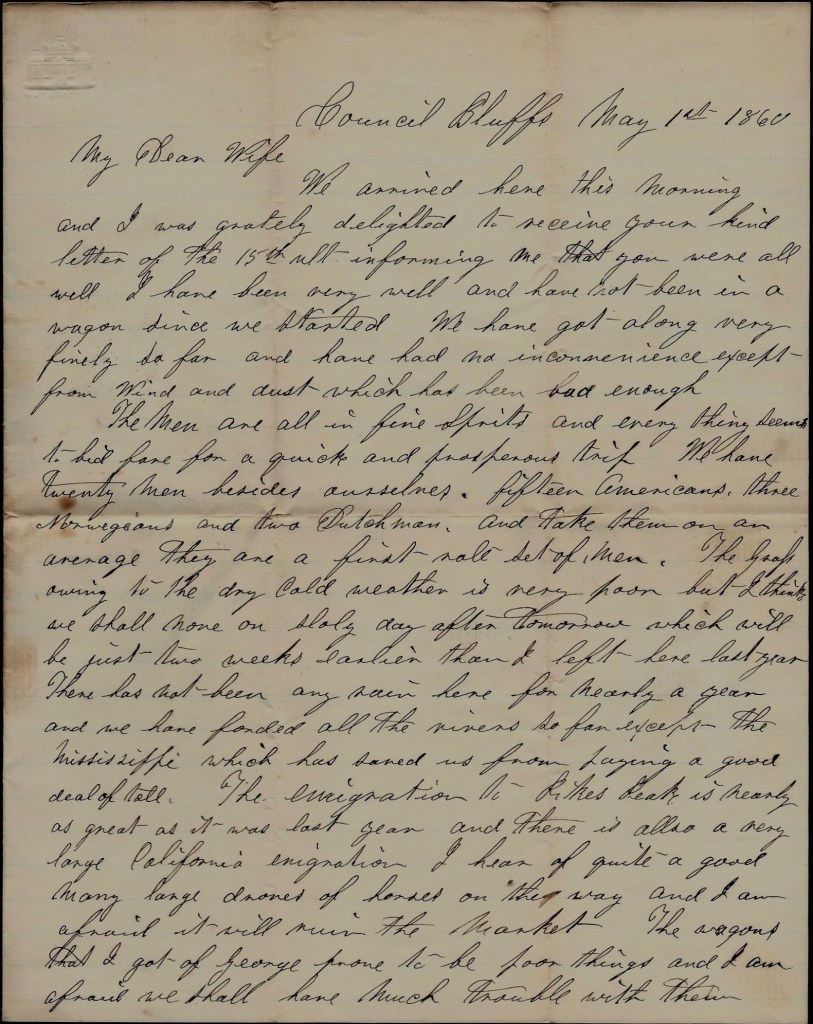
Council Bluffs May 1, 1860
My Dear Wife,
We arrived here this morning and I was greatly delighted to receive your kind letter of the 15th ult. informing me that you were all well. I have been very well and have not been in a wagon since we started. We have got along very finely so far and have had no inconvenience except from wind and dust which has been bad enough.
The men are all in fine spirits and everything seems to bid fair for a quick and prosperous trip. We have twenty men besides ourselves—fifteen Americans, three Norwegians, and two Dutchmen, and take them on an average. They are a first rate set of men. The grass owing to the dry weather is very poor but I think we shall move on slowly day after tomorrow which will be just two weeks earlier than I left here last year. There has not been any rain here for nearly a year and we have forded all the rivers so far except the Mississippi which has saved us from paying a good deal of toll.
The emigration to Pike’s Peak is nearly as great as it was last year and there is also a very large California emigration. I hear of quite a good many large droves of horses on their way and I am afraid it will ruin the market. The wagons that I got of George prove to be poor things and I am afraid we shake have much trouble with them.
My precious little wife, I hope it will not seem very long until we meet again and I am sure I hope it may never be necessary fr us to part again. Not a day has passed but what I have taken a good look at your portrait and felt how much I worshipped the original. I hope you will try and get along this summer as pleasantly as possible and concur with you in not desiring to cultivate the Kleckner acquaintance. I suppose I shall not hear from you again until I get to Salt Lake which seems a long time.
Tell Louey to see if she cannot improve so much in music as to astonish me when I come home. Write me how you get along about money matters. Give my love to Louey and Carrie and Edith and Willie and George and Susan. And my respects to all enquiring friends. Very affectionately yours, — Francis Henry West
Letter 6
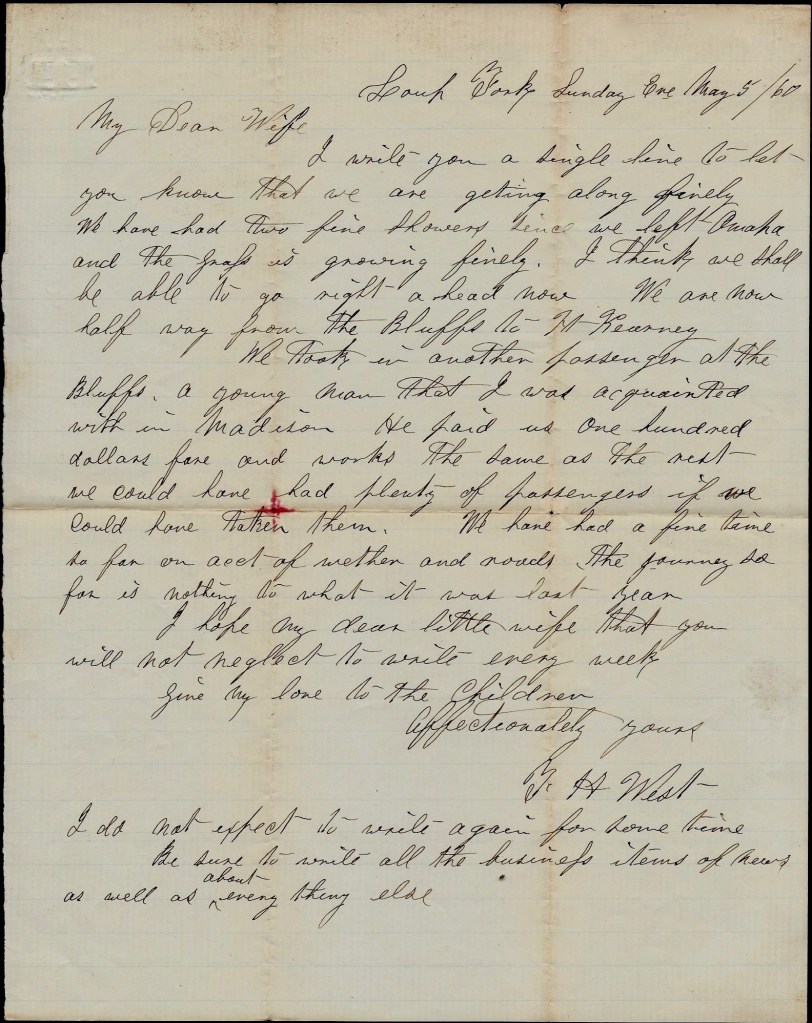
Loup Fork [Platte river] Sunday eve. May 5, 1860
My Dear Wife,
I write you a single line to let you know that we are getting along finely. We have had two fine showers since we left Omaha and the grass is growing finely. I think we shall be able to go right ahead now. We are now half way from the Bluffs to Ft. Kearney.
We took in another passenger at the Bluffs—a young man that I was acquainted with in Madison. He paid us one hundred dollars fare and works the same as the rest. We could have had plenty of passengers if we could have taken them. We have had a fine time so far on account of weather and roads, The journey so far is nothing to what it was last year.
I hope my dear little wife that you will not neglect to write every week. Give my love to the children. Affectionately yours, — F. H. West
I do not expect to write again for some time. Be sure to write all the business items on news as well as about everything else.
Letter 7
[Within 150 miles of Fort Laramie] Saturday eve, May 19, 1860
My Dear Wife,
We are all well and getting along finely, considering how poor and backward the grass is. We are now within a week’s drive of Fort Laramie (150 miles). Our horses are looking very well and we feel in good spirits thinking we shall have a easy and quick trip. We are pretty much ahead of all the emigration and have the road all to ourselves. There are a good many large droves of horses on the way which will somewhat effect the California market when they get in.
I do not expect to get a chance to mail this letter until we get to Laramie and perhaps not then, but I could not help writing to you. If I could only hear from you often, how much it would relieve the tediousness of the trip. I want you to write previous to June 15th and direct to Placerville. All after that, direct to Sacramento.
My dear wife, you. do not know how much my mind and heart and very soul is filled with you and I hope if I ever get home again with you, I shall be able to stay there.
Write very often to your affectionate husband, — F. H. West
Letter 8
Ft. Laramie Friday, May 25, 1860
My Dear Wife,
We arrived here today all right except a smashed wagon wheel. We are now making a raft to float over to Laramie on to get it mended. Am in hopes to get it done so as to leave here tomorrow afternoon.
We have got a first rate lot of men and are getting along finely. Be sure and write very often, my dear, dear wife, and give me every scrap of news—both business and political. Also all the gossip of the day. Tell me what everyone is doing and what all the children say, &c. &c. Also what you learn from Charlestown. You need not expect another letter for some time. I have read your kind letter sent to the Bluffs for the tenth time and kissed your dear sweet likeness for the hundredth time since I started.
You need not be afraid that I shall be drowned in crossing the river for the simple reason that I shall not cross.
I wish you had written me a letter to this place. — Frank
Letter 9
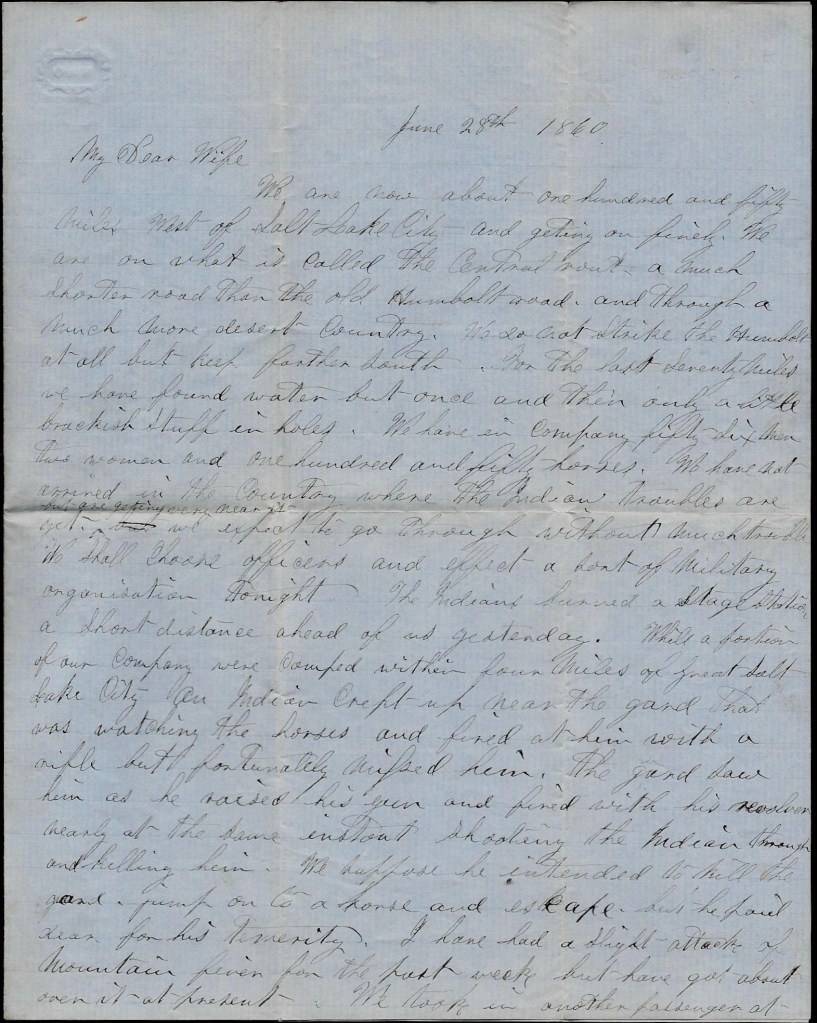
[150 west of Salt Lake City] June 28th 1860
My Dear Wife,
We are now about one hundred and fifty miles west of Salt Lake City and getting on finely. We are on what is called the central route—a much shorter road that the Old Humboldt Road—and through a much more desert country. We do not strike the Humboldt at all but keep farther south. For the last seventy miles we have found water but once and then only a little brackish stuff in holes. We have in company fifty-six men, two women, and one hundred and fifty horses. We have not arrived in the country where the Indian troubles are yet but are getting very near it. We expect to go through without much trouble. We shall choose officers and effect a sort of military organization tonight.
The Indians burned a stage station a short distance ahead of us yesterday. While a portion of our company were camped within four miles of Great Salt Lake City, an Indian crept up near the guard that was watching the horses and fired at him with a rifle but fortunately missed him. The guard saw him as he raised his gun and fired with his revolver nearly at the same instant, shooting the Indian through and killing him. We suppose he intended to kill the guard, jump onto a horse and escape but he paid dear for his temerity.
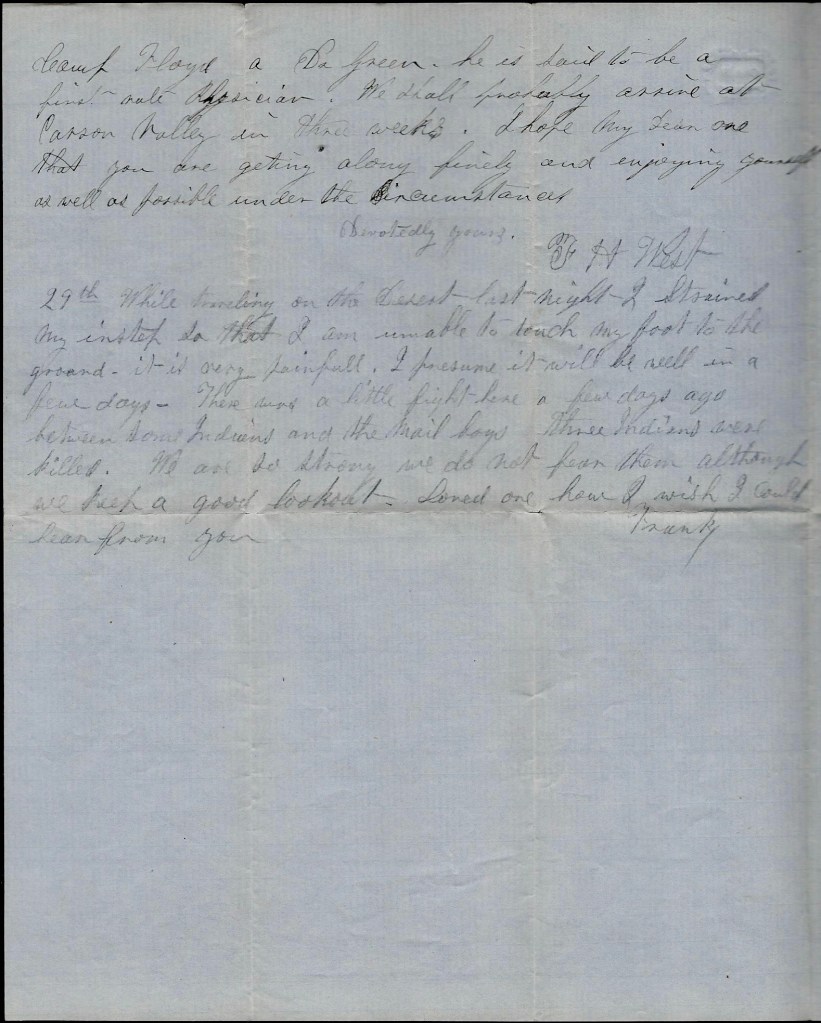
I have had a slight attack of mountain fever for the past week but have got about over it at present. We took in another passenger at Camp Floyd—a Dr. Green. He is said to be a first rate physician. We shall probably arrive at Carson Valley in three weeks. I hope my dear one that you are getting along finely and enjoying yourself as well as possible under the circumstances. Devotedly yours, — F H West
29th. While traveling on the desert last night, I strained my instep so that I am unable to touch my foot to the ground. It is very painful. I presume it will be well in a few days. There was a little fight here a few days ago between some Indians and the mail boys. Three Indians were killed. We are so strong, we do not fear them although we keep a good lookout. Loved one, how I wish I could hear from you. — Frank
Letter 10
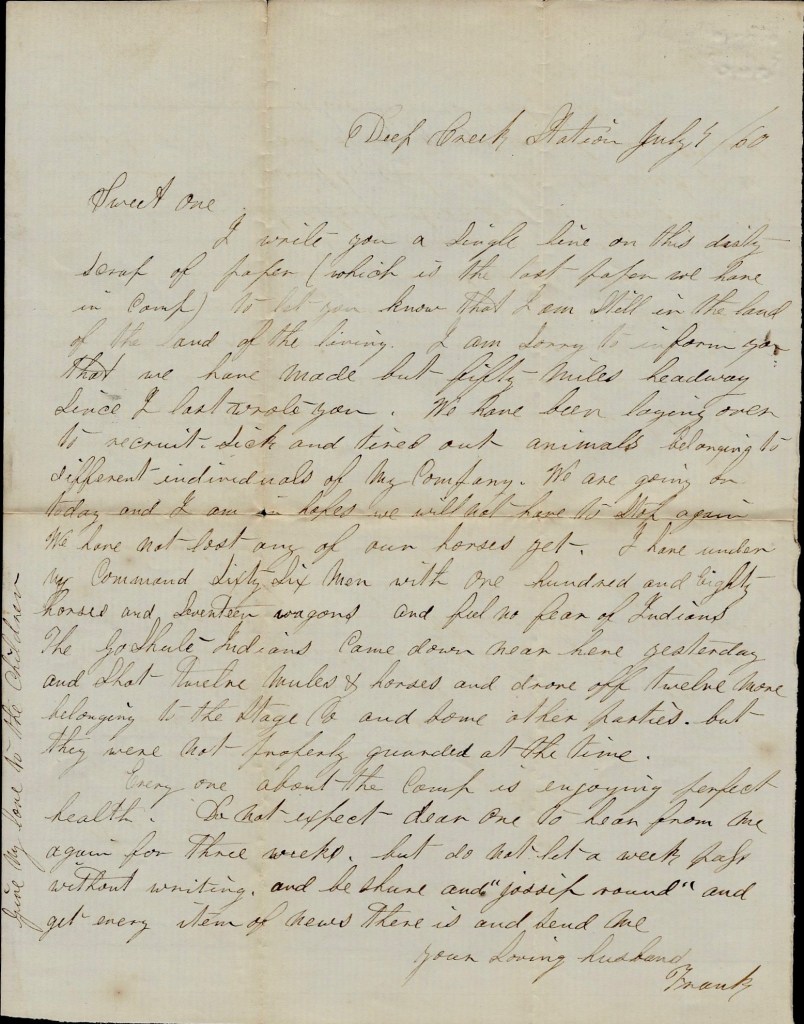
Deep Creek Station July 4, 1860
Sweet one,
I write you a single line on this dirty scrap of paper (which is the last paper we have in camp) to let you know that I am still in the land of the living. I am sorry to inform you that we have made but fifty miles headway since I last wrote you. We have been laying over to recruit sick and tired out animals belonging to different members of my company. We are going on today and I am in hopes we will not have to stop again. We have not lost any of our horses yet.
I have under my command sixty-six men with one hundred and eighty horses and seventeen wagons and feel no fear of Indians. The Goshute Indians came down near here yesterday and shot twelve mules & horses and drove off twelve more belonging to the stage company and some other parties but they were not properly guarded at the time.
Everyone about the camp is enjoying perfect health. Do not expect, dear one, to hear from me again for three weeks, but do not let a week pass without writing and be sure and “gossip round” and get every item of news there is and send me. Your loving husband, — Frank
Give my love to the children.
Letter 11
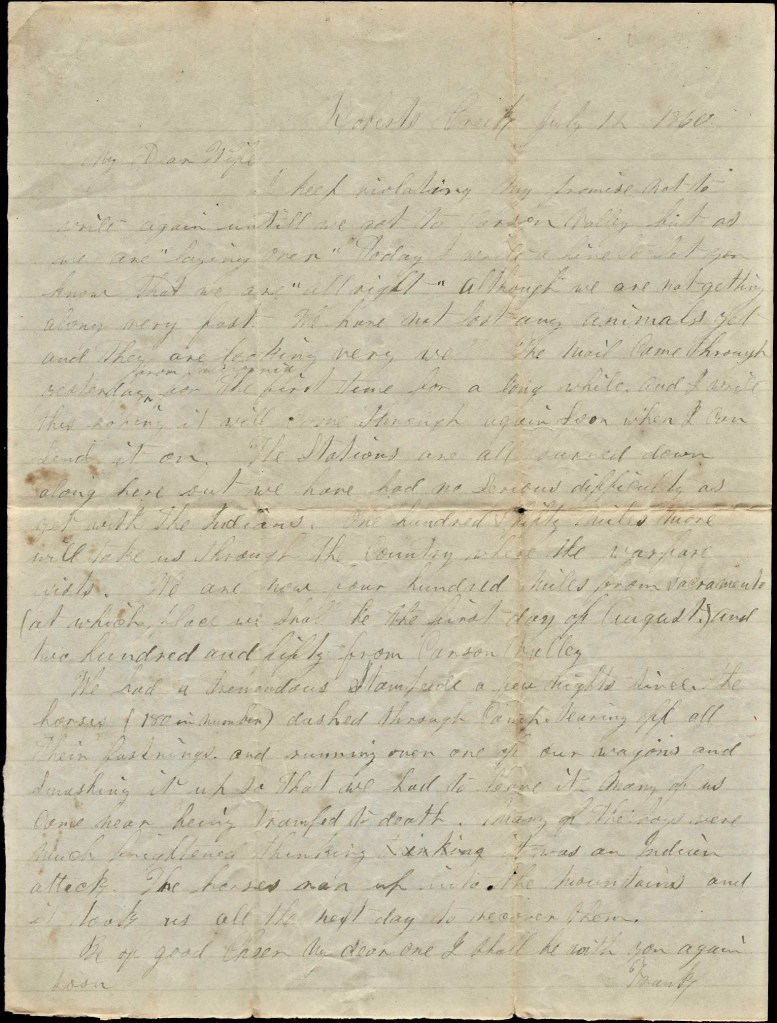
Roberts Creek [present day Nevada] 1 July 12, 1860
My Dear Wife,
I keep violating my promise not to write again until we get to Carson Valley but as we are “laying over” today, I write a line to let you know that we are “all right” although we are not getting along very fast. We have not lost any animals yet and they are looking very well.
The mail came through yesterday from California for the first time for a long while and I will send this hoping it will come through again soon when I can send it on. The stations are all burned down along here but we have had no serious difficulty yet with the Indians. One hundred and fifty miles more will. take us through the country where the warfare exists. We are now four hundred miles from Sacramento (at which place we shall be the first day of August) and two hundred and fifty from Carson Valley.
We had a tremendous stampede a few nights since. The horses (180 in number) dashed through camp tearing up all their fastenings and running over one of our wagons and smashing it up so that we had to leave it. Many of us came near being trampled to death. Many of the boys were much frightened thinking it was an Indian attack. The horses ran up into the mountains and it took us all the next day to recover them.
Be of good cheer, my dear one. I shall be with you again soon. — Frank
1 The Roberts Creek Pony Express Station was built in the spring of 1860. It seems that the station was still intact around May, 1860. After this time it is thought that the station was destroyed by Indians and Bolivar Roberts set out to rebuild destroyed stations and restock them. This time the buildings were better constructed and men left to occupy each one until the Indian troubles were over. On June 16 they met Howard Egan at Robert’s Creek. Robert’s Creek Station was a telegraph station as well as an Overland Stage Station. It was an Overland stop until 1869. The site of the station is now on the Robert’s Creek Ranch owned by Filbert Etcheverry of Bakersfield, California. Peter Damele noted the old Pony Express station, a log structure, has long since been obliterated by the owners. There is a log dugout very near the Express site he described, but no one knows if it is part of the original station or not. Robert’s Creek is 15 miles north of Highway 50.
Letter 12
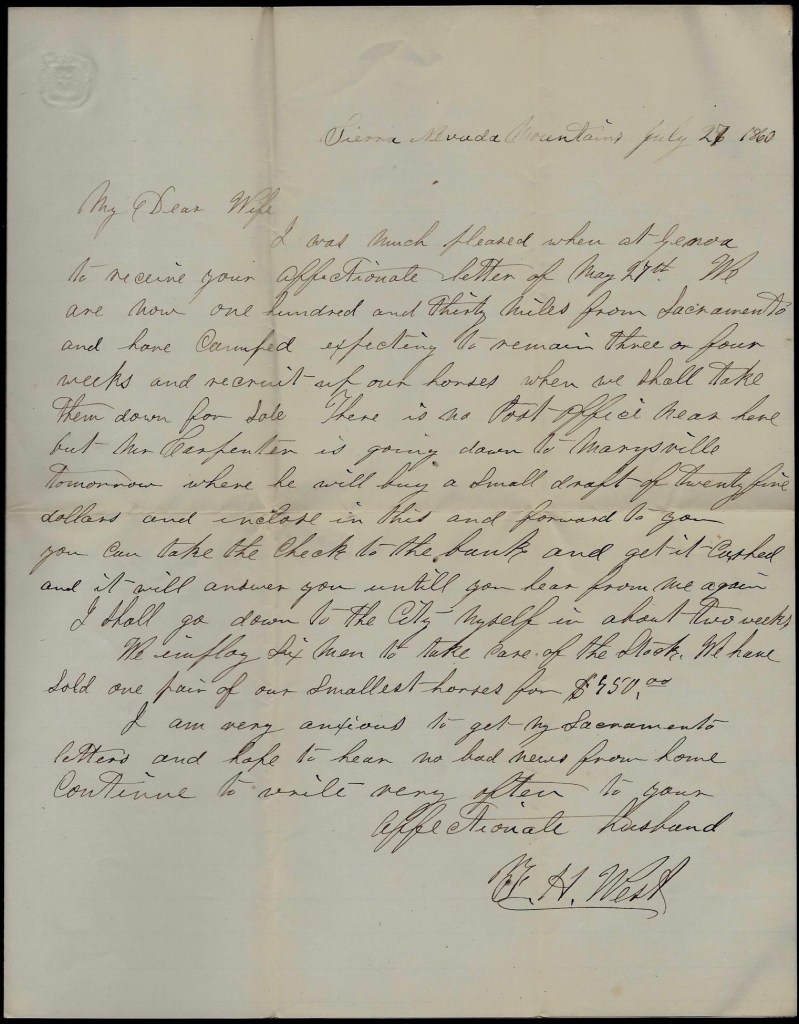
Sierra Nevada Mountains July 27, 1860
My Dear Wife,
I was much pleased when at Genoa to receive your affectionate letter of May 27th. we are now one hundred and thirty miles from Sacramento and have camped expecting to remain three or four weeks and recruit up our horses when we shall take them down for sale. There is no post office near here but Mr. Carpenter is going down to Marysville tomorrow where he will buy a small draft of twenty-five dollars and enclose this and forward to you. You can take the check to the bank and get it cashed and it will answer you until you hear from me again.
I shall go down to the City myself in about two weeks. We employ six men to take care of the stock. We have sold one pair of our smallest horses for $450.00.
I am very anxious to get my Sacramento letters and hope to hear no bad news from home. Continue to write very often to your affectionate husband, — F, H. West
Letter 13
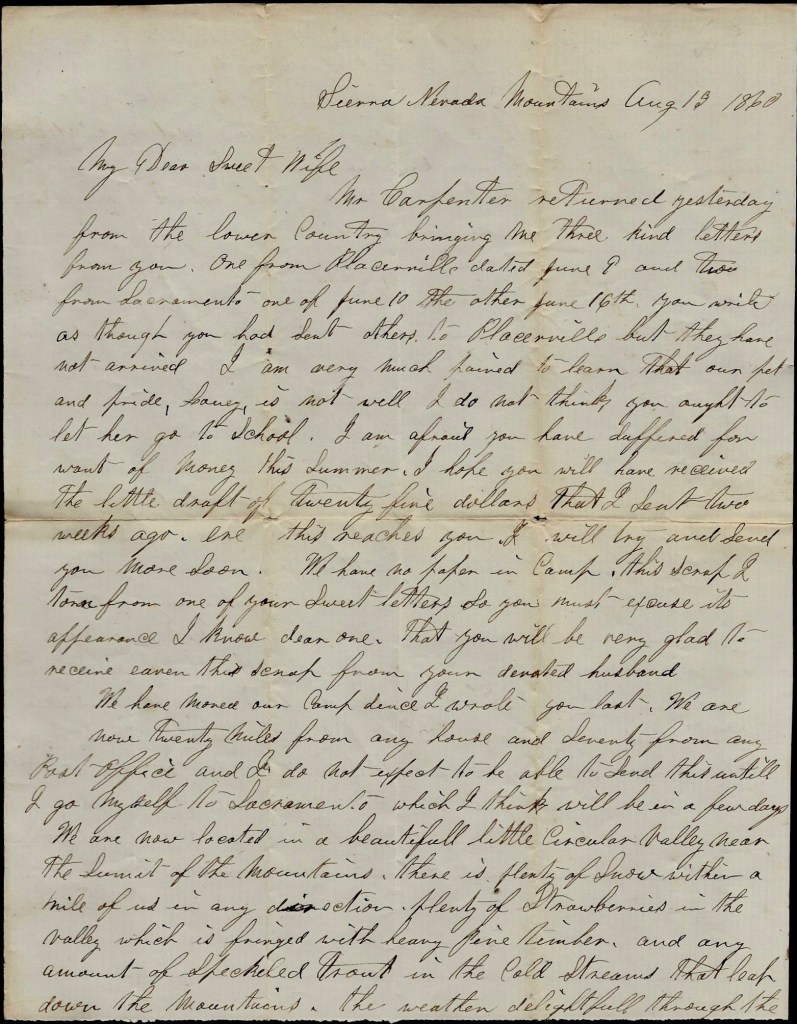
Sierra Nevada Mountains August 12, 1860
My Dear Sweet Wife,
Mr. Carpenter returned yesterday from the lower country bringing me three kind letters from you—one from Placerville dated June 9th, and two from Sacramento, one of June 10th and the other June 16th. You write as though you had sent others to Placerville but they have not arrived. I am very much pained to learn that our pet and pride, Louey, is not well. I do not think you ought to let her go to school. I am afraid you have suffered for want of money this summer. I hope you will have received the little draft of twenty-five dollars that I sent two weeks ago ere this reaches you, I will try and send you more soon. We have no paper in camp. This scrap I tore from one of your sweet letters so you must excuse its appearance. I know, dear one, that you will be very glad to receive even this scrap from your devoted husband.
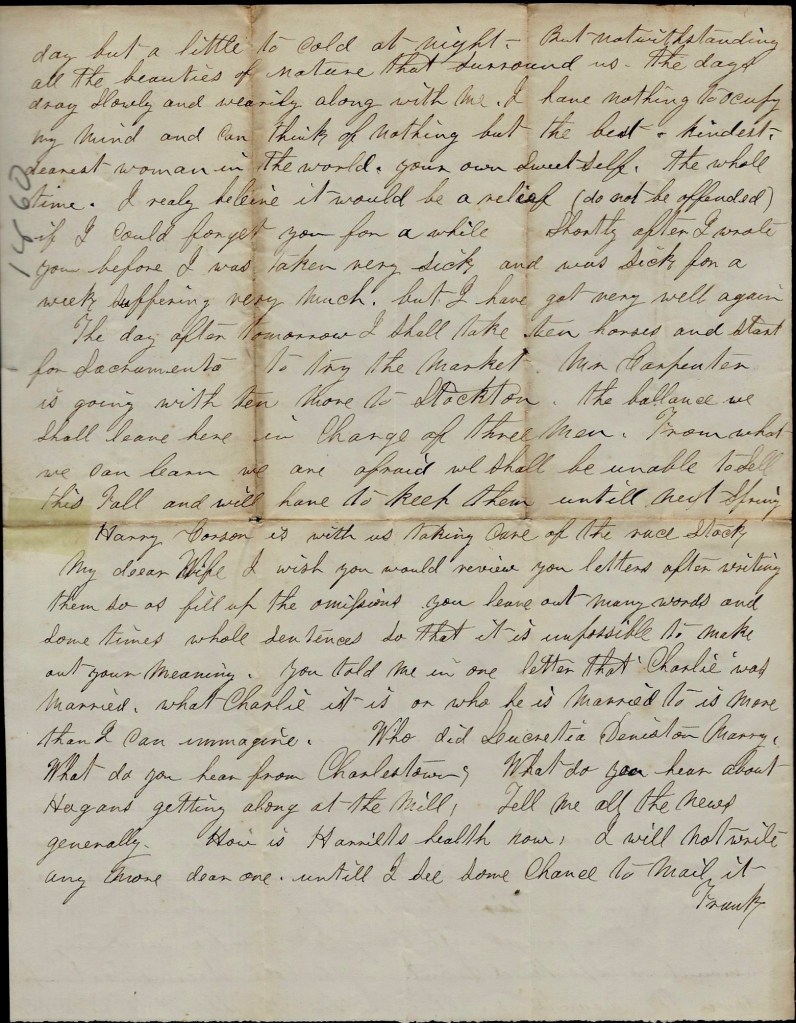
We have moved our camp since I wrote you last. We are now twenty miles from any house and seventy from any post office and I do not expect to be able to send this until I go myself to Sacramento which I think will be in a few days. We are now located in a beautiful little circular valley near the summit of the mountains. There is plenty of snow within a mile of us in any direction—plenty of strawberries in the valley which is fringed with heavy pine timber and any amount of speckled trout in the cold streams that leap down the mountains. The weather delightful through the day but a little too cold at night. But notwithstanding all the beauties of nature that surround us, the days drag slowly and wearily along with me. I have nothing to occupy my mind and can think of nothing but the best & kindest, dearest woman in the world—your own sweet self—the whole time. I really believe it would be a relief (do not be offended) if I could forget you for awhile.
Shortly after I wrote you before, I was taken very sick and was sick for a week suffering very much. But I have got very well again.
The day after tomorrow I shall take ten horses and start for Sacramento to try the market. Mr. Carpenter is going with ten more too Stockton. The balance we shall leave here in charge of three men. From what we can learn, we are afraid we shall be unable to sell this fall and will have to keep them until next spring.
Harry Carson [Corson?] is with us taking one of the race stock.
My dear wife, I wish you would review your letters after writing them so as to fill up the omissions. You leave out many words and some times whole sentences so that it is impossible to make out your meaning. You told me in one letter that Charlie was married. What Charlie is it or who he is married to is more than I can imagine. Who did Lucretia Deniston marry? What did you hear from Charlestown? What do you hear about Hogans getting along at the mill? Tell me all the news generally. How is Harriet’s health now> I will not write any more, dear one, until I see some chance to mail it. — Frank
Letter 14
Sacramento [California] September 9th [1860]
My Dear Wife,
I have just received two long expected and very welcome letters from you. It is the first news I have had from home. They came down from Placerville. One was dated June 26th, the other July 5th. I have not received the one from Fred. I ought to receive some of much later date from you by this time.
I wrote you a few days since requesting you to write me at San Francisco. I shall probably leave there for New York before the letter reaches there. The steamers sail on the 5th and 20th of each month. I intend if possible to sell out my horses so as to take the steamer on the 5th of October and I want you to write immediately on receipt of this and direct to New York, Care of Mr. Briggs of the “Brandreth House.” I shall probably go up to Charlestown before going home and I want to be sure and hear from you as soon as I arrive.
My horses have come down from the mountains and looking much better than when I left them. I have fourteen yet to sell which it may take me some time to dispose of as times are very hard here as well as in Wisconsin and all. kinds of property very low. “Emigrant horses” are the only thing in fact that will sell at all. I have sold twelve for twenty-six hundred and ten dollars. My expenses are very heavy necessarily. The horses that I lost would have brought me three thousand dollars.
The State Fair commences next Tuesday and judging from the preparations that are being made, is to be a grand affair. I am very anxious to hear how George is doing. Write me in your New York letter.
I do not think I can take time to go and see any of my cousins in this country. Give my love to all the little ones. My respects to my friends and try and get along the best you can, my dear little wife, until I get home which will be in a very short time if I have no bad luck.
Your very affectionate husband, — Francis H. West
Letter 15
Confidential
Sacramento [California] September 10th 1860
My Dear Wife,
I have just received your letter of August 6th. I have received none between that date and June 19th. I cannot think it possible that you have neglected to write to me for so long a time. I am very glad to hear that you are getting along so well. I have been very busy since my stock came down from the mountains and it keeps me all the time showing customers horses. I am selling them off very rapidly but at low prices. I have already sold over forty at an an average of $260 per head. If I can sell the balance as well, we shall make about eight thousand dollars clear. Could I have the whole of this as I should have had if I had had any capital to have gone on, it would have paid me first rate, but come to divide it, it don’t amount too much. I have the whole business here to see to.
Mr. Carpenter, on account of some pecuniary difficulty that his brother here has got them into, has had to make his property over to me and keep himself out of sight. I suppose he will sail for home on the steamer tomorrow. This is strictly confidential and must not be mentioned to anyone. Neither must any part of this letter as to when I am coming home or how poor getting along selling horses. I have some little matters that I wish to arrange at home before it is known when I am coming home or that I have got any money, so keep mum.
I expect the balance of my horses will sell very slow, but the State Fair commences here next week when I am in hopes to close out most of them in which case I shall start for home in four or five weeks. In any case, I think I shall force sales so as to start by the first of November. I am the worst troubled to know what to do with the race horses. They are unfit to sell or do anything else with this fall. I guess I shall leave them.
My sweet wife, if I have good luck, it will be but a short time until I shall be with you.
The weather is cool and delightful. I hope I shall receive several letters from you before I start home. I am glad Louise is getting along so well with her music. Tell al the children that I am very anxious to see them.
I sent a business letter to Mr. Ludlow by Pony Express today. Affectionately yours, — F. H. West
Letter 16
Sacramento [California] September 23, 1860
My Dear Wife,
I have received but one letter from you since June 19th and must conclude that you are either sick or very negligent. I hope the latter, But my dear one, I hope that in a very few days after you receive this you will have a chance to explain the matter to me in person. I expect to sail on the next steamer which goes out on the first day of October and shall probably reach home between the 25th and 28th. I shall have to stop a day at Rochester, New York, to settle with Mr. Carpenter. The very moment you read this, write me at New York, care of J. G. Briggs, Brandreth House.
I have sold out all. but my race stock and shall leave them if I do not sell this week. The State Fair is now in successful operation here. I shall send the second bills of exchange to you by Overland Mail when I start.
I am still in hopes of hearing from you before I start. Say nothing about it. Affectionately yours, — F. H. West
Eve. 23rd. The steamer and Overland Mails are just in but nothing from you. I learn from Dr. Young whose wife thinks enough of her husband to write to him once in awhile, that you were all well on the 21st of last month. You will not receive this in time to write me at New York. I hope the children have not forgotten me if someone else has, — Frank

















 Spared & Shared 23