
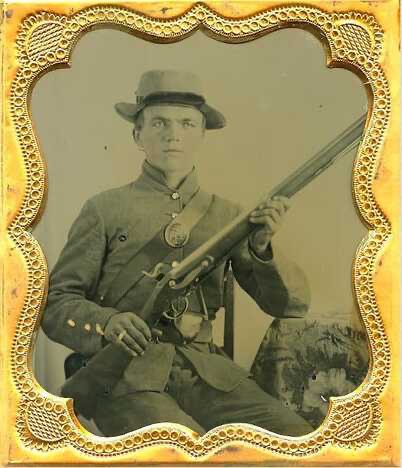
The 7th – 12th Regiments all received grey uniforms when they re-enlisted for three years, likewise the 13th – 22nd Regiments were also issued grey uniforms which consisted of a grey jacket, and trousers, and grey broad brimmed hat. ‘The fatigue suit is a shirt, pantaloons and “Zouave” cap in a firm hickory cloth’, noted the Chicago Tribune in April 1861.
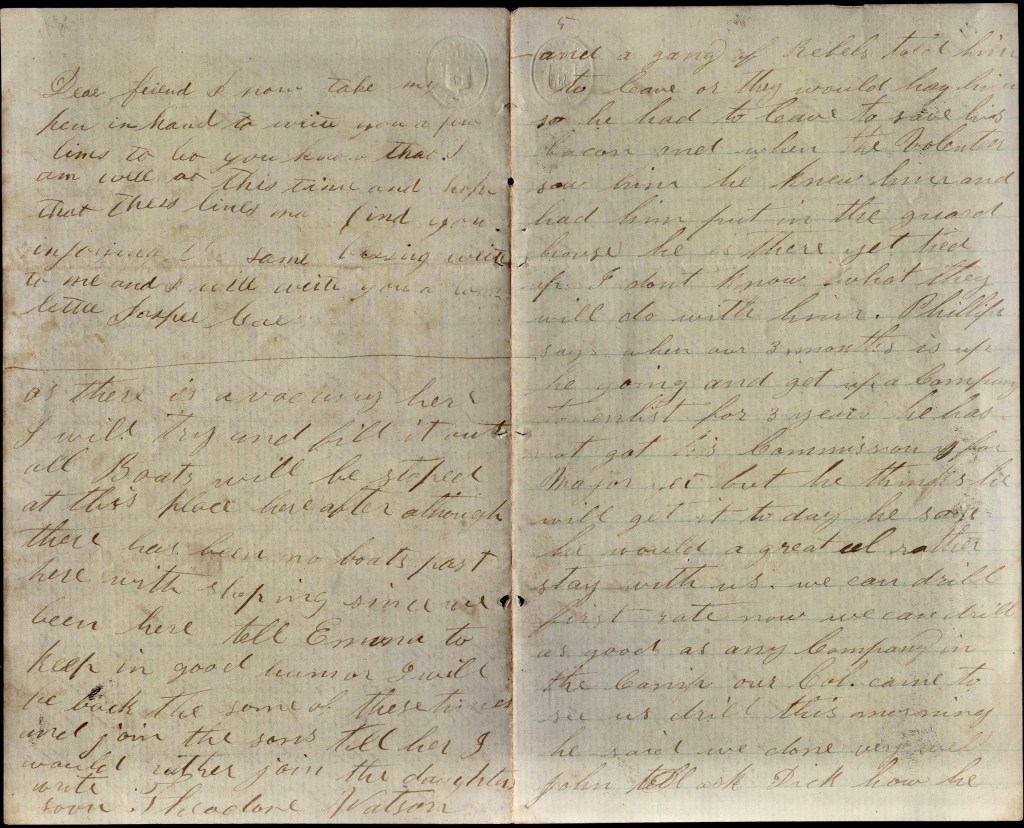
This letter was composed by Theodore Watson (1838-1864) during his service in Company H, 3rd Illinois Infantry (3-month enlistment) regiment. Ten of Theodore’s letters, authored between April 27th and July 7th while in this regiment, are preserved in the Newberry Library in Chicago, while this particular letter remains in private possession.
Watson’s correspondence reflects a mix of enthusiasm for the rigors of army life, where morale is relatively high, and provisions are adequate, allowing for sufficient rest. Upon the company’s establishment at Camp Defiance in Cairo, Watson expresses a sense of well-being and readiness for the tasks ahead, enjoying activities such as singing, games, swimming, and the general camp experience. Yet, by early July, despite his initial pride in the military skills of his unit, he has become weary and disillusioned, experiencing ill health. Consequently, Watson cautions his brother John against enlisting, as he himself also declines to commit to the extended three-year enlistment.
Theodore was the son of John Watson (1806-1890) and Mary Eliza Kelly (1802-1853) from Hillsboro, Montgomery County, Illinois. He died in 1864 in Hillsboro, apparently from disease.

T R A N S C R I P T I O N
[Camp Defiance] Cairo, [Illinois]
May 9th 1861
Dear Brother,
I received yours of the 8th with great pleasure . You had better believe I was anxious to hear from you. We have got a better place now to sleep in, We have built some barracks here. WE have got fixed up nicely. But Major [Jesse J.] Phillips says he would not be surprised if we were sent to Texas. We would all like to go there. Here is the idea. We would get to see the country if nothing more. Everything is quiet here. No fighting yet. We are all spoiling for a fight. You said you heard that the secessionists were building batteries on the Kentucky shore, I guess there is nothing of it. There were some of our boys over on the Kentucky shore the other day. They say there were no signs of batteries over there. But excuse me from going over there although they got back safe. We get papers here every day. We hear all the news.
You want me to give you a description of Cairo. Cairo is the nastiest place I ever was in. The levee is on a pretty high place but back of the levee it is lower than the river. Some of the houses are built in ponds, Our camp is at the edge of Cairo in a low place but it is a very good place in dry weather. We have had a little rain here but not much. We are in a dry place.
I guess the election will come off today for electing our Captain Jim Munn is a going to run against [John W.] Kitchell. I don’t know which will be elected. I am a going to vote for Kitchell. Kitchell was appointed Adjutant General at Springfield but if he is elected Captain he will resign his present position. They say there are about 30 six-pounders scattered along the river. There are only 5 six-pounders in this place but no secessionists can land here. It is as Col. Prentiss says, we are ready for them. I have not seen Colonel Prentiss yet although some of the boys has. I don’t know what kind of a looking man he is. The Colonel of our regiment, Col . [Eleazer A.] Payne, is a very nice kind of a man.
Ira Clark took sick yesterday. He went to the hospital last evening. The rest of us are all well, fat and saucy. I believe we could whip the whole South. Dinner is about ready now. I will leave the rest till after dinner. I am very hungry.
Well, John, I have are my dinner and feel very much refreshed. I drank about a pint and a half of coffee. You said you heard the Ohio was poisonous. There is nothing of it. There was a man taken here yesterday as a spy. One of the volunteers in our camp was acquainted with him in Kentucky. The volunteer said he was living in Kentucky when this spy and a gang of rebels told him to leave or they would hang him so he had to leave to save his bacon and when the volunteer saw him, he knew him and had him put in the guard house. He is there yet, tied up. I don’t know what they will do with him. Phillips says when our three months is up, he is going and get up a company to enlist for three years. He has not got his commission for Major yet but he thinks he will get it today. He says he would a great deal rather stay with us. We can drill first rate now. We can drill as good as any company in the camp. Our Colonel came to see us drill this morning. He said we done very well.
John, ask Dick how he like packing flour. Tell him I wouldn’t exchange places with him [for] anything. Tell him I don’t see how it makes his knuckles sore as it never made mine sore. When it gets warm weather, I guess he will wish he never saw the mill—that is, if you. run all the time. John, I would rather do anything else than pack flour in the summer time. I like it very well here except cooking. That is what I hate the most. we don’t see a woman here once in a week. If one of the Hillsboro girls wish to come down here and look for us, tell them we will give them their board if they cook and wash for us. But they will find that we are a pretty hard set here. John, bring your girl here some day and take dinner with us. John, you mustn’t run around with the girl too much. John, this is a very warm day but we have cool nights.
John, I am afraid if I write any more, I will not have anything for next time. I wrote to father yesterday. I guess I will not write any more till I hear from some of you again. I will not close this yet for I may get some more ideas between now and evening.
You want to know what Henderson knows about his girls. How does he know they are all right. Tell Emma I will be back there some of these times and join the sons. Give my folks my respects and write soon. — Theodore
As there is a vacancy here I will try and fill it out. All boats will. be stopped at this place hereafter although there has been no boats past here with stopping since we’ve been here. Tell Emma to keep in good humor, I will be back there some of these times and join the Sons. Tell her I would rather join the Daughters. Write soon. — Theodore Watson



 Spared & Shared 23