Category Archives: Camp Dennison

1862: Basil H. Maxwell to friend Mattie

The following letter was written by Basil H. Maxwell (1837-1916) of Steubenville, Jefferson county, Ohio, who enlisted on 13 August 1862 as a private in Co. E, 52nd Ohio Volunteer Infantry (OVI) He served three years, mustering out on 3 June 1865.
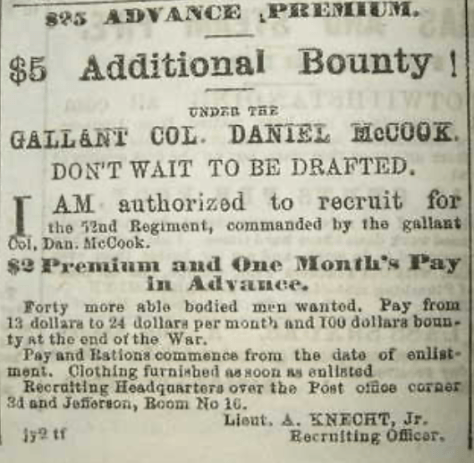
Recruiting bonus advertisement for enlistment in the 52nd OVI

Basil was the son of William and Sophia (Dural) Maxwell. He did not marry until 1872 when he took Emily Catherine Urquhart (1847-1899) as his wife.

The 52nd Ohio was commanded by Col. Daniel McCook. They began their training at Columbus but completed it at Camp Dennison near Cincinnati. They were mustered into service on 23 August 1862, the day before this letter was penned. Two days later they were marched to Cincinnati and crossed the Ohio River to Covington, Kentucky, where the command boarded railroad cars for Lexington, Kentucky. They were there assigned to the 36th Brigade, 11th Division, Army of Ohio. Their first engagement was in the Battle of Perryville on 8 October 1862.

T R A N S C R I P T I O N

[Camp Dennison, Ohio]
August 24, 1862

Dear Friend,

I again take the privilege of addressing you a few lines to let you know how I like the look of things by this time. Well as it regards camping, I like it very well. But when it comes to stand guard, I don’t think it is so nice as sitting in the parlor beside of a nice little woman like I have seen not long ago. I think I can tell about the time the moon gets up now without an almanac.

Well, Mattie, this is Sunday and it is awful to think how men that has been born and raised in a civilized nation will carry on ,swear and dance, and do everything that is unbecoming for a civil man to be guilty of. Well this [is] a gay place and gay people here. The women are no ways backward. They just walk past the guard as though they had a right to. But you know that the women are as independent as a hog on ice.

If you was here and could see this camp (which you could), I know you would say it was the grandest thing you ever saw. It is a beautiful place most assuredly. Well, there was a man got on a drunk and went to a little town below the camp and got a gun and broke in a drug store through the window and played thunder. Col. [Daniel] McCook ordered the guard to take him so they went down, brought him up, and the Colonel said that he would have to walk around the pump for five days with a guard around him and I tell you, the Colonel made things go just as he says.

We are uniformed and equip[ped] and we have as much harness on us as would harness two horses. If we ever get back, we will be good to peddle table cloths or pack salt. Well, I sent you a few lines by Hastings and I suppose you got them. I wish you could just see Miller and I. You would laugh I know for my pants are big enough for Old Jimmy Anderson and the legs are wide enough for wool sacks. The balance of our suit does very well. We have tolerable good grub but no variety.

Well, I want you to write to me as soon as you can and give me every particular and tell me what has been going on since we left and what is the prospect for volunteers. So nothing more at this time but remain as ever your true friend, — B. H. Maxwell

to Mattie M. [ ]

Don’t let any person read this letter if you please.

1861: Cassius Newell Baker to “Friend Henry”

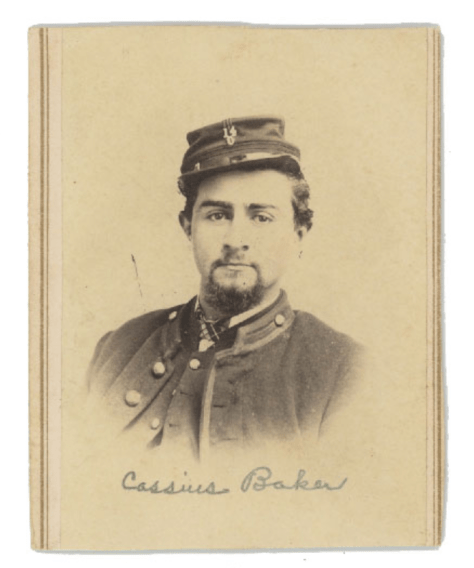
Cassius Baker (ca. 1864)

The following letter was written by Cassius Newell Baker (1844-1919), the son of Harris Porter Baker (1801-1879) and Emily C. Baker (1806-1852) of Mesopotamia, Trumbull county, Ohio. Cassius enlisted as a bugler on 8/20/61 in the 14th Ohio Independent Battery of Light Artillery. He reenlisted in 1864 and mustered out of the Battery on 8/9/65 at Camp Dennison.

After his service, Cassius married and relocated to Pottawattomie county, Kansas, where he worked as a retail grocer in Louisville. He later moved his grocery to Wamego.

T R A N S C R I P T I O N

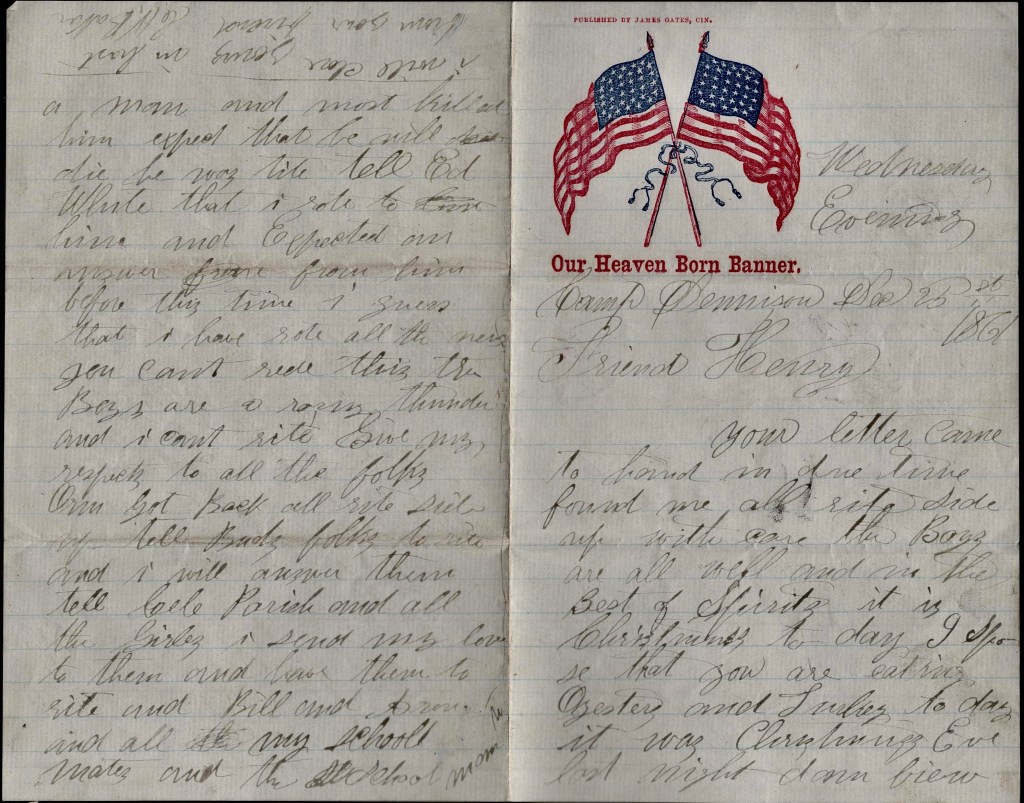
Camp Dennison
Wednesday evening, December 25, 1861

Friend Henry

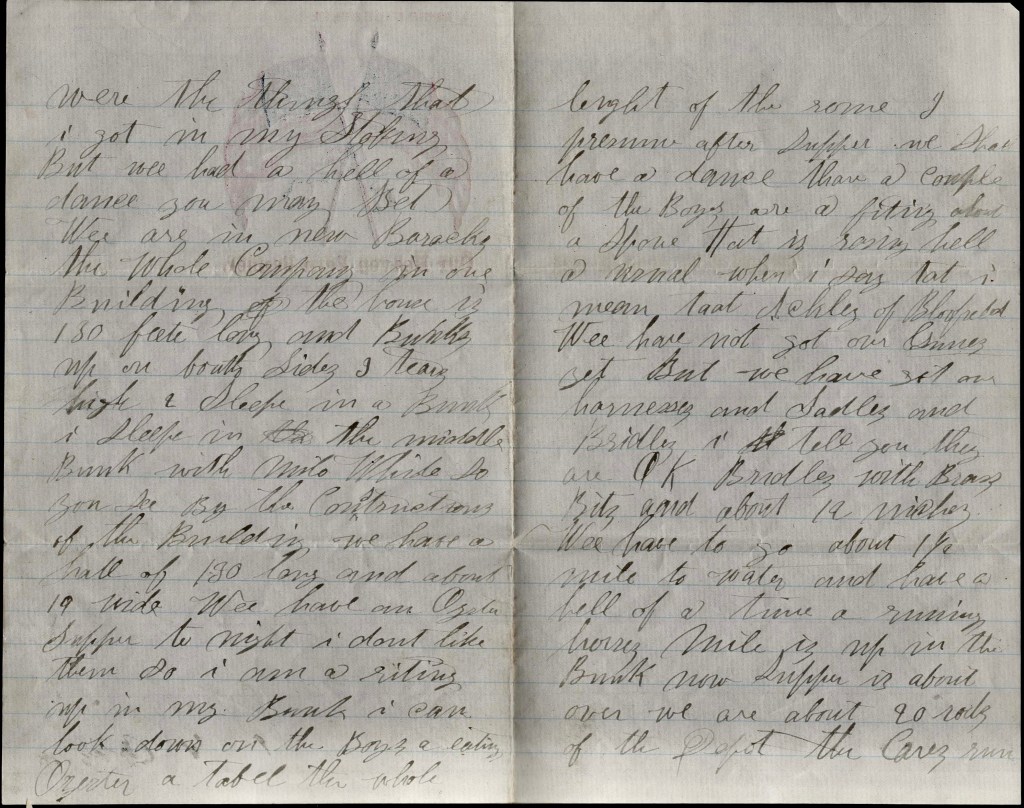
Your letter came to hand in due time [and] found me all right side up with care. The Boys are all well and in the best of spirits. It is Christmas today. I suppose that you are eating oysters and turkey today. It was Christmas eve last night. Few were the things that I got in my stocking but we had a hell of a dance you may bet.

We are in new barracks—the whole company in one building. The house is 130 feet long and bunks up on both sides three tiers high. Two sleep in a bunk. I sleep in the middle bunk with Milo White so you see by the construction of the building we have a hall of 130 [feet] long and about 19 wide. We have an oyster supper tonight. I don’t like them so I am a writing up in my bunk [while] the boys [are] eating oysters [at] a table the whole length of the room. I presume after supper we shall have a dance. Then a couple of the Boys are a fighting about a spoon [?]—that is, [?]. When I say that, I mean taat [?] Ackley of Bloomfeld.

We have not got our guns yet but we have got our harnesses and saddles and bridles. I tell you, they are O. K. Bridles with brass bits and about 12 inches.

We have to go about 1.5 miles to water and have a hell of a time a running horses. Miles is up in the bunk now. Supper is about over. We are about 20 rods (~100 yards) off the depot. The cars run [over] a man and most killed him. Expect that he will die. He was tight.

Tell Ed White that I wrote to him and expected an answer from him before this time. I guess that I have wrote all the news. You can’t read this. The boys are a raining thunder and I can’t write. Give my respects to all the folks. Orm got back all right side up. Tell Bud’s folks to write and I will answer them, Tell Cele Parish and all the girls I send my love to them and have them to write, and Bill and Aaron and all my school mates and the school mom too.

From your friend, — C. N. Baker

1862: Willis Augustus Wolcott to “Friend Pratt”

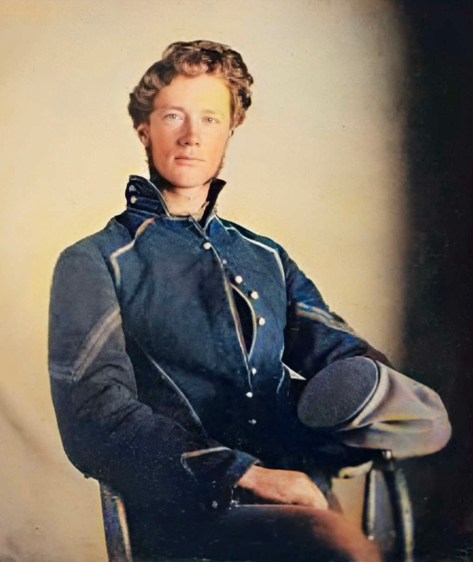
I could not find an image of Willis here is Solomon Large who was a bugler in the 6th OVC (ancestry.com)

The following letter was written by 35 year-old Willis Augustus Wolcott (1826-1890), the son of Daniel Russell Wolcott (1782-1872) and Philanda O. Atwood (1788-1867) of Orwell, Ashtabula county, Ohio. Willis claimed he was only 30 when he added his name to the muster rolls of Co. K, 6th Ohio Volunteer Cavalry (OVC) in October 1861. He did not remain on the rolls long, however. He was discharged for disability (“heart disease”) on 20 September 1862.

In January 1862 the regiment moved to Camp Dennison for drill instruction. In March it was assigned to Camp Chase to guard Confederate prisoners. The 6th Ohio moved to Wheeling, WV, on 13 May 1862. It entered Union field service, joining Fremont at Strasburg during his pursuit of Jackson down the Shenandoah Valley. On 7 June at the battle of Cross Keys, several Ohio cavalrymen were killed.

After a brief encampment at Strasburg, the regiment moved under Gen. Sigel, who had replaced Fremont. Coming under Gen. Pope’s command, the 6th Ohio faced Confederate fire at Rappahannock for 4 consecutive days. On 29 Aug., after the Second Battle of Bull Run, the 6th Ohio, along with the Union Army, retreated to Alexandria. Having passed the 1862-63 winter campaign guarding the passage of the Rappahannock, the 6th Ohio was reorganized for the spring campaign under the command of Gen. Hooker.

T R A N S C R I P T I O N

Camp Dennison
January 15, 1862

Friend Pratt, dear sir—

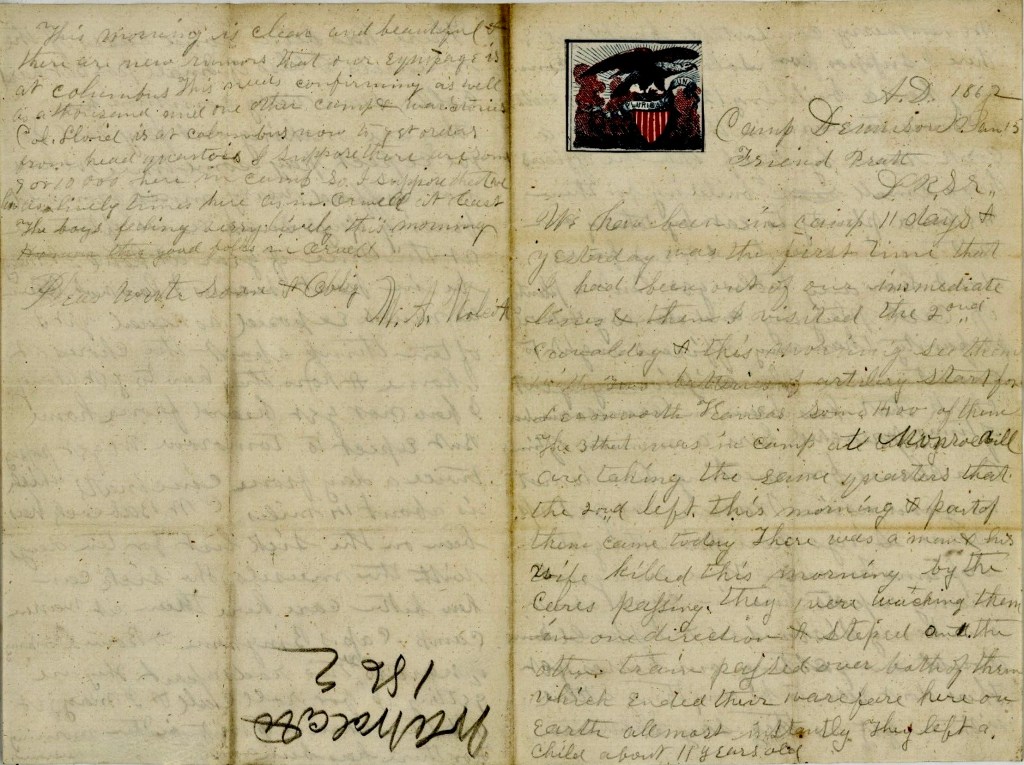
We have been in camp 11 days & yesterday was the first time that I had been out of our immediate lines & then I visited the 2nd Cavalry & this morning see them with two batteries of artillery start for Leavenworth, Kansas. Some 1400 of them. The 3 that was in camp at Monroeville are taking the same quarters that the 2nd left this morning & part of them came today.

There was a man and his wife killed this morning by the cars passing. They were watching them in one direction & stepped out [and] the other train passed over both of them which ended their warfare here on earth almost instantly. They left a child about 11 years old.

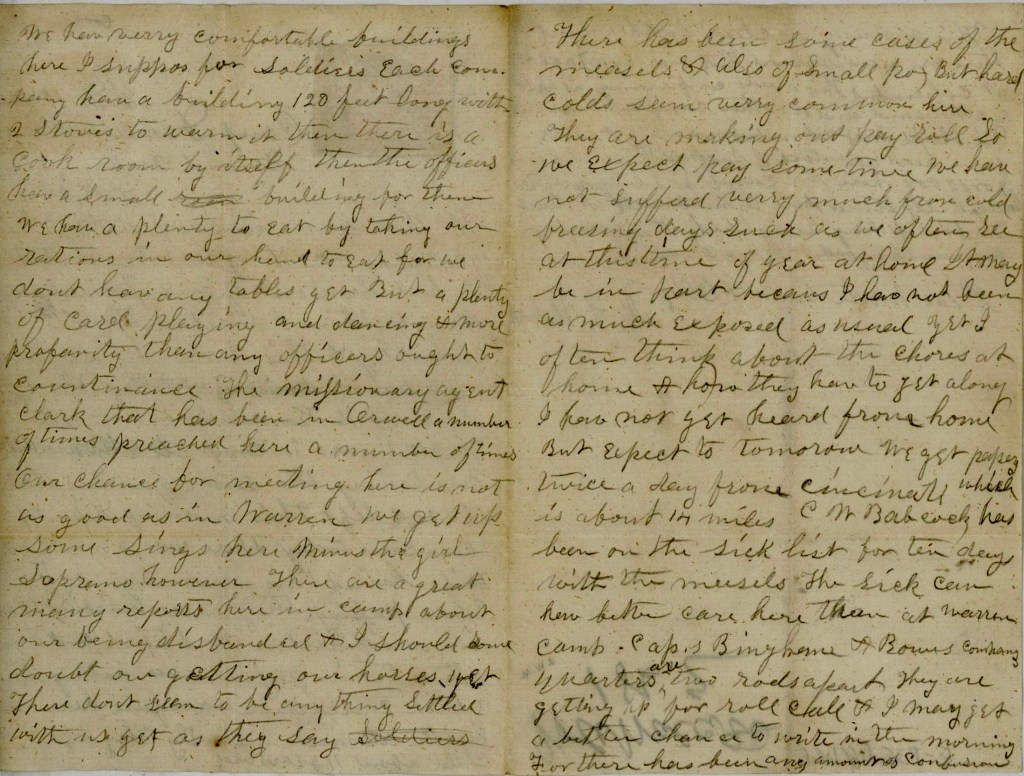
We have very comfortable buildings here, I suppose, for soldiers. Each company have a a building 120 feet long with two stoves to warm it. Then there is a cook room by itself. Then the officers have a small building for them. We have a plenty to eat by taking our rations in our hand to eat for we don’t have any tables yet, But a plenty of card playing and dancing & more profanity than any officers ought to countenance.

The missionary agent Clark that has been in Orwell a number of times preached here a number of times. Our chance for meeting here is not as good as in Warren. We get up some sings here minus the girl soprano, however. There are a great many reports here in camp about our being disbanded and I should some doubt our getting our horses yet. There don’t seem to be anything settled with us yet, as they say.

There has been some cases of the measles and also of small pox but hard colds seem very common here. They are making out pay rolls so we expect pay sometime. We have not suffered very much from cold freezing days such as we often see at this time of year at home. It may be in part because I have not been as much exposed as usual yet. I often think about the chores at home & how they have to get along. I have not yet heard from home but expect to tomorrow. We get papers twice a day from Cincinnati which is about 14 miles.

C. W. Babcock has been on the sick list for ten days with the measles, The sick can have better care here than at Warren Camp. Capts. [Amandar] Bingham and [Charles R.] Bowe’s company quarters are two rods apart. They are getting up for roll call and I may get a better chance to write in the morning for there has been any amount of confusion.

This morning is clear and beautiful. There are new rumors that our equipage is at Columbus. This needs confirming as well as a thousand and the other camp and war stories. Col. [William R.] Lloyd is at Columbus now to get orders from headquarters. I suppose there are some 9 or 10,000 here in camp. So I suppose the [ ] as lively times here as in Orwell. At least the Boys are feeling very lively this morning. How are the goo folks in Orwell?

Please write soon & oblige, — W. A. Wolcott

1862: Alice Maria (Lee) Warner to David Henry Lee

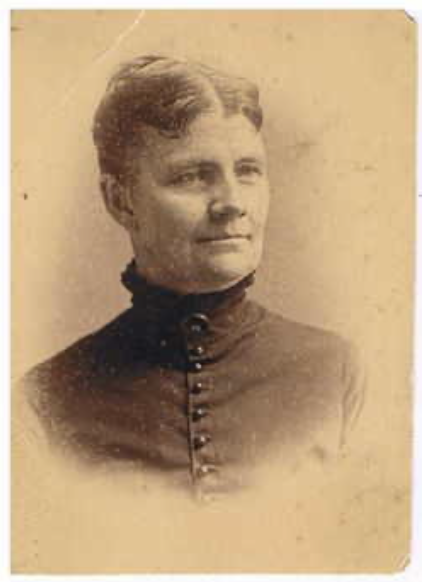
Maria (Lee) Warner

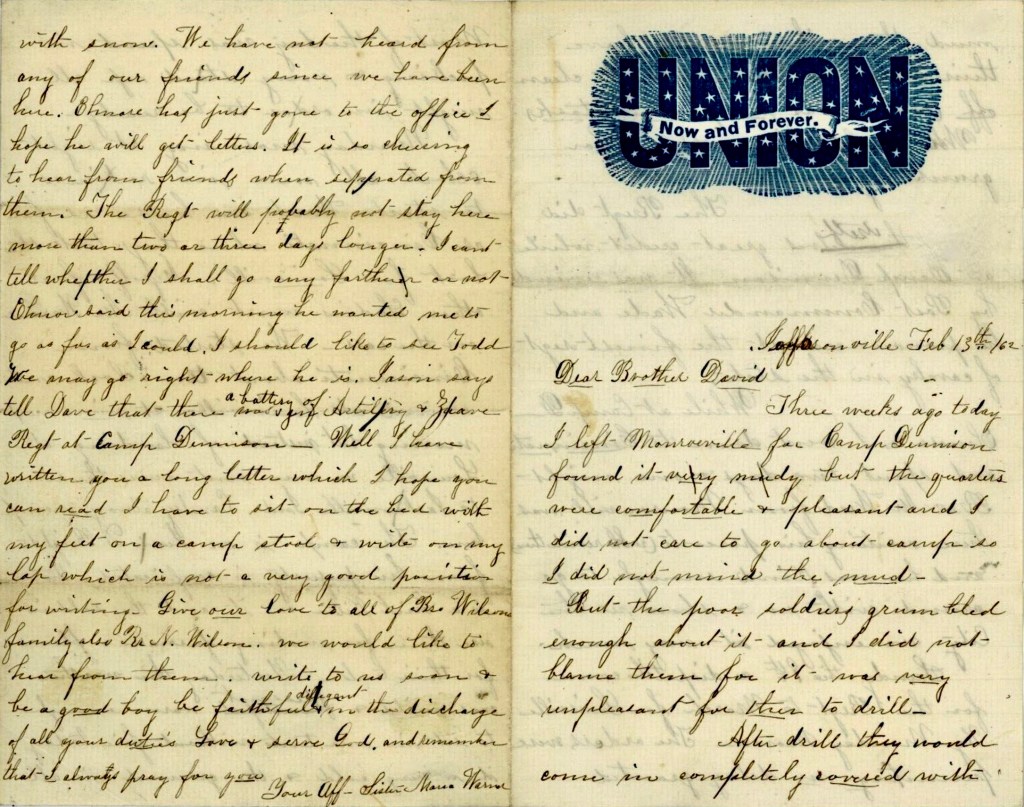
The following letter was written by Alice “Maria” (Lee) Warner (1843-1915), the daughter of Barton B. Lee (1811-1856) and Henrietta Lee Steele (1808-1869). Maria was married in October 1859 to Rev. Elmore Yocum Warner (1833-1886). She wrote the letter to her younger brother, David Henry Lee (1845-1912).

In her letter, Maria informs her brother of her travel in mid-February 1862 to visit her husband at Camp Dennison, Ohio, where he was serving as the Chaplain of the 3rd Ohio Cavalry. Her letter also describes the journey of the regiment from Camp Dennison to Camp Joe Holt near Jeffersonville, Indiana. She mentions a Zouave regiment drilling at Camp Dennison in February 1862 which may well have been the 54th Ohio Infantry. They wore Zouave uniforms that were identical to those of the 34th Ohio (Piatts Zouaves). They left for Paducah on 17 February 1862.

Transcription

Jeffersonville [Indiana]
February 13th 1862

Dear Brother David,

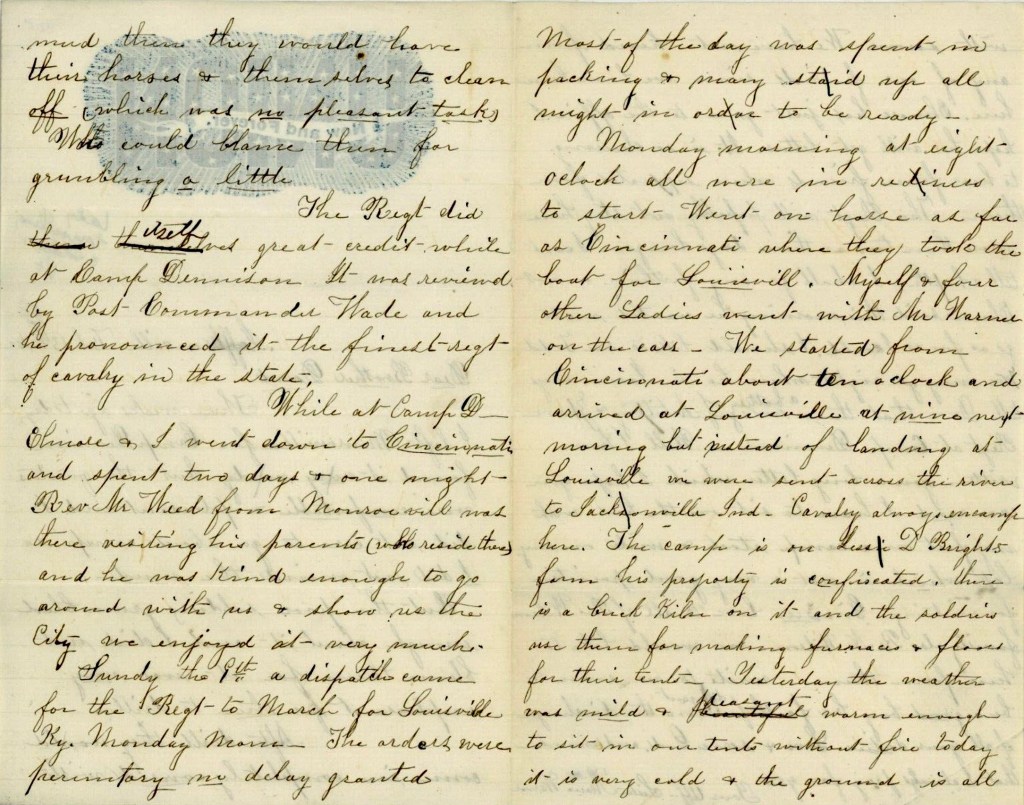
Three weeks ago today I left Monroeville for Camp Dennison. Found it very muddy but the quarters were comfortable & pleasant and I did not care to go about camp so I did not mind the mud. But the poor soldiers grumbled enough about it and I did not blame them for it was very unpleasant for them to drill. After drill they would come in completely covered with mud. Then they would have their horses & themselves to clean off (which was no pleasant task). Who could blame them for grumbling a little.

The regiment did itself great credit while at Camp Dennison. It was reviewed by Post Commander Wade and he pronounced it the finest regiment of cavalry in the state.

While at Camp Dennison, Elmore & I went down to Cincinnati and spent two days & one night. Rev. Mr. Weed from Monroeville was there visiting his parents (who reside there) and he was kind enough to go around with us and show us the city. We enjoyed it very much.

Sunday, the 9th, a dispatch came for the regiment to march for Louisville, Kentucky, Monday morn. The orders were peremptory—no delay granted. Most of the day was spent in packing & many stayed up all night in order to be ready.

Monday morning at eight o’clock all were in readiness to start. Went on horse as far as Cincinnati where they took the boat for Louisville. Myself and four ladies went with Mr. Warner on the cars. We started from Cincinnati about ten o’clock and arrived at Louisville at nine next morning but instead of landing at Louisville, we were sent across the river to Jacksonville [Jeffersonville], Indiana. Cavalry always encamp here. The camp is on Jessie D. Bright’s farm. His property is confiscated. There is a brick kiln on it and the soldiers use them for making furnaces and floors for their tents.

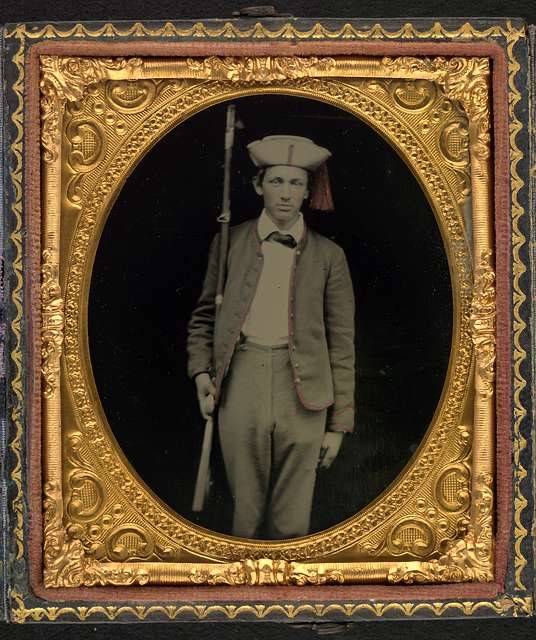
Pvt. Christian H. Cook, Co. B, 54th Ohio Infantry. This regiment was drilling at Camp Dennison in early February 1862. (LOC)

Yesterday the weather was mild and pleasant—warm enough to sit in our tents without fire. Today it is very cold & the ground is all [white] with snow. We have not heard from any of our friends since we have been here. Elmore has just gone to the office. I hope he will get letters. It is so cheering to hear from friends when separated from them. The regiment will probably not stay here more than two or three days longer. I can’t tell whether I shall go any farther or not. Elmore said this morning he wanted me to go as far as I could. I should like to see Todd. We may go right where he is. Jason says tell Dave that there was a battery of artillery & Zouave Regiment at Camp Dennison.

Well, I have written you a long letter which I hope you can read. I have to sit on the bed with my feet on a camp stool & write on my lap which is not a very good position for writing. Give our love to all of Bro. Wilson’s family. Also Br. N. Wilson. We would like to hear from them. Write to us soon and be a good boy. Be faithful & diligent in the discharge of your duties. Love & serve God, and remember that I always pray for you. Your affectionate sister, — Maria Warner

1861: Guilderoy L. Patton to Frederick Patton

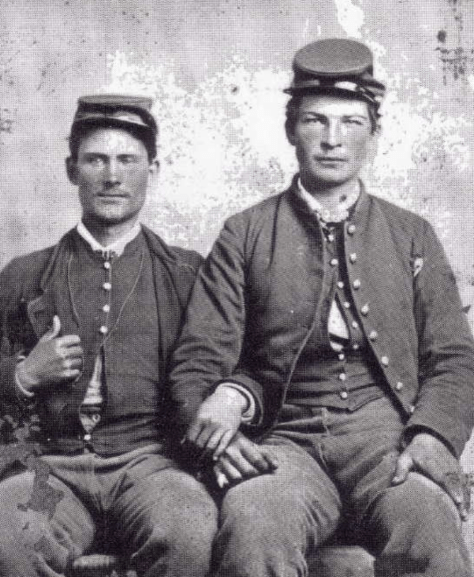
I could not find an image of Guilderoy but here is one of Moses Rogers (at right) of the 48th OVI, probably with a comrade from the same unit. (Ancestry. com)

This letter was written by Guilderoy L. Patton (1840-1862), the son of Frederick Patton (1816-1875) and Elizabeth Rolfo (1812-1870) of Sterling, Brown county, Ohio. Guilderoy was 21 years old when he enlisted on 14 October 1861 to serve as a private in Co. C, 48th Ohio Volunteer Infantry (OVI). According to muster rolls, he died of typhoid fever at Camp Dennison on 2 March 1862, never having left the State of Ohio. Due to a shortage of recruits, they were not mustered into the service until mid-February 1862, after which they were sent to Paducah for duty. Guilderoy died just about five weeks before the regiment saw their first action at the Battle of Shiloh.

Transcription

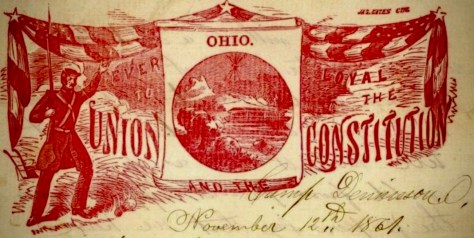
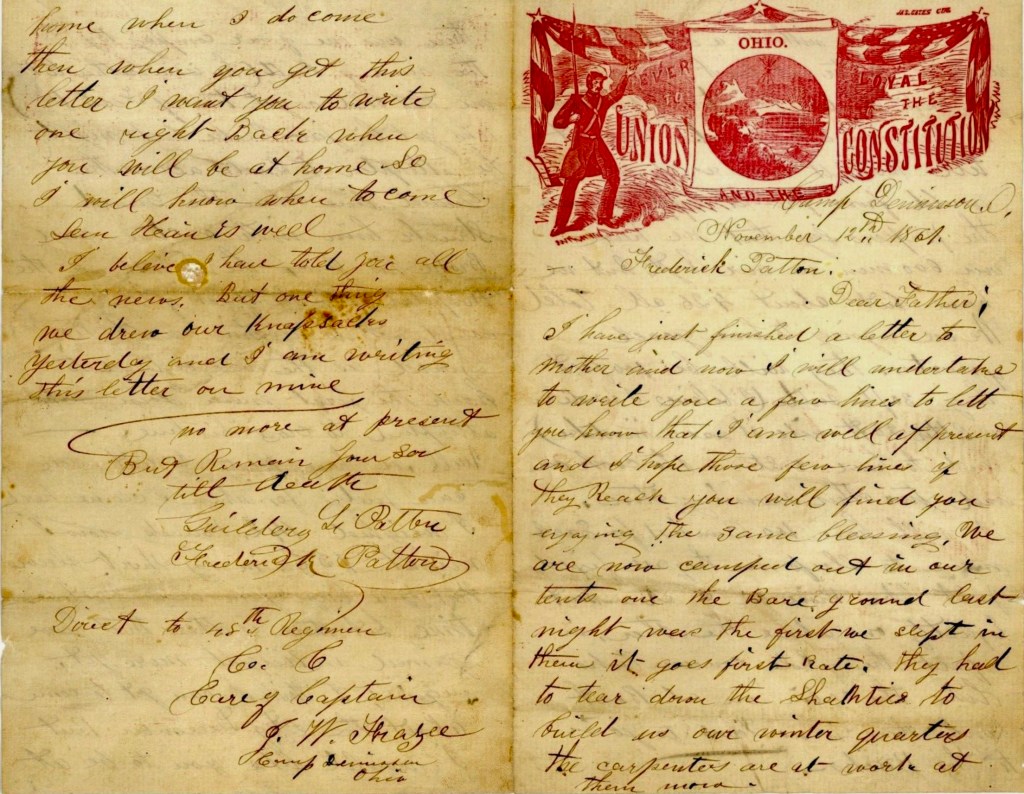
Patriotic letterhead—Ohio, “Union and the Constitution”

Camp Dennison, Ohio
November 12th 1861

Frederick Patton. Dear father,

I have just finished a letter to mother and now I will undertake to write youy a few lines to let you know that I am well at present and I hope these few lines—if they reach you—will find you enjoying the same blessing. We are now camped out in our tents on the bare ground, Last night was the first we slept in them. It goes first rate. They had to dear down the shanties to build us our winter quarters. The carpenters are at work at them now. It is now, without a doubt, that we will winter [here]—at least we will go into winter quarters. Whether to remain all winter, we can’t tell but it looks as if we would from present appearance. The papers say that we have over 600 men in our regiment but we have but about 426 all told.

We are going to have good quarters. They will be 100 feet long, 30 feet wide (I believe I wrote in a letter 20 feet wide. It was a mistake) and to have 3 stoves, one to cook on and two other warming stoves. It will have 100 bunks, one for each man to sleep in. They are fixed just like those on a steamboat, exactly one above the other. In fact, the whole concern looks like the cabin on a boat, only there is no doors to go into the bunks.

There was one of our company by the name of Pratt (he is a brother to the one that sold or got trees of French Hill) who got his jaw broke last night. He attempted to break across the guard line when the guard struck him with a stone and broke his jaw. He is now in the hospital from the effects of it. They could not do anything with the guard as they was ordered to knock the first man down who attempted to cross the line.

Well we have plenty to eat you can judge for when I came here I weighed 142 pounds. Now I weigh 156 in my shirt sleeves. That is a large gain in so short a time but there is others that have gained in weight more yet again. I think I can get to come about the 1st of December but I would like you to be at home when I come then.

When you get this letter, I want you to write one right back when you will be at home so I will know when to come. Lem Hair is well. I believe I have told you all the news but one thing, we drew our knapsacks yesterday and I am writing this letter on mine. No more at present but remain your son till death, — Guilderoy L. Patton

to Frederick Patton

Direct to 48th Regiment, Co. C, Care of Captain J. W. Frazee, Camp Dennison, Ohio

1861: Unidentified Soldier to his Brothers

The following letter was written by a soldier at Camp Dennison in mid-December 1862. The Ohio regiment he was in was most likely organized there as it appears they were there for some time; not simply passing through.

Though I could not identify him, he provides good information on the timing of, and specifications on, the construction of stables built at the camp.

Transcription

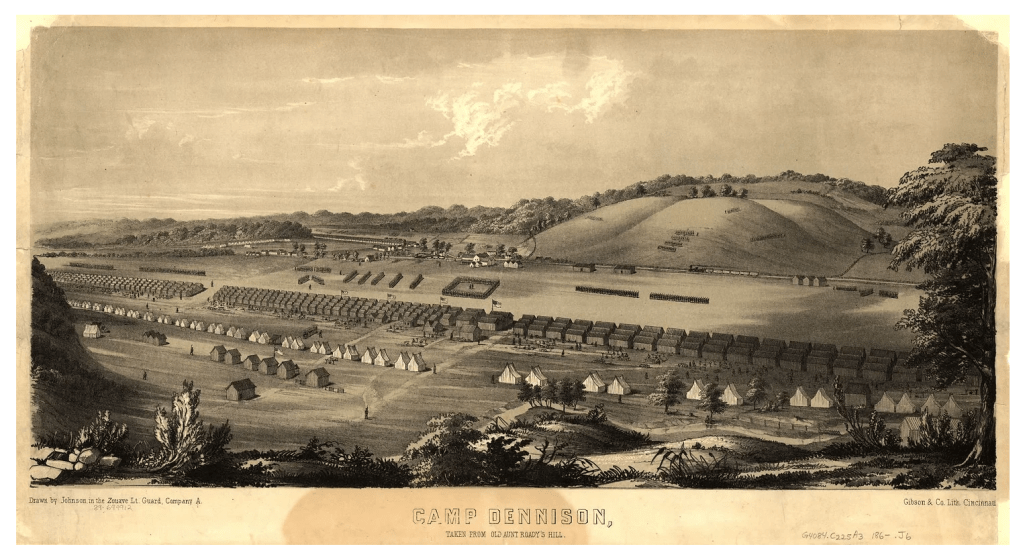
Camp Dennison, Library of Congress

Camp Dennison
December 16th 1861

Dear Brothers,

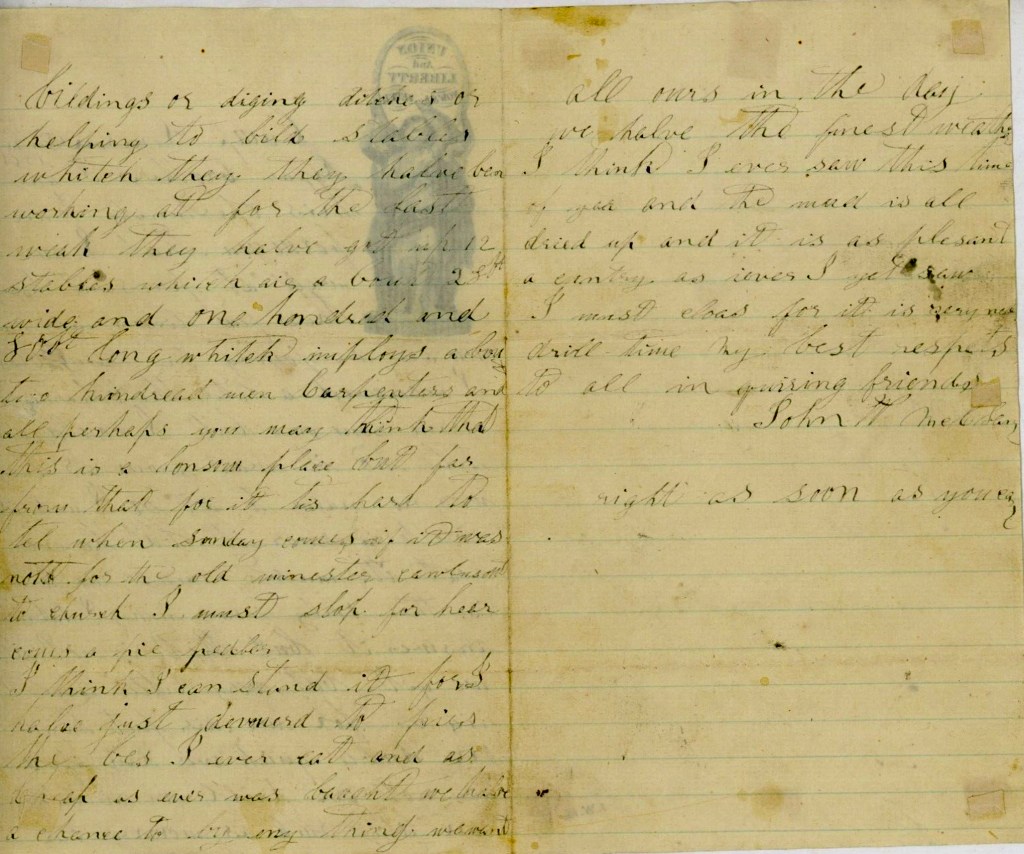
I take this opportunity to inform you that I am well at present, hoping these few lines may find you all enjoying the same blessing. I received a letter the other day from someone but I could not tell who it was from as there was no name to it so I wasn’t able to answer it but whoever wrote it must excuse me for that is the only reason why I did not answer it. But that is not all, We get but very little time to write for we are out through on double quick every day. If we are not on drill, we are detailed in fatigue, such as moving old buildings or digging ditches or helping to build stables which they have been working at for the last week. They have got up 12 stables which are about 28 feet wide and one hundred and 80 feet long which employs about two hundred men, carpenters and all. Perhaps you may think that this is a lonesome place but far from that for it tis hard to tell when Sunday comes if it was not for the old minister [ ] to church. I must stop for here comes a pie peddler.

I think I can stand it for I have just devoured two pies—the best I ever ate—and as cheap as ever was bought, We have a chance to buy anything we want all hours of the day.

We have the finest weather I think I ever saw this time of year and the mud is all dried up and it is as pleasant as country as ever I yet saw, I must close for it is very near drill time. My best respects to all inquiring friends. — John W. McC____

Write as soon as you can.

1861: Henry A. Jackson to Miss Tina

This letter was written by Henry A. Jackson (1841-1862) of Co. A, 32nd Ohio Volunteer Infantry (OVI). Henry enlisted as a private on 12 July 1861 and was killed in action on Bolivar Heights near Harper’s Ferry on 15 September 1862.

I believe that Henry A. Jackson was the son of Isaac and Mary (Manful) Jackson of Augusta, Carroll county, Ohio. See also—1861: Thomas J. Hendrix to Miss Haskey.

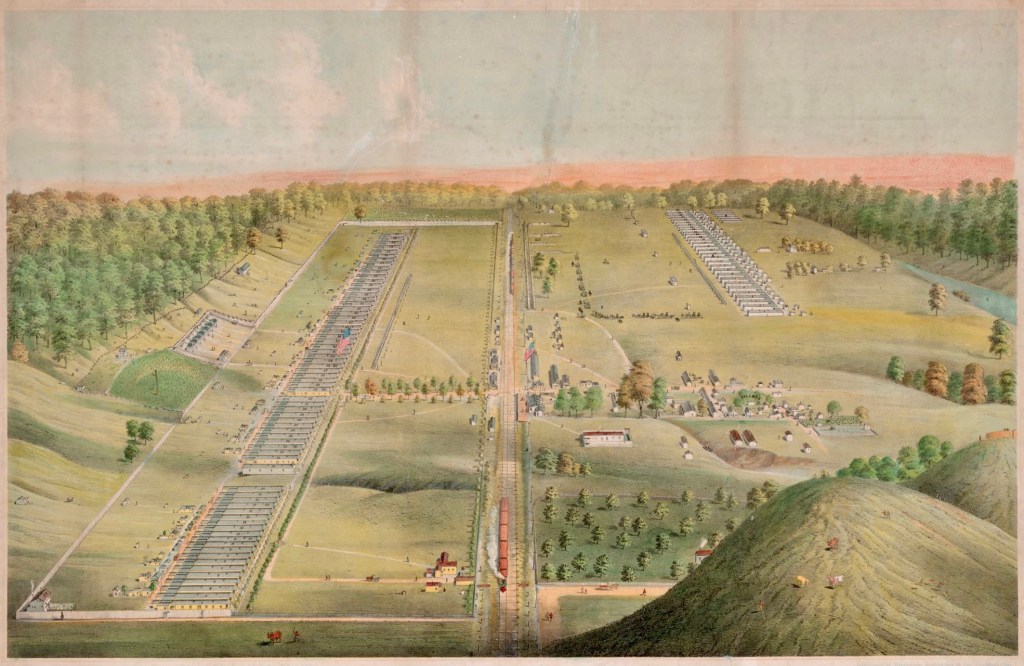
A view of Camp Denison later in the war, showing the railroad and the Little Miami River.

Transcription

Camp Dennison
September 7th 1861

Miss Tina,

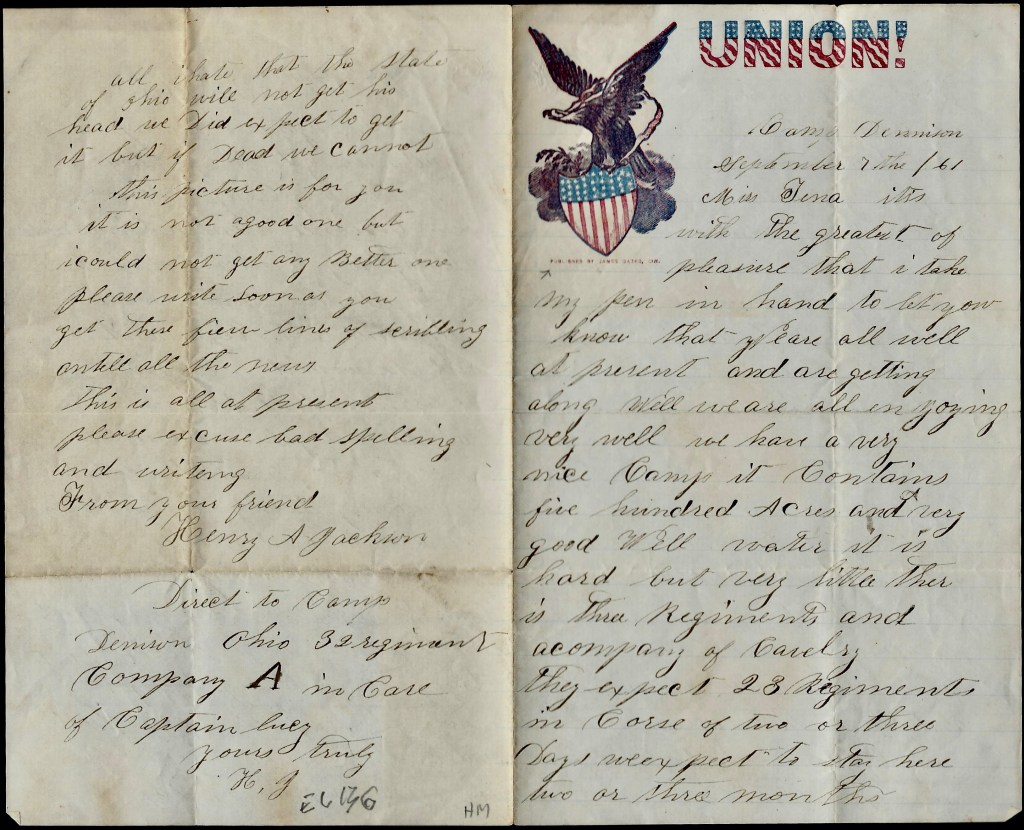
It’s with the greatest of pleasure that I take my pen in hand to let you know that we are all well at present and are getting along well. We are all enjoying [ourselves] very well. We have a very nice camp. It contains five hundred acres and a very good well water. It is hard but very little. There is three regiments and a company of cavalry. They expect 23 regiments in the course of two or three days, We expect to stay here two or three months. I can’t tell when we can get to come home. Captain has promised to give us a furlough when James Watson comes back but I don’t know whether he can get a furlough yet or not. But he will if possible.

We are not homesick yet but our folks wants me to come home. If it was not for that, would not come for a year. We have good times here. We have made our bedsteads today and I think we will get along a great deal better. We have Mr. [Henry] Chain and Sam McClellan in our mess and they keep us boys straight.

The Miami River runs through our camp and we get to go down to it every day or two. Our Colonel went to Cincinnati yesterday to get our arms but he said that it was an Independent Regiment and he would not give us arms. If he does not after we get drilled, we will go in another state. We are only twenty miles from Cincinnati and only 18 miles from Kentucky. The railroad runs through our camp ground. The cars run through perhaps a dozen times a day.

The latest news is that Jeff Davis is dead and I guess it must be so for the papers say so every day. All I hate that the State of Ohio will not get his head. We did expect to get it but if dead, we cannot.

This picture is for you. It is not a god one but I could not get any better one. Please write soon as you get these few lines of scribbling and tell all the news. This is all at present. Please excuse bad spelling and writing. From your friend, — Henry A. Jackson

Direct to Camp Dennison, Ohio 32nd Regiment, Company A, in care of Captain Lucy. Yours truly, H. J.

1862: John F. Hoy to Friend Swigart

This letter was written by 19 year-old Pvt. John F. Hoy (1843-1914) of Co. E, 61st Ohio Volunteer Infantry (OVI). When he enlisted, John expected to be mustered into the 52nd OVI—as stated in this letter—but because the regiment was not yet full in mid-April, they were transferred to the 61st OVI to fill out that regiment. As such, unlike most Ohio regiments, the 61st OVI had members from nearly every county in the state. Nine of their companies were German speaking immigrants and two companies were Irish Catholics.

The Regiment fought at 2nd Bull Run, Chancellorsville, Gettysburg, Lookout Mountain, the Atlanta Campaign, March to the Sea, the March through the Carolinas, and at Bentonville, North Carolina. The 61st served the entire war as part of Gen. Oliver O. Howard’s 11th Corp. They began their service with the Army of the Potomac; then were transferred to Gen. Sherman’s western armies in September of 1863.

John was the son of Judge John Hoy (1797-1873) and Elizabeth Traxler (1803-1866) of Franklin, Summit county, Ohio. He participated in the battles of Cedar Mountain, Chancellorsville and Gettysburg, from Chattanooga to Atlanta, the March to the Sea, and the march into North Carolina where he was taken prisoner on 11 March 1865 at Fayetteville. He was held in captivity for 23 days.

Transcription

Camp Dennison, Ohio
April 13th, 1862

Friend Swigart,

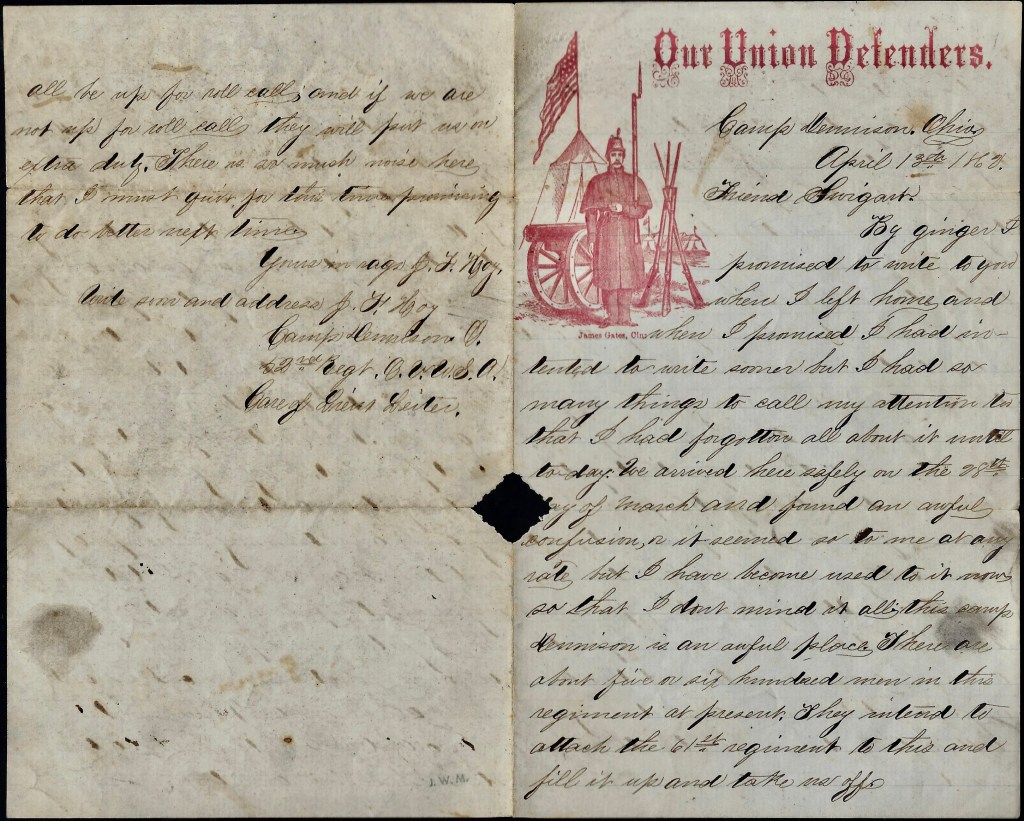
By ginger, I promised to write to you when I left home and when I promised I had intended to write sooner but I had so many things to call my attention to that I had forgotten all about it until today.

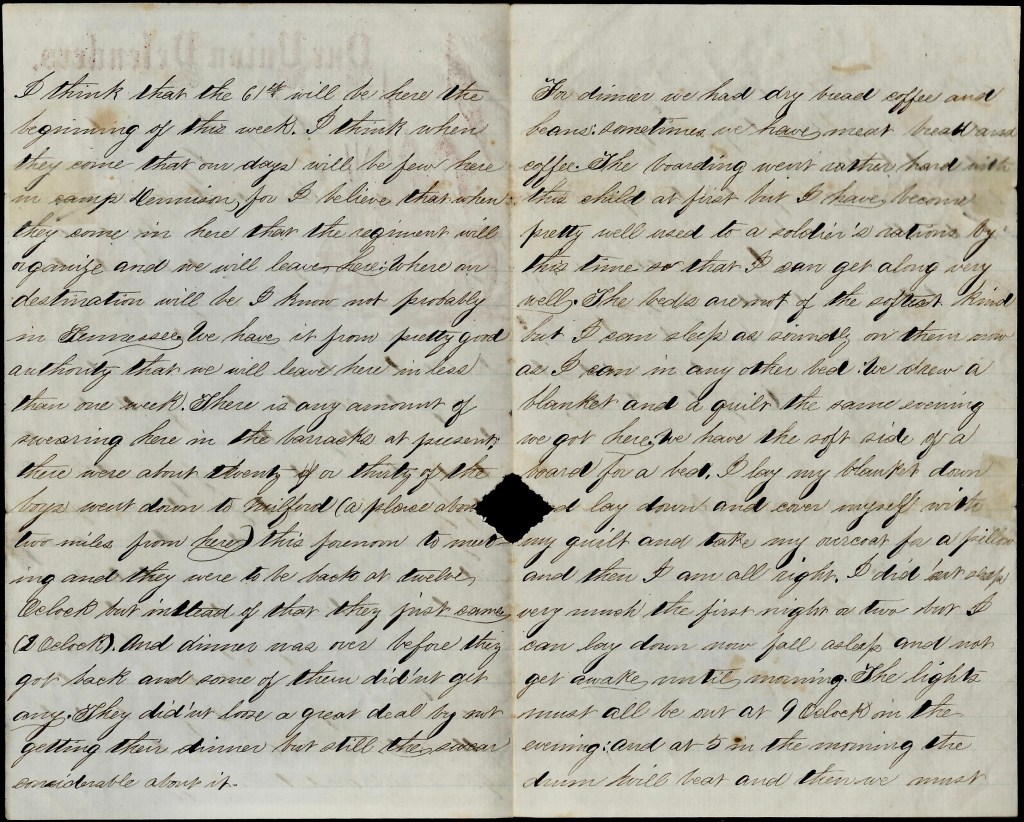
We arrived here safely on the 28th day of March and found an awful confusion, or it seemed so to me at any rate, but I have become used to it now so that I don’t mind it all. This Camp Dennison is an awful place. There are about five or six hundred men in this regiment at present. They intend to attach the 61st Regiment to this and fill it up and take us off. I think that the 61st will be here the beginning of this week. I think when they come that our days will be few here in Camp Dennison for I believe that when they come in here that the regiment will organize and we will leave here. Where our destination will be, I know not—probably in Tennessee.

We have it from pretty good authority that we will leave here in less than one week. There is any amount of swearing here in the barracks at present. There were about twenty or thirty of the boys went down to Miford (a place about two miles from here) this forenoon to meeting and they were to be back at twelve o’clock but instead of that they just came (2 o’clock) and dinner was over before they got back and some of them didn’t get any. They didn’t lose a great deal by not getting their dinner, but still they swear considerable about it.

For dinner we had dry bread, coffee and beans. Sometimes we have meat, bread and coffee. The boarding went rather hard with this child at first but I have become pretty well used to a soldier’s rations by this time so that I can get along very well. The beds are not of the softest kind but I can sleep as soundly on them now as I can in any other bed. We drew a blanket and a quilt the same evening we got here. We have the soft side of a board for a bed. I lay my blanket down and lay down and cover myself with my quilt and take my overcoat for a pillow and then I am all right. I did not sleep very much the first night or two but I can lay down now, fall asleep, and not get awake until morning. The mights must all be out at 9 o’clock in the evening and at 5 in the morning the drum will beat and then we must all be up for roll call, and if we are not up for roll call, they will put us in extra duty.

There is so much noise here that I must quit for this time, promising to do better next time. Yours in rags, — J. F. Hoy

Write soon and address J. F. Hoy, Camp Dennison, Ohio, 52nd Regt. O. V. USA, Care of Lieut. Leiter

1861: Theodore M. H. to Sabina

The following letter was written by a soldier I believe was named “Theodore M. H.” and written to a woman in called “Bine” which may have been short for Sabina. It was datelined from Camp Dennison on 8 September 1861. Camp Dennison was a Federal Army training camp located in the town of Germany, Ohio, sixteen miles northeast of Cincinnati. George B. McClellan, a major general in the Ohio militia, chose Germany as the site for a camp. The camp was named for Ohio Governor William Dennison.

Camp Dennison was strategically located near Cincinnati, the Ohio and Little Miami Rivers, and the Little Miami Railroad. The rivers and railroad provided quick transportation from various parts of Ohio and surrounding states. The presence of troops at Camp Dennison also provided Cincinnati with soldiers to protect this important manufacturing city from Confederate attack. Camp Dennison encompassed more than seven hundred acres of land.

The camp hosted 75,000 to 100,000 soldiers traveling to and from the war. Since the soldiers only stayed for a short time, my only chance of identifying them was to look for regiments stationed at the camp in early September 1861, particularly those composed of German-Americans from Cincinnati. However, I couldn’t find anyone who fit that description by that name.

Transcription

Camp Dennison,
September 8th 1861

Dearest Bine Mine,

I have been looking very strong for a letter from you last week but now it is Sunday and I feel very lonesome and disappointed because I did not get the letter you ought to [have] sent me. Now Bine, I want you to answer my letters the same day you receive them hereafter for they are the only thing that gives me any pleasure. And if you knew how anxious I am to get a letter from you, I know that you would not disappoint me. Now, if I do not get two letters at the very least from you this week, I shall in the future take the same time to answer yours that you do mine. Next to yourself, and your letters, that old pipe is my most loved friend and consequently I could not think of locking it up. But I think it would be policy to lock Bine up to keep her from running away. Why what would I do if you were to? If such a thing happens, I hope the first secessionist I meet will shoot me, for when I loose you, I will have lost all incentives to live. But this can never happen and I will not dwell on it for it gives me the blues to even think of it.

There was one of two things that I wanted to receive as a present from you but have got them from a different source. One was a needle case, the other a testament. The needle case was presented to me by a young lady from the country, the other case by some of the girls of our town. The testament was given to me here at the camp. I am afraid I do not study it enough to do much good—not one-eighth so much as I would read it if Bine had given it to me for then I would have studied it for the sake of the giver.

Will Hopkins was down yesterday to the mill with the wagon and came up to the camp and wanted Julius and I to go out home with him. As Julius wanted to go so bad to see Emaline Combs, I consented provided the Lieutenant would let us off and I went and asked him if he would let us off. He said that if we went, he could not let us go home for some time and as I wanted to see you worse than the folks in the country, I would not go (much against Julius’ will).

We had preaching today by Mr. [Samuel] Yourtree. 1 There was about three thousand there. It was the poorest sermon I ever heard but he made up for his lack of preaching by the prayer which was the most eloquent and patriotic I ever heard. There will be prayer meeting this afternoon at four o’clock and if I do not go down to Milford this afternoon, I think I will go.

Will Hopkins said the folks were coming down this week when I will get some more of the good things to eat. I will write the rest when I get yours.

Yours, Theo. M. H.


1 Samuel Livingston Yourtree (1817-1880) was a Cincinnati pastor of the Methodist Episcopal Church.

1861: Thomas W. Powell to Olive Powell

Though unsigned, the provenance that came with this letter attributes it to Thomas W. Powell while serving in Co. E (the “Huron Infantry”), 7th Ohio Volunteer Infantry (OVI) when it was a three-months organization. This regiment was mustered into service in late April 1861 at Cleveland and mustered out on 24 July 1861 at Camp Dennison, Ohio. The regiment never saw any action and were barely organized and drilled before military authorities began requested that the soldiers reenlist for three years of service. Most men agreed, but those who did not were mustered out of service upon the end of their three-months term.

There is a muster record for a “Powell” (no first name given) in Co. E, 7th OVI (3 months) and I assume this is the same soldier. His name does not appear in the roster of the 7th OVI (3 years) regiment so I can only assume he decided against reenlisting as it appears his sister had advised him.

I have searched the census records in Erie county for Thomas and his sister Olive but have not found him though I note he refers to the United States as his “adopted” country so it may be that he was a recent emigrant. If a recent immigrant, he probably came from Canada as his English vocabulary is pretty good though his spelling is poor.

An early war image of Camp Dennison on an envelope

Transcription

Camp Dennison (Ohio)
May 30, 1861

Sister Olive, 

Once more I find myself engaged in the delightful task of writing you a letter—although I realize it is in much weakness—but then I know you are charitable in some respects, and will make due allowance. I received yours Tuesday [and] not tell you how thankful I was for your condescension in writing to one so unworthy and hope this will be received with half the appreciation that yours was. Would also acknowledge the reception of your note which has been remailed from Berea.

I must apologize at the onset for writing you as long a letter as I intend to, but judging from some parts of your letters, you are considerably tinctured with that which goes by the name of patriotism although in your case I believe it sincere. I thought it would not come amiss to give you my opinion of some matters as they now stand. It is with a heart of sorrow I write what I am going to—sorrow for this my land of adoption as I see her crumbling and falling from her once glorious position and bending under the iron heel of oppression.

I with the thousands left my home to contend for right, as the booming cannon of Sumter echoed not only in Charleston but in the heart of every freeman calling him to arms. But little did I think that while going to fight for freedom, of myself becoming a slave to a set of “petty tyrants.” Not only have we to be nosed round by a set of officers but the government has used us as no feeling man would use his dog. Some men have been sent home because they would not enlist for three years—hundreds of miles from home, no provision made for their return, and without a cent in their pocket and scarcely a rag on their back.

Those at home are no more honorable who promised to provide for the families of those who volunteered. I have seen letters from wives to their husbands stating what suffering they are called upon to pass through. Two from Milan [Erie county, Ohio] I saw yesterday saying they had not received a cent’s worth since their husbands left and beg of them to return home as soon as possible. You would be astonished to see three-quarters of the men, some without breaches, making drawers supply their deficiency. Others barefooted. Uncle Sam supplied some of the most needy with split leather shoes which I should call worse than one.

You advise me not to go for three years. I certainly shall not under present circumstances although if the case is urgent of two evils, I shall choose the least—that is, to be a slave to a military despotism or a southern aristocracy. As regards my constitution failing, that is all nonsense. There is not a person in the company better able to go than I am as far as that is concerned. I will give you a little of our camp life. We have to stand guard 24 hours about once a week. I was on a few days ago. It rained all day and all night. we are two hours on and four off while on duty. We have to walk back and forth. When off, we are housed in a guard house or lie on the ground.

— Thomas W. Powell, Co. E, 7th Regiment, care of Capt. [John W.] Sprague 1


1 On April 25, 1861, at the beginning of the Civil War, John Wilson Sprague joined the 7th Ohio Infantry and was made a captain in the unit’s Company E. In August 1861, while heading home on leave, he and a small group of other Ohio soldiers were captured in West Virginia by Confederate troops. He was held at the infamous Libby Prison in Virginia, and then moved to South Carolina where he was held in Charleston and then Columbia. After five months, Sprague was released as part of a prisoner exchange in January 1862. He returned to duty with the Ohio 63rd Infantry Regiment. On January 23, 1862, he was promoted to colonel. Sprague led the regiment at the Siege of Corinth.