
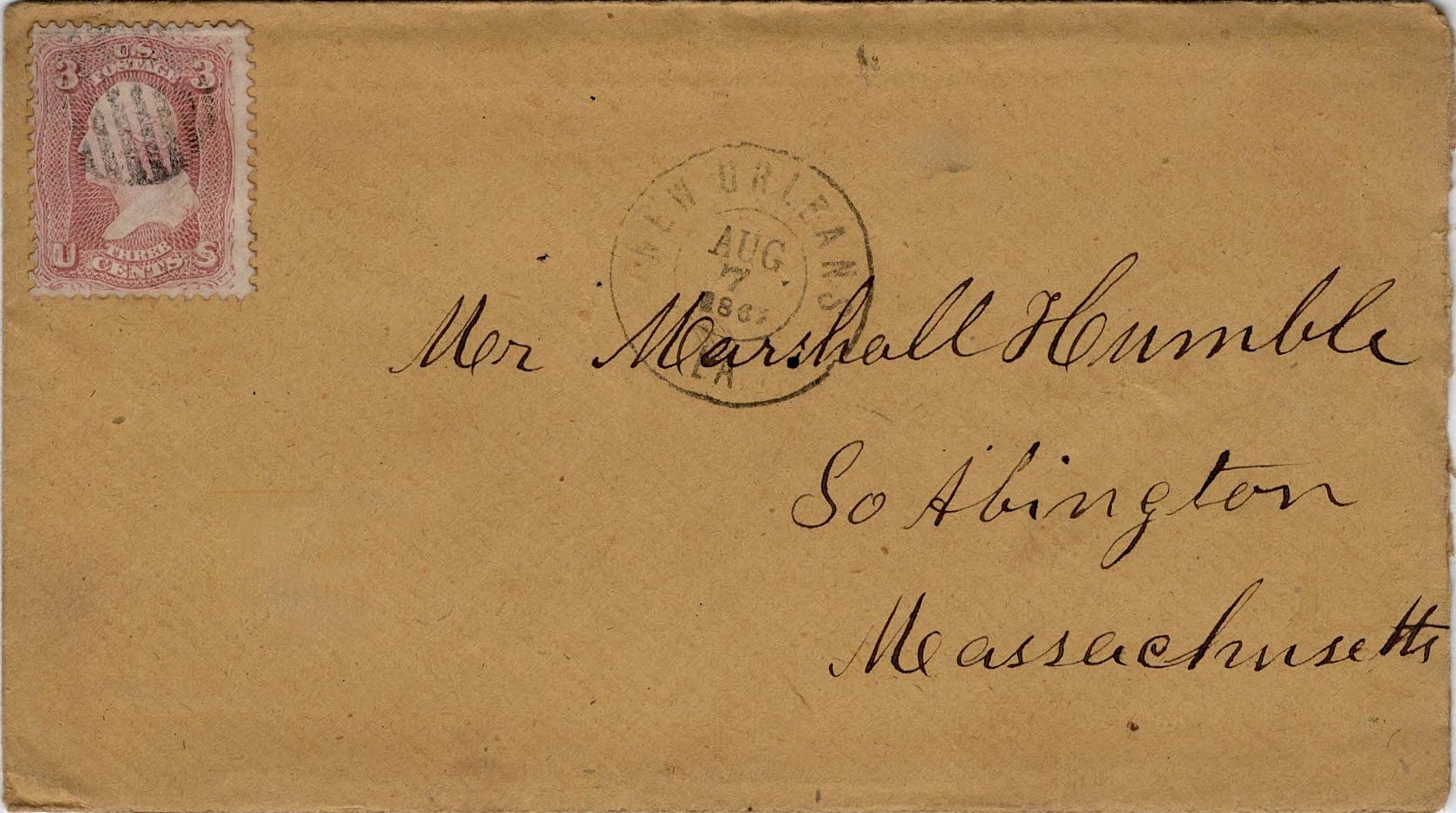
These letters were written by Henry Humble (1836-1908), the son of Marshall Humble (1807-1896) and Emily Reed (1808-1899) of Abington, Plymouth county, Massachusetts.
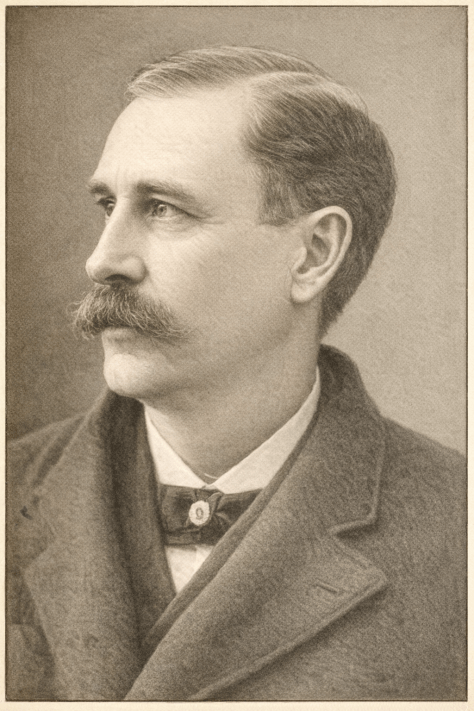
Henry was a 24-year-old shoemaker when he enlisted at Abington on 16 April 1861 and was mustered six days later as a Sergeant in Co. E of the 4th Massachusetts. This 90-day regiment was the first from the Bay State to answer President Lincoln’s call and were deployed to garrison Fortress Monroe in Hampton, Virginia, and Camp Butler at Newport News. Half the regiment was engaged in the battle of Big Bethel on Jun. 10th. The regiment returned to Boston on July 22nd and was mustered out of service.
Henry was commissioned as a 1st Lieutenant in Co. E, when the 4th Massachusetts was mustered for a second service of 9-months duration on 26 September 1862. His regiment left the State on Dec. 27th and, after a brief stop in New York City was sent to Louisiana, arriving on 13 February 1863. The regiment assisted in Admiral Farragut’s running of the fleet past Port Hudson, was involved in the assault on Fort Brisland in April and the siege and assault on Port Hudson, which culminated in that city’s surrender on 8 July 1863. On June 23rd Henry was one of a large number from the 4th Massachusetts who were captured and taken prisoner. They were transported to Texas where they were first imprisoned at Camp Groce near Hempstead and then later at Camp Ford at Tyler, Texas. He was released with others of his regiment in July 1864 and was mustered out of service on 9 August 1864.
Henry, who never married, worked in shoe and boot factories following his military service and was a member of the David A. Russell G.A.R. Post 78 in Whitman. He was 72 when he died of heart disease.
Letter 1
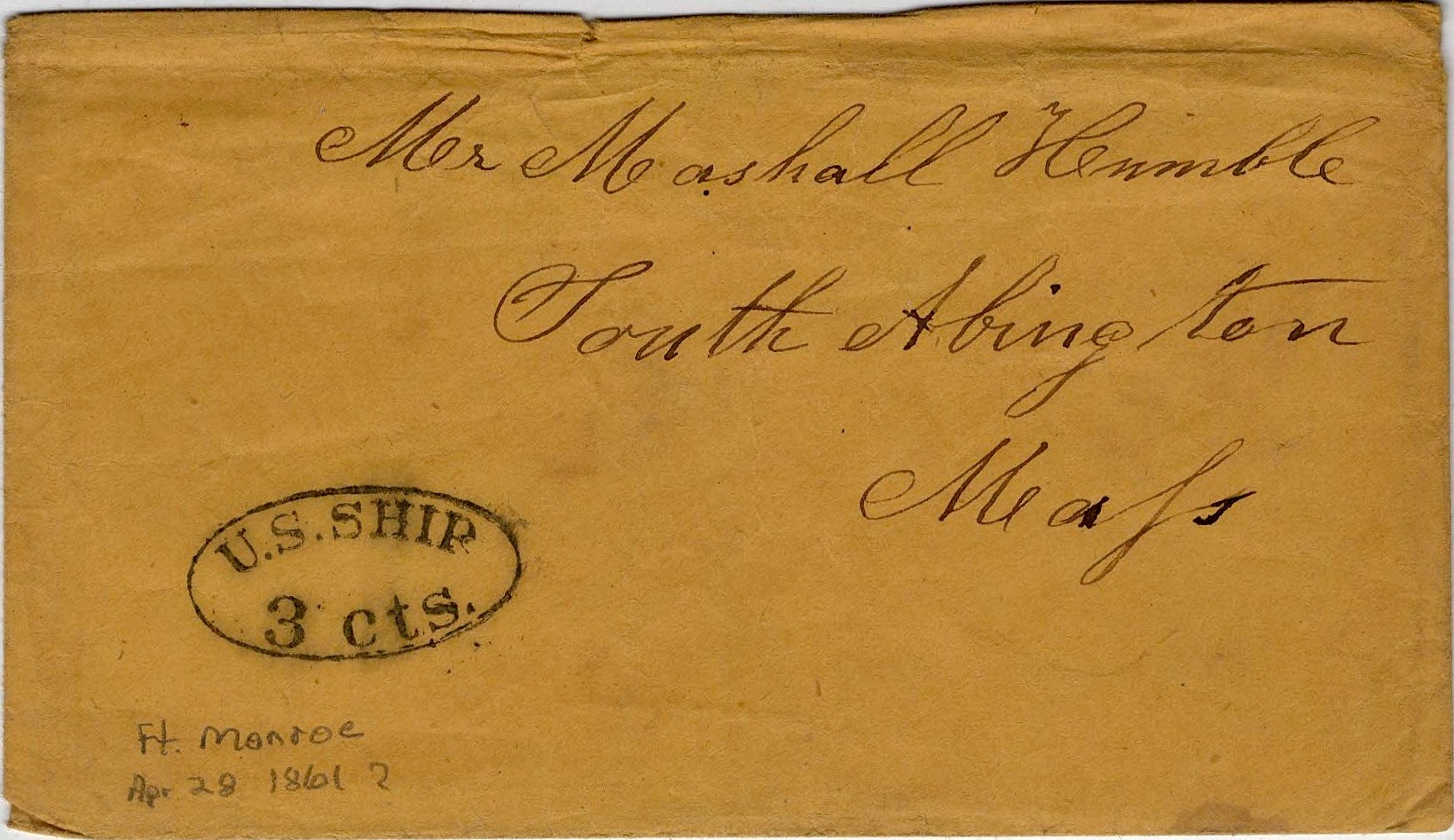
Fort Monroe
April 28, 1861
Mr. Humble,
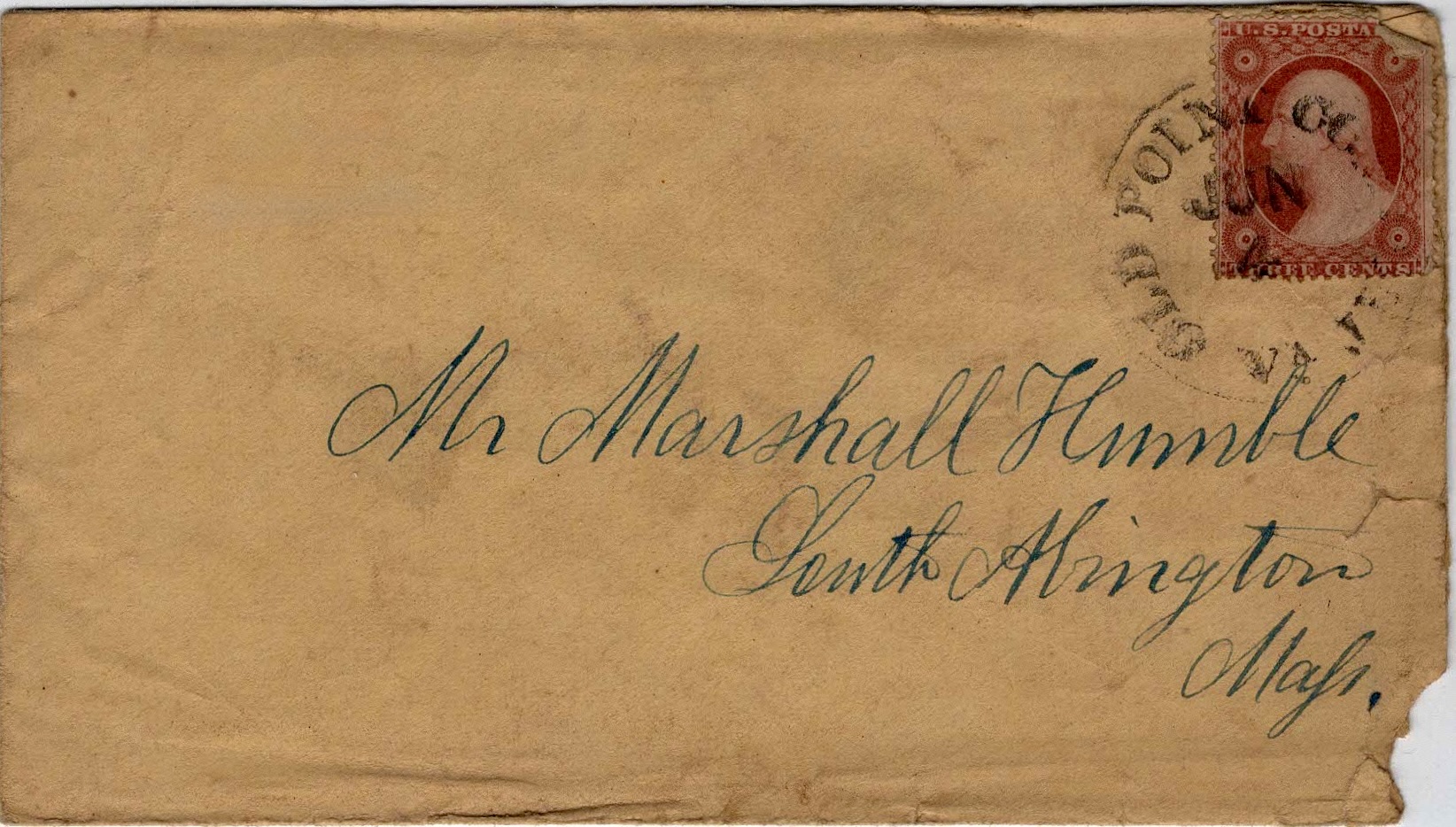
Dear Father, we are in Fort Monroe and all well. I am better than I ever was before. It is healthy here. We are in good spirit, have a good living and clothing and twenty-seven dollars month. Do not want to come home yet. Want you to write as soon as you can and tell me how you all get along. Want to know if you are well and how business is.
We have beef, pork all we want. Have captured one prize armed with artillery. We are at work mounting guns as fast as we can. There is 1500 to man the guns. It will take 50,000 to take this fort from us. Feel safe.
When you write, address Fort Monroe, Virginia. Write soon. Want to hear from home. Want all to write. From your son, — Henry

Letter 2
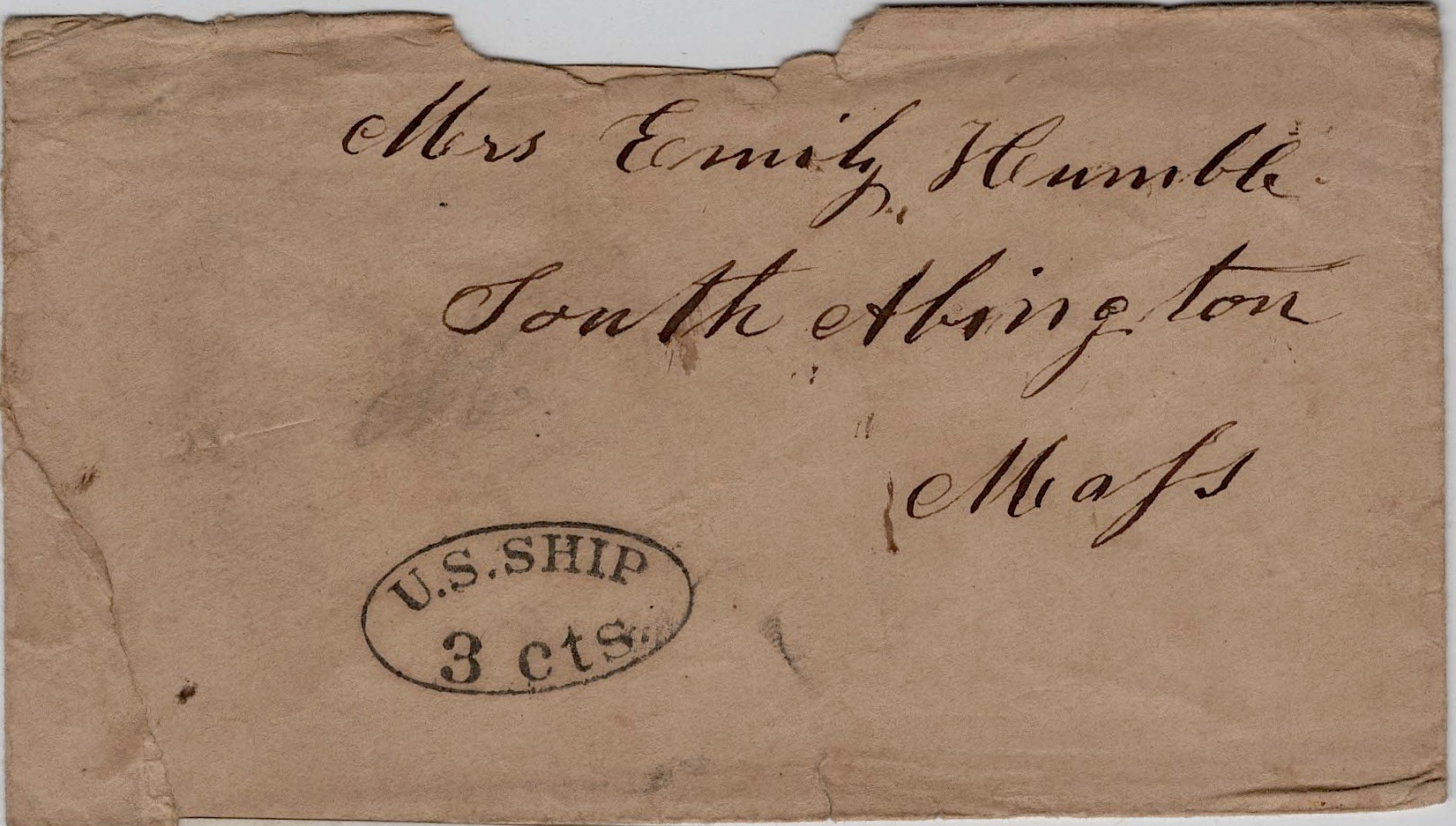
Camp Butler
Sunday, June 2, 1861
Dear Father,
Since I left home, have been in all kinds of business—the business that I like. Our living has not [been] so good as it might be but it will do well enough. Our living consists of beef, pork, beans, peas, sweet potatoes, and hard bread, a little coffee, but we have to drink it without sweetening. Don’t find any fault with it. We do not get any soft bread, butter, tea, but our time has expired.
Since we went from the fort, have been at work throwing up entrenchments. We are now at the place called Newport News, twelve miles above the fort on the banks of the James river. Splendid place for our camp. The climate is healthy but it is rather warm sometimes. We have heard that our regiment—the 4th—have had a battle at Sewell’s Point. We have never been there and I think we shall not go any farther.
The Vermont regiment is here and a Dutch regiment making in all over 2500 men. With our fortifications, we can hold out against ten thousand troops. Have to work harder here than at the fort. Yesterday I was Sergeant of the Guard. In the afternoon when I was at supper, one of my guard shot two of his fingers off while he was capping his gun.
Have not had any rainy weather to speak of since we left home until today. We had a heavy shower that lasted some four hours. I never was as healthy in my life as I now am. Do not want to go home until we have some kind of a brush today, We had green peas for dinner. Wish you would write as soon as can. The boat is going and I must stop now.
From your obedient son, — Henry
Have to write on the ground or hold paper in my hand.

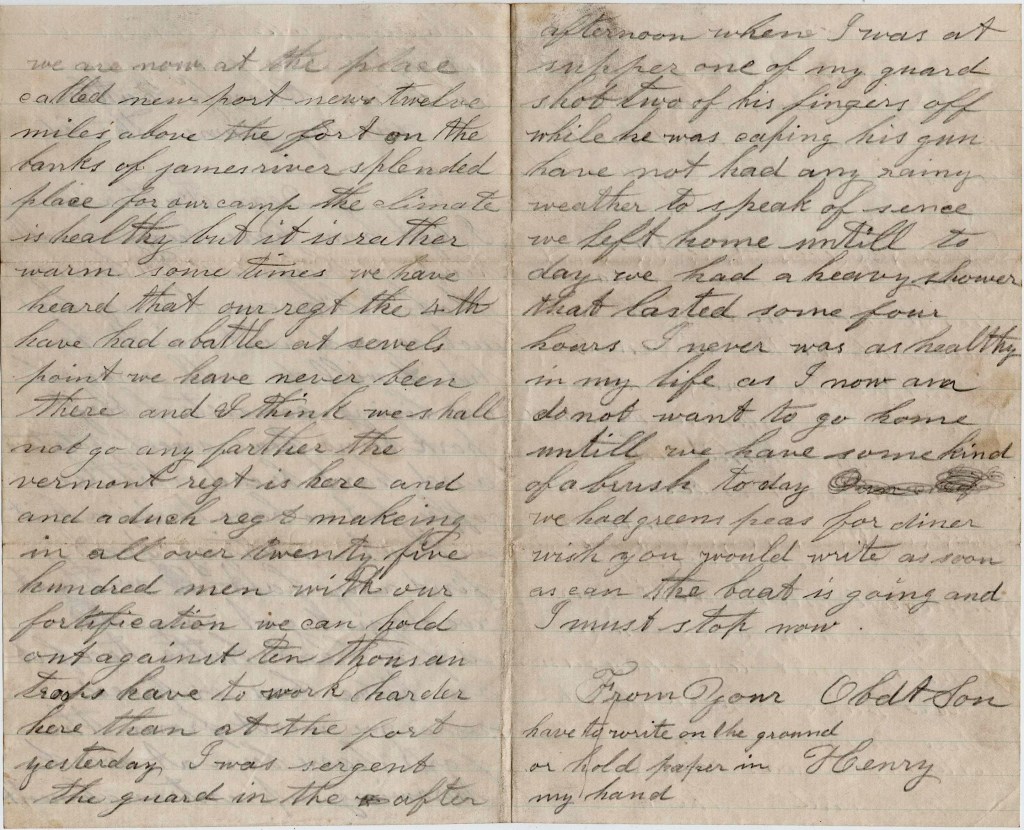
Letter 3
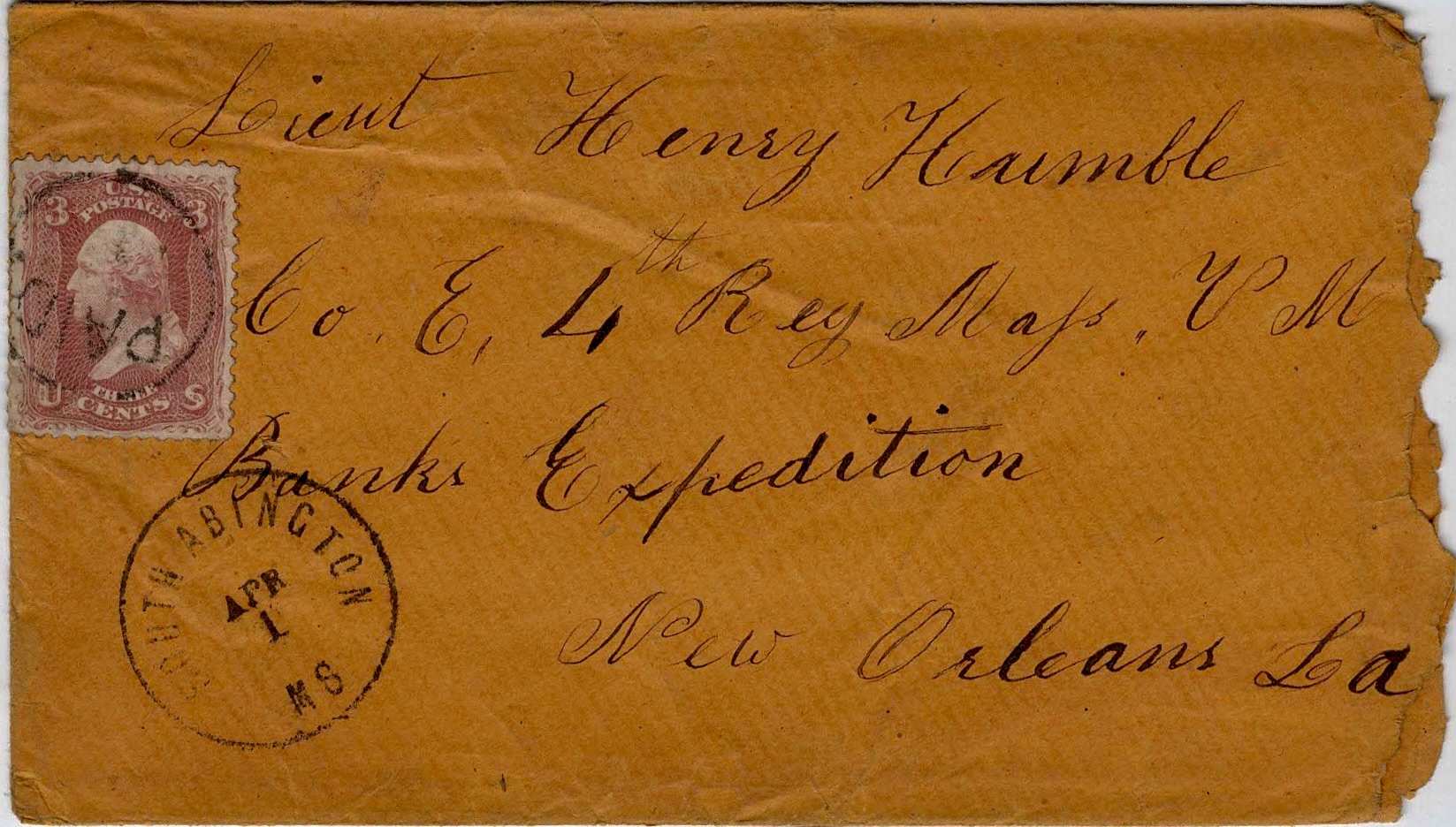
South Abington [Mass.]
March 30th [1863]
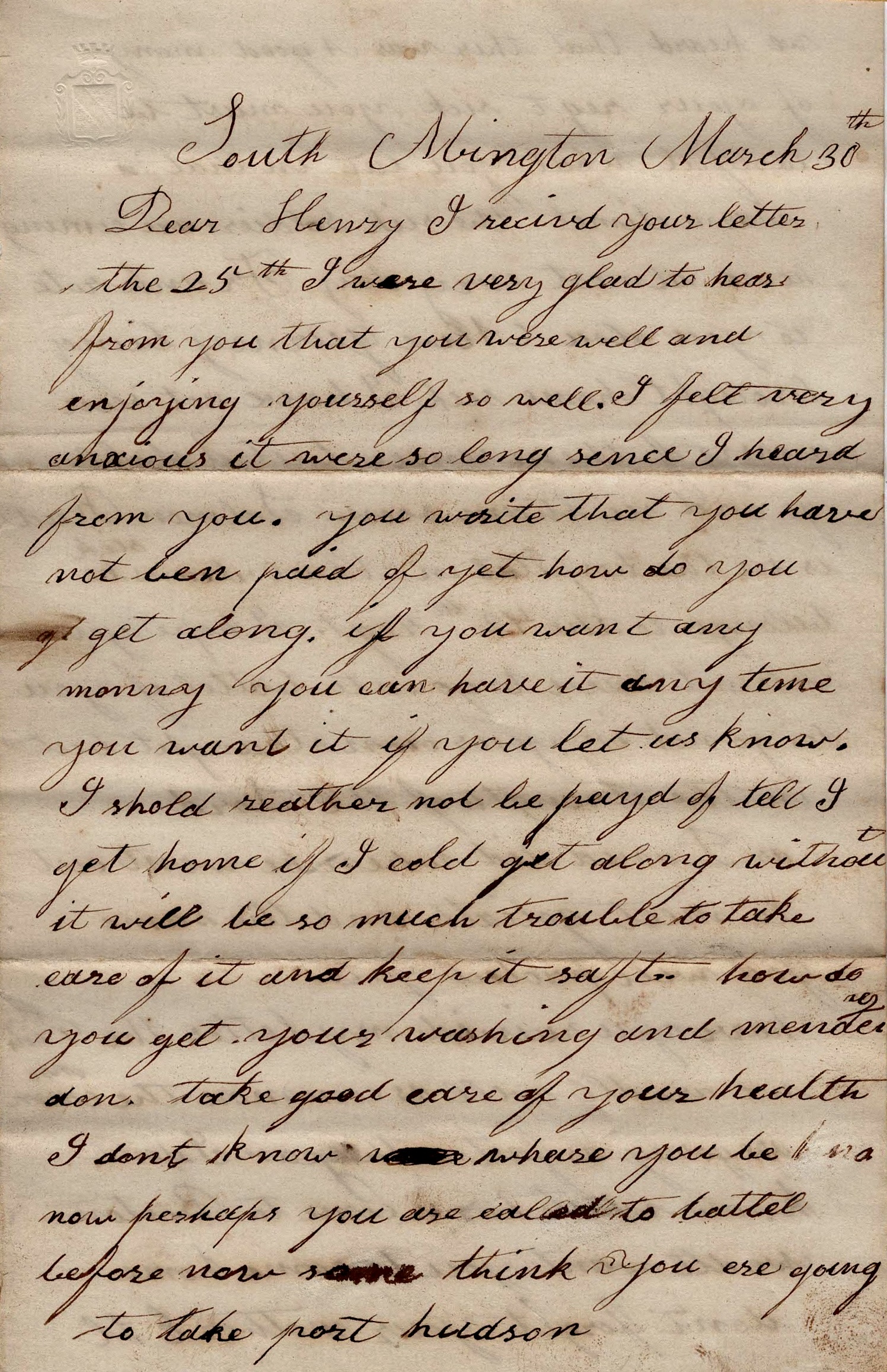
Dear Henry,
I received your letter the 25th. I was very glad to hear from you that you were well and enjoying yourself so well. I felt very anxious, it were so long since I heard from you. You wrote that you have not been paid off yet. How do you get along? If you want any money, you can have it any time you want it if you let us know. I should rather not be paid off till I get home if I could get along without; it will be so much trouble to take care of it and keep it safe.
How do you get your washing and mending done. Take good care of your health. I don’t know where you be now. Perhaps you are called to battle before now. Some think you are going to take Port Hudson. We heard that there was a goo many of your regiment sick. You must be careful what you eat in that warm climate. The sick soldiers are coming home almost every day. Frank wrote to you about Alve Gurney being brought home sick. I have not seen any of them since but I shall go and see them soon. Salmon Reed is in the hospital in New Orleans sick. He belongs to the 42nd [Mass.] Regiment. I hope you will not have to go into battle. If you do, go not in your own strength but in the strength of the Lord as David did when he went out to meet Goliath and the same God will protect you.
Have you received my letter the 4th instant? We are all well as common. The cannons are going as fast as they can. I don’t know what is come to Boston. We all want you to come home. Don’t forget your mother, — E. H.

Letter 4
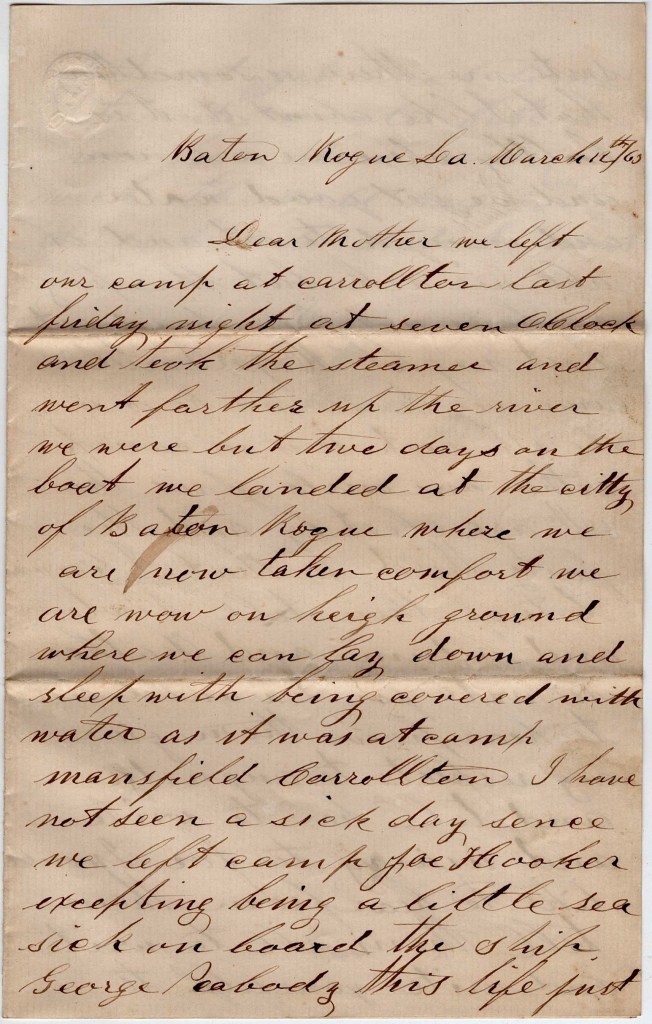
Baton Rouge, Louisiana
March 12, 1863
Dear Mother,
We left our camp at Carrollton last Friday at seven o’clock and took the steamer and went farther up the river. We were but two days on the boat. We landed at the city of Baton Rouge where we are now on high ground where we can lay down and sleep with being covered with water as it was at Camp Mansfield, Carrollton. I have not seen a sick day since we left Camp Joe Hooker excepting being a little seasick on board the ship, George Peabody.
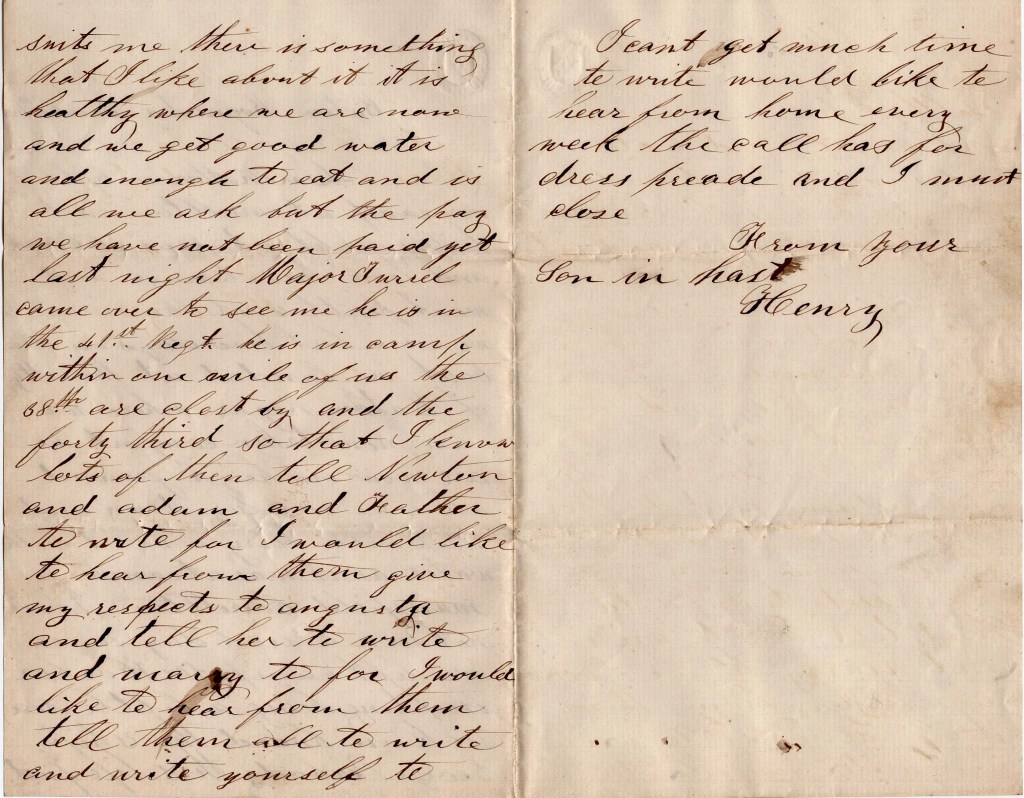
This life just suits me. There is something that I like about it. It is healthy where we are now and we get good water and enough to eat and is all we ask—but the pay. We have not been paid yet.
Last night Major Turiel came over to see me. He is in the 41st [Massachusetts] Regiment. He is in camp within one mile of us. The 38th are close by and the 43rd so that I know lots of them. Tell Newton and Adam and Father to write for I would like to hear from them. Give my respects to Augusta and tell her to write and Mary too for I would like to hear from them. Tell them all to write and write yourself too.
I can’t get much time to write. I would like to hear from home every week. The call has for dress parade and I must close. From your son, in haste. — Henry
Letter 5
Brashear City
April 14, 1863
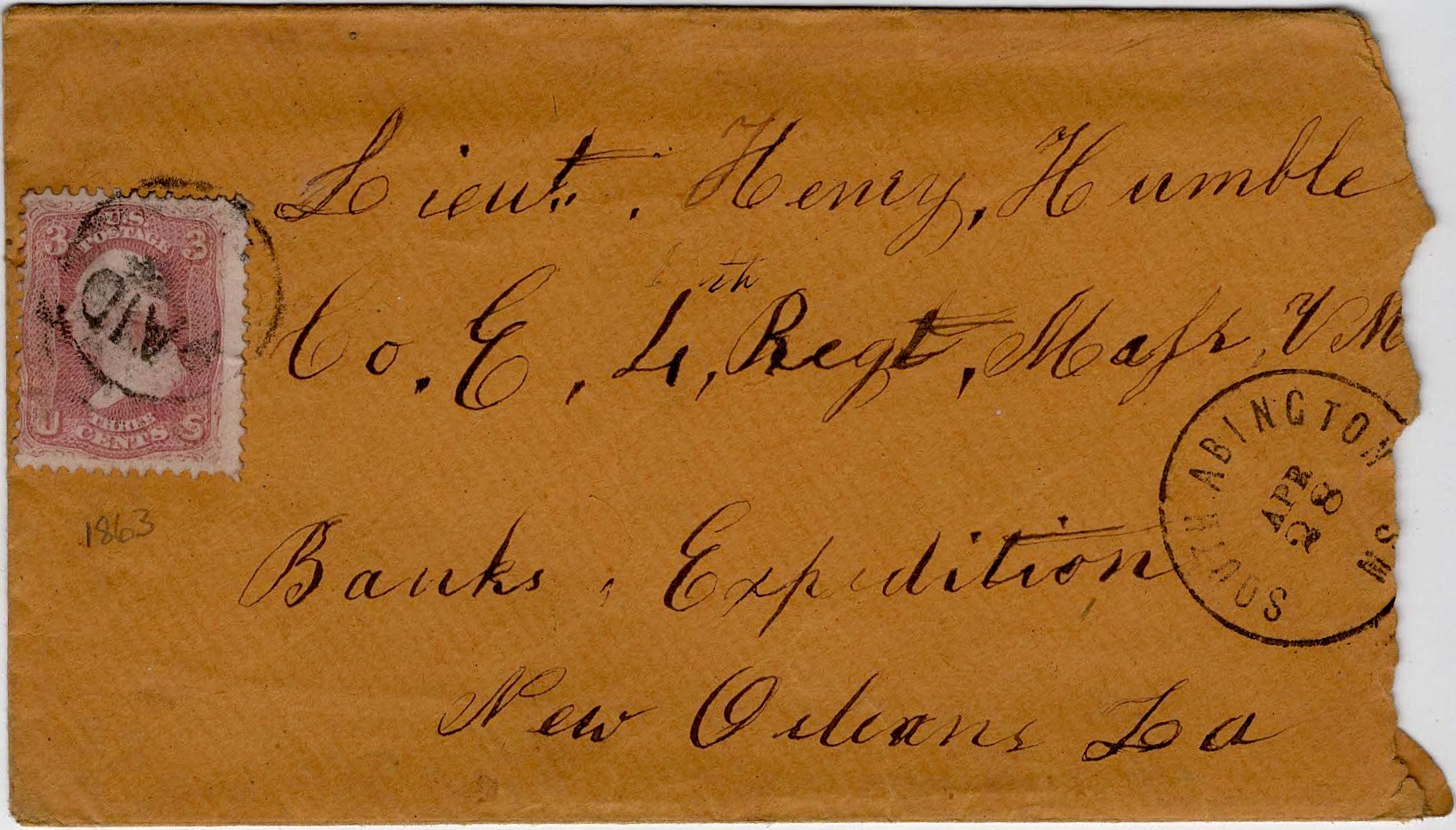
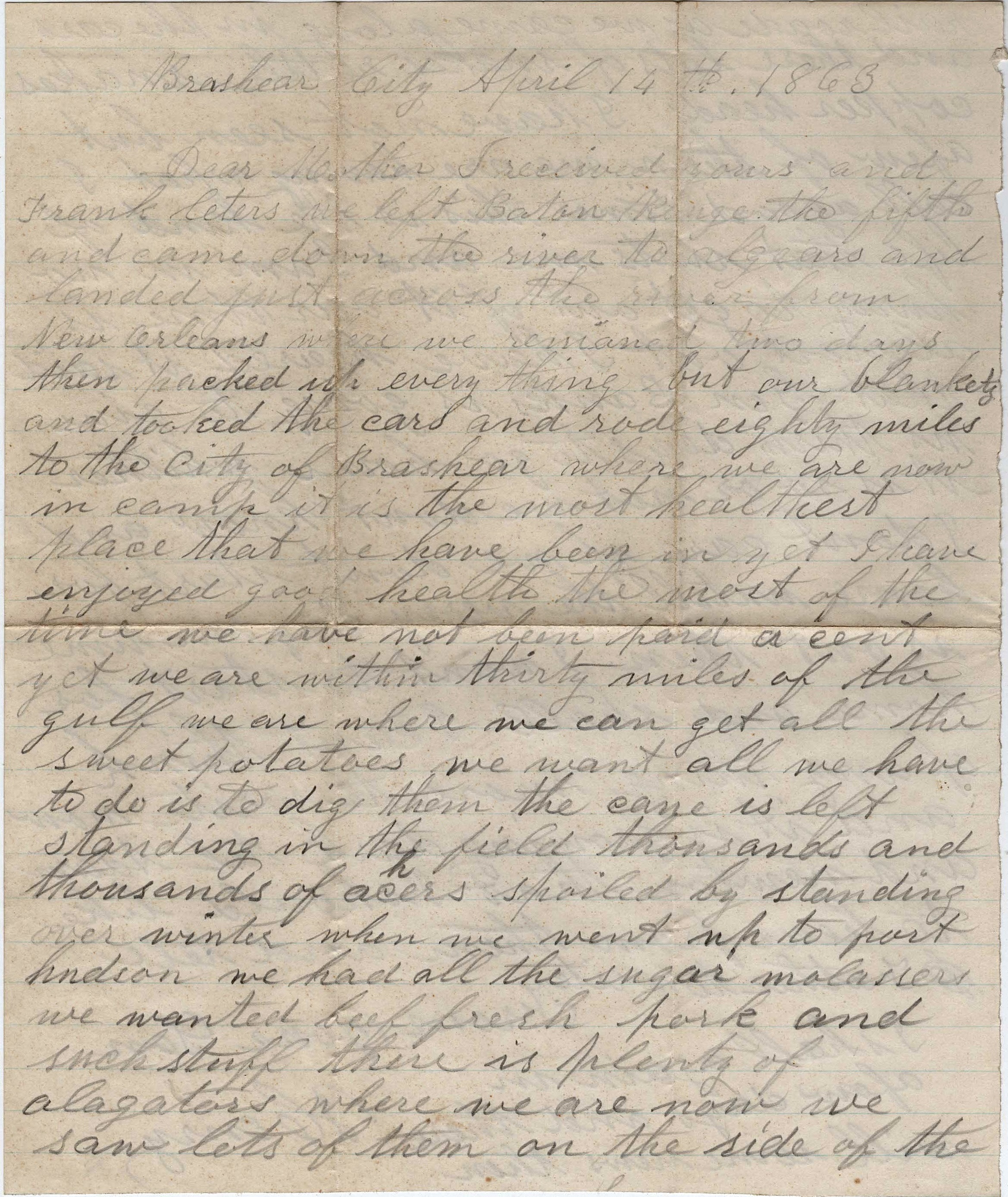
Dear Mother, I received yours and Frank’s letters. We left Baton Rouge the fifth and came down the river to Algiers and landed just across the river from New Orleans where we remained two days. Then packed up everything but our blankets and took the cars and rode eighty miles to the city of Brashear where we are now in camp. It is the most healthiest place that we have been in yet. I haveenjoyed good health the most of the time.
We have not been paid a cent yet. We are within thirty miles of the Gulf. We are where we can get all the sweet potatoes we want. All we have to do is dig them. The cane is left standing in the field, thousands and thousands of acres spoiled by standing over winter.
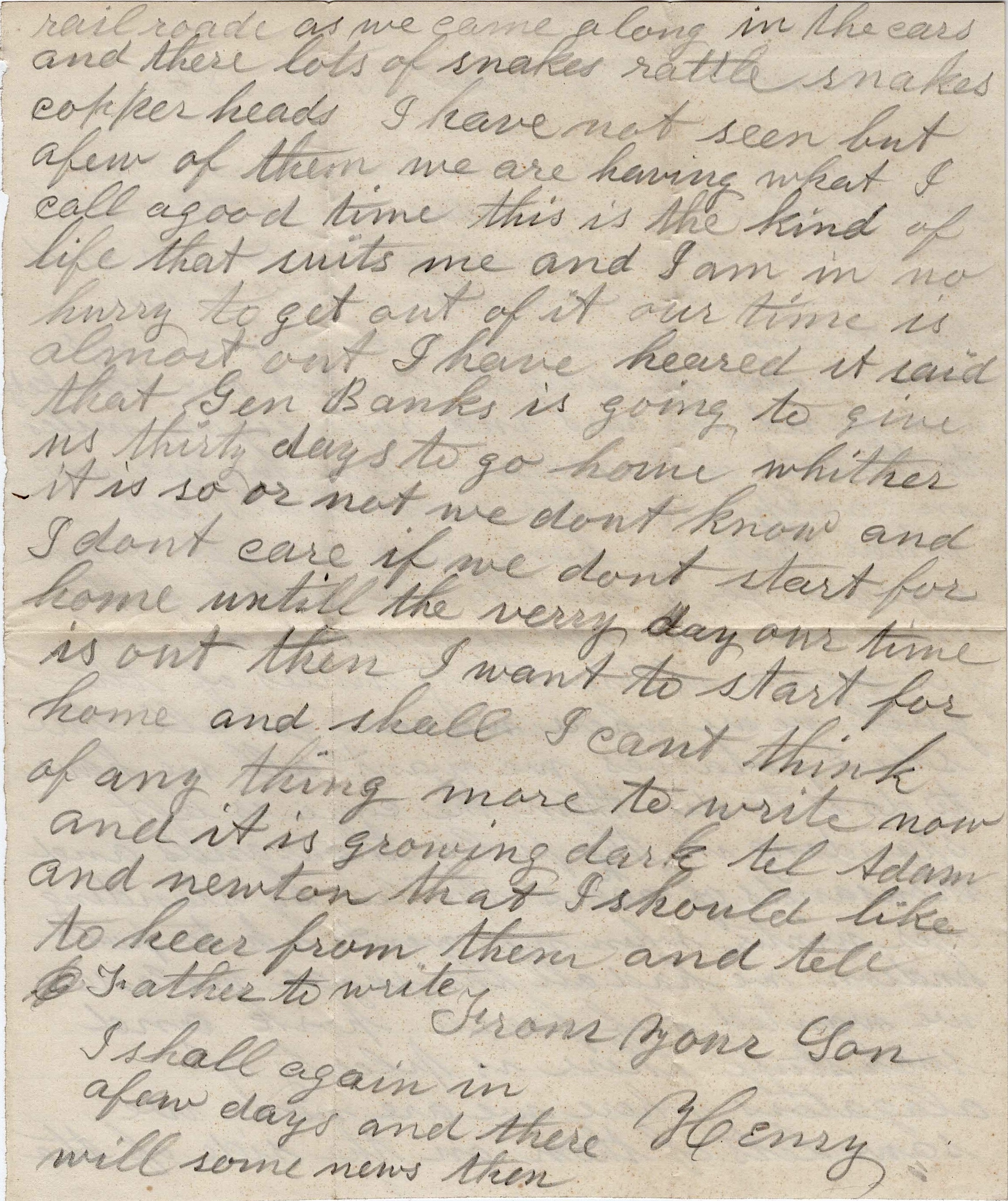
When we went up to Port Hudson, we had all the sugar molasses we wanted, beef, fresh pork, and such stuff. There is plenty of alligators where we are now. We saw lots of them on the side of the railroad as we came along in the cars and there [are] lots of snakes—rattlesnakes, copperheads. I have not seen but a few of them.
We are having what I call a good time. This is the kind of life that suits me and I am in no hurry to get out of it. Our time is almost out. I have heard it said that Gen. Banks is going to give us thirty days to go home. Whether it is so or not, we don’t know and I don’t care. If we don’t start for home until the very day our time is out, then I want to start for home and shall.
I can’t think of anything more to write now and it is growing dark. Tell Adam and Newton that I should like to hear from them and tell Father to write. From your son, — Henry
I shall [write] again in a few days and there will [be] some news then.
— Henry
Letter 6
Abington [Massachusetts]
May 5, 1863
Dear brother,
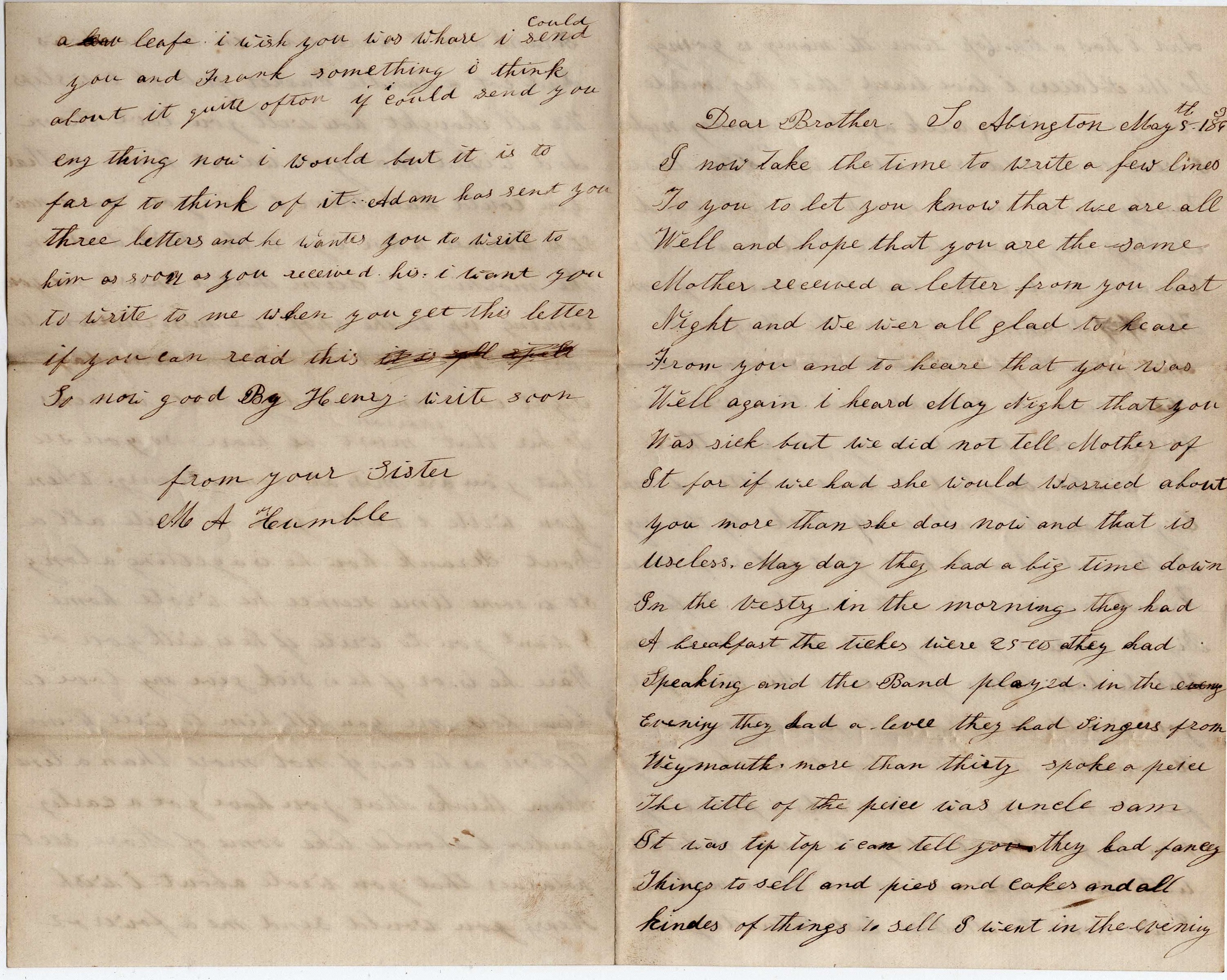
I now take the time to write a few lines to you to let you know that we are all well and hope that you are the same. Mother received a letter from you last night and we were all glad to hear from you and to hear that you was well again. I heard that you was sick but we did not tell Mother of it for if we had she would have worried about you more than she does now and that is useless.
On May Day they had a big time down in the vestry. In the morning they had a breakfast. The tickets were 25 cents. They had speaking and the band played in the evening. They had a levee. They had singers from Weymouth, More than thirty spoke a piece. The title of the piece was Uncle Sam. It was tip top, I can tell you. They had fancy things to sell and pies and cakes and all kinds of things to sell. I went in the evening and I had a tip top time. The money is going to the soldiers. I have heard that they made over $150.
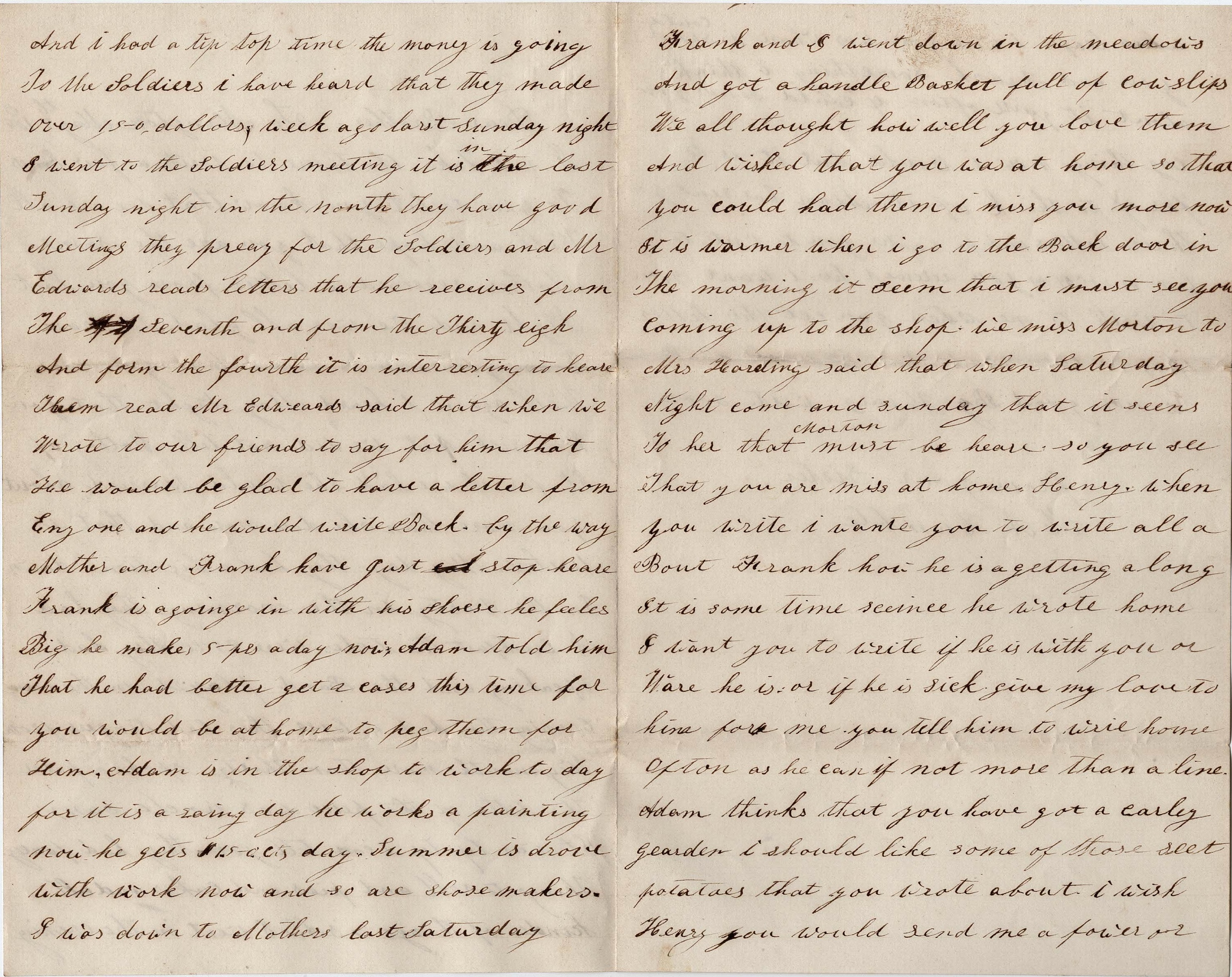
A week ago last Sunday night I went to the soldier’s meeting. It is in the last Sunday night in the month. They have good meetings. They pray for the soldiers and Mr. Edwards reads letters that he receives from the 7th and from the 38th and from the 4th [Massachusetts Regiments]. It is interesting to hear them read. Mr. Edwards said that when we wrote to our friends, to say for him that he would be glad to have a letter from anyone and he would write back.
By the way, Mother and Frank have just stopped here. Frank is a going in with his shoes. He feels big. He makes 5 pairs a day now. Adam told him that he had better get a cases [?] this time for you would be at home to peg them for him. Adam is in the shop to work today for it is a rainy day. He works a painting now. He gets $1.50 a day.
Summer is drove with work now and so are shoemakers. I was down to Mother’s last Saturday. Frank and I went down in the meadows and got a handle basket full of cow slips. We all thought how well you love them and wished that you was at home so that you could had them. I miss you more now it is warmer. When I go to the back door in the morning, it seems that I must see you coming up to the shop. We miss Morton too. Mrs. Harding said that when Saturday night comes and Sunday, that it seems to her that Morton must be here. So you see that you are missed at home, Henry.
When you write, I want you to write all about Frank—how he is a getting along. It is some time since he wrote home. I want you to write if he is with you or where he is or if he is sick. Give my love to him for me. You tell him to write home often as he can if not more than a line. Adam thinks that you have got a early garden. I should like some of those sweet potatoes that you wrote about. I wish, Henry, you would send me a flower or a leaf. I wish you was where I could send you and Frank something. I think about it quite often. If I could send you anything now I would but it is too far to think of it. Adam has sent you three letters and he wants you to write to him as soon as you received his. I want you to write to me when you get this letter if you can read this. So no more. Goodbye, Henry. Write soon. From your sister, — M. A. Humble
Letter 7
Brashear City, La.
May 18, 1863
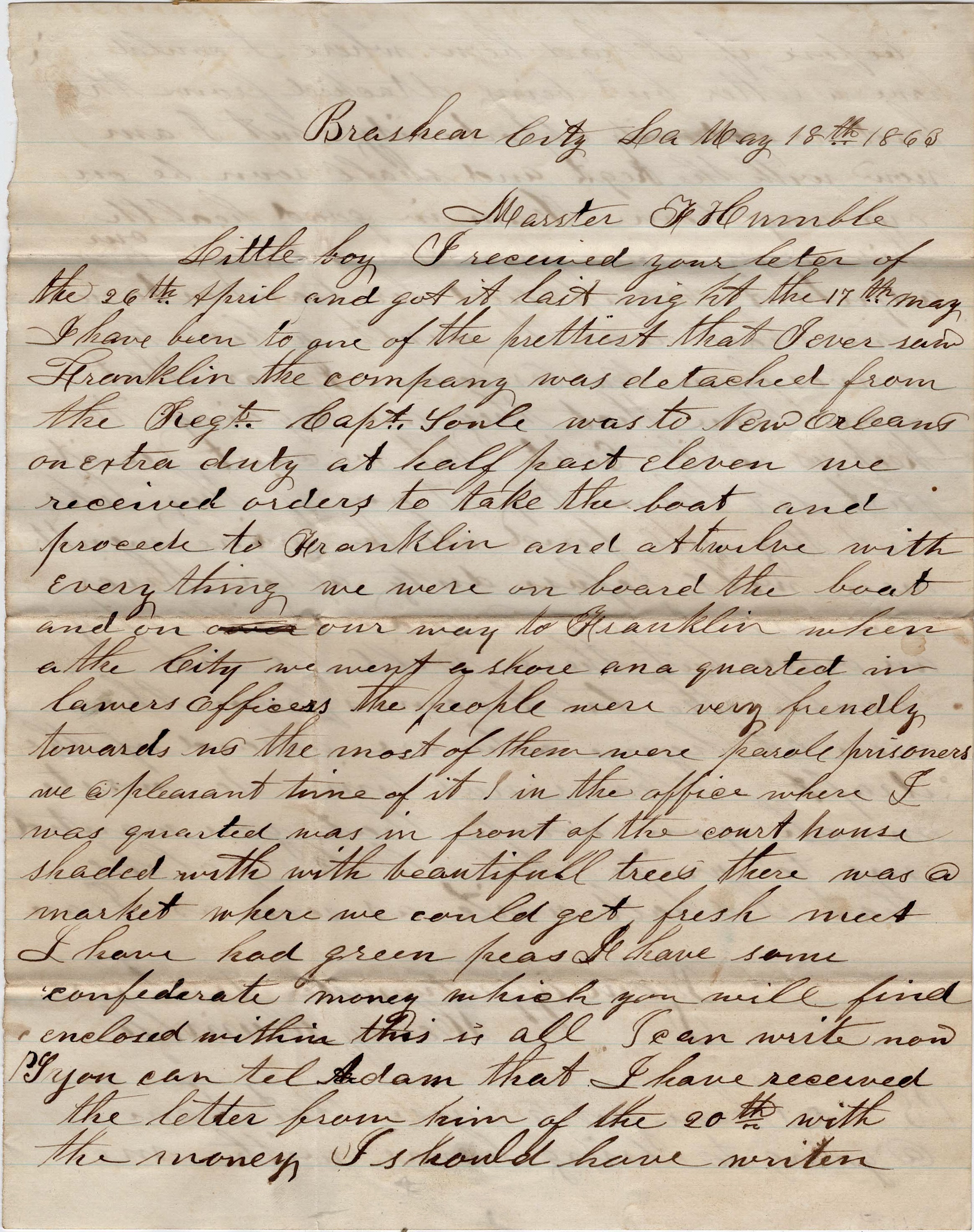
Master F[rank] Humble,
Little boy, I received your letter of the 26th April and got it last night, the 17th of May. I have been to one of the prettiest [places] that I ever saw—Franklin. The company was detached from the regiment, Capt. [Lewis] Soule was [sent] to New Orleans on extra duty. At half past eleven we received orders to take the boat and proceed to Franklin and at twelve with everything, we ewre on board the boat and on our way to Franklin. When at the city, we ewnt ashore and quartered in lawyers’ offices. The people were very friendly towards us. The most of them were paroled prisoners. We had a pleasant time of it. The office where I was quartered was in front of the court house shaded with beautiful trees. There was a market where we could get fresh meat. I have had green peas.
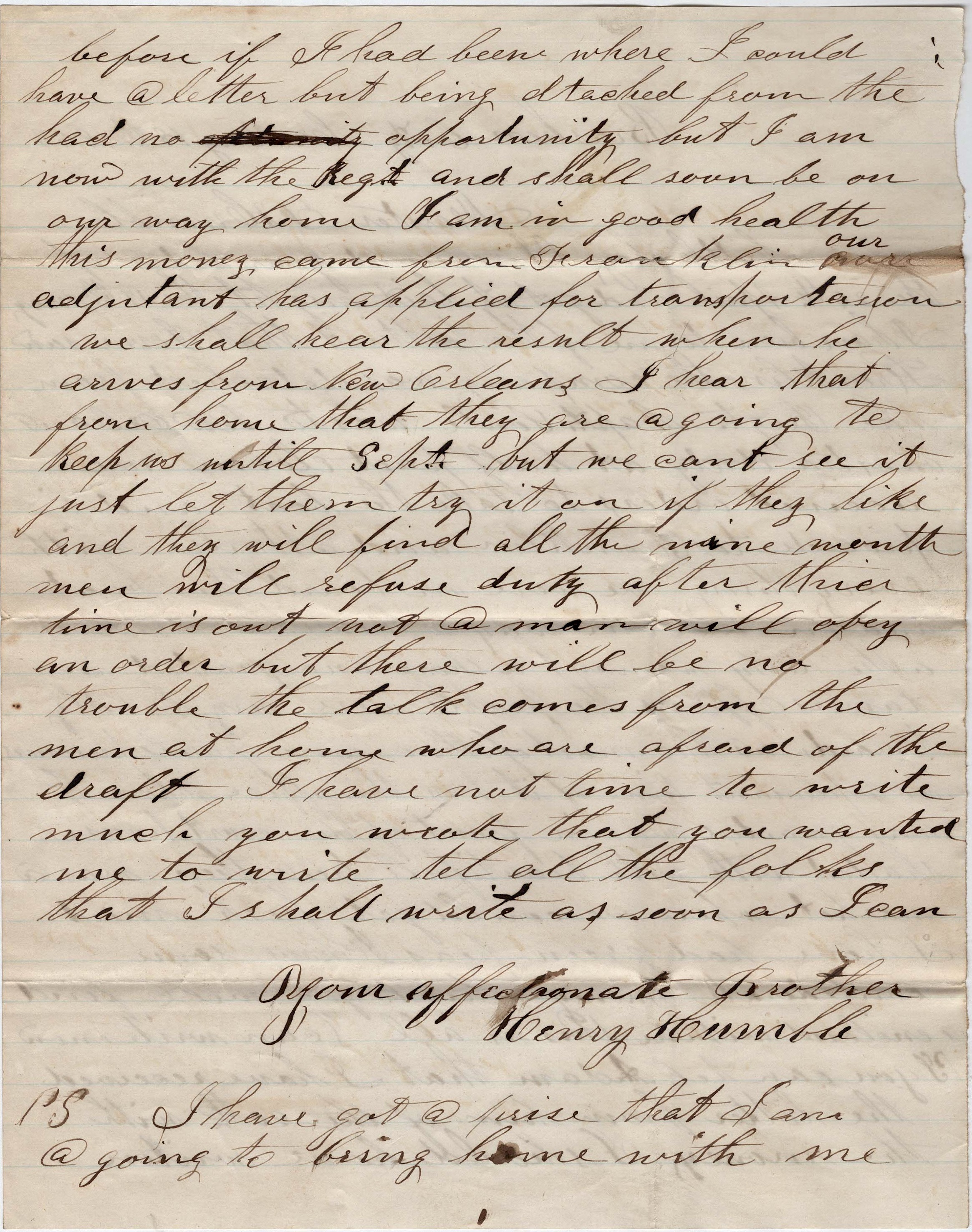
I have some confederate money which you will find enclosed within. This is all I can write no. P. S. You can tell Adam that I have received the letter from him of the 20th with the money. I should have written before if I had been where I could have a letter but being detached from the [regiment], had no opportunity. But I am now with the regiment and shall soon be on our way home. I am in good health. This money came from Franklin.
Our adjutant has applied for transportation. We shall hear the result when he arrives from New Orleans. I hear that from home that they are a going to keep us until September but we can’t see it. Just let them try it on if they like and they will find all the nine-months men will refuse duty after their time is out. Not a man will obey an order. But there will be no trouble. The talk comes from the men at home who are afraid of the draft. I have not time to write much. You wrote that you wanted me to write to all the folks that I shall write as soon as I can. Your affectionate brother, — Henry Humble
P. S. I have got a prize that I am a going to bring home with me.
Letter 8
Brashear City [Louisiana]
May 27, 1863
Dear Mother,
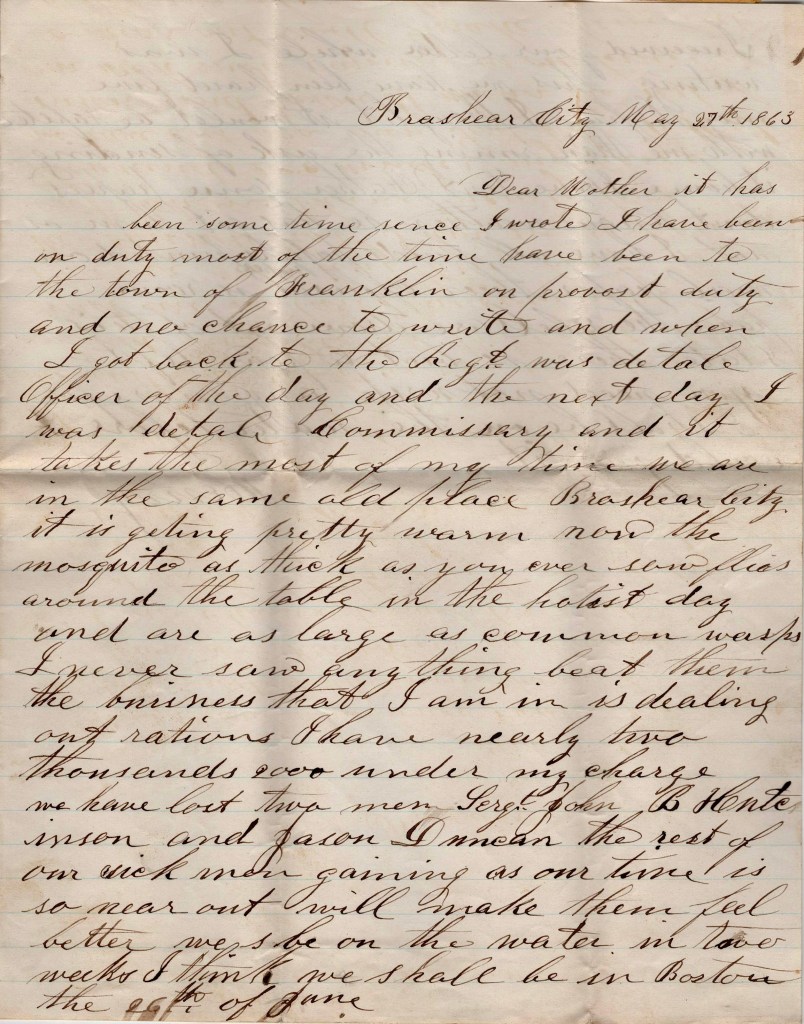
It has been some time since I wrote. I have been on duty most of the time. Have been to the town of Franklin on Provost duty and no chance to write and when I got back to the regiment, was detailed Officer of the Day and the next day I was detailed Commissary and it takes most of my time.
We are in the same old place, Brashear City. It is getting pretty warm now. The mosquito are thick as you ever saw flies around the table in the hottest day and are as large as common wasps. I never saw anything beat them. The business that I am in is dealing out rations. I have nearly two thousand under my charge.
We have lost two men, Sergt. John B. Hutchinson and Jason Duncan. The rest of our sick men [are] gaining as our time is so near out will make them feel better. We be on the water in two weeks, I think. We shall be in Boston the 26th of June.
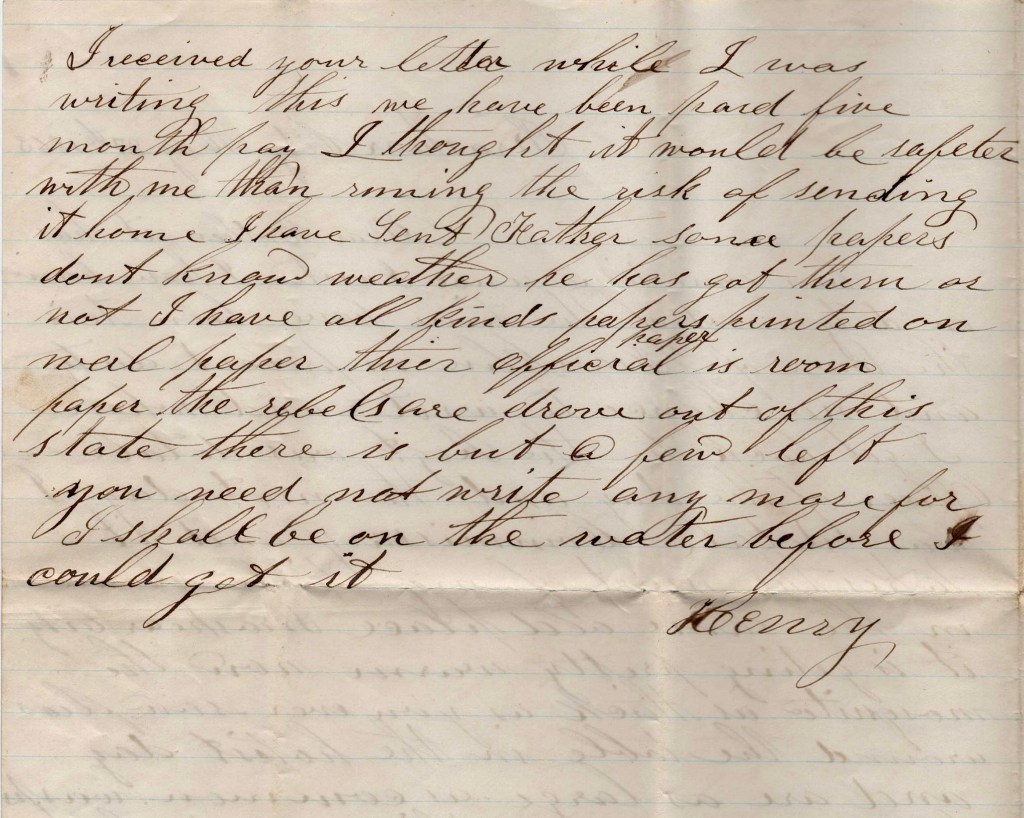
I received your letter while I was writing this. We have been paid five months pay. I thought it would be safer with me than running the risk of sending it home. I have sent Father some papers. Don’t know whether he has got them or not. I have all kinds of papers printed on wallpaper. Their official paper is room paper.
The rebels are drove out of this state. There is but a few left. You need not write any more for I shall be on the water before I could get it. — Henry
Letter 9
Franklin, Louisiana
July 13th 1863
Dear Father,
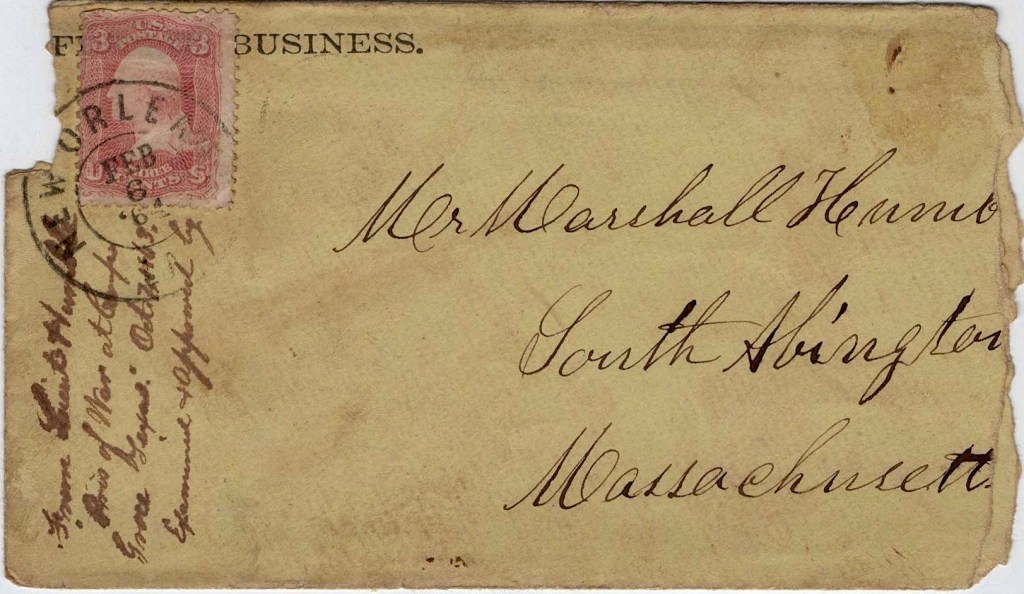
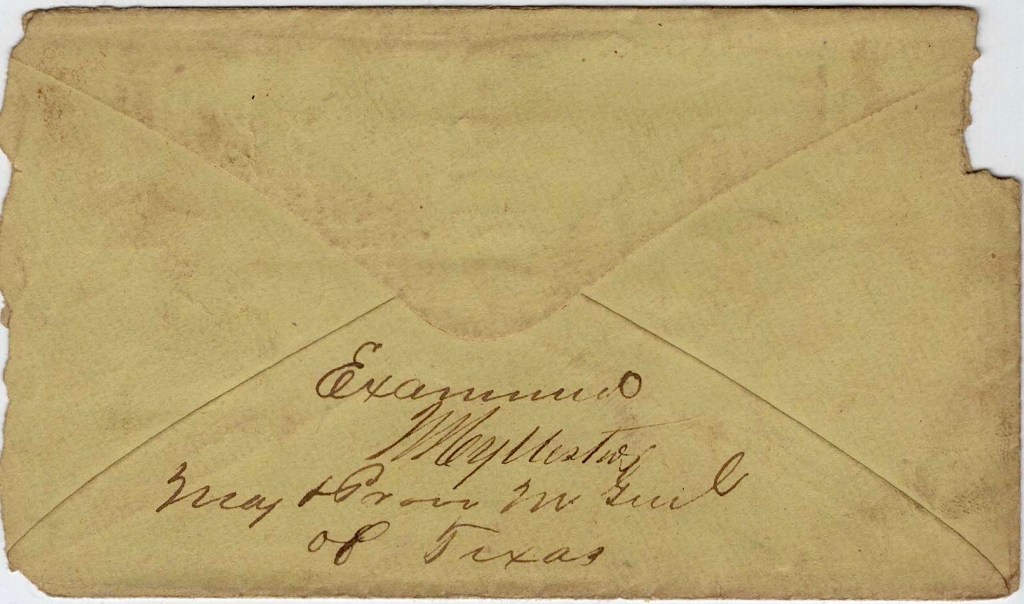
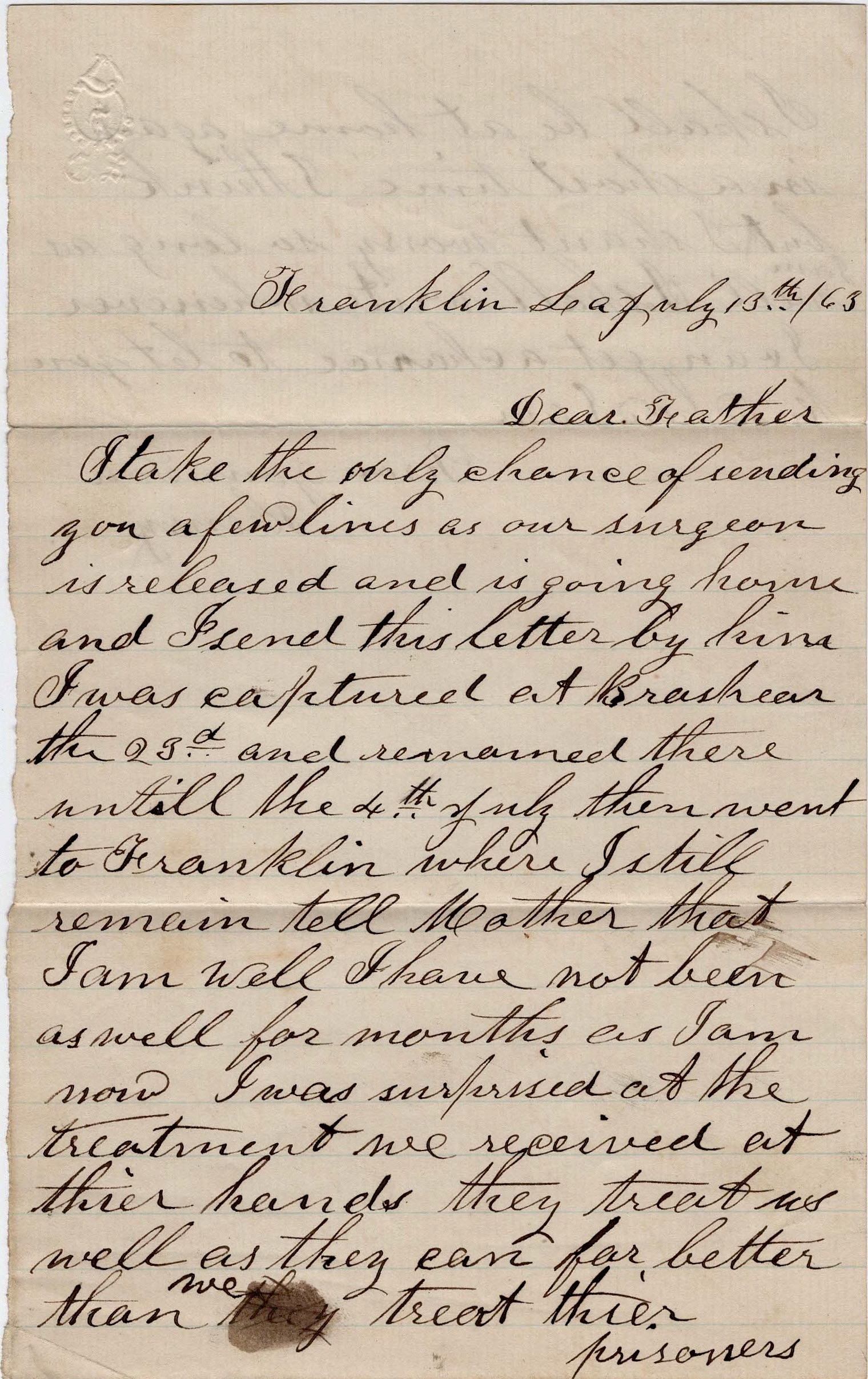
I take the only chance of sending you a few lines as our surgeon is released and is going home and I send this letter by him. I was captured at Brashear the 23rd and remained there until the 4th of July, then went to Franklin where I still remain. Tell Mother that I am well. I have not been as well for months as I am now. I was surprised at the treatment we received at their hands. They treat us well as they can—far better than we treat their prisoners.
I shall be at home again in a short time, I think but I shan’t worry so long as I am well. I shall write whenever I can get a chance to let you know how I am. From your son, Henry.
Letter 10
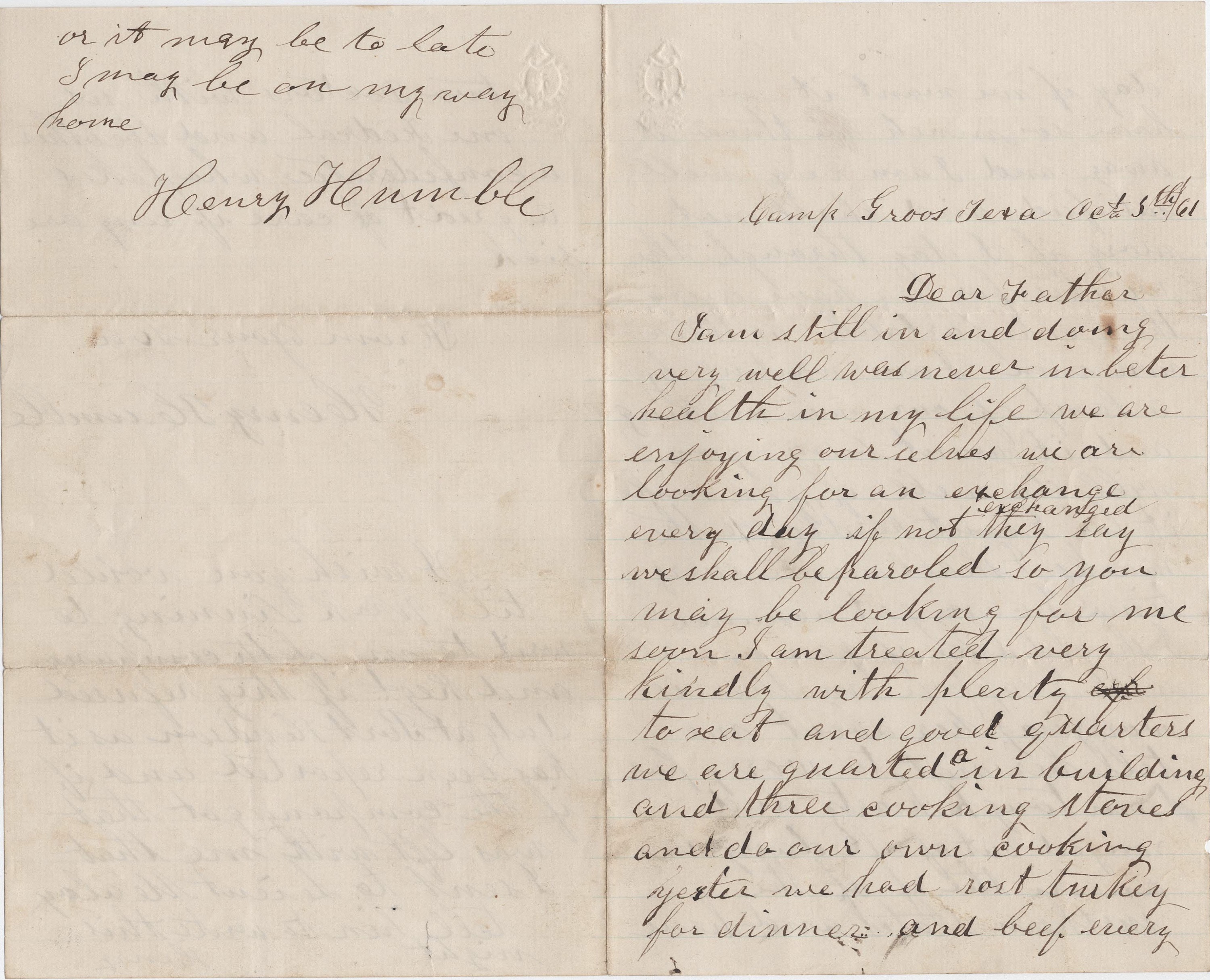
Camp Groce [near Hempstead], Texas 1
October 5, 1861 [should be 1863]
Dear Father,
I am still in [confinement] and doing very well. Was never better in my life. We are enjoying ourselves. We are looking for an exchange every day. If not exchanged, they say we shall be paroled so you may be looking for me soon.
I am treated very kindly with plenty to eat and good quarters. We are quartered in a building and three cooking stoves and do our own cooking. Yesterday we had roast turkey for dinner and beef every day if we want it. We have so much we throw it away and I am very satisfied and shall not worry if I stay through the winter for we have everything [as] comfortable as their own men.
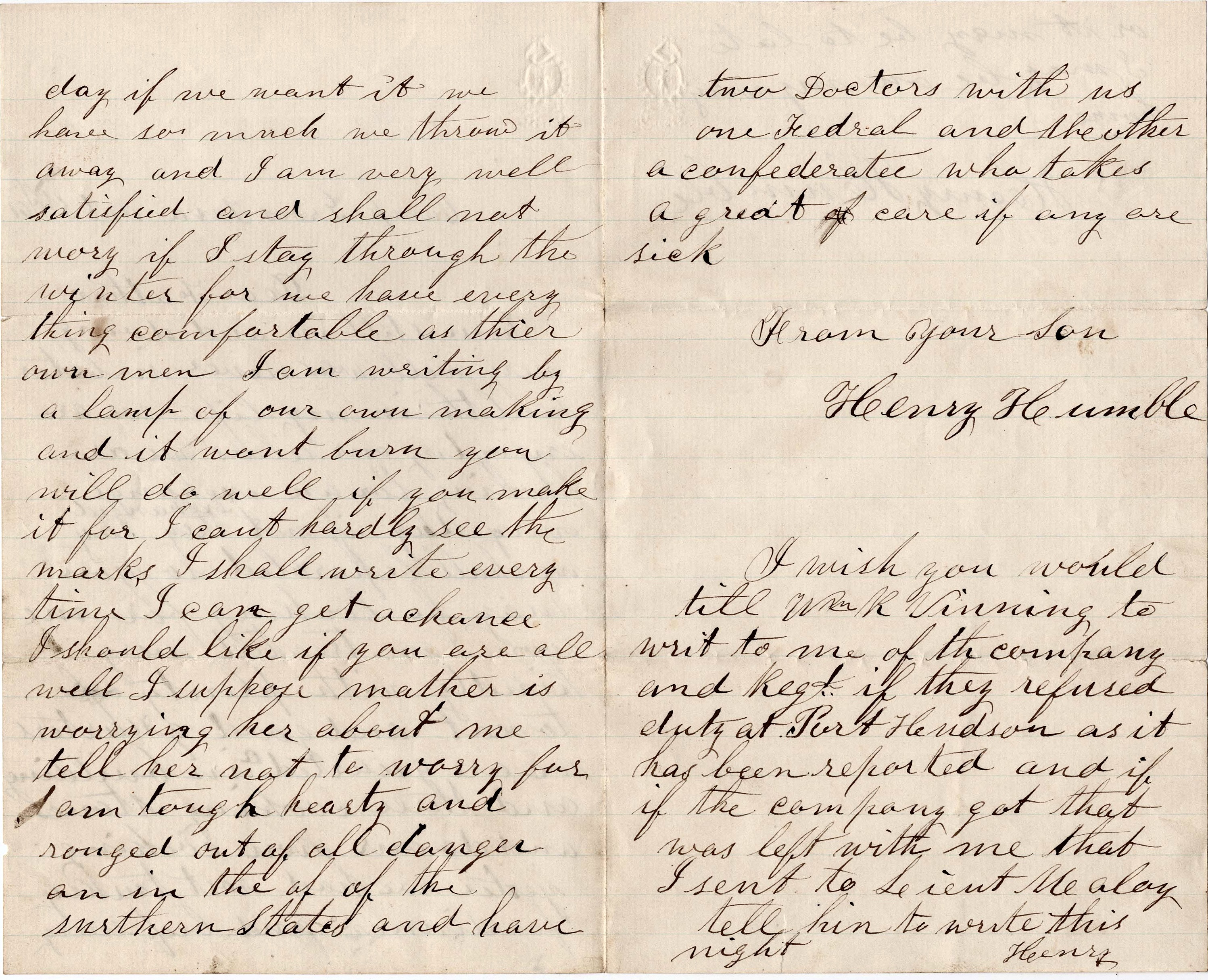
I am writing by a lamp of our own making and it won’t burn. You will do well if you [can] make it [out] for I can’t hardly see hte marks. I shall write every time I can get a chance. I should like if you are all well. I suppose Mother is worrying her[self] about me. Tell her not to worry for I am tough, hearty and ranged out of all danger. Am in the souther states and have two doctors with us—one Federal and the other a Confederate who takes a great care of any are sick.
From your son, — Henry Humble
I wish you would tell Wm. R. Vining to write to me of the company and regiment if they refused duty at Port Hudson as it has been reported and if the company got that was left with me that I sent to Lieut. McAlloy. Tell him to write this night or it may be too late [as] I may be on my way home. — Henry Humble
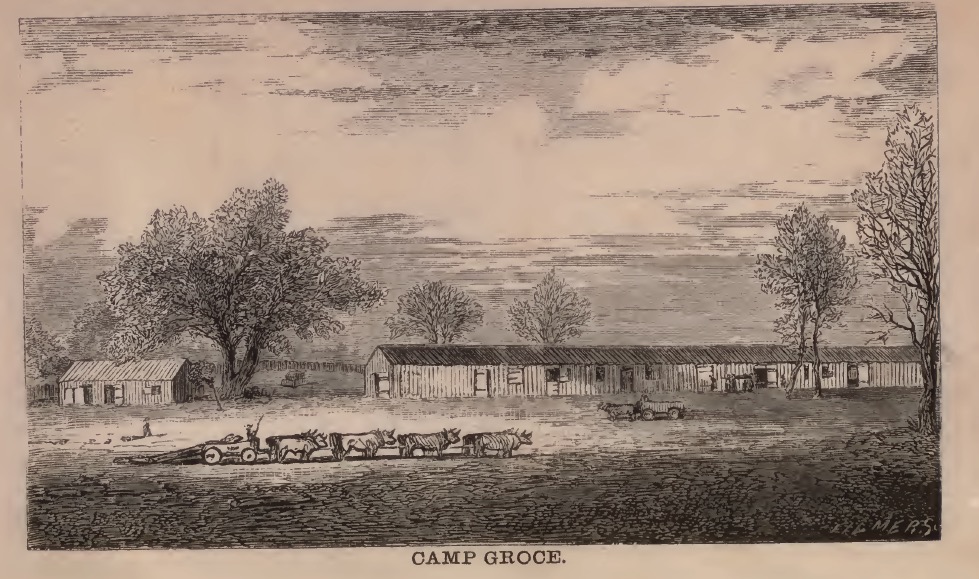
1 “Camp Groce, at times referred to as Camp Liendo, was located on Col. Leonard W. Groce’s Liendo Plantation on Clear Creek and the Houston and Texas Central Railway, two miles east of Hempstead in Waller County. Established in 1862 as a place for instruction for Confederate recruits, Camp Groce had two rows of barracks built in what seemed an ideal spot. However, stagnant water in the creek made the location sickly, and the camp was little used until the summer of 1863 when it was designated as a prison for Union soldiers captured in the battles of Galveston (January 1, 1863) and Sabine Pass (January 21, 1863). After the second battle of Sabine Pass (September 8, 1863), the prisoner population swelled to more than 400 officers, soldiers, and sailors. At first most prisoners lived in an open clearing, but in October 1863 a stockade was built to enclose them.” Conditions included rations supplemented by local sources, access to wells and nearby woods for water and fuel, and barracks that offered relative shelter compared to other Texas prisons, though illnesses like typhus and a severe yellow fever outbreak in September 1864 prompted evacuations. Rations were sparse—typically cornmeal, occasional beef, and limited vegetables—reflecting Confederate supply constraints in Texas. [Source: Camp Groce: A Historical Overview of the Confederate Prison by Brad Clampitt, published 1952, updated 23 November 2012.]
Letter 11
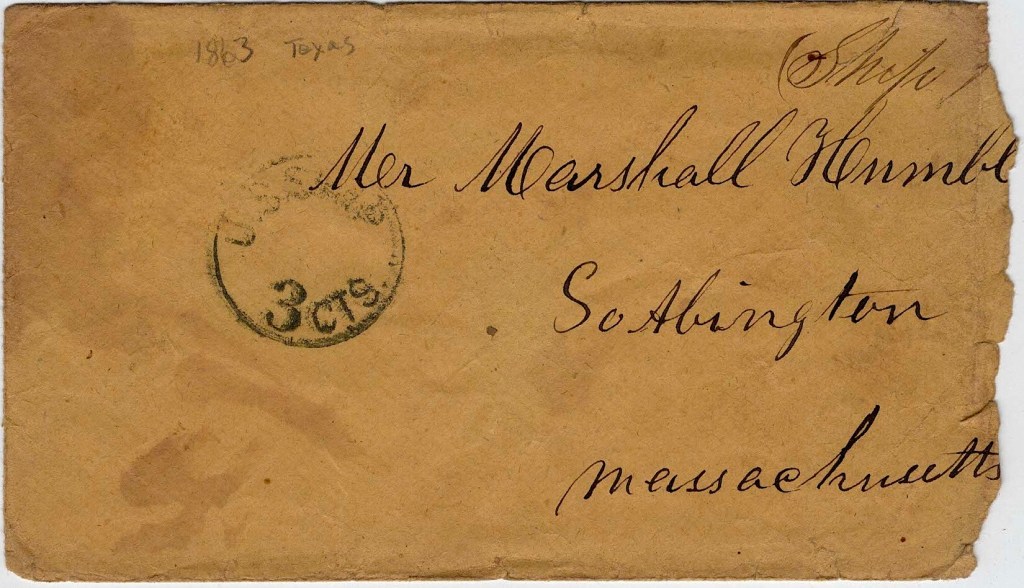
Texas
November 1, 1863
Dear Mother,
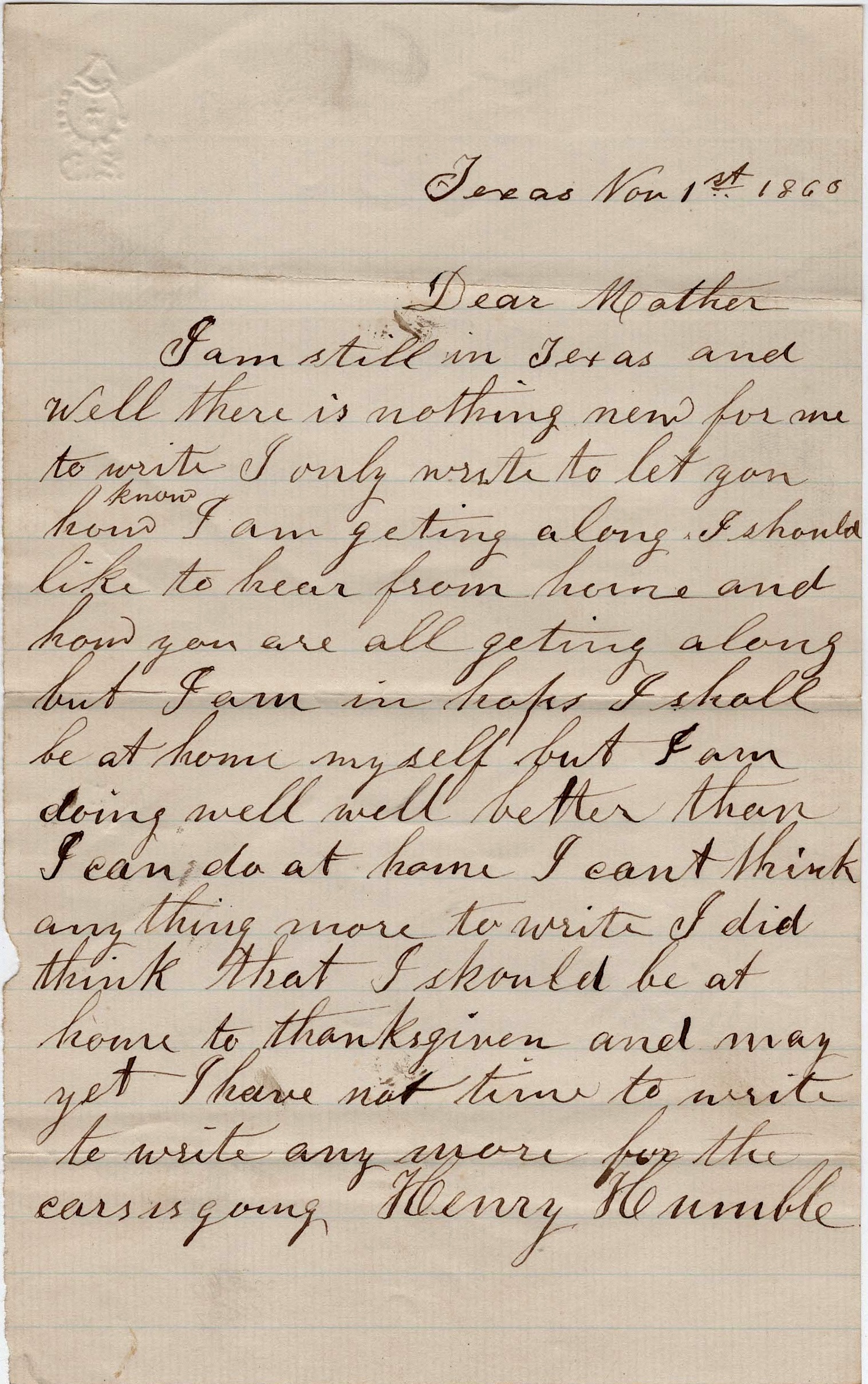
I am still in Texas and well. There is nothing new for me to write. I only write to let you know how I am getting along. I should like to hear from home and how you are all getting along but I am in hopes I shall be at home myself. But I am doing well—better than I can do at home.
I can’t think of anything more to write. I did think that I should be at home to Thanksgiving and may yet. I have not time to write any more for the cars is going. — Henry Humble
Letter 12
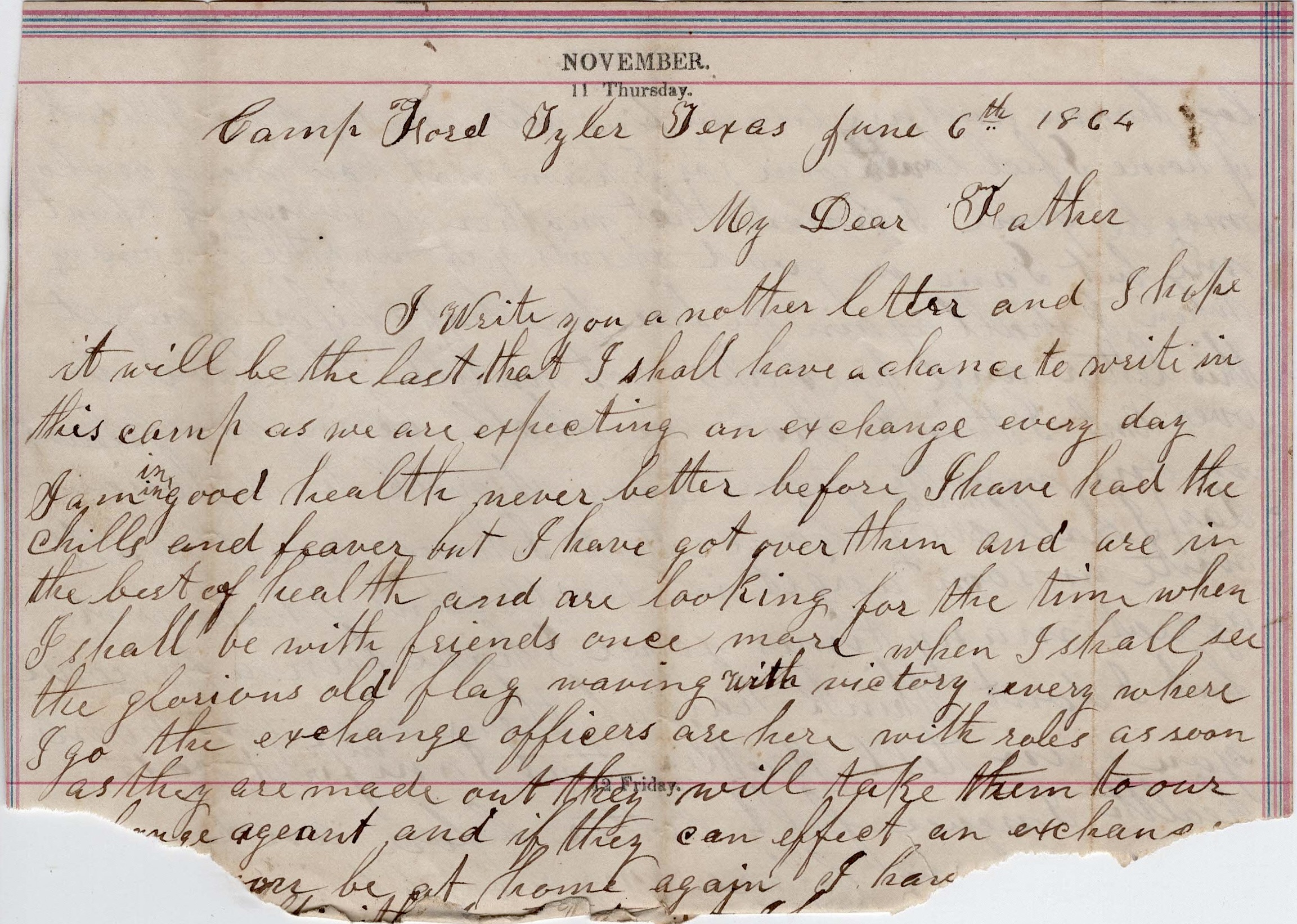
Camp Ford, Tyler, Texas 1
June 6th 1864
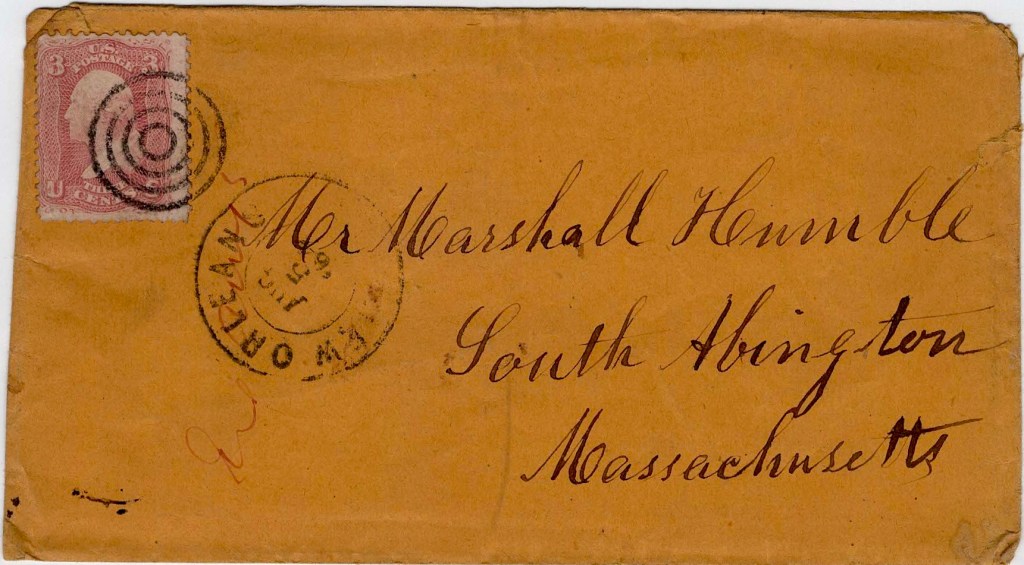
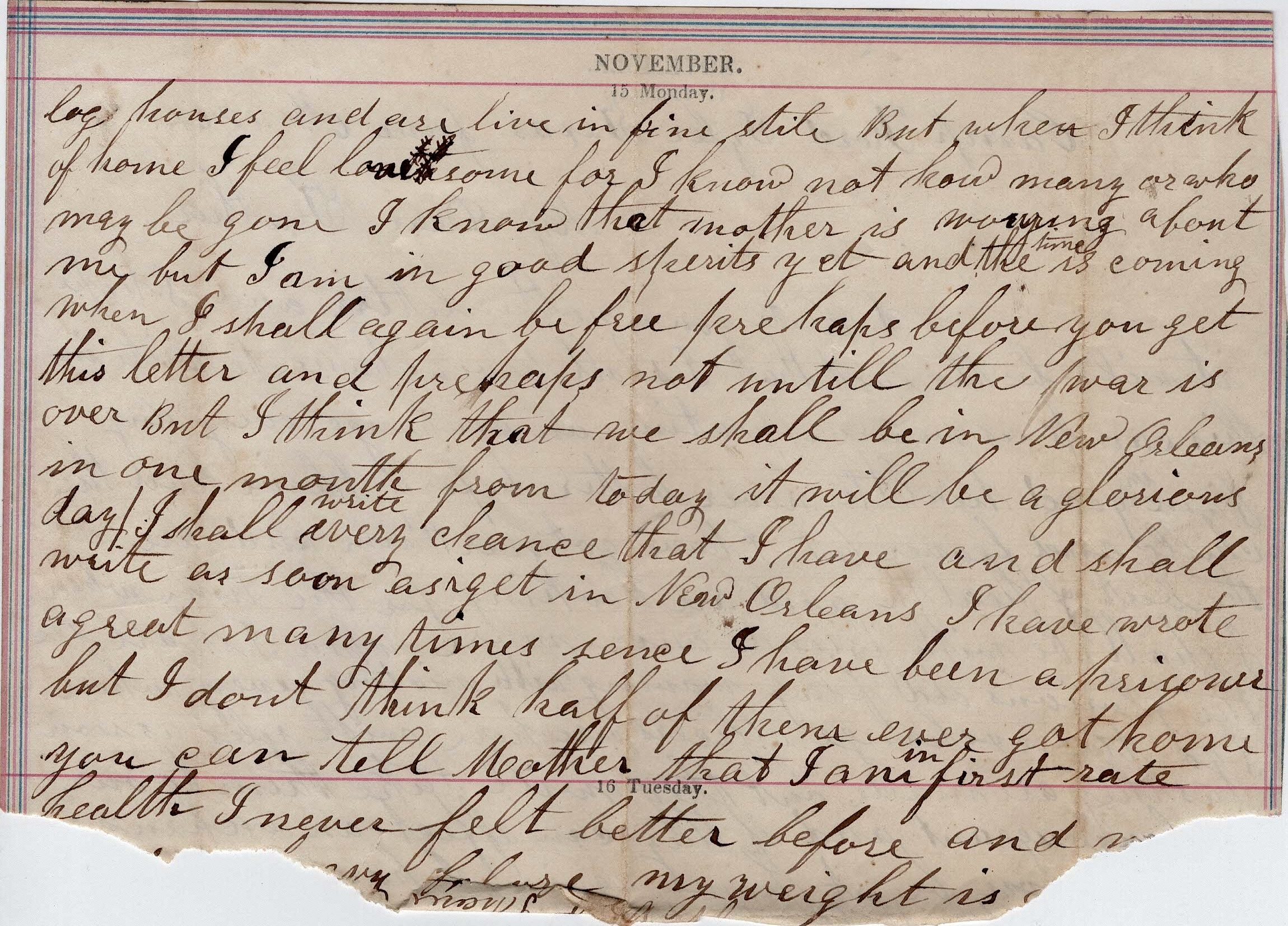
I write you another letter and I hope it will be the last that I shall have a chance to write in this camp as we are expecting an exchange every day. I am in good health—never better before. I have had the chills and fever but I have got over them and are in the best of health and are looking for the time when I shall be with friends once more when I shall see the glorious flag waving with victory everywhere I go. The exchange officers are here with rolls. As soon as they are made out, they will take them to our exchange agent and if they can effect an exchange, I will soon be at home again. I have…
…log houses and live in fine style. But when I think of home, I feel lonesome for I know not how many or who may be gone. I know that Mother is moving about. My, but I am in good spirits yet and the time is coming when I shall be free—perhaps before you get this letter and perhaps not until the war is over. But I think that we shall be in New Orleans in one month from today. It will be a glorious day.
I shall write every chance that I have and shall write as soon as I get in New Orleans. I have wrote a great many times since I have been a prisoner but I don’t think half of them ever get home. You can tell Mother that I am in first rate health. I never felt better before and… My weight is…[paper torn at bottom]
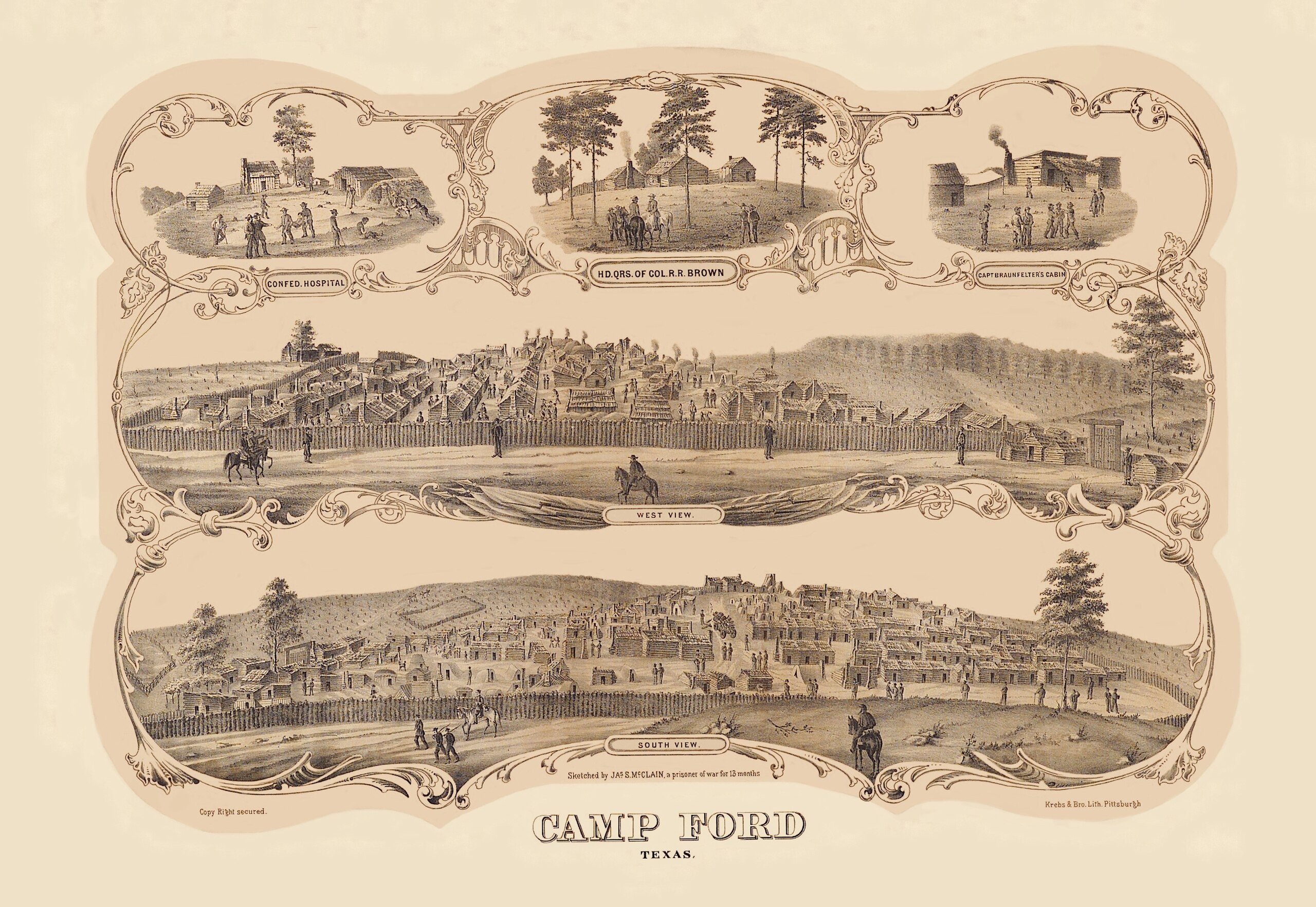
1 Camp Ford was the largest Confederate Prisoner of War camp west of the Mississippi River. It was established in August 1863 and did not close until May 1865. In July 1864, it held over 5300 prisoners.
Letter 13
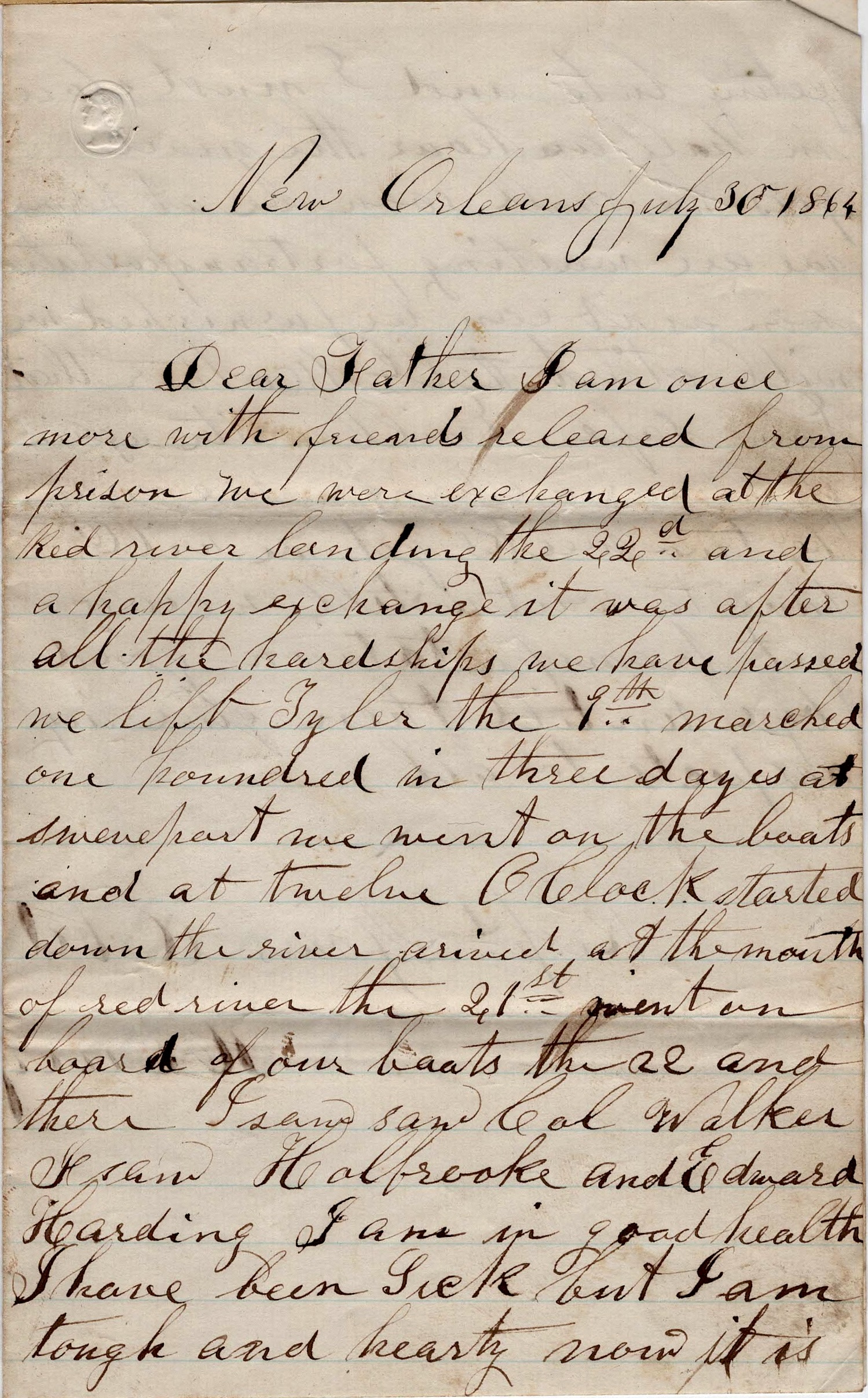
New Orleans [Louisiana]
July 30, 1864
Dear Father,
I am once more with friends—released from prison. We were exchanged at the Red River landing the 22nd and a happy exchange it was after all the hardships we have passed.
We left [Camp] Tyler the 9th, marched one hundred [miles] in three days. At Shreveport we went on the boats and at twelve o’clock started down the river. Arrived at the mouth of Red River the 21st, went on board of our boats the 22nd, and there I saw Col. Walker. I saw Holbrooke and Edward Harding.
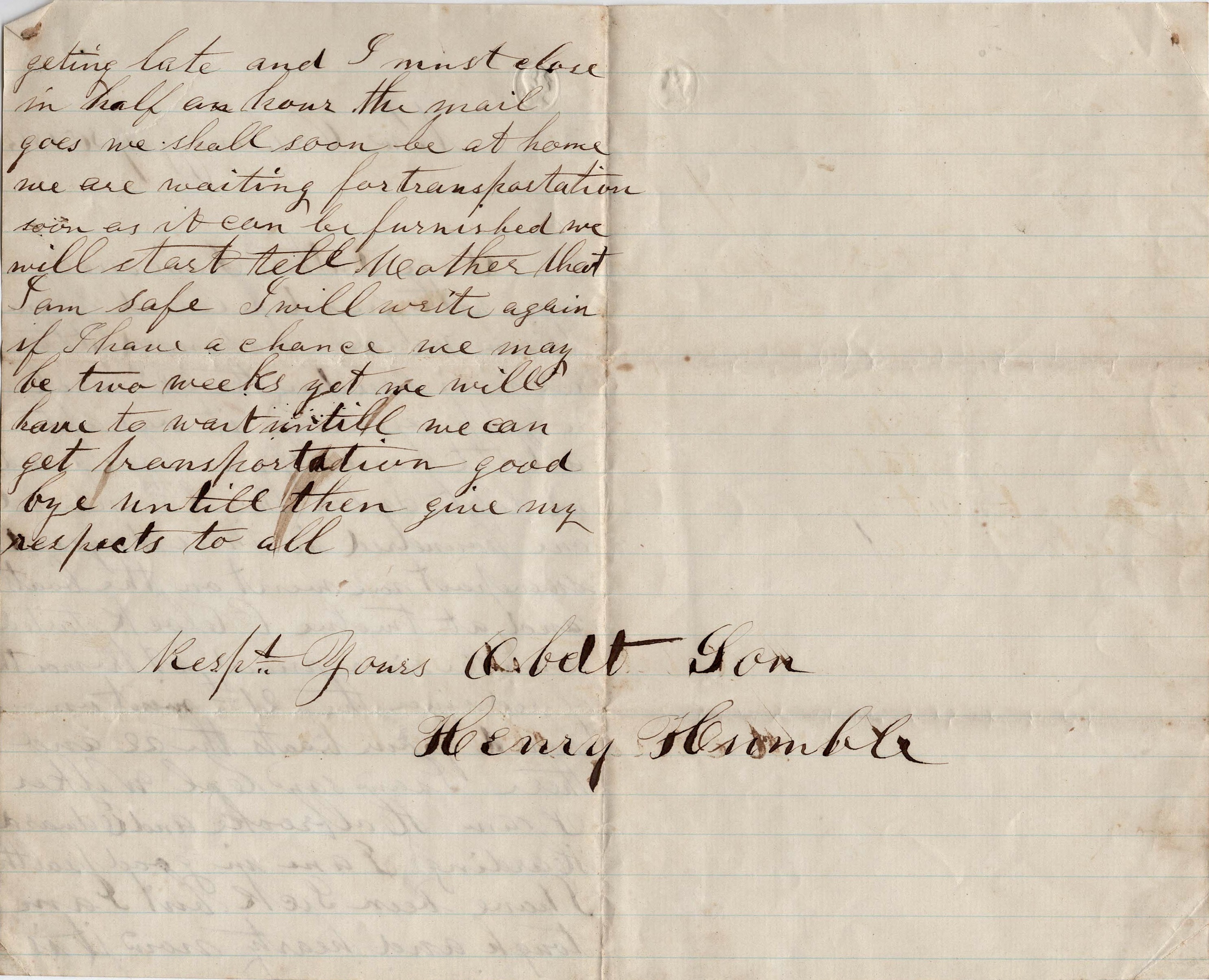
I am in good health. I have been sick but I am tough and hearty now. It is getting late and I must close. In half an hour, the mail goes. We shall soon be at home, We are waiting for transportation. Soon as it can be furnished, we will start.
Tell Mother that I am safe. I will write again if I have a chance. We may be two weeks yet. We will have to wait until we can get transportation. Goodbye until then. Give my respects to all. Respectfully your obedient son, — Henry Humble
 Spared & Shared 23