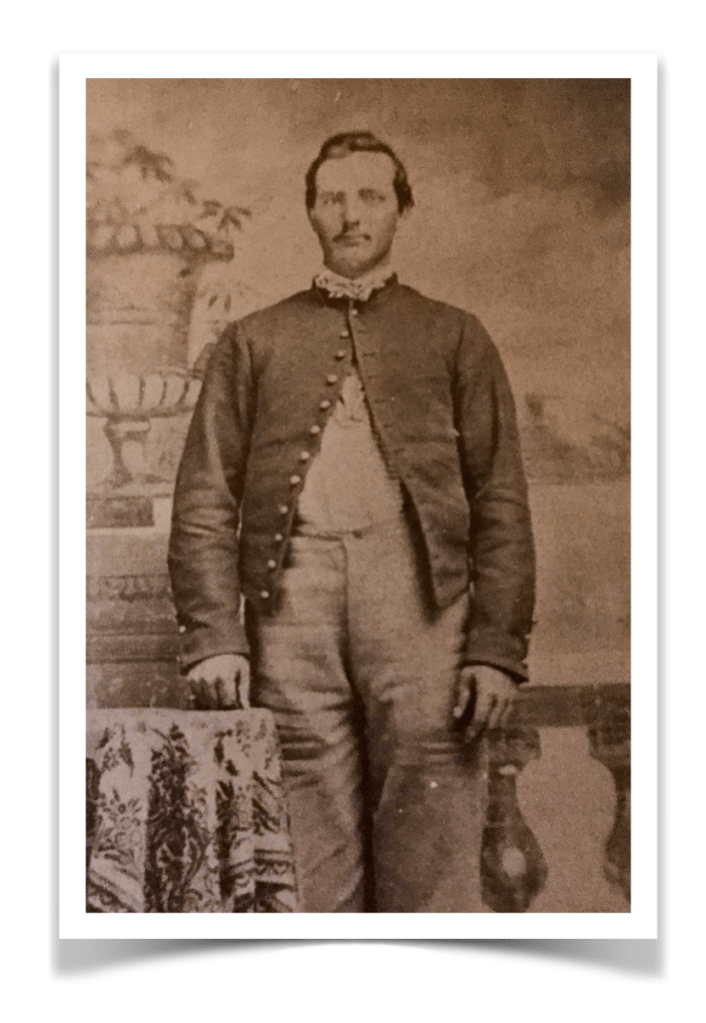
The following letter was written by Frederick P. Rowe (1842-1907), the son of John N. Rowe (1807-1880) and Sarah Electa Wilson (1813-1889) of Hurley, Ulster county, New York. At the time of his enlistment, he was described as a 5 foot, 10 inch tall farmer, with dark eyes, dark hair, and a dark complexion.
Frederick mustered into Co. A, 120th New York Infantry on 22 August 1862 as a private. He was mustered out of the regiment on 3 June 1865 as a corporal. According to muster roll records he was taken prisoner at Gettysburg on 2 July 1863 and was sent to Camp Parole at Annapolis to await exchange where he wrote the following letter in May 1864.
At Gettysburg, the 120th New York fought in Humphrey’s division. It became involved in the disaster of the second day’s battle on the Union left, but like the rest of the 3d corps, it fell back in good order to the second line, fighting as it went. Its casualties in this battle aggregated 30 killed, 154 wounded and 19 missing; total, 203. Eight officers were killed and 9 wounded in that battle.
Transcription
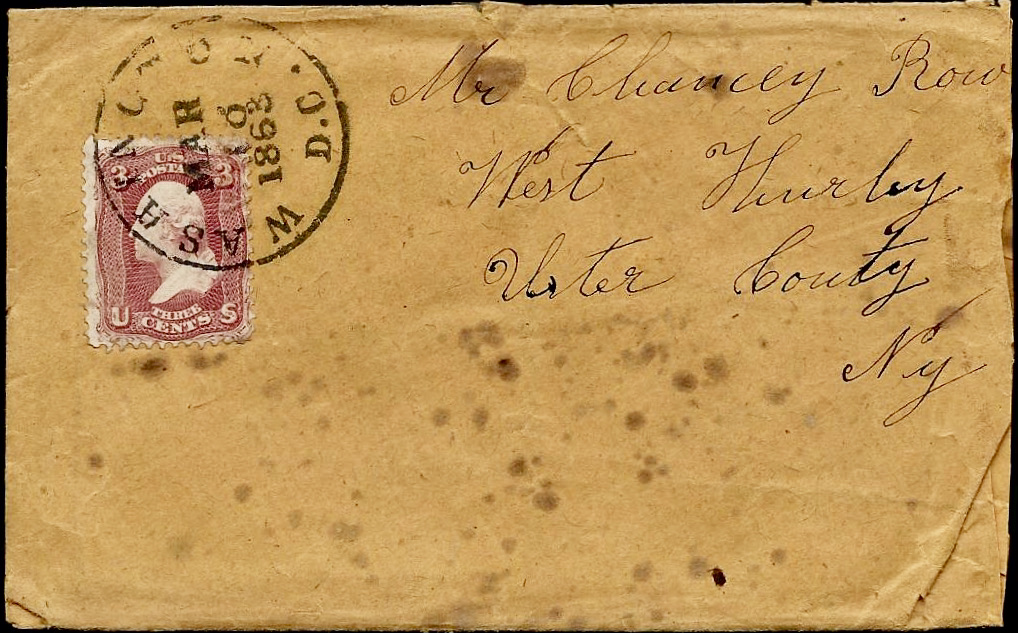
Addressed to Mr. Chauncey Rowe, West Hurley, Ulster county, New York
Camp Parole Annapolis, Maryland May 7th 1864
Dear cousin,
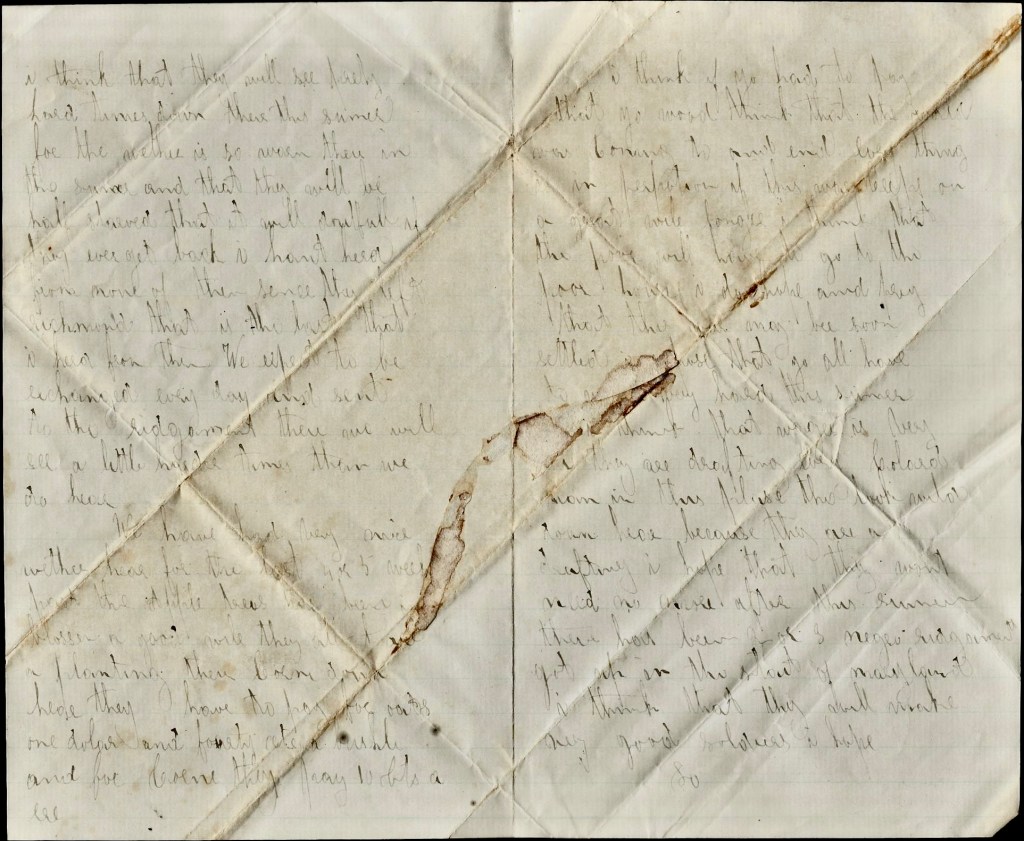
I now sit down to answer your welcome letter which I received the other day. I have neglected writing on the account of cleaning house. I have had my house painted and it makes lots of work for me. I have a barracks all alone by myself and I have got to keep that clean. The reason that I took it was because it was getting rather warm weather and there was so many in the old barracks that it wasn’t healthy.
There is a great many soldiers that dies here. There was 15 buried yesterday. They was those that just came from Richmond. There is more or less buried every day. I wish that those boys that is in Georgia was here. It think that they will see pretty hard times down there this summer for the weather is so warm there in the summer and they will be half starved. It will be doubtful if they ever get back. I hain’t heard from none of them since they left Richmond. That is the last that I heard from them. We expect to be exchanged every day and sent to the regiment. Then we will see a little harder times than we do here.
We have had very nice weather here for the last 4 or 5 weeks past. The apple trees has been in blossom a good while. They are out a planting their corn down here. They have to pay for oats one dollar and forty cents a bushel and for corn they pay 10 bits an ear. I think if you had to pay that, you would think that the world was coming to an end. Everything is in proportion. If this war keeps on a great while longer, I think that the poor [soldier] will have to go to the poor house. I do hope and pray that the war may be soon settled. I suppose that you all have to work very hard this summer. I think that wages is very high.
They are drafting every colored man in this place. Thy look wild down here because they are a drafting. I hope that they won’t need no more after this summer. There has been two or three negro regiments got up in the State of Maryland. I think that they will make very good soldiers. I hope so.
I have written you all the news so I shall have to close. Give my love to Chancy and Mary and all the rest. Please write just as soon as you get this. This is from your affectionate cousin, — Fred P. Rowe
I could not find an image of Frank but here is Pvt. Albert Conover of Co. E, 94th New York Infantry (LOC)
The following letters were written by Pvt. Franklin M. Rice (1840-1917) of Co. C, 94th New York Infantry who enlisted on 18 October 1861 and served until 18 July 1865, according to Muster Rolls.
“Frank” was the son of Franklin A. Rice (1812-1888) and Amanda Hoisington (1816-1900) of Ellisburg, Jefferson county, New York. He was married to Ellen E. Pratt (1847-1918) but given her age at the time of his enlistment, my hunch is that the couple were married while Frank was at home on a Veteran’s Furlough in early 1864.
From the regimental history we learn that the 94th New York participated in the Battle of Gettysburg and then spent the next several months in a “fruitless campaign” in Virginia culminating in the Mine Run Campaign. While most of the Army of the Potomac went into winter quarters at Culpeper, the 94th New York was ordered to Annapolis, Maryland, where it was attached to the 8th Corps temporarily, and where it remained on duty at Camp Parole until 26 May 1864 when it rejoined the army at the front.
To read other letters I’ve transcribed & posted on Spared & Shared that were written by other member of the 94th New York Infantry, see:
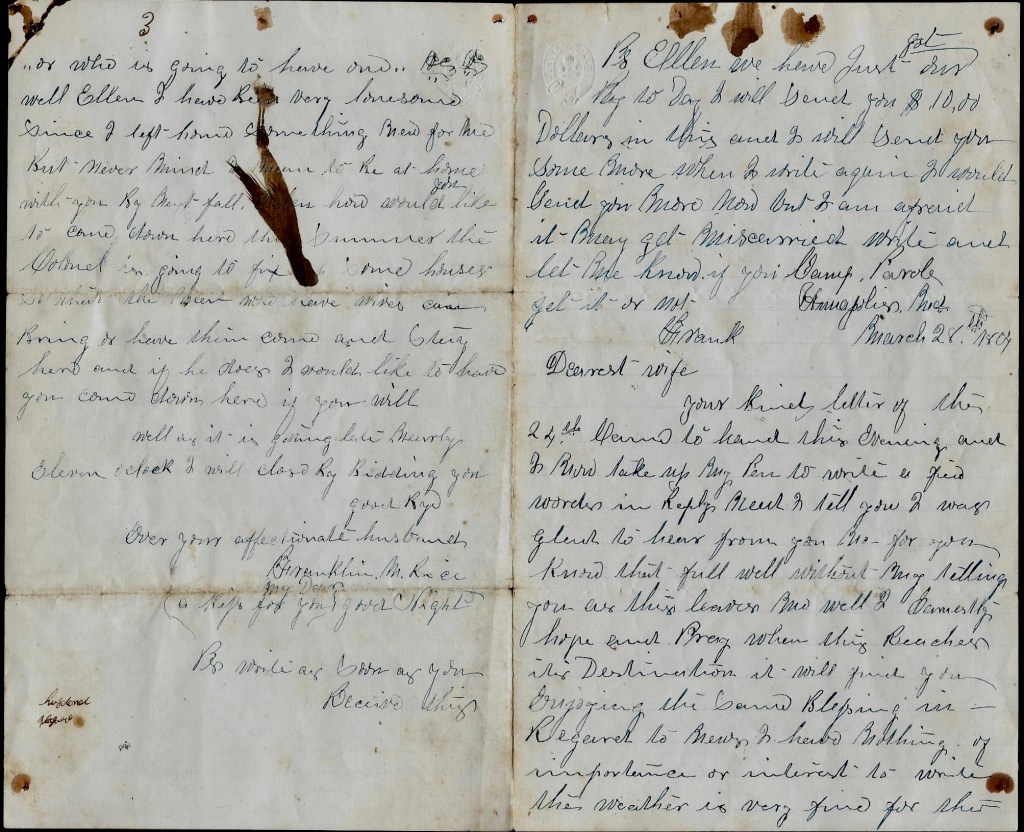
Your kind letter of the 24th came to hand this evening and I now take up my pen to write a few words in reply. Need I tell you how glad I was to hear from your brother for you know that full well without my telling you. As this leaves me well, I sincerely hope and pray when this reaches its destination, it will find you enjoying the same blessing.
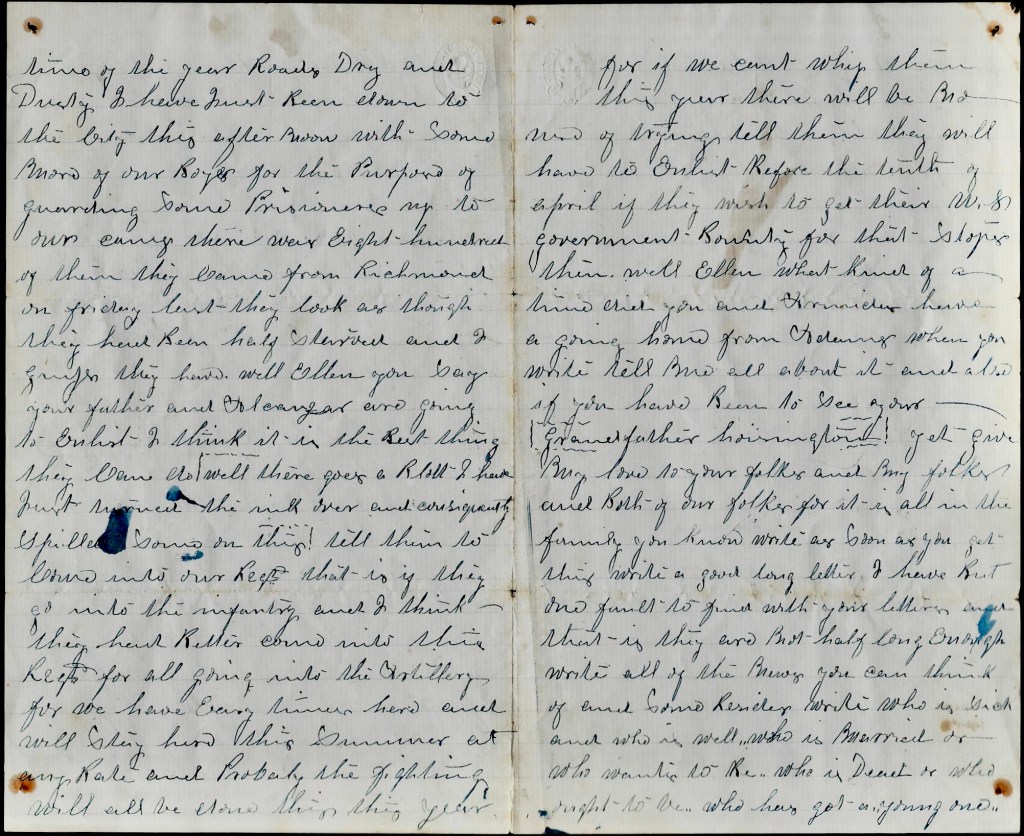
In regards to news, I have nothing of importance or interest to write. The weather is very fine for this time of the year. Roads [are] dry and dusty. I have just been down to the city this afternoon with some more of our boys for the purpose of guarding some prisoners up to our camp. There were eight hundred of them. They came from Richmond on Friday but they look as though they had been half starved and I think they have.
Well, Ellen, you say your father and [ ] are going to enlist. I think it is the best thing they can do. Well, there goes a blot. I have just turned the ink over and consequently spilled some on this. Tell them to come into our regiment— that is, if they go into the infantry. And I think they had better come into this regiment for all going into the artillery for we have easy times here and will stay here this summer at any rate and probably the fighting will all be done this year for if we can’t whip them this year, there will be no more of trying. Tell them they will have to enlist before the tenth of April if they wish to get their U.S. Government Bounty for that stops then.
Well, Ellen, what kind of a time did you and [ ] have a going home from Adam’s? When you write, tell me all about it and also if you have been to see your Grandfather Hoisington yet. Give my love to your folks and my folks and both of our folks for it is all in the family you know. Write as soon as you get this letter. I have just one fault to find with your letters and that is they are but half long enough. Write of all the news you can think of and some besides. Write who is sick and who is well, who is married or who wants to be, who is dead or ought to be, who has got a young one or who is going to have one. Ha, Ha.
Well, Ellen, have been very lonesome since I left home—something new for me but never mind. I mean to be at home with you by next fall. Ellen, how would you like to come down here this summer? The Colonel is going to fix up some houses so that the men who have wives can bring or have them come and stay here and if he does I would like to have you come down here if you will. Well it is getting late, nearly eleven o’clock. I will close by bidding you goodbye.
Ever your affectionate husband, — Franklin M. Rice
My dear, a kiss for your goodnight. Please write as soon as you receive this.
So Ellen, we have just got our pay today. I will send you $10 in this and I will send you some more when I write again. I would send you more but I am afraid.it might get miscarried. Write and let me know if you get it or not. – Frank
Letter 2
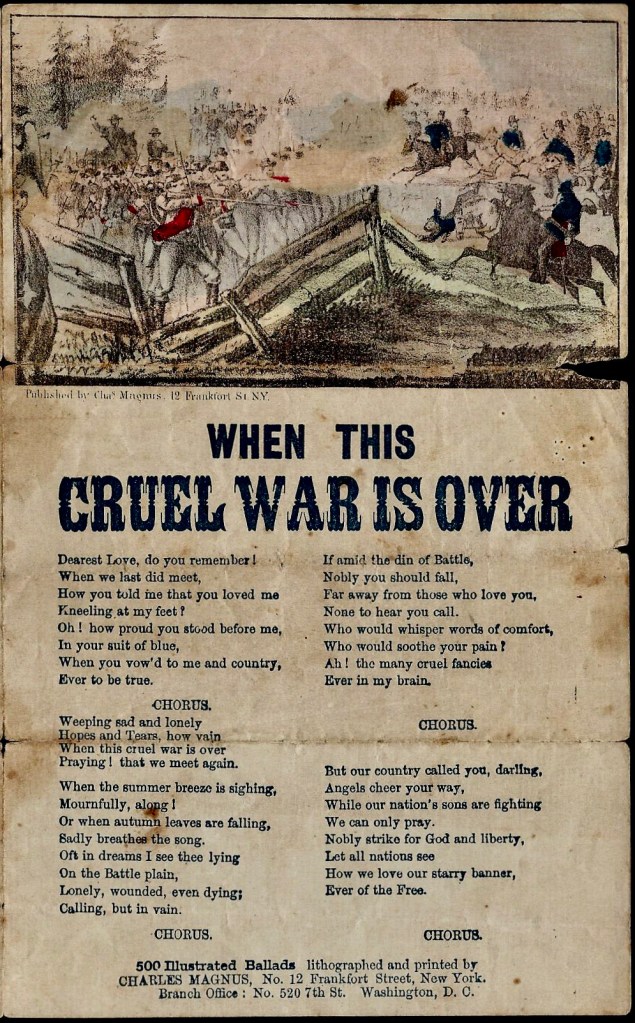
Stationery used by Frank for his letter.
Camp Parole Annapolis, Maryland April 18, 1864
Dearest Ellen.
With pleasure I now take up y pen to write a few words on reply to your kind and welcome letter of the 13th inst. which came to hand this morning. I was very glad to hear from you and to learn you was well as this leaves me. Well, I hope and trust it will find you you enjoying the same blessing.
I have no news of importance or interest to write for it is the same thing over and over again. The weather is quite mild. We have a shower of rain occasionally—just enough to lay the dust—but it seldom rains more than 4 or 5 days at a time.
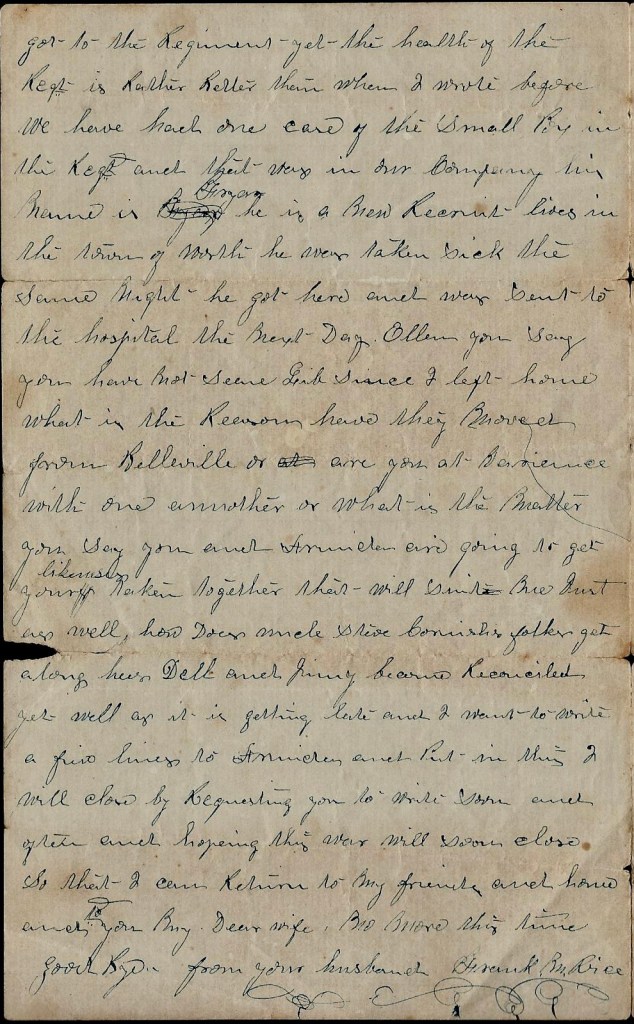
Ellen, you say you do not get all of my letters, or rather you seem to blame me for not writing more often. I have written seven or eight letters to you since I got back to the regiment. I don’t see why you have not got more of them. Your father has just got to the regiment, yet the health of the regiment is rather better than when I wrote before. We have had one case of the small pox in the regiment and that was in our company. His name is [Francis P.] Fryar. He is a new recruit. Lives in the town of Worth. He was taken sick the same night he got here and was sent to the hospital the next day. 1
Ellen you say you have not seen Lib since I left home. What is the reason? Have they moved from Belleville or are you at variance with one another, or what is the matter? You say you and [sister] Armida are going to get your likenesses taken together. That will suit me just as well. How does Uncle Steve Cornish’s folks get along? 2 Have Dell and Jimmy become reconciled yet?
Well, as it is getting late and I want to write a few lines to Armida and put in this, I will close by requesting you to write soon and often and hoping this war will soon close so that I can return to my friends and home and to you, my dear wife. No more this time. Goodbye, from your husband, — Frank M. Rice
1 Francis P. Fryar enlisted at the age of 18 on 15 March 1864 at Lorraine to serve three years in Co, C, 94th New York Infantry. He was wounded in action on 13 June 1864 at White Oak Swamp, Va., and died the following day.
2 This was Steven Silas Cornish (1824-1888) of Ellisburg, Jefferson county, New York. Steven was married to Amira Rice (b. 1822). They had a daughter named Adell (“Dell”) who was born in 1847.





 Spared & Shared 23