
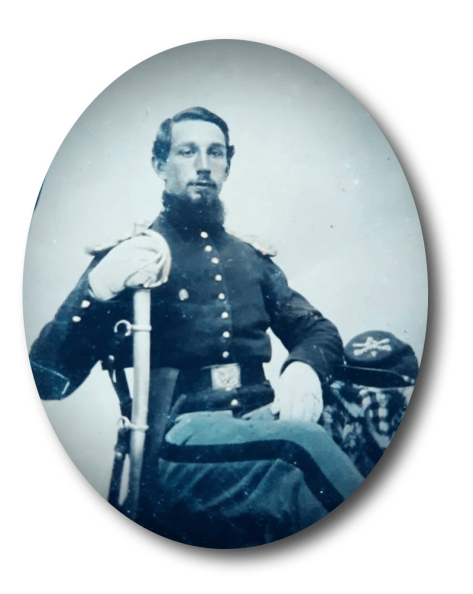
The following letter was written by 24 year-old Wallace A. Bishop (1837-1862) of Co. D, 2nd New York Cavalry. He died of disease, November 28, 1862, near Warrrenton, Va. An obituary notice for him claims that “the deceased was a young man of fine talents and much promise; and in the summer of 1861 was a student in the law office of S. W. Kellogg in this place [Waterbury, CT]. Immediately after the battle of Bull Run, without waiting for a regiment to be formed in this State, he sought the first opportunity to give his services to his country, by volunteering with Captain, then Lieutenant, Marcus Coon in the squadron of Harris Light Cavalry, raised in this State under Major Mallory of Watertown. He did his duty as a patriot and a soldier in all places and won the praises of his officers by his strict performance of duty and devotion to his country’s cause. At the time Gen. Burnside marched from Warrenton to Fredericksburg in November last, Sergeant Bishop was left behind in a farm house, being too sick with fever to be removed. The rebels took possession of the place and from that time, his friends have been in utter ignorance in regard to his fate, yet hoping almost against hope that he might yet be restored to them, A short time since, his company made a foraging expedition to the place and on enquiry, found that he died suddenly after a partial recovery, and after being paroled by the rebels, at the house where he was left. The writer of this knew him well, and knew his generous and self-sacrificing traits of character; and it is no vain or unmeaning eulogy to say that one of the noblest young men from this neighborhood, who has fallen in the great struggle for a Nation’s life, was Wallace A. Bishop.”
Wallace was the son of William R. Bishop (1806-1883) and Augusta Maria Sheldon (1812-1897). Wallace had an older brother named Hobart H. Bishop (1836-1865) who also died in the war. He was a sergeant in Co. L, 1st Connecticut Cavalry. He died at his father’s house in Plymouth on New Year’s Day, 1865, after his release from Andersonville Prison where he had been confined many months which broke his health. The letter was probably written to Mary A. Bishop (1839-1906).
T R A N S C R I P T I O N
Camp Sussex
Washington D. C.
October 3rd 1861
My dear sister,
Your letter of the 27th ult. came last evening. It was the first letter I had received since leaving Scarsdale and the second since leaving home. To say I was rejoiced to get it would convey no adequate idea of the pleasure it gave. I have written ten times and think it rather saucy that four-fifth of my conversations should remain unanswered. Only three of the letters, two to Mother and one to you, were sent home. I am very sorry that the family letter miscarried. I have received a paper from Father for which I am greatly obliged. J. B.(I suppose it means Joel Blakeslee) has sent me a paper also. I wish you would thank him if you have an opportunity.
But I suppose you would like to hear of the camp. And to begin with I will give you the calls that you may have an idea approaching adequate of our daily duties and of the little time we have to devote to our correspondents and ourself. At 6 a.m. reveille, watering call 6.30, stable call 7, breakfast 7.30, guard mounting and sick call 8, drill no horse 9 to 12, watering 12.15 p.m. to 12.30, takes an hour, dinner 1 drill to horse 2 to 4, drill to sabre 4 to 5, retreat 5, watering 5.30, stable 6, supper 7, non-commissioned officers recitation 7.30, commissioned officers recitation 8.30, tattoo 9, taps or lights out 9.30. Add to this time taken after retreat for duty impossible to perform in it, appointed seasons and for fatigue work necessary to our comfort, and for housekeeping and for burnishing arms and for the thousand and one little things that spring up unexpectedly during every hour of duty free and you can see that a cavalry man’s place is no sinecure.
One squadron of the regiment has moved since I wrote you and there is talk of our following them shortly but we place no reliance upon it. they have gone, I believe, where they can combine instruction with experience but I apprehend that the proportions of the the former will be very large in the mixture. As no doubt you have inferred, I have my horse and with the exception of my revolver (here but not given), my arms. The former is medium sized handsome bay which on the trot, gallop, or run is a match for anything that sports legs. I call him Rocker and sit him so easily. My sabre is a light, keen blade and I think I shall become as adept in its [ ]. I can already handle it well.
I am living like a prince just now for in addition to Uncle Sam’s fodder, Charlie Lewis—one of my boys who has just received a box from home—permitted me with cake of various kinds, cheese, butter, pickles &c. ad infinitum and I occasionally go beyond the lines to get persimmons and grapes of which goodies there are quantities in the forest all around. I have just returned from one of these rambles (my nag is slightly distempered and I’m off drill) upon which I fell in with a slave who gave me a drink of whiskey—villainous stuff—and very much valuable information. After quite a talk I asked him how much his master paid for him and was so startled by the train of thought that the question evoked that I turned and told [ ] that it was for the first time such humiliation [ ] my life. He said he was born in the place [ ]… I can whip Old Rheumatism with both hands or any other man … Love to all, your affectionate brother, — Wallace A. Bishop


 Spared & Shared 23