
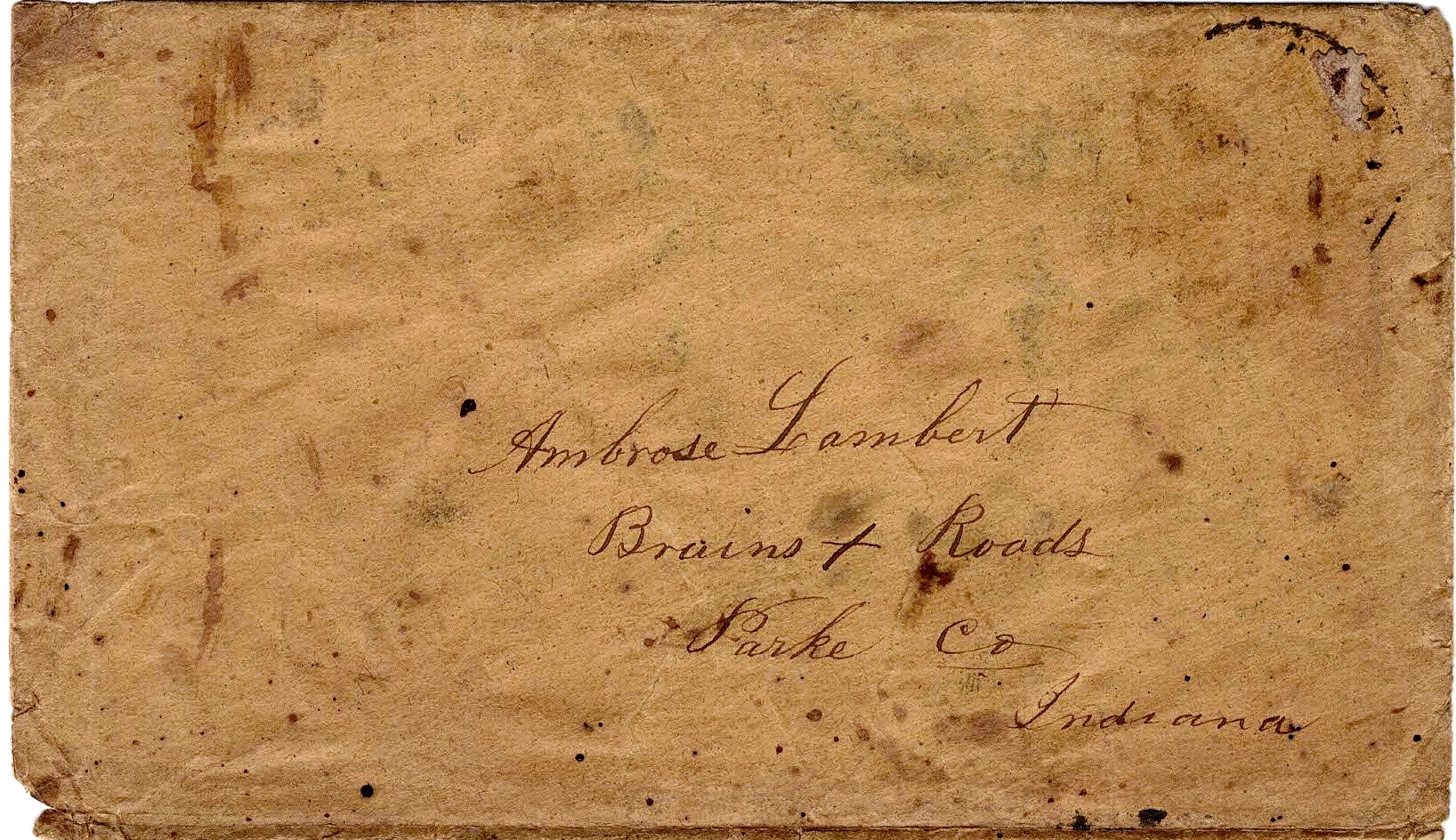
The following letter was written by James Lambert (b. 1822), the son of Virginia native, Ambrose Waveland Lambert (1796-1882) and Mary “Polly” Walker Adams (18xx-1867) of Parkeville, Parke county, Indiana. No regimental affiliation is identified in his letter and the content suggests that he was serving as a teamster or driver—possibly in a civilian capacity—in Gen. Crooks’ Headquarters in 1862 and 1863. He mentions being a part of “six regiments of the Kanawha Division” who were sent east to the aid of Gen. Pope just prior to the 2nd Battle of Bull Run. I believe these six included the 11th, 12th, 23rd, 28th, 30th and 36th Ohio Infantry regiments. I could not find a “James Lambert” in their rosters, however. The on-line ancestral tree for Ambrose Lambert, his father, to whom he addressed the letter, is also incomplete and seems to contain many errors so is of little help.
Be that as it may, the content of the letter is excellent, giving a description of the movements of these regiments sent East from West Virginia in August 1862 and of their participation in the battles at South Mountain and Antietam where Lambert served as an “eye witness” to both battles. He then describes their transfer to the Army of the Cumberland in January 1863 and of the journey up the Cumberland river to Carthage, Tennessee, where he wrote the letter. When Crook arrived in Carthage in 1863, he set up his headquarters in the Smith County courthouse and put his troops to work on the Battery Hill Earthworks.
T R A N S C R I P T I O N
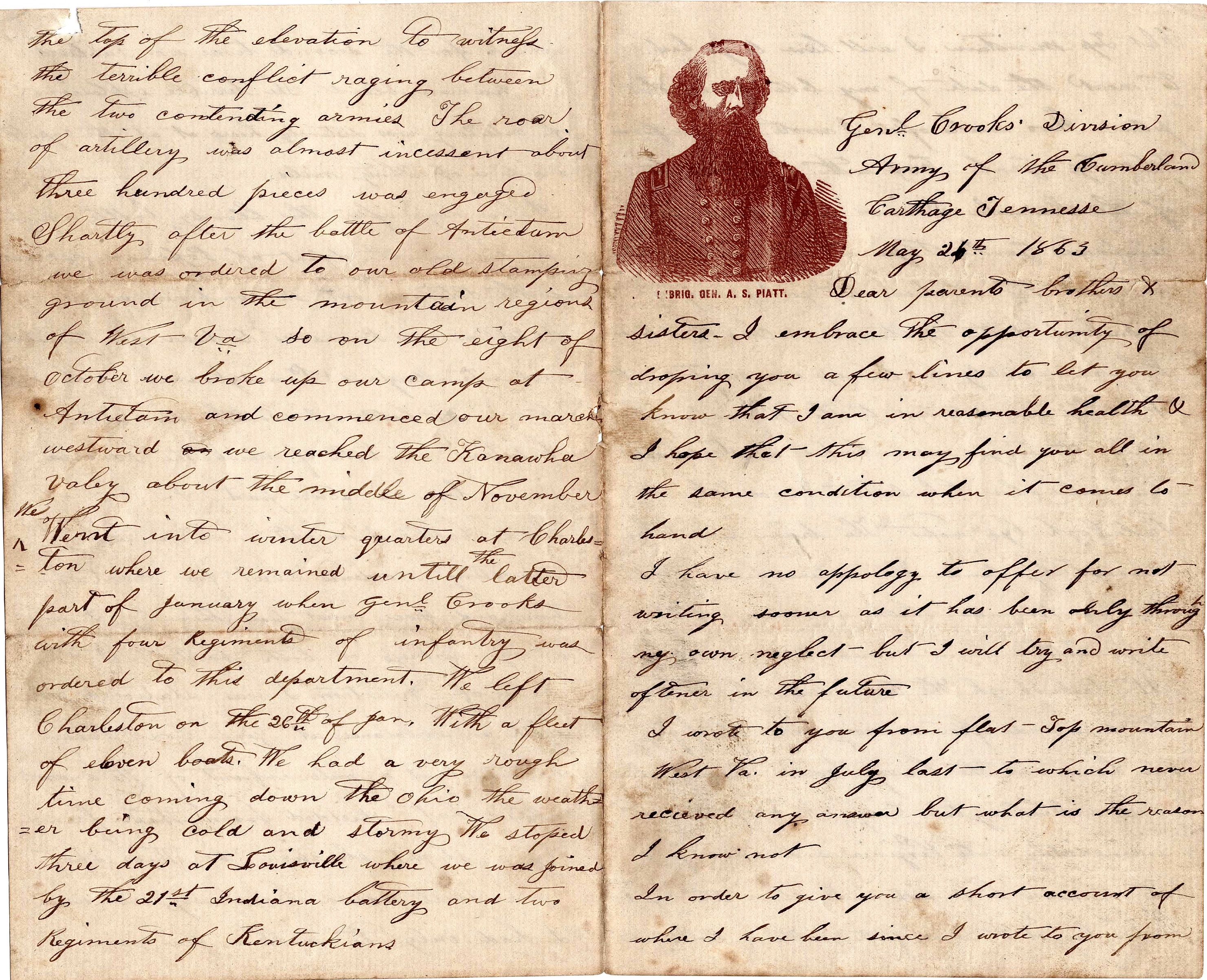
General Crook’s Division
Army of the Cumberland
Carthage, Tennessee
May 25th 1863
Dear parents, brothers & sisters,
I embrace the opportunity of dropping you a few lines to let you know that I am in reasonable health and I hope that this may find you all in the same condition when it comes to hand.
I have no apology to offer for not writing sooner as it has been only through my own neglect but I will try and write oftener in the future. I wrote to you from Flat Top Mountain, West Virginia, in July last to which I never received any answer but what is the reason, I know not.
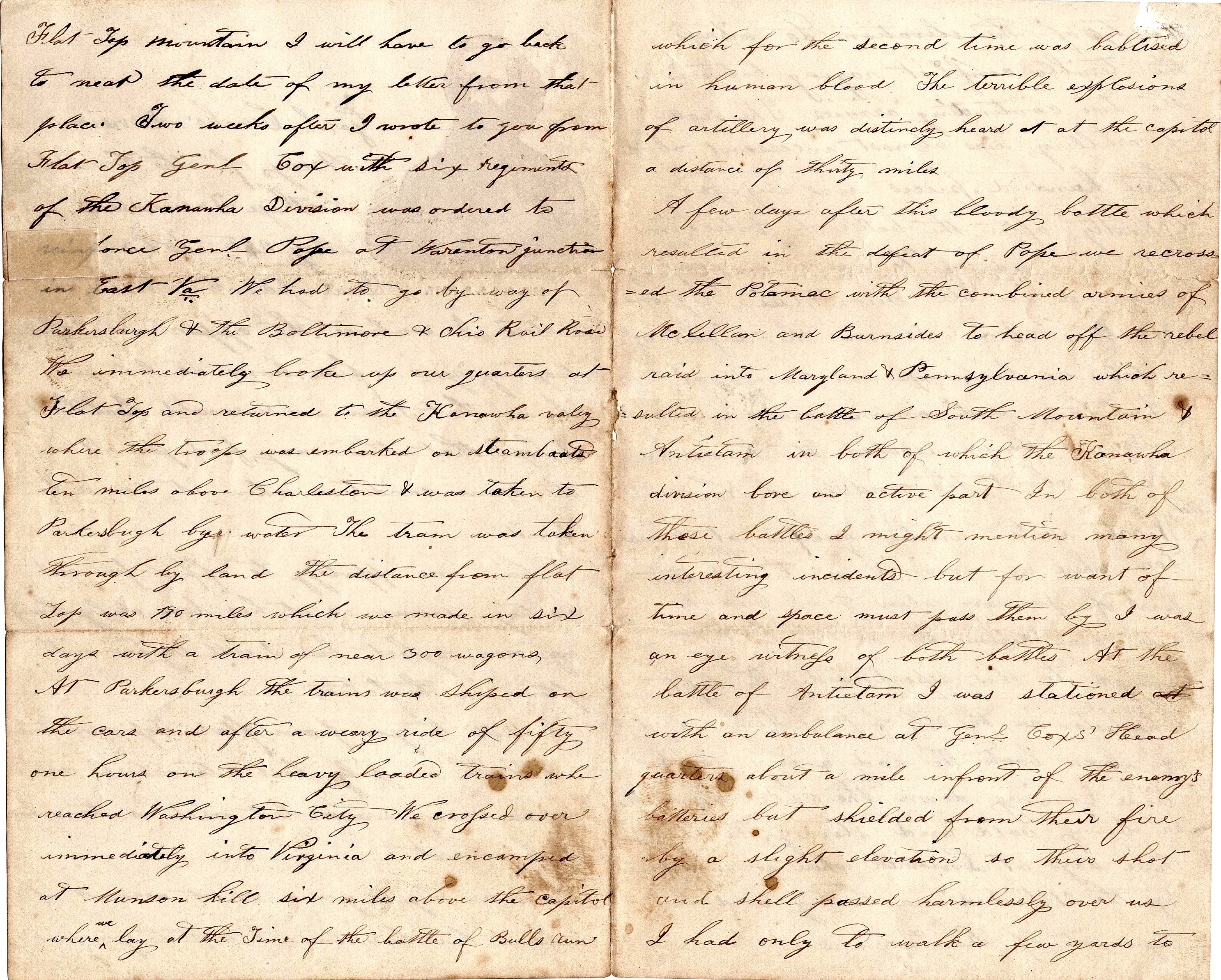
In order to give you a short account of where I have been since I wrote to you from Flat Top Mountain, I will have to go back to near the date of my letter from that place. Two weeks after I wrote to you from Flat Top, General [Jacob D.] Cox with six regiments of the Kanawha Division was ordered to reinforce General Pope at Warrenton Junction in East Virginia. We had to go by way of Parkersburg and the Baltimore & Ohio Railroad. We immediately broke up our quarters at Flat Top and returned to the Kanawha Valley where the troops was embarked on steamboats ten miles above Charles Town & was taken to Parkersburg by water. The train was taken through by land. The distance from Flat Top was 190 miles which we made in six days with a train of near 300 wagons. At Parkersburg, the trains was shipped on the cars and after a weary ride of fifty-one hours on the heavy-loaded train, we reached Washington City. We crossed over immediately into Virginia and encamped at Munson Hill, six miles above the Capitol, where we lay at the time of the Battle of Bull Run, which for the second time was baptised in human blood. The terrible explosions of artillery was distinctly heard at the Capitol—a distance of thirty miles.
A few days after the bloody battle—which resulted in the defeat of Pope—we recrossed the Potomac with the combined armies of McClellan and Burnsides to head off the rebel raid into Maryland & Pennsylvania which resulted in the Battle of South Mountain & Antietam, in both of which the Kanawha Division bore an active part. In both of those battles, I might mention many interesting incidents but for want of time and space, must pass them by. I was an eye witness of both battles. At the Battle of Antietam, I was stationed with an ambulance at Gen. Cox’s Headquarters, about a mile in front of the enemy’s batteries but shielded from their fire by a slight elevation so their shot and shell passed harmlessly over us. I had only to walk a few yards to the top of the elevation to witness the terrible conflict raging between the two contending armies. The roar of artillery was almost incessant. About three hundred pieces was engaged.
Shortly after the Battle of Antietam, we was ordered to our old stomping ground in the mountain regions of West Virginia. So on the 8th of October, we broke up our camp at Antietam and commenced our march westward. We reached the Kanawha Valley about the middle of November. We went into winter quarters at Charles Town where we remained until the latter part of January when Gen. Crook with four regiments of infantry was ordered to this department.
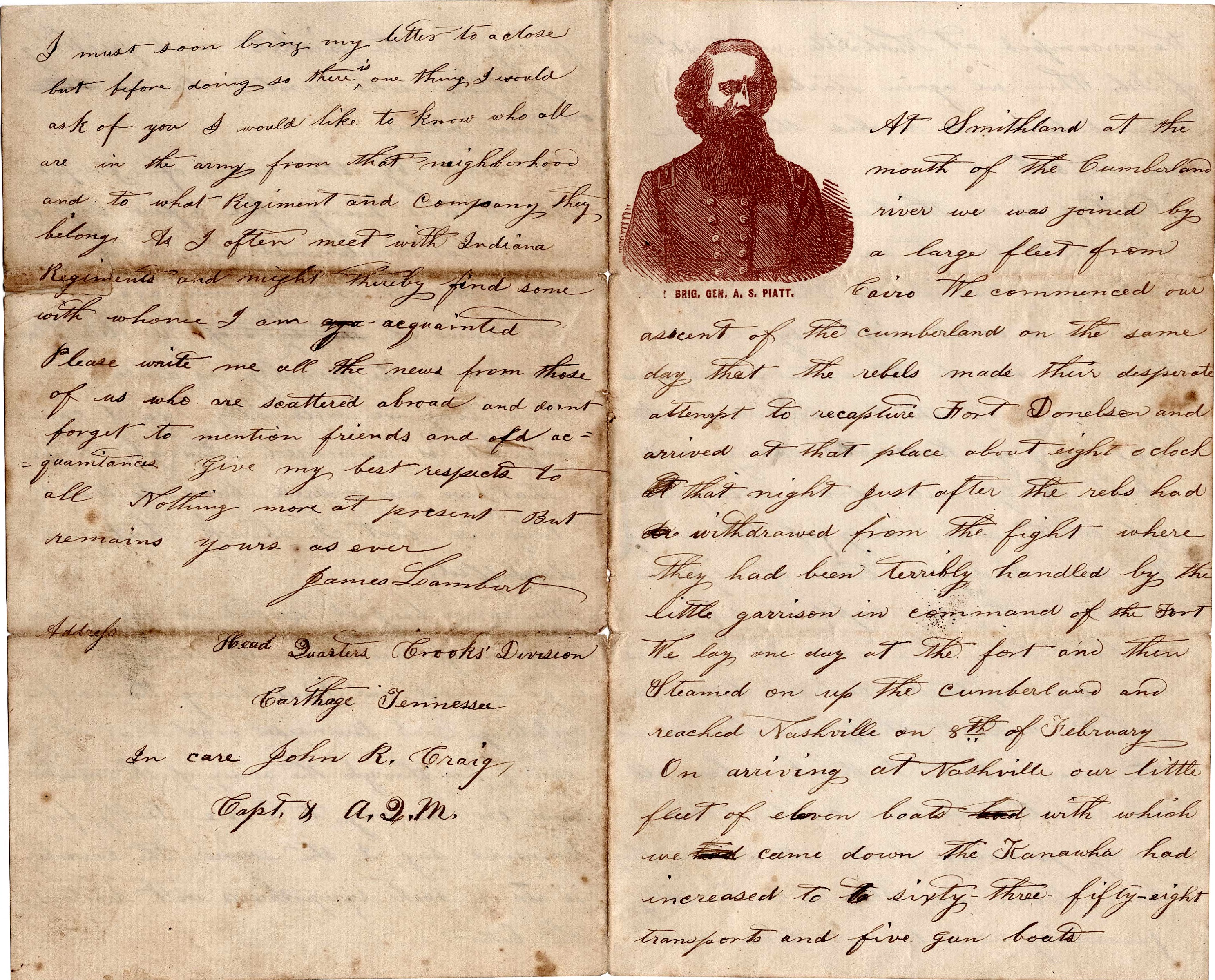
We left Charles Town on the 26th of January with a fleet of eleven boats. We had a very rough time coming down the Ohio, the weather being cold and stormy. We stopped three days at Louisville where we was joined by the 21st Indiana Battery and two regiments of Kentuckians. At Smithland at the mouth of the Cumberland river, we was joined by a large fleet from Cairo. We commenced our ascent of the Cumberland on the same day that the rebels made their desperate attempt to recapture Fort Donelson and arrived at that place about 8 o’clock that night, just after the rebs had withdrawn from the fight where they had been terribly handled by the little garrison in command of the fort.
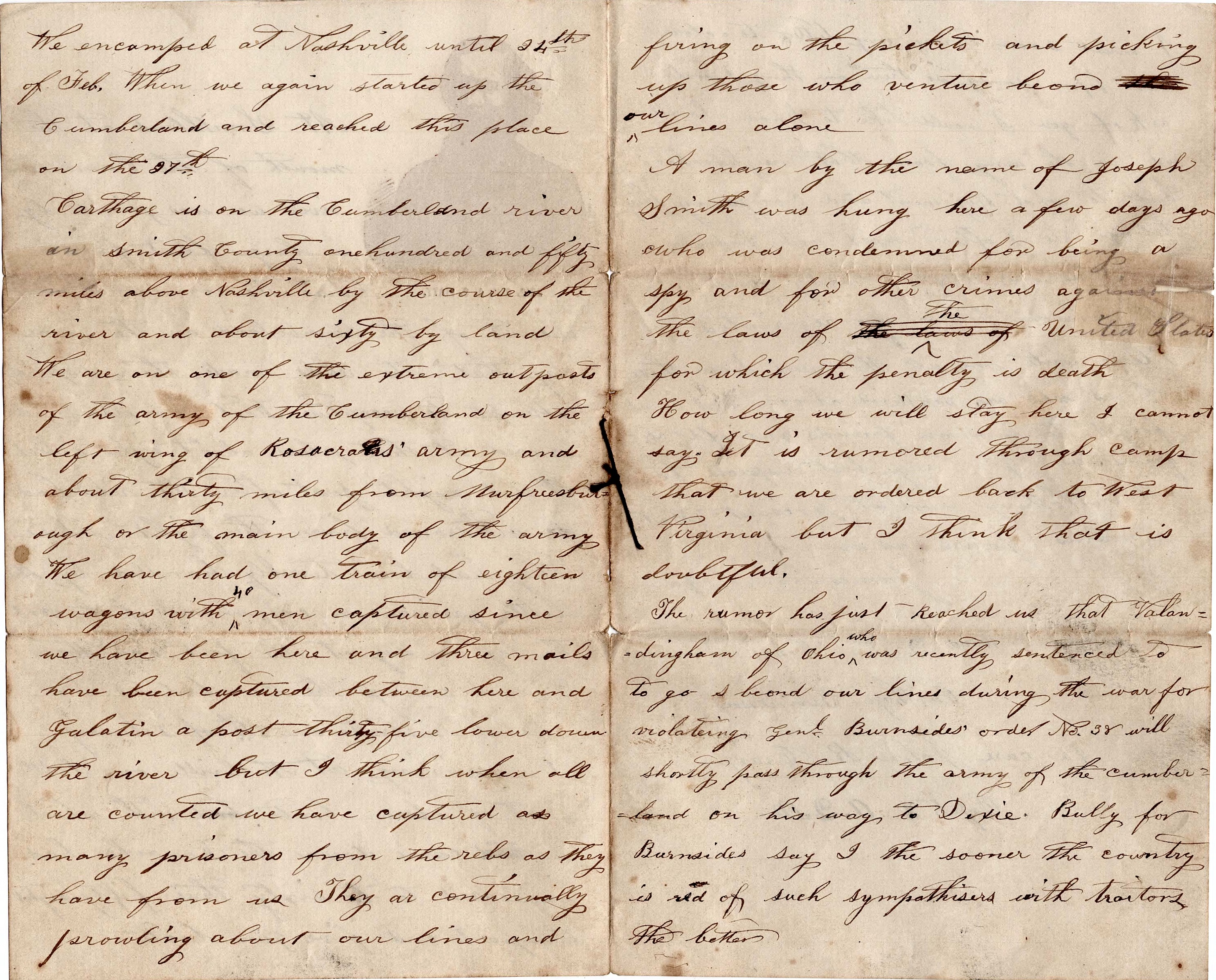
We lay one day at the fort and then steamed on up the Cumberland and reached Nashville on the 8th of February. On arriving at Nashville, our little fleet of eleven boats with which we came down the Kanawha had increased to 63—58 transports and 5 gunboats. We encamped at Nashville until 24th of February when we again started up the Cumberland and reached this place on the 27th.
Carthage is on the Cumberland river in Smith County, 150 miles from Nashville by the course of the river and about 60 by land. We are on one of the extreme outposts of the Army of the Cumberland on the left wing of Rosecrans’ Army and about 30 miles from Murfreesboro or the main bosy of the army. We have had one train of 18 wagons with 40 men captured since we have been here and three mails have been captured between here and Gallatin—a post 35 [miles] lower down the river. But I think when all are counted, we have captured as many prisoners from the rebs as they have from us. They are continually prowling about our lines and firing on the pickets and picking up those who venture beyond our lines alone.
A man by the name of Joseph Smith was hung here a few days ago who was condemned for being a spy and for other crimes against the laws of the United States for which the penalty is death.
How long we will stay here I cannot say. It is rumored through camp that we are ordered back to West Virginia but i think that is doubtful.
The rumor has just reached us that [Clement] Vallandigham of Ohio who was recently sentenced is sentenced to go beyond our lines during the war for violating General Burnsides’ Order No. 38 [and] will shortly pass through the Army of the Cumberland on his way to Dixie. Bully for Burnsides! say I. The sooner the country is rid of such sympathizers with traitors, the better.
I must soon bring my letter to a close but before doing so, there is one thing I would ask of you. I would like to know who all are in the army from that neighborhood and to what regiment and company they belong. As I often meet with Indiana regiments and might thereby find some with whom I am acquainted. Please write me all the news from those of us who are scattered abroad and don’t forget to mention friends and old acquaintances. Give my best respects to all. Nothing more at present but remain yours as ever, — James Lambert
Address: Headquarters Crooks’ Division, Carthage, Tennessee, in care of John R. Craig, Captain & Asst. Q. M.
 Spared & Shared 23