Category Archives: Causes of War—Slavery

1861: Joseph Long to his Nephew

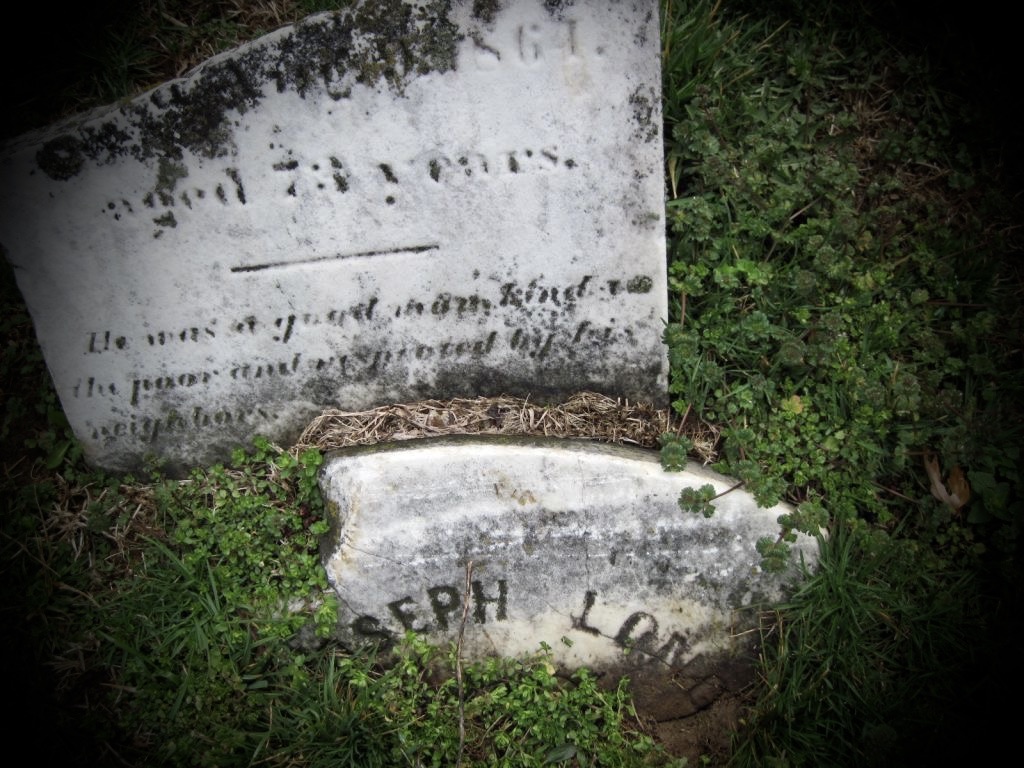
The shattered headstone of Joseph Long—“He was a good man, kind to the poor and respected by his neighbors.”

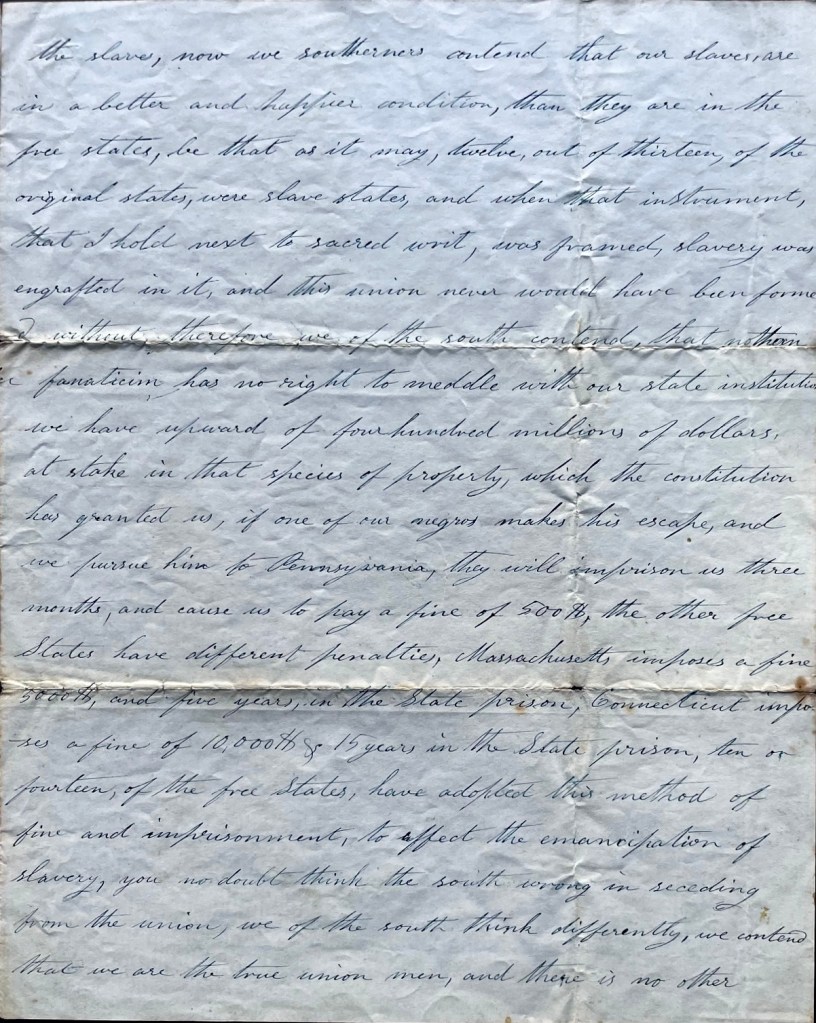
The following letter was written by 72 year-old Joseph Long (1789-1864) of Newtown Stephensburg, Frederick county, Virginia. Joseph’s parents were Ellis Long, Sr. (1758-1837) and Elizabeth Pendleton (1761-1844). Joseph was married to Elizabeth Wilson (1791-1862) and the couple had several children, one of whom—Robert Henning Long (1832-1909)—is mentioned in the letter.

Joseph’s letter provides a summary of the violations of the South’s constitutional rights that culminated in the dissolution of the Union in 1861. It is evident that Joseph predominantly attributes responsibility to northern abolitionists and their relentless opposition to slavery. The letter was composed shortly after the assault on Fort Sumter and the passage of Virginia’s Ordinance of Secession. The identity of Joseph’s nephew, to whom the letter was addressed, is not revealed in the letter but it’s clear that he lived in the North. It would not be long before mail service between the two sections would be suspended.

[This letter is from the collection of Greg Herr and was offered for transcription and publication on Spared & Shared by express consent.]

Transcription

Newtown Stephensburg [Frederick, Va.]
April 27th 1861

My dear Nephew,

Yours of the 22nd was duly received. I feel much obliged to you for writing to me for the first time, and I hope it will not be the last as it is always gratifying to me to hear from you all. I seldom hear from you and when I did, it was through my friends—the Steele family. I am sorry you did not mention your brothers & sisters & their families as I should have been much pleased to hear from you all and how you are all getting along in life. Myself and family are in usual health. Your cousin Robert H. Long is now in the Southern army stationed at Harper’s Ferry. He is second in command of a troop of cavalry 1 and has left a wife and three children, all to defend what we consider our constitutional right, as handed down to us by the Revolutionary Fathers.

The South has been imposed upon steadily by the North for the last thirty years and they have been blowing the fuel of Abolitionism until it has kindled a deadly flame which I greatly fear will result in the destruction of our once happy Union for your miserable northern abolition President seems determined to destroy as much of the public property as he possibly can. He commenced by ordering the destruction of Fort Moultrie which caused the South Carolinas to fortify and take Fort Sumter. He next ordered the destruction of Harpers Ferry. His troops succeeded in destroying an immense quantity of arms of every description of the most improved quality which caused the Governor of our State to have the place guarded by a sufficient number of troops, and all the machinery that was not injured by the blowing up and burning of the works, is now removing. to Richmond which will require 10 of our large wagons six months in transporting it. And not content with that, he has caused the destruction of the Navy Yard at Portsmouth, Va., and much valuable property estimated at ten millions dollars, causing to be burnt to the water’s edge six or seven of our most valuable war vessels, and it is thought he will destroy all the forts and public works in the State of Virginia relied on.

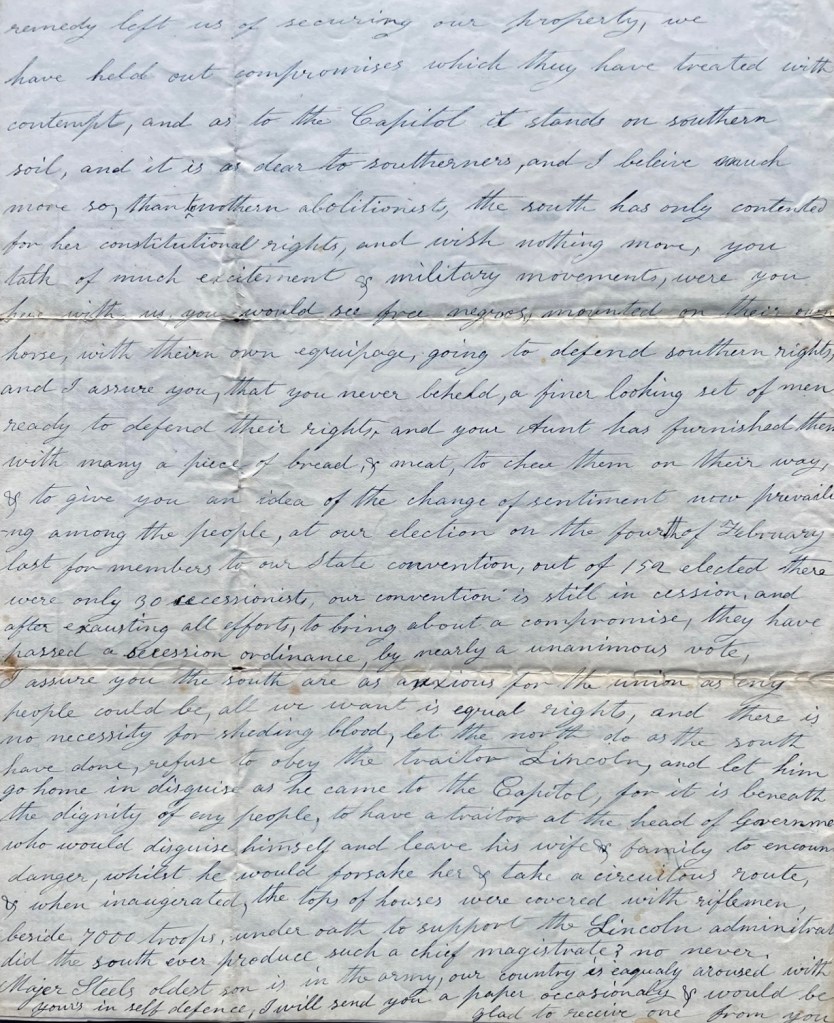
Whilst our conventions were endeavoring to bring about a compromise, he was filling the different fortifications with abolition troops who are determined to destroy the country or, as they say, to liberate the slaves. Now we southerners contend that our slaves are in a better and happier condition that they are in the free states. Be that as it may, twelve out of thirteen of the original states were slave states, and when that instrument that I hold next to sacred writ was framed, slavery was engrafted in it, and this Union never would have been formed without. Therefore, we of the South contend that northern fanaticism has no right to meddle with our state institution. We have upward of four hundred millions of dollars at stake in that species of property which the constitution has granted us. If one of our negroes makes his escape and we pursue him to Pennsylvania, they will imprison us three months and cause us to pay a fine of $500. The other free states have different penalties. Massachusetts imposes a fine of $5,000 and five years in the State Prison.

Ten or fourteen of the free states have adopted this method of fine and imprisonment to effect the emancipation of slavery. You no doubt think the South wrong in seceding from the Union. We of the South think differently. We contend that we are the true Union men and there is no other remedy left us of securing our property. We have held out compromises which they have treated with contempt, and as to the Capitol, it stands on southern soil and it is as dear to southerners—and I believe much more so—than to northern abolitionists. The South has only contended for her constitutional rights and wish nothing more.

You talk of much excitement & military movements. Were you here with us, you would see free negroes mounted on their own horse with their own equipage going to defend southern rights and I assure you that you never beheld a finer looking set of men ready to defend their rights, and your Aunt has furnished them with many a piece of bread & meat to cheer them on their way. And to give you an idea of the change of sentiment now prevailing among the people, at our election on the fourth of February last for members to our State Convention, out of the 152 elected, there were only 30 secessionists. Our convention is still in session and after exhausting all efforts to bring about a compromise, they have passed a secession ordinance by nearly a unanimous vote. I assure you, the South are as anxious for the Union as any people could be.

All we want is equal rights and there is no necessity for shedding blood. Let the North do as the South have done—refuse to obey the traitor Lincoln, and let him go home in disguise as he came to the Capitol, for it is beneath the dignity of any people to have a traitor at the head of Government who would disguise himself and leave his wife & family to encounter danger, whist he would forsake her & take a circuitous route, & when inaugurated, the tops of houses were covered with riflemen, beside 7,000 troops under oath to support the Lincoln administration. Did the South ever produce such a chief magistrate? No, never.

Major Steele’s oldest son is in the army. Our country is equally aroused with yours in self defense. I will send you a paper occasionally & would be glad to receive one from you. Your Uncle John & Mr. Steele desire to be remembered to you. Their families are in usual health. Gen. Harney was captured at Harpers Ferry 25th at 2 a.m. on his way to Washington & taken to Richmond. 2 Your affectionate Uncle, — Joseph Long


1 Robert H. Long served in Co. A, 1st Virginia Cavalry. He enlisted 19 April 1861.

2 In April 1861, he was ordered to report to Washington by Lincoln’s new Secretary of War, Simon Cameron. The train on which he was traveling was stopped at Harper’s Ferry, and a young confederate office boarded announcing “General Harney, sir, you are my prisoner!” He was told a Confederate battalion had surrounded the train, sent with orders to intercept him before he reached Washington. In this way, William S. Harney became the first prisoner taken by the South in the Civil War. Later, in Virginia, William received apologies for the manner in which he was brought there, and he was offered a Confederate command under Robert E. Lee. He had previously served with Lee in the U.S. Army in the Mexican War. William refused, and he was allowed to continue on his trip to Washington. [Military Career of William Selby Harney]

1861: E. Dana to a dear friend

I can’t be certain of the author of this letter signed (I think) “E. Dana.” The Dana family had a long history in Boston and my hunch is that it was written by Edmund Trowbridge Dana (1818-1869), the son of Richard H. Dana, Sr. and Ruth Charlotte Smith. His more famous brother, Richard Henry Dana, Jr., served in the US Senate in 1859 and during the Civil War was a United States Attorney for Massachusetts.

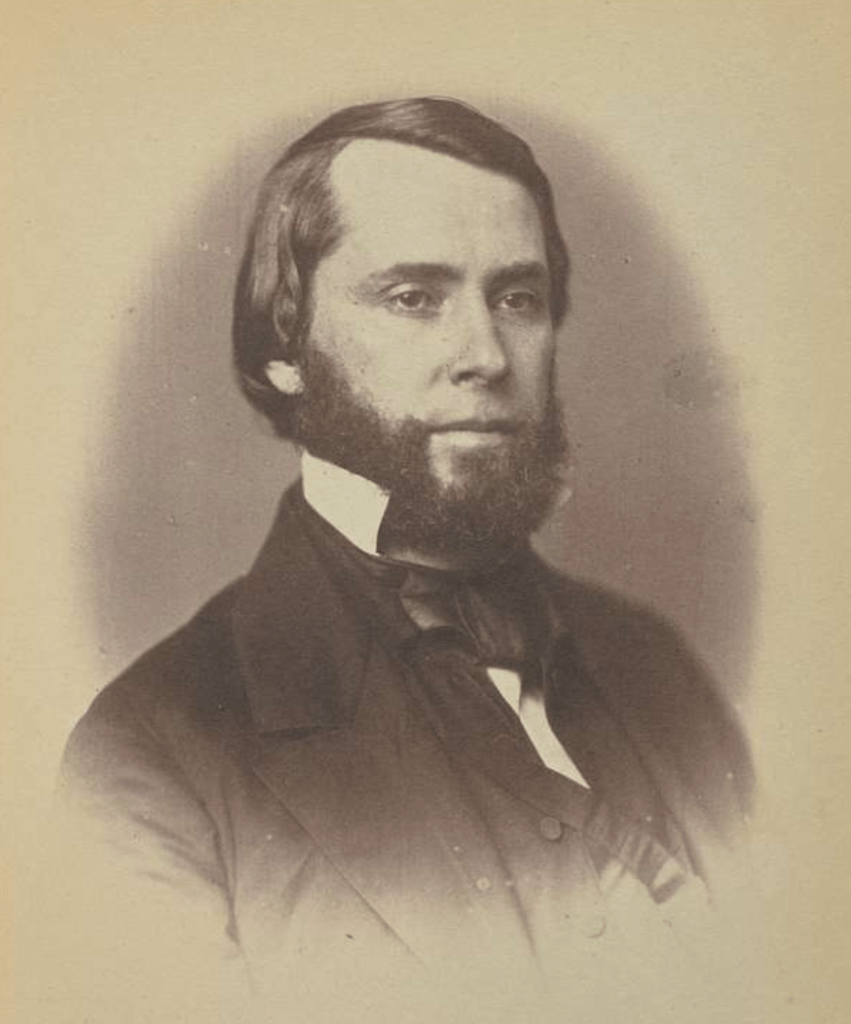
Hon. Sherrard Clemens of Virginia

The letter opens with a reference to Virginia congressman Sherrard Clemen’s speech delivered in Congress on 22 January 1861 which was a warning to fellow Southern congressmen that a breakup of the Union would certainly mean the death of slavery—the key sentences in a long speech stating, “Before God, and in my utmost conscience, I believe that slavery will be crucified, if this unhappy controversy ends in a dismemberment of the Union. Sir, if not crucified, it will carry the death rattle in its throat. I may be a timid man; I may not know what it is to take up arms in my own defense. It remains to be seen, however, whether treason can be carried out with the same facility it can be plotted and arranged.” Referring to any fellow statesmen in Congress who advocated secession, he said, “He can take an oath to support the Constitution of the United States, but he can enter with honor into a conspiracy to overthrow it. He can, under the sanctity of the same oath advise the seizure of forts and arsenals, dockyards and ships, and money, belonging to the Union, whose officer he is, and find a most loyal and convenient retreat in State authority and State allegiance.”

The letter ends with a condemnation of the Massachusetts Senators in Congress (outspoken abolitionists) for not having been more outraged and vocal about the perceived treasonous acts of their fellow Congressmen and not trying harder enough to hold the Union together. The Union Meeting held at Faneuil Hall in early February 1861 emerged with a series of resolutions that essentially endorsed the “Crittenden Compromise” as an unsavory, but temporary solution to the secession crisis.

Transcription

Boston, [Massachusetts]
8 February 1861

My dear friend,

I am much obliged for [Sherrard] Clemens’ speech. I have read it with much pleasure— and wish it could be sent all over the South. Perhaps nothing will do them any good—but this must if anything will.

I see that [Henry Winter] Davis of Maryland made a ringing speech yesterday. 1 Is it to be published? if so, as we get only poorly printed copy in our papers—a partial even, I shall be glad if you will send me a copy. I don’t believe you can do a better thing than to send Capt. Holmes one—or indeed any speech that has real back bone in it. The Capt. sets at the Table and in the reading room and fights the Northern secessionists (of which white-livered bread Boston abounds) and Northern disunionists with real old Teutonic grit. It would have done you good to have heard him come down on the last Union meeting at Faneuil Hall.

The Hon. G. L. now gives him the go by—because the Capt. dares to go in for “the Union, the Constitution, and the enforcement of the Laws”—and he throws it in the face of the Bell Weathers to their great discomfort. Was there ever a more pitiable back down than that party North exhibits in their practically annulling all they pretended to fight for in the last canvass—and now refusing sympathy and support to their political friends South in the late campaign.

Here—this party deride Massachusetts & it seems as though they could not say enough of her—and to anything like argument, their reply is—Mass. delegation in the House. Charles Sumner, Henry Wilson, and the inevitable Nigger. Beyond this, their vision does not extend. The fabric of Massachusetts history would be ruined and suffer a total eclipse if left alone to their guardianship and patriotism.

The Capt.’s address is P. Holmes, Tremont House.

As I said before, I think he would be pleased to receive any speech that has back bone in it—like [Henry Winter] Davis, Millen [?], or [Charles F.] Adams—which [ ] he endorses very heartily.

Yours, E. Davis

The temp a.m. from 13o believe in the city. Is 22 in suburbs

1 The gist of Hon. Henry Winter Davis’ speech echoes that of Clemens’ speech. It also addresses the slavery argument thus: “As to slavery, the slavery question represents no interest which now requires to be touched by any department of the government. The mischief that has been done was done at home or South. The great cause of the excitement was the mode in which the recent political canvass had been conducted in the South. It had been by blackening and misrepresenting the true character and designs of the great mass of Northern people…If Southern gentlemen would go home and tell. truth about the North as they know it to be, there would be peace in all the country in a very short time.”

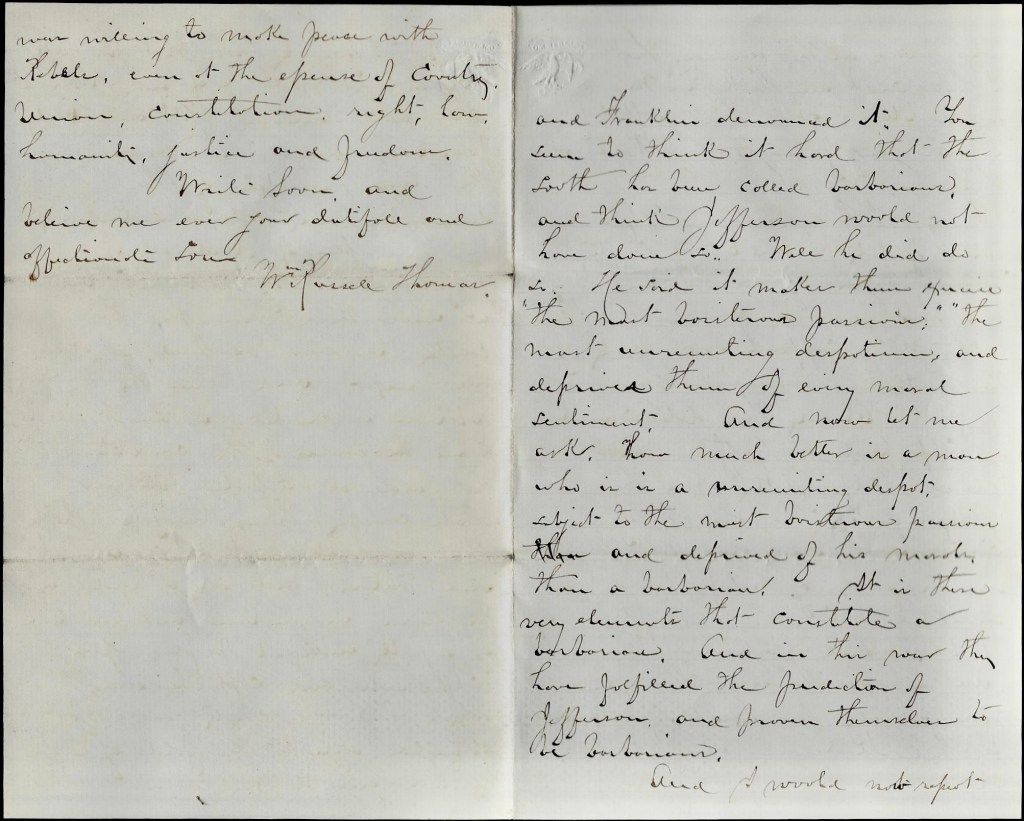
1863: William Russell Thomas to Chauncey Thomas

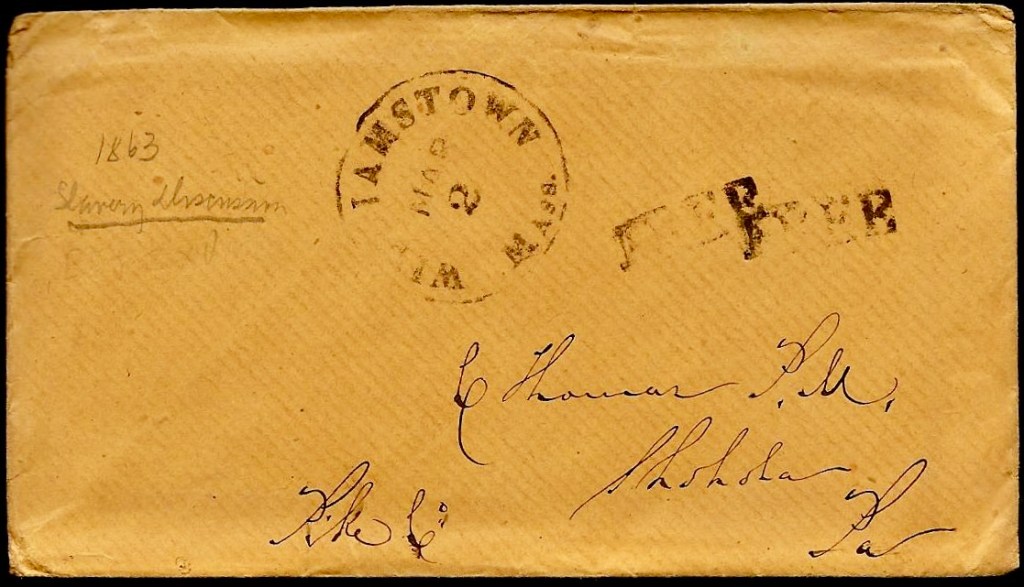
This letter was written by William Russell Thomas (1843-1914) in February 1863 while a student at William College in Williamstown, Massachusetts. William was the eldest son of Chauncey Thomas(1802-1882) and Margaret Bross (1819-1856). His obituary record at Williams College states that “while he was a mere child, his parents moved to Shohola, Pennsylvania, just across the Delaware River from his birthplace [Barryville, New York]. He prepared for college in the academy at Monticello, New York, and graduated from Williams in the class of 1865. During his college course, he took some practical lessons in journalism on the Chicago Tribune, of which his uncle, Lieutenant Governor William Bross, was then chief owner. His first real assignment was the funeral of Abraham Lincoln. Wishing to push on towards the real frontier in the early spring of 1866, he journeyed to Colorado on a stage coach, before the days of western railroads. He spent that summer traveling over the Rockies with Bayard Taylor. In October 1866, he became editor of the Register-Call, a frontier daily paper published in Central City, Colorado. In May, 1867, he went to the Rocky Mountain News as traveling correspondent, in which position he spent several years riding over Colorado, New Mexico and Wyoming…He later became the managing editor, which position he held for sixteen years and helped to make it the leading paper of the West.” [Obituary Record of the Alumni of Williams College, Class of 1865]

In this February 1863 letter, William attempts to dissuade his father from embracing the Copperhead movement by illustrating through the words of Jefferson, Washington, and other revolutionary leaders that slavery was a moral wrong and that, if given sufficient time, slavery would have been abolished by a democratic process.

[See also 1863: Willam Russell Thomas to Chauncey Thomas on Spared & Shared 10.]

Transcription

Addressed to C. Thomas, Post Master, Shohola, Pennsylvania

Williams
February 28, 1863

My dear Father,

I have just received your letter and also the box by Express for which I am very much obliged. A token like that from home is always thankfully received for it reminds one that he is not forgotten at home. Aunt E___’s letter I will answer tomorrow, but yours I will answer immediately. I am sorry that you considered the letter to which you refer as a reprimand. I had no such intention and it wsa furthest from my thoughts. I wrote it as a fair and just argument, intended it should be that, and am sorry that it was not taken as such.

As to your remark on Jefferson, I would say I uphold in its fullest extent the right of free speech until it comes to treason which a government has the right to suppress. Admitting this, it leads us to this. A man has a perfect right to denounce slavery, or he has a the same right to praise it. And as long as each party keeps within bounds of the Constitution, each party has the undoubted right to extend their principles.

You try to escape the force of my argument by a quibble—that I cannot show that Jefferson ever belonged to a society to denounce the institutions of one section. Jefferson denounced slavery everywhere—North, South, East and West, as it then was, and when the North, East and West squared themselves upon the principles of Jefferson, did his denounciation of the system not apply just the same, even if it existed in one Section instead of all four? This argument would be sufficient, but to fashion it, I enclose some of his opinions on the point. See extract 1 where he considers it an honor to belong to such a society.

And now, on to [George] Washington. For his views on slavery, I refer you to extract No. 2. A man who would proclaim such sentiments now is called an abolitionist and on such we shall consider George Washington. Whose fault was it that a sectional party was formed! If the North chose to place itself upon the principle of Washington as here expressed, was it not the fault of the section that refused to come up the principles of Washington that the party became sectional! This is the point. The North said with Washington and Jefferson, we believe slavery to be wrong, and called upon the whole country to oppose the sentiments of the founders of our government. The South refused, and the party in the North became sectional by that refusal. Where was the fault? Certainly not of the North. I think the position taken by the sectional party on the mode of stopping the advance of slavery to have been wrong. I believed then—I believe now—that the principle of popular sovereignty was the fairest, most constitutional and most democratic way of stopping that advance. But I believe that every man has the right to denounce the institution of slavery. And if as I have heard you say, slavery is wrong, it is the moral duty of every man to denounce it, just as Jefferson denounced it—just as Washington and Franklin denounced it.

You seem to think it hard that the South have been called barbarians and think Jefferson would not have done so. Well he did do so. He said it makes them exercise “the most boisterous passions”—“the most unremitting despotism and deprives them of every moral sentiment.” And now, let me ask, how much better is a man who is an unremitting despot, subject to the most boisterous passions and deprived of his morals than a barbarian? It is these very elements that constitute a barbarian. And in this war they have fulfilled the prediction of Jefferson and proven themselves to be barbarious.

And I would now repeat what I said in the beginning, that if I have sau anything in my former letter, or in this, which injures your feelings, I ask to be forgiven.

I have written out of a feeling of duty I owe to my country to prevent you, if possible, and everybody else from being numbered with the Copperheaded Party of the North. Already the late convention of Copperheads of Hartford has place itself flatly upon the platform of the Old Hartford Convention, and also upon the very principles of nullification advocated by Calhoun and opposed by Webster and Jackson. Are you willing to go there and place yourself in direct opposition to where Madison and Jackson stood? I cannot believe you will. But I firmly believe that you will stand yet with Dix and Dickerson, Butler and Tremain, Holt and Andy Johnston, under whose guidance the true principles of the Democratic Party will be sustained—the principles of Madison, of Jefferson, and of Jackson. And under these principles the country has ever prospered, so it ever will prosper. And when the rebellion is crushed, as sure it will be, when the powers of the Constitution shall again be respected over our whole country, then the fate which shall be meted out to secessionists and traitors will only be equaled by the scornm indignation, and execution of a justly indignant people upon Copperheads and Copperheadism which, while the country was all but strangled beneath the folds of a wicked, gigantic, and damnable rebellion, was willing to make peace with Rebels, even at the expense of country, Union, Constitution, right, law, humanity, justice, and freedom.

Write soon and believe me ever your dutiful and affectionate son, — Wm. Russell Thomas

1860: Earl Bill to John Carey

This letter was written by 47 year-old Earl Bill (1813-1885) of Tiffin, Seneca county, Ohio. Earl’s first wife was Roxy Ann Allen (1820-1847); his second wife was Susan Eliza Johnson (1820-1899). Though Earl made his living as a commission merchant, he was also active in politics. Previous to the date of January 1860 letter, he had served one term (1850-1851) in the Ohio Senate and he would afterward, in May 1860, serve as a delegate to the Chicago convention that emerged with the ticket of Lincoln and Hamlin. In the 1850s he partnered with another to publish the Sandusky Register which became the mouthpiece of the rising Republican Party in northwestern Ohio.

Earl wrote the letter to his representative in Congress, the 67 year-old John Carey, a War of 1812 veteran whose career included serving as a judge, an Indian agent, a member of the Ohio legislature, and an elected Republican to the 36th US Congress (1859-1861). He died in the town he founded, Cary, Wyandot county, Ohio, in March 1875.

[Note: This letter is from the personal collection of Richard Weiner and is published on Spared & Shared by express consent.]

The cartoon reflects the considerable bitterness among New York Republicans at the party’s surprising failure to nominate New York senator William H. Seward for president at its May 1860 national convention. The print was probably issued soon after the convention’s nomination of Abraham Lincoln. (LOC)

Transcription

Tiffin, Ohio
January 24, 1860

Hon. John Carey,
House of Representatives, Washington

Dear Sir—Permit me to obtrude a few words upon you on political matters. At the moment I write, we have no information of the organization of the House, and we must understand probably the true causes. It is doubtless from a determination on the part of the “Democratic Party” never to let go of the hold on the public teat except when grim death summons the from all things sublunary. Thus far they have cloaked their purpose under a thin veil of pretended solicitude for the peace of Southern society, which is of course a mere show. Thus far, our Republican friends have nobly stood by their chosen leader of whom they are justly proud. Do they or do you doubt whether their constituents approve? Perhaps some shade of doubt sometimes crosses their minds; but sir, as for your District, I do not believe there can be found a single man who voted for you who would ever do so again if you should be driven by Southern bluster or Northern bluster to desert the standard bearer of the present contest so long as he maintains his present firm, self-respecting, and dignified attitude. I say this with entire respect, and not for a moment believing your firmness will be insufficient. But it may prove some satisfaction to yourself to know that your views of duty are concurred in at home.

US Congressman John Carey of Ohio

The truth is, there seems to be a number of Representatives from the Slave-holding States who are willing to destroy the Union and set up a Negro-Confederacy of their own; and in my judgment, they have initiated the matter already and intend never to cease their treasonable plans unless they can bully the North into a surrender of everything (including Northern manhood) into their hands. This should never be done. Let us know, now—and now is a good time to come at it—whether the North is to be a mere hewer of wood for Negro-drivers, and not to be allowed to have any opinions of its own on Governmental questions. The people of the Free States never boasted of superiority over their brethren of the South; but they do claim and will maintain (I hope) to be the peers of any people. If the maintenance of their just rights in the Confederacy produces the “Irrepressible Conflict,” 1 then let it come, but only their assailants must be held responsible for the consequences.

Truly yours, — Earl Bill


1 “The term “irrepressible conflict” originated with William H. Seward in an 1858 speech predicting the collision of the socioeconomic institutions of the North and the South. Seward maintained this collision would determine whether the nation would be dominated by a system of free labor or slave labor. In 1858 Abraham Lincoln proposed the same idea in his “House Divided” speech. At the time, the use of the phrase did not include the assumption that the “irrepressible conflict” would necessarily find expression in violence or armed conflict.” [Assessible Archives]

1862-64: Dwight Whitney Marsh to his Family

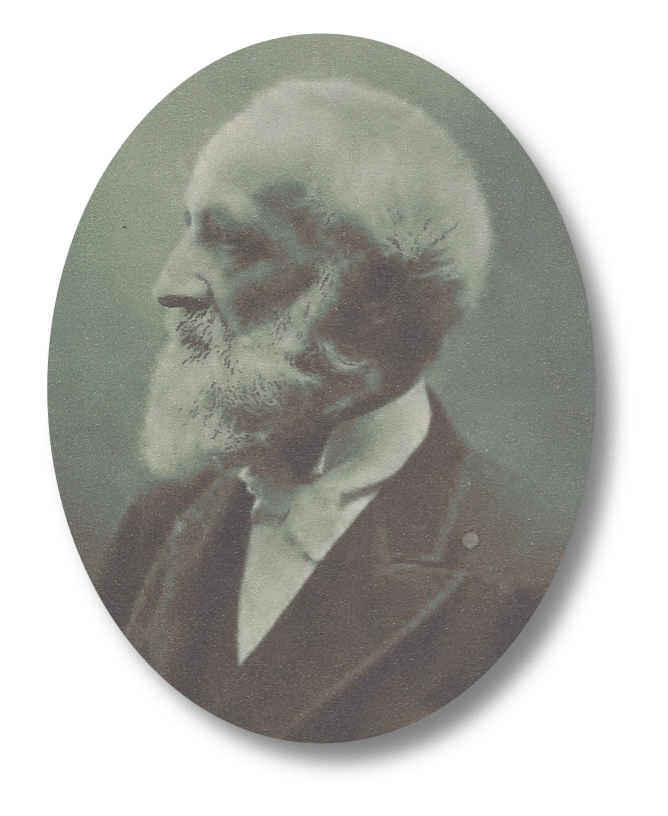
Rev. Dwight Whitney Marsh in later years

These two letters were written by Dwight Whitney Marsh (1823-1896), the son of Henry Marsh (1797-1852) and Sarah Whitney (1796-1883) of St. Louis, Missouri. Dwight had several siblings; those mentioned in these letters include, Calvin “Waldo” Marsh (1825-1873), Elizabeth (“Lizzie”) Willard Marsh (1829-1882), and Clarissa (“Clara”) Dwight Marsh (1834-1899) who married Samuel Watkins Eager, Jr. (1827-1903). Dwight’s father was an attorney in St. Louis at the time of his death in 1852 at the age of 53.

Dwight was born in Berkshire county, Massachusetts, and graduated from Williams College in 1842. He studied theology at Andover Theological Seminary in 1842-3, and then taught school in St. Louis, Mo., from 1843 to 1847. He continued his theological training at Union Theological Seminary and graduated in 1849, after which he was ordained and sailed in December 1849 from Boston to Mosul, Turkey, as a missionary for the A. B. C. F. M. In 1852 he returned to the U.S. and married 19 October 1852 to Julia White Peck of New York City. He then returned to Mosul where his wife died in August 1859. He finally returned to the U.S. in 1860 and began a lecture tour on missionary life. He was married on 21 August, 1862, to Elizabeth L. Barron in Rochester and then accepted charge of the Rochester Young Ladies’ Female Seminary where he remained five years. While there, he also preached for the Wester House of Refuge. He then went on to serve in the pulpit of various churches in the midwest before his death in 1896.

Letter 1

Osburn House
Rochester, New York
Thursday, August 21, 1862

My own ever dear sister Lizzie,

I am very sorry that our marriage comes off so suddenly that you & Mother could not be present. I think of you all much. It is now about noon & we are to be married at 3:30 & at 9 shall be at the [Niagara] Falls if all goes well. We have a charming day & I wish you were here to share in our delight. How often in this life our affairs move differently from our anticipations. I think we are about to be happy; but only our Maker knows what trials of sickness or partings are in store.

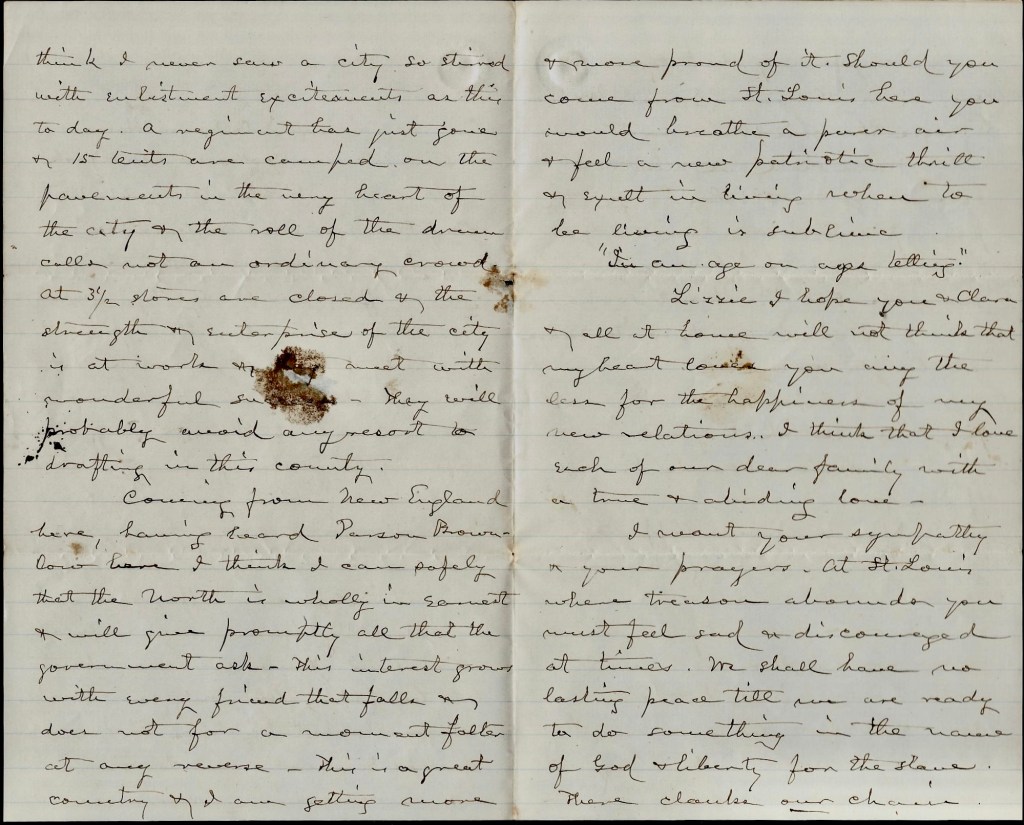
We are in war times. I think I never saw a city so stirred with enlistment excitements as this day. A regiment has just gone & 15 tents are camped on the pavements in the very heart of the city & the roll of the drum calls not an ordinary crowd. At 3:30 stores are closed & the strength & enterprise of the city is at work & will meet with wonderful success. They will probably avoid any resort to drafting in this county.

Coming from New England here, having heard Parson Brownlow 1 here, I think I can safely [say] that the North is wholly in earnest & will give promptly all that the government asks. This interest grows with every friend that falls & does not for a moment falter at any reverse. This is a great country & I am getting more & more proud of it. Should you come from St. Louis here, you would breathe a purer air & feel a new patriotic thrill & exult in living where to be living is sublime. “In an age on ages telling.”

“We shall have no lasting peace till we are ready to do something in the name of God & liberty for the slave. There clanks our chain.”

Rev. Dwight Whitney Marsh, 21 August 1862

Lizzie, I hope you & Clara all all at home will not think that my heart loved you any the less for the happiness of my new relations. I think that I love each of our dear family with a true & abiding love. I want your sympathy & your prayers. At St. Louis, where tiresome abounds, you must feel sad & discouraged at times. We shall have no lasting peace till we are ready to do something in the name of God & liberty for the slave. There clanks our chain.

Do give my best love to Anna & Clara & Sam & Waldo & kiss the children. When shall we meet? I cannot go to St. Louis for the present. I shall have to go look after Charlie again, as soon as October 1st, if not sooner. I shall try to write more at length soon. I hope Katy will not forget “Uncle Dwight.” Remembrance to all friends.

Your ever affectionate brother, — Dwight

1 William Gannaway Brownlow (1805-1877) was a preacher in the Methodist Church and a Tennessee newspaper editor. A Unionist despite owning slaves himself, Brownlow criticized the Confederacy even after Tennessee seceded. He was briefly imprisoned by the Confederacy at the beginning of the war. After leaving the state, he began a lucrative lecture tour in the North.


Letter 2

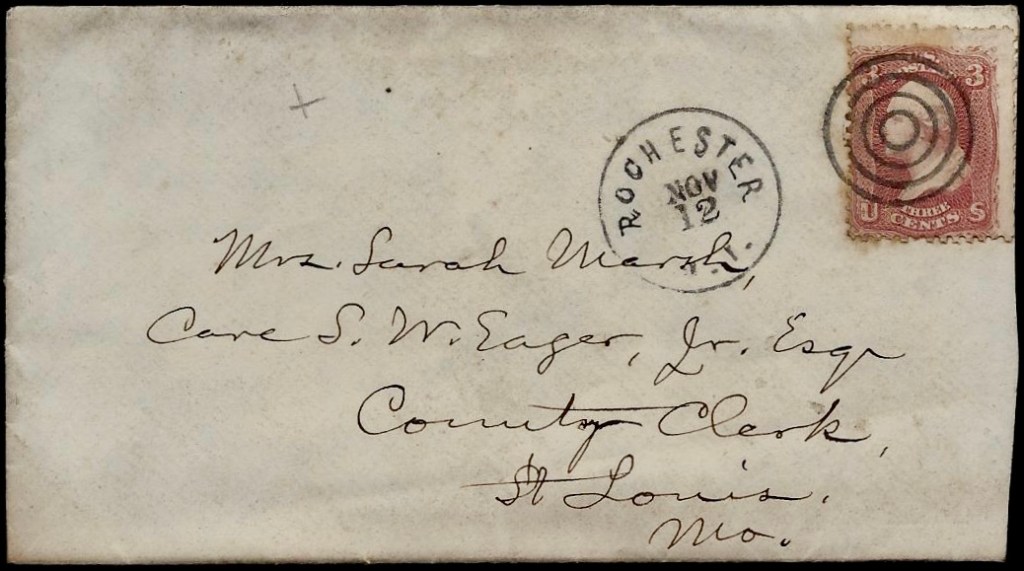
Addressed to Mrs. Sarah Marsh, Care of S. W. Eager, Jr., Esqr., County Clerk, St. Louis, Mo.

Rochester, New York
Saturday, November 12th 1864

My own dearest Mother,

Your kind letter written just before election came yesterday & now we can rejoice & thank God together. This state and Nation are safe. God has heard the prayer of thousands of His creatures. He has been very gracious & to Him be all glory & praise. The world does surely move on towards the glad day when truth shall no longer be trampled down in the streets. The Nation, by God’s inspiring decree & influence, has asserted the heaven given rights to live notwithstanding rebels in arms & traitors at the polls would have assassinated the nation.

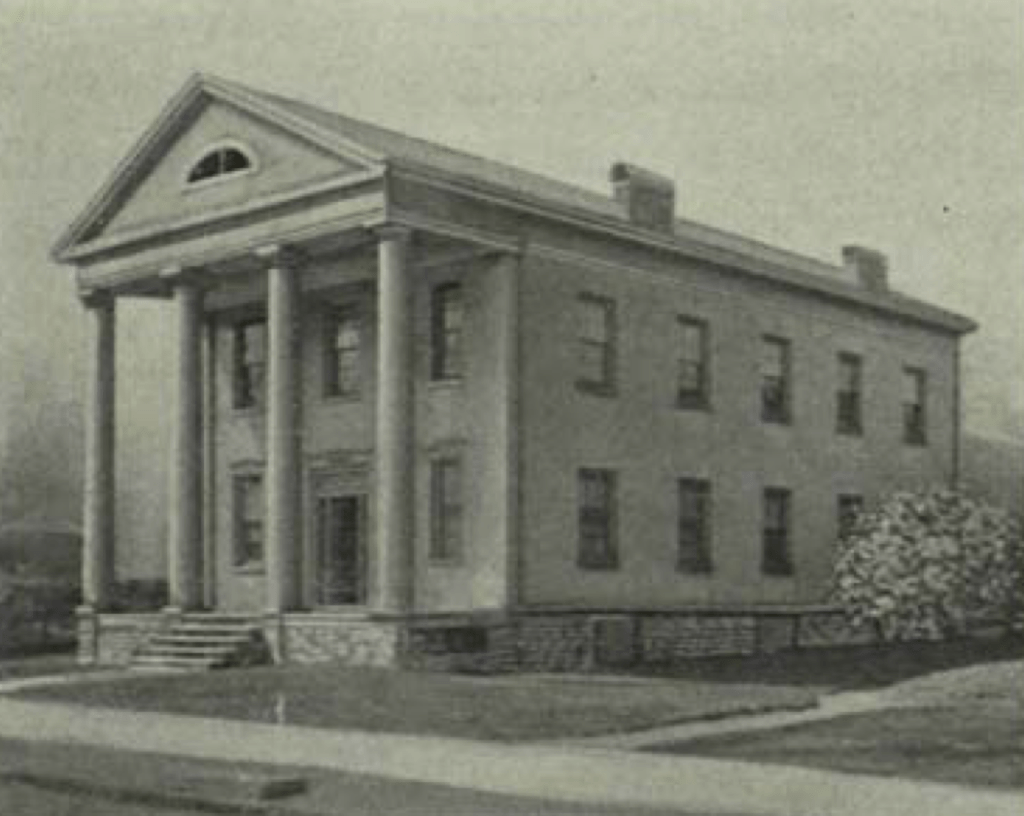
Rochester Female Seminary—pillars repaired in 1864

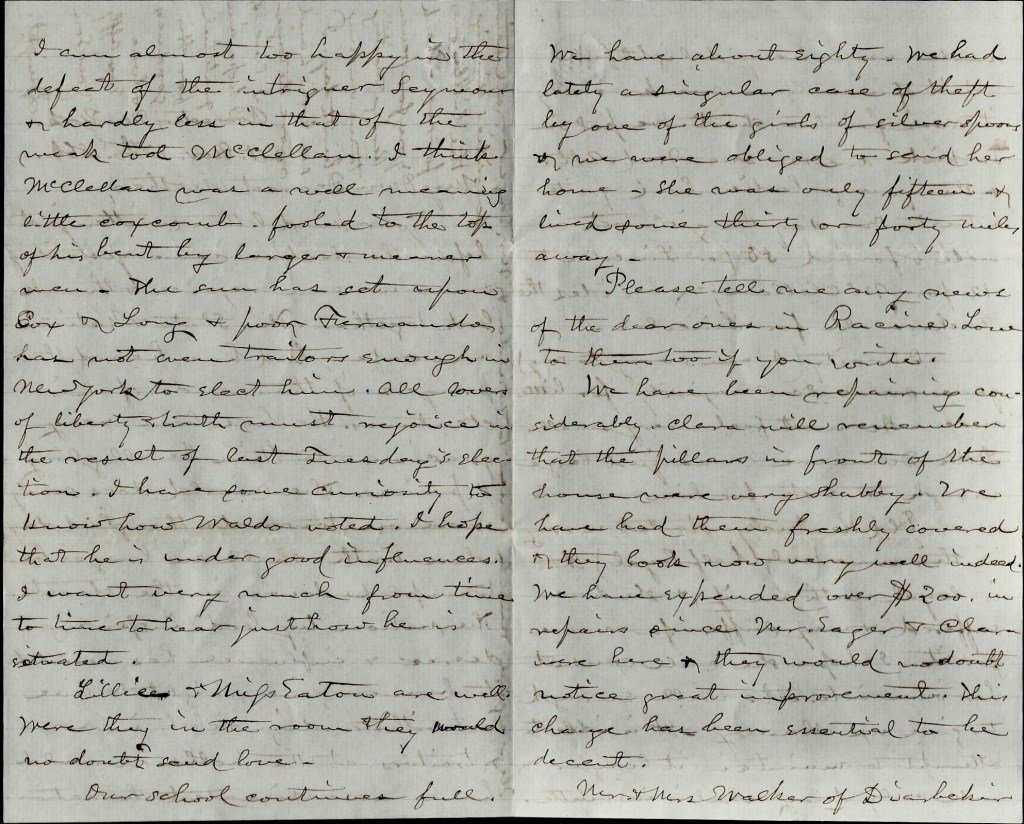
I am almost too happy in the defeat of the intriguer [Horatio] Seymour & hardly less in that of the weak tool McClellan. I think McClellan was a well-meaning little coxcomb—fooled to the top of his bent by larger and meaner men. The sun has set upon [Samuel S.] Cox & [Alexander] Long & poor Fernando [Wood] has not even traitors enough in New York [City] to elect him. All lovers of liberty & truth must rejoice in the result of last Tuesday’s election. I have some curiosity to know how [brother] Waldo voted. I hope that he is under good influences. I want very much from time to time to hear just how he is situated.

Lillie & Miss Eaton are well. Were they in the room, he would no doubt send love.

Our school continues full. We have about eighty. We had lately a singular case of theft by one of the girls of silver spoons & we were obliged to send her home. She was only fifteen & lived some thirty or forty miles away.

Please tell me any news of the dear ones in Racine. Love to them too if you write.

We have been repairing considerably. Clara will remember that the pillars in front of the house were very shabby. We have had them freshly covered and they look now very well indeed. We have expended over $200 in repairs since Mr. Eager & Clara were here & they would no doubt notice great improvement, This change has been essential to be decent.

Rev. Augustus Walker and his bride, Eliza Mercy Harding—Congregational missionaries to Turkey

Mr. & Mrs. [Augustus] Walker 1 of Diarbekir made us a very delightful visit of nearly a week—only it was too short. We put on Turkish dresses on Wednesday afternoon & the young ladies had quite a treat. One day the girls took a vote & found 58 for Lincoln to 12 for McClellan, & besides the teachers all for Lincoln.

Our city (I am sorry to say) gave some 80 majority for Little Mac. He must feel very small. Little Delaware was just large enough to vote for him.

Old Kentucky started wrong in this war (only half loyal)—that is, loyal with an if—and she has suffered & may suffer far more for it. I hope she will consult her own interests well enough to give up slavery. It is idle to attempt to maintain it longer & will only delay what is inevitable.

Please give much love to Waldo & Mr. Eager & all their families, kissing the little ones for me. Thank you for remembering & writing to me on my birthday. I see God’s hand more the longer I live & I hope am grateful for His goodness & love. Every affectionately your son, — Dwight

1 Rev. Augustus Walker and his wife, Eliza Mercy Harding, were missionaries to Diarbekir, Turkey, where they spent 13 years. They had six children, two of whom died in Turkey. Only one child, Harriet, was born in America during a furlough. In 1866 the Reverend Augustus Walker died of cholera in Turkey, and Mrs. Walker returned to America with their four children.

1861: Mary C. Stewart to Sarah Elizabeth Russell

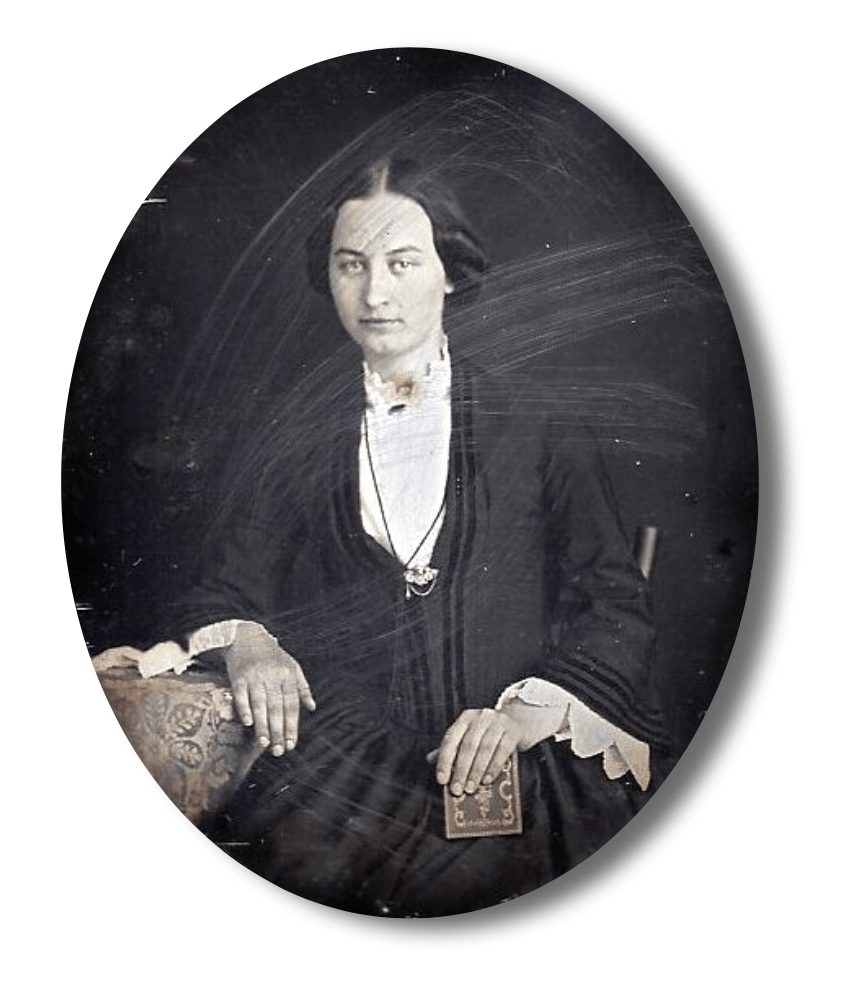
Libby Russell, ca. 1855

This letter was penned in June 1861 by a young school teacher who signed her name “Mary.” The content of the letter suggests to me that she was actually from the same same village as the young woman she was writing to which was her friend, Sarah Elizabeth (“Libbie”) Russell (1834-1925), the daughter of Luther Russell (1802-1878) and Polly E. Russell (1806-1896) of Streetsboro, Portage county, Ohio. The 1860 US Census for Streetsboro reveals a school teacher by the name of Mary C. Stewart (b. 1832) who was single and living with her parents. Since it was not uncommon for school teachers to leave their hometowns and teach in rural school districts while boarding with families of the students, my hunch is that this letter was written by Mary C. Stewart though of course I cannot confirm that by anything in the letter.

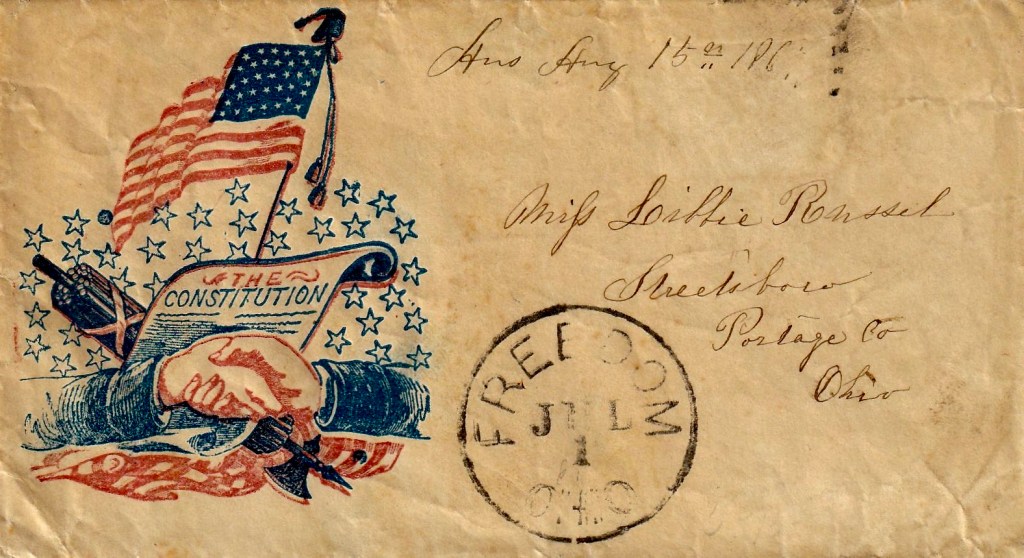
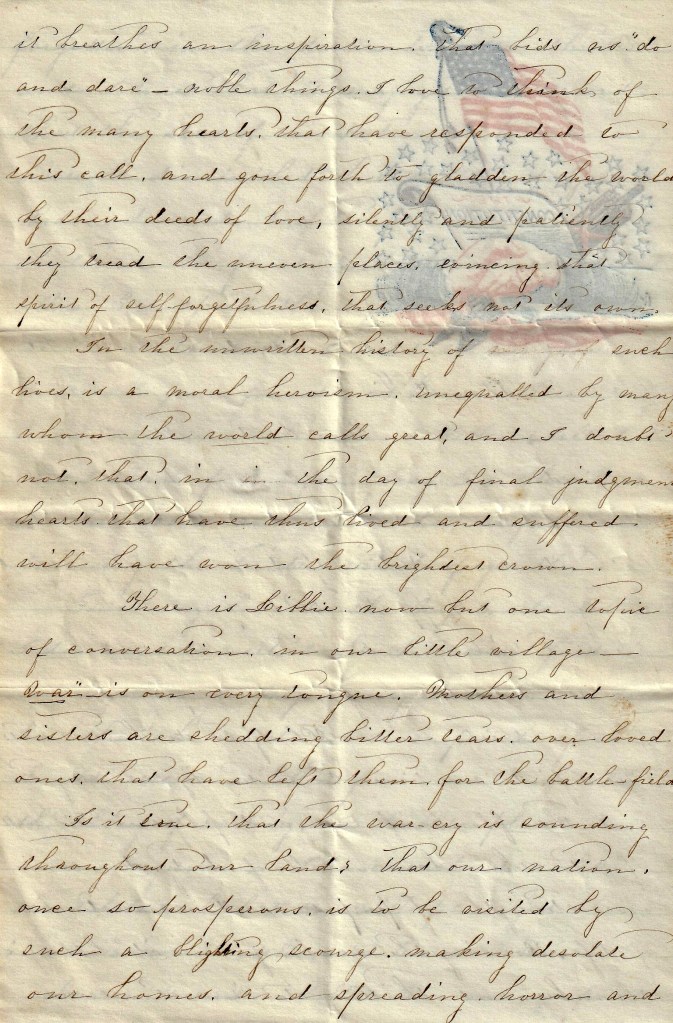
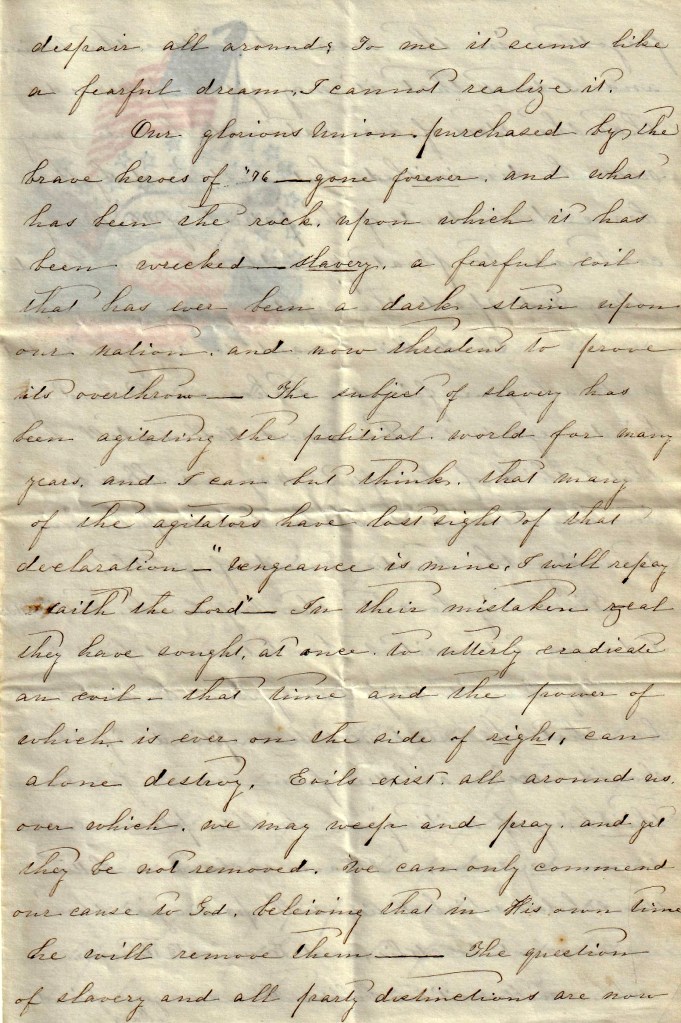
Mary’s patriotic envelope and stationery immediately arrest the eye but what is most interesting and appropriate is the postmark “Freedom, Ohio” given the content of her letter. Written prior to any major battle, Mary’s letter foreshadows the “blighting scourge” that is about to descend on the Nation, delivering “horror and despair” to the mothers and sisters who are already “shedding bitter tears over loved ones that have left them for the battlefield.” Mary lays the cause of the war on the evil “Slavery!” but also expresses her belief that the “agitators” (abolitionists) are as much to blame for sparking the war because they “sought at once” to eradicate the evil rather that trust that task to God.

The recipient of this letter (Libbie) never married. Her younger sister, Helen M. Russell (1841-1881), was betrothed to Corp. James (“Jimmie”) Fitzpatrick of Co. D, 104th OVI. He was shot in the head in the fighting near Dallas, Georgia on 28 May 1864 and died two days later.

[Note: This letter is from the personal collection of Richard Weiner and is published by express consent.]

Transcription

Addressed to Miss Libbie Russell, Streetsboro, Portage County, Ohio
Postmarked Freedom, Ohio, July 1 [1861]

Freedom [Portage county, Ohio]
June 21, 1861

Dear Libbie,

Your kind letter was received long since and would ere this have been answered had not time laden with its many duties sped so swiftly onward giving me no opportunity to perform the pleasant task of writing to you.

I am teaching. Have a pleasant school of about thirty scholars. Plenty to do have I not? Yes, I find no time to loiter by the way to cull the flowers of ease and pleasure. Tis well for to the clarion call of duty so we owe strength of purpose and earnestness of life. Rousing the soul from its lethargic slumber and thrilling its inmost recesses, it breaths an inspiration that bids us, “do and dare”—noble things. I love to think of the many hearts that have responded to this call and gone forth to gladden the world by their deeds of love, silently and patiently they tread the uneven places, evincing that spirit of self forgetfulness that seeks not its own.

In the unwritten history of such lives, is a moral heroism, unequaled by many whom the world calls great, and I doubt not that in the day of final judgment, hearts that have thus lived and suffered will have won the brightest crown.

There is Libbie now but one topic of conversation in our little village. “War” is on every tongue. Mother and sisters are shedding bitter tears over loved ones that have left them for the battlefield. Is it true that the war-cry is sounding throughout our land? That our nation, once so prosperous. is to be visited by such a blighting scourge, making desolate our homes and spreading horror and despair all around? To me it seems like a fearful dream. I cannot realize it.

Our glorious Union, purchased by the brave heroes of ’76—gone forever. And what has been the rock upon which it has been wrecked? Slavery! a fearful evil that has ever been a dark stain upon our nation, and now threatens to prove its overthrow. The subject of slavery has been agitating the political world for many years and I can but think that many of the agitators have lost sight of that declaration—“Vengeance in mine. I will repay saith the Lord.” In their mistaken zeal they have sought at once to utterly eradicate an evil—that time and the power of which is ever on the side of right can alone destroy. Evils exist all around us over which we may weep and pray, and yet they be not removed. We can only commend our cause to God, believing that in His own time He will remove them. The question of slavery and all party distinctions are now forgotten in the desire to “save the Union” and I trust that it may yet be preserved, that the stars of our national banner may never be diminished but sustained by the brave descendants of the patriots of ’76—may continue to float proudly over our land. May God speed the right.

Oh Libbie, I want to see you “so bad” and all your friend at home. Present my kind regards to them and Helen. Tell her that I think of her often. May God bless her in her labors and make her useful in training the tender mind of youth.

Give my love to the Miss Combs. Tell Addie I do want to write to her but cannot find time. My love to Nancy Russell and tell her that she need not be surprised if she should receive a letter from me for I am thinking of writing. Libbie, please write soon—very soon. I have enclosed a letter to the scholars which Hellen will please give them. Also a note to Addie and Emma Patterson. When will [you] visit me Libbie? Ever your friend, — Mary