
Though neither letter is signed with anything other than “Albert,” I was able to attribute the following letters to Albert Wesley Pillsbury (1834-1914), the son of Methodist clergyman, Rev. Samuel Pillsbury (1802-1888) and Eliza A. Latta (1809-1883) of Durand, Winnebago county, Illinois.
Albert wrote the letters to Marion C. Chamberlain (1836-1872), a native of Canada, who was enumerated as a schoolteacher in Durand, Winnebago county, Illinois in the 1860 US Census. In the 1870 US Census, Albert and Marion were residing as man and wife in Virginia City, Madison county, Montana, where Albert was farming and Marion was “Keeping House.”
Albert wrote both letters from Lake Gulch in the Central City Gold Mining region of Colorado Territory, in November 1861. In local news he writes of hunting down a horse thief and of a devastating fire in nearby Nevada City [Nevadaville]. He also writes some of the what he hears about the war back East and of the enlistments both in Denver as well as in Illinois.
Letter 1

Lake Gulch, Colorado Territory
November 3rd 1861
Dearest Marion,
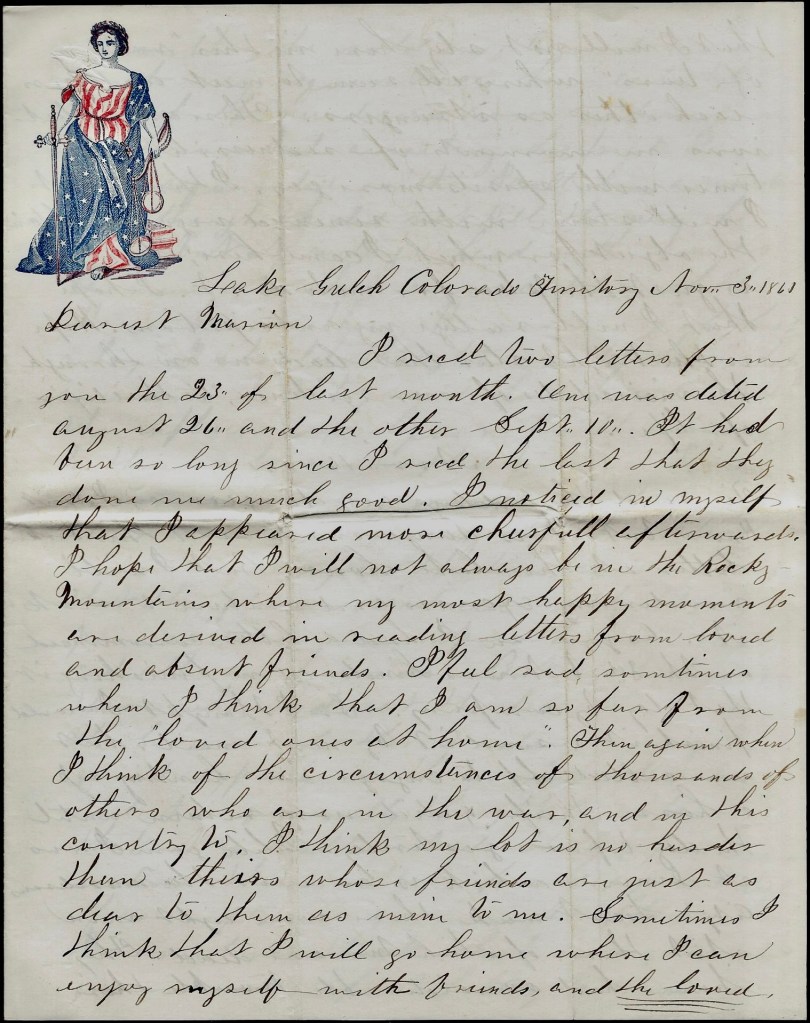
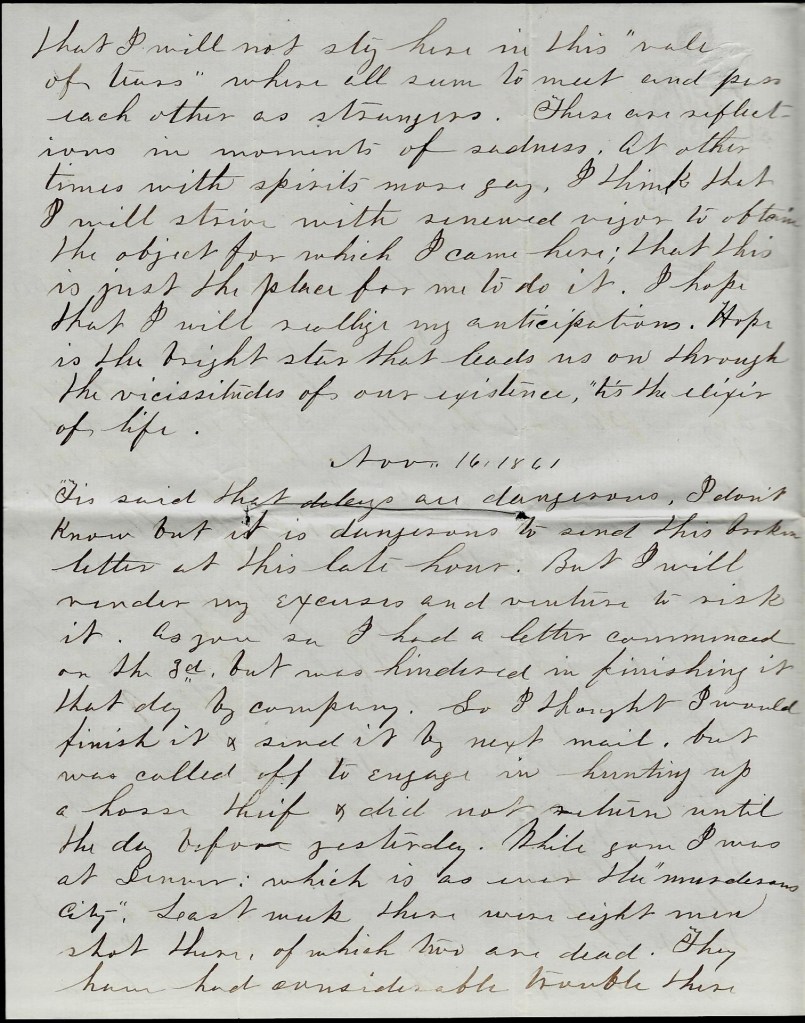
I received two letters from you the 23rd of last month. One was dated August 26th and the other September 10th. It had ben so long since I received the last that they done me much good. I noticed in myself that I appeared more cheerful afterwards. I hope that I will not always be in the Rocky Mountains where my most happy moments are derived in reading letters from loved and absent friends. I feel sad sometimes when I think that I am so far from the “loved ones at home.” Then again, when I think of the circumstances of thousands of others who are in the war and in this country too, I think my lot is no harder than theirs whose friends are just as dear to them as mine to me. Sometimes I think that I will go home where I can enjoy myself with friends and the loved—that I will not stay here in this “vale of tears” where all seem to meet and pass each other as strangers. These are reflections in moments of sadness. At other times with spirits more gay. I think that I will strive with renewed vigor to obtain the object for which I came here; that this is just the place for me to do it. I hope that I will realize my anticipations. Hope is the bright star that leads us on through the vicissitudes of our existence. Tis the elixir of life.
November 16, 1861
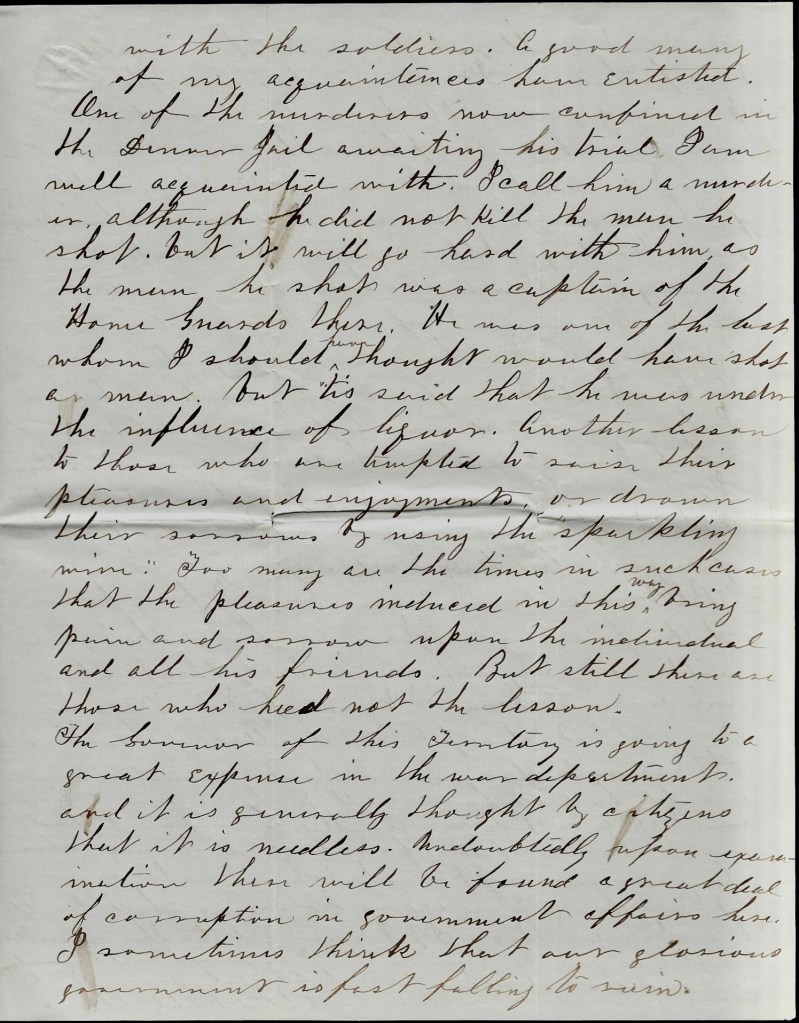
Tis said that delays are dangerous. I don’t know but it is dangerous to send this broken letter at this late hour. But I will render my excuses and venture to risk it. As you see, I had a letter commenced on the 3rd but was hindered in finishing it that day by company. So I thought I would finish it & send it by next mail, but was called off to engage in hunting up a horse thief & did not return until the day before yesterday. While one, I was at Denver which is as ever the “murderous city.” Last week there were eight men shot there of which two are dead. They have had considerable trouble there with the soldiers. A good many of my acquaintances have enlisted. One of the murderers now confined in the Denver jail awaiting his trial I am well acquainted with. I call him a murderer although he did not kill the man he shot—but it will go hard with him as the man he shot was a captain of the Home Guards there. He was one of the last whom I should have thought would have shot a man. But tis said that he was under the influence of liquor. Another lesson to those who are tempted to raise their pleasures and enjoyments or drown their sorrows by using the “sparkling wine.” Too many are the times in such cases that the pleasures induced in this way bring pain and sorrow upon the individual and all his friends. But still there are those who heed not the lesson. 1
The Governor of this Territory [William Gilpin] is going to a great expense in the War Department and it is generally thought by citizens that it is needless. Undoubtedly upon examination there will be found a great deal of corruption in government affairs here. I sometimes think that our glorious government is fast falling to ruin. That it will yet prove to the world to be a failure. It seems that everything is proving favorable to such an end. The ones in whom we placed the most confidence are, it seems, trying to use it to the gratification of their own desires. It seems that they are standing still before the traitorous enemy, and when there is a sacrifice made, it consists of our bravest and best men. We have not many [Nathaniel] Lyons and [Edward D.] Bakers to dispose of at this critical period.
I have not received any letters since the ones of which I mentioned in the commencement of this. I am waiting in great expectation: but when I think of being disappointed, I remember that you are looking as anxiously as I am. But you don’t know how I long for a letter from you. I am so afraid that you will not say what you truly think about my coming home. I know if I don’t come you will be disappointed. “Every heart has its secret drawer.” I think sometimes it would be best for us all to have some friend in which to confide our troubles. At home I had two or three confiding friends, and I miss them here. Do you suppose that home will ever appear home to me again. It seems that I will be a stranger there. If I receive a letter this week, I will answer by next mail. I hope you will overlook my long delays. Direct to Central City, Colorado Territory.
Write soon. Yours as ever in love, truth and fidelity, — Albert
1 The Captain of the Home Guards was Capt. Zeiglemuller. It was the Orderly of the Rifles that shot the captain in a financial dispute between them.

Letter 2
Lake Gulch, Colorado Territory
November 24, 1861
“O! that my prayer might unto heaven ascend,
T’would be that thou went ever blest;
That joy and sunlight, thy path might blind
And tranquil visions lull thy peaceful rest.”
My dearest Marion,
In my last I promised if I should receive a letter this week from you that I would answer it by return mail. I am very glad that I have been enabled to fulfill the promise. It much rejoices me to learn that your organ of hope is so very large. If a person could believe without a doubt (and never even think otherwise) in the idea that you advanced in your last, that is, “that good and evil alike, when come from God were blessings,” they necessarily would be happy. You say that you do think that I will be with you before Christmas. Now it makes me feel sorry to think that you are to be so much disappointed. Still I don’t entertain the idea that it will cause you to commit suicide or any other rash deed. “The way the twig is bent, the tree is inclined.” We may as well learn to stand grief while we are young; then it will not be so hard for us to endure it in riper years. It may tend to more fully prove to your mind that doctrine you so frequently advance—viz: “It is all for the best.” I expect you will say that is poor consolation for me. Still, I hope “it is all for the best.”
I don’t get any letters lately from home. Perhaps they think that we will be at home in a few days and it is of no use to write. I am sorry to disappoint them so much. But I don’t see any need of this being lonesome if we don’t come. I expect they are having fine times going to school as I suppose it has commenced before this time. The girls in Durand will have nothing to do this winter but study, as the young men are all gone so that they will not be likely to be bothered going to parties, &c. It must be rather dull times there in general. Who is to be married this winter? None, no not one, “nary one.”
I was much surprised to hear of the proceedings of Mr. & Mrs. D. J. Stines upon his volunteering. She must think a great deal of her country. If I had been in Lumpster’s place, I believe that I should have told her to wait a little longer—that she was not old enough to get to marry. He must have seen at once, if he would have considered any upon the matter of backing out, that it would forever be a stigma upon his character as a true patriot, as a lover of his birthright. I would not have such a charge brought against my name and known right amongst my own folks to be true for all the women in God’s footstool. I had twice, or even a thousand times rather die for my country. But I suppose there are some grounds to partially excuse Demp. upon. I suppose his mother thought it was dreadful for him to go. But I can imagine in my own mind how she talks about the war. I will bet that she thinks it the duty of everyone to go. She thinks that government should compel a force to march upon the enemy longer than it now has. I can just see in my mind how she gets up in meeting and sympathizes for her country, grieves at its wrongs, and wishes for every loyal American to resent those wrongs, to gather around the standard of her flag and protect it to the last extremity. But she don’t want Demp to go. There is too much rish to run. “Twould make Mary sick to have him go to the war. She would not give her son for the final salvation of the whole human family. No, she would not even risk her wealth, or future prosperity for such a gift. She would rather teach herself that it was an impossibility—that all don’t deserve any such merits. Self rules predominant in her mind to believe any such doctrine, tis too liberal. But Mary’s and Mrs. Stine’s whining would not in my mind justify his turning traitor to his country.

Week before last this portion of the mountains were thrown into a great deal of excitement by fire. There were about fifty houses burned in Nevada City [Nevadaville] which is about one and a half miles from here. The wind blew awfully. It seemed as if the elements were bound to drive the people from this part of the mountains. It was as light as day anywhere within a mile of the fire. Everything here is so dry and so full of pitch and the wind so dreadful that when fire breaks out, it is apt to do a great deal of damage. There were not many goods burned. They took them and threw them into bad holes and put them into tunnels, but a great many of them were destroyed and damaged by moving them so hastily. Besides these were several families burned out but no one burned to death. The people in Central City, which is about three-quarters of a mile from Nevada, took all of the goods out of the place, supposing that it would be destroyed also. Teams got broke $10 to $25 per load for hauling goods to the nearest prospect hole or tunnel. But luckily the fire did not do any damage there, but it caught fire a great many times and was put out. This all happened in the night which made it much more fearful. The air was filled with flying sparks. It blew them as much as a mile, which made the fire jump from mountain to mountain. The family that I live with got their goods all packed up and out ready to start, but were not damaged any, but dreadfully frightened. 1
Write soon. Direct as usual. You don’t know how I want to find out about what you think of my coming home. I am afraid that you will not say as you think about it. No more at present. I hope that you will ever believe that I am your true and affectionate lover. Goodbye for a while, — Albert
1 In 1861 a fire destroyed most of the town. A newspaper article about the fire stated that there were around 40 stamp mills in the vicinity of Nevada, a staggering number for that early date, which surely made the town the milling center of Colorado at that time.




 Spared & Shared 23