I have not conducted an exhaustive search on the identity of these correspondents who are identified only by their initials. But I transcribed the letter because I found the content interesting.
The letter includes a discussion of two events affecting Charleston and the State of South Carolina. The first part of the letter pertains to the calling out of the state militia in both Rhode Island and in South Carolina in response to the United States declaring war on Great Britain in June 1812. Apparently, the author had previously held a commission with the militia in Rhode Island that he believes should exempt him from service in South Carolina where marching off into the country and camping in the swamps would most certainly result in his inglorious death. As part of that discussion he reveals the current efforts by South Carolina’s Governor, Joseph Alston, to strengthen the state’s militia laws and levy hefty penalties upon those who fail to report for duty. Period newspaper accounts of the Governor’s support for a doctrine that would enable him to declare martial law in time of peace caused South Carolinians to express “surprise, indignation, and horror at the revival of this question in this free country. Before we consent to put it at issue, let us tear up the History of the Revolution, cancel the memory of the achievement of our Fathers, and burn the Declaration of Independence, for they will but shame our degeneracy and satirize our unworthiness.” [Charleston Courier, September 15, 1813]
The second part of the letter shares news of some of the disastrous impacts of a hurricane that pummeled Charleston during the evening hours of Friday, August 27, 1813. Locals referred to it simply as “The Gale.”
“Although brief, the cyclone was fierce, “one of the most tremendous gales of wind that ever was felt upon our coast,” with a constant deluge of rain. For six hours, wind blew at hurricane force, driving in the storm surge at midnight. The rush of water equaled the horrific flood of 1752; the high water mark was reported to have been eighteen inches higher than during the “great gale” of 1804. By morning, the fast-moving storm had traveled up the coast. The litany of damage was familiar. In every part of the city, trees were uprooted or snapped. Buildings had blown down, fences washed away, animals lost or drowned. Water and wind had wrecked some houses and damaged many more, toppling chimneys and tearing away roofing…The wharves and docks were a “melancholy scene of distress, of vessels crushed on against the other, or thrown up high and dry.”Commercial losses were heavy, but, as the Charleston Times remarked, “had it not been for the present state of things, that left little merchandise and less shipping here, the loss would have been immense.” The “state of things” was the War of 1812…By far the most expensive single loss was the New Bridge across the Ashley River, completed in July 1810 at an estimated cost of $175,000.” [Source: 1813 Cyclone]
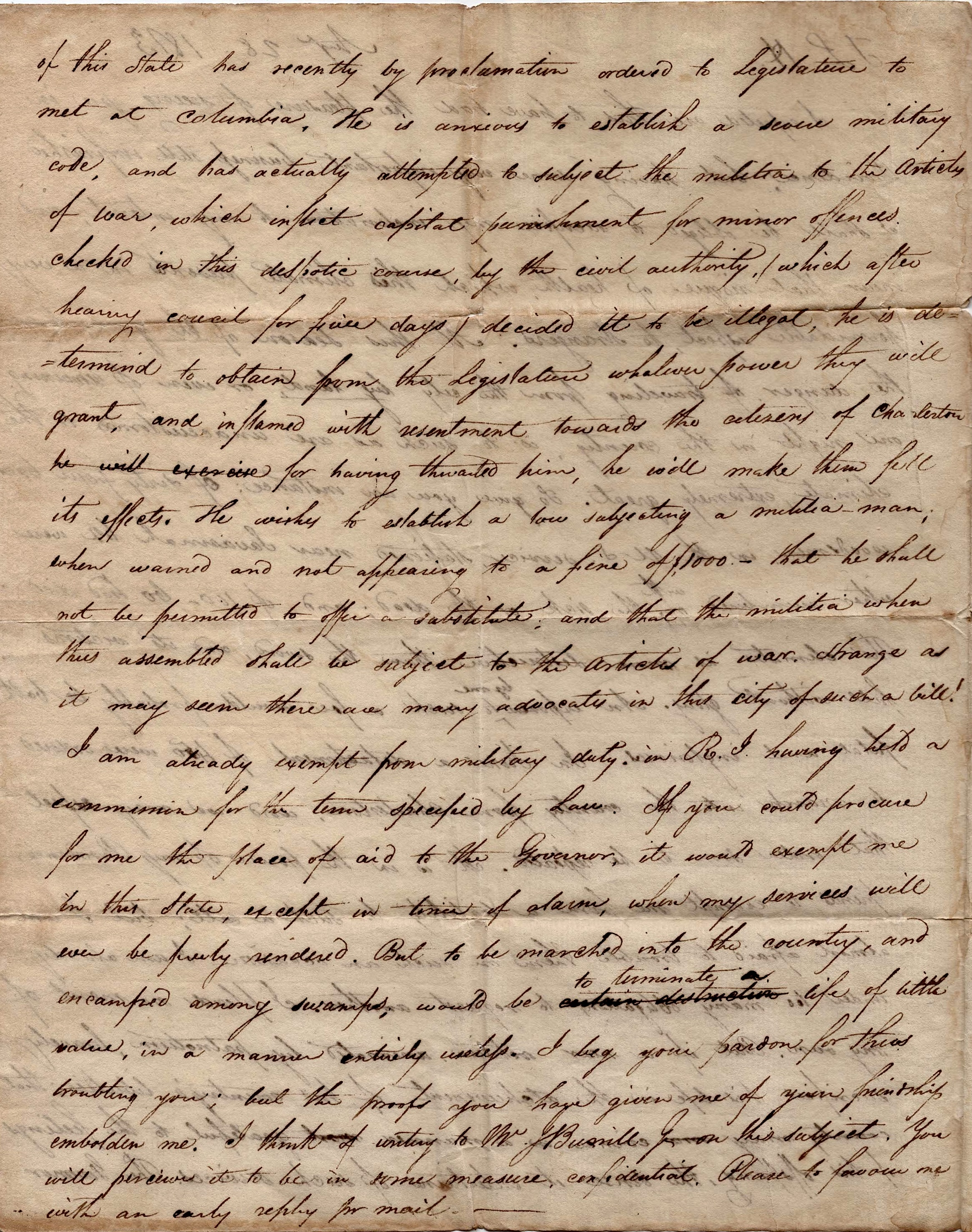
T R A N S C R I P T I O N
[Charleston, South Carolina] August 28, 1813
T. L. H.,
I expected ere this to have had the pleasure of seeing you in Providence but having some very important business still unfinished, I shall be obliged to sacrifice my inclination to my interest and incur that risk of health which this climate presents in a very formidable aspect to strangers. At this season of the year, the danger of traveling from the city by land, or even of remaining one night in the country, is to such as are unaccustomed to the climate, extremely great. To give you an instance, of 64 back woodsmen in the U. S. service stationed near Savannah, 62 were either numbered with the sick or the dead, and of 100, 60 had died. The climate is more destructive than the sword and its victims fell without glory. An exposure by ,e to such a foe would probably be both fatal and inglorious.
In June a detachment of 450 were ordered to march into the country from Charleston, and we may expect that order soon to be repealed. It is in the power of Providence friends to exempt me from a liability to such a call, But I am almost afraid to trouble them on such an occasion. I am already under too many obligations to request another. I plead no merit of my own. But if a near relation animated by patriotism, bravely sacrifices his life in the achievement of his county’s liberties; that country may evince in a manner grateful to the feeling of his offspring, the sense it entertains of such services.
The Governor of this state has recently by proclamation ordered the Legislature to meet at Columbia. He is anxious to establish a severe military code and has actually attempted to subject the militia to the Articles of War, which inflict capital punishment for minor offenses. Checked in this despotic course by the civil authority (which after hearing council for five days) decided it to be illegal, he is determined to obtain from the Legislature whatever power they will grant and inflamed resentment towards the citizens of Charleston for having thwarted him. He will make them feel its effects. He wishes to establish a law subjecting a militia man, when warned and not appearing to a fine of $1000 that he shall not be permitted to offer a substitute and that the militia when thus assembled shall be subject to the articles of war. Strange as it may seem, there are many advocates in the city of such a bill!
I am already exempt from military duty in Rhode Island having held a commission for the time specified by law. If you could procure for me the place of aide to the Governor, it would exempt me in this state, except in time of alarm, when my services will ever be freely rendered. But to be marched into the country and encamped among swamps, would be to terminate a life of little value, in a manner entirely useless. I beg you pardon for thus troubling you, but the proofs you have given me of your friendship embolden me. I think of writing to Mr. J. Busvill Jr. on the subject. You will perceive it to be in some measure confidential. Please to favor me with an early reply per mail.
This city was last night visited by the most tremendous gale storm I ever experienced. The wind was at Northeast and the damage sustained incalculable. All the wharves are in ruins. The tide was one or two feet higher than ever before known. The beautiful new bridge was in a great degree swept away. The shipping in the harbor much injured and the large ship Canton is sunk. It is feared the sea island cotton adn rice crops are materially injured by the tide and those of corn &c. by the wind. Many chimneys are blown down. Capt. Cross’ house escaped without injury.
Be pleased to make my affectionate regards to your amiable family, and accept the assurances of my esteem and friendship. — C. R. G.
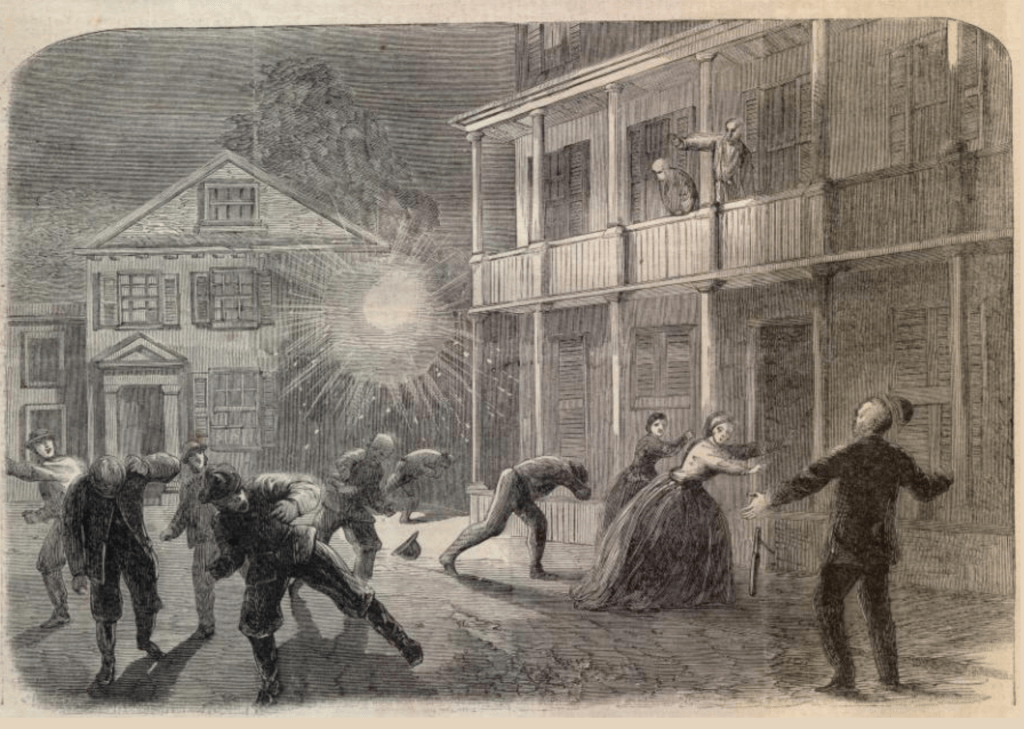
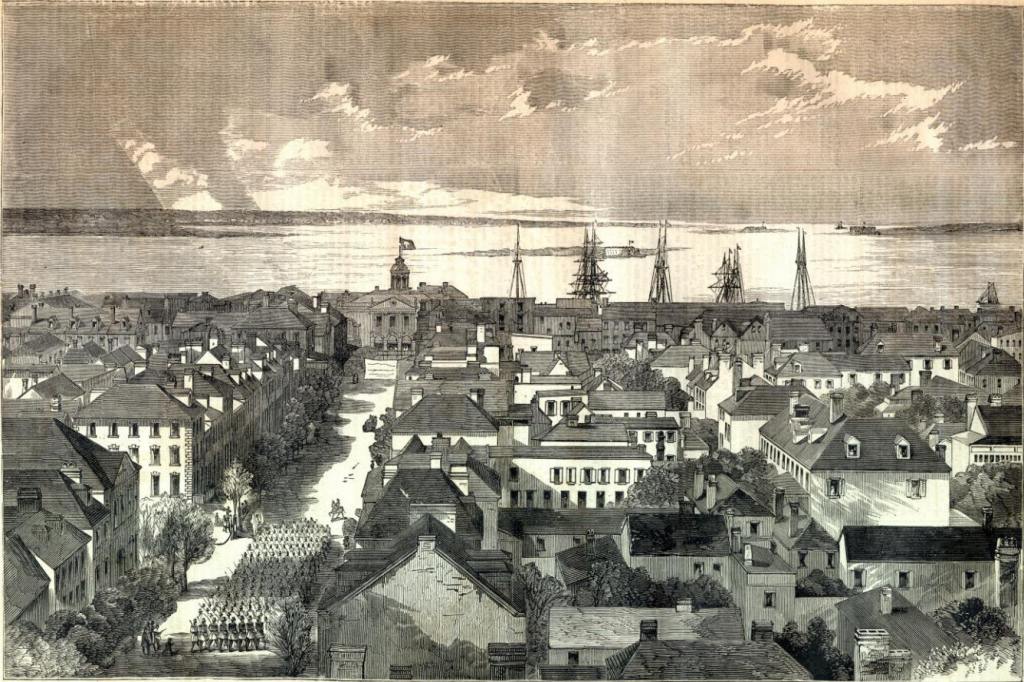
After several unsuccessful attempts to take Charleston by water, the Union launched a different tactic—shelling Charleston civilians from James and Morris Islands. Gillmore set twenty-two thousand men to work erecting gun batteries in the island marshes facing the Charleston peninsula and Fort Sumter. The batteries were five miles from the city, too distant for conventional ordnance to reach, so residents were at first unconcerned. However, recent weapon developments and rifling technology actually put the city in range, and on the night of August 22, 1863, the “Swamp Angel” gun opened fire on Charleston.
The first shell hit Hayne Street near the Market, narrowly missing the Charleston Hotel. A British visitor recalled, “At first I thought a meteor had fallen, but another awful rush and whir right over the hotel and another explosion beyond, settled any doubts that the city was being shelled.” Beauregard admonished Gillmore: “It would appear sir, that despairing of reducing our works, you now resort to the novel measure of turning your guns against old men, the women and children, and the hospitals of a sleeping city, an act of inexcusable barbarity.” Church steeples became targets for Union artillery, so many closed during the siege for the safety of their parishioners. Newspapers reported that many residents had made a “Grand Skedaddle,” leaving as quickly as they could pack their belongings.
Those who stayed became used to the daily explosions. Fitz Ross, a visiting journalist, wrote, “Nine out of ten shells fall harmless—the hope of the Yankees to set fire to the city or batter it down have hitherto proved disappointing.” The shelling continued with varying degrees of intensity for 587 consecutive days. In January 1864 the Charleston Mercury did report a frightening near miss: “One of the enemy’s large shells, after penetrating the roof of a dwelling, overturned a bed in which three young children were sleeping, throwing them rudely on the floor, but then strange to say, it passed without bursting, and buried itself in the foundation of the house.”
The worst bout of shelling occurred during a nine-day stretch in 1864, when over fifteen hundred shells rained down on the city. Volunteer fireman Charles Rogers wrote to his wife in June 1864 that “there was a fire downtown last week, and the Yanks dropped their shells in town like peas…I have experienced a remarkable change since my return. In fact it is a matter of much congratulation in the Starvation times. I don’t eat half as much now.” [Source: Christina Rae Butler, Legends Magazine]
I can’t be certain of the identity of the “S. S. Roberts” who wrote this letter but I believe it to have been 30 year-old Stephen S. Roberts (b. 1834) who worked as a clerk in Charleston and whose widowed mother Mary Roberts lived on Spring Street east of King Street in the City. Though he called himself “Old Woman,” I think this was in jest. The letter was datelined from Summerville where many residents fled to avoid the shelling.
The letter was written to William Birnie (1782-1865), a Charleston, S.C., merchant and president of the Bank of South Carolina. It may have been that Roberts clerked for Birnie. William Birnie was an immigrant from Aberdeen, Scotland, who had settled in Charleston in the 1850s. Birnie refugeed to Greenville during the Civil War, and in October 1863 purchased 96 acres and a home on the Augusta Road for $30,000 that became his home.
Charleston remained under intermittent bombardment from August 1863 until it was evacuated in February 1865. Though only five individuals would be killed by the cannonade, Charlestonians moved north of Calhoun Street and along the Ashley River. The downtown area became known as the “Shell District.” The historic churches, houses, and graveyards were damaged and some destroyed by Union shells.
Shelling of Charleston, South Carolina
Transcription
Summerville, [South Carolina] 17th January 1864
Wm. Birnie, Esq.
Respected sir, it has been some time since I wrote you last and there has been many changes in our good old city since then. I removed Mr. Ogilvie’s 1 stock up Meeting Street after I found Broad Street had been completely deserted by everybody else. A great many removed to the south of Calhoun Street which I remarked at the time was very foolish of them. Friday’s shelling will tell them that they will be compelled to make another move higher up.
Last Friday the Yanks threw a shell into Charlotte Street & another in John Street east of Meeting Street. What a stampede these two devils have caused amongst the people. The Banks & portions of the Government departments removed by daylight Saturday morning. The Bank of Charleston had pulled up stakes & gone—where to? deponent knoweth not. Sub Treasury & most of the other banks were removing yesterday afternoon.
I do hope that the Yanks may never reach my new quarters. On Thursday last the enemy put a shell through the shed of our old store which did not stop until he reached the second floor. There the gentleman belched out all his venom & made sad havoc all around. The lower story not injured farther than the contraction of the doors attached to the large safe, or in other words—vault. Not many panes of glasses to be seen over the building. To my astonishment, there is not one piece of the shell to be found in the rooms. I notice several holes in the walls so I suppose the fragments have hid themselves in them. The building is not as badly damaged as I expected to find it.
The Southwestern Railroad Bank was also struck and received much more injury than your building. Yesterday when I was down in Broad Street, the shells came whistling over my head like so many Mock Birds. Any number struck around the neighborhood. When leaving the old establishment, I took a farewell look at the old place & said to myself, “Old woman, this will be the last visit I will pay you until our esteemed friends shall stop sending so many black pills to yourself & neighbors, as I have no relish for those sort of plums.”
I have heard heavy firing all last night & this morning. My health & my mother’s not of the best. I hope this will find yourself & family well. Please accept for yourself & Mrs. B. our best respects. I remain, dear sir, truly — S. S. Roberts
1 William Matthew Ogilvie (1810-1872), a native of Scotland, married Margaret Murdock Walker in Charleston in 1840 and was a merchant in Charleston at the time of the Civil War.
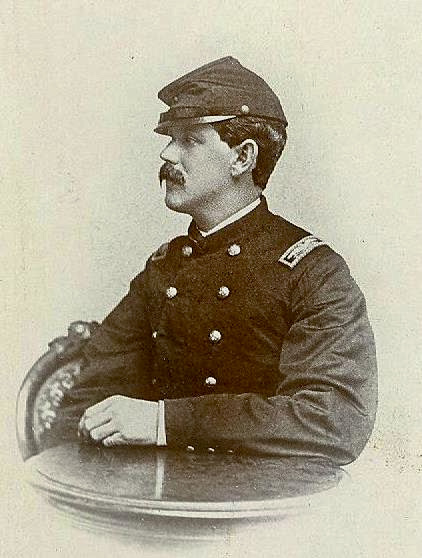
Col. Charles Ray Brayton, 3rd Rhode Island Heavy Artillery
Charles R. Brayton (1840-1910) was born in Warwick, Rhode Island to William Daniel Brayton and Anna Maud (Clarke) Brayton. In 1857, his father was elected as a Republican representing Rhode Island in the U.S. Congress. In 1859, he began attending Brown University in Providence, but left in the middle of his second year to join the 3rd Rhode Island Heavy Artillery. He was commissioned as first lieutenant in 1861, promoted to lieutenant colonel in 1863, and to colonel in April 1864. He was honorably mustered out of service in October 1864. In March 1865, along with many others, he received a brevet (honorary promotion) to the rank of brigadier general. That same year, just a month before the end of the war, he married Antoinette Percival Belden.
Charles wrote the letter to Col. Edwin Metcalf of the 3rd Rhode Island Heavy Artillery. At the time of this letter, the 3rd Rhode Island Heavies were still stationed on Morris and Folly Islands near Charleston, South Carolina.
[Note: These letters are from the personal collection of Greg Herr and were transcribed and published on Spared & Shared by express consent.]
Letter 1
Headquarters Battery C, 3rd Rhode Island Vol. Artillery Morris Island, South Carolina September 14, 1863
Dear Colonel,
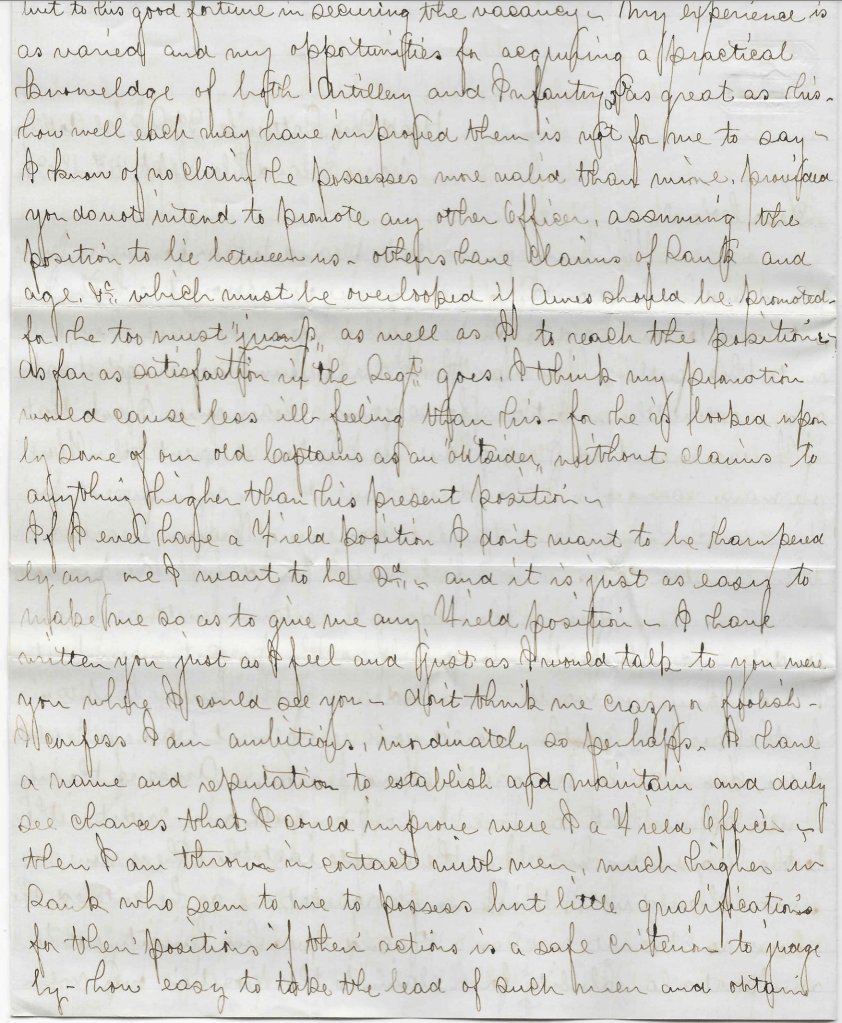
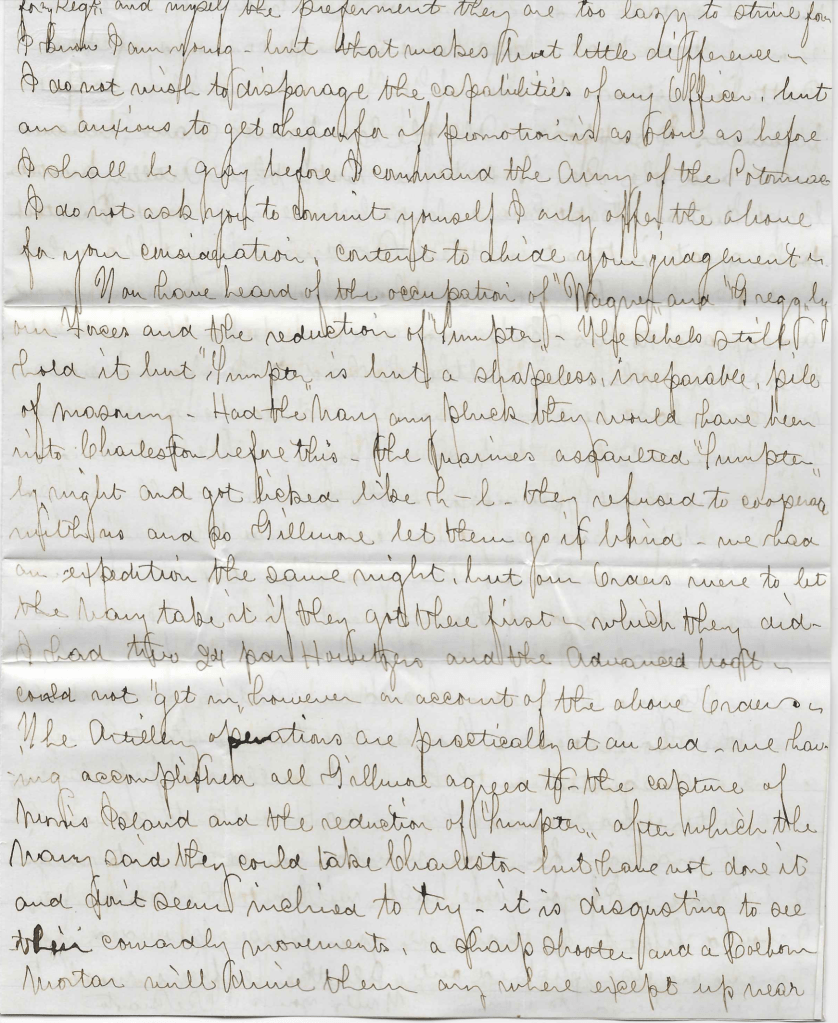
Thinking you would be pleased to hear from us on Morris Island and having something to say on my own account which I intended to have said to you personally before you went home, I write this epistle. You may think me presumptuous, egotistical, and inordinately ambitious for so young a man when I ask that if Frieze is removed, I may have his position as Lieut. Colonel. There are many reasons why I should not have it—my age, present position in the line, and three Majors besides. There are also others why I feel that I could fill the position as well as an officer in the regiment, certainly with as much credit and satisfaction to yourself as the present incumbent. I hardly think you would recommend any of the “Senior” Captains for the position. Neither would your judgement lead you to select either Day or Bailey for equally strong reasons.
Ames is the only Field Officer that can fill the position with any credit, either to the regiment or himself. The simple fact that he is now my Senior should not, I think, weigh against me as he entered the service as 2nd Lieutenant and I as a 1st, and owes his seniority not to any particular ability for, or claim to, the position over me, but to his good fortune in securing the vacancy. My experience is varied and my opportunities for acquiring a practical knowledge of both artillery and infantry are as great as his. How well each may have improved them is not for me to say. I know of no claim he possesses more valid than mine, provided you do not intend to promote any other officer, assuming the position to lie between us. Other have claims of rank and age, &c., which must be overlooked if Ames should be promoted for he too must “jump” as well as I to reach the position.
As far as satisfaction in the regiment goes, I think my promotion would cause less ill feeling than his for he is looked upon by some of our old Captains as an “outsider” without claims to anything higher than his present position. If I ever have a Field Position, I don’t want to be hampered by anyone. I want to be 2nd and it is just as easy to make me so as to give me any Field Position. I have written you just as I feel and just as I would talk to you were you where I could see you. Don’t think me crazy or foolish. I confess I am ambitious, inordinately so perhaps. I have a name and reputation to establish and maintain and daily see chances that I could improve were I a Field Officer. I am thrown in contact with me, much higher in rank who seem to possess but little qualifications for their positions. If their actions is a safe criterion to judge by, how easy to take the lead of such men and obtain for my regiment and myself the preferment they are too lazy to strive for.
I know I am young but that makes but little difference. I do not wish to disparage the capabilities of any officer, but am anxious to get ahead for if promotion is as slow as before, I shall be gray before I command the Army of the Potomac. I do not ask you to commit yourself, I only offer the above for your consideration—content to abide your judgement.
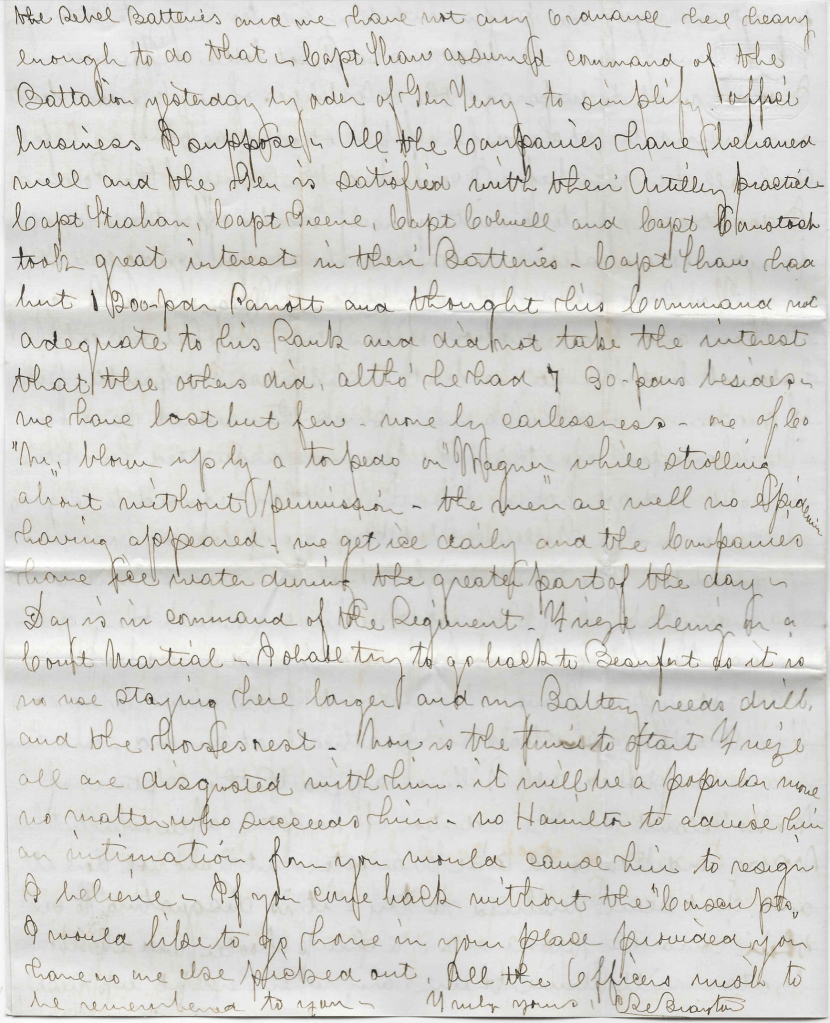
You have heard of the occupation of [Forts] Wagner and Gregg by our forces and the reduction of “Sumpter.” The rebels still hold it but “Sumpter” is but a shapeless, irreparable pile of masonry. Had the Navy any pluck, they would have been into Charleston before this. The Marines assaulted “Sumpter” by night and got licked like hell. They refused to cooperate with us and so Gillmore let them go it blind. We had an expedition the same night but our orders were to let the Navy take it if they got there first, which they did. I had the 24 pounder Howitzers and the Advanced boat. Could not “get in” however on account of the above order. The artillery operations are practically at an end—we having accomplished all Gillmore agreed to—the capture of Morris Island and the reduction of “Sumpter” after which the Navy said that they could take Charleston but have not done it and don’t seem inclined to try. It is disgusting to see their cowardly movements. A sharpshooter and a Coehorn Mortar will drive them anywhere except up near the Rebel Batteries and we have not any ordnance here heavy enough to do that.
Capt. Shaw assumed command of the Battalion yesterday by order of Gen. Terry to simplify office business, I suppose. All the companies have behaved well and the General is satisfied with their artillery practice. Capt. Strahan, Capt. Greene, Capt. Colwell, and Capt. Comstock took great interest in their batteries. Capt. Shaw had but one 200-pounder Parrott and thought his command not adequate to his rank and did not take the interest that the others did, although he had seven 30-pounders besides.
We have lost but few—none by carelessness. One of Co. “M” blown up by a torpedo on “Wagner” while strolling about without permission. The men are well. No epidemic having appeared. We get ice daily and the companies have ice water during the greater part of the day. Day is in command of the regiment, Frieze being on a court martial. I shall try to go back to Beaufort as it is no use staying here longer and my Battery needs drill, and the horses rest. Now is the time to start Frieze. All are disgusted with him. It will be a popular move no matter who succeeds him. No Hamilton to advise him. An intimation from you would cause him to resign, I believe. If you come back without the “conscripts,” I would like to go home in your place provided you have no one else picked out. All the officers wish to be remembered to you.
Truly yours, — C. R. Brayton
Letter 2
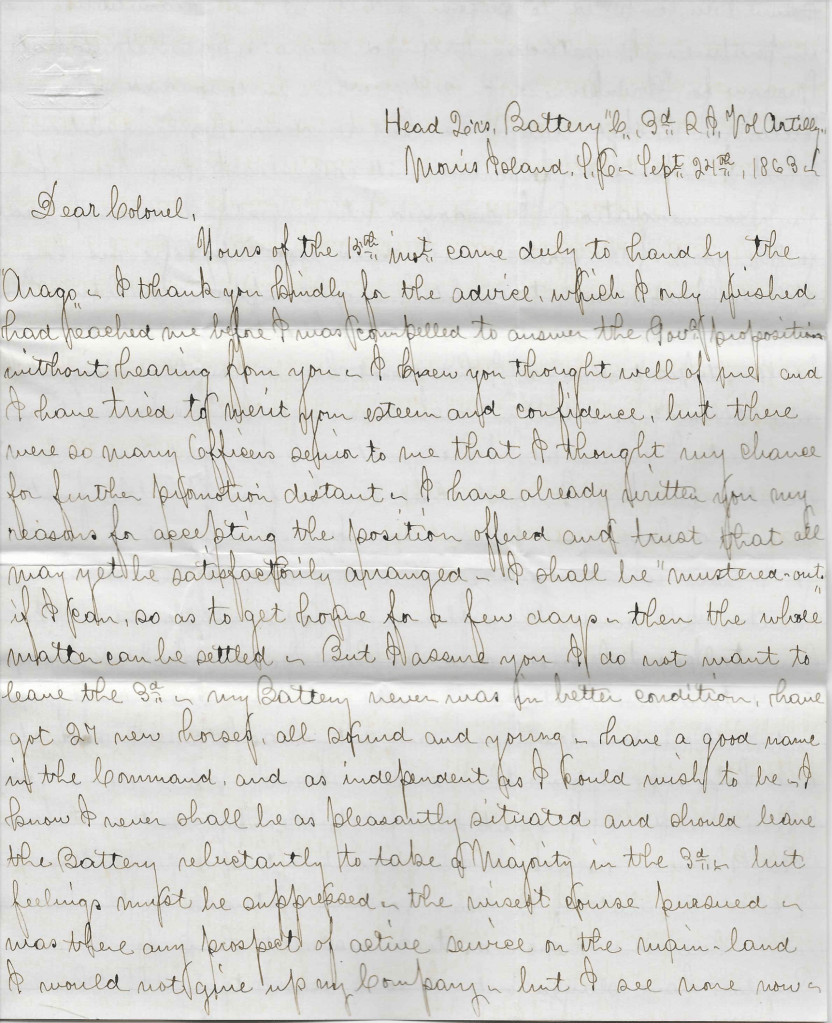
Headquarters Battery C, 3rd Rhode Island Vol. Artillery Morris Island, South Carolina September 24, 1863
Dear Colonel,
Yours of the 13th inst. came duly to hand by the Arago. I thank you kindly for the advice which I only wished had reached me before I was compelled to answer the Governor’s proposition without hearing from you. I knew you thought well of me and I have tried to merit your esteem and confidence, but there were so many officers senior to me that I thought my chance for further promotion distant. I have already written you my reasons for accepting the position offered and trust that all may yet be satisfactorily arranged. I shall be “mustered out” if I can so as to get home for a few days. Then the whole matter can be settled. But I assure you I do not want to leave the 3rd. My Battery never was in better condition. Have got 27 new horses, all sound and young, have a good name in the command, and as independent as I could wish to be. I know I never shall be as pleasantly situated and should leave the Battery reluctantly to take a Majority in the 3rd but feelings must be suppressed—the wisest course pursued. Was there any prospect of active service on the main land, I would not give up my company, but I see none now.
I have been compelled to perform a duty at once humiliating and imperative. I yesterday preferred charges against Lieut. Morrow for “Drunkenness on duty” while in command of a section on picket duty. He has tendered his resignation which I respectfully forwarded. It came back from Henry Metcalf for my recommendation. I endorsed it “respectfully recommended for the good of the service.” I could not approve his honorable discharge and thought I might appear to crowd him too hard did I insist on a court martial. As it is, he may be court martialed as I have not heard from the resignation and Gillmore is severe in such cases. Did I do more than my duty? No doubt of his guilt, as I brought him to camp beastly drunk. I regret that my company furnishes the first case and hope you will not consider it a fault of mine for I have ever discouraged drinking and no one ever saw me drunk or under the influence of liquor while here.
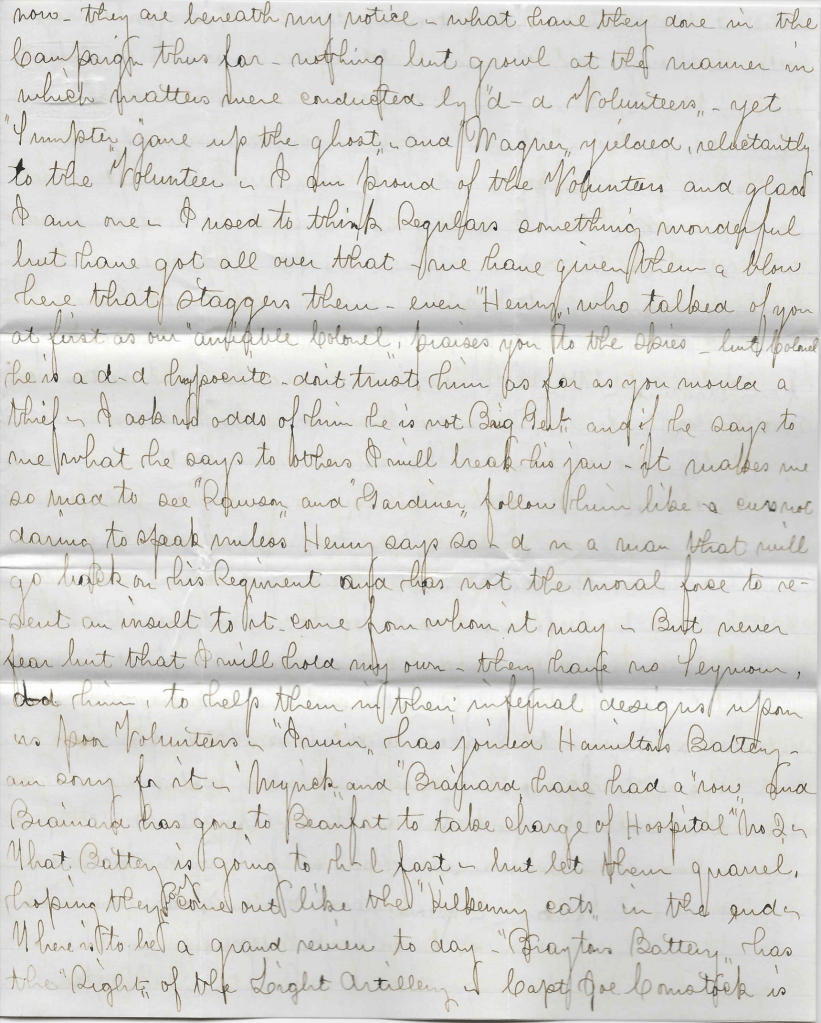
I have talked to Morrow and let him pass when my judgment told me better. I could not have been more lenient with my own brother. My duty was plain. I did it and hope you approve the course. It may save some good officers and be of great benefit to the regiment in the end. Gen. Gillmore has received his appointment as a Major General. I fired a salute of 13 guns for his yesterday on the beach where there were thousands to congratulate him by cheers.
Regulars have “played out.” I don’t associate with them now. They are beneath my notice. What have they done in the campaign thus far—nothing but growl at the manner in which matters were conducted by “damned Volunteers,” yet “Sumter” gave up the ghost, and “Wagner” yielded reluctantly to the Volunteer. I am proud of the Volunteers and glad I am one. I sed to think Regulars something wonderful but have got all over that. We have given them a blow here that staggers them. Even Henry, who talked of you at first as our “amiable Colonel, praises you to the skies.” But Colonel, he is a damned hypocrite. Don’t trust him as far as you would a thief. I ask no odds of him. He is not Brig. Gen. and if he says to me what he says to others, I will break his jaw. It makes me so mad to see “Rawson” and “Gardiner” follow him like curs—not daring to speak unless Henry says so. Damn a man that will go back on his regiment and has not the moral force to resent an insult to it—come from whom it may. But never fear but that I will hold my own. They have no Seymour, damn him, to help them in their infernal designs upon us poor Volunteers.
“Irwin” has joined Hamilton’s Battery. Am sorry for it. “Myrick” and “Brainard” have had a “row” and Brainard has gone to Beaufort to take charge of hospital. No. 2 in that Battery is going to hell fast. But let them quarrel, hoping they may come out like the “Kilkenny cats” in the end.
There is to be a Grand Review today. “Brayton’s Battery” has the “Right” of the Light Artillery. Capt. Joe Comstock is still at the [Hilton] Head awaiting transportation. You speak in your letter as though the 3rd was intolerable now. I can’t believe you really mean any such thing. Cursed we are by as miserable a lot of Field Officers (excepting yourself and Ames) as ever sapped the life of any regiment, but still we have talent among us sufficient to fill creditably any position. Our officers are far in advance of any I have seen here, take them as a class. You have no idea of the class of officers that came with those troops from Virginia. The 3rd stands well and are treated as Artillery Companies should be. They have done well. I am proud of them. If you can make a better regiment than stands out of the 4rd Rhode Island, mark out your cause and there are enough of us to support you. Only a few croakers to deal with.
Never fear about our getting into Charleston before you come back. Don’t you think me rather precocious in asking what I did. But I can’t help it for if I am left out now, I shall never command a regiment, I fear, and it is hard jumping from Major to Colonel over a Lieut. Colonel. But we will talk this over I hope before anything definite is done. I can keep my counsel—have so far—and promise you I will in future. Please excuse the emphatic remarks. Yours truly, — C. R. Brayton
Letter 3
Office of the Chief of Artillery Morris Island, South Carolina December 14, 1863
Dear Colonel,
Yours ofthe 4th and 5th (postscript) was duly received a few hours after I had mailed one for you. I think Eddy’s case settled for I well knew the Gov. had “no personal interest in the matter.” Bailey, I think, was at the bottom of the affair, put up to it by Eddy’s friends at home. If you think the matter need more attention, I will write the Governor about it, but I think it unnecessary.
Maj. Ames is in command of the Battalion. I showed him your letter about Report and Returns. Peirce of Co. D had a Descriptive List which Burton says he gave to Lamson, one having been given, the Company Commander has no right, I think, to give another.
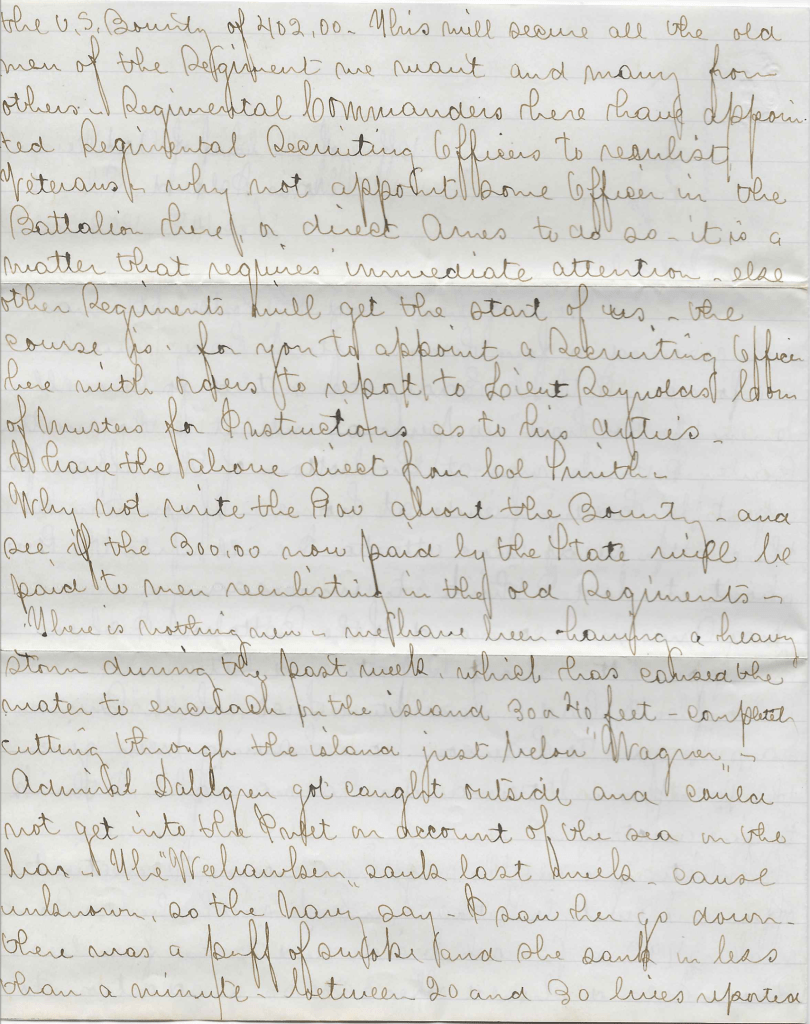
Reenlisting is all the rage here now. Connecticut offers a bounty to Veterans which with the US Bounty, makes $792 for cash, beside aid to the families. Rhode Island should offer $500 in addition to the US Bounty of $402. This will secure all the old men of the regiment we want and many from others. Regimental commanders here have appointed Regimental Recruiting Officers to reenlist Veterans. Why not appoint some officer in the Battalion here or direct Ames to do so? It is a matter that requires immediate attention—else other regiments will get the start of us. The course is for you to appoint a Recruiting Officer here with orders to report to Lieut. Reynolds, Com. of Musters for instructions as to his duties. I have the above direct from Col. Smith.
Why not write the Governor about the Bounty and see if the $300 now paid by the State will be paid to men reenlisting in the old regiments.
There is nothing new. We have been having a heavy storm during the past week which has caused the water to encroach on the island 30 or 40 feet, completely cutting through the island just below “Wagner.” Admiral Dahlgren got caught outside and could not get into the Inlet on account of the sea on the bar. The “Weehawken” sank last week—cause unknown, so the Navy says. I saw her go down. There was a puff of smoke and she sank in less than a minute. Between 20 and 30 lives reported to have been lost.
The storm has evidently broken up the “obstructions” 1 between Sumter and Moultrie as large masses of timber, evidently links of some chain have been driven on shore. They consist of 9 sticks of 15 in. hard pine timber firmly bound together with iron hoops. Through the centre is a bar of railroad iron, on either end of which iron links have been attached so that an indefinite number of these wooden masses can be joined together and thus make a chain of great strength. The timber having buoyancy enough to support the railroad iron at all times and the iron being strong enough to prevent vessels from forcing their way past it.
Sumter was on fire in the Southwest corner during the past week—cause unknown to us. We shell the city every twenty-four hours. I will see about King’s Case Co. M today. Regards to all your officers. I pity Lanahan’s wife—she being alone at Pulaski, but Capt. Jerry is satisfied, I suppose. Write soon. Have not yet received our mail by the Arago. Can’t it be sorted at the Head some way?
Ever your sincere friend, — C. R. Brayton
1 The New York Herald of 7 April 1863 carried an article on “the obstructions” in Charleston Harbor. They were said to consist of “floating rafts, made of heavy timber, securely lashed together by cable chains, and then bolted to an upper layer of timber, which not only covers the chains, but adds a bracing strength to the structure. At a given point this bar or boom is provided with a moveable gate, which is opened to allow their own vessels to pass in and out. This place of ingress is directly under the guns of Fort Sumter and so close that it seems impossible that any vessel could pass them, A chain and a connecting seres of obstructions exist between Forts Sumter and Moultrie.”
Out of concern that the Union army would attempt to take Charleston in 1863, Jefferson Davis requested South Carolina to raise a local defense which resulted in five regiments being organized that became known as the South Carolina State Troops. The initial enlistment was to be for 6 months but the men could be called upon to serve longer. The 1st Regiment, South Carolina State Troops was organized in July 1863. It was also known as Roberts’s Regiment and did not go into active service until 4 September 1863. They did not participate in any battles and they served until February 3, 1864.
In this letter written to his father in October 1863, Sergeant Major J. W. Norris of the 1st South Carolina State Troops discusses Yankee artillery firing into Charleston, poor Confederate provisions, and his need for warm clothing as colder weather approached. Norris opens the letter stating “we are still in Charleston, but with some prospect of being ordered to Greenville or Asheville, N.C.” He continues, “the Yankees are firing very rapidly & steadily for the past few days.” Since August Federal artillery had been harassing the city from their Marsh Battery position near Morris Island-including the brief use of a massive 16,500 pound Parrott rifle nicknamed the “Swamp Angel.” Norris notes, however, that “they have not thrown any more shells into the city since Monday as they burst their gun.” The gun he refers to was not the Swamp Angel, which burst in August, but of another gun firing from the same position. Norris then mentions “Williams’s Regt. of State Troops are gone to Greenville today,” referring to Colonel James H. Williams’s 5th State Line Infantry. He also mentions that James L. Orr, Confederate Senator and organizer of Orr’s Rifles, “came down & went over to the Island yesterday.”
Charleston, South Carolina
Transcription
Charleston, South Carolina 20th October 1863
Dear Father,
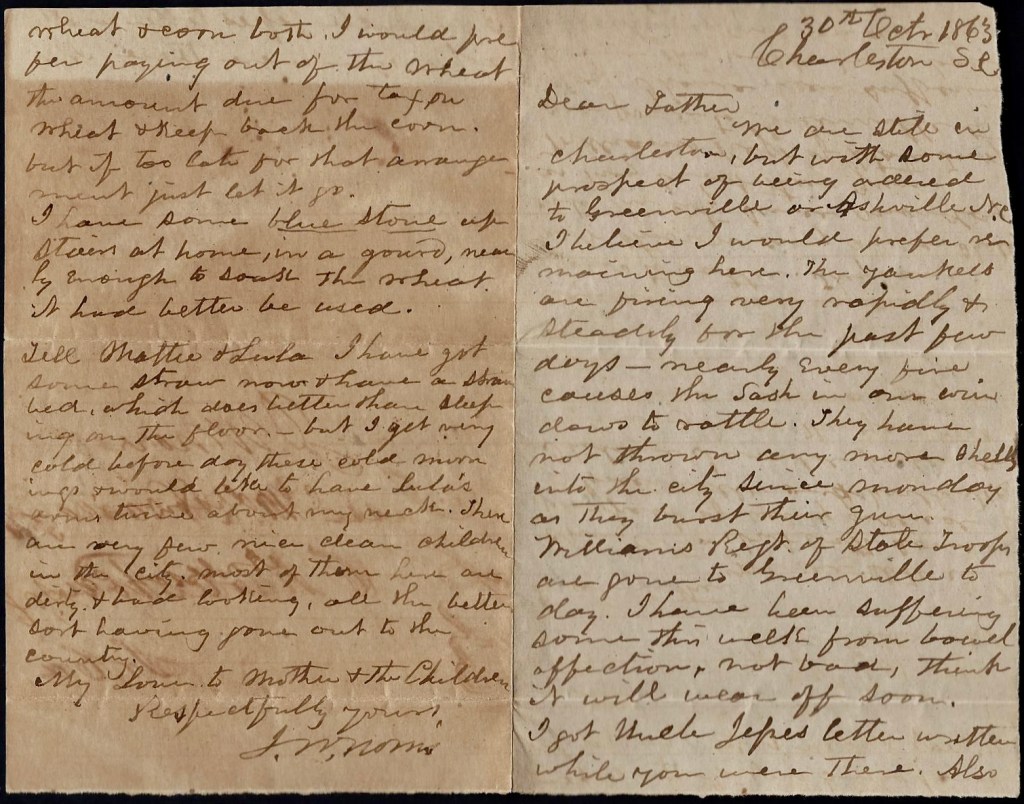
We are still in Charleston but with some prospect of being ordered to Greenville or Ashville, North Carolina. I believe I would prefer remaining here. The Yankees are firing very rapidly & steadily for the past few days—nearly every fire causes the sash on our windows to rattle. They have not thrown any more shells into the city since Monday as they burst their gun.
William’s regiment of State Troops are gone to Greenville today. I have been suffering some this week from bowel affliction—not bad—think it will wear off soon.
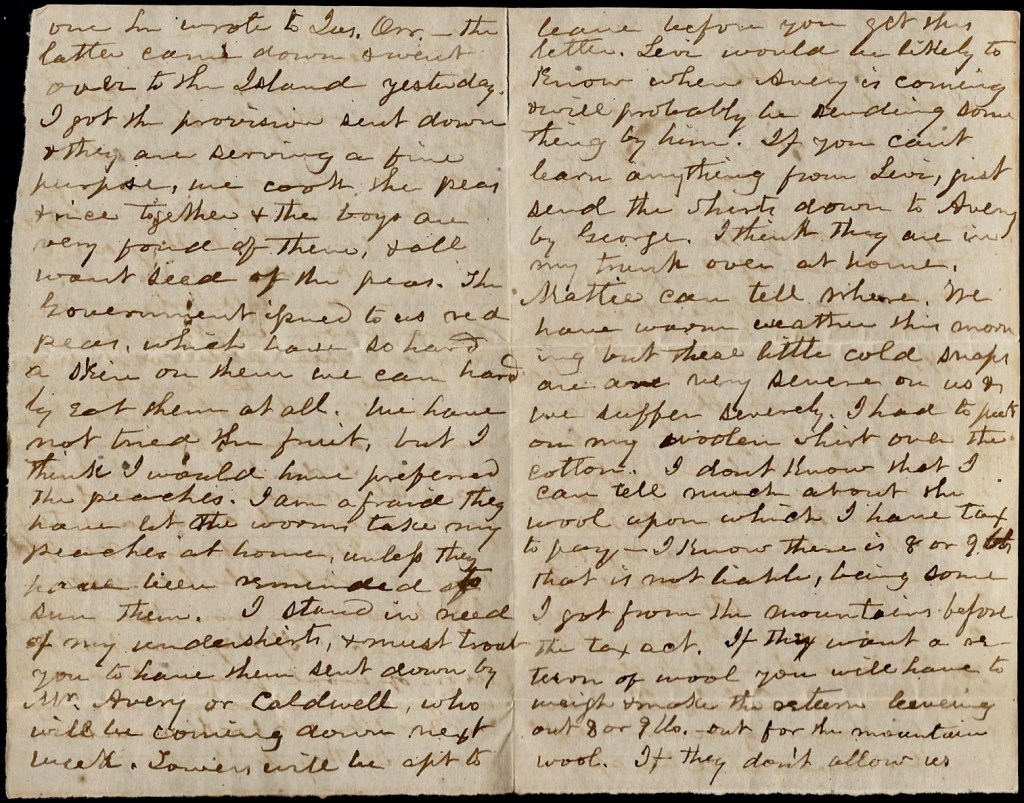
I got Uncle Jess’s letter written while you were there. Also one he wrote to James Orr. The latter came down & went over to the Island yesterday. I got the provision sent down & they are serving a fine purpose. We cook the peas & rice together & the boys are very find of them & all want seed of the peas. The government issued to us red peas which have so hard a skin on them we can hardly eat them at all. We have not tried the fruit but I think I would have preferred the peaches. I am afraid they have let the works take my peaches at home unless they have been reminded to save them.
I stand in need of my undershirts & must trouble you to have them sent down by Mr. Avery or Caldwell who will be coming down next week. Towers will be apt to leave before you get this letter. Levi would be likely to know when Avery is coming & will probably be sending something by him. If you can’t learn anything from Levi, just send the shirts down to Avery by George. I think they are in my trunk over at home. Mattie can tell where.
We have warm weather this morning but these little cold snaps are very severe on us & we suffer severely. I had to put on my woolen shirt over the cotton. I don’t know that I can tell much about the wool upon which I have tax to pay. I know there is 8 or 9 lbs. that is not liable, being some I got from the mountains before the Tax Act. If they want a return of wool, you will have to weigh & make the return leaving out 8 or 9 lbs. out of the mountain wool. If they don’t allow us wheat & corn both, I would prefer paying out of the wheat the amount due for tax on wheat and keep back the corn but if too late for that arrangement, just let it go.
I have some blue stone upstairs at home in a gourd, nearly enough to soak the wheat. It had better be used.
Tell Mattie & Lula I have got some straw now & have a straw bed which does better than sleeping on the floor but I get very cold before day these cold mornings & would like to have Lula’s arms twine about my neck. there are very few nice clean children in the city. Most of them are dirty & bad looking. All the better sort have gone out to the country.
My love to Mother & the children. Respectfully yours, — J. W. Norris











 Spared & Shared 23