Category Archives: Chattanooga, Tennessee

1865: Lauretta H. Cutler to friend Louisa

The following letter was written by 39 year-old Lauretta H. Cutler (1826-1915), the daughter of Elijah Tisdale Cutler (1796-1860) and Editha Jones (1790-1834). In the 1860 US Census, Lauretta—an orphan—was residing with the Levi Warren Giddings family in Williamsfield, Ashtabula county, Ohio, and working as teacher. Later in life (1880), she married Rev. William Henry Hoisington (1813-1899).

During the Civil War, Lauretta volunteered as an Army Nurse and was pensioned for services. In a book entitled, “Our Army Nurses” by Mary Gardner Holland (1897), Lauretta claimed to have entered the service at Hospital No. 1 in Chattanooga, commissioned by James E. Yeatman, acting agent of Miss Dorothea Dix. She remained there in Hospitals No. 1 and No. 2 until released in June 1865—a total of thirteen months.

She wrote of her experience there: “During the first few weeks I worked in the kitchen, visiting the wards a little while each day; then I became a regular nurse. No. 1 Hospital was composed partly of framed buildings, formerly used as a hospital by Bragg; the remainder of tents. If my memory serves me well, its capacity was six hundred; and when I went there it was full of sick and wounded soldiers. Here it was that I first began to learn the lesson (that difficult lesson that all nurses had to learn) to govern, or, I would better say, battle against my feelings, and work with a will for the sufferers. I also learned how little I could do in comparison to what was needed to be done, and often I could do no more than give a kind look or word to show that I would do more if it were in my power. Alas ! how degradingly cheap is human life in time of war, when our fathers, husbands, brothers, and sons must deliberately kill each other, and call it a victory.”
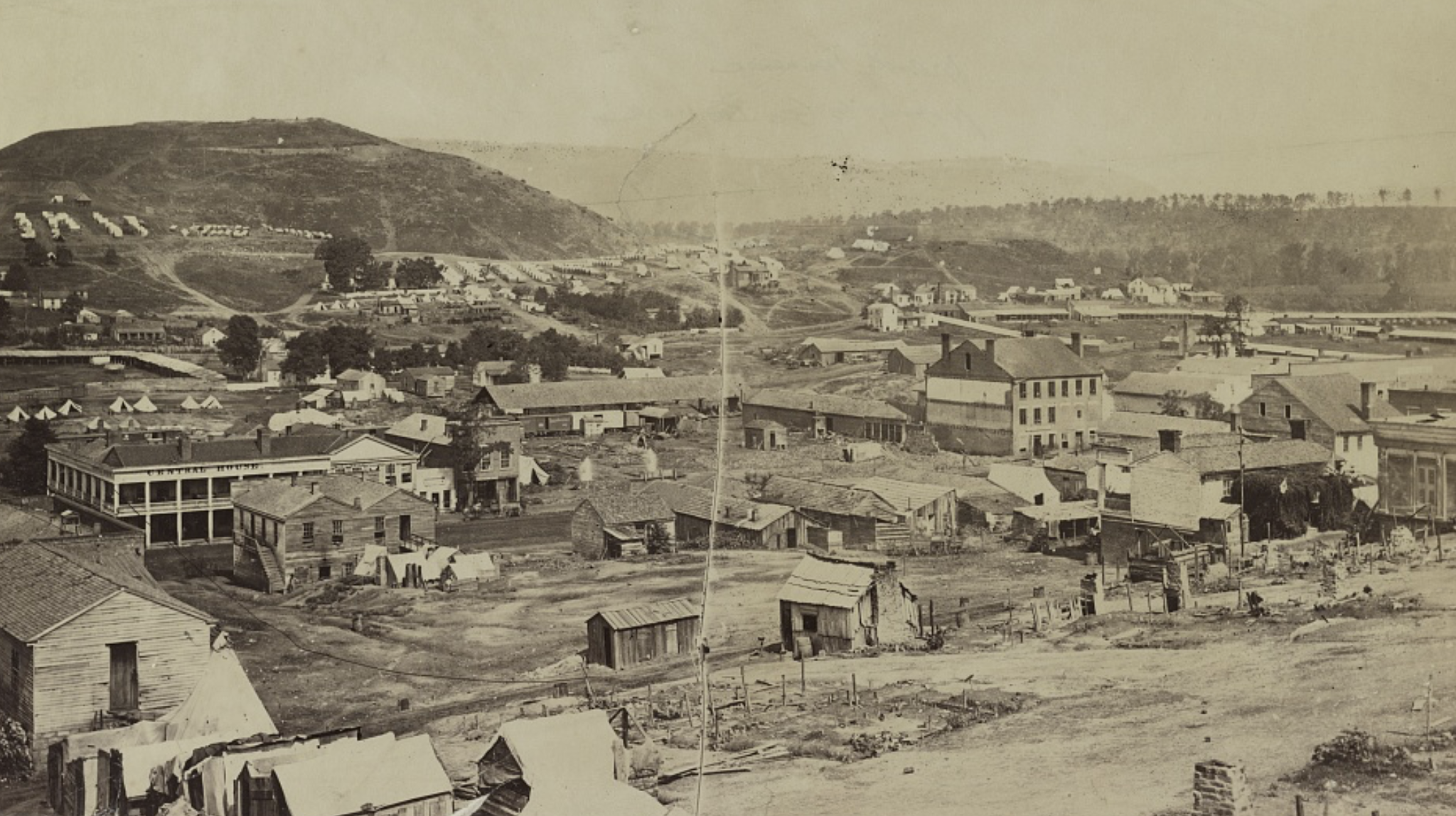
Chattanooga, Tennessee, circa 1864 (Library of Congress)

T R A N S C R I P T I O N

Hospital No. 1
Chattanooga, Tennessee
March 19th 1865

Dear Friend Louisa,

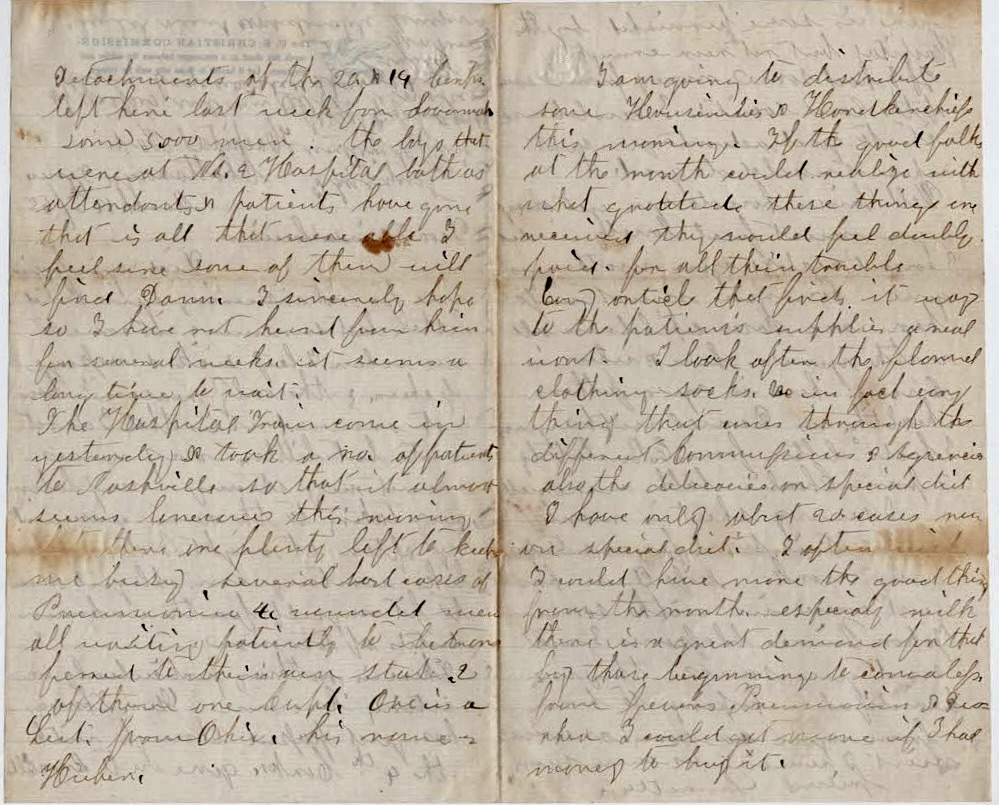
Did you forgive me for not answering your kind letter last summer? It come to me when I lay sick [with typhoid fever] a message of cheer. The only reason I have not answered it is that I do not write but little. My nerves are not very strong—my labor very taxing to the nerves. Subsequently, often at night, I do not feel like writing. Am obliged at times to fit myself for the unknown duties of tomorrow.

There is nothing particularly exciting here now. Gen. Thomas has just passed through with the 4th Corps, gone on to Knoxville. Detachments of the 20th & 14th Corps left here last week for Savannah, some 5,000 men. The boys that were at No. 2 Hospital, both as attendants & patients, have gone—that is, all that were able. I feel sure some of them will find Donne [?] I sincerely hope so. I have not heard from him for several weeks. It seems a long time to wait.

The Hospital train come in yesterday. I took a no. of patients to Nashville so that it almost seems lonesome this morning. But there are plenty left to keep me busy—several bad cases of pneumonia, 4 wounded men, all waiting patiently to be transferred to their own states. Two of them—one a captain, one a lieutenant from Ohio. His name is Huber.

I am going to distribute some housewives [sewing kits] and handkerchiefs this morning. If the good folks at the North would realize with what gratitude these things are received, they would feel doubly paid for all their troubles. Every article that finds its way the patients supplies a real want. I look after the flannel clothing, socks, &c., in fact, everything that comes through the different Commissions & Agencies. Also the delicacies on special diet. I have only about 20 cases now on special diet. I often wish I would have more of the good things from the North—especially milk. There is a great demand for that by those beginning to convalesce from fevers. Provisions [ ] when I could get none if I had money to buy it. There is some furnished by the Hospital but not bear enough. If I had some money from some of the said societies, I could use it to good advantage, just when it would do good.

Well, Louisa, how do you get along? You must feel lonely indeed. I cannot realize your mother is gone. How you must miss her. Are Moses’ children all with you? How and where is Ann’s? How is your father’s health? Is Daniel with you? I had a letter from E. B. lately and from Charlie. Both were well. I see my sheet is nearly full. It is time for me to go to my work.

Miss Dean has just come in with some [ ] blossoms. I will send you some. They are beautiful. Hoping to hear from you soon as convenient, I remain as ever your friend, –Lauretta

I have just written to Ohio to get 8 fit [ ] of dresses. Will you tell them she [ ]. I should need considerable [ ] Miss Dean suits me well yet. Also Miss Tuttle. 1
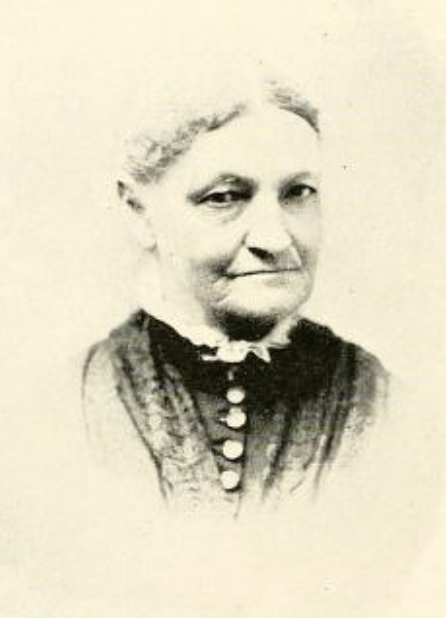

Lauretta H. (Cutler) Hoisington (1826-1915)

1 The following was found in a History & Genealogy of Captain Israel Jones (1902), page 262, in which Lauretta recalled: “In the meanwhile Sherman was marching on, and another hospital was necessary, which was called No. 2, and as soon as able I was assigned to it. I was agreeably surprised by finding here Miss Tuttle and Miss Dean, of Ashtabula county, Ohio, who were to be my comrades, and it was a happy meeting to us all.

“Special orders for food and drink for each patient were given by the surgeon, and in passing around to each with cheerful words, I learned the sanitary needs of each, which were supplied from the stores sent by the loved ones at home through the sanitary and aid societies.

“As time passed by Miss Tuttle, who had been a nurse since the battle of Antietam in 1862, was transferred to No. 1, and Miss Dean to the kitchen of No. 2. Many convalescents were furloughed and went home to vote for President Lincoln, and we made it a point to add to their comfort from the stores at our command. I remember one occasion when we gave each man a few grapes and a pocket handkerchief. The thanksgiving dinner came, and royally did Miss Dean superintend the feast. It was like an oasis in a desert; and the hearty response of the boys, ‘long may she live,’ was a worthy recompense, as it came from the hearts of suffering, but brave soldier boys.

1863: Samuel Williston Ludden to Cornelia (Johns) Ludden

The following letter was written by Samuel Williston (“Will”) Ludden (1841-1889), the son of Nathaniel Thayer Ludden (1808-1846) and Cornelia Johns (1817-1895) of Detroit, Michigan.

I could not find an image of Will but here is one of Burton Abbey who also served as a sergeant in Co. D, 13th Michigan Infantry (Ancestry.com)

Will enlisted as a private in Co. D, 13th Michigan Infantry in January 1862 for three years and mustered out as a sergeant. His older brother, Henry D. Ludden (1837-1891), served as a corporal in Chadwick’s Company Michigan Engineers.

There is no date on this letter but the regimental history informs us that the 13th Michigan was one of the first regiments to march into Chattanooga on the morning of the 13th of September. It then proceeded almost at once to Chickamauga, where it was engaged the 19th and 20th of September, coming in contact with the Confederate forces near the Lee and Gordon’s Mills, where before the close of the battle, it lost 107 killed, wounded and missing out of a total of 217 men, the numbers of officers and men the Regiment carried into the action. Since the envelope appears to bear a Nashville, TN, postmark of 25 September, it is presumed this letter was penned just prior to the Battle of Chickamauga, the battlefield being approximately 20 miles from Chattanooga.

Transcription

Addressed to Mrs. Cornelia Ludden, Box 9023, Detroit, Michigan. Envelope includes verse, “The Song My Mother Sang.”

Camp in the field, 14 miles in advance of Chattanooga
September 1863

Dear Mother,

I have but a few minutes to let you know of my welfare as we expect to move camp in a few minutes & the mail is about going out. Well, I suppose you have heard of the downfall of Chattanooga. We marched in there three days ago, Wood’s Division being the first troops to enter the town, our Brigade in advance. I am now at Headquarters as Sergt. of Provost Guard. I have 18 men to see to. I took my squad & by a short cut was the first in Chattanooga. I wish you could of seen the Butternuts flew when we got within a mile of them. There was two or three regiments of cavalry left as rear guards & such a dust as they kicked up when they left you never saw. We took but a few prisoners but those that were captured seemed glad to get out of the service & were willing to take the Oath of Allegiance & become peaceable citizens.

We are moving toward Atlanta at which place we shall probably have a big fight. When you think of me, you may place me in the rear of the whole Division during a fight as it will probably be my business to take charge of prisoners so do not fret about us boys. Only 14 months longer & then for a happy time at home. Henry is well. He has at last picked up a horse so that walking & his has had a falling out. We are all well. I will write you a long letter as soon as I can find time. I will close with much love to all. Tell them all to write [and] not wait for me. With much love, I remain affectionately, your son, — Will Ludden

1863: James Alfred Jones to Harriett (Hoghton) Jones

The following letter was written by James Alfred Jones (1824-1864), the son of Elias Jones (1797-1876) and Lydia Sweet (1802-1885). At the time of the 1860 Census, James was enumerated in Delavan, Tazewell county, Illinois, with his wife, Harriet (Hohton) Jones (1836-1903), and made a living as a medical doctor. Their first child Mary was born in 1857; their second child Minnie in 1861.

Jones was mustered in for 3 years into F&S, 115th Illinois Regiment Infantry on 3 October 1862 at Springfield as an Assistant Surgeon.

Isaac Royse, a 2nd Lieutenant in Co. E, wrote a history of the 115th Illinois Volunteer Infantry, published in July 1900. In it, he describes the events that led to James Jones death on page 215:

Very early on the morning of 11th July (probably 9th July 1864) a report was brought in by a citizen that a band of rebel guerrillas were crossing the country west of town (Tunnel Hill, Georgia) apparently intending to cut the railroad bridge about 2 miles north of the town. The Colonel at once ordered Lt. Royce with Company E to make double-time up the railroad and, if possible, intercept them. It was scarcely sunrise when the company reached the point of expected mischief, just in time to see the Confederates scampering up the hill to the right…The company at once made pursuit, but with the usual disadvantages of infantry trying to follow cavalry. Their route led over the hills to the valley east of the village, when it was learned that the rebels had made their escape after murdering Dr. Jones. Not knowing the nearness of the enemy the doctor with a few assistants, all of them armed, had hurriedly gone to the pastures in the valley to bring in the regimental horses that were out there grazing. As they were hastening towards camp with their charge the rebel band came dashing into the valley right upon them. Determined to make his escape if possible, Dr Jones put spurs to his horse and as he was riding at full speed attempted to make his horse leap a wide, deep ditch. It was wider than he had counted upon and his horse fell heavily against the opposite bank. While struggling to free himself the rebels overtook him and, though seeing his helpless condition, fired upon him, inflicting wounds from which he died soon after. After taking all the horses they could catch and capturing one or two men the rebels hastily left the Valley – going south east – just in time to avoid a contest with Company E which was rapidly approaching.

Harriet Jones was awarded a widows pension of $17 per month on 15thSeptember 1866 which was increased in September 1868. Harriet remarried in January 1869 to William J Scott and made a successful application for minors’ pensions for her two children in July 1869. The hearing was in front of a local Justice of the Peace in Tazewell County where an affidavit relating to the death of James Jones was provided by Captain Reardon of the 115th Illinois Infantry.

See also—1862: Dr. James A. Jones to Harriet (Hoghton) Jones on Spared & Shared 7 (posted August 2014).

Transcription

Camp near Chattanooga, Tennessee
October 15, 1863

My dear wife,

I am again seated under my tent fly as my only shelter to write to you. It rains, and has dine [so] for three days. Nonetheless I remain dry and comfortable as one in the army need to. I am well and as long as I continue so, I can scarcely have any cause of complaint, even though I should be called upon to undergo hardships and privations for a time.

I received your letter of the 28th on the 10th and though I wish they were not so long coming, I think they come as soon as could reasonably be expected under the circumstances. I fear that my letters to you are much longer in reaching you owing to difficulty in getting them off from Chattanooga. I received a letter from father this week. They are all well amongst brothers and sisters there. Brother Danford has been drafted, but when father wrote, he had not decided whether to go into the service or pay the commutation money.

I hope you may have a good time with Margaret & I am glad I am absent for I think you will enjoy her visit much more than if I were at home. I hope she will make you a good long visit.

We remain in camp just where we were when I wrote to you last, but we are expecting to be removed to the other side of the river soon. Rosecrans is reorganizing the army and aggregating the old brigades and we will now be in a brigade of about ten regiments under command of Gen’l. [James B.] Steedman and take position in Sheridan’s Division. I prefer remaining on this side of the river until the railroad is in operation to this place as forage is scarce and our horses fare much better here than on the other side. The roads, just at this time, are very bad in consequence of the rain, but a few days sun will soon dry them up and make them good again.

Since writing to you there has been no fighting though the rebels have been trying to hinder our supply trains by shooting our teams across the river, about six miles below here at a point where the road runs along the river bank, but we have planted a couple of guns there and shelled them out, and will have no difficulty in keeping them away in the future.

The rebels have had two battles among themselves within a few days, near enough to us so that we could distinctly hear the sound of their cannon, and it is reported at headquarters that their battles were really bloody ones, which I hope may be the case, for one of their battles will be as good as two of ours, as the loss will be all on one side, while we are unhurt. 1

Both sides have undoubtedly been largely reinforced but with the present state of the weather, there is no possibility of another engagement for some time, and in my opinion there will be no more fighting at Chattanooga, and the chances are pretty goo I think for us to remain in this vicinity for a good while unless we fall back to save transporting our supplies so far over bad roads.

Since commencing to write, it has stopped raining and the sun is now shining out beautifully for the first time for three days. I think the river here will raise rapidly after this rain so that the rebels will have no chance of crossing again at the fords, and we will consequently be troubled no more with raids upon the railroad in our rear, while we will have no difficulty in throwing over as many pontoon bridges as we may need. Our supplies are our only difficulty, and I shall expect the railroad open now in a very short time, and as we already have as much as three week’s supplies in advance, I have no fear on that score.

Our wounded are doing well—that is, those that remain here. The largest share of them have been sent to Nashville and about two hundred ambulances will go today with more of them, some of who are going home on furlough. If I was only wounded now there would be a chance for me to go home for a while, but as I have nothing more than a couple of boils, my chance is pretty slim—especially as they are nearly well. But we will not despair entirely for I may get a wound in the next battle and then my turn will come. I will soon be able to procure anything in the clothing line from the Commissary Department that I shall need in consequence of losing my baggage, but for the present I am scaarcely in need of anything.

I expect the balance of our things that we left at Bridgeport will be here today or tomorrow, and then I will have my tent again and many other conveniences that are more desirable than really necessary. Since leaving Bridgeport, I have learned that we were encumbering ourselves with many little conveniences that I can well dispense with and there were many things in my valise that I shall not think of supplying again as they were wholly unnecessary. The longer I remain in the service, the less things I want around me, and one suit of clothing with a simple change of underclothes is all I want as long as I remain in the field.

It is now twelve months since I left you and I can certainly say that is it the shortest year I ever saw in my life, though I presume it has not been so with you, as you are situated so as to be more lonely than I am, and you have never before been called upon before to depend upon yourself so that it is quite reasonable that time should drag with you, while it flies by swiftly with me. I have no idea that another whole year will go by without our having an opoortunity of seeing each other and with the prospect of the war closing before that time, I hope we may be as content as possible in view of “a good time coming.”

If you have that “check” yet, you may hold on to it till I write you in regard to it again. I would like to know of Mr. Lawton furnishes you any money now-a-days. Let me know also how much you have in bank. If you have a chance, buy five or six bushels of potatoes and put in the cellar. Also put up plenty of apples. At the same time, accept this imaginary kiss and the love of your husbandm — James

To Harriett


1 While I am aware that the Confederate commanders were quarreling among themselves and officers in the field were petitioning for the removal of Braxton Bragg, I have never heard of them waging actual warfare against each other.

1863: John Thompson to Harriet (Knowles) Thompson

The following letters were written by 30 year-old John Thompson (1833-1916) of North Colebrook, Ashtabula county, Ohio. He wrote the letters to his wife, Harriet (Knowles) Thompson, while serving in Co. I, 105th Ohio Volunteer Infantry (OVI). He served from August 1862 until June 1865. Frequently mentioned in his letter is his young first-born son, Elmer Adelbert Thompson, born in April 1862.

John’s 2nd letter was datelined from the Union entrenchments at Chattanooga in the days following the setback at Chickamauga. He informs his wife that, “if it was not for the officers, this war would soon be over. The Rebel privates is tired enough of the war.” He speaks of the exchange of newspapers between pickets—apparently acceptable between enlisted men but as soon as a lieutenant tried it, he was nabbed. He mentions the accidental death of a soldier who threw a shell into a fire, a rumor of fighting between Longstreet’s and Bragg’s men over disagreements in command, and of his longing for home. He also encourages her to write. “I want you should let me know all the particulars about everything you can think of and some more.”

Lieutenants Tourgee, Wallace, & Morgaridge of 105th OVI, July 1863 (L. R. Stevens Collection)

Letter 1

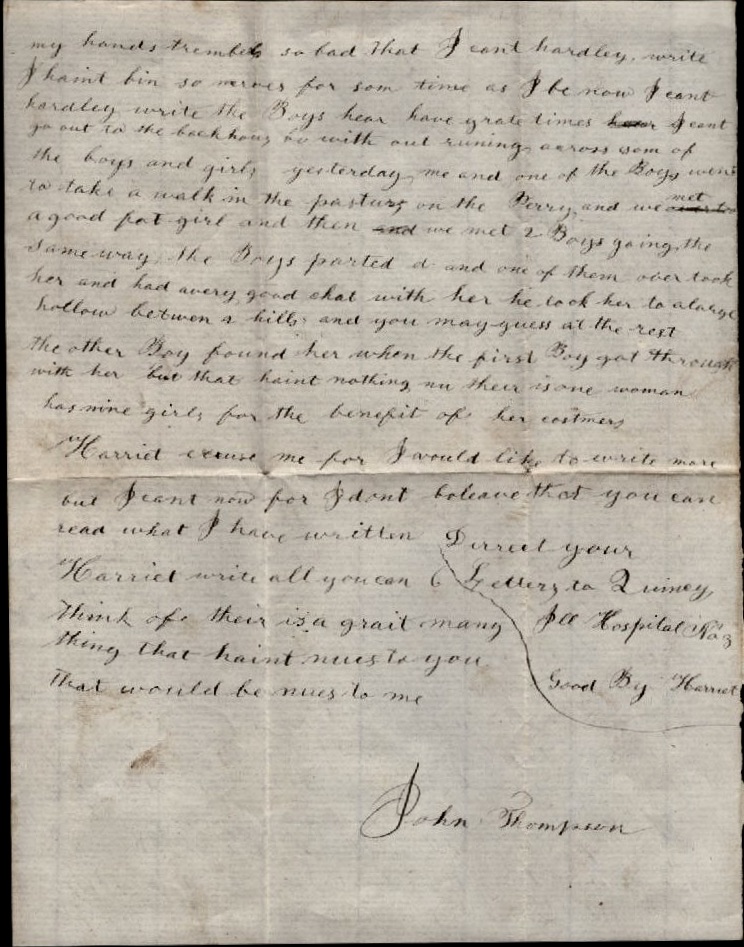
[Hospital No. 3] 1
Quincy, Illinois
May 10, 1863

Dear Companion,

I should like to spend this evening with you and Elmer. We would have a good visit most a beautiful chat. I long to see you. If I go to Camp Chase or to Cleveland, I shall try to go home on a furlough and see you and Elmer, and if I can’t go and see you, you. can come and see me. You said that you wished that I was to home so I could help you take care of Elmer. Harriet, keep up good courage and be as contented as you can and take care of what little we have and the money that I send you. I have been mustered in for pay once more and if I get it, I shall send it home to you as soon as I get it. When I get home for good and the war closes, we will have some good times.

If you don’t want to sell the colts, you. need not sell them. I want to stop interest on our place as fast as possible. Harriet, I think that when I get home we will have some good times. We have a small place and if we have good luck and pay for it, we have taken comfort in riding around and we can take comfort again, I hope. I think of you night and day. If it was in my power to come home and see you, I should go. But Uncle Sam has got me in his clutches and I can’t do so as I wish. If I was of any use to the government, I would not think of going home for I came here to serve my country, and I want to serve it. But it will be some time yet before I can go back again, if ever. I don’t think that I can stand camp life but I wish I could. You must excuse my writing for my hands tremble so bad that I can’t hardly write. I hain’t been so nervous for some time as I be now. I can’t hardly write.

The Boys here have great times. I can’t go out to the back house without running across some of the boys and girls. Yesterday e and one of the Boys went to take a walk in the pasture on the Ferry and we met a good fat girl and then we met two boys going the same way. The boys parted and on of them overtook her and had a very good chat with her. He took her to a large hollow between the hills and you may guess at the rest. The other boy found her when the first boy got through with her but that haint nothing new. There is one woman has nine girls for the benefit of her customers. 2

Harriet, excuse me for I would like to write more but I can’t now for I don’t believe that you. can read what I have written. Harriet, write all you can think of. There is a great many things that hain’t news to you that would be news to me. Direct your letters to Quincy, Illinois Hospital No. 3. Goodbye Harriet, — John Thompson


1 Hospital No. 3 opened in October 1862 on the northeast corner of Sixth and Spring. Dr. Bailey was in charge under Dr. Nichols. When opened, it was to be used only when the two other hospitals were full. That changed as the war went on and more hospitals opened. [Source: Civil War Hospitals Grew to Five in Quincy]

2 Quincy’s “seedy indulgences” were well established before the Civil War but the large influx of soldiers into the town caused the red light district to flourish. See: “Illuminating History on Quincy’s Red Light District.”


Letter 2

[This letter is from the personal collection of Greg Herr and was transcribed and published by Spared & Shared by express consent.]

Chattanooga, Tennessee
October 11, 1863

Dear Companion,

I thought I would spend a few moments in writing to let you know that I am well and enjoy myself well considering everything—not as well as I would if I was to home, and I hope these few lines will find you well and Elmer [too].

I have been on inspection and ate my dinner. You would like to know what we had for dinner? We had beans and hard tack and coffee and now I am sitting on my bunk with my bunk mates on each side of me. One of them is [ ]. Ball and N[ewton] Knolton. We have still times gear today as for cannonading.

There was one man killed and one or two wounded this morning. They was playing with a shell and the shell bursted. They supposed that they had got the powder out of the shell and then threw it in the fire and throwing it in the fire bursted.

1st Lt. Andrew Clement, taken prisoner by the Rebels while exchanging newspapers on the picket line at Chattanooga, TN. (Wisconsin Historical Society)

Our boys in my [company] is well and enjoying themselves well. We have been pretty busy since we came here in fortifying our camp. Our regiment was on picket yesterday and day before we lost one man—or the 15th Wisconsin Regiment lost one. The boys have been in the habit of exchanging newspapers with the rebs. One of the lieutenants 1 thought he would try it and he went over to the Rebs’ lines and they took him in and kept him. The Rebs and our lines is from 40 to 50 rods (250 yards) apart. We can talk with each other. The Rebs as a general thing is very talkative. If it was not for the officers, this war would soon be over. The Rebel privates is tired enough of the war.

I see Dr. L. Chapel yesterday. I did not have much time to visit with him. He told me that I must call on him if I got wounded. I see John Carmichael yesterday. He is fat as a bear. I have seen a number of the Quincy boys since we came here to hold the right or left wing. We hold the center now. We are getting good news occasionally. It is a flying report that Longstreet’s men and Bragg’s men have had a fight between themselves and killed quite a number and wounded a good many. I don’t know how true it may be. If we have a battle here with them and whip them, I think it will be the last big battle that we will have.

Harriet, I wish you would see Elder Washburn the first chance you have and have him see to my place and crops if he will. Tell him that I will pay him for his trouble. If there is any crops on the place, I want he should divide them. I hain’t heard anything from Thomas yet and shan’t until it is too late to do anything about them.

Harriet, do the best you can for me and yourself and when I get home, I will tend to such things myself. If you can sell my harnesses, you may do so for the money or some good man’s note. I would rather have the two-thirds of what they are worth than have them laying around at loose ends. If I could get home only for one week, I could see to such things myself but I can’t at present at any rate, and if the war should close by spring, I would rather stay than get a furlough if the Elder should see to my place.

I should like to have the grass get a good start in the meadow and then you can keep the colt in the meadow this winter. I want you should let me know whether Lonny is a going to keep the cows this winter or not. I want you should let me know all the particulars about everything you can think of and some more.

Harriet, keep the things as straight as you can and as snug for it is for your interest and Elmer’s so that I never should return, you will have what little we have. You and Elmer can have it for your own. Keep up good courage and good spirits. I know how lonesome you feel—if you feel as I do—but I hope that my life will be spared and return home to my little family once more to enjoy ourselves once more. I think that time is not far off. Our army has had good luck this season. That you can see for yourself.

I hain’t had any letter from you for some time. Harriet you must excuse my scribbling for I wrote in a hurry and am knocked on one side and then on the other. Harriet, if there is anyone that you would rather see to our place, you can get them. This is from your most beloved husband, — J Thompson

to H. E. A. Thompson

I want a pair of gloves and two pairs of socks. You can send me a pair of gloves in a newspaper and socks in the same way, one at a time. Goodbye.

I have had a letter from K. Thompson. He is well. He has been in a hard battle.


1 The lieutenant was Andrew Clement of Co. K, 15th Wisconsin Infantry. He enlisted in October 1861 at Waupon when he was 22. He was appointed to the rank of sergeant. He was reduced in ranks to Musician in May 1862 and then in October was commissioned a 1st Lieutenant and transferred to Co. K, In October 1863, he was “taken prisoner” while on picket duty near Chattanooga and was paroled and returned to service in December. He was sent home on leave where he died of chronic diarrhea in September 1864.

1862: Thomas Emory Jefferson to Frances (Foster) Jefferson

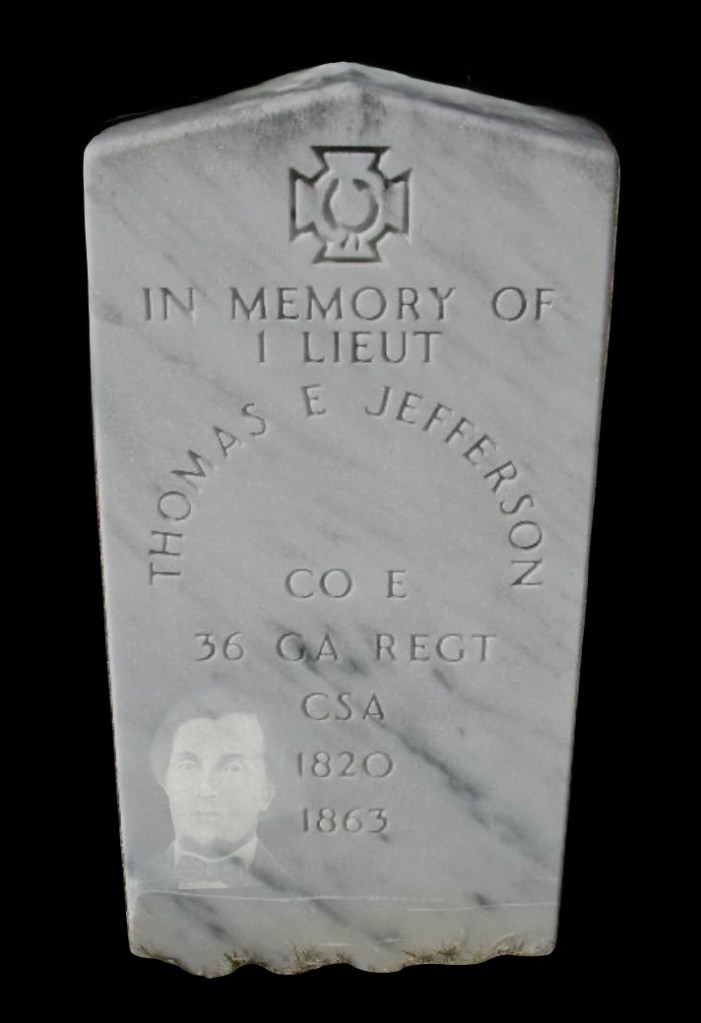
Headstone 1Lt. Thomas E. Jefferson, Co. E, 36th Georgia Infantry

The following letter was written by Thomas Emory Jefferson (1820-1863) of Cherokee county, Georgia, who was married to Mary Frances Foster in 1844 and made a living as a school teacher prior to the Civil War. Leaving his wife and three daughters, Thomas accepted a commission as 1st Lieutenant of Co. E, 36th Georgia Infantry when it was formed during the winter of 1861-62. Its first major engagement of the war was at Champion’s Hill and then again in the defense of Vicksburg where those who were not killed or escaped were surrendered to Grant’s army on 4 July 1863. The date of Thomas’s death is not known but he was killed in or about Vicksburg. He is now buried in the Cedar Hill Cemetery at Vicksburg

[Note: This letter is from the private collection of Jack Dunagan who made it available to Spared & Shared for transcription and publication by express consent. Jack is a descendant of Lt. Jefferson.]

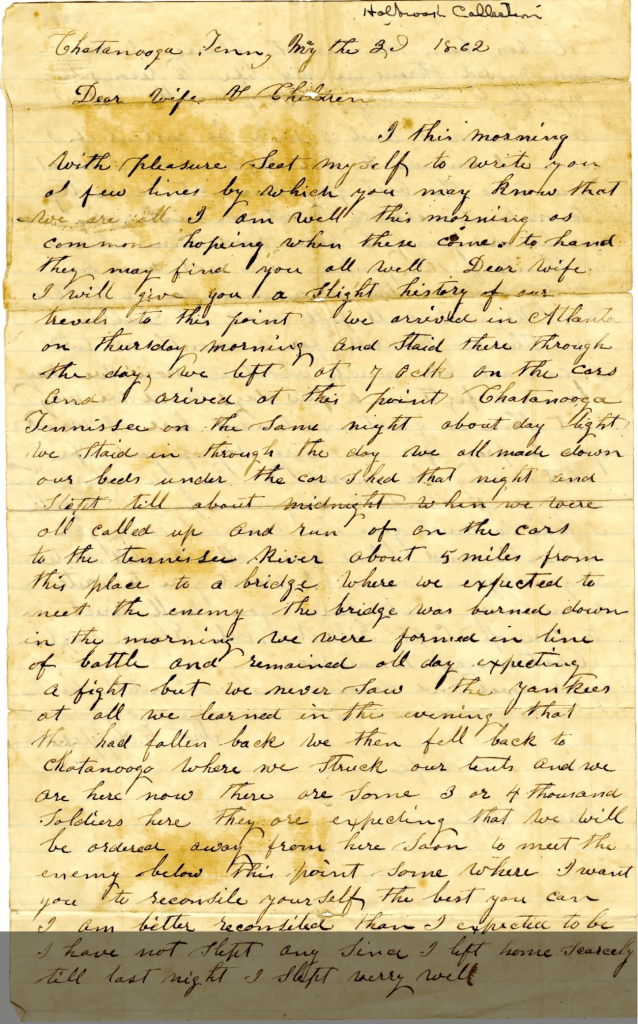
Transcription

Chattanooga, Tennessee
May 2nd 1862

Dear wife & children,

I this morning with pleasure seat myself to write you a few lines by which you may know that we are well. I am well this morning as common, hoping when these come to hand, they may find you all well.

Dear wife, I will give you a slight history of our travels to this point. We arrived in Atlanta on Thursday morning and staid there through the day. We left at 7 o’clock on the cars and arrived at this point, Chattanooga, Tennessee, on the same night about daylight. We staid in though the day. We all made down our beds under the car shed that night and slept till about midnight when we were all called up and run off on the cars to the Tennessee River about 5 miles from this place to a bridge where we expected to meet the enemy. The bridge was burned down in the morning. 1 We were formed in line of battle but we never saw the Yankees at all. We learned in the evening that they had fallen back. We then fell back to Chattanooga where we struck our tents and we are here now.

There are some 3 or 4 thousand soldiers here. They are expecting that we will be ordered away from here soon to meet the enemy below this point somewhere. I want you to reconcile yourself the best you can. I am better reconciled than I expected to be. I have not slept any since I left home scarcely till last night I slept very well. It has been the hardest thing I have ever passed through in my life, to reconcile myself to be away from you all. But I am here now and I will be content if I can. I intend to live right and I want you to do the best you can at home. Try to make something to eat for next year for we are going to have hard times sure.

I think if the Yankees does not come on to try to take this place in a day or two that our regiment will fall back to Dalton or Atlanta to drill for a month or two. I cannot tell much about it now. We may be in a fight in a few days and we may not. There is great excitement here. I want you to pray for me every day of your life that I may be spared to see you all again and if it should be my unhappy lot to fall, I hope to meet you in heaven.

May God be with and bless you all. I will write to you again soon. I want you to write to me every week sure. You will direct to care of Capt. Gilbert, Col. [Jesse A.] Glenn’s Regt., Chattanooga, Tennessee

Your loving and devoted husband until death, — Thos. E. Jefferson

to wife, Frances Jefferson


1 A pontoon bridge was later erected over the Tennessee river at this same location.