Category Archives: Chicago, Illinois

1855: Nathaniel Bourne to Huldah Worth

An unidentified young man from the mid 1850s (Rick Brown Collection)

This letter was written by 22 year-old Nathaniel Bourne (1833-1889), the son of Israel and Elizabeth (Jenkins) Bourne of Barnstable, Massachusetts. He was reared and educate in New England and was married in Oswego county, New York, in 1858, when about twenty-five years of age, to his cousin, Huldah Worth (1827-1913), a daughter of Thomas R. and Mary (Bourne) Worth. Immediately after their marriage the young couple came to Iowa, settling in Dubuque county, where they lived for three years. They then removed to Linn county, taking up their abode in Cedar Rapids, where Mr. Bourne continued to make his home until his death, which occurred December 27, 1889. Throughout that period he carried on operations as a builder and contractor and in later years was active in real-estate interests.

T R A N S C R I P T I O N
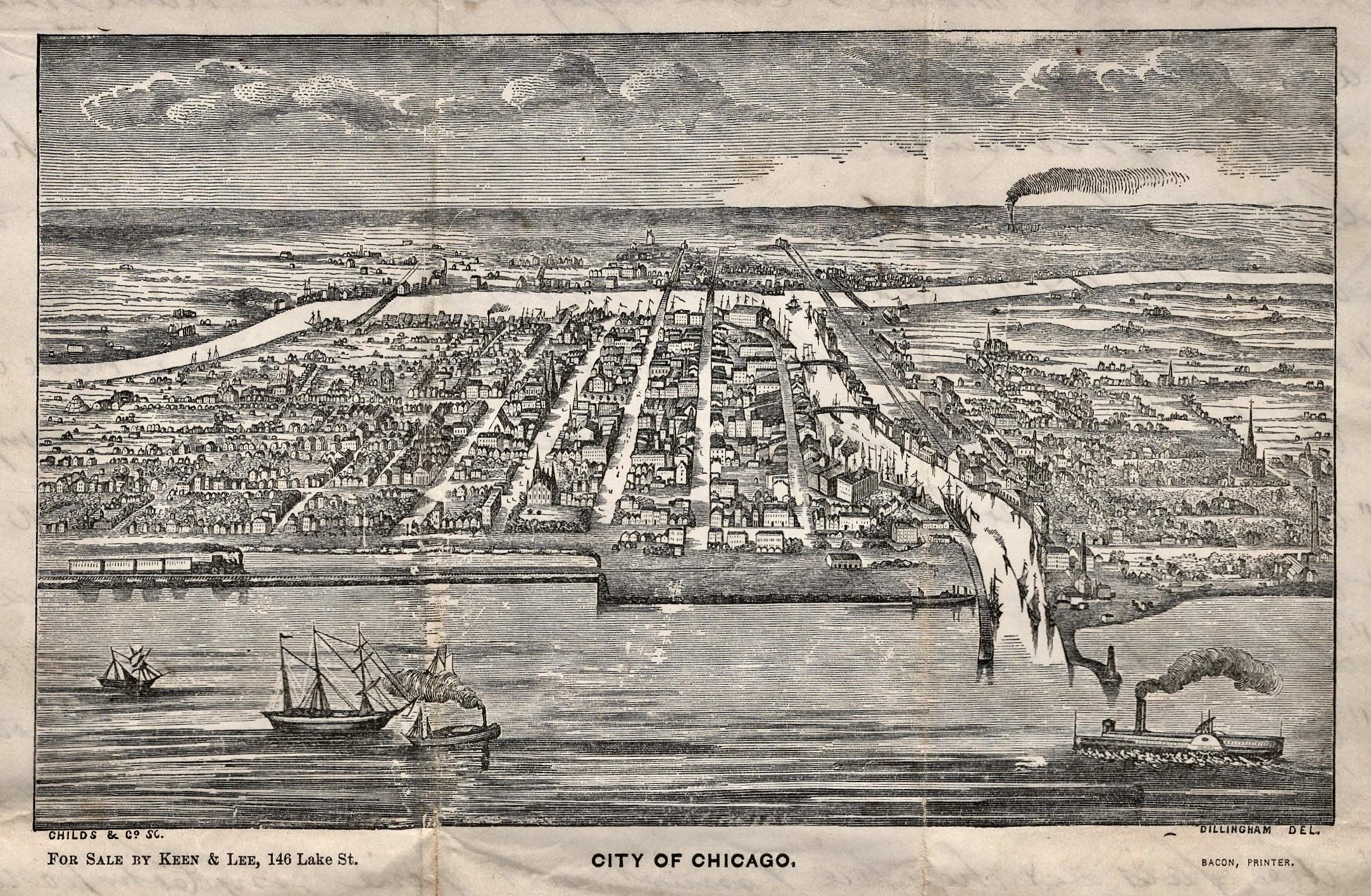
“City of Chicago” lithograph on stationery used by Nathaniel.

Chicago [Illinois]
August 21, 1855

Dear Cousin,

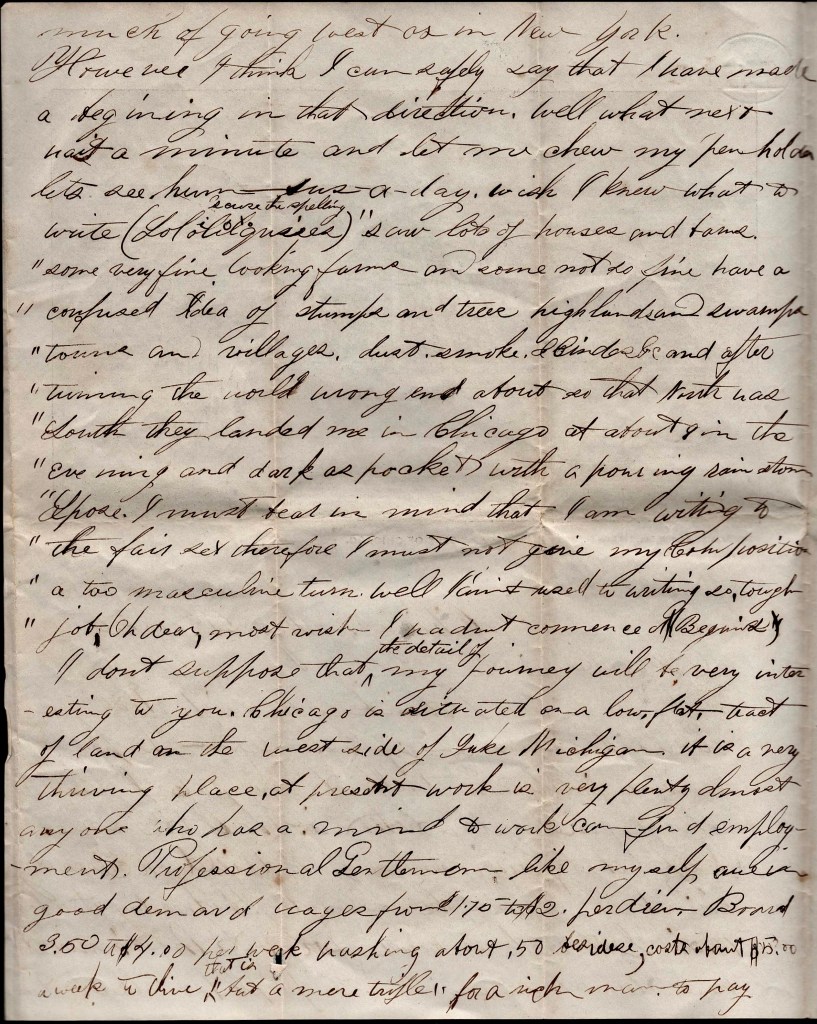
I think you said that you would answer an effusion from the pen of mine illiterate self. At any rate, I guess I shall find out about it. Well, let me see. I left the fair town of Redfield on Tuesday, arrived at Rome the same day. Wednesday at about 11.30 I started en route for “Out West.” Arrived here Thursday evening. The people here talk about as much of going west as in New York. However, I think I can safely say that I have made a beginning in that direction.

Well, what next? What a minute and let me chew my pen holder. Let’s see—hmmmm—sus-a-day. Wish I knew what to write…Saw lots of houses and barns, some very fine looking farms and some not so fine. Have a confused idea of stumps and trees, highlands and swamps, towns and villages, dust, smoke, & cinders, &c. and after turning the world wrong and about so that North was South, they landed me in Chicago at about 9 in the evening and dark as pocket with a pouring rainstorm. Suppose I must bear in mind that I am writing to the fair sex. Therefore, I must not give my composition a too masculine turn. Well, I ain’t used to writing so [it’s a] tough job. Oh dear, most wish I hadn’t commenced (begun).

I don’t suppose that the detail of my journey will be very interesting. to you. Chicago is situated on a low, flat tract of land on the west side of Lake Michigan. It is a very thriving place at present. Work is very plenty. Almost anyone who has a mind to work can find employment. Professional gentlemen like myself are in good demand—wages from $1.70 to $2 per diem. Board 3.50 to $4 per week, washing about 50 cents besides. Costs about $5 a week to live. That is but a mere trifle for a rich man to pay but it makes a poor one with a family having rather hard times to make two ends meet. Fortunately I am neither one or the other.

The sidewalks are made of planks. They go jumping and tilting as you walk over them and in the dark if you are not careful, you may stub your — and fall headlong. 1 The lake water is used almost exclusively for cooking, washing, and drinking, &c. It is raised a sufficient elevation by steam power and then conducted over the city by the means of pipes. I haven’t seen any ladies that would scarce fear a comparison with those at R[edfield]. One of these days when I get in more comfortable circumstances, I may — well, never mind. Time enough yet if it isn’t too late…I once heard of a man who said that if he had any clothes to repair that he would take them to Quaker meeting for the old adage went that “where the least is said soonest mended.”

I like the place very well. Think I shall make quite a pause in this vicinity. Well, in fact I don’t seem to know either how or what to write. Won’t you please to give me some advice on the subject. Of course you will be favorably impressed with my connected, smooth, elaborate style of composition.

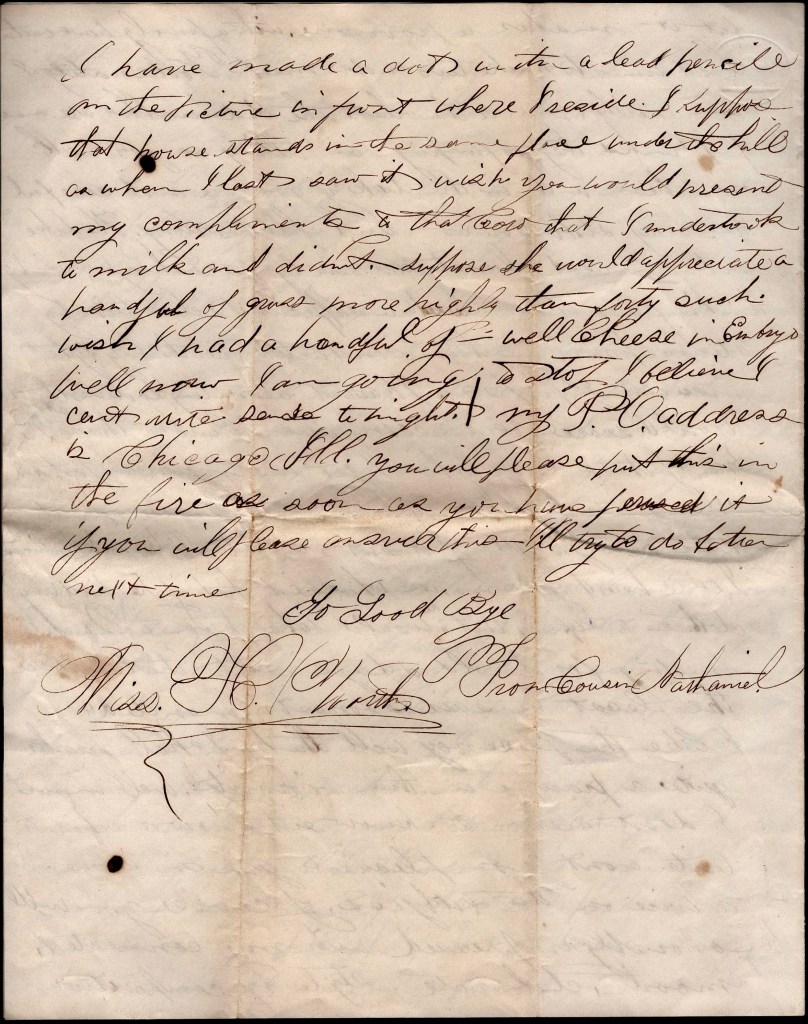
I have made a dot with a lead pencil on the picture in front where I reside. I suppose that house stands in the same place under the hill as when I last saw it. Wish you would present my compliments to that cow that I undertook to milk and didn’t. Suppose she would appreciate a handful of grass more highly than forty such. Wish I had a handful of—well, cheese in embryo. Well now, I am going to stop. I believe I can’t write… My P.O. addresss is Chicago, Illinois. You will please put this in the fire as soon as you have perused it. You. will please answer this. I’ll try to do better next time. So goodbye, — From Cousin Nathaniel

To Miss H. Worth
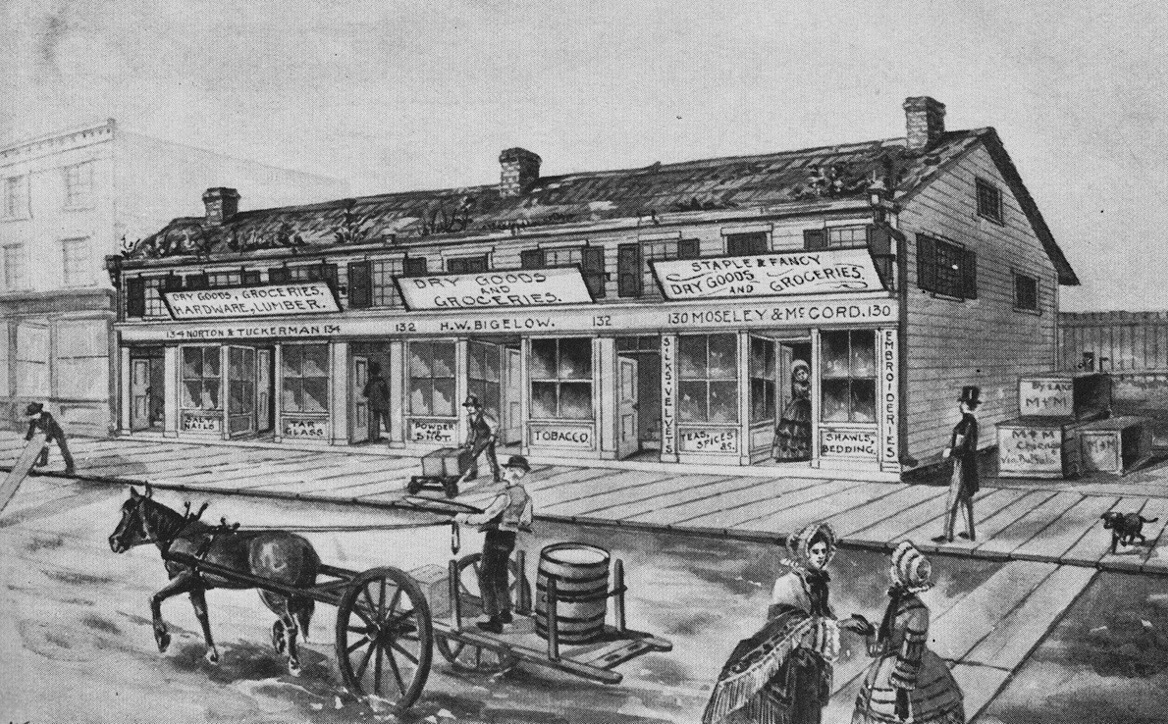

North side of Lake Street, west of Clark. 1843. (Heise and Edgerton, Chicago: Center for Enterprise)

1 Chicago’s sidewalks and many of its streets were planked in the 1840s and after years of exposure to the yearly cyclical nature of Chicago’s climate, began to rot and wear badly. “Before long, the planked streets became waiting booby-traps as the rotting boards would snap without warning with a resulting one-two punch: first, the broken plank would rise into the air, often slapping a horse in the face; then on the way down, the falling missile would crash into the muck below, splashing any innocent bystander with the ungodly [sewage] effluent [flowing beneath].”

1850: Daniel C. Nicholes to John Hastings

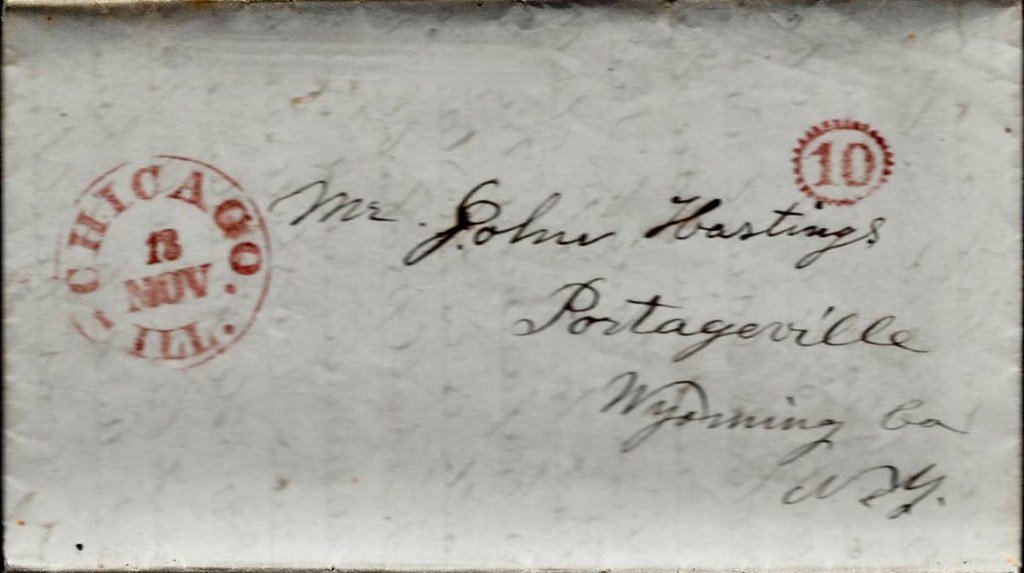
The following letter was written from Chicago in November 1850 by Daniel C. Nicholes (1817-1889), the orphaned son of Daniel Nicholes (1773-1847) and Diantha Holly (1785-1845). We learn from the letter that Daniel and his brother Ira James Nicholes (1819-1881) had a law practice in Chicago at the corner of Randolph and Clarke Streets, conveniently located opposite the Court House.

Transcription

Chicago [Illinois]
November 10, 1850

Dear Sister,

We received a letter last week from Phebe containing a general history of the times and of all matters which she thought would interest us. I was also very happy to learn your whereabouts. It has been a long time since you have written to me or since I have heard from you. I wrote a letter to John some time since and directed it to Shuylerville, not knowing where his post office address was. I have received no answer and presume he did not receive it. I was very glad to hear that you were all enjoying good health and prospering in business. I have been in hopes that John would find it for his interest to visit the West and perhaps settle somewhere in this vicinity. Whether he could do better here than where he is, I am unable to say. The people here complain of hard times and I presume they do in most other places. We would be very glad to have you make us a long visit and if it would be for your interest to do so, to live near us. We have a home of our own such a one as it is and we think it is tolerably comfortable.

Out lot cost us about two hundred and fifty dollars. We have got a fine fence around it which cost us about thirty-five or forty dollars. I will give you a short description of our house. It consists of a dining room, kitchen, bedroom and vestry below, and two rooms and two closets above. The rooms are all small as our house is small. We have got it carpeted and papered below. We are getting fixed so we can begin to live comfortably. Our law business has increased so that if it continues as good as it is at present, we shall keep our heads above water we think.

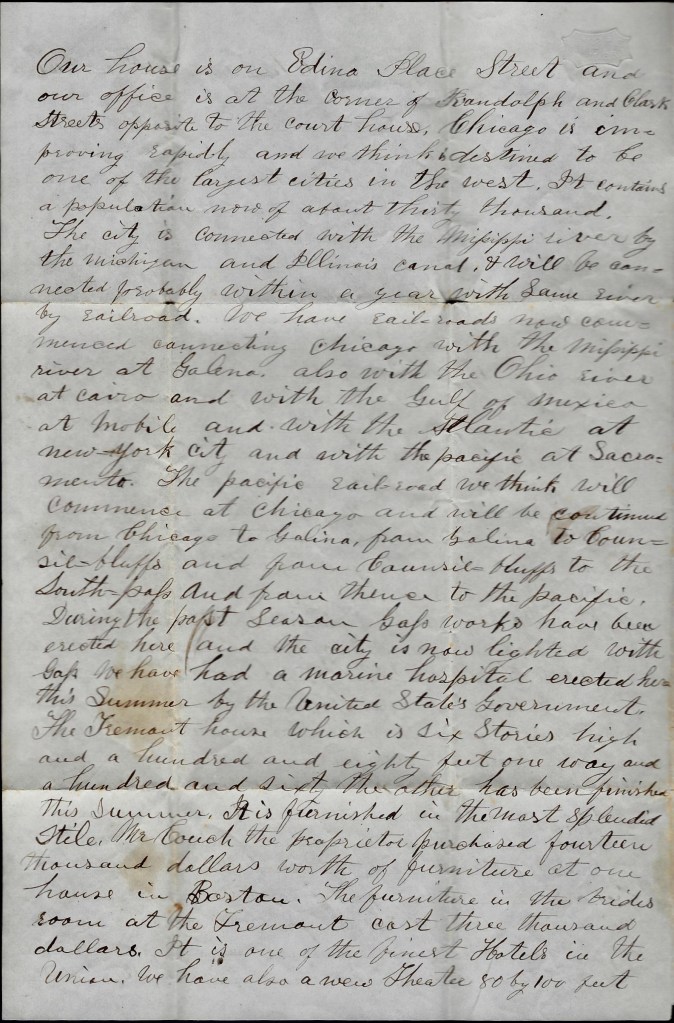
Out house is on Edina Place Street and our office is at the corner of Randolph and Clark Streets opposite to the Court House. Chicago is improving rapidly and we think is destined to be one of the largest cities in the West. It contains a population now of about thirty thousand. The city is connected with the Mississippi river by the Michigan and Illinois Canal & will be connected probably within a year with the same river by railroad. We have railroads now commenced connecting Chicago with the Mississippi river at Galena, also with the Ohio river at Cairo, and with the Gulf of Mexico at Mobile and with the Atlantic at New York City, and with the Pacific at Sacramento. The Pacific Railroad we think will commence at Chicago and will be continued from Chicago to Galena, from Galena to Council Bluffs, to the South Pass, and from thence to the Pacific. 

During the past season, gas works have been erected here and the city is lighted with gas. We have had a Marine Hospital erected here this summer by the United States Government. The Tremont House which is six stories high and a hundred and eight feet one way and a hundred and sixty the other, has been finished this summer. It is furnished in the most splendid style. Mr. [Ira] Couch, the proprietor, purchased fourteen thousand dollars worth of furniture at one house in Boston. The furniture in the Bride’s Room at the Tremont cost three thousand dollars. It is one of the finest hotels in the Union. 1

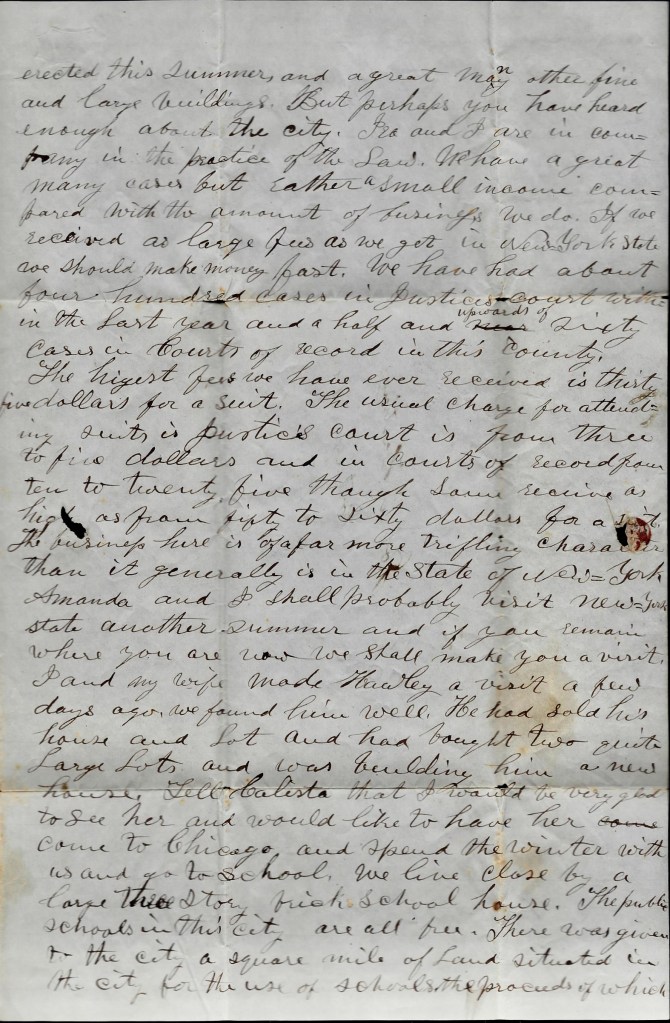
We have also a new theatre [Rice’s Theatre], 80 by 100 feet, erected this summer and a great many other fine and large buildings. But perhaps you have heard enough about the city.

Ira and I are in company in the practice of Law. We have a great many cases but rather a small income compared with the amount of business we do. If we received as large fees as we get in New York State, we should make money fast, We have had about four hundred cases in Justice Court within the last year and a half and upwards of sixty cases in Courts of Record in this county. The highest fees we have ever received is thirty-five dollars and in Courts of Record from ten to twenty-five though some receive as high as from fifty to sixty for a suit. The business here is of a far more trifling character than it generally is in the State of New York.

Amanda and I shall probably visit New York State another summer and if you remain where you are now, we shall make you a visit. I and my wife made Hawley a visit a few days ago. We found him well. He had sold his house and lot and had bought two quite large lots and was building him a new house. Tell Calista that I would be very glad to see her and would like to have her come to Chicago and spend the winter with us and go to school. We live close by a large three-story brick school house. The public schools in this city are all free. There was given to the city a square mile of land situated in the city for the use of schools, the proceeds of which build all the school houses and pay all the expenses of the schools. My wife sends her best respects to you all and we expect you will write to us soon after the receipt of this. Very truly your brother, &c., — Daniel C. Nichols


1 The Tremont House…is one of the chief ornaments of the City, and reflects great credit upon its proprietor, Mr. Ira Couch. The Tremont fronts 120 feet on Lake and 180 feet on Dearborn street. It is five and a half stories high. Its internal arrangements, finish, furniture and decorations are in the highest style of art, and of the class denominated princely…The cost of the building was about $75,000.

1847: Aura M. Hugunin to Elizabeth Gladwin

I could not find an image of Aura but here is a young woman whose image dates to the late 1840s.

The following letter was written by 19 year-old Aura M. Hugunin (1827-1914), the daughter of Robert H. Hugunin (1792-1862) and Eleanor Waring (1804-1873) of Chicago, Cook county, Illinois. Aura’s father was a veteran of the War of 1812, a ship owner, and also a ship captain, sailing out of Chicago. Aura was married twice; first to Calvin D. Bristol (1817-1852), and second to Ephraim Holton (1814-1865). Both husbands were born in New York State.

From the letter we learn that Aura had only recently relocated from New York State to Chicago with her family which included not only her parents, but younger siblings named William (b. 1829), Robert (b. 1835), and Caroline (b. 1839). On the passage down Lake Michigan, the steamboat stopped at Southport (which is present day Kenosha) where Aura was persuaded to spend a few days with her uncle “General Hugunin” and his family. I believe this was Daniel Hugunin, Jr. (1790-1850) who served as a US Congressman from New York State in the late 1820s.

Aura wrote the letter to her friend, Elizabeth Gladwin (b. 1830), the daughter of William H. Gladwin (1797-1876) and Eleanor M Daniels (1802-1874) of Sacket’s Harbor.

Aside from her description of the trip from Sacket’s Harbor, New York, to Chicago Illinois, by way of railroad and steamboat, Aura shares her fist impressions of Chicago which were not very favorable. “It is a very large city but not a very genteel one. Everything looks so common to me—the streets so dirty. But it is all hurly burly. The greatest business place you ever saw. Everyone seems to be about crazy-looking and running every which way. ” And then she added, “The gentlemen look about as the city does—rather unpolished. You needn’t think that I am going to fall in love with the hoosiers here, I can tell you, for I have stood unmoved in more polished circles.”

Transcription

Chicago [Illinois]
Sunday, June 6th 1847

Dear Elizabeth,

Agreeably do I fulfill the promise we contracted when we last parted; and having somewhat recovered from the fatigue and excitement of our journey and once more get set down and collecting scattering thoughts, my mind wanders back to Sacket’s Harbour and happily do I say that I left you all reluctantly and with feelings of soul felt gratitude to most of you for while we lived at your place I was dependent upon the treatment of others for my enjoyment and I was perfectly satisfied that in my case, the old adage was more than verified (that merit meets with its own reward). And if my conduct was worthy to warrant kindness and friendship from my acquaintances, it shows plainly that they are charitable; and do by others as they would wish others to do by them, and I will try to do justice to their feelings.

Now I must tell you, Libbie, how we all are and how we enjoyed our [journey] through the lakes. You will know that we enjoyed ourselves when I tell you that we were not sick a bit the whole way and that was almost a miracle for I never went the length of Lake Ontario without being very seasick before. We were just a week and one night getting to Chicago.

Monday evening we left Sacket’s and the next morning if I did not have my lunch [ ] to Oswego. I went up to Cousin Henry’s where I visited last summer and took breakfast and returned to the boat to receive calls as the news got there before we did that we were on our way to Chicago and we had the pleasure of seeing all our relations and friends and to bid them goodbye and I left Oswego very tired but pleased that we had seen all our friends. We had a delightful time to Lewiston with but one exception—that is we had to get up in the morning about three o’clock (and oh, I was so sleepy) to take the morning train of cars to Buffalo.

We got to Niagara Falls at sunrise. We stayed to breakfast and had a tramp or a regular romp over and round about the falls for there was a great many of us. Tore off one of the souls to my shoes and returned to the hotel where in a minute, our came the roaring iron horse a puffing and blowing with all vengeance, and into the box or whatever it is, we all tumbled and on we went as though we were never to stop and in an hour and a half we were in Buffalo. We spent the day there—was all over the town. Was shopping all day a buying a little of nothing. Had a call—a good long one—from Dr. Hunter, and in the evening went aboard of the steamboat Oregon, there to remain till we got to Chicago. We found the very steamboat we were anxious to take. She had only five hundred passengers but there was plenty of room. The Upper Lakes boats are magnificent. They are nicer than I imagined. There are indeed a “floating palace.” They always carry a band of music with them and a beautiful piano and an elegant sounding one. But they go to such an extreme in dissipation; they dance aboard every night and such bewitching music. It is such a temptation one can hardly refuse—[especially for] one that is as fond of dancing as I be.

We were disappointed in our visit to Cleveland for the boat was belated at Buffalo half a day so we remained in Cleveland only an hour. It was almost a calm, the lakes was, till we got to Lake Huron when it poured down rain as though we needed it on the lake. But my only trouble was that it would blow for it was just dark and they were clearing the saloon for dancing. But it did not discommode us in the least and everything went on finely.

The next morning was Sunday and I was waked up from my slumbers by the boats stopping and it proved that we had got to the Manitou Island to take on wood and in a few minutes I was up and ashore. And such a delightful walk as the clerk of the boat and my own dear self did have was not to be beat. We went along the beach where the most beautiful pebbles and shells was. The boat lay there three or four hours. Sunday evening was spent at Sheboygan on Lake Michigan. It was a bright moonshiny night and I was up in town and I enjoyed it beyond description. The next morning was in Milwaukee. Had a visit from Mr. Hopkins. The boat laid there all the forenoon. Our next stopping place was to Racine and the next was to Southport where General Hugunin’s family reside and one of my cousins happened aboard and nothing would do but I must stop and so I did and they kept me till last Monday [when] cousin escorted me to Chicago.

We come from Southport on the Hendrick Hudson—the most elegant boat of the whole and never did I behold so much splendor. We went aboard Monday at two o’clock and Tuesday morning was in Chicago to breakfast. Danced all the evening as a matter of course. I never was more pleased with a visit than I was at Southport.

Goodbye and ever remain your affectionate friend, — Aura M. Hungunin

Now Elizabeth, you will write to me as soon as you get this, won’t you? It seems as though I could hardly wait as long but I shall be obliged to. But remember that I am very impatient and not delay. You will forgive this horrible writing, won’t you, for if you know what a rickety old pen I have got, you would make all due allowance. Give my love to Clarissa and Maryett Pickering, if you please. Tell them to fulfill their promise in writing. Have you not thought how queer Maria treated me that night? I got all over it after the boat left the wharf two minutes and had a hearty laugh at her expense. Such child-like freaks but they are most intolerable. Ma says give my love to Mrs. Gladwin and Elizabeth, and Caroline says give mine too. I spent the evening with Dr. Hudson and his sister and Miss Luff Friday. It was indeed a Sacket’s Harbour party. They were over to see Emma Wilder. They said she was larger than her mother. No doubt.

I have become acquainted with Mr. Root, Samuel Root’s brother, and I am as much fascinated with his appearance as I was his brother and you know how much I was captivated they other way. The gentlemen look about as the city does—rather unpolished. You needn’t think that I am going to fall in love with the hoosiers here, I can tell you, for I have stood unmoved in more polished circles. I want you should remember me with a great deal of love to your mother. Tell Walter that I think Robert would appreciate his society now if he could have the privilege of enjoying it again. He is rather lonely but will soon commence school. Ma will go East in August so you will see her. Goodbye. — Aura

Since I saw you I have been in [ ] with the toothache but had it extracted last Saturday so I am happy again…

I have yet said nothing about how I liked Chicago for I have not been long enough in the city to know but one thing. I think I am quite certain that I do not like very much the appearances. It is a very large city but not a very genteel one. Everything looks so common to me—the streets so dirty. But it is all hurly burly. The greatest business place you ever saw. Everyone seems to be about crazy-looking and running every which way. Mother and I have both been homesick and Father makes all sorts of fun of us. Father comes in every day [and says,] “Mother, do you want to go back.” “Yes,” we cry. “Well,” he says, “you may go” (next Christmas, I suppose) but after we get acquainted perhaps we shall like it better. Dr. Maxwell and his lady were over to see us last week.