Category Archives: Cholera Epidemic

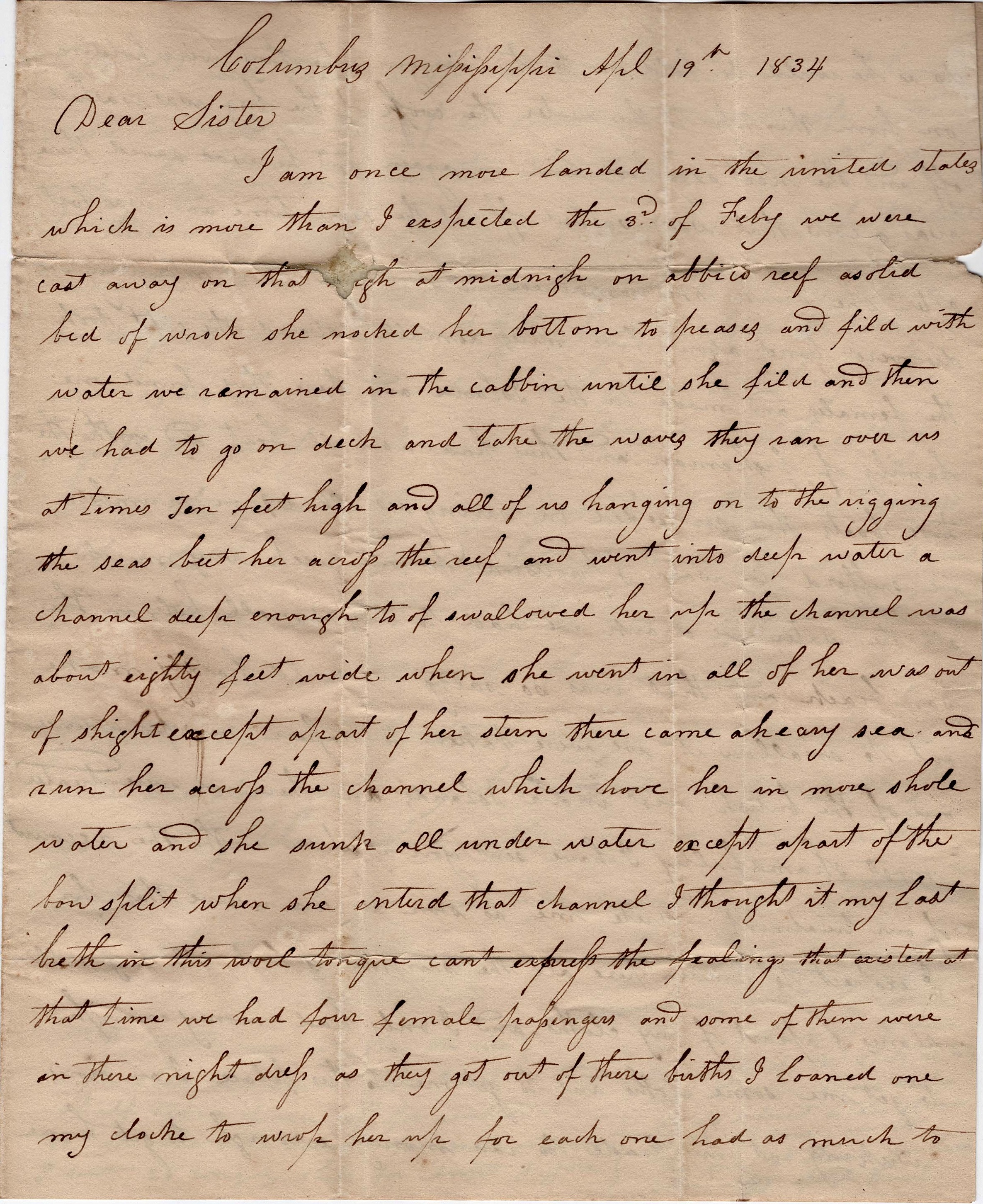
1834: John M. Neal to Ann O. [Neal] Myrick

John M. Neal wrote the following letter to his sister, Ann O. (Neal) Myrick (1790-1835), the wife of Walter B. Myrick of Hertford county, North Carolina. There are references in the letter to John’s Uncle, Thomas Newsom of Southhampton county, Virginia, which was just across the state line from North Carolina.

John’s letter relates the details of a shipwreck in the middle of the night on July 3rd 1833 in which he and 68 other souls survived though the vessel they were on was raked over a reef in the British West Indies and sank with little but the bow sprit rigging above the surface of the waves and five miles from the nearest island. It’s a riveting account—one that would have John informing his sister, “Tongue can’t express the feelings that existed at that time…I thought it my last breath in this world.”
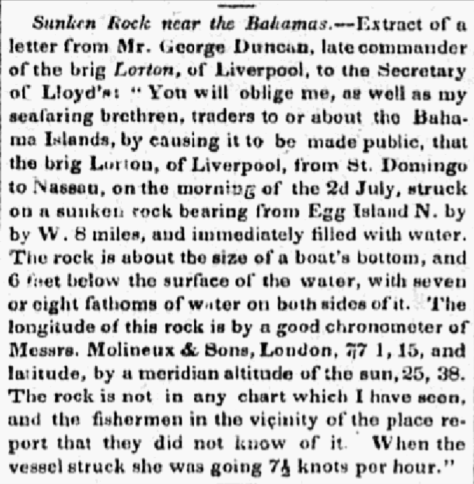
The Southern Patriot, 7 November 1833

It’s believed the ill-fated vessel John was traveling on was the English brig Lorton commanded by George Duncan. An extract of Capt. Duncan’s account of the incident was widely published in the latter half of 1833 in which he relates that “on the morning of the 2nd July” while en route from St. Domingo to Nassau, his vessel “struck on a sunken rock bearing from Egg Island N. by W. 8 miles.” He clarified that “the rock is about the size of a boat’s bottom, and 6 feet below the surface of the water, with seven or eight fathoms of water on both sides of it,” adding that “the rock is not in any chart which I have seen and the fishermen in the vicinity of the place report that they did not know of it.”

John’s letter concludes with a description of the rest of his journey to Columbus, Mississippi, by way of New Orleans and Vicksburg where he had to avoid residents and passengers suffering from the Cholera Epidemic of 1833.
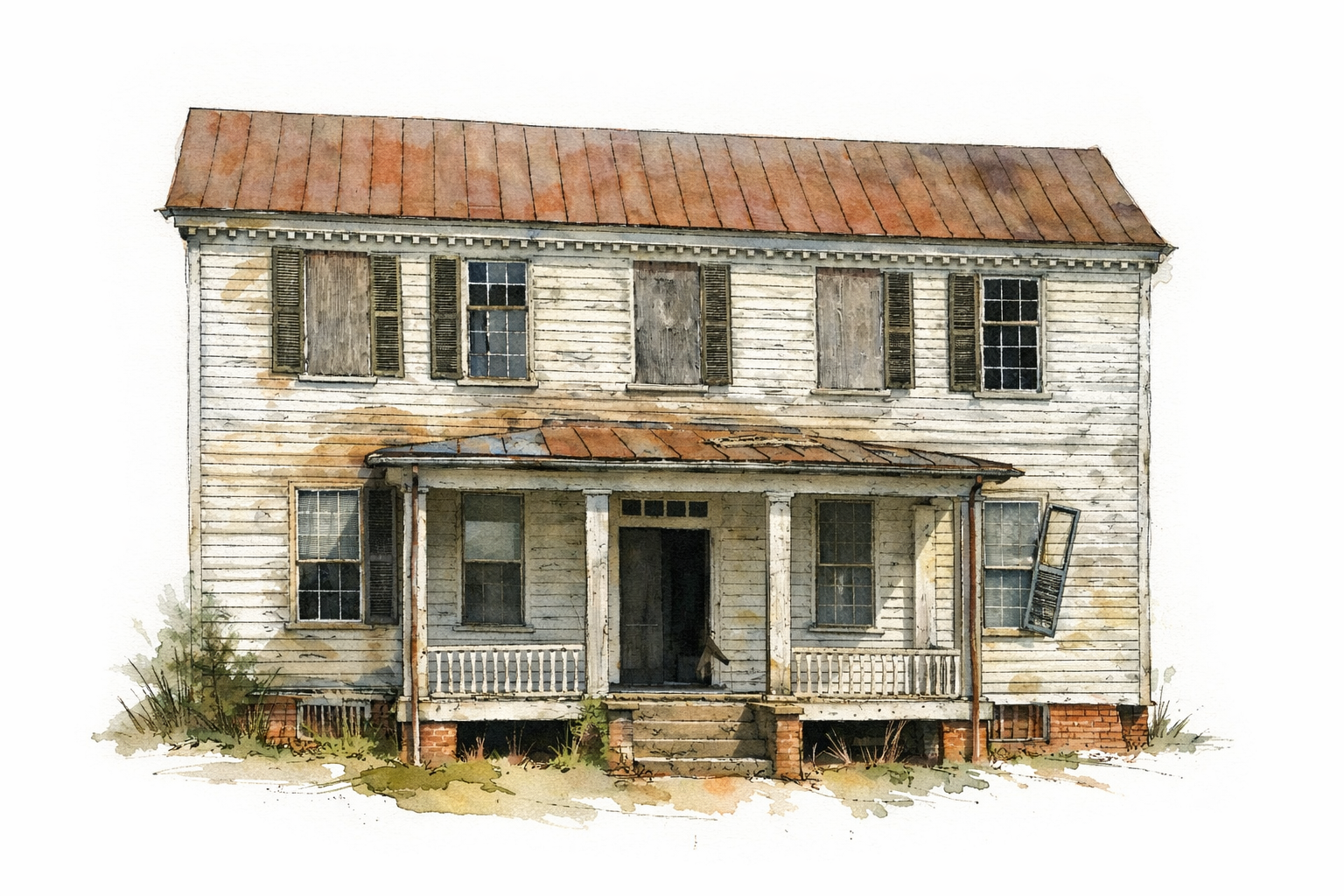
The house Walter B. Myrick (1795-1870) built in North Carolina, just across the State line from Southampton county, Virginia.

T R A N S C R I P T I O N

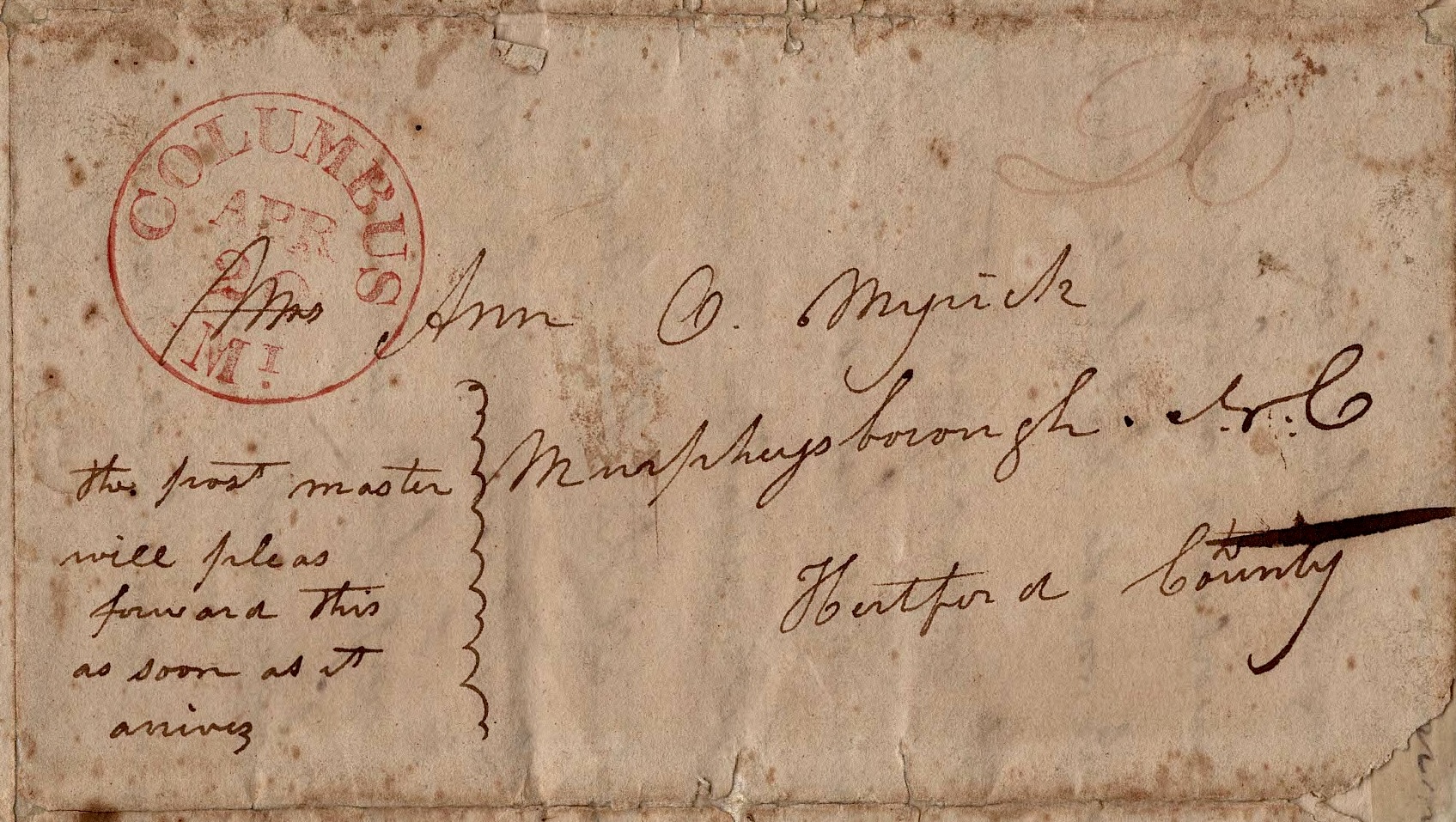
Addressed to Mrs. Ann O. Myrick, Murphrysborough, Hertford county, North Carolina

Columbus, Mississippi
April 19th 1834

Dear Sister,

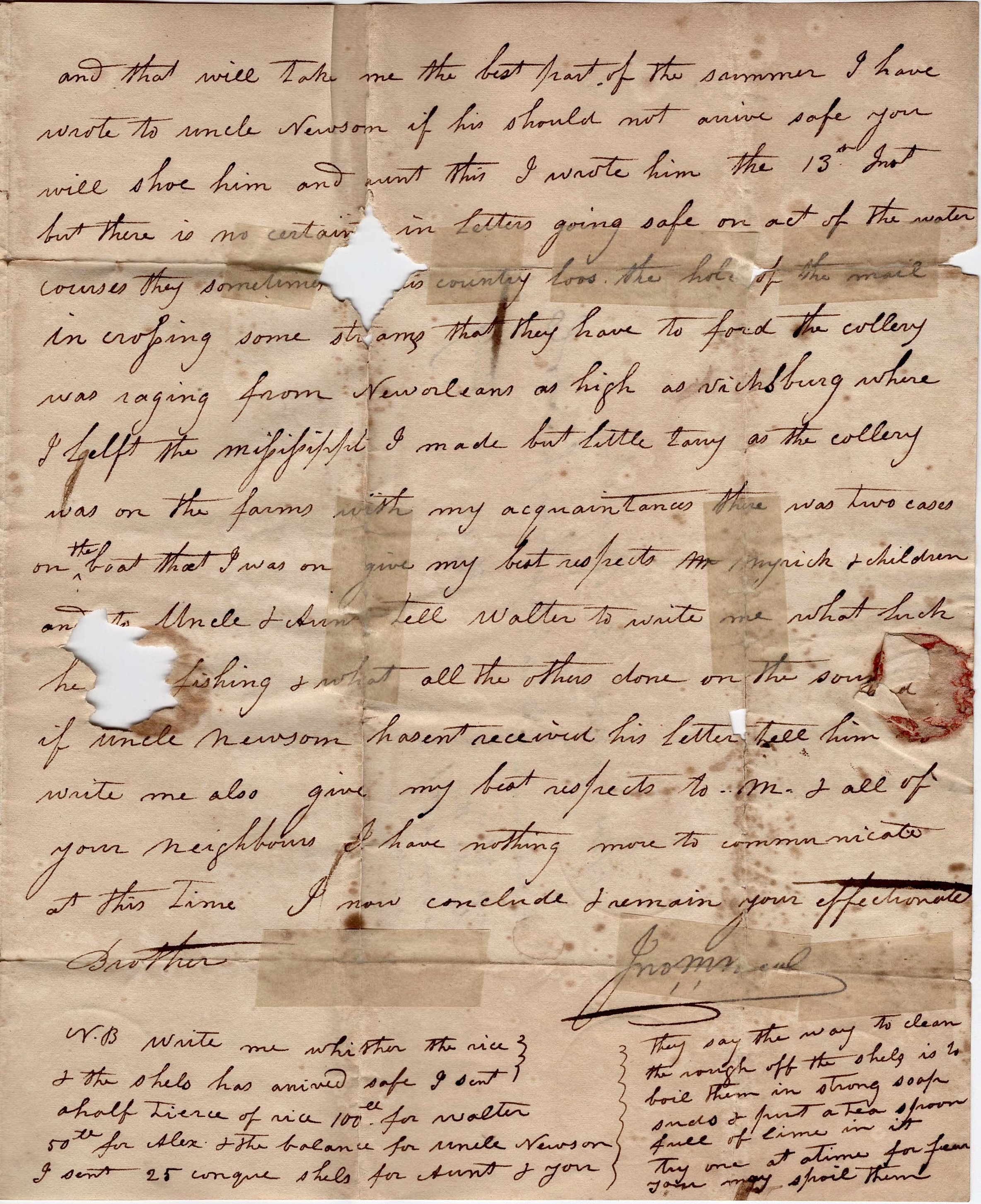
I am once more landed in the United States which is more than I expected. The 3rd of July we were cast away on that night at midnight on Abbie’s Reef, a solid bed of rock. She knocked her bottom to pieces and filled with water. We remained in the cabin until she filled and then we had to go on deck and take the waves. They ran over us at times ten feet high and all of us hanging on to the rigging. The seas beat her across the reef and went into deep water, a channel deep enough to of swallowed her up. The channel was about 80 feet wide. When she went in, all of her was out of sight except a part of her stern. There came a heavy sea and run her across the channel which hove her in more shoal water and she sunk all under water except part of the bow sprit.

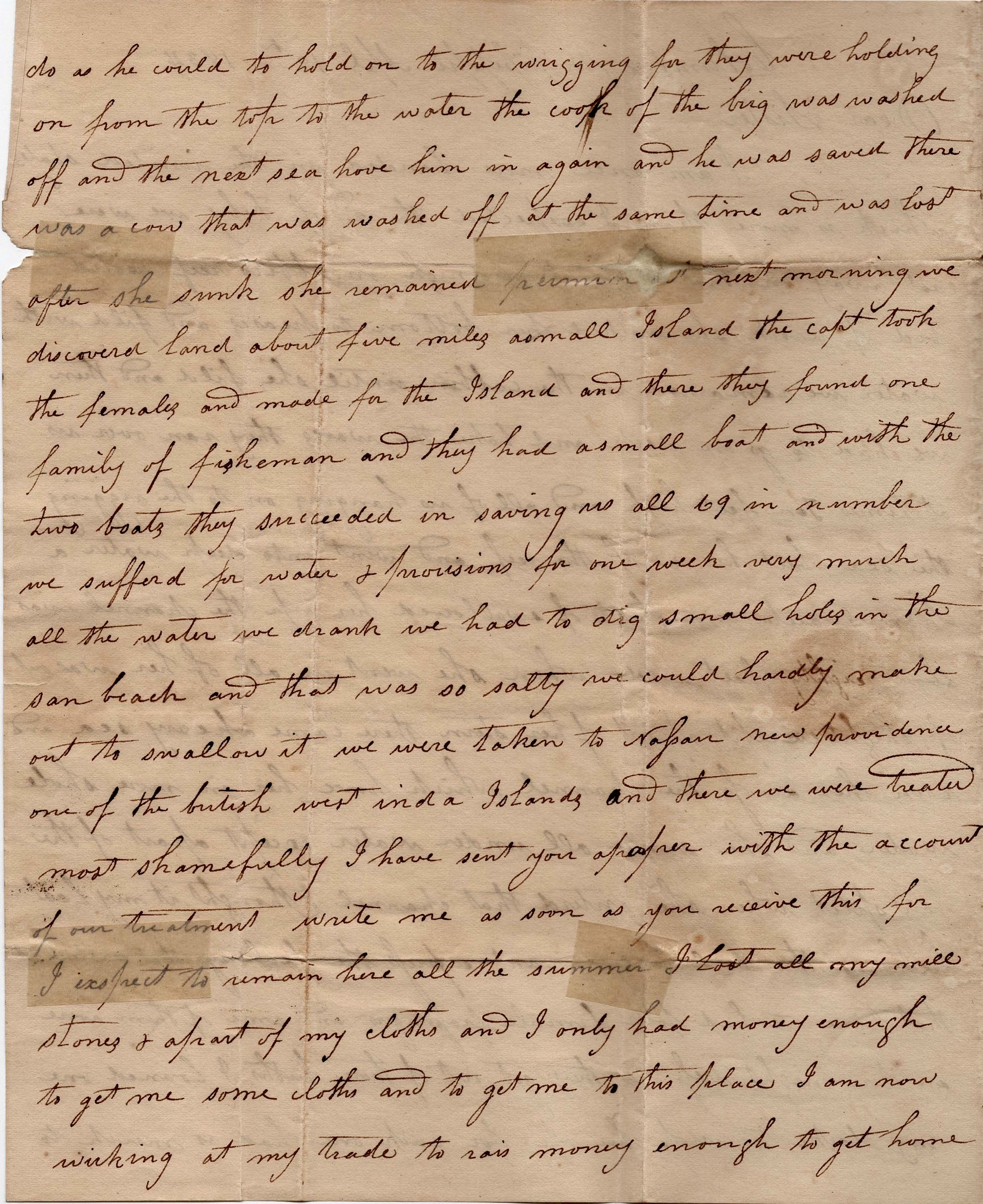
When she entered that channel, I thought it my last breath in this world. Tongue can’t express the feelings that existed at that time. We had four female passengers and some of them were in their night dress [just] as they got out of their berths. I loaned one my cloak to wrap her up for each one had as much to do as he could to hold on to the rigging for they were holding on from the top pf the water. The cook of the brig was washed off and the next sea hove him in again and he was saved. There was a cow that was washed off at the same time and was lost after she sunk. She remained permanent.

Next morning we discovered land about five miles—a small island. The captain took the females and made for the island and there they found one family of fisherman and they has a small boat and with the two boats, they succeeded in saving us all—69 in number. We suffered for water and provisions for one week very much. All the water we drank we had to dig small holes in the sand beach and that was so salty we could hardly make out to swallow it.

We were taken to Nassau, New Providence—one of the British West India islands—and there we were treated most shamefully. I have sent you a paper with the account of our treatment. Write me as soon as you receive this for I expect to remain here all the summer. I lost all my mill stones & a part of my clothes and I only had money enough to get me some clothes and to get me to this place.

I am now working at my trade to raise money enough to get home and that will take me the best part of the summer. I have wrote to Uncle [Thomas] Newsom. If his [letter] should not arrive safe, you will show him this. I wrote him the 13th inst. but there is no certainty in letters going safe on account of the water courses. They sometimes in this country lose the whole of the mail in crossing some streams that they have to ford.

The cholera was raging from New Orleans as high as Vicksburg where I left the Mississippi. I made but little tarry as the cholera was on the farms with my acquaintances. There was two cases on the boat that I was on.

Give my best respects to Mr. Myrick and children, and to Uncle & Aunt. Tell Walter to write me what luck he had fishing & what all the others done on the [paper torn]. If Uncle Newsom hasn’t received his letter, tell him to write me. Also give my best respects to M. & all of your neighbors. I have nothing more to communicate at this time. I now conclude & remain your affectionate brother, — Jno. M. Neal
1849: Benjamin Franklin Wallace to William Hervey Lamme Wallace

Benjamin F. Wallace (ca. 1865)

This letter was written in 1849 from Independence, Jackson county, Missouri, by Benjamin Franklin Wallace (1817-1877). Benjamin was the son of Thomas Wallace (1777-1858) and Mary J. Percy (1785-1874) who came from Virginia to Missouri in 1833 by way of interim residency in Kentucky. Benjamin married Virginia Johnston Willock (1824-1908) at Independence on 1 August 1847 and their first child, mentioned in this letter, was Mary Albina Wallace (1848-1854) who was born on 2 May 1848. Their second child, David Willock Wallace was born on 15 June 1860. [I should mention here that when David W. Wallace grew up, he married Madge Gates in 1883 and their first child was Elizabeth Virginia (“Bess”) Wallace—the future wife of Harry S. Truman—Bess Truman!]

In the 1850 Slave Schedules, Benjamin was enumerated among the slaveholders. He owned three slaves—a female aged 22 and two young children, ages 5 and 2. In the 1860 US Census, Benjamin was identified as a “Bank Clerk” in Independence. In 1869, Benjamin served as the Mayor of Independence. By 1870, he was employed as a dry goods merchant.

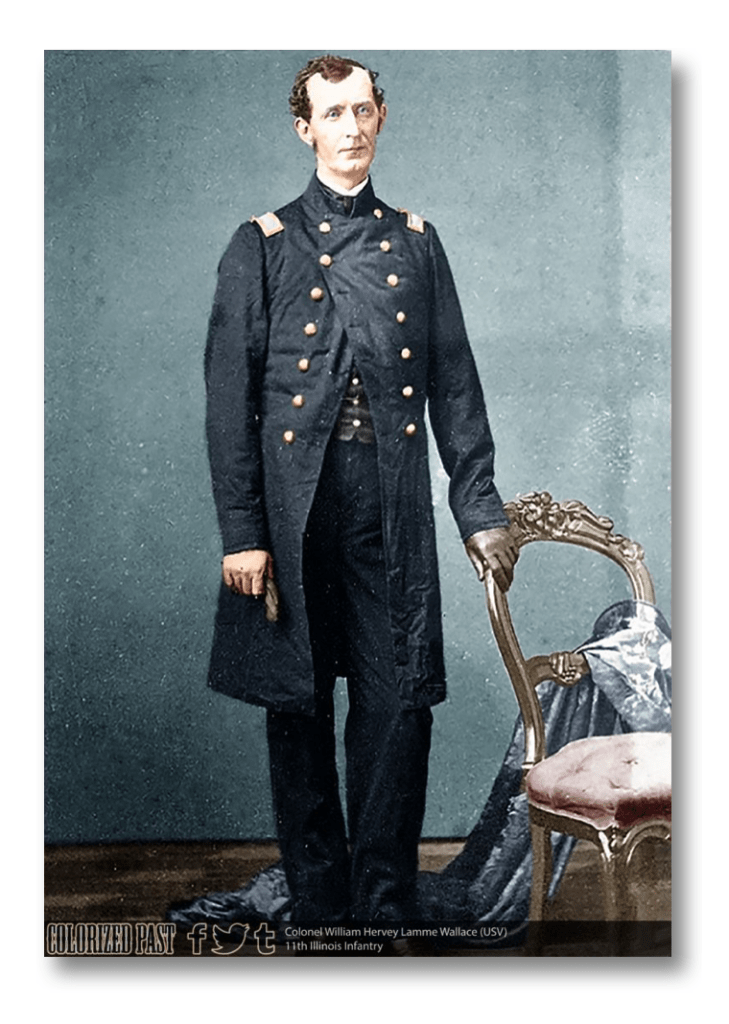
Col. William H. L. Wallace, 11th Illinois Infantry

Benjamin wrote the letter to William Hervey Lamme Wallace (1821-1862) of Ottawa, LaSalle county, Illinois. William’s obituary on Find-A-Grave informs us that prior to the Civil War, he served as the District Attorney for LaSalle County. When he entered the service, in 1861, he was commissioned the Colonel of the 11th Illinois Infantry. For his gallantry at the February 1862 Battle of Fort Donelson, he was promoted to Brigadier General and placed in command of the Army of Tennessee’s 2nd Division. Though he was a new division commander, yet he managed to withstand six hours of assaults by the Confederates, directly next to the famous Hornet’s Nest, or Sunken Road. When his division was finally surrounded, he ordered a withdrawal and many escaped, but he was wounded in the head by a shell fragment and only later found barely alive on the battlefield by his troops. He died three days later in his wife’s arms in a hospital near Savannah, Tennessee. [See “The Death of General W. H. L. Wallace at the Battle of Shiloh,” Iron Brigader.]

William’s younger brother, Martin Reuben Merritt Wallace (1829-1902) was also a Brigadier General during the Civil War, having begun as Colonel of the 4th Illinois Cavalry.

Trails leaving Independence, Missouri in 1849, Charles Goslin

Transcription

City of Independence, Missouri
August 9th 1849

W. H. L. Wallace
Dear Cousin,

Altho I may have written last, still I do not intend you shall forget me. I trouble you with another letter by way of reminding you that your unknown cousin has not forgotten you.

I have nothing of any great interest to write about, but feel quite grateful that I am alive and still able to correspond with my old friends & relatives whilst death has been abroad & taken many—very many—of my acquaintances. Still myself & mine still live altho death has spread quite a gloom over our beautiful city. Myself & family have remained well. None of your relatives here have been sick with the scourge (the cholera). Altho our next door neighbors have been taken of [it] in a few hours, we have been preserved. Our beautiful city has suffered to a greater degree than even the ill-fated St. Louis according to the amount of population. At present, we have but little I have heard of but one case in the last four days which occurred today and proved fatal in about eight hours (t’was that of a child).

We have had one continual excitement the present year. First the California emigrants & secondly the cholera. These were quite different. The first was pleasant & the last terrifying. A vast number of gold seekers have passed through our place during the last spring & present summer & among the number who have passed recently was some of our old friends from Illinois—Thomas Bassney & others. Bassney told me he knew you well & said you was to have been one of their party 1 but from some cause or other, you had not come on. I told him I suspected Old Zack [Zachery Taylor] had given you an office for I see he appointed W. H. Wallace to be “Register of Lands from Illinois” and suspected it was you (if you have gone to Iway [Iowa], you may never get this). I have but one fault to find to Old Zack’s Administration—I.E., he don’t turn out Locofoco’s fast enough [from such appointed offices] & fill the same with decent Whigs.

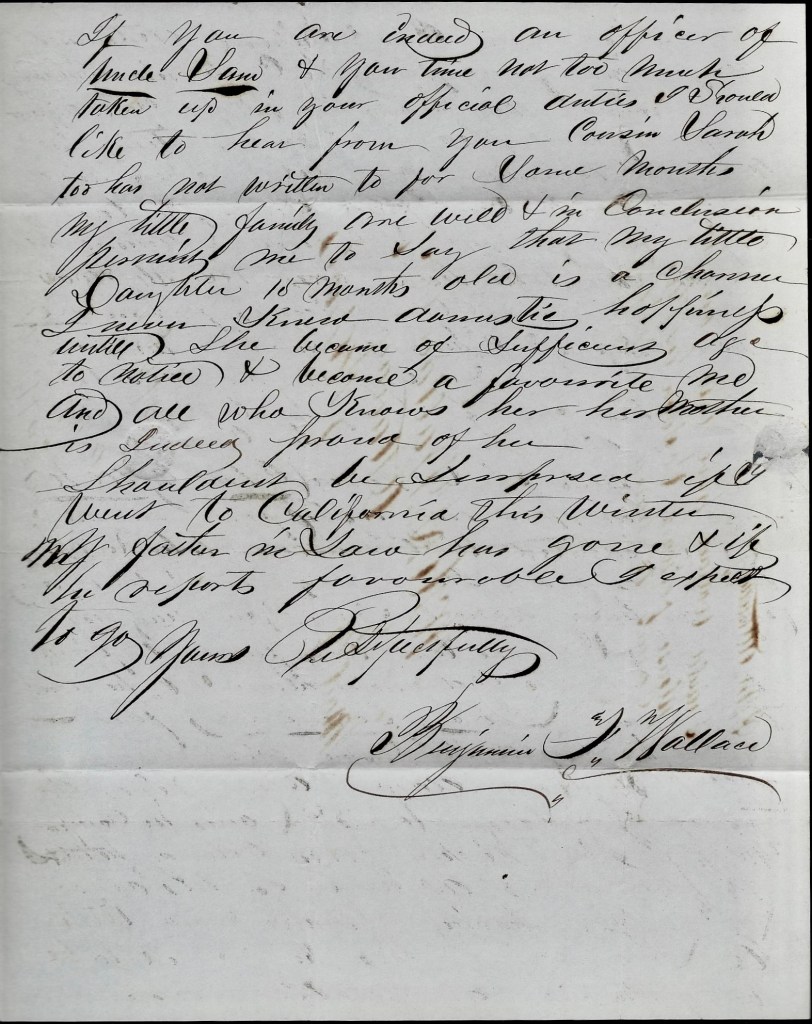
I went down our river the first of June to St. Louis in company with Mr. Fisher from Ottoway [Ottawa]. He told me you was as one of his own sons, you having studied law with a son of his [see George Smith Fisher (1823-1895)]. He seemed to be very much of a gentleman. If you are indeed an officer of Uncle Sam & your time not too much taken up in your official duties, I should like to hear from you. Cousin Sarah too has not written to [us] for several months. My little family are well & in conclusion, permit me to say that my little daughter 15 months old is a charmer. I never knew domestic happiness until she became of sufficient age to notice & become a favorite [to] me and all who knows her. Her mother is indeed proud of her.

Shouldn’t be surprised if I went to California this winter. My father-in-law has gone & if he reports favorable, I expect to go. Yours respectfully, — Benjamin F. Wallace

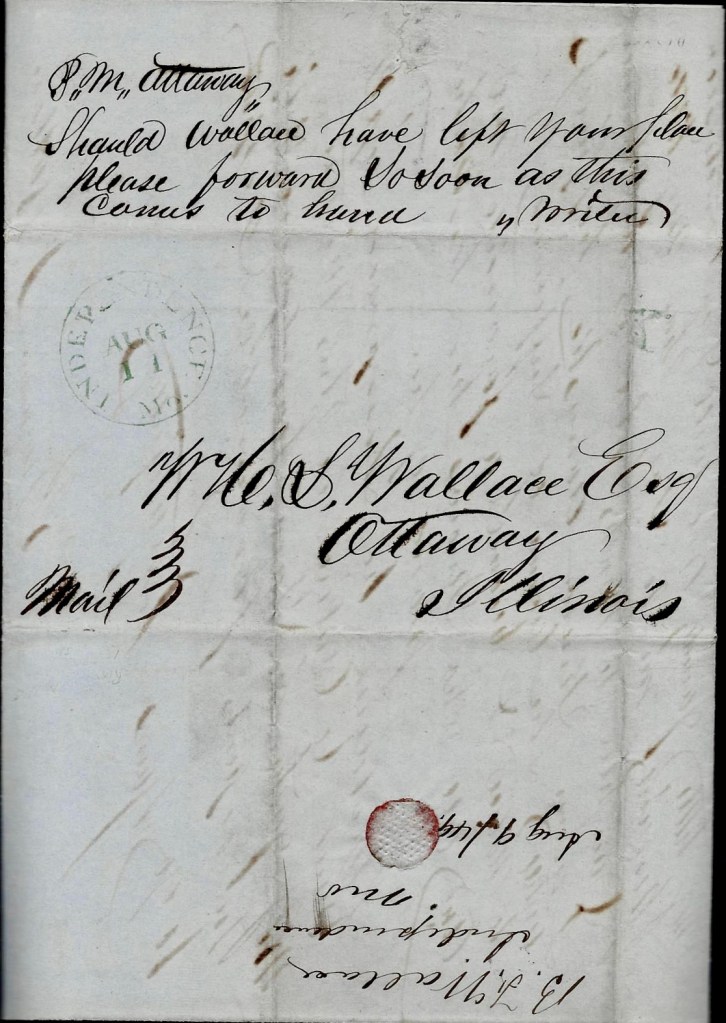
Postmaster Ottoway: Should Wallace have left your place, please forward so soon as this comes to hand.


1 This “California Party” was probably the “Dayton Party” formed at Dayton (near Ottawa) under the command of Captain Jesse Greene. Their rendezvous was to be at St. Joseph on the Missouri in April 1849. One of the party, a store clerk in Ottawa named Alonzo Delano (1806-1874) and his record of the journey can be found at “Life on the plains and among the diggings.” See also “Dayton and the Greens.”