The following letter was written by 18 year-old Adalaide Barbara Fair (1845-1912), the daughter of Charles T. Fair (1810-1888) and Elizabeth (“Eliza”) Slaybaugh (1815-1887) of Taneytown, Carroll county, Maryland. Adalaide was married in 1869 to Thomas Angell (1838-1906). Adalaide’s husband served in Co. G, 3rd Maryland Potomac Home Brigade from April 1862 to April 1865.
Adalaide wrote the letter to Matilda (“Tilly”) Cline (1836-1922), the daughter of John Kline (1800-1882) and Maria Magdalena Slaybaugh (1804-1866) of Menallen township, Adams county, Pennsylvania. Tilly was married in October 1863 to Jacob Crum (1836-1922).
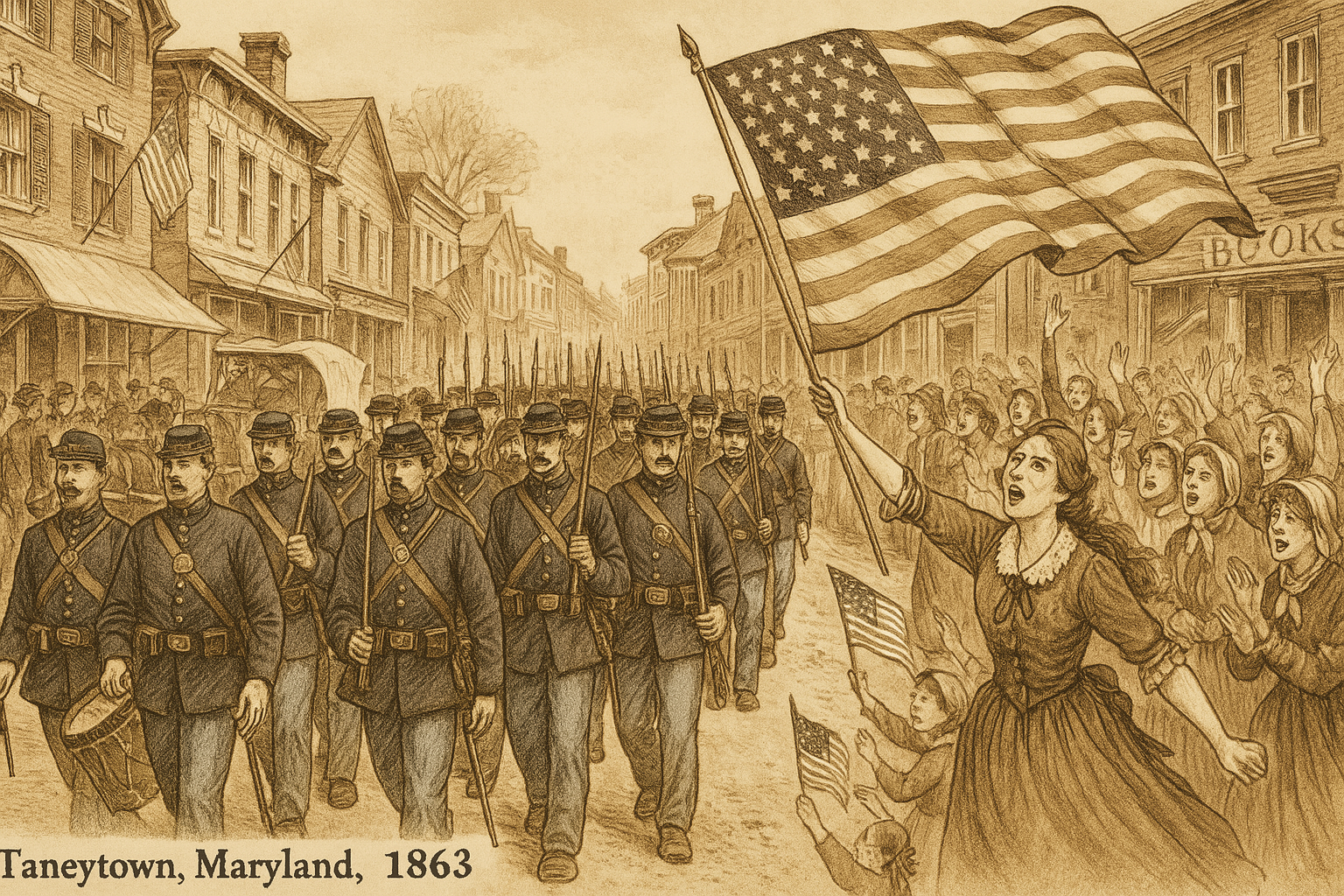
Adalaide’s letter offers a detailed and poignant account of the movement of Union troops through the village of Taneytown, Maryland, located approximately 13 miles south of Gettysburg. Moreover, she recounts her visit to the Gettysburg battlefield, where she observed the hastily dug graves of Confederate soldiers, their remains partially exposed due to the relentless rains of the past few weeks.
“Oh Union boys, ain’t you happy, as you go marching home?”
T R A N S C R I P T I O N
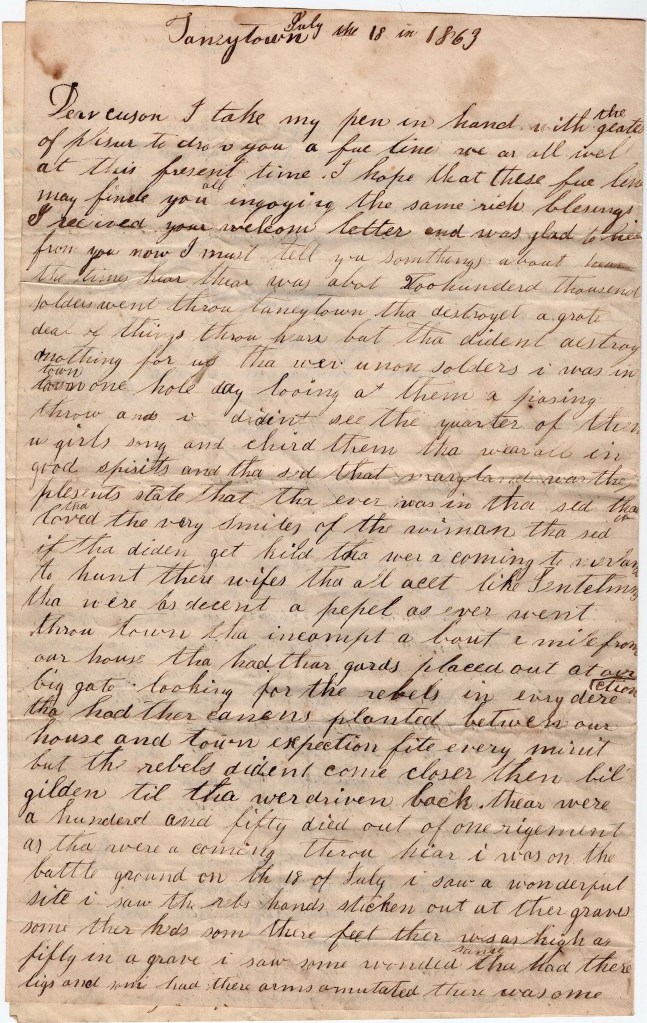
Taneytown [Carroll county, Maryland] July 18, 1863
Dear Cousin,
I take my pen in hand with the greatest of pleasure to drop you a few lines. We are all well at this present time, I hope that these few lines may find you all enjoying the same rich blessings. I received your welcome letter and was glad to hear from you.
Now I must tell you something about the times here. There was about two hundred thousand soldiers went through Taneytown. They destroyed a great deal of things through here but they didn’t destroy nothing for us. They were Union soldiers. I was in town one whole day looking at them a passing through and I didn’t see the quarter of them. Us girls sang and cheered them. They were all in good spirits and they said that Maryland was the pleasantest state that they ever was in. They said that they loved the very smiles of the women. They said if they didn’t get killed, they were a coming to Maryland to hunt their wives. They all acted like gentlemen. They were as decent a people as ever went through town. They encamped about a mile from our house. They had their guards placed out at our big gate looking for the rebels in every direction. They had their cannons planted between our house and town expecting a fight every minute but the rebels didn’t come closer than Bill Gilden till they were driven back.
There were a hundred and fifty died out of one regiment as they were a coming through here. I was on the battleground on the 18th of July. I saw a wonderful sight. I saw the rebs hands sticking out of their graves, some their heads, some their feet. There was as high as fifty in a grave. I saw some wounded. They had their legs and some had their arms amputated. There was one poor creature was taking the lock jaw when I was there. They expected him to die and the rest of them was all lively.
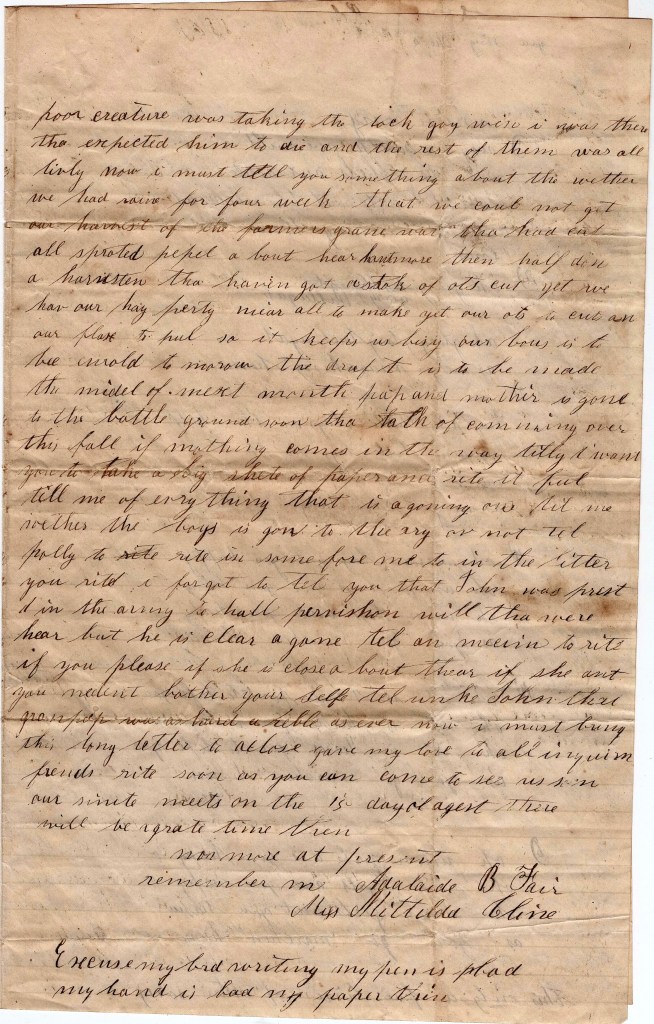
Now I must tell you something about the weather. We had rain for four weeks that we could not get out harvest off. The farmers grain war___, they had eat all sproted [?] people about here. Han’t more than half done a harvesting. They haven’t got a stack of oats cut yet. We have our hay pretty near all to make yet, our oats to cut, our flax to pull, so it keeps us busy.
Our beaus is to be enrolled tomorrow. The draft is to be made the middle of next month. Pap and mother is going to the battle ground soon. They talk of coming over this fall if nothing comes in the way. Tilly, I want you to take a big sheet of paper and write it full. Tell me everything that is a going on. Tell me whether the boys is gone to the army or not. Tell Polly to write in some for me too in the letter you write. I forgot to tell you that John was pressed in the army to haul provision while they were here but he is clear again. Tell Aunt Maria to write if you please if she is close about there. If she and you needn’t bother yourself. Tell Uncle John that Grandpap was as hard a pebble as ever. Not I must bring this long letter to a close. Gove my love to all inquiring friends. Write soon as you can. Come to see us soon. Our Sinod meets on the 15th day of August. There will be a great time then. No more at present. Remember me. — Adalaide B. Fair
To Miss Matilda Cline
Excuse bad writing, My ped is bad. My hand is bad. My paper thin.
This interesting letter was written by Andrew Jefferson Sagar (1830-1900), a son of William C. Sagar, Jr. (1800-1877) and Dolly Wheeler (1803-1880) of Steuben county, New York, who moved with his family to Virginia in the 1850s to farm in Fairfax county. Andrew married Hannah Atta Bentley (1843-1913) on 7 February 1861.
Sagar wrote the letter to Abram P. Pruyn (1836-1918), the son of Henry Pruyn (1812-1893) and Ann Putnam (1816-1888) of Auriesville, Montgomery county, New York.
Andrew’s letter provides us with a civilian account of the Rebel army’s occupation of Fairfax county after the Second Battle of Bull Run in late August 1862. As natives of New York, and Unionists in Virginia, the Sagars were not anxious to suffer through another rebel occupation as they had following the First Battle of Bull Run when there were no less than three rebel encampments on his property [See newspaper clipping below from the New York Tribune of 20 July 1861.] Andrew informs us of the rebel army taking several Unionist citizens as prisoners.
Andrew wrote the letter from Steuben county where he and his wife and parents took refuge for some time among relatives. In June 1863, he was still there when he registered for the draft. Land records show that he purchased the property in Fairfax county from his parents in 1865.
Transcription
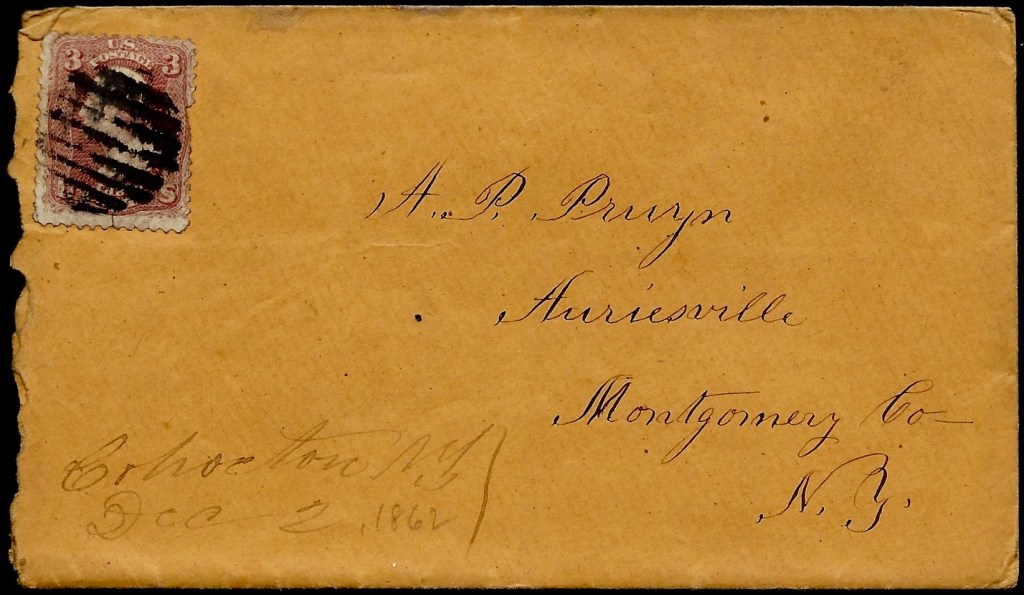
Addressed to A. P. Pruyn, Auriesville, Montgomery county, New York
Cohocton [Steuben county, New York] November 30th 1862
Friend A. P. Pruyn,
You have been anxious undoubtedly to hear of our whereabouts & prospects since our reverse last August & I feel as though I had hardly done right in not writing to you sooner.
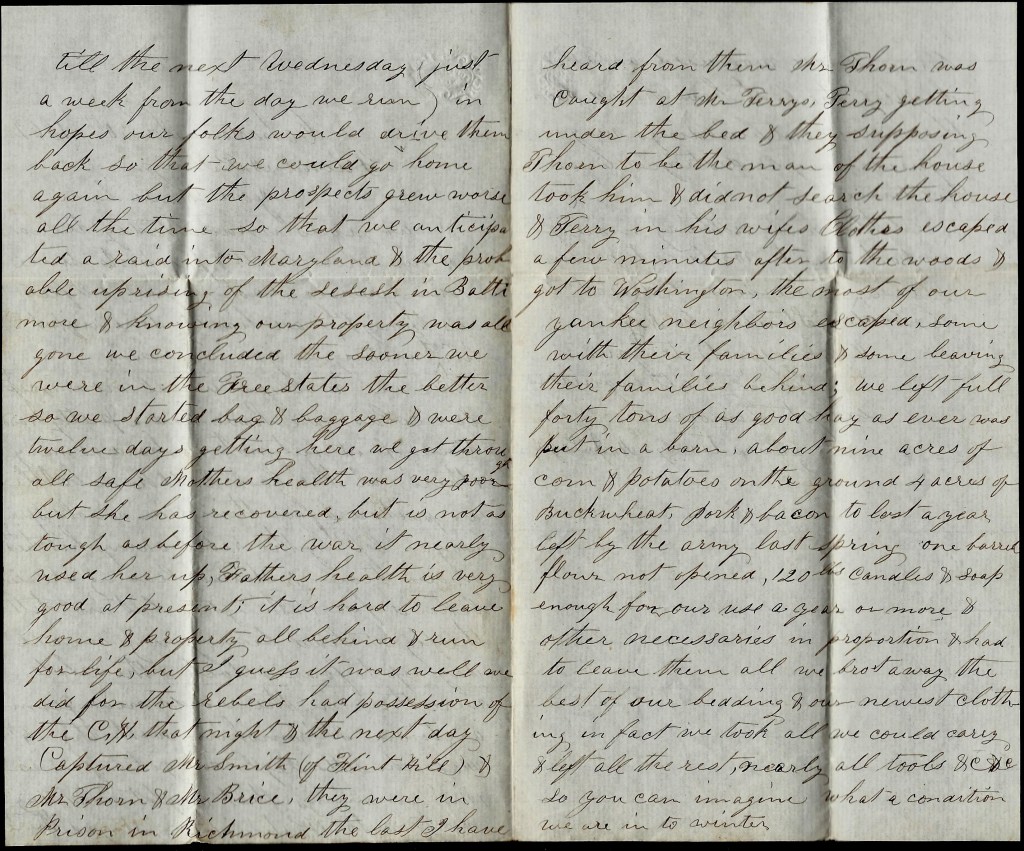
We are all well as usual now except bad color. We have had a pretty hard time of it but not as hard as many others. At the last Bull Run battle we packed a few things in an old spring wagon left by the rebel army, hitched on our team and started leaving all else behind for Washington but not till the fight had been going on all day up to four o’clock & the rebels were then in the woods near Germantown skirmishing with the 13th Massachusetts Regiment. We got as far as Mr. Demmings that night [and] next day went on to Washington & stayed there till the next Wednesday (just a week from the day we run) in hopes our folks would drive them back so that we could go home again but the prospects grew worse all the time so that we anticipated a raid into Maryland & the probably uprising of the sesesh in Baltimore & knowing our property was all gone, we concluded the sooner we were in the Free States the better so we started bag & baggage & were twelve days getting here. We got through all safe.
Mother’s health was very poor but she has recovered, but is not as tough as before the war. It nearly used her up. Father’s health is very good at present. It is hard to leave home & property all behind & run for life but I guess it was well we did for the rebels had possession of the [Fairfax] Court House that night & the next day captured Mr. Smith (of Flint Hill) & Mr. Thorn 1 & Mr. Brice. 2 They were in prison in Richmond the last I have heard from them. Mr. Thorn was caught at Mr. Terry’s, Terry getting under the bed & they supposing Thorn to be the man of the house, took him & did not search the house & Terry in his wife’s clothes escaped a few minutes after to the woods & got to Washington.
The most of our Yankee neighbors escaped, some with their families & some leaving their families behind. We left full forty tons of as good hay as ever was put in a barn, about nine acres of corn and potatoes on the ground, 4 acres of buckwheat, pork & bacon to last a year left by the army last spring, one barrel of flour not opened, 120 lbs. candles & soap enough for our use a year or more, and other necessaries in proportion & had to leave them all. We brot away the best of our bedding & our newest clothing. In fact, we took all we could carry and left all the rest—nearly all tools, &c. &c.—so you can imagine what a condition we are in to winter.
Our house was used as a hospital the last have heard from there & our out buildings very much injured & may be destroyed before this time.
I think of nothing more of importance to write at present. Please write to me soon and direct to Cohocton, Steuben county, New York.
Our respects to your family & all enquirers except Democrats. Yours truly, — A. J. Lagar
In the letter, it is stated that Rebels were in the woods near Germantown which is located at the lower right on the map.
1 Possibly Talmadge Thorne.
2 Matthew Bryce (1807-1863) was Unionist from Oakton, Fairfax county, Virginia. He died a prisoner of war in Richmond, Virginia, on 17 March 1863 at the age of 55.
Allie’s Headstone at the Oak Hill Cemetery in WDC.
This incredible and lengthy letter provides us with a vivid account of Fort Monroe, Yorktown, and Williamsburg from the perspective of a female civilian who was a native of Virginia and held strong secessionist views. Her name was Allie Catesby Jones (1836-1874) and I feel confident she was the same woman by that name who would later become the wife of Caleb Clapp Willard (1834-1905), possibly her cousin. Caleb, the son of Joseph and Susan (Dorr) Willard, was born in Vermont but came with his family to Washington D. C. about 1850. His older brothers, Henry and Joseph C. Willard, were then the proprietors of the Willard Hotel. After attending Washington Seminary, Caleb was schooled in the hotel business and sent, for his first assignment, when he was but 19 years old, to take charge of the Hygeia Hotel at Old Point Comfort which had a capacity of 1,000 guests and was the only summer hotel south of New York.
A yellow fever epidemic closed the hotel in the 1850s for a time but Caleb returned to partner with John Segar to purchase it and he had the exclusive management of the hotel until 1862 when the government ordered the hotel to be torn down because it interfered with military and naval operations. According to his obituary, Caleb was offered the privilege of superintending the destruction of the building which took two weeks. He then stayed on as a commissary storekeeper until 1864 when he went back to Washington, purchased the Ebbitts House, and became one of the wealthiest men in the District of Columbia.
I’m not certain of Allie’s parents but I believe she was the 13 year-old child named “Alice Jones” residing with Joseph and Catharine Weisiger in Hampton, Virginia, in the 1850 US Census. From her letter we learn that just prior to making the trip to Fort Monroe where this letter was datelined, she was living in St. Joseph, Missouri. She was married to Caleb on 8 September 1863 and the couple had two children, Katherine Dorr Willard who was born on 19 November 1864, and Walter Jones Willard born 1 December 1868.
Fortress Monroe, Old Point Comfort, & Hygeia Hotel in 1861-62
Transcription
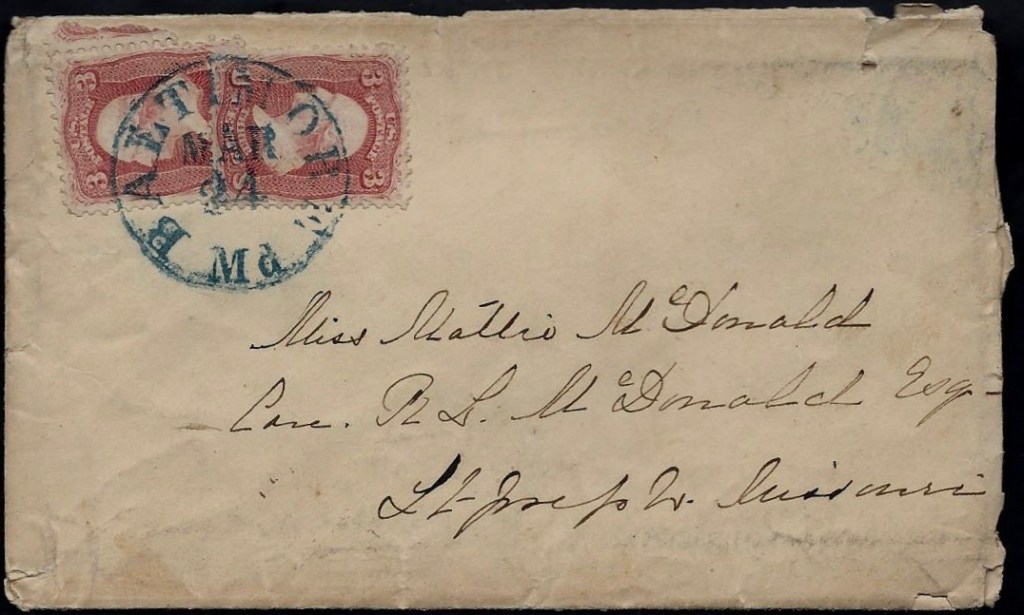
Addressed to Mattie McDonald, Care of R. S. McDonald, Esq., St. Joseph, Missouri
Near Fort Monroe March 22nd 1863
My dear friend,
There has not been an hour since I left you but my promise to write you has come up before me & I have not intended or wished to defer it so long. I have though been in one constant whirl of excitement & confusion & I did not think I could bring order out of such confusion & write such a letter as i should desire or you deserve. I am very far from being settled here now but my anxiety to hear from you all prompts me to write at all hazards. I need not tell you of our journey homeward—it consisted of the usual (no, I think ours was very unusual) amount of railroading, omnibus, shaking steam boating, & hotel stopping, of sight-seeing & shopping. So it was after being through all, after many tears and much sorrowing at leaving all all in dear St. Joe. we arrived in Baltimore on the Thursday following.
After we left Missouri, I sent a card to one very dear friend & she came at once to see me. We went shopping & such a world of lavishly beautiful goods—enough to make ones mouth water. Silks of the loveliest hues, laces fine as webs, & delicate as frost [ ] flowers which look as if they did have an odor—everything so tempting & such fabulous prices. I purchased a handsome black silk only and took to my friend Miss Fall’s, dressmaker. She only took a few measures and came out with the dress lining, fitting to perfection. I left the dress with her. I will give you an idea how fashionable dresses are made. It has four quillings, not flounces, on the shirt confined with velvet. The waist is plain. Two [ ] in front a deep point behind….Silks are very high $4.50 & 5.00 per yard.
After doing my shopping and seeing the secesh—and by the way, one of my purchases was a tiny gold microscopic view of Mr. Davis, Jackson, Bragg, Price, Lee, Morgan, Semmes & Beauregard—I left on Saturday evening and then was on the lovely Chesapeake, one side of whose waters have the shores of “My Maryland,” the other my own Virginia. We came down the bay in the lovely steamer Adelaide whose facsimile you have seen in my picture of Fort Monroe & we arrived at the fort on Sunday morning, three weeks ago today. Mr. Willard’s carriage was there for us & we came over to the Hotel—one of the loveliest places you can imagine.
This morning I just wish I had you here to examine the scenery. Fort Monroe is just a few hundred yards distant with its high stone walls & grim war dogs with the mouths pointed inland. The blue waters sparkle & dance in the sunlight. The first harbingers of spring are singing—the trees in foliage—a few flowers blooming, and everything looks bright & cheerful. But then I turn & look from another window into the country. Here lie fertile fields a waste, trodden hard by the vandals instead of growing crops, dotted all over with pitched tents, negro huts, no enclosure of any kind, lovely homes desecrated & occupied by the vandals. Many the tears I’ve shed over the desolations of my home. I find some friends here who being unable to leave have taken houses in the country. Everyone is glad to see me & this somewhat compensates for the regrets I had at leaving you all.
I have not been idle since coming here. Sister and myself & our Coz [cousin] procured a Pass from our “Old Massa”—Gen. Dix—and started to Williamsburg to see our old Aunt & her family. Coz Williard went so far as Yorktown with us. We went on a splendid steamer & arrived at Yorktown—the famous Yorktown—in the afternoon. There we procured another pass and walked around the fortifications—the same our brave Southerners had created. These were the same battlements over which the flags of our Young Confederacy had waved—the same paths where their feet had trodden—the same bold road which they had jogged upon. I must confess a thrill of joy shot through me as I remembered our Davis was here & his brave followers. I went to the house in which the “war council” was held when Davis and Lee said, “We can’t fight here, Magruder.” & he replied, “If I can’t whip them here, I can’t anywhere.” I took a piece off a tree from the yard, a piece at the gate through which they passed, and as bush overhung the gate, no doubt it has been touched by the sacred garments of our generals. We surveyed the place & after getting a few relics, returned to the boat where we remained all night.
Early next morning we took an ambulance kindly loaned by one of Gen. Keyes’ staff officers, & bidding Mr. Willard adieu, we started for Williamsburg—12 miles distant by the same road over which McClellan’s grand army pursued. I can’t describe my feelings as we passed through forests which I knew had echoed the tread of my friends over bridges which I knew had borne them. All along the road were entrenchments which my friends had thrown up—some only to mount one cannon & that to command the road.
After riding 10 miles we came to the battle ground, to “Fort Magruder”—only 3 miles from Williamsburg. Here stood the same fort but also how changed—not in outer appearance but in occupants. There lay the battlefield stretched out before me—trees shattered by cannon ball & everything quiet, as if no shrieks of dying men had risen from the earth. There is no vestige of the bloody conflict left—only a few large mounds beneath which lie some of our best men. We passed near enough to Fort Magruder to get some leaves from a tree on the parapet. We rode on and soon came in sight of the antique town, the first Capitol of Virginia. I did breathe freer to feel I was only a few miles from our capitol. Williamsburg is only about 80 miles distant.
As we passed through the streets, everything was familiar & here we see the splendid old Manor Houses built of imported brick, with high gable roofs, small windows, circular stone steps and mahogany stairways, large halls and [ ] so ancient and aristocratic one almost looks [ ]. Ladies in stiff, rustling brocades & gentlemen in shorts & powdered hair, descending the steps and promenading the halls.
We found our dear old Aunty’s family well—herself and two daughters. Our boy Jim to the wars. They have a fine large comfortable & well furnished house & plenty to eat, but everything so high. In them we saw secessionists indeed. I can’t hold a light to them & I cannot wonder when they tell us the outrages. They were in Williamsburg the day of the battle. Our army was retiring towards Richmond & the rear guard fights the battle. They tell me how our poor wounded were brought injured to the Ladies to care for. My two cousins went out & took two poor fellows to their home—almost every house had someone wounded in it. The churches were filled.
Our army left their wounded in Williamsburg & of course the Yankees coming in & taking possession found them. The Ladies of the place took linen sheets and pillow cases, fine bandages & everything for their comforts to them and carried everything for them to eat. Our wounded were badly treated by the Yankees. In the old church yard are about 60 graves, each one labeled. On each one is grown over with flowers and evergreens & hung with fresh wreaths everyday which tells the vandals who now possess the soil that they can never quench the spirit of the woman.
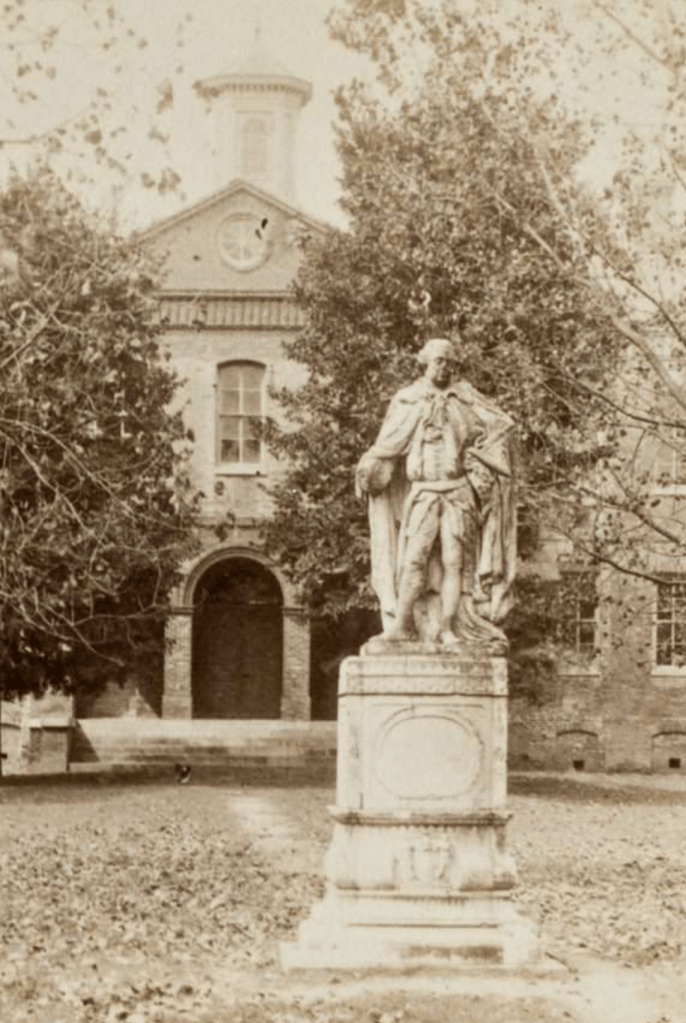
The Statue of Sir Norborne Berkeley at William & Mary College
We went out to see the town. There stands, fast falling to ruin, our “William & Mary College” where some of our bravest officers & men have received teachings. The college was burned by the Yankees 1 —now the blackened walls alone are there—no professors, no pupils. I took a piece of slate from the roof. In front of the college on the green is a splendid statue of Sir Norborne Berkeley, Gov. of the colony. This statue which has stood for years & never been defaced by her sons, is now shattered by her invaders, the hands broken off, the form defaced. 2
We go then to the “Lunatic Asylum” and here I saw the first genuine Confederate persons I’d ever seen. A Capt. Jeffreys, CSA. The lunatics are still there & though our people wish to take care of them, the Yankees won’t allow it. Capt. Jeffries was wounded in the Williamsburg battle & has never been well enough to move. He is so handsome and so warm-hearted. All of the old families are in the town & are very bitter against the Yankees. There are the Tuckers, the Southalls, the Douglasses, Wallers, Byrds & other of the FFV [First Families of Virginia]. There are no men in the town—only a few lazy villains who want to stay at home & enjoy after awhile the liberty our brave men are periling all for. The young ladies scorn them and call them Jeff’s girls, send them tiny articles of ladies wearing apparel. nibs, napkins, &c.
The Yankees say “the women of Williamsburg ain’t afraid of the Devil himself.” They tell me when the Confederates retreated through Williamsburg, the air was rent with sobs and cries of the ladies. As they would pass, they’d take off hats and say, “Goodbye ladies. God bless you. We hate to leave you.” and the girls cried themselves sick in bed. Sad the day, all tell me, to have them go & then have the despicable wretched come in. One yankee rode up to my cousin’s front window where she stood & pointed a pistol at her head. She ran from him & he followed on horseback [as she went from ] the house into the garden. She ran and he pursued until finally she dropped from fear and exhaustion and he then went off. Everyone has tales of horror to tell. We remained one week, visited all the noted places and came home laden with relics.
I must tell you of the late Confederate raid. Three weeks since one morning a body of rebels came in town. The Yankees fled as they came through. All the doors and windows long closed were opened & the ladies, old & young, welcomed them. The men said, “Good morning, ladies, how are you? You are looking very well considering the bad company you’ve been in.” Ladies asked, “Where are the Yankees? We are looking for them. Tell us where they are?” And all such fun. Tis said the Yankees ran away so fast, they did not ever mount their horses. We had a delightful visit & enjoyed the secesh talk. I heard on Sunday prayers for the “President of the Confederate States” & a southern sermon at the house of the Reverend Mr. [Thomas M.] Ambler, his church having been closed. 3
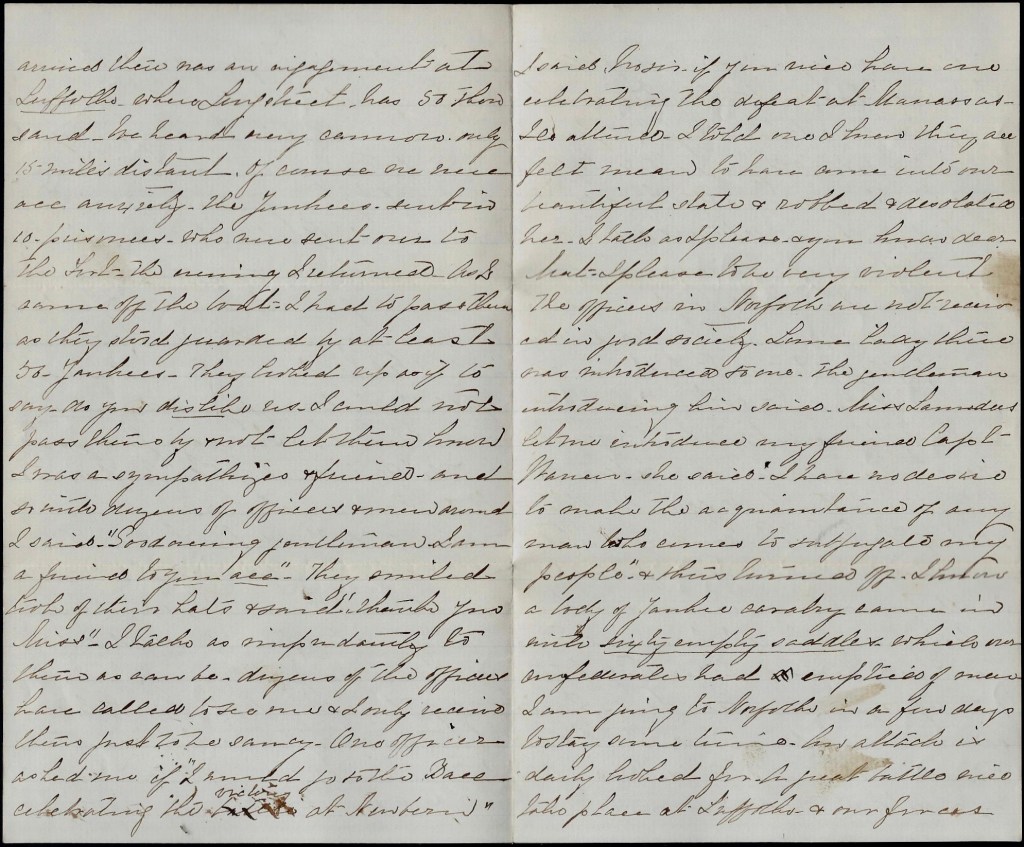
Since our return, I have been up to Norfolk to see my Mother’s family—such delight you never saw. They complain bitterly of the evacuation. I saw the obstructions in the harbor & all the forts around. Everything is quiet on the city but on the day after I arrived, there was an engagement at Suffolk where Longstreet has 50 thousand. We heard heavy cannon only fifteen miles distant. Of course we were all anxiety. The Yankees sent in 10 prisoners who were sent over to the Fort the evening I returned. As I came off the boat, I had to pass them as they stood guarded by at least 50 Yankees. They looked as if to say, do you dislike us? I could not pass them by and not let them know I was a sympathizer & friend and so with dozens of officers and men around I said, “Good evening gentlemen, I am a friend to you all.” They smiled, took of their hats, and said, “Thank you Miss.” I talk so impudently to them as can be—dozens of the officers have called to see me & I only receive them just to be saucy. One officer asked me if I would go to the Ball celebrating the victory at Newbern. I said, “No sir. If you will have one celebrating the defeat at Manassas, I’ll attend.”
I told one I knew they all felt mean to have come into our beautiful state and robbed & desolated her. I talk as I please & you know, dear Mat, I please to be very violent. The officers in Norfolk are not received in good society. Some lady there was introduced to one. The gentleman introducing him said, “Miss Saunders, let me introduce my friend, Capt. Warner.” She said, “I have no desire to make the acquaintance of any man who comes to subjugate my people!” and thus turned off. I know a body of Yankee cavalry came in with sixty empty saddles which our Confederates had emptied of men. I am going to Norfolk in a few days to stay some time. An attack is daily looked for. A great battle will take place at Suffolk & our forces victories will push on to Norfolk. Semmes has sent to the President today. He must have a port opened to take his valuable prizes to and Norfolk must be the one. An attack is daily looked for here. Batteries are moved. Gunboats in readiness & our Merrimack is dreaded. I hope to see the fight. I have seen some 50 prisoners sent by flag of truce to Richmond.
Your letter is too voluminous. It can’t fly twice but my brother in Norfolk tells me he can send a letter to Greensboro without difficulty. They talk of the USRR “underground railroad as if it was a fixed institution. I have seen several letters from the rebel army since I arrived. We are not ready yet to give up & prisoners tell me Davis scorns a compromise. Don’t believe newspaper stories. We are well off and determined as ever. But only see what a long letter I have written. I have written as if I was talking to you. I wish I might see you—I have so much more to say but I must stop.
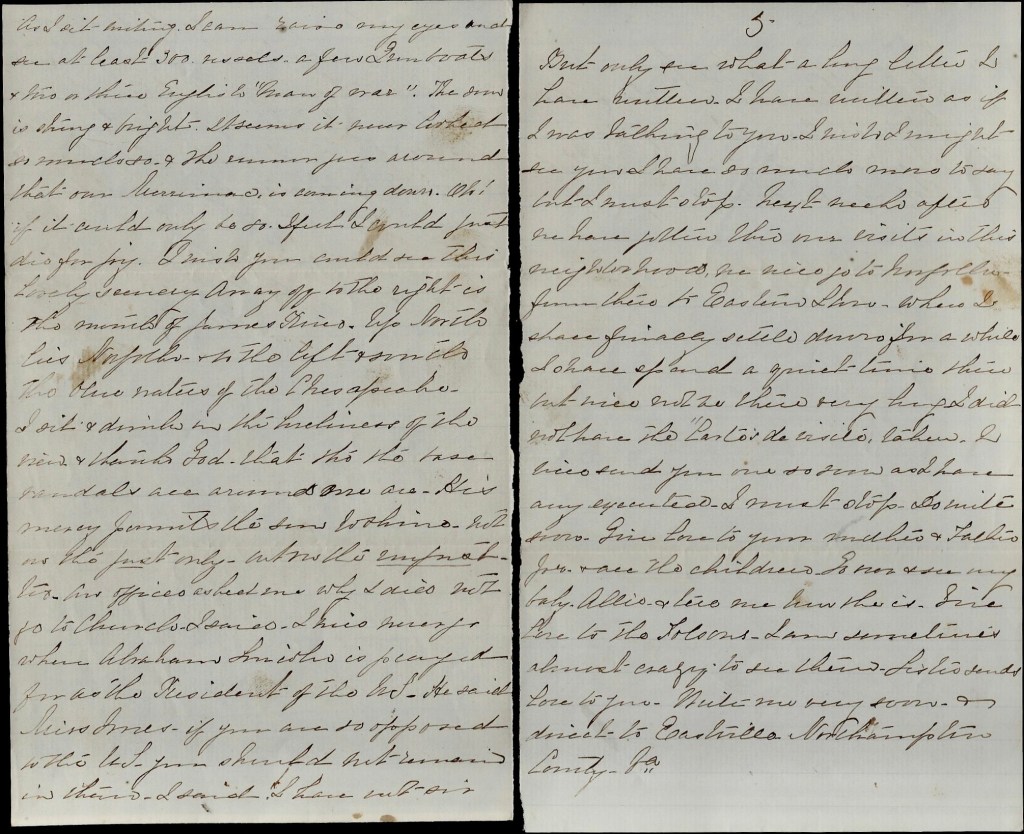
Next week after we have gotten this our visits in this neighborhood, we will go to Norfolk [and] from there to Eastern Shore where I shall finally settle down for awhile. I shall spend a quiet time there but will not be there very long. I did not have the “carte-de-visite” taken. I will will send you one as soon as I have any executed. I must stop. Do write soon. Give love to the Folson’s. I am sometimes almost crazy to see them. Sister sends love to you. Write me very soon and direct to Eastvilla, Northampton county, Virginia.
As I sit writing I can raise my eyes and see at least 300 vessels, a few gunboats, and two or three English “Man of War.” The sun is shiny and bright. It seems it never looked so much so & the rumor goes around that our Merrimack is coming down. Oh! if it could only be so. I feel I could just die for joy. I wish you could see this lovely scenery. Away off to the right is the mouth of James river. Up north lies Norfolk. To the left & south the blue waters of the Chesapeake. I sit and drink in the loveliness of the view & thank God that though the base vandals are all around me, His mercy permits the sun to shine, not on the just only, but on the unjust too.
Two officers asked me why I did not go to church. I said, “I will never go where Abraham Lincoln is prayed for as the President of the U. S.” He said. “Miss Jones, if you are so opposed to the U. S., you should not remain in them.” “I have not, sir, I am in the Confederate States. Virginia is one of them & I think it best for invaders to leave & let those [alone] who will build her up.” I am going out for a ride this afternoon along the whitest and loveliest of shores. Again let me beg you to write soon. I am with all love and a kiss in my heart for you. Your affectionate friend, — Allie
I send you a piece of lox from the yard of the Nelson house where the Council of War was held & a piece from Fort Magruder. The first one at Yorktown. The last at Williamsburg.
1 The Wren (or Main) Building of the College of William & Mary was burned in September 1862, the fire started by Union soldiers from the 5th Pennsylvania Cavalry in retaliation for the surprise raid and capture of the provost marshal.
2 In 1797 the President and Professors of the College of William & Mary purchased the statue for $100. It was removed to the College in 1801, partially repaired, and placed in front of the Sir Christopher Wren Building in the College Yard, where, as a student of the day commented, “it cut a very handsome figure indeed.” There it remained for 157 years except for a brief period during the Civil War when it was placed for safekeeping on the grounds of Eastern State Hospital. [William & Mary Special Collections]
3 Rev. Thomas M. Ambler served the pulpit in the Bruton Parish Church in Williamsburg. His church was ordered closed in February 1863 by the provost marshal when Ambler refused to pray for the President of the United States.
This unsigned, mid-July 1861 letter was written by a youthful businessman from La Grange, Tennessee. It came to me for transcription with the hope that I might be able to identify the author. The letter was written to a northern acquaintance about the present political and social situation in Tennessee, including a discussion of his own sense of allegiance to the South and his predictions about how the fateful course of events will unfold for both sides. Between the lines there is a sense of the deep struggle taking place within his own mind and heart on these issues, just as he describes it for others. Indeed, Tennessee was very much a split state as far as sentiments were concerned. Confederate allegiances were much higher in the western areas where La Grange is located than they were in the northeastern portion of the state, which Confederate troops actually had to forcibly occupy.
La Grange was incorporated as a town in 1829 and enjoyed the reputation of being the wealthiest and most cultured town in the South at the time. The oldest town in Fayette county, it is located 50 miles east of Memphis and only three miles north of the Mississippi state line. At one time, its population topped 2,000; today it claims only 160 residents. During the Civil War, the town suffered severely at the hands of the thousands of Federals who established a garrison there. Less than a week after the fall of Memphis, Union troops took occupancy of the town and after that, due to its strategic importance along the Memphis and Charleston Railroad, it was continually occupied by either Union or Confederate troops. At one time, as many as thirty thousand Union soldiers were encamped in and around the town, and over three thousand wounded or sick were hospitalized there.
This letter was written just 10 days after Tennessee was admitted to the Confederacy—the 11th and last state to do so. It is very much a manifesto of the inevitability of impending war, as well as its high eventual cost. The first major conflict—the Battle of Bull Run—was fought 9 days later in Virginia, with the Union’s prevailing belief in an early triumph dashed. The letter ends suddenly, and though it may well be only a partial letter, the absence of a signature may be intentional. In this regard, the author notes that he now is using private rather than public conveyance for his mail.
From the letter, I surmised that the author was a comparatively young businessman who worked in a La Grange store doing business with customers that would often purchase goods on credit—a common practice at the time, particularly in agrarian societies. He mentions learning the business from the “old man” which may very well have been, in the customary reference, his own father. A website on the history of La Grange informs us that between 1860 and 1862, the merchants were J. T. Foote, George P. Shelton, O. S. Jordan, C. F. Chessman, Cossett, Davis & Bryan, Fowler & Louston, T. S. Parham, R. J. Bass & Co., and John Goodwin.
After searching through the 1860 US Census records for these businessmen, I discovered that John W. Goodwin—the last named merchant—was enumerated in the 1860 US Census taken at La Grange as the 28 year-old son of 61 year-old merchant, James Doswell Goodwin (1798-1869). In researching this family, I discovered that John Watts Goodwin (1831-1922) was the oldest son of his merchant father; his mother, Catharine (Watts) Goodwin (1806-1851), had died in Rolls county, Missouri, when John was 20 years old. Digging deeper into John’s biography, I discovered that he was born in Virginia (as were his parents) and that he attended the Fleetwood (military) Academy in Virginia before attending Jubilee College in Charleston (now Brimfield), in Peoria county, Illinois. In the 1850 US Census, 19 year-old John W. Goodwin was enumerated in his father’s household in District 73, Ralls county, Missouri, where his father farmed. Ralls county borders the Mississippi river in northeast Missouri.
Given these facts, I’m inclined to attribute this letter to John Watts Goodwin, writing to a former acquaintance in Illinois or Missouri. An obituary notice for him claims that he worked for a time in various capacities for the Memphis & Charleston Railroad during and after the Civil War. In 1869 he was appointed secretary and treasurer of the Little Rock & Memphis Railroad. In 1900 he became a director of the First National Bank of Little Rock.
[Note: This letter is from the private collection of Richard Weiner and is published on Spared & Shared by express consent.]
Transcription
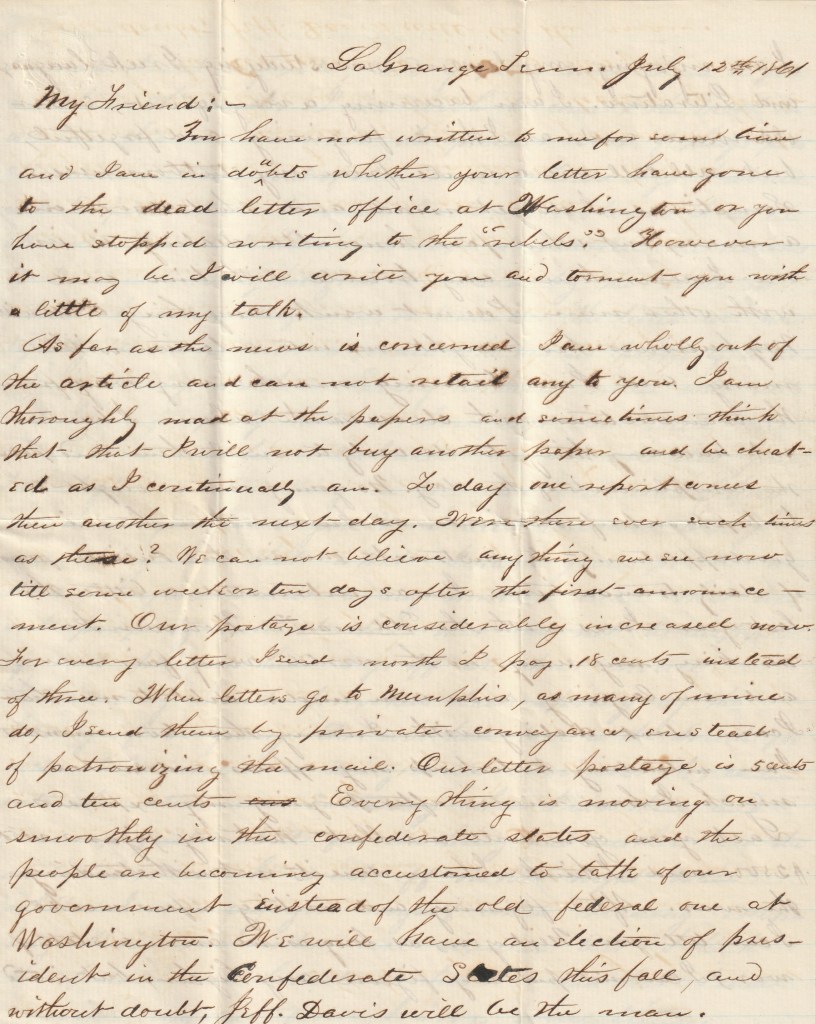
La Grange, Tennessee July 12th 1861
My Friend:
You have not written to me for some time and I am in doubts whether your letter have gone to the dead letter office 1 at Washington or you have stopped writing to the “rebels.” However it may be, I will write you and torment you with a little of my talk.
As far as the news is concerned, I am wholly out of the article and cannot retail any to you. I am thoroughly mad at the papers and sometimes think that I will not buy another paper and be cheated as I continually am. Today one report comes—then another the next day. Were there ever such times as these? We cannot believe anything we see now till some week or ten days after the first announcement.
Our postage is considerably increased now. For every letter I send North, I pay 18 cents instead of three. When letters go to Memphis—as many of mine do—I send them by private conveyance instead of patronizing the mail. Our letter postage is five cents and ten cents. Everything is moving on smoothly in the confederate states and the people are becoming accustomed to talk of our government instead of the old federal one at Washington. We will have an election of president in the Confederate States this fall, and without doubt, Jeff Davis will be the man.
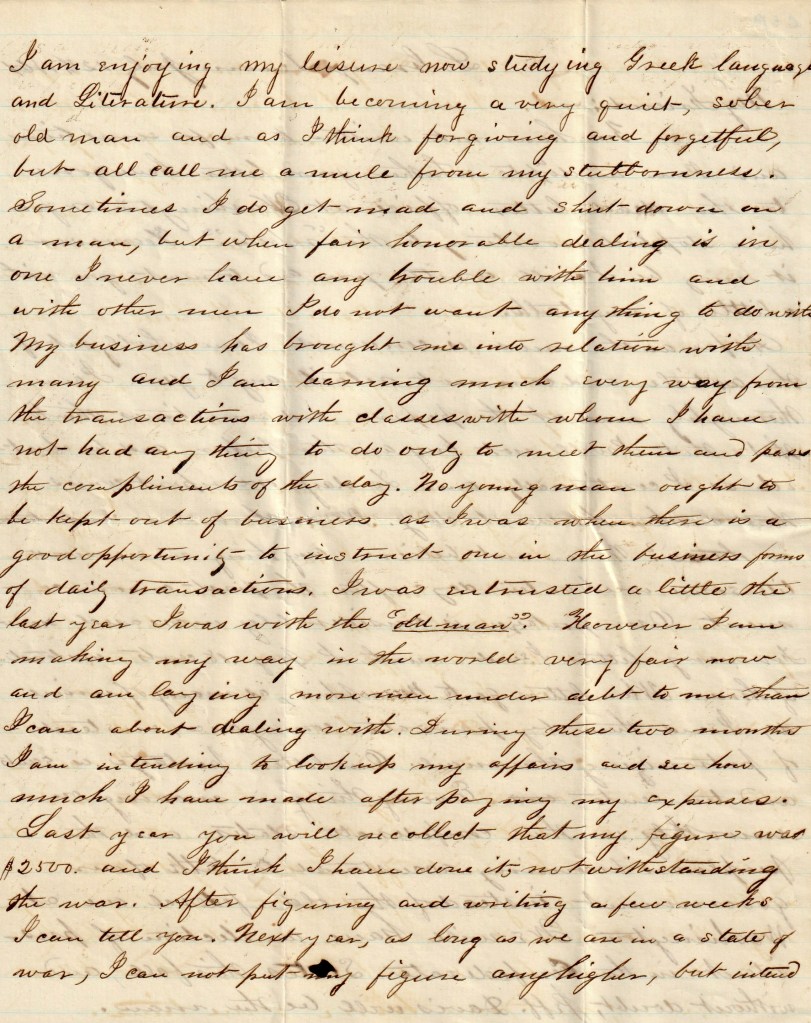
I am enjoying my leisure now, studying Greek language and literature. I am becoming a very quiet, sober old man and as I think—forgiving and forgetful. But all call me a mule from my stubbornness. Sometimes I do get mad and shut down on a man, but when fair honorable dealing is in one, I never have any trouble with him and with other men I do not want anything to do with. My business has brought me into relation with many, and I am learning much every way from the transactions with classes with whom I have not had any thing to do—only to meet them and pass the compliments of the day. No young man ought to be kept out of business as I was when there is a good opportunity to instruct one in the business forms of daily transactions. I was entrusted a little the last year I was with the “old man.” However, I am making my way in the world very fair now and am laying more men under debt to me than I care about dealing with.
During these two months, I am intending to look up my affairs and see how much I have made after paying my expenses. Last year, you will recollect, that my figure [goal] was $2,500 and I think I have done it, notwithstanding the war. After figuring and writing a few weeks, I can tell you. Next year, as long as we are in a state of war, I cannot put my figure any higher, but intend to make it at any rate. And if peace comes I am in for another thousand.
I did wish to come to the North on a visit this summer but the present state of things puts all such notions out of one’s head. Should I go, I would not be permitted to come back. Nor should I so be allowed. Now that there is a conflict between the sections, it becomes every citizen to stand by the state to which he owes allegiance—or leave it. The lines are now tightly drawn and a man who has no property interest is closely watched. Every Northern man who did not have property interest here left, and some—one at least—and he a dishonest one—have also gone. Two left without calling on me and even asking, “how much do I owe you?” I am ashamed to say one thing, and that is that I have given positive orders to refuse credit to any northern man that has not property interest here that can be disposed of and permit him to go off at short notice.
I was very much provoked last spring by the leaving of a young Dr. who had been in the South for some time and was doing some business. He came into the store one Saturday when I was there and run up quite a bill for one thing and another and the very next week went off on the night train while I was enjoying myself either reading or sleeping. There was another case similar but I think the fellow was honest at heart and that I shall receive my due from him some time. As a matter of course, interest will keep a man when, were he free from anything that bound him to a place, he would return to his old allegiance. Such seems to be the case here now and men and women that can get away seem to do so. On the other hand there are many men here of northern birth who are true to the South. Many have every reason to be so. Wife, children, slaves, and all their friends and interest, bind them to this and no other portion of the earth, and now that the conflict has come, there is but one step for them to take—viz: to espouse the cause which lies nearest to their hearts.
These are hard times and many are the troubles that are to follow if this war is to be prosecuted as the message of Lincoln seems to indicate it will be. Let them push on but my opinion is that—let it turn out as it may—there will be a debt heavier than any ever dreamed of before. I very much doubt whether the new loan and levy will accomplish his object. After his money is spent and his army unpaid, Mr. Lincoln will find the same race of rebels in the South and an army for him to meet. The commercial interest of the South will be prostrated if England respects the federal blockade. The northern shipping must feel it also as they must lie idle and do nothing. Manufactories at the North are now closed and will stay so till the war is over and amicable relations again restored—not as the same nation, but as two separate and independent republics.
1 The Dead Letter Office opened in 1825. By the 1860s, with the nation’s men busy fighting in the Civil War, women employees outnumbered the men 38 to 7. These mostly female clerks acted as “skilled dead letter detectives,” inspecting the mail for potential clues about who sent it or where it was going.












 Spared & Shared 23