Category Archives: Commissary of Subsistence

1864: Cardella E. Brown to his Relatives

This beautifully written letter was penned by Cardella E. Brown (1841-1896) who was a clerk at the Connecticut Mutual Insurance Company in Hartford, Connecticut in 1860. His parents were divorced and he lived with his mother in Hartford while his father lived in New York City with his second wife and Cardella’s brother Gerald and sister Lulette, while Brown’s other brother Henry was employed as a printer in Boston.

In September, 1861, Brown was mustered in as a Corporal in Co. B of the 6th Connecticut Regiment. He served three years and muster rolls record that he was discharged in September 1864 as a Sergeant. It’s presumed that Cardella elected to stay with the army following his discharge to serve as a civilian in the commissary. Suffering from depression, Cardella shot himself in 1896 at the age of fifty-five, leaving a widow and three sons—one of whom was named Cardella Drake Brown (the “Drake,” no doubt, from his “Uncle Drake” who is mentioned in this letter.)
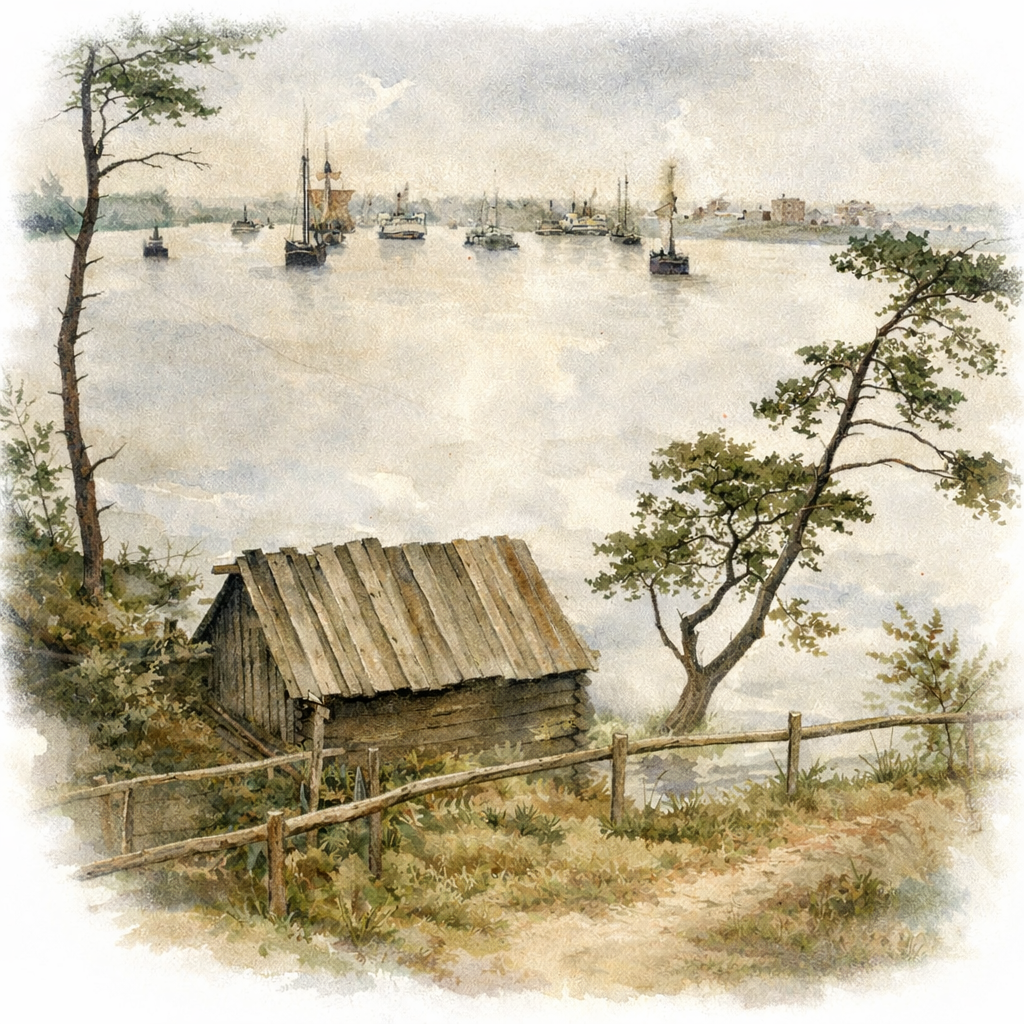
James’ Landing, Virginia in 1864

The Huntington library holds three volumes belonging to Cardella E. Brown. The first is a letterpress copybook containing approximately 100 outgoing personal letters Brown wrote from 1859 to 1861 while he was living in Hartford, Connecticut and working as a clerk at Connecticut Mutual Insurance Company. The letters are addressed to Brown’s parents, siblings, a cousin, and other family members and friends. The detailed and candid letters are written in a conversational tone devoid of usual epistolary formalities. The letters comment on a wide range of topics, including Brown’s personal life and sexuality, goings on in Hartford, and state and national politics of the 1860 election year. He talks in detail about Stephen A. Douglass, the anticipated secession of South Carolina, the Buchanan administration, and the hanging of John Brown. [Archived @ The Huntington]

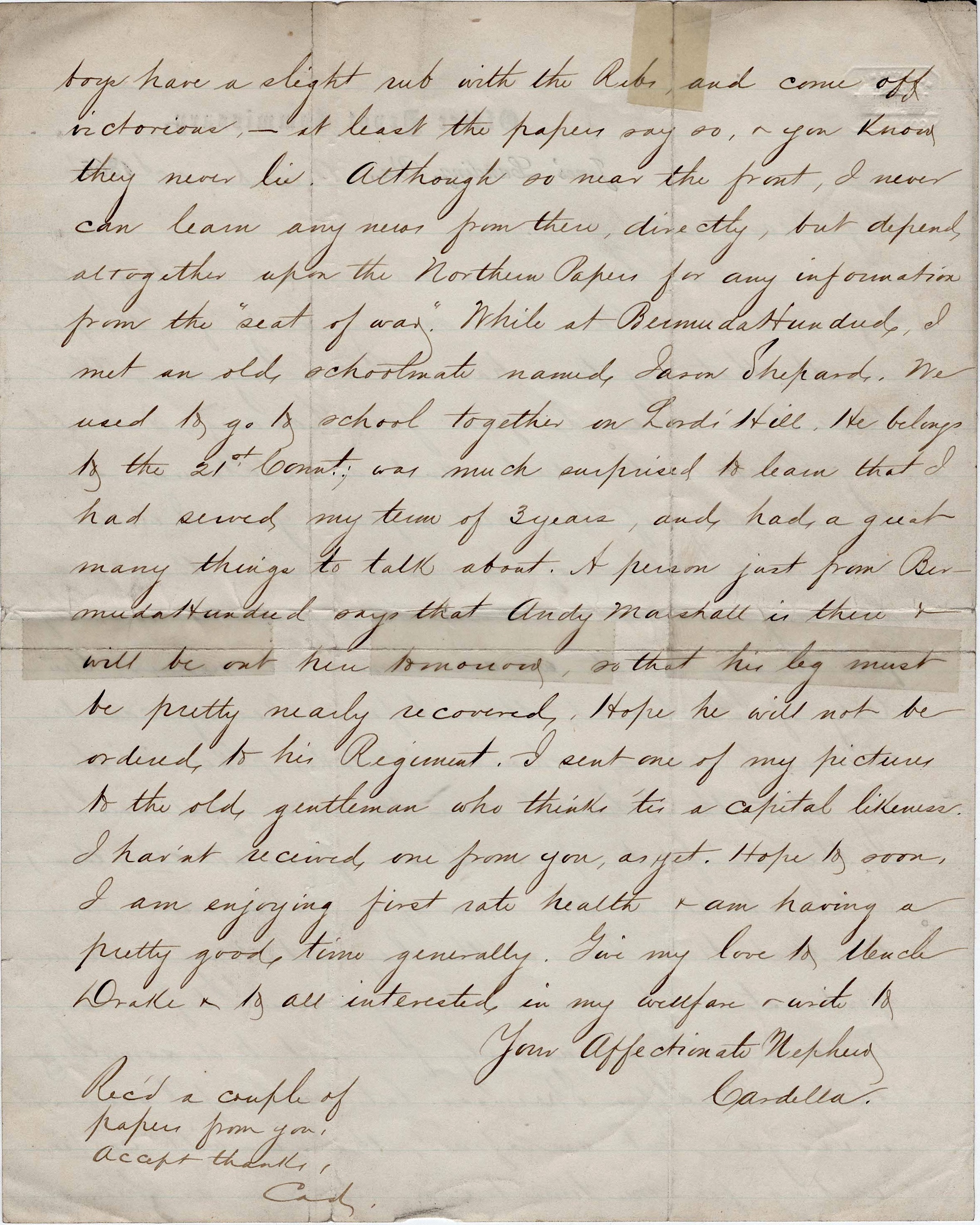
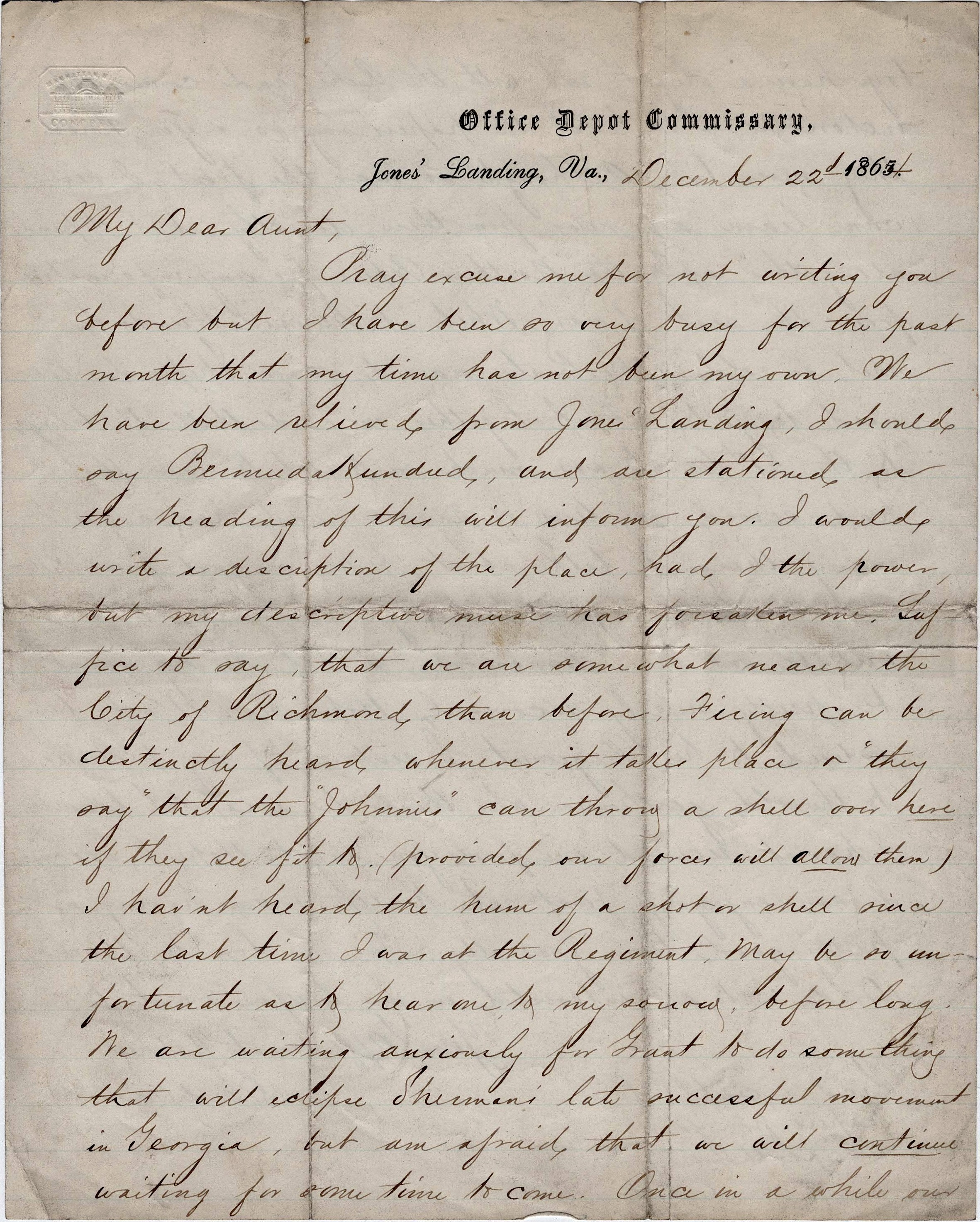
T R A N S C R I P T I O N

Office Depot Commissary
Jones’ Landing, Va.
December 22d 1864

My dear Aunt,

Pray excuse me for not writing you before but I have been so very busy for the last month that my time has not been my own. We have been relieved from Jones’ Landing—I should say Bermuda Hundred—and are stationed as the heading of this will inform you. I would write a desription of the place had I the power but my descriptive muse has forsaken me. Suffice to say that we are somewhat nearer the City of Richmond than before. Firing can be distinctly heard whenever it takes place & “they say” that the “Johnnies” can throw a shell over here if they see fit to (provided our forces will allow them). I haven’t heard the hum of a shot or shell since the last time I was at the Regiment. May be so unfortunate as to hear one to my sorrow before long.

We are waiting anxiously for Grant to do something that will eclipse Sherman’s late successful movement in Georgia, but I am afraid that we will continue waiting for some time to come. Once in a while our boys have a slight rub with the Rebs and come off victorious—at least the papers say so, & you know they never lie. Although so near the front, I never can learn any news from there directly, but depend altogether upon the Northern papers for any information from the “seat of war.”

While at Bermuda Hundred, I met an old schoolmate named Jason Shepard. We used to go to school together on Lord’s Hill [in Hartford]. He belongs to the 21st Connecticut. Was much surprised to learn that I had served my term of three years and had a great many things to talk about. 1

A person just from Bermuda Hundred says that Andy Marshall is there & will be out here tomorrow, so that his leg must be pretty nearly recovered. Hope he will not be ordered to his Regiment. 2

I sent one of my pictures to the old gentleman who thinks tis a capital likeness. I haven’t received one from you as yet. Hope to soon. I am enjoying first rate health & am having a pretty good time generally. Give my love to Uncle Drake & to all interested in my welfare or write to your affectionate nephew, – Cardella

Received a couple of papers from you. Accept thanks, — Card.


1 Jason J. Shepard (1841-1916) served in Co. A of the 21st Connecticut Infantry from 5 September 1862 until 22 November 1863 when he was transferred to the US Signal Corps. He was discharged from th service in June 1865. He was born in western Massachusetts but in 1860 was residing in Hartford, Connecticut. After the war he married and settled in Hartford until late in life when he moved to California.

2 Andrew Marshall was the 2nd Lieutenant of Co. B, 6th Connecticut Infantry.
1864: Augustus Granville Randall to a Friend

The following letter was written by Augustus Granville Randall (1813-1898), a lawyer of Lincoln, Penobscot, Maine. He was married to Mary Shannon Sanders (1823-1866) in 1847 and had at least five children by 1863. The following biographical sketch appears in a history of Lincoln, Maine, though it fails to mention that he served in the State Legislature prior to his military service. It also fails to mention that before he was discharged from the service, he had to stand trial for a charge of “habitually selling subsistence stores at a rate exceeding prices invoiced” without accounting for the excess. He plead not guilty to these charges but was subsequently found guilty.

“Mr. Randall was the son of Nathan Randall, born in Leeds, Me., 15 June, 1813-; died in Chicago, 22 Feb., 1898. Mr. Randall was a lawyer in Passadumkeag in 1839., and went to Lincoln, probably, in the winter of 1848, and was a lawyer in Lincoln till 1864, when he went to Oshkosh, Wis., and from there he removed to Chicago in 1892. In 1863 he had entered the Commissary Department of the army, his appointment being signed by President Lincoln, and he served with the rank of Captain till the close of the war. Mr. Randall, during his residence in Lincoln, was active in the municipal affairs of the town and in temperance and civic reforms. On the 22 Oct., 1859, a division of the Sons of Temperance was instituted at Lincoln in which Mr. Randall, with a dozen of the· more prominent citizens, was active. He had been identified with these affairs while in Passadumkeag.” [History of the Town of Lincoln, by Dana Willis Fellows, page 109.]

Augustus wrote the letter soon after arriving in Washington D. C. in early June 1864 after having been commissioned into the US Volunteers Commissary Department. He served on this position with the rank of Captain until May 1865 when he was dismissed from the Commissary Service Volunteers.

Transcription

Washington
June 5th 1864

My dear sir,

Your very kind favor of the 2nd inst. has just been received and I assure you it was a most welcome message. Please accept my thanks for it, and be assured that nothing will give me greater pleasure than a correspondence with you. You are mistaken as to my feelings in leaving Old Penobscot. I did not feel cross. It is true there were some things I could have wished had been otherwise. You know what they are. It has never been any part of my political life to lie, cheat, and deceive, and I detest those who do. What little political record I have is in Old Penobscot. I am not ashamed of it. I shall return there if I live one of these days and, perhaps, may have an opportunity to help some of my friends to places of honor and trust.

In regard to Main[e] politics, I feel the same interest I always felt and wish I could be there to help the campaign along. As to the judge of Probate, any man but Godfrey. Don’t renominate him. Hilliard is the best of the three by all odds yet he would not be my choice. But if one of the three you mention must have it, take Hilliard.

Hon. John Hovey Rice (1816-1911), ca. 1864

And for Congress, don’t fail of giving Rice a renomination. There is no man stands better here than John H[ovey] Rice and no one can accomplish much for the 4th District and for Maine as he can. Besides, it is no time to send green hands here, and no intelligent constituency will do it. It would be worse than folly—yes, suicidal to do so. Maine must keep her faithful and tried representatives here during this struggle for Constitutional liberty, and not send men here, who, during these three years of terrible war for the Union have but recently found where they are. These men who have been so long coming to the light, see it but dimly now and will be quite likely to fall back into utter darkness. Mr. Rice is not only a popular man in Congress, but an industrious, working man. Every moment of time, aside from his public duties, is devoted to the wants of our poor wounded soldiers from early morning until noon—the hour Congress meets—and from adjournment until 11 & 12 o’clock at night he is visiting the different hospitals, writing letters, sending dispatches, &c. &c. for the boys of his District. Mrs. [Grace E. (Burleigh)] Rice labors equally hard. To set aside so faithful and devoted public servant at this time of our country’s peril for a green hand of somewhat doubtful political stripe, would be an act of folly I never shall believe Old Penobscot will be guilty of.

For President & Vice [President] we all go for Lincoln & Hamlin and they will be nominated. It would be too personal and unjust to leave Hamlin off and take Dickinson or Johnson.

I suppose you have seen my appointment and confirmation in the Commissary Department. This is a good place and pays well, provided I can procure the necessary bond. The duties are to receive & distribute subsistence to some division of the Army. The rank is that of Captain of Cavalry. I am entitled to one, & in certain cases, two clerks at from 75 to 100 per month & rations. How I wish I could have you here with me.

I shall not move my family here at present, if at all. I room at 421 11th Street between G & H West and board at the New England Restaurant. I have not got settled yet. Shall take a larger room soon and board at a hotel—a good boarding house. If you come here, and I hope you will, come to my room and I will take care of you as long as you stay. If I change quarters, I will inform you in season.

Clark, postmaster, has been removed and is now about the State of Maine Agency, in what capacity I know not. Azro is, or was here a few days ago. I should be very glad to have you send me some Maine papers. Two cents postage on 4 oz.’s without regard to number of papers is the law now. Printed matter goes by weight. 4 oz. two cents; 8 oz. 4 cents.

Now Mart, I have written you a hasty letter and hope I shall receive an answer soon. Remember me to all my friends, if I have any, in that section—particularly to your wife. Give my regards to Mag Smith, Mr. Jameson and others. With great respect, your friend & servant, — A. G. Randall

Don’t forget me to my friend Hammatt. I wish I could have seen him longer.

The following documents from Fold 3 reveal that Augustus G. Randall was actually nominated for his position by the Hon. John H. Rice. I do not see any evidence that President Abraham Lincoln signed his appointment letter despite what his obituary says.