
The following letters were written by Don Fernando Johnson (1819-1888), the son of Stephen Johnson (1786-1853) and Electa Noble (1787-1878) of Vernon, Tolland county, Connecticut. At the time of the 1860 US Census, Don was residing in Willimantic, Windham county, Connecticut, and employed as a master carpenter. He was married to Sarah Cordelia Crane (1825-1894).
Johnson’s first letter, written to his mother, refers to the death of his father-in-law, Millen Crane (1802-1863)—the husband of Sally (Bennett) Crane (1807-1886) of Mansfield City, Connecticut. We learn from the letter that Millen Crane contracted typhoid fever while visiting his son, Lt. Alvin M. Crane (1839-1922) of Co. D, 21st Connecticut Infantry, in Portsmouth, Virginia, where Alvin was on Provost Duty. Alvin survived the war but was wounded in the Battle of Drewry’s Bluff in May 1864.
Johnson’s second letter speaks to the progress of the war as Grant’s Overland Campaign began and also refers to the recent Gold Hoax.
Letter 1
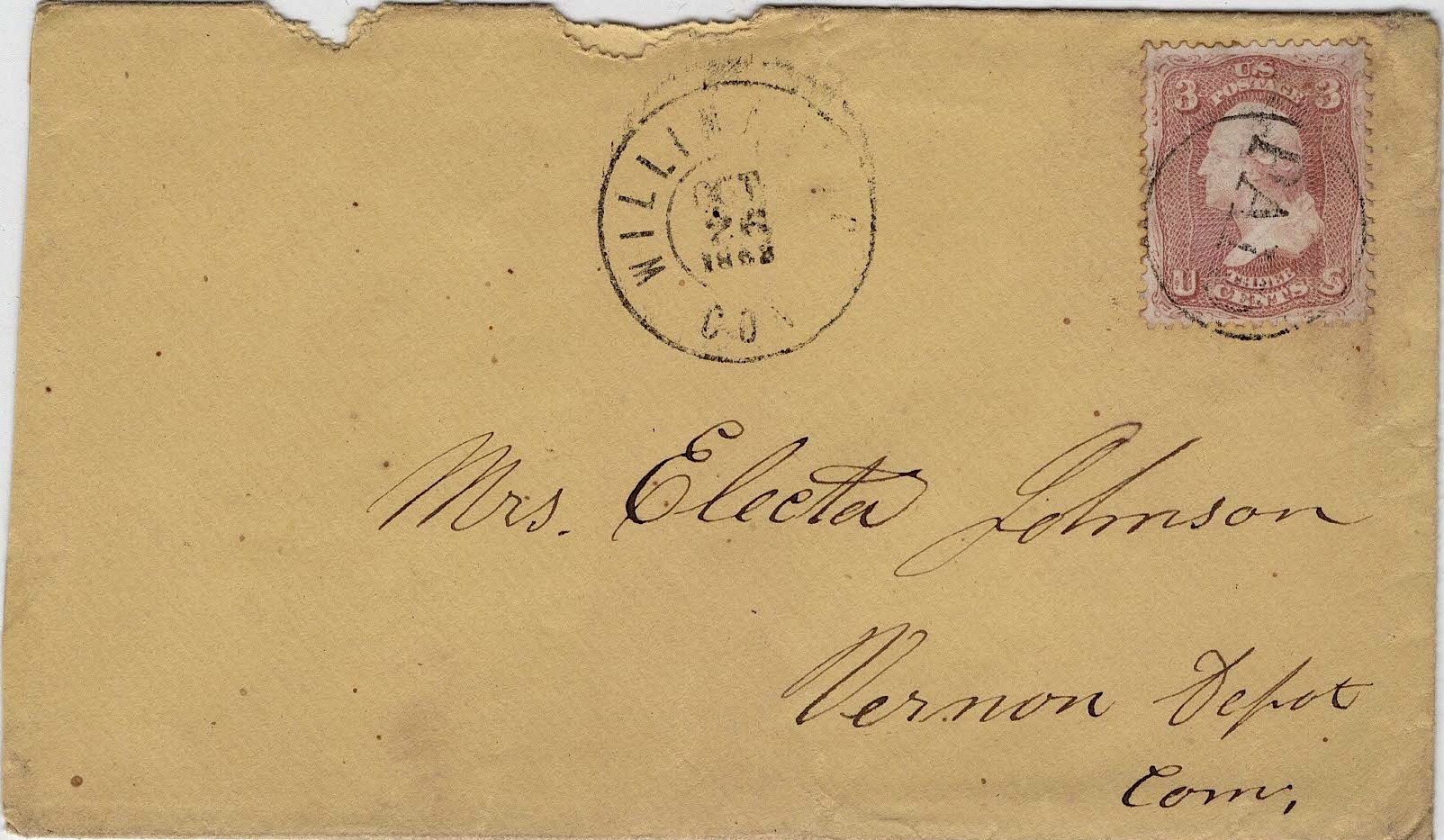
Willimantic [Tolland county] Connecticut]
October 25th 1863
Dear Mother,
The delay of this letter which I intended to have written a week ago was caused by the sickness of Father Crane which you probably heard of by way of Sarah’s letter to Harriet. I have now to announce to you his sudden death. He died last Tuesday, the 20th, about 1 o’clock p.m. His funeral was Wednesday the day after. It was thought not prudent to put it longer time as his disease was such which was considered by the doctor the Camp Fever, or Typhoid of the worst kind.

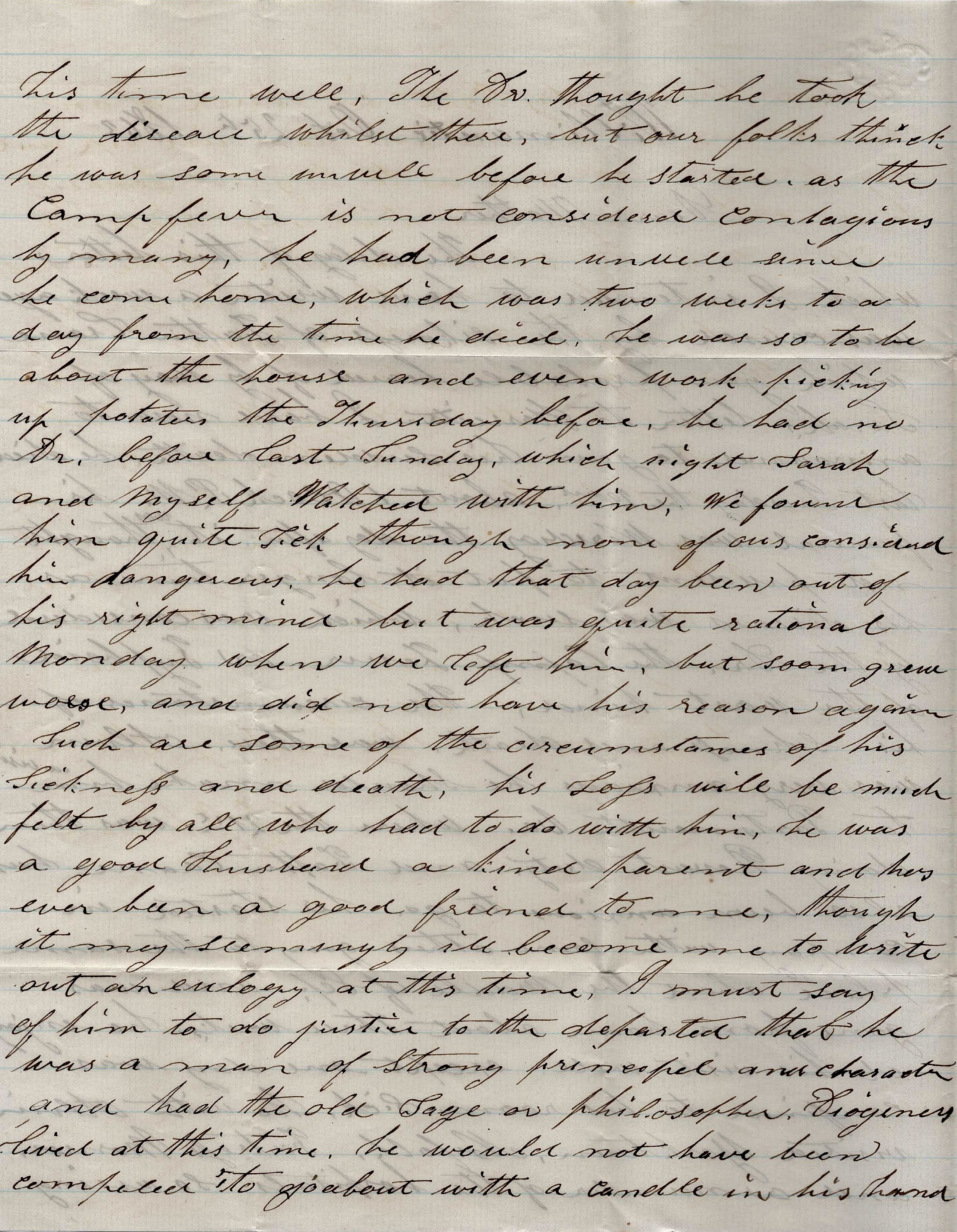
The circumstances of his sickness and death were these. Alvin was very anxious he should make him a visit to Portsmouth, Virginia, where the 21st was then doing Provost duty, and Father Crane has also been anxious to go. He started in company with some others going to the same place about the middle of September and was gone from home about three weeks. He enjoyed his visit well except one day was confined to his room sick. He with Alvin visited Yorktown, Norfolk, Fortress Monroe, and a number of the hospitals so using his time well. The doctor thought he took the disease whilst there but our folks think he was some unwell before he started as the Camp Fever is not considered contagious by many. He had been unwell since he come home, which was two weeks to a day from the time he died. He was so to be about the house and even work picking up potatoes the Thursday before. He had no doctor before last Sunday which night Sarah and myself watched with him. We found him quite sick though none of us considered him dangerous. He had that day been out of his right mind but was quite rational Monday when we left him, but soon grew worse, and did not have his reason again.
Such are some of the circumstances of his sickness and death. His loss will be much felt by all who had to do with him. He was a good husband, a kind parent, and has ever been a good friend to me. Though it may seemingly ill become me to write out an eulogy at this time, I must say of him to do justice to the departed that he was a man of strong principle and character and had the old sage or philosopher Diogenes lived at this time, he would not have been compelled to go about with a candle in his hand in broad daylight in search of an honest man for no one can rise up and say he was not. And to his great tenacity to what he thought was true and right, I will only quote what was said by the preacher of his funeral discourse: that he was made of that fit kind of material for a martyr.
We are getting on about as usual. I am at work about in the village. Have no help now and doing some repair shingling, &c. We shall look for Harriet now any time Sarah wants to have her come before she commences her school. I have heard nothing from you since Sarah was to B. Write us soon all the news. We are having fine weather now besides beautiful moon light evenings. I must close this hoping this finds you all well. — D. F. Johnson


Letter 2
Willimantic
May 22, 1864
Dear mother,
My delay in writing you before may be charged to the account of much visiting back and forward of late, which we were very glad to receive….
What warm weather for the Spring months. It is like summer. The leaves are about as much grown as they usually are the middle of June. The grass has got high enough to make butter lower. The birds sing whilst they busy making their nests. Great big bumble bees to the consternation and astonishment of my wife and Mrs. Bradley fly in and mount the sugar bowl just the same as if it were cheap as of old. The lilac are in full blossom; also the apple trees, filling the air with odorous and fragrancy so pleasing to smell, whilst Johnny Atwood goes barefooted and has blown out in the seat of his trousers. In fact, everything seemingly indicates a forward season.
The war news now most engrosses the attention. About half of it is bogus but enough is known of Gen. Grant’s movements to give the people confidence that he will give the Rebs hell before long. By his management, the result of this campaign is beyond the region of doubt so far as human eye can see.—“Mudsills” are now in the ascendant and will be historical in the admiration and praises of the times to come. But a great deal more blood has yet to flow, but the right must prevail.
The forged Proclamation created universal astonishment all over the country. the perpetrator of that document should be caught and his wind shut off at once. [see Civil War Gold Hoax]
We have the names of some of the Willimantic Boys killed or wounded in the late fights—none that you know. Lieut. [Charles A.] Wood went from this place in the 7th Conn. Vols., married here, [and] is reported killed [at the Battle of Drewry’s Bluff on 14 May 1864]. His parents live in Rockville.
[My brother-in-law] Alvin [Crane] is with Butler before Richmond. They will have some hard fighting to do there. If Harriet is at home, tell her that when Lester wasn’t but three days old, or before he had the whopping cough or a little before, he broke out with the measles. He come very near having the small pox. I guess if I had not known how to doctor no better than most folks do, he would have died if he had had it. But I think it was the itch that saved him as it made him scratch to get along so well so to be so bold a Captain….




 Spared & Shared 23