The following letter was written by 52 year-old Rev. Henry G. Stewart (1811-1871), a native of Vermont employed as a clergyman in Warwick, Kent county, Rhode Island, on the cusp of the Civil War. He was married to Ardelia Bailey Day in 1841 and had several children one of whom—Sarah (b. 1846) added a post script to this letter. He wrote the letter to his older brother, Harvey Stewart (1798-1868), a farmer in Clarendon, Rutland county, Vermont.
In his letter Henry refers to the Rhode Island Association for Freedman that was established in early February 1864 (predating the Freedmen’s Bureau by almost a year) of which he anticipated serving as a general agent upon his return from a trip to the Mississippi river valley to visit the Freemen’s (Contraband) Camps sited there. Some of the best accounts of the condition of these Contraband Camps was captured in a piece by E. C. Collins, the Secretary of the Friends Association of Philadelphia; see—1863-64: Condition of Contraband Camps.
Henry also refers to the 14th Rhode Island Heavy Artillery Regiment (Colored) that was mustered into service at Providence in late August 1863 for three years service. They were later designated the 8th US Colored Heavy Artillery, and then again to the 11th US Colored Heavy Artillery. They spent some time garrisoning a fort on Matagorda Island, Texas.
Transcription
Providence [Rhode Island] March 28th 1864
My dear Brother,
Your last came duly to hand and I have only time to say a few words in reply. Tomorrow I expect to start for New Orleans direct, by transport from Newport, with the 14th Rhode Island [Heavy Artillery] Regt. (Colored). I go with them as far as New Orleans, from whence they will go to Texas and I shall go up the Mississippi river to visit the different camps of the Freedmen on its banks between New Orleans and St. Louis. I expect to be absent eight or ten weeks and will write you again on my return, and perhaps while I am on my tour, I go as a delegate of the Christian Commission, not for, and as General Agent of the Rhode Island Association for Freedmen in whose behalf I expect to labor in Rhode Island and vicinity after my return. My pay is $75 per month and expenses paid.
We are all very well at present. Sarah has recovered from her severe sickness excepting strength. There is nothing of special interest with us. Yours truly, — H. G. Stewart
[to] Harvey Stewart, Esqr.
P. S. Dear Uncle, I have had some pictures taken for our friends in Vermont. Since I have lost my hair by the fever as a “natural curiosity”—enclosed is one for your family. Your affectionate niece—Sarah
The following 12-page handwritten document contains extracts from letters sent to the Friends’ Association (Quakers) of Philadelphia by agents sent out throughout the South to alleviate the suffering, attend to the needs, and to educate the large numbers of refugee slaves who entered Contraband Camps established by the military in 1863. The misery of the ex-slaves’ past lives, as well as the level of ignorance in which they had been maintained, is countered by their hope for the future.
Transcript
The following extracts from letters recently received embody such information as can be gleaned from them for the benefit of our friends at a distance. — E. C. Collins, Secretary
December 24th 1864
Elkanah Beard and his wife Irena organized a relief effort for freed slaves in the Mississippi River Valley.
“I have very recently visited the camps between here & Vicksburg (12 in all) containing about 26000 freed people. Nearly one half of these people are doing tolerably well, all things considered. The others are suffering in various ways; thousands have not a change of raiment and no bed clothing and are compelled to quarter in tents that shield them but very little from the weather—the cold rains and freezing winds of winter. From this exposure they cannot avoid pneumonia, small pox and other diseases incident to camp life are on the increase and more fatal. There are several thousands in other camps that I have not visited; in the interior of Arkansas if reports are to be credited, there is more destitution than in any camps on the river. From a lack of clothing or goods to be made up, a vast number that are convalescent, will no doubt, be chilled to death.
Schools have been organized in nearly all the camps on or near the river which are largely attended and most of the pupils are making rapid progress in learning. Stocking, yarn and knitting needles are very much needed, and many begged me to furnish them, but as yet I have not been able. With desires that all friends of suffering humanity may be fully aroused to a sense of duty and immediate action, I conclude for want of time to add more.” – Elkanah Beard, Memphis, Tennessee
[Note: the Elkanah Beard letter was published in full in the Friends Review of 23 January 1864, pp. 323-324.]
Helena, 1
“The condition of this camp is far from satisfactory though superintendent Kenick is doing all that he can to improve it. The visit to it was a very sad one, and I longed for a supply of clothing at once to relieve the needs of the poor creatures who in many cases had but one garment and were suffering from cold and disease. There is a peculiar dampness in the atmosphere which makes the cold hard to bear. The number of colored people here during the past year has been some 4,000. There have [been] 1,100 deaths. This statement tells the story. They want underclothes and children’s clothing. Garments for the men are not needed as they have the clothing of deceased soldiers which they use for outside garments. In one case I saw a sick woman in bed who had nothing but a blanket in which she rolled herself. Children’s shoes are very badly needed here. I think almost the best thing we could do would be to send some shoemaker’s tools and several sizes of lasts for women and children with suitable thread. They can get leather here and there are several shoemakers among them who understand how to use the tools.”
— Samuel Shipley
1 In May 1863, a Quaker man named Levi Coffin visited Helena, where he met with an old neighbor, William Shugart. Coffin wrote that he found 3,600 contrabands in Helena working either in the service of the government or as farmers. Many blacks were living in three large churches, while others found shelter in houses and in tents. Coffin referred to other camps between Helena and Vicksburg, Mississippi, among them Camp Deliverance, Camp Wood, and Camp Colony. However, shortly after Coffin’s visit, these camps were attacked by the Confederates, and many blacks perished in the burning cabins in which they were housed.
2nd letter from S. Shipley, dated Vicksburg
Vicksburg represents a number of camps. The general superintendents of the Western & Southwestern camps is Col. John Eaton. He is one of nature’s noblemen. Happy are these oppressed people that they have found such an advocate & defender. He strongly advises us to send out an agent who understands farming. He expressed much satisfaction in the labors of the Friends—says that all we can do will be needed; that the work is colossal. There are two schools here with 500 scholars and 20 teachers. Some classes are taught by soldiers. 30 learned to read in 8 weeks. Clothing is hard to procure; calico sells for 50 cents per yard. A tin basin for $1, and all other things in proportion. The greatest trouble is in the camps outside of the city limits. I rode on horseback to Blake’s Plantation; 2 though the superintendent, Capt. Elliott, is doing all he can, there is great suffering there. About 1,600 are in two camps. In my walks there through the quarters, I found many poor creatures wornout with long years of suffering & privation, some of them now over 75 years old, on beds of sickness with scarcely clothing to cover them. You would be deeply moved to hear them thank their Heavenly Father for the great boon of Freedom and express themselves satisfied that He could care for them. No tongue can tell what they have suffered. I authorized Capt. Elliott to buy two stoves for a large room in the second story of a barn hitherto unused because it could not be warmed. He proposes to use this room as a hospital. I shall direct E[lkanah] Beard to supply this camp with clothing. There are numerous camps of which we hear little or nothing.”
2 See Letter No. 5, 1863-64: THURLOW JOSEPH WRIGHT TO CAROLINE S. WRIGHT describing Blake’s Plantion; “[Benson Heighe] Blake Plantation about ten miles from Vicksburg on the Valley Road. The husband of Mrs. Blake is a colonel in the rebel army. She is living on the plantation and depends upon the government for rations. The Blake’s Plantation are three in number which contain many thousands of acres of as fine land as the sun ever shone upon. She is, I am informed, strong in the faith still. Yet a visible improvement has taken place in her made from the remark, I am told she has frequently made—that is, that she does not care which government is successful, ours or the Southern Confederacy so that the property she and her husband once owned could be placed in her possession as it once was. She is after the dollars and the negroes could she hold them.”; See also excerpts of Memoirs of Louisa Russell Conner who wrote: “[The Yankee] army was followed by hundreds of negroes and they formed these contrabands as they were called into camps or corrals. One of these corrals was on each of Mr. Blake’s plantations the one at Blakely being probably the largest as the accomodations [sic] were greater. There were seventeen hundred in this corral stored away in the quarters, in tents and in the gin to which they built two stories…. Very soon Yankee school teachers or ‘Marms’ as they were called arrived and took up their quarters in the corral to teach the negroes. The whole field presented a singular appearance dotted with camps, etc. and standing out in the sun and rain were carriages of various kinds which were brought there by the Yankees or negroes.”
A letter from T. Nicholson dated December 30th [1863] says—
“More suffering exists in Tennessee & in Alabama & interior of Arkansas than any other points. It is very satisfactory to know that the agents employed appear to do their best. Col. Eaton says that the great necessity centers at Pine Bluff, Vicksburg, & Natchez.
At one point where 100 orphan children are collected a request was made for needles & yarn. It is a great satisfaction to know that the Young Men’s Aid has sent out both needles and yarn to meet this want, & that they have also dispatched lasts, with shoemakers findings for the camp indicated by Samuel Shipley where shoes were so much wanted.
From Newbern, N. C. where so much distress from small pox 3 has prevailed, the letter from Helen James (the wife of the Superintendent) states, “I am happy to announce the arrival of your valuable box. A part of the contents have already been distributed to meet the requisitions made upon me by the orders from the small pox hospitals. These are given to patients about to be discharged & are all they have to begin the world with, as every particle of clothing & bedding possessed by those poor creatures is burned.”
3 John Williams, an African-American soldier in New Bern, N.C., supplied more chilling detail in an 1864 letter to a Union officer outlining the disparity in treatment of white and black victims: “I write to know if theire cant be some protection for the colored people of new Bern the people of coler when they are taken with the small pox they hae to be dragged across the river and their they have not half medical attendanc for them. It is said by the folks that has got well that they do not get enough to eat and when thy die thy have a hole dug and put them in without any coffin and I think this is a most horrible treatment and therefore thy ought to have some person that will look after them in a better manner then this[.] the[re] is A grat distinction made between the white and the colored in such cases as this when the whites are taken with this disseas thy taken care of and so you will pease to look into this matter.”[Source: Freed Slaves Battle Small Pox and Other Diseases, by Jim Downs]
From Norfolk—Lucy Chase 4 writes on December 23, 1863—
“I am fresh from an hour or two at the jail yard where 130 refugees are looking into the future. They came in yesterday, brought from their masters by Col. Wild’s Brigade. Smiling, hopeful, and satisfied they all are. “Don’t care if we are crowded”—“Would rather live on bread & water than stay in my old home.” You must all go to the schoolhouse tomorrow, I said. We will give you books and teach you & fit you to help yourselves.” “If I can find the way there, I reckon I shall be [ ] there myself,” said one sprightly mama. “I’ll go;” ”I’ll go” said several. I took with me a quantity of primers adn after exciting the ambition of the multitude, I took a slate and wrote copy for them, and plunged them deep into letters. A moment of instruction tests the ability & interest. Some of the very young boys and girls gave me undivided attention and learned rapidly. Others never knew the meaning of fixed attention and required constant urging. We have had many bunks built in the yard, have had the walls whitewashed, the broken window sashed, mended and an approach to comfort secured. Every new arrival is more marked in interest than any preceding one; as the multitude crowded around me this morning, losing their heads in the folds of my shawl, looking into my face with faith and thanksgiving, crowding the stairway, grouping themselves into families, as it were instinctively, on the approach of a stranger, the scene was picturesque in the extreme. Seeing but little baggage, I enquired if they were obliged to leave it behind. “We couldn’t bring anymore honey.” … 18th—Today 125 wagon loads of negroes came into Portsmouth & will probably be here tomorrow. Sarah & I spent this afternoon in the yard giving necessary clothing to a few of the most needy and remembering the many on their way, husbanding our resources. 23rd—300 more refugees came yesterday—seventy wagon loads on 7th day last—and 125 a few days before. Now they are dropped outside the city on a farm where huts have been built for them. We with many others passed this afternoon in patching the clothes of the school children who would come in for repairs. We mended their coats and pantaloons on their backs and sent them home rejoicing.”
Virginia Contraband, Library of Congress
4 “When Lucy Chase (1822-1909) and her sister, Sarah Chase (1836-1911), single women from a well-to-do Quaker family of Worcester, Massachusetts, arrived at the contraband camp established on Craney Island near Norfolk, Virginia, in 1863, they found the needs of the newly freed slaves assembled there to be overwhelming. They commenced their work of dispensing material aid, establishing schools, and preparing black people to become self-sufficient, work they continued in other locations in the South for much of the decade. The correspondence of the Chase sisters, which spans the years 1861-70 and includes a number of letters from New England supporters and blacks whom the sisters had taught, constitutes a valuable source for examining the interaction of female humanitarians from the north with federal officials, ex-slaves, and white southerners. Lucy Chases’s richly detailed accounts of the life histories of former slaves and the beliefs and religious practices of the black community are of unusual interest.” [See Dear Ones at Home; Letters from Contraband Camps“
William Burgess 5 writes from Yorktown, December 19th [1863]—
“I have just got my school started; have 58 scholars—the number is increasing and by New Years I think there will be a hundred. As I have no schoolhouse, I just take my chart, speller & chalk around to their houses—hear their lessons—then make chalk letters on the walls about for them to learn by the next day. Then go to the next house and do likewise & so on. Those who are most anxious to learn follow me around and so recite several times. As i go, I have a class of about half a dozen of the brightest with me most of the time; that suits me exactly. I am very much encouraged. They learn so much faster than I ever expected.”
On the farms in the Department around Fortress Monroe, Norfolk, etc. comprising over 5,000 acres, two thousand hands are constantly employed—the produce raised is very valuable & does much to render them self sustaining. In another year they will be probably more than self-sustaining.
Small image of the author discovered pasted on inside cover of Fred’s Vol 4 Diary
[Insert bio (yet to be written)] of J. Frederick Hammerly, born 1834 in Koenigreich, Wirtemberg, Germany. Came to America on 3 October 1852.
This is the third diary of J. F. H. I have transcribed. It is identified as “Vol. 4” but Vol. 2 is missing. The first two transcribed diaries may be found here:
Frederick’s brother, Jacob Hammerly, enlisted on 25 August 1861 in Co. B, 12th Illinois Infantry. He drowned on 15 September 1861. Residence place give: Amboy, Illinois.
[Note: The Hammerly Diaries are from the collection of Greg Herr and are published on Spared & Shared by express consent.]
First page of Fred’s Diary. Bought at Amboy, Lee County, Illinois, April 6, 1863, Vol. 4
Amboy, April 8th 1863. I am home on a short furlough. Have to leave tomorrow night. The following are short sketches of the 12th Regiment and myself from the time I joined it until this present day.
The 12th Regiment was organized August 1, 1861. Jacob, Martin & myself joined the regiment August 28th at Birds Point. Went to Belmont August the 31st. Came back to Birds Point September 2nd. Arrived at Paducah (Ky) September 7th 1861. Left the 15th of January 1862 for the 11 days’s expedition. Came back January 25th.
Left for Fort Henry February 5th 1862. The fort was bombarded and taken the 6th. We left Camp Heiman (opposite Fort Henry) February 12th and arrived at or near Fort Donelson on the 13th. The bombardment of the Fort commenced early in the morning of the 13th. It lasted until the 15th. The 16th they surrendered. Left Fort Donelson February 22nd. Arrived at Clarksville (Tenn.) in the night on board the [steamer] Memphis. Arrived at Nashville February 27th 1862 on board the [steamer] Woodford. Got back to Clarksville March 1, 1862.
Arrived at Paducah (on the Savannah Expedition) March 7th. Stayed a few hours and arrived at Savannah March 11th 1862. Landed and camped at Pittsburg Landing. March 17th and 18th. The battle of that place was fought April 6th & 7th, 1862. General C. Smith died at Savannah of a fever April 20th, 1862. Left Pittsburg Landing April 29th. Corinth was evacuated May 30th. Battle of Iuka September 19th. Battle of Corinth October 3rd-4th 1862.
April 1863
On board the Mary Forsyth on the way to Alton, April 1st 1863. Wednesday. Weather nice and clear today. Arrived at St. Louis at 3:30 o’clock p.m. Donely and myself arrested three passengers who were suspected of having some stolen money and property on their persons; nevertheless nothing was found. Stayed over at the Scofield Barracks. Pretty hard place.
Friday, April 3rd 1863. Arrived here at Alton, Illinois, after dark. The 77th Ohio is doing Provost Duty here. The prisoners we brought up (deserters) were made secure.
Saturday, April 4th, 1863. Arrived here to George’s. Amboy, Lee county, Illinois, this morning early—before sunrise. Left Alton yesterday at 8 a.m. Stayed at Bloomington from 5 p.m. until 10 p.m., then took the Illinois Central to Amboy. Had to pay full fare from Alton to Amboy.
April 10th, 1863. Amboy, Lee county, Illinois. I had started last night but made up my mind to wait for the next train. Left today about noon. Arrived at Bloomington an hour before dark. Stayed over until 4 o’clock the next morning. Had a rather short but a good visit. Wished to stay a few weeks longer.
April 11, 1863. Alton. Saturday. Weather windy and chilly. Left Bloomington at 4 a.m., arrived here about noon. Got through on a soldier ticket. Left Amboy yesterday the 10th about noon. arrived at Bloomington before supper. Stayed at the American House. Saw Mary Carl there as waiter.
Sunday, April 12th 1863. Rather windy and chilly. Have hardly enough clothes with me. We have to wait for a boat until tomorrow. The 77th Ohio Volunteers tell us that three of the prisoners got out one night. Two of them were caught 15 miles out. The other escaped. A rebel female spy is there imprisoned. 1
1 “There are also accounts of Confederate spies in Middle Tennessee. One of the most infamous female spies associated with Nashville was Clara Judd. The Annals reported that she traveled from Nashville to Louisville with the purpose of acquiring quinine and other medicines for the Confederacy, but her true intent was to pass Union Army information to Confederate raider John Hunt Morgan. Judd’s information on Union troop strengths and locations along the Louisville and Nashville Railroad helped Morgan lead successful raids. When the Union Army learned of Judd’s involvement, she was arrested and sent to a military prison in Alton, Illinois.”[See Spying & Smuggling…” by Rob DeHart]
April 13th, Monday. St. Louis. Weather damp and cloudy but changed to a misty warm day. Arrived here at 11 a.m. Took dinner at a saloon. Found Herman Schuh, an old schoolmate, at the drugstore, corner of Chambers and Broadway in St. Louis. Had a short and good visit. He informed me of his two brothers and Jacob Hall’s whereabouts. Left St. Louis at 6 o’clock p.m. on board the Mary Forsyth—the same boat we came up on from Memphis.
April 14th, Tuesday. On board the Mary Forsyth. Weather cold and rainy. Laid over most all last night. This morning the boat run aground past some island. I thought it would wreck. However, no damage was done. Co. D of the 4th Missouri Cavalry which are on board this boat. their captain arrested three sergeants, one corporal, and one private. They were left under guard at Cape Girardeau.
April 15th 1863. On board Mary Forsyth. Laid over last night at Price’s Landing. Rained a considerable last night. About daylight just as they were getting up steam, one of the steam pipes bursted and created quite a scare. No one was hurt. Had the accident occurred when all the steam was up, many lives might have been lost. Arrived at Cairo at 11:30 a.m. Found Paul G. Shuh. Had ta two hours good stay with him. Weather cloudy and clear, chilly and warm. Arrived at Columbus [Ky] just dark. Like to see Mr. Plummer but have no time. The 128th Illinois and some Marines are doing Provost Duty here.
April 16th 1863. Thursday. On board the Mary Forsyth. Weather more fair than yesterday. Must have went quite a distance last night. Unloaded and loaded lots of freight at Perrickville below New Madrid. The 28th Iowa [Infantry] is at that place. 3:30 o’clock p.m. passed the steamer Hope. She was aground. Later, we are passing an immense sight of boxes, barrels, sacks, &c. They say it is the cargo of the steamer Hope (and so it was).
April 17, 1863. Memphis. Arrived here before daybreak. Were too late for the train to Corinth. Our transportation was not made out in time. It is growing very warm. Went out to see the boys of the 46th Illinois Volunteers. Found them all well. Had a few hours visit with them. Weather is very warm today. Went to the theatre this evening but did not get the worth of my money. Mosquitoes are rather bad this time in the year.
April 18th 1863. Saturday. Corinth, Mississippi. Left Memphis at 7:30 a.m. and arrived at Jackson about 2 o’clock p.m. At Corinth after dark. It is quite warm today. Considerable anxiety is felt in regard to the expedition that left this place a few days ago. The 12th [Illinois] too had been out to reinforce the Glendale troops last Thursday. A few guerrillas made a dash at that place. They however were driven back to their main whole beyond Iuka where quite a number of our men are busying them. Martin had three letters for me—two from Christian, one from Mother, received one from John M., Rushville, [Pa.].
April 19th 1863. Sunday. Corinth, Miss. It is very warm today. We are receiving a variety of news (mostly bad) about our expedition at Bear Creek. Our men have lost heavy and are on retreat to this place. A company of the 9th Illinois [was] taken, several killed including a Captain, and more wounded. The 10th Missouri Cavalry badly cut up and two pieces of artillery taken. 2 Such and other news is current.
2 The 9th Illinois Infantry was ordered to be mounted in March 1863. “They were mounted on mules by 20 March 1863 and by mid April, they were pressed into service as scouts throughout northern Alabama and southern Tennessee. In one of their first cavalry operations, the “Bloody Ninth” of Illinois found themselves in a definite pickle near Chattanooga, as Company D was captured, on 17 April 1863. The regiment suffered 5 wounded and 59 captured; during the skirmish at Lundy’s Lane, Alabama. The Ninth reengaged the enemy near their previous position on 19 April; and within fifteen minutes of skirmishing, they had driven the enemy off their position.“
April 20th 1863, Monday. Corinth, Miss. I am on picket today. The most of the troops are out on an expedition beyond Iuka. Reinforcements were sent out from here and other stations (between here and Jackson) last night and this morning. Troops are coming in constantly. Numerous rumors are afloat in regard to the eminent contest beyond Iuka. Several trains loaded with troops went out to reinforce our men. 4 o’clock p.m. were relieved by the 27th Ioa from Picket Guard. Soon after I was detailed as Provost Guard. Weather warm and comfortable. Two more trains with troops come in this evening.
April 21, 1863. Tuesday. Corinth, Miss. It is warm this morning but is clouding up. Later, it thunders and rains hard. Afternoon, it is raining yet. Today we hear better news from the Bear Creek Expedition. Not much has been done excepting some skirmishing. Capt. Cameron of the 9th [Illinois] was killed and only a few wounded. Our men are checking the rebels at every point. This news needs to be confirmed.
April 22, 1863. Wednesday, Corinth, Miss. Weather warm. Am on fatigue [duty]. Nothing reliable yet from the expedition that left this place. It is rumored and believed that Vicksburg is taken.
[April 23, 1863] Thursday. Weather fair, nice & warm. Nothing more about Vicksburg. Sent a letter to Mother [and] one to George. Martin to Katie Conder.
April 24th 1863. Friday. Today it is nice warm weather. I am on Provost Guard. Can’t hear nothing from Dodge’s forces nor from elsewhere. Am very anxious to hear from Vicksburg.
April 25, 1863. Saturday, Corinth, Miss. Had been warm all day but cloudy this evening. It thunders and will soon rain.
April 26, 1863. Sunday. Got some rain last night. This morning it thunders and rains very hard. Am on Provost Guard. Sent a letter to Mr. Bear Received a letter from Philadelphia.
April 27, 1863. Monday. Had several severe thunder and rain showers last night. Today it is cloudy and raining at intervals.
April 28, 1863. Tuesday. Corinth, Miss. Weather cloudy. Afternoon, clear. Sent a letter to Michigan.
April 29, 1863. Wednesday. Weather comfortable and warm. Am on Provost Guard. About 200 negro women and children arrived here and marched out to the corral. 3
3 The contraband camp (also referred to as the “contraband retreat” and “contraband corral”) was a tent city that was first established in the fall of 1862 on the Philips farm and placed under the supervision of Chaplain James M. Alexander of the 66th Illinois Infantry. by mid-1863, it resembled a small town, complete with a church, commissary, hospital, frame and log houses and gridded streets. [See Contraband Camp at Corinth by National Park Service]
April 30, 1863. Thursday. Weather fair. Had been chilly this morning. The moon shone as bright as day last night. Had monthly inspection (muster for pay) today. Sent a letter to Philadelphia.
May 1863
May 1, 1863. Friday. Corinth, Miss. Am on Camp Guard. Received a letter from Charles Dykeman. It is rumored that a detachment from Grant’s army has been successful in tearing up the railroad below Jackson, Mississippi. Also burning the Iron Works at Jackson.
May 2, 1863. Saturday. Weather warm and fine. Are working hard to get our barracks finished. Afternoon. The Dodge’s Expedition is coming in. The 9th Illinois, Co. D (40 men) taken [prisoners]. Only two or three killed and wounded as far as known, lost one cannon. Scattered the rebels. Had been at Florence.
May 3, 1863. Sunday. Corinth, Miss. Had rained last night but has cleared off again and is comfortable today. Sent a letter to Alfred. On Provost Guard in morning.
May 4, 1863. Monday. Weather hot. The moon shone very bright all last night. Washed off in a creek. Sent a letter to Ch. Dykeman. Another to Mass. A third M. N.
May 5, 1863. Tuesday. Another cloudy and cool this morning. Had a small shower last night. Am on Camp Guard. Sent a letter to Rushville, Pa. One to Clark P. Roff, Marine Hospital, Chicago.
May 6, 1863. Wednesday. Corinth, Miss. It is cold today. Our butter is getting hard. The barracks are going up one after another. Charles Peterson left for home this morning. I sent with him [money] Martin sent 30 dollars. Ten dollars to Mr. Mingle for shoes.
May 7th 1863. Thursday. Weather real cold. A fire feels good.
May 8th 1863. Friday. Cold this morning. Went on Headquarters Guard. Is growing warmer. Afternoon. The rest of the 9th [Illinois] came in with a lot of prisoners belonging to [Brig. Gen. Philip D.] Roddey. Good news from Hooker’s Army. No mail tonight owing to the burning of a mail packet at Island No. 8. Several passengers perished in the flames. Others badly burned. Among them were several on their way to visit their sick and wounded children at Memphis.
May 9th 1863. Saturday. Was quite chilly this morning but turned [out] to be quite a warm day. A few more prisoners arrived this day with some of the 10th Missouri Cavalry. Continued good news arrived here from Hooker’s Army. The same from Vicksburg.
May 10, 1863. Sunday. Weather fair and comfortable. Had weekly inspection and dress parade this evening. There must be good news. The troops are cheering all around here. The Ohio Brigade left for Memphis, perhaps to Vicksburg. A dispatch was read on the color line of Stoneman’s taken Richmond. 75 men from the 12th [Illinois] are detailed after lumber to a mill at Red Sulfa Springs. After reveille. The 70th Illinois are having another great cheering and playing by Gen. Dodge’s Brass Band. An officer read a second dispatch (telegraphic) to the 9th [Illinois] stating and confirming of Stoneman’s entering Richmond [and] also the capture of Lee’s train and a large portion of his army by Gen. Hooker. This news is most too good to believe and as we had such news once or twice before, it is doubted by many. I feel rejoiced. I think it true. We shall son have this rebellion crushed and be on our way to the Prairie State and again in peace. The 7th Illinois is having a great time, They have a splendid fire. It is after ten o’clock p.m. I understand they have marching orders.
May 11th 1863. Monday. Weather warm. Got up this morning at 4 a.m. Got breakfast. Left a little after sunrise. Arrived at the sawmill at 4 p.m., loaded (had about 25 teams) and went back about 3 miles. Then camped on a plantation. Could not sleep on account of flies and wood ticks on some other animals.
May 12, 1863. Tuesday. Had been warm all day. Got up and had breakfast early and left before sunup. Arrived at Corinth about noon. The capture of Richmond is as yet confirmed (must be true). Also the taking of Vicksburg is reported again but the night papers say nothing about it. The boys say the town was illuminated last night. The 7th [Illinois] left. Received a package from Philadelphia.
May 13th 1863. Wednesday, Corinth, Miss. Weather warm. Worked hard cutting timber for another shanty for myself and two or three more. the papers this evening are not saying a word f the capture of Richmond. It is doubted by most everybody now. From Vicksburg we have no reliable news as yet.
May 14th 1863. Thursday. weather warm—yes, hot part of the day. It looks a little like rain this eve. The taking of Richmond has turned out to be a hoax. Nevertheless some important move has been made.
May 1863 – “A Camp Meeting with a Purpose”: At the moment this photograph was taken in the yard of the Verandah House, General Lorenzo Thomas was addressing Corinth’s Union garrison. With arms stacked, the soldiers gathered about an improvised stand sheltered with canvas, listening to a speech “upon a burning question of the hour – the employment of colored troops in the field.” [Page 155, Volume II, Miller’s Photographic History of the Civil War.]
May 15, 1863. Friday. Corinth, Miss. Weather warm. Is very dusty. Adjutant General [Lorenzo] Thomas arrived here yesterday and today he made a speech in front of Gen. Dodge’s Headquarters to all the troops of this place. Afterward he reviewed us. He said in his address that his main object of his coming here was to organize and encourage everyone to sustain the organization of the negro into regiments for the U. S. service for it was the wish of the President and Congress to do so and all loyal men will undoubtedly be in favor of all this. He stated that he oganized ten regiments of this class on the Mississippi and that they make good soldiers—that they are vigilant and ready to apply to every call of their duty; that he had been an eyewitness of it in an engagement on one of the gunboats on the Mississippi. He expressed himself with heart full of wisdom and a man of feeling could not help but say that he spoke in favor of the welfare of this nation, the love of the Constitution, and the establishment of peace and Union forever.
Dr. Florence Cornyn entered the service as a surgeon but preferred fighting and was given command of the 10th Missouri Cavalry to the disappointment of his Lt. Col. William Bowen who thought he should have had the command. Bowen later killed Cornyn.See entry for 11 August 1863.
After he took his seat, Gen. [“Uncle Dick”] Oglesby was called upon. He arose and made a very interesting and important speech. He said he was in for arming the blacks and to use every instrument to hurt the rebels no matter whatever. A year ago he was against the arming of the blacks but now, said he, “I am in favor of not only of the arming them, but of the President’s emancipation proclamation to cripple slavery forever. After this, Gen. [Grenville M.] Dodge and Col. [Florence] Cornyn of the 10th Missouri Cavalry made some short remarks. After they had finished, the band struck up a few patriotic tunes and we were ordered to fall in for review. It was most awful dusty. It looked as like the chariots had come down in a mass of clouds. There [were] quite a few of the soldiers grumbling about the negro organizations. They can not shake off prejudice against the unfortunate blacks which have so long been oppressed by the unfeeling and inhuman whites.
May 16th 1863. Saturday. Felt quite chilly last night on Patrol but is warm again today.
May 17, 1863. Sunday. Corinth, Miss. Weather fair and warm. Sent a letter to cousin Fred. Gen. Grant has no doubt possession of Jackson, Miss. Took it today.
Monday the 18th and Tuesday the 19th, we moved into our new barracks made of our own hands. We have our hands full doing guard, fatigue, and duty and building houses for ourself. Martin and myself have moved into our house 12-12. This evening we have to put in a door and window yet and do some patch work. Then we shall be ready (after we have a table and a few chairs or stools) to receive company. Received a letter from M. North, a paper from cousin Fred. Martin from Katie Conder. Vicksburg is not taken yet but Jackson, Miss is. War news is not very encouraging. Would like to hear from Brother Alfred. A member of our company who was wounded at Fort Donelson and since once or twice been reported dead, arrived here last night.
May 22, 1863. Friday. Weather warm and streets dusty. Yesterday we had a small shower and more water would be acceptable. This night it looks some like rain. Yesterday morning I was relieved from Provost Guard.
May 23, 1863. Saturday. It is most awful warm. It may rain before night. Am on patrol. Ha a small shower. Did not do much good. Received a letter Mass. Another from Maine.
May 24th 1863. Sunday. Weather very warm. Rain is wanted very much. It looked like rain this morning but has cleared off again. Had dress parade. had the new colors (flags) out. Cheering news came in from Vicksburg. Perhaps Grant has possession of it by this time. Received a letter from cousin Lucie. States that Brother Ch. Alfred reported among the missing. In a letter to C. Camp the same is stated. Received another from Brother George. A third from Ch. W. Peterson. A price list from Mingle.
May 25, 1863. Monday. Weather as yesterday. Vicksburg reported again to be ours. Hope so at least. If not taken yet, it soon must fall. Martin sent a letter to Mr. Church.
May 26th 1863. Tuesday. Weather warm, hot and dusty. I am on Camp Guard. An expedition left here today noon consisting of mounted infantry, cavalry, and one battery of artillery—a force maybe some three thousand strong. Their destination is unknown as yet. Received a letter from Brother John. Another from Alfred on his way from Richmond paroled.
May 27, 1863. Wednesday. Corinth, Miss. It is cooler today. It sprinkles some this evening. Received a box of boots and shoes from Amboy. Sent a letter to N.
May 28th 1863. Thursday. Weather warm and cloudy. I am on Headquarters Guard. Received a letter from Mingle. Sent one to Rushville. Enclosed one to Alfred. Nothing reliable has been heard from the expedition that left here the 26th inst.
May 29th 1863. Friday. Weather cool and cloudy. Fixing for rain. 5 o’clock p.m., had quite a storm here. The dust has disappeared. More rain we want. Sent a letter to Michigan. Another to Dubuque. A third to Paul S. A fourth to Herman S.
May 30th 1863. Saturday. Weather comfortable. Some cloudy and airy. I am on Camp Fatigue grubbing and clearing the color line. Today it is a year when this place (Corinth) was evacuated. I remember the mysterious movement we made.
May 31st 1863. Sunday. Weather clear and cloudy, quite warm but airy. The expedition that left this place the 26th inst. has come in with 60-70 prisoners 3-400 mules and horses and maybe one hundred negroes. The rebels followed our men up to the Tennessee River opposite Hamburg Landing. The gunboats shelled the rebels this morning after our men had left Hamburg Landing. Some think they will attempt to cross the river. Our men burned a large amount of property at and around Florence, Alabama. There were about 8 to 10 of our men wounded and killed.
June 1863
June 1, 1863. Monday. Weather cloudy but warm. I am on Forage Guard. It looks some like rain this eve. Received a letter from Michigan. Received Amboy Times.
June 2, 1863. Tuesday. Had quite a rain shower this morning. There is considerable stir here this morning. Some of the forts (Batteries) have been taken up by fresh artillery who arrived here last night and this morning. Some are looking and talking about an attack on this place. Jackson, Tennessee, is being evacuated. This artillery speaking of above is said to be from there. Letters from the North state the firing of cannons all over saluting the taking of Vicksburg on May 28th or 29th. Many refugees came in from Jackson last night. More are expected.
June 3rd 1863. Wednesday. Weather warm and clear. Went on Provost Guard. Two trains arrived from Jackson.
June 4th 1863. Thursday. Weather cool and cloudy. Commenced getting cold early this morning about the same time clouding up. It is now raining hard three o’clock. Quite chilly too. Buel’s Batteries left this morning, destination unknown. It is rumored that our brigade with exception of this regiment is under marching orders. We don’t care and if we had to go. 4 o’clock pm. We are having a very hard shower. Many trees are blowing down, It is very cool.
June 5th, 1863. Friday. Weather cold and overcoat feels comfortable this morning. It is windy and cloudy. Went on Provost Guard. Afternoon. It is now again real warm. The 9th Illinois, 81st Ohio, and Buel’s Battery—also they say the 122nd Illinois—has left for Pocahontas and other stations (between here and Grand Junction). Many think that we soon will follow them. This eve it is real warm. Went to the Corinth Theatre as guard.
June 6th, 1863. Saturday. Weather cloudy but comfortable. Received marching orders. Expect to leave tomorrow morning. It is believed we are going to Grand Junction. We hate to leave our new quarters (shanties) on which we laid out so much work. Afternoon. The 50th Illinois relieved our regiment from Provost Duty. The boys have all come up and we are getting ready for a move tomorrow. Sent a letter to cousin Cinda.
June 7, 1863. Sunday. Got up pretty early this morning. Had roll call. Packed up. Breakfasted and are ready to march. At 8 o’clock a.m. we all fell in and marched down to the depot. About ten we left on board a train and went as far as the Tuscumbia Bridge to where the road was finished. we unloaded and stayed until 4 p.m. when Companies A, B, C, E, & F marched up to Pocahontas on the railroad track, a distance of 2.5 miles. Companies D, H, I, and K were left to guard the Tuscumbia Bridge. A few companies of the 57th Illinois and two pieces of artillery were relieved and went back on the train to Corinth. Our quarters are on a side hill east of the town of Pocahontas near the railroad. A fort on the opposite side is commenced and will within a week be finished.
Bissell’s Engineer Regiment of the West
Six companies of [Josiah] Bissell’s Engineer Corp is encamped here also. The 9th Illinois Infantry (mounted now), the 81st Ohio, and Buel’s Battery, a company of Home Guards (Tennesseans) and some of the 18th Missouri Infantry (now mounted). This place is noted for their loyalty. I went on Camp Guard this evening. It looks some like rain.
June 8th 1863. Monday. It cleared off last night but this morning it is again getting cloudy. Later. We had several small showers all through today. I was relieved at 6 p.m. All the tents we had were pitched yet a number of the boys are sleeping in the open air. Received an Amboy Times.
June 9th 1863. Tuesday. Prospects for much rain. I with a number of others guarded our company trains to get our camp equipments from the Tuscumbia Bridge. Five miles by the wagon road. Commenced to rain at 8 o’clock a.m. and rained nearly all day and came down in great river through the night.
June 10th 1863. Wednesday. Pocahontas, Tennessee. One shower follows another nearly all through the day at intervals. The sun comes out very warm. Our teams made two trips and got mostly all of the equipment. Received a letter from Charles Dykeman.
June 11th 1863. Thursday. Weather cloudy and windy. Had several small showers. I went on picket this morning. A small scouting party went out ad came in again this eve reporting a small force of guerrillas towards Ripley.
June 12th 1863. Friday. Pocahontas, Tenn. It cleared off last night and is very warm this morning. I bound a few bundles of wheat in a field near the picket line belonging to a loyal citizen, Had some dew berries. Got relieved by the 81st Ohio at 9 o’clock a.m. Bathed in the Hatchie River (creek). Afternoon. Three of us went out to help bind wheat in the above mentioned field. A large scouting party with two pieces carried a message for us to come to camp. Companies A and B had marching orders. Packed up and waited at the depot nearly two hours. Went back to camp again with orders to keep myself in readiness until further orders.
June 13th 1863. Saturday. Pocahontas, Tenn. Weather fair and quite warm. Our train from the Memphis yesterday a rebel raid between Memphis and Germantown is reported. Both today’s and yesterday’s train arrived and went through to Corinth for the first time since the evacuation of Corinth. I. W. Camp arrived. Also Corp. Hawk. The Quartermaster’s negro drowned. A negro less and gone to h_ll is the tune of several of Co. C’s and B’s brutes.
June 14th 1863. Sunday. Weather hot. Went on Fatigue to help build an oven. Worked until p.m. when I was ordered to report to my company. They were just falling in. Had no trouble to pack up. Arrived at headquarters. Instructions were given, viz. to Companies A, B. & C to post and guard the Hatchie Bridge 1.5 miles from town. Yesterday’s raid between Memphis and Germantown is counterdicted. Yesterday’s scouting party came in late this evening with 12 prisoners, some contraband and refugees.
June 15th 1863. Monday. Pocahontas, Tenn. Weather fair. Had been quite chilly last night on picket. I relieved at 8 this a.m. Cos. A’s and B’s camp equipments were brought out here. Are fixing up quarters upon a steep hill called Ray’s Hill [Ray’s Bluff]. A fort [see Big Hill Pond Fortification] is laid out and we soon will have our hands full of guard and fatigue duty. More trains than common are running back and forth. Our rations are short right after we left Corinth, Miss.
June 16th, 1863. Tuesday. It is very hot today although an overcoat felt comfortable last night on picket. The fort here is progressing slowly. The ironclad car and engine attached went through a small bridge between Grand Junction and Jackson (on a road lately evacuated) killing two men and wounding one. The latter died this morning. This happened yesterday. Set a letter to Clark C. Puff.
June 17th 1863. Wednesday. Pocahontas. Weather very hot this forenoon. This afternoon it rains much. This evening it rains hard. A prospect to rain all night. Went to work on the fort. Sent a book and letter to Mother.
June 18th 1863. Thursday. Weather hot, clear and cloudy. I went on picket again.
June 19th 1863. Friday. Weather hot. I was relieved at 7 this morning. Six of us went scouting through the country. Went as far as the [Stephen A.] Hurlbut’s Hatchie fight [of last October]. Saw many marks of shell and shot. Had some plums and many dewberries. Blackberries are abundant and soon will be ripe. Received a letter from cousin Fred.
June 20th 1863. Saturday. Weather cloudy and I am on fatigue [duty]. Sent a letter to Ch. W. Peterson.
June 21st 1863. Sunday. Weather fair. Rather hot this afternoon. I went on picket this morning. Received a letter from George Hammerly’s wife and Amboy Times.
June 22, 1863. Monday. Had been real cold last night. My toes were cold. Is cool and airy all day. The 9th Illinois had been out again and came back with a loss of some thirty killed, wounded and taken [prisoner]. They also lost their baggage. Nevertheless they brought in 26 prisoners, among them are three officers. Sent a letter to cousin Fred, another to Jacob Holly, Received one from Joe Kelley.
June 23rd 1863. Tuesday. Ray’s Hill near Pocahontas, Tenn. Weather fair and comfortable. I am on picket (bridge guard).
June 24, 1863. Wednesday. Commenced raining early this morning. It rains hard yet. I think it will rain all day. Later. Such violent rain I hardly ever saw, It continues to rain tonight. All of the boys out were sent to camp. Sent a letter to Michigan. Another to George. A third to Charles Dykeman.
June 25, 1863. Thursday. Weather cloudy. Sprinkles at intervals. The Tuscumbia [river] has risen 8 foot and continues to rise. Our cooks will have to move before the water washes them out. I am on picket.
June 26, 1863. Friday. Rained some last night. Is cloudy and hot this forenoon. Nothing has been done on the fort since Tuesday on account of the weather. Our cooks moved this morning. The water is over their fireplaces.
June 27, 1863. Saturday. Ray’s Hill near Pocahontas, Tenn. Weather hot, warm and cloudy. Had some rain.
June 28, 1863. Sunday. Weather very hot and cloudy. It may rain again. This evening and tonight it is raining considerable. I went on picket again. Tonight it rains like the blazes.
June 29, 1863. Monday. Weather windy but warm. Drawed soft bread—the first since we left Corinth.
June 30th 1863. Tuesday. Weather hot. This is the first day it did not rain any since the 23rd. Received a letter from S. Vorthway and an Amboy Times. I am on picket (bridge guard). We done picket duty for the engineers. Had muster for pay.
July 1863
July 1, 1863. Wednesday. Ray’s Hill, Pocahontas, Tenn. Weather very hot. Had some rain and thunder this evening. Martin received a letter from S. C.
July 2, 1863. Thursday. Weather very hot. I went to work on Fort Flood (the fort here). Sweat like a teamster. Had a sunshine shower this afternoon. This evening it is raining again. Stirring news arrived here in the Memphis Bulletin. Rosecrans is pressing the rebs. the siege of Vicksburg progressing. The rebs under Lee advancing on Harrisburg, Pa.
July 3d 1863. Friday. Weather not. Sweat runs freely. Rained much this afternoon and is much cooler. I am on picket. The mosquitoes are thick and are much annoying us. The boys not on duty were all summoned and sent with a sergeant of the 18th Missouri to the other side of the river where the said sergeant saw (as he reported ) 15 to 20 rebs surround a house where there were some of our boys. They turned out to be three or four from our boys and a few citizens after pork. The 4 companies below under Maj. [James R.] Hugunin’s command too were arr____ by the rumor. Received a letter from Ch. Dykeman.
July 4, 1863. Saturday. Ray’s Hill, Pocahontas, Tenn. Weather very hot all day. Salutes of big guns were fired at Pocahontas and Corinth. I have a severe headache nearly all day. Tonight it seems to be increasing. Hear of Rosecrans’ success. Glad of it.
July 5th 1863. Sunday. Weather hot this forenoon. This afternoon rained some and turned cool and windy. Hear of Gen. Foster (the S. C. forces) taking Richmond, Virginia. The rebel Gen. Smith—his forces is rumored to be driven back by the militia. I am on picket (bridge guard).
July 6th, 1863. Monday. Weather hot. Some air is astir though. Considerable rain fell this afternoon and tonight. The river has fell to its almost normal depth. Sent a letter to Mother and Alfred’s mother, to Brother John. Received one from the former.
July 7th, 1863. Tuesday. Weather wet, warm and cloudy. Mosquitoes are driving us out of our tents. I never saw them so thick. I am about half eat up by the barbarians. At 12 o’clock M. a salute was fired of 13 guns in honor of the taking of Vicksburg on the 4th inst. with 25,000 prisoners and a large amount of arms. Sent a letter to Luther D. Wolf.
July 8, 1863. Wednesday. Fort Flood, Pocahontas, Tenn. Weather hot. Mosquitoes awful. Had some rain. I am on picket guard. Richmond is invested by Gen. Foster too but not taken as reported. We pray it may soon be.
July 9th 1863. Thursday. Weather very hot. Had only a slight rain today. Helped bury Ed[ward F.] O’Neill [of Dwight, Illinois]—a member of our company. My heart was much suppressed. Had artillery drill for the first time this eve. The surrender of Vicksburg with 31,000 prisoners and any amount of arms is no longer a doubt. Good and encouraging news is received from all quarters. A letter to New York.
July 10th 1863. Friday. Weather exceedingly hot. Was detailed on picket (bridge guard). Done picketing duty for the engineers. They are cutting and hauling timber back of our camp for the [Memphis & Charleston] railroad. Had a small shower. Fighting mosquitoes is all we can do.
July 11th 1863. Saturday. Weather very warm but misty sky. Several of us got a pail-full of blackberries some distance from this camp. Gen. Meade’s forces (late Hooker’s) took—according to rumors—nearly a full 30,000 prisoners. great anxiety is felt in regard to that army. Great and hard fighting was to take place there (in Penn.) yesterday or today. Mosquitoes are playing all night and day.
July 12th 1863. Sunday. Fort Flod [Flood], Ray’s Hill, Pocahontas, Tenn. Weather misty. Rather warm. Good news is continuing. We are much rejoiced of it. The news of the capture of Port Hudson is awaited daily. Mosquitoes so thick and bothersome that I am hardly able to write these lines. Martin sent a letter to Ch. Church. Am on guard in the fort.
July 14th 1863. Tuesday. Weather cool. Sky misty. Nevertheless the mosquitoes are as thick as usual. I am on picket.
July 15th 1863. Wednesday. Weather comfortable. Some cloudy. The news of port Hudson’s surrender today is confirmed with 5,000 prisoners. Received a miscarried letter from Mother.
July 16th 1863. Thursday. Weather cool and cloudy. Afternoon warmer. I am on picket. The 9th Illinois arrived with about 40 or more prisoners from Jackson, Tennessee.
July 17, 1863. Friday. Weather cloudy. Rather warm. Had been chilly last night. Sent a letter to Mass. to L. Northway. Received one from Mich.
July 18, 1863. Saturday. Fort Flodd [Flood] Ray’s Hill near Pocahontas, Tenn. Weather warm. Some cloudy. The papers today being the news of a desperate riot in New York City, Boston, and one or more other northern cities. In New York over 100 rioters are reported killed and many wounded. Gen. Lee crossed the Potomac and escaped Gen. Meade. We thought so. Am on picket (bridge guard).
July 19, 1863. Sunday. Weather cloudy. Hot and airy. Attended weekly inspection.
July 20, 1863. Monday. Weather clear and cloudy, hot. Some guerrillas burned the Big Muddy Bridge last night. The 9th Illinois went after them. The trains were delayed a few hours. Fort Flodd [Flood] is finished.
July 21, 1863. Tuesday. Weather cloudy. Clear this afternoon. Had a heavy rain early this morning. The news in the paper is that Charleston, S. C. is ours. Received an Amboy Times.
July 22, 1863. Wednesday. Fort Flodd [Flood], Ray’s Hill, Pocahontas, Tenn. Weather hot. Partial cloudy. The Memphis Bulletin of today reports Morgan’s forces partly taken. The rest scattered and demoralized. It too gives an estimate of rebel losses during the first week of July thus: Prisoners at Gettysburg 25,000; at Vicksburg 32,000; at Helena 2,000; at Port Hudson 7,000; total 66,000. Artillery pieces 250; small arms 75,000. I inscribed a head board over [Edward] O’Neill’s grave. Received a letter from Rushville.
July 23, 1863. Thursday. Weather warm. Yesterday Co. F came here to assist us; only 10 men instead 16 are drilling artillery. They don’t have any other duty but artillery.
July 24, 1863. Friday. Weather very warm. I am on picket guard (timber g.). An attack on Columbus, Kentucky is talked of. Pitched new tents. Turned the old ones over. Martin and I have one to ourselves. We made a floor, writing desk, stool, and bench.
July 25th 1863. Saturday. Weather clear and cloudy. Sunshine and rain. This evening one of our company who lives in Corinth came here. He told us that last Thursday one of the 1st Tennessee Cavalry (Scouts) 4 was shot by order of the court martial. He had deserted there and was caught lately (acting as spy to the rebel army) near Pocahontas.
Execution of Civil War deserter Alex J. Johnson, soldier in Company D of the 1st Alabama Cavalry in Corinth, Mississippi, circa 1863. (Chicago History Museum)
4 This should be the 1st Alabama Cavalry (not Tennessee). The deserter was Alex J. Johnson who enlisted as a private in the 1st Alabama Cavalry, Co. D on 1 June 1863 at Glendale, Mississippi. Eighteen day later, he deserted while on picket duty.
July 26th 1863. Sunday. Fort Flodd [Flood], Ray’s Hill, Pocahontas, Tenn. Weather cloudy. We had a few showers this afternoon. The state of New York threatens disobedience to the government. What will come next? The forces from here went out again. The Corinth and Grand Junction forces are to join them. Their destination is Ripley where there is a rebel brigade whole.
July 27th 1863. Monday. Weather warm. I am on bridge guard. [John] Cook and [William] Fox went home on a furlough. Received a letter from George’s wife.
July 28th 1863. Tuesday. Weather fair. Had been chilly last night. Martin and I started to Corinth but Col. [Augustus L.] Chetlain disapproved our pass. Bad luck to him. Received a delayed letter from George’s wife. One from P. G. Schuh.
July 29th 1863. Wednesday. Weather cloudy and windy. Very comfortable. Thunder p.m. Sent a letter to Michigan. One to P. G. Schuh. Another to Ch. Dykeman.
July 30th 1863. Thursday. Weather warm. Some cloudy. Went on Timber [guard] at bridge. The noon train today was fired on (from Memphis) by some ambush assassins. One soldier was killed, three wounded. The murderers fled after the first volley. The New Orleans Era states the rejoicing of that city over the reopening of the Mississippi. The arrival of the Imperial from St. Louis marks an epoch in the history of our country and is the first fruit of those great victories which have given back to the Nation its most magnificent highway of commerce. Let it be written down not alone on paper, but in the hearts of a grateful people, and let it be told to posterity as one of the memorable events of these memorable weeks that on the 16th day of July 1863, the steamboat Imperial, having without obstructions or annoyance, passed down the Mississippi River and steamed up to the levee at New Orleans.
From the Memphis Bulletin, July 30th, Military execution yesterday. A. H. Johnson paid the dreadful penalty of his crimes. He was the second one of the family who paid this debt during the short space of one week. Last Thursday his brother was executed at Corinth for desertion and yesterday Johnston met his doom for the same offense. He was a citizen of Tippah county, Miss. and had deserted from one side to the other two or three times.
July 31st 1863. Friday. Fort Flodd [Flood], Ray’s Hill near Pocahontas, Tenn. Weather cool and comfortable. This p.m. we had a very hard shower mixed with hail and heavy winds. Attended monthly inspection. Yesterday’s and today’s papers conforms the capture of Morgan and his whole force on Sunday last by Gen. Shackleford.
August 1863
August 1, 1863. Saturday. Weather cool and cloudy. Rain this afternoon. The canons we heart about noon at Pocahontas were fired to raise a body drowned in the Hatchie. He was a member of Buel’s [Battery I, 1st Missouri Light Artillery] Battery. Today it is just two years since this regiment was organized. The 1st of next August, Uncle Sam will have to discharge us. I received a letter from D. Wolf.
August 2, 1863. Sunday. Fort Flood near Pocahontas, Tenn. Cloudy and warm. I am on picket. Our foraging party from this place was fired into by 9 or 10 guerrillas five miles from here while on their way home. No one was injured. This happened yesterday. Send a letter to Rushville, Pa.
August 3, 1863. Monday. Weather hot and some cloudy. Ten of us went out scouting through the country where they were fired into last Saturday. Stopped in many houses. Found them rather poor. Got dinner in one. Found some loyal, some lukewarm, and some hard secesh. The women all use tobacco. We heard three guns and afterwards understood it was the salute over the drowned man’s grave. He was the only child of the nurserer, Mr. Adwards from Lee, Lasalle county, Illinois.
August 4th 1863. Tuesday. Weather hot and cloudy. Rains at intervals. I am on guard (Viadet.)
August 5th 1863. Weather cloudy and warm. Thunders much. The forces have come back with few prisoners.
August 6th 1863. Weather cool, cloudy and rainy. Much wind. Sent a letter to George. One enclosed to Chicago, on to brother Ch. Alfred.
August 7th 1863. Friday. Fort Flood, Ray’s Hill near Pocahontas, Tenn. Weather cool and windy. Cloud. Some rain. The Memphis Bulletin of today has it (through some sources) that Rosecrans was within fifteen miles of Savannah (Georgia). Received a letter from Ch. Dykeman. Martin one from Charles Church. Signed the pay rolls. The steamer Ruth burned to the water. Over two millions of greenbacks was burned.
August 8th 1863. Saturday. Weather clear and cloudy and comfortable. I am on picket. Tonight about 10 o’clock the pickets at Pocahontas fired 8 to ten shots. Nothing more is heard—a false alarm!
August 9th 1863. Sunday, Weather very warm and sultry. I read two chapters of Life of J. C. Fremont’s [biography]. Mosquitoes are not quite as thick as they have been. Them little gnats are bad in the morning.
August 10th 1863. Monday. Weather clear and cloudy. Calm and breezy. Hear distant thunder. I am on fatigue. This afternoon I finished the Life of J. C. Fremont. It is quite an interesting work—more so that I first anticipated.
August 11th 1863. Tuesday. Fort Flood near Pocahontas, Tenn. Weather very warm—hot but breezy. Much thunder. This afternoon it sprinkled some. It rains hard this evening. Lightening and thunders hard. The body of Col. Cornyn arrived at Pocahontas this p.m. from Corinth on its way home. He has been shot yesterday by the Lieut. Col. [Wm. Bowen] of his own regiment (the 10th Missouri Cavalry) at the court martial office while said Lieut. Colonel was having his trial. We hear that a large portion of his regiment attempted to hang the Lt. Col. but an additional detail of patrols and guards quieted the place. Cornyn had been a very active Colonel. He is much blamed for insulting his Lt. Colonel. He struck him in the face several times when the other shot him thee times. Died soon after. Received a letter from Mother and an Amboy Times.
August 12th 1863. Wednesday. It rained much last night. This morning it is foggy and cool but now it is hot and cloudy. I have a fever today. A small foraging party of the Engineer Corps were fired into yesterday by Salstreet’s Guerrillas. It resulted in the killing of two of Salstreet’s men. None was hurt of the Engineers. Today thy found in going over the grounds another dead rebel. I am on the sick list.
August 13th 1863. Thursday. Weather fair. I had a very restless night last night. This afternoon I feel much better. The doctor gave me some powders.
August 14th 1863. Friday. Weather hot. I had several attacks of fever this afternoon. I could not write this evening. I am not much better. We had general inspection today. Received a letter from Ch. W. Peterson.
August 15th 1863. Saturday. Weather comfortable in the forenoon. Rather hot at p.m. Rained towards evening.
August 16th 1863. Sunday. Weather very hot. I am much better. News is very scarce. Sent a letter to Mother.
August 17th 1863. Monday. Weather very hot. I am almost well. I did not hear of any news at all. Sent a letter to Michigan.
August 18th 1863. Tuesday. Weather very hot. The news is that the 9th Illinois and Inf. A who went out a few days ago with 6 days rations had a fight with a force below Ripley. They have sent in a few prisoners today.
August 19th 1863. Wednesday. Weather cool and comfortable. I am on picket again. Three trains of troops passed by here from Corinth, probably to reinforce the 9th [Illinois] below Ripley. Buel’s Battery practiced target shooting.
August 20, 1863. Thursday. Fort Flood near Pocahontas, Tenn. Weather cool this a.m. Warm and sultry this p.m. Rained at intervals.
August 21, 1863. Friday. Weather warm and sultry. Rained much this evening. The 9th Illinois Infantry and other forces under Lieut. Col. Phillips destroyed an immense quantity of railroad stock at Grenada, Mississippi. Co. A of the 90th came in today. I went after medicine for Martin late this evening. He has the bilious colic.
August 22, 1863. Saturday. Weather cool this a.m. Rather hot this p.m. The Chicago Tribune states an engagement of the eastern armies but without result. The news though seems to be encouraging.
August 23, 1863. Sunday. Weather hot. Sweat flows freely.
August 24, 1863, Monday. Weather very hot. It thunders hard this evening and looks like rain. The 90th Illinois came in this morning from their Grenada trip They brought about 40 prisoners and 400-500 negroes. The latter are to be sent to Grand Junction to fill up the negro regiment there.
August 25, 1863. Tuesday. Fort Flood near Pocahontas, Tenn. It rained some last night and soon after turned real cold. I was on picket and got cold ties. We were instructed to keep a good look out for something is expected between Corinth and Grand Junction. It was quite cool all day. Aday or two ago the negro vedettes between Farmington and Corinth were attacked but they reported the guerrillas with considerable haste. Sent a letter to cousin Cinda. Another to Philadelphia, Received one from P. G. Schuh.
August 26th 1863. Wednesday. It has been quite cold last night. Under two blankets. I slept rather cold. This forenoon was cool. Afternoon quite warm. Martin and I went to Pocahontas. Got a picture and sent it to P. G. Schuh to have him take it to Germany. He calculated to start before the 5th of September. We went to see Sorall of the 9th Illinois. The 3rd Michigan Cavalry passed through Pocahontas on their way to Corinth. The paymaster is there. The engineers left on two trains for Vicksburg or Natchez. Sent a letter to Ch. Peterson.
August 27th 1863. Thursday. Pocahontas, Tenn. Weather cool. I slept cold last night. I am on picket (bridge guard). We had artillery practice at our fort.
August 28th 1863. Friday. It had been chilly but moonlight last night. This a.m. we had a very chilly and uncomfortable rain. It is quite pleasant this evening. A battery of negroes passed here from Corinth on their way to Memphis or elsewhere. Received 52 dollars—4 months pay. Received a letter from Michigan.
August 29th 1863. For Flood near Pocahontas, Tenn. Weather cool. Nine of us went out into the country to get our haversacks filled with apples. They are getting scarce. We went over the battlefield. I saw 17 or 18 graves in one line—headboards over all of them. One of Co. C by the name of [Jacob] Spies of the 46th Illinois Infantry lies buried there. 5 I am on bridge guard tonight in a sick one’s place. Mosquitoes are nearly played out.
5 Pvt. Jacob Spies (1843-1862) , a native of Germany and residing in Freeport, Illinois, when he enlisted on 29 October 1861. He was killed in action near Hatchie, Tennessee on 5 October 1862.
August 30th 1863. Sunday. It had been cold but nice moonlight last night. My toes get very cold. It is chilly all day although the sky is clear. Had weekly inspection. After retreat, orders were given to all in the company to be ready for any emergency at any moment’s warning. Rebel news have Charleston in our possession. Sent a letter to Ch. Dykeman.
August 31st 1863. Monday. Weather warmer but had been chilly again last night. I am on picket. Our chaplain visited us yesterday and gave us quite a good sermon. He has I understand to oversee the cultivation of about 1,500 acres near Grand Junction and has charge of many contraband. We were mustered for two months pay. Sent a letter to Mr. Tickner and another to Mr. Brigham. The engineers got back. They got as far as Memphis. [See The Contraband Camp at Grand Junction, Tennessee]
September 1863
September 1, 1863. Tuesday. Weather has been comfortable. Last night was not as cold as it has been. One of our boys from Corinth has been with us yesterday. He confirms the finding of the Iowa soldiers hanging to trees near Corinth to have been hung by citizens in retaliation for the deserter [Alex. J.] Johnson who has been executed there.
September 2, 1863. Wednesday. Weather comfortable. Last night after 11 o’clock a musket was heard nearby at Pocahontas. The alarm bugle sounded & the discharge of a cannon followed. Not taking time, everyone made a jump into the street to see what’s up. Another big gun and another. Get ready boys! It was all still nothing but the fire of some building. We all retired. This morn. we heard that someone set the negro quarters on fire back of Turner Hotel. Set a letter to George and another to Mr. Brigham. Received one from brother John and another from Emma Way.
September 3, 1863. Thursday. Weather comfortable. I went to town, heard that 200 guerrillas effected an entrance into Corinth and killed 5 soldiers in the Seminary Hospital. How they got in or out, I did not learn. The story is reliable. Sent a letter to Luther D. Wolf. Received one from Schuh.
September 4, 1863. Friday. Weather comfortable. I am on guard. The rebel raid into Corinth is untrue. Only some of the pickets were fired on. Sent a letter to Michigan. Another to New York.
September 5th 1863. Saturday. Weather comfortable through the day. I felt the cold considerably last night. A fleet of ironclads from England for the C. S. A. is reported in the papers on the way. Sent a letter to N. Y. Answered.
September 6th 1863. Sunday. Weather comfortable. Rather hot part of this afternoon. I went to Pocahontas with the company books.
September 7th 1863. Monday. Fort Flood, Pocahontas, Tenn. I am on guard. Two young fellows—residents of this vicinity—enlisted in our company today. Received a letter from Chicago. 6
6 The Company roster indicates the two “young fellows” were probably John and Joseph Kennedy of Pocahontas, Tennessee.
September 8th 1863. Tuesday. It has been warm all day. Last night was warmer than common. Received a letter from Rushville; another from Vicksburg and an Amboy Times. Alva Griswold [of Lee county, Illinois] went home on a furlough. I sent 71 dollars.
September 9th 1863. Wednesday. Weather comfortable. Pawpaws are plenty. I found them good to my taste for the first time. Sent a letter to brother John, Amboy.
September 10, 1863. Thursday. Weather hot. I am on bridge guard. Had a pleasant night.
September 11, 1863. Friday. Weather hot and dry. The papers are containing but little news. Oh how anxious we are to hear the fate of Charleston. Burnside is reported to have taken Knoxville. Two more boys have enlisted in our company. There is much talk here that McArthur is going to have our regiment in his Division. The general belief is that we will leave for Natchez within two weeks. Co. E with our Captain left here after supper on an expedition or scouting. I sent a letter to Tarolott, Amboy.
September 12th 1863, Saturday. Ray’s Hill near Pocahontas, Tenn. Weather warm. It looked like rain this p.m. It thundered much. Yesterday’s scouting party came in safe this afternoon not losing or receiving many injuries. Had quarters and ordnance inspection. Received a letter from cousin Fred. Sent to New York.
September 13th 1863. Sunday. Weather hot. I am on bridge guard today. Not a pass is allowed to be issued. They are looking for an attack on Middletown some distance to west of Pocahontas. The 122nd Illinois is there.
September 14, 1863. Monday. Weather hot. I went to Pocahontas. Three companies of the 9th Illinois are out. A dash from Johnston’s cavalry is expected. The trains are running regular. Sent a letter to Philadelphia.
September 15, 1863. Tuesday. Weather very hot. All is quiet. It looks like rain this eve. Received a letter from Mr. Brigham. Another from Philadelphia.
September 16, 1863. Wednesday. Weather rather warm but windy. This afternoon it sprinkled some. This evening it rained. Col. Hess’s men took about 40 of Roddey’s rowdies prisoners yesterday near Dicinto [Desoto, MS?] . Sent a letter to Emma N. W. Another to John W., A third to Chicago.
September 17, 1863, Thursday. Fort Flood near Pocahontas, Tenn. Weather cool and breezy. Sprinkled several times. Had general inspection.
September 18, 1863. Friday. It rained after dark. Soon after it changed to a dark, windy and cold night. It has been cold and wind, partial cloudy all day. Had a slight frost this morn. I am on guard. Some of the boys are building fire places already. A large train of negro troops passed here this evening on their way to Corinth.
September 19th 1863. Saturday. It has been cold. Last night we had a fire for the first time this season. The sky is clear but cold. Overcoats are worn all day. Today is a year since the Battle of Iuka.
September 20th 1863. Sunday. Weather cool and clear. This morning the ground was white with frost. The cotton crop is a failure. Much hurt. I sent a letter to Ch. Alfred to Annapolis, Maryland.
September 21, 1863. Monday. Fort Flood near Pocahontas, Tenn. Weather hot and dusty and clear. I sweat much today. Last night I froze nearly. Give companies of the 1st Alabama Colored Regiment passed here on their way to relieve four companies of our regiment at the Tuscumbia Bridge 1.5 miles below ere. This evening they came up on the cars and are going to camp at Pocahontas. We received orders this evening to move up there by tomorrow. I heard a company of negroes are going to relieve Companies A, B, and F. We hate to leave only for such a short distance but a move on a large scale is expected to follow soon.
September 22, 1863. Tuesday. Right after breakfast we packed up, struck tents and an hour afterwards had everything ready for shipment but not until three o’clock p.m. when a train came and relieved us from our anxious waiting. Arrived at Pocahontas at our old camping place. we had but just time before night set in to pitch tents and get supper. Weather had been comfortable. Also nights are some warmer that they have been.
September 23, 1863. Wednesday. Weather clear and comfortable. I am on fatigue [duty and] part of the time helping Martin fixing up in the tent. Received a letter from Philadelphia.
September 24, 1863. Thursday. Pocahontas, Tennessee. Weather clear and warm. The 9th [Illinois] scouts brought in two armed guerrillas. The papers state that Rosecrans is whipped [at Chickamauga].
September 25, 1863. Friday. Weather smoky but cleared nice. Moonshine this evening. I went on Show guard. Had much trouble to keep the rowdies out notwithstanding the 12 guard. Several S___ came in under the tent. The negro guards were fired on last evening at the Tuscumbia [bridge] where four companies of our regiment were relieved last Monday. Rosecrans had a hard fight in George the 19th inst. but is not whipped.
September 26th 1863. Saturday. Weather warm and comfortable. What a nice moonlight night.
September 27, 1863. Sunday. Weather warm—yes, hot and dry. Considerable talk about our leaving here is in progress. Everything indicates a move southeast of here. Three large train with wagons, mules, beef cattle &c. passed by here to Corinth. Everyone talk about the marching orders this evening and many are preparing to go this week. Today we drawed the Springfield rifled musket (brand new). They are a splendid gun but I preferred my old Enfield.
September 28, 1863. Monday. Pocahontas, Tenn. Weather warm and dry. I am on picket. Found many muscatine’s, pawpaws and some grapes. A negro got run over at the station. He died soon after.
September 29th 1863. Tuesday. Weather some cloudy but warm and very dusty. Three trains with troops, covered wagons, and camp equipage passed by our line last night. This morning we hear the 13th Illinois passed by here. Several extra trains passed by during today loaded with troops, wagons, mules, &c. Some of our sick were sent to Corinth. Received a letter from Chicago and New York. Martin from Katie C.
September 30th 1863, Wednesday. It rained nearly all day and tonight looks much like it.
October 1863
October 1, 1863. Thursday. It rained much last night and the biggest portion of today. Cleared off late this p.m. I am on picket at the railroad. Saw the 13th [Illinois] pass by but did not recognize any on I knew—the train went too swift. Four trains with troops passed during the day and one at night. Gen. [Peter Joseph] Osterhaus was on one of them, It is thought all of Sherman’s forces are to be concentrated at Corinth. The 11th Army Corps is reported to be marching from Louisville to Chattanooga. Another Shiloh is expected there. Received a letter from Philadelphia.
October 2, 1863. Friday. Pocahontas, Tenn. Weather clear and warm. Large trains of troops passing continually. Four companies of the Engineers are to leave tomorrow eastward.
October 3rd 1863. Saturday. Weather clear and warm but how cold I slept last night. The train from Corinth was four hours behind on account of a bridge being burned (by guerrillas) between here and Corinth. Also the telegraph wire was cut in several places between Grand Junction and Corinth. Three trains passed here from Corinth—the 57th Illinois on one and a Missouri Battery on the other. The first was empty. An orderly from the 57th fell off, got run over and expired on the spot. He belonged to Co. F. 7 We hear 4 more killed of the same regiment between here and LaGrange. Sent a letter to Mr. Brigham.
7 The Orderly who was killed when he fell off and was run over by the train was George W. Tyner (1833-1863) of Tiskilwa, Bureau county, Illinois. The company roster says of him, “1st Sergt. Died from injuries received while in line of duty.”He was a mechanic by trade and mustered into the regiment on 26 December 1861. The details of his death are not stated in the pension records; his wife Mary received $8 per month commencing from the date of his death on 3 October 1863.
October 4, 1863. Sunday. Rather windy and cool, clear and cloudy. I am on Provost Guard (supernumerary). The 9th Illinois came in today with two prisoners. They had a fight yesterday losing one man who belonged to the 109th Illinois. Was much thought of by all who knew him. They threatened to shoot one of the prisoners in retaliation but the guards were informed to keep outsiders away. Three trains with troops went to Corinth. Received a letter from George. Sent a letter to Upham.
October 5th 1863. Monday. Pocahontas, Tenn. Weather clear and cool. Had a gig frost last night. No person is allowed to go outside of the lines. From 3 to 4 trains of troops passed to Corinth. The 59th Indiana and 18th Wisconsin were some of them. Gen. Blair passed by here on his way to Corinth. Received a letter from Mother.
October 6th 1863. Tuesday. Weather cool and rain at intervals. Is warmer this evening. I am on provost guard. Two trains with troops passed by this eve. The 9th Illinois went out.
October 7th, 1863. Wednesday. Weather cool and partial cloudy. Two trains passed with troops this p.m.
October 8th, 1863. Thursday. Weather warm and fair but real cold last night. I am on provost guard. Sent a letter to cousin Fred. Martin to H. C.
October 9th 1863. Friday. Weather clear and warm. I am not well. Took a dose of oil. The train from the West is 4 hours behind owing to the retreat of the 9th [Illinois] They have twenty killed and wounded. 9 wounded came in on the train. Our arms stood on the color line all day. Tonight we expect to fall out. Alva Griswold has come back from a furlough. Brought me two watch and chains.
October 10, 1863. Saturday. Pocahontas, Tenn. Weather fair. This morning before daylight we fell in. Our arms were stacked all day. The 9th [Illinois] are fighting yet and falling back. Troops from LaGrange are reinforcing them. Four trains with troops went to Corinth today. Went on the sick report and sent a letter to R. R. Landon.
October 11th 1863. Sunday. Another partial cloudy day. I went to the hospital. The trains are behind time but arrived safe. the fight at Salem (on the east of LaGrange) is reported as a sharp one. Cannons and small arms could be heard at LaGrange. Gen. Sherman and the train he was on is reported captured. Late this evening our regiment received marching orders to be ready in a half hour. Over two hundred teams (wagons) belonging to Sherman’s Corps arrived here this eve. Also a brigade to guard them. They camp opposite our hospital. Our regiment is not to march until tomorrow morning at 6 o’clock.
October 12th 1863. Monday. Weather cool, cloudy and windy. Rains at intervals. The regiment will not go at all. Gn. Sherman is not a prisoner but come very near to it. The 13th Regulars with the aid of a few volunteer companies in the 60th Indiana whipped and drove the rebels about 8,000 strong. Sherman took advantage of the Fort at Collierville. Col. [Jesse L.] Phillips [9th Illinois Cavalry] is reported killed in a fight at LaGrange. The new brigade are doing picket today.
October 13th 1863. Tuesday. Weather rather damp, cloudy and rainy. I am getting better. Sherman passed by on his way to Corinth. The news near Collierville is contraband.
October 14, 1863. Wednesday. Weather cold and chilly. Rains much. I shall be able to leave the hospital tomorrow. Col. Phillips is not killed but had many close calls. Received a letter from Mr. Tichner. Tells of cousin Fred’s being drafted.
October 15th 1863. Thursday. Weather cool this a.m. Rained some. This p.m. it cleared off. It is warm.Nearly a whole division came in this eve. Chicago Battery is in camp close to our hospital. Lieut. Whaley and Sergt. Parker came to see me. They look hearty.
October 16, 1863. Friday. Weather clear and warm. I left the hospital this morning.
October 17, 1863. Saturday. Weather misty and cloudy but warm. The 9th [Illinois] sent in a few more of their wounded. They have been fighting last near Tallahatchie. [John] Brough is elected Governor of Ohio. Has over one hundred thousand majority over Vallandigham (the arch traitor). Three trains with troops passed to Corinth. Sent a letter to George and to Clark Roff.
October 18, 1863. Sunday. Pocahontas, Tenn. Weather fresh clear and cloudy. The 9th Illinois came in today with a few prisoners. Sent a letter to Mother. Gov. Curtin is again elected by 20-30,000 majority [in Pennsylvania].
October 19, 1863. Monday. Weather warm and clear but had been awful cold last night. I am on the sick report yet. Took emolsion three times today. Guerrillas have again disappeared on the road—for awhile at any rate. Received a letter from Michigan.
October 20th 1863. Tuesday. Weather cloudy and windy. The moon shines nice tonight. Sent a letter to Cal.
October 21st 1863. Wednesday. It rained hard last night after bed time. Damp and rainy all day. Sent a letter to Emma N. W.
October 22, 1863. Thursday. Weather cloudy and windy. Partly warm. Received two months pay. Clothing bill settled. 23 dollars were coming to me. The Ohio Brigade came in foot. Sent a letter to Philadelphia. To New York. To J. L.
October 23rd 1863. Friday. Pocahontas, Tenn. Weather cold and uncomfortable. I feel miserable today. The Ohio Brigade left for Corinth on the noon train. Sent (bilder) Mich. Received one from Chicago.
October 24th 1863. Saturday. Weather cold. Had a very cold night. Froze ice and my toes. Is some warmer this eve. and moon shines brighter. Sent a letter to Nashville.
October 25th 1863. Sunday. Clear and fair this p.m. Cloudy and growing cold. Warm again towards night. The moon shines bright.
October 26th 1863. Monday. Rather cold this morning. This p.m it is clear and warm. I am on picket. Received the unexpected news of Rosecrans’ removal.
October 27th 1863. Tuesday. Rather warm. Had battalion drill. Received marching orders this evening. Expect to leave within two days. Commenced making a chimney but quit it.
October 28, 1863. Wednesday. Pocahontas, Tenn. Weather fair. It is quite still about the marching orders. This eve the 9th [Illinois] got orders to beard at 10 o’clock tomorrow.
October 29, 1863. Thursday. Rather windy. Rained some this evening. I am on provost guard. Received orders to be ready early this morning. Sent home $50. martin $40. For express $1.50.
October 30, 1863. Friday, Rained much last night and blowed big guns. Is growing colder. We are getting ready. Expect to leave every minute. The regiment started about 1 o’clock p.m. amidst a heavy and cold rain. It rained hard all day. I with many of the guards left for Corinth on the freight train. Helped water the train and wood up. We arrived at Corinth about 5 o’clock whilst raining. This evening it’s growing colder.
October 31st 1863. Saturday. I and two more of the company stayed overnight with Will Doan. Slept with them or Co. C. I was a very cold night. I most awfully hate this cold weather. How I longed and wished for termination. Groswold and I went out to our old quarters. They are in some places worse and in some better.as we left them. I am now seated in the Engineer’s Quarters writing these lines. it is cold and the fireplace feels good. Our regiment and the 81st are camped outside the picket line. The passenger train did not leave for Iuka. They say that a battle is in progress. My watches have not come yet.
November 1863
November 1, 1863. Sunday. Weather some cold. Grew warmer this evening. The regiment is outside the picket yet. The Engineers have marching orders too. Bissell’s Engineers came in from Iuka last night and think to stay at Corinth. They will be the only white troops there. The rest are colored. Stevens’ Division is expected there today.
November 2nd 1863. Monday. Near Burnsville. I and two others stayed in our old barracks last night. Kept a large fire in one of the fireplaces. The regiment came in this morning. Had no time for breakfast before we joined it. Marched on the east side of Corinth where we halted about two hours. Started about ten and marched by Glendale about 4 p.m., halted nearly an hour, got some coffee, when we marched within 2.5 miles of Burnsville. I went on picket. Had been a comfortable day to march. Rather warm though.
November 3rd 1863. Weather cloudy but warm. Had been warm last night. It looks some like rain. Co. B and two other companies went as rear guard. Stopped every few minutes of account of the teams. Our knapsacks were hauled. Arrived at Iuka before dark. Saw the front of a store inscribed J. G. Hammerly, brother. I do not know why I do not get more letters.
November 4th 1863. Wednesday. Weather warm. Stayed at Iuka all day. Washed some clothes and bathed. Iuka is a much prettier place than I thought last year. Has great water privileges.
November 5th 1863. Thursday. This morning it commenced to rain after breakfast. Last night when we went to rest, it was clear. It rained all day and part of the night at intervals. We left Iuka about 8, marched outside and laid over until noon. Arrived as tired mud hens at Eastport before dark and camped in the valley leading to Iuka. Gen. Dodge’s whole Division is coming. He and his staff already arrived. This evening late we received orders to keep in readiness for a march at any moment’s warning. A heavy detail of fatigue went to the landing. Left a shirt and a vest at Iuka and yet my knapsack is heavy.
November 6th 1863. Friday. Eastport, Alabama. We crossed the Tennessee this morning and are now rested on a plantation a few rods from the river. Camped about three miles out. The 111th Illinois put in our brigade. The 122nd [Illinois] stayed at Eastport. ([William] Calwell shot himself).
November 7th 1863. Saturday. Weather warm. The roads are getting nice. Guerrillas captured some of our advance teams. We marched about 15 miles today, keeping the river valley. I am on picket this evening. The 9th Illinois mounted infantry came though our lines with 15 mules and horses. The 66th Illinois Birge’s [Western] Sharpshooters joined us at Burnsville marched through Waterloo.
November 8th 1863. Sunday. Marched about 15 miles today. Roads are middling good. My knapsack was nearly bushing me. Was a rather warm day. Camped on a large plantation. The planter has three sons in our army. His name is Townsley. Have plenty to eat.
November 9th 1863. Monday. Camp Comfort, Alabama. Weather fair. The night was colder than common. Marched from seven to eight miles. Went through Lauderdale—a town with a large cotton factory on Shoal Creek. The bridge was burned, Crossed on footboards. Have plenty of everything. There is plenty of forage. Our brigade marched in the rear of the division.
November 10, 1863. Tuesday. Camp near Lexington, Alabama. The ground and the water in our canteens was frozen. We burned many rails. Marched about 18 miles. Had splendid roads. Good and plenty of water. Passed some nice farms. Saw the cotton factory or fire at Lauderdale before we left.
November 11th 1863. Wednesday. Camp in the woods (Tenn.) Weather fair today, The ground was heavy frost. Today we went about 20 miles, passed a town on Sugar Creek named Tin hook, marched left in front, expected an attack from Roddey. We have a big fire of logs and sticks. My bed consists of two rubbers, an overcoat, and all my wearing apparel.
November 12th 1863. Thursday. Camp at Pulaski [Tenn.] It is warm. The roads are in splendid traveling condition. Marched through a splendid valley. Passed many nice plantations. Arrived at Pulaski, Tenn. this a.m. at 11 o’clock. Marched through town in style. Is a very nice and large town. It resembles Clarksville much. Maybe as large or larger. Marched 6 miles. Our brigade talks of staying here. A rumor has Corinth taken. This evening we hear of starting with a wagon train to Columbia to get provision for this place.
November 13th 1863. Friday. Weather fair and warm. Our regiment, the 2nd Iowa, and some mounted guards left for Columbia in about 200 wagons from 4 to 6 men in each wagon. Many a hog, goose, and chicken were slain on the road. We are passing through a beautiful country—the heart of the South. Passed through Lynnville. The 50th Illinois is there camped on a rich plantation. The rails, hay and fodder of all kind suffered much. The people are mostly rank sesesh. Have six miles to Columbia yet. Our front was fired on but no damage done.
November 14th 1863. Saturday. Commenced raining before daylight. I am on picket. Our breakfast was soaked with rain. Passed through Columbia—a fine Southern city. The road is macadamized all along from Pulaski to as far as we went (as far as Nashville). The citizens are losing turkeys general all kinds of eatables yet. We are now camped 2.5 miles from Smith’s Station where we are to wait for supplies from Nashville. It is cloudy yet but warm. We got a mail tonight. I got two letters. One from R. M. Brigham, one from New York, Got news of Meade hipping the rebs on the Rappahannock.
November 15th 1863. Sunday. Weather cloudy, clear and warm. Commenced loading teams today. Have plenty of fresh meat, potatoes—sweet and Irish. Received a letter from Mother. Another from George. A third from M. N. Way.
November 16th, 1863. Monday. Camp near Columbia. Weather cloudy but warm. I am on fatigue. The wagons are all loaded and tomorrow we will leave for Pulaski. This is the third night we are here. Our camp is within a few rods of the Weatherford Creek. Columbia is on the Duck River. The news of the last fight in Virginia is encouraging.
November 17, 1863. Tuesday. Left our boys early this morning. The teams had all forded the Duck River before 11 o’clock. Camped about 12 miles from Columbia and 18 to 20 miles from Pulaski.
November 18th 1863. Wednesday. Camp between Columbia and Pulaski. Weather clear and warm. Left camp early and arrived at Pulaski before sundown. I am foot sore and tired. Got three more letters. One from Johnny. Clark Roff, Katie C.
November 19th 1863. Thursday. Camp this morning on a hill overlooking Pulaski from the east. Have no tents and are not allowed to take but a few rails. We will wish ourself away from here.
November 20th 1863. Friday. It commenced raining early this morning. Our stall containing 7 of us has 9 rubber on its roof. It does shed water but the whole front is open. Sent a letter to George and to Mother.
November 21st 1863. Saturday. Weather foggy. Rain at intervals this a.m. Cloudy this p.m.
November 22nd, 1863. Sunday. Weather fair. Some windy. I am on picket northwest of the town. Got instructions not to go in any house now. Not allowing privates to enter any residences. Sent a letter to Parker. Express Pocahontas to Adams.
November 23rd 1863. Weather windy and cloudy. Got relieved at guard this morning. The 9th Illinois brought in some fifteen rebs yesterday and today 15-20 more arrived. Received marching orders this pm. to be ready to go to Richland, 7 miles from here.
November 24th 1863. Tuesday, Pulaski, Tenn. It commenced raining last night. Left camp this a.m. about 9 o’clock. Marched 6 to 7 miles. Rained hard all the time. Every time we pull up sticks, i rains. How sick I am if such living (and more of having two pair of pants soiled in the mud and I am in it. A fight with the bullies, ha.ha.
November 25th 1863. Wednesday. It cleared off yesterday afternoon and today it is nice and clear weather. Saw the eclipse of the moon las night. Pulled up sticks and are now viz. Company’s A, B, C, & F, 11 miles south of Pulaski guarding both a bridge and a tunnel. Our houses are as at Pulaski, [made] of rails.
November 26, 1863. Thursday. Tunnel bridge 13 miles south of Pulaski. Weather fair. Had been very cold last night on picket. Expect to be relieved at 3 this p.m. Later. I am relieved and this evening we are to work by candlelight at our board shanty.
November 27th 1863. Friday. Weather fair. Slept warm and sound in our half-finished shanty last night. Had much straw. The news from Gen. Dodge’s headquarters is that Bragg’s army is defeated by Sherman, Hooker and Grant [at Chattanooga].
November 28th 1863. Saturday. It thundered and lightened and rained hard last night and rained nearly all day. I am on fatigue. Our shanty is waterproof. Slept with my clothes off—the first time since we left Pocahontas (Tenn) and a sound sleep it was. Sherman’s dispatch to Dodge dated November 26th is: “We defeated Bragg completely on the Missionary Ridge. Our troops are pressing closely.” A Rebel spy has been hung by Gen.Dodge at Pulaski a day or two ago.
November 29th 1863. Sunday. Camp 9 miles south of Pulaski. It rained at intervals last night and grew cold. Slept very cold and uncomfortably. This morning early it snowed a little and afterwards cleared off. Cold and chilly all day. Our mess got a load of brick and built a chimney. Passed by Brown’s place. the out houses are all torn up and some destroyed. have commenced at the dwelling. Two sewing machines and any amount of fine furniture are laying around in pieces. Brown 8 is said to be in the C. S. A. His overseer and family with a few tenants are yet living there. How I hate to see property destroyed. Our officers have forbidden to pass any more lumber through the lines. Our chimney is done. I am on picket, detailed at 3 p.m.
8 This was probably the plantation of Thomas Brown on the west side of Richland Creek, about two miles southwest of Midbridge and near where Sanders Road us today. The Tunnel Hill contraband camp was sited on the Thomas Brown plantation less than a mile east of Tunnel Hill.
November 30th 1863. Monday. Weather clear but cold. Last night was a severe one. Had a large fire on the reserve. Laid down to sleep. Woke up half frozen. We only get mail twice a week. Grant took 10,000 prisoners, 40 pieces of artillery, and a large amount of small arms at Chattanooga.
December 1863
December 1st 1863. Tuesday. Tunnel bridge 9 miles south of Pulaski. Weather clear and cold. Brown’s houses are now fast growing into shanties at this and two or three other detachments, His dwelling will be out of sight within a few more days. Brown is according to what citizens say, a son-in-law to Gen. Pillow.
December 2nd 1863. Weather clear, cool and dry. ([James B.] Nesbitt left the company on a detail). I am on picket at three p.m. Sent a letter to R. M. Brigham.
December 3rd 1863. Thursday. Weather fair and warm. Had been a moderate night on picket. Three o’clock p.m. I am relieved. Weather warm. A detail from this place who went out this morning come in with negroes and horses to work on the bridge. The 9th Illinois stopped here with a Major and 41 other secesh prisoners which they took west of here. The major was on his way to inspect Roddey’s men.
December 4th 1863. Friday. Camp Tunnel bridge. Weather fair and warm. Three o’clock p.m. I am on picket again. Sent a letter to E. N. Way.
December 5th 1863. Saturday. Had a pleasant post. The night was cold. The sun rose with the clouds. Rained some this a.m. Is clear this p.m. Not enough men in camp for all the picket posts. A detail went after more horses. They took 2 days rations with them and then went out foraging. Some are helping the engineers. Heard of John Morgan’s escape.
December 6th 1863. Sunday. Weather springlike. A mail come in. Nothing for me. No news at all.
December 7th 1863. Monday. Weather fair and warm. Air damp this p.m. Hear of Gen. Burnside capturing Gen. Wheeler with eight thousand prisoners and 40 pieces of artillery. At 3 o’clock p.m. I am on picket. The boys who left Saturday came in with a number of horses, mules and negroes.
December 8th 1863. Camp Tunnel Hill. Tuesday. Weather wet and damp. Commenced raining before daybreak and rained all day. Was relieved at 3 p.m. Received a letter from Michigan.
Wednesday 9th 1863. Weather cloudy and damp.
December 10th 1863. Thursday. Weather clear and cloudy. Was detailed to go mule back scouting. A false report of some 4-500 rebs within 4 miles of here caused the whole camp to stay up last night. This morning, nothing can be heard. All is quiet. Gen. Dodge with staff and body guard passed here going to Athens.
December 11th 1863. Friday Tunnel Hill. Weather cloudy but warm. Cleaned up in front of our quarters. Graveled our doorsteps.
December 12th 1863. Saturday. Cloudy and rain at intervals.
December 13th 1863. Sunday. Rained all day. Thundered much—a sign for cold weather. The mule squad came in tonight.
December 14th 1863. Monday. Weather wet, camp and rainy. Growing cold. Received 2 months pay late this p.m. A Company d’ Afrique was mustered in at Camp Richland. Sergeant [Norton W.] Campbell of Co. G is Captain.
December 15th 1863. Tuesday. Weather warm. Partial cloudy. I went to Richland (Camp Chetlain). Went on picket.
December 16th 1863. Wednesday. Weather rainy.
December 17th 1863. Thursday. Weather wet and damp.
December 18th 1863. Friday. Weather cold and clear. Froze hard. Sent a letter to Syracuse to Rice & Co., Received one from Alfred. The engineers commenced putting up [ ] for the bridge.
December 19th 1863. Saturday. Tunnel Hill. Weather cold and clear. The ground is froze hard. I am on picket this p.m. Co. F drawed mules to be mounted. Hope they won’t mount us. Sent a letter to Alfred, Philadelphia, Pa.
December 20th 1863. Sunday. Weather clear but very cold. Thaws some this p.m. Was relieved at 3 p.m.
December 21st 1863. Monday. Weather clear and cold. Sent a letter to cousin Fred. Another to Michigan. A large ring around the moon tonight.
December 22nd 1863. Tuesday. Today it is warm like summer. Went on picket at 3 p.m.
December 23rd 1863. Wednesday. Tunnel Hill. Had been warm all night until 4 a.m. when in a moment the heavens were covered with clouds. Looks like snow this p.m. [Martin] Clink is going to start for home in the morning. Received a letter from Pocahontas and Amboy Times.
December 24th 1863. Thursday. Weather fair, warm and nice. Much talk about reorganizing this regiment. Clink left for home. so did [Joseph] Cullison. I sent $20. Martin [sent] $50.
December 25th 1863. Friday. Today it is Christmas. Biscuits and pies are plenty. Many went to hear Col. Chetlain’s speech at Richland. Tomorrow he will address us and tell all about the reenlistment. I am on picket this p.m. Weather cloudy.
December 26th 1863. Saturday. Tunnel Hill. It commenced to rain early this morn. Rained nearly all day.
December 27th 1863. Sunday. Weather wet, muddy and rainy. Captain [Henry] Van Seller is appointed recruiting officer of veteran troops. Is scouting now and made a short address here in regard to it. No doubt those that reenlist will go to Springfield next week.
December 28th 1863. Monday. Weather rainy, damp and muddy. Was out to help hunt a rebel mail but did not find it. Col. Chetlain was here and explained the reenlistment, &c. to us.
December 29th 1863. Tuesday. Tunnel Hill. Weather clear. Freezing cold. Received a letter from Emma.
December 30th 1863. Wednesday. Weather clear this a.m. Cloudy this p.m. Went on picket this p.m. Drawed clothing.
December 31st 1863. Thursday. Rained considerable last night. Had a good fire. Rained nearly all day. This evening it snows and blows big guns. Is growing awful cold. Col. Chetlain had been here explaining the reenlisting again. He thinks the regiment will get ready to go to Springfield next Sunday or Monday.
January 1864
New Years Day. Tunnel Hill, Tennessee. Weather cold all day. Captain [Henry] Van Sellar swore a number of Veterans into the service. Snows.
January 2nd 1864. Saturday. Weather cold and windy.
[January 3rd] Sunday. Weather very cold. Rains and snows at intervals. Col. Chetlain’s farewell address was read here by Lieut. Vanhorn. I went on picket. Promised to join the veterans. A portion of Sherman’s troops passed by here (92nd Illinois Regiment mounted).
January 4th 1864. Monday. Tunnel Hill. It rains much. Is cold. Muddy too.
January 5th 1864. Tuesday. Weather cold. Snows some. Freezes hard. My enlisting papers were brought in. Took a notion not to sign them. Received a letter from George.
January 6th 1864. Wednesday. Weather very cold. Roads rough and hard. I am on picket.
January 7th 1864. Thursday. Weather severe. Sows much. The ground is covered with snow. Snows hard this eve. Had a hard night on picket.
January 8th 1864. Friday. Weather cold. Received a letter from R. M. Brigham. Syracuse. Three from Mother. Sent one to George to Nashville.
These rare and detailed letters were written by 46 year-old Thurlow Joseph Wright (1817-1877) who was commissioned surgeon—with the rank of Major—of the 7th Louisiana Infantry (African Descent), or the 64th USCT, on 26 November 1863. The 16 letters begin in September 1863 and end in December 1864. They add significantly to the body of knowledge pertaining to the superintendence of contrabands in the Lower Mississippi River between Natchez and Memphis, particularly with respect to their medical care. In addition, there are first-hand observations of Memphis, Vicksburg, and Little Rock; notices of guerrilla warfare up and down the river—including Quantrill and his band; a tour of the home Grant occupied during the siege of Vicksburg; a 4th of July celebration at Jeff Davis’s plantation in Mississippi; the mention of the Sultana when she was just another steamboat on the Mississippi; and much more.
An unidentified Union Surgeon with rank of Major
Though I could not find a biographical sketch of Dr. Wright, I discovered that he obtained his medical degree from the Eclectic Medical Institute in Cincinnati under the tutelage of Prof. Wooster Beach (Clinical Medicine & Surgery) in 1849; the catalogue for that year indicated he was from Iowa. In the 1850 and 1860 US Census records, Dr. Wright was enumerated in Cincinnati laboring as a physician. In the early 1850s, he accepted an offer to become dean of a rival medical school in Cincinnati named the America Medical College of Ohio, but this school soon folded for lack of a sufficient number of students.
The only obituary I could find for Dr. Wright appeared in the Cincinnati Commercial Tribune on 1 July 1877 which read:
“Dr. T. J. Wright, who died yesterday from injuries sustained a few days ago from the trampling of his horse, was an old and esteemed physician. He was born in Derbyshire England and came to this country while a lad. He was one of the early graduate of the Eclectic Medical Institute, and always adhered to that branch of the medical profession. He was never married but lived with his sisters on George Street until the Shillito purchase necessitated a change of residence to [114th W.] Seventh Street near Race, where he died. Dr. Wright was hospital surgeon several years during the war, and located at Vicksburg much of the time. He was sixty-five years old.” [Another source says 60].
Prior to volunteering his services as a surgeon, we learn from local papers that Dr. Wright was a 1st Lieutenant in the 14th Ward Home Guard in Cincinnati.
All 16 of these letters were addressed to “My dear sisters” who were Caroline S. Wright (1822-1901) and Felicitous (or Philicitous) Wright (1824-1887) both also born in England. They shared a residence with Thurlow in Cincinnati, running a boarding house in later years.
A report submitted by Dr. T. J. Wright describing the various contraband camps within the limits of his jurisdiction may be found on-line. The report was submitted to Surgeon D. O. McCord after his tour in February 1864.
Letter 1
Addressed to Caroline S. Wright, No. 8 George Street, Cincinnati, Ohio
Contraband Camp Memphis, Tennessee September 7, 1863
My dear sisters,
This day week, if my memory serves me right, I last wrote you in a very hurried manner, upon a topic or two uppermost in my mind at the time. And upon that of my pay I am no nearer now than then, of receiving it soon. I have a plan, however, in contemplation, which if adopted will bring the long controversy to a close. It is to make a truthful statement of the facts in the case and furnish the Department a second time with certified copies that I was on duty in hospital at La Grange from the 19th of January last till the 8th of February, inclusive. From the beginning to the end of that period, they (the clerks) inform me that they have no evidence in the office that I was on duty during that period.
The Medical Director is of the opinion that they have no right to question his statement as to its truthfulness. Hence, he has been and is now opposed to furnishing the Department a second time with the facts contained in my first account. It is equivalent to saying to him that we do not believe what you say. On this point he is sensitive and does not like the course the Department is pursuing, in consequence, to obtain the necessary information. Had I been let alone in the matter I should have taken the shortest road to obtain the information and then have forwarded it to Washington as requested. I have already written to Surgeon Crawford, now at Milliken’s Bend, La., formerly surgeon and Chief of Hospitals at La Grange when I was there to furnish me with a certified duplicate copy that I was on duty as stated above during the eight days commencing with the 1st of February. Then I shall call upon Surgeon Strode who is now in the city and in charge of the Webster Hospital who had charge of the hospitals at La Grange when I was ordered to report to him on the 19th of January last.
Having furnished the needful information, I am inclined to believe that my pay will be forthcoming which period cannot be more than two weeks from today, should I receive—as I expect to do—the certificates from surgeon Crawford in a day or two, when I shall have seven months pay due me at $100 and 83/100 per month.
The weather is quite warm again after a few days of very cold weather for this part of the country. About the same time, the newspapers inform us that it was correspondingly cold in the North so that it would appear that the weather here is influenced to a greater or lesser extent by the weather in the North. It is also reported that it was found in Illinois and other northwestern states damaging very materially the standing crops. The weather is now both dry and hot; very much as the weather was last fall when I made my appearance among the soldier patriots of the southwest.
One day about a week ago I spent part of the afternoon in the schoolhouse among the children, young men and women, and men and women of middle age. From conversations repeatedly had with Mr. [Abijah] Conner 1 from Wheeling, Va., who has been officiating as resident chaplain and Superintendent of the school, I had formed a more favorable opinion than my visit would warrant as to the facility with which the colored children receive information. There are but few among them who can read and the most of them do not know the alphabet, though they are spelling and trying to read in books which would imply that they were somewhat advanced in the rudiments of the English language.
In conversations had from time to time, Mr. Conner gave us to understand that the children received instructions as readily as white children do in other parts of the country. There are a few facts to be taken in consideration in making up the estimate of their ability to acquire information. In the first place, they are not encouraged by their parents to prosecute their studies as white children in Cincinnati are; hence, as soon as learning to read becomes irksome—as it does to may—every device imaginable is resorted to to evade going to school. Then again the number of scholars are too numerous for the teachers employed. Only two young women are now in the field laboring for the common good of the scholars and they have been sick for several weeks during the summer. The scholars under them are between two and three hundred. You may readily infer that but little time can be devoted to each class out of so many by two delicate females assisted occasionally by a married woman—the wife of a soldier attached to our camp. But a few minutes can be devoted to each class during the forenoon or afternoon of each day in place of an hour or two in the public schools of Ohio.
One of the Memphis Freedman’s Schools, ca. 1865
On the Island 2 the school has been suspended for some time in consequence of sickness; and the female school teachers are now in hospital—or one of them, at least—and the other is with her as a companion during her sickness. I am not certain that there is teaching of any kind going on on the island. Yet about two weeks since it was reported that one or more of the detailed white soldiers were to be ordered to open the school and “teach the young ideas how to shoot.” I have not heard of it being opened, however. In my opinion there is not a minute to lose providing we study the best interests of the people.
Yours, — T. J. Wright
1 The Superintendent of the contraband school was Rev. Abijah Conner (1830-1870)and his wife who were assisted by Miss Mary B. Johnson, Miss Fannie Kiddoo, and Miss Agnes Henry. [Source: Historical Sketch of the Freedman’s Missions of the United Presbyterian Church, 1862-1904 by Margaret Lorimer McClenahan.]
The first free colored school taught in Memphis was opened in the early part of 1863, in a barrack building in South Memphis, by Miss Fannie Kiddoo [Kidder], a Lady of culture and high Christian character, from Illinois, sent here by the United Presbyterian Freedman’s Aid Society. She continued to teach under different benevolent societies for four years, during which time she was nobly assisted by many brave and noble ladies, among whom should be mentioned Misses Mary Johnson, Mary Tyler, Eliza Mitchell, Rose Kinney, Nellie V. Kimbal and Belle Rose. These pioneers labored on amidst many privations, sacrifices and hardships, beside the insults, slanders and abuse, not only of the low and vulgar enemies of the colored people, but also of the press of the city. They deserve honorable mention for the great good done to the colored people, not merely by the instruction given, but by the influence exerted to remove the prejudice against and opposition to their education.” [Source]
2 Camp Dixie was a contraband camp built on President’s Island west of Fort Pickering in 1863. It held over 2,000 fugitive slaves. The contrabands in Camp Dixie cultivated 300 acres of cotton, and built a sawmill and school in 1863.
An article appearing in the Boston Recorder on April 9, 1863, described the situation in Memphis in March 1863:
“…The increase of colored people in and about two has been immense—probably about four thousand. Coming from all the various conditions of slavery, they constitute a most interesting class, however contemplated. Until of late, their place of habitation, labor, all were entirely voluntary. Of the able-bodied men, about four hundred have on an average worked on the defenses here—a great military work—and saved our soldiers many a hard day’s digging with spade and pick. These men worked voluntarily and were paid and fed only the days they labored. Their families have lived as they could in houses vacated about town, or gathered in a village of their own building, below the fort. Many have driven drays or worked in steamboats, or sawed wood, or done service for families. No control was assumed until the present plan of supervision was adopted. At first the new arrivals were all the Superintendent could shelter and manage. Among those living about at their own option, it was found vice and crime had singular sway. They become the dupes alike of those who would hire them to steal horses, mules, &c., from citizens, and of those who would carry on unlawful trade with the enemy. The Superintendent, Rev. Mr. Fiske, was ordered to assume control of their voluntary village. They had a guard of their own,–colored—but he soon had occasion to investigate the cases of stealing cattle, and found guard, and preachers also, implicated. Those over who he exercised his kindly authority have never been known connected with any violation of law. The old prejudices remain here. A man who has started a colored school among blacks in town able to pay tuition, has been mobbed. He is expected to continue. We shall see. He has one hundred and sixty scholars. If our soldiers all knew how to treat a colored fellow as a human being, the citizens would learn faster. It is a singular fact that those superintending this work have to carry on a double warfare—against rebel residents and loyal soldiers—a war within a war…”
Letter 2
Holly Springs Contraband Camp Memphis, Tennessee December 9th 1863
My dear sisters,
I have to inform you that I have received a commission from the President of the United States to serve as surgeon of the 7th Louisiana Volunteers of African Descent, which will place e a little higher in office than I have been heretofore, and an additional sum to my pay per month, all of which will be as gratifying to you as it is to me.
Though I have indirectly alluded to the contemplated change in several of my letters, I thought it better not to inform you of my object till I had something reliable in my possession. About two months since I made known to the Medical Director of the 16th Army Corps that I should like a commission in a regiment. He immediately invited me to call on the Medical Examining Board which met at his Headquarters and submit myself to an examination, which I did, and of course I must have passed or I should not now be favored with a commission.
In consequence of this gratifying change in office, I shall in all probability be ordered to report for duty to one of the Contraband Camps below Memphis—perhaps Vicksburg. I shall know tomorrow.
Had I known this two months ago, I could have had my trunk sent down to me and such other articles of wearing apparel as I am in need of. As it is, I must wait till I am located before I can order you to send my trunk and a few white shirts and perhaps a dress coat and overcoat, unless I conclude to buy one here.
Yesterday a fire broke out in the small pox hospital connected with our department which reduced the building to ashes. Though full of patients at the time, not one of whom was injured by the fire. It is rather remarkable that fires do not more frequently occur than they do for they (the colored people) are the most careless creatures I ever saw.
Last night was one of the stormy ones of the season. It blew and rained as if to tear to pieces the tents and submerge the campground in water. Many tents were blown down, leaving the people without any shelter during the storm and their goods exposed to the pelting rain and fierce wind that shook everything that was not as fixed as the rock of ages.
Today I was in the quarters up to the ankles in mud and mire. What with the storm and the smoke of the fires, the poor people were objects of charity. I cannot see how they endure he smoke for I cannot stand it for two minutes—much less all the time.
I will close this note when I know where I shall be in my new office.
I have been at headquarters to receive orders but am to remain here for a time—perhaps a week, perhaps for months. I cannot say how long or how short.
Mr. Olive leaves for Cincinnati today and will call on you as soon as he can after arriving. If you can make it convenient, you may order me a dress coat and purchase me a short or two (colored) and a few white ones, and such odds and ends as you may think of. Direct it to the care of J. N. Alonis [?] & Co. Mr. Alonis will take charge of it.
I met Mr. Eugene T____ in the street today. He has been in the city all the time.
Yours, — T. J. Wright, Surg. South La. Vol. Inf. A. D.
Letter 3
Addressed to Caroline S. Wright, No. 8 George Street, Cincinnati, Ohio
Contraband Camp Memphis, Tennessee December 15, 1863
My dear sisters,
I have to inform you that I am under orders to report to Col. Thomas at Vicksburg, Mississippi. I expect to leave the coming week. My labors in that field will differ somewhat from those I have been rendering here. The Department of Tennessee including Arkansas is to be be, or rather is, by an order of S[amuel]. Thomas, Adjutant General USA, separated from the Military and Medical Authorities, so fas as the appointing power is concerned. General Thomas has appointed Col. [John] Eaton Superintendent with power to appoint such persons as he may deem proper. He has appointed Surgeon McCord Medical Director for the Medical Department. I am next in rank (Major) in consequence of which my office will be more of a business than medical in character. I am in other words the Senior Surgeon and no one can outrank me but Surgeon McCord who fills an office intimately related to mine.
The hospital building in which I expect a room and an office is situated in the center of Vicksburg and in all probability I shall have more comfortable quarters there than here. I shall be from necessity in the very midst of the gay and fashionable men of the army. In consequence of which I shall have to mingle more than I have heretofore done with the outside world; and must as a matter of necessity spend more money in dress than I have lately done, as well as money in the form of pocket change. My business will compel me to keep a horse which I have not always done. I am also entitled to feed for three horses according to regulations.
Orders received from McCord, Medical Director Freedmen Department of the Tenn. and State of Arkansas, dated 13 December 1863
When I reach Vicksburg, I shall also be better supplied with servants than heretofore. In consequence of which I expect to meet with some one who can wash white shirts better than it has been my good fortune to meet with thus far. Please send me about half a dozen shirts and a few more neck ties such as I wore in Cincinnati. In addition to my dress coat, which I have ordered you to get made for me, will perhaps be all that my immediate wants demand. Should you procure for me a pair of shoulder straps (which I leave to you entirely so that they may be put on by the tailor) please purchase none but plain Major’s straps unless the letters M. S. are worked in silver as the wreath is in gold. The letters you send me I have not wore. I can either wear straps with the letters referred to , or without, at pleasure. By far the greater number of Majors in the Medicial Department wear their straps without the letters.
In consequence of the order which I have received to report to Col. [Samuel] Thomas at Vicksburg, I think it would be your best plan to send my trunk by Express to Vicksburg direct. Otherwise I fear it will be double trouble to ship it at Cincinnati to the care of Mr. Oliver and company and some delay in consequence. You can consult Mr. Oliver upon the subject. Direct it to T. J. Wright, Surgeon, 7th Regt. Louisiana Vol. of A. D. [African Descent], Vicksburg, Mississippi. You will also from this time direct all letters and papers as above till ordered otherwise.
As soon after my arrival as possible, I shall write you and let you know how I like my new location. I shall not leave for several days and may, before I take my departure, write you another letter.
Very respectfully, your obedient servant, — T. J. Wright
7th Regt. La. Vol. A. D.
Letter 4
Vicksburg, Mississippi January 4th 1864
My dear sisters,
Soon after my arrival here and before I entered upon the duties of my profession, I wrote you a few lines to let you know that I had arrived safely and in good health. I have now to inform you that I have just returned from a tour of inspection of the caps in my district which extends from Vicksburg to Goodrich’s Landing in Louisiana. The country over which I rode is one continuous grave yard. All along the levee and by-the-by, the country is covered all along and for hundreds of miles both above and below [with] the graves of the thousands who died from exposure before and after the surrender of Vicksburg [which] meets the eye from morning til night.
At the first camp I visited, which is about two miles below Vicksburg by land, the Superintendent informed me that the soldiers from the Eastern states were camped but a short distance from where we were then standing which is studded with small pieces of boards and containing the name and regiment of the soldiers’ remains deposited there.
Till recently, I never saw a cotton farm on a large scale. I can now, however, say that I have seen them in both good and bad condition. Each of the plantations contain hundreds of acres of as fine alluvial land as the sun ever shone upon. In many respects, it resembles the rich bottom lands of the Ohio and other rivers in the West. In another particular, It may be compared to the prairies found in Illinois for there are but few plantations that contain any trees or stumps. They are generally clean, smooth lands freed from all kinds of shrubs and trees.
The quarters, as the buildings are called, are in general very comfortable cabins of moderate size. They are built in rows as we build houses in cities and a space intervening between about as wide as some of our widest streets. The plantations that I have visited contained three rows of these cabins each and containing from ten to twelve and all white-washed with the out buildings such as barns, stables for the mules, corn cribs, gin house, and a fine building or two for the overseer which give the quarters the appearance at a distance of a village or small town. In descending the river from Memphis to Vicksburg, I took the plantation quarters for so many villages.
All along the roads over which I rode and as far as the eye could reach, the remains of plantations could be seen as monuments of the once greatness of the Sunny South. The chimneys of nearly all the gin houses and many of the quarters still stand to note the spot where they once stood. Not a fence or the signs of a fence did I see till I approached within a short distance of the headquarters of Gen. Grant, McPherson, and others who it appears reserved a small portion of the wood work around each mansion more for their own accommodation than the good of the owners, I should judge.
The house occupied by Gen. Grant during the siege of Vicksburg I have had the pleasure seeing it both inside and out. It is a frame building of moderate size with a very wide hall and lofty ceiling. In one of the parlors a mirror still remains as it was before the General occupied the building. It is not less than eight feet long with a very heavy gilt moulding or frame which cost in Paris four hundred and fifty dollars before the war. The furniture has been removed or disposed of in some way with a few exceptions. From the size and value of the mirror you may form a good idea of the quality and value of the furniture for I have no doubt but it corresponded with the mirror—at least I can say that which I did see did.
I am sorry to say that the contrabands are in daily fear of the guerrillas who occasionally make raids upon them and rob them of everything worth removing and in some cases even destroy the contrabands who may chance to be in their way. A raid of this kind was made on a plantation about two miles above Milliken’s Bend but a few days before I had to cross it to reach Goodrich’s Landing. The raiders killed five contrabands who were living there and would no doubt have taken the life of the only white man in the place had he not made his escape on a fast horse just in season to save his life.
At Van Buren, another contraband plantation a few miles below Milliken’s Bend, when I rode up there was a company of colored troops being drawn up in a line of battle to defend themselves against a guerrilla party who was reported advancing but a short distance off.
Yours, — T. J. Wright, Surg, 7th La. Vol. Infantry A. D.
Letter 5
Vicksburg, Mississippi January 11th 1863 [should be 1864]
My dear sisters,
Thus far I have to inform you that I have received one newspaper and a letter from Henry W. Rittenhouse, Medical Storekeeper M. S. A., Acting Medical Purveyer “from Cincinnati.” The letter of Mr. Rittenhouse is one of enquiry by whose authority the money was paid. The Warrant No. 9075, the first warrant on which I was paid, by my order to you. O presume it is right. It is my impression that you wrote to me informing me that the second payment is the one that you were so long in obtaining. Should there be an error on this subject, you can easily correct it. If you received your money, the first payment, it is all right, from him, as I presume you did.
Since I last wrote you we have had strange weather for the Sunny South. It has been so cold that I [have] not been able to do anything of a business character. Wood and coal are both very scarce—much more so I suppose than in Cincinnati. The price I will not mention for the reason that I do not know what it is but you may rest assured that it is high enough. As we do not pay for fuel, it makes but little difference in pecuniary sense.
In my last I did not inform you of the sights I saw on my way to Goodrich’s Landing. But I did inform you of the sights I saw during the first two days.
From Young’s Point to Van Buren are some of the finest plantations for the cultivation of cotton it has been my good fortune to look upon. Hundreds and thousands of acres of nearly lean land extends as far as the eye can reach. Not a rail either is to be seen along the extent of territory. Now and then a brick chimney peers above like lone trees on the western prairies to inform the passerby that here stood a cotton gin or there a saw mill and beyond it in the distance once stood the palace in which lived the overseer and perhaps the driver of the numerous slaves who once clustered around the negro quarters at night but now as still as if the habitations had never been the abode of living human beings.
A short distance above Milliken’s Bend there is a plantation called Omega containing about 200 negroes and a few whites and where a raid was made a few days before I passed the point by a band of guerrillas, in consequence of which the people nearly all left and have not returned so I am informed to assume their former avocations. These raids are by far too numerous for the common good of the people or the safety of travelers.
After riding for nearly six hours I reached the landing and remained all night with H. H. Littlefield, Act. Assistant Surgeon, USA, who is in charge of the contrabands at the landing. The day following I rode round to the plantations on which I found the negroes as wild as deer. Though I was dressed in uniform, they ran like deer to the woods and canebrakes where they remain in the night and return to their cabins in the day. It may seem strange to you that negroes run at the sight of a U. S. officer. It is not strange, however, when we take into consideration that guerrillas frequently appear in the uniform of our soldiers and officers to deceive the negroes and others with whom they may come in contact. I could not have realized the excitement common to this people had I not seen them myself and witnessed the action of them at the sight of a white man. A few days before I reached the landing a party of colored men and their whites with ten trains, eight six-mule teams, and two four all of whom were gobbled up—that is, the teams and men were seized and appropriated. The negroes were sent to Texas and the white men were put to death.
On my return to Vicksburg, I soon started out to visit the [Benson Heighe] Blake Plantation about ten miles from Vicksburg on the Valley Road. The husband of Mrs. Blake is a colonel in the rebel army. She is living on the plantation and depends upon the government for rations. 1 The Blake’s Plantation are three in number which contain many thousands of acres of as fine land as the sun ever shone upon. She is, I am informed, strong in the faith still. Yet a visible improvement has taken place in her made from the remark, I am told she has frequently made—that is, that she does not care which government is successful, ours or the Southern Confederacy so that the property she and her husband once owned could be placed in her possession as it once was. She is after the dollars and the negroes could she hold them.
News reached me on Saturday that the guerrillas with soldiers in the Confederate service held both sides of the river at or near Greensville near Napoleon in Arkansas. Batteries and regiment were forwarded from here yesterday.
Yours, — T. J. Wright, Surgeon, 7th La. Vol. of A. D.
The Plantation House at Blakely, home of Benson Blake
1 “Benson Heighe Blake moved to Mississippi in 1834 according to information on his application for a pardon after the Civil War. He married Caroline Downs Ferguson widow of Thomas Ferguson and owner of the property that became Blakeley Plantation. Blake inherited the property from Caroline after her death in 1849. Blake married Mary Savage Conner daughter of Henry LeGrand Conner and Susan Evelina Baker in 1852 at Berkeley Plantation in Adams County, Mississippi. In 1862, Blake took the majority of his slaves, stores, and silver when the Union Army approached Vicksburg. He went to Demopolis, Alabama where he stayed until moving to a place sixteen miles south of Albany, Georgia. Most of the slaves returned to Blakeley Plantation with Blake after the Civil War.“
“[The Yankee] army was followed by hundreds of negroes and they formed these contrabands as they were called into camps or corrals. One of these corrals was on each of Mr. Blake’s plantations, the one at Blakely being probably the largest as the accommodations were greater. There were seventeen hundred in this corral stored away in the quarters, in tents and in the gin to which they built two stories…. Very soon Yankee school teachers or ‘Marms’ as they were called arrived and took up their quarters in the corral to teach the negroes. The whole field presented a singular appearance dotted with camps, etc. and standing out in the sun and rain were carriages of various kinds which were brought there by the Yankees or negroes.” [Source]
Letter 6
Steamer W. L. Ewing Mississippi River January 27th 1864
My dear sisters,
In my last I informed you that I should like to see you down here on my return from Arkansas. I regret to inform you now that it would not be safe to do so. Orders have been issued to Divisions to make ready for a move at a moment’s warning. This morning we passed eleven steamboats loaded with soldiers and stores bound for Vicksburg. In addition to this, the troops stationed on the river at and near Goodrich’s Landing have received marching orders and the contrabands are being taken away as fast as the boats can carry them. When our boat arrived at the landing, we found it black over with contrabands and their goods, all ready to leave as fast as the boats could take them away. Such a sight I never saw before and the reality of which I hope I shall not be compelled soon to witness again. It is one of the most heart-rending scenes I ever saw or expect to see. Only picture to yourself a band of guerrillas within a few miles of the people and the people’s protection—our troops—ordered away immediately and thousands of people still here and cannot get away in consequence of the limited number of boats to carry them away, and you may form a faint idea of the condition of the poor contrabands whose lives in the hands of the guerrillas are as uncertain as the wind.
We took on board of the Ewing about three hundred ([inserted] I should have said six hundred) contrabands who had been employed to work the plantations the coming season at and near the landing but who had been compelled to leave with all their agricultural implements and stock after the boat had been loaded as the captain thought to express. The boat is now discharging her living freight and the implements of industry as well as livestock and provisions at a point called after you, Caroline, in the State of Mississippi 100 miles above Vicksburg.
I was informed by Col. E. W. Chamberlain, one of the planters at Goodrich’s Landing that Quantrill’s guerrillas were within two miles of the landing at sundown last night. Several persons are now on board who fled to save their lives. Were it not for the colored troops under the command of [Brig.] Gen. [John Parker] Hawkins—a portion of whom have been detained, the colored people and the whites would be murdered indiscriminately by Quantrill’s band of murderers.
We have on board of our boat about 100 rebel prisoners who could, had they the slightest chance, make an effort to escape. Besides this, the whites on board, pretended Union men, are not reliable in case of an attempt on the part of the rebels to escape. The officers on board are watchful and the men under them are reliable as steel so that we feel comparatively speaking safe. It is that safety which cold steel only can command.
To see the people and goods on shore was a sight to be sure. Horses, cattle, mules, and contrabands in one conglomerated mass. The pigs and goats contributing their noises share to render the sight one of the most ridiculous and laughable I ever saw. Though they have removed from Goodrich’s Landing, it is a question with me whether they have not run away from one trouble to meet at some future period a still more serious one.
This life of the poor contraband is one of trouble which is likely to accumulate till the war is closed and their right to freedom is no longer a question of doubt.
Contraband collected at the steamboat landing
Should I be detained at the mouth of White river, I will write you a few lines and will try to let you know where I am as often as possible.
Very respectfully, your brother, — T. J. Wright, Surg., 7th La. Vol. of A. D.
Letter 7
Vicksburg, Mississippi March 7th 1864
My dear sisters,
Allow me to inform you that I expressed, by Adams Express, the sum of $300 on Saturday last. I received the sum of five hundred of the paymaster, and for fear of an accident, I dispatched it in post immediately.
I am now under order for Davis’s Bend but shall be in town in the course of a week or two.
I am sorry to inform that my trunk has not been heard from. What is the matter that you don’t let me know whether you have forwarded it or not?
Tell Phelicitous I should like to hear from her once in awhile. Please let her do a little of the writing.
I wrote a letter to Mr. John Halstead some time since but I had to direct it from memory in consequence of which I may have made a mistake. If you have the number of the street, be kind enough to let me know. I received a letter from Mr. Daniel’s brother dated December last in which I am informed that he (Hiram Daniel) was then sick and desired to see me. I have written to his brother to let him know where I can be found.
If you have a desire to visit the South, you can do so. They are now charging large sums of money on the steamboats coming here and returning from Vicksburg. The trip to Vicksburg and return will cost you a hundred dollars each, I have no doubt. Yet, if your desire is strong enough to run the risk of coming down here and returning, I shall do all in my power to make your visit agreeable. I can do a good deal for you in this particular which will be as freely bestowed upon you as it will be acceptable on your part. I have thought that it will be paying a good deal for a little. In a military and historical sense, the trip would be interesting. Yet all can be seen after the war is over better than now and under more favorable circumstances. Should you come, I should like to go with you to New Orleans but I am not certain that a pass could be procured. Besides, I might not be able to procure a leave of absence for so long a time.
If you should conclude to come, you must prepare yourselves with dresses of the latest fashion so that you will be able to appear as well as the best of the ladies here, if not better. The people live fast in the army and judge a person by the quality of his coat, or the style in which it is cut.
I am an old bachelor, so regarded by the military, so that it makes but little difference how I appear. But when my sisters visit me, I expect to let the military know that they are some. You must be prepared for horseback riding. We have as much riding here as in Cincinnati if not more.
I must have another pair of pants and a vest. The pants with gold cord, like my first ones, on the seams. The vest of light cloth for the warm season, not yellow.
I shall be able to send you some more money soon. I have an order for $160 more; will have to go to Memphis for it in all probability.
Yours, — T. J. Wright, 7th La. Vol. of A. D.
Letter 8
Vicksburg, Mississippi March 23rd 1864
My dear sisters,
I am afraid you will think I’m writing oftener than necessary. You will excuse me, however, for this when I inform you that I am under orders to leave for a point some seventy miles south of this with several companies of the regiment to which I am attached as surgeon. The guerrillas are numerous enough to require attention. The name of the place is Waterproof [Louisiana]. 1
I am in most excellent health and in as fine sprits as I have been in since I entered the service of our common country. Should anything transpire worthy of a note, I shall try to let you know should I have time as I hope I shall.
The steamer on board of which our troops are is the packet Adj. Gen. Thomas’s boat which is now coaling on the other side of the river. It will be here in the course of an hour or two when I shall go onboard to be ready to leave with it this afternoon or evening. Most of the men are from the camp at Memphis, nearly all of whom are my old and personal friends. As soon as they saw me this forenoon on my way to the boat, they cried out, “Here comes our old doctor!” and as soon as I touched the boat they came by tens and twenties to shake hands with me. When they were recruited, I promised to see them all righted and they feel now that I am the man to comply with my promise. I feel gratified to be in active service with the men who feel so well pleased to have me with them. Indeed, I could not get my will to say no to such a noble set of fellows.
I am not to remain permanently with them in the field. I only go for a time or till an assistant surgeon—a man of the right kind—can be obtained to fill the position with me in the regiment.
The weather is fine today and the storm and rain which annoyed us so much a day or two ago has passed over and the dirt in the streets is becoming quite dry.
I hope you have received the money I forwarded to you. One package of three hundred dollars and one of one hundred and fifty; four hundred and fifty in all.
Very respectfully, your obedient brother, — T. J. Wright, Surgeon
64th US Infantry, colored Acting Medical Inspector
1 A garrison of 300 African-American Union troops based in Waterproof was attacked on February 13, 1864, by 800 Confederates under Captain Eli Bowman. The Federal gunboat Forest Rose opened fire from the Mississippi River and drove back Bowman’s men. The next day Bowman resumed the attack, but the Forest Rose again shelled the Confederates, who again fell back in confusion. Joining Bowman was the cavalry commanded by Isaac F. Harrison. On February 15, Harrison, in command, tried to storm Waterproof but was again checked by the Forest Rose. Harrison was compelled to call off the attack and retreated westward toward Harrisonburg, the seat of Catahoula Parish. “The Confederates’ unreasonable fear of gunboats had been insurmountable, and Waterproof remained in Federal hands,” explained historian John D. Winters in his The Civil War in Louisiana (1963). [Wikipedia]
Letter 9
Vicksburg, Mississippi April 26th 1864
Caroline S. Wright,
Allow me to introduce to you Surgeon D. O. McCord, Medical Director of Freemen, who will visit Cincinnati on business.
Respectfully yours, — T. J. Wright, Surgeon, 64th US Infantry (Col)
Letter 10
Vicksburg, Mississippi May 1st 1864
My dear sisters,
Since I wrote you, several changes of importance have been made. Day before yesterday I learnt with sorrow and regret that a portion of the forces (the cavalry especially) had been ordered away from Vicksburg and sent north, perhaps to Memphis, in consequence of which Blake’s Plantation—situated about eight miles from town—has been broken up and the colored people ordered here. Surgeon Parks in charge and his hospital steward have been compelled to leave with their medical stores and hospital furniture and are now with us waiting orders. The sick have been brought here and are now inmates of the Prentiss Hospital while a portion of the people have been sent to Davis’s Bend; say about one hundred and fifty in number. The rest of the people are in camp in the bottom outside the picket line. Yesterday Col. Eaton informed me that the people will be ordered to Davis’s Bend immediately.
The steamboat Grey Eagle brought us the news on Friday last that the camp at Waterproof [Louisiana] had been attacked by a force not known how strong consisting of cavalry and one field piece. The garrison suffered no loss so I am informed. Lieut. Fogg was there and returned yesterday, who has furnished us with additional information. He had command of Capt. Elliot’s company, the captain being otherwise engaged. The attack was made by the plank road. No one injured so far as I can learn. Surgeon Hemming writes me that they had quite a lively time of it and a good deal of shooting but to no effect. More powder and shot wasted, I apprehend, than a little, The pickets commenced firing and retreating as they fired all in good order.
I am informed that there is now a gunboat stationed there with two tiers of guns so that should another attack be made on the garrison while the gunboat remains there, the attacking party may look out for a warm reception. The garrison is to be furnished with a battery of field pieces of not less than four, perhaps six guns. They will in all probability leave port tomorrow so that in the course of a few days, the strength of the garrison will be much better than it is now.
Within a few days Point Pleasant in the state of Louisiana near Davis’s Bend has been raided, and a number of our pickets have been taken by the guerrilla band making the attack and put to death no doubt in the most brutal manner, as that mode of daring business appears to be the order of the day with them. In consequence of the raid, the planters have left their plantations and the laborers have been sent to the Mississippi side where they will remain for a time in all probability. When Surgeon McCord left Vicksburg, Point Pleasant was in great need of a surgeon and I was ordered to supply the place just as soon as one reported for duty. No one has as yet reported except Surgeon Parks who would have been ordered there but for the unfortunate raid made on the Point and the place vacated, rendering a surgeon almost unnecessary.
The Plantation System 1 adopted by the Treasury Department is becoming daily more and more a matter of regret by those who, to make fortunes, entered the field almost blindfolded for if they had used a little common sense in the case, they would certainly have arrived at the same conclusion that I arrived at months ago. The source of trouble is m_____y by the two parties interested, each one of whom saw money in the enterprise—one to supply the Treasury with the means to carry on the war [and] the other to make fortunes for themselves out of the misfortunes of others. The laudability of the former is apparent; not so with the latter.
Exposed as the territory is which is sought to be cultivated by the leases under the Treasury Department, should have been a sufficient reason for the planters to have paused before risking thousands upon thousands of dollars in the wild scheme soon to be exploded with the loss of many valuable lives. The Government has not the men to spare to guard the plantations were it so disposed. Besides, a vigorous prosecution of the war is of far more importance to the Nation than the cultivation of a few plantations out of which the government would not receive money enough—or not much more than enough—to pay the expenses of agents to attend to the business department, leave out of question the incidental expenses of sustaining a small force not one hundredth part large enough to protect the plantations and the people.
In consequence of this foolish project being insisted on, the property and lives of not a few are sure to atone for the folly and indiscretion of those who should have known better. This season I am sure will demonstrate to the understanding of all the impracticality of raising cotton in states infested by guerrilla bands without the protection of an army almost as large as General Grant is soon to lead to battle and to victory, I hope.
Yours, — T. J. Wright, Surgeon, 64th U. S. Infantry (Col.)
1 In March 1863, Secretary of War Edwin M. Stanton sent Adj. Gen. Lorenzo Thomas to the Mississippi Valley to develop a program that would enable freedmen to become self sufficient and provide “useful service” as laborers and soldiers. Gen. Thomas instituted a plan that called for the leasing of abandoned and confiscated plantations to private individuals who would agree to hire freedmen. Three commissioners were appointed to supervise the leasing, and wit the help of assistant provost marshals, they settled disputes that arose between freedmen and lessees (planters). Contraband camps were to be continued but only as a place for the unemployed and a source for acquiring able-bodied laborers to work in plantations. Planters were responsible for providing food, clothing, and monthly wages for the persons they employed. Male hands were paid $7 per month, women $5, and children between the ages of 12 and 15 received half wages. Instead of paying ordinary rent, planters were required to pay the Federal Government a produce tax that amounted to “two dollars for each 400 pounds of cotton produced and five cents for ever bushel of corn or potatoes.” To protect the freedmen and planters from the attacks of “guerrillas,” Gen. Thomas established a “Colored invalid corps” comprised of black men unsuited for field service but capable of other military duties. Some of these guards were drawn from the 7th Louisiana (64th USCT). By the end of 1863, responsibility for managing this program was transferred to the Treasury Department. As Dr. Wright’s letter attests, the plan was Plantation System was a failure primarily because there was inadequate security provided to protect the crops and the laborers from guerrillas that prevailed in the Mississippi River valley.
Letter 11
Vicksburg, Mississippi May 8th 1864
My dear sisters,
I have been busily engaged nearly all week in attending to the sick from Blake’s Plantation. In consequence of the evacuation of that place and the hurried manner in which the people left it, some lost their clothing [and] others who were improving in their health have brought about relapses. Taking into consideration their exposed condition, is it any wonder that we have an increased sick list on the one hand and an increased mortality on the other? Houseless and homeless as these poor creatures are in many instances, it is no wonder that their numbers decreased rapidly as they do. After attending in person to all the sick from the plantations referred to who are just outside the lines, I received verbal information from Col. Eaton, Superintendent of Freedmen, late on Friday afternoon, that there was a number of sick on one of Blake’s Plantations on the Yazoo river who required attention and he requested my attention to the subject. This place is some twelve miles from Vicksburg and nearly as many miles outside our lines. I might have sent out a hospital steward or a surgeon, but I am not certain that either one would have been induced to discharge their duties in the case. What was I to do? Leave the poor creatures to the mercy f persons of their own color as they had been for over a week? No! I resolved to attend to the matter myself, without an ambulance, wagon, or any kind of a carriage in which to put the sick when found.
About nine o’clock I left Vicksburg on y little pony and rode for hours over one of the dustiest roads I ever passed over till I reached Blake’s Plantation on which I found a few colored families in the quarters who had returned after the excitement was over and one white man, one of the employees of Mr. Smith who informed me that nothing could induce him to remain there any longer than it required to get a settlement with Mr. Smith for past services. This gentleman accompanied me after dinner to the plantations on the Yazoo river. On our way there, the hospital steward formerly of Blake’s Plantation camp accompanied us who rode up to a temporary building on the hillside which is used and occupied as a small pox hospital in which were found three persons in the advanced stage of that loathsome malady, attended by a negro woman. It was not known that any persons were there till our investigations discovered the group.
We continued our ride up the road and through the camps where our soldiers but little over a week before were encamped and saw the remnants of camp equipage strewn about in profusion. About a mile beyond we reached the bank of the Yazoo river and the spot on which but a short time since one man perished on a telegraphic pole to compensate in part for the numerous outrages committed on our people by the rebels but a short time before. Having reached the river we had about a mile further to go to reach the lower plantation on which the sick were reported to be. On our arrival there I entered the building in which were the day before one if not two of the sick. To my great surprise I could not discover a being, living or dead. In a corn crib to the right on the bank of the river, I heard a man crying loudly who noise attracted my attention to his location. In one of the log cabins in the quarters a woman and girl were found, the former in a helpless condition and literally lying in her own filth and rolling about from side to side like a hog wallowing in the mire. This woman was reported as being put on the wagon at Blake’s Plantation, who was on the sick list there, to be put on board of the steamer sent up the Yazoo river to take the people away when the order was issued to withdraw the protection which our troops had extended to them.
These unfortunate people had been in this helpless condition and in the quarters alone for one week. I am informed that teams had been there every day for three days for corn, yet not one of the drivers had humanity enough to bring them away to a place where they could be cared for. These drivers by-the-by are of their own color, which goes to show how far one cares for another when in distress.
We found near the quarters two negroes with a yoke of cattle and an old dilapidated wagon in search of lumber to take to the new camp on the river. Having no means of taking the sick away at my command, I pressed into service the cattle of these colored brethren, put the sick on board, and ordered the driver to take them to camp. I have learnt this morning hat they arrived at camp last night and are to be brought to this hospital today.
On our way home I saw several large alligators in the Chickasaw Bayou lot less than eight feet long.
Yours, — T. J. Wright, Surgeon
64th U. S. Infantry (Col.)
Letter 12
Vicksburg, Mississippi May 21st 1864
My dear sisters,
I am fearful you will feel uneasy about me in consequence of not writing as often as usual. About the time I forwarded to you two hundred and fifty dollars, about a week ago, I received an order to go below and attend to a little business connected with our Department which deprived me of the opportunity of writing as I have been accustomed to once a week.
On my way down the river I had business at Davis’s Bend where I remained two days, after which I went as far as Waterproof, Louisiana, and just arrived there in season to be present at the evacuation of that recently occupied post. The orders were to leave the place immediately and occupy posts nearer Natchez to protect a few plantations near there from guerrilla raids.
Union fortifications at Davis’s Bend on the Mississippi manned by members of the 64th USCT
As I had not time to discharge the business devolving upon me at Waterproof before the troops left, I had no alternative left me but to go with them either by water or land and the former route I made choice of in preference. No soon had our troops got ready to depart than the guerrillas were seen moving around in the woods on the outskirts of town. In a thicket of woods a little north of the town, quite a number of them were secreted, which induced our boys to fire into the thicket, soon after which the guerrilla scoundrels were seen running in every direction to escape the effects of the shot. Seeing the good effect that one shot had, our boys were anxious to try another or two which gave rise to a response from the guerrillas so that our boys struck up a breeze which continued for some time, injuring no one on our side. Before the boys left, they set on fire several buildings—the hospital building included.
On our way down by land we could see the smoke ascending in vast clouds indicative of the magnitude of the fires. On my return, the other night, from Natchez, the moon shone bright which enabled me to see the ruins of the conflagration of a few days before. I recognized two camp fires in the town which I took to be the fires of the guerrillas who now occupy the town. It was an interesting sight to see the colored people pack up their traps and follow us just as soon as they could after the fact was made known to them that our forces were leaving. Even the plantation negroes for miles came after our troops by land traveling all night with their goods either on their heads or on their backs.
On the second day I overtook several women with pails on their heads with all their goods and eatables in them. On enquiring I found they were from Waterproof, many of whom were not able to leave with us but who left soon after and took the roads as if returning to their former masters who live about eight miles back in the country. No sooner out of the reach of the guerrillas than they changed their course and followed us and when I saw them, they were on their way to Vidalia [Louisiana], a small town opposite Natchez.
The country between Waterproof ad Natchez is studded with the largest kind of plantations, varying from six hundred acres each to several thousands, with quarters correspondingly commodious.
The town of Natchez is divided into two portions—Natchez under the hill, and Natchez on the hill. The town on the hill is much better built that Vicksburg and is nearer a level than the latter.
Yours, — T. J. Wright, Surgeon
64th U. S. Infantry (Col.)
Letter 13
Office Freedmen’s General Hospital Vicksburg, Mississippi July 3rd 1864
My dear sisters,
I have to inform you that I am once more in the enjoyment of good health—a blessing I have learned to appreciate.
In my last I think I informed you that I am retained in charge of the Freemen’s General Hospital situated near the river [at the corner of Crawford and Levee Streets] in the City of Vicksburg. It was formerly the Prentiss House or public hotel. It is the largest building in the town that now remains standing. When it came into our hands it was in a ver bad condition. The shells and missiles which were thrown from our boats during the siege came very near demolishing the building. With the exception of the walls, but little remained to tell the sad tale. Judging from the size of the building and the numerous rooms, it must have been the fashionable place of resort for the traveling public and the planters in particular. It is a brick edifice, four stories high on the side fronting the river; while it is but three on the opposite side which is the main entrance to the building. In the centre of which, on the second floor, there is a recess extending over one third of the front, and about half the depth of the building, two stories high, supported by circular massive pillars which commence on the second story and extend to the roof. I should judge that it was used as a promenade for the visitors during their sojourn in place of the side walks which are not very good here.
The building proper occupied about half a square while the yard and a few out buildings occupy the other half.
The Prentiss House stands at far left at the corner of Crawford & Levee Streets in Vicksburg
I can give you but an imperfect idea of the size and form of the rooms when the building was occupied as an hotel for the reason that they have been very much altered in repairing the building and fitting it for the purpose for which it is now used. The dining room—which was a large one—is now much larger, two or three other rooms being knocked into one. These rooms and the former dining room now constitute the largest ward in the building, occupying the river front on the second floor and extending the whole length of the hospital proper. It is filled now with male patients and had in it when I came here seventy-five cots. I consequence of the warm weather, I have thought proper to reduce the number of cots so that they are not so crowded now as they were about a week ago. Besides that, the air is in a much better condition than it was before the change was made. To render the ward still freer from impurities, I have removed the patients with sires of various kinds to a building in the opposite end of the lot which I take charge of myself and attend in person to the dressing of their ulcers and wounds of various kinds. Morning and evening there I am found busily devoting my time and attention to the treatment of what may be termed a specialty.
The reason why I have adopted this plan of operating is simply this. The attendants, white and black, do not like to labor in this field for the reason that it is offensive and exceedingly unpleasant, in consequence of which the sores were but seldom thoroughly cleansed; the bandages but imperfectly applied. The result, as you may easily imagine, was exceedingly unfavorable. Besides that, I am setting them all an example which I hope they will all profit by sooner or later.
I am under no obligation to enter the practical field of the profession, but have chosen to labor among the most objectionable class of patients in the institution rather than see them neglected.
In general the Surgeon-in-Chief of a hospital does not enter the practical department of his profession for the reason that he has business enough (or at least it is supposed so) to attend to in procuring supplies, making out reports, pay rolls, and so forth, to occupy as much of the time as he should do for his own good.
Though a great deal of work has been done to put the building in repair, there is still more which should be done to make the building what it should be. Several rooms require plastering or patching here and there, and white washing to make them as comfortable as they should be for the reception of the sick. I made out an order some time since for the plastering which was approved by the Quartermaster but the mechanics have not as yet made their appearance, nor do I know when they will. The mechanics for the government care but little about the work so that the time passes along for which they are paid. Indeed, all persons emplyed at public hands, or detailed men, do the smallest amount of work in a given time I ever saw in my life. The order of the day is to do as little as possible and full well do they perform their part.
I shall have to let the Prentiss House pass for the present to inform you that tomorrow—the Fourth of July—is to be celebrated by the friends of Freedom at Davis’s Bend. I am invited to be there. I should much rather remain at my post here than spend the day in going to and returning from the scene of the festivities. The weather is very hot and exceedingly unpleasant to persons when compelled to be in the sun as we shall be more or less on our way there and in returning. I have no doubt but we shall be made as comfortable as possible on our arrival there. Mrs. [Frances Dana Barker] Gage, formerly of St. Louis, is invited and will be there to respond to a toast. Mrs. [Cordelia A. Perrine] Harvey of Wisconsin is also invited who will be present as well as numerous others of the strong minded so called, because thy think they have rights in common with others which are worth talking about.
Now my dear sisters, there is nothing that would please me more than to have you, Mr. Halstead, and Miss Sibree with me to partake of the hospitality of the people of Davis’s Bend on that ever to be revered day—the Fourth of July.
— T. J. Wright, Surgeon-in-Charge of Freedman’s General Hospital, Vicksburg, Mississippi
Letter 14
Office Freedmen’s General Hospital Vicksburg, Mississippi July 7th 1864
My dear sisters,
I have to inform you that I have just received information that I am soon to be ordered into Arkansas to organize the Medical Department of the Freedmen in that state. Col. Eaton has just returned from a trip of exploration in that distant field of his charge and finds I suppose that the Medical Department is in great need of a system by which the machinery of the department can be out in better running order than heretofore. Another member of the profession was designed for that field but from some cause knot known to me he is not to be placed in the position that he has been looking for so hopefully for more than a month. Honestly I am inclined to think it’s the best policy for anyone in or out of the Freedmen’s Department. On this principle I have acted during my labors with the soldiers and the Freedmen so that today I can look back upon my past labors and conduct approvingly. I wish I could say as much of others who have been associated with me in the various capacities of surgeons, stewards, nurses, and so forth.
Though I never intrude myself upon anyone or push myself forward so that I ay become noticed and known. My habits as you know full well are not of a showy character. Yet with all my diffidence and stillness, I am called for here and there up the river and down the river to take charge of htis camp or that hospital or detachment of soldiers as the case may be. Why is it that I am in such demand? The reason is plain. Wherever I have been, the duty I owe to my country and to the soldiers fighting her battles as well as to the Freedmen has occupied my time and attention in place of bestowing them on others not entitled to the,. It is simply then in doing my duty to the best of my ability wherever I have been and recognizing those who were sick and placed under my charge as objects of sympathy and medical attention, black as well as white, that has done its work for me.
With regard to personal comforts and conveniences, I do not expect to be placed in as favorable a position as the one I now occupy. It is true I have assumed no small amount of responsibility in taking charge of the Prentiss House hospital medicines, furniture and supplies and [ ] the property of the government for all of which I am held responsible. Should a single article be lost that I could not account for, the value of it would be deducted from my pay. In any part of Arkansas, living is very high and the accommodations correspondingly poor. Yet as I wrote to you in the month of February last, the town of Little Rock where I expect to have my office is one of the most desirable towns to live in in the southwest.
I gave you then a general description of the town and of the objects in and about it which impressed me favorably and unfavorably as the case might be. I shall continue that description and include objects of interest that I have not mentioned before.
I am not certain that I shall be ordered there but think it quite probable that I shall. I am never certain till the order is issued that shall be required to go there or elsewhere. Yet it is quite probable that I shall be ordered to Arkansas unless my presence should be required near Natchez where Surgeon McCord is going in a day or two. On his return, I shall know for he will then have been at all the points on the river from Cairo to Natchez within the last month. Just as soon as I have positive information as to the place where I shall be ordered, I will inform you by letter.
Union Soldiers at Brierfield – This Picture Was Probably Taken During the July 4th, 1864 Independence Day Celebration at Brierfield. (Old Court House Museum, Vicksburg, MS)
On the Fourth of July the day was celebrated by the friends of Freedmen on Jeff Davis’s plantation on Davis’s Bend, he proceedings of which you will find in the Vicksburg Herald of the 6th, four copies of which is enclosed in a wrapper to be used as you may think proper. Mrs. [Frances Dana Barker] Gage spoke with as much fire and good sense as she did in Smith and Nixon’s Hall in Cincinnati some eight years ago. She is looking much older now than she did then. In conversation with her a few days before the Fourth while on a visit to the Freedmen’s General Hospital, she informed me that she lived in Columbus, Ohio, now. In other words she makes that place her home. Having lost her husband, she has returned to Ohio because perhaps her children live there. In her speech, I understood her to say that she has two sons in the army, one daughter and herself laboring in the field for the common good of the soldiers. Towards the close of her speech she read an original poem written for the occasion which does not appear in print but will do, no doubt.
The tone and tenor of the speeches were of the true radical kind but seldom if ever heard on that plantation while Jeff occupied it I am inclined to think. The strong minded women were there in large numbers. The school teachers and missionaries in general are not spoiled with beauty though most of hem have a very good opinion of themselves. While there are some who are modest and lady-like in their manners, a very large proportion deviate very much from a line of conduct becoming persons filling important and responsible positions in our Department as they do. Many of them come down here to market because they could find none in the North to suit them. The reason is I suppose that they are not spoiled with beauty. I shall be very much mistaken should they be more successful here than in the States they left behind.
Te weather remains quite warm and oppressive. The Fourth was very pleasant with the exception of a shower of rain that commenced about 12 o’clock M. and continued till past five when we had to have to be on board the boat in season.
Yours, — T. J. Wright, Surgeon-in-Charge
64th Regt., U. S. Inf. (Col)
Letter 15
Office Freedmen’s General Hospital Vicksburg, Mississippi July 10th 1864
My dear sisters,
I have to inform you that I have just received your letter of July 4th in which you inform me that Mr. Halstead and Miss Sibree had not then arrived but were expected in a day or two. I regret exceedingly that he did not come sooner so that he might have extended his trip to Vicksburg and spent a few days in looking at the city and its surroundings before I leave for Little Rock, Arkansas.
Surgeon McCord is now at Natchez attending to the business of the Department there and near there which will detain him several days. On his return orders will be issued to me requiring my presence at Little Rock. The purport of the business devolving upon me I am not informed but suppose it will e to organize the Medical Department in the State of Arkansas. Little Rock being the capitol, it will be the most suitable place for my headquarters, though Pine Bluff—a town smaller in size and near forty miles below—had when I was there in February last more Freedmen depending on the government for protection than had Little Rock. Yet the nearer I can get to the General in command, the less labor it will be for me to make the necessary changes in the Freedmen’s Department contemplated in my orders.
Surgeon McCord will not return for several days so that should he issue orders on his return, I cannot leave in less than a week. I am at present better prepared to entertain a friend than I have been or shall be for some time to come. I occupy two rooms in one of which I have a furnished cot for the accommodation of anyone who may think proper to give me a call and the table with one exception is the best I have dined at since I left Memphis.
You will be kind enough to inform Mrs. Haven that I shall be pleased to do all I can for her in the way of obtaining information of her relations supposed to be in Jackson, Mississippi. I informed you some time since that I had forwarded by a person going to Jackson a letter directed to the Doctor in which I requested him to furnish me with the desired information. Thus far I have received no reply.
At present I presume the opportunities to transmit letters to and from Jackson are few and far between in consequence of the troops which are now in the vicinity of Jackson and as report has it, fighting has been going n for several days between the forces sent from Vicksburg and commanded by General Dennis and a large force of Confederates under the command of Wirt Adams. An expedition, if it has not already started, is being fitted out here to be in charge of General Slocum who has command of Vicksburg and destined for Jackson to assist our force already there.
During the early part of last week, the Marine Brigade consisting of five large transports with horses and soldiers accompanied by gunboats landed at Rodney, Mississippi—a town between Vicksburg and Natchez—where the soldiers disembarked and soon found the enemy in force with whom they fought several battles and took a number of prisoners, both black and white. The Brigade returned and reached the landing a little before sundown last night with their prisoners on board. Military matters are just now very active here. Nearly every boat that arrives is pressed into government service for some purpose connected with the movements now apparent to every observing eye. The steamer Sultana left the landing about 9 o’clock a.m. with steam up and running at full speed when she had reached the upper part of the landing, a tug put out to intercept her which it did in a few minutes and ordered her into government service.
In one of the papers ent you, you will notice the death of Capt. Rogers who had command of a company of men in the regiment to which I am attached. I am sorry to inform you that his death was brought about by fear. He was stationed at a place called Ashland on the Louisiana side of the river opposite Davis’s Bend to protect the plantations and all the men he had to protect them with was two companies of colored troops who at best could not muster much over one hundred men fit for duty. Reports say the guerrillas who infest that part of the state number several hundred. It is now nearly three weeks, maybe more, since the force under Captain Rogers was attacked by a superior force. The captain’s force inside a stockade of a triangular form, one one side of which was the river. The space was sufficiently large to hold his men and cabins in which they lived. They were attacked there by a superior number and fought the enemy for an hour or more when the enemy demanded an unconditional surrender or they—the guerrillas—would return in an hour or two with additional numbers and put all to death. The captain refused to surrender as was demanded of him. In consequence of having no means of escape but by water and the only boat connected with the command had been taken away from its moorings a few days before by two men deserters who made their escape in it acted upon the mind of the captain with so much force as to bring on a nervous fever which terminated his existence. Another fact which contributed somewhat to bring about this unfortunate result I may as well relate here.
A few weeks before the last fight, the plantations nearby were raided and the stock such as mules, horses, and cows were driven off and quite a number of our men lost their lives in consequence of which the planters felt aggrieved and charged the captain with cowardice in letters by them to the Superintendent of Freedmen/ I saw him in camp a short time after the charges had been made and had a conversation with him upon the subject. He felt the charge keenly I know from the remarks made in my presence.
Very respectfully your obedient servant, — T. J. Wright, Surgeon-in-Charge, 64th Regt. U. S. Col. Infantry
Letter 16
Freedman’s General Hospital Vicksburg, Mississippi December 14th 1864
My dear sisters,
I have to inform you that I received the socks you sent me and I believe have received an dam receiving all the newspapers you have sent me as well as the public documents. You also inform me that the bonds and money reached you in safety.
Please inform Dr. Carter that I will comply with his request as soon as I have spare time and feel well enough to give him a few items of interest from the Department.
I do not feel much like writing but felt it to be my duty to give you the reason why. On last Saturday I was riding out on my horse which is very wild in consequence of being young, well fed, and but seldom used. When passing the corner of the hospital building in capering about he slipped and fell on his right side with my right foot under his right shoulder which sprained my ankle and rendered the limb unfit for use since and is likely to be for some time to come. I feel thankful that no bones were broken. It is very much swollen—so much so that I cannot get anything on my foot but my sock. It is not quite so sore today as it was yesterday though the swelling is extending up the leg. I think in about a week I shall be able to use it a little at least. I am now attending to my business though I have to go on crutches for the first time in my life.
The weather is quite cold. We have one of the cold snaps for which this country is distinguished. In a day or two it will be as warm as spring again.
Since I have been in the public I have not been sick much so that I have no particular reason to complain for an accident like this to trouble me for a week or two. I don’t want you to feel uneasy about me. Spend all your sympathy on Felicitous for I feel that I can take care of myself.
Very Respectfully your obedient servant, — T. J. Wright

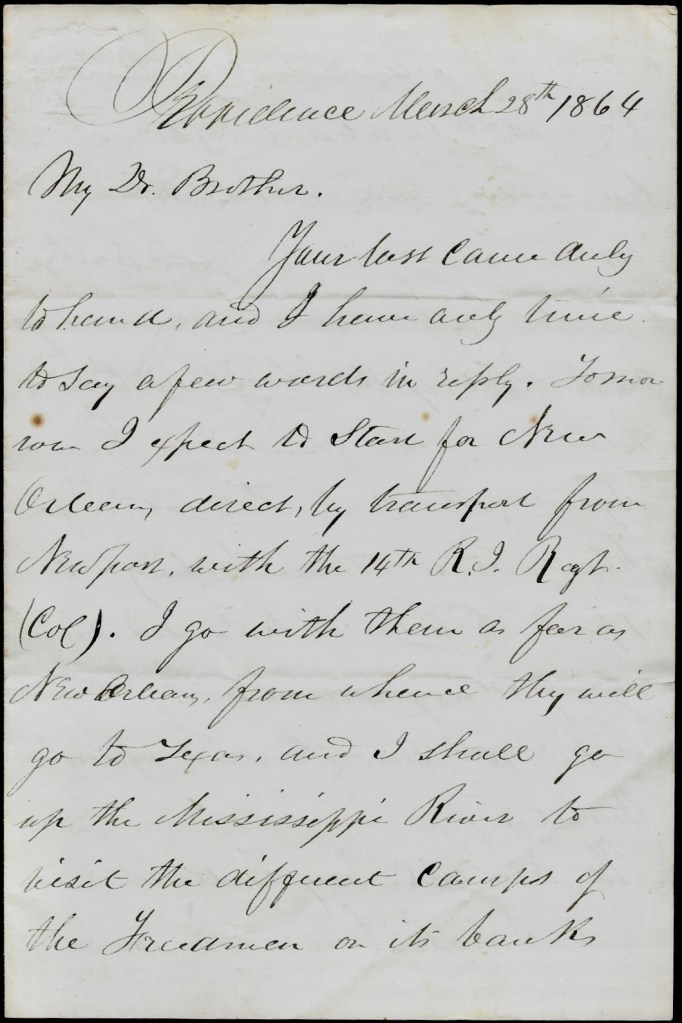


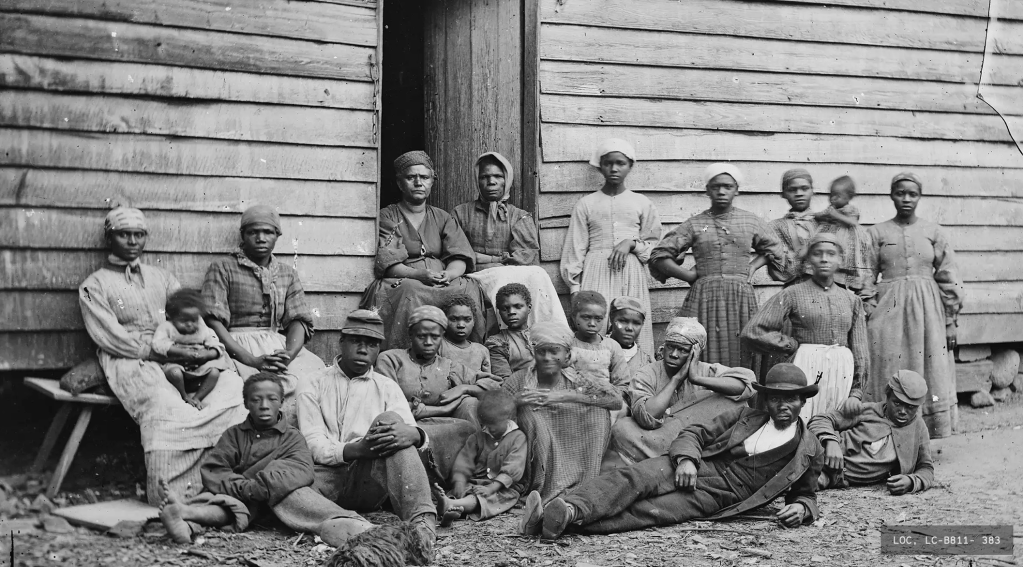

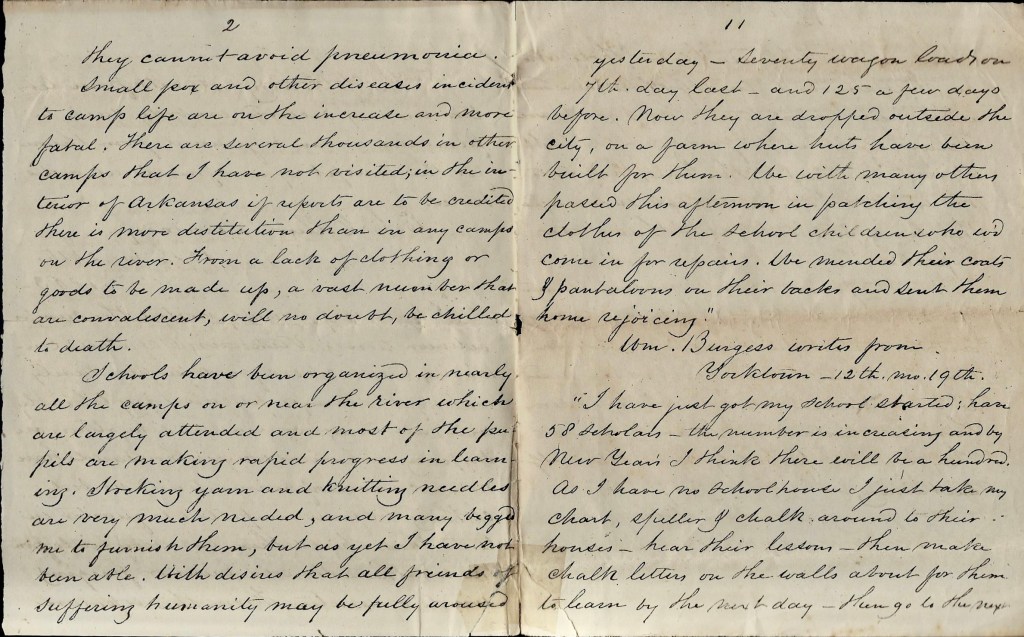


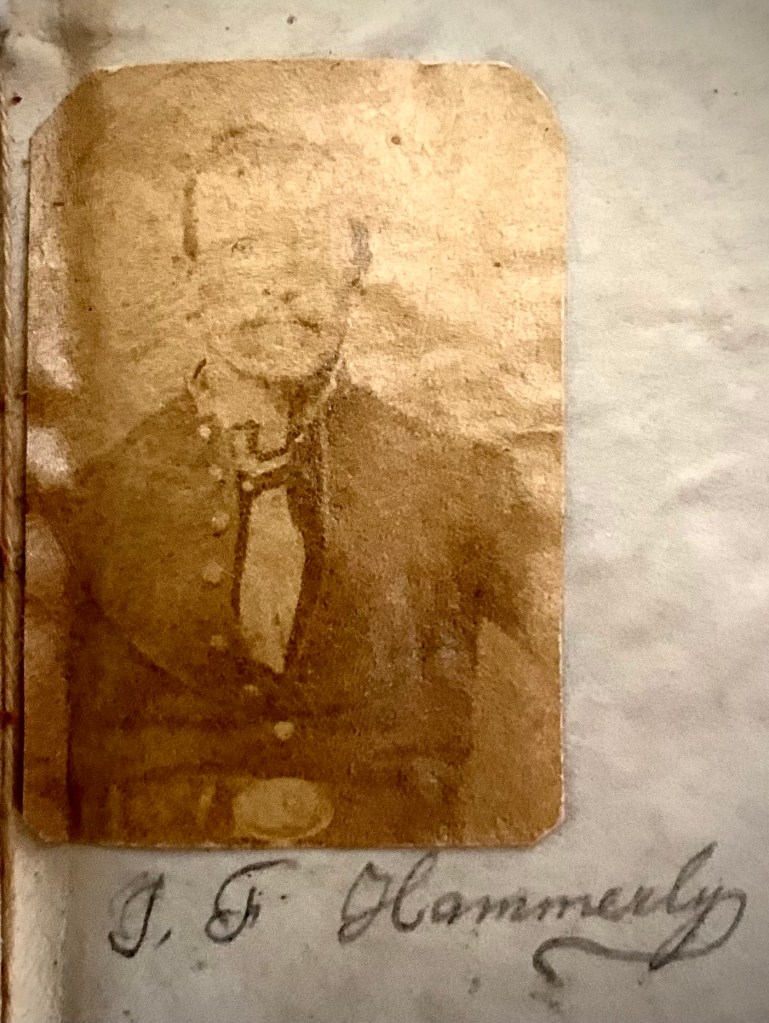


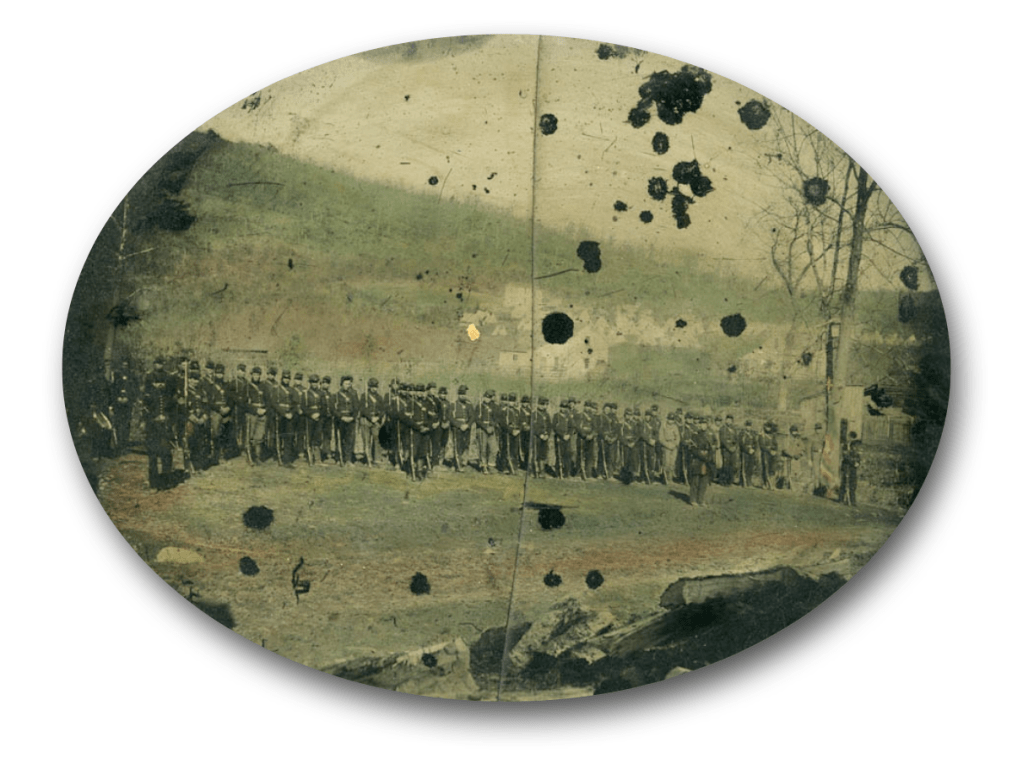

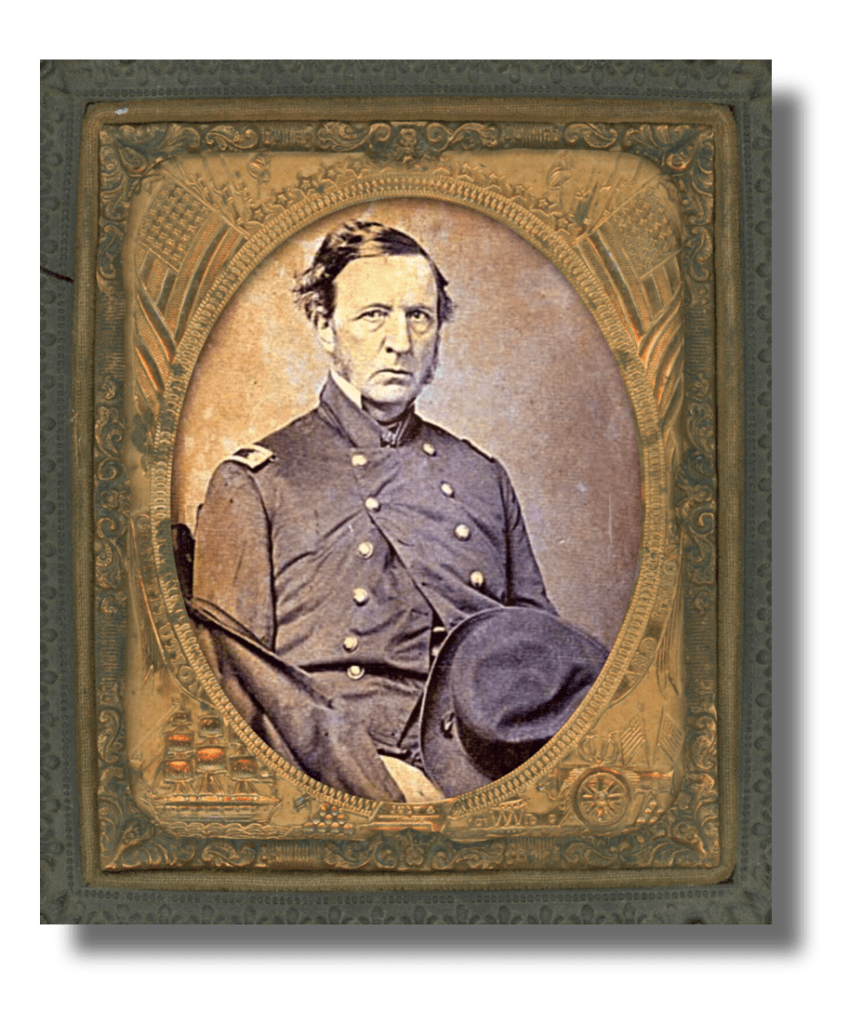
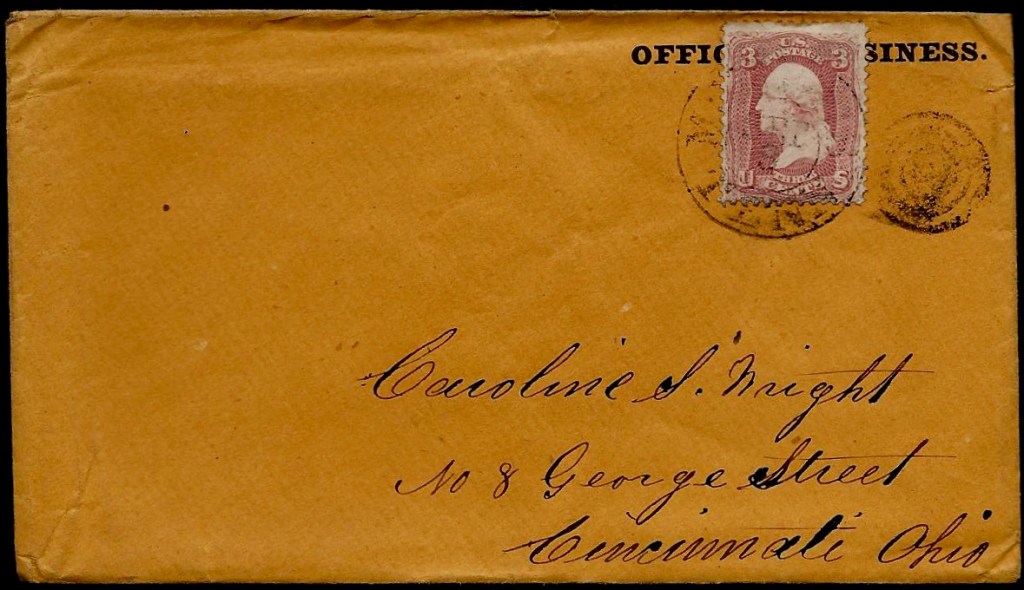
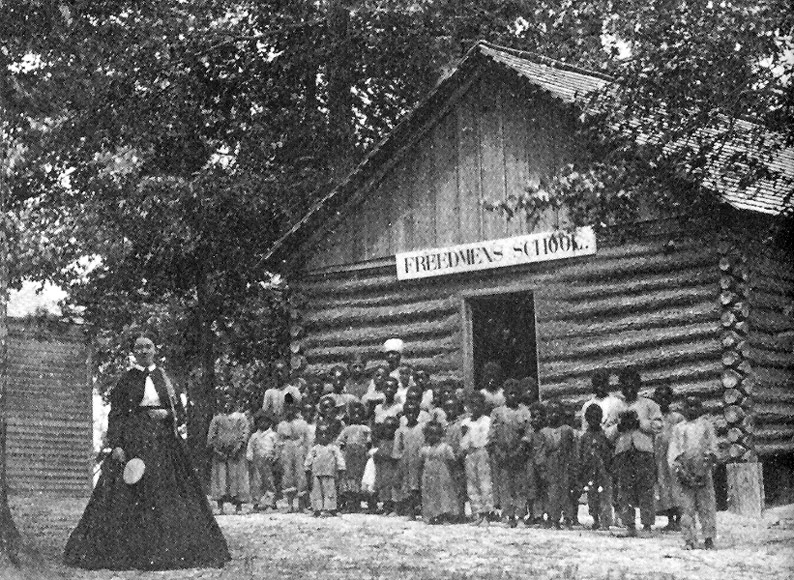
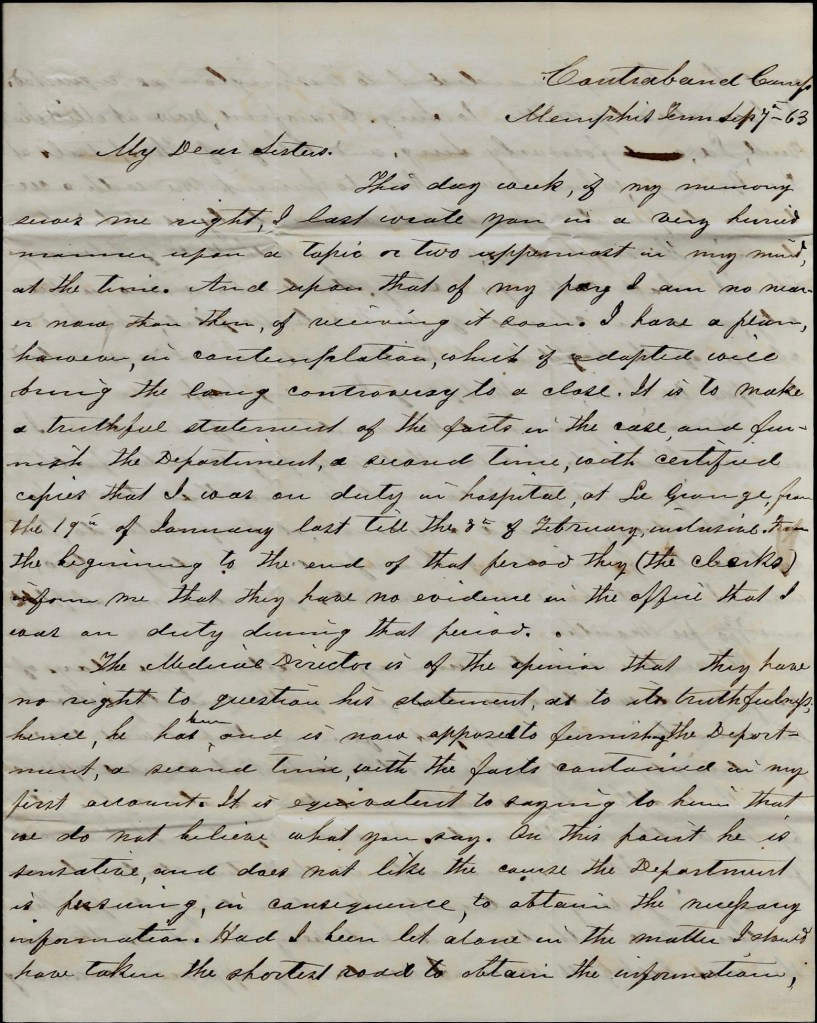
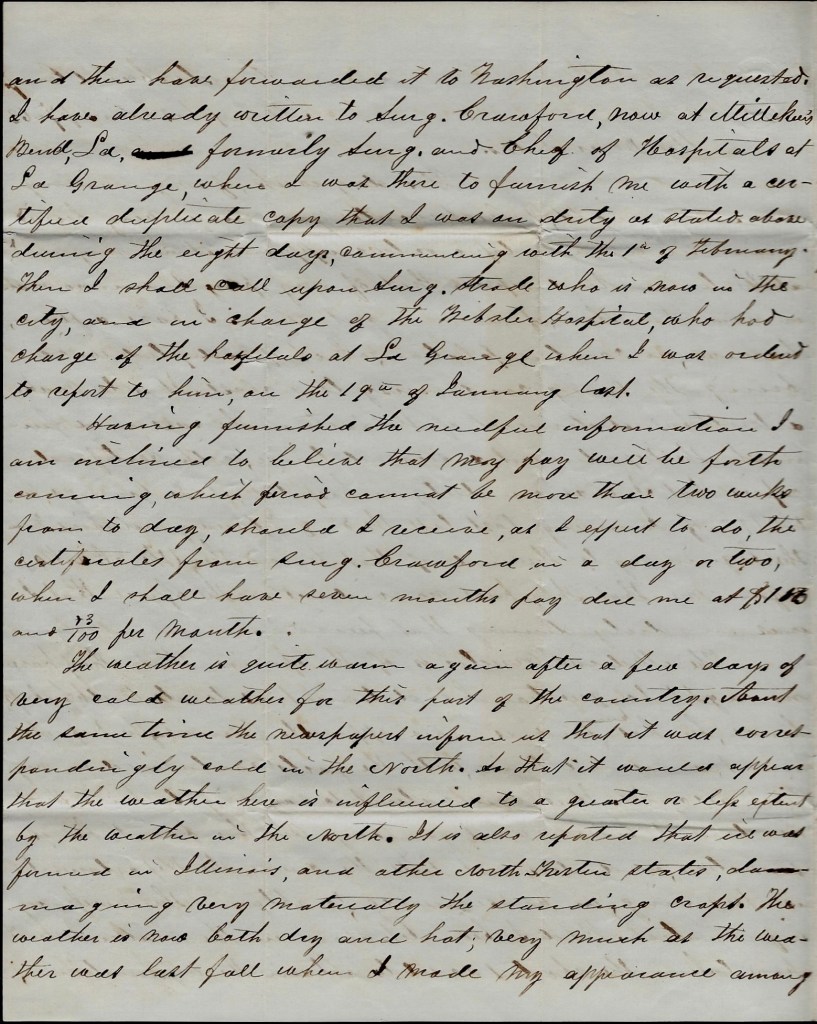
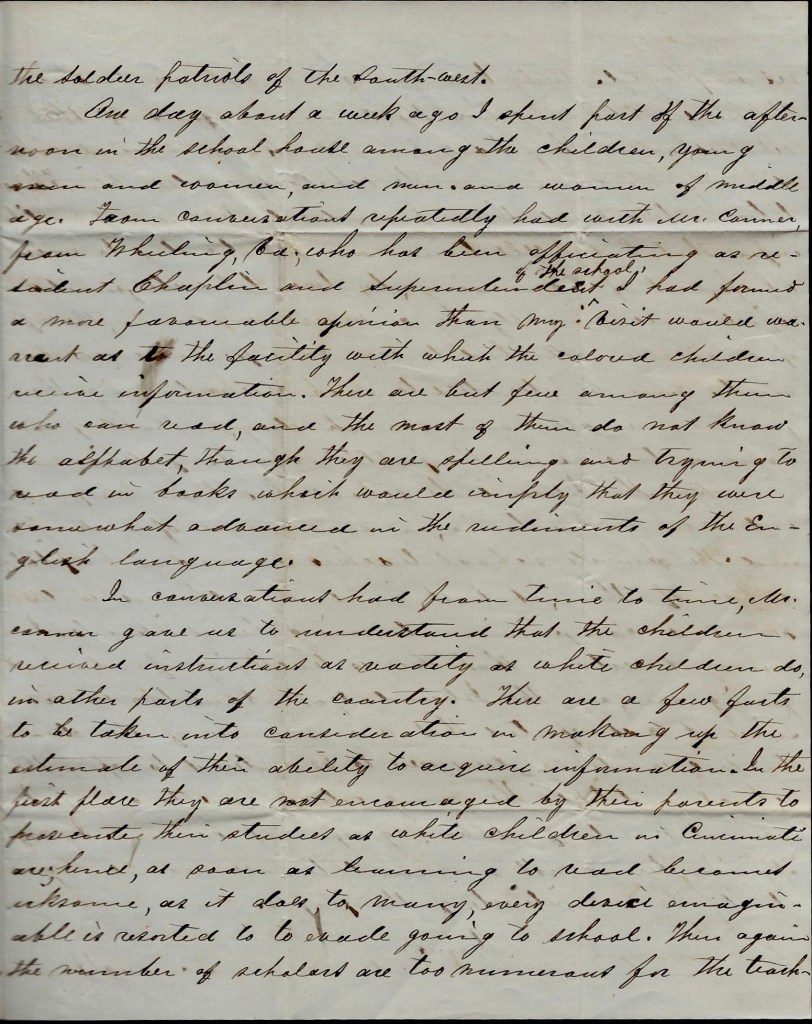
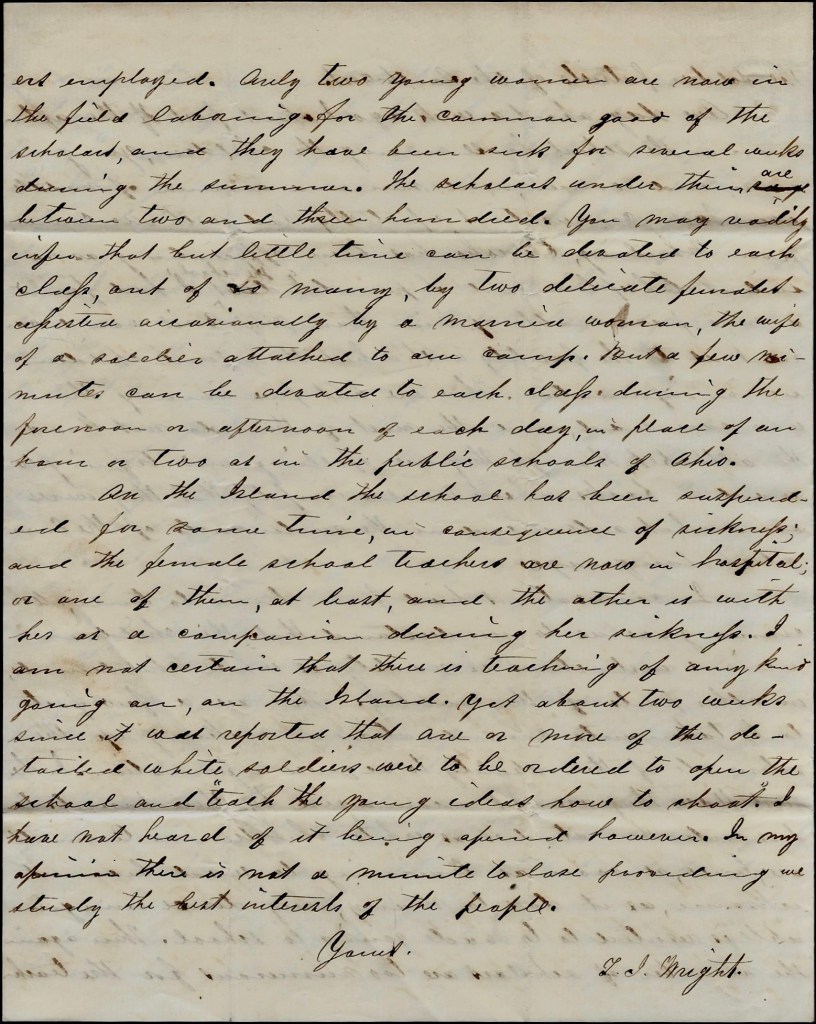
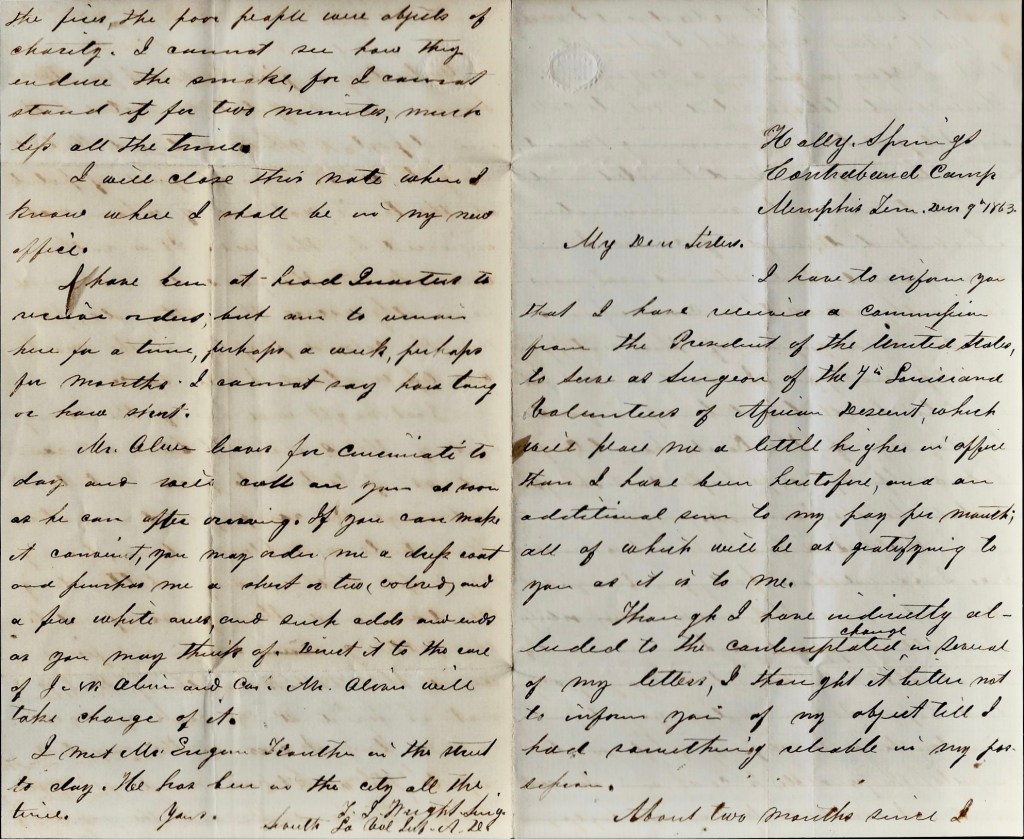
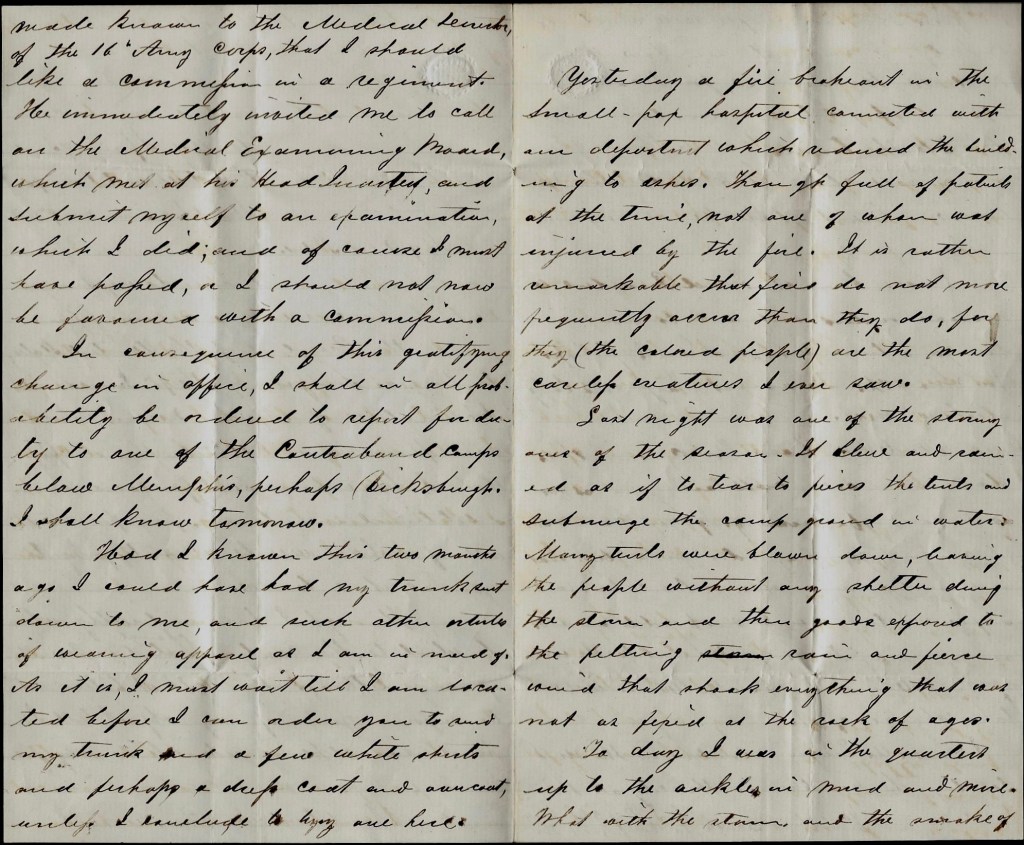
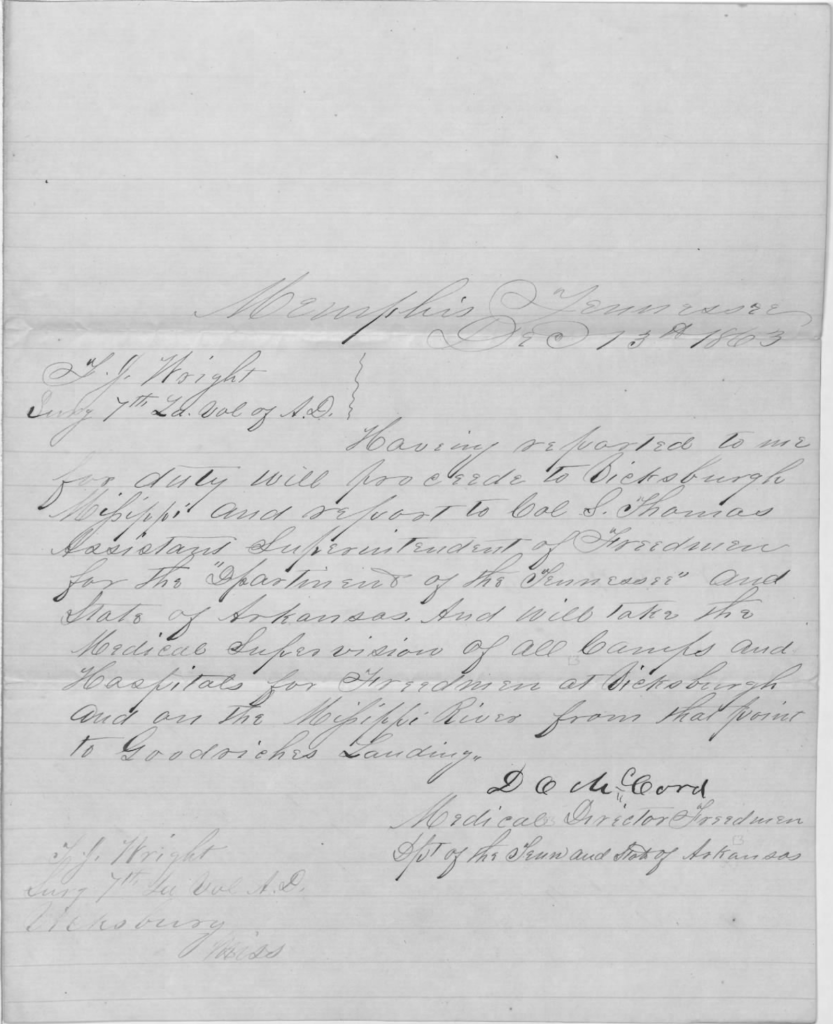
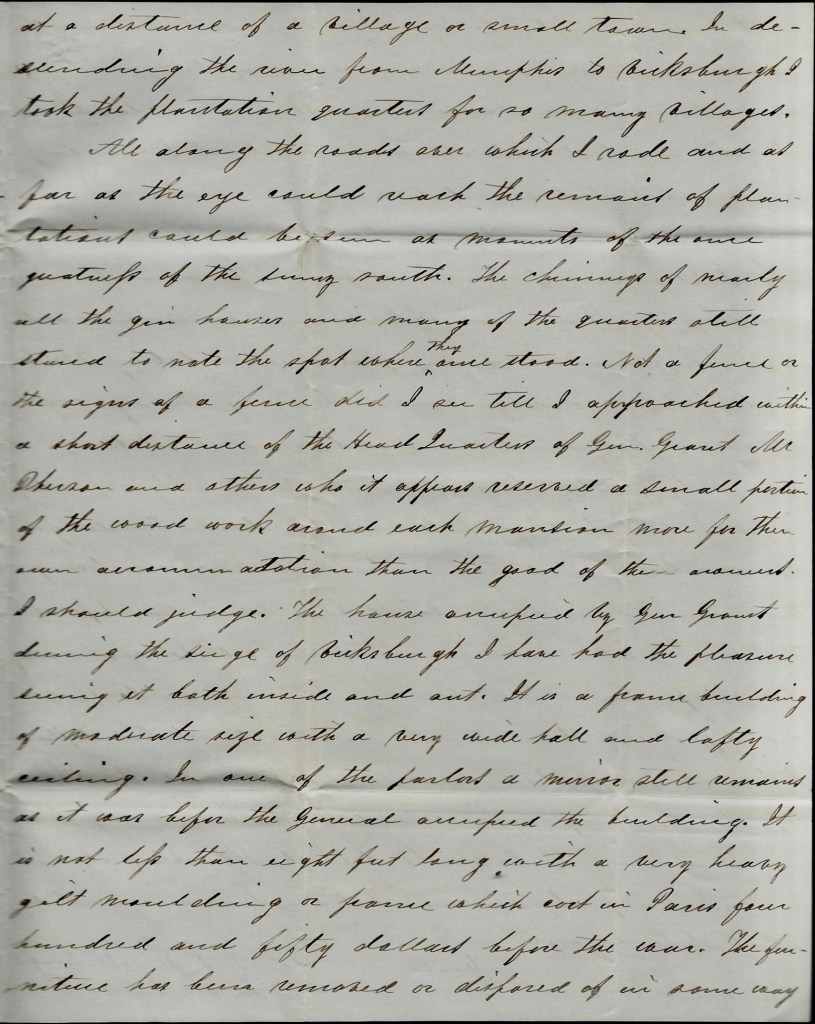
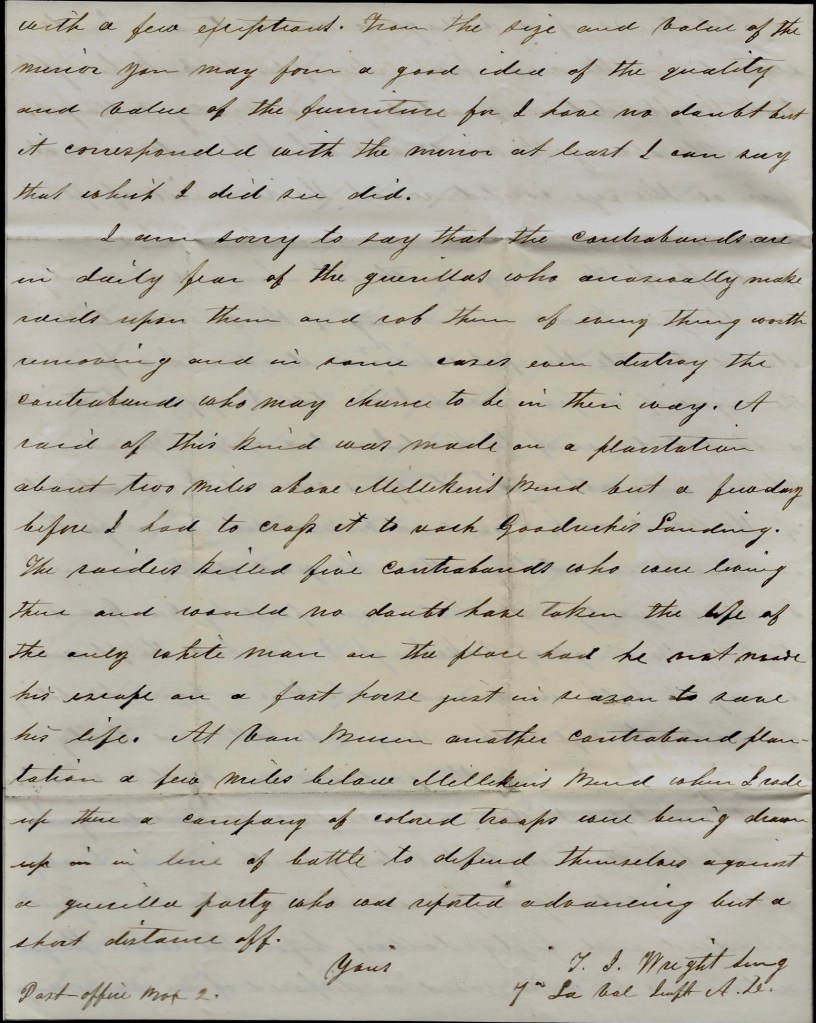
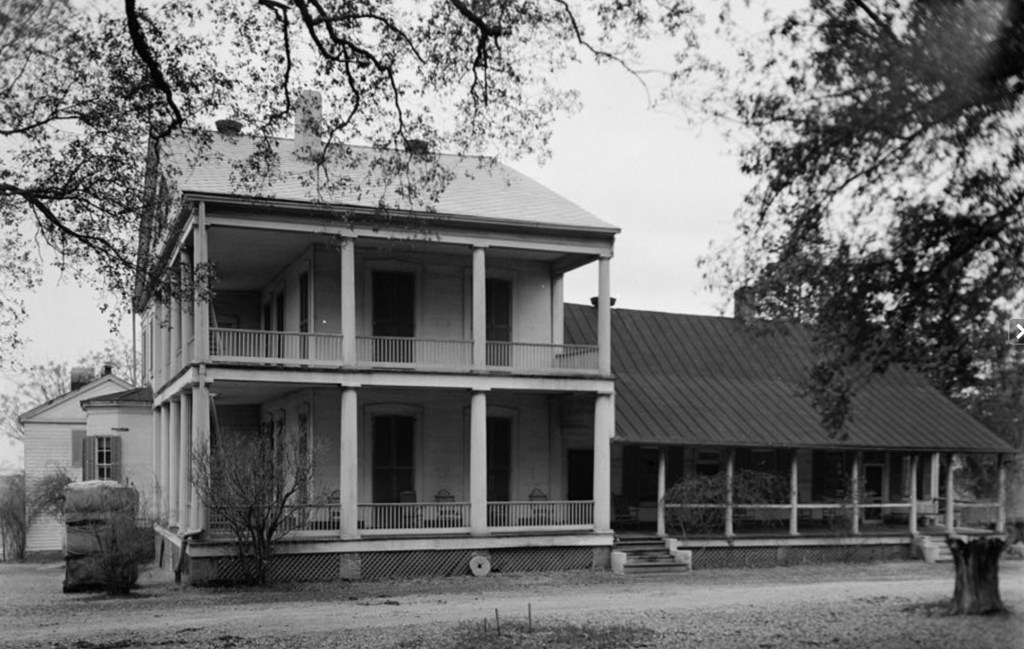
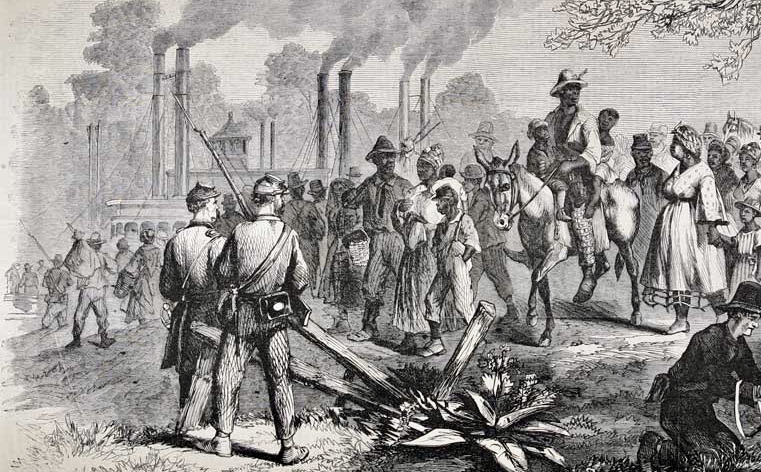
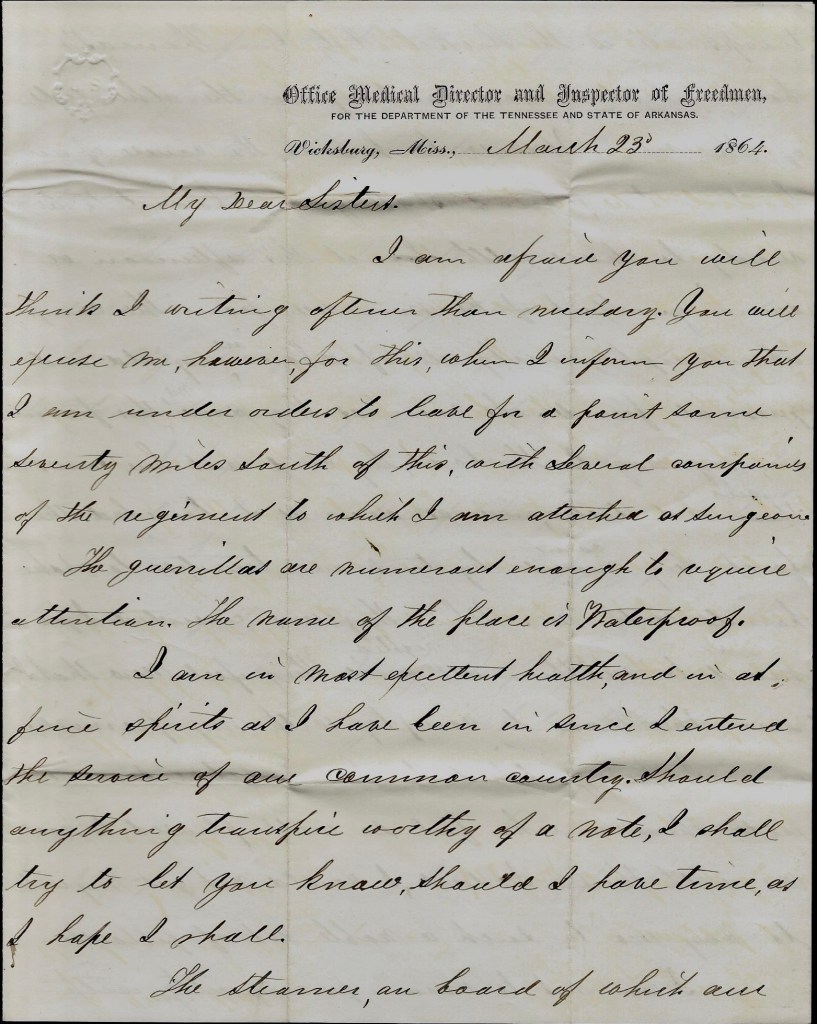
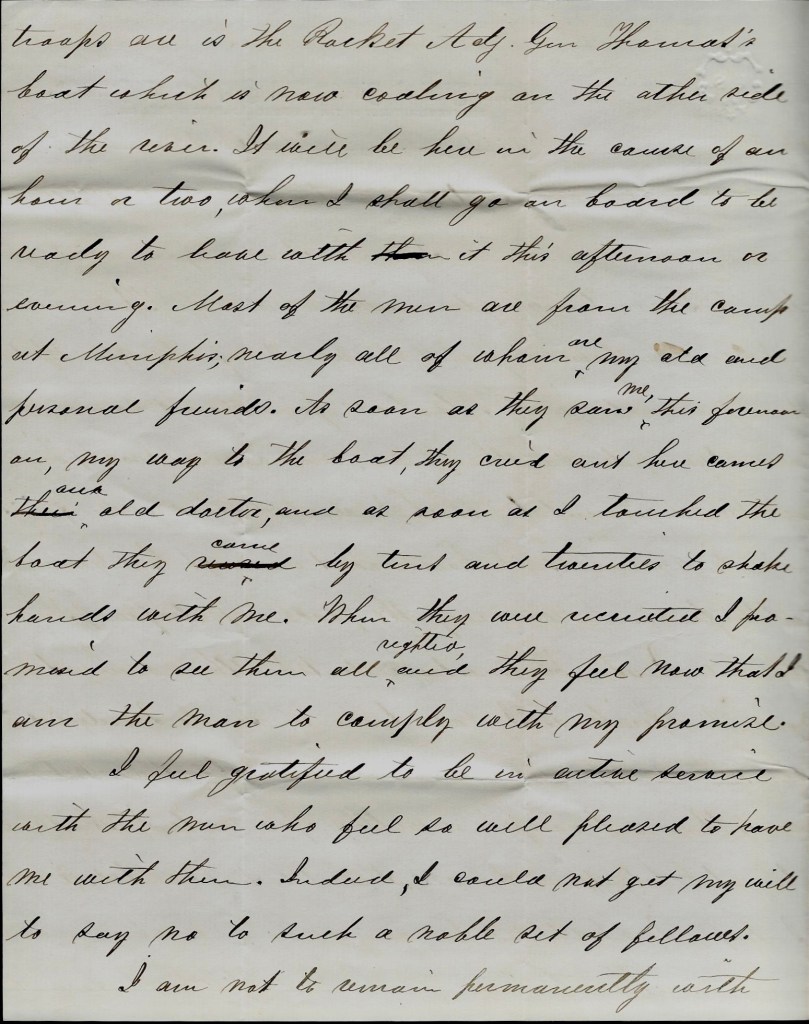
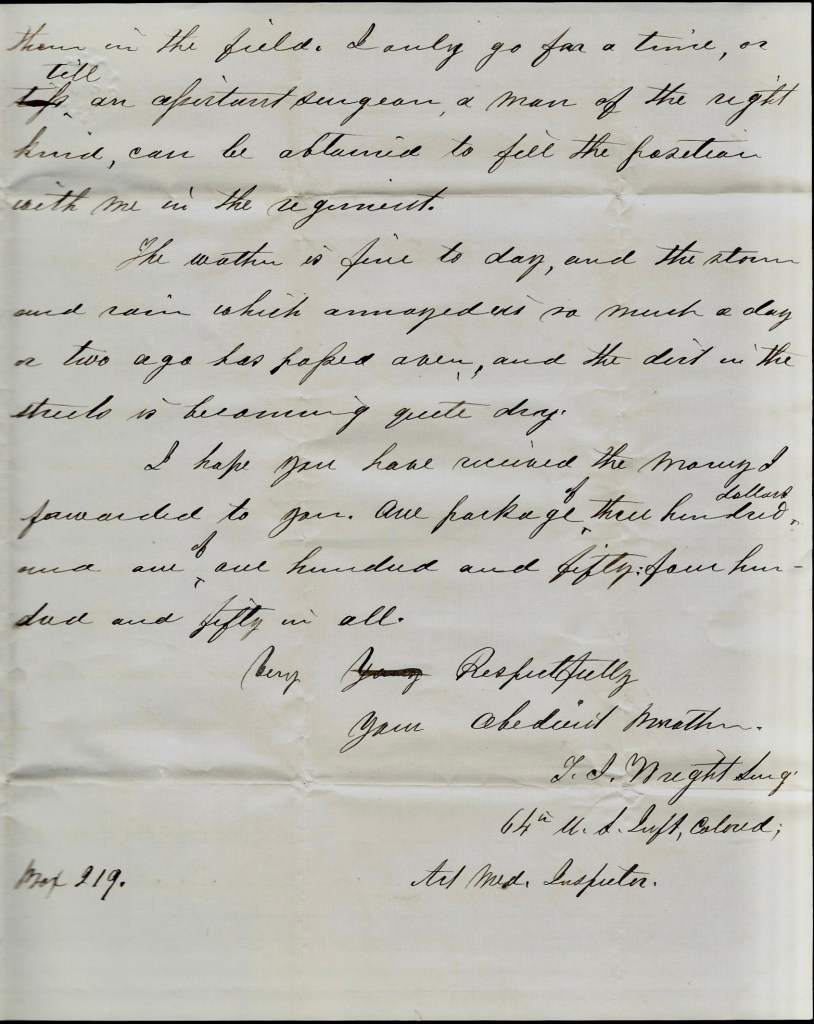
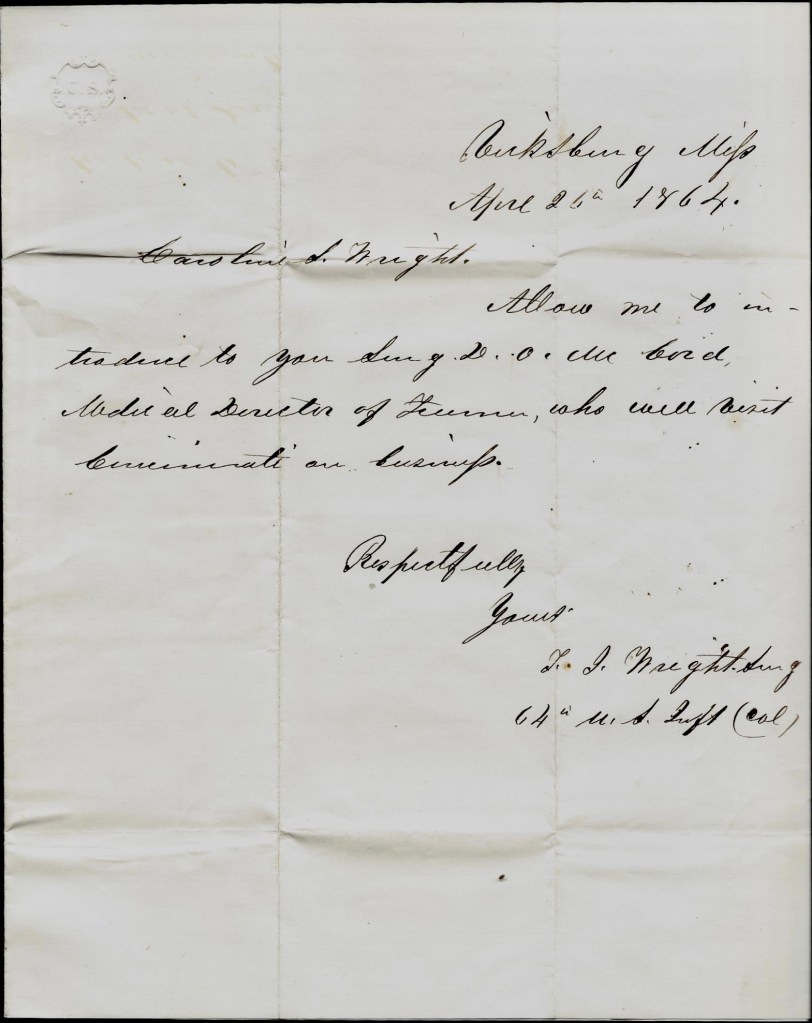
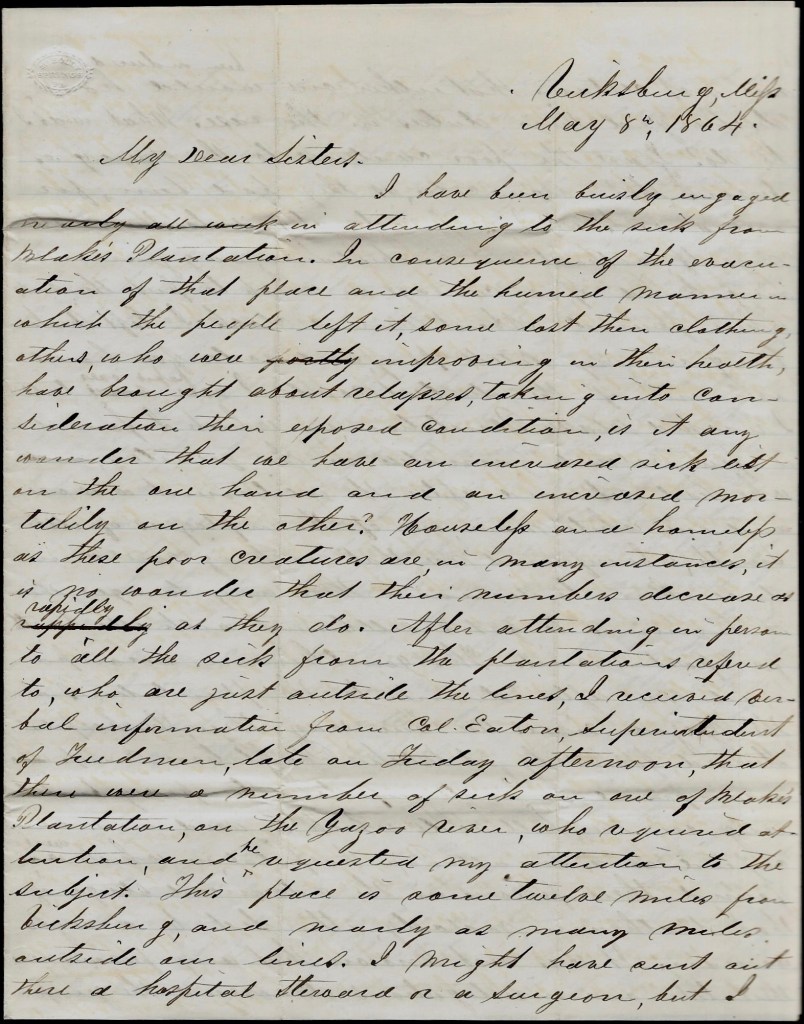
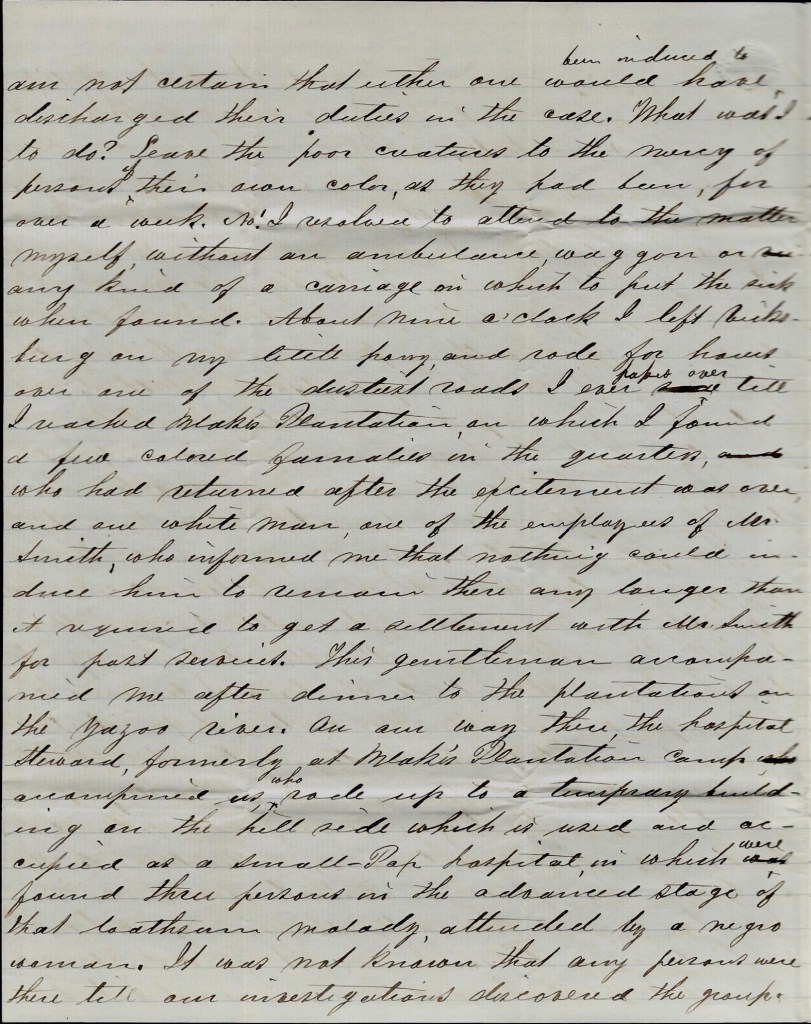
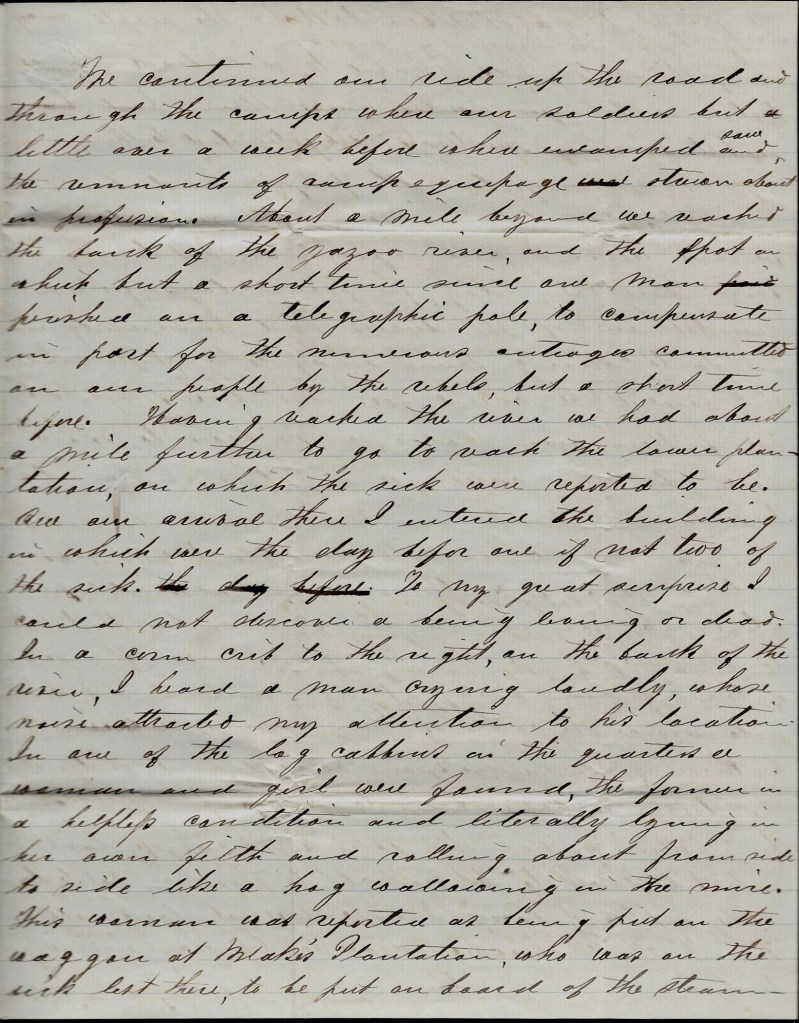
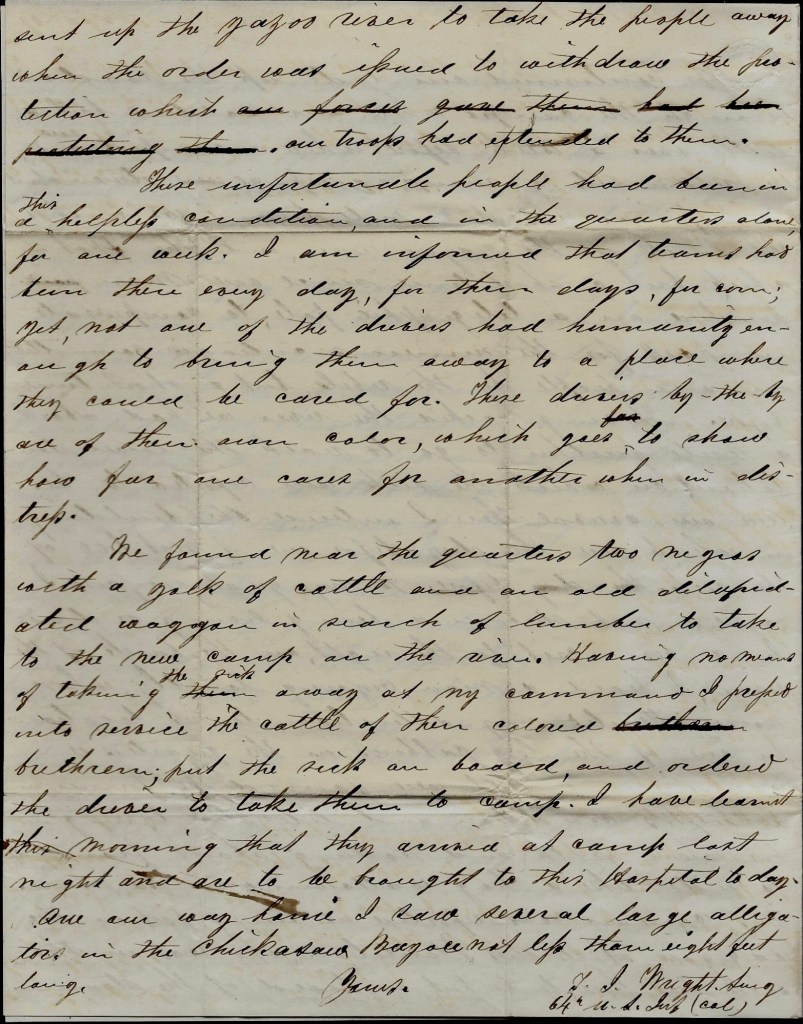
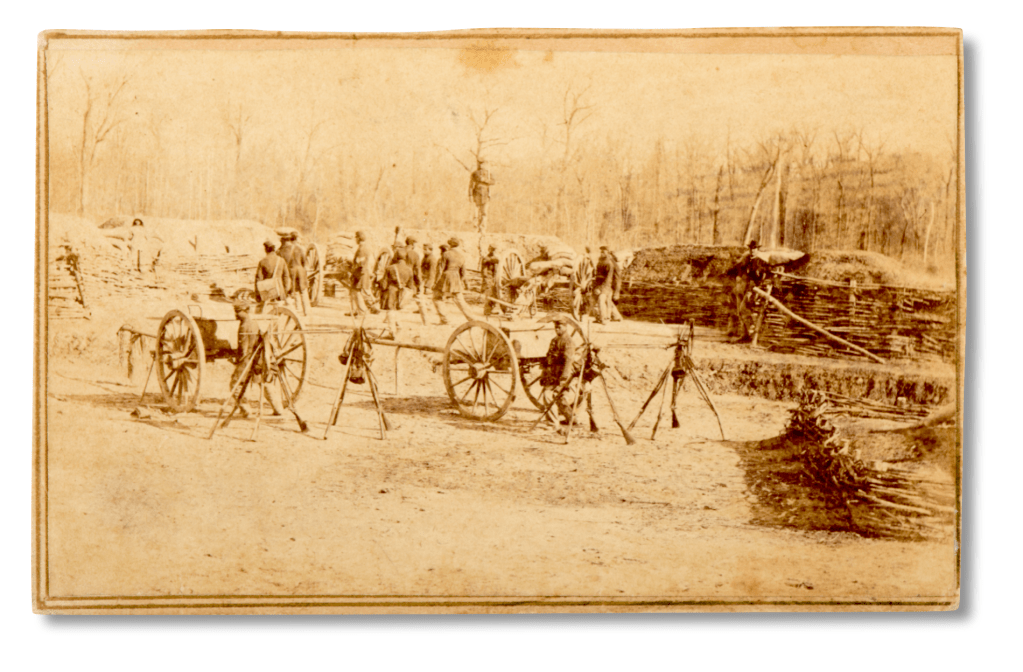
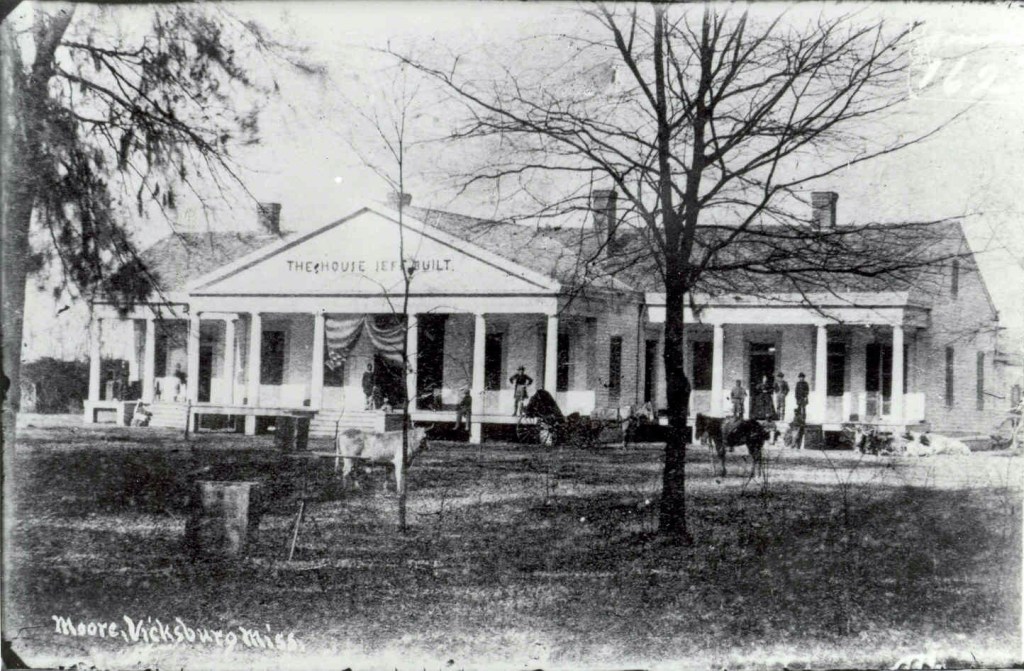
 Spared & Shared 23