Category Archives: CSS Virginia

1862: John Sterling Bird to friend “Herb”

The following letter was written by John Sterling Bird (1836-1900), the son of David Bird (1804-1863) and Eunice A. Phelps (1805-1882) of Winchester, Litchfield county, Connecticut. He wrote the letter while attending the Columbia University College of Physicians and Surgeons in 1862. He was still identified as being a member of the “medical class” in the session of 1863-64. It appears that he practiced medicine in Dutchess county, New York, in the 1870s and 1880s. He was married to Alice Emma Jones (1854-19180 in the early 1870s.

Bird wrote the letter to his friend “Herb” who remains otherwise unidentified but probably a childhood friend from Litchfield. We learn that Herb was serving in the Union army but his regiment is unknown. Herb may have been serving in an Indiana regiment such as the 14th, 19th, or 27th as he adds the statement, “If the Indiana men in Virginia do as well as in Tennessee, I think they will have their reputation made.” This comment makes little sense otherwise.

Bird’s letter refers to the recent Union victories in Tennessee and in North Carolina but also mentions the latest news from Hampton Roads announcing the destruction of two Union wooden-hulled ships (USS Congress and USS Cumberland) by the ironclad CSS Virginia (Merrimack) on 8 March 1862. On the very day that Bird wrote this letter—the 9th of March—the ironclad USS Monitor would duel with the CSS Virginia for three hours, neither vessel able to inflict any significant damage on the other.

The College of Physicians & Surgeons at the corner of 23rd Street and 4th Avenue in NYC

Transcription

New York City
March 9th 1862

Friend “Herb,”

I received yours of Jan. in due time for which please accept my most hearty thanks. But perhaps you say that I had better have answered it at once, if I was so mighty thankful. Well, I suppose I had, but please recollect that civilians have to keep busy, as well as soldiers.

Just because few of these ‘risque” images survive today doesn’t mean they didn’t exist. Many were probably discarded into campfires along with playing cards as soldiers prepared to march into battle.

It seems that “sweethearts” are so scarce down your way that you are obliged to make the most of such pictures as you sent me in your letter. Well, in want of the genuine article, I suppose that you will be justified in exercising your imagination to a certain extent. But I should suppose that you might convert some of those Virginia misses from the error of their ways and in doing so, make love to them at the same time. Suppose you try the experiment. You know that a handsome young man like yourself—in uniform—can accomplish wonders with the fair sex.

Unless I should forget it, I will give you an article of news which I have at once. Leroy Wetmore is married to Fred Hills’s daughter (Lucy, I believe) of Torrington—first cousins I believe. Think they must have been rather hard up, don’t you? 1

So you see that most all our old friends have got into the entanglements of matrimony. If they are satisfied, I am. When you and I get ready, when you have immortalized your name by killing people, and I by curing them, then perhaps we’ll try it.

Since I wrote you last, there has been stirring times among the national armies. Victory upon victory has been achieved. You cannot have sent terror to rebel hearts, and joy unbounded to all loyal northern homes. I can’t believe that you can conceive of the thrill of joy which shot like lightning through all the North at the news of Henry, Donelson, and Roanoke. People fairly cried for joy. Army operations seem to be progressing well at this time and if this is kept up, something will be accomplished. But it is not to be all smooth sailing yet for as I write there is an extra out with news from Fortress Monroe that the Rebels have destroyed some of our ships and are shelling our camp at Newport News.

I suppose that you are in Virginia now and whether you will get this, I know not. I expect to stay in the city for some time yet. I don’t see as I can write much more this time. Keep you courage up. If the Indiana men in Virginia so as well as in Tennessee, I think they will have their reputation made.

Now answer this as soon as you can directing to College of Physicians and Surgeons, 23rd Street and 4th Avenue, New York.

This from your friend, — J. S. Bird

1 Leroy Whiting Wetmore (1836-1872), the son of Abel Samuel Wetmore (1802-1879) and Lucy Amira Hills (1810-1881), was married on 12 February 1862 at Torrington, Litchfield county, CT, to Lucy Ann Hills (1841-1871).

1862: Howard McCutchan to James Buchanan McCutchan

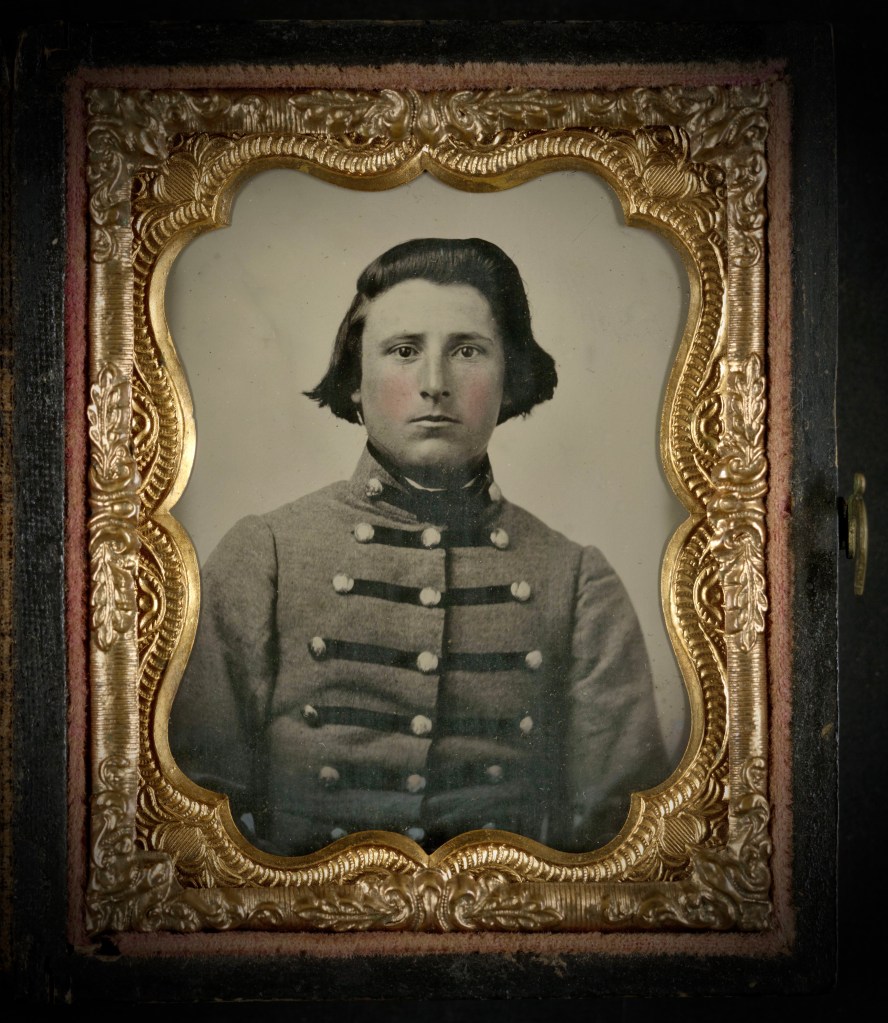
Howard’s brother, James B. McCutchan of the 5th Virginia Infantry (Find-A-Grave)

The following letter was written by Howard McCutchan (1837-1864), the son of Addison, McCutchan (1805-1880) and Ann Kirkpatrick Buchanan (1811-1880) of Augusta county, Virginia, who enlisted as a private in mid-April 1861 in Co. D (the “Spalding Greys”), 2nd Georgia Infantry Battalion. He was soon elected 2nd Lieutenant of his company and was eventually promoted to 1st Lieutenant. He was apparently made an offer to reenlist that he couldn’t refuse for he was still with the regiment at Gettysburg where he was wounded in the second day’s action near the Codori House. A year later, at Staunton, he died of disease. His gravestone in Shemariah Church Cemetery in Middlebrook, Augusta County, Virginia, bears the inscription, “Died in defence of Southern rights, July 29, 1864, 28 years, 9 months, 22 days.”

Howard wrote the letter to his brother but does not identify him by name. It was most likely addressed to James Buchanan McCutchan (1839-1920) who was closest in age to Howard among the McCutchan children. James served as a sergeant in Co. D, 5th Virginia Infantry during the war.

Transcription

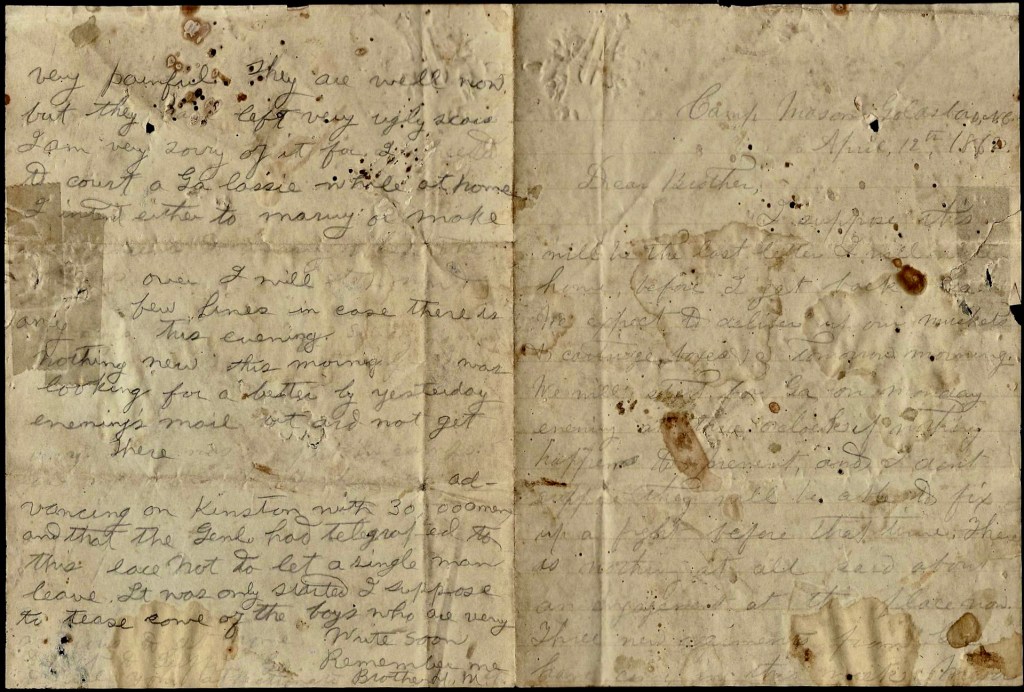
Camp Mason, Goldsboro, N. C.
April 12th, 1862

Dear Brother,

I suppose this will be the last letter I will write home before I get back to  Georgia. We expect to deliver up our muskets & cartridge boxes &c. tomorrow morning. We will start for Georgia on Monday evening at three o’clock if nothing happens to prevent and I don’t suppose they will be able to fix up a fight before that time. There is nothing at all said about an engagement at this place now. Three new regiments from Georgia have come in this week. Major Hardeman is colonel of one of them—the 45th, and Capt. [Robert A.] Smith (one  of our captains) is colonel of the 44th. Colonel Hardeman’s regiment arrived on Wednesday evening. He took us to town yesterday evening to drill us once more before we were disbanded.  The Major General [Theophilus] Holmes tried again to get us to re-enlist but our boys would not listen to  him. He is trying to get some of us to stay and drill his new regiments. Five or six of us sent up our names and asked him what pay he would give and what chance there was for promotion. If he makes a good offer, I will stay here & not, so to Georgia.

I suppose you have heard all about the great fight at Corinth.1 The last reports say General Buell of the Feds is killed and about 5,000 of them captured. We have not heard the particulars yet but will perhaps hear by this evening’s mail. It is said the Virginia 2 went out a few days since & captured 3 boats and schooners without firing a gun.

We have had bad weather this week and it has made a good many of our boys sick. I have been taking salts all week in broken doses to clean my blood. I have had boils coming out on my face and they have been very painful. They are well now but they have left very ugly scars. I am very sorry of it for I expected to court a Georgia lassie while at home. I intend either to marry or make acquaintance & marry before the war is over. I will try to write later a few lines in case there is any news this evening.

Sunday morning. Nothing new this morning. I was looking for a letter by yesterday evening’s mail but did not get any. There  was a report in camp last night stating that the Yankees were advancing on Kinston with 30,000 men and that the general had telegraphed to this place not to let a single man leave. It was only started I suppose to tease some of the boys who are very anxious to get home. Write soon. Direct to Griffin, Georgia. Remember me. Your affectionate brother — H. M.


1 Howard is referring to the Battle of Shiloh that took place on April 6-7, 1862.

2 The “Virginia” was the refurbished USS Merrimack turned into the ironclad CSS Virginia by the Confederates. Howard is referring to the following event: On April 11, the Confederate Navy sent Lieutenant Joseph Nicholson Barney, in command of the paddle side-wheeler CSS Jamestown, along with Virginia and five other ships in full view of the Union squadron, enticing them to fight. When it became clear that Union Navy ships were unwilling to fight, the CS Navy squadron moved in and captured three merchant ships, the brigs Marcus and Sabout and the schooner Catherine T. Dix. Their ensigns were then hoisted “Union-side down” to further taunt the Union Navy into a fight, as they were towed back to Norfolk, with the help of CSS Raleigh.