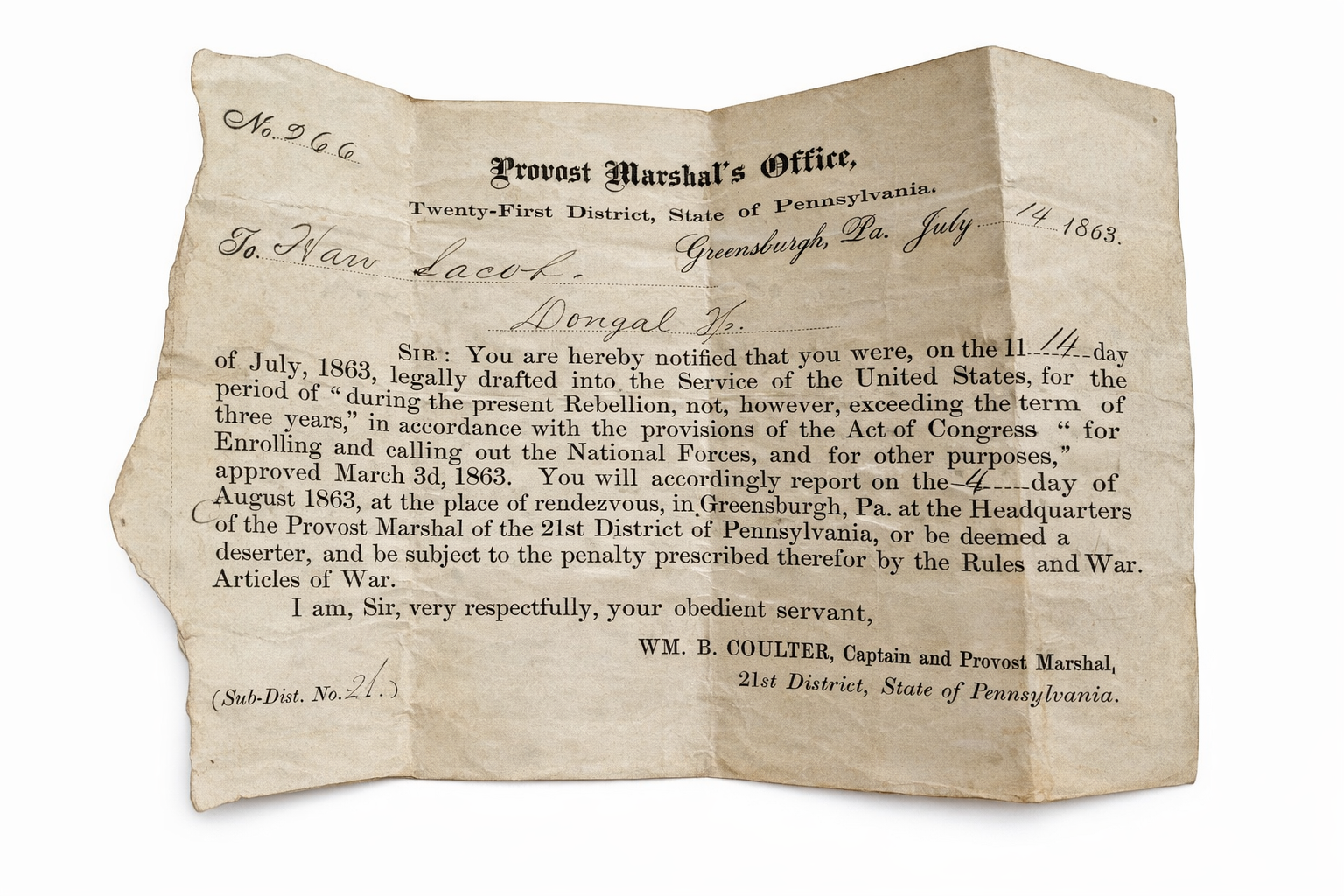
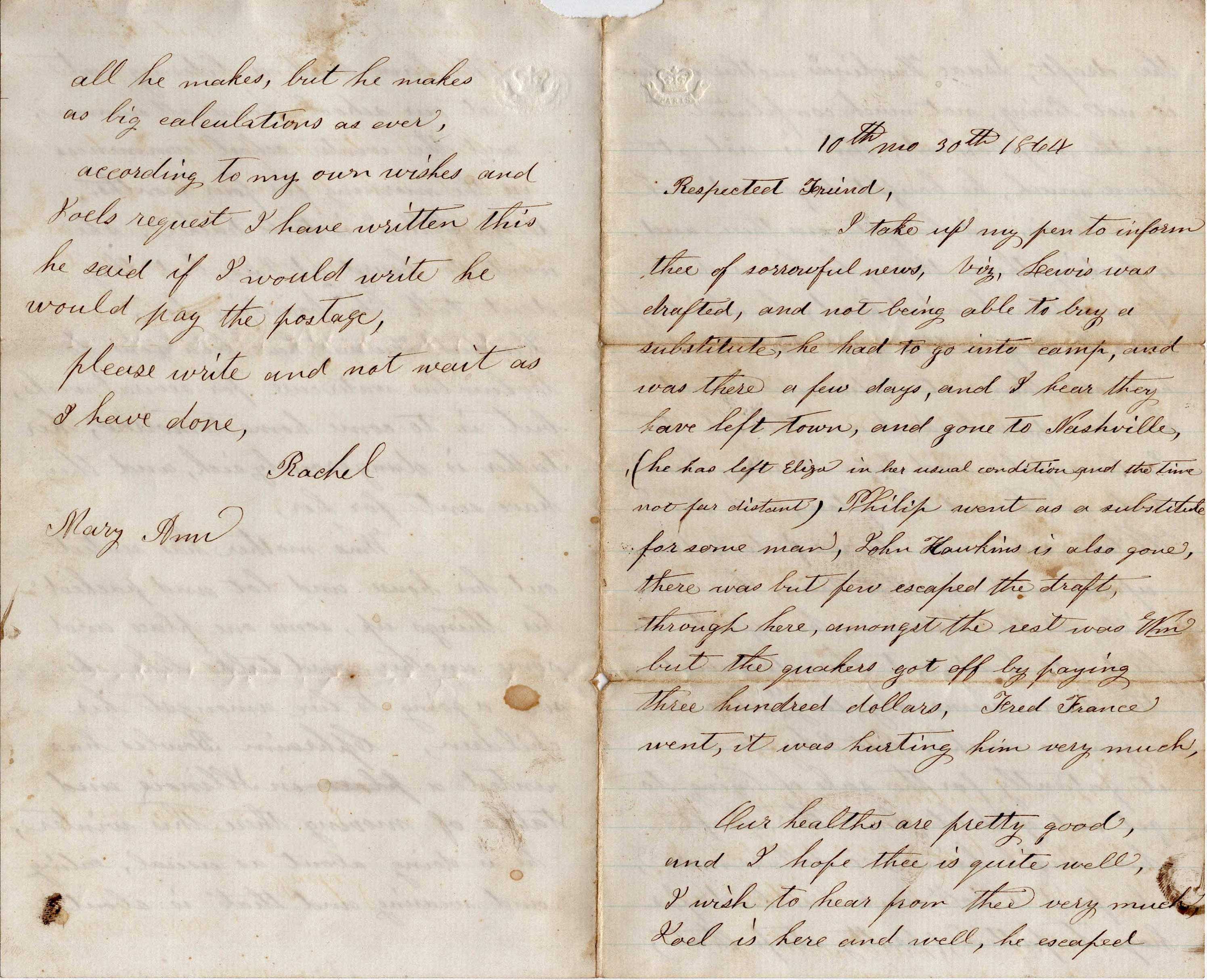
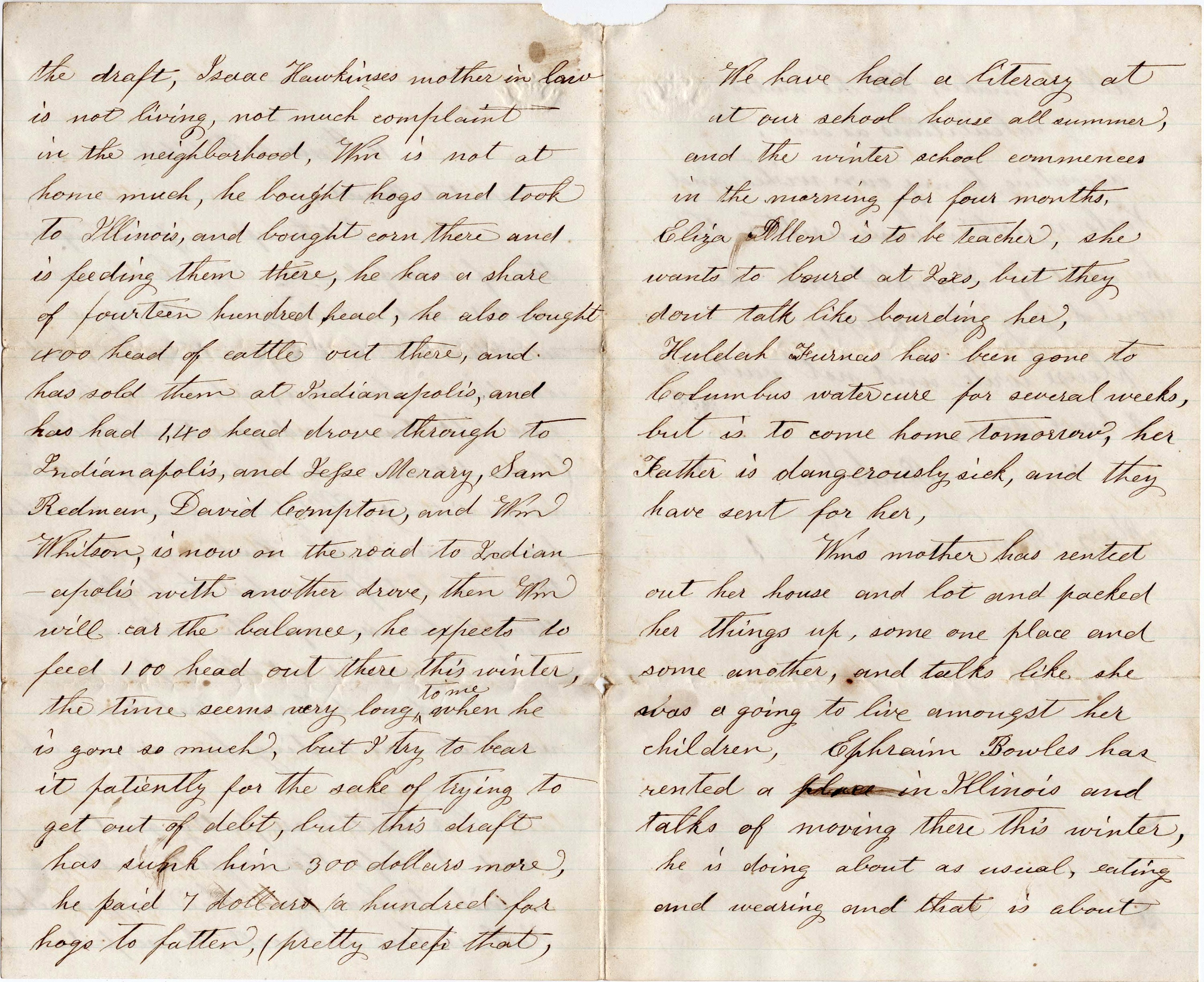
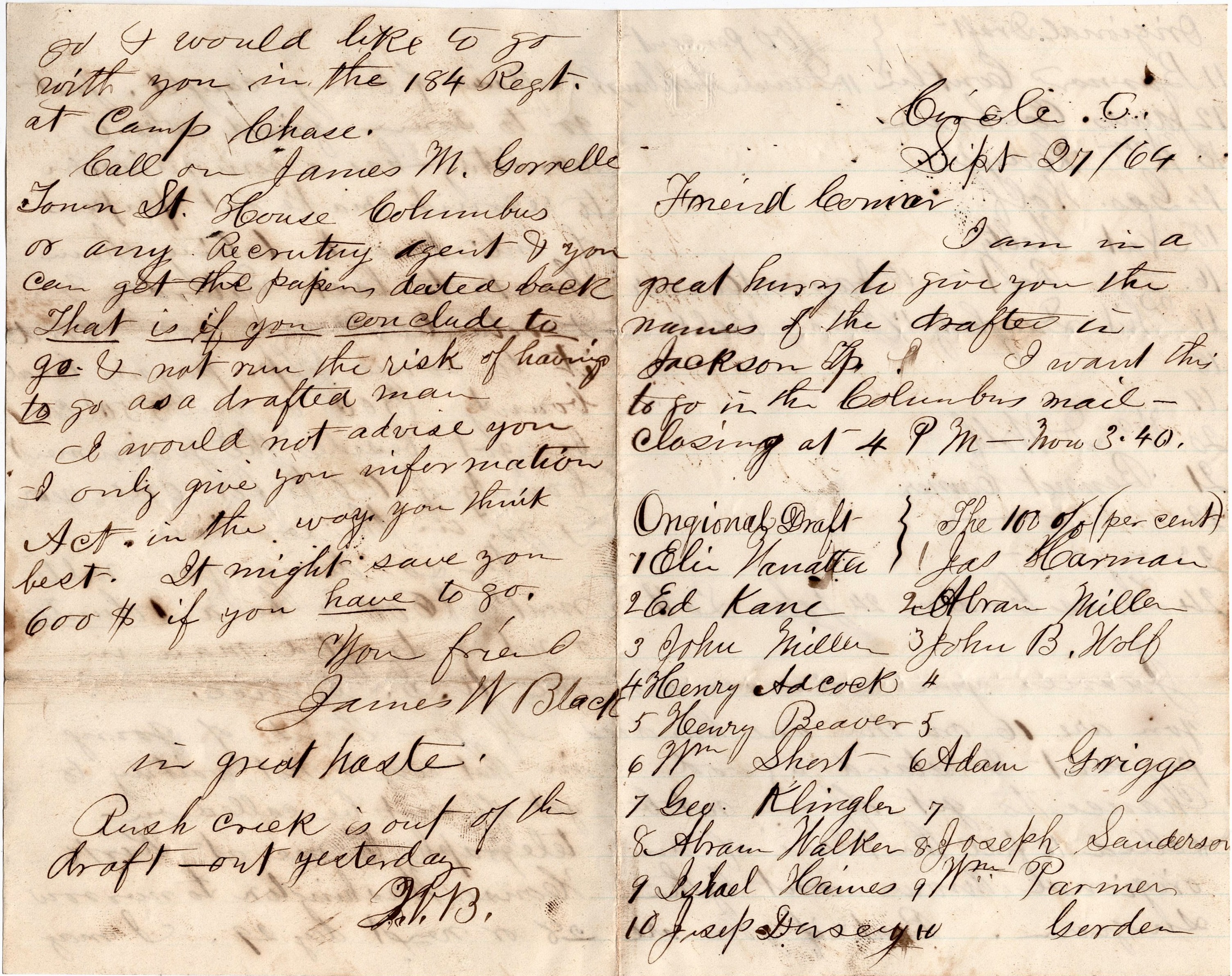
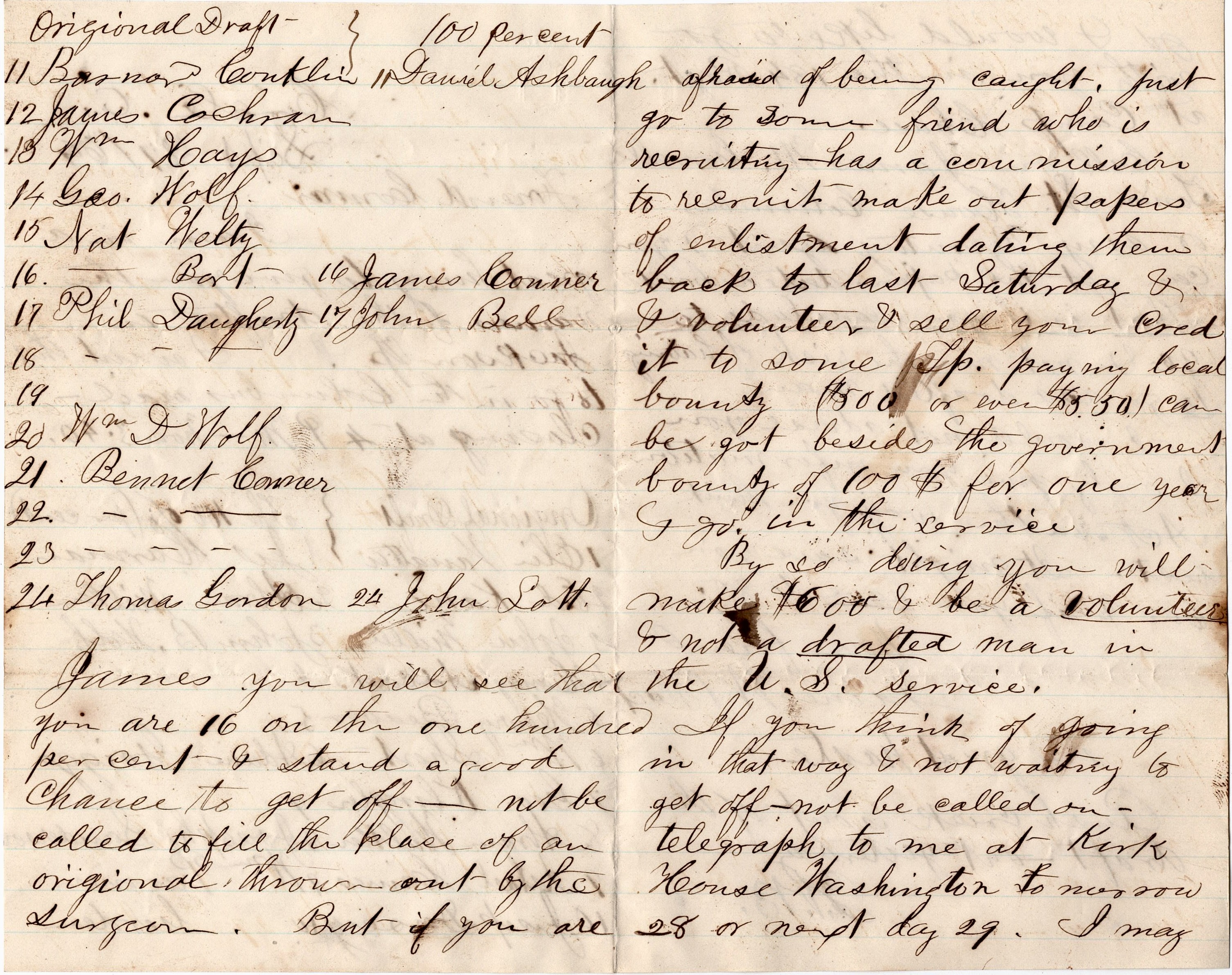
The following letter was written by James W. Black to his friend James Conner advising him of the names of those age eligible individuals selected in the 1864 draft in Pickaway county, Ohio. He suggests that his friend may want to ask a recruiter to back date enlistment papers for him as a volunteer in order to collect a hefty bounty rather than report as a draftee and receive no bounty.
T R A N S C R I P T I O N
Circle[ville], Ohio September 27, 1864
Friend Conner,
I am in a great hungry to give you the names of the drafted in Jackson township. I want this to go in the Columbus mail. Closing at 4 p.m. Now 3.40.
[list of names]
James you will see that you are 16 on the one hundred per cent & stand a good chance to get off- not be called to fill the place of an original throw out by the surgeon. But if you are afraid of being caught, just go to some friend who is recruiting, has a commission to recruit, make out papers of enlistment dating them back to last Saturday, & volunteer & sell your credit to some township paying local bounty ($500 or even $550) can be got besides the government bounty of $100 for one year & go in the service. By so doing you will make $600 & be a volunteer & not a drafted man in the U. S. service.
If you think of joining in that way & not waiting to get off, not be called on, telegraph to me at Kirk House, Washington, tomorrow 29 or next day 29. I may go & would like to go with you in the 184 Regiment at Camp Chase.
Call on James M. Gorrelle, Town St. House, Columbus or any recruiting agent & you can get the papers dated back—that is, if you conclude to go & not run the risk of having to go as a drafted man. I would not advise you. I only give you information. Act in the way you think best. It might save you $600 if you have to go. Your friend—James W. Black
in great haste.
Rush Creek is out of the draft out yesterday J. W. B.
Underlining the prevalence of draft resistance, and its echoes in broader American culture, the draftee in this cartoon says, “Doctor I’m weak in the back,” to which the examining surgeon replies, “Yes, I see it – can’t go – too delicate.” Courtesy Library Company of Philadelphia.
The following letter was only signed “Henry” and though he gave his regiment as the 30th Indiana Infantry, the regimental roster does not include any late war draftees in it. The reorganized 30th Infantry, however, does and I was able to find him in Co. C of that reorganized regiment. He was William Henry Lockwood, born 1835, married in 1863, the son of Wesley Lockwood (1808-1881) and Mary Ann Philo (1809-1901) of Quincy, Branch county, Michigan.
It isn’t clear where Henry and his wife were living at the time of the 1864 draft but it’s presumed someplace in Indiana as he was subject to the draft there and he speaks of his wife “coming to Michigan” for a visit. According to the roster of the reorganized 30th Indiana, Henry was mustered into the service on 29 September 1864 and he was mustered out on 13 July 1865.
Transcription
Pulaski, Tennessee November 17th 1864
Dear Parents, Brother & Sisters,
It is with pleasure that I improve the present time in penciling a few lines to let you know where I am. I am with the 30th Indiana Regiment which is at Pulaski now. How long we will stay here, I do not know. We are not assigned to any company yet so when you send me any letters, direct to Pulaski, Tennessee, 30th Regiment Indiana Volunteers, care of Captain Boydson, and they will come all right.
I am well at present except a bad cold. I had the diarrhea when I started from Indianapolis and it continued until I got here, but I am better now. The soldier’s life is no life for me. I used to think that I had hard times at home. I longed to be of age so that I could have liberty and do as I pleased, but I did not know what enjoyment was. Now I can see when I spent my happiest days. It was when I was young and had not a care on my mind, when I had kind parents to look at my welfare and take care of me when sick, to guard me from danger and give their advice in regard to my best interest. But how changed is the scene. I am in the army and surrounded by the evil influences that generally prevail in a camp life, and also exposed to the murderous fire of the enemy’s guns. In looking into the future all is dark in respect to things earthly. It is my prayer to God that I may be permitted to survive the dangers that the soldier is exposed [to] and meet with my friends on earth again. I spend a great many hours in thinking of home.
I did come with a willing mind. I hated [to] leave home and friends most dear and take a my life in my hand for the purpose of fighting to sustain this cruel war. [But] I could not get anyone to go in my place so I had to go, and I must make the best of it I can. If I fall in battle or by disease, it is my prayer that I may fall with the armor of Christ, my Redeemer, on. Pray for me.
When I think of my father and mother, brother and sisters and also my dear wife, tears will unbidden start in my eyes and I have to go out by myself and give vent to my feelings. Father, tell Libbeous not to be over anxious to get into the army [for] if once he gets in, he will wish himself out again. He is the best off to stay at home as long as he can. Jennie talked of coming to Michigan on a visit. Make her as contented and happy as you can. She had rather I would have let the last cent and last bed go for a substitute than had me go to the army, but that could not be done as substitutes were from 700 to 1,000 dollars and I could not raise that sum. The best way I could fix it, consequently, [was] I had to go myself. I hope that I will live to get home again.
The rebels are no where near us now. The weather is warm here now. There has not been frost enough to kill the blackberry leaves yet. The crickets are singing as merry as in June in Michigan. There are lots of grasshoppers and spiders running as lively as in summer up there. The country is desolate and dreary. Everything appears to be on a standstill. It is all high hills, deep gullies, and rocks. If what I have seen is an index of the Sunny South, it not worth half the money that has been spent to carry on this war—[to] say nothing about the lives lost and families broken up. I had no idea of the destruction of property until I came here and have not begun to see all yet. The railroad has been burned to the ground, fences used for firewood, and the whole country presents one almost unbroken commons. I will be glad for one when the end comes. When that will be, I do not know.
Direct your letters to Pulaski, Tennessee, 30th Regiment Indiana Volunteers, in care of Capt. Boydson and they will come all right. I want some of you to write as soon as you get this. I want to hear from home. I have [not] heard one word from any of my friends since I left. Do not delay 24 hours. One letter from home will do me a great deal of good. So write immediately. From your son, — Henry
Remember me to the throne of Grace. Best respects to all. Tell Horace to write. I have only one sheet.
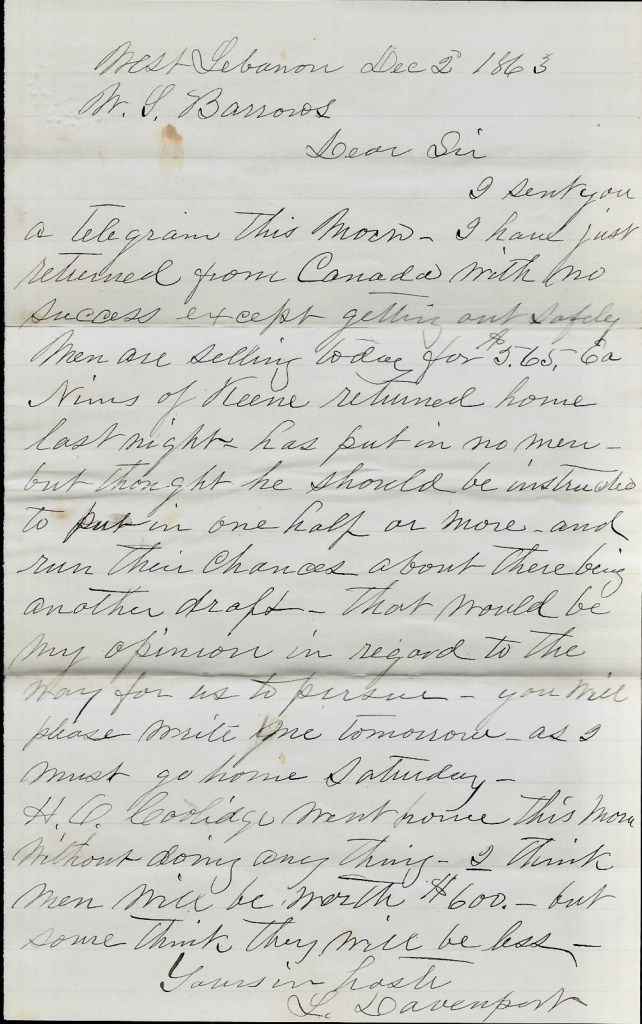
This letter was composed by Lockhart Davenport (1818-1875) of Hinsdale, Cheshire county, New Hampshire. According to the 1860 US Census, Davenport was involved in the lumbering business. He was also evidently tasked by his county or the provost marshal office to apprehend draft evaders in Canada or to locate military-age men willing to accept bounties offered by county governments to fulfill their draft quotas. Davenport’s letter discloses that the prevailing rate in New Hampshire for conscript substitutes was $565 and was projected to exceed $600 before the county quota could be fulfilled.
Davenport wrote the letter to Warren Snow Barrows (1824-1888) of Hinsdale, Cheshire county, New Hampshire. He was married in May 1856 to Maria L. Walker of Keene, Cheshire county, New Hampshire.
Transcription
West Lebanon [New Hampshire] December 2, 1863
W. S. Barrows, dear sir,
I sent you a telegram this morn. I have just returned from Canada with no success except getting out safely. Men are selling today for $565 each. Nims of Keene returned home last night. Has put in no men but thought he should be instructed to put in one half or more and run their chances about there being another draft. That would be my opinion in regard to the way for us to pursue. You will please write me tomorrow as I must go home Saturday.
H[enry] O[scar] Coolidge went home this morn without doing anything. I think men will be worth $600 but some think they will be less. Yours in haste, — L. Davenport
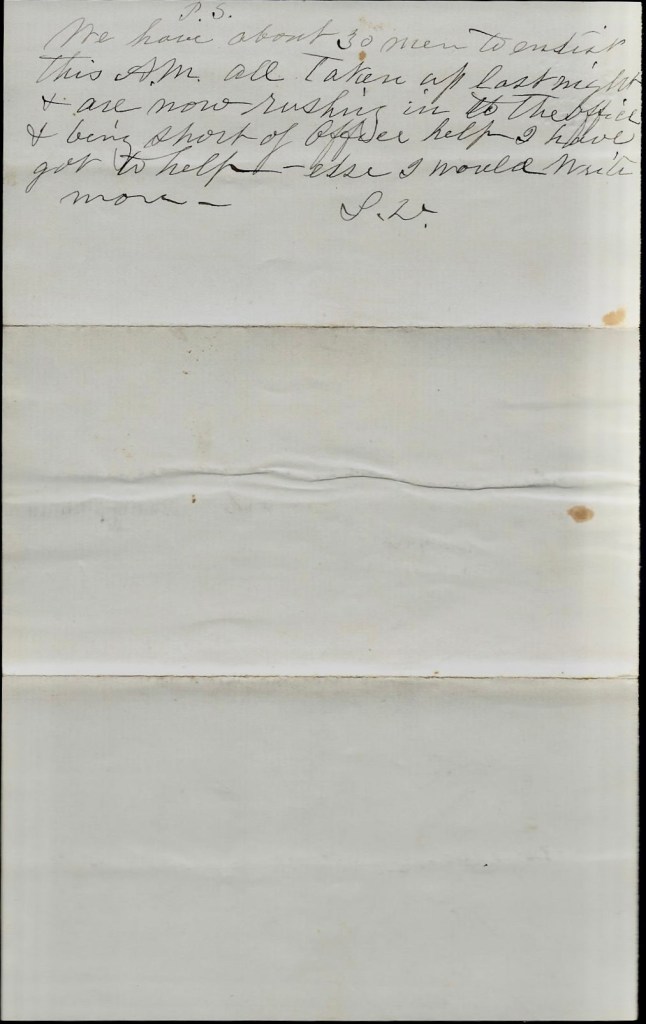
P. S. We have about 30 men to enlist this a.m. all taken up last night & are now rushing in to the office and being short of office help I have got yp help. Else I would write more. — L. D.
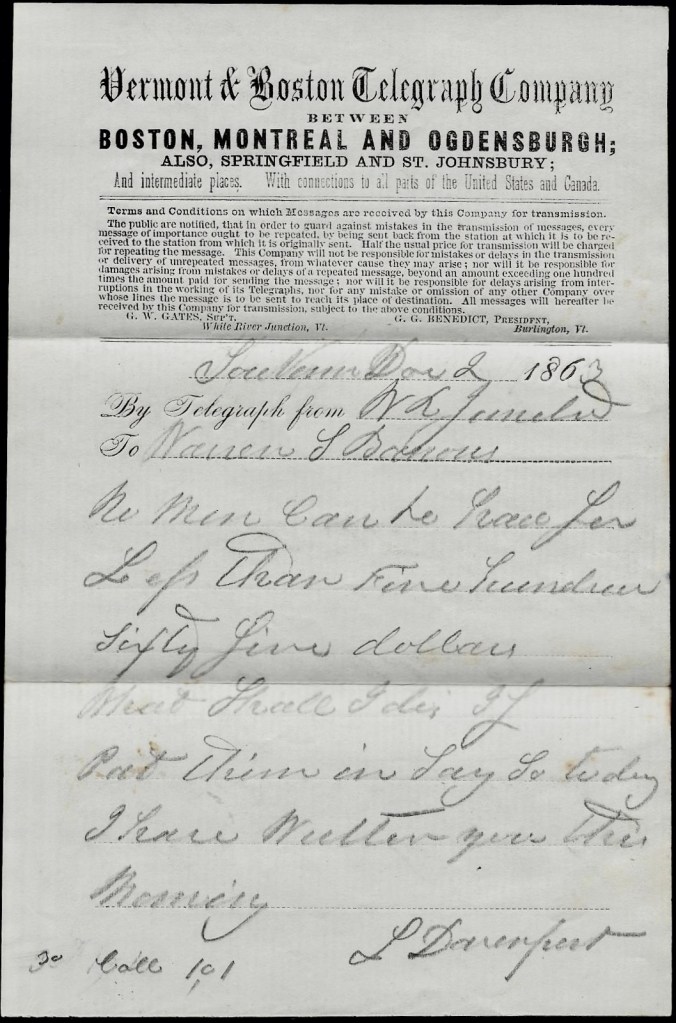
Telegram
“No men can be had for less than five hundred sixty-five dollars. What shall I do? If put them in, say so today. I have written you this morning.” — L. Davenport
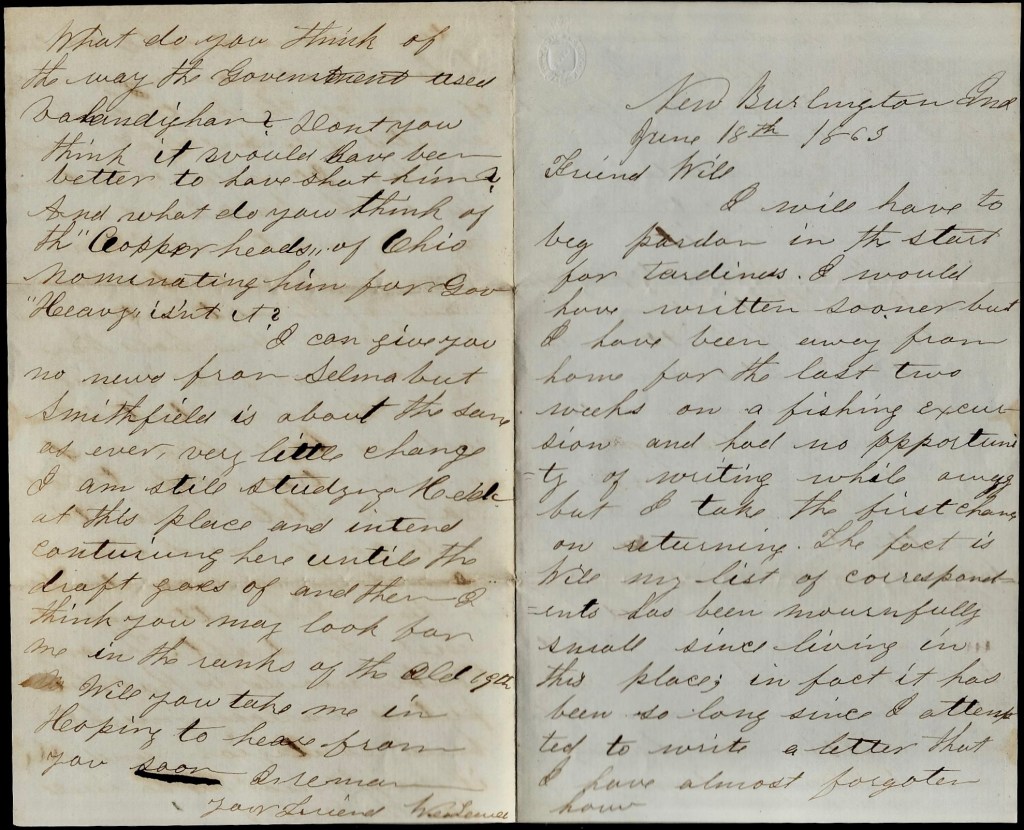
The author of this letter has not been identified. His signature appears to read, “Wes Land” but I can find no one by that name, or similar name, in New Burlington, Indiana. Regardless of his identity, Wes provides his friend in the Iron Brigade some interesting news about the attempt to set up the draft in Indiana during the summer of 1863 and the resistance of the Copperheads.
Wes wrote the letter to his friend, William Harrison Campbell, a 23 year-old school teacher from Selma, Liberty Township, Delaware county, Indiana. Will enlisted in Co. K, 19th Indiana Infantry on 29 July 1861 as a first sergeant and was promoted to 2nd, then 1st Lieutenant during the war. The 19th Indiana was, of course, part of the famed Iron Brigade or “Black Hat” Brigade. He was discharged for medical disability in October 1863 on account of the wound he received at Gettysburg in his right hand.
Transcription
Addressed to Will H. Campbell. Co. K, 19th Indiana Vols., Washington D. C.
New Burlington, Indiana June 18th 1863
Friend Will,
I will have to beg pardon in the start for tardiness. I would have written sooner but I have been away from home for the last two weeks on a fishing excursion and had no opportunity of writing while away. But I take the first chance on returning. The fact is, Will, my list of correspondents has been mournfully small since living in this place; in fact, it has been so long since I attempted to write a letter that I have almost forgotten how. And you know how hard it is for a fellow to begin writing after “forgetting how.” However, I know that I am writing to a friend and not to a critic and will risk it.
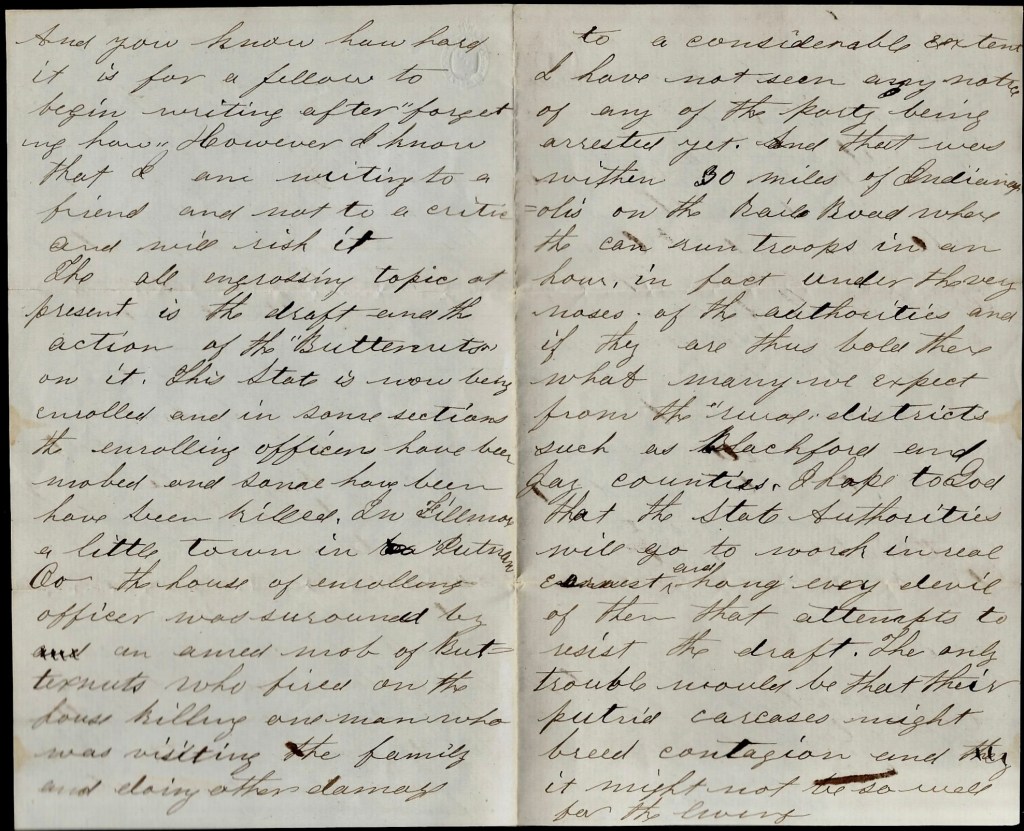
The all engrossing topic at present is the draft and the action of the “Butternuts” on it. This State is now being enrolled and in some sections the enrolling officers have been mobbed and some have been killed. In Fillmore—a little town in Putnam county—the house of the enrolling officer was surrounded by an armed mob of Butternuts who fired on the house killing one man who was visiting the family and doing some other damage to a considerable extent. I have not seen any notice of any of the party being arrested yet. And that was within thirty miles of Indianapolis on the railroad where they can run troops in an hour. In fact, under the very noses of the authorities, and if they are thus bold there, what may we expect from the rural districts such as Blackford and Jay counties?
I hope to God that the State Authorities will go to work in real earnest and hang every devil of them that attempts to resist the draft. The only trouble would be that their putrid carcasses might breed contagion and it might not be so well for the living.
What do you think of the way the Government used Vallandigham? Don’t you think it would have been better to have shot him? And what do you think of the “Copperheads” of Ohio nominating him for Governor? “Heavy,” isn’t it?
I can give you no news from Selma but Smithfield is about the same as ever—very little change. I am still studying H___ at this place and intend continuing here until the draft goes off and then I think you may look for me in the ranks of the Old 19th. Will you take me in? Hoping to hear from you soon, I remain your friend, — Wes Land
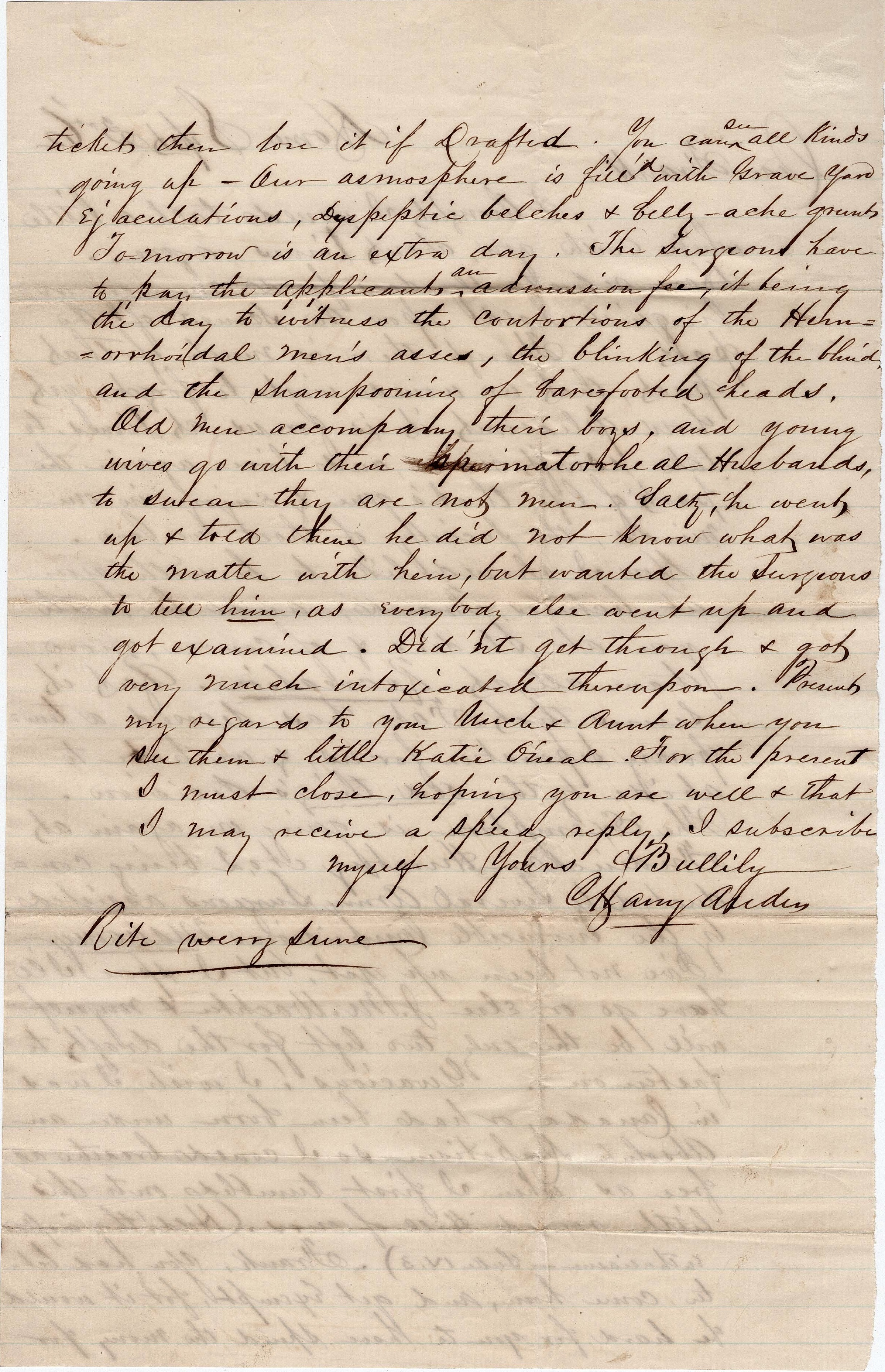
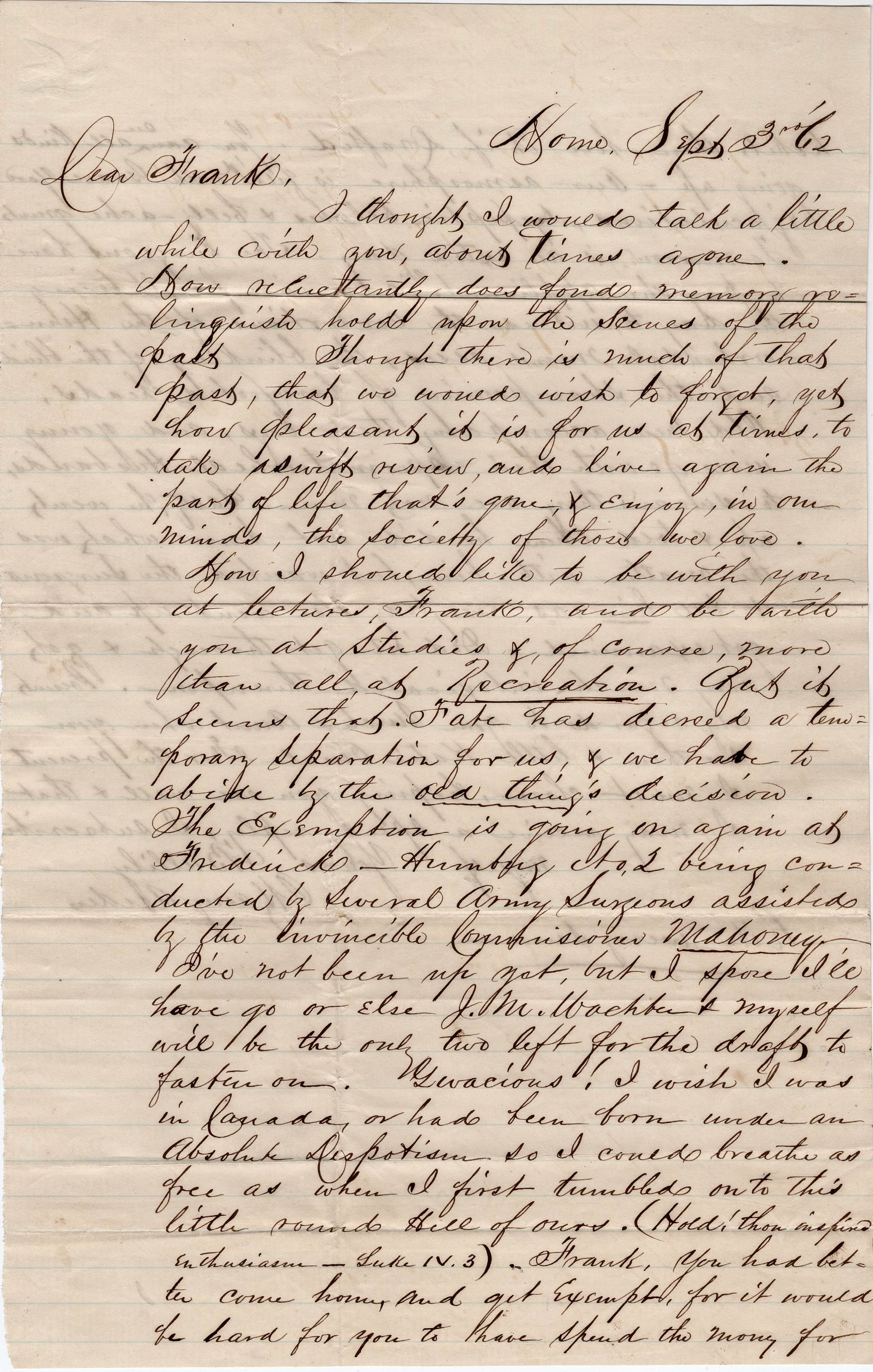
Not holding back, this vitriolic attack on James Reed Burchett of Salem, Virginia, reveals just how cruelly some citizens—or soldiers suspected of “playing off”—could be treated if they did not pick up the musket in the defense of their country’s “rights.” I’ve seen similar sentiments expressed in letters by Union soldiers but this is the first time I’ve seen it written by a soldier wearing the butternut.
Military records indicate that James R. Burchett enlisted on 4 June 1861 at Salem in Co. E, 42nd Virginia Infantry, but he was mustered out six weeks later at Lynchburg. James died single at the age of 25 on 28 August 1864 while attending school at Roanoke College. The cause of death was said to be typhoid fever. His death record identifies him as “Soldier and Student.”
The letter is not dated by I suspect it was written sometime in 1862 as that was the first year that the Confederate government introduced the draft.
[This letter is from the personal collection of Richard Weiner and is transcribed and published on Spared & Shared by express consent.]
Transcription
Mr. Burchett,
As I sit musing upon the past, my thoughts settled upon one prominent subject and that was of you not taking a part in defense of our country’s rights. I am indeed truly sorry that the Southern Confederacy holds such as you. I have heard of you frequently, You talked very extravagantly when the first volunteers were called out. To hear of you, I thought you would be the first to go into service. But alas! it was all talk.
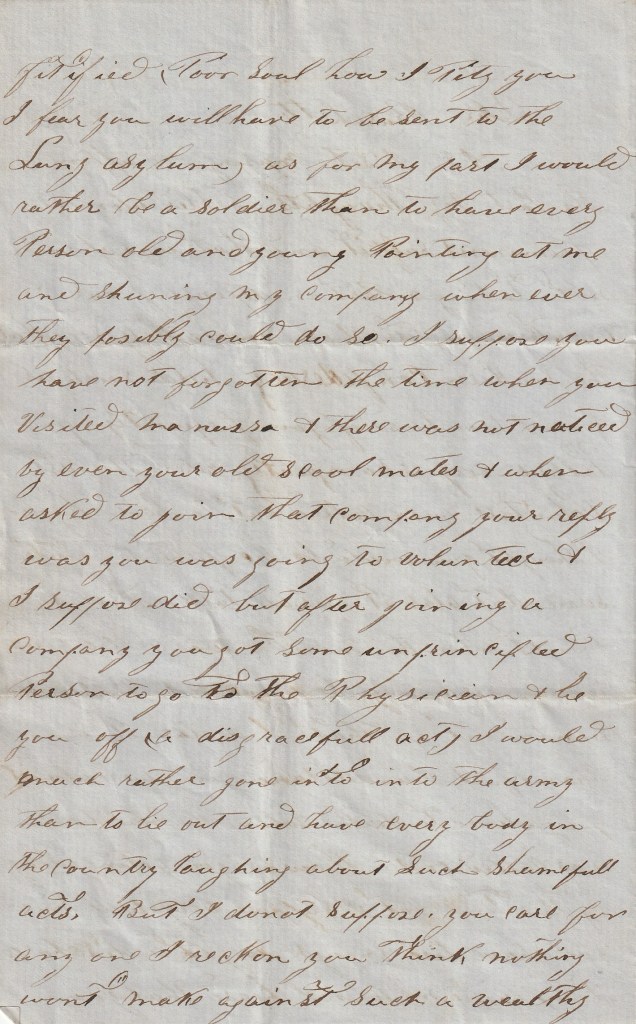
It was thought when the militia was called, you would certainly be dragged out. But you even lied out of that. I declare, it is shameful. I understand you were almost frightened to death when the militia was called out. How are you getting along by this time? But I suppose very well since you have led enough to get a discharge. It surprised me when I heard that you fitified 1 (Poor soul, how I pity you. I fear you will have to be sent to the lung asylum).
As for my part, I would rather be a soldier than to have every person, old and young, pointing at me and shunning my company whenever they possibly could do so. I suppose you have not forgotten the time when you visited Manassas & there was not noticed by even your old schoolmates, and when asked to join that company your reply was you was going to volunteer & I suppose did. But after joining a company you got some unprincipled person to go to the physician & lie you off (a disgraceful act). I would much rather gone into the army than to lie out and have everybody in the country laughing about such shameful acts.
But I do not suppose you care for anyone. I reckon you think nothing won’t make against such a wealthy intelligent young man as you think you certainly are. I swear that you are the only person that thinks of your qualification as being anything more than any fitifed other persons. I have heard it spoken of as if you was going to marry soon. I hope you will get a lady that will take care of you when in your insane condition. Some say that they think if you would of told the [Draft] Board that you was going to marry that would of been a better excuse. If will so allow me as I am anxious to hear from you to ask it of you, how many fits have you had lately. It is reported in camp that you have gotten entirely over them. I hope it may be true as I received a letter some time since and in that letter a person that knew you well told me that your disease was a hereditary one—that she knew your grandma and she was in your fix—that is, she had something of the same nature as you have—spells of insanity. I hope when you get married, you will come out and try the Yankees a shot or two.
If you ever have an idea of joining any company, I would be glad if you would join this company as there are several of your friends that belong to this company that will take care of you if you should have any of your fits in their presence. I will advise you to marry if you have a chance to do so for after the war is over & peace is made and we all get home, some of the boys will try to cut you out & as you say you have spasms, they probably would take the advantage of you in some way or another. As you know, some persons will take the advantage of a poor, fitified person as you profess to be.
As I fear my letter will not be interesting, I will close by sending your dearest dear my never dying respects & love. One of your old friends. Yours respectfully. [no signature]