Category Archives: Early War Correspondence

1861: Benjamin D. Carpenter to John Simpson Crocker

Not unlike the poisonous effects of the shadow of the deadly upas tree,” secession “has spread a blight and desolation over the country.” So wrote 42 year-old Benjamin D. Carpenter (1819-1895), “a northern man who settled in Alexandria county, Virginia, long before the war, having a large farm at Red Hill…Coming to Washington during the war, he bought a large farm on Rock creek west of Brightwood, where he lived for nearly a quarter of a century. This place is now embraced in Rock Creek Park.” [Source: Obituary] Benjamin was married in the mid 1840s to Anna Maria Crocker (1822-1895) and was the proud father of four daughters.

Benjamin was trained as a surveyor and he was the first to prepare a map showing the metes and bounds of the District of Columbia.

Benjamin wrote the letter to his brother-in-law, John Simpson Crocker (1825-1890) who was appointed Colonel of the 93rd New York Infantry. He was captured during the siege of Yorktown and imprisoned at Libby Prison and later Salisbury before being exchanged in August 1862.
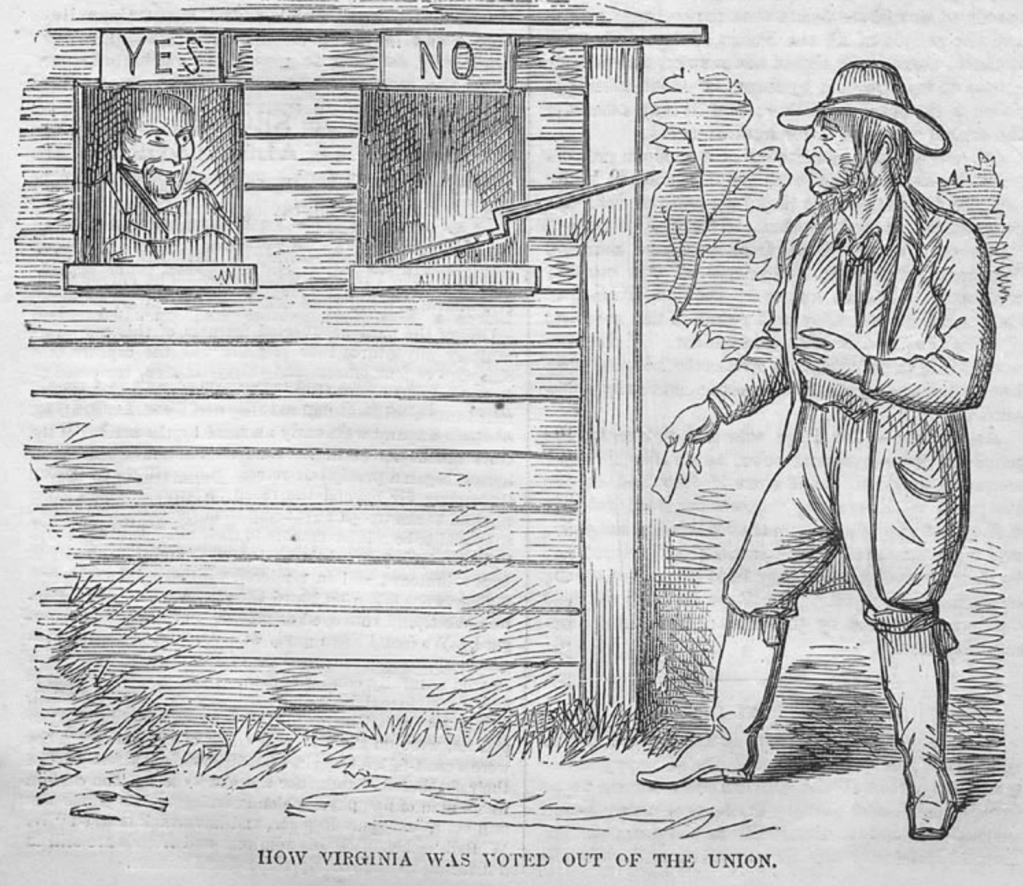
“Men were deprived of the elective franchise through fear and suffer all the horror of a reign of terror rather than vote at all. ” — Benjamin D. Carpenter

Transcription

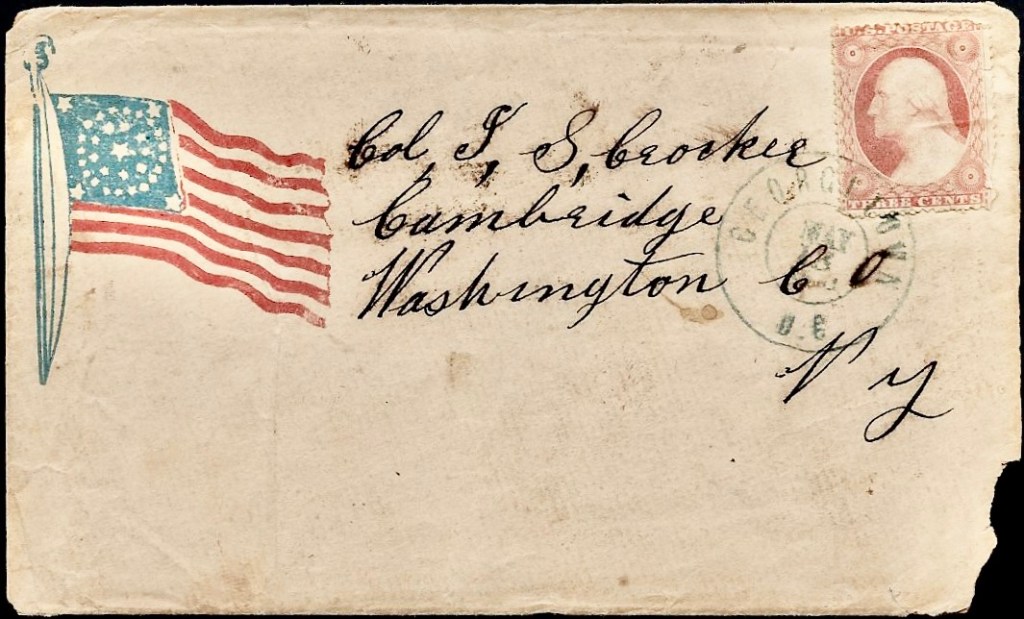
Addressed to Col. I. S. Crocker, Cambridge, Washington county, New York

Fairfax county [Va.]
May 30th 1861

Dear brother,

Yours has been duly received and I hasten to reply. You will perceive that I have changed front or right about faced since I last wrote you. That’s so. I go in for the motto that heads this sheet secession is but a name for all that is devilish and infernal. If you or anyone else were here only one week, you would see a fair illustration of Mexican despotism. You would see the most intense hatred of those anti-white labor Nero’s that would cause your blood to boil with indignation and would make you turn away from them with loathing and contempt. Men are prosecuted and threatened with violence and even with hanging for wishing to cling to that government which has protected them in their civil and religious liberty, which has thrown over them and around them a halo of Freedom and prosperity that no other government under heaven has. Men are fleeing for their lives for wishing to preserve the Union of these states which was formed for the protection of our lives, liberty and property.

Secession leaders marched about breathing vengeance on all who would not enroll themselves with them under the black banner of Treason whose baneful shadow is not unlike the poisonous effects of the shadow of the deadly upas tree. It has spread a blight and desolation over the country; it has paralyzed and prostrated business and the energy of the people; it has destroyed the confidence between friends and neighbors; it has made vacant firesides and empty houses; it has made silent workshops and deserted villages; it has silenced the ploughman’s song and the wagons rattle on the roads, and last but not least of all, it seeks to pull down the strong pillars of the wisest and best governments, and if they can accomplish no more, involve all in one common total overthrow. It makes my heart bleed to see the people leaving for life, fleeing from that demon of secession which would wring the last drop of blood from one’s heart for wishing to live in the Union—the land of the free and the home of the brave.

Thirty-four families left Vienna in two days with what they could hastily gather up and then bid adieu to their homes for which they have toiled to make comfortable and pleasant. John, a great gloom is over the land like some great and sudden calamity. The sun seems to shine through some kind of a veil which casts a shade of sadness over heavens and earth, not unlike the feeling of some swift and sudden calamity about to happen, that strikes terror and dread to the heart. Men were deprived of the elective franchise through fear and suffer all the horror of a reign of terror rather than vote at all.

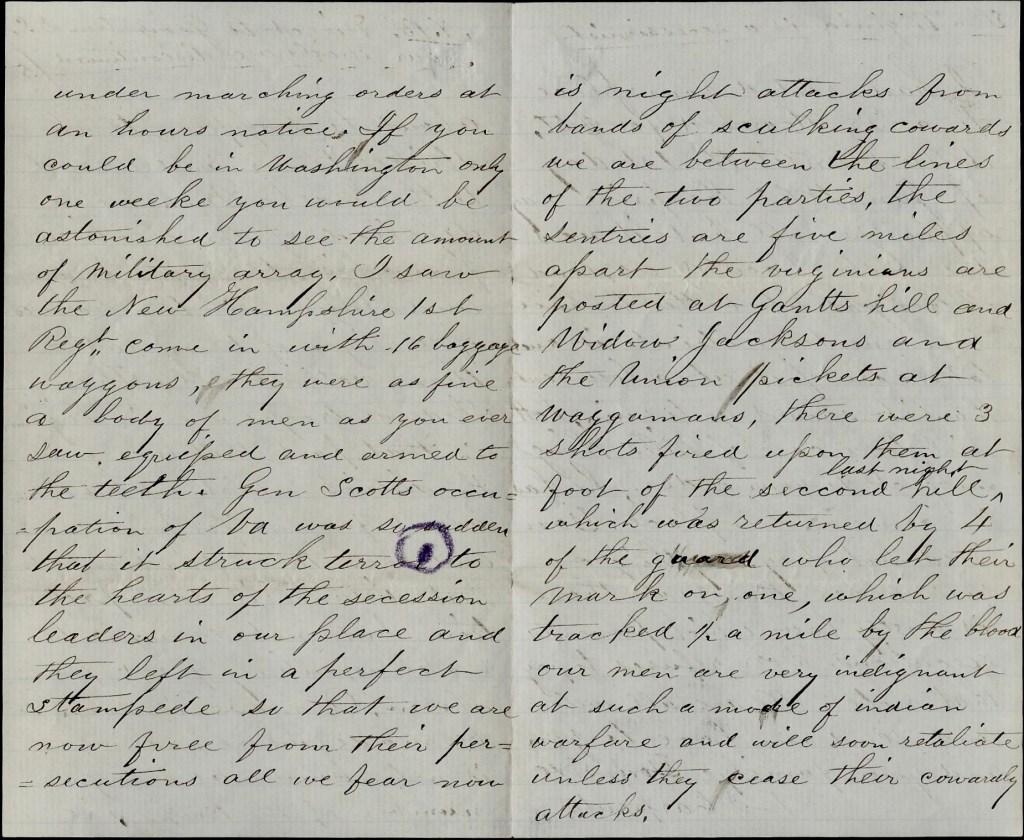
The Federal troops are in Virginia in that part that once was the district which makes them about four miles from us and even their shadow at that distance is some protection but not enough to make us entirely free from alarm. A move is soon to be made—where and when is not known—as a large number of troops are under marching orders at an hour’s notice. If you could be in Washington only one week, you would be astonished to see the amount of military array. I saw the New Hampshire 1st Regiment come in with 16 baggage wagons. They were as fine a body of men as you ever saw, equipped and armed to the teeth. Gen. Scott’s occupation of Virginia was so sudden that it struck terror to the hearts of the secession leaders in our place and they left in a perfect stampede so that we are now free from their persecutions. All we fear now is night attacks from bands of skulling cowards. We are between the lines of the two parties, The entries are five miles apart. The Virginians are posted at Gantt’s Hill and Widow Jackson’s, and the Union pickets at Waggaman’s. There were three shots fired upon them at the foot of the second hill last night which was returned by four of the guard who left their mark on one, which was tracked half a mile by the blood. Our men are very indignant at such a mode of indian warfare and will soon retaliate unless they cease their cowardly attacks.

I have rented your place to a Dr. Harrold for $50 dollars until the 1st day of January 1862. The price may appear small but it was the best I could do adn I thought it better to have someone to cultivate it and take care of it at a low rent than it should go to ruin. Lott will take care of Will’s things. subject to your order. He has the cows on his place. You need not pay anything on your place this year. There is a stay law which prevents executions. Dorr refuses to pay that note. We are all well and send our love to you and your families. Yours, &c. — B. D. Carpenter

Ellen Virginia is a secessionist.

N. B. Direct to Georgetown. Our mails are discontinued.

1861: John Watts Goodwin to a Northern Friend

La Grange, Fayette county, Tennessee

This unsigned, mid-July 1861 letter was written by a youthful businessman from La Grange, Tennessee. It came to me for transcription with the hope that I might be able to identify the author. The letter was written to a northern acquaintance about the present political and social situation in Tennessee, including a discussion of his own sense of allegiance to the South and his predictions about how the fateful course of events will unfold for both sides. Between the lines there is a sense of the deep struggle taking place within his own mind and heart on these issues, just as he describes it for others. Indeed, Tennessee was very much a split state as far as sentiments were concerned. Confederate allegiances were much higher in the western areas where La Grange is located than they were in the northeastern portion of the state, which Confederate troops actually had to forcibly occupy. 

La Grange was incorporated as a town in 1829 and enjoyed the reputation of being the wealthiest and most cultured town in the South at the time. The oldest town in Fayette county, it is located 50 miles east of Memphis and only three miles north of the Mississippi state line. At one time, its population topped 2,000; today it claims only 160 residents. During the Civil War, the town suffered severely at the hands of the thousands of Federals who established a garrison there. Less than a week after the fall of Memphis, Union troops took occupancy of the town and after that, due to its strategic importance along the Memphis and Charleston Railroad, it was continually occupied by either Union or Confederate troops. At one time, as many as thirty thousand Union soldiers were encamped in and around the town, and over three thousand wounded or sick were hospitalized there.

This letter was written just 10 days after Tennessee was admitted to the Confederacy—the 11th and last state to do so. It is very much a manifesto of the inevitability of impending war, as well as its high eventual cost. The first major conflict—the Battle of Bull Run—was fought 9 days later in Virginia, with the Union’s prevailing belief in an early triumph dashed. The letter ends suddenly, and though it may well be only a partial letter, the absence of a signature may be intentional. In this regard, the author notes that he now is using private rather than public conveyance for his mail. 

From the letter, I surmised that the author was a comparatively young businessman who worked in a La Grange store doing business with customers that would often purchase goods on credit—a common practice at the time, particularly in agrarian societies. He mentions learning the business from the “old man” which may very well have been, in the customary reference, his own father. A website on the history of La Grange informs us that between 1860 and 1862, the merchants were J. T. Foote, George P. Shelton, O. S. Jordan, C. F. Chessman, Cossett, Davis & Bryan, Fowler & Louston, T. S. Parham, R. J. Bass & Co., and John Goodwin.

After searching through the 1860 US Census records for these businessmen, I discovered that John W. Goodwin—the last named merchant—was enumerated in the 1860 US Census taken at La Grange as the 28 year-old son of 61 year-old merchant, James Doswell Goodwin (1798-1869). In researching this family, I discovered that John Watts Goodwin (1831-1922) was the oldest son of his merchant father; his mother, Catharine (Watts) Goodwin (1806-1851), had died in Rolls county, Missouri, when John was 20 years old. Digging deeper into John’s biography, I discovered that he was born in Virginia (as were his parents) and that he attended the Fleetwood (military) Academy in Virginia before attending Jubilee College in Charleston (now Brimfield), in Peoria county, Illinois. In the 1850 US Census, 19 year-old John W. Goodwin was enumerated in his father’s household in District 73, Ralls county, Missouri, where his father farmed. Ralls county borders the Mississippi river in northeast Missouri.

Given these facts, I’m inclined to attribute this letter to John Watts Goodwin, writing to a former acquaintance in Illinois or Missouri. An obituary notice for him claims that he worked for a time in various capacities for the Memphis & Charleston Railroad during and after the Civil War. In 1869 he was appointed secretary and treasurer of the Little Rock & Memphis Railroad. In 1900 he became a director of the First National Bank of Little Rock.

[Note: This letter is from the private collection of Richard Weiner and is published on Spared & Shared by express consent.]

Transcription

La Grange, Tennessee
July 12th 1861

My Friend:

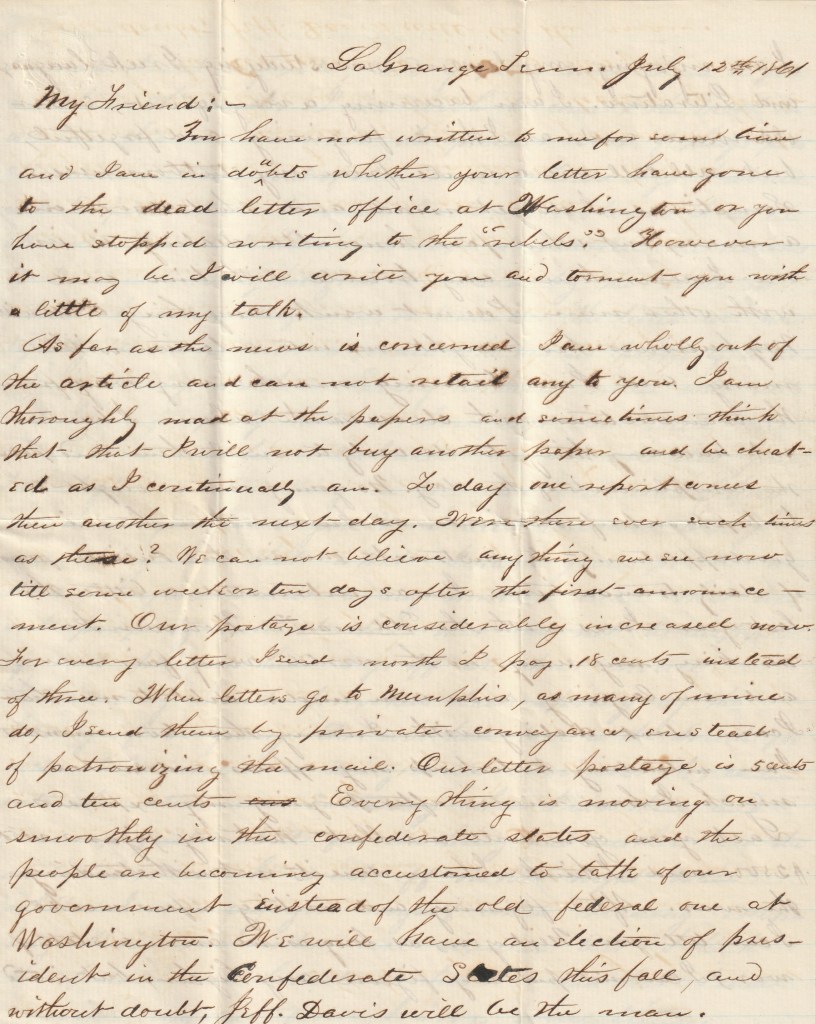
You have not written to me for some time and I am in doubts whether your letter have gone to the dead letter office 1 at Washington or you have stopped writing to the “rebels.” However it may be, I will write you and torment you with a little of my talk.

As far as the news is concerned, I am wholly out of the article and cannot retail any to you. I am thoroughly mad at the papers and sometimes think that I will not buy another paper and be cheated as I continually am. Today one report comes—then another the next day. Were there ever such times as these? We cannot believe anything we see now till some week or ten days after the first announcement.

Our postage is considerably increased now. For every letter I send North, I pay 18 cents instead of three. When letters go to Memphis—as many of mine do—I send them by private conveyance instead of patronizing the mail. Our letter postage is five cents and ten cents. Everything is moving on smoothly in the confederate states and the people are becoming accustomed to talk of our government instead of the old federal one at Washington. We will have an election of president in the Confederate States this fall, and without doubt, Jeff Davis will be the man.

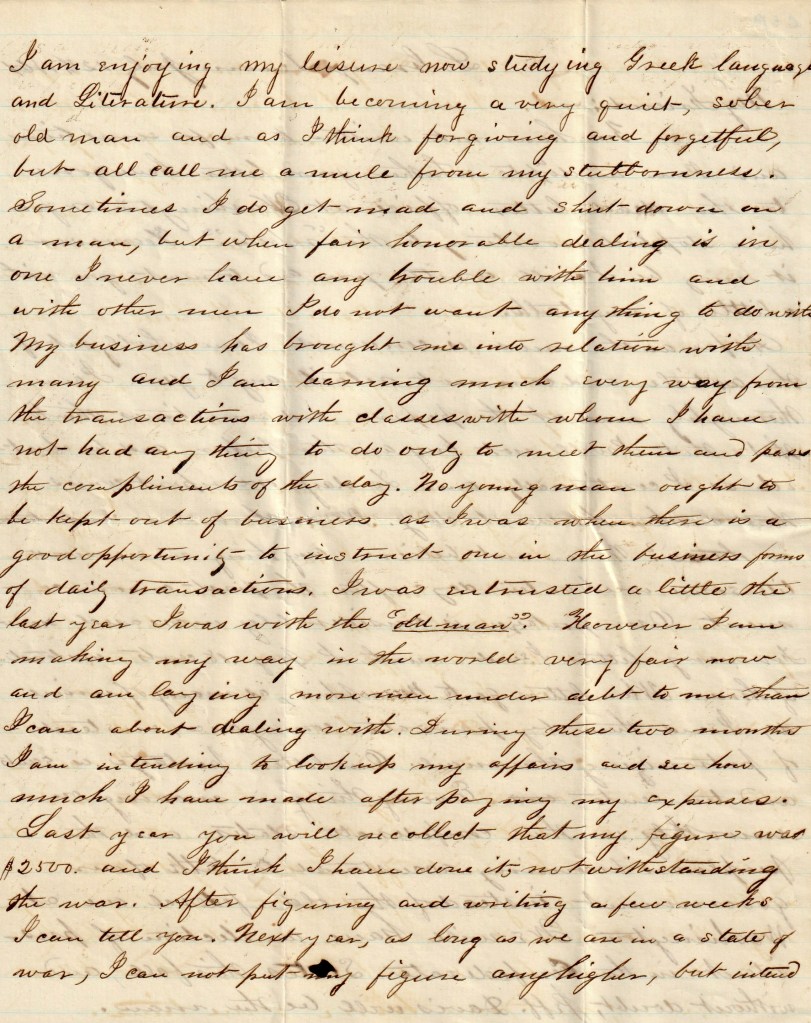
I am enjoying my leisure now, studying Greek language and literature. I am becoming a very quiet, sober old man and as I think—forgiving and forgetful. But all call me a mule from my stubbornness. Sometimes I do get mad and shut down on a man, but when fair honorable dealing is in one, I never have any trouble with him and with other men I do not want anything to do with. My business has brought me into relation with many, and I am learning much every way from the transactions with classes with whom I have not had any thing to do—only to meet them and pass the compliments of the day. No young man ought to be kept out of business as I was when there is a good opportunity to instruct one in the business forms of daily transactions. I was entrusted a little the last year I was with the “old man.” However, I am making my way in the world very fair now and am laying more men under debt to me than I care about dealing with.

During these two months, I am intending to look up my affairs and see how much I have made after paying my expenses. Last year, you will recollect, that my figure [goal] was $2,500 and I think I have done it, notwithstanding the war. After figuring and writing a few weeks, I can tell you. Next year, as long as we are in a state of war, I cannot put my figure any higher, but intend to make it at any rate. And if peace comes I am in for another thousand.

I did wish to come to the North on a visit this summer but the present state of things puts all such notions out of one’s head. Should I go, I would not be permitted to come back. Nor should I so be allowed. Now that there is a conflict between the sections, it becomes every citizen to stand by the state to which he owes allegiance—or leave it. The lines are now tightly drawn and a man who has no property interest is closely watched. Every Northern man who did not have property interest here left, and some—one at least—and he a dishonest one—have also gone. Two left without calling on me and even asking, “how much do I owe you?” I am ashamed to say one thing, and that is that I have given positive orders to refuse credit to any northern man that has not property interest here that can be disposed of and permit him to go off at short notice.

I was very much provoked last spring by the leaving of a young Dr. who had been in the South for some time and was doing some business. He came into the store one Saturday when I was there and run up quite a bill for one thing and another and the very next week went off on the night train while I was enjoying myself either reading or sleeping. There was another case similar but I think the fellow was honest at heart and that I shall receive my due from him some time. As a matter of course, interest will keep a man when, were he free from anything that bound him to a place, he would return to his old allegiance. Such seems to be the case here now and men and women that can get away seem to do so. On the other hand there are many men here of northern birth who are true to the South. Many have every reason to be so. Wife, children, slaves, and all their friends and interest, bind them to this and no other portion of the earth, and now that the conflict has come, there is but one step for them to take—viz: to espouse the cause which lies nearest to their hearts.

These are hard times and many are the troubles that are to follow if this war is to be prosecuted as the message of Lincoln seems to indicate it will be. Let them push on but my opinion is that—let it turn out as it may—there will be a debt heavier than any ever dreamed of before. I very much doubt whether the new loan and levy will accomplish his object. After his money is spent and his army unpaid, Mr. Lincoln will find the same race of rebels in the South and an army for him to meet. The commercial interest of the South will be prostrated if England respects the federal blockade. The northern shipping must feel it also as they must lie idle and do nothing. Manufactories at the North are now closed and will stay so till the war is over and amicable relations again restored—not as the same nation, but as two separate and independent republics.


1 The Dead Letter Office opened in 1825. By the 1860s, with the nation’s men busy fighting in the Civil War, women employees outnumbered the men 38 to 7. These mostly female clerks acted as “skilled dead letter detectives,” inspecting the mail for potential clues about who sent it or where it was going.