
The following letter was written by Canadian-born Owen Miles Higgins (1840-1913) who came to the United States with his parents, Miles Higgins (1820-1894) and Mary Devitt (18xx-1890) in 1849. During the Civil War, Owen volunteered to enlist in February, 1862, with a company of marksmen recruited at Detroit known as “Brady’s Sharpshooters” named after a Frontier General. It was organized by Captain Kiniston S. Dygert who had served under that General. On the records of the adjutant General’s office the company was designated as the first independent company of sharpshooters and they were attached to the 16th Michigan Infantry (previously known as “Stockton’s Independent Regiment“). Brady’s Sharpshooters or “Dygert’s Sharpshooters” as they were alternately called, served with the 16th Michigan Regiment until the close of the war. Although they were issued standard military rifles (Prussian Lorenz and Schuetzen Rifles, we had 1861 Springfields and 1853 Enfields), many of the volunteers brought with them their personal customized target rifles, often equipped with telescopic sights, which were used in local shooting competitions. The special mission and origin of these sharpshooters helps to explain the strong esprit de corps of the unit, and why, throughout its service, no draftees were ever included; all of the Brady’s Sharpshooters were volunteers, and though casualty rates were high, there was only one desertion in the field.
The 16th Michigan regiment and Brady’s Sharpshooters would first see action in the Siege of Yorktown and were soon assigned to the V Corps, as part of the 3rd Brigade of the 1st Division.
A portion of the letter was penned by Charles McCormick whom I believe was the infantryman by that name who served in Co. D, 4th Michigan Regiment. He was in a different brigade than Owen but both brigades were in Fitz John Porter’s 1st Division of Heintzelman’s III Corps during the Peninsula Campaign. As such, they were probably camped near each other.
The letter was addressed to Beeri B. Noyes (1841-1924) of Macomb county, Michigan. He was married to Jerusha McCormick (1842-1905) so he would have been Charles McCormick’s brother-in-law.
Transcription
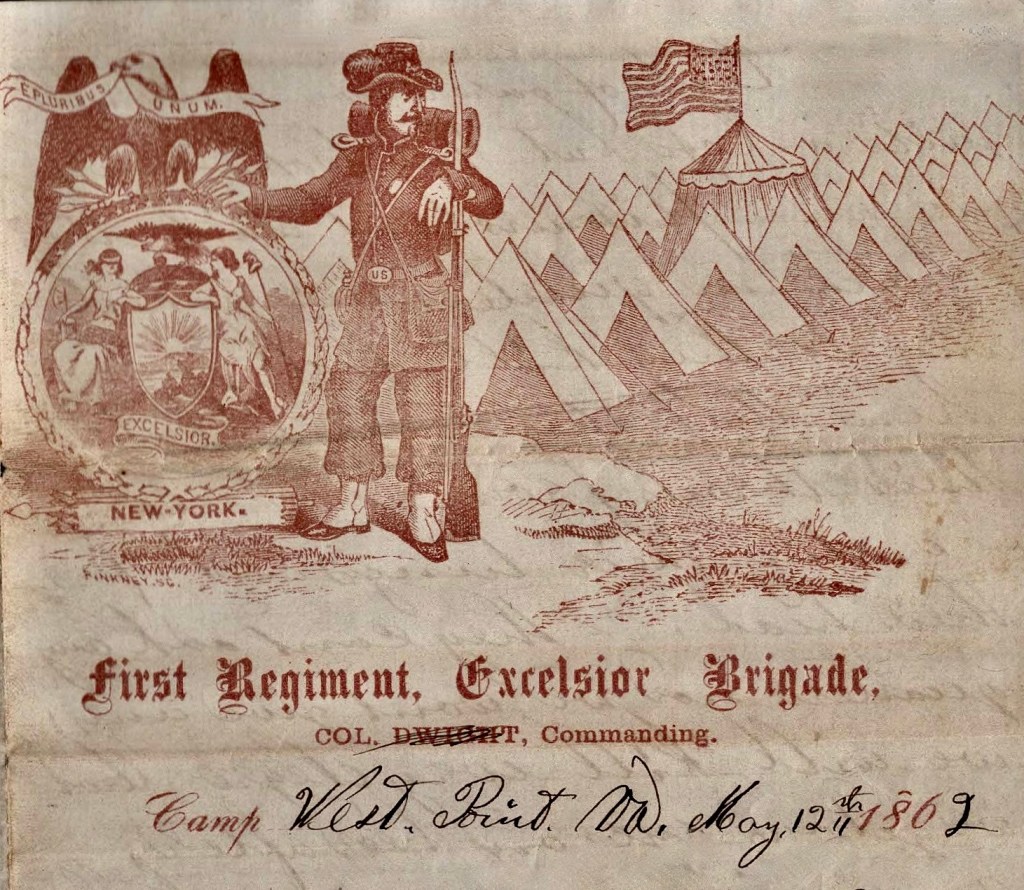
West Point Virginia,
May 12th 1862
Friend B. B. Noyes,
I have sat down to write you a few lines to let you know where & how we are. We are at West Point. We left Yorktown the 6th after the evacuation & sailed up the York river on the United States Steamship. There had been a fight the day before we landed here by our troops & the Brigade of Texan Rangers, 1 Negroes & Indians & two regiments of ours drove them with quite a loss, but they took some of our men prisoners but said they showed no quarters nor asked any, so they killed all of our men that they took by cutting their throats from ear to ear & cutting their tongues out of their head so they can’t ask any quarters nor we won’t give any. We will kill every Negro that we get our eyes on hereafter. Some of our boys have killed five or six now within a day or two for their barbarity by cutting their throats or hanging them up by their heels.
A big thing—we caught a spy during the recent skirmish at this place that owns this plantation. He was down at Halls Hill, Va., selling songs & you probably have heard one of them—the new Dixie that Fred Smith sent back & he used to get up on stumps & sing. But he will learn to dance now on a swing. He went by here under guards & the boys commenced singing some of his patriotic songs to him as he went marching along. We are now under marching orders with three days rations for Richmond. Well, I guess I will bring this letter to a close & let Charley have a chance as he is here. Please write. From O[wen] Higgins to B. B. Noyes
Direct the same as usual. Stockton’s Michigan Regiment, Brady S[harpshooters].
West Point, Va.
May 12, 1862
Dear Brother,
As I am here & Owen is a writing, he wants me to write a little but I don’t know anything to write. I wrote a letter home yesterday. We are a having the nicest weather that I ever saw. I wish that you could be here a few days to see how we get along. We have a having good times.
I went to drill this forenoon & we went down on the shore & went in a swimming. We stayed in the water till our time was up and then we went back to camp so I think that we had a good drill—just the kind that I like. Owen sits here with his hands on his knees a thinking about something, I don’t know. No more at present, so goodbye. This from your brother, — C. McCormick
1 It was not the “Texas Rangers” but men of John Bell Hood’s Texas Brigade that advanced on the Union troops near Eltham’s Landing near West Point, Virginia. The battle was really nothing more than a heavy skirmish. There were 194 Union casualties and 49 Confederate. There were no Indians or Negroes assisting in the Confederate attack and no instances of brutality that such was suggested in this letter than I could find in the literature—not even period newspapers.


 Spared & Shared 23