Category Archives: Fall of Richmond

1865: William Duffield McIlvaine to Sarah Jane McIlvaine

The following letter was written by William Duffield McIlvaine (1839-1916), the son of George D. McIlvaine (1805-1849) and Sarah Stauffer (1810-1901) of Gap, Lancaster county, Pennsylvania. After the war, in 1870, William married Mary Elizabeth Warren (1840-1917) in Milwaukee, Wisconsin, while working as a salesman. By 1880 he was living in Chicago employed as a clerk in a shot manufacturer’s establishment. He died in Oak Park, Illinois.

William wrote the letter to his sister, Sarah Jane McIlvaine (1837-1921) who was about to marry Charles Blanchard Seely (1824-1901), a real estate broker of East Liberty, Pittsburg.

In the 1860 US Census, William was enumerated in his mother’s household in Salisbury (Gap Post Office) in Lancaster county, Pennsylvania. His occupation was given as “machinist.” The first notice I can find of him serving in the US Navy was in March 1862 when he was assigned to the steam sloop Oneida. He served aboard this vessel until some time in 1864. Five of his letters were transcribed and published on Spared & Shared in May 2022. See—1862-64: William Duffield McIlvaine to Sarah Jane Duffield.

The only record I can find on Fold 3 is a letter William addressed to Secretary of the Navy Gideon Wells on 16 January 1865 (see below) in which he acknowledges the receipt of orders assigning him to duty aboard the USS Agawam as a 2nd Assistant Engineer.

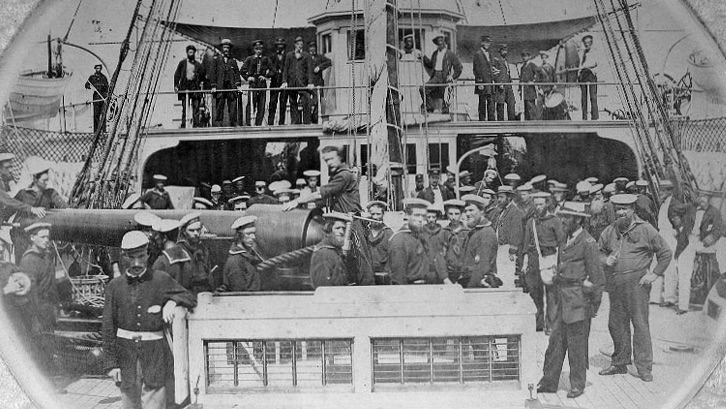
Ship’s officers and crewmen pose onboard the deck of the USS Agawam in August 1864 in the James River. Commander Alexander C. Rhind, ship’s Commanding Officer, is at the extreme right with his foot on the ladder. Standing next to him is Assistant Surgeon Herman P. Babcock. Lieutenant George Dewey is in the right center, wearing a straw hat, directly below the end of the davit. The pivot gun is one of the ship’s two 100-pounder Parrot rifles. Note Marine in the left foreground. Collection of Surgeon Herman P. Babcock, USN. Donated by his son, George R. Babcock, 1939. U.S. Naval Historical Center Photograph.

Transcription

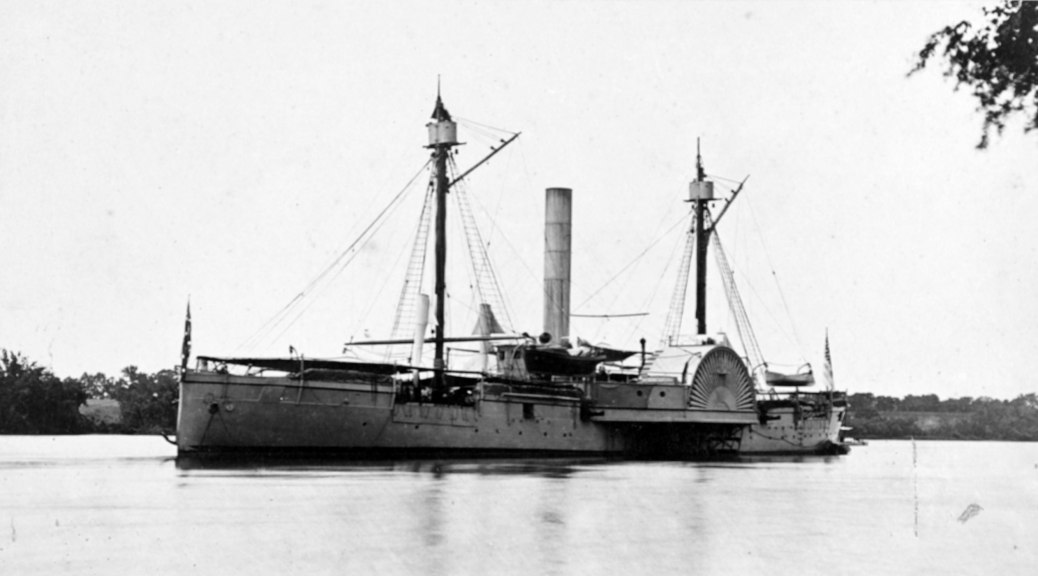
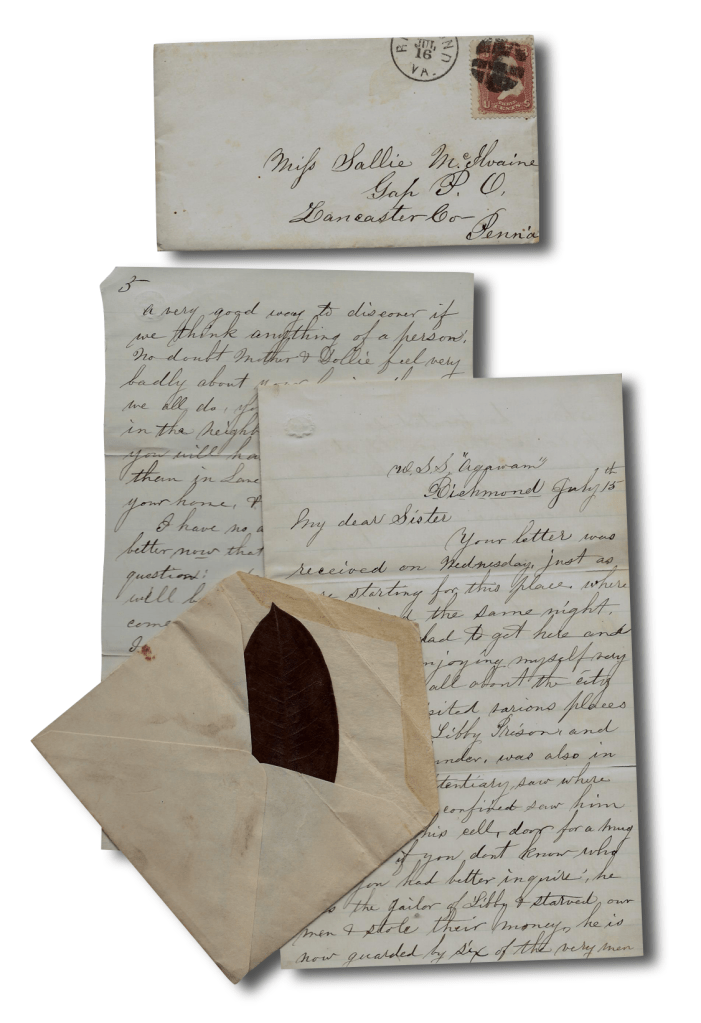
USS Agawam
Richmond, [Virginia]
July 15 [1865]

My dear sister,

Your letter was received on Wednesday, just as we were starting for this place where we arrived the same night. I am very glad to get here and have been enjoying myself very much. Rode all about the city yesterday, visited various places, was through Libby Prison and at Castle Thunder. Was also in the State Penitentiary [and ] saw where Dick Turner is confined. Saw him reach above his cell door for a mug of water. If you don’t know who he is, you had better enquire. He was the jailor of Libby & starved our men & stole their money. He is now guarded by six of the very men whom he treated so badly as prisoners. They would starve him if let alone. He is getting well paid for all his crimes I am convinced and will probably swing one of these days. 1

I had not been ashore long before I found my old friend and schoolmate Jere Horton who is on duty with the army here. He has lots of horses and wagons at his service so I can ride when or where I please. I had a very good time yesterday and expect to have some more next week. Was at Jeff Davis’s home, saw Gen. Lee’s house, was in the State House, and in fact almost everywhere. Coming up the river, saw all the fortifications and Dutch Gap Canal, which is a very small affair—contemptible. We had to run very slowly to keep off of piles, old vessels, rams, &c. sunk in the river all the way up here from City Point. On both sides of the river the banks are covered with earthworks and heavy forts. The ground seems to have been dug all over. I can truly appreciate the great work an army had to overcome to get to Richmond. Don’t think they could ever get in any other way than by cutting off the enemy’s supplies.

Jeff Davis Home in Richmond as it appeared in 1865

I am very much pleased with Richmond. It is, or has been a fine place situated on a hill in a very pretty country—scenery almost equal to Lanc. county. One can see many miles any direction from the Capitol. The river is much lower than the city and is small and narrow. There are a great many fine residences here and much shrubbery, trees, &c. A very pretty public square and I could give you no idea of all there is to be seen. One cannot look any way without seeing some house or object he has not read of during the past four years. I got some leaves from Jeff Davis’s yard and and some small stones from out of Libby Prison. I got a nice piece of grey cloth such as rebel uniforms were made of in the penitentiary where it was woven. I thought it might do to work something out of—tis only a few inches squarre. We will be here a week yet, I guess. 2

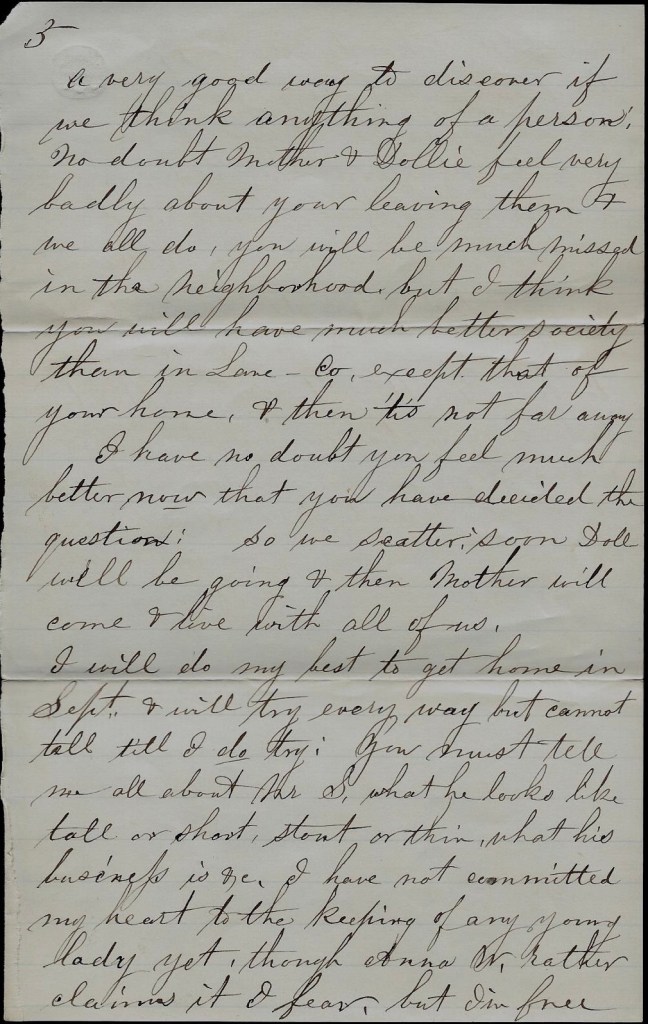
What must I say about the great news you wrote me. One naturally feels sad, at first thought, of a member of the family taking a new name and leaving home. One is apt to think she will be less to them than before. It is a new experience for our family & we rather shrink from it. On the other hand, I am happy at the prospect of your entering into this new relation and of your having a home and someone to love, for it is the natural way of living. And I pray and believe you will be happy. Of course you love the man and perhaps found it out when you got home & saw no more of him, which is a very good way to discover if we think anything of a person. No doubt Mother and Dollie feel very badly about your leaving them & we all do. You will be much missed in the neighborhood, but I think you will have much better society than in Lanc. County, except that of your home, & then ’tis not far away.

I have no doubt you feel much better now that you have decided the question. So we scatter. Soon Doll will be going & then Mother will come & live with all of us.

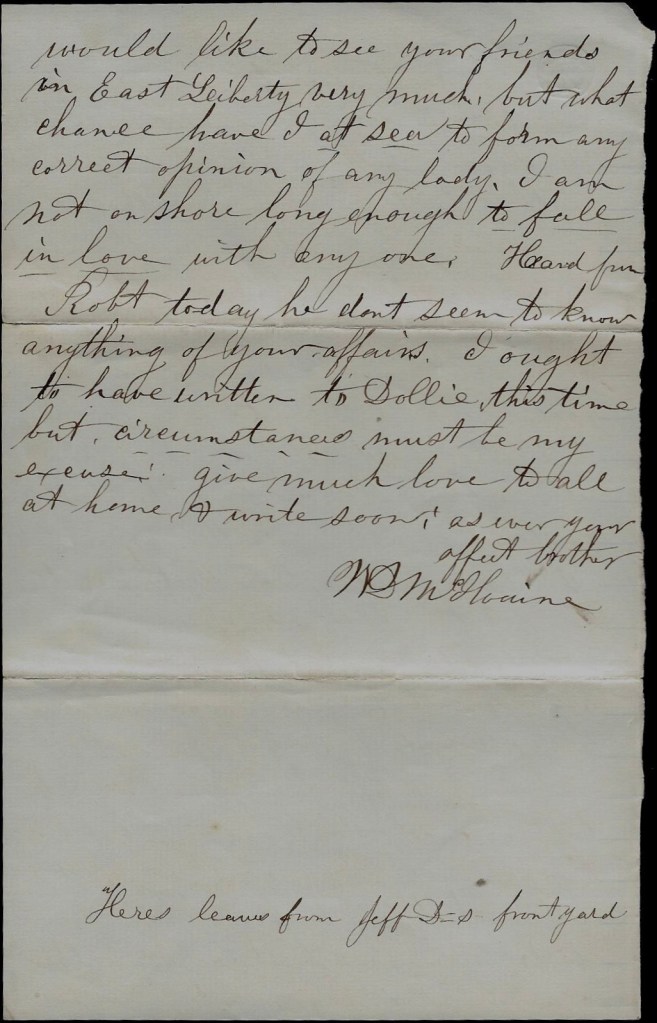
I will do my best to get home in September and will try every way but cannot tell till I do try. You must tell me all about Mr. S[eelly]. What he looks like—tall or short, stout or thin? What his business is, &c. I have not committed my heart to the keeping of any young lady yet, though Anna W. rather claims it I fear. But I’m free. Would like to see your friends in East Liberty very much but what chance have I at sea to form any correct opinion of any lady. I am not ashore long enough to fall in love with anyone.

Heard from Robert today. He don’t seem to know anything of your affairs. I ought to have written to Dollie this time but circumstances must be my excuse. Give much love to all at home & write soon. As ever, your affectionate brother, — W. McIlvaine

Here’s leaves from Jeff Davis’s front yard.


1 The Encyclopedia Virginia informs us that, “Libby Prison’s commandant, Major Thomas Pratt Turner, had been a student at the Virginia Military Institute in Lexington and then at the United States Military Academy at West Point. He left West Point in 1860, refusing to “swear allegiance to, a Government I despise and abhor.” He was described by one inmate as a man whose “utter depravity seems to have gained a full and complete expression in every lineament of his countenance.” Inmates, however, often confused Turner with another Libby official, Richard Randolph “Dick” Turner, no relation [another source says they were cousins], who was universally despised and singled out by U.S. secretary of war Edwin M. Stanton, in November 1865, for investigation into the criminal treatment of prisoners. It appears that Dick Turner was commissary at the prison and referred to as the “jailor.” Though Thomas Turner escaped when Richmond fell, Dick Turner was captured and held in Libby Prison for a few days until he escaped. He was caught again later and held at the State penitentiary where McIlvaine wrote that he saw him in Richmond, but he was paroled in June 1866.

This view of Libby prison was taken by [Charles R.] Rees in August of 1863. It is one of only two wartime images of the prison known to exist. The four men in the foreground are William D. Turner, Erasmus Ross, prison clerk, Richard Turner, jailor and Thomas Turner, Commandant.

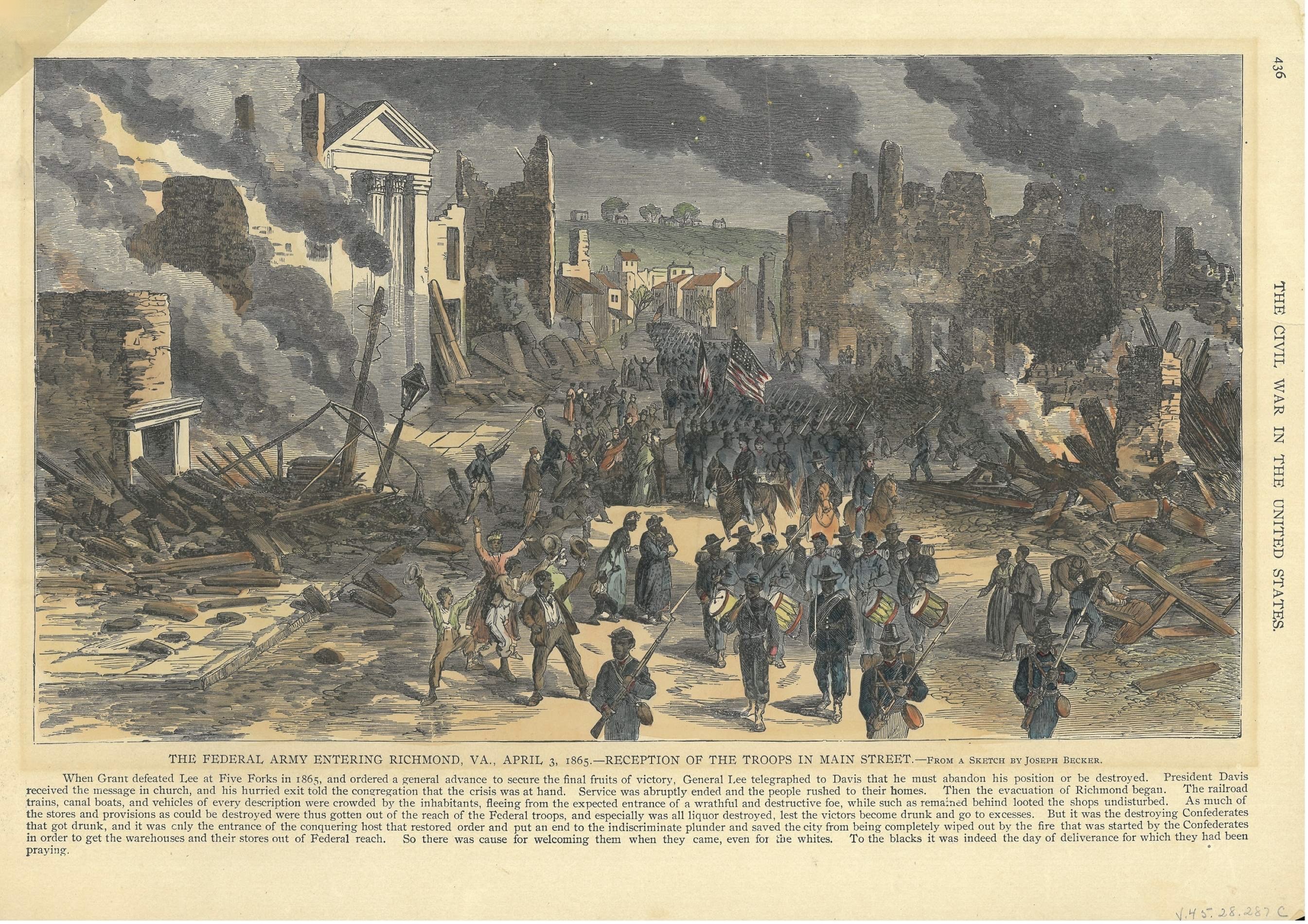
2 Curiously McIlvaine makes no mention of the destruction in much of the business district in the city caused by the fires set by Lee’s retreating army. The Union army is often mistakenly accused of burning Richmond but the fires were actually set by Lt. Gen. Richard S. Ewell, Richmond’s military commander, who was ordered to destroy all of the liquor in the city and also all of the government stores. The fires were so extensive that they got out of control and burned much of the business district. Union soldiers arriving in the city attempted to put the fires out but a sudden change in the wind direction was the only thing that really saved the destruction of the entire city.

Richmond fire ruins

1865: William Fraser to William J. Fraser

Most of these letters were written by William Fraser (1801-1877) of New Ephrata (renamed Lincoln), Lancaster county, Pennsylvania. He wrote the letters to his son, William Jackson Fraser (1835-1910) who was serving in Co. B, 195th Pennsylvania Infantry (1 Year Unit) that was not mustered out until June 1865.

A mourning ribbon for the assassinated President

There are three letters included here written by Wiliam’s boyhood friend, Samuel Musser Fry, Jr. (1845-1924), the son of Samuel Fry (1808-1887) and Nancy Ann Musser (1811-1886). In the 1860 US Census, Samuel Fry, Jr. was enumerated in his parents’ household in Warwick township where his occupation was given as “miller.” In 1862, either Samuel or his father took ownership of the three-story stone gristmill and sawmill previously owned and operated by Jacob Weis. According to the History of Lancaster County (Ellis and Evans), both Samuel and his younger brother Phares Fry (1845-1921) served as privates in Co. D, in the Fiftieth Regiment Emergency Troops of 1863.” These troops were organized into companies and placed along the river in Lancaster county with Emlen Franklin serving as their Colonel. This regiment went to Carlisle and Chambersburg, then to Hagerstown and Williamsport. They were stationed for a brief time at Dam No. 5 where they did picket duty until the middle of July, then returned to Harrisburg where they were discharged. Samuel and Phares subsequently served in the 195th Pennsylvania from 20 July 1864 to 4 November 1864 (a “hundred days” unit). Phares was a corporal in Co. G and Samuel was a private in Co. C.

This collection of home front letters were all penned from the Lancaster county hamlet of Lincoln during the final days of the Civil War and the assassination of President Lincoln.

See also

1863-5: William Jackson Fraser to Parents published on Spared & Shared 17.
1864-5: Samuel Musser Fry, Jr. to William Jackson Fraser on Spared & Shared 17.

Letter 1

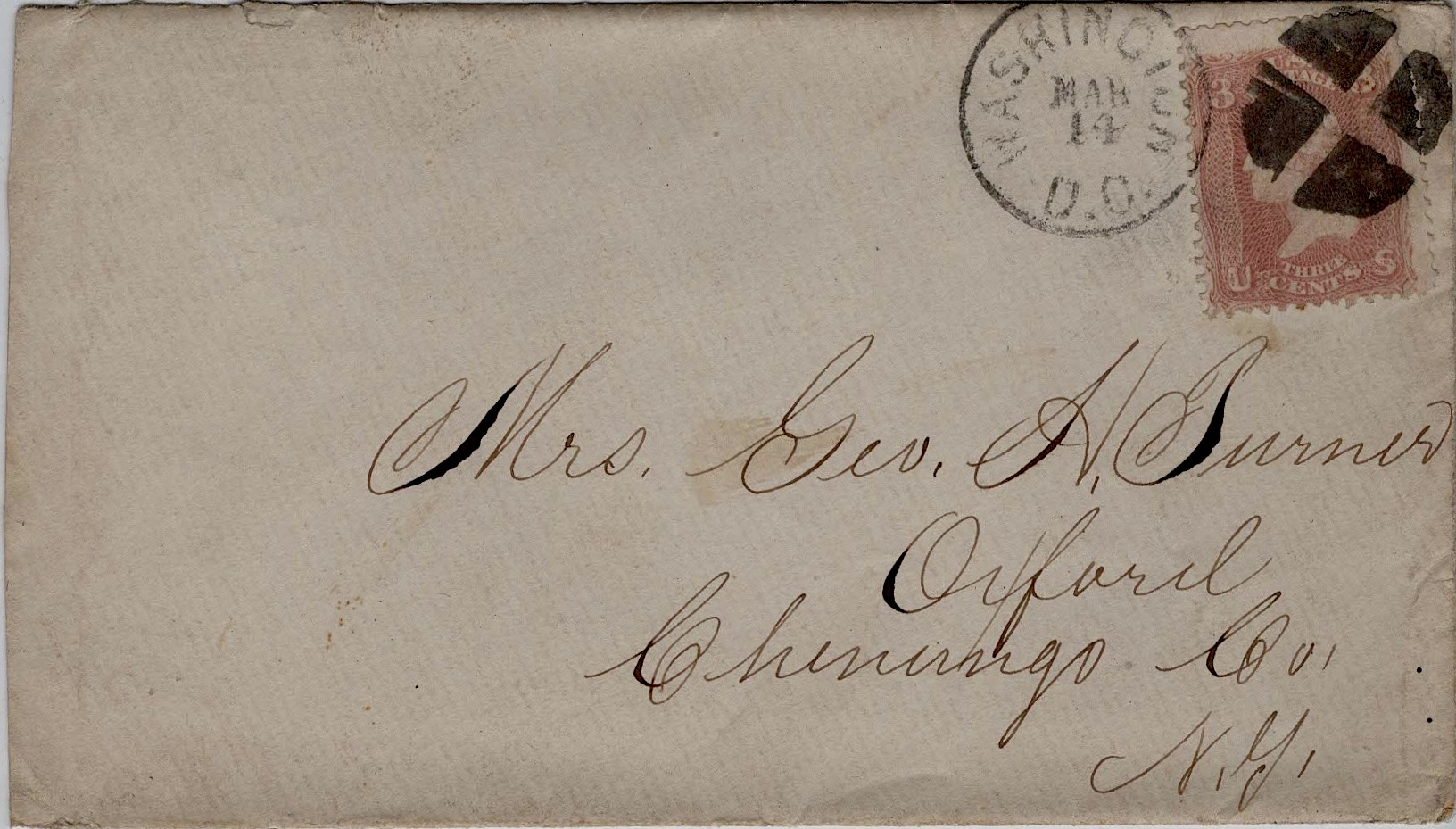
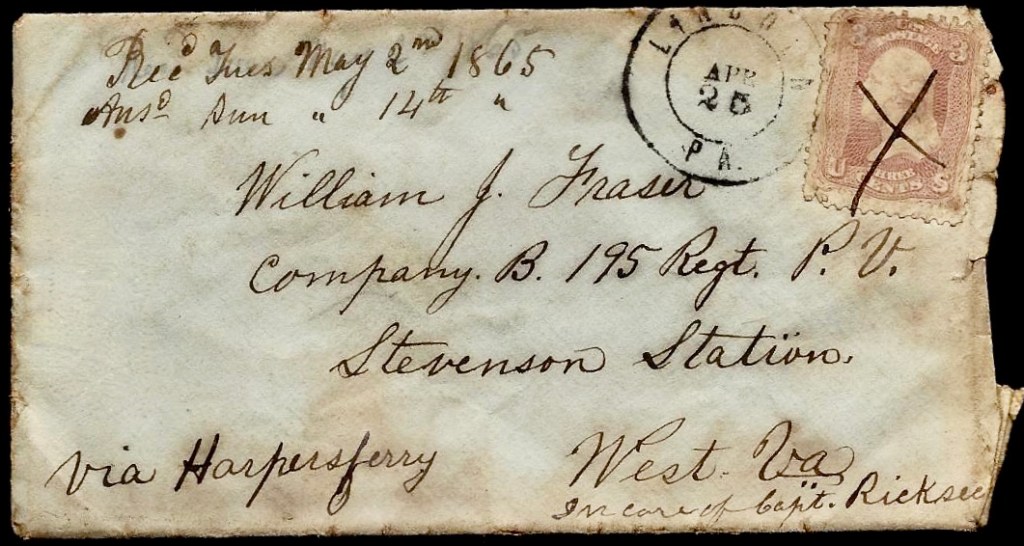
Addressed to Mr. William J. Fraser, Co. B, Detached 195th Regiment, Martinsburg, W. Virginia

Lincoln [Pennsylvania]
March 11, 1865

Dear Son,

I received two letters from you—one dated February 22nd, the other March 7th. You may rest assured that we were pleased to hear from you—especially that you were enjoying that greatly needed gift of the soldier, “good health and spirits.” I requested George to answer your first letter immediately after receiving it but was answered that he would soon see you personally but as circumstances would not permit for him to leave at the expected time, the letter has been neglected.

You enquire in your last whether we received the photographs, package, paper, &c. The photograph came to hand a the proper time, 2 in number. I also received Baltimore papers several times. Your discharge of the 100 days service is received and will be kept until your return home (if Providence grants you the boon). The package that you alluded to containing papers, coffee, &c. has as yet not been received although it may yet arrive. George has been the recipient of the fifty dollars forwarded by you and has deposited them safely into “Uncle Sam’s” coffers according to request. Mary sent a pair of stockings & a pair of wrist bands or pulse warmers to you (by mail) about the 3rd February but you have kept silent in your letter in regards to them. We therefore came to the conclusion that you did not receive them. Is our supposition correct? Or have you merely forgotten to note them in your letters?

You ask for my opinion of the President’s Inaugural Address. I think it is very good, suitable for the times; as the old adage is “short but sweet.”

…I do not know what kind of weather you have had in the “Old Dominion” but here let me tell you we have had an old fashioned winter—nothing but snow, sleet, ice, and sleighing all the time. I can yet by looking out of the window see the snowbanks along most every fence, but by looking over the uncovered grain fields, no one can fail to notice that the grain appears to have been invigorated by the warm covering of snow. The grain fields have a spring-like appearance, promising a fair yield for the coming summer.

We doubt you have thought that our little town must be lonesome since so many of our neighbors have left to reinforce the armies of the Union. We do not feel the effect of this last call of the President but nevertheless we cheerfully submit so that this cursed rebellion will be crushed and our banner float victorious over sea and land. All these soldiers’ families appear to be in good health and spirits, no doubt taking the consolation that their friends and relatives have gone to fight the battles of the just.

Our family are all in better health than myself. I as a general thing being the invalid on account of rheumatism but still being able to be on my feet and work a little….

Your father, — Wm. Fraser


Letter 2

[Note: The following letter was written by Samuel Fry, Jr. of Lincoln, Pennsylvania.]

Lincoln, [Pennsylvania]
March 31, 1865

Friend William,

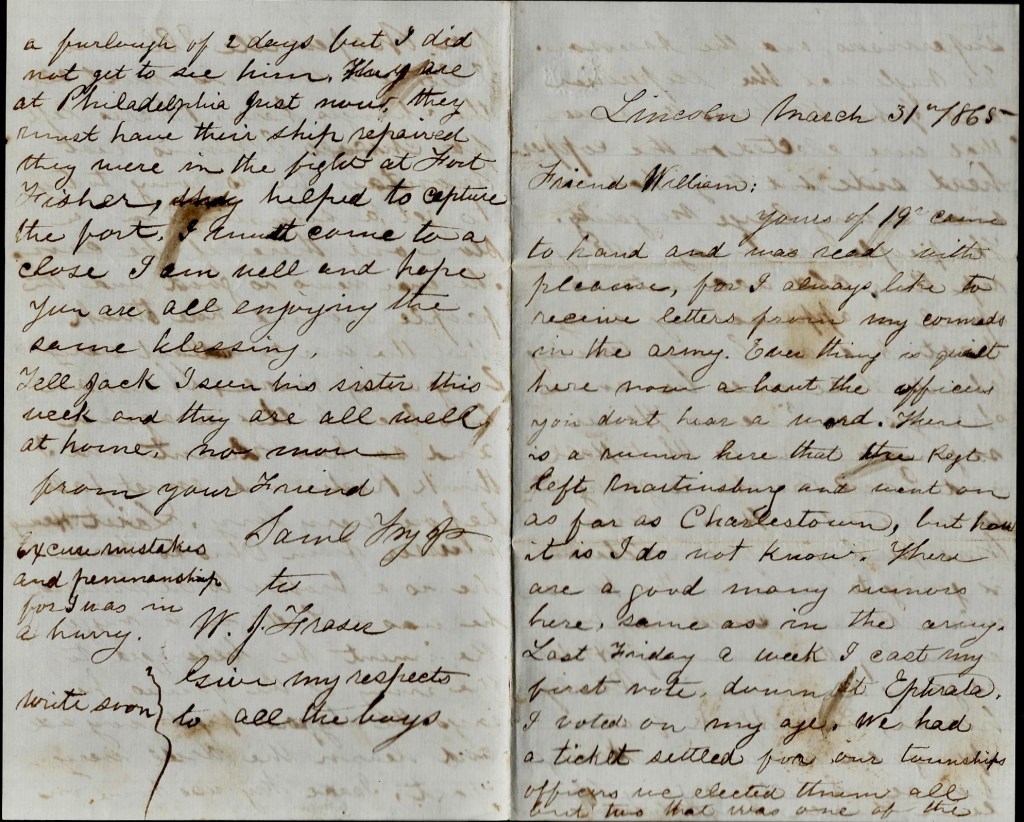
Yours of the 19th came to hand and was read with pleasure for I always like to receive letters from my comrades in the army. Everything is quiet here now about the officers. You don’t hear a word. There is a rumor here that the regiment left Martinsburg and went on as far as Charlestown [W. Va.] but how it is, I do not know. There are a good many rumors here same as in the army. Last Friday a week I cast my first vote down the Ephrata. I voted on my age. We had a ticket settled for our township officers. We elected them all but two that was one of the supervisors and the assessor. Ed Nagle was the supervisor and John W. Gross was the assessor that was elected on the Copperhead side but they had not such a very large majority.

Thhe people are busy settling up their old accounts as April is approaching very fast and are busy moving about. There will be some changes in Lincoln. Heiser is going to move to White Hall and Ernie Buck is going to move where Heiser lives. Mrs. Hershburger from Lebanon is going to move in the house where Reason lived in. A man by the name of Ander is going to move in Oberly’s house. Levi Shirk is Swilly’s house. Swilly is going to leave Lincoln next Tuesday for Naperville, Illinois. I believe them is all the changes here. Phares left for Chicago, Illinois, last Monday. He is going to try to get a situation in a store out there if he can.

The war news is good and the people around here think that the war can’t last very long anymore. Sherman has been victorious again and so has Grant and I think Richmond must fall before very long. Lieut. Henry Musser from Ohio is here. He is brother to Ed Musser. He is a lieutenant in a nigger regiment. He belonged to the Army of the James. He says the niggers fight very well and learn the drill very fast. Fry was home on a furlough of 2 days but I did not get to see him. They are at Philadelphia just now. They must have their ship repaired. They were in the fight at Fort Fisher. They helped to capture the fort.

I must come to a close. I am well and hope you are all enjoying the same blessing. Tell Jack I seen his sister this week and they are all well at home. No more.

From your friend, — Samuel Fry, Jr.


Letter 3

Lincoln, Lancaster county, Pennsylvania
April 9, 1865

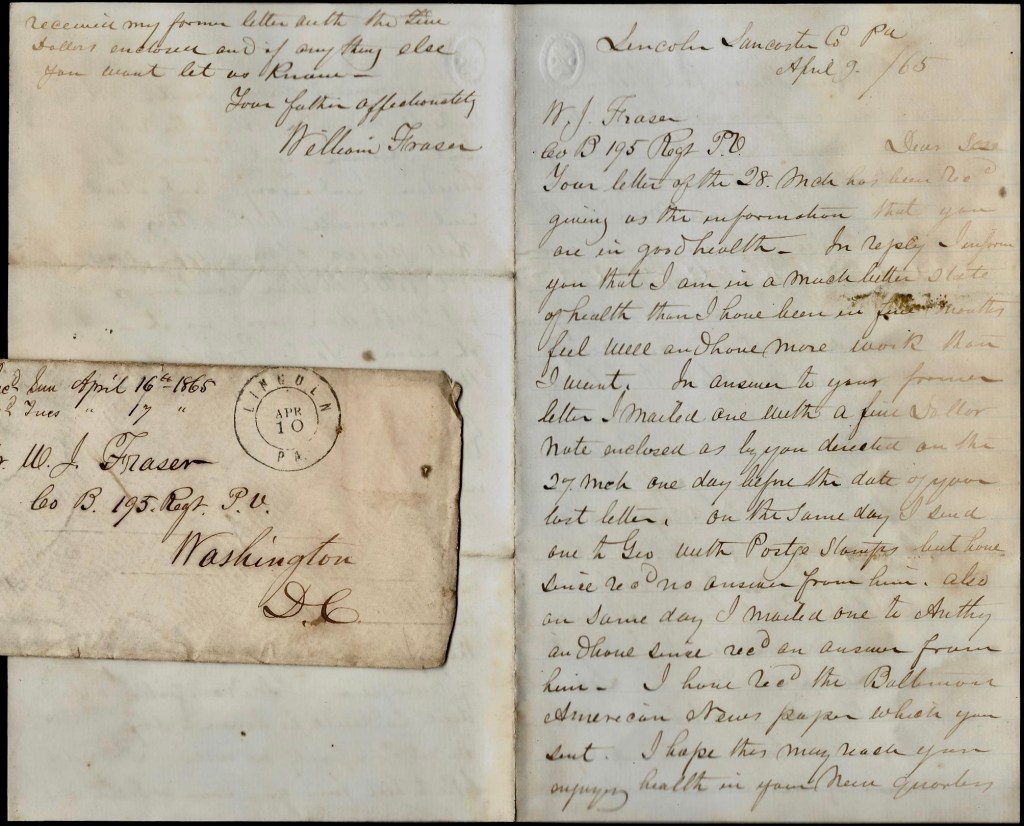
W. J. Fraser, dear son,

Your letter of the 28th March has been received giving us the information that you are in good health. In reply I inform you that I am in a much better state of health than I have been in five months. I feel well and have more work that I want. In answer to your former letter, I mailed one with a five dollar note enclosed as by you directed on the 27th March one day before the date of your letter. On the same day I send one to George with postage stamps but have since received no answer from him. Also on the same day I mailed one to Anthony and I have since received an answer from him. I hope you may reach your enjoying health in your new quarters.

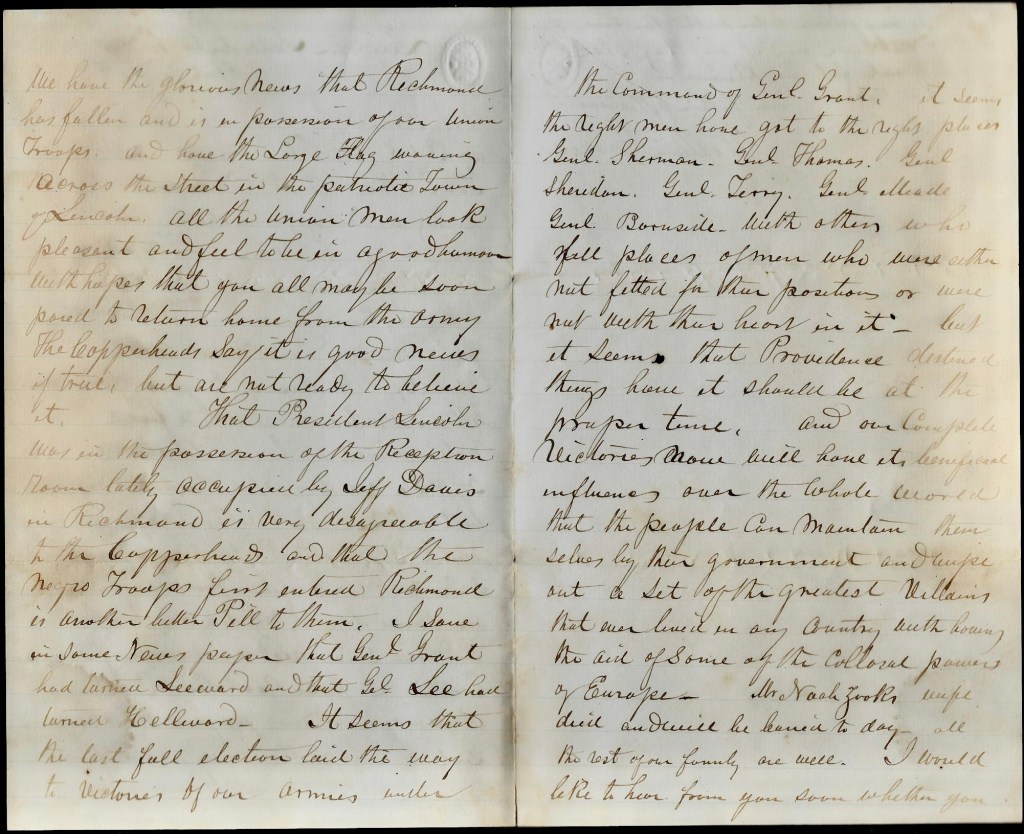
We have the glorious news that Richmond has fallen and is in possession of our Union troops and have the large flag waving across the street in the patriotic town of Lincoln. All the Union men look pleasant and feel to be in good humor with hopes that you all may be soon spared to return home from the army. The Copperheads say it is good news if true, but are not ready to believe it.

“That President Lincoln was in the possession of the reception room lately occupied by Jeff Davis in Richmond is very disagreeable to the Copperheads and that the Negro troops first entered Richmond is another bitter pill to them. I saw in some newspaper that General Grant had turned Leeward and that Gen. Lee had turned Hellward.”

William Fraser, Lincoln, Pennsylvania, 9 April 1865

That President Lincoln was in the possession of the reception room lately occupied by Jeff Davis in Richmond is very disagreeable to the Copperheads and that the Negro troops first entered Richmond is another bitter pill to them. I saw in some newspaper that General Grant had turned Leeward and that Gen. Lee had turned Hellward. It seems that the last fall election laid the way to victories of our armies under the command of Gen. Grant. It seems the right men have got to the right places. Gen. Sherman, Gen. Thomas, Gen. Sheridan, Gen. Terry, Gen. Meade, Gen. Burnside, with others who fill places of men who were either not fitted for their positions or were not with their heart in it. But it seems that Providence destined things how it should be at the proper time and our complete victories now will have its beneficial influences over the whole world—that the people can maintain themselves by their government and wipe out a set of the greatest villains that ever lived in any country without the aid of some of the colossal powers of Europe.

Mr. Noah Zooks wife died and will be buried today. All the rest of our family are well. I would like to hear from you soon whether you received my former letter with the five dollars enclosed and if anything else you want, let us know.

Your father affectionately, — William Fraser


Letter 4

[Note: The following letter was written by Samuel Fry, Jr. of Lincoln, Pennsylvania.]

Lincoln [Pennsylvania]
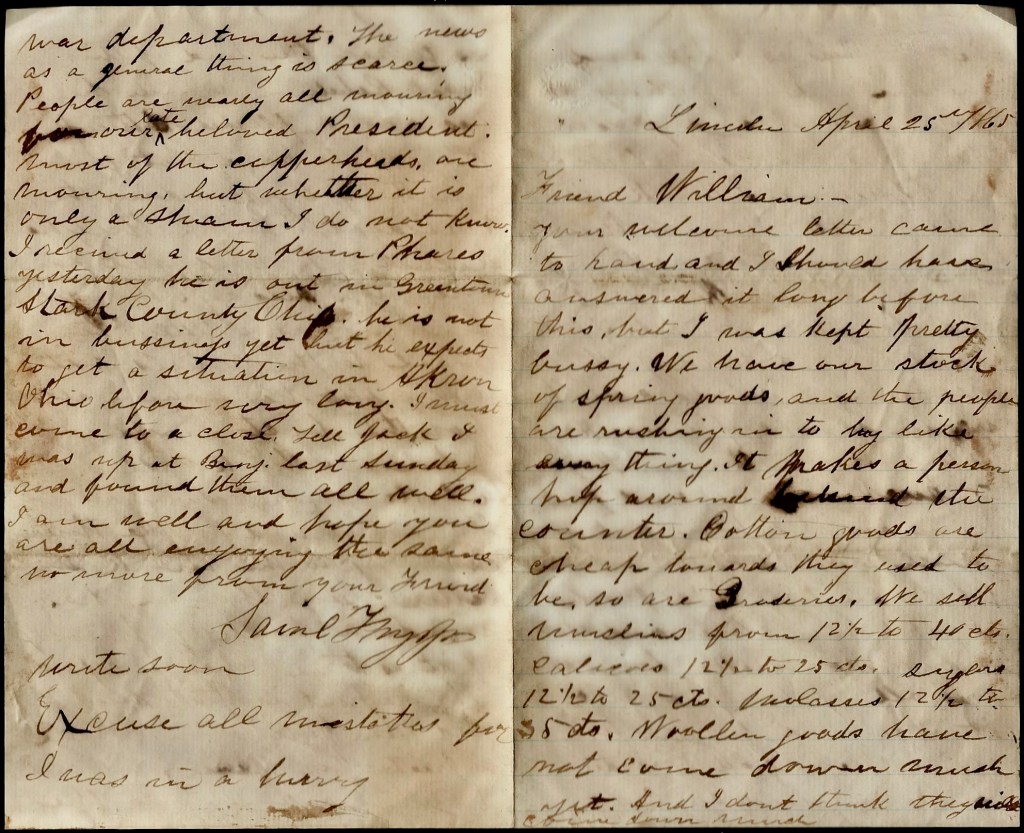
April 25, 1865

Friend William,

Your welcome letter came to hand and I should have answered it long before this but I was kept pretty busy. We have our stock of spring goods and the people are rushing in to buy like everything. It makes a person hop around behind the counter. Cotton goods are cheap towards they used to be. So are groceries. We sell muslins from 12.5 to 40 cents, calicoes 12.5 to 25 cents, sugar 12.5 to 25 cents, molasses 12. to 35 cents. Woolen goods have not come down much yet and I don’t think they will come down much.

The weather is nice and warm and everything is growing nice and green. Cherry trees and peach trees are in blossom.

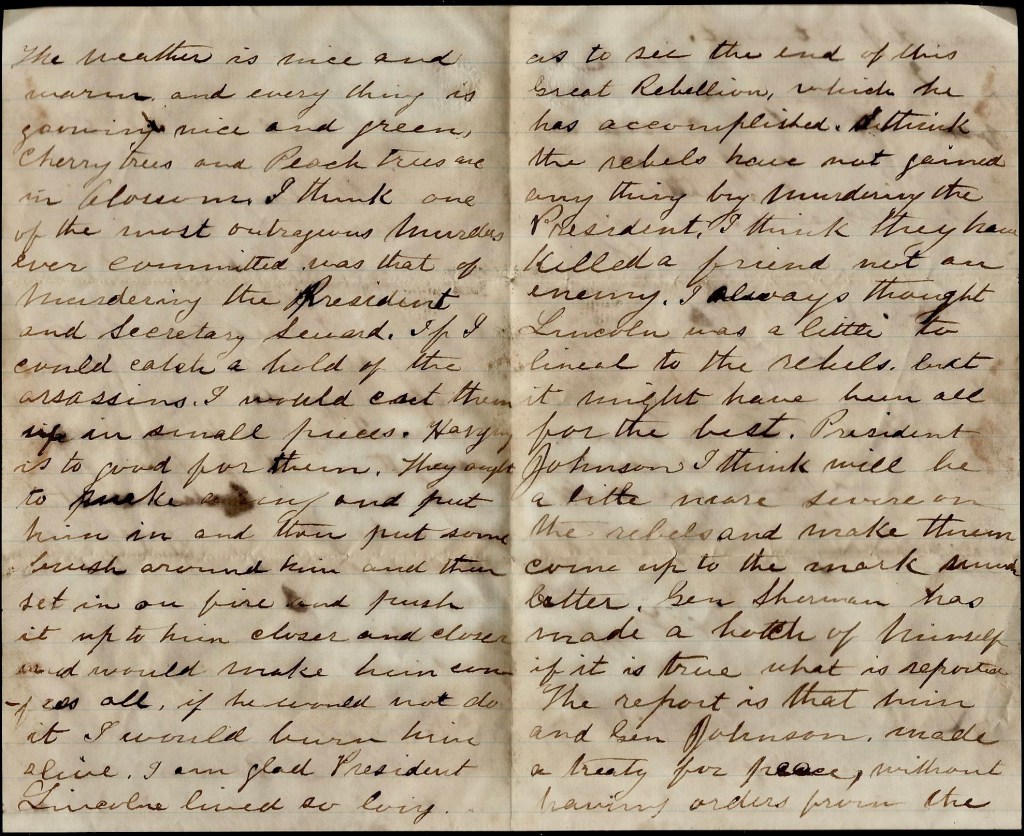
I think one of the most outrageous murders ever committed was that of murdering the President and Secretary Seward. If I could catch a hold of the assassins, I would cut them up in small pieces. Hanging is too good for them. They ought to make a ring and put him in and then put some brush around him and then set it on fire and push it up to him closer and closer and would make him confess all. If he would not do it, I would burn him alive. I am glad President Lincoln lived so long as to see the end of this Great Rebellion which he has accomplished. I think the rebels have not gained anything by murdering the President. I think they have killed a friend—not an enemy. I always thought Lincoln was a little too lenient to the rebels but it might have been all for the best. President Johnson, I think, will be a little more severe on the rebels and make them come up to the mark some better.

General Sherman has made a botch of himself if it is true what is reported. The report is that him and Gen. Johnston made a treaty for peace without having orders from the War Department. The news as a general thing is scarce. People are nearly all mourning our late beloved President. Most of hte Copperheads are mourning but whether it is only a sham, I do not know.

I received a letter from Phares yesterday. He is out in Greentown, Stark county, Ohio. He is not in business yet but he expects to get a situation in Akron, Ohio, before very long. I must come to a close.

Tell Jack I was up at Benj. last Sunday and found them all well. I am well and hope you are all enjoying the same. No more from your friend, — Samuel Fry, Jr.

Write soon. Excuse all mistakes for I was in a hurry.


Letter 5

Lincoln, Pennsylvania
April 29, 1865

Mr. Wm. J. Fraser, dear son,

Your letter of the 17th mailed on the 20th was received on the 22nd and glad to hear from you being well and that you received the five dollar note. We are all enjoying good health and my health in particular is much better than I have had for many years. You mention that you have sent some clothing with others directed to Rev. E. H. Thomas and Ben. Dressler. We have received none of your clothing as yet.

We have received the news that Booth, the murderer of President Lincoln, was taken but is now dead. Yet he was taken alive mortally wounded. We have mysterious news from Gen. Sherman but that Gen. Grant will bring all right and that Jeff Davis is fleeing heavily loaded with specie to Texas and is presumed bound for Mexico after having sacrificed the lives of so many for Southern Rights which enabled him to lay up a large store of wealth when thousands were suffering for want of the needful subsistence. I think the time will come when it will become manifest to the people of the Southern States that President Lincoln was their true, honest friend and desired to give them protection when they were blinded by falsehood &c. which afforded Jeff Davis to rob them of lives and treasure. The day of reckoning has come and although the much lamented President has fallen by the hand of an assassin, our government survives the shock and will overcome the disgrace which has been inflicted for a time.

The sin of tolerating slavery for such a length of time has manifested itself more conclusively and President Lincoln’s lenient policy of mercy to the misguided men has not been appreciated by them in any reasonable manner whatever.

…As soon as I receive your clothing, I will let you know. I expect to see Ben Wissler today or this evening. He had received nothing on last Wednesday.

Your affectionate father, — William Fraser


Letter 6

Lincoln, Pennsylvania
May 23, 1865

Dear Son, William Fraser.

Your letter of the 12th was received on the morning when Mr. Faust left and always glad to hear of you being well and would have answered sooner but as Mr. Forest left with whom I sent the V. which George in his letter states you had received…

I expected you to be mustered out of the service soon, but I have no satisfactory information now to form any opinion when you may be discharged. The sooner you could be relieved, the better I would like it as work has been crowding in on me with that expectation that you might return before long but will have to do the best we can.

George in his letter states that he has received his uniform and is pleased with the fit. This morning the ministers and elders who attended the meeting of the Classes all left after having been in session since last Friday. It was quite an interesting affair and some very good sermons preached. On Sunday there was meeting in the forenoon, afternoon, and evening. Dr. Nevin preached in the english language and Rev. Eckert from the lower end of the county preached in the english language. In the whole, it was not only interesting but a very creditable meeting of the classes. It was an unfortunate thing that the bell on the church cracked a few weeks ago and has become entirely useless and could not have been replaced in time for the meeting of the classes…

Your clothing, the overcoats and boots with some papers, has arrived all in good order….

We are all well and hope to hear from you soon. Your affectionate father, — William Fraser


[Note: The following letter was written by Samuel Fry, Jr. of Lincoln, Pennsylvania.]

Letter 7

Lincoln [Pennsylvania]
May 24, 1865

Friend William,

…Last week we had quite a lively time here at Lincoln. They had a Synod here at church. There were some fifteen to eighteen ministers here. It commenced on last Friday and closed on Monday evening. On Sunday we would have had a great crowd of people here but it rained so there were not so many as we expected. But I am sorry to say most of these ministers were Copperheads. Peter Kurtz has left the store so I was alone for about a week but we have one again. Phares is here now. He came here last Tuesday. He came back from the West last Saturday a week. He could not get any employment out there so he thought he would come back again. He was gone 7 weeks. He was at Chicago and Naperville, Illinois, from there he went back to Greentown, Ohio, and New Berlin, Canton, and other places around there but he could get no situation, he came out so late. All the merchants had made their spring changes already. He liked it very well in Ohio but in Illinois he did not like it so very well.

On next Tuesday there will be a “Love Feast” at Samuel Fahnestock and on Thursday a week there will be one at Christian Wenger’s down toward Earlville somewheres. There will also be one at Jacob R. Keller’s but when that will be, I do not know.

The news is scarce. The war is over now so there is not much news. Thy have caught Old Jeff now. He tried to make his escape in female attire through the woods but he was kidnapped and is now on the way to Washington to have his trial. I think he is interested in the assassination of Lincoln. Yesterday, Henry B.. Martin S. Fry, and some more started for Washington to see the Grand Review which is to take place.

Isaac Fry is home on a furlough of 10 days. He is still stationed at Philadelphia. I also seen David Grant of your company a few weeks ago. He was here at Lincoln. He looks well and hearty. I think after the review is over, you will all be sent home in time of haymaking and harvest. There will be a heavy crop this summer. I have never seen the grass look so well before this time of the year.

On Thursday a week we are going to have the store closed. It is a “Fast Day.” Rev. Boyer is going to preach a Funeral Sermon for Lincoln in Reamstown. I guess he will have a great crowd there. The stores at Gravel Hill & at Rothsville are about being closed up….

— Samuel Fry, Jr.