The following letter was written by Alvin Parker Dutton (1845-1891), the son of Alexander Dutton (1809-1875) and Rebecca Gage (1807-1892) of Bilerica, Middlesex county, Massachusetts. He presumable sent the letter to Henry A. Dutton (1839-1903), the only brother living with him in his parents home in 1860. Alvin’s father was a blacksmith.
Alvin would have been 18 (or nearly 18) in February 1863 when he volunteered to serve in the 15th Independent Battery, Massachusetts Light Artillery. This battery was organized at Lowell and Fort Warren and two weeks later shipped to New Orleans for duty in the Western Theater.
Alvin wrote this letter in late February 1865. The battery had wintered in Memphis and in January 1865 moved to Kennersville, Louisiana and then to Greenville in mid February. They were then transported to Barrancas, Florida, where they were preparing for a march to Fort Blakely, Alabama, which began on 20 March 1865. They participated in the siege and storming of Fort Blakely in one of the last battles of the war.
T R A N S C R I P T I O N
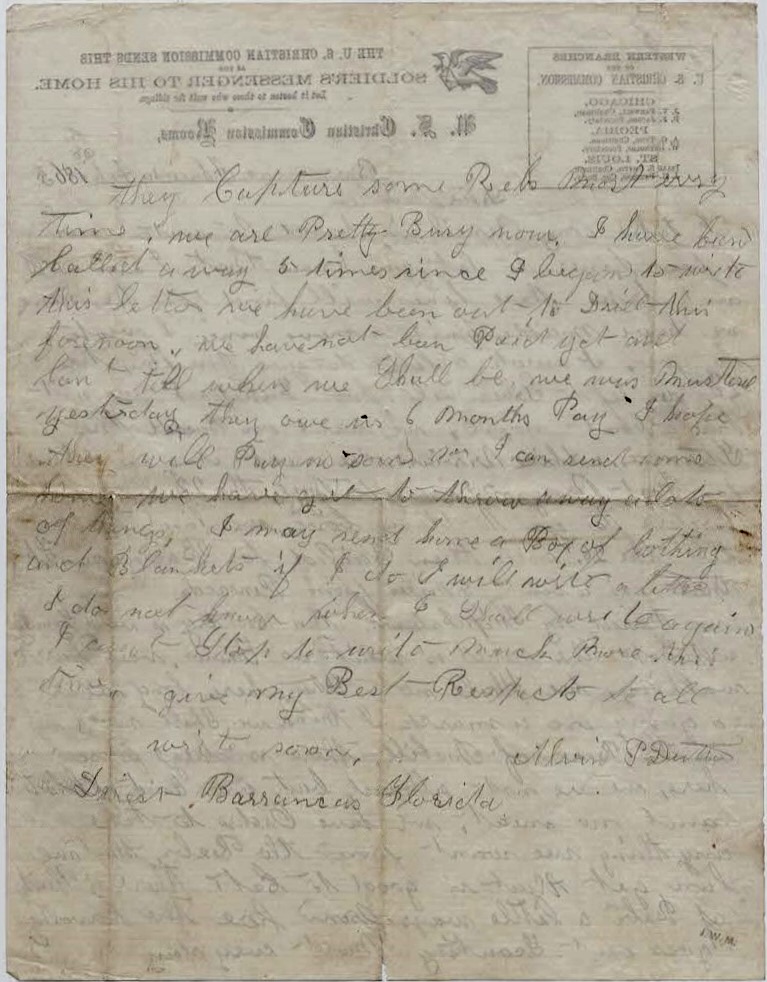
Barrancas, Florida February 28, 1865
Dear Brother,
I take my pencil in hand to write you a few lines to let you know that I am well and hope these lines will find you the same. We have made quite a move since I wrote to you. I wrote a letter to you the 15th. The 20th we left Greenville for Lakeport. We got there about noon. We went on board the steamer Alice Vivian the next day [and] we sailed for Fort Morgan. We got there the 22nd. We had orders to go to Navy Cove. We laid there till the 26th and then sailed for Barrancas, Florida. That is about 5 miles from Pensacola.
We passed Ship Island. This country is very sandy and hot. The sand is white as snow—very hard walking. We should not stay here long. We are a going on a march. I think we shall march in the rear of Mobile. There is a large force here. We are not allowed but one suit of clothes and no meat. We have orders to take everything we want from the Rebs that we can get that is good to eat. There is plenty of Rebs a little ways from here. The cavalry goes out scouting most every day. They capture some Rebs most every time.
Reported photograph of some men in the 1st Florida Union Cavalry, Ft. Barrancas, 1865.
We are plenty busy now. I have been called away 5 times since I began to write this letter. We have been out to drill this forenoon. We have not been paid yet and can’t tell when we shall be. We was mustered yesterday. They owe us 6 months pay. I hope they will pay us soon so I can send some home. We have got to throw away a lot of things. I may send home a box of clothing and blankets. If I do, I will write a letter. I do not know when I shall write again. I can’t stop to write much more this time.
Give my best respects to all. Write soon. — Alvin P. Dutton
Though only signed “John,” I can safely attribute this letter to John B. Wilson (1834-1866) who served as the captain of Co. H, 15th Maine Infantry. From his letter we learn that he was serving in the Office of the Provost Marshal at Fort Barrancas, Florida, but that he aspired for a change of duty and that he had requested his father to use whatever influence he had with Maine’s new Governor, Abner Coburn, for a change in commission. From another letter that I found for sale written by this same John (signed “John B.”), he hoped for a commission as a surgeon, having been practicing as a physician in Exeter, Maine since 1859. In a history of the 15th Maine, I discovered the following relevant biography: John B. Wilson was transferred for promotion on 15 June 1863 as Surgeon of the 96th USCT in October 1863. He served with distinction as Surgeon in charge of the post hospital at Fort Esperanzas, Texas, and later as Surgeon in Charge of the USA Hospital at Fort Gaines, Florida. He was discharged from the service in January 1865.
John wrote the letter to his wife, the former Samantha (“Sammie”) Tryphosa Perkins (1837-1881). The couple were married in 1860 and their child, Charles Branch Wilson (1861-1941) was born in October 1861. After John’s death in 1866, Sammie married Dr. Atwood Crosby (1838-1883) in 1870.
[Note: This letter is from the private collection of Don Andrew and was offered for transcription and publication on Spared & Shared by express consent.]
T R A N S C R I P T I O N
Office of Provost Marshall Barrancas, Florida 1 April 19th 1863
My darling wife,
Since I last wrote you, a mail has arrived bring me four letters from your dear hand, one of them as late as March 29th. They were read & reread and then took the place in my breast pocket of two received by previous mail which had been so long bosom can perceive as to be scarcely legible. I did not drop old friends, however, who had been worn out in my servies but gave them a good place for the great good they have done.
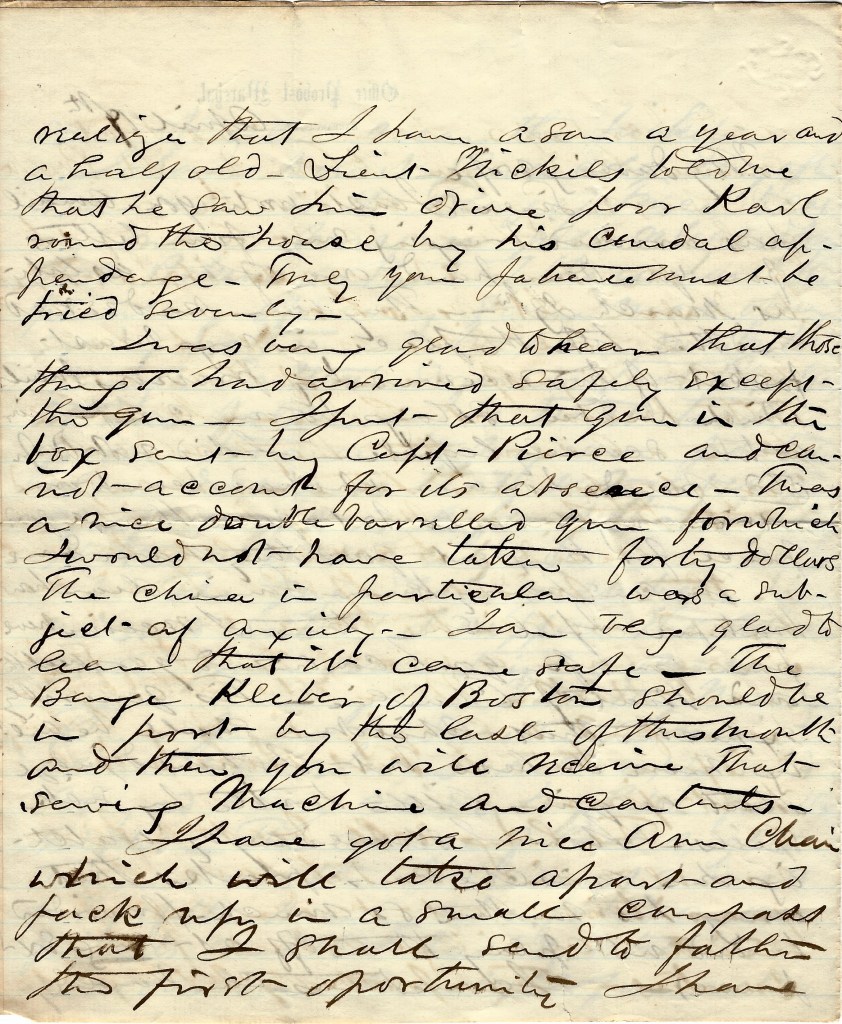
You can hardly know, Sammie dear, how thankful I feel every time I receive news from you for your continued good health and that of Charlie. Tis generally expected that children shall be ailing more or less but I should judge that he gives little trouble by sick spells. How I should enjoy watching his mischievous pranks that annoy his mother so much (provided he did not play them off at my expense). I sometimes can hardly realize that I have a son a year and a half old. Lieut. [John B.] Nickels told me that he saw him drive poor R___ round the house by his caudal appendage [tail]. Truly your patience must be tried severely.
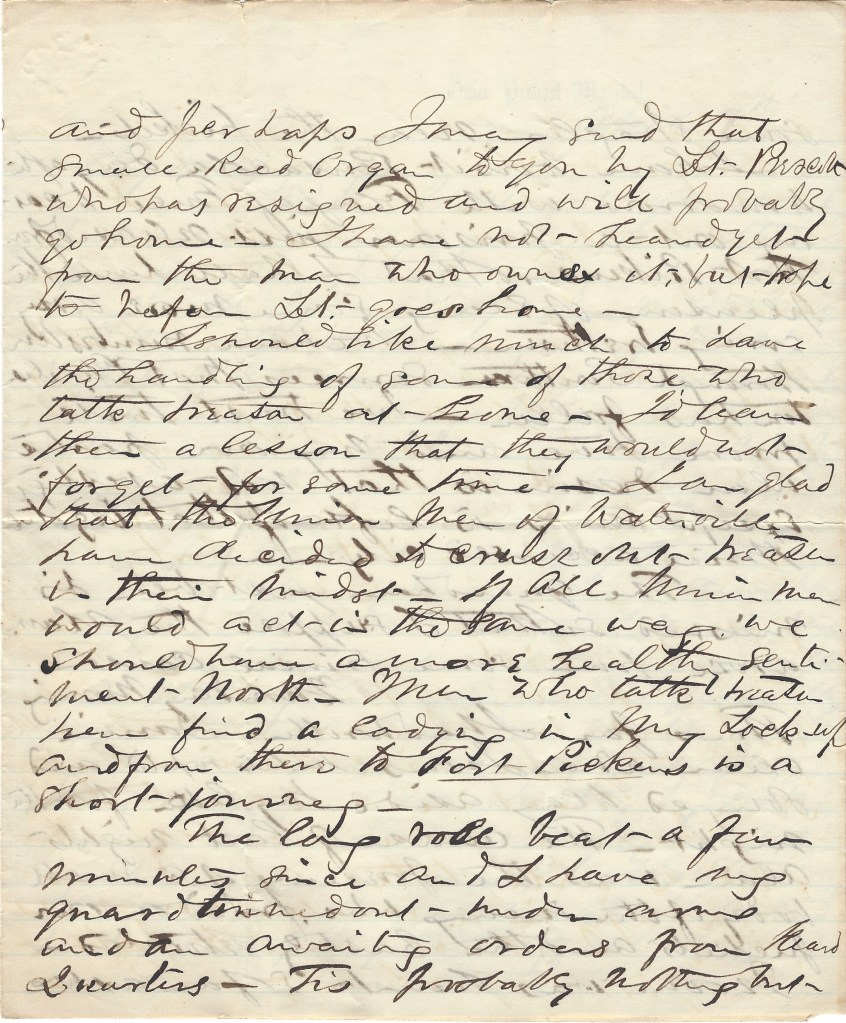
I was very glad to hear that those things had arrived safely except the gun. I put that gun in the box sent by Capt. Pierce and cannot account for its absence. Twas a nice, double barreled gun for which I would not have taken forty dollars. The china in particular was a subject of anxiety. I am very glad to learn that it came safe. The Barque Kleber of Boston should be in port by the last of this month and then you will receive that sewing machine and contents. I have got a nice arm chair which will take apart and pack up in a small compass that I shall send to father the first opportunity I have and perhaps I may send that small reed organ to you by Kt. Prescott who has resigned and will probably go home. I have not heard yet from the man who owns it but hope to before Lt. goes home.
I should like much to have the handling of some of those who talk treason at home to learn them a lesson that they would not forget for some time. I am glad that the Union men of Waterville have decided to crush out treason in their midst. If all Union men would act in the same way, we should have a more healthy sentiment North. Men who talk treason here find a lodging in my lock up and from there to Fort Pickens is a short journey.
The long roll beat a few minutes since and I have my guard turned out under arms and are awaiting orders from headquarters. Tis probably nothing but some straggler near the pickets. I have to visit Pensacola day after tomorrow with Flag of Truce to carry out a prisoner just released from Fort Pickens so that I shall have the pleasure of seeing some more of my Southern brethren. We have rumors here though southern sources that Charleston has fallen. We trust twill prove true and my own particular design is that not a vestige except ruins is left of that bigoted, thrice accursed city.
The guard have just been dismissed so that I suppose the alarm arose from some trivial cause.
Monday morning. Thus far I had written, Sammie dear, when I was interrupted and obliged to lay aside my letter for the night. The cause of last night’s alarm was the presence of a small body of the enemy who fired on our pickets and then hastily retreated. No one was hurt so far as we know.
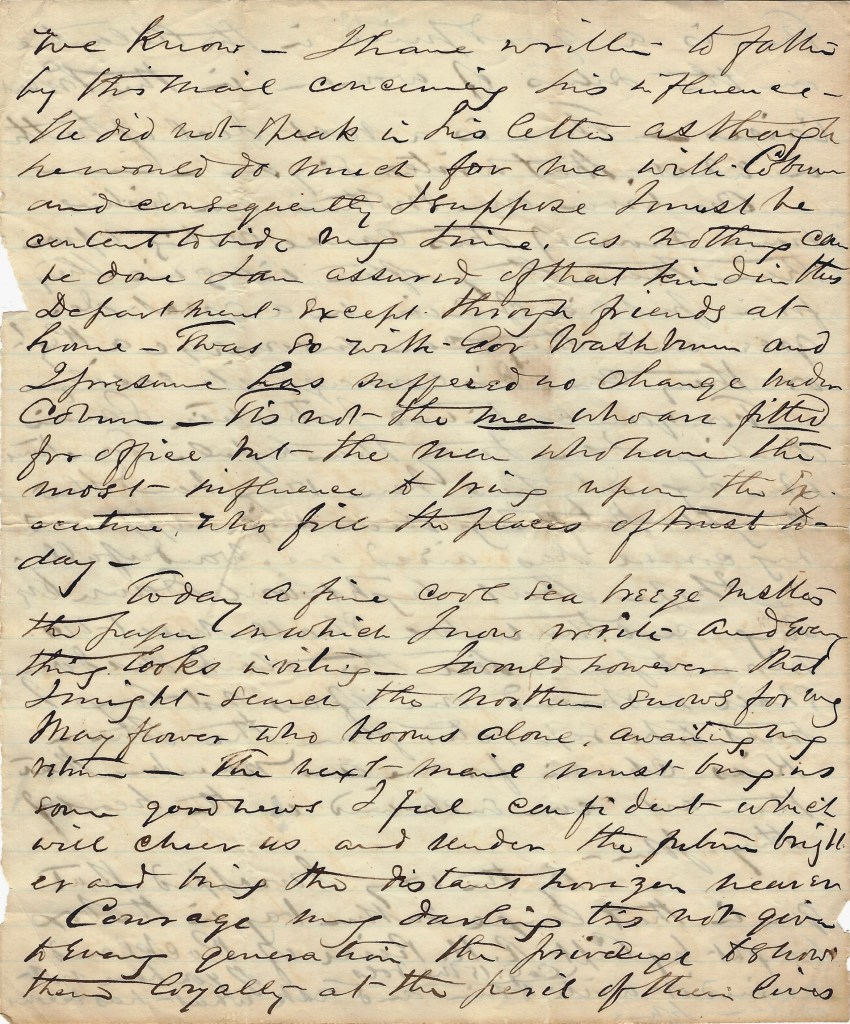
I have written to father by this mail concerning his influence. He did not speak in his letter as though he would so much for me with [Gov. Abner] Coburn and consequently I suppose I must be content to bide my time as nothing can be done and am assured of that kind in this Department except through friends at home. Twas so with Gov. Washburn and I presume has suffered no change under Coburn. Tis not the men who are fitted for office but the men who have the most influence to bring upon the Executive who fill the places of trust today.
Today a fine cool sea breeze rustles the paper in which I now write and everything looks inviting. I would, however, that I might search the Northern snows for my Mayflower who blooms alone, awaiting my return. The next mail must bring us some good news, I feel confident, which will cheer us and render the future brighter and bring the distant horizon nearer. Courage, my darling, tis not given to every generation the privilege & shows them loyalty at the peril of their lives. There is a good piece in the Atlantic [Magazine] on the duties of woman in the present crises. There is a vast deal of truth in what that writer says.
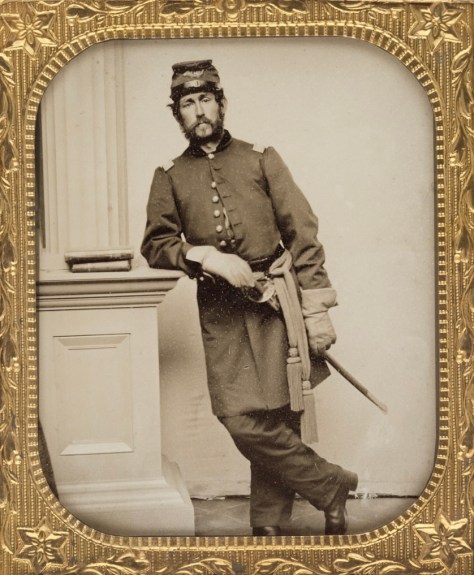
Capt. Ranson Newton Pierce, Co. G, 15th Maine Infantry
Our wives, our mothers, our sisters have more of this cause resting upon them than they often imagine. They form public opinion in a great degree and they can encourage a regiment or they can discourage it easily. For your continued patriotism, Sammie darling, I am truly thankful. Sometimes when my duty has been very hard, the thought that my dear wife approved my course has aided me wonderfully. I hope that we shall meet no more to part till the dark shadow shall shroud one of us, not long I trust to be separated from the other. Kiss Charlie for me and remember that thou art enshrined in the heart of thy John.
By the way, I wrapped that gun in that large [ ] bag in the box brought by Capt. R[ansom] N[ewton] Pierce of Rockland, Co. G, 15th Maine Volunteers. If you have not received it, write him and ask what has become of it. — John
1 Fort Barrancas, was built in the 1830s at the location of San Carlos de Antonio, a Spanish fort dating back to the conquistadors. Barrancas stood closest to the naval yard, located on a bluff overlooking the bay.







 Spared & Shared 23