
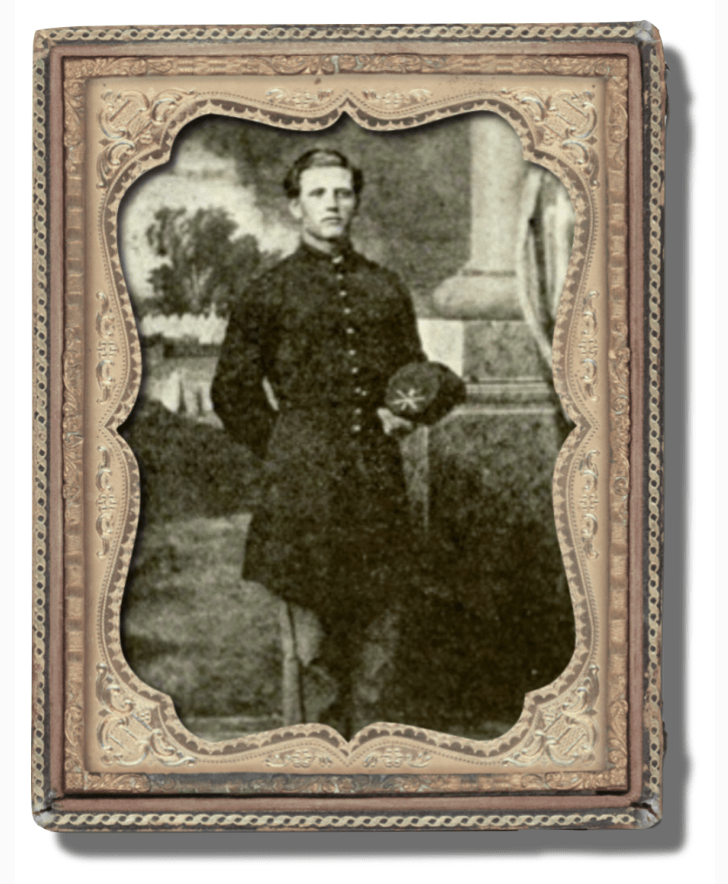
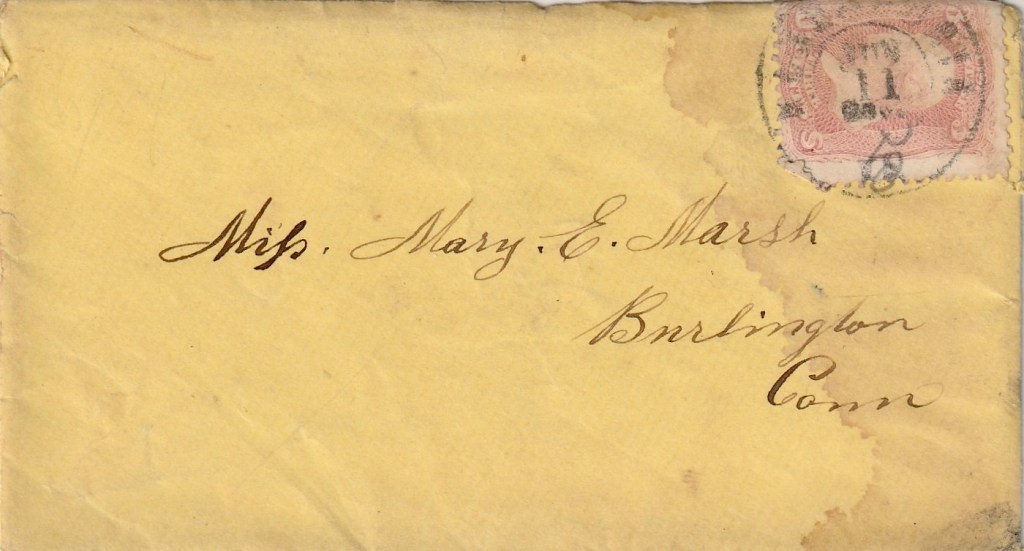
This letter was written by Alfred N. Smith, born in Ohio in 1836, I believe, who was living with relatives in Batavia, Branch county, Michigan in 1860. In 1858, he was listed in the Vincennes (IN) City Directory working as a plasterer and boarding in Mrs. Harriet Burrows’ boarding house on the north side of Water Street between Main and Busseron. It was to Mrs. Burrows that he addressed his letter, written from Fort Lyon near Alexandria, Virginia, while serving in Co. C, 2nd Michigan Infantry.
Harriet was the daughter of Hiram Soden and his wife Sarah Beedle. She was married twice and had eight children by her two husbands but only three survived infancy. Her first husband was James Burrows whom she married on 13 Sep 1846 in Knox County, Indiana. James died in 1859 or 1860 as his youngest child was born in November 1859 and Harriet was a widow at the time of the 1860 census. She then remarried to William Wolfe in February 1865. They had one daughter and moved to Missouri where William died. Harriet and her remaining family moved to Los Angeles, California sometime before 1900.
The 2nd Michigan Volunteer. Infantry was recruited to serve for three months, but before they could be mustered in, orders came from the War Department that enlistments were to be extended to three years. Those who did not want to serve the three years were allowed to withdraw and the Second Michigan Infantry was mustered in as a three year regiment on May 25, 1861.

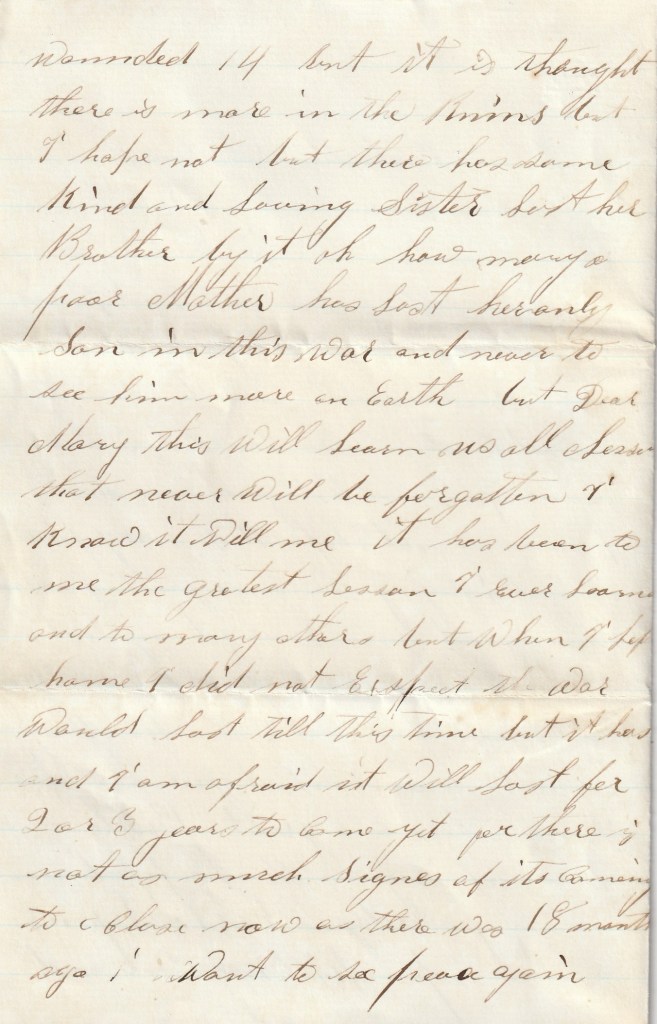
T R A N S C R I P T I O N
Fort Lyon, Va.
November [1861]
Friend Hatt
Your kind letter of the 22nd is received. It affords me the greatest of pleasure to have the privilege of answering it. I am very sorry to hear of Frankie’s continued illness but hope he will be better soon. 1 I suppose Sallie and Maggie are very much delighted with the idea of going to the “Golden State.” I suppose that Mother Doak is a going too. They would not leave her. I am exceedingly glad to hear your health has so improved and that you are a getting along fair. You were speaking about having a boarder by the name of “Smith.” It is a wonder that you would ever think of taking another of that name after being pestered with one for so long a time before. But, however, I wish you had another Smith boarder for a few weeks—one that is soldiering in a Michigan Regt. at Fort Lyons—for I think he could spend a few weeks with his friends to a very good advantage just now, couldn’t he?
I have almost forgotten to tell you about our moving and where we went to. Well we moved from Arlington Heights on the 16th of October and are now in camp at Fort Lyons, Va., which is one and a half [miles] south of Alexandria where we have been ever since we left Arlington Heights.
Fort Lyons is a very high and sightly place commanding a delightful view of the country for miles in ever direction besides the City of Alexandria, City of Washington, and the ancient City of Georgetown which joins Washington on the northwest. Fort Lyons surrounds 15 acres of land and mounts 129 guns, most of them 64-pounders, but it is only one of the many [forts] that circle the City of Washington so you can have some idea how well we are fortified here and how we could deal death to any approaching foe.
The weather has not been very pleasant here this fall. We have had several very cold rains. The wind [blows] very hard all the time. On the 29th October it blowed a complete hurricane. The tent that I and 14 other boys live in blowed clear away while a half dozen of us were a trying to hold it and I expect the plagued thing is a going yet unless the secesh have captured it which I presume is most likely for they haven’t any and the last I saw of it, it was soaring off in that direction. But we did not care much for it left us in a cold drenching rain and that offered us a good excuse for leave of absence to go to Alexandria to stay overnight which was granted us. For the first time since last May, I had the privilege of getting into a nice clean bed which I tell you looked tremendous good. After supper I retired but could not sleep. Did not know what was the reason but supposed it was because things [were] so nice and clean. So I took off the sheets and pillow cases and folded them up and stowed them under the bed and turned in again but it was no use. I could not sleep. Dreamed the secesh took no prisoner and consigned me to the dark walls of the prison. Waked in the morning and found myself 10 feet away from the bed with my head comfortably located in the spittoon. So you can see going to the city has a bad effect on me, but I have never tried it since.
Our quartermaster made us all feel glad the other day by furnishing us new tents and nice clean bed ticks filled with feathers that grew on a last year’s oat field. We have been very busy since we came here. We have two drills a day; battalion in the morning and bigade drill in the afternoon. Then there is guard duty which takes 140 men per day, one half of which goes seven miles southwest of camp as picket guard. The balance of our time is taken up with shovel and pick ax or drill on Fort Lyons.
We have been out reconnoitering twice since we came here. The first time on the 18th October. We marched to Occoquan Creek some ten miles southwest of here. We drove in the secesh pickets, found out something near their number and position. This being all we marched for, we returned to camp. The next time on the 13th November we went in force 16,000 infantry, two batteries, 6 companies of cavalry. We marched in three columns, one by way of Mount Vernon. The Brigade I was with went by Pohick Church. Another Brigade four miles north of us. We drove the secesh back to their batteries. They killed three of our cavalry that were scouting ahead of us. We drove all that Gen. McClellan ordered and came back bringing one prisoner. The 20th [November] our Brigade went to the Grand Review at Bailey’s Crossroads. The newspapers have said so much about it, it is not worth while for me to say anything about it. No more room to write. Your friend, — A. N. Smith
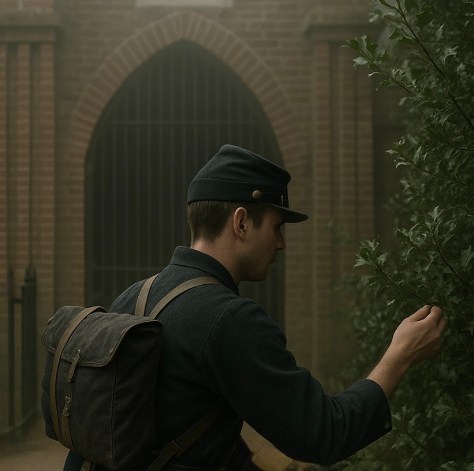
Enclosed within please find a twig of English Holly which I took from Mount Vernon near the tomb of Washington.
1 Frank (“Frankie”) Burrows was the youngest of the seven children of James Burrows and his wife, Harriet Soden. Frank was in Missouri for the 1870 and 1880 census but had moved to Los Angeles, California before 1900. He never married and was a painter by trade. He died from a fractured skull as the result of a fall from a scaffold.







 Spared & Shared 23