
The following interesting letter was written by John Pattee, a Canadian by birth, who “came to Dakota Territory from Iowa in 1861. He had served as Iowa’s State Librarian (and State Auditor) for three years, from 1855 to 1858. Shortly after he left office, a second marriage made him the brother-in-law of Iowa Governor Samuel J. Kirkwood. (Perhaps he left the position in part to protect his new in-law from charges of nepotism, something honest politicians strive to avoid.) In early 1861, like thousands of his fellow Iowans, Pattee volunteered for service in the Civil War.

He mustered into the Fourteenth Iowa Volunteer Infantry Regiment, and was named captain of Company A. Rather than being sent south to fight the Confederates, as expected, Pattee’s company was sent west, along with Companies B & C of the 14th, to relieve the regular army regiment then stationed at Fort Randall, Dakota Territory. (Many of the men were upset at losing the chance for glory in the big battles of the Civil War, but perhaps they changed their mind when the rest of the regiment was decimated in the Battle of Shiloh.) Pattee, as the senior captain, was given overall command of the battalion.
For the next three years, Pattee and his men would patrol the Dakota frontier and participate in significant actions during the Sully campaigns against the Sioux. (The three companies of the 14th Iowa Infantry would soon be re-designated as the 41st Iowa Infantry and later incorporated as Companies K, L, and M of the 7th Iowa Cavalry.) As the commanding officer in Dakota Territory, Pattee faced a number of challenges.
First, some wily Dakotans tried to usurp his command when “Major” Lyman showed up at Fort Randall and claimed the command for his own. Pattee was suspicious of Lyman’s commission (the papers bore an unusual number of erasures and changes), and refused to yield command. For this, he was placed under arrest and held for several months. Eventually, with the help of Governor Kirkwood and the Secretary of War, Lyman’s commission was proven false, and Pattee resumed command.
Pattee also faced some rebellion within the ranks when the captain of Company B—who thought he, not Pattee, should have been given command—fomented unrest among his men. Pattee effectively dealt with this by exiling Company B to the godforsaken post at Fort Pierre.
During the Sully campaign of 1863, Pattee stayed behind in Sioux City to command the department while Sully was in the field. In 1864, Pattee accompanied Sully on his campaign. In later columns, we’ll explore some of the pivotal events of these campaigns and their impact on central South Dakota.
In late 1864, Pattee led a small force from Sioux City up the Big Sioux in search of some remaining Dakota Sioux still causing problems in the area. Just south of present day Hawarden, IA, Pattee discovered the remains of two men killed by Indians earlier that year. The two had been hunting and trapping, and were likely killed for the large quantity of furs they had accumulated. One of the men, Mr. Tennis, was identified when soldiers found his wooden leg. The other man was Frederick Pattee, John’s brother. All John found of his brother was a boot with some foot bones still inside.
That night Pattee and his men camped near the mouth of a small creek flowing into the Big Sioux a few miles north of the site of the bodies. Some say the creek is called “Pattee Creek” in honor of John. I have to wonder, though, if a grieving John might not have named the creek in honor of his lost brother, Frederick.” [Source “From State Librarian to Dakota VIP“]
Pattee’s letter mentions John Blair Smith Todd, the cousin of Mary Todd Lincoln, who used his personal connections to seek political and military appointments for himself and friends in the Lincoln Administration.
[This letter is from the personal collection of Greg Herr and was offered for transcription and publication on Spared & Shared by express consent.]
Transcription
Fort Randall, Dakota Territory
January 19th 1862
Dear Governor,
I scarcely know whether I had rather venture to write again or not. I have written once to you and once to Mrs. K. and have not received a line from either since we left home but I claim to be very charitable and I will attribute it to a want of time with you. I will try again.

We were getting along very smoothly and nicely until news arrived that we was to be detached from the 14th Regiment and another Major appointed. This of course disturbed some a little, but none less than me, I assure you for I considered that matter definitely settled long ago. A petition would have been sent in long ago but I prevented it. But now a new contingency has arose. Two companies are being raised in this Territory and through the influence of J. B. S. Todd who was the sutler, a Mr. Lyman—a frontiersman with a squaw for a wife—has been appointed Major and is expected here in three days to take command of troops here. This man Todd is the man that rode in the cars with us to Davenport on the 13th of September last. He used to be sutler here and was arrested by the Commanding Officer and broke the arrest by running away and went to Washington and resigned his sutlership and because he was cousin to Mrs. Lincoln, got an appointment as Brigadier General. He never owned any part of the goods in the store here. They belonged to a man in St. Louis but he used some $4,000 in money & goods from the store to secure his election to Congress from this Territory. And is now, though a Democrat, able to wield some influence at Headquarters. He is quite influential here among half breeds which are quite numerous owing to the fact that he and many others like him have lived here some time.
There are men here in our companies that are acquainted with Major Leonard, lived by him for some time in Des Moines County, and when the news arrived today (in a letter from Will Kirkwood) that Major Leonard would probably be sent here, their men said, “For God’s sake, keep Major Leonard where he is and let us have the Mustang half-breed for our commander if he is from Dakota.” There is not men enough in the Territory to make up two companies and they are getting the balance from Iowa about Sioux City.
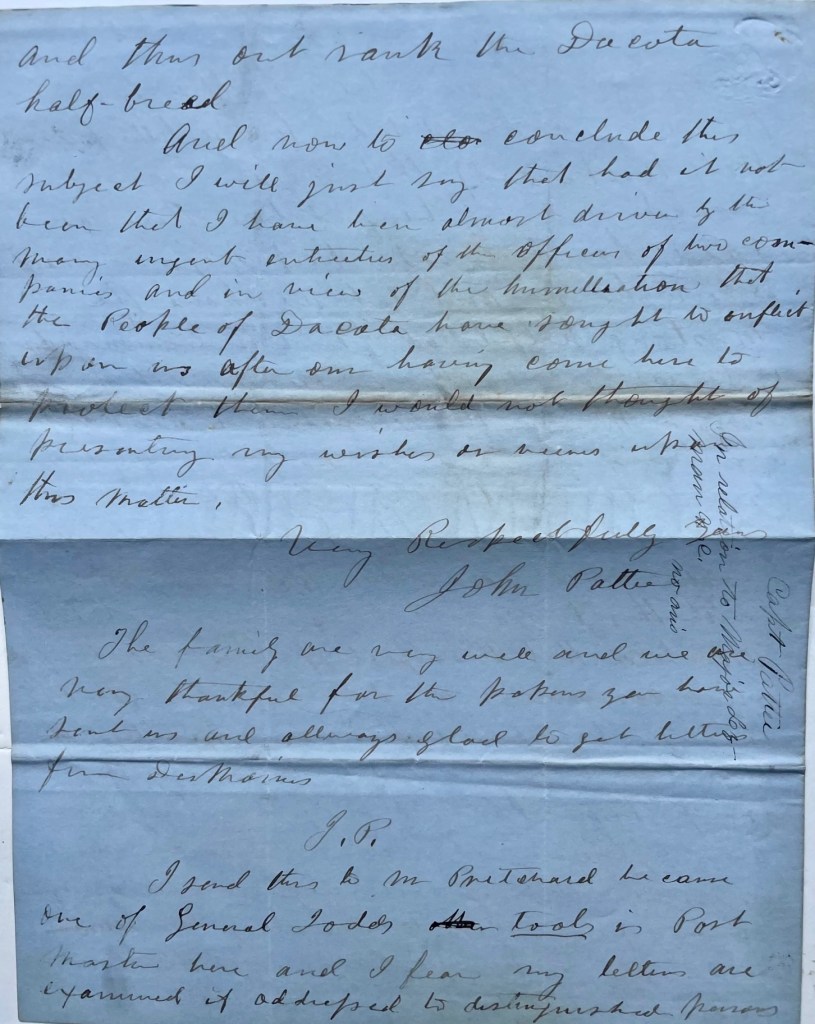
A letter or petition in regard to this matter will leave here by the same mail with this to you. I have not seen it but am told that the object of it is to ask of our companies are detached from the14th that we be allowed the same privilege that has been accorded to most of the troops from Iowa—that of electing our own officers. I will venture one more assertion that it will require but a word or two from you to Secretary Cameron in regard to the importance of this post and so forth to give us a Lieut. Colonel and thus outrank the Dakota halfbreed.
And now to conclude this subject, I will just say that had it not been that I have been almost driven by the many urgent entreaties of the officers of two companies and in view of the humiliation that the people of Dakota have sought to inflict upon us after our having come here to protect them, I would not thought of presenting my wishes or views upon this matter.
Very respectfully yours, — John Pattee
The family are very well and we are very thankful for the papers you have sent us and always glad to get letters from Des Moines. — J. P.
I send this to Mr. Pritchard because one of General Todd’s tools in Post Office here and I fear my letters are examined if addressed to distinguished persons.


 Spared & Shared 23