
The following letter was written by Eugene Allen Dye (1854-1896), the son of Ledyard Dye (1819-1886) and Clarinda Fletcher (1826-1900) of Chautauqua county, New York. Eugene datelined his letter from Millette, Spink county, South Dakota, in 1886 where he was a school teacher and the first superintendent of public instruction for the Dakota Territory. Three years later, South Dakota and North Dakota became the 39th and 40th States in the Union.

Transcription
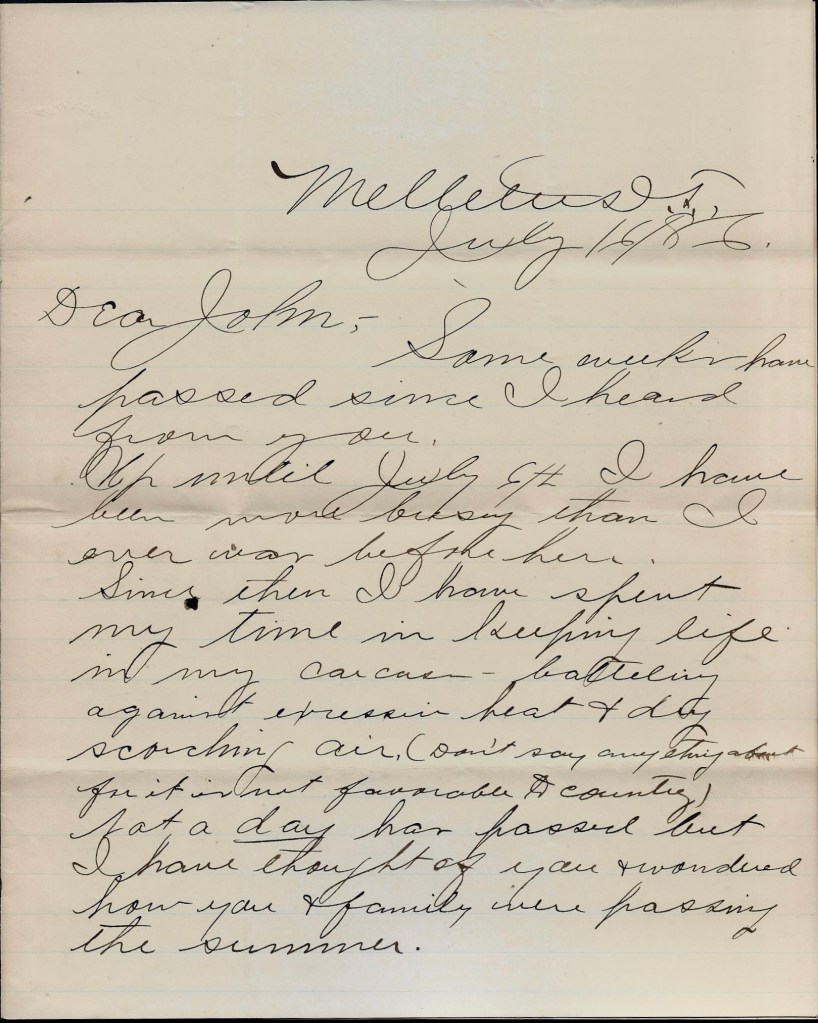
Millette, Spink county, Dakota [Territory]
July 16, 1886
Dear John,
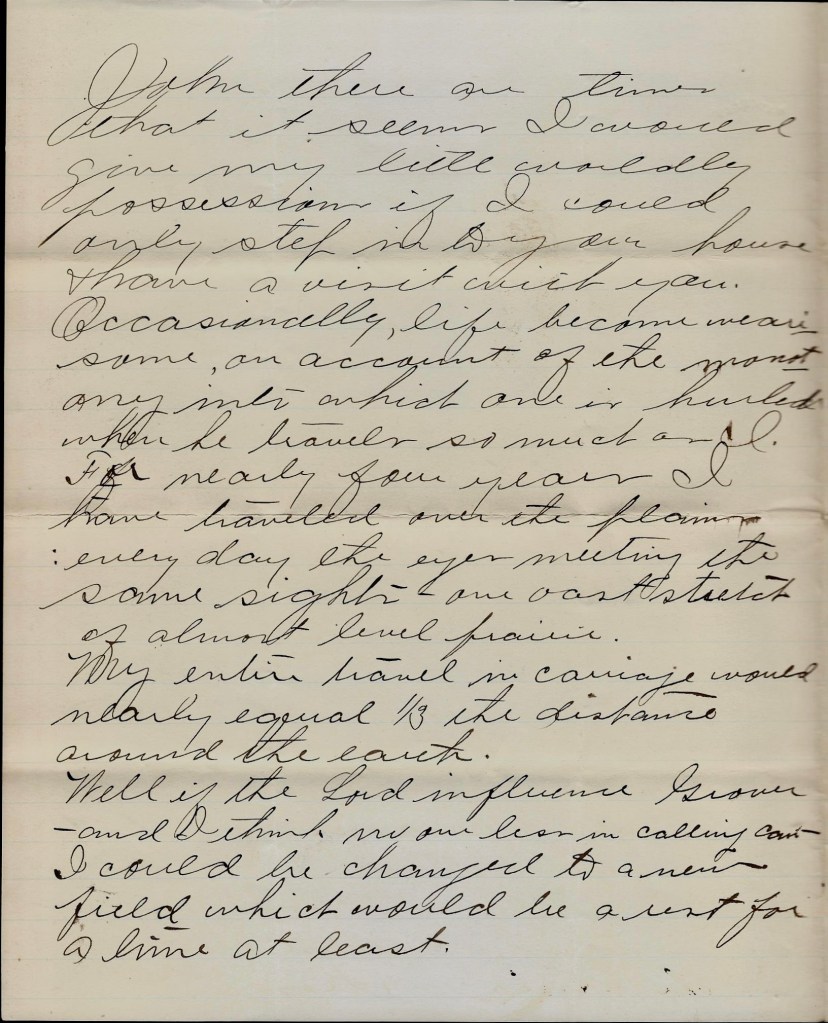
Some weeks have passed since I heard from you. Up until July 6th I have been more busy than I ever was before here. Since then I have spent my time in keeping life in my carcass—battling against excessive heat and dry scorching air (don’t say anything about for it is not favorable to country). Not a day has passed but I have thought of you & wondered how you & family were passing the summer. John, there are times that it seems I would give my little worldly possessions if I could only step into your house & have a visit with you. Occasionally life becomes wearisome on account of the monotony into which one is hurled when he travels so much as I. For nearly four years I have traveled over the plains, every day the eyes meeting the same sights—one vast stretch of almost level prairie. My entire travel in carriage would nearly equal one-third the distance around the earth. Well, if the Lord influence Grover—and I think no one less in calling can—I could be changed to a new field which would be a rest for a time at least.
John, I took a most interesting trip among the Sioux Indians recently & perhaps you may be interested in a brief account of the trip. I enclose a programme which will explain much. Well about 40 of us—women and men—started from Pierre 44.250 north latitude at about five o’clock a.m. After driving 25 miles north along the Missouri, we reached Ft. Sully which is located on a beautiful plateau overlooking the river. Only about 200 soldiers are kept there but everything is in the very finest shape. It is one of the most beautiful places I ever visited. Everything that Uncle Sam’s money could do to beautify & make pleasant has been done.
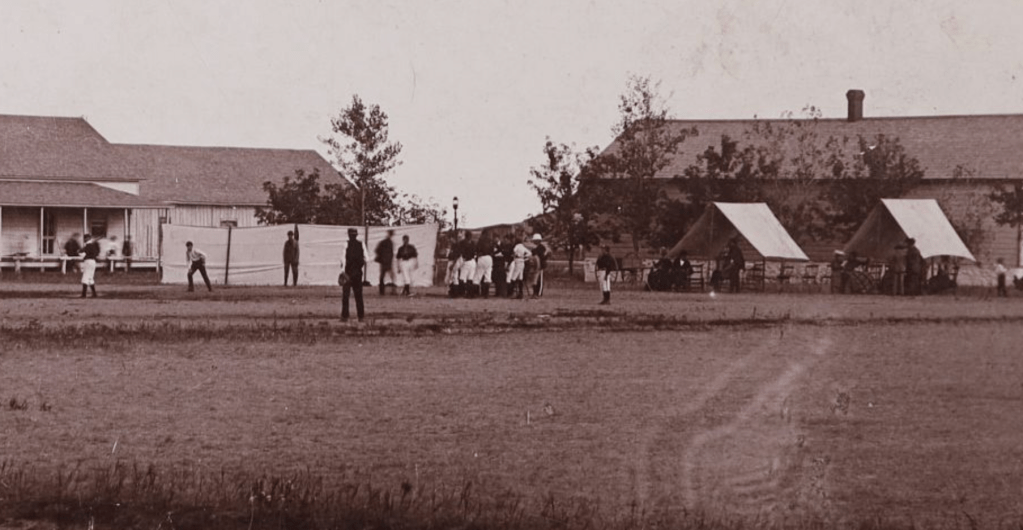
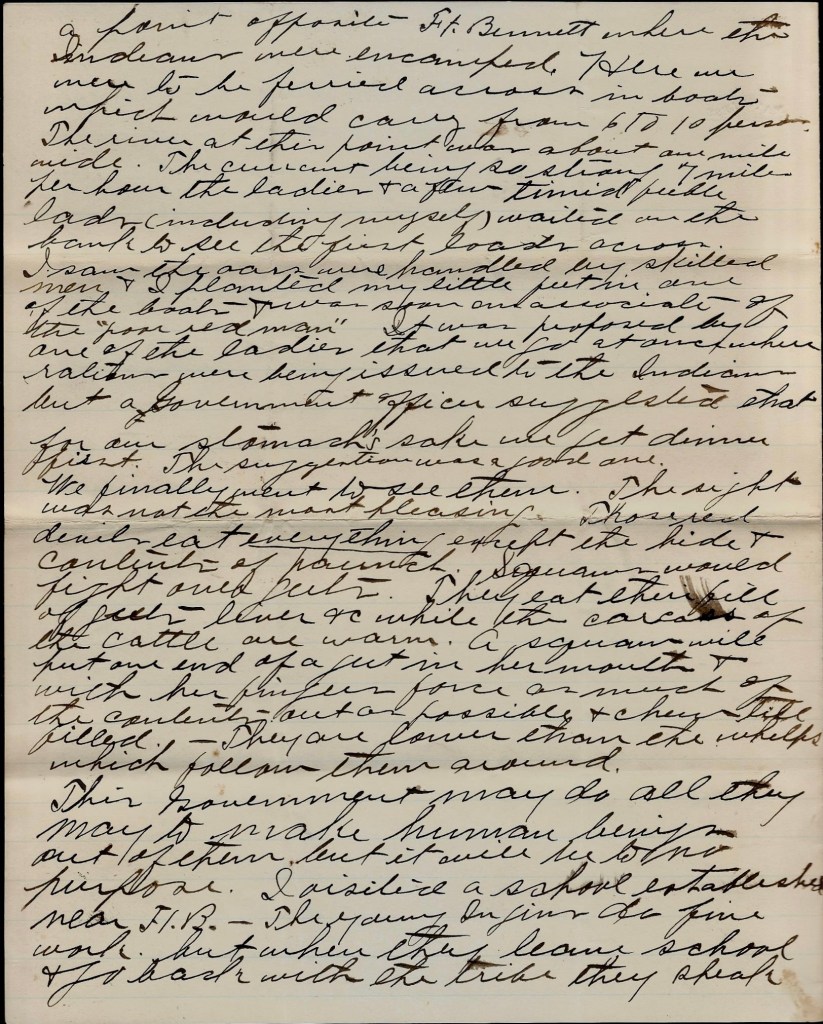
After a splendid breakfast with the soldiers, who were not only soldiers but gentlemen, we seated ourselves in the carriages & drove 8 miles to a point opposite Ft. Bennett where the Indians were encamped. Here we were to be ferried across in boats which would carry from 6 to 10 persons. The river at this point was about one mile wide. The current being so strong—7 miles per hour—the ladies and a few timid, feeble lads (including myself) waited on the bank to see the first loads across. I saw the oars were handled by skilled men and I planted my little feet in one of the boats & was soon an associate of the “poor red man.”

It was proposed by one of the ladies that we go at once where rations were being issued to the Indians but a government officer suggested that for our stomach’s sake, we get dinner first. The suggestion was a good one. We finally went to see them. The sight was not the most pleasing. Those red devils eat everything except the hide and contents of the paunch, Squaws would fight over guts. They eat their fill of guts, liver, &c. while the carcass of the cattle are warm. A squaw will put one end of a gut in her mouth and with her fingers force as much of the contents out as possible and chew till filled. They are lower than the whelps which follow them around. This government may do all they may to make human beings out of them but it will be to no purpose.
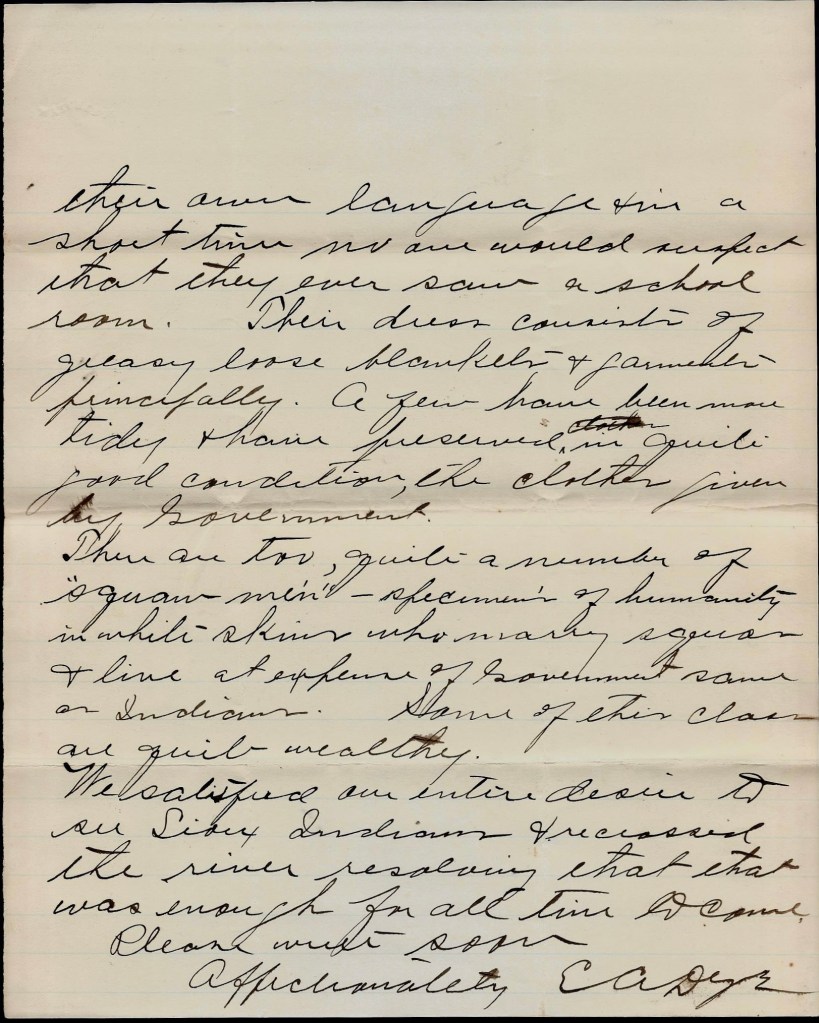
I visited a school established near Ft. Bennett. 1 The young Indians do fine work but when they leave school and go back to the tribe they speak their own language & in a short time no one would suspect that they ever saw a school room. Their dress consists of greasy loose blankets and garments principally. A few have been more tidy and have preserved in quite good condition the clothes given by government. There are too, quite a number of “squaw men”—specimens of humanity in white skins who marry squaws & live at the expense of government same as Indians. Some of this class are quite wealthy. We satisfied our entire desire to see Sioux Indians and recrossed the river resolving that was enough for all time to come. Please write soon. Affectionately, — E. A. Dye
1 The Cheyenne River Agency was established at Fort Bennett in 1878. The Cheyenne River Agency Boarding School for Indian Boys was sited there and St. John’s—a school for girls—was sited nearby.

 Spared & Shared 23