
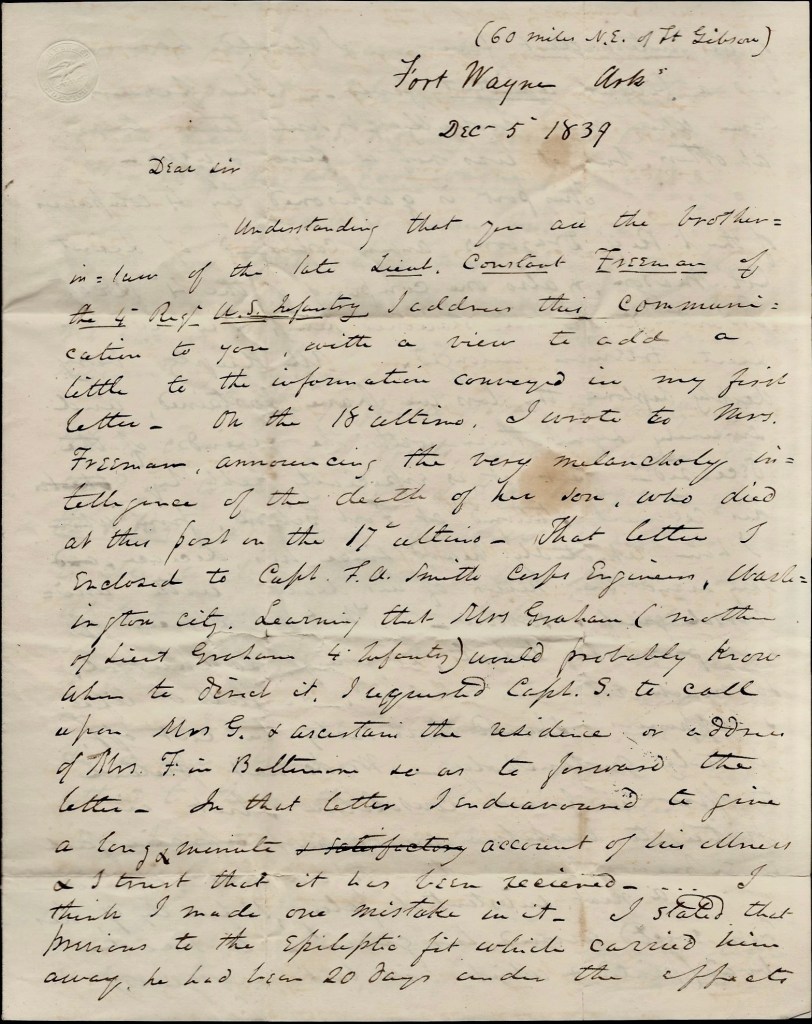
In this letter to the deceased’s brother-in-law, Lieutenant Benjamin Alvord is following up on a previous communication regarding the death of Lieutenant Constant Freeman, 4th Regiment U.S. Infantry. Freeman was a graduate of the West Point Class of 1838 who was commissioned a 2nd Lieutenant and who died on duty at Ft. Wayne in Indian Territory on 17 November 1839.
Constant was the son of Ezekiel Freeman (1762-1825) and Rebecca Price (1761-Aft1839). The letter was addressed to John LeMessueries Smith (1802-1844), the husband of Constant’s older sister, Sophia Price Freeman (1814-1894).
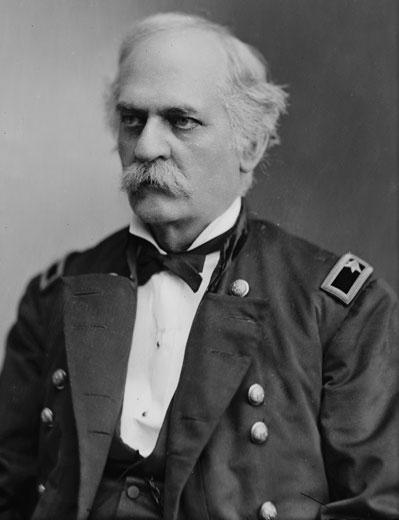
Lieutenant Benjamin Alvord (1813-1884) was an 1833 graduate of West Point (his classmates included future Civil War Union Generals John G. Barnard and Rufus King, as well as future Civil War Confederate Generals Henry C. Wayne and Daniel Ruggles. He was on frontier duty when he wrote this letter, and thereafter engaged in the Florida War with the Seminole Indians, the Mexican War, and the Civil War, being breveted a brigadier general in 1865 for his long and faithful service. His entire service during the Civil War years were in the American Northwest, where he spent much of his time mediating between Indians and White settlers (who for the most part repeatedly broke treaties with the Native Americans). Resigning his Volunteer commission in August 1865, he was sent to the East, where he became Paymaster of New York City, New York. His subsequent military service was in the paymaster department, eventually being promoted to Brigadier General and Chief Paymaster of the United States Army.
Originally called Camp Illinois, what became Fort Wayne was built on the south side of the Illinois River near present-day Watts, Oklahoma; it was named in honor of General Anthony Wayne, commonly referred to as “Mad Anthony,” a notable figure in the Revolutionary War. Construction was begun on October 29, 1838, by Company C of the Seventh Infantry of the U.S. Army, commanded by Captain John Stuart. After the death of Captain Stuart on December 8, 1838, four companies of dragoons were stationed there under the command of Lieutenant Colonel Richard B. Mason in summer 1839 to relieve Stuart’s infantry. By this time, it had supplanted Fort Coffee, which had been constructed farther south in 1834. Lt. Col. Mason and companies E, F, G, and K of the First Dragoons arrived at Fort Wayne on June 16, 1839. Eighty men became ill, including Lt. James M. Bowman. Deemed “unhealthy” by military authorities, the fort was moved north by Mason’s troops to Spavinaw Creek on the southwestern edge of Beaty’s Prairie in the Cherokee Nation, four miles from Maysville, Arkansas.
Though Lt. Alvord asserts that ague was not the cause of Lt. Freeman’s illness, the symptoms described suggest to me that he and many of the other soldiers were probably suffering from malaria. Cases of cerebral malaria can cause paroxyms that were often mistaken for epileptic fits.
Transcription
Fort Wayne, Arkansas
(60 miles N. E. of Ft. Gibson)
December 5, 1839
Dear Sir,
Understanding that you are the brother-in-law of the late 1st Lieutenant Constant Freeman of the 4th Regiment U. S. Infantry, I address this communication to you, with a view to add a little to the information conveyed in my first letter. On the 18th ultimo. I wrote to Mrs. Freeman announcing the very melancholy intelligence of the death of her son who died at this post on the 17th ultimo. That letter I enclosed to Capt. F. A. Smith, Corps Engineers, Washington City. Learning that Mrs. Graham (mother of Lieut. Graham, 4th Infantry) would probably know where to direct it, I requested Capt. Smith to call upon Mrs. Graham and ascertain the residence or address of Mrs. Freeman in Baltimore so as to forward the letter. In that letter, I endeavored to give a long and minute account of his illness and I trust that it has been received.
I think I made one mistake in it. I stated that previous to the epileptic fit which carried him away, he had been 20 days under the effects of an intermittent fever. I should have said a bilious remittent fever. The fever came upon more violently at some times than at others but it was not a fever & ague.
This post is garrisoned by four companies of the 1st Regiment Dragoons under command of Lieut. Col. Mason and also one company of the 4th Regt. Infantry, temporarily stationed here & to which Lieut. Freeman belonged. All deeply, very deeply, deplore the loss we have sustained and sincerely sympathize with the friends of the late deceased. But it is especially felt by his regiment stationed at Fort Gibson from whom I have repeatedly heard since his decease. They heard the news of his death with universal grief and sorrow. That an officer of such promising talents, so you and so cheerful, so much esteemed and beloved, so full of life and happiness, should thus early be cut off, is truly melancholy. We do not pretend to offer his friends consolation; but in justice to ourselves we cannot fail to express these sentiments on this occasion.
A neat, substantial paling, 12 feet by 9, has been erected around his grave. A head board (painted & which will last many years) has been prepared having the following inscription cut upon it. “In memory of Constant Freeman, Lieut. U. S. Infantry, born at Baltimore 8 May 1819, died at Fort Wayne, 17 November 1839.”
I leave here myself very soon but some of his friends here contemplate next spring to plant within the paling some shrubbery or some prairie flowers which they may transplant from the surrounding country.
By the 95th ARticle of War, the duty of taking charge of his effects devolved upon the second in command, Capt. J. H. K. Burgwin of the 1st Regt. of Dragoons. He will (as soon as he is able to do so) foward a list of his effects which are here or at Fort Gibson, and also of all demands against his estate. The delay in the matter is occasioned by his not learning all that was necessary from Fort Gibson. He is now absent and at Fort Gibson & will doubtless attend to the matter. When he writes, I presume he will submit the question as to how his friends wish his effects to be disposed of—whether to have them sold here, reserving such articles his friends would like as mementoes of him, or forward them to the North.
Your communications on all these matters should be addressed to Capt. Burgwin. I do not expect I shall remain in Arkansas two months longer and expect to repair with my company to Fort Gibson in a few days.
I am, very respectfully, your obedient servant,
— Benjamin Alvord, Lieut., USA
[to] J. L. M. Smith, Esqr.
P. S. His sword and sash, perhaps his uniform and some of his books, besides of course all his private papers are probably the articles his friends would most value. The claims against his estate I understand are large but I do not know what amount of pay was due him.


 Spared & Shared 23