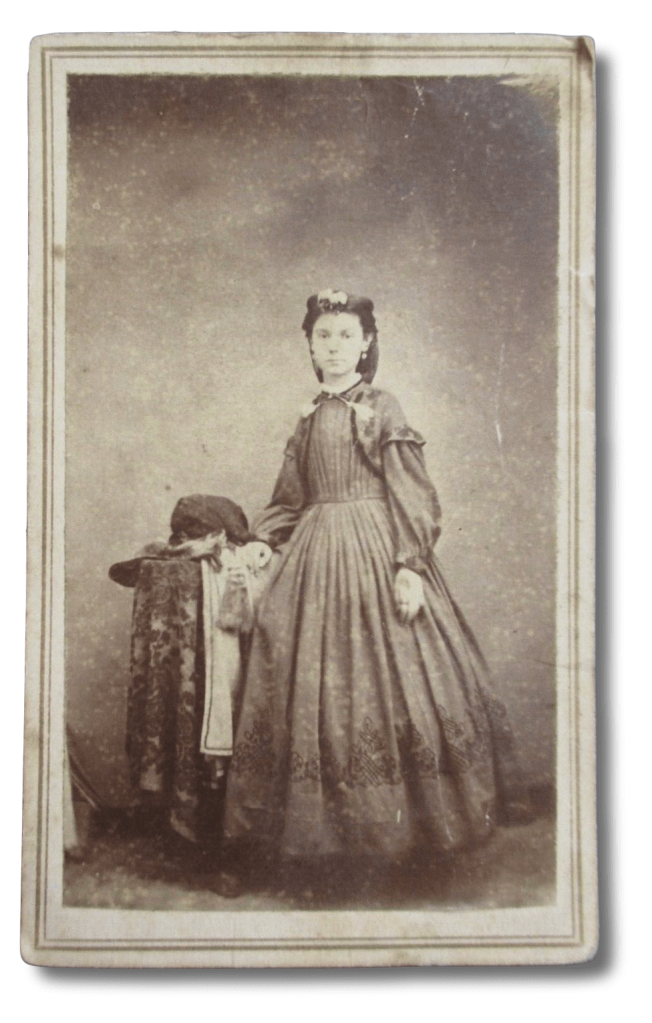
This is a carte-de-visite (cdv) of Harriet E. Whiting (1839-1888), the daughter of Presbyterian minister, Rev. Russell Whiting (1797-1855) and Theodotia M. Mitchell (1798-1845) of Preston, Chenango county, New York. Note that her mother died when she was but 5 or 6 years old. At the time of the 1850 US Census, Harriet, or “Hattie” as she was called, lived with her father and her stepmother Eva (her mother’s step-sister) in Oswego, Kendall county, Illinois. Five years later, Hattie’s father died when the family resided in Sugar Grove, Kane county, Illinois.
A search of School records informs us that Hattie’s father was an 1835 graduate of Union College in New York State. He then attended the Princeton Theological Seminary from 1825-1826, the Andover Theological Seminary from in 1828, and was ordained by the Albany Presbytery in October 1828. His first pastorate was at Batavia, New York (1829-1831) and then at various other churches in Western New York before relocating to Oswego, Illinois in 1849.
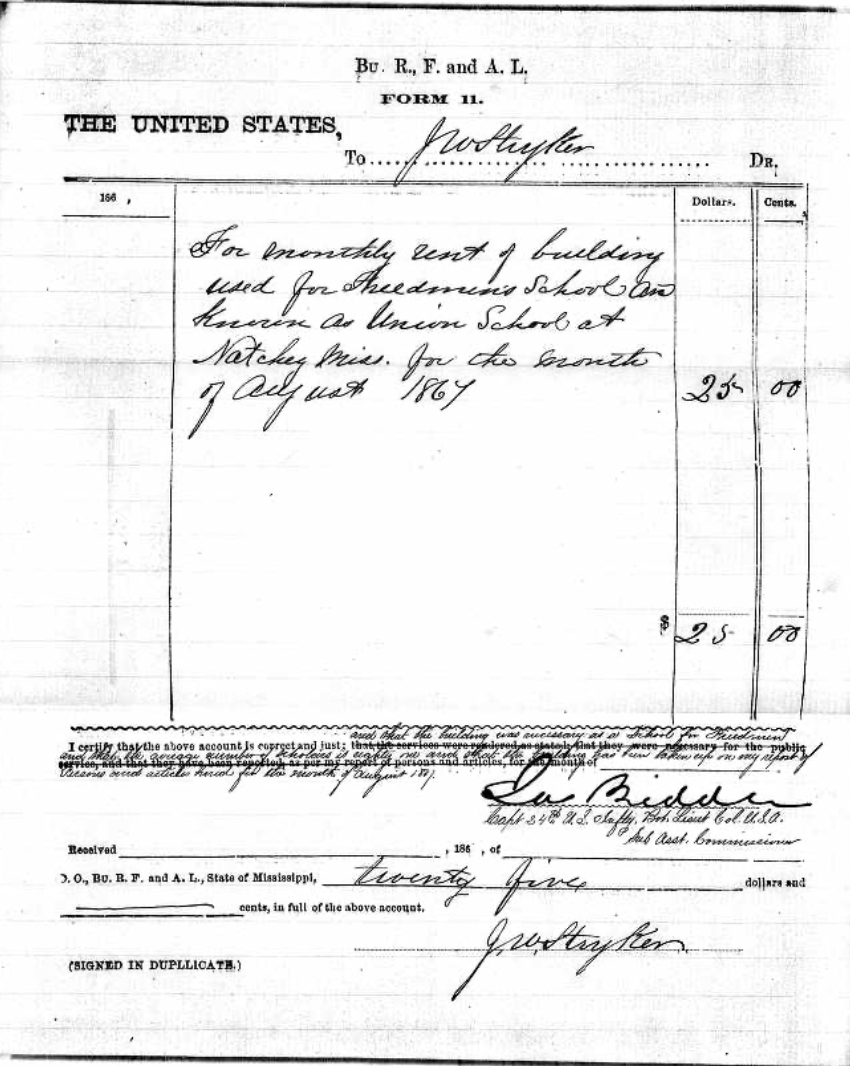
Freedmen’s Bureau Records, 1865-1878
Hattie’s whereabouts could not be confirmed in the 1860 US Census when she would have been 21. It may be that she was on her own working as a school teacher somewhere. The cdv featured above that was taken in Natchez by the Hughes & Larkin studio was probably taken in 1865. That’s the year that the Freedmen’s Bureau established schools in the vicinity of Natchez. Hattie married Jonathan W. Stryker (1836-1888) on 3 March 1867 in Joliet, Illinois. A Freedmen’s Bureau record dated August 1867 shows that J. W. Stryker (and Hattie) were reimbursed by the Bureau for the monthly rent of $25 for the Union School in Natchez.
The 1870 US Census records enumerate Jonathan and Hattie Stryker in Port Gibson, Claiborne county, Mississippi where they were working as teachers for the Freedman’s Bureau. That census record informs us that Jonathan was born in Canada. The couple were living in Spink, South Dakota, in the 1880s where they died.
Curiously, in a poor hand, someone has written on the front of Hattie’s cdv, “My school marm.” This was most likely a black student attending school in Natchez. The cdv was found in the album of a member of the 3rd US Colored Cavalry.
In yet a different hand, not Hattie’s, someone has written on the verso, “Stray Lamb Hattie.” Hattie’s signature is believed to be at the bottom of the verso.
[Note: This photograph is from the collection of Rick Brown who asked for research on the image and gave express consent for me to share it on Spared & Shared.]
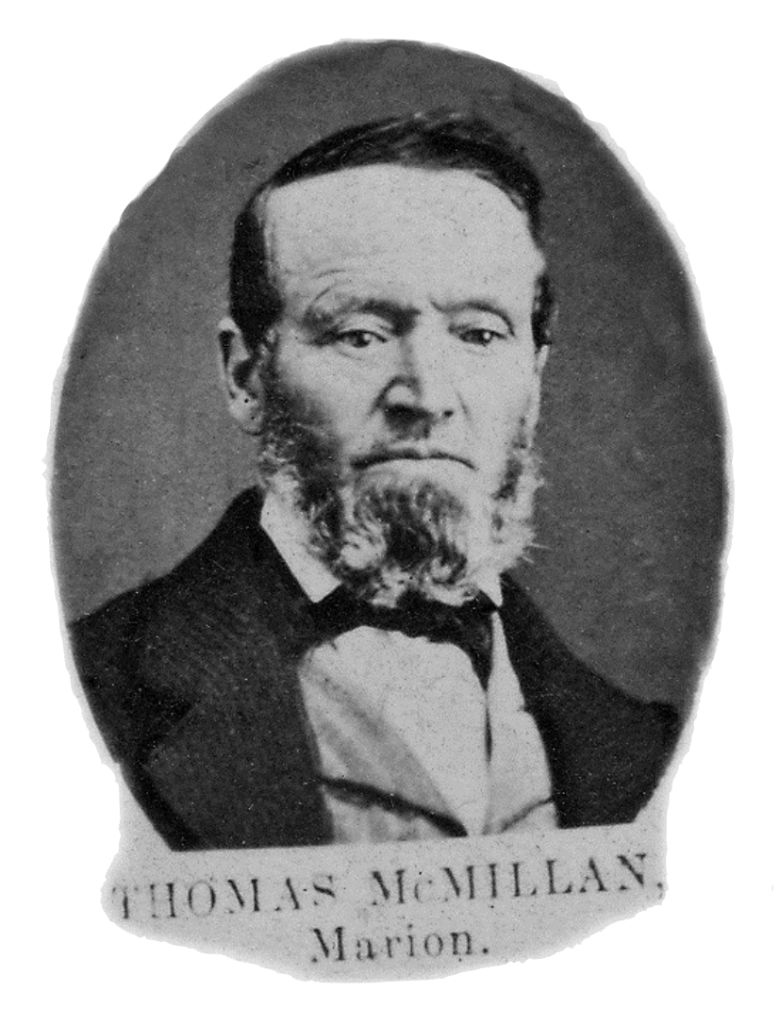
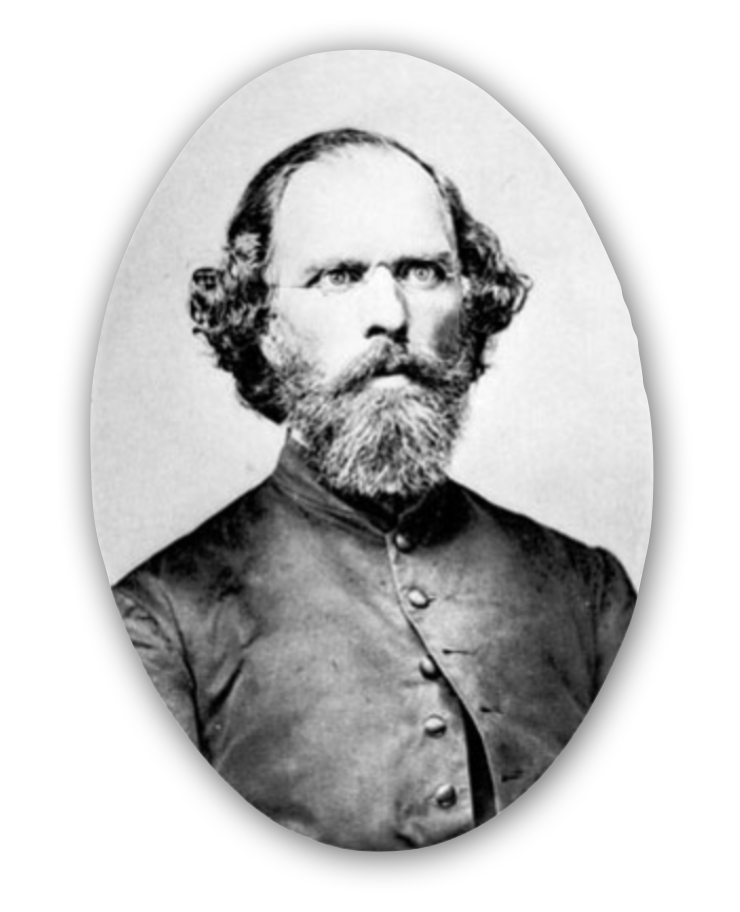
The following letter was written by Senator Thomas McMillan whose biographical sketch appears in the Iowa Official Register as follows:
“Born in Scotland, on the twentieth day of February, 1809, and learned the trade of baker in his youth. In 1832 he decided to emigrate to the United States and settled first in Cincinnati, Ohio, and then removed to Dayton, in that State, and while living here was married to Miss Mary Breckenridge, in 1835, a native of the same town in Scotland. After a residence of three years in Dayton he removed to Indianapolis, Indiana, where he remained eighteen years, working at his chosen occupation. In 1854 he came to Iowa and settled in Marion County on a farm, and for twelve years was engaged in agricultural pursuits. In 1864 he was elected to the Senate of the State Legislature, and the manner in which he filled this position is evinced from the fact that he was reelected in 1868, and served with great credit. His private character and public record are alike untarnished. Mrs. McMillan died in 1872, leaving five children.”
Thomas wrote the letter to his son-in-law, Alexander Morrison Clark (1832-1926). Alexander married Sarah Jane McMillan in 1864. He enlisted in the Iowa 8th Infantry in 1861 and rose in rank steadily until named the captain of Co. E in March 1865. He mustered out at Selma, Alabama, in April 1866.
In his letter, Thomas expresses deep disappointment with President Johnson’s decision to veto the Freedmen’s Bureau Bill which would have extended funding for the Freedmen’s Bureau created during the Lincoln Administration.
Transcription
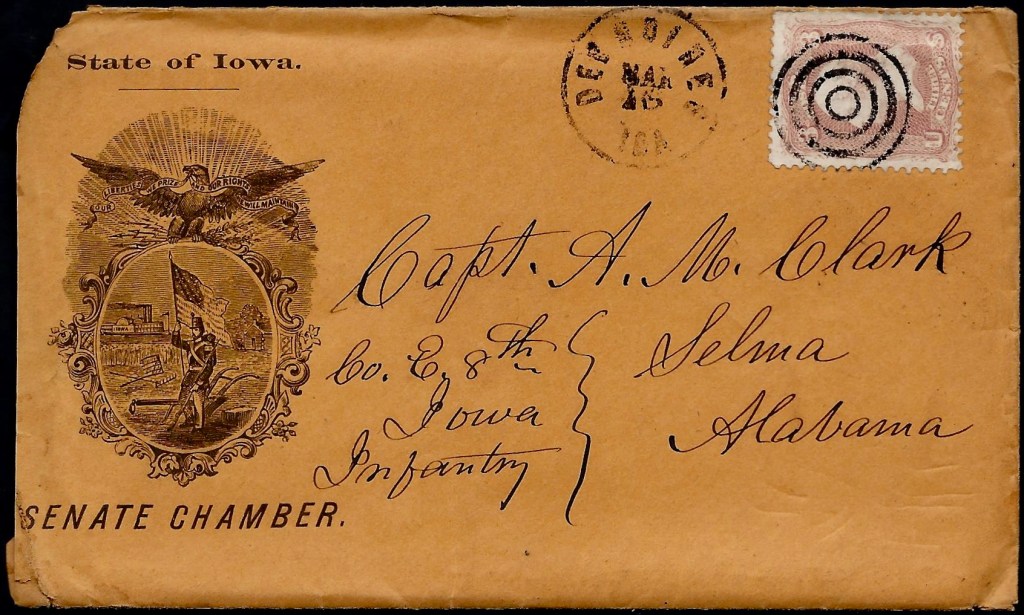
Addressed to Capt. A. M. Clark, Selma Alabama Co. E, 8th Iowa Infantry
DesMoines, Iowa March 14th 1866
Dear Son,
Your kind letter from Selma was received a week ago. I am glad to hear of your welfare. How wonderfully you have been preserved in the 4½ years you have been in the service of your country. Surely we have great reason for gratitude and thankfulness to our Heavenly Father for His mercy & goodness in preserving you all through so many dangers. Col. Ryan is now a Representative from Jasper County, calls on me frequently and enquires kindly after you. Also a Mr. McConnell from Keokuk County who was hospital steward in your company. He asks to be remembered to you.
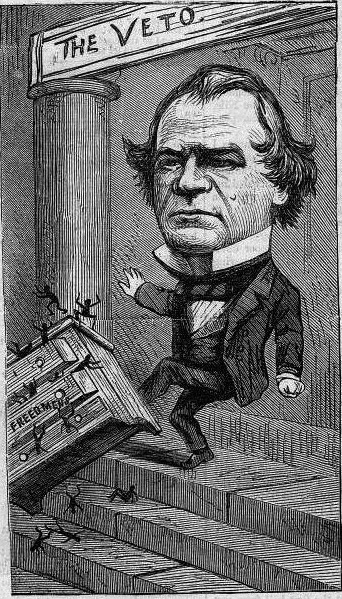
A cartoon by Thomas Nast appearing in Harper’s Weekly, April 14, 1866
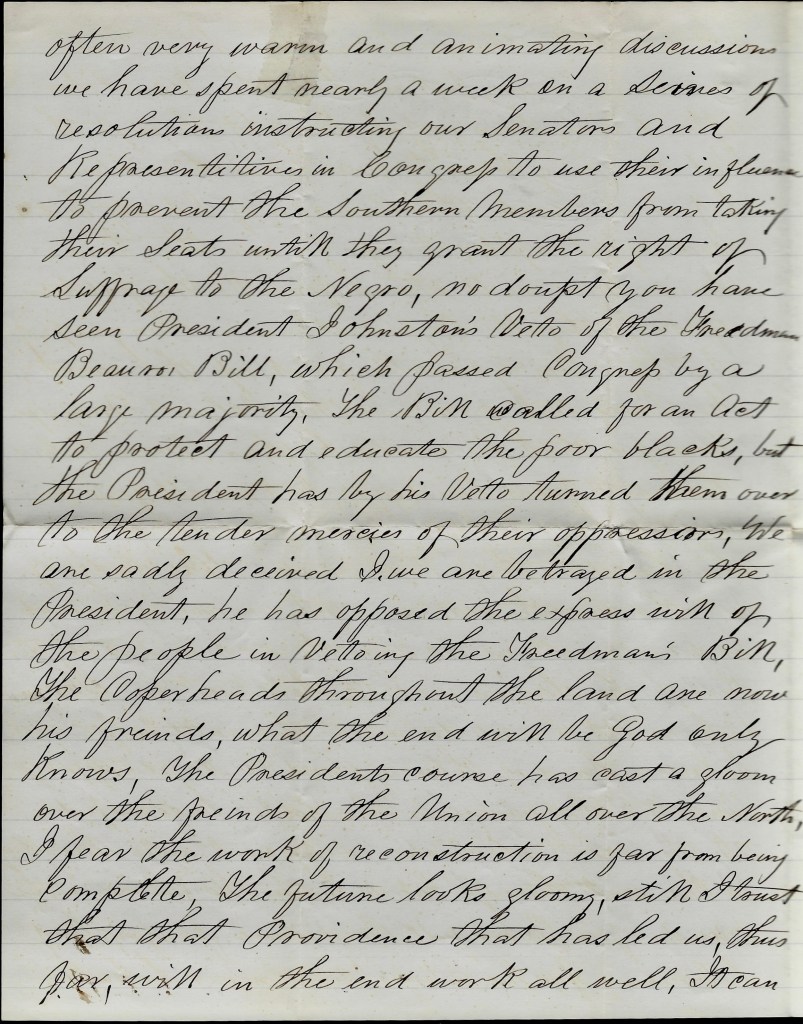
This is the tenth week of the session. We have passed a resolution to adjourn on the 3d of April. This is an exciting place. We have often very warm and animating discussions. We have spent nearly a week on a series of resolutions instructing our Senators and Representatives in Congress to use their influence to prevent the Southern members from taking their seats until they grant the right of suffrage to the Negro. No doubt you have seen President [Andrew] Johnson’s veto of the Freedmen’s Bureau Bill which passed Congress by a large majority. The Bill called for an Act to protect and educate the poor blacks, but the President has by his veto turned them over to the tender mercies of their oppressors. We are sadly deceived & we are betrayed in the President.
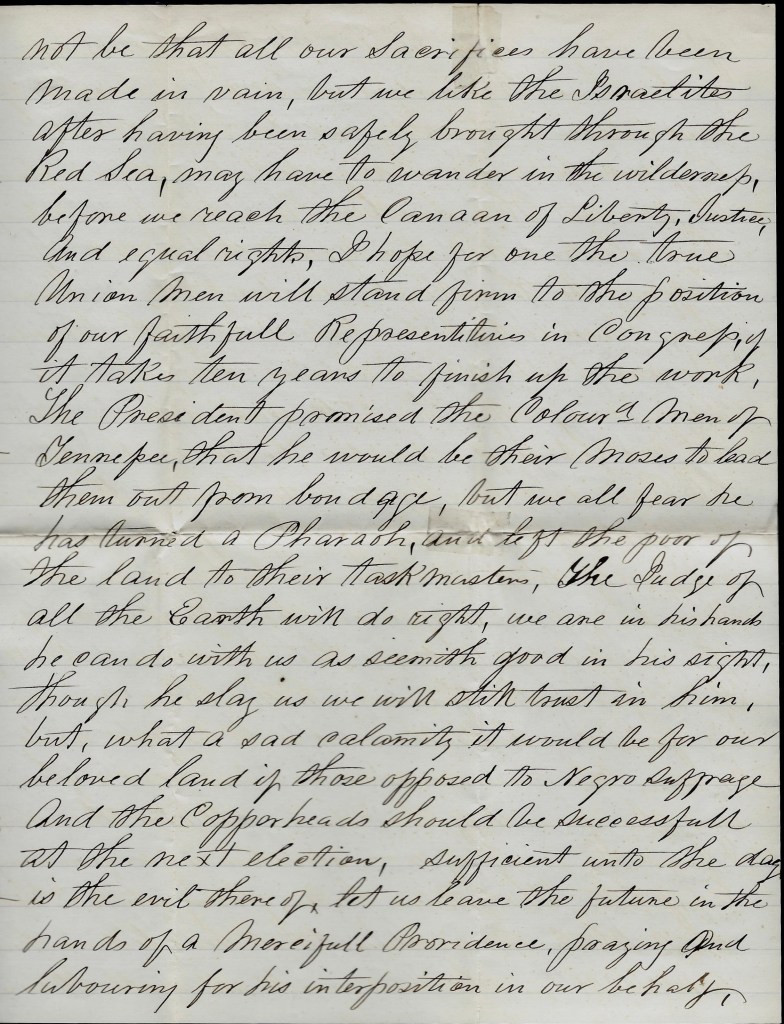
He has opposed the express will of the people in vetoing the Freedmen’s Bill. The Copperheads throughout the land are now his friends. What the end will be, God only knows. The President’s course has cast a gloom over the friends of the Union all over the North. I fear the work of reconstruction is far from being complete. The future looks gloomy. Still I trust that [the] Providence that has led us thus far, will in the end work all well. It can not be that all our sacrifices have been made in vain, but we, like the Israelites after having been safely brought through the Red Sea, may have to wander in the wilderness before we reach the Canaan of Liberty, Justice, and equal rights.
I hope, for one, the true Union men will stand firm to the position of our faithful Representatives in Congress if it takes ten years to finish up the work. The President promised the colored men of Tennessee that he would be their Moses to lead them out from bondage, but we all fear he has turned a Pharaoh, and left the poor of the land to their task masters. The Judge of all the Earth will do right. We are in His hands. He can do with us as seemeth good in His sight. Though He slay us, we will still trust in HIm. But what a sad calamity it would be for our beloved land if those opposed to Negro suffrage and the Copperheads should be successful at the next election. Sufficient unto the day is the evil thereof. Let us leave the future in the hands of a Merciful Providence, praying and laboring for His interposition in our behalf.
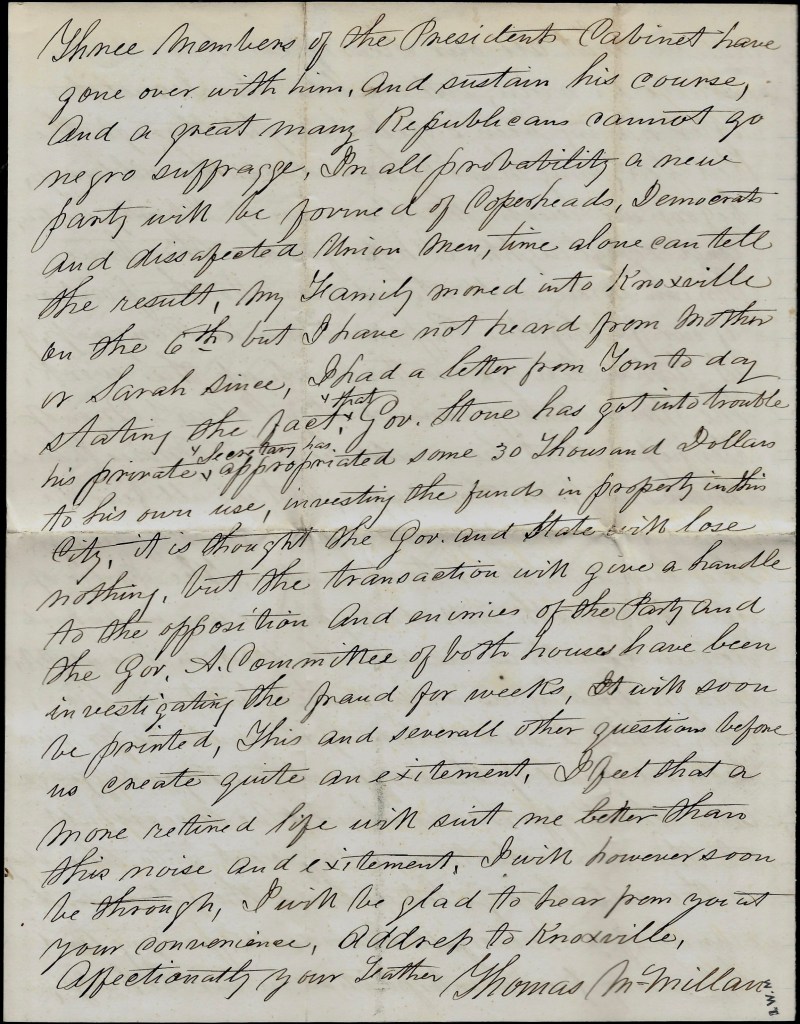
Three members of the President’s Cabinet have gone over with him and sustain his course. And a great many Republicans cannot go negro suffrage. In all probability, a new party will be formed of Copperheads, Democrats and disaffected Union men. Time alone can tell the result. My family moved into Knoxville on the 6th but I have not heard from Mother or Sarah since. I had a letter from Tom today stating the fact that Gov. Stone has got into trouble. His private Secretary has appropriated some 30 thousand dollars to his own use, investing the funds in property in this city. It is thought the governor and State will lose nothing, but the transaction will give a handle to the opposition and enemies of the Party and the governor. A committee of both houses have been investigating the fraud for weeks. It will soon be printed. This and several other questions before us create quite an excitement. I feel that a more retired life will suit me better than this noise and excitement. I will, however, soon be through. I will be glad to hear from you at your convenience. Address to Knoxville [Marion county, Iowa].
Lucius Parker Merriam (1846-1883) was only 17 years old in 1864 when he travelled from his home in Grafton, Massachusetts, to New Bern, North Carolina, captured by the Union Army from the Confederates two years before, then becoming a “mecca” for thousands of “contrabands”—freed slaves who flocked there seeking protection and sustenance. The humanitarian problem confronting the Union Army in caring for the contraband was given to Worcester clergyman and Army Chaplain Horace James who had already recruited Merriam’s 23 year-old college-educated sister, Sallie Anna (“Annie”) Parker Merriam (1839-1923) to teach school to illiterate Blacks.
By the time Lucius came to New Bern as a civilian Quartermaster clerk, Capt. James had created a small town for 3,000 freed slaves, a “Trent River Settlement” renamed “James City” in his honor. Merriam spent two years clerking for some 20 Army officers and civilian employees who administered this ramshackle Black community, duties assumed, after Lincoln’s assassination and War’s end, by the newly-established Bureau of Refugees, Freedmen & Abandoned Lands, more commonly and simply called, the “Freedmen’s Bureau.” Despite instances of rampant corruption, the Freedmens Bureau would resist the efforts of President Andrew Johnson to abolish it. Spouting Republican rhetoric about “Universal Liberty,” Merriam insisted his Bureau must survive until “the Southerners are ready to give the colored man his just rights and acknowledge his manhood.” [This letter was sold from a small lot of letters written by Merriam by PBA Galleries in August 2014.]
Lucius’ parents were Charles Merriam (1807-1888) and Caroline Parker (1811-1890) of Grafton, Worcester county, Massachusetts. In 1869, Lucius entered Amherst College, graduated in 1873, and later taught school in Norwich, Connecticut, in Springfield, Massachusetts, and served as a high school principal in Providence, Rhode Island. In the 1870s he married Emily Atwell Clemons (1852-1910) but died a premature death in 1883 after fathering three children. He died of diabetes in Knoxville, Tennessee, while trying to regain his health during the winter of 1882-83 with the idea that he might relocate there.
[This letter is from the personal collection of Richard Weiner and is published on Spared & Shared by express consent.]
Lucius P. Merriam worked as a clerk in the Freedmen’s Bureau at New Bern after the war while his sister Annie taught a school for Blacks at Raleigh and later New Bern.
Transcription
Bureau of Refugees, Freedmen & Abandoned Lands Headquarters, Eastern District of North Carolina New Berne, North Carolina January 22nd 1866
My dear mother,
You must pardon me for not writing you oftener but the fact is I’ve been very busy lately. I have been employed on Capt. [Frederick A.] Seely’s 1 papers most of the time since I have been with him and have now finished them of this months.
Capt. Horace James, a former pastor of the Old South Congregational Church in Worcester who joined the 25th Mass. Infantry as a chaplain and then took charge of contraband during the war. For a great article chronicling his service to Freedmen, see Joe Mobley’s biographical sketch on NCPedia.
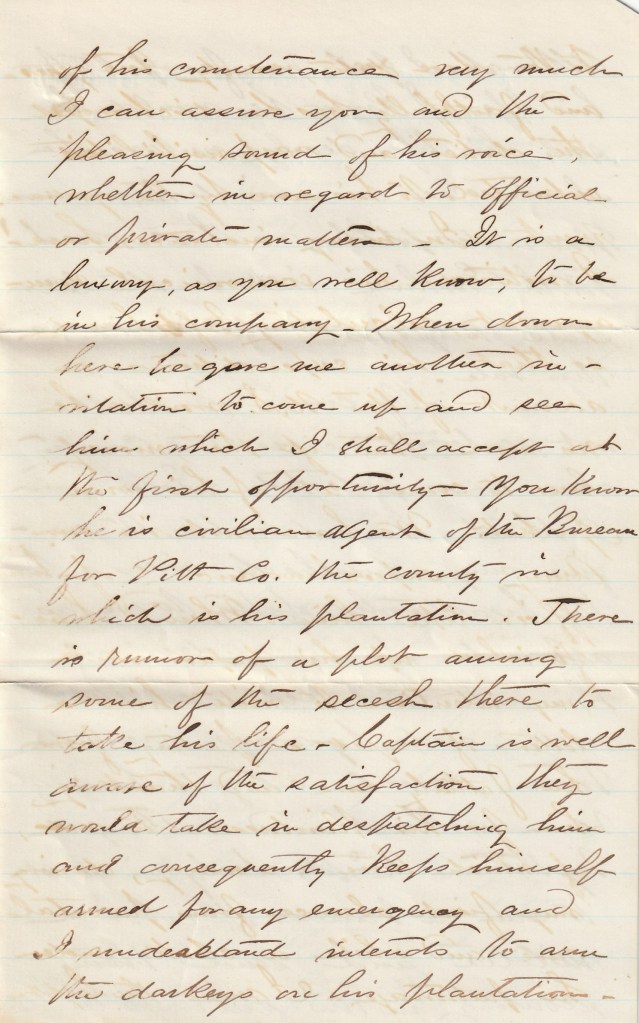
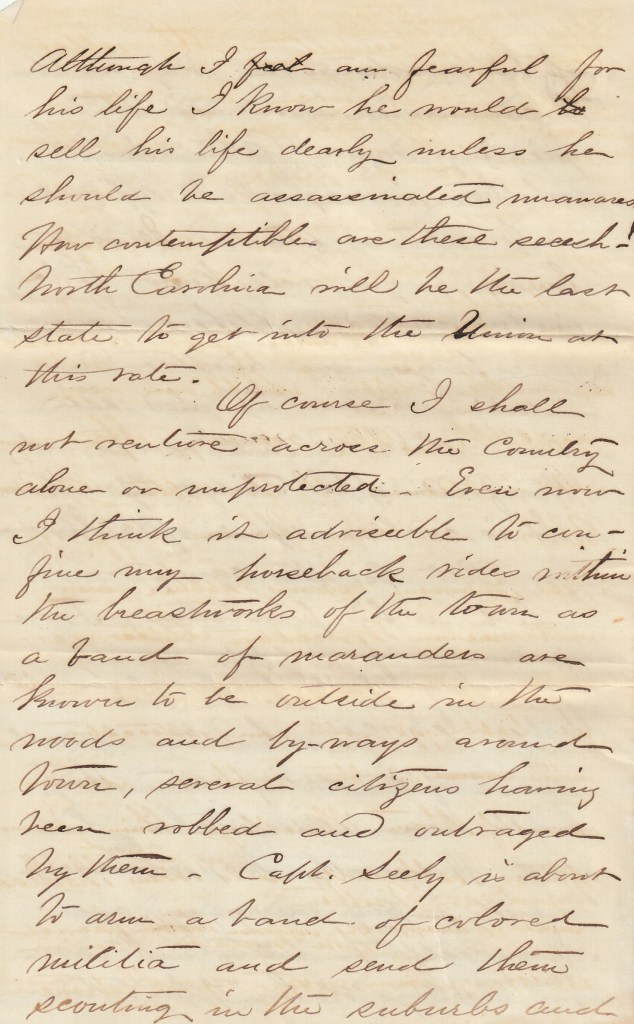
I am now busy in finishing up Capt. James’ papers of December and January. While here a week ago he received a letter from the War Department at Washington honorably mustering him out of the U. S. service in answer to his own request, his services being no longer necessary. The date being January 8th 1866. He has now been a Quartermaster [in the Freedman’s Bureau] from February 18th 1864 to the above date—nearly two years—and faithfully has he discharged the duties and responsibilities entrusted to his care by the government. In many instances have I noticed his economical management, calculating beforehand so that his expenditures on account of the U. S. would be no more than if the money was to come out of his own pocket. We have not in our army a superabundance of officers like him. When I have finished up his papers, it is my intention to write him a letter of regret on parting from his fatherly care and thanking him for his kindnesses to me of which there are many during my first absence from parental care and while a clerk under his patronage. I miss the light of his countenance very much, I can assure you, and the pleasing sound of his voice, whether in regard to official or private matters. It is a luxury, as you well know, to be in his company. When down here, he gave me another invitation to come up and see him which I shall accept at the first opportunity. You know he is civilian agent of the Bureau for Pitt Co., the county in which is his plantation. 2 There is a rumor of a plot among some of the secesh there to take his life. Captain is well aware of the satisfaction they would take in dispatching him and consequently keeps himself armed for any emergency and I understand intends to arm the darkeys on his plantation. Although I am fearful for his life, I know he would sell his life dearly unless he should be assassinated unawares. How contemptible are these secesh! North Carolina will be the last state to get into the Union at this rate.
An 1868 engraving of “James’s Plantation School” in North Carolina. This freedmen’s school is possibly one of those established by Horace James on the Yankee or Avon Hall plantations in Pitt County in 1866. North Carolina Collection, University of North Carolina at Chapel Hill Library.
Of course I shall not venture across the country alone or unprotected. Even now I think it advisable to confine my horseback rides within the breastworks of the town as a band of marauders are known to be outside in the woods and byways around town, several citizens having been robbed and outraged by them. Capt. Seely is about to arm a band of colored militia and send them scouting in the suburbs and through the county with orders to hang at once anyone who is known to be an outlaw or engaged in plundering and overhauling unprotected citizens or travelers.
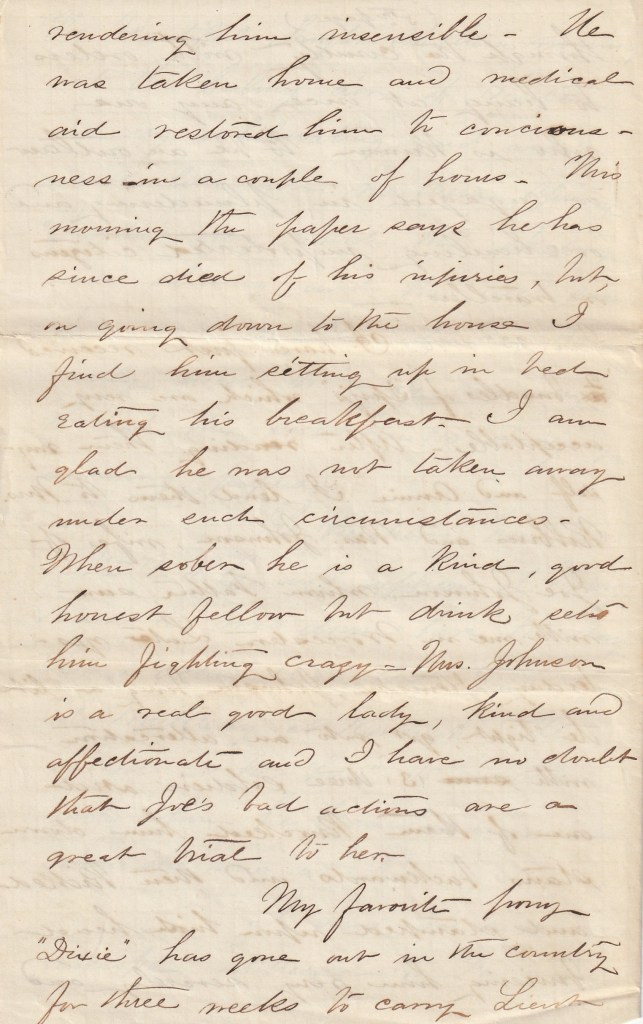
January 23, 1866. I have just received two bundles of [Worchester] “Spys” which are very acceptable. After reading them—myself and Annie—I lend them to Mrs. Robbins and Mrs. Johnson, wife of Joe Johnson, whom Father saw with me in Worcester. Late yesterday afternoon, Johnson, being a little “tight,” got into an altercation with (3) three soldiers and one of them knocked him downstairs backwards and then kicked and stamped upon his head, bruising him very severely and rendering him insensible. He was taken home and medical aid restored him to consciousness in a couple of hours. This morning the paper says he has since died of his injuries but on going down to the house, I find him sitting up in bed eating his breakfast. I am glad he was not taken away under such circumstances. When sober, he is a kind, good, honest fellow, but drink sets him fighting crazy. Mrs. Johnson is a real good lady—kind and affectionate—and I have no doubt that Joe’s bad actions are a great trial to her. 3
My favorite pony “Dixie” has gone out in the country for three weeks to carry Lieut. [George S.] Hawley of the Veteran Reserve Corps on a tour of inspection. Mine is the only quartermaster horse that could stand such a tramp so he had to go. Capt. Seely told me he had done something which he supposed I would abuse him about—viz: letting my horse go for a short time. Nevertheless, he has given me the use of a private pony of his during Dixie’s absence. Capt. Seely is a sensible man. He calculates on his clerks have exercise out of office hours. Every one of his three clerks has a horse. Woog, I think, has a buggy. Captain also has a buggy.
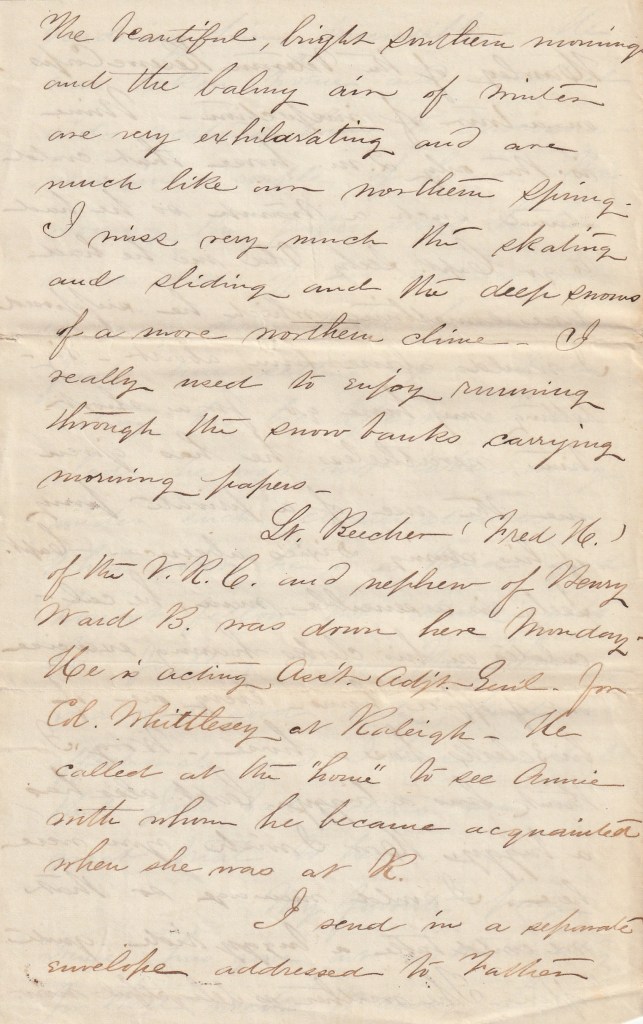
How I wish you were here. I could manage so that we could take a buggy ride quite often. The weather is delightful now. The beautiful, bright southern mornings and the balmy air are very exhilarating and are much like our northern spring. I miss very much the skating and sliding and the deep snows of a more northern clime. I really used to enjoy running through the snow banks carrying morning papers.
Lt. Beecher (Fred H.) of the Veteran Reserve Corps and nephew of Henry Ward Beecher was down here Monday. He is acting Asst. Adjt. General for Col. [Eliphalet] Whittlesey at Raleigh. He called at the “home” to see Annie with whom he became acquainted when he was at Raleigh.
I send in a separate envelope addressed to Father my invitation by Mr. Near to a New Year’s dinner; my letter to Col. [Nathan] Goff of the 37th N. C. C. T. [USCT] relative to the death of young [Lieut.] Mellon [shot on 23 September 1865] and his reply, also notice of a meeting of our “Social Sociable Association.” This association is not a rough and tumble conglomeration of everything and everybody as you might think its name implied, but is a company of respectable northern young men mostly who have regular meetings in the capacity of a literary club and its object is as stated in the by-laws for the mutual improvement of all its members in parliamentary rules of debate, declamation, and the proper mode of conducting meetings. They have already given one lecture this winter by Capt. James. They seem to want to have me belong to the club as they voted me in without my wish or consent. All that is necessary for me to become an active member is to sign the constitution and by-laws (and slide into the Treasury a greenback). It is a very good kind of society to belong to and if I was North, I would join it eagerly, but I wish to give my best attention to my business and have time enough for recreation. I don’t want to tax either my mind or pocket unnecessarily or without improvement. The chairman of the lecture committee, Mr. Frank H. Sterns, came up to the office and presented us clerks with complimentary tickets. He gave me two—one for Annie and one for me.
This p.m. we are going out on a grand horseback ride. Mr. [Edward] Fitz, Annie and myself, and perhaps Miss Thompson. Mr. Fitz has gained honor and credit to himself by his decided stand against the popular immoralities of the times. Through my own and Joe Towle’s intercedence, I think an amicable feeling will be brought about between parties lately at [ ]. I think each and all have done wrong in some degree. Those quoted lines in your letter which aroused your suspicions was simply my opinion; they did not relate to Mr. Fitz particularly. I think just so no matter who it hits. Everyone has a right to his or her opinion on matters and things and our judgement becomes more just as we advance in knowledge. 4
Mr. John F. Keyes [1835-1921] of Clifton, Mass., came in to the office to see me this morning. He was Capt. James’ commissary and a chum of Abernethy’s in dealing out rations. He was a detailed soldier of the 2nd Massachusetts Heavy Artillery. He has come out here to start in the carriage business which is his trade.
Our Congregational Society are about to lose the use of the Presbyterian Church….
1 Capt. Frederick A. Seely served as the Superintendent of the Eastern District of the Bureau of Refugees, Freedmen, and Abandoned Lands (a.k.a., the “Freedmen’s Bureau”), headquartered in Newbern, North Carolina, between January and May 1866. He later worked for the Bureau in Missouri.
2 Capt. Horace James “remained as head of the eastern district until December 1865, when Gen. O. O. Howard finally accepted his resignation. After leaving the Freedmen’s Bureau he entered into a plantation and labor scheme in Pitt County. In the enterprise he was the partner of Whittlesey and Winthrop Tappan, a neighbor of Whittlesey in the state of Maine. The plan conceived by Whittlesey and Tappan and presented to James called for the two men from Maine to rent two plantations in Pitt County from the owner, William Grimes. The plantations, named Avon and Yankee Hall, were located about twelve miles from Washington on opposite sides of the Tar River. James received money for expenses and had complete charge of the farms, including hiring and supervising freedmen as laborers and purchasing supplies. On each of the sites he established schools and churches for the freedmen. In overseeing the laborers employed on the plantations, James acted as a civilian agent for the Freedmen’s Bureau; he received no salary, but if the project produced a profit he was to share in it equally with his partners.
“In the summer of 1866, a black laborer was killed on one of the plantations. In September a military court tried James as an accomplice in the shooting and for allegedly exploiting the freedmen in the profit-making venture. The court also tried Whittlesey for using his position as head of the Freedmen’s Bureau in the state to exploit freedmen labor and for not reporting the Pitt County shooting to headquarters in Washington. Both men were acquitted. Whittlesey soon left the state and rejoined Howard’s staff in Washington, D.C.
“James continued to run the plantations until a crop failure in 1867 led to the venture’s termination, after which the land was returned to the owner. James returned to Massachusetts in the same year and took charge of a parish in Lowell, serving also as associate editor of the Congregationalist, a church publication. He then traveled abroad. While visiting Palestine, he contracted a severe cold that resulted in consumption and ultimately his death in Worcester, Mass. He was survived by his wife and son.” [NCPedia]
3 Joseph (“Joe”) Johnson may have been the member of Co. H, 25th Massachusetts Infantry by the same name from Worcester who served as a wagoner during the war and was a machinist by profession. This is the same regiment that Capt. Horace James first served as chaplain. He was married to Lucretia Wheelock (1834-1888) of Worcester county.
4 Rev. Edward Fitz was a Worcester, Massachusetts, clergyman who exercised arbitrary powers of law enforcement in James City. Fitz was charged with practicing “revolting and unheard of cruelties on the helpless freedmen under his charge” which was supported by testimony from those he had harshly punished. An Army Court of Inquiry dismissed the charges as personal “malice” but also dismissed Fitz for administrative “malfeasance.” Defending Fitz, Lucius wrote in another letter, “This is the reward of four years of his labor for the Contrabands. I would not blame him in the least for turning to an Andy Johnson man. These ignorant darkeys are the hardest people to get along with I ever saw. The more you do for them the more they hate you and will trample on you…”
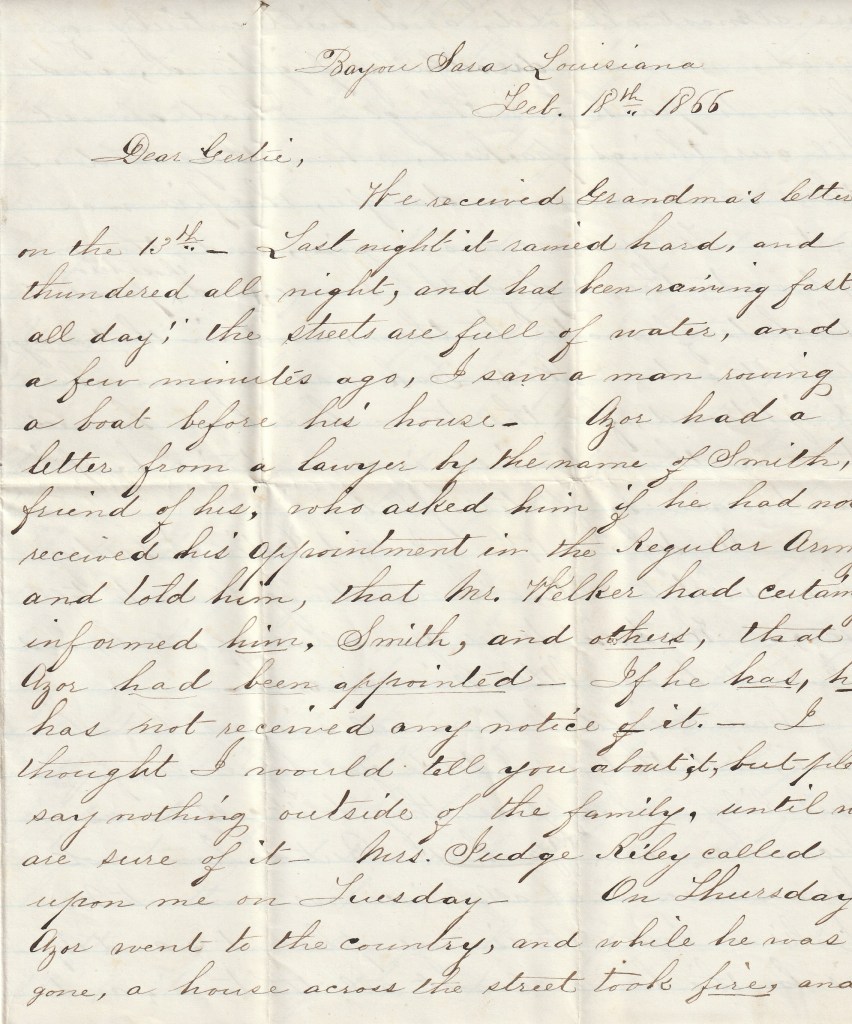
This letter was datelined from Bayou Sara, Feliciana Parish, Louisiana, in mid-February 1866 and written by Nellie (Riegel) Nickerson—the 19 year-old wife of Azor Howitt Nickerson (1837-1910). Nellie was the daughter of John Riegel (1818-18xx) and Susan Adams Ingol. Nellie’s sister, to whom she addressed her letter, was Sarah Gertrude (Riegel) Groff (b. 1844), the wife of Johnson R. Groff of Mechanicsburg, Pennsylvania. Unfortunately for Nellie, her marriage to Azor was brief—she died of spotted fever at Fort Boise, Idaho, only 14 months later.
There is no surviving image of Nellie that I have found but here is a young woman about her age wearing apparel that dates to about 1866.
But what was Nellie’s husband doing in Bayou Sara, Louisiana, in February 1866? A Washington Post article researched and written by William Horne informs us that Azor was there as an agent of the Freedmen’s Bureau tasked with protecting the interests of the former slaves who were being hired to work for wages on the sugar and cotton plantations. Protecting their interests meant providing them assistance in the way of food, shelter, medical aid, schools and legal assistance. Indeed, the Freedmen’s Bureau Louisiana Field Office list of personnel gives “A. H. Nickerson” as “Agent and Asst. Subassistant Commissioner” from January 1865 to May 1866. Nellie’s letter was written in the winter time when the risk of disease was relatively low but apparently during the previous summer of 1865, a small pox epidemic erupted in the area, hitting the black communities particularly hard where, clustered in cramped quarters, the disease spread rapidly unchecked. Allegedly Nickerson colluded with the white planters to keep the infected blacks out of the village (where he was living with his wife), which essentially “condemned them to almost certain death.” Later, Nickerson accused the mayor of attempting to spread the disease, even by going so far as to infect him with it, by sending diseased blacks to his office hoping to run both him and the Bureau out of the parish and thereby maintain elements of hierarchy reminiscent of slavery. [See “In the hands of racist officials…” by William Horne]
Nickerson had a long a controversial post-war career best summarized on the Arlington National Cemetery website that highlights events captured in a book entitled, “The Tarnished Saber: Major Azor Nickerson, USA, His Life and Times” by Angelo D. Juarez.
[Note: This letter is from the private collection of Richard Weiner and is published on Spared & Shared by express consent.]
Transcription
Bayou Sara, Louisiana February 18, 1866
Dear Gertie,
We received Grandma’s letter on the 13th. Last night it rained hard, and thundered all night, and has been raining fast all day. The streets are full of water and a few minutes ago, I saw a man rowing a boat before his house. Azor had a letter from a lawyer by the name of Smith, friend of his, who asked him if he had not received his appointment in the Regular Army and told him that Mr. Welker had certainly informed him—Smith, and others, that Azor had been appointed. If he has, he has not received any notice of it. I thought I would tell you about it, but please say nothing outside of the family until we are sure of it. 1
Mrs. Judge Riley called upon me on Tuesday. On Thursday Azor went to the country an while he was gone, a house across the street took fire and as it was a very windy day, and the houses are almost all old and built entirely of wood, we were dreadfully frightened. and began to pack our things. I had almost all our things packed when they told us there was no more danger—the fire was out. They have no engine and the men got onto the roof of the house and those below passed buckets of water to them, and in that way, put it out. Mrs. Leak was very much frightened for the town has been burned two or three times—one or twice by fires and once by Porter’s fleet. 2
Monday, February 19th. Indeed, Gertie, I hardly know what to write. I have nothing new to tell you. We want to see you all very much and I want to see little Minnie so much.
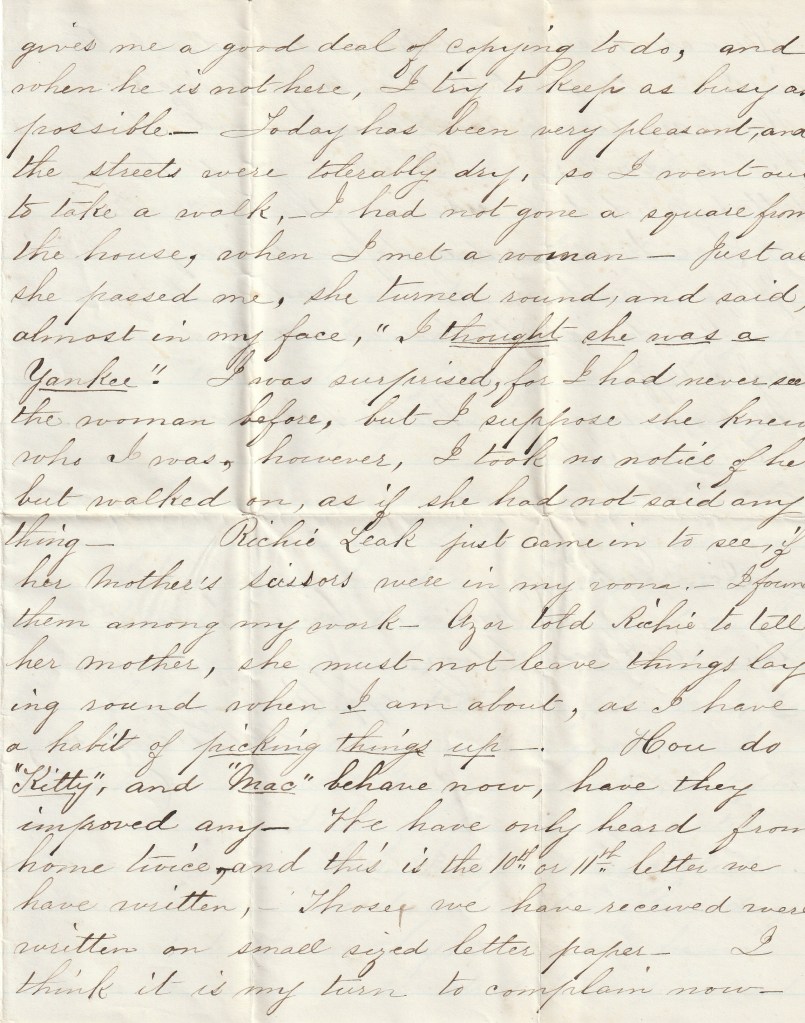
I have received but one call since we have been here and that, as I told you before, was from Mrs. Riley. I suppose they don’t call on us because we are “Yankees” but I have not been lonesome at all since we came to Mr. Leake’s. 3 Mrs. Leake is very pleasant and Azor is in the house almost all the time and gives me a good deal of copying to do, and when he is not here, I try to keep as busy as possible.
Today has been very pleasant and the streets were tolerably dry, so I went out to take a walk. I had not gone a square from the house when I met a woman. Just as she passed me, she turned round and said, almost in my face, “I though she was a Yankee!” I was surprised for I had never seen the woman before but I suppose she knew who I was, however. I took no notice of her but walked on as if she had not said anything.
Richie Leake just came in to see if her mother’s scissors were in my room. I found them among my work. Azor told Richie to tell her mother she must not leave things laying around when I am about as I have a habit of picking things up.
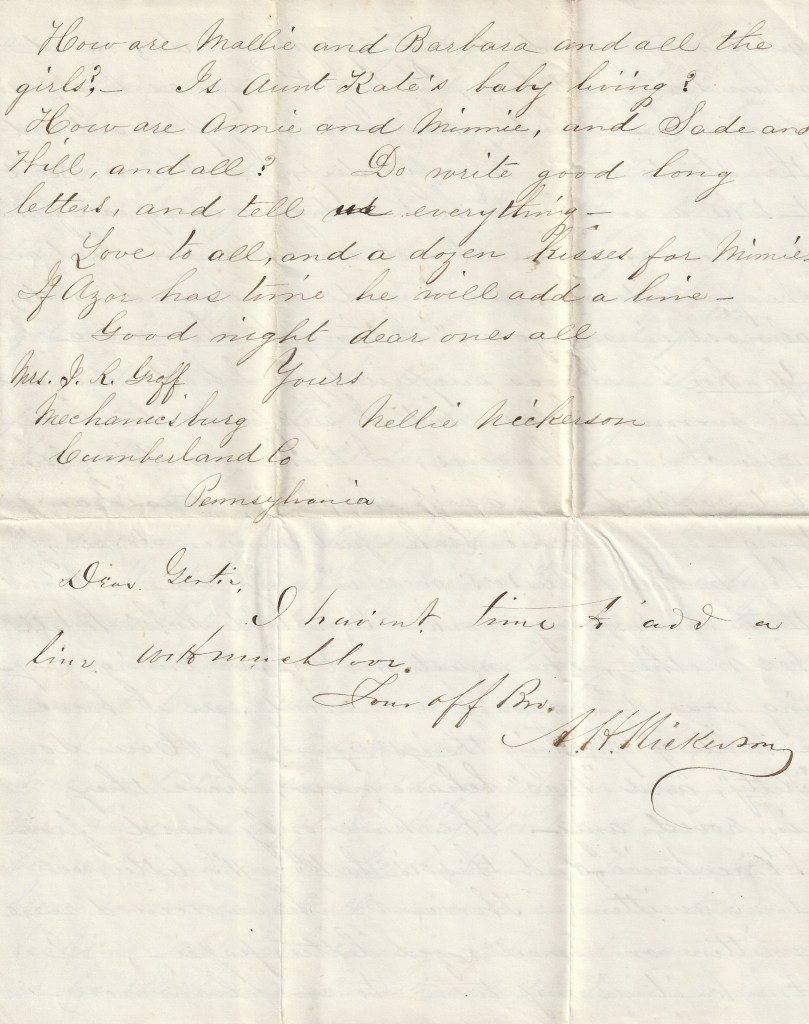
How do “Kitty” and “Mac” behave now? Have they improved any? We have only heard from home twice and this is the 10th or 11th letter we have written. Those we have received were written on small sized letter paper. I think it is my turn to complain now. How are Mollie and Barbara and all the girls? Is Aunt Kate’s baby living? How are Annie and Minnie and Sade and Will and all? Do write good long letters and tell everything.
Love to all and a dozen kisses for Minnie. If Azor has time, he will add a line. Goodnight dear ones all. Yours, — Nellie Nickerson
To Mrs. J. R. Groff, Mechanicsburg, Cumberland county, Pennsylvania
Dear Gertie, I haven’t time to add a line. With much love, your affectionate brother, — A. H. Nickerson
1 President Andrew Johnson approved the nomination of 2nd Lt. Azor H. Nickerson to 1st Lt. in the 14th Regiment of Infantry, Regular Army on 23 February 1866.Azor was a captain in the Veteran Reserve Corp at the time he was discharged from the army but apparently was being reinstated in the post war regular service at a lower rank.
2 On 10 August 1862, the US Gunboat Essex shelled the town while a small landing party set it ablaze. All the buildings within two blocks of the river were destroyed. More destruction occurred in the months to follow, virtually leveling the town and no doubt accelerating the resident’s hatred for Yankees.
3 Mrs. Leake was Elizabeth Henrix Pollard who married Richard Marcellus Leake in 1848 in Missouri. Their daughter “Richie” was born in 1854. After Nickerson and his wife left Bayou Sara in the spring of 1866, Richard M. Leake served in the same role as Nickerson for September-October 1866 until he was shot and killed during a labor dispute with William Reynolds—the Irish blacksmith and carriage maker in Bayou Sara.











 Spared & Shared 23