Category Archives: Gen. Benjamin Butler

1864-65: Frank W. Davis to Friend Sylvester

These letters were written by Frank W. Davis (1844-1920) who enlisted as a private in November 1861 to serve in Co. E, 58th Pennsylvania and worked his way up to corporal, to sergeant, to 1st sergeant, and finally to 1st Lieutenant by late December 1864. He mustered out with the company as a veteran in mid-June 1865.

Frank was an 18 year-old carpenter from Bradford, McKean county, Pennsylvania, when he enlisted. He was described as 5′ 4.5″ with brown hair and grey eyes by the enlistment officer. His parents were Reuben Davis (b. 1814) and Sarah C. Moore (b. 1820).

One of Frank’s letter is critical of Gen. Benjamin Butler who was finally dismissed by General Grant for failing to capture Fort Fisher and withdrawing his troops without authorization in December 1864.

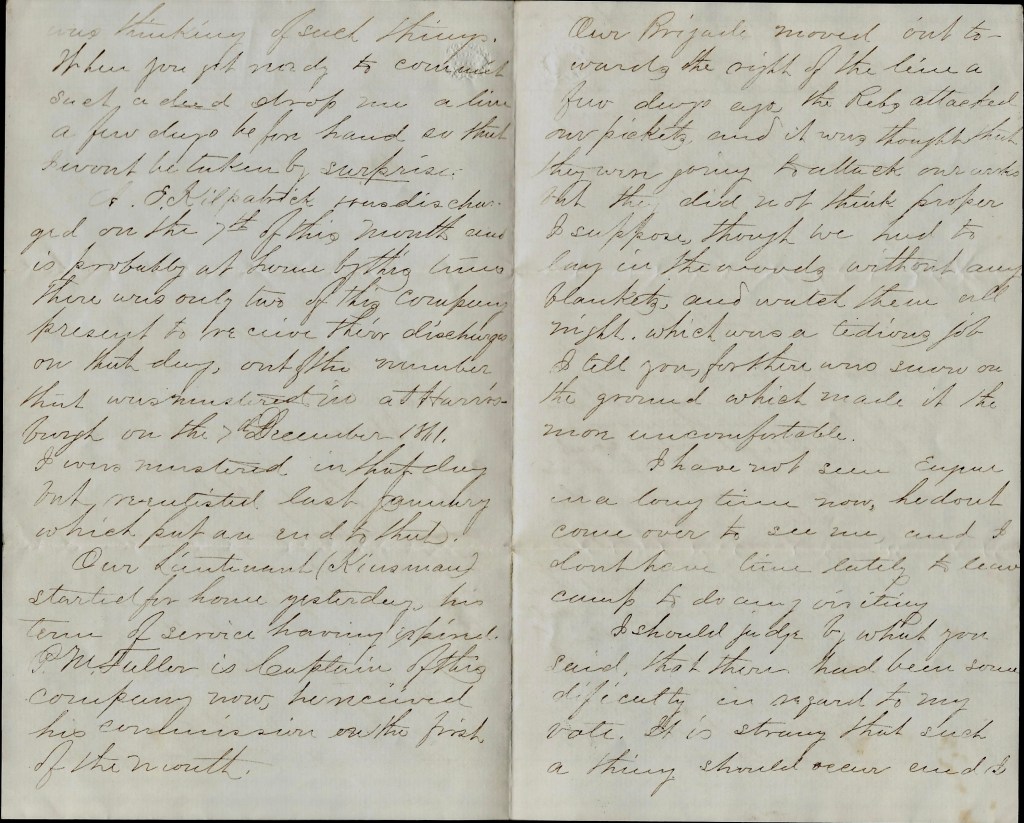
Letter 1

Headquarters Co. E, 58th P. V.
December 13th 1864

Friend Sylvester,

Yours of the 6th inst. was received tonight and I was much pleased to hear from you and get the news from Bradford for you are about the only one that writes the daily occurrences around Bradford.

It seems that there has been a wedding at Bradford lately. I have heard that once or twice before and then heard again that it was not so. However, I think that there must be something in it. I shall expect to hear of your splicing yourself to some fair schoolmate of ours before a great while, for it is getting about time that you was thinking of such things. When you get ready to commit such a deed, drop me a line a few days before hand so that I won’t be taken by surprise.

A. E. Kilpatrick was discharged on the 7th of this month and is probably at home by this time. There was only two of this company present to receive their discharges on that day out of the number that was mustered in at Harrisburg on the 7th December 1861. I was mustered in that day but reenlisted last January which put an end to that. Our Lieutenant (Kinsman) started for home yesterday, his term of service having expired. P. M. Fuller is Captain of this company now. He received his commission on the first of the month.

Our Brigade moved out towards the right of the line a few days ago. The Rebs attacked our pickets and it was thought that they were going to attack our works but they did not think proper, I suppose, though we had to lay in the woods without any blankets and watch them all night which was a tedious job, I tell you, for there was snow on the ground which made it the more uncomfortable.

I have not seen Eugene [Holmes] in a long time now. He don’t come over to see me and I don’t have time lately to leave camp to do any visiting.

I should judge by what you said that there had been some difficulty in regard to my vote. It is strange that such a thing should occur and I did not hear of it before. Wish that you would give me the particulars of the case when you write again for there must be some fraud connected with it either here or at Bradford. Very singular circumstance, I should say. Should like to hear who presented the vote, and whether it was thought by anyone that I was concerned in any fraud or trying to vote illegally. Don’t be afraid of hurting my feelings in explaining the matter for I am anxious to know what it means. I have no doubt but what there was thousands of illegal votes cast at the last election, but I had no hand in them, I consider this holding election in the army a humbug, for the reason that it gives persons that are disposed to commit fraud too much chance, and there is a great many such persons no matter what their politics is. The idea of being victorious at election will prompt most anything.

Hoping that I may hear from you soon, I close with my best regards to all friends and acquaintances, and a large amount for yourself. Very truly yours, — F. W. Davis, Orderly Sergeant, Co. E

Letter 2

[Note: This letter is from the private collection of Greg Herr and was transcribed and published by express consent.]

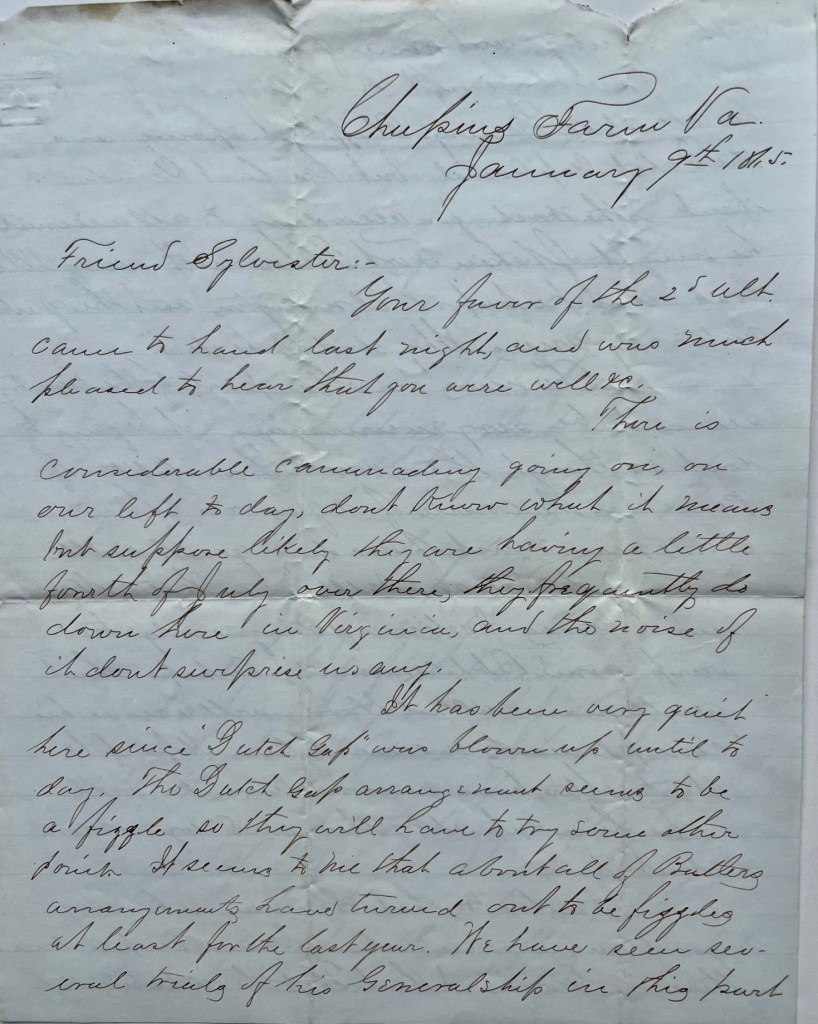
Chapin’s Farm, Virginia
January 9th 1865

Friend Sylvester,

Your favor of the 2nd ult. came to hand last night and was much pleased to hear that you were well, &c.

There is considerable cannonading going on, on our left today. Don’t know what it means but suppose likely they are having a little Fourth of July over there. They frequently do down here in Virginia and the noise of it don’t surprise us any.

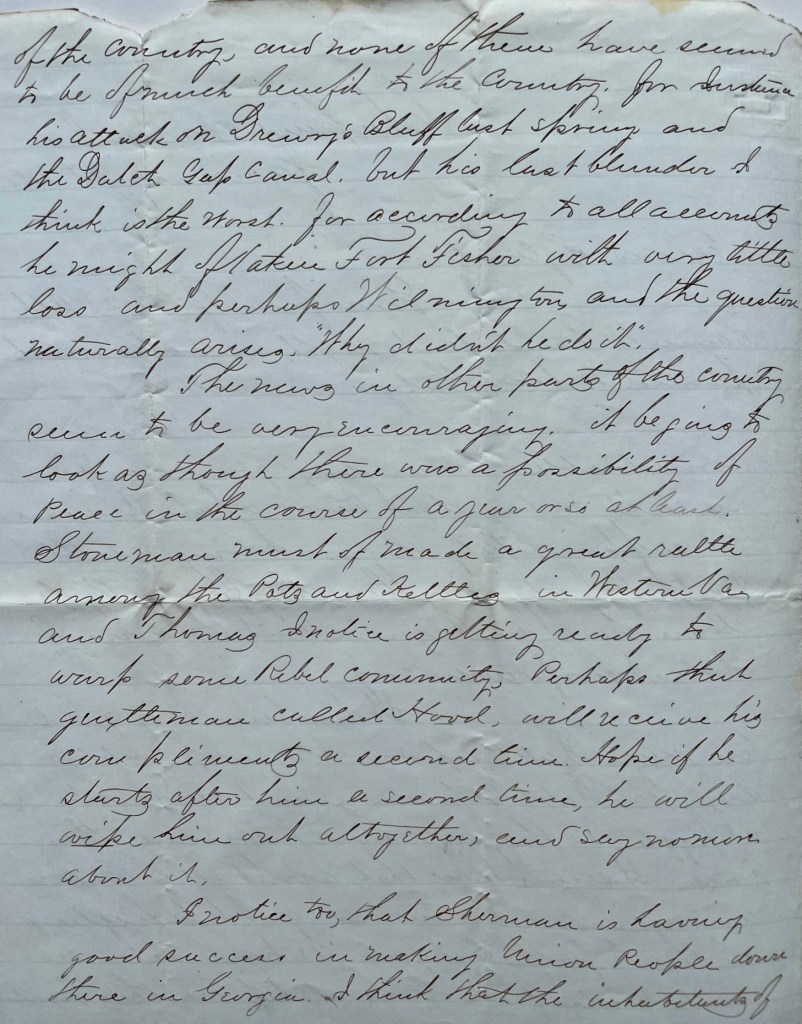
Benjamin Butler faced “several trials of his generalship” in 1864 and was dismissed by Grant on 8 January 1865.

It has been very quiet here since “Dutch Gap” was blown up until today. The Dutch Gap arrangement seems to be a fizzle so they will have to try some other point. It seems to me that about all of Butler’s arrangements have turned out to be fizzles—at least for the last year. We have seen several trials of his Generalship in this part of the country and none of them have seemed to be of much benefit to the country. For instance, his attack in Drewry’s Bluff last spring and the Dutch Gap Canal, but his last blunder I think is the worst, for according to all accounts, he might of taken Fort Fisher with very little loss and perhaps Wilmington and the question naturally arises, “Why didn’t he do it?”

The news in other parts of the country seems to be very encouraging. It begins to look as though there was a possibility of peace in the course of a year or so at least. Stoneman must of made a great rattle among the pots and kettles in Western Virginia and Thomas I notice is getting ready to [ ] some Rebel community. Perhaps that gentleman called Hood will receive his compliments a second time. Hope if he starts after him a second time, he will wipe him out altogether and say no more about it.

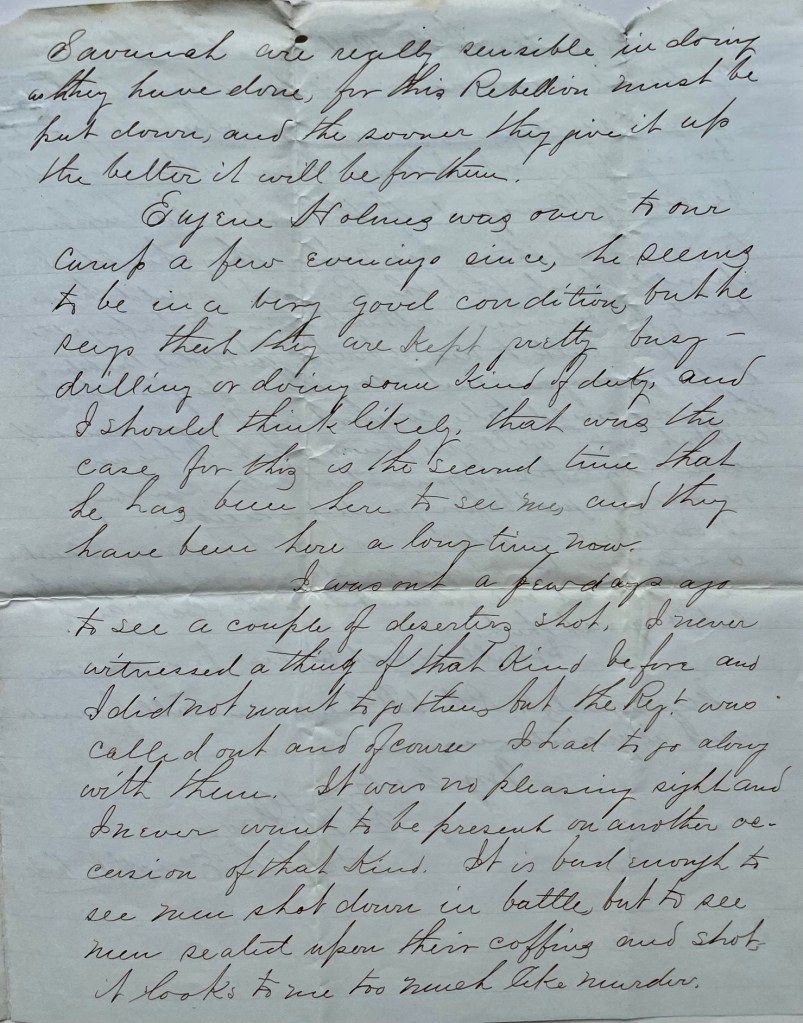
I notce too that Sherman is having good success in making Union people down there in Georgia. I think that the inhabitants of Savannah are really sensible in doing as they have done for this Rebellion must be put down, and te sooner they give it up the better it will be for them.

Eugene Holmes was over to our camp a few evenings since. He seems to be in a very good condition but he says that they are kept pretty busy—drilling or doing some kind of duty, and I should think likely that was the case for his is the second time that he has been here to see me, and they have been here a long time now.

I was out a few days ago to see a couple of deserters shot. I never witnessed a thing of that kind before and I did not want to go then but the regiment was called out and of course I had to go along with them. It was no pleasing sight and I never want to be present on another occasion of that kind. It is bad enough to see men shot down in battle but to see men seated upon their coffins and shot. It looks to me too much like murder.

You spoke of the Oil Question being agitated once more. Hope they will have good success in finding what they are boring for, but I don’t know what would become of Bradford if they should happen to find oil there. In case they should, I should think that the railroad would have plenty of business without going to Lafayette.

You talk to me about a “quiet old bachelor’s life” &c. in your last. Now then, do you think that you could take comfort and enjoy yourself without a —- well, you know what I mean. Somebody to fix up your shirt collar Sunday mornings just before you start to meetin’.

Now take my advice, do not wait for me to make a selection for I have made none yet. You just take the nest one you can find in the flock and let it go at that. I sall expect to hear from you soon.

My regards to Robert D. Golier and all friends and acquaintances. Very truly, — F. W. Davis, 1st Lt., Co. E, 58th Pa. Vols.
Letter 3

Camp 58th Pennsylvania Vols.
February 14th 1865

Friend Sylvester,

Your letter of the 4th inst. was received day before yesterday just before going on picket. Was much pleased to hear of your good health, &c. Hope you are having pleasant times on Tuna [?] now; plenty of good sleighing there no doubt, and plenty of girls to ride with you, so I don’t know of any good reason why you should not enjoy yourself largely. There is no snow on the ground here but it is quite cold and frosty, and very uncomfortable on picket. Have to keep kicking around on picket to keep our blood in circulation.

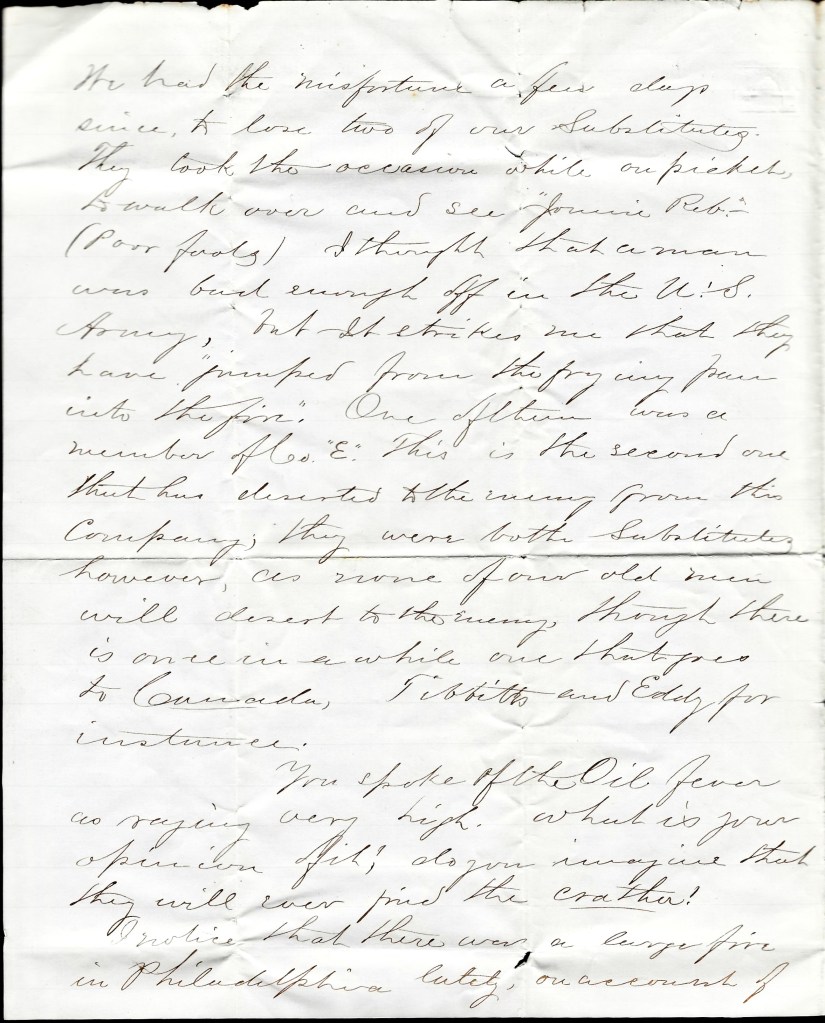
We had the misfortune a few days since to lose two of our substitutes. They took the occasion while on picket to walk over and see “Johnny Reb” (poor fools). I thought that a man was bad enough off in the U. S. ARmy but it strikes me that they have “jumped from the frying pan into the fire.” One of them was a member of Co. E. This is the second one that has deserted to the enemy from this company; they were both substitutes however, as none of our old men will desert to the enemy though there is once in a while one that goes to Canada. Tibbits and Eddy for instance.

You spoke of the Oil fever as raging very high. What is your opinion of it? Do you imagine that they will ever find the crather! I notice that there was a large fire in Philadelphia lately on account of some coal oil that was stored there. I should say that they had better stop digging for that substance if they were going to use it to burn cities with.

I have not see Eugene [Holmes] in a long time though I suppose the regiment is still where it has been as I have not heard of its moving. I am on picket every other day and when I am in camp, I have something to do so that I can’t get time to visit any of my friends. I guess he is busy too as he has not been over to our camp in about three weeks or more.

The Peace Commission of the Rebels which caused so much excitement for a while it seems has fizzled out, and there is nothing to expect but to fight it out now. The Herald seems to be of the opinion that the peace that Grant, Sherman, Thomas, & co. have on hand is a better article than that other peace (piece) that has been talked so much about and is warranted not to fade.

You mentioned in your last that you had heard that I was a prisoner, etc. They have had me dead once or twice on Tuna [?] but this is the first time that I have heard of their having me a prisoner. Wonder what they will have next. You wished to know the whole truth and nothing but the truth, and the truth is, I never was a prisoner, not “if the court knows herself ad she thinks she does.”

My regards to all friends and acquaintances in Bradford. With many good wishes for your health and happiness, I remain yours truly, — F. W. Davis

1861: David Wilbur Low to “Brother Sinclair”

Lt. David Wilbur Low, Co. G, 8th Massachusetts

This incredibly detailed six-page letter was written by Lt. David Wilbur Low (1833-1919) of the 8th Massachusetts Infantry. David was the son of sea captain Frederick Gilman Low (1789-1878) and Eliza Davis (1790-1874) of Gloucester, Essex county, Massachusetts. At the time the Civil War began, David was a merchant in Gloucester, married, but without children.

The 8th Massachusetts regiment entrained and traveled through New York to Pennsylvania where it seized a large railroad ferry called the Maryland to cross the Susquehanna River, arriving off Annapolis on April 21. The arrival of the Eighth Infantry protected the USS Constitution (“Old Ironsides”) from certain capture or destruction by Confederate forces. On April 22, Company K was detailed to reinforce the garrison at Fort McHenry in Baltimore Harbor where they remained until May 16 when they rejoined the rest of the regiment outside of Baltimore. The Eighth secured the Northern railroad supply and communication line to Washington (Baltimore & Ohio Railroad), ensuring a flow of Federal reinforcements at a rate of up to 5,000 troops per day into the Capitol.

If you take the foregoing single paragraph for the regimental history and expand the events described within it into six lengthy pages, you’ll have some notion of the contents of Lt. Low’s letter.

[Note: This letter is from the private collection of Richard Weiner and is published on Spared & Shared by express consent.]

Transcription

Washington City
May 2, 1861

Brother Sinclair,

You have no doubt heard of the adventures of the 8th [Massachusetts] Regiment since they left Boston so that I hardly know what to write. But I must say that when I left home, I did not dream of passing through such hardships so soon as we did. Our bill of fare from the first was short allowance of food, less of water, still less of sleep, and plenty of work.

When we approached Havre de Grace we were inspected and prepared for a fight. Ten rounds of ammunition to a man was supplied and we were told that we were to meet 1600 men and take from them a ferry boat at all hazards as the safety of what was left of the regiment and the “success of our expedition depended upon the capture of the boat.” Every man in the regiment except one (who jumped off the cars) was nerved to the work laid out for him. We stopped half a mile this side of the station, the Salem Zouaves [Co. A, 8th Mass.] thrown out as skirmishers who took to the woods & made for the boats, the regiment following at double quick time. But to our great surprise & joy, we were ahead of the secessionists and took the boat without a gun being fired.

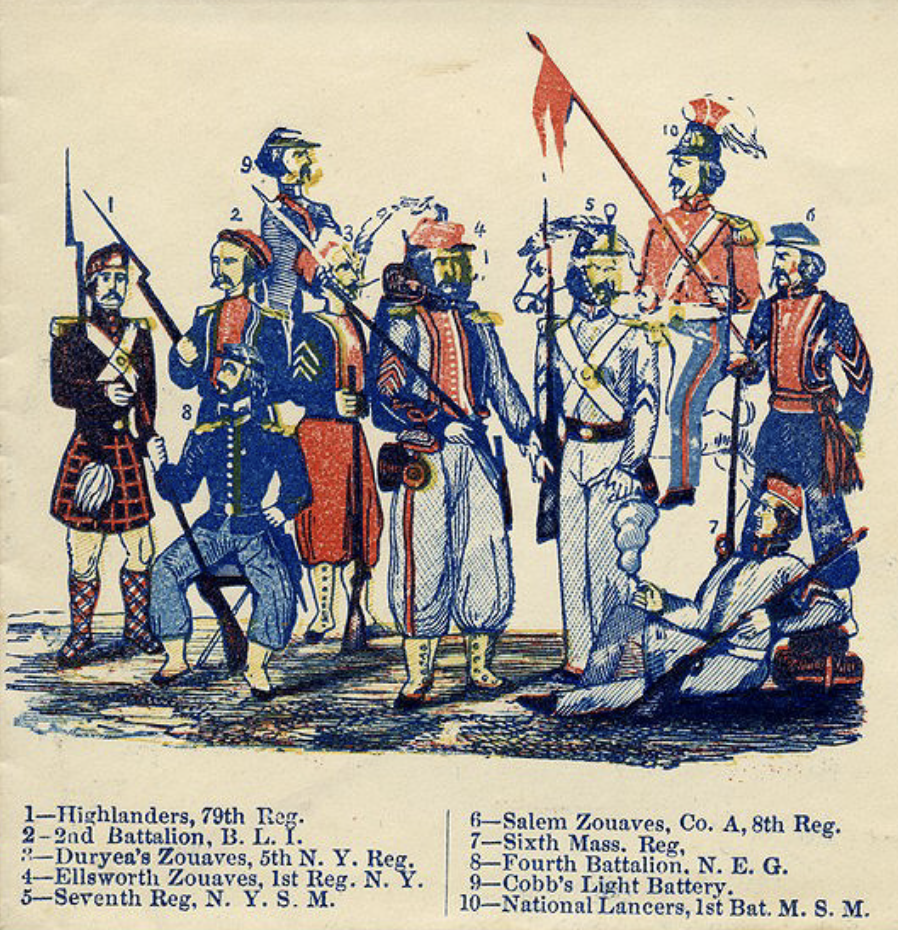
Zouave unit uniforms from a Civi l War Envelope; the Sale Zouaves (Co. A, 8th Mass) are shown as No. 6

Gen. Butler then had a train of coal cars loaded & shoved upon the boat—also about 20 barrels of water. We then started [but] we didn’t know where. The muskets were stacked on the upper deck and guarded and the men slept below. They had to lay across each others legs to stow away. The floor was covered with coal dust as well as every part of the boat. I laid down across & against a door. In the morning there was two inside of me and coal dust instead of my blanket under me.

The next morning (Sunday) we arrived at Annapolis harbor and went alongside of the Old Constitution where we went to work getting her heavy guns out & putting them on board the Maryland (our boat). The sappers & miners, 20 out of 60 from our company, were to work in her hold getting up ballast & throwing it overboard. We lightened her from 23 feet to 19 and then she started, towed by the Maryland to sea. In going over the bar, owing to the treachery of our pilot & engineers, our boat and the ship were both got ashore on the bar. The engineers were immediately arrested & engineers and firemen from the regiment were put in their places. Capt. [Henry S.] Briggs [Co. K]—who was to be Officer of the Guard that night—was sent on board the Constitution [and] I was detailed in his place.

I stationed the men, some 60 in number, in two reliefs. My orders from Gen. Butler was very strict as an attack from Baltimore was anticipated. Two men were stationed over the small boat with orders to blow the first man’s brains out who offered to touch it without orders (as it was expected those belonging to the boat would try to escape). Every boat that approached was challenged and if they gave no good account of themselves, were ordered off under penalty of being fired into. The sappers & miners and other troops on board the Constitution were beat to quarters & drilled at the guns.

The USS Constitution (or “Old Ironsides”)

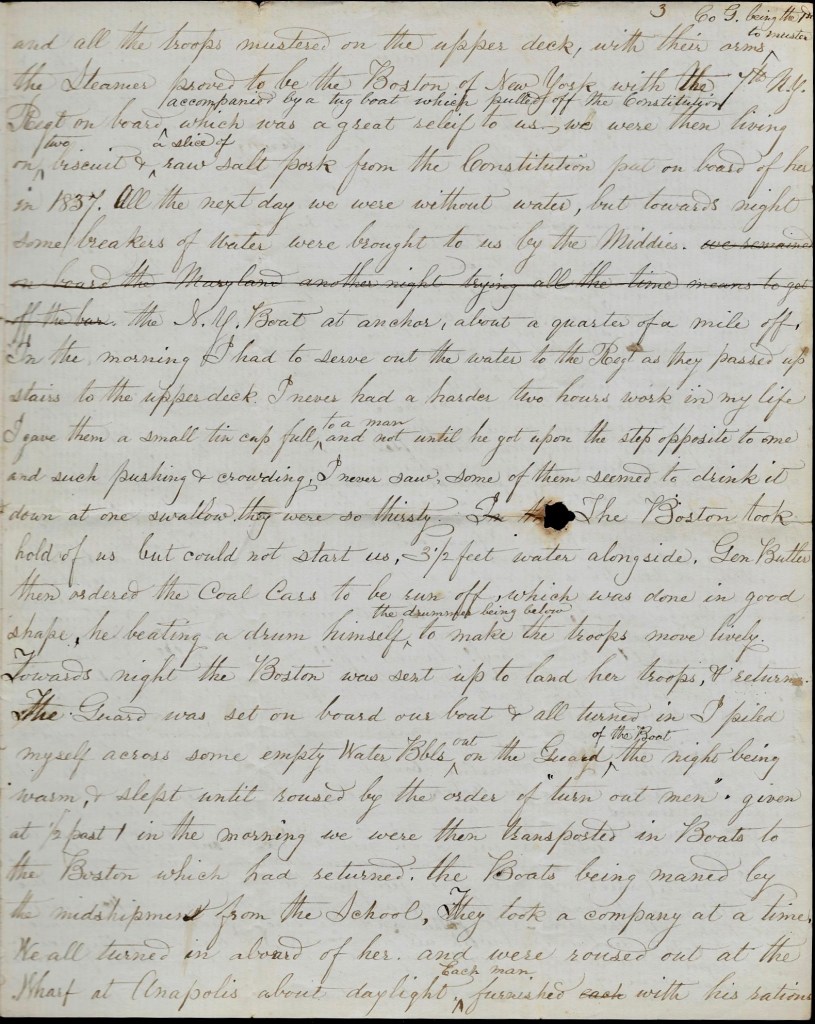
About 3 o’clock in the morning, a steamer was seen approaching. An alarm was raised and all. the troops mustered on the upper deck with their arms, Co. G being the first to muster. The steamer proved to be the Boston of New York with the 7th New York Regiment on board, accompanied by a tug boat which pulled the Constitution off [the bar], which was a great relief to us. We were then living on two biscuits and a slice of raw salt pork from the Constitution put on board of her in 1837.

All the next day we were without water, but towards night some breakers of water were brought to us by the middies. We remained on board the Maryland another night trying all the time means to get off the bar the N. Y. boat at anchor, about a quarter of a mile off.

In the morning I had to serve out the water to the regiment as they passed up stairs to the upper deck. I never had a harder two hours work in my life. I gave them a small tin cup full to a man and not until he got upon the step opposite to me and such pushing and crowding I never saw. Some of them seemed to drink it down at one swallow, they were so thirsty. The Boston took hold of us but could not start us, 3.5 feet water alongside. Gen. Butler then ordered the coal cars to be run off which was done in good shape, he beating a drum himself (the drummer being below) to make the troops more lively. Towards night the Boston was sent up to land her troops & return. The guard was set on board our boat and all turned in. I piled myself across some empty water barrels out on the guard of the boat, the night being warm & slept until roused by the order of “turn out men” given at half past 1 in the morning. We were then transported in boat to the Boston which had returned. The boats being manned by the midshipmen from the [Naval] School; they took a company at a time. We all turned in aboard of her and were roused out at the wharf at Annapolis about daylight.

Each man [was then] furnished with his rations of two biscuit & a slice after which we were marched out upon the parade grounds [and] after drilling a little while, were dismissed. I went the first thing up to the gates where the darkey girls & boys were selling pies & cakes & got something to eat. About 5 o’clock I was ordered by the Colonel [Timothy Munroe] to take charge of fifty men that had just been ordered from the regiment by Gen. Butler for special duty. We were marched with another detail which had been made with Gen. Butler at our head through Annapolis with silent tread to the [railroad] depot where I found that I was to relieve Capt. [George T.] Newhall & his command [Co. D] which had been on duty there all day. The other relief was sent on ahead to guard the track between the depot & the outposts of Capt. [Knott V.] Martin’s company. Gen. Butler gave me my orders and said that “if the depot buildings were surprised & taken, I must answer for it with my life.” I told him “all right” and immediately posted my men as I thought most advantageous to resist attack or give alarm. Capt. Newhall’s company went to sleep and were ready as reserve in case of attack. Men were around us all night long and you better believe your humble servant did not sleep much that night (tired as he was). I had 60 men posted, 50 that I brought and 10 fro the other relief. They were on all night long—but we got through with it safe, thank God.

The next morning all that had been on guard at the depot were sent back to the Chapel at the Naval School (which was to be out head quarters) 1 to get some sleep & get recruited up, while the rest of the 8th [Massachusetts] Regiment and 7th New York Regiment went on. The 8th Regiment—and that only—worked laying track & repairing bridges. Towards night, Lt. Colonel [Edward W.] Hinks with [Knott V.] Martin’s company [C] & detachment, came in. We all had a good night’s sleep. I slept at the Colonel’s quarters having gone there after something from my baggage and went to sleep sitting on a trunk (with my valise in my lap, I suppose) for I found it bottom up alongside of me when I woke up about half past three on the morning. I made a change of my underclothes the first chance I had had). I was about 4 o’clock sent up to the Chapel to arouse Capt. Martin and tell him to get his company ready to march forthwith.

US Naval Academy as it looked in 1861 (Digital Maryland)

When I got up there, I found one or two companies from the 6th Massachusetts Regiment quartered there. It was dark and the floor was completely covered with human beings. I called two or three times for Capt. Knott Martin but could get no response. I then made my way upstairs on every one of which was a sleeper to the singing seats. [On my way up,] a thought having struck me how to awake Marblehead and Gloucester men [and] as soon as I got there, I found, I sung out in my loudest voice (which is not very weak, if hoarse), “All hands ahoy! tumble up!! tumble up!!! Do you hear the news?!” which brought every man to his feet with exclamations of what is it? What is it? Capt. Knott Martin with the rest of the 8th Regt. to be ready to arch forthwith. I then mustered out my command and we all marched off for the depot where we got some raw ham and good fresh baked soft bread which we eat with a relish. We then got on board the cars, my command having a large open platform car with casing about two feet high around it.

Our first stop was stop was a log lashed across the track; our next a tree felled across which was quickly removed. We then went on until we came to a place where the rails were torn up. Men were set to work and by using rails that we brought along with us, we soon got it fixed. My response to a call to run some cars back, my men were so prompt that the next stopping place (which was only seven feet from the end of a rail where two rails, sleepers and all, had been torn up and thrown down an embankment 60 feet high into the river. Eight feet farther and the whole train would have gone to total destruction with all on board.) I was out of the train & on the spot. I was ordered with my men to hunt up the rails (if possible) as we had one of that length. My men I had all out. One man jumped into the river up to his waist and feeling around with his foot found one of the rails which my men dragged up the embankment & what sleepers we could get picked up, but the other rail could not be found. The other side was searched but finally it was found on the same side with the first and in less than half an hour from the time of stopping, the rails were laid & the train went over for which dispatch the train was put in my charge as Conductor (a position I never dreamed of ever reaching & from the experience I have had at it, I don’t envy Conductor Davis or any other).

As soon as we reached the junction two miles from this last place, I had orders to take fifteen men as guard and go back with the train to Annapolis. I had some passengers aboard who had just arrived at the junction from Washington. After running 7 miles from the junction, the train stopped. I got out on the platform & found we were surrounded by the 71st New York Regiment & the Rhode Island troops under Gov. Sprague who was introduced to me. The Colonel of the 71st [George B. Hall] wanted me to run back with some of his troops who he said were tired out & had only one ration left. My inclination was to do so. I told him at last if the passengers were willing, I would do so [but] as I turned to go into the cars, a gentleman met me and said, “Lieutenant, you can’t go back. I’m the bearer of secret dispatches from Washington and you must go on at all hazards.” The other passengers came to the door & said they were willing to go back. I said, “Gentlemen, it is impossible. I can’t go back. My orders are imperative for me to go on.” The Colonel again remonstrating with me, the bearer [of the dispatches] went out and took him one side and spoke to him and showing him his packet under his shirt, the Colonel called out to his men, “The train can’t stop. The conductor would return, but I’m satisfied he can’t according to his orders.” I then made the signal and the train went on.

Gen. Benjamin F. Butler “shook me by the hand & expressed his gratification that the [railroad] route was clear [to Washington D. C.]” — Lt. David W. Low

As soon as I arrived, I told Lieut. Hodges who had charge of the depot & trains at Annapolis that my orders were to bring all the baggage and provisions belonging to the 8th [Massachusetts] back with the train as soon as possible. He told me his orders were to report to Gen. Butler as soon as the train arrived. I then went down to the Academy with the bearer of the dispatches and was told at the door of the General’s quarters that he was too busy for the present. I told him to report Lieut. Low from the Junction [was here and] I was immediately admitted. The General came forward, shook me by the hand & expressed his gratification that the route was clear & then asked me how many men my train would carry. I told him about 600. He then ordered a regiment to the depot. After I got down to the depot, an orderly came to me there and gave me a half dozen letters from the General to parties in Washington. After an hour’s detention, I got the train started, packed solid full of troops and I never travelled on a train of cars where I felt such responsibility resting upon me as that night. I was with my 15 men on the engine & tender. The packing of the engine was loose and a cloud of steam around the engine prevented the sails ahead being seen. However, we got through safe. I then gave up the train to [George B. Hall,] the Colonel of the 71st [New York] who in running back the train run it off the track two miles from the station.

“The regiment marched to the White House [and] from there to the Capitol where they have been quartered since—the roughest, toughest, dirtiest, and ragged regiment there is in Washington.”

Lieut. David W. Low, Co. G, 8th Massachusetts Infantry, 2 May 1861

I went on with the. regiment to Washington where I left at the depot and went and delivered the letters. The regiment marched to the White House [and] from there to the Capitol where they have been quartered since—the roughest, toughest, dirtiest, and ragged regiment there is in Washington. By what I have just learned, they are bound we shall have the brunt of everything. So we are to be under marching orders ready at a moment’s warning after today to march wherever ordered. The Colonel has just been around enquiring the state of the muskets & the supply of ammunition. Our probable destination will be Virginia where in some sections the Union men are kept down by a state of terrorism, threats of the secessionists, and as soon as the Union men know that Government will protect them, they will show their strength. We may remain here for weeks and we may be off tomorrow. It’s hard telling what will be done with us until we receive the orders.

Write me or let Presson write me all about the business, how the vessels are doing, how the notes are met, &c. &c. If we are gone from here, letters will be forwarded. Stir up the citizens to send us a set of knives such as were furnished Allen’s company. We shall need them if we go into active service in Virginia.

We have all been sworn in—not one backed down. I little thought ten years ag when I joined the Mass. Vol. Militia I should ever be an United States officer. I now rank as 1st Lieut. of Co. G, 8th Regt. Mass Militia. Send me with some things I have written to my wife for, some Castile soap & fifty dollars in small gold. If I find I have got to leave the city soon, I shall draw on you for fifty dollars at sight and get Hon. B. B. French who Mr. Parkman has given me a letter of introduction to, to get it cashed for me a it is hard work to get any paper cashed here. Hoping for the best, but prepared for the worst, I remain yours truly, — David W. Low


1 The first building specifically designed for religious services, and referred to as the first Chapel, was dedicated by Chaplain Theodore Bartow in February, 1854. A simple structure, built of brick with Ionic columns, the first Chapel could house 300 people, and also served as an assembly hall for debates and lectures. During the Civil War the building was used as an enlisted men’s barracks.

1865: Wesley Blanchard to Eldora M. Webster

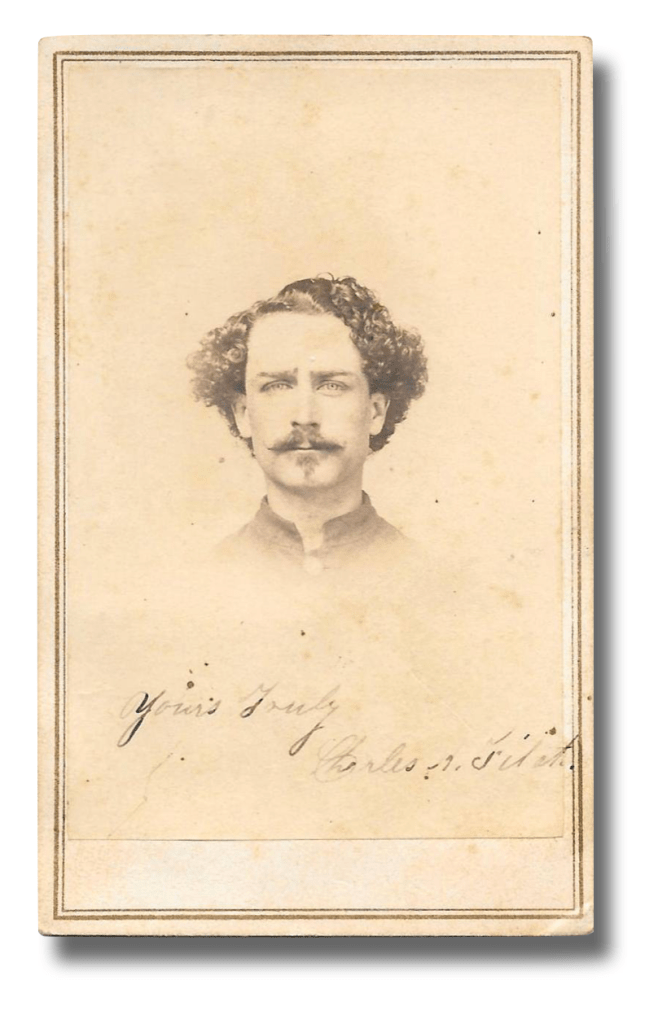
I could not find an image of Wesley but here is one of Charles Asbury Fitch who was the same age and also served in the 24th Massachusetts Infantry (Dave Morin Collection)

This letter was written by 21 year-old Wesley Blanchard (1844-1908) , a grocer from Lewiston, Maine, who enlisted in October 1861 to serve in Co. H, 24th Massachusetts Infantry. He reenlisted in January 1864 and did not muster out of the service until 20 January 1866 at Richmond, Virginia. His military records indicates that he was wounded sometime in 1864 but there are no specifics. The 1900 US Census gives Wesley’s birth date as May 1844 which means he would have only been 17 when he enlisted,

Wesley was the son of Joseph Knapp Blanchard (1820-1885) and Elizabeth Thayer (1824-1884) of Freeman, Franklin county, Maine. Hw wrote the letter to Eldora M. Webster (1846-1913) who became his wife on 5 August 1866. In 1870, the Wesley and Eldora lived in Lewiston where Wesley earned his living as a store clerk. By 1900 he had become an oil merchant.

After the fall of Richmond, the 24th Massachusetts was ordered to the city to preserve order. They set up camp on the corner of Franklin and Nineteenth Streets in Wright’s Tobacco Factory. They were placed as guards at Libby Prison and Castle Thunder where ex-rebels were detained.

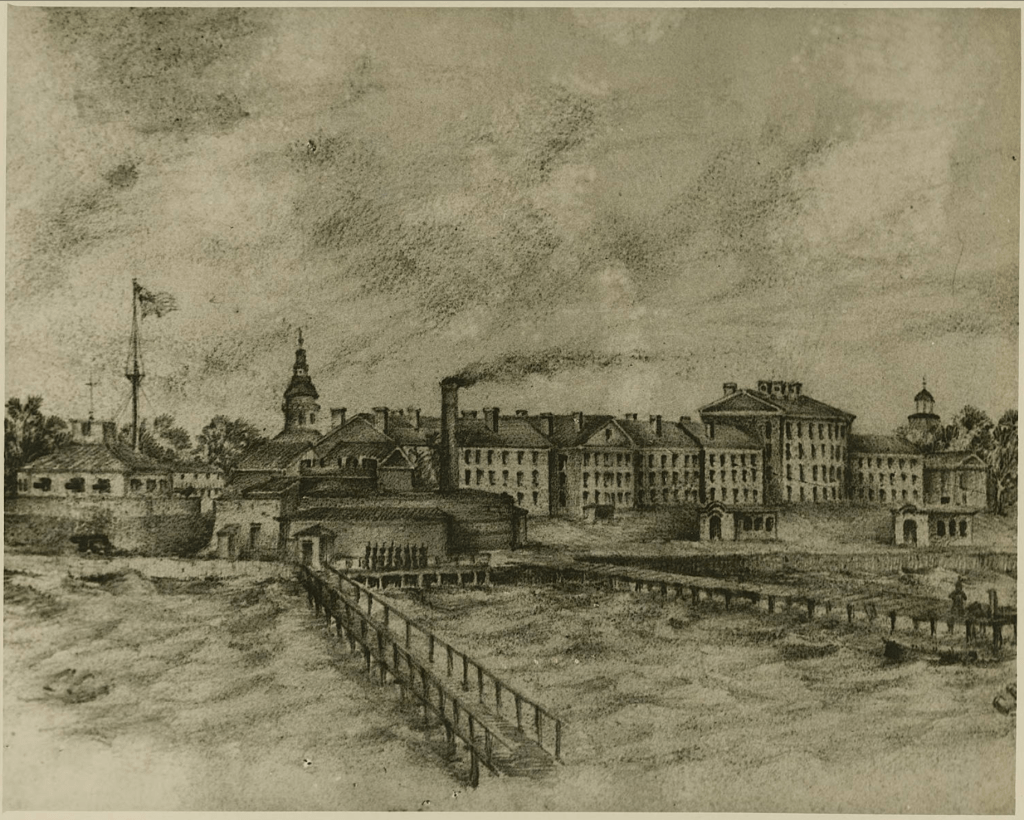
A colored lithograph of Castle Thunder Prison on Cary Street in Richmond where Wesley penned his letter while on guard duty. (Virginia Historical Society)

To read other letters written by soldiers of the 24th Massachusetts that I have transcribed and published in Spared & Shared, see:

Unidentified Soldier, 24th Massachusetts (1 Letter)
Alexander M. Hayward, Co. C, 24th Massachusetts (1 Letter)
Josiah Alonzo Osgood, Co. C, 24th Massachusetts (20 Letters)
William Hunt Goff, Co. H, 24th Massachusetts (43 Letters)

Transcription

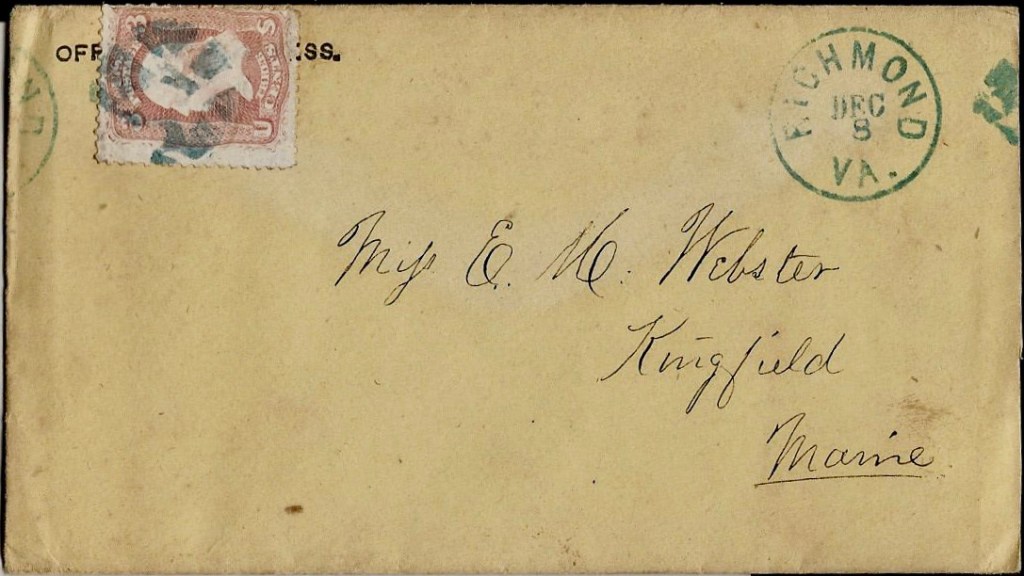
Addressed to Miss E. M. Webster, Kingfield, Maine

Castle Thunder
[Richmond, Virginia]
December 6, 1865

My most true friend,

It is a very rainy night. I am lonely sitting here as all of the boys have gone away to spend the evening. As I was telling—thinking—my thoughts roam back to you and those happy hours we passed together one year ago. Little did we think then that the present time I should be so far away (while Thanksgiving was so nigh I had promised myself a pleasant time with you) but luck does not always favor our expectations. So it seems in the present case.

I have not received any letter from you for three weeks. Do you think that you are forgotten by me? It cannot be! for you have heard my true declaration of my trust. I cannot think so but the withdrawal of your letters show that there is a withdrawal or a misunderstanding. Can it be because of my own neglect in writing? If so, it is my own fault. The blame is on myself. For the future I will try and do better. You have heard in my last my prior reasons. It would not be worthwhile to repeat them, but you have no cause to harbor a single thought but that I am true to you and ever shall be till death.

We have not moved yet but shall soon take up our abode at Libby Prison as it is nearly complete for our admittance. We have at present 59 prisoners of all classes. We have had a slight fall of snow which soon left us. Otherwise we are enjoying an Indian summer.

“Military law yet rules in the city. Ben. Butler is expected here to take command of this department. There will be sport then. Many secesh will feel what it is to come down. They have not had a very strict man to control them.”

—Wesley Blanchard, 24th Massachusetts, 6 December 1865

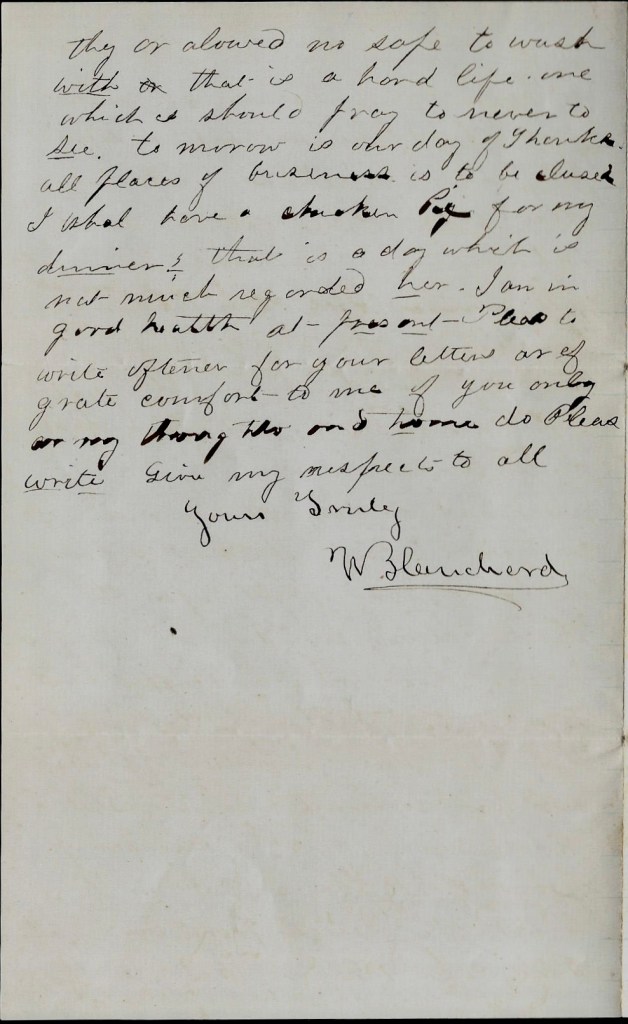
Military law yet rules in the city. Ben. Butler is expected here to take command of this department. There will be sport then. Many secesh will feel what it is to come down. They have not had a very strict man to control them. There is robbing done here every night upon the streets. Nearly every day we see pass by our door men handcuffed and tied to the saddle of the Orderly men who have committed offenses and are committed to the State penitentiary for a number of years. Of all places, that is the worst. they receive hard bread and pork, coffee & sugar. That is all they are allowed. No soap to wash with. That is a hard life—one which I should pray to never to see.

Tomorrow is our day of thanks. All places of business is to be closed. I shall have a chicken pie for my dinner. That is a day which is not much regarded here. I am in good health at present. Please to write oftener for your letters are of great comfort to me—of you only and my thoughts of home/ Do please write. Give m respects to all.

Yours truly, — W. Blanchard