Category Archives: Gen. Henry W. Halleck

1862: William Fletcher Lehew to Samuel Sullivan Cox

The following letter was written by William Fletcher Lehew (1821-1892), son of Thomas Lehew and Catherine Fletcher of Zanesville, Ohio. On 28 October 1841, William and Mary Roberts were married in Muskingum County, Ohio. In 1850, census records show William and wife Mary living in Union Town, Newton Township, Muskingum County, Ohio. By 1857, William and Mary had moved with their four children from Ohio to Henry County, Iowa.

In the fall of 1861, at the age of 41, William F. Lehew and his son Thomas left Henry County and traveled to Davenport, Iowa. On September 18, 1861, William enrolled into the 11th Iowa Volunteer Infantry and was then mustered into Co. G on 15 October 1861. During this time, William was elected to the rank of Lieutenant. From September 15 through November 15, 1861, the 11th Iowa was equipped and drilled at Camp McClellan, Davenport, Iowa. On November 16, 1861, Co. G left Davenport on the Steamer “Jennie Whipple” and proceeded to St. Louis, Missouri.

Lt. Lehew and his company were quartered at the Benton Barracks from November 19, 1861 to December 9, 1861, when the regiment left St, Louis and marched to Jefferson City, Missouri. Lt. Lehew was present with his company during its campaign in Missouri during late 1861 and early 1862. In the spring of 1861, Lt. Lehew, along with Co. G participated in the Battle of Shiloh, Tennessee. After the battle, Lt. Lehew was sent to the hospital with intermittent fever followed by camp diarrhea and piles. He was treated by the Regimental Surgeon William Watson, and on June 9, 1862, sent a letter of resignation to Major Abercombia, Commander of the 11th  Iowa. On June 11, 1862, Lt. Lehew’s letter of resignation was signed by Major General U.S. Grant at the Headquarter of the Army of the Tennessee. He then returned to Iowa where he spent the rest of the war.
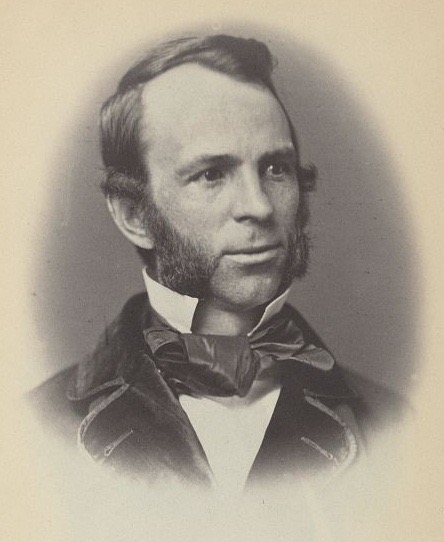
Hon. Samuel Sullivan Cox

William wrote the letter to Samuel Sullivan Cox (1824-1889), a contemporary of William’s who also grew up in Zanesville, Ohio. Samuel attended Ohio University at Athens and then transferred to Brown University where he delivered speeches in support of temperance and Fourierism and in opposition to abolition of slavery. He graduated in 1846 but left the college with negative feeling about Yankees. He practiced law for a time in Ohio after college but in 1853 purchased a controlling interest in the Ohio Statesman (a Democratic paper in Columbus) and pursued journalism and politics. In 1856, Cox narrowly defeated the Republican candidate for a seat in the US House of Representatives as a Democrat and supported Stephen A. Douglas’s popular sovereignty principle. Reelected to Congress, Cox initially supported the Lincoln Administration but opposed the evolution of the war from one of merely preserving the Union to one of liberating the slaves. In 1864, he joined with the Copperheads to oppose Lincoln’s reelection.

T R A N S C R I P T I O N
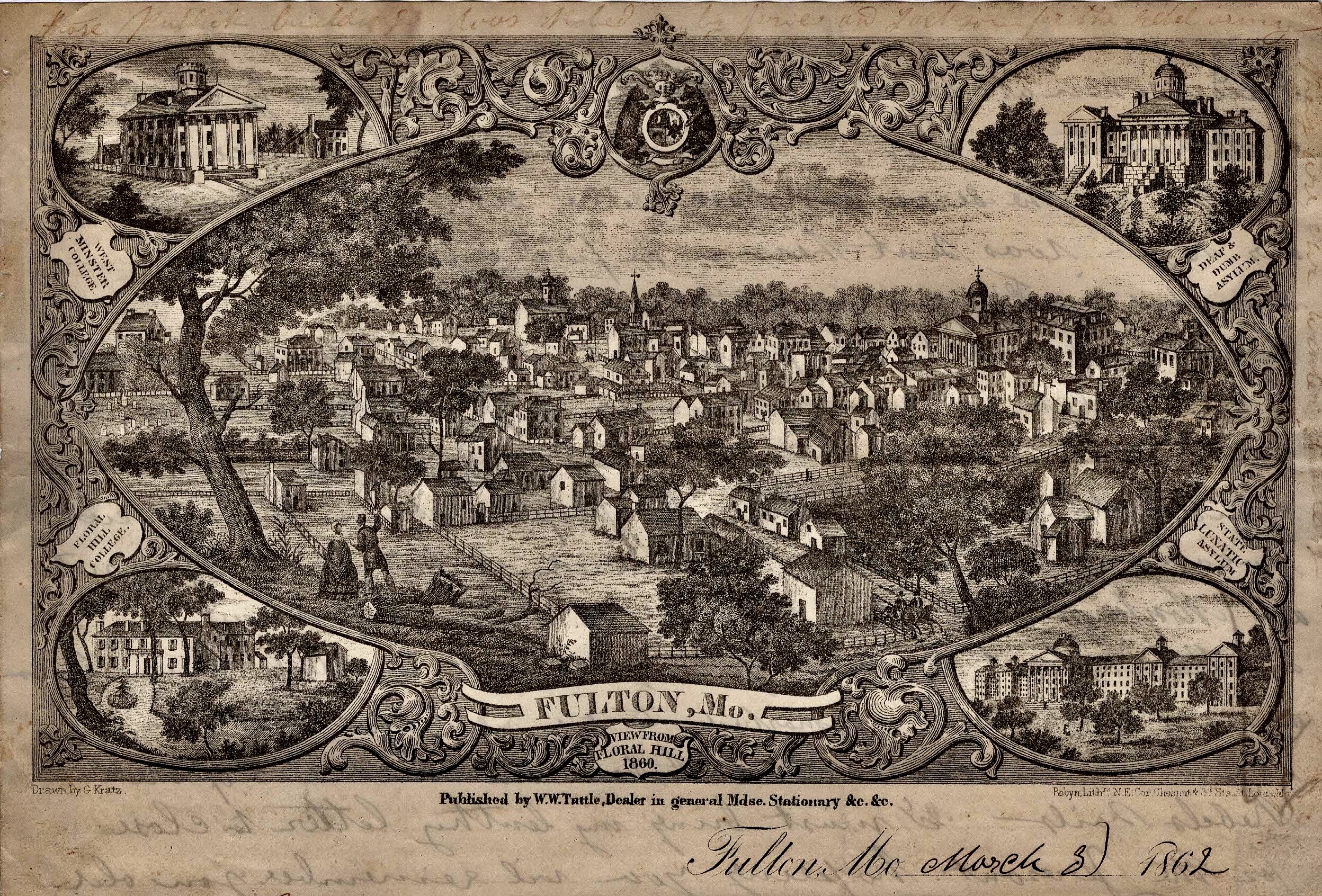
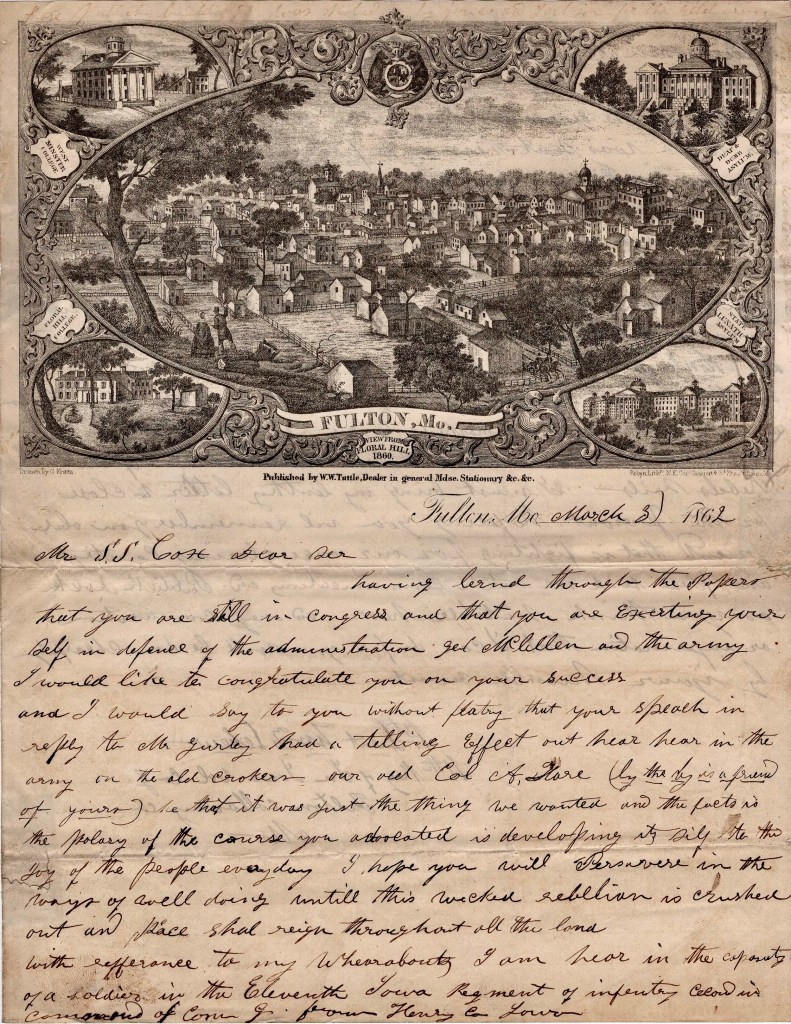
William’s letter was written on stationery with an incredible lithographic view of Fulton, Missouri (“View from Floral Hill, 1860”) that I have not seen before. Barely legible over the top of the lithograph, William has written, “Those publick buildings was robed by Price and Jackson for the rebel army. They are our winter quarters.”

Fulton, Missouri
March 3, 1862

Mr. S. S. Cox, dear sir,
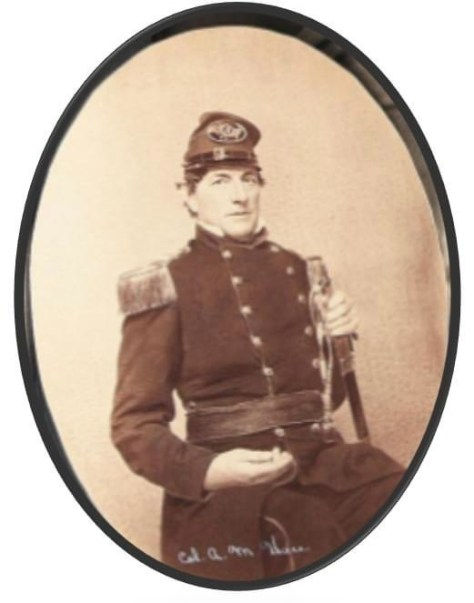
Col. Abraham M. Hare, 11th Iowa Infantry

Having learned through the papers that you are still in Congress and that you are exerting yourself in defense of the administration, Gen. McClellan and the army, I would like to congratulate you on your success and I would say to you without flattery that your speech in reply to Mr. Gurley had a telling effect out here in the army on the old croakers. Our old Col. A[braham M.] Hare (by the by is a friend of yours). He thought it was just the thing we wanted and the facts is, the policy of the course you advocated is developing itself to the joy of people every day. I hope you will persevere in the ways of well doing until this wicked rebellion is crushed out and peace shall reign throughout all the land.

With reference to my whereabouts, I am here in the capacity of a soldier in the Eleventh Iowa Regiment of infantry, second in command of Co. G from Henry county, Iowa. I live when at home near Mt. Pleasant, Henry county, Iowa, a neighbor to the Hon. J[ames] Harlin. I have been over six months in the service and have seen service. Our regiment was sent here on the first of January and have succeeded in the purpose for which we was sent.

“Quite a change has come over the people within the last few weeks. One thing they have learned is that the North is not all Monkeys nor Nigger stealers or Rabid Abolitionists and that it is not the object of the government to steal their Negroes…”

1st Lt. Wm. F. Lewhew, Co. G, 11th Iowa Infantry

Secession has nearly all played out here which was one of the worst holes in Missouri. A number of prisoners that we have want to go into the service of the U. S. Government. Quite a change has come over the people within the last few weeks. One thing they have learned is that the North is not all Monkeys nor Nigger stealers or Rabid Abolitionists and that it is not the object of the government to steal their Negroes, as one of Price’s Majors remarked to us yesterday that Gen. Halleck’s last order had taken the wind out of the Rebel’s sails. 1

I must bring my lengthy letter to a close for the present hoping you will remember your old friend that is fighting for our once glorious country and please send me such communications and public documents as you think suitable here and any communication or information that I can do for you will be done cheerfully by your humble servant.

— 1st Lieutenant Wm. F. Lehew, 11th Regt. of Iowa Vol. , Co. G, Fulton, Calloway county, Mo.


1 Gen. Henry W. Halleck commanded the Department of the Missouri early in the war. On 20 November 1861, he issued General Order No. 3 which directed that no fugitive slaves be permitted to enter the lines of any Union camp or forces on the march. The order was met with opposition from Abolitionists and some members of Congress who felt it went against the Union cause.
1861: James Funston to Elizabeth (Virtue) Funston

The following letter was written by James Funston (1833-1864) while serving as a corporal in Co. B, 19th Missouri Infantry. This battalion, Missouri volunteers, was consolidated with the 3rd Missouri Infantry in January 1862 and James’s company was made Co. H. In July 1862, James was placed on duty in the color guard. From August 1862 to January 1863 he was on duty as color bearer of his regiment. The regiment distinguished itself in the battle of Arkansas
Post, was then in practically all the engagements of the
Vicksburg campaign, was engaged in the expedition from Iuka to
Tuscumbia; afterward fought at Missionary Ridge, Ringgold and
Lookout Mountain.

After the battle of Missionary Ridge it was assigned to the
1st division, 15th army corps, and with this command marched
with Gen. Sherman’s army to Atlanta where James received a gunshot would to the left thigh on 29 May 1864 at Dallas, Georgia. He died on 14 June 1864 at Altoona Gap, Georgia.

James was born in Carne, Donegal, Ireland, and came to this country with his parents, David Funston (1805-1853) and Elizabeth S. Virtue (1877-1877) in the mid-1840s, settling on a farm in Irish Hollow, Jo Daviess county, Illinois.

Transcription

St. Louis, [Missouri]
Turner Hall
November 20th 1861

Dear, I was truly glad to hear from you and to know that you are all well. I am enjoying good health at present. So is my companions that came with me, I thank God for all His mercies. I am trying to live Godly in this present world for it is a world full of sin and in this place sin appears in all its forms.

You ask me if I have been to [Sunday school] class. I have not for reason I could not get to it on Sunday. I get a pass until twelve o’clock at which time I have to be in quarters for the remainder of the day and in any of the churches I have been in, no class meets after preaching but these things do not prevent me from praying to my Savior and telling Him my experience in secret and I have many happy seasons of prayer when none but the eye of God doth see me. The friend which I spoke [of] is from Indiana. His name is A[ndrew] J. Wolf. 1 He is a good man.

Frémont has been superceded by General Halleck who is now in town. One of the sentries was on guard at the Provost Marshall’s Office. His instructions was to let no man lay his hand on the door knob. General Halleck came up to him dressed in citizen’s clothes and wanted to pass. 2 The fellow charged bayonet on him and if he had not gave back, would have run him through.

It is thought the whole western division will winter at this city. There is not ant stirring events now that I know of now except what the fleet is doing and we hear very good reports of its operations on the southern coast.

You can tell David Gray I will write to him soon as I can. I would like to write to all my friends and you can [tell] them I will pretty soon. We had a thunder storm last night which is the first since I came here. The weather is very pleasant for this season of the year.

Pray for your unworthy son who shall ever remember you with that affection which only a son can feel for a mother. If I can get to, I will [come] and see [you] soon.

— James Funston

Address

James Funston
Capt. Hequembourg’s 3 Company
19th Lyon Regiment Missouri Vols.
St. Louis, Mo.


1 Pvt. Andrew J. Wolf also served with James in the 19th Missouri and later in Co. H, 3rd Missouri Infantry.

2 Though it seems incredulous that Gen. Halleck would be wearing civilian clothes, he was also reported to be “dressed in impeccable civilian clothes” when he arrived at Pittsburg Landing to assume command of Grant’s army after the Battle of Shiloh. [See Siege of Corinth by Henry Halleck in 1862 on HistoryNet]

3 Alexander Hequembourg originally enlisted as a Captain in Co. B, 4th U. S. R. C. from May 8 – Aug 19, 1861. He then commanded a company in the 1st Engineer Volunteer Regiment from Sept 9, 1861 – July 2 1862, when he resigned due to health problems. He later served as the Adjutant of the 11th Prov. E. M. M. from Sept. 9-18, 1863 before being commissioned as a Lt. Colonel in the 40th Missouri Volunteers.

1862: William R. Steel to Solomon Steel

Lithograph of Maj. Gen. Henry Halleck on James Gates Co. Stationery

This letter was written by a barely literate soldier—most likely a private—named William R. Steel, if I have transcribed his name correctly. He wrote the letter to his father who I presume was “Mr. Solomon Steel” as was written near the bottom of the letter. Unfortunately I cannot find any soldier who fits the profile of this soldier with a father named Solomon.

The letter was penned in early August 1862 but no location was given. Again I’m going to presume it was written in the East by a soldier who participated on the Peninsula Campaign but I might be mistaken. The hand writing is actually more suggestive of an Indiana soldier but I cannot find any early war soldier from Indiana with that name. There was a William R. Steel who served as a private in the 1st Indiana Cavalry but he did join as a recruit until 1863.

The letter was written on stationery with a lithograph of Maj. Gen. Henry Halleck who was named Lincoln’s General in Chief after McClellan’s failed Peninsula Campaign. The stationery was produced by the James Gates company of Cincinnati, Ohio.

Transcription

The 6th of August 1862

Dear Father,

I sit down to let you [know] that I am well at present and hope that you are the same. I got your letter the 4th of this month. You wanted to know if I was wounded or not. I was in the right leg below the knee but it is well now.

I guess I will get my discharge. My arm is very lame now.

William R. Steel

[to] Mr. Solomon Steel

1863: Walter Lackey to Thomas Walter

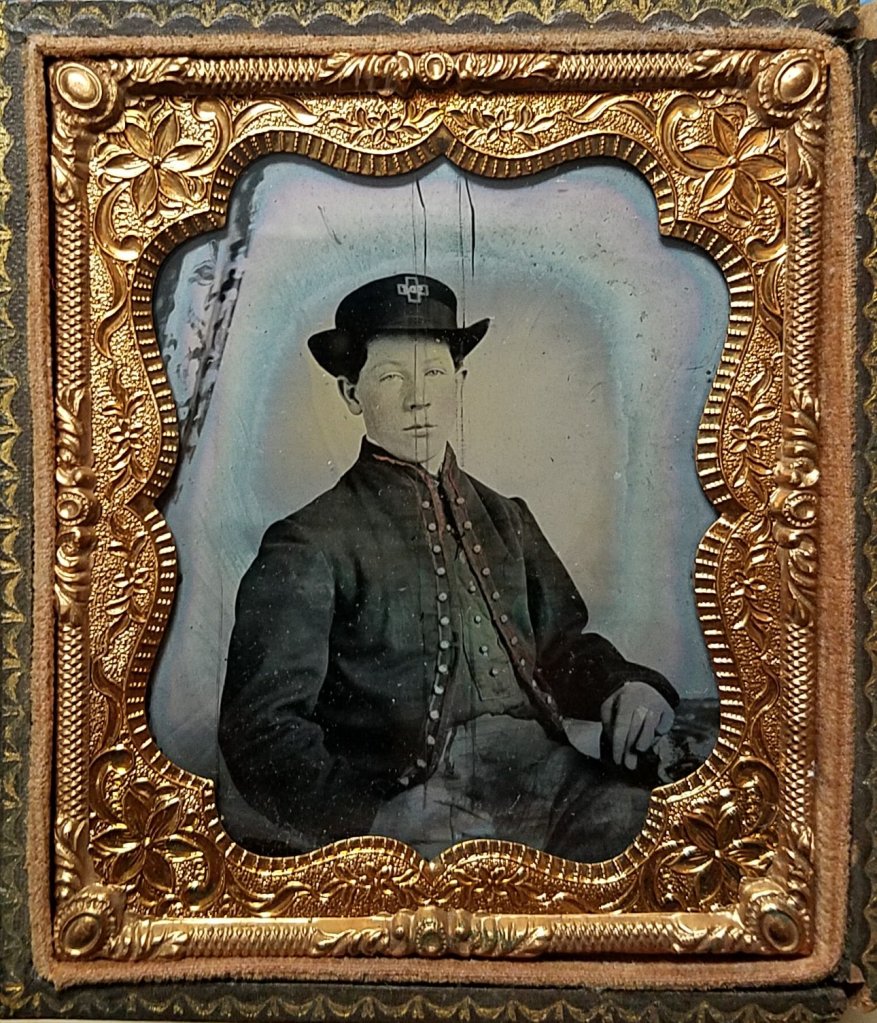
I could not find an image of Walter but here is a 6th Plate Ambrotype of Thomas W. Ward of Co. D, 95th Pennsylvania, or “Gosline’s Zouaves” (David Basco Collection)

This letter was written by Walter Lackey (1841-1898) of Philadelphia, who enlisted as a private in Co. K, 95th Pennsylvania Infantry (“Gosline’s Zouaves”) in October 1861. At the time of his enlistment he was described as a 20 year-old, 5’9″ tall, blue-eyed, light-haired printer. He was discharged with disability in June 1864.

The men of the 95th Pennsylvania had a long and glorious record of achievement on the battlefield. They wore an “Americanized” zouave uniform. Later in the war, they turned in their scarlet pants, scarlet trimed kepis, and tan gaiters, but the jacket, and vest still remained, and they wore the zouave jacket, and vest up until their regiment was mustered out at the end of the war. The regiment lost six field officers during the war: two colonels, two lieutenant-colonels, a major and an adjutant; this is the second highest total of officer casualties for any Union regiment during the war.

According to a notice posted in the Bridgeton Pioneer (New Jersey) on 21 April 1898, Walter “dropped dead at his home” in Philadelphia. He was only 55.

Other letters and diaries by members of the 95th Pennsylvania transcribed & published on Spared & Shared include:
Joshua Thompson, Co. A/H, 95th Pennsylvania (Union/1 Letter)
Samuel Clayton, Co. D, 95th Pennsylvania (2 Diaries)
Edward Riggs, Co. K, 95th Pennsylvania (Union/1 Letter)

Transcription

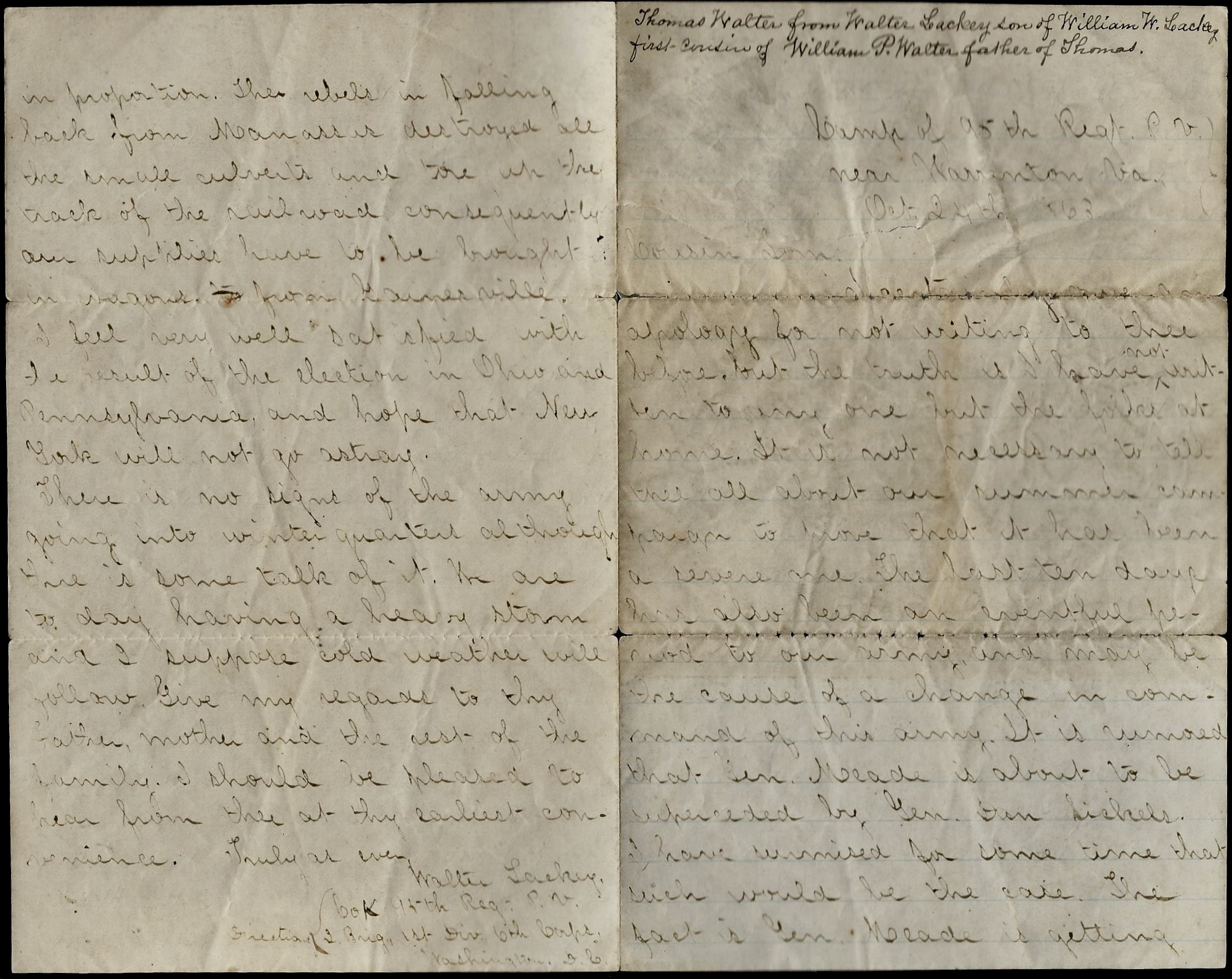
Camp of the 95th Regt. Penn. Vols.
Near Warrenton, Va.
October 24, 1863

Cousin Tom,

I received your letter and owe thee an apology for not writing to thee before. But the truth is, I have not written to anyone but the folks at home. It is not necessary to tell thee all about our summer campaign to prove that it has been a severe one.

“It is rumored that Gen. Meade is about to be superseded by Gen. Dan Sickles. I have surmised for some time that such would be the case. The fact is, Gen. Meade is getting much too popular for that consummate villain H. W. Halleck.”

—Walter Lackey, Co. K, 95th Pennsylvania, 24 October 1863

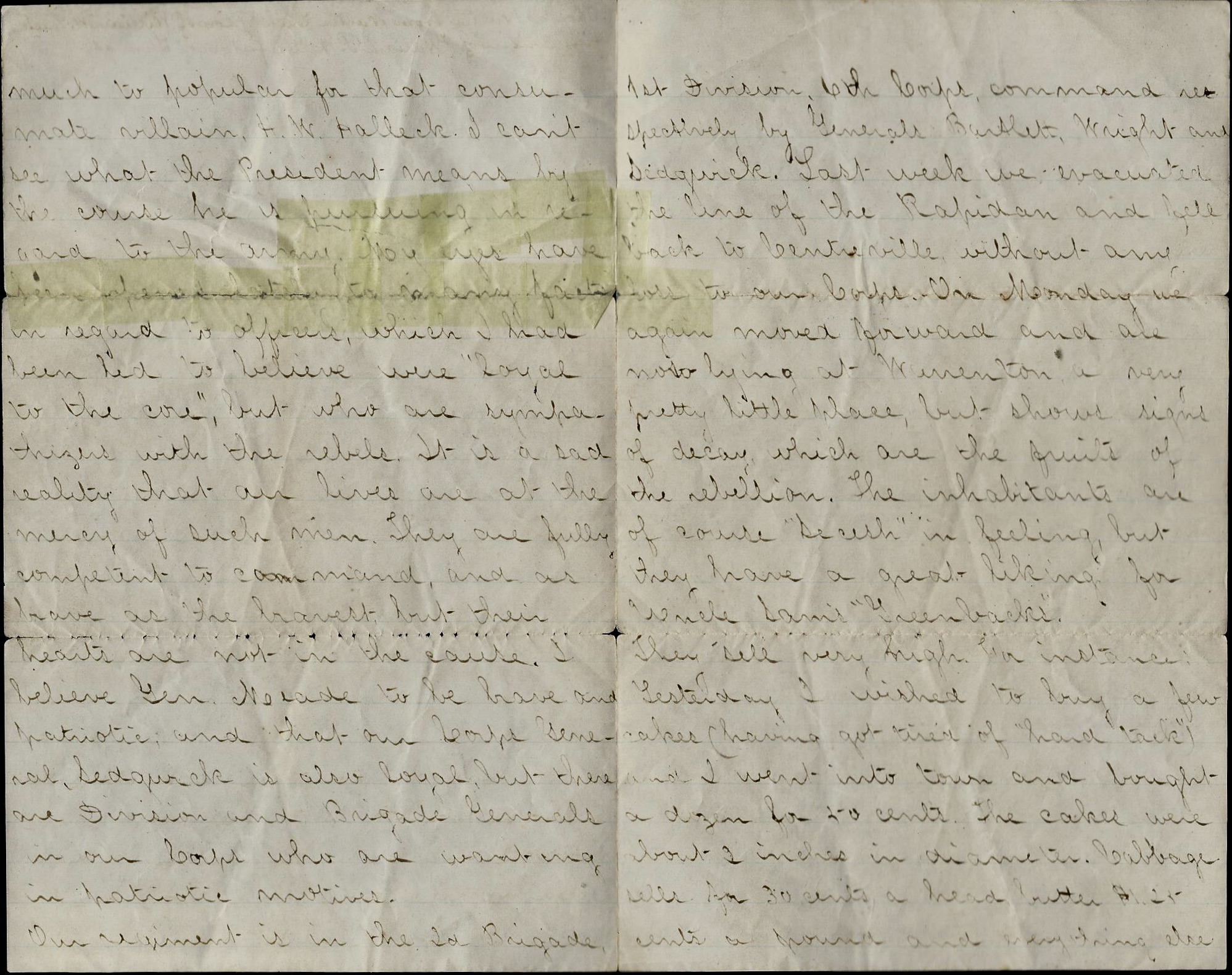
The last ten days has also been an eventful period to our army and may be the cause of a change in command of this army. It is rumored that Gen. Meade is about to be superseded by Gen. Dan Sickles. I have surmised for some time that such would be the case. The fact is, Gen. Meade is getting much too popular for that consummate villain H. W. Halleck. I can’t see what the President means by the course he is pursuing in regard to the army. My eyes have been opened lately by many facts in regards to officers which I had been led to believe were “loyal to the core,” but who are sympathizers with the rebels. It is a sad reality that our lives are at the mercy of such men. They are fully competent to command and as brave as the bravest, but their hearts are not in the cause.

I believe Gen. Meade to be brave and patriotic, and that our Corps General Sedgwick is also loyal, but there are division and brigade generals in our Corps who are wanting in patriotic motives. Our regiment is in the 2nd Brigade, 1st Division, 6th Corps, commanded respectively by Generals Bartlett, Wright, and Sedgwick.

Last week we evacuated the line of the Rapidan and fell back to Centreville without any loss to our Corps. On Monday we again moved forward and are now lying at Warrenton—a very pretty little place, but shows signs of decay which are the fruits of the rebellion. The inhabitants are of course “Secesh” in feeling, but they have a great liking for Uncle Sam’s “greenbacks.” They sell very high. For instance, yesterday I wished to buy a few cakes (having got tired of hard tack) and I went into town and bought a dozen for 50 cents. The cakes were about two inches in diameter. Cabbage sells for 30 cents a head, butter $1.25 cents a pound and everything else in proportion.

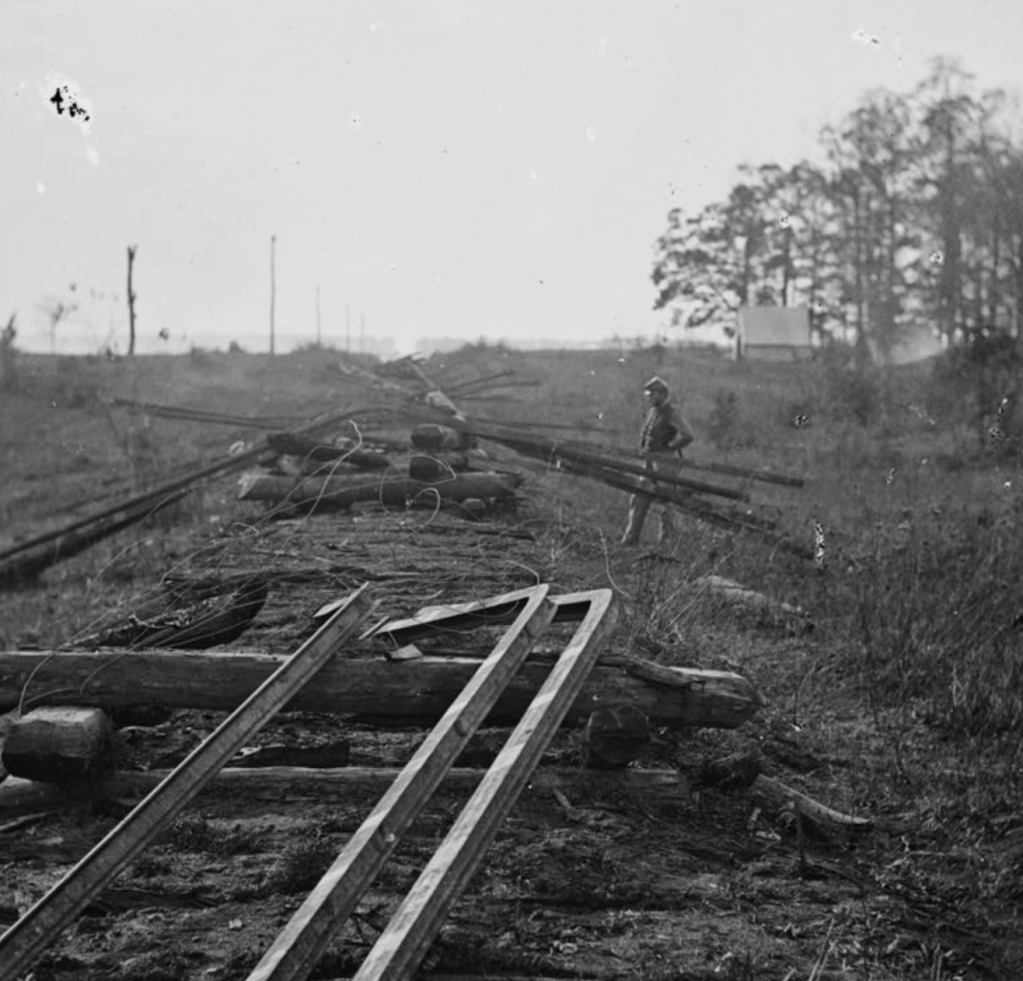
The rebels in falling back from Manassas destroyed all the small culverts and tore up the track of the railroad. Consequently our supplies have to be brought in wagons from Gainesville.

Tracks of the Orange & Alexandria Railroad torn up by the retreating Confederates in the fall of 1863.

I feel very well satisfied with the result of the election in Ohio and Pennsylvania and hope that New York will not go astray.

There is no signs of the army going into winter quarters although there is some talk of it. We are today having a heavy storm and I suppose cold weather will follow. Give my regards to thy father, mother, and the rest of the family. I should be pleased to hear from thee at thy earliest convenience.

Truly as ever, — Walter Lackey

Co. K, 95th Reg. P. V., 2nd Brig, 1st Div., 6th Corps, Washington, DC.