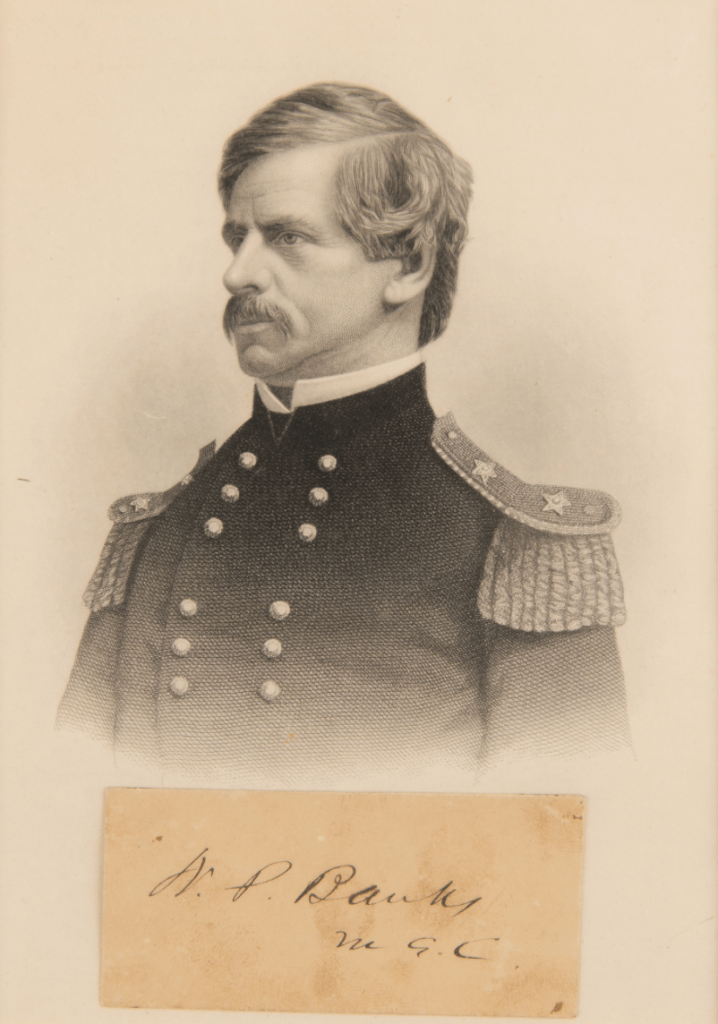
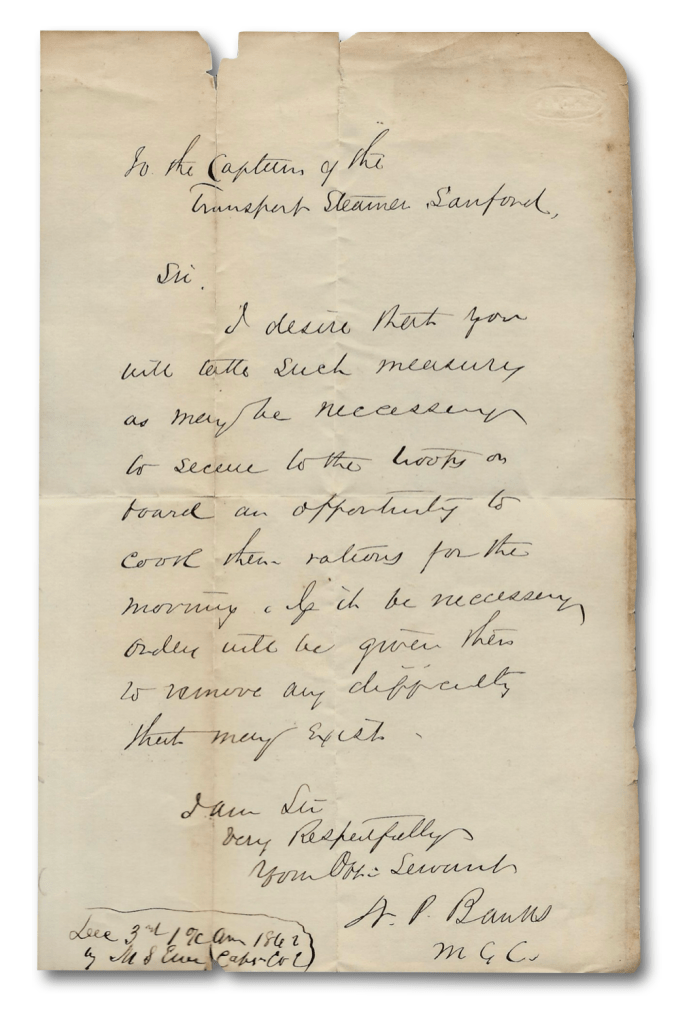
The following missive addressed to the captain of the transport steamer MenemonSanford, appears to be in the original handwriting of Major General Nathaniel P. Banks who headed the expedition to Louisiana in December 1862. It requests the captain allow the men of the 156th New York to be able to cook their breakfasts aboard ship while en route to New Orleans. The vessel never completed the trip, however. It hit a reef and was sunk in the Florida Keys while being steered through the treacherous waters by the morning pilot, who was arrested for sabotage. Luckily the regiment and the crew were saved from drowning by two Union ships that were nearby.
Major General Nathaniel P. Banks with clipped signature.
Signature on document
For more on the shipwreck of the transport steamer MenemonSanford, readers are referred to Letter 3 of those written by Philip J. Miller of Co. I, 156th New York published by Spared & Shared on a website entitled Staten Island Soldiers.
Transcription
To the Captain of the Transport Steamer Sanford 1
Sir,
I desire that you will take such measures as may be necessary to secure to the troops on board an opportunity to cook their rations for the morning. If it be necessary, orders will be given thus to remove any difficulty that may exist.
I am, Sir. very respectfully your obedient servant, — N. P. Banks, M. G. C. [Major General Commanding]
December 3, 1 o’clock a.m. 1862 by M .S. Ewen, Capt. Co. E.
1 The 26 December 1862 issue of the New York Times published the following description of the wreck of the steamer Menemon Sanford on Carysfort Reef 1.5 miles south of the Turtle Harbor Lighthouse: “The steamer M. Sandford, it is feared, will be a total loss, although the agent of Underwriters, Capt. WELCH, with commendable zeal, has sent a steam pump and all necessary assistance to do whatever can be done in saving the vessel and stores.”
KEY WEST, Monday, Dec. 15, 1862. The Banks expedition has met a serious loss in the wreck of the transport steamer M. Sandford, on Carysport Reef, coast of Florida, near the Light of that name, on the morning of the 10th inst., just before daylight. She had on board the One Hundred and Fifty-sixth Regiment N.Y.S.V., and from one of the officers I learn the following particulars: That at a very early hour in the morning the pilot, a Mr. RICHARDSON, of New-York, was heard to order the ship to be headed S. W. by W., which attracted the attention of some one, who immediately notified the Captain of the steamer, whereupon he came at once upon deck and consulted the pilot, who assured him that all was safe and right, and the water being deep all around her quieted all apprehension, when in less than two minutes the steamer was hard on the perpendicular reef in nine feet of water, drawing eleven feet. She was bilged and immediately filled to the water level. Fortunately there were other transports in sight, which at once tendered assistance. These were the propellers Curlew, George’s Creek and City of Bath, which took off on to their already over-crowded decks about 300 of the troops, and landed them here on the 11th. The balance of 500 arrived here this morning, the 12th, on the naval transport steamer Blackstone and gunboat bark Gemsbok, in tow of the steamer. The Blackstone had left here on the morning to the 10th with Rear-Admiral LARDNER, bound home of New-York, carrying our mails; and the promptness and self-sacrifice manifested in this case calls for our warmest commendation. She is now taking in another supply of coal, and will leave again as soon as that shall be completed, having rendered a very important service in thus relieving this large body of men from the discomfort and destitution of a sunken ship and a consequent tedious trip to this place. The troops are all being very comfortably housed in the extensive barracks here and in the fort, where they will await transportation, which can soon be obtained in sailing vessels now here discharging coals. More than fifty large vessels have been seen passing to the west during the past three days, and no disaster has been reported here except that of the Sandford. We bespeak for them fair weather and prosperous gales to their haven, and then may the fate of war give them a glorious victory in the cause of freedom, unity and good government.”
The following two letters were written by Ralph Augustus (“Gus”) Lanning (1835-1893) who enlisted 27 May 1861 and was mustered into Co. D, 83rd New York Infantry as a sergeant. By mid-January 1862 he had received a commission as 1st Lieutenant of his company and by 22 May 1862 he was serving as its Captain.
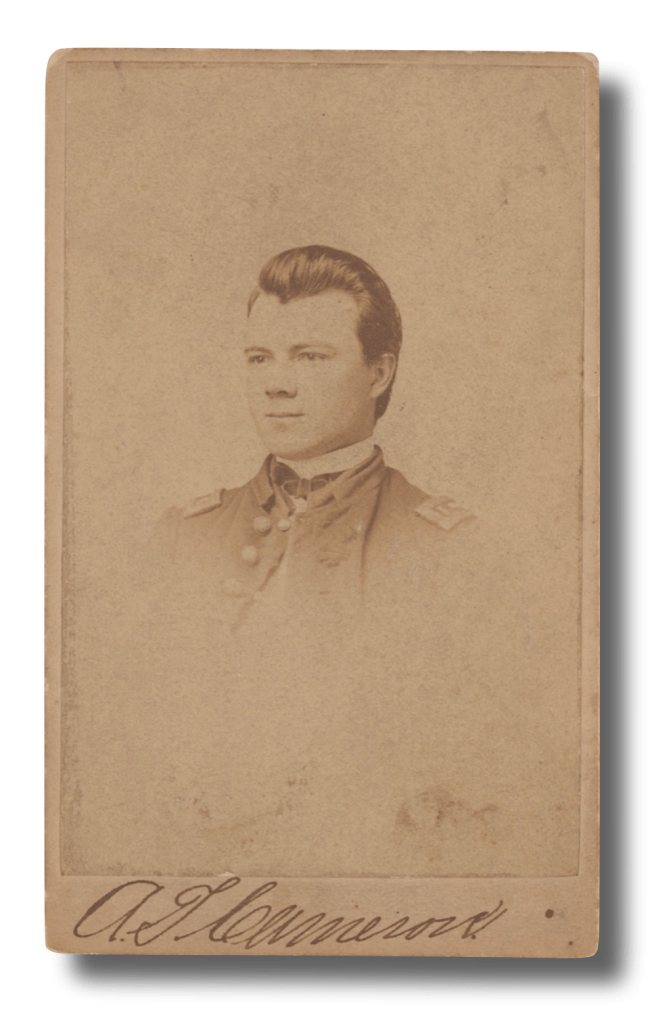
I could not find an image of Gus but here is one of Angus Cameron who also served as a captain in the 83rd New York Infantry. Capt. Cameron was in Co. F. (Photo Sleuth)
The 83rd New York served along the Potomac River in Maryland and at Harper’s Ferry. In the spring of 1862 the regiment was stationed near Warrenton Junction and along the Rappahannock river with several different assignments and participated in Gen. Pope’s Virginia campaign with the 3d brigade, 2nd division, 3d corps, suffering the loss of 75 members at the second Bull Run. The brigade and division were transferred to the 1st corps on Sept. 12, fought at South mountain and Antietam, the regiment being closely engaged in both battles and losing 114 at Antietam. Among those wounded at Antietam was Capt. Lanning who was discharged for disability on 12 December 1862.
In the book, History of the Weld Family (p. 27), it is reported that “Julia Berry Weld (1836-1905) married Mr. Ralph A. Lanning of New York City. He served in the war of 1861, was promoted in office, was wounded, and returned on crutches to his Julia, who received him with a hearty welcome, and they were shortly married. He is a true gentleman, now doing a handsome business in the City of New York.”
Gus was the son of Ralph Lanning (1785-1843) and Mary Wynkoop (1786-1842), both deceased by the time Gus was eight years old. He may have been raised by his Uncle Isaac W. Lanning of Trenton, New Jersey, who was named the trustee of Gus’s inheritance which was part of a farm of 46 acres in Mercer county.
Letter 1
Charlestown, [West] Virginia Sunday, March 2nd 1862
My own darling Julie,
We left Bolivar on Friday night [28 February] about 11:30 o’clock, marched to this place 9 miles. It was a very cold & windy night. I suffered more with the cold than I did anytime through the winter. We were kept in line at Bolivar over an hour before we started. Some of the men had their ears and feet frozen. We made a very quick march—only 1 hour and 55 minutes. We did not make a single halt. When we arrived in Charlestown we could not find out where we were to be quartered. After waiting in the street until the men were nearly frozen, we marched about one mile out of town ad bivouacked in a woods—a very cold place to sleep—but thanks to my men, they got some rails and made me a small house, covered it with brush and leaves, and built a good fire in front & I slept very comfortable.
This is the strongest secession place we have been in. Yesterday our tents came & we are getting along very well, It is snowing very hard at present, Some of the men came to me this morning & asked me if I would allow them to forage for poultry & pigs. I told them I would not prevent them nor give them permission. If they got anything, they must not let me know anything about it. All I do know, I saw them come in camp with some chickens and pigs. I asked no questions. It would not trouble me the least if they took all the poultry in the state. I know very well they would show us no favors. Besides, they have raised one cavalry company & one infantry company & done considerable damage. The troops we had a skirmish with last 4th of July where we lost two of our men were from this place.
We expect orders any moment to move on towards Winchester. We are only waiting for the balance of our army to get here. We have got to see some pretty hard times but I am contented. I am anxious to push on & end this trouble. The men are in tiptop spirits & anxious to see some fun. It is entirely out of the question getting a furlough at present. Enclosed you will find the disapproval of my last furlough. It does appear too bad that I could not get away while we were doing nothing & now we are getting farther off.
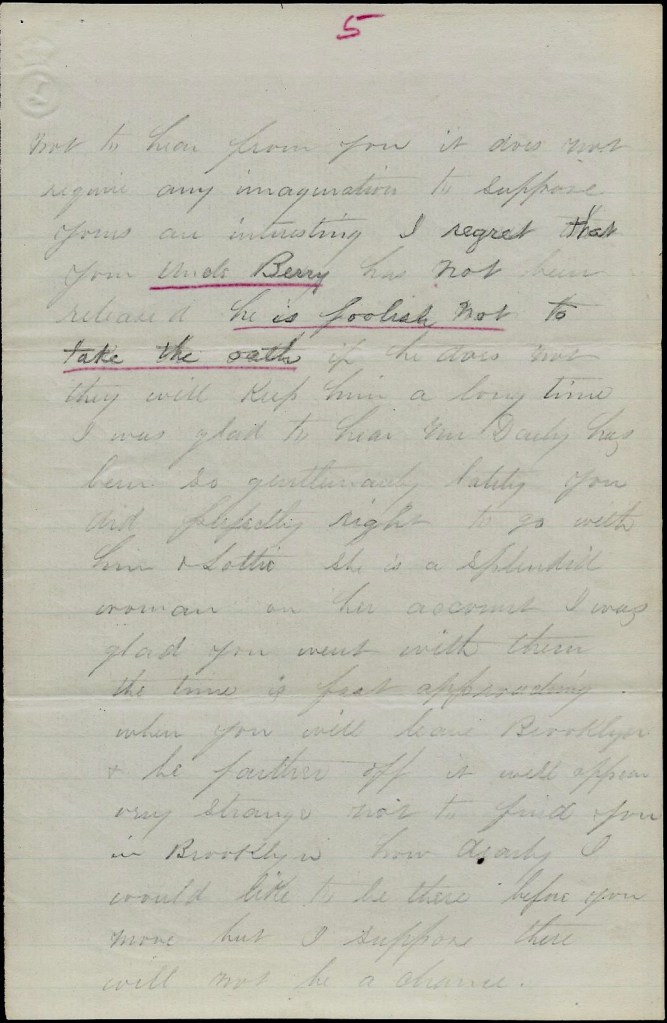
I think more than ever about you, darling one. Do not worry about me. I am well cared for and could not be treated any more kindly than I am by my men except at 45 Sands Street. I received only one letter from you last week. Expect to hear from you this evening. Do hope I will not be disappointed. Please write often. You said in your last you were almost ashamed to send some of your letters. Now darling, I ought to give you a good scolding. Your letters are excellent & very interesting. Please, dear one, not to think so again but write often as you can. I would be very unhappy not to hear from you. It does not require any imagination to suppose yours are interesting.
I regret that your Uncle Berry has not been released. 1 He is foolish not to take the Oath. If he does not, they will keep him a long time. I was glad to hear Mr. Daily has been so gentlemanly lately. You did perfectly right to go with him & Lottie. She is a splendid woman. On her account, I was glad you went with them. The time is fast approaching when you will leave Brooklyn & be farther off. It will appear very strange not to find you in Brooklyn. How dearly I would like to be there before you move but I suppose there will not be a chance.
Monday, March 4th [3rd] 1862. Good morning darling. This is a very gloomy and disagreeable morning. I was disappointed last eve in not getting a letter from you, dear one. There is a report in camp that letters will not go any farther than Baltimore until this move of the army is completed but I do not credit it. The reporters are not allowed to send any dispatches to the papers. It is about time for the mail to leave & I must close this miserable letter. Give my love to all my dear friends at 45 but keep enough love for yourself. May God bless & protect you, darling one, is the prayer of your own, — Gus
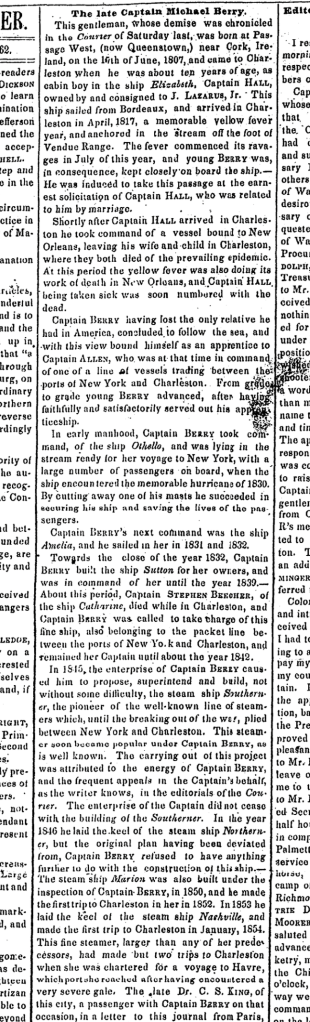
1 Capt. Michael Berry, formerly of the steamship Columbia that made regular runs between New York and Charleston, prior to the secession of South Carolina, was a prisoner in Fort Lafayette, and afterwards at Fort Warren, charged with secession tendencies.
Letter 2
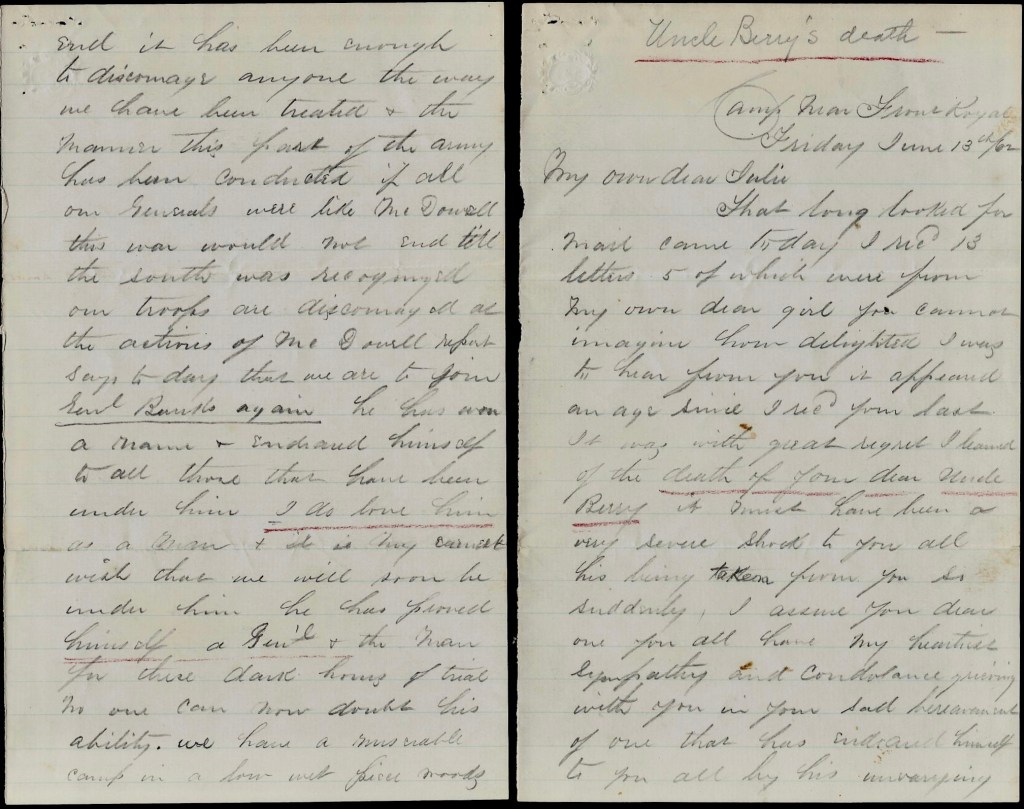
Camp near Front Royal Friday, June 13th 1862
My own dear Julie,
That long looked for mail came today. I received 13 letters—5 of which were from my own dear girl. You cannot imagine how delighted I was to hear from you. It appeared an age since I received your last.
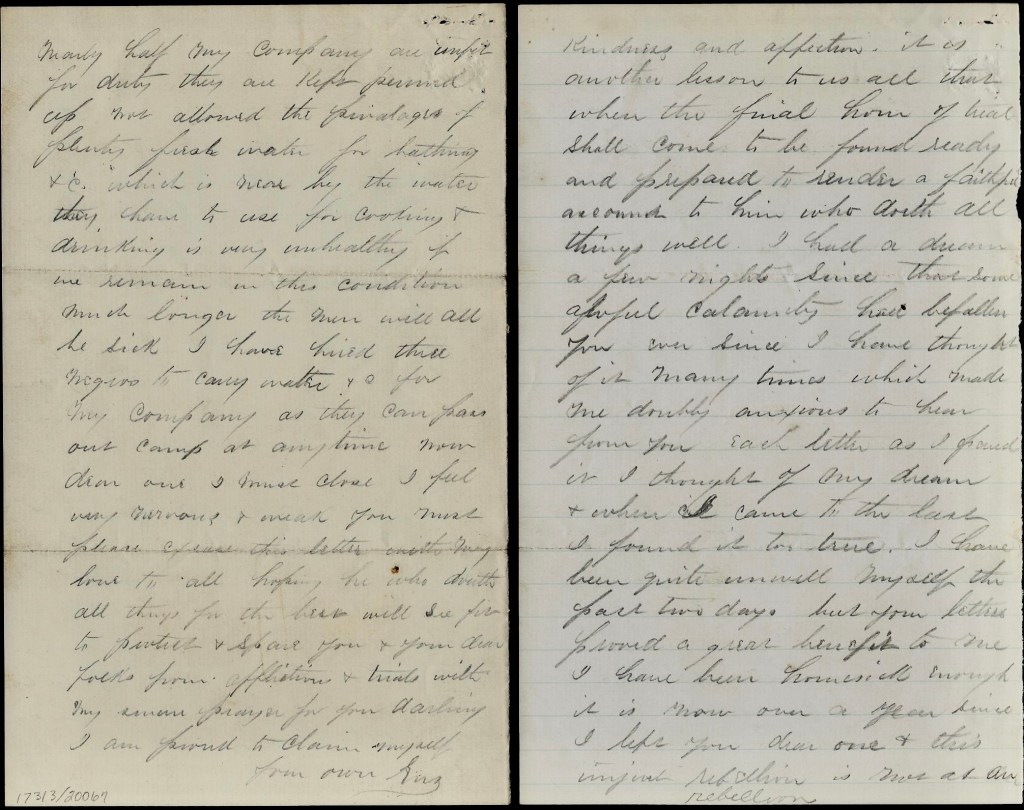
It was with great regret I learned of the death of your dear Uncle Berry. 1 It must have been a very severe shock to you all—his being taken from you so suddenly. I assure you, dear one, you all have my heartiest sympathy and condolence, grieving with you in your sad bereavement of one that has endeared himself to you all by his unvarying kindness and affection. It is another lesson to us all that when the fatal hour of trial shall come, to be found ready and prepared to render a faithful account to Him who doeth all things well.
I had a dream a few nights since that some awful calamity had befallen you. Ever since I have thought of it many times which made me doubly anxious to hear from you. Each letter as I found it I thought of my dream & when I came to the last, I found it to be true.
I have been quite unwell myself the past two days but your letter proved a great benefot to me. I have been homesick enough. It is now over a year since I left you, dear one, and this unjust rebellion is not at all rebellion and it has been enough to discourage anyone the way we have been treated & the manner this part of the army has been conducted. If all our Generals were like McDowell, this war would not end till the South was recognized. Our troops are discouraged at the actions of McDowell. Report says today that we are to join General Banks again. He has won a name and endeared himself to all those that have been under him. I do love him as a man and it is my earnest wish that we will soon be under him. He has proved himself a General and the man for these dark hours of trial. No one can doubt his ability.
We have a miserable camp in a low wet piece of woods. Nearly half my company are unfit for duty, They are kept penned up, not allowed the privileges of plenty fresh water for bathing, &c. which is near by. They have to use for cooking & drinking is very unhealthy. If we remain in this condition much longer, the men will all be sick. I have hired three niggers to carry water &c. for my company as they can pass our camp at anytime.
Now, dear one, I must close. I feel very nervous & weak. You must please excuse this letter. With my love to all, hoping He who doeth all things for the best will see fit to protect and spare you and your dear folks from afflictions and trials. With my sincere prayer for you, darling, I am proud to claim myself your own, — Gus
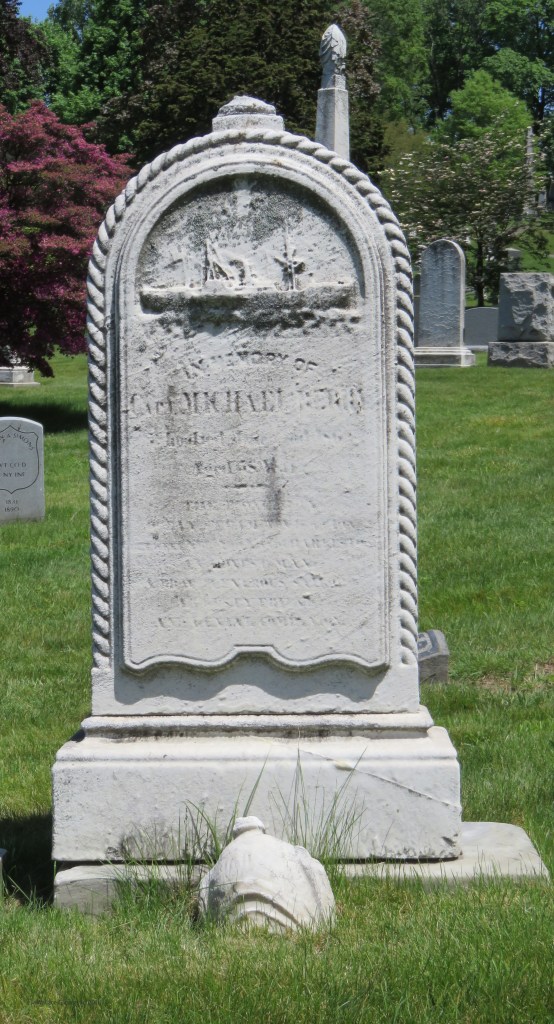
1 An obituary notice was posted in The Atlantic Democrat & Cape May County Register on 14 June 1862: “Death of a Political Martyr.—Died in Brooklyn, on Tuesday morning, Capt. Michael Berry, formerly of the steamship Columbia, that used to run between the port of New York and Charleston, before South Carolina seceded from the Union. Capt. Berry was imprisoned in Fort Lafayette, and afterwards in For Fort Warren, last winter, charged with secession tendencies, but was liberated about a month ago. He was a man of warm sympathies and generous nature, and it is believed that he would have been alive today but for his cruel and illegal imprisonment, — Newark Journal.”
Obituary of Capt. Michael BerryGreenwood Cemetery in Brooklyn, DOD 6 June 1862
The following letters and diary track the movements of Pvt. Gustavis (“Gus”) Davis Bates (1823-1903) of Plymouth, Massachusetts, who enlisted in Co. D, 38th Massachusetts Infantry. He was discharged from the University Hospital in New Orleans, Louisiana, for disability on 5 August 1863.
Gus was well educated—an 1850 graduate of Brown University—and was enumerated in the 1850 US Census as a lawyer in Plymouth, Massachusetts but in August 1862 when he enlisted to serve his country he was a 38 year-old county school teacher. His regiment was transported to Louisiana in the Bank’s’ Expedition and fought at Fort Brisland in March 1863, where a large contingent from the regiment were captured and briefly held as prisoners of war. “Gus” was admitted to University Hospital at New Orleans on April 9, 1863 and remained there until medically discharged from the army on Aug. 5, 1863. His diary entries from May and June 1863 suggest that though he might have been marginally capable of being returned to service in the field, his doctors found his nursing skills to be of greater value to the military and so he was kept at University Hospital until his discharge.
Gus was the son of Comfort Bates III (1791-1876) and Elizabeth Pierce (1792-1878) of Plymouth, Massachusetts. Gus was married in 1848 to Nancy Doten Finney (1828-1896) and had at least three boys living at the time of his enlistment—Charles Hubbard Bates (1849-1918), Josiah Finney Bates (1851-1918), and Alfred Merton Bates (1858-1933). After the war, Gus returned to teaching school in Plymouth.
There are four documents in this archive: A letter dated 19 November 1862 written from Fortress Monroe enroute to Louisiana; a diary fragment from the passage from Baltimore to New Orleans; a letter dated from New Orleans on January 7, 1863; and a diary fragment written at University Hospital in New Orleans in May and June 1864 during the fighting at Port Hudson.
1
Adams Express Co. Fortress Monroe, Va. November 19th 1862
Dear Wife,
I have sent you $15 (fifteen dollars) by Adams Express. As soon as you get this, send directly over to Rich & Westars or other express in town & get it. Carry the paper I send you with you. I received $23.40.
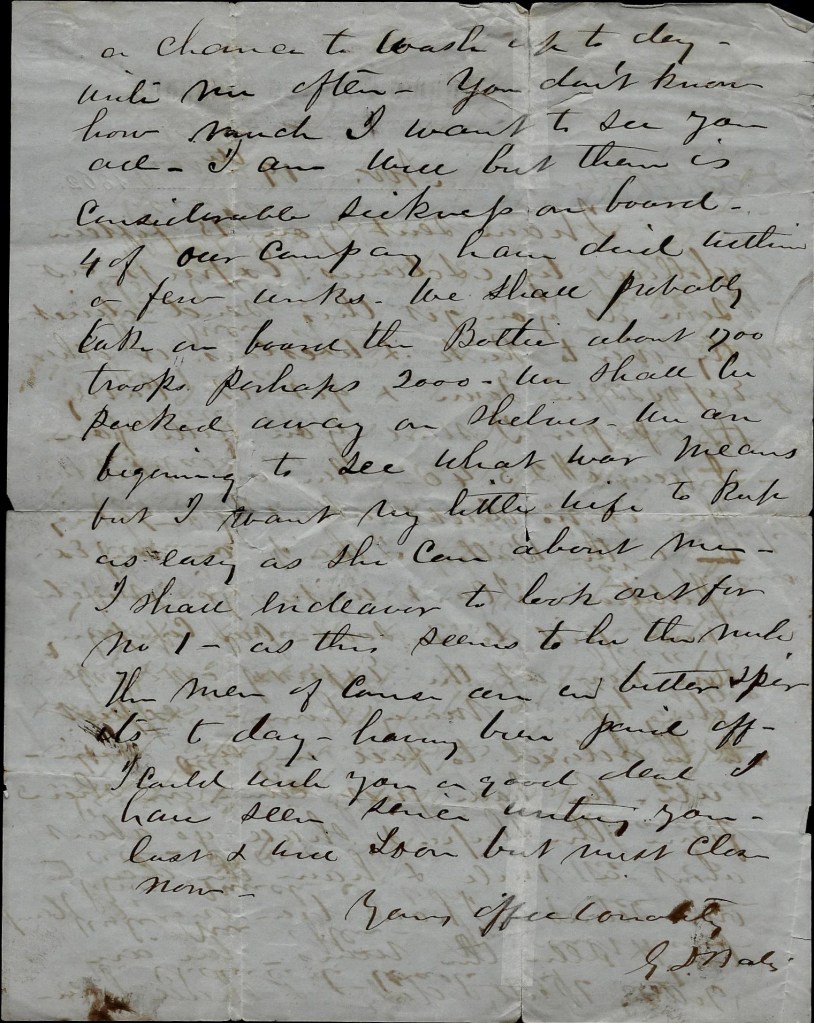
We are still here. There is no doubt about our going in the Baltic, I think on an expedition. I can’t write you much now. Will do so soon. Our company are now at the Express Office sending their money home. Expect to be ordered to fall in any minute. We have just come on here from the ship & shall go about a mile to hair the day to ourselves. I have been over to Hampton and also the rivers. We are getting pretty dirty & shall have a chance to wash up today. Write me often. You don’t know how much I want to see you all. I am well but there is considerable sickness on board. Four of our company have died within a few weeks.
We shall probably take on board the Baltic about 1700 troops—perhaps 2,000. We shall be packed away on shelves. We are beginning to see what war means but I want my little wife to keep as easy as she can about me. I shall endeavor to look out for No. 1 as this seems to be the rule.
The men of course are in better spirits today having been paid off. I could write you a good deal I have seen since writing you last & will soon but must close now. Yours affectionately, — G. D. Bates
2
The U.S.S. Steam Ship Baltic
Steam Ship Baltic, Fort Monroe
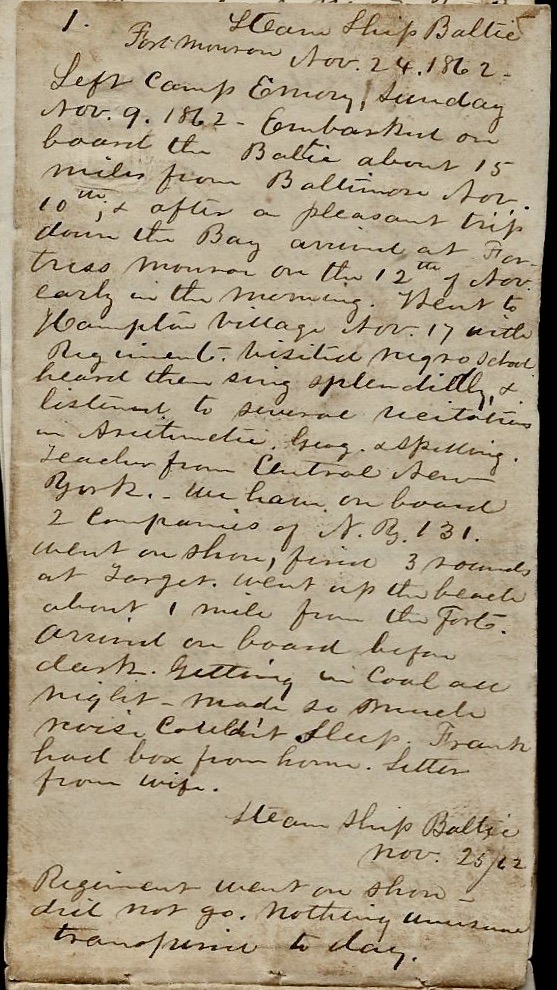
November 24, 1862—Left Camp Emory Sunday November 9, 1862. Embarked on board the Baltic about 15 miles from Baltimore November 10th; and after a pleasant trip down the Bay, arrived at Fortress Monroe on the 12th of November early in the morning. Went to Hampton Village Nov. 17th with regiment.
Visited Negro School. Heard them sing splendidly & listed to several recitations in Arithmetic, Geography, & Spelling. Teacher from Central New York.
We have on board two companies of New York 131st. Went on shore. Fired three rounds at target. Went up the beach about 1 mile from the fort. Arrived on board before dark. Getting in coal all night. Made so much noise, couldn’t sleep. Frank [Bates] had box from home. Letter from wife.
Steamship Baltic—November 25, 1862—Regiment went on shore. Did not go. Nothing unusual transpired today.
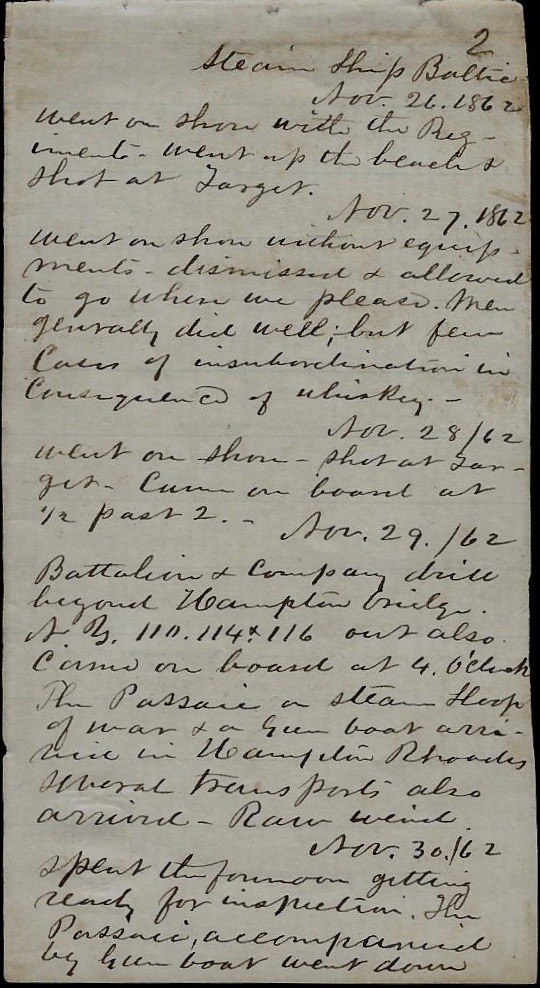
November 26, 1862—Went on shore with the regiment. Went up the beach and shot at target.
November 27, 1862—Went on shore without equipments—dismissed and allowed to go where we please. Men generally did well, but few cases of insubordination in consequence of whiskey.
November 28, 1862—Went on shore. Shot at target. Came on board at half past 2.
November 29, 1862—Battalion & Company drill beyond Hampton bridge. New York 110th, 114th, and 116th [regiments] out also. Came on board at 4 o’clock. The Passaic—a steam sloop of war, & a gunboat arrived in Hampton Roads. Several transports also arrived. Raw wind.
November 30, 1862—Spent the forenoon getting ready for inspection. The Passaic accompanied by gunboat went down the Bay about noon. Quite a stir among the gunboats.
December 1, 1862—Inspection this forenoon. Very Pleasant.
December 2, 1862—On board all day. Indian rubber blankets delivered to the regiments this afternoon. 80 rebel prisoners arrived from Baltimore [who] were well dressed. Gave up cartridges today. Commenced raining about noon. General inspection of quarters by physician. Complaints made & remedies promised. Member of company buried.
Steam ship Baltic, Fort Monroe—December 3, 1862—On board all day. Rainy. The fleet ordered to be in readiness to sail and are making preparations to go to sea.
December 4, 1862—A. S. Russell came on board. Fleet got under way this morning. Men securely fastened & preparations are being made for the coming storm.
Steam Ship Baltic at Sea
December 5, 1862—Wind dead ahead. Ship labors hard. Deck very wet. Spray covered the forward part of the ship blowing a gale. A great deal of seasickness on board. Off Hatteras, encountered a severe gale. The sea breaking completely over the starboard wheelhouse & drenching the men forward, accompanied with vivid lightening & crashing thunder. The rain poured down in torrents & at one time the ship was in great peril—the ship running very high and ship straining every timber to keep on her course.
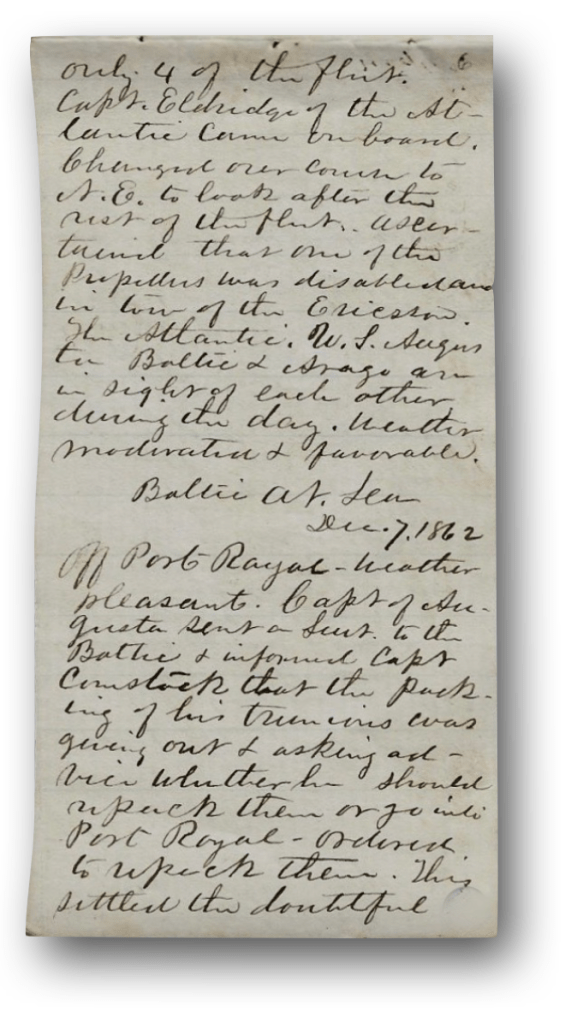
December 6, 1862—At sea. In the morning signaled only 4 of the fleet [in sight]. Capt. Eldridge of the Atlantic came on board. Changed our course to northeast to look after the rest of the fleet. Ascertained that one of the propellers was disabled and in tow of the Ericsson. The Atlantic, U. S. Augusta, Baltic & Arago are in sight of each other during the day. Weather moderated & favorable.
Baltic at Sea
December 7th 1862—Off Port Royal—weather pleasant. Capt. of Augusta sent a Lieutenant to the Baltic & informed Capt. Comstock that the packing of his trunchions [?] was giving out & asking advice whether he should repack them or go into Port Royal. Ordered to unpack them. This settled the doubtful point whether we were going into Port Royal or not. Sent up rockets in the night. Several responses. Having pleasant view. The living on board is very poor & our accommodations are very contracted. The men are scattered over the deck reading, writing, playing cards & chattering together, most of them having recovered from sea sickness & being in good spirits.
At Sea on Baltic
December 8, 1862—Weather fine. Course S. S. W. The remainder of the fleet do not come up. general inspection aft. Inspection of men took off right boot & stocking. Saw three sail towards night. off St. Augustine towards night.
[Page missing, December 9-11, 1862]
At Sea, December. 12, 1862—Warm and pleasant. Fine run last night & today. Nothing unusual has occurred.
At Sea. December 11 [should be 13th], 1862. The Baltic hove to above 4 o’clock in the night. saw the land early in the morning. Arrived at Ship Island at 1 o’clock today. Atlantic went over the bar first. Baltic struck heavily on the bar going in. Gunboat Augusta came in soon after the Baltic. The U. S. Arago, S. R. Spaulding, arrived before us. Some 15 or 20 sail were in port. The U. S. left soon after we arrived. Mataras [?] arrived at 2 o’clock p.m. Capt of Augusta came on board & accompanied General Emory on shore. S. R. Spaulding left in the afternoon. Several vessels left and several arrived during the day.
Ship Island
December 14th, 1862—Commenced going on shore this afternoon. General Banks with the 41st Massachusetts left in the North Star at noon. On board the Baltic all night.
41st Massachusetts soldiers on board the North Star while anchored at Ship Island in December 1862
December 16, 1862—Ship Island. Went on shore this morning in boats ay Ship Island. Encamped about half mile from the wharf on the sand. 23rd Connecticut encamped here. 16th New York and two companies of 13th Maine doing garrison duty. There are about 50 rebel prisoners here. Drew rations of coffee & sugar. Went down the beach and got a good stove. Saw Robert Finny of The Kensington.
From December 16 to 27 [1862]—At Ship Island drilling, Had frequent conversations with rebel prisoners, most of whom were anxious to have the war brought to a close & join the Union. Others would settle on [nothing] but recognition. Six men from each company was detailed to cut wood on the Island about 4 miles from camp. Israel Thrasher 1 of our company went.
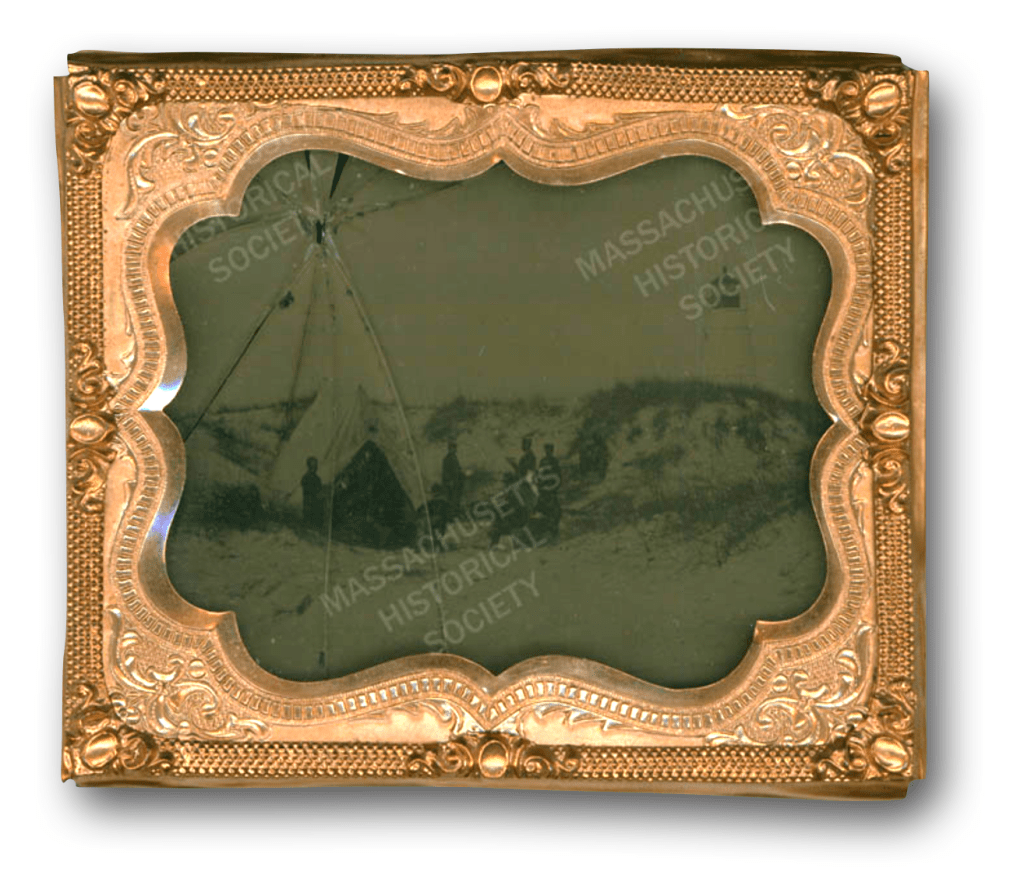
This ambrotype depicts members of the 38th Massachusetts Volunteer Infantry Regiment at camp on the beach of Ship Island, Miss. during the Civil War. The photograph was taken in Dec. 1862 by an unknown photographer and probably was owned by Francis William Loring, a lieutenant with the regiment; an inscription on the verso of the image reads, “Field & Staff 38th M.V. FW Loring Ship Island, Miss. Dec. 25, 1862.” Photo. 2.97 Removed from the Francis William Loring papers[Digital Commonwealth, Massachusetts Collection On Line]
Ship Island, December 27, 1862—Went up the beach with Israel Thrasher, gathered shells & visited the graveyard. Most of the names were between 18 and 25 year old. Mostly from Maine. Indiana, Wisconsin, Connecticut, Vermont, New Hampshire, & Massachusetts were represented among the dead.
Ship Island—December 29, 1862—The North Star, Northern Light, & Illinois came in this morning. Had orders to move. Went on board the Northern Light about 12 o’clock at night.
Steamship Northern Light
December 30, 1862—After some delay in getting off, left Ship Island this morning at 8 o’clock in the Northern Light. Quartered in the forehold. Better accommodations than in the Baltic. Several cases of measles on board. Had a fine run all day & during the night.
Steam Ship Northern Light, Mississippi River. December 31, 1862—Entered the [river] about 9 o’clock this morning. Had a good passage up the river and arrived at New Orleans not far from 7 o’clock in the evening.
1 Israel H. Thrasher was also from Plymouth. He died on 29 June 1863 at New Orleans from wounds received in the fighting at Port Hudson on 14 June 1863.
3
Camp Kearney At Greenville near New Orleans January 7, 1862 [should be 1863]
Dear Wife,
I send you within $20 (twenty dollars) by Adams Express. I can’t write you much now. Shall write you by mail. We are encamped here 4 miles from the city and about 8 by the river. We like the camp better than any camp we have been in. The weather here is pleasant most of the time, not comfortably cool night, so that I am not cold with overcoat & blanket.
We have three days rations ordered to be cooked & 10 days on hand all the time. I think I can send you 4 or 5 dollars now. Shall do so in my letters. It costs 65 cents to send this to Plymouth. I received two letters from you dated 7th and 16th of December. Your Uncle Henry is right, I think about the wood. Pay it.
Lt. Col. David K. Wardwell—“When Wardwell went, the fighting talent went also.”
We arrived here last Thursday, laid over one night in the city, and came up here next day. Whether we shall go up or down the river is uncertain. I shall endeavor to write you once a week about Sunday. If we move, I shall write about the time of moving. Should anything unusual take place, I shall let you know. I think the Colonel will try to have us stay at New Orleans. Col. [Timothy] Ingraham is acting as Brigadier General and the 38th is commanded by Lieut. Col. [William L.] Rodman. When [David Kilburn] Wardwell went, the fighting talent went also.
But I must close. Frank [Bates] 1 and I are well. Tom Savery 2 is sick with the measles [which are] prevalent in camp.
Your affectionate husband, — G. D. Bates
1 Francis (“Frank”) Bates was also from Plymouth. He served as a musician in Co. D, 38th Mass., until 30 January 1864 when he was discharged at Baton Rouge for disability.
2 Thomas G. Savery of Plymouth survived his bout with the measles only to be wounded at Port Hudson on 14 June 1863 and discharged at Boston for disability on 28 December 1863.
4
The remaining diary entries were all penned in the University Hospital at New Orleans
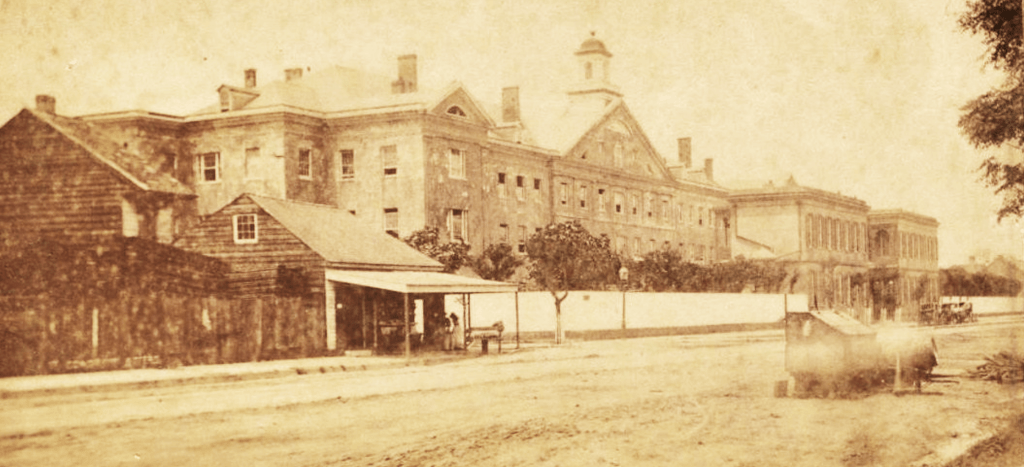
University Hospital, New Orleans
May 27, 1863—About 150 men from this hospital ordered away to their respective regiments. Packing up in the afternoon. Showers during the day.
Thursday, [May] 28th, 1863—Packed my knapsack & put things in readiness to go to the regiment. All the men were ordered into the front hall to answer to their names. No questions were asked me by [Asst. Surgeon] Dr. [Samuel H.] Orton but he ordered me back to room. Unpacked knapsack & put things in [ ] for a further sojourn at this institution. Removal into another war. Saw several wounded pass the hospital. Among them General [Thomas W.] Sherman. Reported also that Neal Dow is killed & General [Christopher C.] Augur wounded at Port Hudson. Several doctors came round at 10 o’clock in the eve and took names to send off. About 120 went today. Papers contain accounts from rebel sources of fights at Port Hudson & Vicksburg. Sent letter home, No. 12. Fletcher, Nye & Laws of the 38th in Ward K went off today. [George H.] Fish of Co. D & H[oratio] Sears of Co. G. [George W.] Belcher of [Co. A], 38th [Mass.] sent back. [Albion] Leavitt of 26th Massachusetts went off also who was in Ward K. Become acquainted with Mr. Burbeck of East Abington.
Friday, May 29th, 1863—Rained last night. Pleasant this morning. Became acquainted with George Bates of Worcester, Co. 130. Wounded, came from Baton Rouge. [Was] on the fight at Port Hudson. Heard of the death of Lt. Col. [William L.] Rodman of the 38th [Massachusetts]. No one could be found to take charge of the regiment. Rumored death of Gen. Paine. Shower in the afternoon accompanied with thunder and lightning. About 70 men left the hospital this afternoon. Joe Loring, Otis Foster, & Israel H. Thrasher went off [back to the regiment] today. Only one left of Co. D in this hospital. Seven transported in the evening.
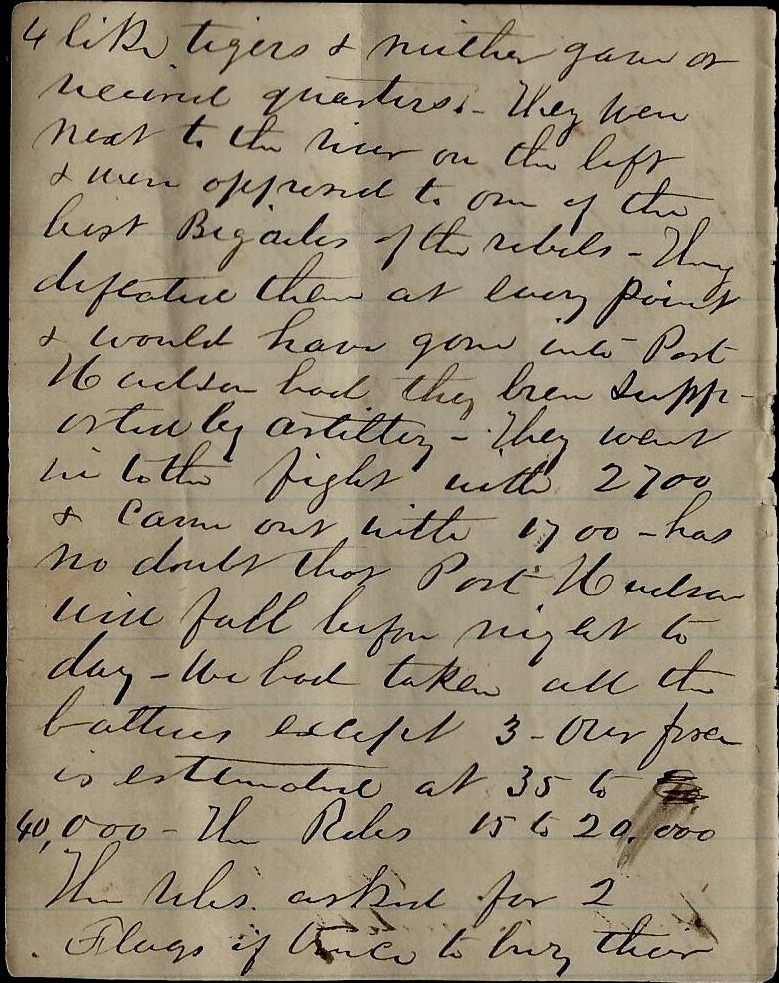
Saturday, May 30th 1863—Hard thunder and rain this morning. Talked with wounded sergeant of 131st New York. 1 Thinks when he left [Port Hudson] there were 3,000 killed & wounded on our side. Represents the fighting as the most desperate of the war. The Negro Brigade fought like tigers & neither gave or received quarters. They were near to the river on the left & were opposite to one of the best brigades of the rebels. They defeated them at every point & would have gone into Port Hudson had they been supported by artillery. They went into the fight with 2700 and came out with 1700.
1 The wounded sergeant was probably one of four men: 22 year old Hector Sears of New York City was 1st Sergeant of Co. I. He was wounded in the fighting at Port Hudson on 27 May 1863; 23 year-old Sgt. Paulis Van Version of Co. F thought the date of his wound was not given; 27 year-old Sgt. James Devlin of Co. F, who was wounded at Port Hudson; or 31 year-old Sgt. William Boxberger of Co. D who was wounded on 27 May 1863 at Port Hudson. One of them would have been the source of the information provided Bates about the “the Negro Brigade.” See poem by John A. Morgan entitled, The Black Brigade at Port Hudson.
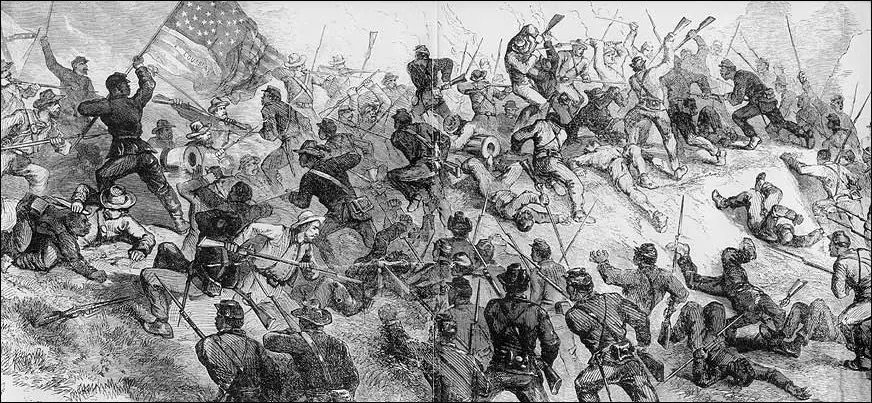
“In May 1863, the 1st and 3d Corps D’Afrique attacked the Confederate stronghold of Port Hudson, Louisiana. After previous units failed to break through the Confederate defenses, Brig. Gen. William Dwight ordered the African American units to attack a strong point along the western edge of the Confederate line. The units crossed a short bridge, bordered on their right by the Mississippi River and on their left by entrenched enemy sharpshooters and cannons. The Louisiana troops, led by freedman Capt. Andre Cailloux, assaulted the position under withering fire. Cailloux, wounded twice, led his soldiers until mortally wounded by a cannon ball just outside the breastworks. The assault withdrew and successfully laid siege to the Confederate garrison until it’s surrender six weeks later. Cailloux’s gallantry under fire became a rallying cry for African American and white Soldiers alike throughout the rest of the war.“
Black troops attack the Confederate line at Port Hudson
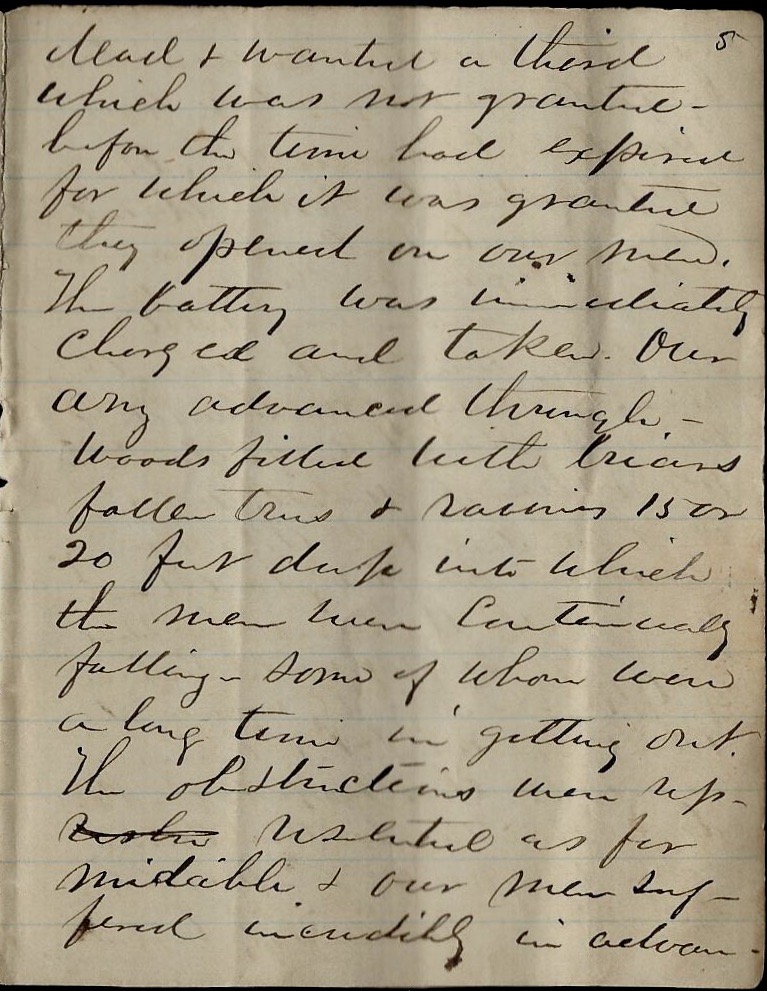
Has no doubt that Port Hudson will fall before night today. We had taken all the batteries except three. Our force is estimated at 35 to 40,000. The Rebs at 15 to 20,000. The Rebs asked for two flags of truce to bury their dead and wanted a third which was not granted. Before the time had expired for which it was granted, they opened on our men. The battery was immediately charged and taken. Our army advanced through woods filled with briars, fallen trees, ad ravines 15 or 20 feet deep in which the men were continually falling—some of who, were a long time in getting out. The obstructions were represented as formidable & our men suffered incredibly in advancing on the enemy who are strongly posted in every advantageous position, commanding the approaches to Port Hudson. No doctor came round today. Warm and pleasant.
Sunday, May 31, 1863—The tables were full again this morning, many of the wounded being well enough to go down. Went through wards where the wounded are this morning. Saw but one very bad case wounded in the head—looked very bad. Talked with [Corp. Lewis M.] Bailey of Co. G, 38th [Mass.] [who was] slightly wounded [at Port Hudson]. About 200 wounded have arrived at this hospital. Hot day. Dr. McLellan came round—No. 452, Ward E, 3rd Story, University building.
University Hospital—June 1, 1863, New Orleans. Hot day. Siege of Port Hudson still going on. General Banks receiving reinforcements. All the wounded men concur in the opinion that Port Hudson must fall soon. Dr. Conner in charge of the Hospital, having returned from Baton Rouge. Quince arrived 26 days from New York.
June 2, 1863—Continues hot. Letter from home [dated] May 17th. A few wounded continue to arrive from Port Hudson.
January 3rd 1863—Warm and pleasant. Letters from home [dated] April 26th, also April 30th. B. F. Hathaway called.
June 4th 1863—Wrote letter No. 13 home. Hot day. Nothing unusual. Papers contain nothing.
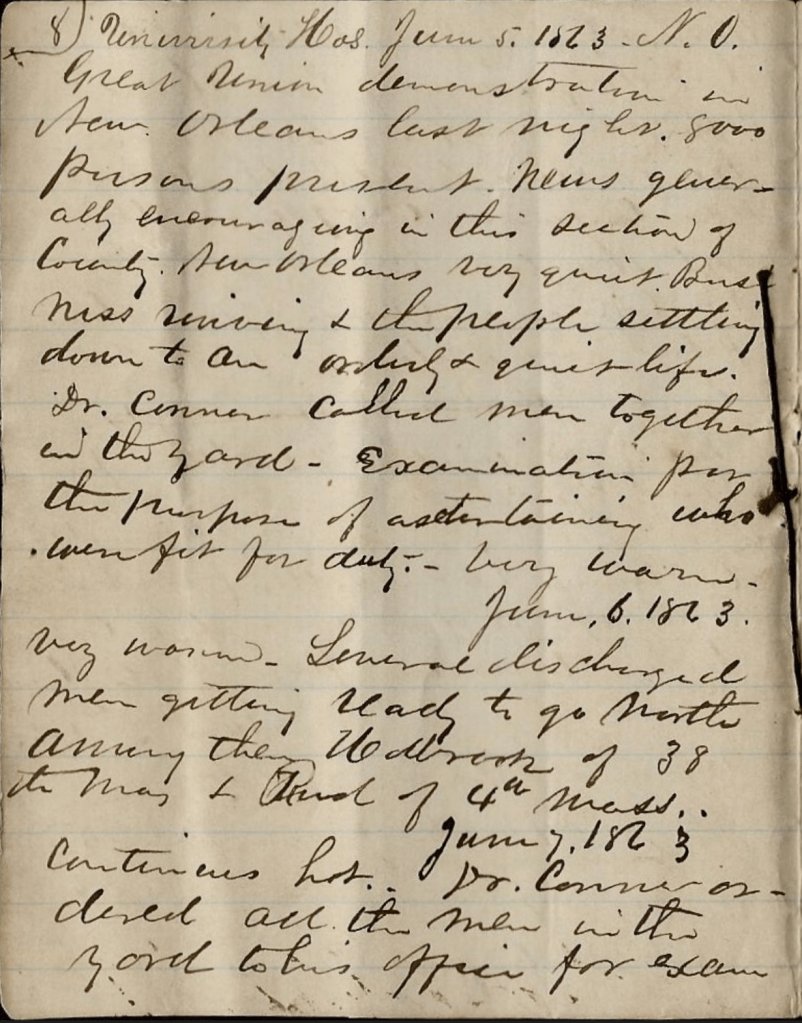
University Hospital, June 5, 1863, New Orleans. Great Union demonstration in New Orleans last night. 8,000 persons present. News generally encouraging I this section of the county. New Orleans very quiet. Business reviving and the people settling down to an orderly & quiet life. Dr. Conner called men together in the yard. Examination for the purpose of ascertaining who were city for duty. Very warm.
June 6th, 1863—Very warm. Several discharged men getting ready to go North. Among them [Corp. Nathaniel O.] Holbrook of [Co. C], 38th Mass. and [Jedediah M.] Bird of the 4th Mass.
June 7th, 1863—Continues hot. Dr. Conner ordered all the men in the yard to his office for examination. 15 or 20 men from the hospital North discharged.
Monday, June 8th 1863—Very hot. 40 or 50 men discharged to regiment today. All the men at supper table ordered to Dr. Conner’s office after supper. Went. Was told to go back to Ward & keep quiet. Took a large number of names for regiment & for light duty about the hospital.
Tuesday, June 9th 1863—Continues hot & dry. Sixty men packed up to leave for regiments. Ordered back & remained over night. Doctor did not come round until after supper.
University Hospital, June 10th, 1863—Continues very warm. 40 or 50 men left this morning for up the river. General Wentzel’s Division defeats the Rebs in rear of our forces at Port Hudson & droves them to Liberty.
June 10th 1863—Cooler. Nothing of importance.
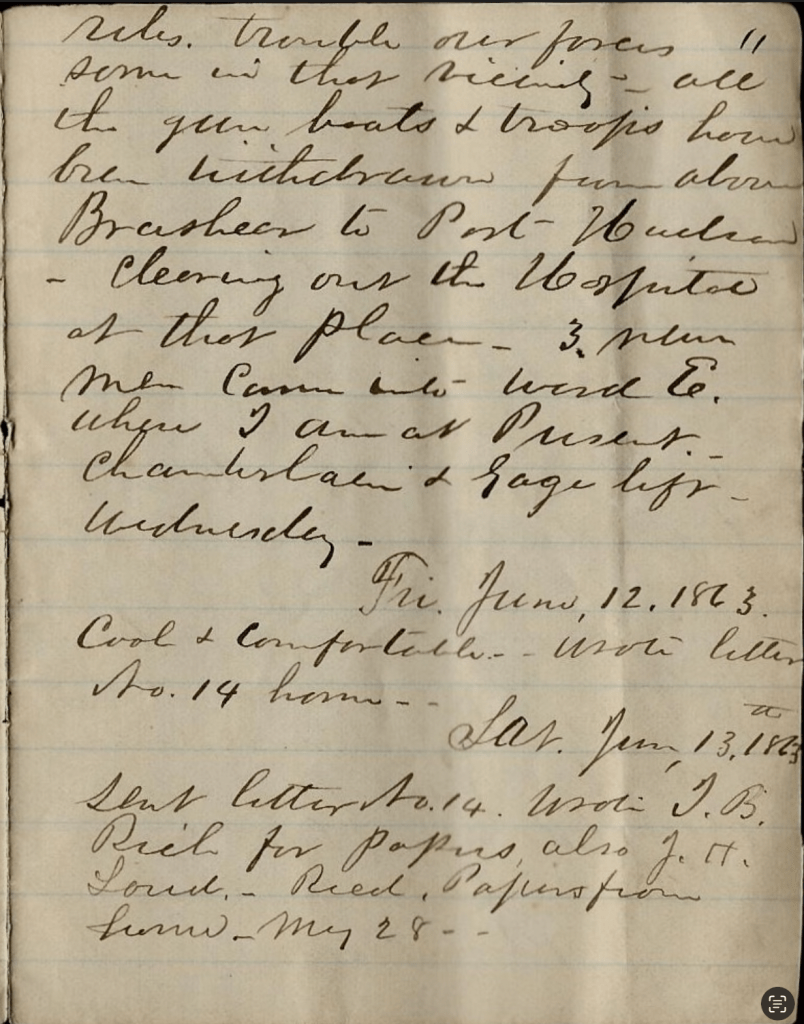
June 11th 1863—Showery. Cooler. Some thunder. Put up cistern in the hospital. Fifty men arrived at hospital from Brashear City. Learn from them that the Rebs trouble our forces some in that vicinity. All the gunboats and troops have been withdrawn from above Brashear to Port Hudson. Clearing out the hospital of that place. Three new men came into Ward E where I am at present. Chamberlain and Gage left Wednesday.
Friday June 12th, 1863—Cool and comfortable. wrote letter No. 14 home.
Saturday, June 13th 1863—Sent letter No. 14. Wrote T. B. Rich for papers. Also J. H. Loud. Received papers from home date May 28th.
University Hospital, June 14, 1863—Comfortable weather. Dr. Conner came round this morning and notified several that he was going to send them home. Said but little to me. Was accompanied by Dr. McLellan who is now practicing in Ward E where I am at present. Had a talk with Quince. Informed me that Israel H. Thrasher & Foster had left Barracks Hospital. Col. [Timothy] Ingraham went home [to New Bedford] today. Several came to the hospital from Brashear City. Had a long talk with Petra of Co, B, 38th [Mass.] Read the scriptures most of the day. Place my dependence on God and try to do my duty & be reconciled to my situation.
Monday, June 15th 1863—Shower in the afternoon. Some thunder. Quite comfortable. Read New York Herald‘s first account of fight at Port Hudson. Some chill today. Received letter from wife of May 31st.
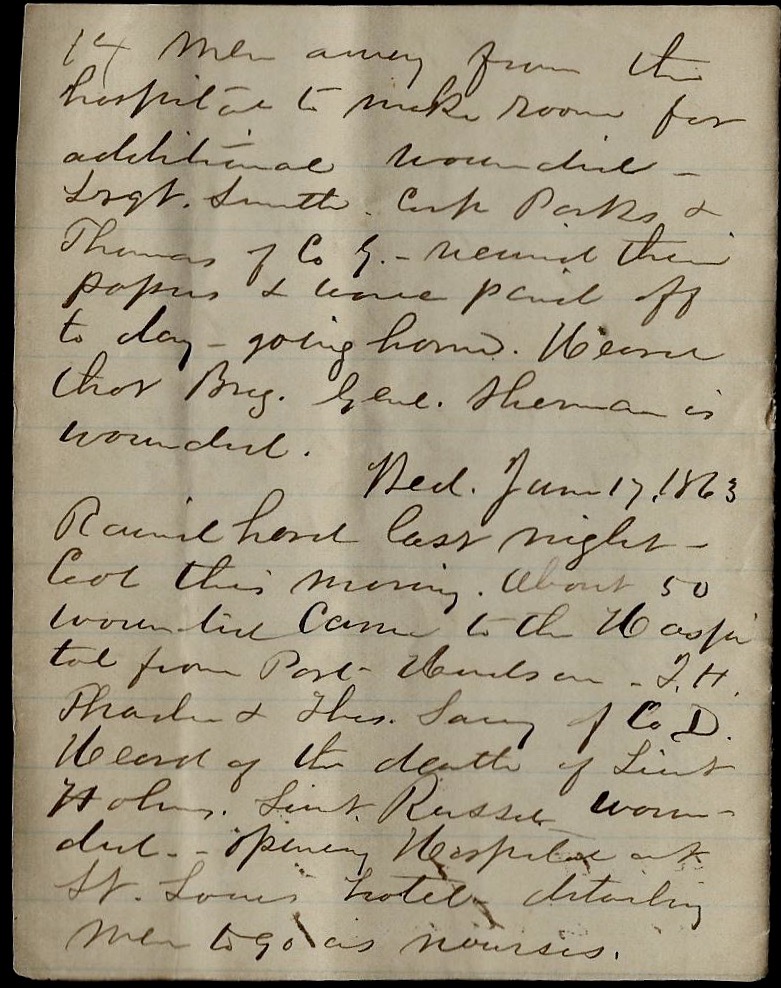
Tuesday, June 16th 1863—Cool this morning. Exciting news from Port Hudson. Few particulars. Sent letter No. 15 home. Rained hard in the eve. Some thunder and lightning. Exciting rumors from Port Hudson. 4th Wisconsin Infantry entirely used up. Talking about sending men away from the hospital to make room for additional wounded. Sergt. [Joseph] Smith, Corp. Parks, & [George W.] Thomas of Co. G received their papers & leave, paid off today & going home. Heard that Brig. General Sherman is wounded.
Wed., June 17th 1863—Rained hard last night. Cool this morning. About 50 wounded came to the hospital from Port Hudson [including] Israel H. Thrasher & Thomas Savery of Co. D. Heard of the death of Lieut. Holmes, Lieut. [George B.] Russell wounded. Opening hospital at St. Louis Hotel. Detailing men to go as nurses.
University Hospital, June 18th 1863—Clear, hot day. About 60 wounded from Port Hudson came to hospital yesterday and today. Thirty or more discharged men left in Matensas for the North, among them [George W.] Thomas of Co. G, and Sergt. [Joseph] Smith of the 38th Mass. Several men left to go as nurses at the St. Louis Hospital. Doctor did not come round today. Reinforcements from Key West, 26th and 47th Mass, went up the river to Port Hudson. Papers contain nothing of movements, successes or reverses in this department. All the information to be had is derived from wounded men whose stories differ so much that but little can be relied on them. Weitzel had has got within fortification at Port Hudson & holds his position.
Friday, June 19th, 1863—Hot day, Several men detailed for St, Louis Hospital. Sent for in the morning by Dr. Conner. Wished me to send down my cord [?] which I did. [George W.] Belcher & [John] Peters were also sent for by the Doctor.
Saturday, June 20th 1863—Sent letter No. 16. Received letter from home [dated] May 24th. Rumors of the Rebs burning 4 or 5 steamers on the Bayou Plaquemine. Heard firing Thursday night up the river. Boats going up the river take on board guns and protect themselves with plating around the pilot house.
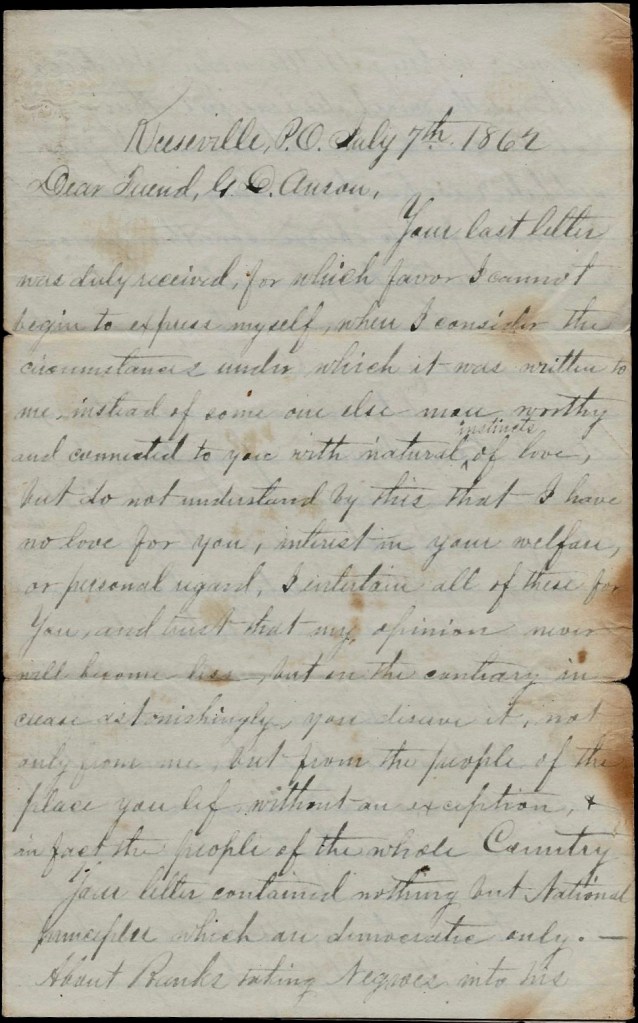
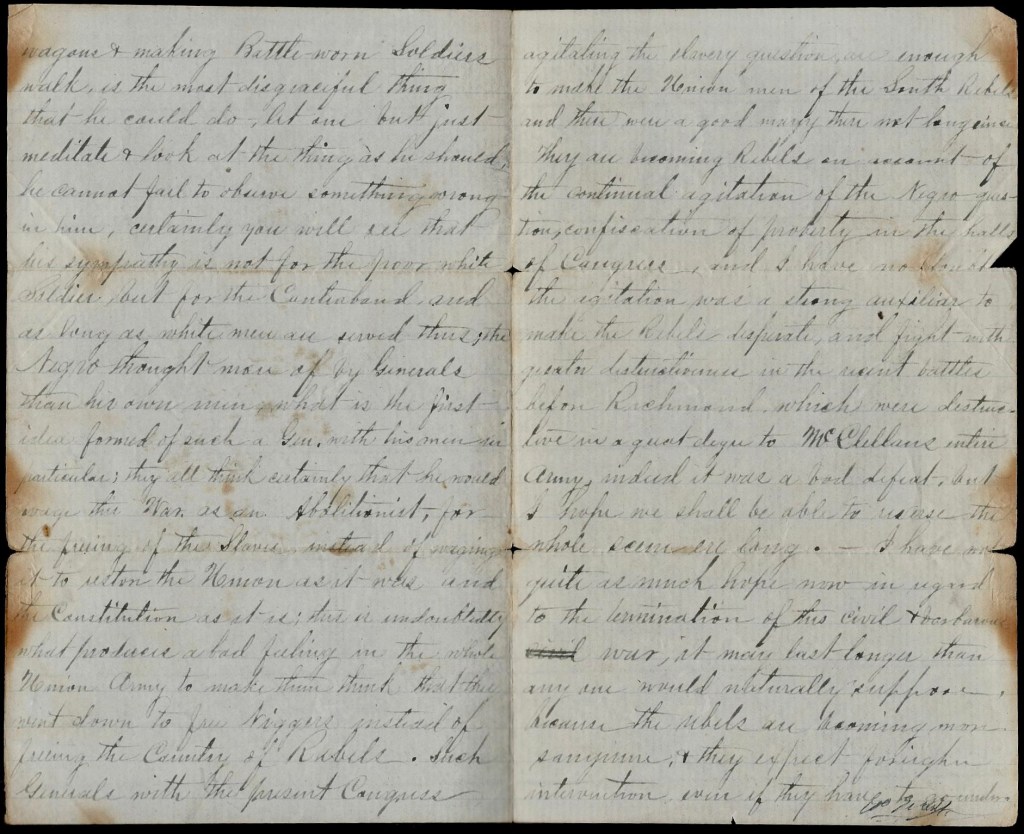
Unfortunately the author of this letter is lost to history but the content is worth preserving. The author captures a general sentiment held in the North that the Lincoln Administration was moving away from its original intent to preserve “the Union as it was and the Constitution as it is” to one in which slaves were to be liberated and made equals to the whites which many Federal soldiers and their families back home objected to.
The letter was addressed to George D. Anson who was a private in Co. A, 1st Vermont Cavalry from November 1861 to November 1864.
Transcription
Keeseville P. O. [Vermont] July 7th 1862
Dear Friend G. D. Anson,
Your last letter was duly received for which favor I cannot begin to express myself when I consider the circumstances under which it was written to me, instead of someone else more worthy and connected to you with natural instincts of love, but do not understand by this that I have no love for you, interest in your welfare, or personal regard. I entertain all of these for you, and trust that my opinion never will become less, but in the contrary, increase astonishingly. You deserve it, not only from me but from the people of the place you left without an exception, & in fact the people of the whole country.
Your letter contained nothing but National principles which are democratic only. About Banks taking Negroes into his wagons and making battle-worn soldiers walk, is the most disgraceful thing that he could do, let one but just meditate & look at the thing as he should, he cannot fail to observe something wrong in him. Certainly you will see his sympathy is not for the poor white soldier but for the contraband and as long as white men are served thus, the Negro thought more of by Generals than his own men, what is the first idea formed of such a General with his men in particular. They all think certainly he would wage the war as an abolitionist for the freeing of the slaves instead of waging it to restore the Union as it was and the Constitution as it is. This is undoubtedly what produces a bad feeling in the whole Union army to make them think that they went down to free Niggers instead of freeing the country of rebels.
Such generals with the present Congress agitating the slavery question are enough to make the Union men of the South rebels and there were a good many there not long since. They are becoming rebels on account of the continual agitation of the Negro question, confiscation of property in the halls of Congress, and I have no doubt the agitation was a strong auxiliar to make the rebels desperate and fight with greater determination in the recent battles befre Richmond which were destructive in a great degree to McClellan’s entire army. Indeed, it was a bad defeat, but I hope we shall be able to reverse the whole scene ere long.
I have not quite as much hope now in regard to the termination of this civil & barbarous war. It may last longer than anyone would naturally suppose because the rebels are becoming more sanguine & they expect foreign intervention even if they have to go under… [rest of letter missing]






















 Spared & Shared 23