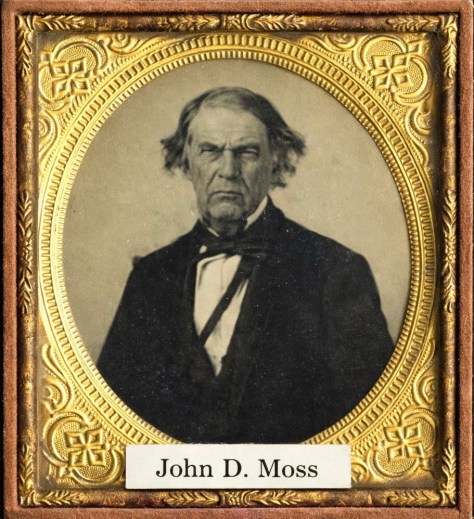
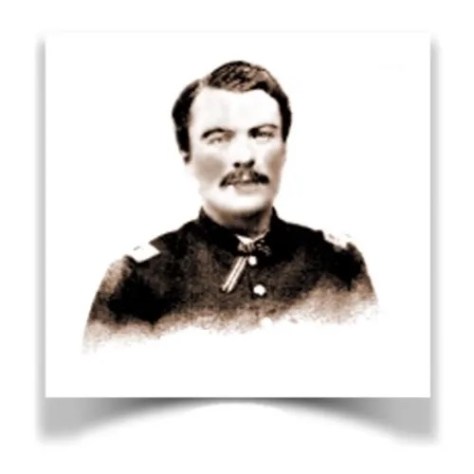
An AI sharpened image of John Dortch Moss from Ancestry.com
The following letter was written by John Dortch Moss (1792-1864), a farmer residing in Athens, Clarke county, Georgia, at the time of the outbreak of hostilities between the North & South. He wrote the letter to his son, John Chesterfield “Goode” Moss (1833-1908) who was married in 1858 and resided in Tallapoosa county, Alabama, at the time. At the time of the 1860 US Census, J. D. Moss was the owner of eleven slaves ranging in age from 5 to 34—7 males and 4 females. Aside from his farm, J. D. Moss was a businessman. He created the John D. Moss Cotton Company in Athens.
Moss’ letter, written just two weeks after the firing on Fort Sumter, refers to the arrival in Athens of the Banks County Guards—organized and accepted into state service at Homer, Banks County, Georgia, on April 20, 1861. They became Co. A, 2nd Georgia Infantry under the command of Capt. Daniel Gill Candler. They passed through Athens in late April and arrived in Savannah in early May. It also refers to the closure of the college in Athens (forerunner of the University of Georgia) due to students leaving to enlist.
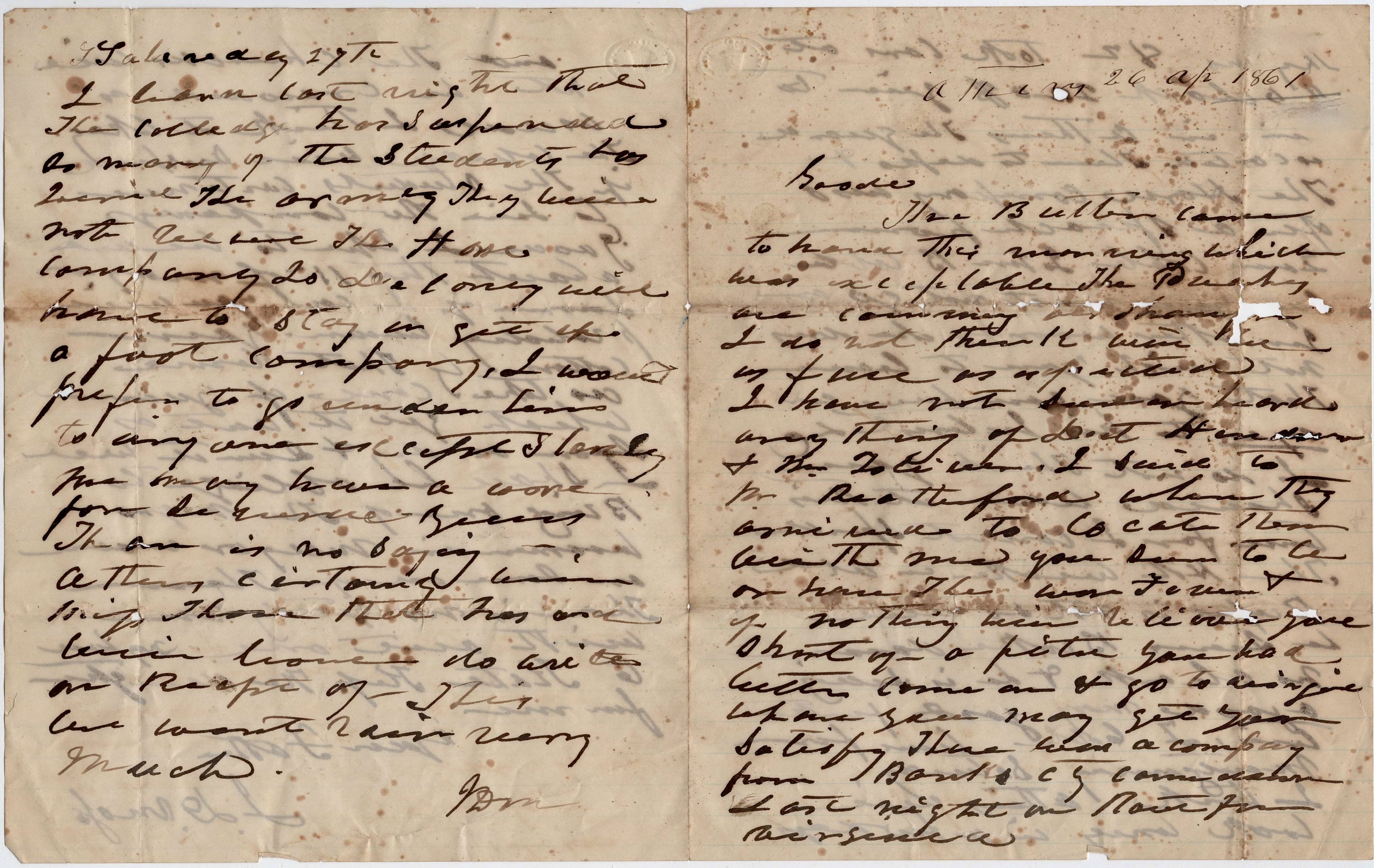
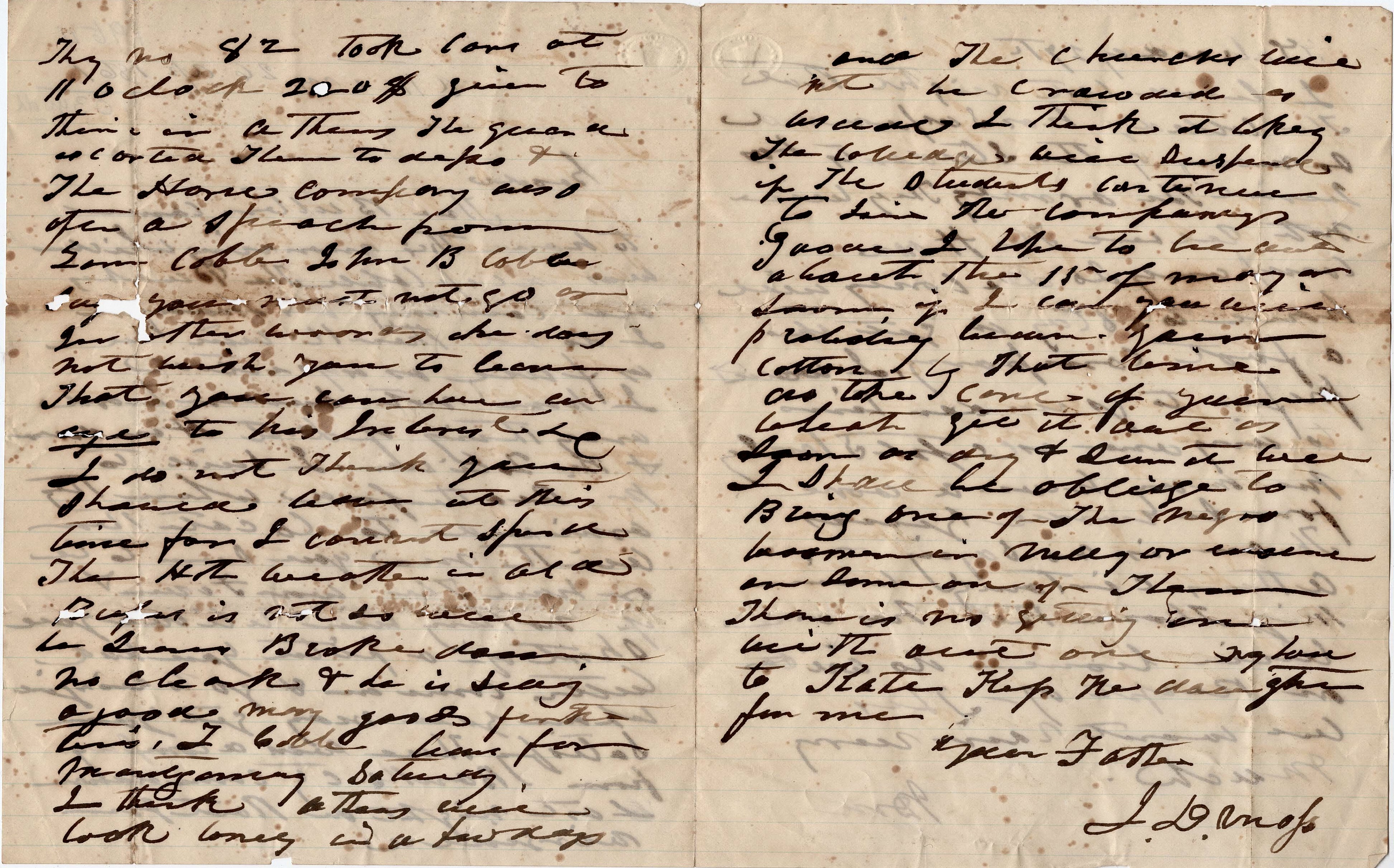
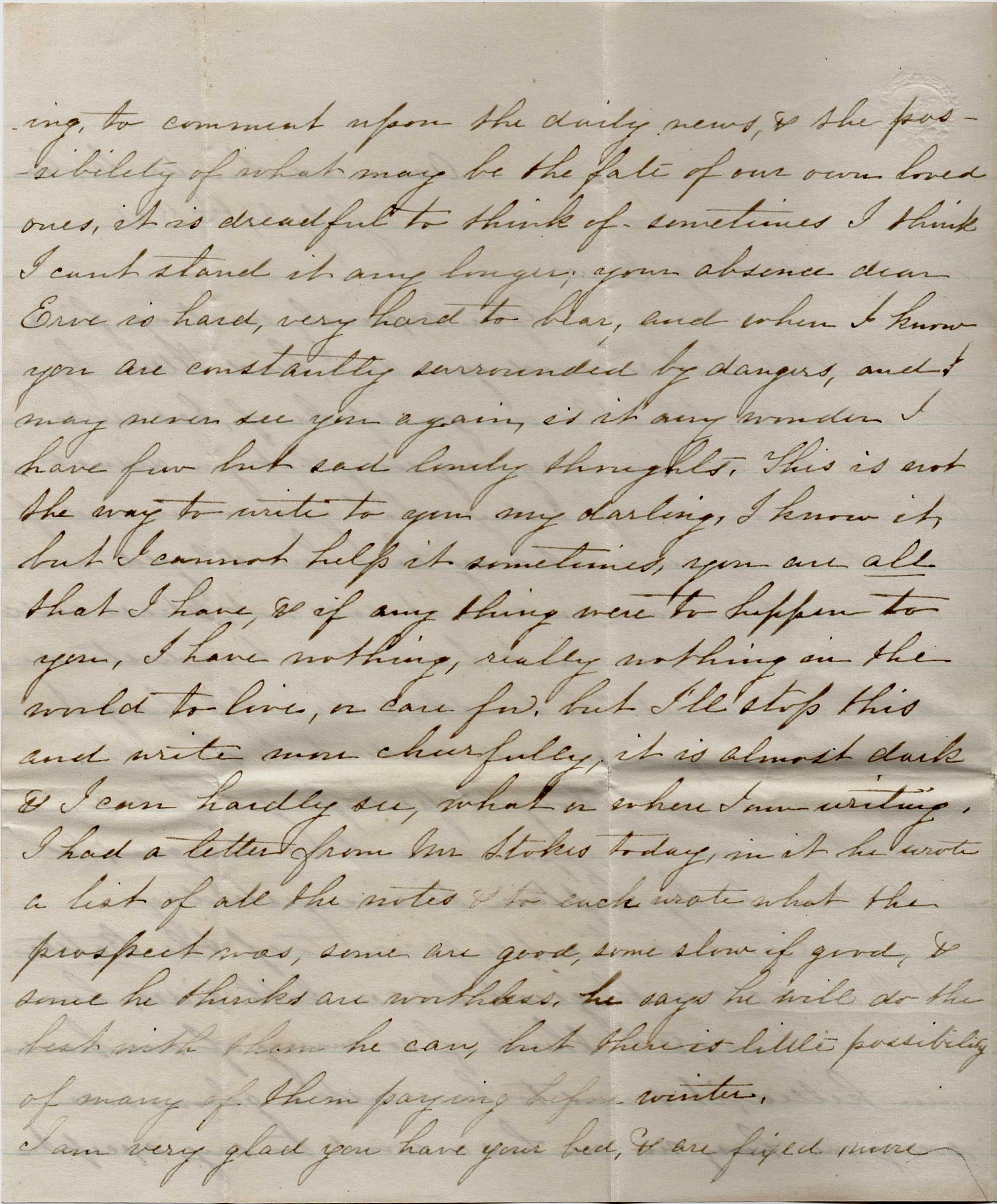
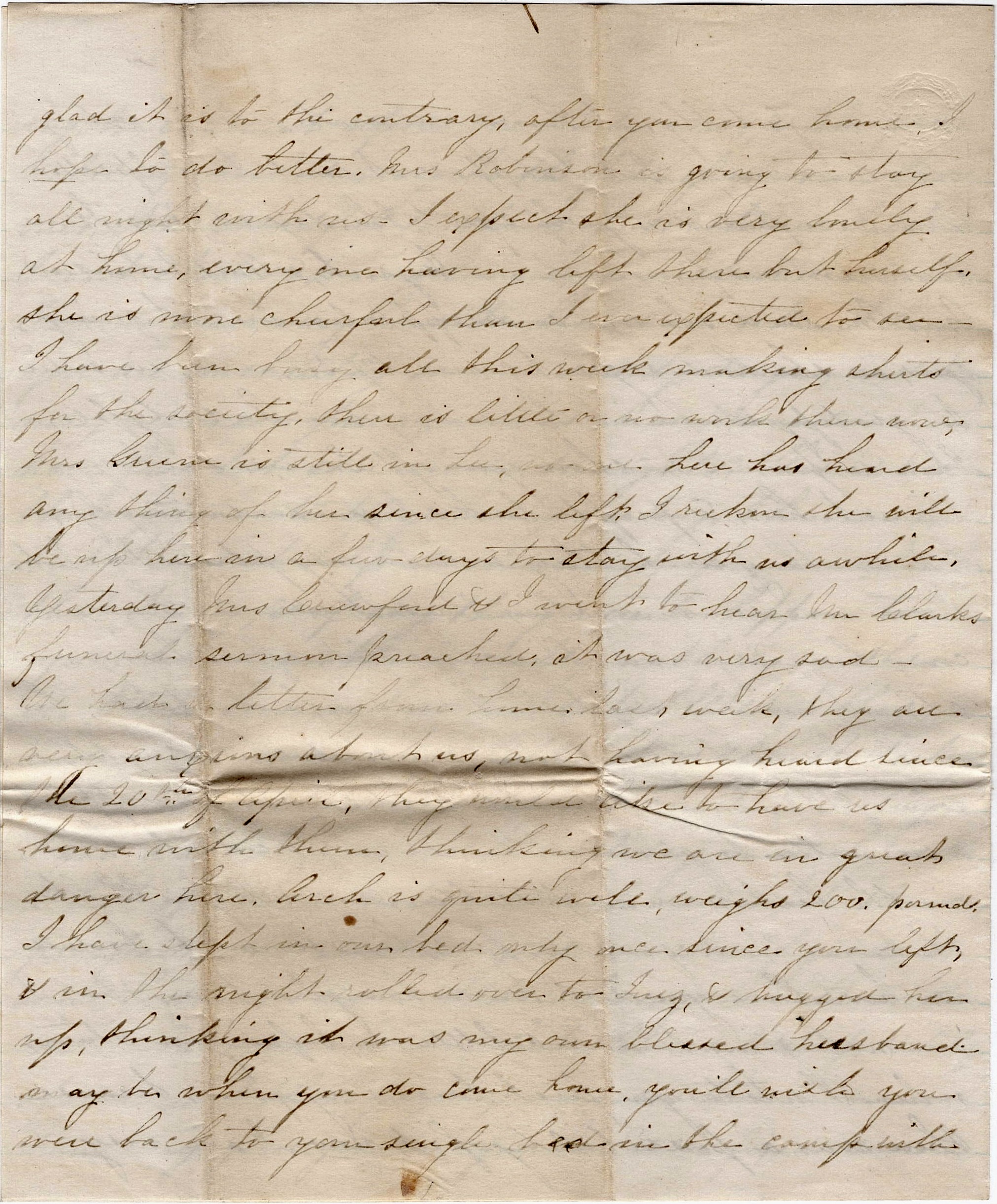
[Editor’s note: J. D. Moss’ handwriting is extremely poor and a challenge to translate but scans of the letter are included for the benefit of those more capable than myself.]
T R A N S C R I P TI O N
Athens [Georgia] 26 April 1861
Goode,
The butter came to hand this morning which was acceptable. The [ ] are coming on [ ]. I do not think [ ]. I have not seen or heard anything of Doct. Henderson & Wm. Toliver. I said to Mr. Rutherford when they arrived to locate them with me.
You seem to be or have the war fever & if nothing will relieve you short of a [ ], you had better come on and go to [ ] where you may get your satisfy. There was a company from Banks county came down last night on route for Virginia. There was 82 took cars at 11 o’clock; $200 given to them in Athens. The guard escorted them to the depot. The Horse Company was also after a speech from [ ] Coble. John B[oswell] Cobb says you must not go, or in other words, he does not wish you to leave; that you can have an eye to his interests, &c. I do not think you should leave at this time for I cannot spare.
The hot weather is at a [ ] old Rufus is not so [ ]; he seems broke down. No clerk & [ ] is doing a good many jobs for the times. T. Coble heard from Montgomery Saturday. I think Athens will look lonely in a few days and the churches will not be crowded as usual. I think it likely the college will suspend if the students continue to join the companies.
Goode, I hope to be out about the 15th of May or sooner if I can. You will [ ] your cotton by that time as the care of your wheat. Get it out as soon as dry and sun it well. I shall be obliged to bring one of the negro women in [ ] or [ ] on someone of [ ]. There is no getting on without one. My love to Kate. Kiss the daughter for me. Your Father, — J. D. Moss
Saturday 29th. I learn last night that the college has suspended, so many of the students has joined the army. They will not [ ] the Horse Company so Delaney will have to stay or get the foot company. I would prefer to go under him to anyone except Stanley [?]. We may have a war for [ ] years—there is no saying. Athens certainly will miss those that has and leaving home. Do write on receipt of this. We won’t [ ] very much. — J. D. M.
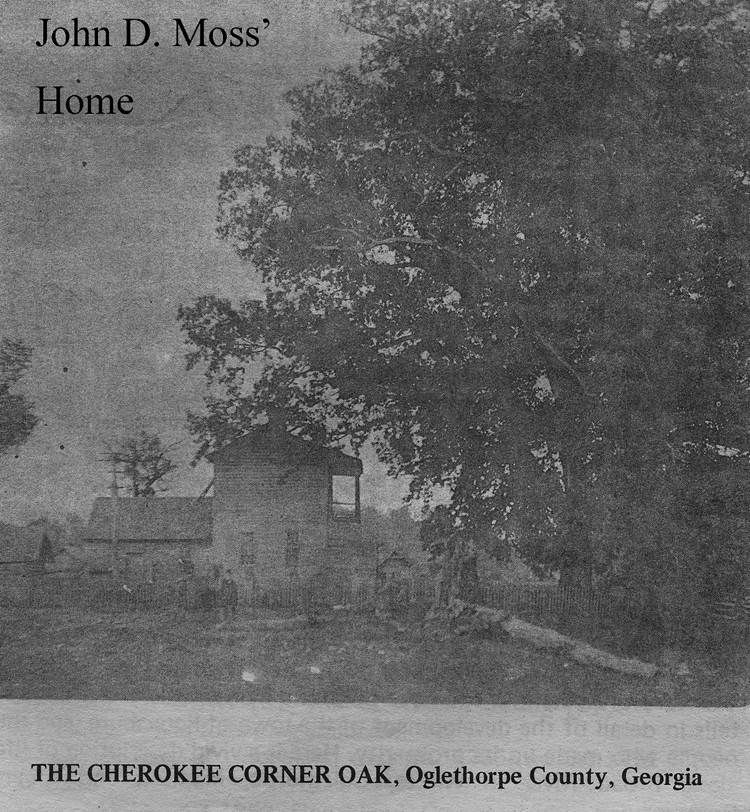
The John Dortch Moss home on the road between Athens and Lexington, GA, at Cherokee Corner, Oglethorpe County, Georgia; digitized by descendant Mary Bondurant Warren (1930-2021). From Ancestr.com
Emma Louise (Ronaldson) Eldridge (1833-1879) to her husband, Erwin James Eldridge (1833-1902) just days after the Battle of First Manassas. She was the daughter Archibald Ronaldson (1808-1865)—a Scottish-born coal mine engineer—and Ellen Jemima Ogilvie of Philadelphia, Pennsylvania.
Erwin was born in Cecil county, Maryland, on February 3, 1833. After earning his medical degree in 1856 from Jefferson Medical School in Philadelphia, he traveled to Vienna, Austria. During his time overseas he served as a surgeon in the Crimean War. When he returned to the United States, he lived in Maryland for a time before relocating to Americus, Sumter county, Georgia. When the civil war began, he enlisted as a sergeant in Co. A, 11th Battalion, Georgia Artillery (a.k.a. the “Sumter Flying Light Artillery”). In July 1861, however, he was appointed an Assistant Surgeon in the 16th Georgia Infantry. By early 1864, he was promoted to Chief Surgeon of Gen. Cobb’s Division. By 1870, Dr. Eldridge was living in Americus, Sumter County, Georgia. He would go on to work as a physician and druggist in Lee and Sumter Counties, Georgia. On March 13, 1902, Dr. Eldridge died and is buried at Oak Grove Cemetery, Americus, Sumter County, Georgia.
See also, in the Digital Library of Georgia, Dr. Erwin J. Eldridge letters, 1860-1865. “The collection consists of three letters from Dr. Eldridge while in service in the Confederate Army. He writes to his wife, Emma of items that he picked up on the Manassas battlefield that he wished to send home to his son, also of long marches and Confederate officers from his experience. Also in this collection are seven much longer letters from Emma to Dr. Eldridge through the care of Howell Cobb’s famous Georgia regiment. In them she describes news of their home from Americus, Georgia, including war news, family matters and a detailed description of a tornado that ripped through town sending slaves and livestock flying through the air. The remaining letters are from family and friends displaying concern for Dr. Eldridge and other family members in the service of the Confederacy.”
T R A N S C R I P T I ON
Americus, Sumter county, Ga. July 24th 1861
My own darling Erve,
After anxiously waiting for a week, I at last received your dear, kind letter by Mr. Davidson. The other one you spoke of has never reached me & I am sorry, very sorry, that you did not tell me in the one of today what you were in need of and want me to send. It may have been delayed and reach me tomorrow. In case it does not, please write me again what you want. I could not understand Mr. Daniels about the bundle & the only thing I could think of were your credentials from the college in Philadelphia. I thought perhaps you had some idea of getting an appointment as surgeon & sent them on by Captain Sirrin [?] yesterday.
We have received terrible accounts of the Battle at Manassas, with great loss on both sides. How terrible it was, & to think of so many of our brave men killed, it seems to have cast a gloom over everyone here. No one has a word to say excepting to comment upon the daily news, & the possibility of what may be the fate of our own loved ones. It is dreadful to think of. Sometimes I think I can’t stand it any longer. Your absence, dear Erve, is hard—very hard to bear, and when I know you are constantly surrounded by dangers, and I may never see you again, is it any wonder I have few but sad lonely thoughts.
This is not the way to write to you, my darling, I now it. but I cannot help it sometimes. You are all that I have & if anything were to happen to you, I have nothing, really nothing in the world to live or care for. But I’ll stop this and write more cheerfully.
It is almost dark & I can hardly see what or where I am writing. I had a letter from Mr. Stokes today. In it he wrote a list of the notes & to each wrote what the prospect was. Some are good, some slow if good, & some he thinks are worthless. He says he will do the best with them he can but there is little possibility of many of them paying before winter.
E. Eldridge (1860)
I am very glad you have your bed & are fixed more comfortably. I know you don’t relish eating off of your lap, but I suppose it can’t be helped. Mrs. Crawford & myself spent the day at Mrs. Hancocks in company with Mrs. Myrick & Mrs. Robinson. Mrs. Myrick said she was so disappointed inn not seeing you, as she had a great curiosity to do so. In order to gratify it, I sent home for your Ambrotype. I am so proud to show you off, Erve, even if you are not here & people look at you so admiringly. I know they wish they were in my place. Mrs. Robinson was commiserating the soldiers who have come home & found their wives sick after being absent so long—Captain Johnson for instance. His wife has just had a baby. She said she thought some of the ladies should hold a meeting & appoint a committee to go and console with him & console him in the best manner possible. Erve, did you think that Mrs. Richardson—so quiet and good—had so much badness in her?
Erve, you don’t know how glad I am that I am not going to have a little one before your return. When I wrote you first I was very glad, because there was a possibility of it. Now I am very glad it is to the contrary. After you come home, I hope to do better. Mrs. Robinson is going to stay all night with us. I expect she is very lonely at home, everyone having left there but herself. She is more cheerful than I ever expected to see.
I have been busy all this week making shirts for the society. There is little or no work there now. Mrs. Greene is still in Lee. No one here has heard anything of her since she left. I reckon she will be up here in a few days to stay with us awhile. Yesterday Mrs. Crawford & I went to hear Mr. Clark’s funeral sermon preached. It was very sad.
We had a letter from home last week. They are very anxious about us not having heard since the 20th of April. They would like to have us home with them thinking we are in great danger here. Arch is quite well, weighs 200 pounds.
I have slept in our bed only once since you left & i the night rolled over to Inez & hugged her up, thinking it was my own blessed husband. Maybe when you do come home, you’ll wish you were back to your single bed in the camp with no one to trouble you. I wish I could see you. It seems months since you left me. I used to think I missed you as much as I possibly could when you were down here before we were married. But oh! Erve, it is a thousand, thousand times worse. When you return, I hope I shall never be separated from you again until I die. Many persons have said since you left, that I take your absence very well indeed. They can’t tell my thoughts, Erve, and don’t know the desolate blank in my heart caused by your absence. God grant you may be safe at home by Christmas. Even that seems like years to look forward to.
I hope Erve that I will receive your letter tomorrow. The mails are so irregular. It may have been delayed somewhere on the road. Some of our letters come in four days. My first one took seven. If I should get it tomorrow, I will get the things immediately and send on by the first opportunity.
I am very glad indeed that the company attend religious services. It is so important. God bless them in endeavoring to do right. Not only bless them in this life but in that which is to come. Mrs. Crawford sends much love to you & says she will write you soon. Inez also. I have not heard a word from Mrs. Bryan although I wrote her some two weeks since. Major B. is still in Lee.
My pen is so miserable I can scarcely write. I must not mind looks though—especially now, so my own darling excuse both the composition and writing. I will supply myself with a new pen next time & hope my brain will be more active. Mrs. Robinson, Inez, Mollie, and Lou all send a great deal of love to you. Do write very soon. Every line from you is a comfort and blessing to me. God bless & keep you my darling and bring you home safe to your own true & loving wife, — Em
Mrs. Hancock says, “Put a heap of love in there for Dr. & tell him to behave himself.” Mr. Cook gave here a small Ambrotype of you. I am glad he did. She prizes it very highly.
The following letter was written by Aaron Hayden Jones (1813-1868), the son of Stephen Jones (1784-1856) and Elizabeth Brackett Young (1789-1828) of Eastport, Washington county, Maine. Aaron was the oldest son of 11 children. Aaron and his younger brother Thomas Gleason Jones (1817-1869) were in the wholesale and retail provision business in Augusta, Georgia, prior to the Civil War.
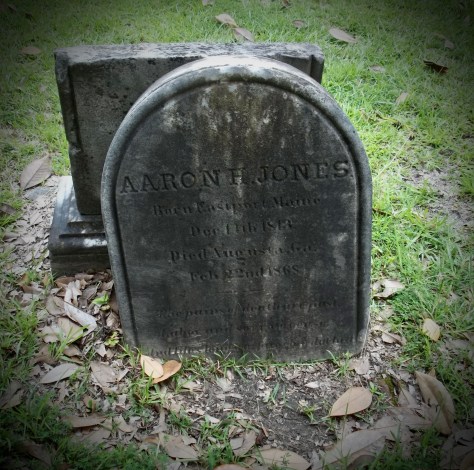
Aaron’s broken headstone in an Augusta Cemetery.
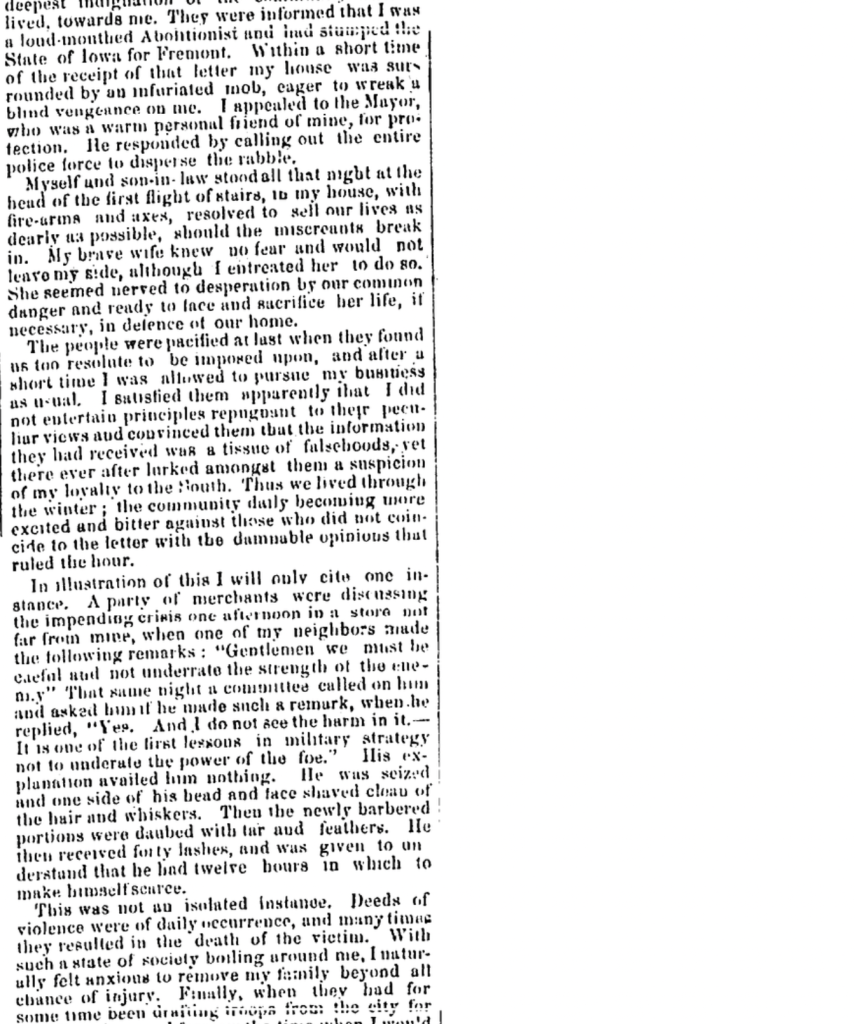
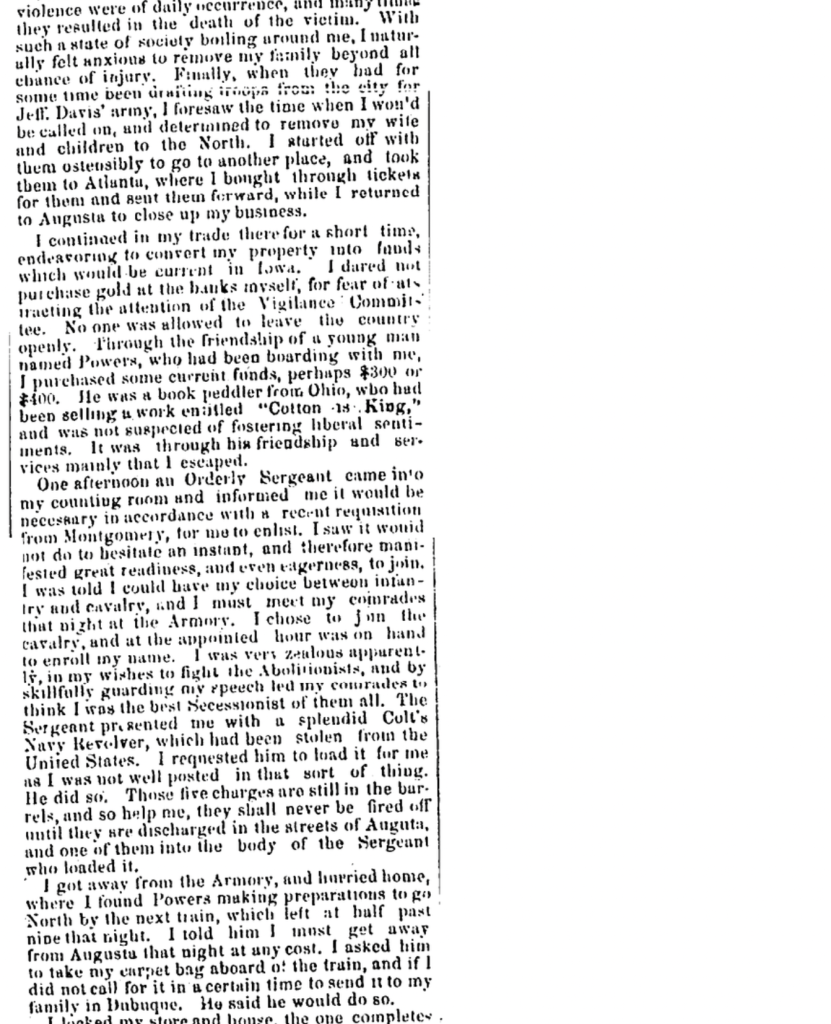
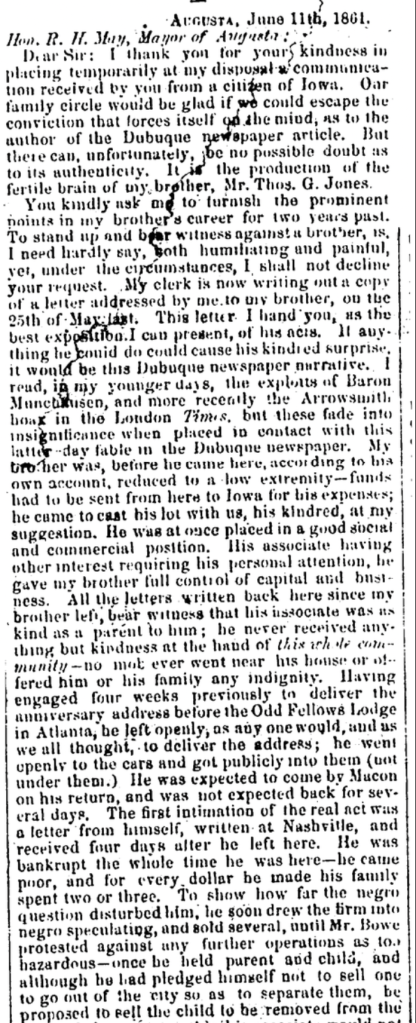
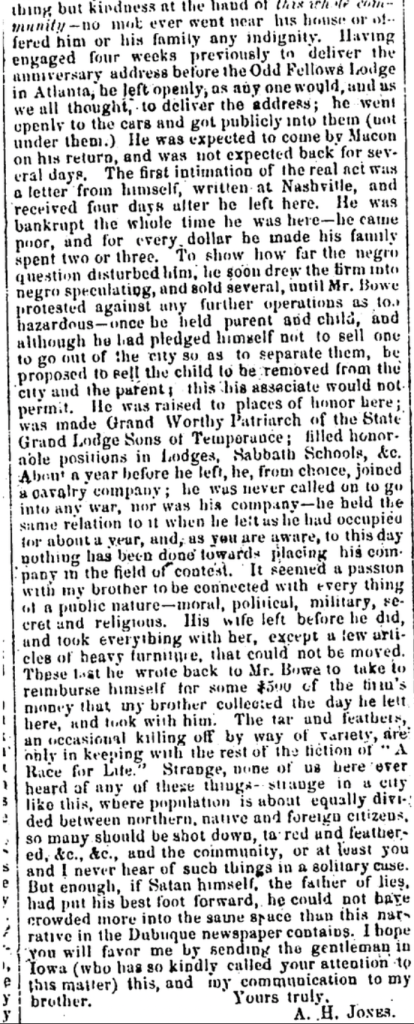
It seems Aaron and his brother Thomas worked in different firms, Thomas having previously operated in Dubuque, Iowa, before coming to Atlanta. A newspaper article published in a Dubuque newspaper in May 1861 under the title, “A Race for Life” contends that Thomas was driven out of Augusta under threat of being tarred and feathered because he was a “loud-mouthed Abolitionist” and was rumored to have stumped the State of Iowa for Fremont in 1856. He supposedly returned to Iowa having left all his assets behind. Once the citizens of Augusta read this article, they approached Aaron to attest to the veracity of this story. In response, Aaron wrote a letter to the editor of the Augusta paper, the Daily Constitutionalist (21 June 1861) refuting the “facts” in this story, alleging that Thomas was never a successful businessman and left Augusta penniless and in debt. He was no Abolitionist either, according to Aaron, and even speculated in the sale of slaves while living in Georgia. [See articles clipped from newspapers in footnotes below.]
Neither brother lived long after the war. Thomas moved his wife and children to Anoka, Minnesota, where he became a life insurance agent and died of “apoplexy” in 1869. Aaron appears to have maintained his business throughout the Civil War in Augusta but no doubt suffered as the prolonged war made keeping his shelves stocked more and more difficult. He died in 1868 at the age of 55. During the war, he filled the ranks occasionally with the Home Guard militia.
Aaron’s letter gives us a glimpse of Augusta in the first full month of the Civil War. His letter alludes to the disruption of the mails caused by the collapse of the mail delivery system in the South as well as the delivery of goods up the Savannah River. His letter also informs us of the formation of a women’s military organization in Augusta equipped and trained for home defense. I could not corroborate this claim from other accounts but believe Aaron’s statement to be factual based upon the evidence of other such companies being formed, the most notable and frequently referenced being Nancy Hart’s Militia formed in LaGrange, Troup County, Georgia. In 1861, when 1,300 men left LaGrange, leaving the town particularly vulnerable to Union attack because of its location midway between Atlanta and the Confederacy’s first capital at Montgomery, Alabama, two of the soldier’s wives—Nancy Hill Morgan and Mary Alford Heard—decided to form a female military company. Almost forty women attended, ready to do their part to defend their homes and families.
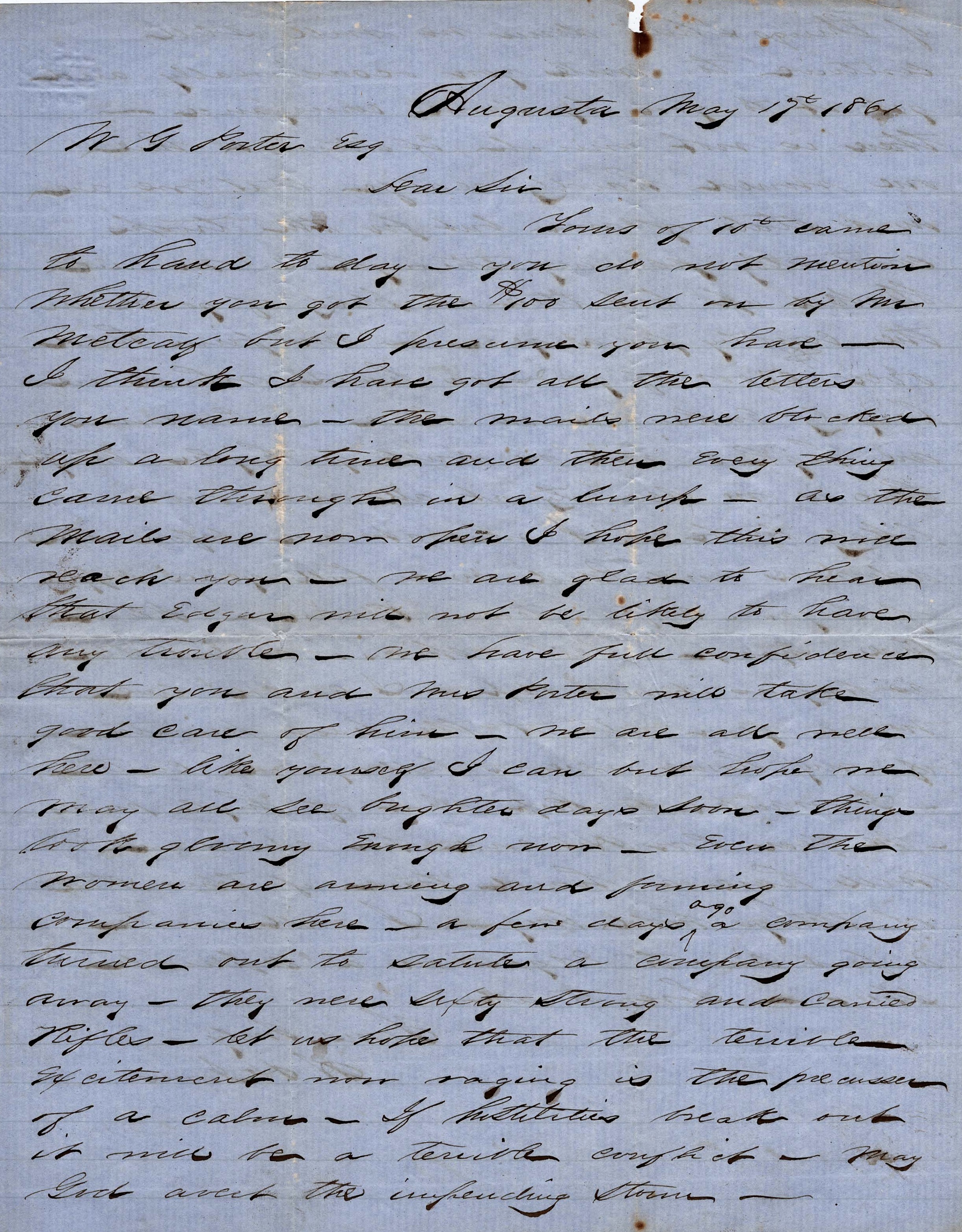
T R A N S C R I P T I O N
Augusta, [Georgia] May 17th 1861
W. G. Porter, Esq.
Dear sir, yours of 10th came to hand today. You do not mention whether you got the $100 sent on by Mr. Metcalf but I presume you have. I think I have got all the letters you name. The mails were blocked up a long time and then everything came through in a lump. As the mails are now open, I hope this will reach you. We are glad to hear that Edgar will not be likely to have any trouble. We have full confidence that you and Mrs. Porter will take good care of him. We are all well here. Like yourself, I can but hope we may all see brighter days soon. Things look gloomy enough now. Even the women are arming and forming companies here. A few days ago a company [of women] turned out to salute a company going away. They were sixty strong and carried rifles.
Let us hope that the terrible excitement now raging is the precursor of a calm. If hostilities break out, it will be a terrible conflict. May God avert the impending storm. If things shut down, we will still continue to write you occasionally and get it to you by some conveyance.
There is not much excitement here. One would hardly realize that we are in a state of war but for the troops constantly passing through. We are blocked up but there are plenty of goods in the country for a year. One firm had over $50,000 of goods on hand which are largely enhanced in value. Provisions are high and with no doubt go higher though there is no scarcity at all and not likely to be. I went at once before the advance and laid in a full year’s supply of sugar, coffee, tea, bacon, flour, rice, syrup, salt, spices, and butter as long as it will keep. I could live now a year without the least privation if my house were a beleaguered castle. I wanted to keep clear of high prices.
We fear poor Het and her children will have a hard time if this state of things hold long. I will write a few lines to Edgar on a separate sheet. Love to all. Yours truly, — A. H. Jones
The following letter was written by Willard Simpson Wells (1835-1865), the son of Willis Lea Wells (1805-1887) and Druscilla D. Sexton (1813-1888) of Stone Mountain, DeKalb county, Georgia. “Simpson” Wells served in Co. D, 38th Georgia Infantry during the Civil War. He wrote this letter to his brother, George Riley Wells (1838-1919) who served as a Lieutenant in the same company until he was captured at Spottsylvania and spent the remainder of the war in a Union prison. George was also the only one of five brothers who survived their service in the Confederate army. Simpson’s health did not allow for active service late in the war and he was detailed as nurse in Rome, Georgia, for many months late in the war. He died at a hospital in Macon, Georgia, on 16 April 1865 just as the war was coming to a close.
With pleasure I embrace the present opportunity of writing you a line, although I have nothing important to write you. We still have very bad weather here and prospect for another snow. And judging by the weather here, I guess it very bad in Virginia. I am afraid that you have had to leave your comfortable quarters from what i heard, and turn out to marching again in the cold. But I hope you have not yet. I heard recently that Longstreet’s Corps was traveling to the South. I wish Jackson’s would move to the South too for I never want to come to Virginia anymore. My furlough expires on the twenty-fifth of March and I shall need another extension, but I fear I shall not be able to get it for I have done over one extension and I don’t think the same Board will be willing to give me another.
We have been almost jubilant about the ending of the war but I am afraid it was all for nothing for I don’t see much prospect now of its ending soon. At any rate, I am afraid that there will be a great deal of hard fighting to do yet before the end.
I wish you could get a furlough and come home but then it would not be much pleasure to you to see the hard times that are in this country for it really looks like starvation is almost inevitable all over the whole country.
I am sorry that you made the trade with Rhenny for you have bought a dear bargain from accounts, but maybe you can trade it to someone and save yourself. I am not ready to give up my transfer business yet, and I have passed an examination and expect to get my papers approved in a short time and will then send them to the Captain and I shall want you to do all you can for me. I don’t think my health will be sufficient to return to Virginia very soon. My health is very poor yet, but I hope I am improving some for I have not strength to walk but very little at one time and I can’t get up on a horse by the stirrup in consequence of my muscular power having failed and I am utterly worthless to myself or Jeff Davis either now.
Our vaccination sores are hurting us all very bad here. We have been vaccinated with something that we can’t get well of and it’s almost as bad as smallpox itself. I am afraid we are badly bitten in our efforts to prevent the smallpox.
All Joe Brown’s commissioned officers are ordered to Savannah. I don’t know what it is for but I guess the Yankees are trying to make a demonstration in that direction, but I hope they will not be able to take the city.
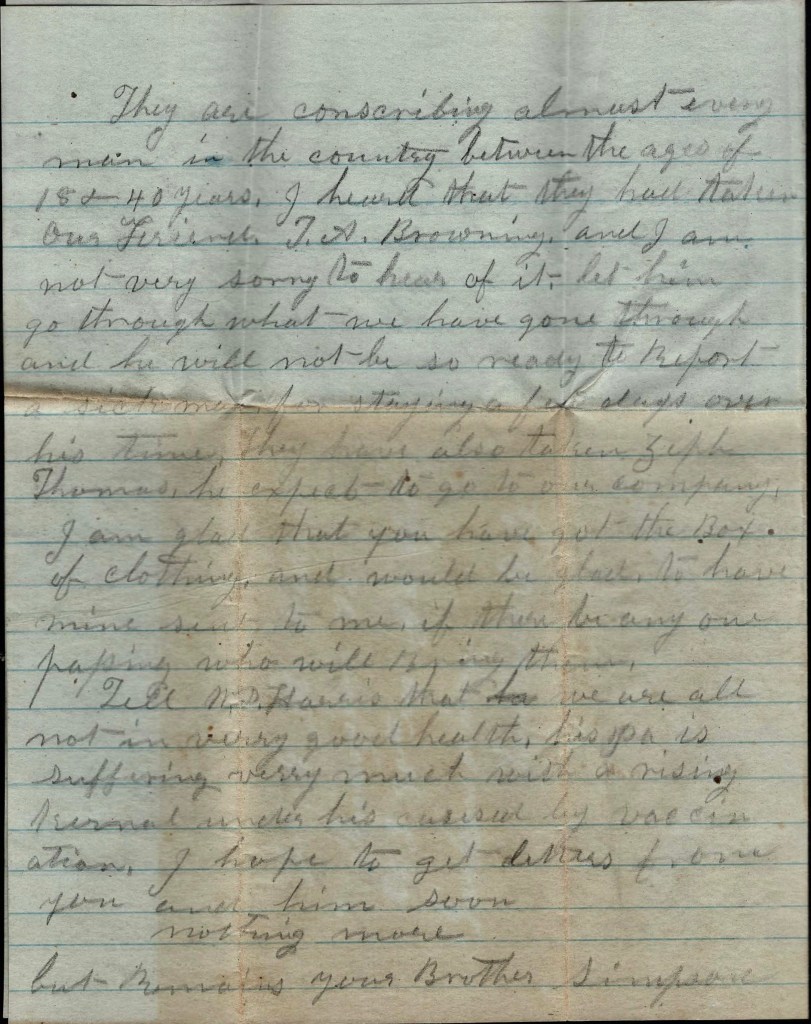
They are conscribing almost every man in the country between the ages of 18 and 40 years. I heard that they had taken our friend, T. A. Browning, and I am not very sorry to hear of it. Let him go through what we have gone through and he will not be so ready to report a sick man for staying a few days over his time. They have also taken Ziph Thomas. He expects to go to our company.
I am glad that you have got the box of clothing and would be glad to have mine sent to me if there be anyone passing who will bring them.
Tell W. D. Harris that we are all not in very good health. His pa is suffering very much with a rising kernal under his [c____ed] by vaccination. I hope to get letters from you and him soon. Nothing more but remain your brother, — Simpson
How Mary might have looked in January 1862(Bob Celli Collection)
“These are dark days we are all passing through now, but some think it is only the beginning. The twilight, as it were, of a dark, long night, & that the New Year that has just dawned will be a “year of blood.” So wrote 32 year-old Mary Jones Wiley (1829-1893), the wife of Atlanta Hardware Merchant William H. Gilbert (1827-1882), in a letter to her aunt on New Year’s day in 1862. Mary’s aunt is not identified but was probably from the Wiley side of the family and a resident of Mobile.
Mary was the daughter of Edwin Wiley (1784-1866) and Eliza DeWitt (1797-1865) of Hancock county, Georgia.
[Note: This letter is from the private collection of Greg Herr and was transcribed and published on Spared & Shared by express consent.]
Transcription
“A happy New Year!” dear Aunty & may you be permitted to spend yet many New Years and always happy ones. I just wish you could sit down here with us today & spend a quiet day. I couldn’t promise you a very sumptuous dinner. I dare say you will do a great deal better in your elegant home—but I should love to see you here with us once more. It is a long time since we heard from you. I wish I was as good a correspondent as you are. It is a real pleasure to have a punctual correspondent.
We are all, I am glad to say, in our usual health. My baby [“Maime”] is a little complaining with an eruption—from teething I think—but she is a great big, fat baby, very much resembling my little boy [Alfred].
Well, what shall I write about? There are many things no doubt you would like to hear—that I cannot think of. These are dark days we are all passing through now, but some think it is only the beginning. The twilight, as it were, of a dark, long night, & that the New Year that has just dawned will be a “year of blood.” God be with us—protect & sustain us. The sacrifice has already been great, but doubtless we are not sufficiently humbled yet, or our punishment would be removed. Well, we will know how to enjoy & appreciate peace & liberty when it does come.
I don’t think any of us have written since Wells was here on his way to Pensacola. But he said he was going to Mobile & I dare say you have seen him long before this. I never saw anyone more changed in appearance than he. He looked so well. We were all very glad to see him. I have lately heard quite particularly from Hancock [county, Georgia]. Mr. G[ilbert] spent a week just before Christmas there & visited all around at sister’s, Cousin Billy Lewis, R[ichard] M[alcolm] Johnston’s, Pa’s, &c. &c. He found Cousin Billy sick with a cold, but he has got over it entirely. They were all at home. Mat was quite unwell too he said, but up. She had a dreadful cold. Ma has had a very severe attack this winter & is still very feeble. I fear she is failing very fast. I do believe that the troubles of the country have much to do with it. She & Sallie made me a little visit in October. Sallie bears Sammy’s absence surprisingly well, but she has many, many trials.
Mr. [Richard Malcolm] Johnston & Fannie & family 1 are well and have lately moved back from Athens to their old place [near Sparta], built a large comfortable cottage with eleven rooms, & will soon have it filled with boys. He is going to teach a select school. They have got their hands full certain. Mr. G[ilbert] said they are killing hogs and the plasterers there, house full of mud and plank, & laths & everything of course topsy turvey hurrying to get things straight for the boys.
You asked in your last to me about Aunt Avis. 2 She is very feeble this winter but is at times very calm & even appears almost cheerful but I don’t know that she is any more reconciled to her loss. She grieves for those two previous children. Henry [Dewitt Beman] & his wife came back to Georgia last June & are now living at Uncle Beman’s. They are very much attached to Belle who is devoted to them & adds immensely to their happiness. Poor Tom, lost his wife this last summer. She died of typhoid fever there at Uncle Beman’s after weeks of intense suffering. Left three little ones—the baby but eight months old. Tom has given to Henry & Bella who had no children. Aunt Avis has the other two—Willie & Kate. The baby’s name is Edward. Tom has lately gone on to Virginia to join his company—the same one that Sammy belongs to. Sammy has had an attack of Catarrhal fever. Was in Richmond several weeks but was fortunate enough to get to a very nice, private house. Has recovered & I believe gone back to his tent home.
Jesse [Gilbert] 3 was here last week, on a sick furlough, but got well and has gone back. He has been sick a good deal of the time & is hardly as stout as he was. Maggie is keeping house here on their lot. Her baby is rather delicate. I forget whether I wrote to you since it was born or not. It’s name is Eliza H.
We heard yesterday of the death of Mr. Bryan & we heard too that Russell Whaley’s wife committed suicide a few days ago by cutting her throat. You know they live near Sparta. 4 Mrs. John Bonner also is dead—poor woman. What a sufferer she has been with that cancer.
We have had a most delightful winter—no snow or sleet & not very much ice. But today looks threatening & I fear we are to have winter weather the remainder of the winter. I suppose you all are almost ready to begin gardening. The weather has been very suitable for it here for the last few weeks. We are living here on our same lot but have at last moved the kitchen back & built a house for the negroes, moved the stable &c. back & got all fenced in quite conveniently, & I must tell you that Mr. G[ilbert] sold that carriage yesterday that you didn’t fancy a bit, & I never did either, so I don’t know as we will have any at all when you come again. He says he will get one to suit him when he gets able.
I have lately heard from Ridgewood that Uncle Jones is better—able to ride out & sometimes speak so as to be understood. Aunt Jones is feeble. Julia has been very dangerously ill with “congestion of liver & upper bowels” but is now able to sit up. She & Dewitt were here last fall.
Monday. After such a long pause I sit down to finish my poor apology for a letter. I have written with such a miserable pen that I fear it will puzzle you to read this. Mother Gilbert wishes me to say to you that her health is better this winter that it has been in a long time & that you must not think hard of her for not writing. She has wanted to & felt like writing a long time but she is in constant trouble & anxiety about Jesse & can’t fix her mind on it. And that you must take part of this from her, &c. &c.
Mr. Gilbert sends love to you all. You must write & let us know how you are this winter & dear me, I see the Yankees are threatening Mobile. What so you all think of it? May the Lord send confusion into their midst & scatter them as chaff.
Mother G[ibert] joins me in love to yourself & Cousin M. & family. Believe me your affectionate niece, — Mary Gilbert
1 Richard Malcolm Johnson (1822-1898) attended Mercer University and then became a lawyer in 1843. In 1857 he accepted an appointment to the chair of belles-lettres and oratory at the University of Georgia in Athens. When the Civil War disrupted the college, he began a school for boys on his farm near Sparta. For a time he served on the staff of Confederate general Joseph E. Brown and helped organize the state militia. After the war he moved to Baltimore and opened a school for boys there.
2 Avis D. Dewitt (1800-1863) was the wife of Carlisle Pollock Beman (1797-1875) of Hancock county, Georgia. Their two oldest boys are mentioned in this letter. Thomas Spenser Beman (1825-1862) was married in 1856 to Lucy Mariah Preston (1835-1861). When she died on 24 September 1861, Thomas gave their youngest child, Edward Douglas Beman (1861-1928) to his brother Henry to raise. He the left his two eldest children, Willard P. Beman (1858-1926) and Kate D. Beman (1860-1951) to be raised by their grandmother while he returned to his regiment, 15th Georgia (Co. E), then quartered in Virginia. Thomas would never return to Georgia—he was killed in the Battle of 2nd Manassas on 30 August 1862.
3 Jesse D. Gilbert (1837-Bef1890) was the son of Darius Gilbert (1800-1850) and Elizabeth Hart Hardwick (1801-1891) of Atlanta, Georgia. Jesse was married to Margaret P. Rogans (B. 1840) in November 1860 and their first born child was Elizabeth (“Lila”) H. Gilbert (1861-1942). Lila was born on 1 September 1861.
4 It was Martha Ann Walker (1824-1860), the wife of Hancock county planter James Russell Whaley (1808-1892), who committed suicide. One source gives her death as 15 November 1860 but it was probably 1861. Russell soon married a second wide by the name of Susan Johnson (1830-1911).
This letter was written by Nancy Caroline Murphy (1836-1916), the daughter of Hiram Byrd Murphy (1807-1889) and Elizabeth Jackson (1812-1908) of Sharp Top, Cherokee county, Georgia. Nancy later (1877) married Francis (“Frank”) Marion Moss (1854-1926). In her letter, Nancy writes of her three younger brothers in the Confederate service, John “Franklin” Murphy (1838-1862), Isaac “Martin” Murphy (b. 1843), and “William” Lial Murphy (1843-1867). She also refers to her older sister, Julia Murphy (1831-1923), the wife of Pearson Lumpkin Worley (1831-1919).
Franklin (“J. F.”) Murphy served as a private in Co. D, Phillips’ Legion (Georgia Infantry). Co. D—known as “Polk’s Rifles” was with the regiment in the battle on 14 September 1862 at Fox’s Gap on South Mountain (Southerners referred to this as the Battle of Boonsboro). An 1863 death claim filed by Franklin’s wife, Phebe Ann (Worley) Murphy, states that Franklin was wounded and taken prisoner in the battle and died at Baltimore in captivity in late October 1862.
Serving in the same regiment with his brother, Isaac Martin Murphy was wounded in the back at the Battle of Sharpsburg and taken prisoner. He was exchanged at Fort Monroe on 13 October 1862 and furloughed home. He never returned to his regiment.
As stated in the letter, William Murphy served in Co. B, 34th Georgia. Accepting a bounty of $50, William enlisted in May 1862. He was taken a POW at Vicksburg on 4 July 1863 and paroled shorty afterward. He died young, however, in 1867.
Transcription
Cherokee County State of Georgia April 5, 1863
Miss Susan A. Hart,
Dear cousin, after a long delay, I seat myself to write you a few lines which if received, will inform you that we are all in tolerable health, hoping this will reach you enjoying the best of health. I reckon I will surprise you as think you have almost forgotten me. I thought I would write to you one more time & perhaps cause you to think of me again.
We have very cold weather for the season. The spring is uncommon late here. There is not a bud to be seen in the woods almost. Everything appears dull and lifeless. Times is very hard here as provision is very scarce.
I reckon you have heard that my brothers is all gone to the army as brother Martin saw your cousin Tucker at Richmond. Brother Franklin was either killed or captured at the battle of Boonsboro the 14th of September last & has not been heard from since. We think he was killed in the battle. He left a wife & two little children. Brother Martin was wounded at the battle of Sharpsburg the 17th September. They was falling back when he was shot in the back, the ball passing through his cartridge belt, glancing down bruising his right lung and lodged in his right side & could not be taken out. He was taken prisoner & stayed with the Yankees one month. He was paroled & came to Richmond. He came home in November & has not been able to go back since. I don’t think he will ever be able for the service any more.
Brother William is at Vicksburg, Mississippi, in the 34 Regiment Ga. Vols. We received a letter from him last week. He was well but suffering for something to eat. Cousin, I need not say anything about my troubles for this war brings troubles for all. I think the time has come when all flesh shall mourn. Life is uncertain & death is sure.
Cousin Susan, I want you to write me & tell me about your brother & cousin, I guess, children and all the news that you think would interest me. Sister Julia sends her love to you all. Susan sends howdy to you and says tell Mother that she has not forgotten her. Mother says tell your mother she often thinks of her and would [like] to smoke with her. Cousin, I wish I could send you and cousin Betsy a large potato that growed in Georgia as we have then plenty, e and mother has some new dresses in the loom. They are bark dye.
My hand is trembling. You must excuse bad writing, My pen is bad and my paper no better. So no more. I am as ever, your sincere cousin, — Nancy Caroline Murphy
N. B. I forgot to say that Mr. Bishop is not gone to the war He is over the age for the conscript. Julia’s husband has been discharged & never went to the army on account of his being deaf in one ear.
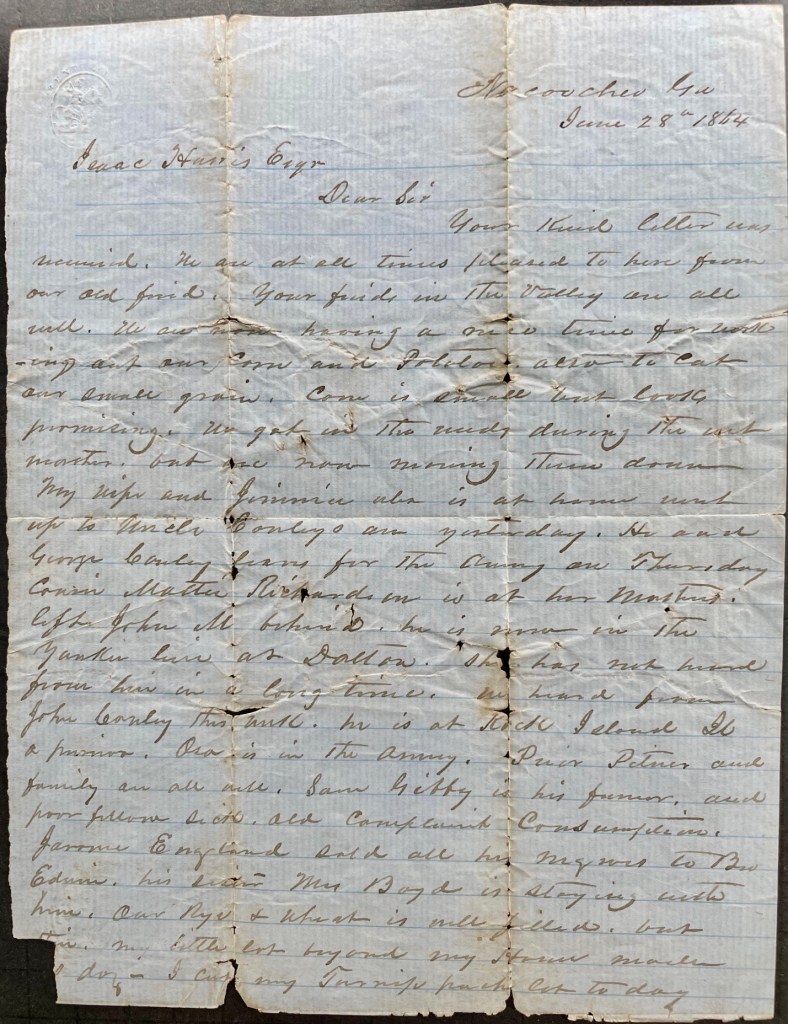
The following letter was written by Charles Lathrop Williams, SR. (1811-1886) of Nacoochee, White county, Georgia. Charles was married to Hannah B. Hollingsworth (1812-1887) in the mid-1830s. Charles mentions his son “Jimmie” being at home. This was James Hollingsworth Williams (1845-1909) who served in Co. C, 24th George Infantry. His headstone claims him to have been a captain but military records show him as a 1st Lieutenant and Adjutant, taken prisoner at Sailor’s Creek on 6 April 1865. He is buried in the Rock Creek Cemetery near Washington D. C.
The letter also mentions George H. Conley (b. 1841), the son of Henry Highland Conley (1798-1866) and Nancy Brown (1801-1881) of Sautee, White county, Georgia. George also served in the same company with Jimmie.
John Conley is also mentioned. This was presumably George Conley’s brother (1828-1890) who served in Co. D, 5th Georgia Infantry. George enlisted in August 1862 and was taken prisoner at Missionary Ridge on 25 November 1863. He was sent to Rock Island Prison in December 1863 but did not stay there long. He took the Oath of Allegiance to the US and joined the US Navy in January 1864. This explains why the family had not heard from him.
Finally, with respect to the slave sale mentioned at the end of the letter, this transaction was between Charle’s brother, Edwin Poore Williams (1814-1896) and Jerome England (1822-1890) who also served in the 24th Georgia Infantry, in Co. G—at least early in the war.
[Note: This letter is from the private collection of Greg Herr and was transcribed and published on Spared & Shared by express consent.]
Transcription
Nacoochee, Georgia June 28, 1864
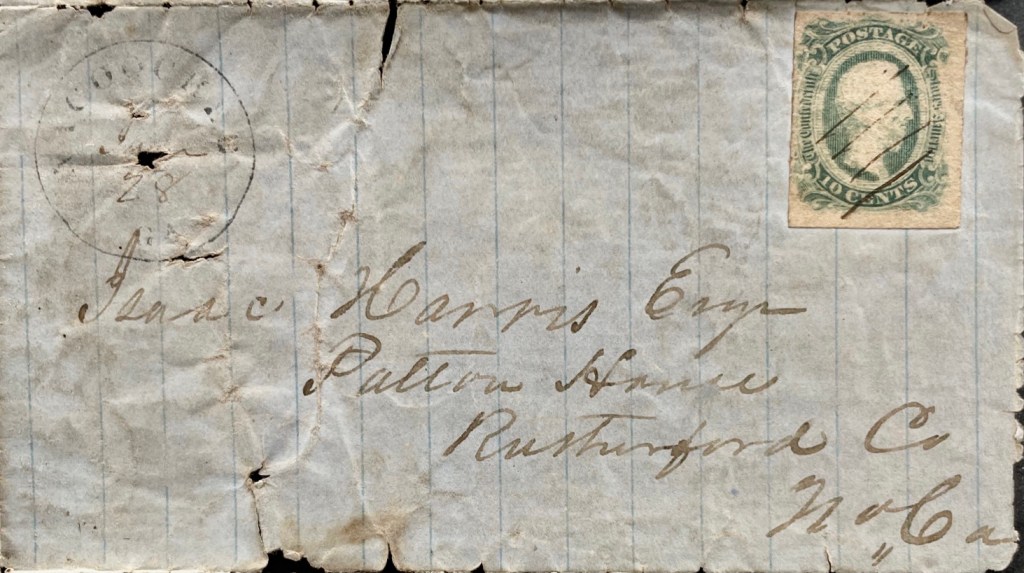
Isaac Harris, Esqr.
Dear Sir—Your kind letter was received. We are at all times pleased to hear from our old friend. Your friends in the Valley are all well. We are now having a nice time for working out our corn and potatoes—also to eat our small grain. Corn is small but looks promising. We got in the weeds during the wet weather but are now mowing them down.
My wife and Jimmie also is at home. Went up to Uncle Conley’s on yesterday. He and George Conley leaves for the army on Thursday. Cousin Mother Richardson is at her mother’s. Left John all behind. He is now in the Yankee line at Dalton. She has not heard from him in a long time. We heard from John Conley this week. He is at Rock Island. It is a prison. Osa is in the army. Prior Pitner and family are all well. Sam Gibby is his farmer and poor fellow sick—old complaint consumption.
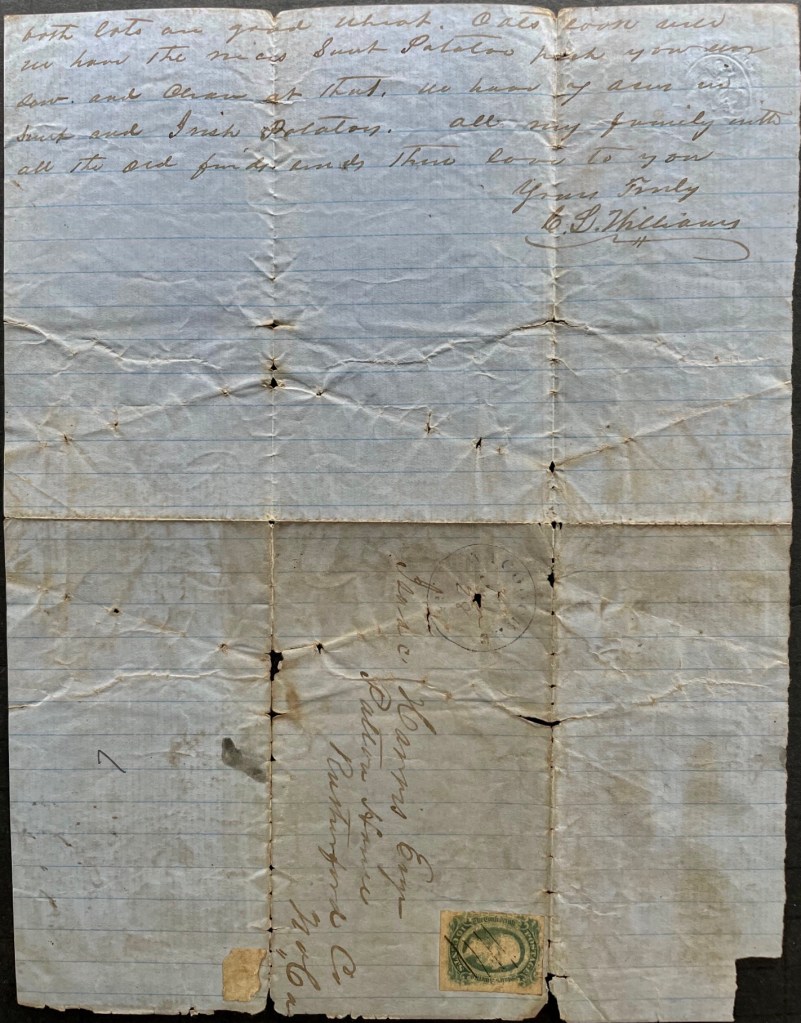
Jerome England sold all his negroes to Bro. Edwin. His sister Mrs. Boyd is staying with him. Our rye and wheat is well filled but thin. My little lot beyond my house made [ ] doz. I cut my turnip patch lot today. Both lots are good wheat. Oats soon and we have the nicest sweet potatoes here you ever saw and clean at that. We have 7 acres in sweet and Irish potatoes.
All my family with all the old friends sends their love to you. Yours truly, — C. L. Williams
Senator Robert Toombs—Gabriel’s more famous brother.
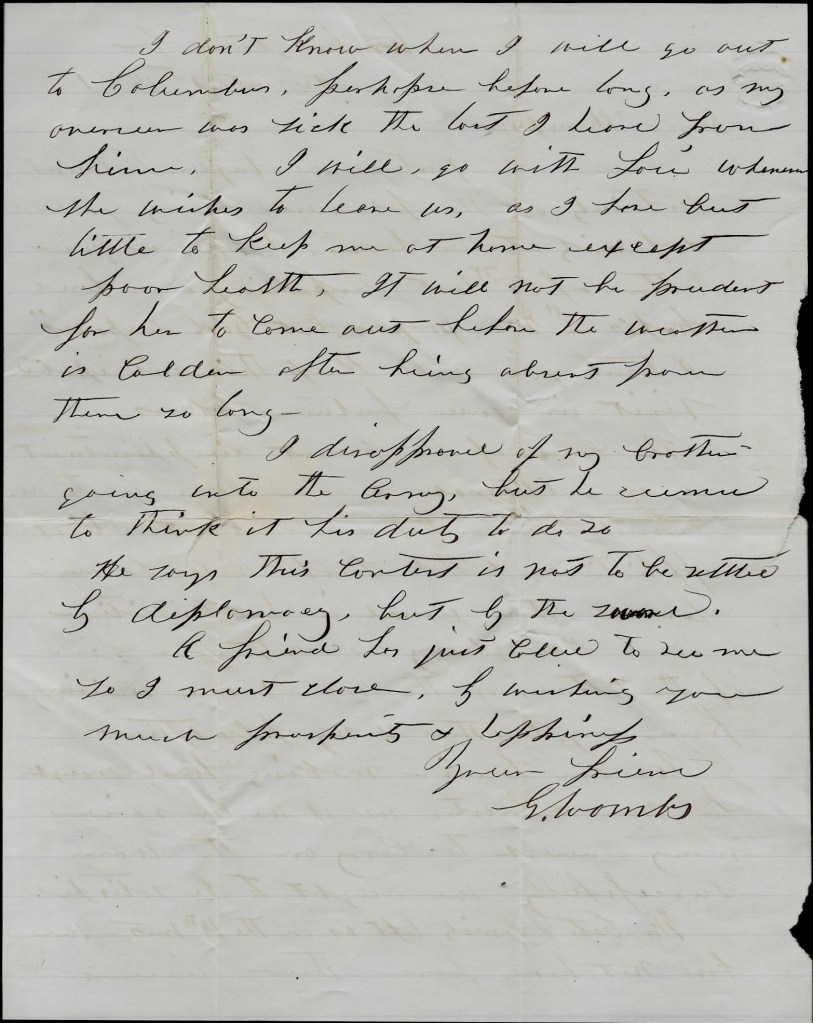
The following letter was written by Gabriel Toombs (1813-1901), the son of Maj. Robert Toombs (1760-1815) and Catherine Huling (1789-1848) of Wilkes county, Georgia. Gabriel was married in 1838 to Mary Susan Richardson (1819-1885) and had at least seven children by the time this letter was written in 1861. Gabriel was plagued with ill health and therefore unable to pursue a college education. Though he lived a long time, his health was always described as frail and delicate. He made his home on his father’s estate in Washington, Georgia, but—as mentioned in his letter—had a plantation near Columbus.
Gabriel’s accomplishments in life were wholly eclipsed by that of his older brother, Robert Toombs (1810-1885) who became a successful lawyer, fought in the militia against the Creek Indians in the 1830s, and then became active in politics, leading the “State-rights Whigs” in the 1840s, first in the US House of Representatives and later as a US Senator. When the crisis of 1861 arose, he advocated disunion and stumped across Georgia asserting that the North would no longer respect the constitutional rights of the South, necessitating secession as the only remedy. He initially accepted the position of Secretary of State in the new Confederacy but resigned in a few weeks to take the commission of brigadier-general in the army. He led his command at Bull Run in July 1861 which took place roughly five weeks before this letter was written. Gabriel mentions his brother in the letter, writing that his brother maintained that “this contest is not to be settled by diplomacy but by the sword.”
Gabriel wrote this letter to his friend, George Hargraves Thompson (1814-1896) of Glennville, Barbour county, Alabama. George was married to Sarah Willis Richardson (1821-1891). In the 1860 US Census, his real estate holdings were valued at $19,000 and his personal estate at $80,000.
Gabriel Toomb’s Home in Washington, Georgia, where he most likely penned this 1861 letter.
Transcription
Addressed to George H. Thompson, Glennville, Barbour county, Alabama
Washington, Georgia August 31, 1861
Dear Thompson,
Just as we begun to count certainly on the pleasure of seeing you & family at our house, I received your letter of 25th inst. dispelling our find hopes. “Man prospers but God disposes.” I trust you will keep this anticipated visit in your future plans.
The cause of the present disappointment is an additional source of regret to us. I trust, however, that yours is but a light affliction & that Sarah will be more favored than usual in her condition.
The gloomy accounts you give of the cotton is the same I am receiving from my brothers and my plantation. We are, however, making food enough for man and beasts, and if we can raise money enough to carry on the war successfully, we ought to be satisfied.
Mr. Cato & family left us on the 17th inst. We have not heard from them since.
I don’t know when I will go out to Columbus. Perhaps before long, as my overseer was sick the last I heard from him. I will go with Lois whenever she wishes to leave us as I have but little to keep me at home except poor health. It will not be prudent for her to come out before the weather is colder after being absent from there so long.
I disapprove of my brother’s going into the army but he seemed to think it his duty to do so. He says this contest is not to be settled by diplomacy but by the sword.
A friend has just called to see me so I must close by wishing you much prosperity & happiness. Your friend, — G. Toombs
















 Spared & Shared 23