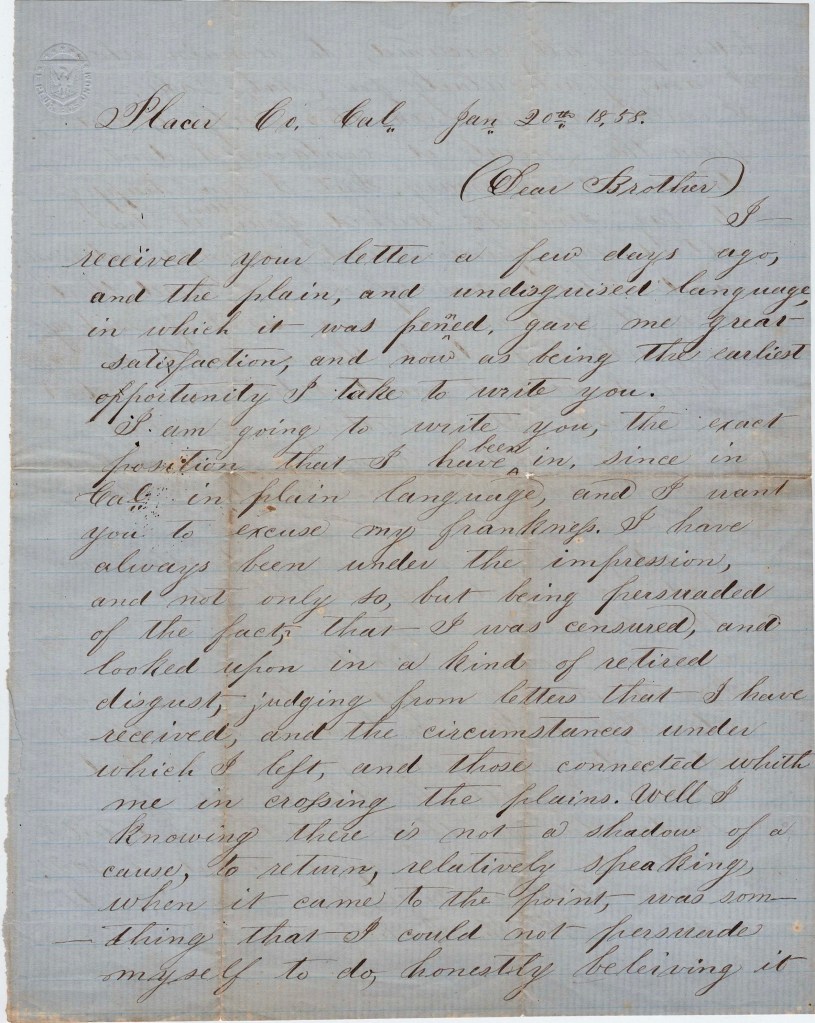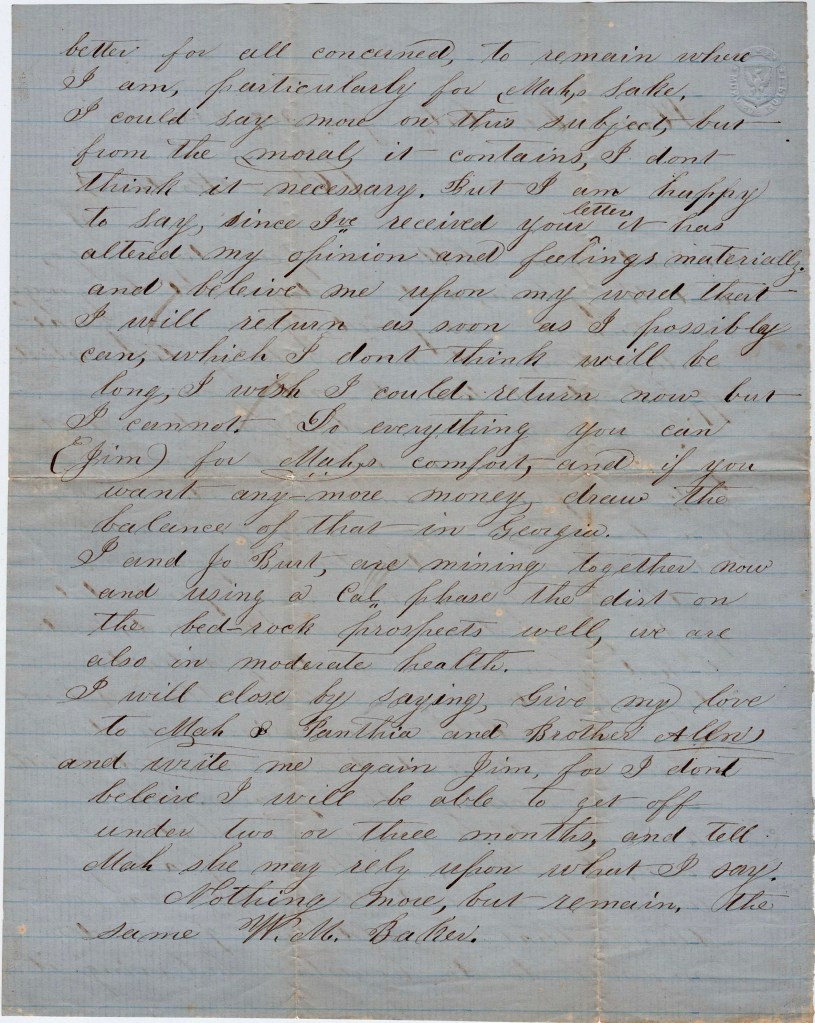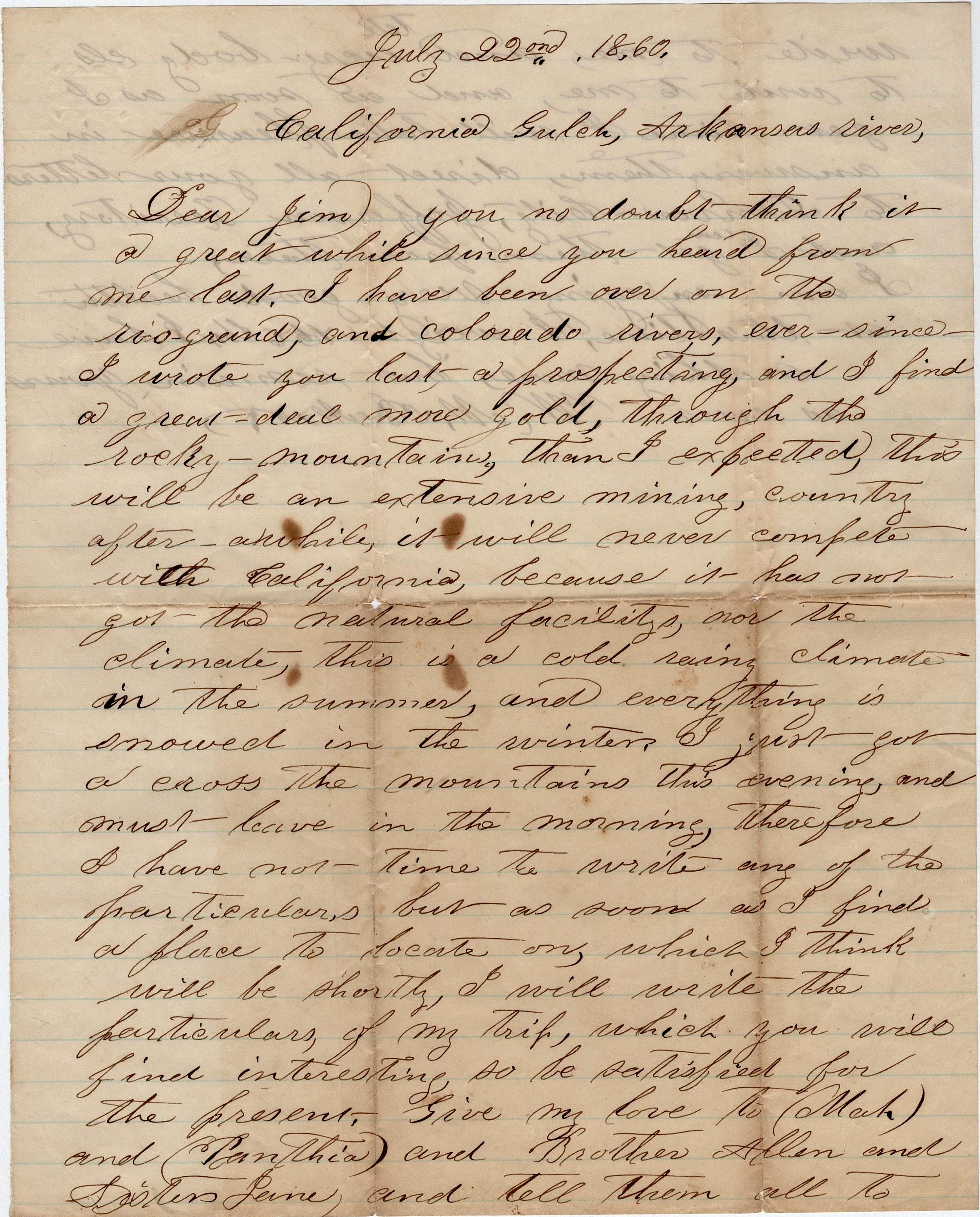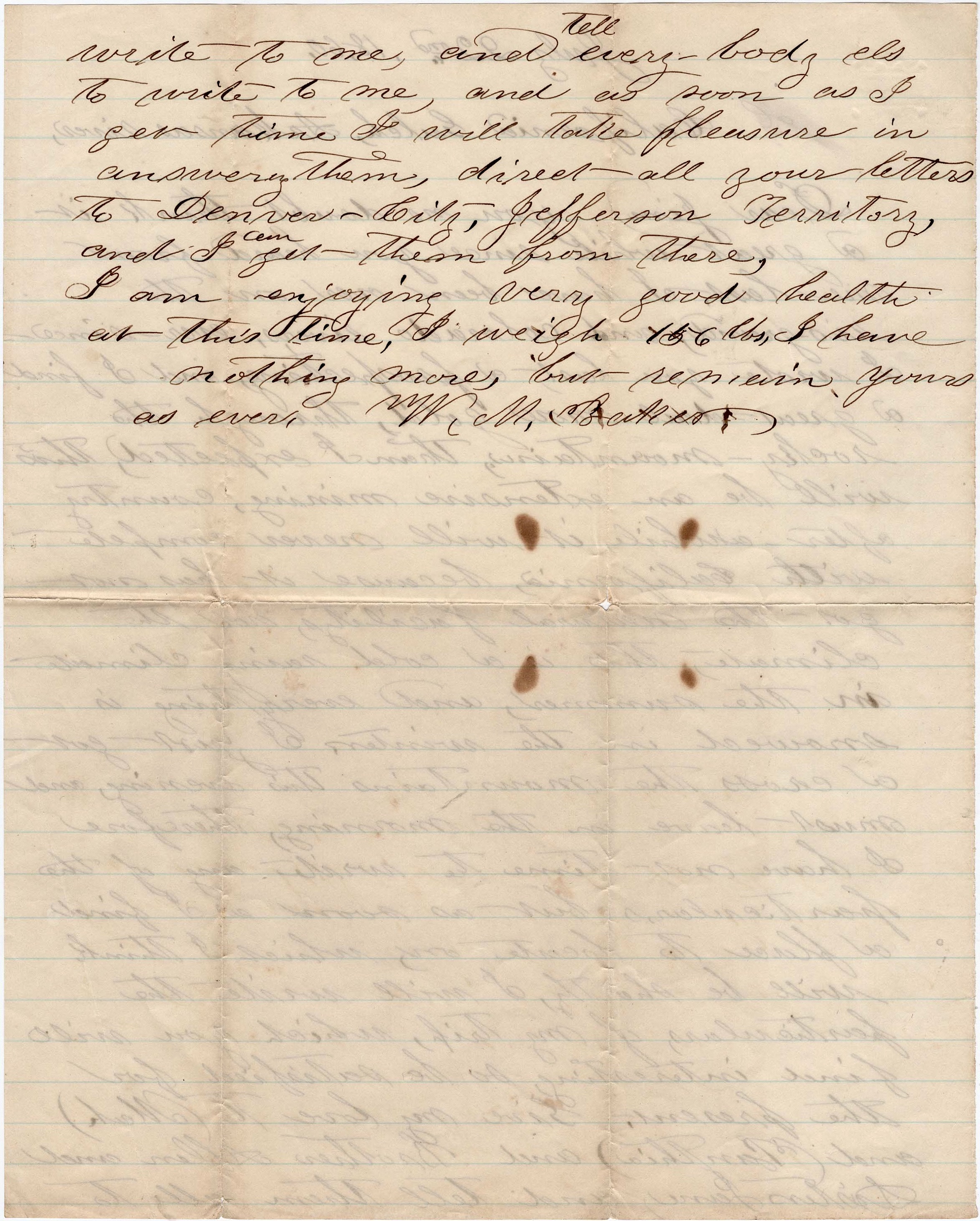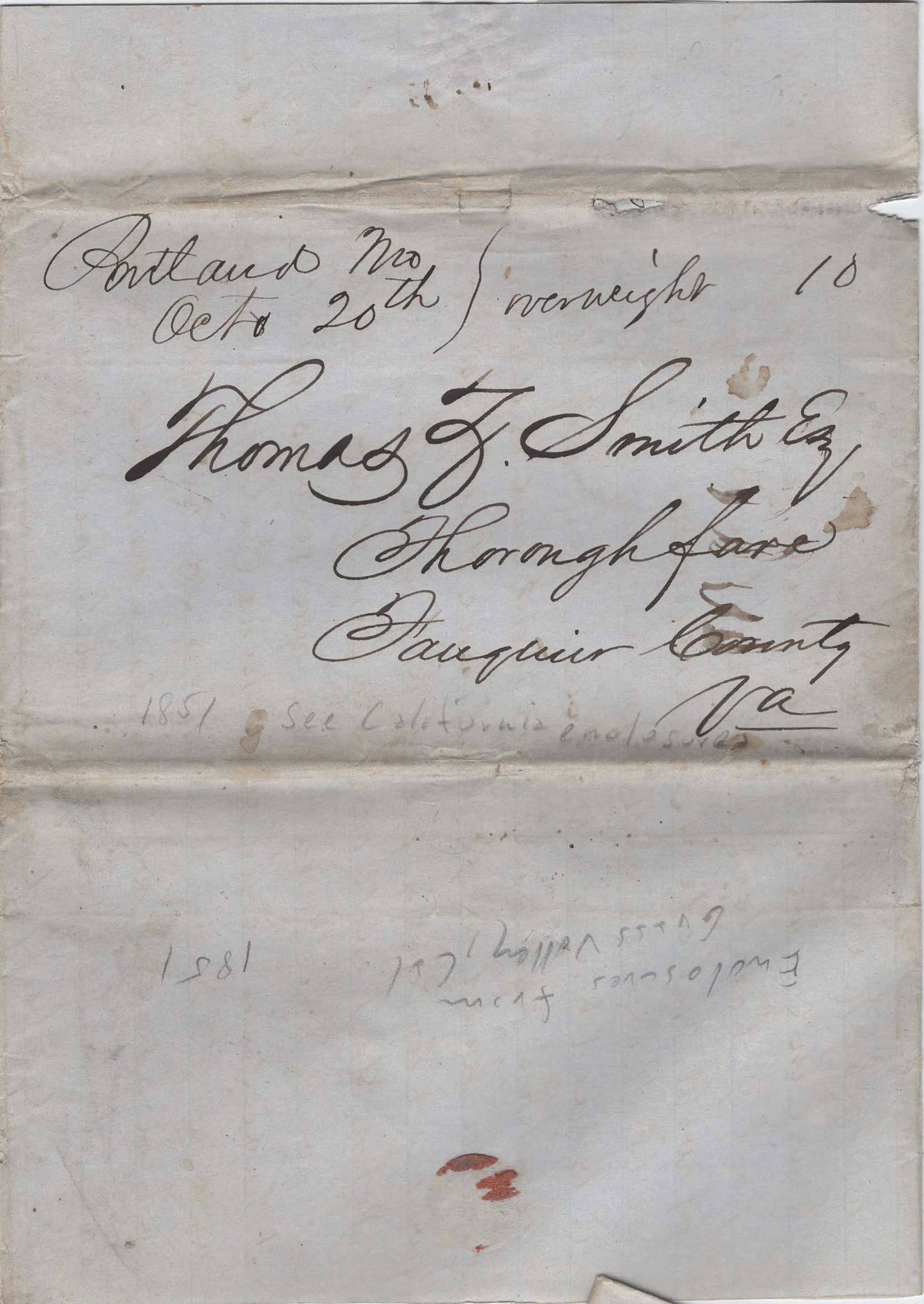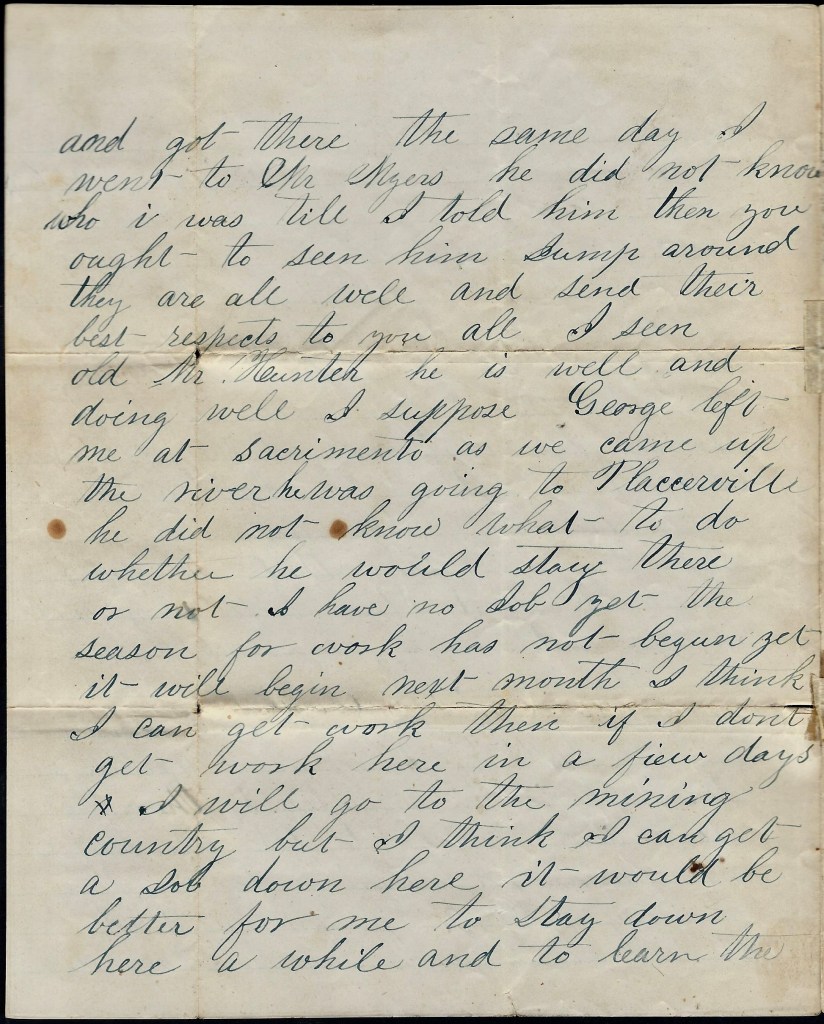
The following letter was written by John L. Koons who we learn had just arrived in Marysville, Yuba county, California, after passage from the east coast to San Francisco by way of the Isthmus of Panama. He apparently had friends of relatives in Marysville that he stayed with before securing a job. He wrote the letter to his father and though I cannot say with certainty where his father lived, my hunch is that he was from Pennsylvania.
In his letter, John informs his father that there are many Chinese emigrants working in Marysville. It is reported that by 1860, 30 percent of the miners in California were Chinese. By 1870, this number had risen to half the miners. [Source: Introduction to Marysville’s Chinatown.]
Transcription
Marysville, [California] April 12, 1863
Dear Father,
I take the pleasure to write you a few lines. I am well at present and hope you are the same. I wrote to you from the Isthmus [of Panama]. I suppose you got the letter. We had a very nice trip all the way. We only had a few days that it was rough. I stood the trip very well. I did not miss one meal on the steamer. I was always ready for my grub. We got into San Francisco on the 6th of April about 4 o’clock in the afternoon.
We stayed there two days and then started up the river and got to Sacramento on the morning of the 9th of April and I started the same day for Marysville and got there the same day. I went to Mr. Myers. He did not know who I was till I told him. Then you ought to have seen him jump around. They are all well and send their best respects to you all. I seen old Mr. Hunter. He is well and doing well, I suppose.
George left me at Sacramento as we came up the river. He was going to Placerville. He did not know what to do—whether he would stay there or not. I have no job yet. The season for work has not begun yet. It will begin next month. I think I can get work then. If I don’t get work here in a few days, I will go to the mining country but I think I can get a job down here. It would be better for me to stay down here a while and to learn the ways of the country. I like the country as far as I have seen very well. The trees and grass is very green and nice. At the market there is potatoes, cabbage, and all kind of garden stuff of this year’s growth. The weather is so nice, I know you would like it here Father. The weather is not so changeable as it is in the states.
We can look from Marysville to the mountains and the tops are covered with snow but it is very nice in the valley. I am getting along very well. The country seems to agree with me. I weigh about ten lbs. more than I did when I started from home. I see a good many different kinds of people here but the chiney [Chinese] men is the funniest looking things I ever seen. They have great long hair braided and hanging down their backs. Some of them touch the ground.
Well, I guess I must close my letter for this time. The next time I can give you more of the particulars as I will be better posted. Give my love to all enquiring friends, if there be any. Nothing more at present but remain your affectionate son, — John L. Koons
When you write to me, direct your letter in care of C. Myers, Marysville, California
Write as soon as you get my letter as I am very anxious to hear from you. — J. L. Koons
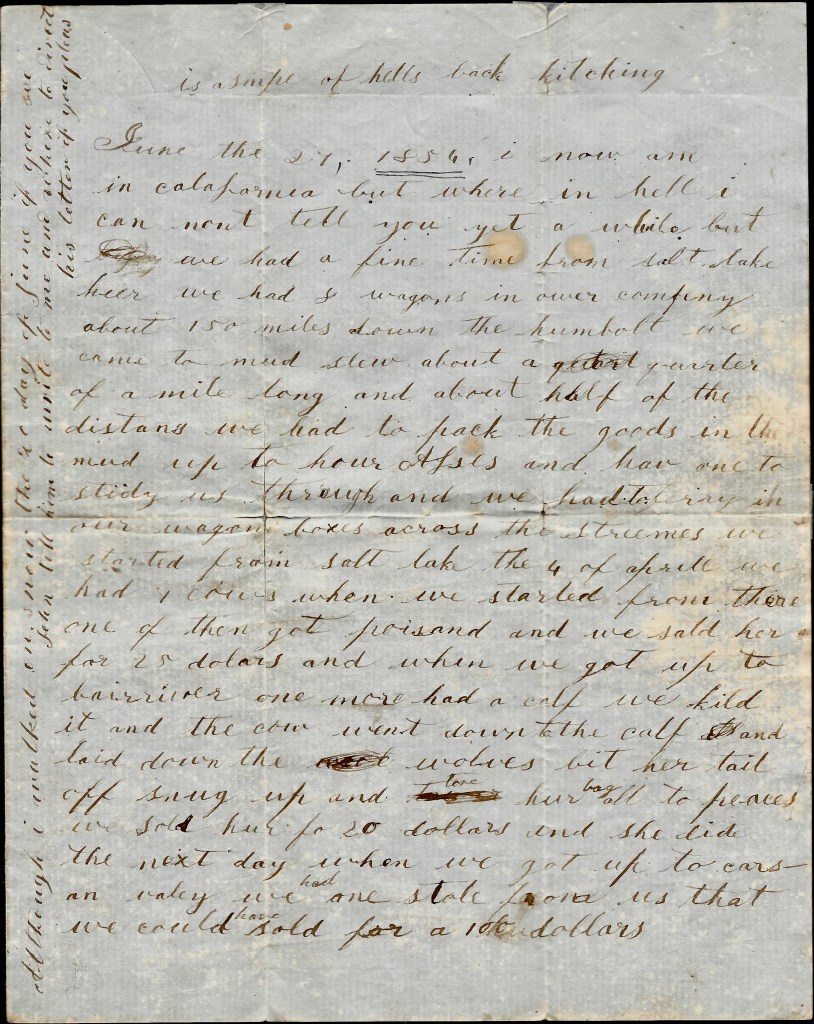
The following letter was written by various members of the Floyd family. We learn from the letter that Enoch Floyd (1808-1855) and Sarah Ingersoll (Harvey) Floyd (1816-1889) made the overland journey from the Great Salt Lake over the Sierra Mountains to the vicinity of Sacramento in the spring of 1856 with their family of five children. They were Enoch Harvey Floyd (1834-1860), Lyman Floyd (1837-1863), Leonard Floyd (1837-1916), Sarah Elizabeth Floyd (1841-1866) and Julia Ann Floyd (1852-1860). Two of their youngest daughters, Martha and Lucy died within days on each other in 1853 probably from some childhood disease. The family resided in Newbury, Essex county, Massachusetts, before making the overland journey.
Transcription
June 27, 1854
i now am in california but where in hell i can nont tell you yet a while but we had a fine time from salt lake heer we had 8 wagons in ower compeny about 150 miles down the humbolt we came to mud slew about a quarter of a mile long and about half of the distans we had to pack the goods in the mud up to hour asses and have ont to stidy us through and we had to ferry in our wagon boxes across the steemes we started from salt lake the 4 of aprill we had 7 cows when we started frome there one of them got poisand and we sold her for 25 doars and when we got up to bairriver one more had a calf and laid down the wolves bit her tail off snug up and tore hur bag all to peaces we sold hur for 20 dollars and she dide the next day when we got up to carsan valey we had one stray from us that we could have sold for a 100 dollars
we are now in prairie sitty all well at this time Enoch is in hangtown to work in the mines for 60 dollars a moth and his board lyman and i have not got enny work yet they are agoin to opin a new mine here and we think taking up a claim or tow and see how we can makit i don’t know of enny thing more to writ
from your obedident servant—Leonard Floyd
Dear frien i will write a few lines i have not got rested enough yet to write or do much else we have had a very tedious journey from Salt Lake here we was from the 4 of April to the 25 of june geting to hangtown or placerville 800 miles from Salt Lake i had rather come from kanesville to Salt Lake 4 times than to come from there here once we are all well but about tired out crosing the siera nevada mountains is enough to kill anybody or thing that ever stood on feet we were one whole day climbing one mountain one and a half miles it is like going up and down the roof of a house with the exception of the sharp edge and rocks in the road as high as the wagon bodys the rocky mountains is nothing to compare to these.
Enoch has kept a journal of Our journey and some time some of us will will write it enoch is 30 miles from us now.
[in a different hand]
if you read this you will do well write as soon as you get this and direct it to sacramento we are 20 miles north of it but where we shall stop i do not know but we shall get the letter When we had all of the goods out of our wagon we had on nine yoke of Oxen to our wageon that would girt from 6 to 7 ft and we spird and sashed them til the blud run their sides to take the empty [wagons] over the siinavada Mountain. Enoch Floyd, Jr.
July 1 since the above was writen we have moved within 5 miles of sacramento Leonard and Lyman are at work for two dollars per day for A short time and their board board is from 6 to 9 dollars per week for constant boarders transient ones more when we got to Carson valley we expected to wait for the snow to go of the carson route so Enoch came on ahead of us he had to pay 11 dollars A week but he got work and i hope will do well but we came the joHnson cut off this road is worse than the other but no snow in the road.
this is A mixed up letter but never mind as long as we know how better in hangtown they have up bets so i am told as high as fifteen hundred dollars to see who will go down to Carson valley and steal the most cattle from emigrants the whites are A great deal worse than the indians the indians seldom troubel any companies unless they are as small as from 5 to 8 men than they will steal their cattle and sometimes fire upon the men but where there is from 15 to 25 men there is no trouble we had 22 men Mr Silas Barn[e]s from Boston with his family came through with us from Salt Lake he lived there two years and A half 1 and Mr. William Paterson formily of haverhill Mass.
We had no serious sickness in our family or company nor Deaths little Julia is cuting Double teeth and it makes her rather cross but she is a good littl girl Sarah send her love to grandmother and grandfather and all the rest of the folks if you could see the style that i write in you would say it is time to say good by till A more conveint time. so good by — Sarah I. Floyd
1Silas P. Barnes was born in Deering, New Hampshire in 1805. He moved to Boston as a young man and married Olive Chapman. In 1851, he settled up his business in Boston and embracing the doctrines taught by Joseph Smith, made his way with his family of nine children to Council Bluffs, Iowa, where they joined a caravan of 60 wagons to journey to Salt Lake City. They lived near Dry Creek until Indian troubles threatened danger and in so they decided in April 1854 to go to California. After a three month’s journey they reached the Golden State and settled in Yolo county. Silas died there in 1888.
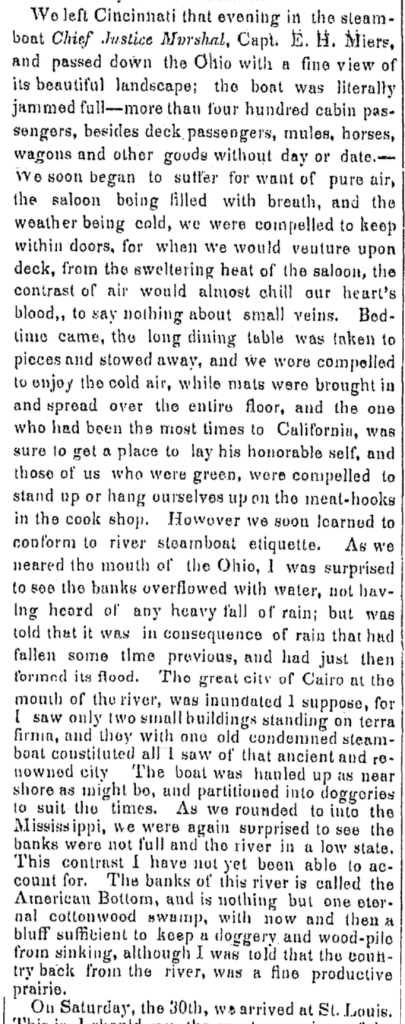
Excerpt of letter by Benjamin Sawtell published in the Cleveland Plain Dealer
The following letter was written by Ira Sawtell (1808-1852), the son of Dr. Jonas W. Sawtelle (1787-1861)—the proprietor of a water cure establishment in Cleveland, and his first wife (name unknown). Ira married Emily Rockwell (1810-1869) in 1830 and had at least three children. At the time of the 1850 US Census, he was enumerated in Cleveland’s 2nd Ward working as a cooper (barrel maker) with three daughters living at home, ages 9 to 18.
Ira wrote the letter to his older brother, Benjamin Sawtell (1805-1851), a cooper from Brooklyn Center (west side of Cleveland), Cuyahoga county, Ohio, who left his wife, Mary Matilda Fish (1819-1873) of 13 years and three children, to go to the gold fields of California in 1850. Benjamin wrote a number of letters to the editor of the Cleveland Plain Dealer chronicling his overland journey to California in 1850. His death in January 1851 in California was mentioned in that paper but I could find no particulars. One of Benjamin’s letters, datelined 8 September 1850 from the Cold Spring Diggins was published in the Cleveland Plain Dealer and reproduced here: Latest from California—An Interesting Letter from Benj. Sawtell, Esq.
Transcription
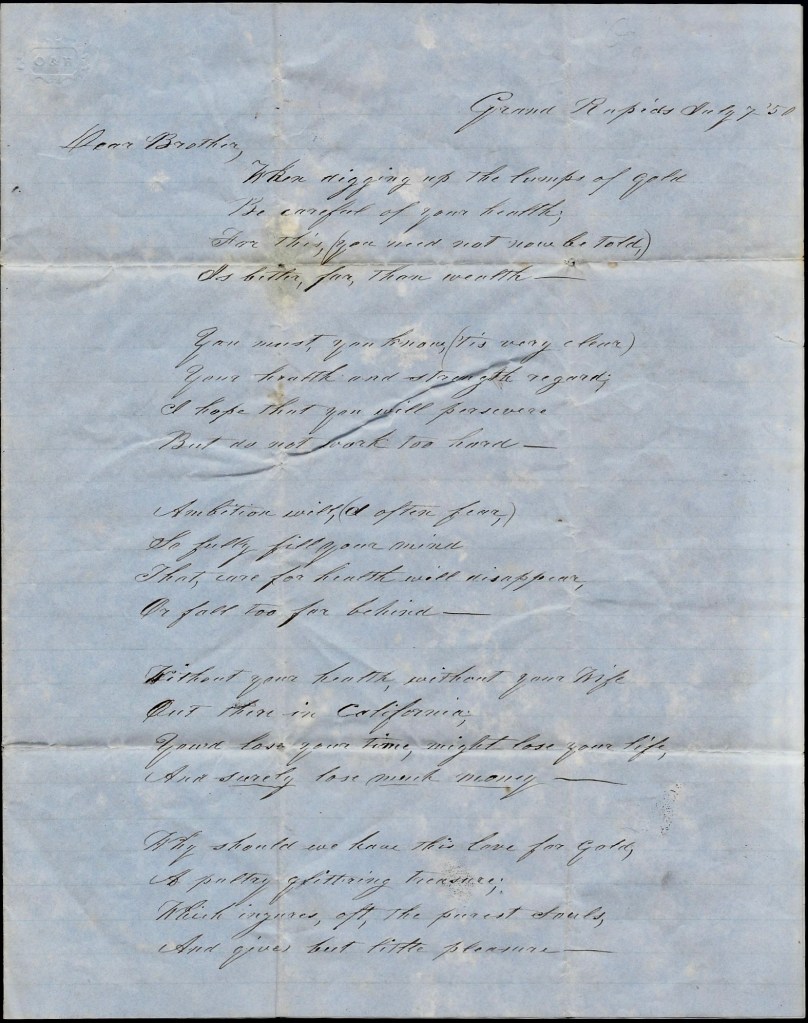
Grand Rapids, Michigan July 7, 1850
Dear Brother,
When digging up the lumps of gold Be careful of your health; For this (you need not now be told.) Is better far than wealth—-
You must, you know (’tis very clear) Your health and strength regard; I hope that you will persevere But do not work too hard—
Ambition will, (I often fear,) So fully fill your mind That are for health will disappear, Or fall too far behind—-
Without your health, without your wife Out there in California; You’d lost your time, might lose your life And surely lose much money.—-
Why should we have this love for Gold, A paltry glittering treasure; Which injures oft, the purest souls, And gives but little pleasure—-
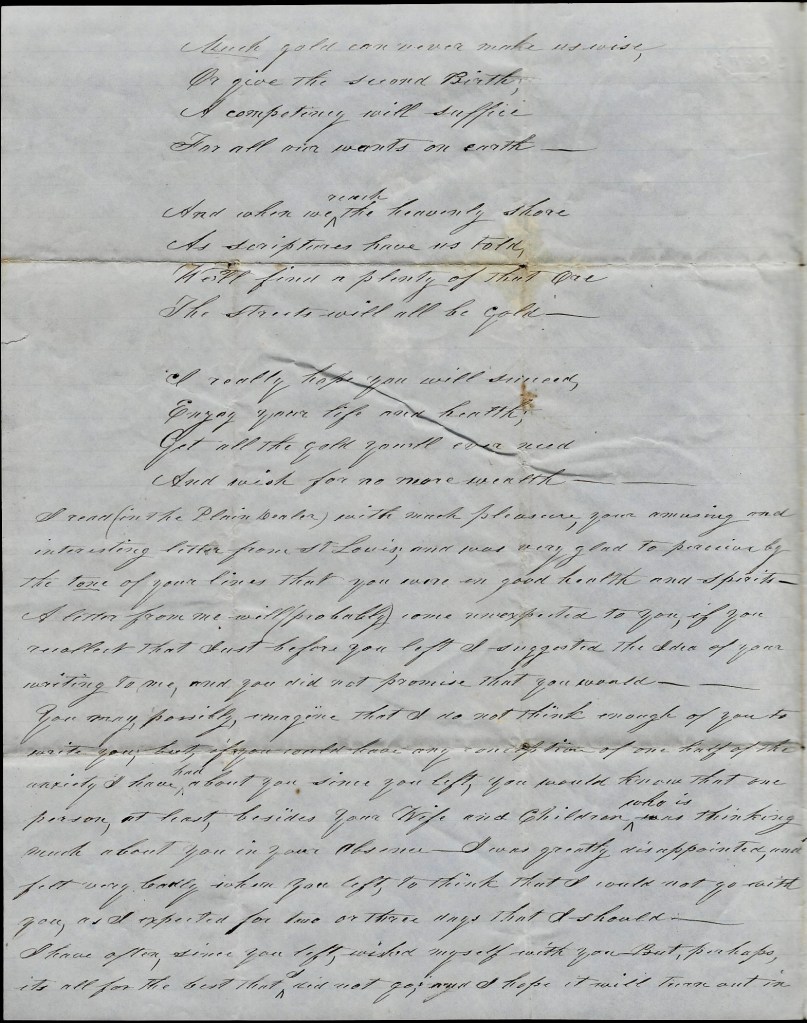
Much gold can never make us wise, Or give the second Birth; A competency will suffice For all our wants on earth—-
And when we reach the heavenly shore As scriptures have us told, We’ll find a plenty of that ore The streets will all be gold—-
I really hope you will succeed, Enjoy your life and health; Get all the gold you’ll ever need And wish for no more wealth—-
I read (in the Plain Dealer) with much pleasure your amusing and interesting letter from St. Louis; 1 and was very glad to perceive by the time of your lines that you were in good health and spirits. A letter from me will (probably) come unexpected to you, if you recollect that just before you left I suggested the idea of your writing to me, and you did not promise that you would. You may possibly imagine that I do not think enough of you to write you; but, if you would have any conception of one half of the anxiety I have had about you since you left, you would know that one person, at least, besides your wife and children was thinking much about you in your absence. I was greatly disappointed and felt very badly when you left to think that I could not go with you and expected for two or three days that I should. I have often, since you left, wished myself with you. But perhaps it’s all for the best that I did not go; and I hope it will turn out in the end to be for the best that you did go. If I was in as good situation as you are as respects property, I should not speak of going to California; but, a I was when you left, and am now poorer than Job ever was and out of business, I thought it best to try my luck. I think I would have stood the journey tolerably well and dug considerable gold when I got there; but probably it’s all hypothesis.
You will be surprised (perhaps) to find that I am here. Darwin wrote to me that he wished me to come and live with him and try my luck here in practice and I concluded to come. I have been here but about three weeks but I have done some business—as much as I expected for the time, and have had good success so far, but I think I shall return to Ohio soon. My health is not very good. The water, air, climate, or something else seems to disagree with me. The Cholera has not, I believe, yet prevailed much in any of our cities in this country although there has been a few cases in some of them. I have heard of its prevailing considerably among the emigrants to California and I have been very much concerned about you, fearing you would have it.
I have no very important news to communicate. I had a letter from Julia three or four days ago. She wrote that your family were enjoying good health. Mr. and Mrs. Brong have been terribly afflicted again by the loss of their oldest child, Mary. Julia informed me that she died about two weeks ago and that Melissa had gone East on a visit.
I caution you again to be very careful of your health, and I sincerely wish you would be so kind as to answer this as soon as you receive it and give me some account of your journey, your prospects of success there, the state of your health, when you think you will return, how you like that country, &c. &c. &c. Give my best respects to Mr. Corbin and Mr. Booth; tell them I wish them good success, good health, &c. Tell them I hear that their families are also enjoying good health.
Now do not fail to write me as soon as you receive this. All our relations here are enjoying tolerably good health, I believe, and they all send their respects, best wishes, and love to you. Your affectionate brother, — Doc I. Sawtell
to Mr. Benjamin Sawtell, Esq.
1 Though datelined from Independence, Missouri, on 15 April 1850, much of the following letter pertains to St. Louis, and I believe this is the letter to the editor of the Plain Dealer that Ira refers to. There are numerous letters appearing in that newspaper chronicling Benjamin Sawtell’s journey to California in 1850.
The following letter was written by 46 year-old John Holman (1803-1872) to his wife Elizabeth (Henderson) Holman (1807-1849) of Wilbraham, Hampden county, Massachusetts. John and Elizabeth were married in December 1829 and lived in the Boston area for a time before pursuing farming and stock raising in Wlibraham.
This clipping provides the names and home towns of the members of the Suffolk Mining Company
John wrote the letter in April 1849 from Rio de Janiero, Brazil, while enroute to the California gold fields as a member of the Suffolk Mining Company. The members of this company included “a clergyman, physician, lawyer, carpenters, tailors butchers, &c.” Newspaper notices pertaining to the company claim that the “company go on strictly temperance principles and pledge themselves to abstain from gambling and labor on the Sabbath.” The 21 member company was lead by Rev. Hiram Cummings (1810-1887)—an anti-slave lecturer. Other members included: F. E. Baldwin, E. A. Kendall, J. R. Carr, L. Cleaves, Joseph A. Whitmarsh, Humphrey Jameson, Hiram W. Colver, Amasa Bryant, Edwin Faxon, John Gregory, Jr., J. W. Gay, Thomas Emery, A. Sigourney, Leonard F. Rowell, Henry Soule, Peletiah Lawrence Bliss, S. W. Grush, W. H, Tupper, John Holman, S. N. Fuller, M. Bruwer, H. M. Adams, Enoch Burnett, Jr., H. E. Gates, James Gibbens, G. A. Hall, R. C. M. Boynson, F. Z. Boynson, B. White, A. 0. Lindsay, C. T. Mallett, E. B. Kellogg, Henry Hancock, George C. Cargoll, Henrick Cummings, Joseph C. Trescott, G. W. Colby, Albert Cook, Francis S. Frost, Albert Merriam, John Hancock, D. C. Smith, J. Lindsay, S. A. Stimpson, R. G. French, and G. J. Lindsay
The company booked passage aboard aboard the 210-ton barque Drummond which departed Boston on 1 February 1849 and arrived in San Francisco on 1 September 1849 (210 days). John claims to have been keeping a journal though I have not found a record of it. Another passenger, Charles T. Mullett, kept a journal also which has survived and is in the Peabody/Essex Museum in Salem. The enties are brief but mention celebrating Washington’s birthday with a 13 gun salute on 22 February, singing, prayers, and an address by Mr. Lindsay, and a dinner of roast pig, chicken, plum pudding and pies. He lists 21 passengers in the forward cabin, most of whom were members of the Suffolk Mining Company, and 22 passengers on the after cabin. [Forty-Niners Round the Horn, page 319]
John’s letter informs us that the Drummond was in port at Rio de Janiero for some two or three weeks making repairs and that the Captain hoped to sail without stop around the horn all to way to San Francisco. Another member of the Mining Company named Peletiah “Lawrence” Bliss wrote a letter [in the Mass. Historical Society] describing the ships voyage that informs us the Drummond had to make another stop at Lima, Peru, before sailing on to San Francisco. His letter also states that the Drummond departed Rio de Janiero on April 19th “to the spirited song of the generous sailors.”
I could not find any record of John in California or of his success in finding gold once there. I believe his experience turned out to be like so many other 49ers—the journey was not worth the cost, financially or emotionally. He mentions his wife and children but I could not find any children that survived his first marriage to Elizabeth. All of them appearing in census records died young, including the child that Elizabeth was bearing at the time of his departure for California. That child died three days after her birth in mid-July 1849 while John was still enroute, and Elizabeth died in early October the same year. If John had any surviving children by the time he heard the news after his arrival in California, he may have immediately booked passage to return home. He was remarried in March 1851 to his second wife and took up farming once again.
The only obituary notice I could find for John was the following: “John Holman, a well-known citizen of Wilbraham, died in his chair while eating his breakfast, Sunday morning. He exclaimed, “How dark it is growing!” and was dead before assistance could reach him. He was 58 [68] years old.” [The Boston Herald, 21 March 1872]
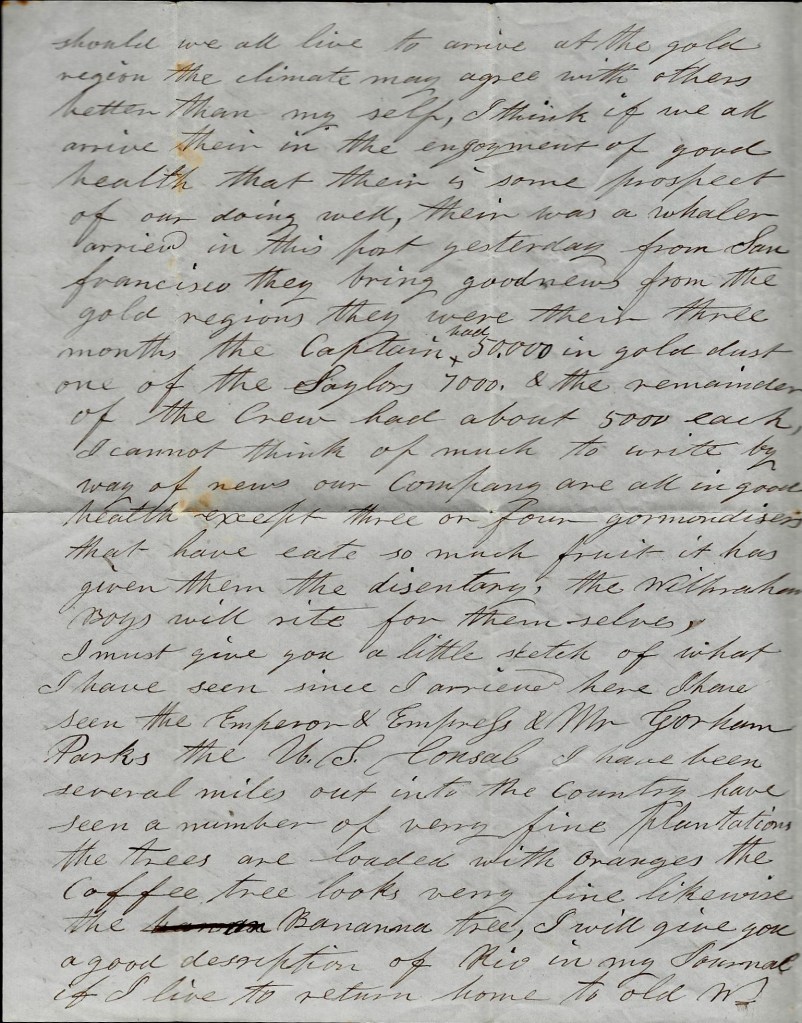
Transcription
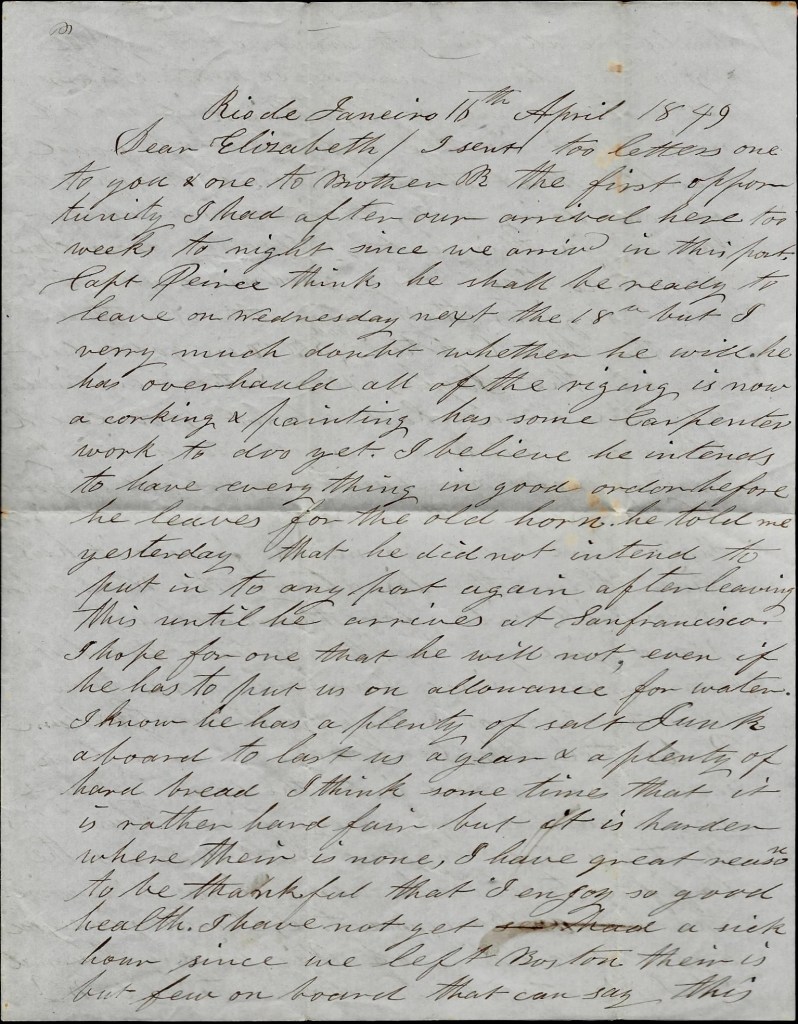
Rio de Janiero 16 April 1849
Dear Elizabeth,
I sent two letters—one to you & one to Mother B. the first opportunity I had after our arrival here two weeks tonight since we arrived in this port. Capt. [Thomas G.] Pierce thinks he shall be ready to leave on Wednesday next, the 18th, but I very much doubt whether he will. He has overhauled all of the rigging, is now a corking & painting. Has some carpenter work to do yet. I believe he intends to have everything in good order before he leaves for the old Horn. He told me yesterday that he did not intend to put in to any port again after leaving this until he arrives at San Francisco. I hope for one that he will not, even if he has to put us on allowance for water. I know he has a plenty of salt junk aboard to last us a year, & a plenty of hard bread. I think sometimes that it is rather hard fare but it is harder where there is none.
I have great reason to be thankful that I enjoy so good health. I have not yet had a sick hour since we left Boston. There is but few on board that can say this. Should we all live to arrive at the gold region, the climate may agree with others better than myself. I think if we all arrive there in the enjoyment of good health, that there is some prospect of our doing well. There was a whaler arrived in this port yesterday from San Francisco. They bring good news from the gold regions. They were there three months. The Captain had 50,000 in gold dust, one of the sailors 7000, & the remainder of the crew had about 5000 each.
I cannot think of much to write by way of news. Our company are all in good health except three or four gormondisers that have eaten so much fruit, it has given them the dysentery. The Wilbraham Boys will write for themselves.
Slaves in Brazil carrying “heavy burdens on their heads.”
I must give you a little sketch of what I have seen since I arrived here. I have seen the Emperor & Empress & Mr. Gorham Parks, the U. S. Consul. I have been several miles out into the country, have seen a number of very fine plantations. The trees are loaded with oranges. The coffee tree looks very fine; likewise the banana trees. I will give you a good description of Rio in my Journal if I live to return home to old Wilbraham. Likewise of the natives & slaves. The poor slaves have a hard time of it. They are compelled to carry heavy burdens on their heads. They will take a barrel of flour & a large bag of coffee & run through the streets. I suppose there are more than a thousand persons in this harbor bound for the gold regions, but enough of this.
I keep the two letters you sent me before I left Boston. It affords me much pleasure to read them occasionally. I thank you kindly for the good advice you gave me in them. I hope you will keep your promise you make in them—that is, to pray for me daily. I will do the same for you & our dear children. Please give my love to them & tell them that although I am far away, they are not forgotten by me daily. I hope if I live to arrive at San Francisco I shall hear from you & them. I am well aware of your situation. I hope you will be well provided for during my absence. I hope you will try & make yourself as happy as you can till we meet again. Please give my love to Father & Mother & all enquiring friends & accept the largest share for yourself.
Your best friend on earth and ever affectionate husband, John Holman
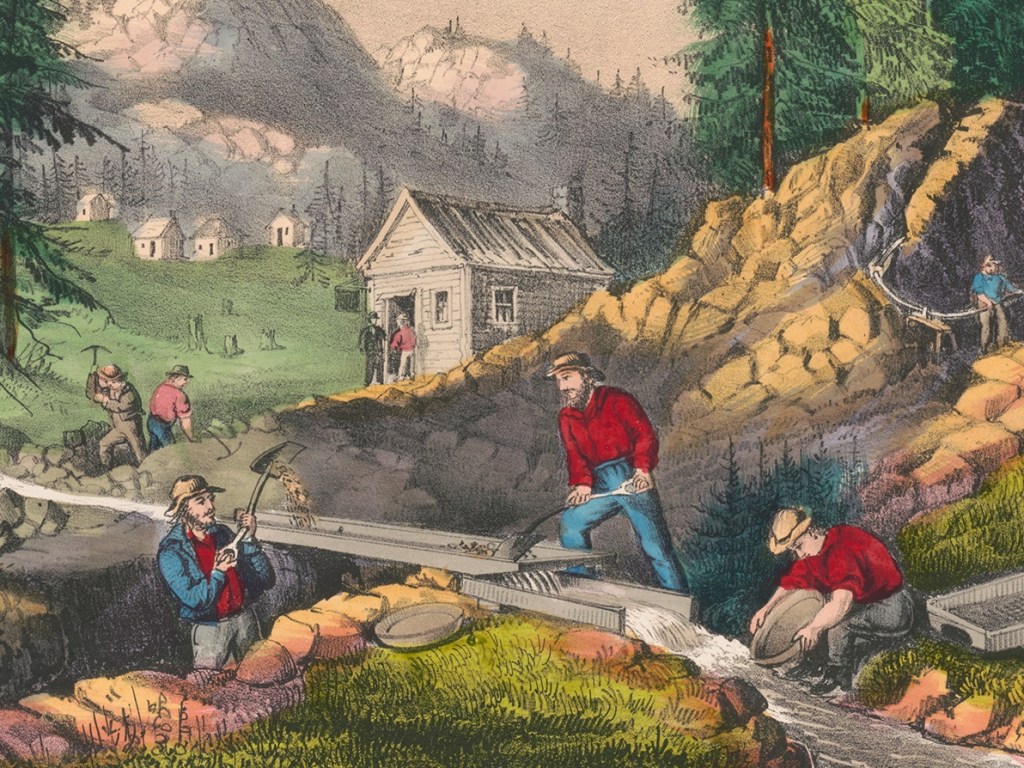
An unidentified California Gold Seeker (Doug York Collection)
The following letters were written by Franklin Farr (1822-Aft1880), the son of Josiah Farr (1781-1849) and Laura Allen (1786-1846) of Cavendish, Vermont. The first letter was written by Franklin enroute to San Francisco, California, in March 1850. The letter was apparently mailed from Calleo, Peru, where the ship he was on stopped after rounding the horn of South America.
The second letter was written from Calaveras county, California, where Franklin had been residing for some time. In this letter he describes the state of mining affairs in Calaveras county, transitioning to Quartz mining. He also speaks of the dangers to human life in the county which prompted San Francisco’s Daily Evening Bulletin on 7 September 1868 to report that Calaveras county was “infested with a gang of robbers and murderers who render it unsafe for anyone to travel to that locality.”
Franklin wrote the letters to Osgood Parkhurst (1808-1867) of Cavendish, Windsor county, Vermont. Osgood was married to Harriet Louisa Farr (1808-1867), an older sister of Franklin’s. The second letter was not written until 1868, a year after Franklin’s sister (Osgood’s wife) had died. Osgood was still residing in Cavendish with his daughter, Mary Parkhurst (b. 1838), however.
Curiously, from the Bellow Falls Times of 23 December 1859, we learn that the Parkhurst family had been the victims of a burglary. Awakened in the night by an intruder in the home, the burglar escaped with $23 from Osgood’s wallet.
[Note: These letters are from the private collection of Richard Weiner and were transcribed and published on Spared & Shared by express consent.]
Letter 1
March 11, 1850
I now take my pen in hand to let you know that I am well at this time and I hope these few lines will find you enjoying the same. I have not got any news to write to you now. I have enjoyed myself very well. We are in Calleo [Peru] now. We shall stop there two days and then we shall start for San Francisco. I have not got time to write but when I get there I will write more.
We have had a very pleasant passage. We can’t get there before the first of May. I don’t want you should think anything about me and if you go out West, tell them that I will come out when I come back. You will want to go out again then you may think that I don’t write much but I will write more next time. There is thirty passengers aboard and we are a going up to [ ] now and then we came back and start. We have not stopped before and shan’t stop again. That is all that I can write here to you.
This is from Franklin Farr
Letter 2
Addressed to Mr. Osgood Parkhurst, Cavendish, Vermont, United States of America
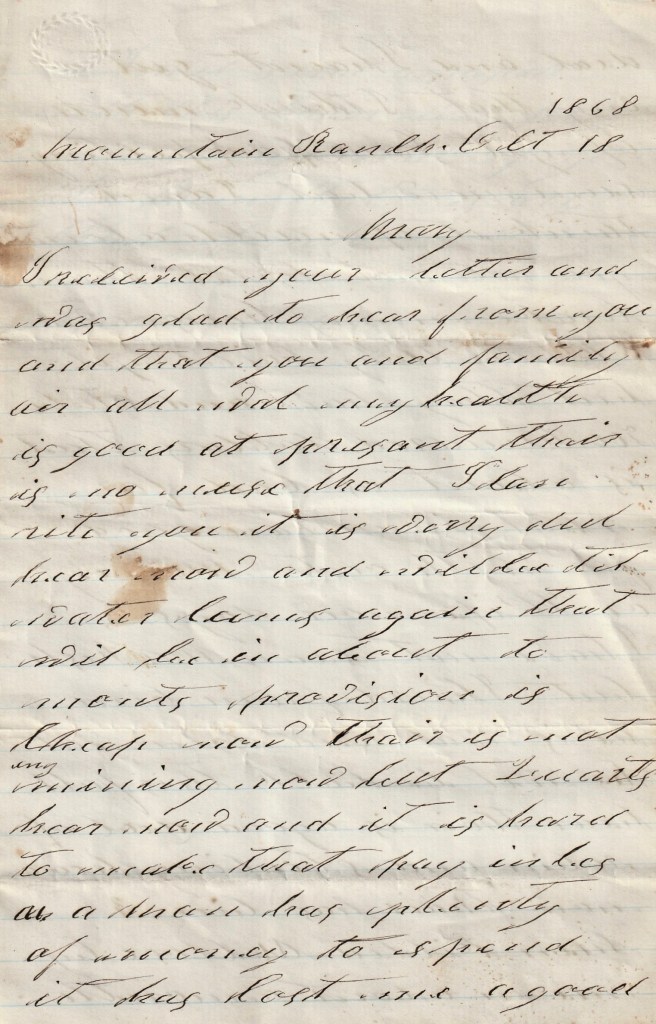
Mountain Ranch October 18, 1868
Mary,
I received your letter and was glad to hear from you and that you and family are all well. My health is good at present. There is no news that I can write you It is very dead here now and will be till water comes again. That will be in about two months. Provisions is cheap now. There is not any mining now but quartz here now and it is hard to make that pay unless a man has plenty of money to spend. It has cost me a good deal and I Han’t got any that. I think much of yet. I am prospecting some now but I don’t think it of much account.
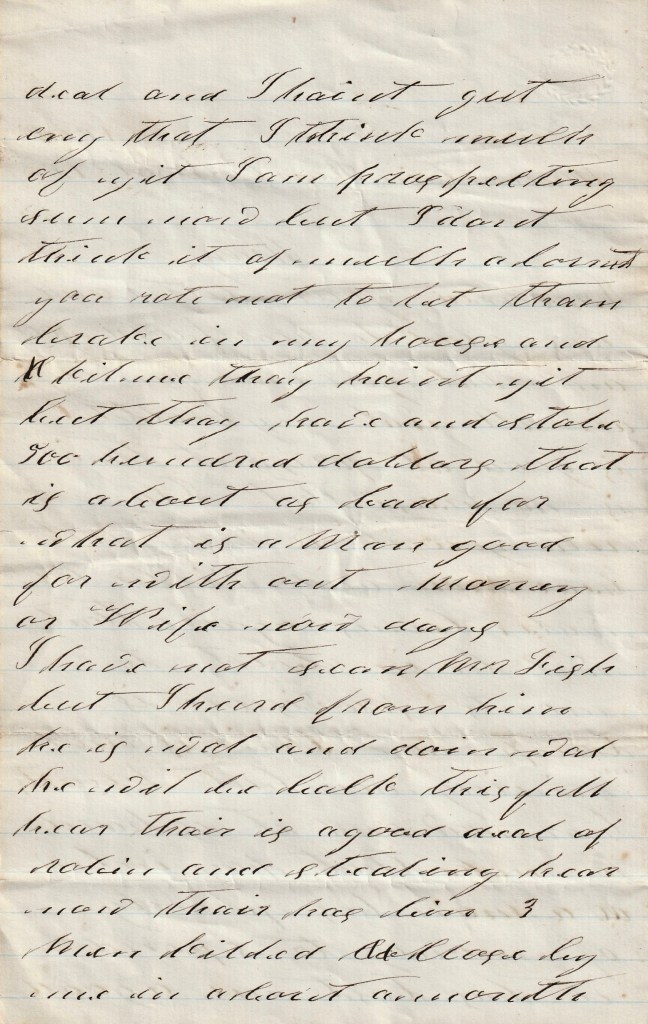
You wrote not to let them break in my house and kill me. They hain’t yet but they have stole 500 hundred dollars. That is about as bad for what is a man good for without money or wife now days.
I have not seen Mr. Fish but I heard from him. He is not doing what he will and doing what he will do…this fall here. There is a good deal of robbing and stealing here now. There has been three men killed close by me in about a month.
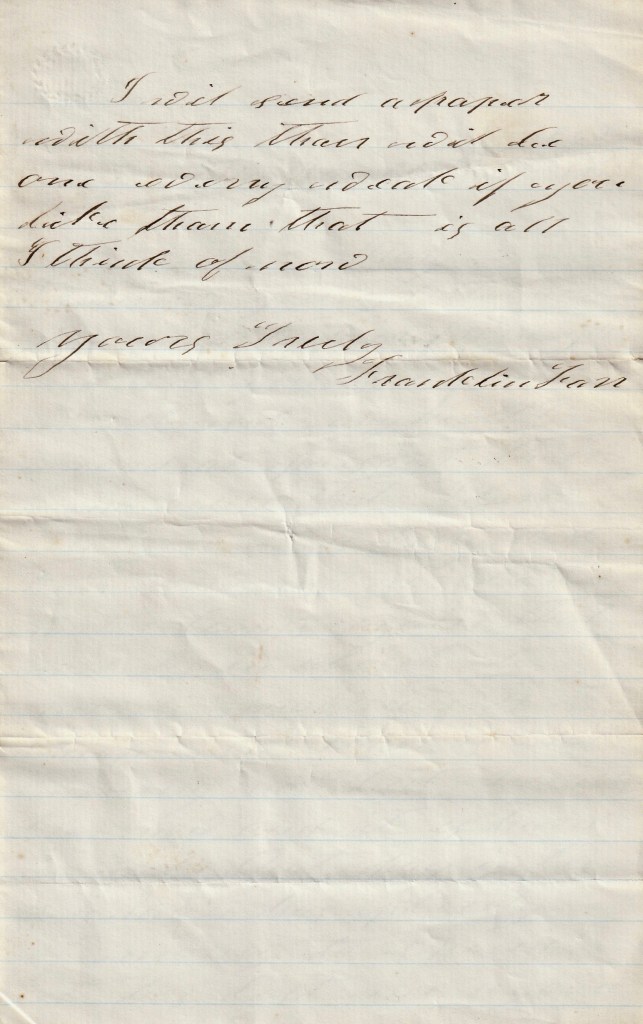
I will send a paper with this. There will be one every week if you like them. That is all I think of now.
This letter was written in 1849 from Independence, Jackson county, Missouri, by Benjamin Franklin Wallace (1817-1877). Benjamin was the son of Thomas Wallace (1777-1858) and Mary J. Percy (1785-1874) who came from Virginia to Missouri in 1833 by way of interim residency in Kentucky. Benjamin married Virginia Johnston Willock (1824-1908) at Independence on 1 August 1847 and their first child, mentioned in this letter, was Mary Albina Wallace (1848-1854) who was born on 2 May 1848. Their second child, David Willock Wallace was born on 15 June 1860. [I should mention here that when David W. Wallace grew up, he married Madge Gates in 1883 and their first child was Elizabeth Virginia (“Bess”) Wallace—the future wife of Harry S. Truman—Bess Truman!]
In the 1850 Slave Schedules, Benjamin was enumerated among the slaveholders. He owned three slaves—a female aged 22 and two young children, ages 5 and 2. In the 1860 US Census, Benjamin was identified as a “Bank Clerk” in Independence. In 1869, Benjamin served as the Mayor of Independence. By 1870, he was employed as a dry goods merchant.
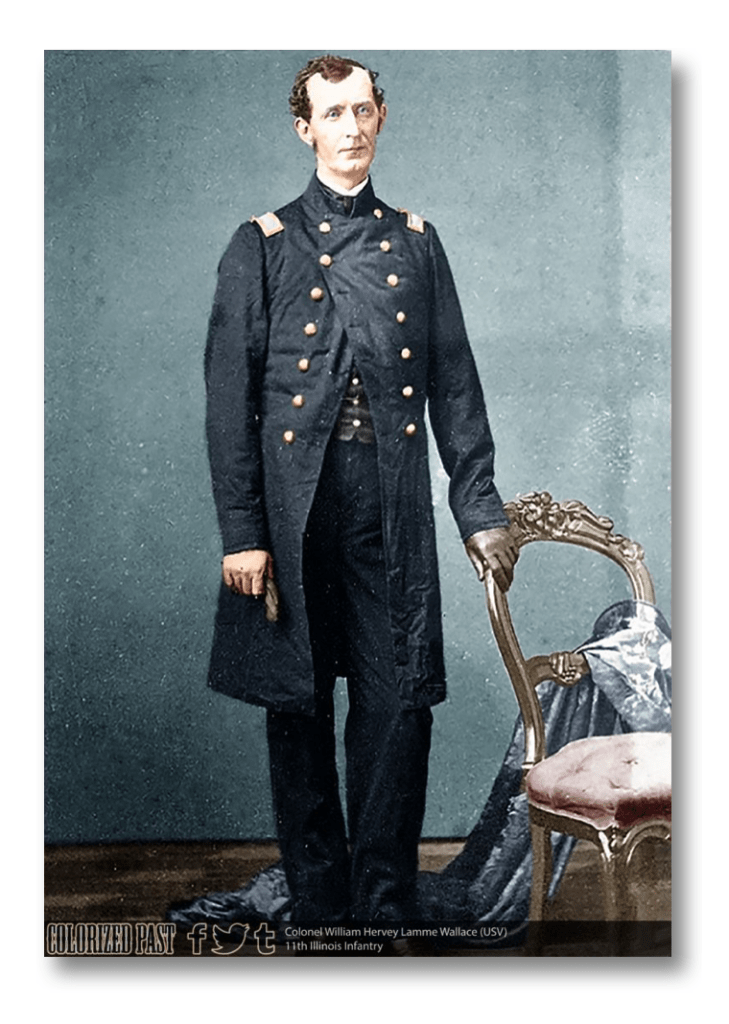
Col. William H. L. Wallace, 11th Illinois Infantry
Benjamin wrote the letter to William Hervey Lamme Wallace (1821-1862) of Ottawa, LaSalle county, Illinois. William’s obituary on Find-A-Grave informs us that prior to the Civil War, he served as the District Attorney for LaSalle County. When he entered the service, in 1861, he was commissioned the Colonel of the 11th Illinois Infantry. For his gallantry at the February 1862 Battle of Fort Donelson, he was promoted to Brigadier General and placed in command of the Army of Tennessee’s 2nd Division. Though he was a new division commander, yet he managed to withstand six hours of assaults by the Confederates, directly next to the famous Hornet’s Nest, or Sunken Road. When his division was finally surrounded, he ordered a withdrawal and many escaped, but he was wounded in the head by a shell fragment and only later found barely alive on the battlefield by his troops. He died three days later in his wife’s arms in a hospital near Savannah, Tennessee. [See “The Death of General W. H. L. Wallace at the Battle of Shiloh,” Iron Brigader.]
William’s younger brother, Martin Reuben Merritt Wallace (1829-1902) was also a Brigadier General during the Civil War, having begun as Colonel of the 4th Illinois Cavalry.
Trails leaving Independence, Missouri in 1849, Charles Goslin
Transcription
City of Independence, Missouri August 9th 1849
W. H. L. Wallace Dear Cousin,
Altho I may have written last, still I do not intend you shall forget me. I trouble you with another letter by way of reminding you that your unknown cousin has not forgotten you.
I have nothing of any great interest to write about, but feel quite grateful that I am alive and still able to correspond with my old friends & relatives whilst death has been abroad & taken many—very many—of my acquaintances. Still myself & mine still live altho death has spread quite a gloom over our beautiful city. Myself & family have remained well. None of your relatives here have been sick with the scourge (the cholera). Altho our next door neighbors have been taken of [it] in a few hours, we have been preserved. Our beautiful city has suffered to a greater degree than even the ill-fated St. Louis according to the amount of population. At present, we have but little I have heard of but one case in the last four days which occurred today and proved fatal in about eight hours (t’was that of a child).
We have had one continual excitement the present year. First the California emigrants & secondly the cholera. These were quite different. The first was pleasant & the last terrifying. A vast number of gold seekers have passed through our place during the last spring & present summer & among the number who have passed recently was some of our old friends from Illinois—Thomas Bassney & others. Bassney told me he knew you well & said you was to have been one of their party 1 but from some cause or other, you had not come on. I told him I suspected Old Zack [Zachery Taylor] had given you an office for I see he appointed W. H. Wallace to be “Register of Lands from Illinois” and suspected it was you (if you have gone to Iway [Iowa], you may never get this). I have but one fault to find to Old Zack’s Administration—I.E., he don’t turn out Locofoco’s fast enough [from such appointed offices] & fill the same with decent Whigs.
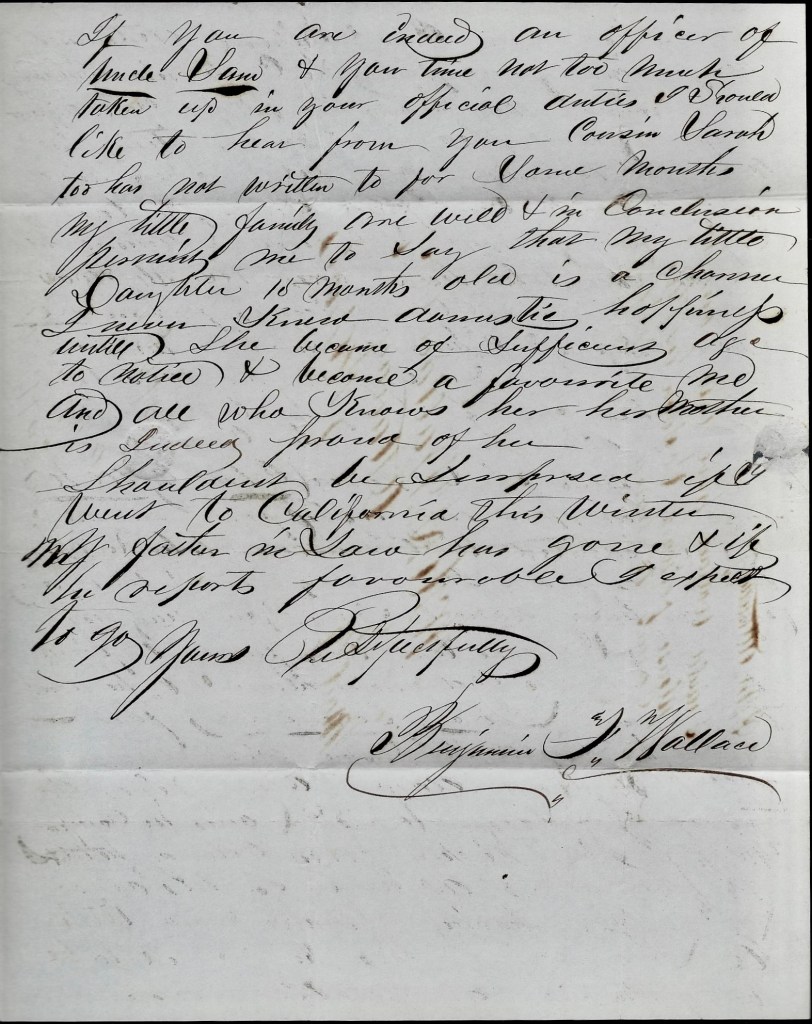
I went down our river the first of June to St. Louis in company with Mr. Fisher from Ottoway [Ottawa]. He told me you was as one of his own sons, you having studied law with a son of his [see George Smith Fisher (1823-1895)]. He seemed to be very much of a gentleman. If you are indeed an officer of Uncle Sam & your time not too much taken up in your official duties, I should like to hear from you. Cousin Sarah too has not written to [us] for several months. My little family are well & in conclusion, permit me to say that my little daughter 15 months old is a charmer. I never knew domestic happiness until she became of sufficient age to notice & become a favorite [to] me and all who knows her. Her mother is indeed proud of her.
Shouldn’t be surprised if I went to California this winter. My father-in-law has gone & if he reports favorable, I expect to go. Yours respectfully, — Benjamin F. Wallace
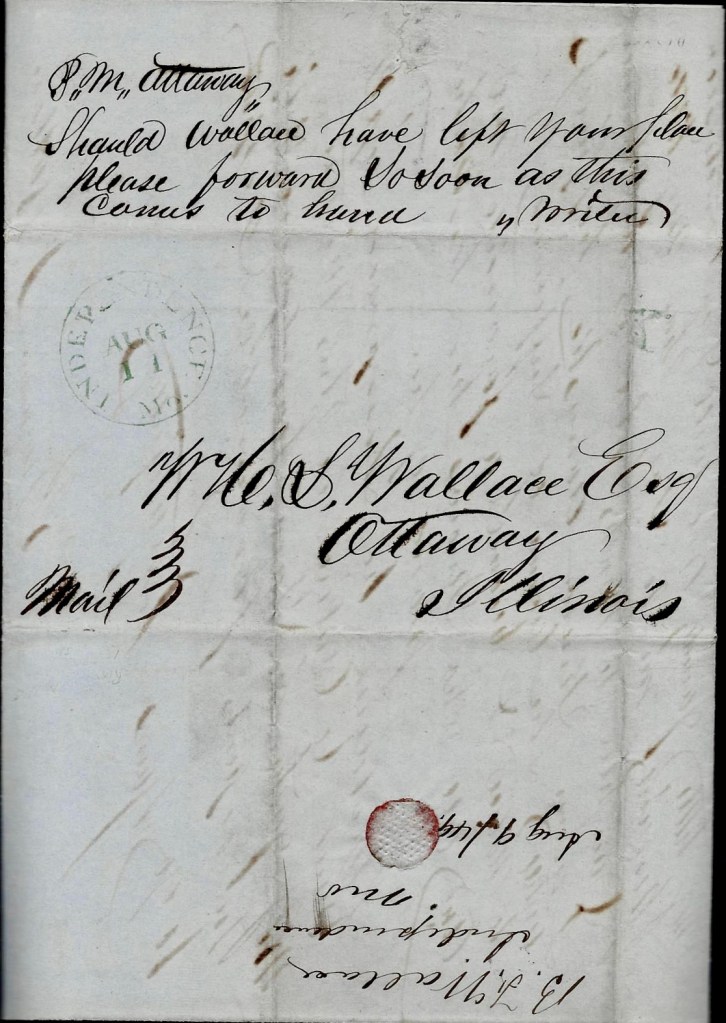
Postmaster Ottoway: Should Wallace have left your place, please forward so soon as this comes to hand.
1 This “California Party” was probably the “Dayton Party” formed at Dayton (near Ottawa) under the command of Captain Jesse Greene. Their rendezvous was to be at St. Joseph on the Missouri in April 1849. One of the party, a store clerk in Ottawa named Alonzo Delano (1806-1874) and his record of the journey can be found at “Life on the plains and among the diggings.”See also “Dayton and the Greens.”
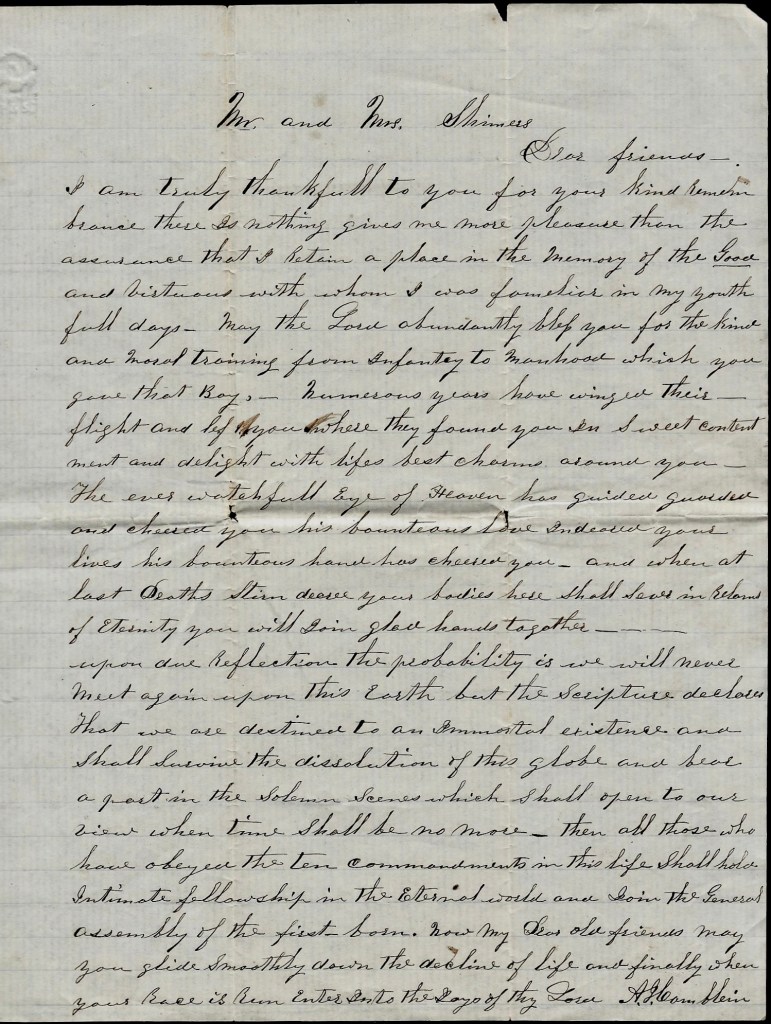
This letter was written by A. John Camblein (1826-1859). He was married to Elizabeth Jane Sroufe (1832-1863) and together they had three children—Margaret Josephine (1853-1924), David Anthony (1856-1935) and George (1859-1863). In the 1850 US Census, John was enumerated in Diamond Springs, El Dorado county, California. According to the mortality schedules in California, John froze to death in November 1859 when he was 33 years old. John’s wife Elizabeth died of breast cancer in 1863.
Transcription
Minersville, [California] July 3rd 1858
Dear Mother,
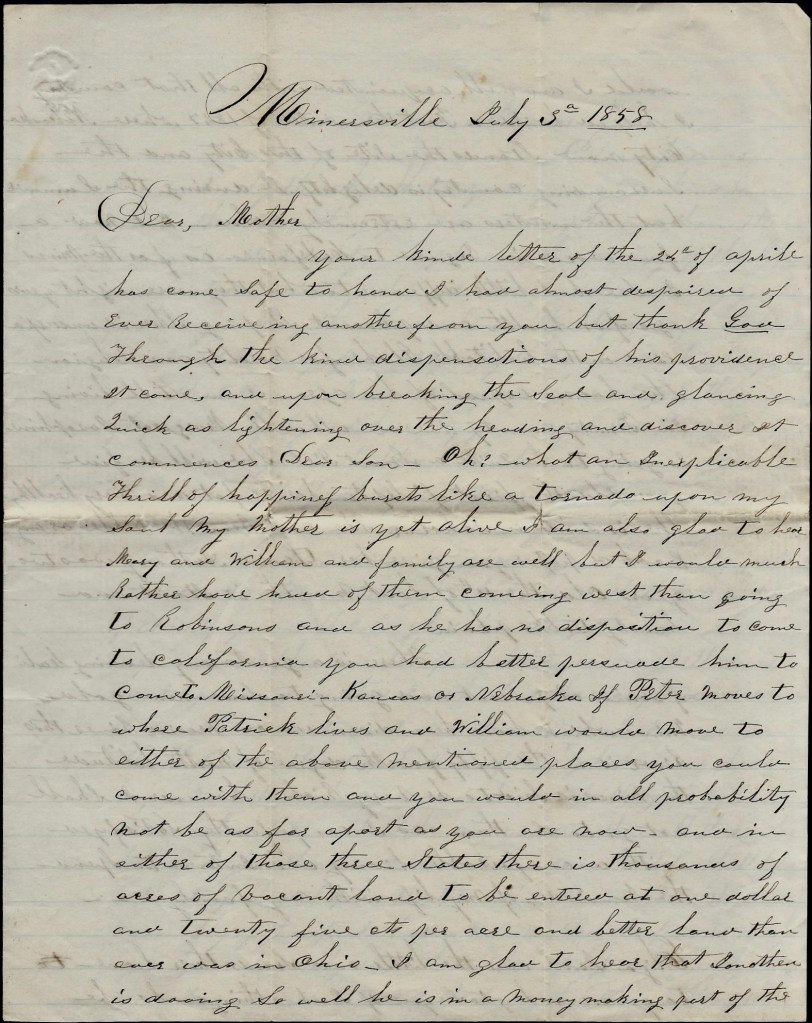
Your kind letter of the 24th of April has come safe to hand. I had almost despaired of ever receiving another from you but thank God, through the kind dispensations of His providence, it come, and upon breaking the seal and glancing quick as lightning over the heading and discover it commences, “Dear Son”—Oh! what an inexplicable thrill of happiness bursts like a tornado upon my soul. My mother is yet alive! I am glad to hear Mary and William and family are well but I would much rather have them coming West than going to Robinsons and as he has no disposition to come to California, you had better persuade him to come to Missouri—Kansas—or Nebraska. If Peter moves to where Patrick lives and William would move to either of the above mentioned places, you could come with them and you would in all probability not be as far apart as you are now. And in either of these three states, there is thousands of acres of vacant land to be entered at one dollar and twenty-five cents per acre and better land than ever was in Ohio.
I am glad to hear that Jonathan is doing so well. He is in a money making part of the world. I am well acquainted with all that country. I helped build a Fort the winter of 1847 where Nebraska City now stands. The site of the city and the surrounding country is delightful during the summer but the winters are extremely cold.
But now a few words in regard to California. As for the mines, I see but little difference to what they were eight years ago. For health and pleasant sleeping, she is unsurpassed on the habitable globe. For morality and religion she has no equal of her ago. I am still living in Trinity county. We are all well. Margaret Josephine is getting to be quite a smart girl. She will be five years old the first of September. Is fat and very healthy. She is quite a scholar. She can read the Bible or any book or paper you give her. David Anthony was two years old the 11th of last month. Is stout and hearty. Talks plain.
There is a great many leaving California at present and going to some new gold mines which have been discovered on Frazier River. This river is in the fifty-fourth degree of North latitude. The mines is said to be very rich. However, I shall not go to see them as I am perfectly satisfied with a comfortable living and intend to spend the remainder of my life with my family.
Eliza Jane and the little ones send their love to you and long to see you, if such a thing could be.
[A sheet follows addressed to Mr. and Mrs. Shimers]
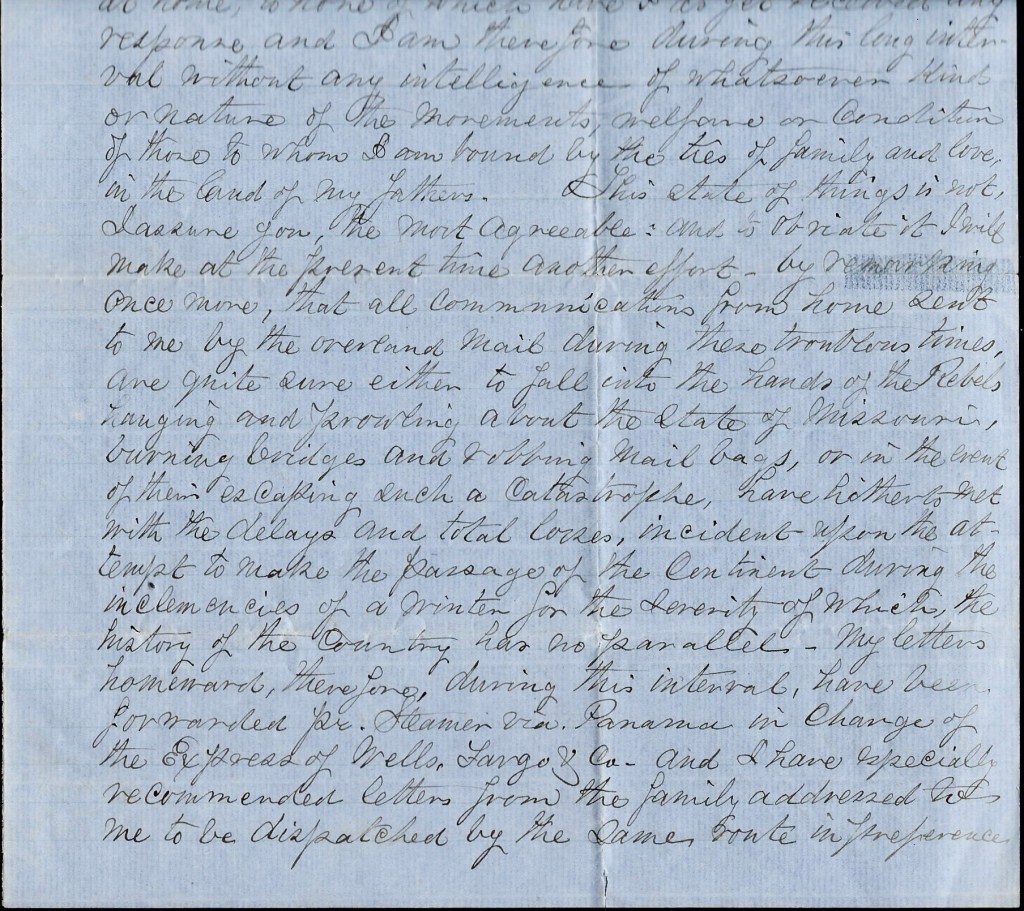
This letter was written by 46 year-old Thomas Wainwright Colburn (1816-1882), the son of dry goods merchant Joshua Colburn (1783-1873) and Eunice Jones (1784-1871) of Boston, Suffolk county, Massachusetts. Thomas wrote the letter to his older brother, George Wood Colburn (1814-1896) who married Sarah Hovey Foster (1820-1914) in 1842.
Thomas made his way to gold fields of California in the early 1850s, taking up residence in Nevada City, California as early as 1852, possibly earlier. In was here in Nevada City that Thomas met and married his wife, Louise Mather (1821-1916) of Albany, New York. While in Nevada City, Thomas apparently entered into the firm Colburn & Jenkins which went bankrupt in 1856. I don’t know for certain what this business was but think it may have been a water canal enterprise associated with the mines. In 1870 Thomas was still affiliated in the mining industry, serving as secretary of the Hidden Treasure company in San Francisco. Thomas died in Stockton, California in 1882.
The letter is marvelously written and readers will no doubt marvel at the author’s prescience—and the confidence with which he expresses it—at the outcome of the civil war that has erupted between the North and South. He, I think, fairly accurately puts his finger on the cause of the “acrimony,” attributing it to the lack of understanding between the residents of the two regions who for too many years were fed falsehoods about each other by biased newspapers, leading to an “unjust prejudice.” [These distortions of reality are captured wonderfully in Thomas Flemings’s book, “A Disease in the Public Mind” published in 2013]
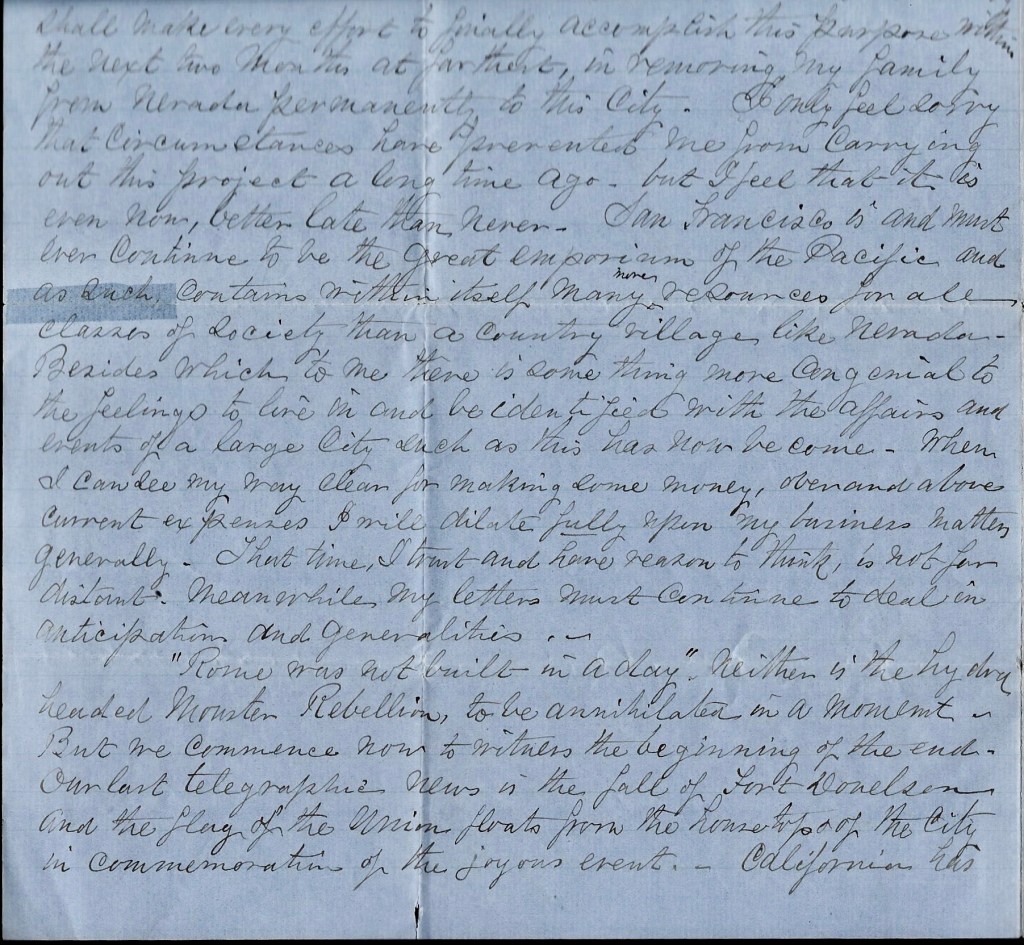
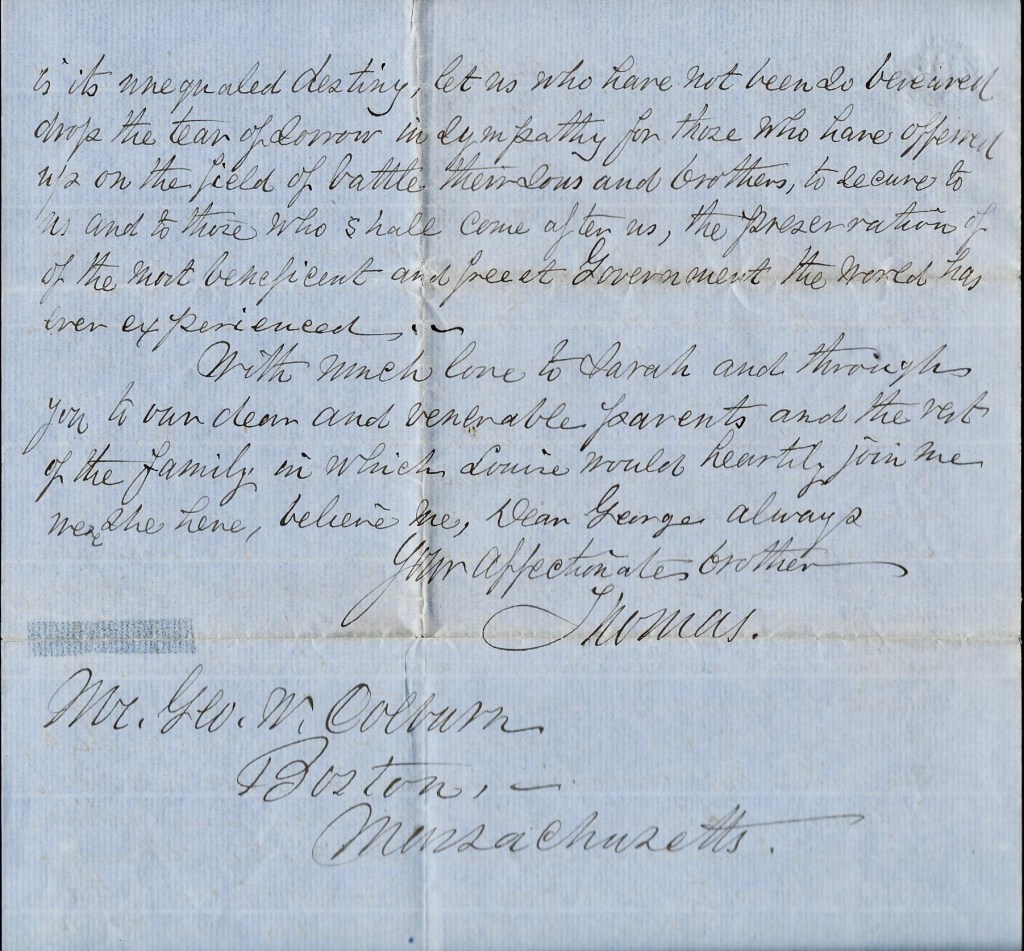
I particularly like his final sentiment which reads: “But while the Country is struggling through this sad and bitter experience in order that it may arrive at that future greatness with greater speed and certainty that is its unequaled destiny, let us who have not been so bereaved drop the tear of sorrow in sympathy for those who have offered up on the field of battle their sons and brothers, to secure to us and to those who shall come after us, the preservation of of the most beneficent and freest Government the world has ever experienced.”
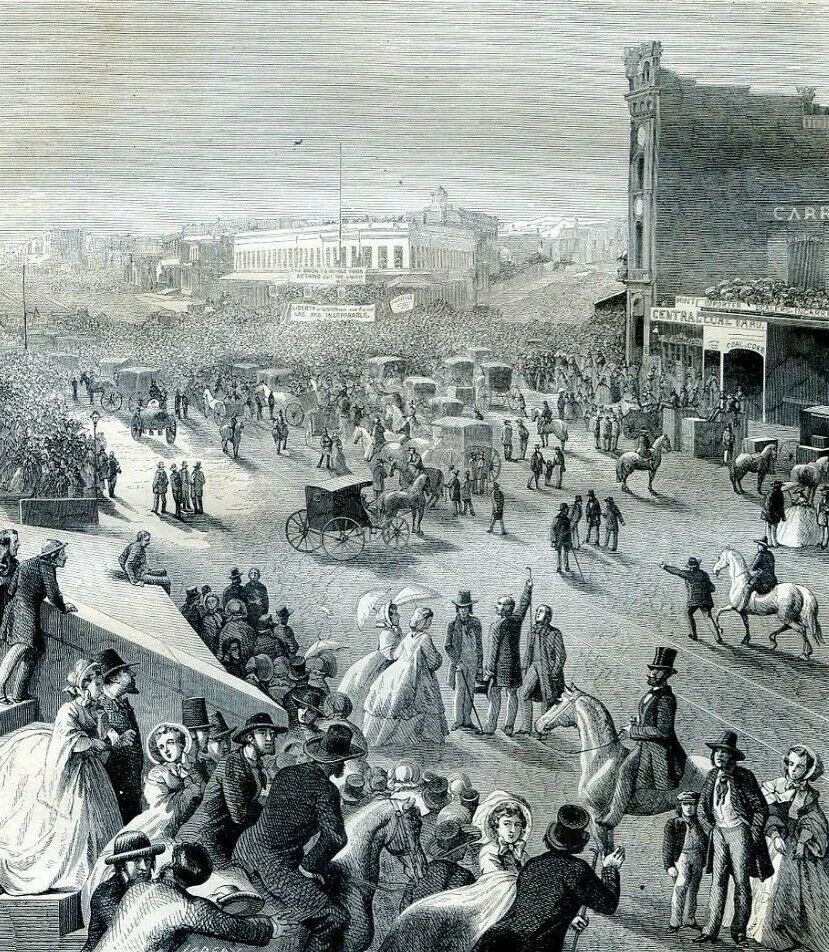
Engraving of San Francisco in 1862
Transcription
Per steamer via Panama 215 California Street San Francisco [California] February 20th 1862
Dear George,
Since my sojourn in this city, which dates back to the middle of October last, I have written sundry and various letters to the members of the family at home, to none of which have I as yet received any response and I am therefore during this long interval without any intelligence of whatsoever kind or nature of the movements, welfare or condition of those to whom I am bound by the ties of family and love, in the land of my fathers. This state of things is not, I assure you, the most agreeable; and to obviate it I will make at the present time another effort by remarking once more, that all communications from home sent to me by the overland mail during these troublous times, are quite sure either to fall into the hands of the Rebels hanging and prowling about the State of Missouri, burning bridges and robbing mail bags, or in the event of their escaping such a catastrophe, have hitherto met with the delays and total losses, incident upon the attempt to make the passage of the Continent during the inclemencies of a winter for the severity of which, the history of the county has no parallel. My letters homeward, therefore, during this interval, have been forwarded per Steamer via Panama in charge of the Express of Wells, Fargo & Co. and I have especially recommended letters from the family addressed to me to be dispatched by the same route in preference to having them subjected to the uncertainties and vicissitudes of the Overland Mail.
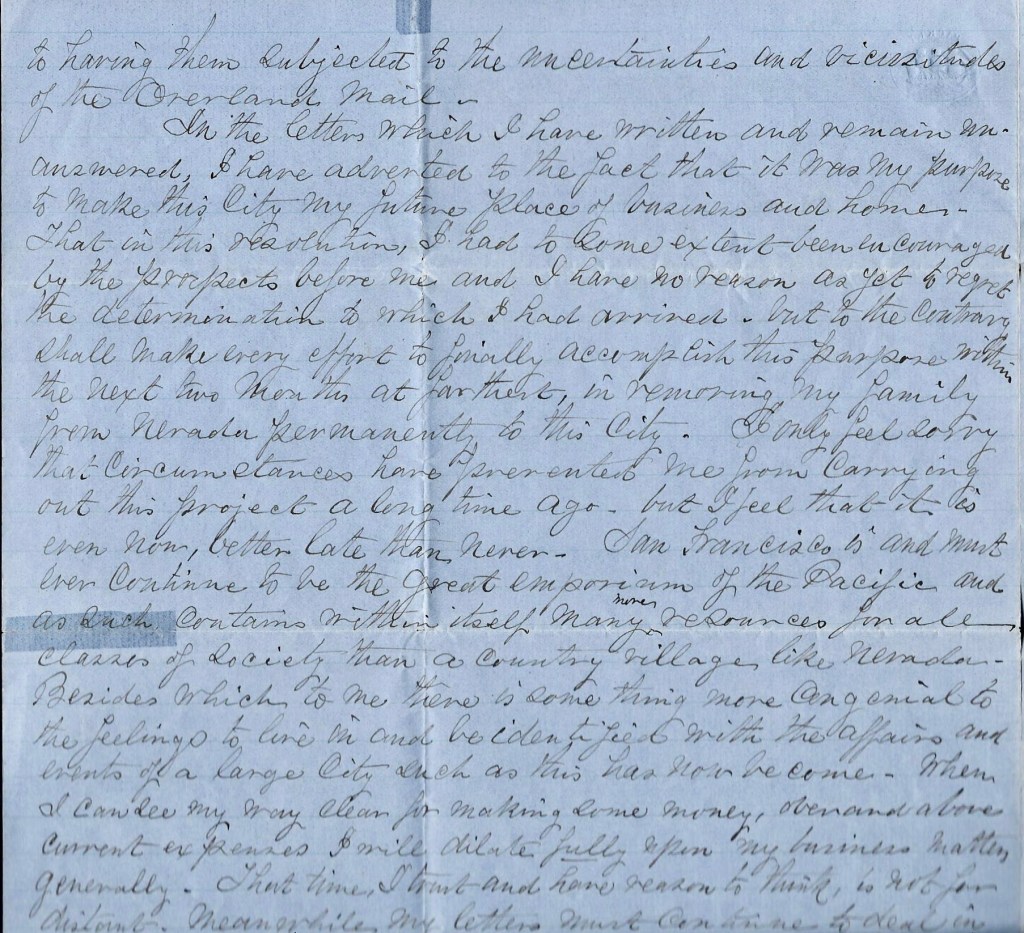
In the letters which I have written and remain unanswered I have adverted to the fact that it was my purpose to make this City my future place of business and home. That in this resolution, I had to some extent been encouraged by the prospects before me and I have no reason as yet to regret the determination to which I had arrived, but to the contrary shall make every effort to finally accomplish this purpose within the next two months at farthest, in removing my family from Nevada permanently to this City. I only feel sorry that circumstances have prevented me from carrying out this project a long time ago, but I feel that it is even now, better late than never.
San Francisco is and must ever continue to be the great emporium of the Pacific and as such contains within itself many more resources for all classes of society than a country village like Nevada. Besides which, to me, there is something more congenial to the feelings to live in and be identified with the affairs and events of a large city such as this has now become. When I can see my way clear for making some money, over and above current expenses, I will dilate fully upon my business matters generally. That time, I trust and have reason to think, is not far distant. Meanwhile my letters must continue to deal in anticipations and generalities. “Rome was not built in a day.” Neither is the hydra headed monster Rebellion to be annihilated in a moment. But we commence now to witness the beginning of the end.
Our last telegraphic news is the fall of Fort Donelson and the flag of the Union floats from the housetops of the City in commemoration of the joyous event. California has been from the first as loyal as any State of the Union and her great heart throbs in unison with her loyal sister States east of the Rocky Mountains. Sarah asked me some time since whether when this foul rebellion is once crushed, we would ever again become in sentiment—as well as in name—a united people. My reply is most emphatically in the affirmative. The acrimony which now exists on the part of the South had its origin in an unjust prejudice based upon almost inexcusable ignorance as to the real sentiments and feelings of the North. When the truthful page of history commences to make the record of this eventful period, this and future generations of southern men—when the passions of the human heart have subsided and reason reigns once more supreme—will peruse that page thoughtfully & dispassionately, and when the task is done, they will acknowledge with shame their ingratitude, their madness, and their blindness in the suicidal course they have pursued.
“But while the Country is struggling through this sad and bitter experience in order that it may arrive at that future greatness with greater speed and certainty that is its unequaled destiny, let us who have not been so bereaved drop the tear of sorrow in sympathy for those who have offered up on the field of battle their sons and brothers, to secure to us and to those who shall come after us, the preservation of the most beneficent and freest Government the world has ever experienced.”
Thomas Colburn, citizen, San Francisco, 20 February 1862
The North in its magnanimity towards a conquered brother, will seek every opportunity to show its generosity by word and deed and thus within this generation link again the South to itself in bonds of fraternal amity which no future contingencies can ever sever again. And another decade will witness the great and glorious spectacle of the most united people—the most prosperous and the mightiest nation on the face of the globe—never again to be disturbed by any internal dissensions and impregnable against the combined forces of the Old World. It takes no prophet nor the son of a prophet to predict this—and even far more. But while the Country is struggling through this sad and bitter experience in order that it may arrive at that future greatness with greater speed and certainty that is its unequaled destiny, let us who have not been so bereaved drop the tear of sorrow in sympathy for those who have offered up on the field of battle their sons and brothers, to secure to us and to those who shall come after us, the preservation of the most beneficent and freest Government the world has ever experienced.
With much love to Sarah and through you to our dear and venerable parents and the rest of the family in which Louise would heartily join me were she here, believe me, dear George, always
This letter was written by “E. J. Bloomer” (b. @1825) who seems to have been running a sawmill operation in California near the Liberty Hill Gold Diggings “that were located on a ridge between Steephollow Creek and the Bear River, about 10 miles east of Nevada City and about 2 miles north of Alta, as the crow flies. It was part of Little York Township and within what was generally called the Lowell Hill mining district, a rich channel of gold bearing ore that ran around Remington Hill to the north down to the Bear River and then crossed over towards Dutch Flat and Alta.” [Nevada County Historical Landmarks Commission]
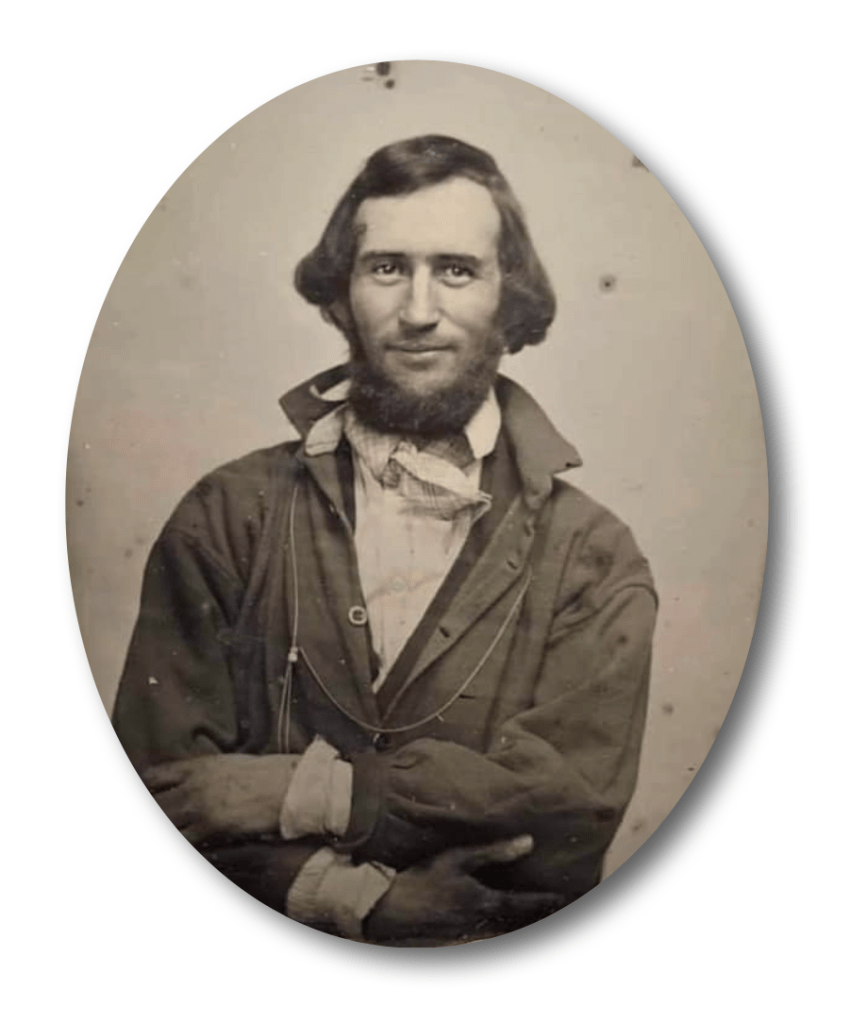
How E. J. Bloomer might have looked(Crocker Art Museum)
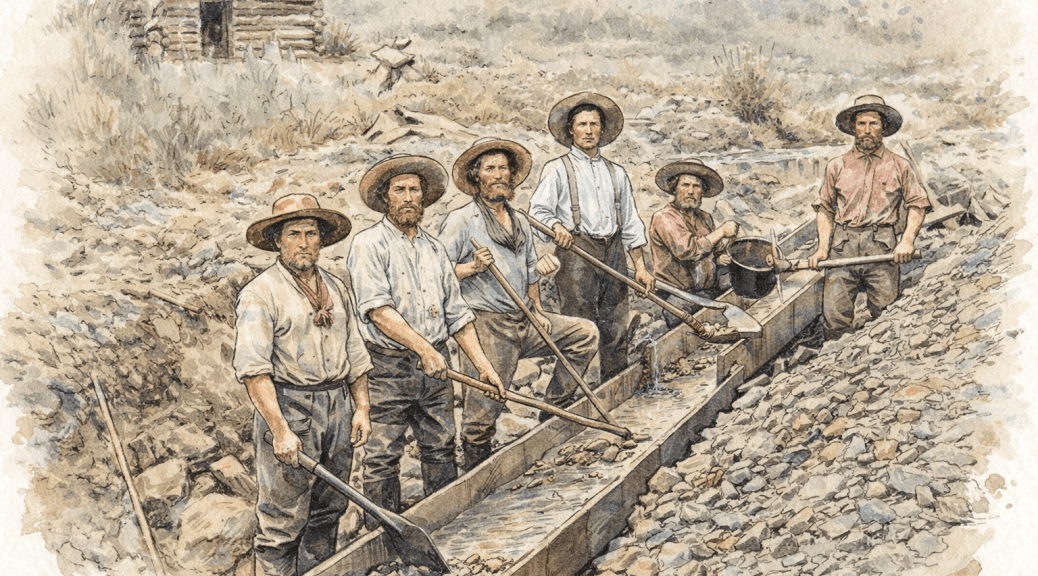
Placer mining for gold required a good supply of water and laborers were required to dig ditches or to saw wood into lumber for making flumes—particularly to carry water to gravelly “dry diggings.” To make sure there would always be a constant supply of water to feed the trenches and flumes, a reservoir was built at Liberty Hill and it appears that Robert Gardner, a “water agent” from Illinois, was at least partially responsible for its construction.
The 1860 US Census for Red Dog Post Office, Little York township, Nevada county, California, enumerates 35 year-old Jacob Bloomer (a laborer from NYS) residing with 24 year-old laborer Peter Rose (also a laborer from NYS) in the household of 30 year-old R. Newton (a “water agent” from Illinois). Also in the same household were 25 year-old Alphonzo Sweet (laborer from Illinois), and 21 year-old Frank Voit [Voight] (a laborer from Illinois). Residing next door was 38 year-old Joseph Gardner (a placer miner from NYS), and 40 year-old Robert Gardner (“water agent” from NYS).
I’m inclined to be believe this letter was written by Egbert Jacob Bloomer (1823-1900), the son of Joshua Bloomer (1792-1835) and Betsy Scott (1797-1888) of Ovid, Seneca count, New York. Egbert was married in 1846 to Mary Vanpatten and they had a child named Ella Rebecca (1848-1905) when they were enumerated in Fairfield, Michigan, in 1850. He was remarried to Mary Vaughan (1839-1914) in Adrian, Michigan, in 1868 and with her he had two more children born in the 1870s. In the 1870 US Census, the couple were enumerated in Fairfield, Michigan, and 23 year-old Ellie (his daughter by first marriage) was living with them.
Egbert’s ancestry record is substantially complete with the exception of the 1860 Census record which is absent. My hunch is that he went to California under the name “Jacob Bloomer.” In November 1862, a letter awaited “E. J. Bloomer” at the post office in Sacramento.
The 1870 US Census for Little York, Nevada county, Ca., enumerates 40 year-old David Rose from New York State as the head of household with two others—50 year-old Oscar Berg from Finland, and 32 year-old Henry McGinn from Ireland. All three were identified as “miners.”
[This letter is from the private collection of Richard Weiner and is published on Spared & Shared by express consent.]
Transcription
Addressed to Mr. David Rose, Charlotte Centre, Chautauqua county, New York
August 26, 1860
Mr. D. Rose, Sir,
I received your letter today July twenty-eighth and was glad to hear from you and from my folks and about my children. I received a letter from Love some two weeks ago stating that you had been there and should been glad to have had you stayed longer. I should like to see them.
I will give you how things have went since you left the best I can think. We finished the old logs the first day of June and R. Gardner had let some men the job of cutting logs that day we went to Nevada [City]. They came from Fraser River—some connection of Moody of Liberty Hill. they cut the sugar pine up above the house. The best logs scaled sixty-seven inches and made when sawed twenty-four hundred [and] fifty feet.
Joe Muncan’s [Munson’s] boy, or child, was buried the 9th of June. The cattle got here the sixth and looked first rate. Sam Latta has got a yoke of oxen. Give two hundred [for them]. He had them picketed out on his ranch and one got his foot fast in the rope and killed him. Now he has bough that ox that Sweet claimed. John Smith of Liberty had one bone of his leg broke the 12th of June in the diggins. Liberty has used up some men this year. A[bert] Nutting has got well so he begins to work. He was a hard-looking sight. R. Gardner though most too much to do so. He had Frank Voigt to come and work. He came some two weeks after you left and he had one by the day some four or five weeks to help me and help pile the lumber.
The oak trees commenced looking green Sunday the 17th of June. They had a ball at J. Duffy’s the twentieth for his benefit and they took in some seven hundred dollars. John Whitedge and Jim Myers had some words and John shot Myers arm off—or so they have to cut it off close to the shoulder—and John left and they have not got him. Jack McConnell gave up the chase and said that he would not try anymore.
The Fourth of July they had quite a time at Dutch Flat and Pete went, and a picnic at York and Jack went to York. Robert went to York in the afternoon but I stayed and sawed all day alone. It commenced raining the night of the tenth and rained all the next day. The eleventh about eight o’clock I was sawing [when] that guging they put in last winter dropped off. I was sawing sugar pine and went without any jare. Got a new one in and started the nineteenth and plenty of water till the first of this month. Quit sawing last Thursday the 23rd. Water was turned out of the ditch on Friday and Jack came back from turning out the water and went to York that day and the next day he said he was a going home. He is to leave York today. I suppose he will go on the same boat with this.
They had a dance at Parish on Saturday, July 21st. Quite a turnout. J. Gardner went down to Sacramento the last of July and got a span of Spanish horses. They are not broke to work. He got them to draw lumber. They built a blacksmith shop across the road from the logs under that fur tree and had Old Tiger of Remington Hill here to fix the wagons. We got up August the 4th and shop tools of all kinds. He had most all out of the mill [which] was burnt slick and clean to the ground and the woods on fire and the fire going towards the mill when I got there at four o’clock, August 6th.
Donald McKenzie was killed in V[alentine] Curran’s diggins [when] the bank caved in on him. He got some sixty feet when it buried him up. It catched Tom [too] but he got out. It took some time to find him for they did not know where he was was. He was buried some four feet deep with red dirt and [7 year-old] Jimmy Dryman fell and broke one arm the same day. Jack Stuart left here the last of June for home. He sailed the thirty-first. Pete [Rose] and Jack is a team a drawing logs and they have got most all in, some fifty more to haul. Gardner has commenced his flume for Christmas Hill. I started for there with the team on Friday with nineteen hundred feet [of lumber] and got down below long ravine where that bridge was. They took off the plank and filled in with brush and dirt. I went on and over went the load and wagon on top so I came back and tried it again. Yesterday I went through but they had to fix it some.
I do not know what I shall work at now. [Robert] Gardner is a going to make the reservoir larger. Oh yes, they have got a school house just above that spring up from the reservoir and have a school. Cooper—that one is sick—teaches. I can’t think of anything more. If you can make this out, you will do well. You must write again.
Oh, Miss Ann Swift is here yet. She goes by here some two or three times a week. My best respects, — E. J. Bloomer