
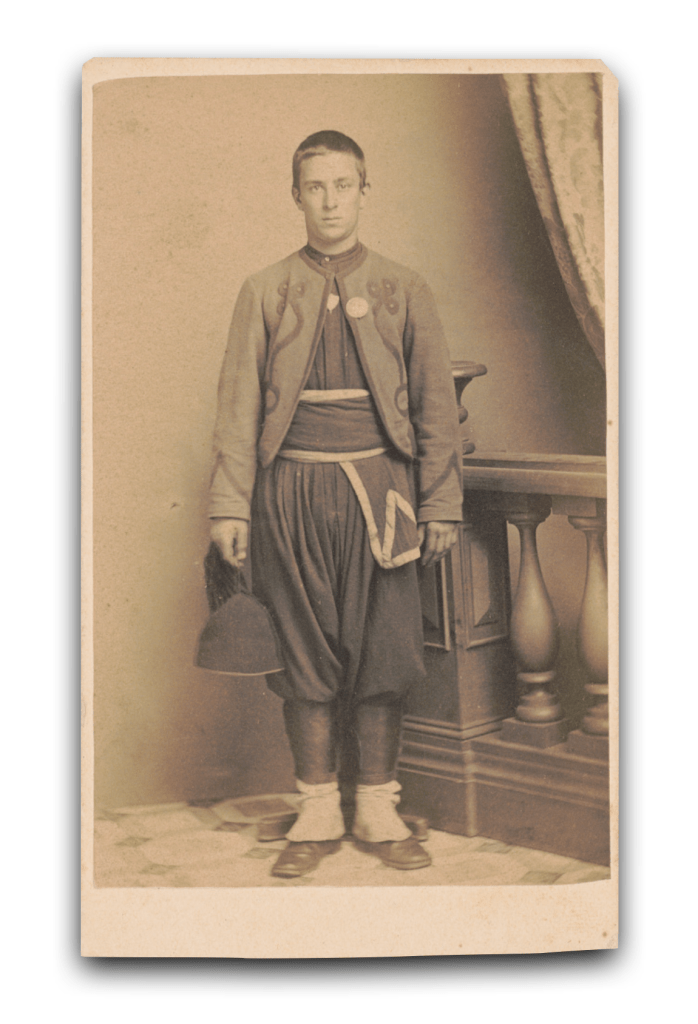
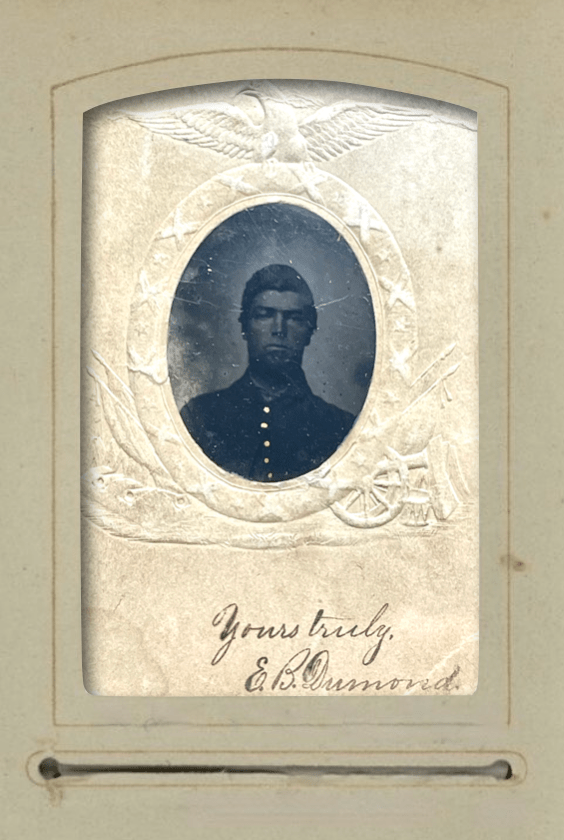
The following letters were written by James E. Weir who mustered in as a private in Co. C, 5th New York Infantry on 9 May 1861 to serve two years. He mustered out with company on 14 May 1863, at New York city. The regiment—also known as Duryée’s Zouaves—were moved to the Virginia Peninsula with two weeks of their mustering into service and encamped near Fortress Monroe, and then at Newport News before leading the force at Big Bethel in mid-June 1861. Following that they were sent to Baltimore to protect the railroads and the city. They garrisoned an earthen fort at the summit of Federal Hill.

Letter 1
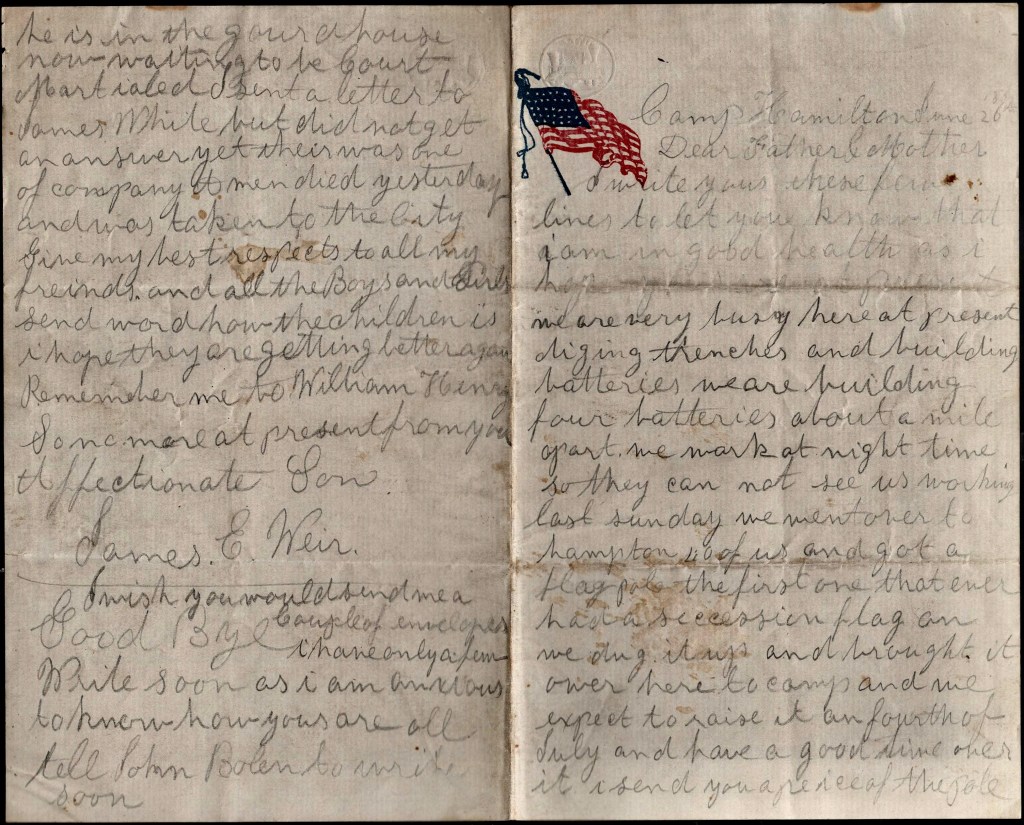
Camp Hamilton
June 26, 1861
Dear Father & Mother,
I write you these few lines to let you know that I am in good health as I hope you are at present. We are very busy here at present digging trenches and building batteries. We are building four batteries about a mile apart. We work at night time so they cannot see us working. Last Sunday we went over to Hampton—40 of us—and got a flag pole, the first one that ever had a secession flag on. We dug it up and brought it over here to camp and we expect to raise it on the Fourth of July and have a good time over it. I send you a piece of the pole as a relic. It is the same pole that we took the secession flag from that was sent down to the city last week.
We have got two pieces of artillery—one a Howitzer, and the other is a rifled cannon and we expect some in the course of a week or so.
The sergeant that got shot last week is getting along very well. I just came in from picket guard. We have ben away for two days. We have to march 10 miles before we get to the place where the guard stops. It is very hot out here. There is not a man out here but is sun burnt and the skin is pealing off their face. I forgot to tell you that every regiment takes turns once a week. We all get along very well here—only for the sun.
Robert Williams is a disgrace to his company and the regiment. I suppose that he will get drummed out of the regiment so if he comes home, you will know the reason. On Monday when we were on drill, there was a pair of pantaloons hanging up in one of Company A’s tents and there was some letters and money in them and when the man came after them, he swore he did not see them and he had them on him at the same time and he was the first one to open his knapsack and let them search it. He lost his own and that [was] the reason he took them, because he thought that he was going home so let all the boys know it. He is inn the guard house now waiting to be court martialed.
I sent a letter to James White but did not get an answer yet. There was one of Company A men died yesterday and was taken to the City. Give my best respects to all my friends and all the boys and girls. Send word how the children is. I hope they are getting better again. Remember me to William Henry. So no more at present. From your affectionate son, – James E. Weir
I wish you would send me a couple of envelopes. I have only a few. Goodbye. Write soon as I am anxious to know how you are all. Tell John Bolen to write soon.

Letter 2
Camp Federal Hill
July 30th 1861
Dear Father & Mother,
I write these few lines to let you know that I am in good health as I hope you are at present.
On Thursday we got orders to strike tents and get three days rations ready for a march to Fox Hill and then from there to Yorktown. But the order was countermanded and then the orders was to march on to Washington. So we started about 10 o’clock the next night and embarked on board the steamer Adelaide for Baltimore, then to Washington, but instead of going to Washington we encamped on Federal Hill, Baltimore, near Fort McHenry. It is a splendid place. We have a splendid view of the City of Baltimore. It looks more like being home.
Last night we had a long roll and every man was in line in less time than could be thought of. Then there was four companies picked out for to go to President Street Railroad Station to quell a riot. But when we got there, it was all over so they had no fun as they call it. We had crowds of visitors every day coming to see us. I sent you a Secession envelope which I got in the City of Baltimore.
Robert Williams 1 received his sentence last night. His sentence was to have his head shaved and receive no pay and a board hanging around his neck with the word “Thief” printed on it and be drummed out of the regiment for stealing a pair of pants from Private Wams [?] of Company I. Also stealing a sash from Private [Charles E.] Ellis in the same tent with himself, and third stealing a pistol from Private [William] Potts, also in the same tent with him. There is not a man in the company sorry for him but they pity his father and mother as I do myself. Some of the boys says he run the guard. I have not seen him since last night so I cannot tell.
We expect to go to Washington as soon as some regiment relieves us as we had to relieve the 18th Pennsylvania Regiment. But not until then.
Give my best respects to all my friends and all the boys and girls, Remember me to the children and to William Henry. Tell Albert Buschman he must excuse me for not writing as we have been very busy ever since I received his, but I will write as soon as I get time. Sergeants [George E.] Hager and [Galbreath] Mathews send their best respects to you. When you write, direct your letter to Camp Federal Hill, Baltimore, instead of Camp Hamilton. No more at present. From your affectionate son, — James E. Weir
Write soon. Goodbye.
1 Robert H. Williams was 19 years old when he enlisted in April 1861 at New York City to serve as a private in Co. C, 5th New York Infantry. He deserted on 31 July 1861 at Baltimore, Maryland.


Letter 3
Camp Federal Hill
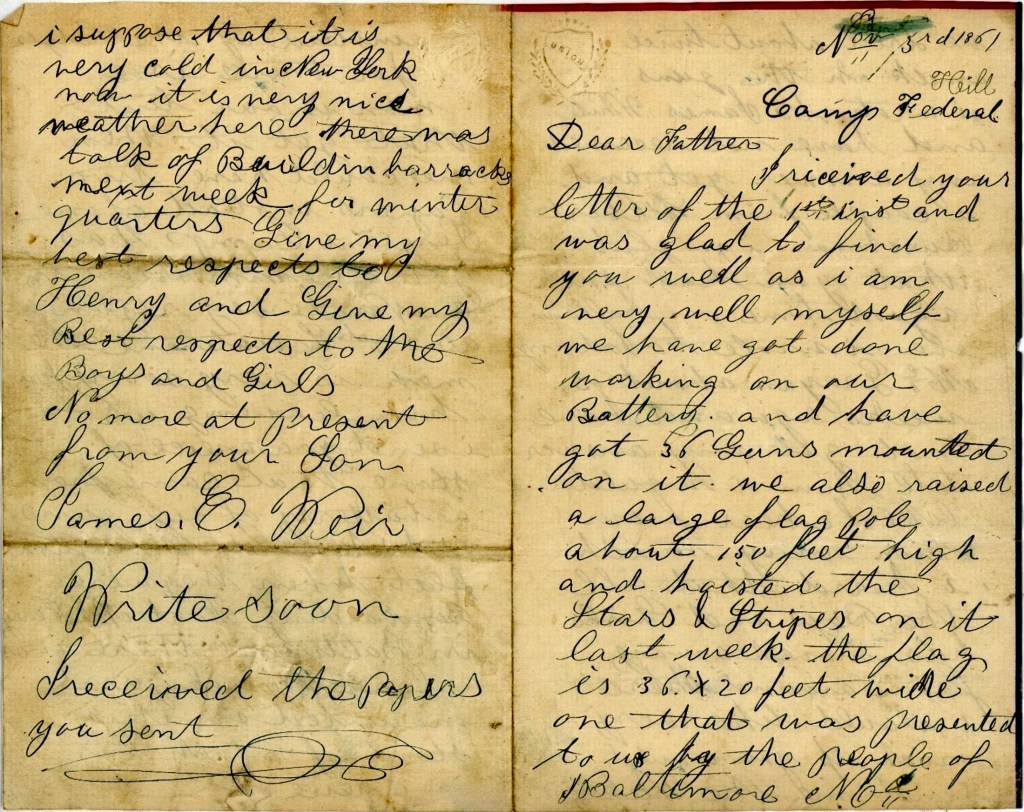
November 3rd 1861
Dear Father,
I received your letter of the 1st inst. and was glad to find you well as I am very well myself. We have got done working on our battery and have 36 guns mounted on it. We also raised a large flag pole about 150 feet hight and hoisted the Stars & Stripes on it last week. The flag is 36 x 20 feet wide—one that was presented to us by the people of Baltimore, Maryland.
We drill about twice a week on the guns. I wrote to James White and have not received any answer yet and a couple from Albert Buschman. I am glad that you had such a good time on hallow eve. I wrote to Johnny McGrayan about 3 weeks ago and have not got any answer. Tell him I would like to hear from him very much. I heard that all the boys and girls has moved away from around there.
I would like very much if you would send me the Weekly instead of the Ledger for there is a man in our tent that gets it. Then we could have two papers instead of one.
Sergeant [Norman H.] Camp has got a commission in a New Jersey Regiment as 2nd Lieutenant. 1 The men is very sorry for him leaving us.
I send you a piece of stone that came from a battery of six guns which sunk the English fleet when they were bombarding Fort McHenry in Baltimore. There was a large swivel gun mounted on this stone of which this is a piece of.
I suppose that it is very cold in New York now. It is very nice weather here. There was talk of building barracks next week for winter quarters.
Give my best respects to Henry and give my best respects to the boys and girls. No more at present. From your son, — James E. Weir
Write soon. I received the papers you sent.
1 Norman H. Camp was promoted sergeant in Co. C on 28 October 1861. He was discharged on 29 October 1861 to accept a commission and 2d Lieutenant of Co. K, 4th New Jersey Volunteers.

Letter 4
Harewood Hospital
October 8, 1862
Dear Father,
I received your letter of the 5th and was glad to find you all in good health. I still continue the same way. I am sorry that I did not see Mrs. Gibson. There is a great many ladies comes here to the hospital to give any little nourishment that the sick like to have. I got a letter from Johnny McGray on the next day after I received yours. He says that Jim is in business in King Street, Alexandria. He wrote about the marriage and said they had a good time of it.
It would be a great deal better for Robert Gibson to get home if he could for he is hardly able to stand it. But he has stuck it out pretty good since he has been in the army. There is no such thing as getting a furlough to go home. Those that is home has skedaddled from the regiments when the fighting was going on and got home.
I have been expecting a letter from one of the boys in the regiment but I believe they have not got any mail yet. But they expect it every day [or] so one of the boys that has left the regiment lately says.
I wish you would tell John Hamilton to write a little oftener. Do not be so long in answering my letters for I feel very bad when I do not hear from home. You might try and see if you could not get me a furlough. If it is any trouble to get it, you need not trouble yourself about it for I am not very anxious to get home for it would be just as bad leaving again as it was when I first left. I will try and see if I cannot get out and see Anthony for I would like to see him very much.
Those men that has deserted ought to be sent somewhere and made [to] work all the time they were away from their regiments.If they cannot stay long enough from home until they serve their time out [that] they swore in for, they ought not join the army but stay home and go and starve. If they do not think enough of the country, they ought to leave it.
Give my respects to all the boys and girls. Also remember me to William, Henry, and the children. No more. From your affectionate son, — James E. Weir
Write soon.



 Spared & Shared 23