Category Archives: Harper’s Ferry, Virginia

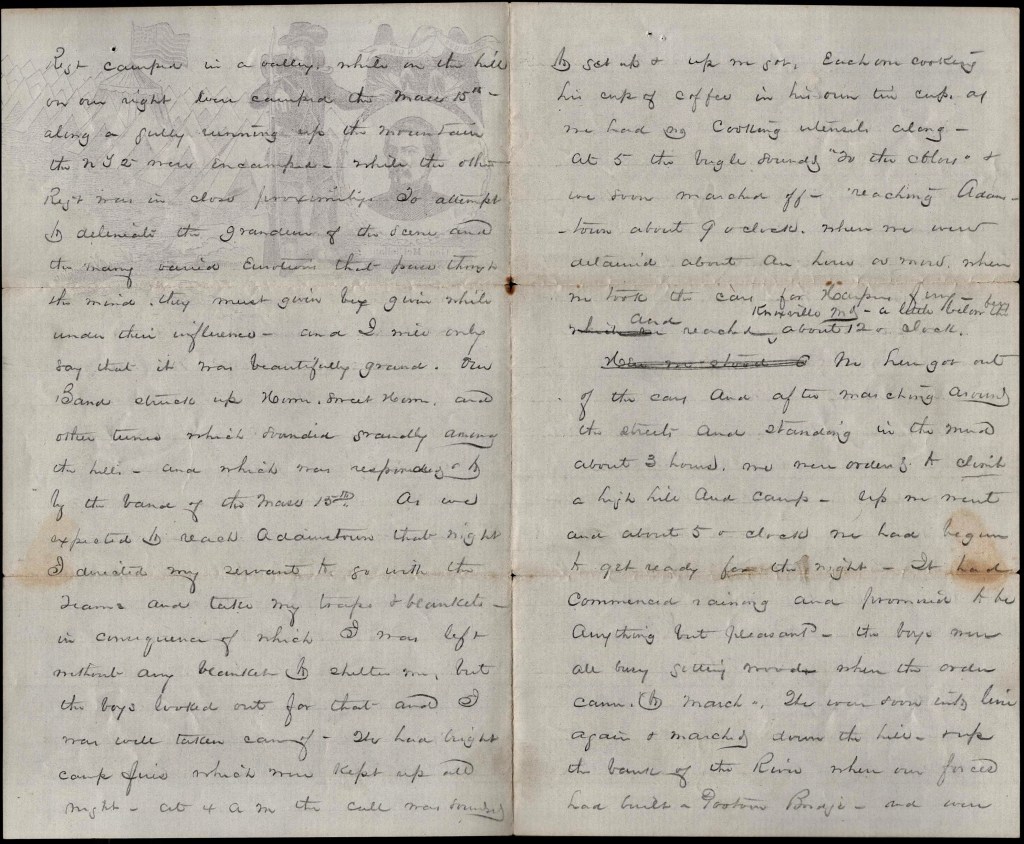
1862. Charles Edward Davis to his Family

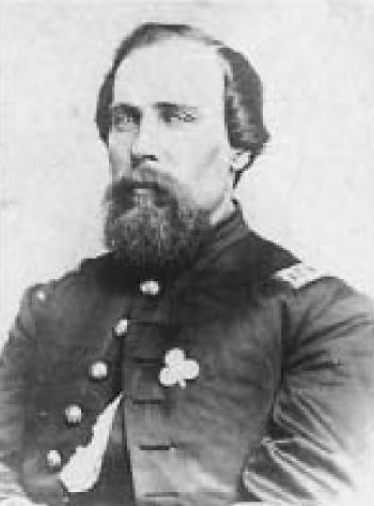
C. Edward Davis when he was captain of Co. E, 1st Minnesota Infantry

Though this letter was only signed “Edward,” the contents of this letter led me to the 1st Minnesota Infantry and the only officer named Edward who matched the profile. ” This letter can be safely attributed to Lt. Charles “Edward” Davis (1835-1885) of Co. I, 1st Minnesota Infantry. He later rose in rank to Captain of Co. E. There are a number of letters housed in the Minnesota Historical Society by Davis, a St. Paul (Minn.) resident who served in the First Minnesota Infantry in the Civil War. They were written to his father and siblings. In them, he comments on activities and officers of the regiment and the Army of the Potomac, and on attitudes of soldiers and civilians. There are a few letters discussing survey work for the Nebraska and Lake Superior Railroad Co. (1859-1860) and Davis’ participation in the Vermilion (Minn.) gold rush (1866). Though he signed this letter Edward, he was known to many of his friends as “Ned.”

I found a notice in the St. Paul Dispatch on 14 October 1868 in which it was announced that “Capt. C. Edward Davis” had been connected since the war with “Gen. [Gouverneur Kemble] Warren’s River Survey” but that he had been “ordered to Gettysburg to make a survey of the battlefield there. As Ned was in that battle [and was wounded there], he is a proper person to make the survey.”


Transcription

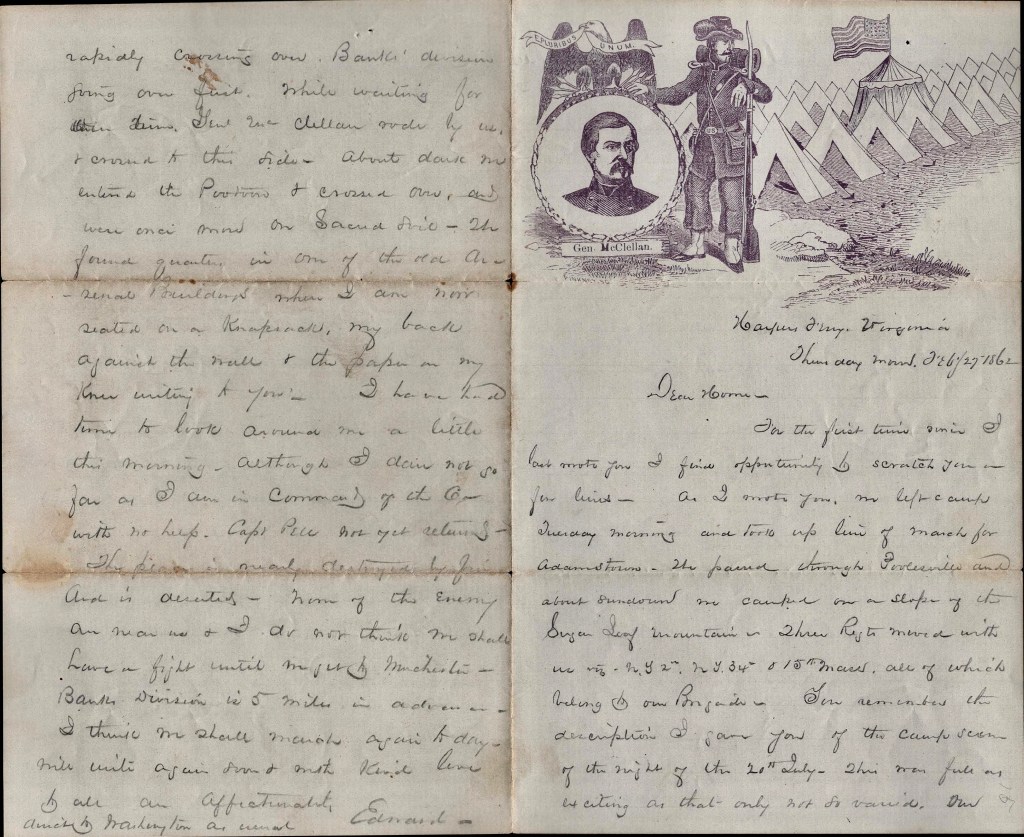
Patriotic stationery used by Edward in this letter home. Bust of Gen. McClellan.

Harpers Ferry, Virginia
Thursday Morning, Feb 27, 1862

Dear Home,

For the first time since I last wrote you I find opportunity to scratch you a few lines. As I wrote you, we left camp Tuesday morning and took up line of march for Adamstown. We passed through Poolesville and about sundown we camped on a slope of the Sugar Loaf Mountain. Three regiments moved with us, viz: the N. Y. 2nd, N. Y. 34th, & 15th Mass., all of which belong to our brigade. You remember the description I gave you of the camp of the night of the 20th July. This was full as exciting as that, only not so varied. Our regiment camped in a valley, while on the hill on our right were camped the Mass 15th. Along a gully running up the mountain the NY 2nd were encamped, while the other regiment was in close proximity. To attempt to delineate the grandeur of the scene and the many varied emotions that pass through the mind, they must be given while under their influence and I will only say that it was beautifully grand. Our band struck up “Home, Sweet, Home” and other tunes which sounded grandly among the hills and which was responded to by the band of the Mass 15th.

As we expected to reach Adamstown that night, I directed my servant to go with the teams and take my traps and blankets, in consequence of which I was left without any blanket to shelter me. But the boys looked out for that and I was well taken care of. We had bright camp fires which were kept up all night.

At 4 a.m. the call was sounded to get up & up we got—each one cooking his cup of coffee in his own tin cup as we had no cooking utensils along. At 5 the bugle sounds “to the colors” & we soon marched off, reaching Adamstown about 9 o’clock where we were detained about an hour or more, when we took the cars for Harper’s Ferry and reached Knoxville, Maryland (a little below the ferry) about 12 o’clock. We then got out of the cars and after marching around the streets and standing in the mud about 3 hours, we were ordered to climb a high hill and camp. Up we went and about 5 o’clock we had begun to get ready for the night. It had commenced raining and promised to be anything but pleasant. The boys were all busy getting wood when the order came to march. We was soon into line again & marched down the hill & up the bank of the river where our forces had built a pontoon bridge and were rapidly crossing over, Banks’ Division going over first.

While waiting for our turn, Genl. McClellan rode by us & crossed this side. About dark we entered the pontoon & crossed over and were once more on sacred soil. We found quarters in one of the old arsenal buildings where I am now seated on a knapsack, my back against the wall & the paper on my knee writing to you. I have had time to look around me a little this morning although I dare not go far as I am in command of the company with no help—Capt. [John H.] Pell not yet returned. The place is nearly destroyed by fire and is deserted. None of the enemy are near us & I do not think we shall have a fight until we get to Winchester. Banks’ Division is 5 miles in advance. I think we shall march again today. Will write again soon & with kind love to all and affectionately, — Edward

Direct to Washington as usual.
1864: John Grandy to Mary L. Grandy

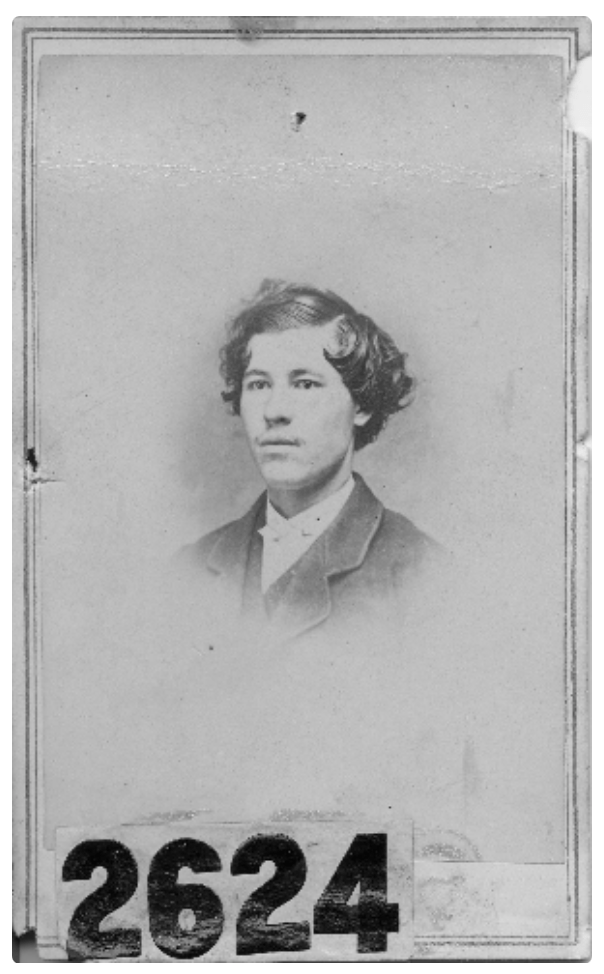
I could not find an image of John but here is a CDV of Lorenzo D. Lisdell who also served in Co. C, 153rd New York Infantry (Photo Sleuth)

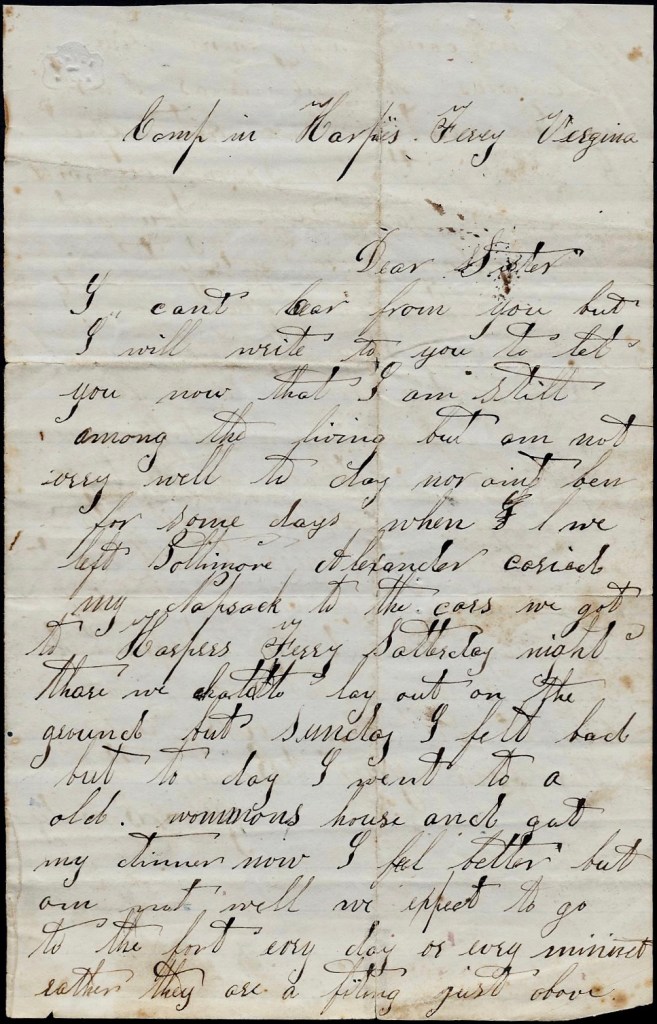
The following letter was written by John Grandy (1843-1864), the son of Lyman Grandy (1804-1877) and Miranda Crandall (1817-1890) of Charleston, Montgomery county, New York. He wrote the letter to his younger sister, Mary L. Grandy (1847-1932).

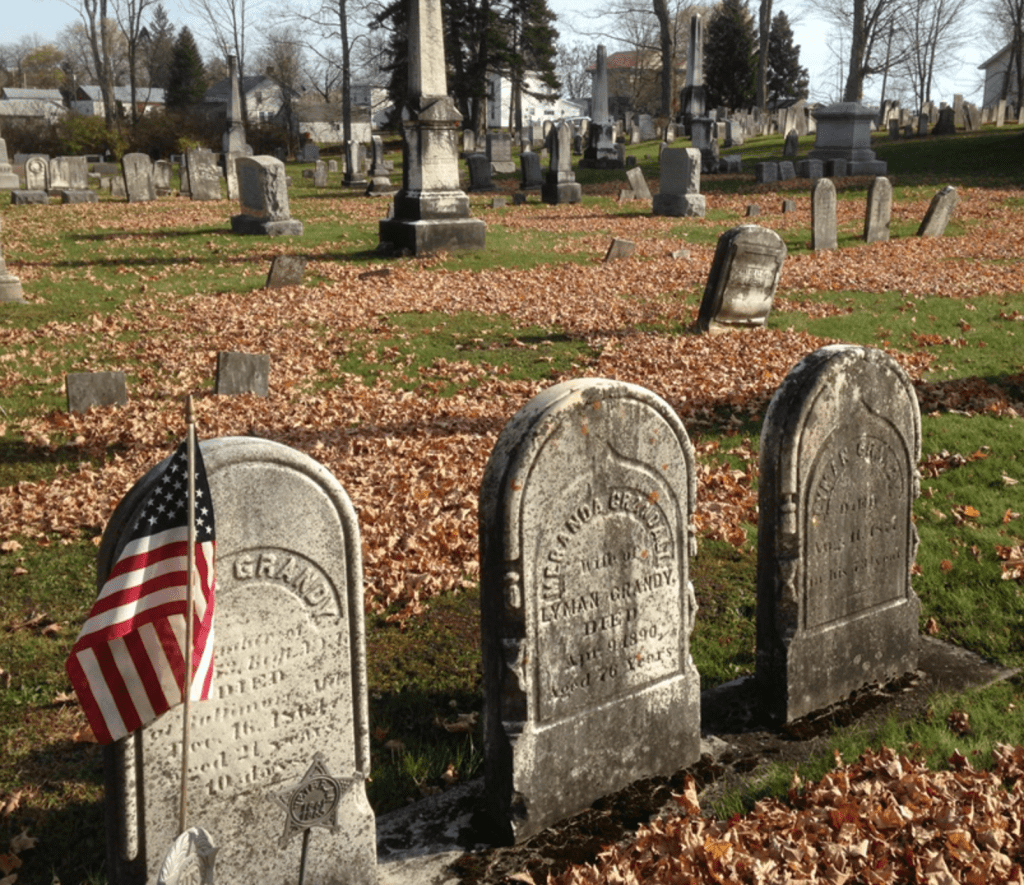
John was a 20 year-old carpenter when he was recruited into Co. C, 153rd New Infantry on 1 September 1864. In his enlistment records, he was described as standing just north of 5′ 9″ tall with light hair and blue eyes. In this letter, penned at Harper’s Ferry, he had just arrived from Baltimore and had not yet been sent forward to the regiment. The letter has a tenor of foreboding within it which is poignant as he was soon to be mortally wounded (gunshot in right thigh) on 19 October 1864 in the fighting at Cedar Creek. He died in a Baltimore hospital on 16 November 1864. He now lies buried next to his parents in the Christian Church Cemetery at Charleston Four Corners, New York.

For Lyman and Miranda Grandy, John was the second son they had lost during the Civil War. John’s older brother, Corp. George W. Grandy was killed at Gettysburg while serving in Co. D, 1st Minnesota Infantry. He was buried in a mass grave with other members of his regiment.

John Grandy lies buried in a grave next to his parents in the Christian Church Cemetery at Charleston Four Corners, New York

Transcription

Camp in Harper’s Ferry, Virginia
[September 1864?]

Dear Sister,

I can’t hear from you but I will write to you to let you know that I am still among the living but I am not very well today nor ain’t been for some days. When we left Baltimore, Alexander carried my knapsack to the cares [for me]. We got to Harper’s Ferry Saturday night. There we had to lay out on the ground but Sunday I felt bad but today I went to a old woman’s house and got my dinner. Now I feel better but am not well.

We expect to go to the front every day—or every minute rather. They are a fighting just above here [in the Valley]. We can hear them fire the cannons here. It is as close as I want to be but expect I will have to go soon. You will hear of the battle before you get this.

Mary, when you get this, learn these verses and when I come home, sing them for me. I would like to hear from home to hear how Father was getting along and all the rest of the folks. As soon as we get to our regiment, then I will write again. We ain’t doing anything but laying around on the ground. Tell Charley that he is taking comfort at home.

Yours truly. This from your brother, — John Grandy

Mr. Charles Grandy, Leatherville Road, Rural Grove, Montgomery [New York]

1862: Edward H. Finch to John Taft

I could not find an image of Edward but here is Sgt. Ransom Y. Hazard who served in Co. B, 137th New York Infantry. (Union Drummer Boy)

The following letter was written by Edward H. Finch (1842-1867), the son of Bryan Finch (1814-1852) and Mary Thorne (1818-1893) of Caroline Centre, Tompkins county, New York. Edward was working as a mechanic at the time he enlisted on 14 August 1862, accepting a $100 bounty from the town to serve in Co. K, 137th New York.

According to county records, Edward was wounded “in hip slightly” while defending Culp’s Hill on 2 July 1863 at Gettysburg. There is an excellent blog article entitled, “Who Lives, Who Dies, Who Tells Your Story? David Ireland and the 137th New York” that was published on 19 October 2016 describing the critical role played by the 137th New York at Gettysburg. It points out that “Just as the 20th Maine under Joshua Lawrence Chamberlain held the Union left flank at Gettysburg on July 2, David Ireland and the 137th New York held the Union right. Yet unlike the 20th Maine, the 137th saw significant action on the final day of battle.” Regrettably and unfairly, Chamberlain and the 20th Maine get most of the publicity when the losses at either end of the Union defenses might have proven equally disastrous.

After Edward recovered from his wound, he returned to the regiment and participated on Sherman’s Atlanta Campaign and later on the march through the Carolinas. Though he dodged death in the war, Edward did not live long after he returned to Tompkins county following his discharge in 1865. Less than two years later, on 22 April 1867, when Edward and his sister, Mary Ellen Finch, were riding home in a wagon from Caroline Centre to their home on the Speed farm, “a flash of lightning struck him on the head and passed down the whole length of his body, tearing his clothes into shreds. The same stroke” set his sister’s clothes on fire and burned the left side of her body very badly before she could put it out. (Ithaca Journal)

The letter was addressed to John Taft (1795-1876), the father of his friend and comrade, 2nd Lieut. William Henry Taft, who had also served in the same company until he died of disease at Knoxville, Maryland, on 31 October 1862. William’s remains were returned home and buried in the family plot at Caroline. See—1862: William Henry Taft to John Taft.

The letter contains a rare reference to Thaddeus Lowe’s Observation Balloon being launched “every day when it is still” on the heights overlooking Harper’s Ferry in late October 1862.

Transcription

Addressed to Mr. John Taft, Caroline Center, Tompkins county, New York

137th New York Vols. Col. Ireland
Company K
Sunday, November 2nd 1862

Mr. John Taft,

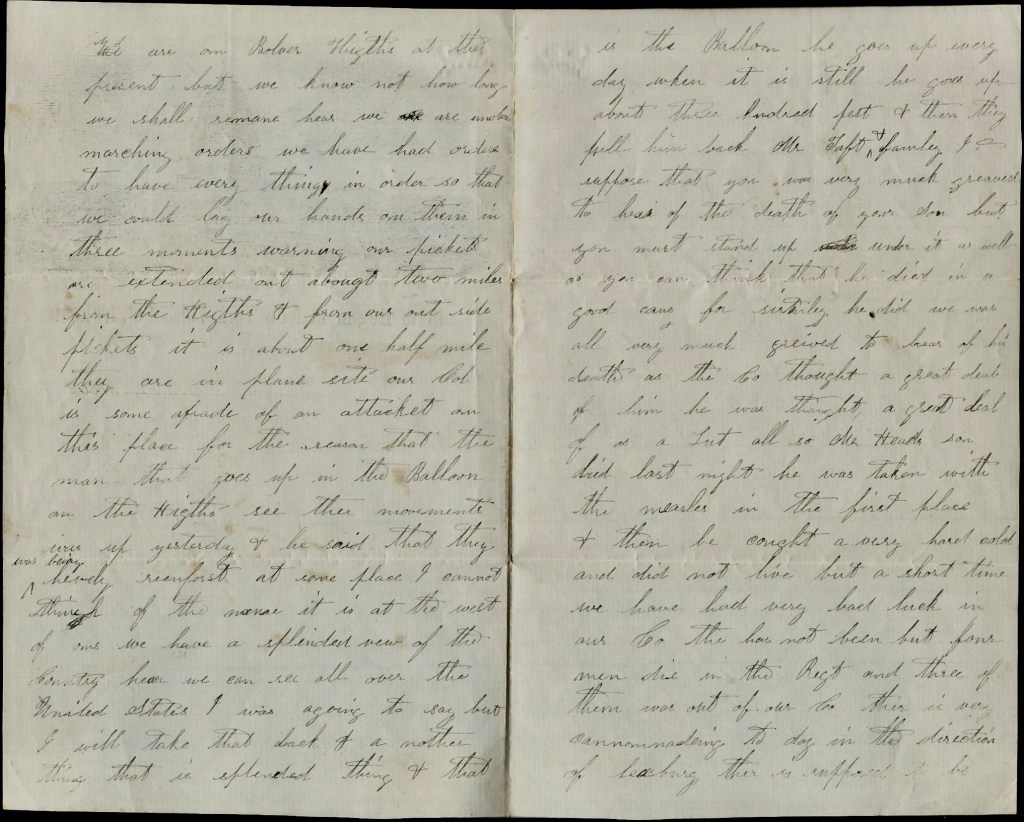
I thought that I would write you a few lines as it was Sunday and I had a few moments to spare. Well, Mr. Taft, we are in the land of the Rebs. I am within sight of them at the present time as I am out on picket duty today and yesterday. We was to be relieved this morning but through some mistake we was not. We are on Bolivar Heights at the present time but we know not how long we shall remain here.

We are under marching orders. We have had orders to have everything in order so that we could lay our hands on them in three moments warning. Our pickets are extended out about two miles from the heights & from our outside pickets it is about one half mile. They are in plain sight. Our Colonel [David Ireland] is afraid of an attack on this place for the reason that the man that that goes up in the balloon on the heights [to] see their movements was up yesterday & he said that they was being heavily reinforced at some place—I cannot think of the name—it is at the west of us.

We have a splendid view of the country here. We can see all over the United States, I was a going to say, but I will take that back, And another thing that is a splendid thing & that is the balloon. He goes up every day when it is still. He goes up about three hundred feet & then they pull him back. 1

Sketch courtesy of A. Lee. Drawing shows Bolivar Heights as seen from Camp Hill. Scattered buildings in hilly country, with a hot air balloon hanging in the sky in the distance.

Mr. Taft & family, I suppose that you were very much grieved to hear of the death of your son [William] but you must stand up under it as well as you can. Think that he died in a good cause for certainly he did. We was all very much grieved to hear of his death as the company thought a great deal of him. He was thought a great deal of as a Lut [Lieutenant] also. Mr. Head’s son [Isaac] died last night. He was taken with the measles in the first place and then he caught a very hard cold and did not live but a short time. We have had very bad luck in our company. There has not been but four men die in the regiment and three of them was out of our company.

There is very [much] cannonading today in the direction of Leesburg. There is supposed to be a very hard battle there this day that came on this ground. There is a great movement of the army in these parts. The regiments that was in camp here was ordered to move off & we was ordered to move on and it is said that the whole army was under a move. It is supposed that there is to be some fighting now. I shall be home by spring I think if my life is spared me till that time.

Mr. Taft, I have heard them talk about the Sunny South but deliver me from this country. It is quite warm here yet. It is warm days and cold nights. I hear that you have had snow in your town. That’s more than I have seen yet. Well, I must close. Excuse this writing as I am writing on the ground. If you think this worthy of an answer, please write soon. — Edward H. Finch

1 According to the Harper’s Ferry National Historical Park, on October 16, 1862, chief of aeronautics for the Union Army Professor Thaddeus Lowe manned a balloon above Bolivar Heights to assist with observations of General Robert E. Lee’s Confederate army. Lowe’s balloon corps marched with a complex contraption consisting of two wagons “with very large high boxes made perfectly air tight.” These boxes held the gas that filled and lifted the balloon. Harley Milborn of the 145th Pennsylvania Infantry noted, “For the last two days they have been inflating it. [T]hey finished last night, and then a few men took hold of the cords to keep it down and they conducted it through our camp.” Hillborn watched for a time, but didn’t observe the end product: “Whether he made any discoveries or not, I do not know.”