Category Archives: Henry Clay

1838: Henry Simpson Mesinger Farnam to George Henry Hough Silsby

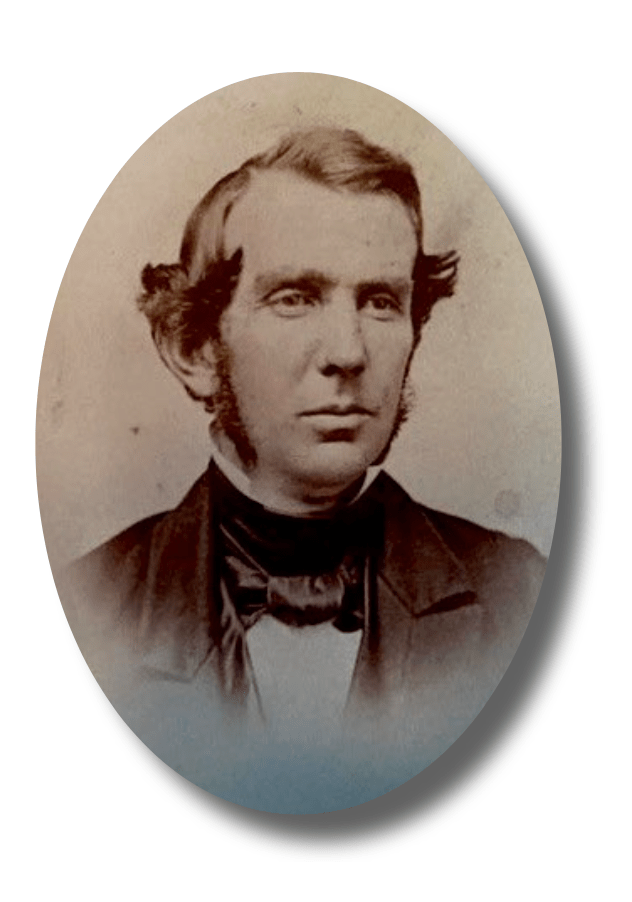
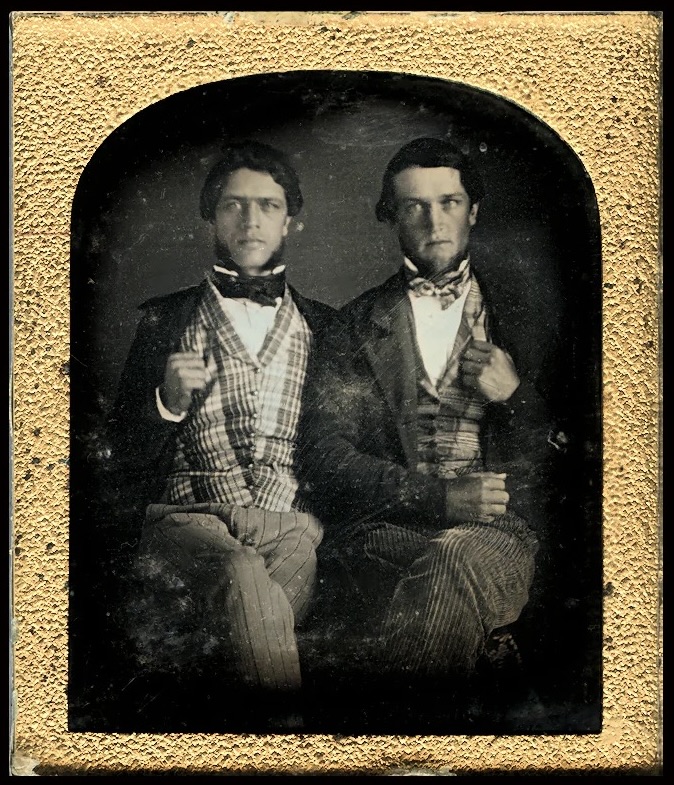
How these two friends might have looked at the time.

The following letter was written by Henry Simpson Mesinger Farnam (1815-1878), the son of Roger and Susan (Everett) Farnam of Attleboro, Massachusetts. Henry wrote the letter to his friend, George Henry Hough Silsby (1817-1892), the son of Ozias and Francis (Jones) Silsby of Hillsboro county, New Hampshire. We learn from the letter that Henry and George were former partners in the publication, “Star in the East“—a religious newspaper out of Concord, New Hampshire. The letter was written in the midst of the financial depression that occurred in 1837 so my assumption is that the newspaper failed as did many small businesses at that time.

From what little I could find on both young men, George remained in Concord all of his life. He ran for the position of town clerk in Concord, N. H. in 1849 but was defeated. In the 1850s he was a partner in the printing firm of Morrill & Silsby on Main Street in Concord. George was a stationer, printer, and bookbinder, and followed that business during the active period of his life.

Henry left Concord and attempted to earn a living in the District of Columbia, in New York City in the early 1840s. He may have been the same Henry S. M. Farnam (Farnam & Osgood) groceries and dry goods, who was listed in the 1867 Concord, New Hampshire.

Henry’s letter is a tantalizing treasure trove of historical tidbits delving into the social and political scene of the District of Columbia in the late 1830s. Within its pages, he regales us with colorful depictions of Henry Clay, James Buchanan, and John Quincy Adams, shedding light on the excessive alcohol consumption among Congressmen and the proliferation of brothels in the city.
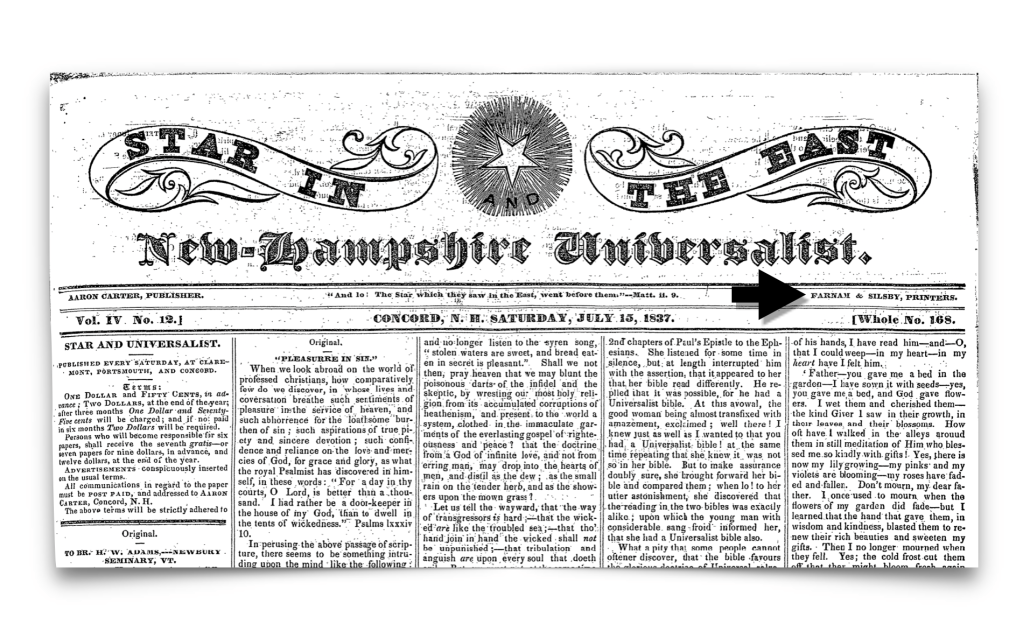
The July 1837 Issue of the “Star in the East” printed by Farnam & Silsby in Concord, N.H.

Transcription

Washington D. C.
April 23, 1838

Friend Silsby,

“God bless you!” is just such a salutation as I should greet you with were I to meet you in person or perhaps might “run in this wise”—“God bless you, Squire, give us your hand.” But as it would be useless and vain for me to add the request here, I will content myself with invoking the blessing.
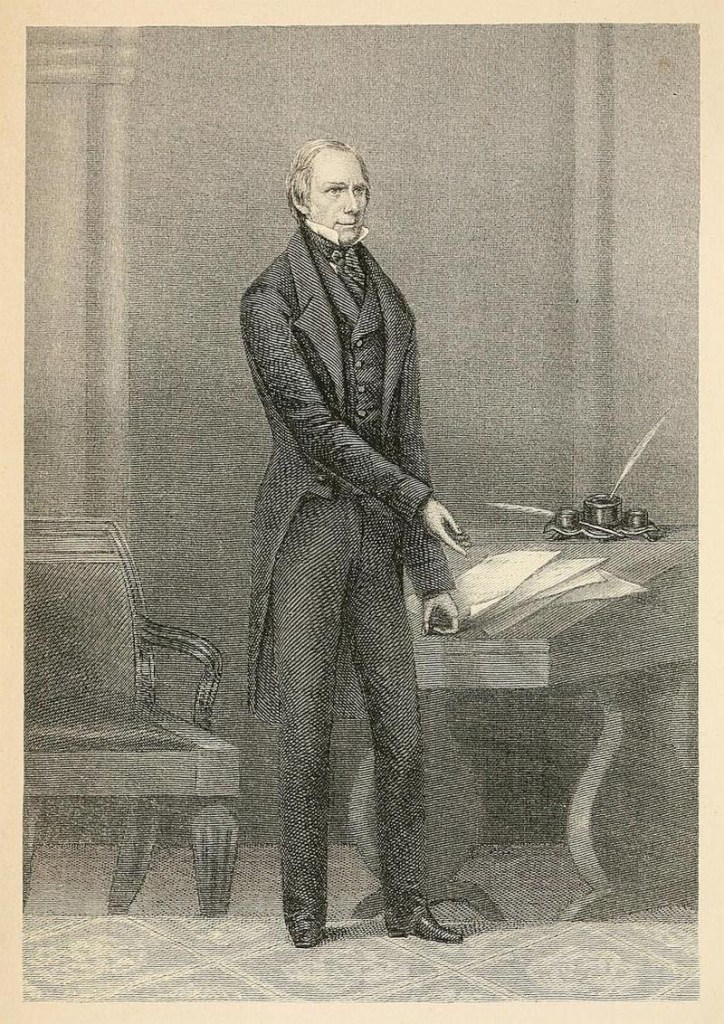
Henry Clay as he appeared in the late 1830s.

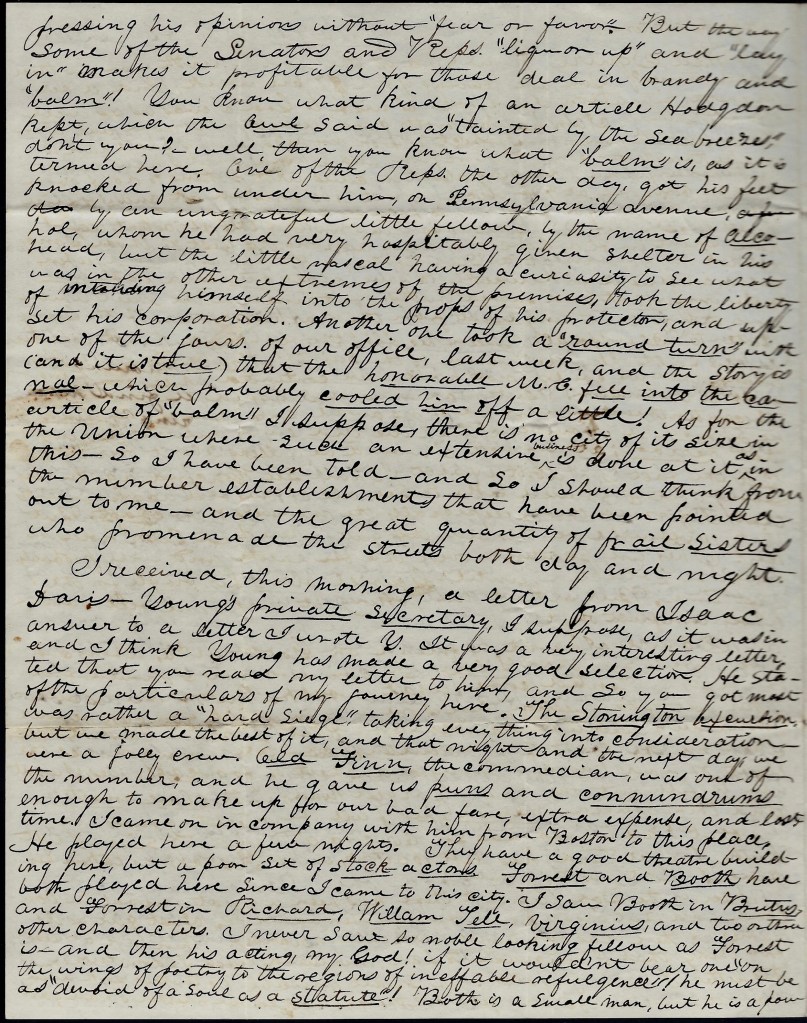
I am on a furlough this afternoon which you know is a very desirable respite to a jour[neyman] printer—especially when he has the consolation of knowing when Saturday night comes round that he shall find his bill docked at the rate of 20 cents per hour during his absence. But I shall be called on duty again tomorrow morning, while three poor devils received the gratifying intelligence when they come into the office this morning that that their services were no longer required. Four of us were furloughed for this afternoon only, one of whom concluded that it would be a good time to take a “round turn” as they call it here—what we at the North usually call a “bust“—and he has probably arrived at the corner and capsized before this; while two others and myself took a “B-line” for the Capitol where we hear Henry Clay make one of his best speeches, a short one however, and a reply to it from Buchanan of Pennsylvania. Clay is a noble-looking fellow, and his eloquence when speaking exceeds all the lofty opinions I had ever formed of it from what I had read and heard of his greatness as an orator and debater. the likeness in his biography, which you have seen, is a good one. Buchanan too is one of the finest speakers in the Senate. I have heard the most of the distinguished men in the Senate speak a few minutes each, and some of the most talented ones in the House. 1

I went into the House a few moments this afternoon. Old Johnny Q. [John Quincy Adams] had the floor, and, as usual, expressing his opinions without “fear or favor.” But the way some of the Senators and Reps. “liquor up” and “lay in” makes it profitable for those [who] deal in brandy and “balm!” You know what kind of an article Hodgdon kept, which the owl said was “tainted by the sea breezes,” don’t you? Well then you know what “balm” is, as it is termed here.

One of the Reps. the other day got his feet knocked from under him on Pennsylvania Avenue by an ungrateful little fellow by the name of alcohol whom he had very hospitably given shelter in his head, but the little rascal having a curiosity to see what was in the other extremes of the premises took the liberty of intruding himself into the props of his protector, and upset his corporation. Another one took a “round turn” with one of the jours. of our office last week and the story is (and it is true) that the honorable M. C. fell into the canal which probably cooled him off a little! As for the article of “balm”, I suppose there is no city of its size in the Union where such an extensive business is done at it as in this—so I have been told—and so I should think from the number [of] establishments that have been pointed out to me—and the great quantity of frail sisters who promenade the streets both day and night.

I received this morning a letter from Isaac Davis—Young’s private secretary, I suppose, as it was in answer to a letter I wrote Young. It was a very interesting letter and I think Young has made a very good selection. He stated that you read my letter to him and so you got most of the particulars of my journey here. The Stonington Excursion was rather a “hard siege” taking everything into consideration but we made the best of it and that night and the next day we were a jolly crew. Old Finn, the comedian, was one of the number, and he gave us puns and conundrums enough to make up for our bad fare, extra expense, and lost time. I came on in company with him from Boston to this place. He played here a few nights.
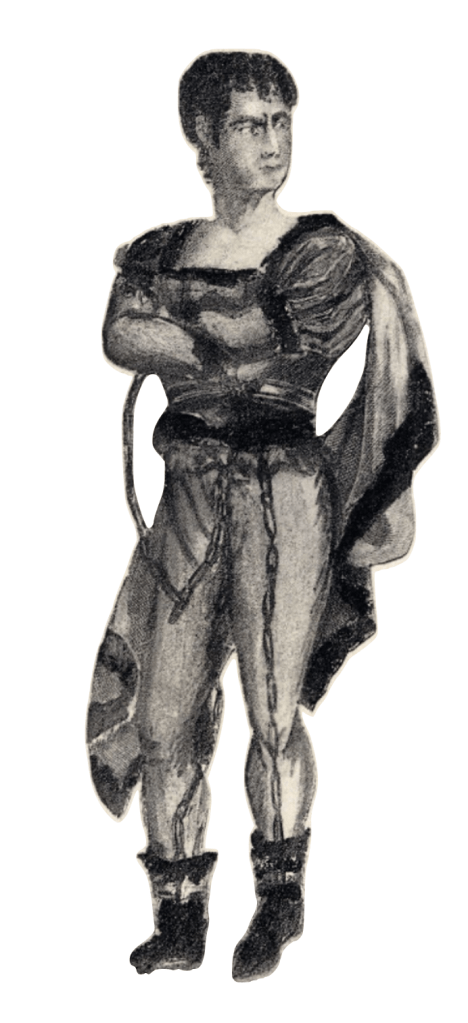
Edwin Forrest in his William Tell costume (Illinois Library Digital Collections)

They have a good theater building here but a poor set of stock actors. Forrest and Booth have both played here since I came to this city, I saw Booth in Brutus and Forrest in Richard, William Tell, Virginians, and two or three other characters. I never saw so noble-looking fellow as Forrest is—and then his acting, my God! if it wouldn’t bear one “on the wings of poetry to the regions of ineffable refulgence!” He must be as “devoid of soul as a statue!” Booth is a small man but he is a powerful actor.

Well, Squire, how “wags the world” with you in these hard times? You are having you $7 per week and a permanent situation, I suppose. I wish to God I was as well off. It is true, I am having pretty good wages just now, but then in a month from now. I expect to be on my oars when I shall have to make tracks for some other region and spend what I have earned in traveling and lounging about in cities with nothing to do. A good cit. [situation] in Concord at 7 per week is not to be sneered at and I advise all who have got such an [one] to hold on to it as long as they can.

The blues crawl over me sometimes when I think of the pleasant days I have spent in Old Concord, and among the best of those I may reckon my sojourn at the “Star” office, with you as a comp[anion], when our names went forth weekly to give character and influence to the important and sacred truths contained in the sheet which bore them; scattering light from the darkest corners of the Grany State, to “Bluffsdale, Green county, Illinois”—the residence of that believer “in the faith and delivered to the Saints,” Abram Coon!! 1 It is strange that we could not have been contented while enjoying such a distinction! But man is never satisfied, you now, until contentment would be of no avail, and then he only thinks he should be. However, I think we did enjoy ourselves during that period; at any rate, I would be willing to try it over again. But the fact is, I don’t expect I shall see Concord again very soon, but I should like to see all of the old acquaintances that I formed there—especially the members of the craft. But that never will be “this side of the gate whereof St. Peter holds the key.” They are scattered over the earth and will probably never be collected until Gabriel blows his bugle for the last time. But without any joking, it akes me feel melancholy to reflect on it.

Squire, I haven’t a friend on God’s earth whom I would give more to see than Silsby! If you were here, I should feel perfectly contented, come what would. But as that is altogether out of the question, there is one way in which you can render me a very essential service—and that is—as you cannot “shed upon me the light of countenance“—-to “shed upon me the light of your mind,” through a sheet of foolscap! Yes, I want you to fill out one of the largest kind, with close matter, and thin-spaced (minion type) of all the interesting events, &c. that have transpired in Concord and vicinity since I left. Winter, I understand, has left Barton’s and Foster has taken his place. What was the trouble?

I see by the Bap[tist] Reg[ister] that there has been a great revival in Concord, and that great numbers have been added, &c. Just give us the names, if there has been any remarkable instances. There are at least forty things that I intended to have mentioned when I commenced this letter I have forgotten. I shall probably go to New York when I am out here and if I don’t get work there, I don’t know whether I shall go to Boston or to the West! Oh, by the way, I received a letter from Sherman the other day. He says he is in the paper-making business yet. Fisher is with him. He didn’t say whether they were in the money-making business or not. Tell Isaac that I will endeavor to answer his letter before long. Tell Elder Morse if he goes to New York to let me know it.

Now Squire, I want you to answer this without delay. Don’t be afraid of exposing your penmanship to my criticisms, although it may not bear a comparison with mine!! Give my respects to all who recollect me. I must wind up by subscribing myself your everlasting friend, “in the bonds of the gospel” — H. S. M. Farnam

P. S. I dare not read this over, and, shall have you to correct the errors. I will endeavor to a more interesting next time, that after I receive one from you which I shall expect soon. I suppose you are freezing in New Hampshire yet. We have had it hot enough to “scorch a feather”—peach trees blossomed a week ago. We have pretty good living here—poultry a plenty of it, from turkeys down to robins, blue birds, and even yellow birds—four to the mouthful. Possums too brought into market every morning! Oh, I’ve left off chewing tobacco–[ ] today! and take but 3 glasses of ale a day! — H. S. M. F.


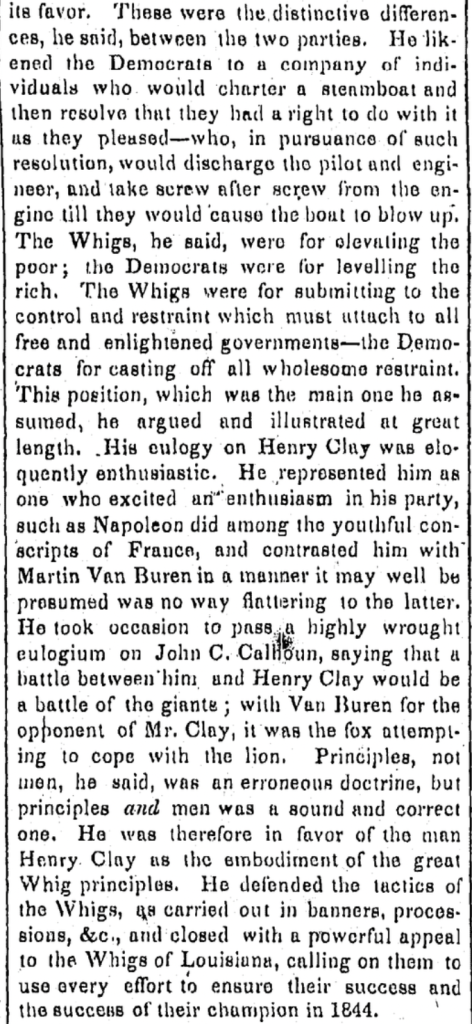
1 In 1837, Henry Clay was hard at work in a successful effort to organize and strengthen the new Whig party. In his attempt to provide for it an ideological core, he emphasized restoration of the Bank of the United States, distribution of the treasury surplus to the states, continued adherence to his Compromise Tariff Act of 1833, and federal funding of internal improvements. The achievement of these goals, Clay reasoned, would mitigate the severe impact of the Depression of 1837 and sweep the Whigs into the White House in 1840. A review of the newspapers at the time of this letter suggests Clay’s speech probably had something to do with the distribution of the treasury surplus.

2 Abraham Coon (1810-1885) was a member of the Church of Jesus Christ of Latter-day Saints.

1844: William Dare Garrison to Harriet Fithian Garrison

The following letter was written by 18 year-old William (“Will”) Dare Garrison (1826-1847), the eldest child of at least six born to Edmund Fithian Garrison (1802-1858) and Rebecca Dare (1808-1845) of Swedesboro, Gloucester county, New Jersey.

When war was declared on Mexico in May 1846, Will enlisted in Co. D (“Cambria Guards”), 2nd Pennsylvania Volunteers. Although he traveled with the volunteers in 1846 he did not officially enlist until 21 Jan. 1847. William would pass away on 11 July 1847 from illness at the Castle of Perote in Mexico City, aged twenty-one.

In this incredible letter, Will provides us with rich detail of the 4th of July events in Camden, New Jersey, in 1844 which happened to coincide with the Presidential campaign of Whig candidate Henry Clay and his running mate, Theodore Frelinghuysen. We learn that a political barbecue with food and speeches was held in the afternoon of the day’s events on Smith Island, in the middle of the Delaware river between Camden and Philadelphia. The letter was written on 6 July 1844, just one day before a major riot erupted across the river in Philadelphia between the Nativists and Roman Catholics.

A view of Camden from Philadelphia in 1844. Smith’s Island is in the middle of the Delaware river at left where all the trees are shown.

Will wrote the letter to his sister, Harriet Fithian Garrison (1831-1919) who married John W. Kirby (1826-1897) in 1854. That the family admired the statesman Henry Clay seems to be of little doubt as Will had a younger brother named Henry Clay Garrison (1835-1913) who humorously wrote his own epitaph: “Poor old Garry, Here he lies. Nobody laughs, And nobody cries; Where he has gone, Or how he fares, Nobody knows, Nobody cares.”

[Note: to see a map of Lobos Island drawn by Will in April 1847 during the Mexican-American War, see Manuscript Map.]

Transcription

Camden [New Jersey]
July 6th 1844

Dear Sister,

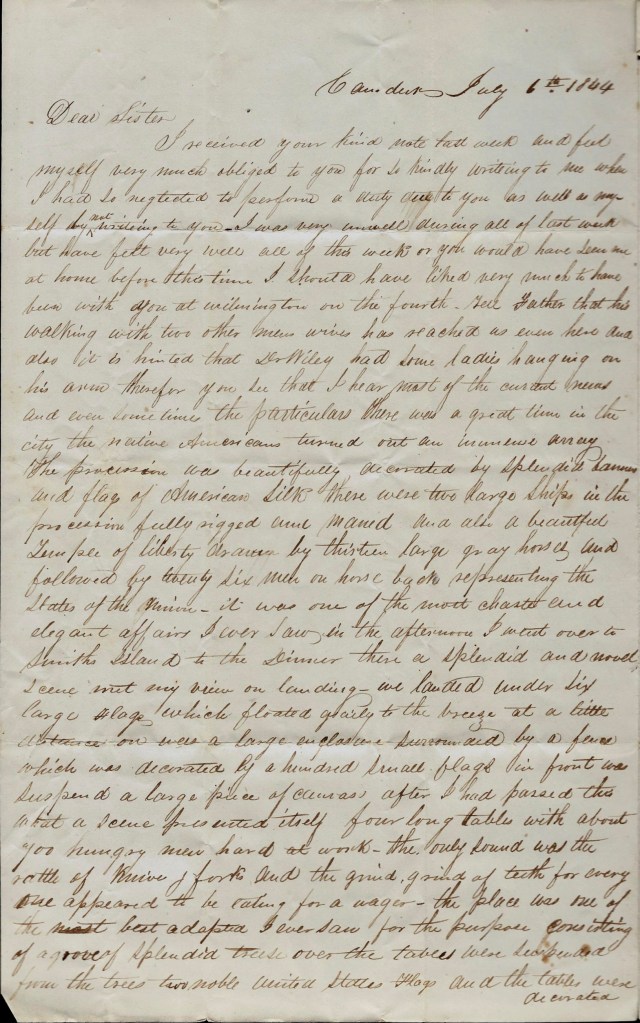
I received your kind note last week and feel myself very much obliged to you for so kindly writing to me when I had neglected to perform a duty due to you as well as myself by not writing to you. I was very unwell during all of last week but have felt very well all of this week or you would have seen me at home before this time. I should have liked very much to have been with you at Wilmington on the fourth. Tell Father that his walking with two other men’s wives has reached us even here and also it is hinted that Dr. Wiley had some ladies hanging on his arm. Therefore, you see that I hear most of the current news and even sometimes the particulars.

There was a great time in the city. The native Americans turned out an immense array. The procession was beautifully decorated by splendid banners and flags of American silk. There were two large ships in the procession fully rigged and manned and also a beautiful Temple of Liberty drawn by thirteen large gray horses and followed by twenty-six men on horseback representing the States of the Union. It was one of the most chaste and elegant affairs I ever saw.

“…what a scene presented itself. Four long tables with about 700 hungry men hard at work—the only sound was the rattle of knife and fork and the grind, grind of teeth for everyone appeared to be eating for a wager.”

— William Dare Garrison, 6 July 1844

In the afternoon, I went over to Smith’s Island to the dinner. There, a splendid and novel scene met my view on landing. We landed under six large flags which floated gaily to the breeze. At a little distance on were a large enclosure surrounded by a fence which was decorated by a hundred small flags. In front was suspended a large piece of canvas. After I had passed this, what a scene presented itself. Four long tables with about 700 hungry men hard at work—the only sound was the rattle of knife and fork and the grind, grind of teeth for everyone appeared to be eating for a wager. The place was one of the best adapted I ever saw for the purpose consisting of a grove of splendid trees. Over the tables were suspended from the trees two noble United States flags and the tables were decorated with numerous small flags bearing the names of Clay and Frelinghuysen. At one end and against the screen was an elevated platform and a table for the officers and speakers. Over them hung a portrait of Henry Clay with U. S. flags festooned over it and two splendid banners hung on either side of it. Opposite to it at the other end of the table, hung a splendid banner surmounted by a gilt eagle festooned with flowers. Upon the side nearest the water was erected a stand for the speakrs, gaily decorated with flags. After dinner we had some toasts and very good speaking interrupted only be cheers and the roar of cannon.

The afternoon concluded with cheers, the firing of cannon, and the bursting of rockets and other fireworks. In the evening there was a splendid display of fireworks.

Give my best respects to all my friends and kiss the family all around for me. There has been a great number of persons over here since the fourth and yesterday there were several fights in the [beer] gardens and a good deal of hard fun. The Dutch [Germans] brought over a band and they danced all the afternoon. Altogether the fourth has gone off with less trouble than was anticipated. I hope that the fourth at Swedesboro went off without any new sprees. Tell Mother that I aim to get up at 5 o’clock after this in order to take exercise and hope by that means to keep from getting sick any more. Give her my love. Tell Father I am looking for him every day in order to make some arrangements. I must now conclude for business calls me to attend to something else. Therefore, I subscribe myself your affectionate brother, — Will D. Garrison

Write back soon.

Burn all my letters for I do not want them kept as monuments of my foolishness and tell John to do the same. — WDG

Programme of Events, Pennsylvania Inquirer, 4 July 1844

1844: Jeremiah Woolston Duncan to John A. Duncan

The following letter was written by Jeremiah Woolston Duncan (1810-1854), the son of John Duncan (1776-1852) and Elizabeth Woolston (1778-1851). He wrote the letter from New Orleans in February 1844 to his older brother, John A. Duncan (1806-1868) of Wilmington, Delaware.

Jeremiah Woolston Duncan

Jeremiah was married in 1833 to Elizabeth Strode Brinton (1810-1859) and the couple had two children by the time of this 1844 letter. They would have at leasts four more children, the last two after the family moved to the fledgling city of Chicago in 1849.

“Jeremiah was born in Baltimore, Maryland in 1810. He received, in common with all the other members of his father’s family, a good English education, but his active and enterprizing nature early asserted itself, and while still but a boy in years, he proceeded of his own volition to Philadelphia, where he became a clerk in a hardware store, remaining till he was twenty years of age. He then went into partnership, in Wilmington, with his brother, John A. Duncan, in the hardware business. In 1830 he withdrew from the firm and went into the lumber business with Baudy Simmons and Company, of Wilmington. He afterwards retired, also, from this firm and went into the West India trade and wholesale grocery business, in partnership with Matthew and Andrew Carnahan, in the same place. He next erected a steam saw mill on the “Old Ferry” property. In 1850 he removed to Chicago, where he engaged extensively in the lumber business. He owned large tracts of land in Michigan, near the straits of Mackinaw, and the town of Duncan, in that vicinity, was named in his honor. But the life he now led subjected him to frequent and severe exposures, and carried away by his activity and energy, he paid too little regard to his health. It thus happened that in the prime of his vigorous and most valuable life he contracted a fatal sickness. He returned to Wilmington and died, December 31, 1854.  Mr. Duncan was a man highly respected in all his wide circle of acquaintance, and warmly regarded among his friends. His activity and energy were remarkable, and the results proportionate.” [Source: History of New Castle County, Delaware]

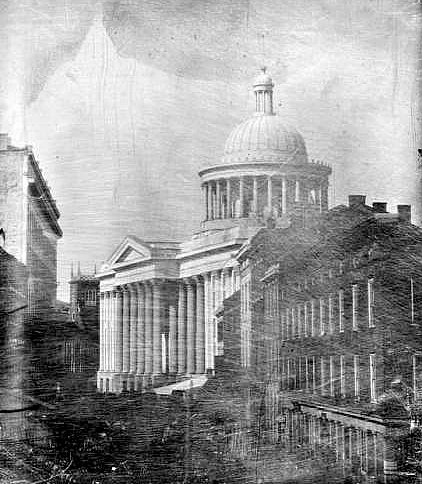
The St. Charles Exchange Hotel in New Orleans in 1847
(Courtesy of Fred Diegel)

[Note: This letter is from the private collection of Richard Weiner and was transcribed and published on Spared & Shared by express consent.]

Transcription

Addressed to Mr. John A. Duncan, Wilmington, Delaware, via Philadelphia

St. Charles Exchange Hotel 1
New Orleans
February 22, 1844 2

Dear John,

Having a little leisure before dinner, I thought I would improve it by writing you a few lines. Today here you will observe by a paper I mailed to you this morning, is a busy one. There is a great gathering of the Whigs of Louisiana beside a grand military parade, sham battle, &c. about going on at this moment—2 o’clock—and most of the business is stopped on account of it. Many stores closed.

The Daily Picayune, 22 February 1844“All will be life, marching, music and animation”

Yesterday was another gala day being Mardigra [Mardi Gras 3] on which occasion carriage of men and women ride about the city in mask & all kinds of grotesque forms imaginable & form a procession the B[ ] throwing dust and flour in their faces at the corners (and by the way, you never saw a dusty city—it is here about ankle deep—and as far as flour, until yesterday we had a little rain which reversed the matter into mud half shoe deep). The citizens consider the turn on yesterday pretty near a total failure—nothing much but ordinary women & rowdies whereas heretofore respectable people used to parade. Old Harry stay much of his time at [illegible] & is to be here tomorrow & hold a sort of Levee in our spacious dining room. 4

This is the finest hotel I ever was in—much ahead of the Tremont or Astor House but, O Harry, how they plaster it on $3 per day or $15 per week if you stay a week at a time. This city is like all other cities—plenty of people here for the business at this time but the prospect for a lively spring trade is pretty good. The wharves look beautiful today. The immense number of ship with all their flags displayed—ships of many nations. It is really a pleasing sight. Steam boats by dozens a belching like volcanoes. I must say I really hate these high pressure boats. With all I had heard about the immense boats on the Mississippi, I am disappointed. The Empire on the North River would eat one of the largest for a breakfast. But there is a great quantity of them going & coming all the time and full of freight.

The substance of Prentiss’s speech
The Daily Picayune, 23 February 1844

February 24. I had to knock off for dinner. I have not found time sure to get at it again until this morning at 7 o’clock. If you ever saw a swarm of bees, this house has been one for three days past. I was at a great Whig gathering last night & they began to call for [Seargeant Smith] Prentiss of Mississippi who addressed the convention the day before & one continual cry for at least one hour.

I have ridden out round the city, down the Shell Road & Cr & taken a general survey. Went on the Parade [ground] after the Battle had been fought & see company after company of Frenchmen—all small men and all commanded in French—not a word in English. These French here are great military men. The 2nd Municipality, you could not be from New York in which most of the business is done & in the 1st and more in the 3rd. you will hear all the negroes talk French. I had not been down in the 3rd before the afternoon of the parade the whole of which I spent in that part of the town as it was a complete holiday.

The idea I had formed of the levee was a very enormous one. It to be sure is much higher than the rest of the city, but a stranger may land on it and walk into the city & not observe it. I could write you an hour more but must close. I have some other writing to be done this morning. Give my love to my dear wife & little ones & all your folks & to all my friends my best respects.

From your affectionate brother, — Jeremiah W. Duncan

P. S. Shall have much to talk [about] when I see you. T. H. Larkin is here. Old Mr. Handy of Chil & the 2 McMain Boys & sundry others.


1 “The St. Charles was the first large building erected above Canal Street.  Within its walls, 
over the next hundred years, half the business of the city was to be transacted and half the 
history of the state of Louisiana was to be written.  The hotel was designed by noted architect James Gallier. It was the grandest hotel in the South, in fact, the first of all great American 
hotels. Oakey Hall, who later became the mayor of New York, said of it, ‘Set the St. Charles
down in St. Petersburg, and you would think it a palace; in Boston, you would christen it a 
college; in London, it would remind you of an exchange; in New Orleans, it is all three.’  Mr. 
Hall was unable to contain his surprise at finding in the city of New Orleans something far 
grander than anything New York could boast of. The hotel had a magical effect upon the quarter of the city in which it stood.  It rapidly built up the First District, known as the American sector.  Around it, as a center, gathered the traffic and trade of the city.  Churches sprang up near it; stores and dwellings spread out in every direction.  St. Charles Street, which did not extend far above the hotel, became the most animated thoroughfare in the United States.”

2 Jeremiah’s visit to New Orleans in February 1844 was just prior to a fire in the summer of 1844 which destroyed about seven blocks of buildings between Common and Canal Streets, near the Charity Hospital.

3 After decades of suppression (under Spanish rule) the Mardi Gras parade was reinstated in New Orleans in 1837 (at least the first recorded). It remained popular until the early 1850s when it began to wane, but then was reinvigorated in 1857.

4 “Old Harry” is often an alternative name for the Devil but in this case it is referring to Henry Clay, the Senator from Kentucky, who was being nominated again by the Whig Party as their choice for President in 1844.