Category Archives: Holly Springs, Mississippi

1863: John A. Buchanan to his Sister

The following letter was probably written by Sgt. John A. Buchanan (1826-1885) of Co. A, 100th Indiana Infantry. John was 35 years old and married to Emily (“Em”) Burns when he enlisted with his younger brother George in August 1862. John survived the war, mustering out on 8 June 1865. His brother George was not so lucky. He was wounded severely in November 1864 at the Battle of Griswoldville, Georgia, though he survived and was able to return to farming after the war. They were both listed as being residents of Corunna, a little farming village in DeKalb county—roughly 30 miles north of Fort Wayne, Indiana. I don’t have a picture of either of them but I’ve posted two members of the 100th Indiana wearing their Zouave jacket with the distinctive “100th” badge sewn on their breast, the arabic numeral 100 surrounded by an oval.

Co. A was raised in DeKalb county, Indiana, and after training in Fort Wayne and Indianapolis, they were sent to Carrollton, Kentucky, for a brief time and then were ordered to Memphis by way of Cairo and the Mississippi river in November 1862. They were stationed at Fort Pickering and assigned to a brigade that consisted of the 100th Indiana, 40th Illinois, 46th Ohio, 6th Iowa, and the 13th US Infantry. 1st Battalion. In late November 1862, the Brigade advanced under the command of Maj. Gen. James B. McPherson until they reached the Tallahatchie River where the Confederates under Price and Van Dorn put up some resistance. By December 18th, the command had reached Yocna Patufna Creek. At this point the command was recalled to Holly Springs, Grant’s supply depot, which had been raided and ransacked by Van Dorn on 20 December 1862—essentially foiling Grant’s overland campaign against Vicksburg. The 100th Indiana only remained a few days in Holly Springs before moving on to Grand Junction where they went into winter quarters and were detailed as guards on the Memphis and Charleston Railroad.

Transcription

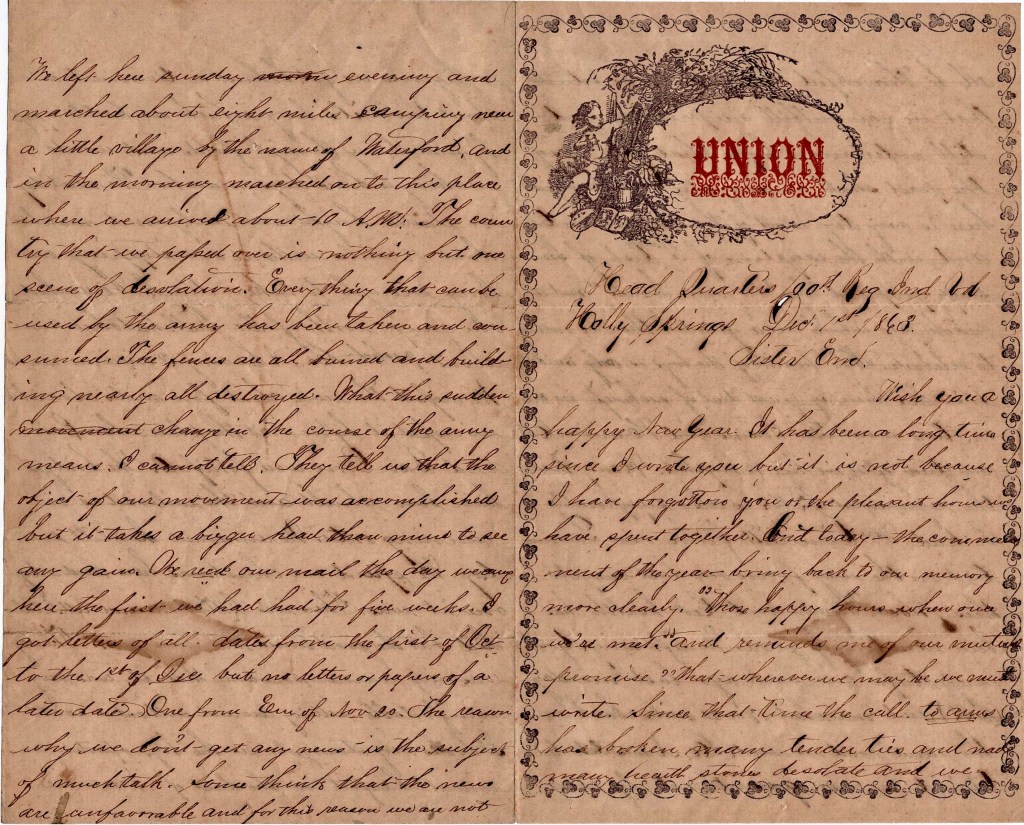
Headquarters 100th Reg. Indiana Volunteers
Holly Springs [Mississippi]
December [January] 1st 1863

Sister Em.

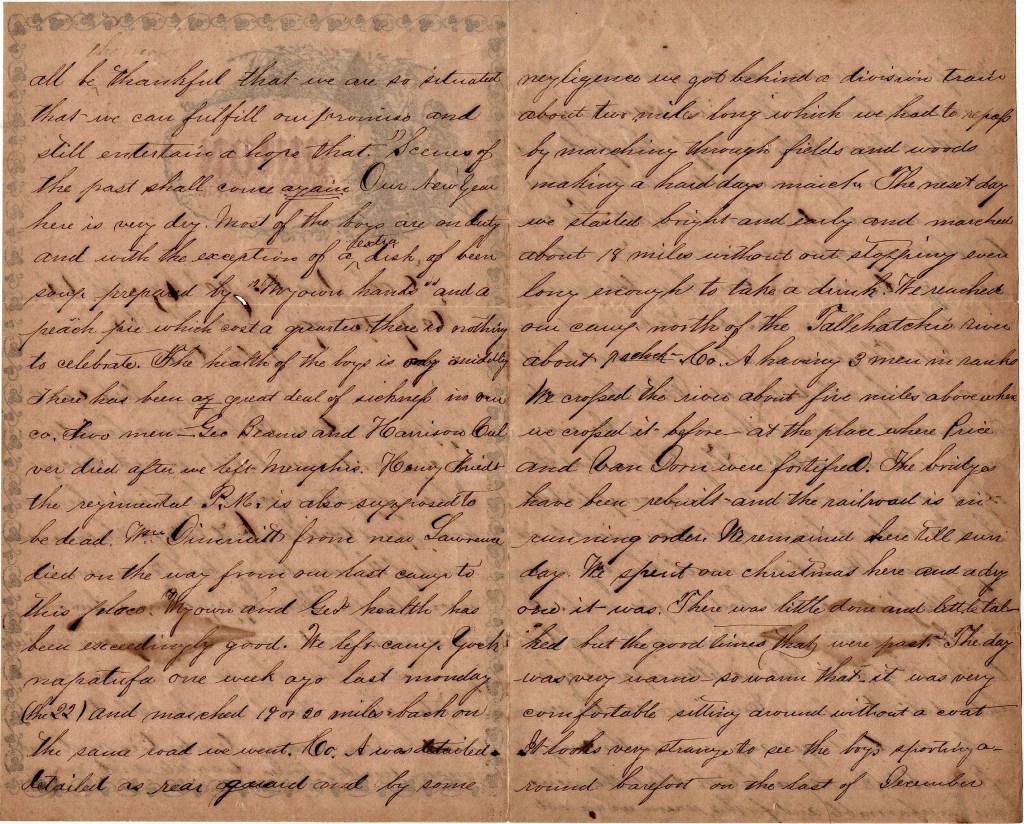
Wish you a Happy New Year. It has been a long time since I wrote you but it is not because I have forgotten you or the pleasant hours we have spent together. But today—the commencement of the year—bring back to our memory more clearly those happy hours when our were met” and reminds me of our meeting promise that wherever we may be, we must write. Since that time the call to arms has broken many tender ties and made man’s hearth stones desolate and we all be thankful that we are so situated that we can fulfill our promise and still entertain hope that “scenes of the past shall come again.”

Our New Year here is very dry. Most of the boys are on duty and with the exception of a extra dish of bean soup prepared by “my own hands” and a peach pie which cost a quarter, there is nothing to celebrate. The health of the boys is only middling. There has been a great deal of sickness in our company. Two men—George Beams 1 and Harrison Culver 2 died after we left Memphis. Henry Friedt 3 the regimental post master, is also supposed to be dead. William [H.] Dimmitt 4 from near Lawrence died on the way from our last camp to this place. My own and [brother] George’s health has been exceedingly good.

We left camp Yocknaptufa one week ago last Monday (the 22nd) and marched 19 or 20 miles back on the same road we went. Co. A was detailed as rear guard and by some negligence we got behind a division train about two miles long which we had to pass by marching through fields and woods making a hard days march. The next day we started bright and early and marched about 18 miles without any stopping even long enough to take a drink. We reached our camp north of the Tallhatchie river about 7 o’clock., Co. A having 3 men in ranks. We crossed the river about five miles above where we crossed it before—at the place where Price and Van Dorn were fortified. The bridges have ben rebuilt and the railroad is in running order. We remained here till Sunday.

We spent our Christmas here and a dry one it was. There was little done and little talked but the good times that were past. The day was very warm—so warm that it was very comfortable sitting around without a coat. It looks very strange to see the boys sporting around barefoot on the last of December. We left here Sunday evening and marched about eight miles, camping near a little village by the name of Waterford and in the morning marched on to this place where we arrived about 10 a.m.

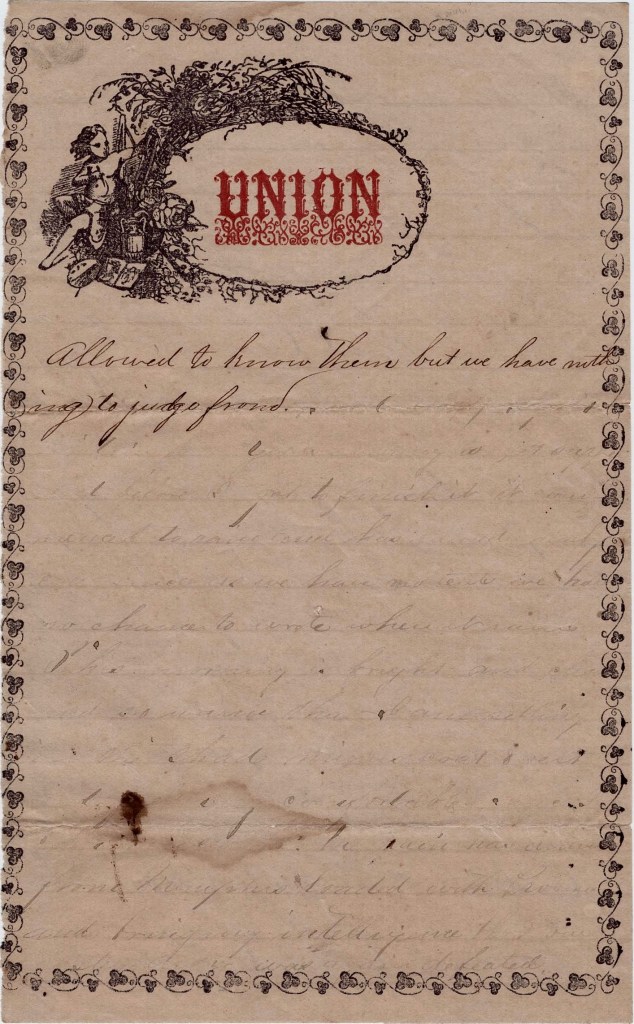
The country that we passed over is nothing but one scene of desolation. Everything that can be used by the army has been taken and consumed. The fences are all burned and buildings nearly all destroyed. What this sudden change in the course of the army means, I cannot tell. They tell us that the object of our movement was accomplished but it takes a bigger head than mine to see any gain. We received our mail the day we came here—the first we had had for five weeks. I got letters of all dates from the first of October to the 1st of December, but no letters or papers of a later date. One from [my wife] Em of November 20. The reason why we don’t get any news is the subject of much talk. Some think that the news are unfavorable and for this reason we are not allowed to know them but we have nothing to judge from.

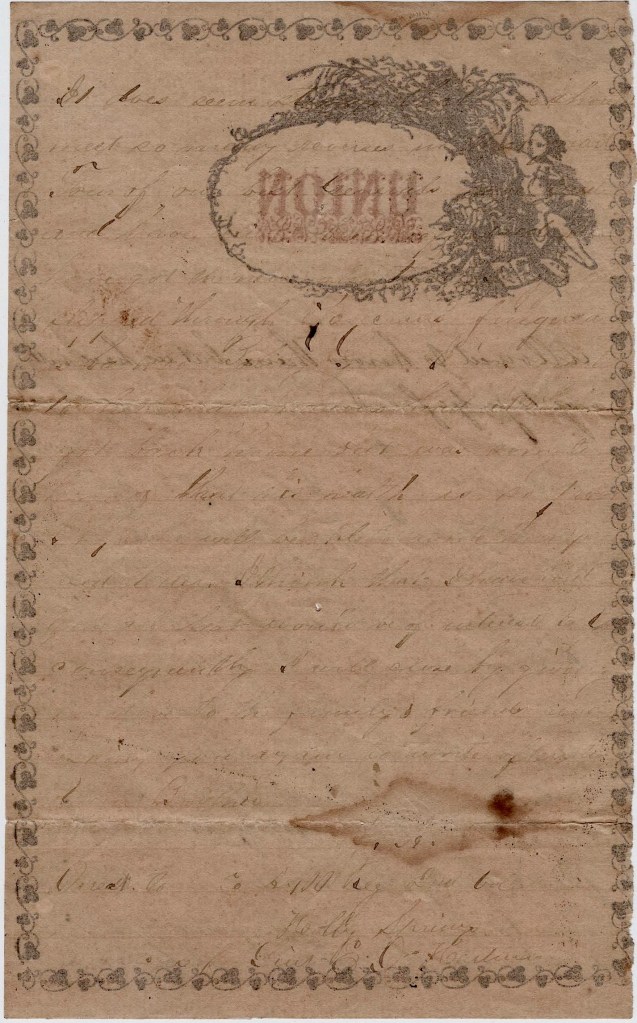
[Remainder of letter written with very faint ink and nearly illegible though I can make out “direct to Company A, 100th Reg. Indiana Volunteers, Holly Springs, in care of Lieut. E. O. Hartman]


1 George Beams of Spencerville, Indiana, died at Memphis, Tennessee, on 24 November 1862.

2 Harrison Culver of Auburn, Indiana, died at Memphis, Tennessee, on 24 December 1862.

3 Henry Friedt of Spencerville, Indiana, was discharged on 30 January 1863.

4 William H. Dimmitt died at Abbyville, Tennessee on 24 December 1862.
1862: Mitchell Campbell Lilley to Amanda (Brooks) Lilley

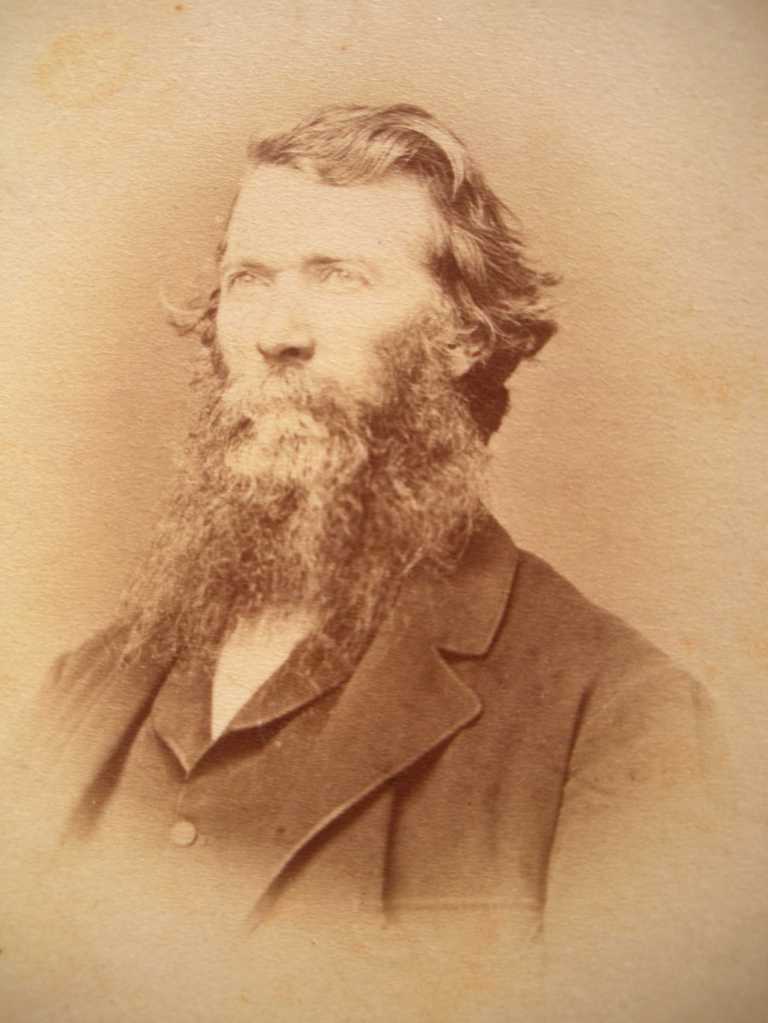
The following letter was written by 43 year-old Mitchell Campbell Lilley (1819-1897), the proprietor of a moderately successful bindery and printing firm in Columbus, Ohio, at the time that civil war erupted in 1861. Having served previously in the Mexican War, and being a member of the local militia, Lilley was quick to offer his service as Captain of Co. H, 46th Ohio Volunteer Infantry (OVI). Ill health, however, forced Lilley to resign from active service in January 1863 but he returned to Columbus to command a home guard militia for the duration of the war.

Mitchell Campbell Lilley

Following the war, Lilley convinced the Ohio General Assembly that deaf students at the state institution for the deaf could be trained in bookbinding skills which enabled him to expand his business and branch out into other endeavors, such as manufacturing and distributing fraternal regalia.

Lilley was married in 1849 at Paris, Illinois, to Amanda C. Brooks. They had 13 children, five of who died in infancy.

The 46th OVI took part in Grant’s first attempt to seize Vicksburg which was to march his army overland from La Grange, Tennessee, following the Mississippi Central Railroad south toward Vicksburg. He imagined that a supply line could be maintained from Columbus, Kentucky, but this proved impossible. Once Grant’s forces had made it as far as 35 miles south of Grand Junction, the large supply depot he had established at Holly Springs in his rear was swiftly and unexpectedly attacked by Earl Van Dorn’s Cavalry, destroying $1.5 million of supplies, capturing the Federal garrison quartered there, and destroying track and bridges. The damage inflicted by Van Dorn’s troopers caused sufficient harm for Grant to withdraw his forces to Memphis and rethink his strategy.

In this letter, Capt. Lilley describes their return to Holy Springs and what they found when they got there.

For an interesting article by my friend Dan Masters, see “Crank” Worthington’s Boys at Shiloh, published on 28 June 2020.

[Note: This letter is from the personal collection of Greg Herr and was transcribed & published on Spared & Shared by express consent.]

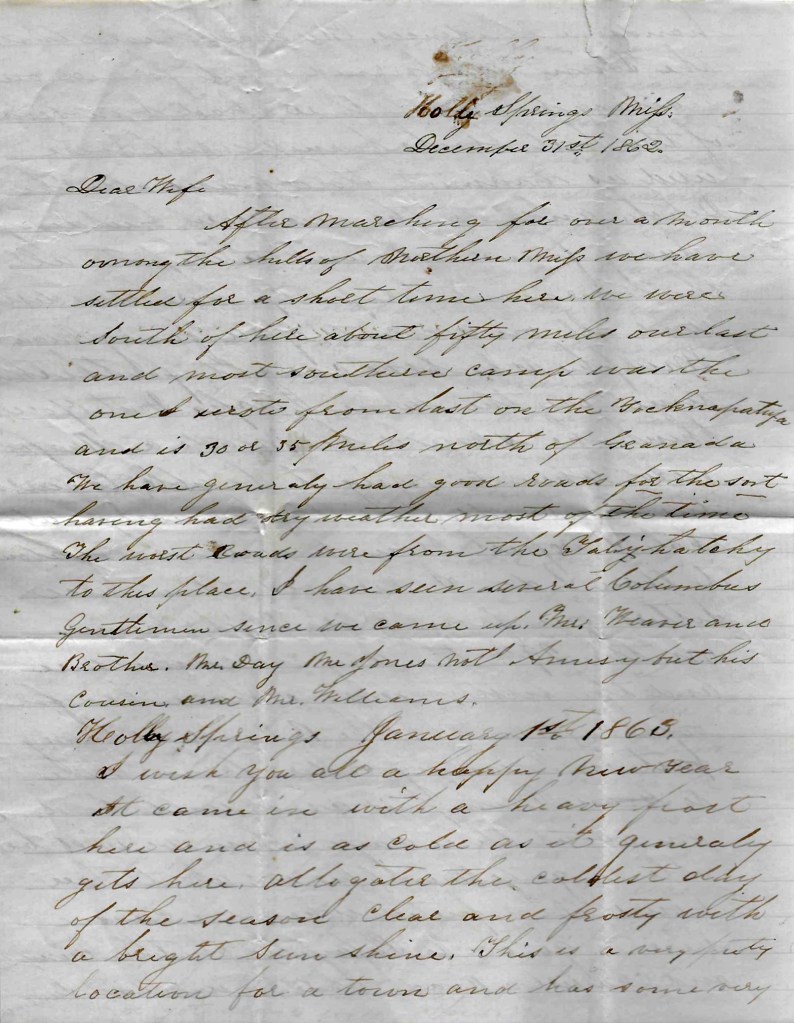
Transcription

Holly Springs, Mississippi
December 31, 1862

Dear Wife,

After marching for over a month among the hills of Northern Mississippi, we have settled for a short time here. We were south of here about fifty miles. Our last and most southern camp was the one I wrote from last on the Yachnapatufa and is 30 to 35 miles north of Grenada. We have generally had good roads for the sort, having had dry weather most of the time. The worst roads were from the Tallahatchie to this place. I have seen several Columbus gentlemen since we came up. Mr. Weaver and brother, Mr. Day, Mr. Jones—not Amisy but his cousin, and Mr. Williams.

Holly Springs, January 1st 1863. I wish you all a happy New Year. It came in with a heavy frost here and is as cold as it generally gets here, altogether the coldest day of the season, clear and frosty with a bright sunshine. This is a very pretty location for a town and has some very handsome residences. We had heard that the town was burned but found on reaching here that there had been several of the best blocks burned which were used as Government storehouses—also the depot, and all the necessary buildings usually found around a depot. All the government property here was destroyed and all on account of a fancy man, Col. [Robert C.] Murphy, who was caught for the third time in the same trap. Don’t you think he should be made a Major now when he might be able to surrender his thousands.

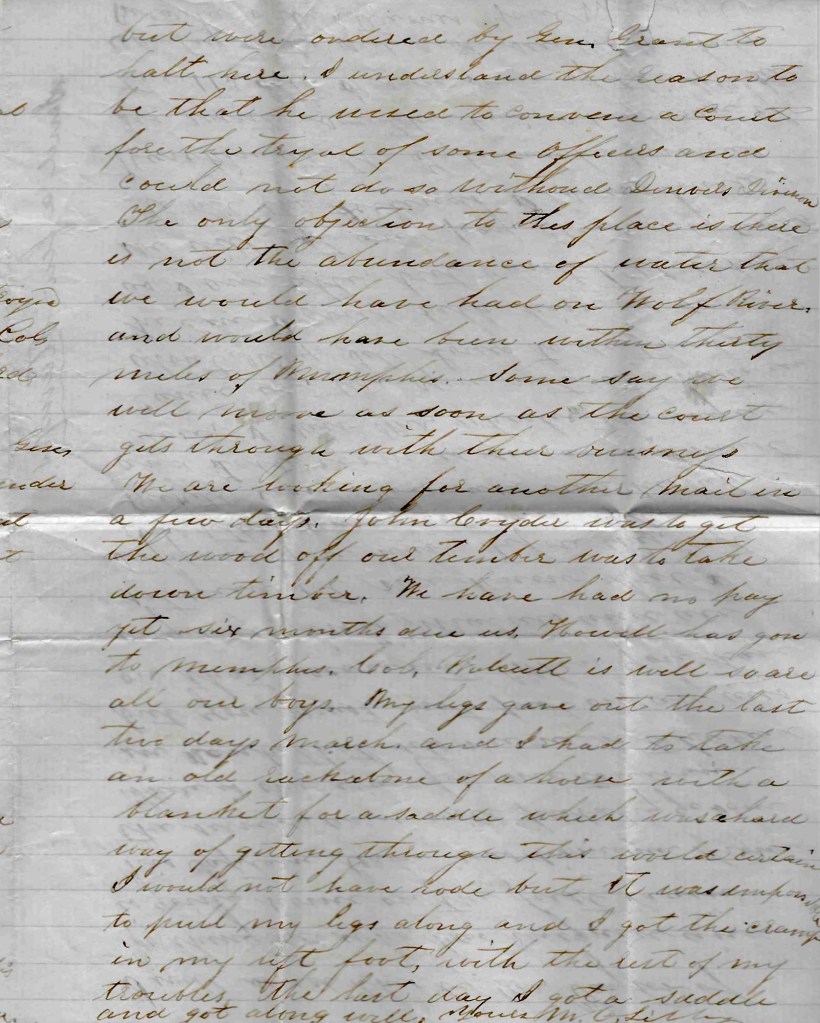
Well, talk enough about that. I expect you know more about it than I do. I received your three letters—one from Cairo, Paris, and home—on the 29th, the day we came here, and the first news we have had for over a month. The railroad is being put in running order from here to Memphis and will be done in about three days when we will be able to go to Memphis in about three hours. We expected when we came here to go on to Lafayette on the Memphis & Charleston Road where we were last summer, but we were ordered by Gen. Grant to halt here. I understood the reason to be that he wished to convene a court for the trial of some officers and could not do so without Denver’s Division. 1 The only objection to this place is there is not the abundance of water that we would have had on Wolf River, and would have been within thirty miles of Memphis. Some say we will move as soon as the court gets through with their business.

We are looking for another mail in a few days. John Cryder was to get the wood off our timber was to take down timber. We have had no pay yet—six months due us. Howell has gone to Memphis. Col. Wolcutt is well. So are all our boys. My legs gave out the last two days march and I had to take an old rackabone of a horse with a blanket for a saddle which was a hard way of getting through this world certain. I would not have rode but it was impossible to pull my legs along and I got the cramps in my left foot, with the rest of my troubles. The last day I got a saddle and got along well. Yours, — M. C. Lilley

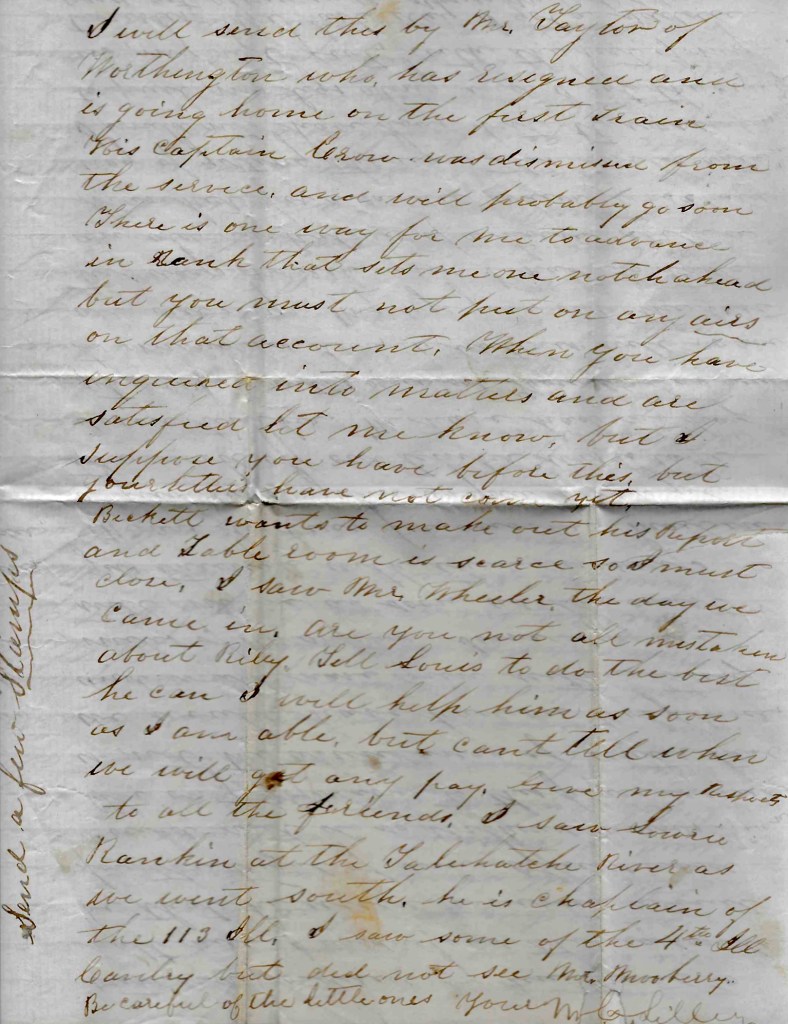
I will send this by Mr. Taylor of Worthington who has resigned and is going home on the first train. His Captain Crow was dismissed from the service and will probably go soon. There is one way for me to advance in rank. That sets me one notch ahead but you must not put on any airs on that account. When you have enquired into matters and are satisfied, let me know, but I suppose you have before this. But your letters have not come yet.

Beckett wants to make out his report and table room is scarce so I must close. I saw Mr. Wheeler the day we came in. Are you not all mistaken about Riley? Tell Louis to do the best he can. I will helm him as soon as I am able, but can’t tell when we will get any pay. Give my respects to all the friends. I saw Lowrie Rankin at the Tallahatchie River as we went south. He is chaplain of the 113th Illinois. I saw some of the 4th Illinois Cavalry but did not see Mr. Mooberry. Be careful of the little ones. Yours, — M. C. Lilley


1 Gen. James W. Denver remained in command of this brigade until about November 23, 1862 when he was given the command of one of the three divisions Sherman’s division was split into. During this period Gen. Denver and his brigade participated in the Siege of Corinth, a march to Memphis, and a brief move south with Sherman toward Holley Springs, December 5, 1862. After returning to Memphis his division transferred to Gen. Hurlbut’s XVI Corps where it was designated as the First Division. Its assignment was to guard 65 miles of the Memphis & Charelston Rail Road. He was preforming this duty when he resigned his commission March 18, 1863. He remained in his command until his replacement, Gen. William Sooy Smith, took command of the division.

1862: Alfred A. Laughlin to his Parents

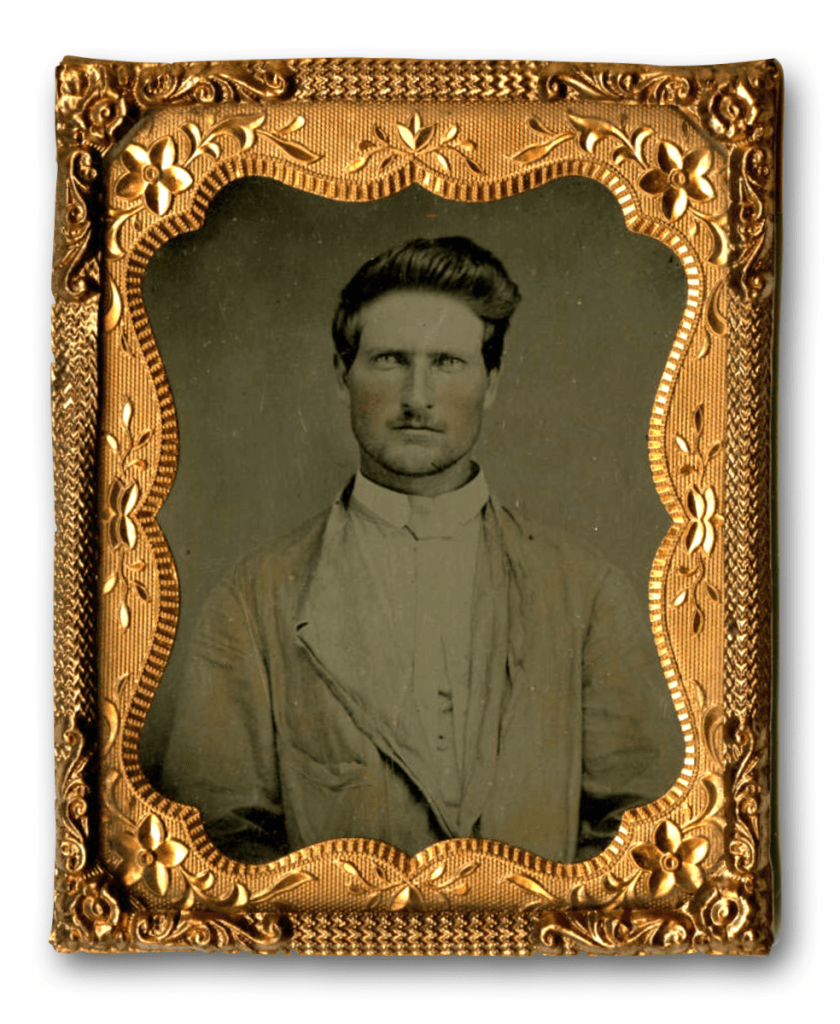
I could not find an image of Alfred but here is a tintype of Sullivan Gilpin of Co. D, 63rd OVI (Ohio History Connection)

This letter was written by Alfred A. Laughlin (1844-1862) who lived in Germantown in southwestern Ohio. The letter came from a collection of letters that were sold by the Swann Auction Galleries. Laughlin joined the 112th Ohio Volunteer Infantry (OVI), which never reached full strength and was merged into the 63rd Ohio Infantry. The lot included several letters he wrote to his parents David and Susan in Germantown from September to December 1862. This is the last letter in that collection, dated 7 December 1862, written from Mississippi where his regiment expected to face off soon against Confederate general Sterling Price: “Sunday we could hear the cannon roar all day. There are troops enough around here to eat old Price and all his men. A deserter from Price’s army came in here yesterday. He says that the most of the soldiers’ time is up, and they won’t fight any more.”  

Laughlin died of dysentery in camp later that month (19 December 1862). The lot included two letters from men in his regiment to his grieving parents. Francis Emley tries to give his best account of Laughlin’s final days: “He did not appear to suffer much pain and he died very easy. . . . Thank God he died in a glorious cause, that cause was for the old flag, that ower forefathers fought for. . . . Alford was buried very nice, for I helped to dig his grave, and I know that it was don right.” The company captain George Wightman followed up in September with advice on securing Laughlin’s effects and final pay.

Transcription

[Near Holly Springs, Mississippi]
December 7, 1862

Dear Father and Mother,

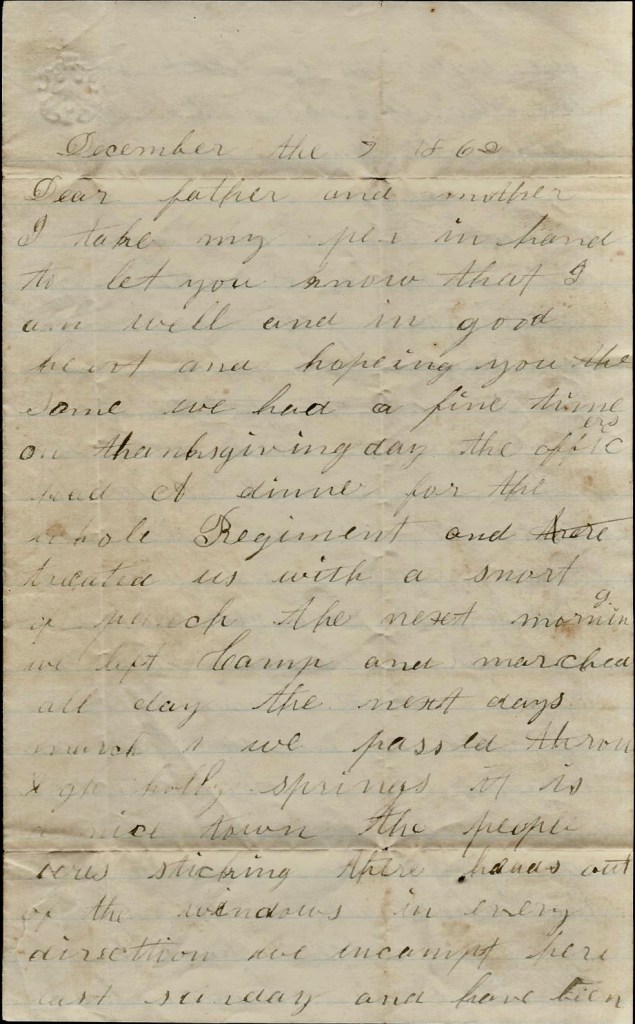
I take my pen in hand to let you know that I am well and in good heart and hoping you [are] the same. We had a fine time on Thanksgiving Day. The officers had a dinner for the whole regiment and treated us with a snort of punch. The next morning we left camp and marched all day. The next days march we passed through Holly Springs. It is a nice town. The people were sticking their heads out of the windows in every direction. We encamped here last Sunday and have been here ever since.

Last Sunday we could hear the cannon roar all day. There are troops enough around here to eat Old Price and all his men. A deserter from Price’s army came in here yesterday. He says that the most of the soldiers time is up and they won’t fight anymore.

We have plenty to eat. We get beef every day and have good water. We could get plenty hogs and chickens if we would darst take them [but] if a fellow takes anything, he is put under arrest. There was fifty-two prisoners passed here the other day. If you get this letter before Ed Hoffman leaves home, if you can get a pair of gloves and send them along with him. If you have not got my dress coat yet, go to Coblent’s. We boxed them up and was going to the quartermaster to be started away and we thought we had better send them home. It is tied with a twine string and has my name on a piece of paper,

I will send you a few cotton seeds and you can plant them and see if it will grow up there. Nothing more. Write soon. — A. A. Laughlin