Category Archives: Indian Uprising

1852: William Barrett Blair to George Gibson

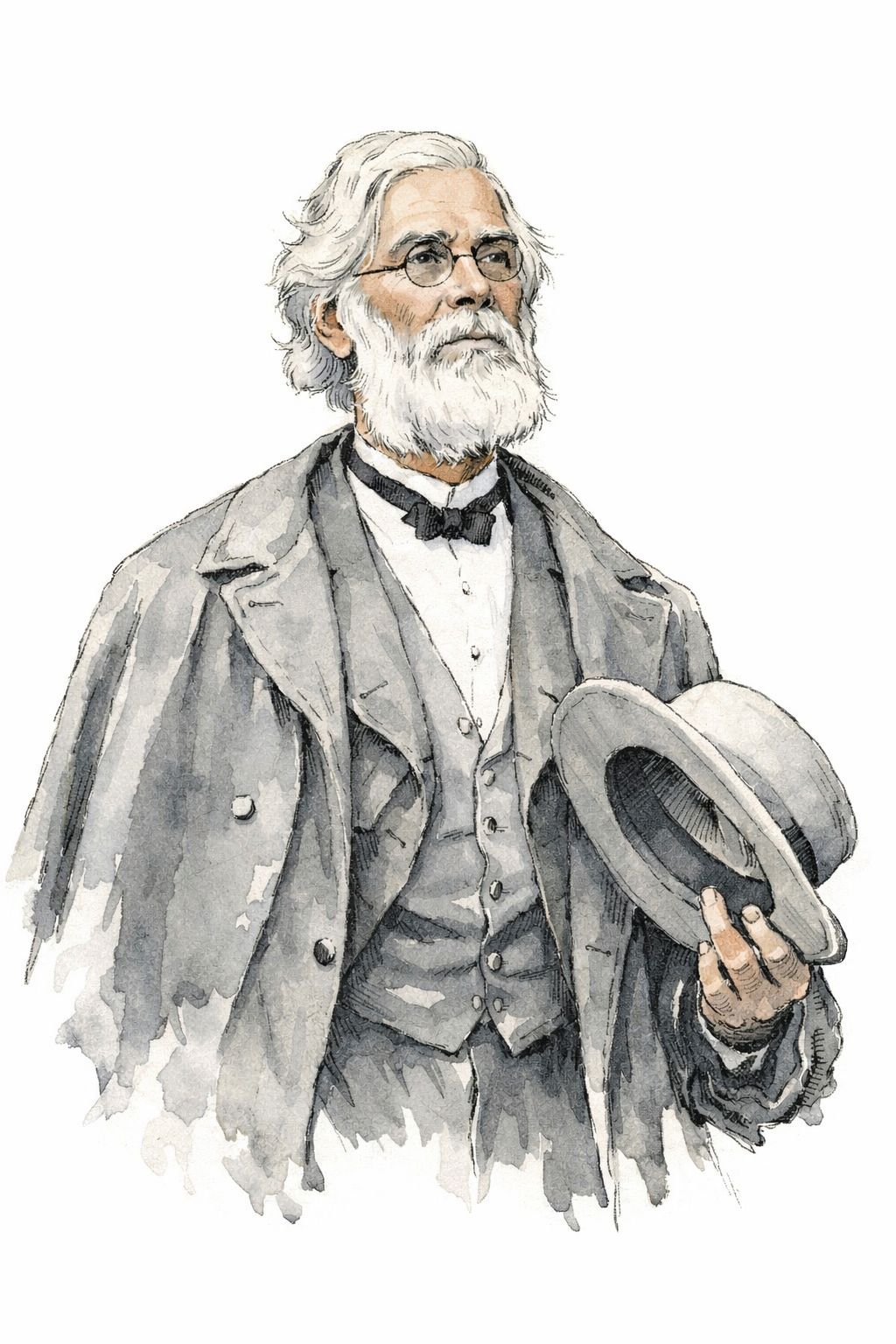
A post Civil War image of William B. Blair

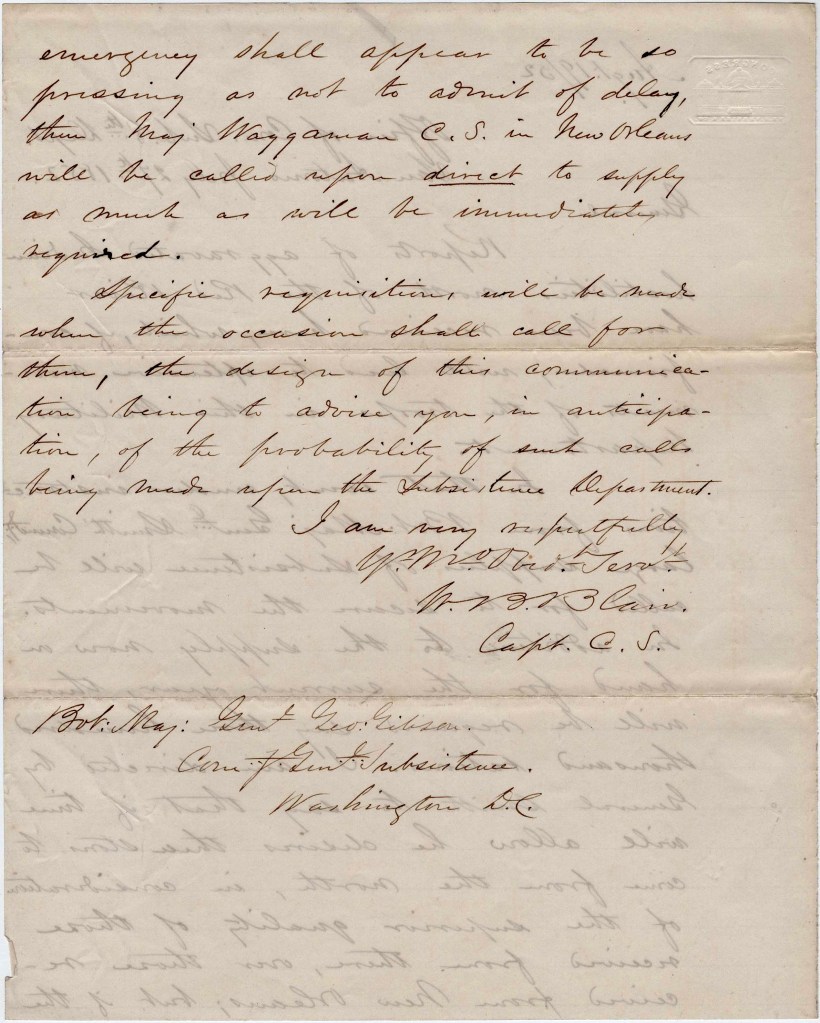
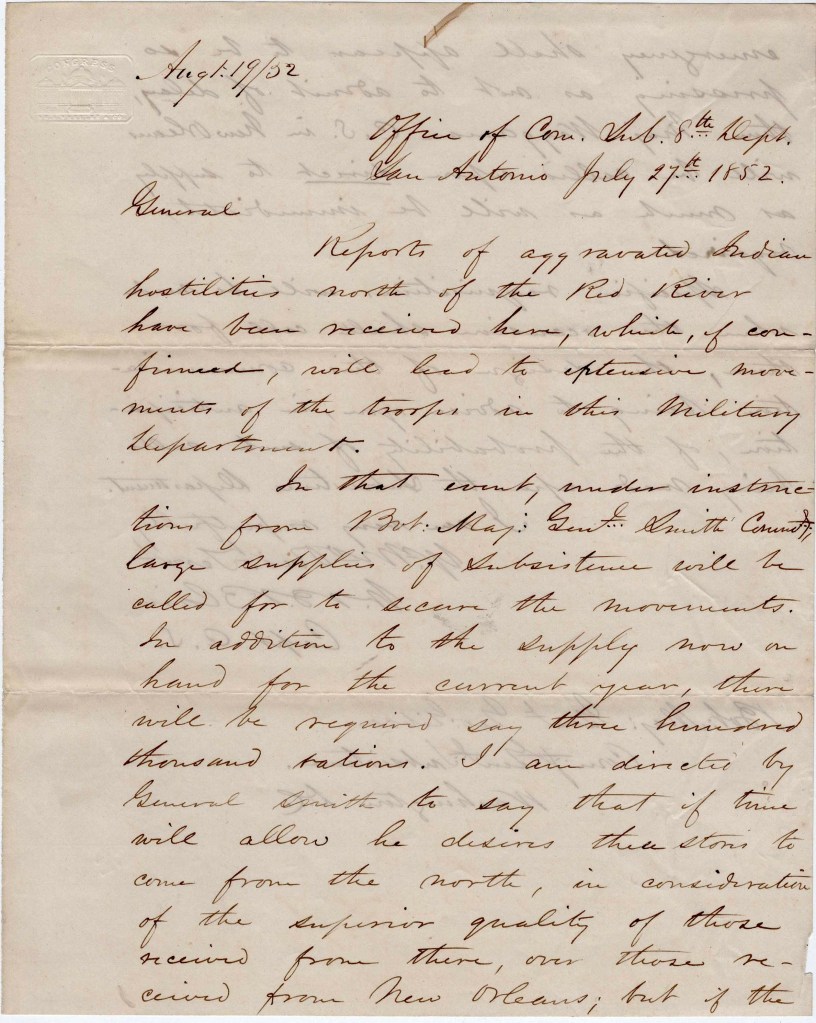
The following letter 1852 was written from San Antonio, Texas, during a period of heightened conflict north of the Red River. It was penned by Captain William Barrett Blair (1818-1883) to Commissary General George Gibson, reporting “aggravated Indian hostilities” which, if confirmed, will require “extensive movements of the troops in this Military Department.” Acting under the direction of Brevet Major General Persifor Frazer Smith, Blair anticipates the need for “say three hundred thousand rations” beyond the current stock on hand. Blair notes a preference for supplies obtained from northern depots “in consideration of the superior quality of those received from there, over those received from New Orleans,” but authorizes immediate procurement through Maj. Henry Waggaman in New Orleans if the situation proves too urgent to allow delay. Blair closes by advising the Subsistence Department that formal requisitions will follow as the situation develops.

The 1850s Red River–Cross Timbers corridor remained one of the most volatile regions in the Southwest, with Comanche, Kiowa, and allied groups resisting U. S. encroachment and the Army maintaining a chain of scattered posts from San Antonio northward.

William Barrett Blair graduated from the US Military Academy in 1838 and after an early assignment to the Northern Frontier, returned to the Academy as a professor of Mathematics until the War with Mexico. In that conflict, he served in the Ordnance and Commissary Departments. He afterward took an assignment in Texas on the staff of the Commissary Subsistence Department unto the Civil War broke out at which time he resigned his commission and joined his native State of Virginia in rebellion against the United States. At the time of his death in 1883, he was on the faculty at VMI in Lexington, Va. 

T R A N S C R I P T I O N

Office of Commissary Subsistence, 8th Deptartment
San Antonio, [Texas]
July 27th 1852

General,

Reports of aggravated Indian hostilities north of the Red River have been received here, which, if confirmed, will lead to extensive movements of the troops in this Military Department.

In that event, under instructions from Bvt. Maj. Genl. [Persifor F.] Smith, Commanding, large supplies of subsistence will be called for to secure the movements. In addition to the supply now on hand for the current year, there will be required say three hundred thousand rations. I am directed by General Smith to say that if time will allow, he desires these stores to come from the north, in consideration of the superior quality of those received from there, over those received from New Orleans; but if the emergency shall appear to be so pressing as not to admit of delay, then Maj. [Henry] Waggaman, C. S. in New Orleans will be called upon direct to supply as much as will be immediately required.

Specific requisitions will be made when the occasion shall call for them, the design of this communication being to advise you, in anticipation, of the probability of such calls being made upon the Subsistence Department.

I am very respectfully, your most obedient servant, W. B. Blair, Capt. C. S.

[to] Bvt. Maj. Genl. Geo. Gibson, Com. Genl. Subsistence, Washington D. C.
1857: Jennette (Graham) Hicks to Jefferson Salsig

The following letter was written by Jennette (Graham) Hicks (1831-1897). She married Henry Hicks (1824-1903) in St. Joseph county, Michigan on 1 August 1848. She had two children—Avery L. Hicks (1849-19130) and Ellis Henry Hicks (1853-1917). Jennette’s husband served during the Civil War as a private in Co. E, 11th Michigan Infantry. Jennette and her husband were born in New York State; her father was born in Ireland and her mother in New Jersey.

In 1850, Jennette and her husband were living in Lockport, Michigan. In 1860, Jeannette and her husband, a carpenter (house builder), were living in Lockport, Michigan, with their four children, Avery (b. 1849), Ellis “Henry” (b. 1853), Ida (b. 1855) and Delos (infant). The children were all born in Michigan. In 1870, the Hicks family resided in Three Rivers, Michigan. In 1880, they resided in Grand Rapids, Michigan.

Jennette wrote the letter to her sister, Ruth Ann (Graham) Salsig (1829-1904), the wife of Jefferson T. Salsig (1824-1874) who was also a carpenter. They were married in March 1847 in Kalamazoo county, Michigan. Ruth and her husband had several children born between 1851 and 1864 but some died young. Jefferson’s family tree is well-documented but the Graham side of the family is not.

Jennette (who spelled her name “Gennette”) did not fully dateline her letters and there are too few clues in the letter to accurately pinpoint the date and location but the information provided with the letter to its current owner claimed it was written in May 1857 from Plattsmouth, Nebraska Territory. I cannot confirm this, however. If true, the “massacre” mentioned in the letter may be a reference to the Spirit Lake Massacre that took place in March 1857 by the Santee Sioux of scattered northwest Iowa frontier settlements. In 1857, Plattsmouth was a burgeoning settlement on the Missouri River where a ferry had been established in 1852. The absence of postal markings suggests the letter was hand carried back East.

T R A N S C R I P T I O N

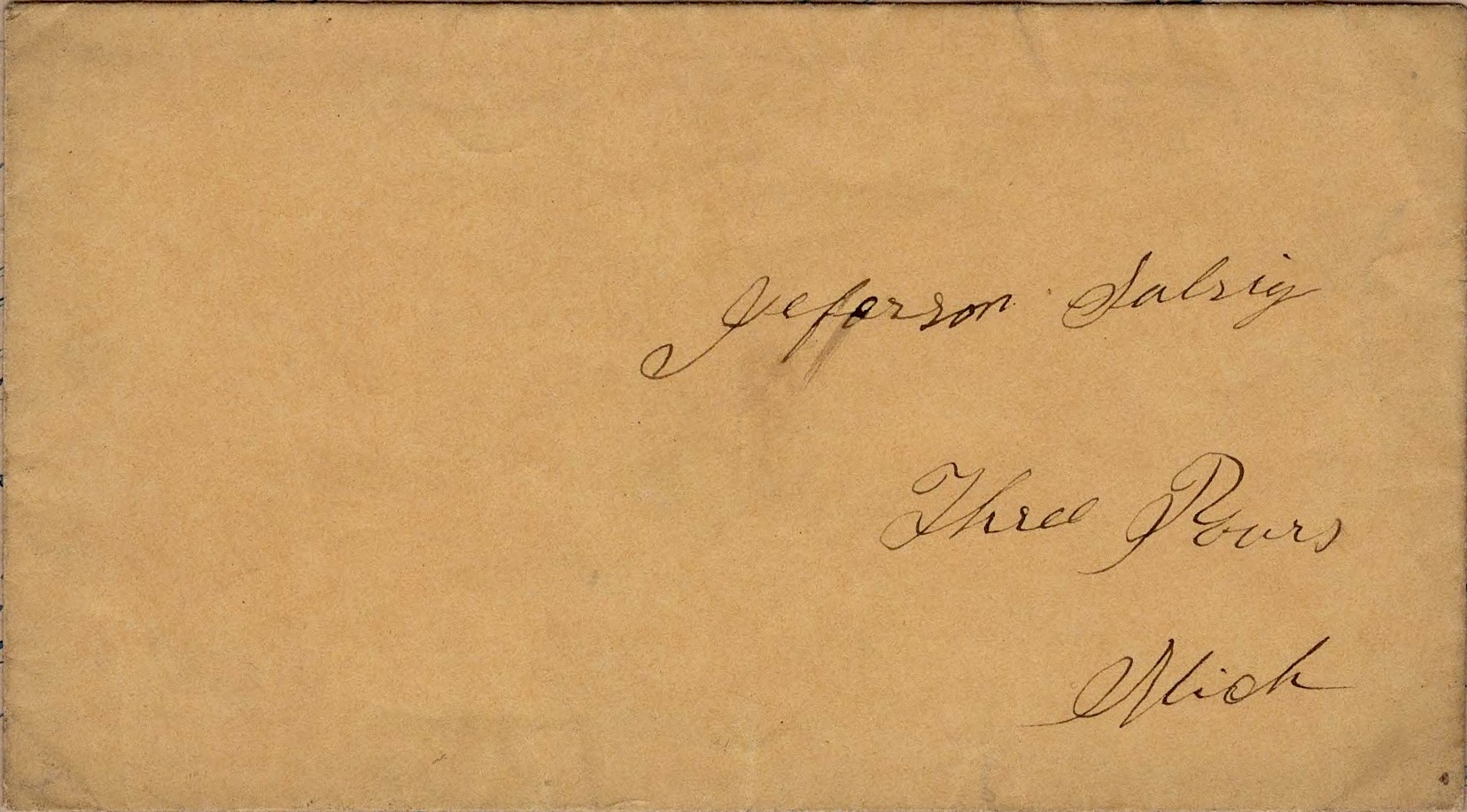
Addressed to Jefferson Salrig, Three Rivers, Michigan

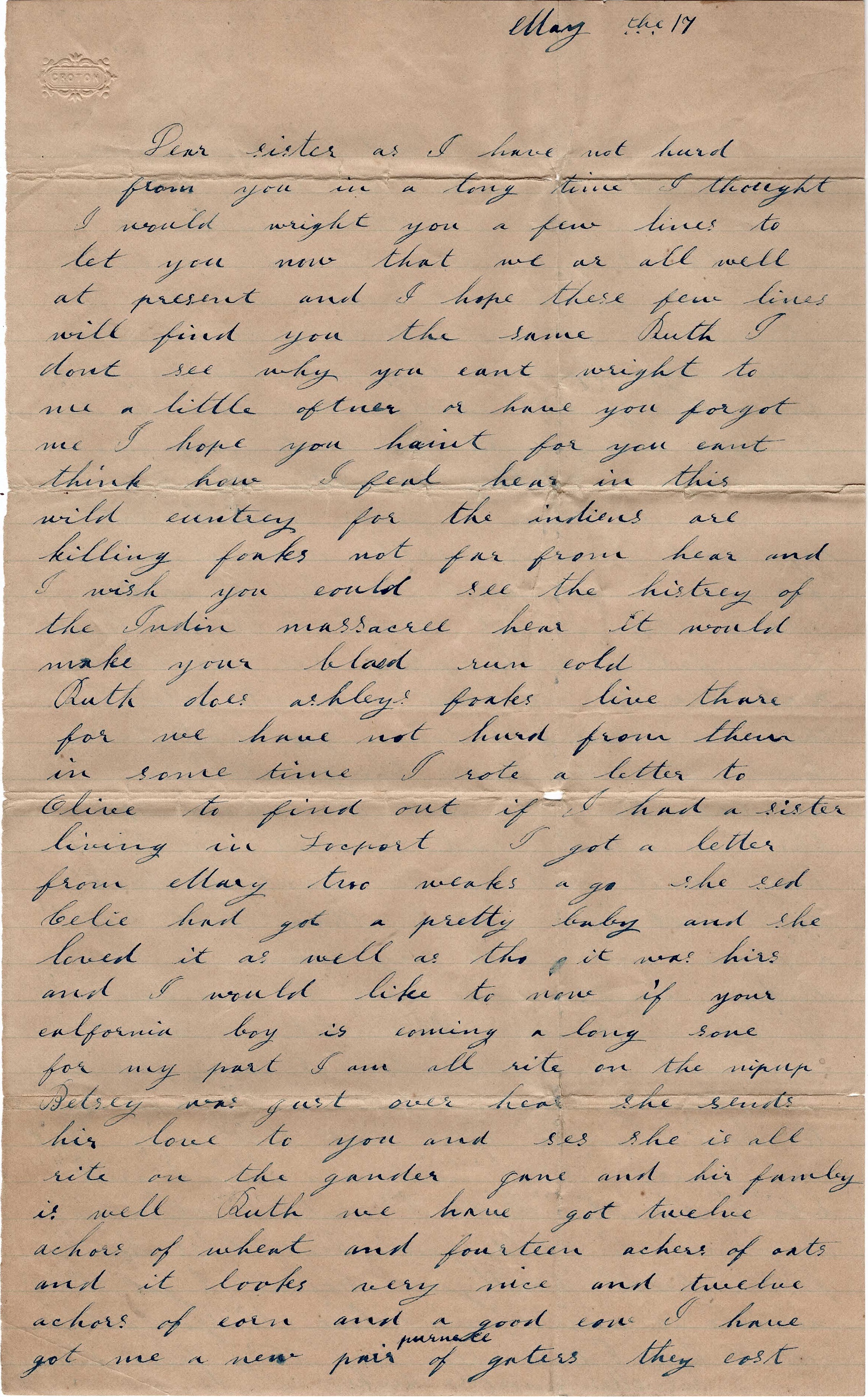
May 17 [1857?]

Dear sister,

As I have not heard from you in a long time, I thought I would write you a few lines to let you know that we are all well at present and I hope these few lines will find you the same. Ruth, I don’t see why you can’t write to me a little oftener or have you forgot me? I hope you hain’t for you can’t think how I fel here in this wild country for the Indians are killing folks not far from here and I wish you could see the history of the Indian massacre here. It would make your blood run cold.

Ruth, does Ashley’s folks live there for we have not heard from them in some time. I wrote a letter to Olive to find out if I had a sister living in Lockport. I got a letter from Mary two weeks ago. She said Celie had got a pretty baby and she loved it as well as though it was hers. And I would like to know if your California boy is coming along soon.

For my part, I am all right on the nipup [?]. Betsy was just over here. She sends her love to you and says se is all right on the gander. Jane and her family is well.

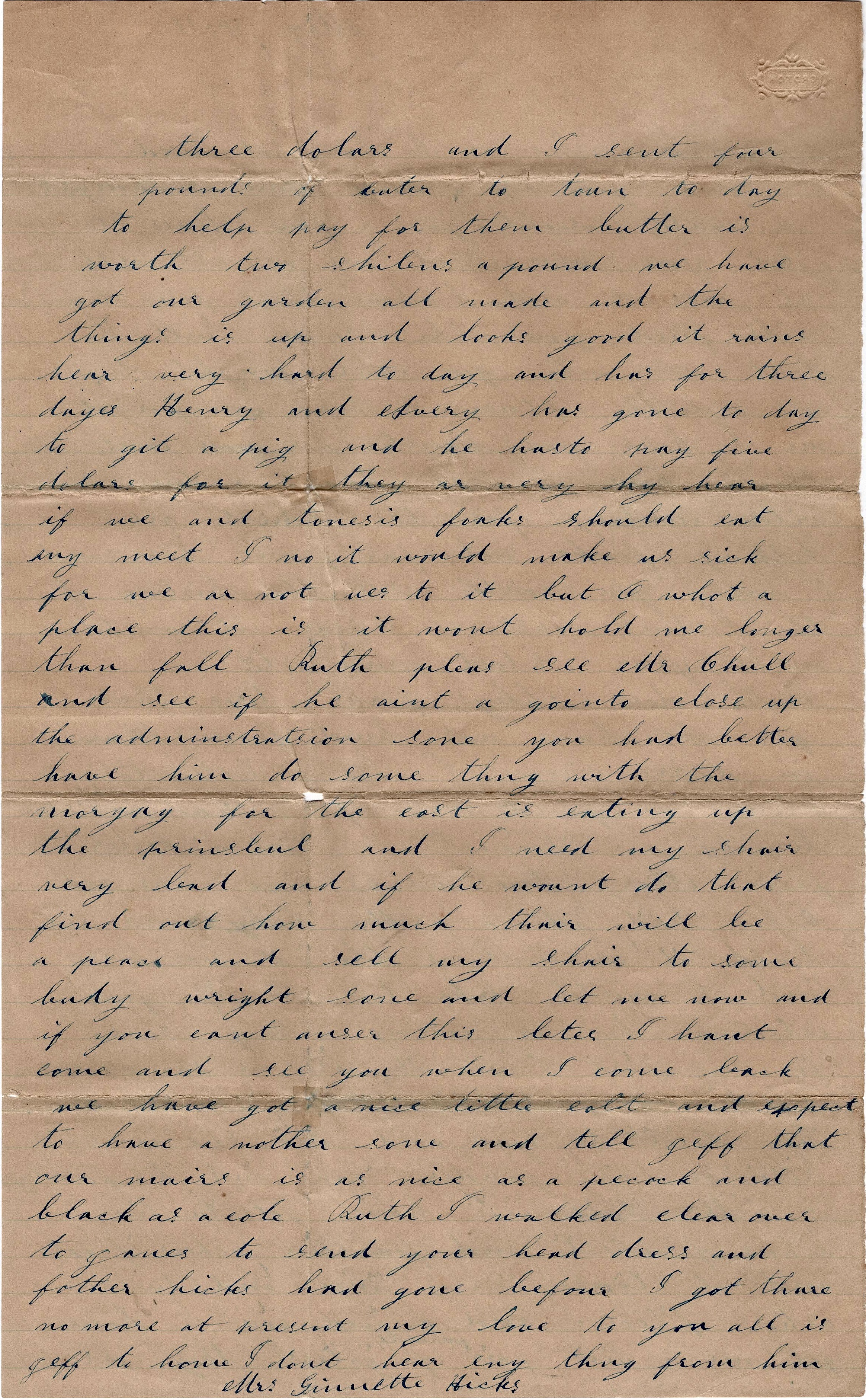
Ruth, we have got twelve acres of wheat and fourteen acres of oats and it looks very nice, and twelve acres of corn and a good cow. I have got me a new pair of gaters. They cost three dollars and I sent four pounds of butter to town today to help pay for them. Butter is worth two shillings a pound. We have got our garden all made and the things is up and looks good. It rains here very hard today and has for three days.

Henry and Avery has gone today to get a pig and he has to pay five dollars for it. They are very high here. If we and Tonesis’ [Tunis’ ?] folks should eat any meat, I know it would make us sick for we are not use to it. But Oh! what a place this is. It won’t hold me longer than fall.

Ruth, please see Mr. Chull and see if he ain’t a going to close up the administration soon. You had better have him do something with the mortgage for the cost is eating up the principal and I need my share very bad. And if he won’t do that, find out how much there will be apiece and sell my share to somebody. Write son and let me know and if you can’t answer this letter, I hant come and see you when I come back.

We have got a nice little colt and expect to have another soon and tell Jeff that our mares is as nice as a peacock and black as coal. Ruth, I walked clear over to Jane’s to send your head dress and Father Hicks had gone before I got there. No more at present. My love to you all. Is Jeff to home? I don’t hear anything from him. — Mrs. Ginnette Hicks