The following letter was written by Rachel (Hawkins) Epperson (1827-1896), the wife of William Epperson (1833-1904) of Decatur, Marion county, Indiana. At the time she wrote this letter in October 1864, she was the mother of two children—Austin L. Epperson (1856-1931) and Uriah Spray Epperson (1861-1944). She was also pregnant with her third child, Emma Epperson (1865-1944).
Rachel and her husband were Quakers. She was the daughter of Nathan Hawkins and Rebecca Roberds. She was married first in Bucks county, Pennsylvania, April 1848, to Joseph Furnas (1826-1849) but he died the following year. As the letter will show, Rachel’s 2nd husband, William Epperson, was in the meat business. Af few years after this letter was written, the family moved to Kansas City, Missouri, where William pioneered the Pork and Beef Packing industry in 1868.
Rachel wrote the letter to her “respected friend” Mary Ann (Byerly) Wiseman (1837-1922) who was married to William Benjamin Wiseman (1832-1909) of Corydon, Harrison county, Indiana, in 1858. Mary Ann was the daughter of Jacob Byerly (1812-1862) and Susan Eliza Wiseman (1817-1869).
The letter speaks of the military draft in Indiana in 1864 and the effects it was having in disrupting the lives of her neighbors as well as her own family. In 1864, Indiana, like other Union states, held multiple drafts to meet federal quotas, allowing draftees to avoid service by hiring a substitute or, early in 1864, paying a $300 commutation fee. Substitutes were often paid high fees (sometimes over $1,000) by wealthy men, and they were frequently sourced from men under 20, non-citizens, or previously exempt individuals.
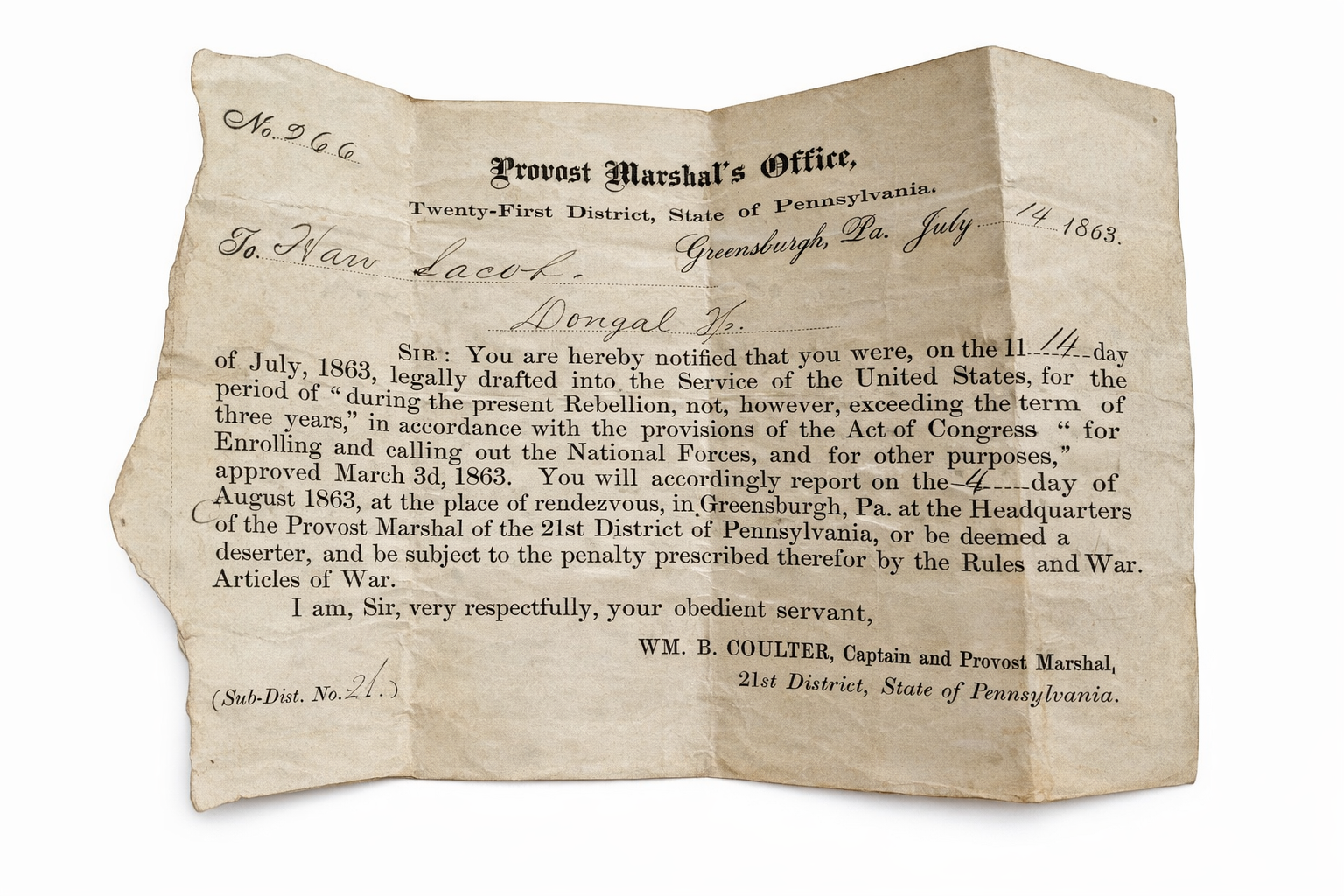
A typical draft notice in 1863
T R A N S C R I P T I O N
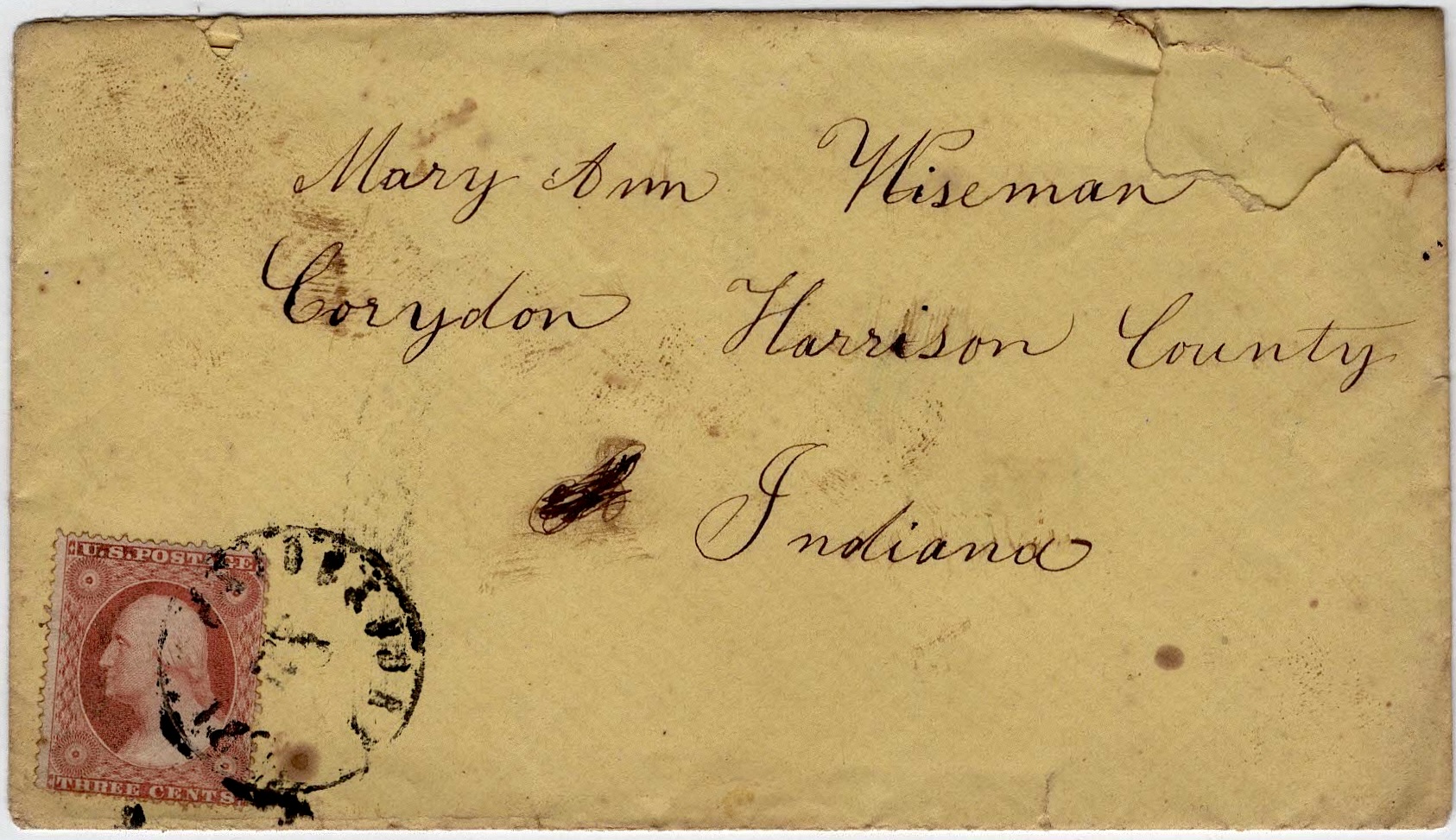
Addressed to Mary Ann Wiseman, Corydon, Harrison county, Indiana
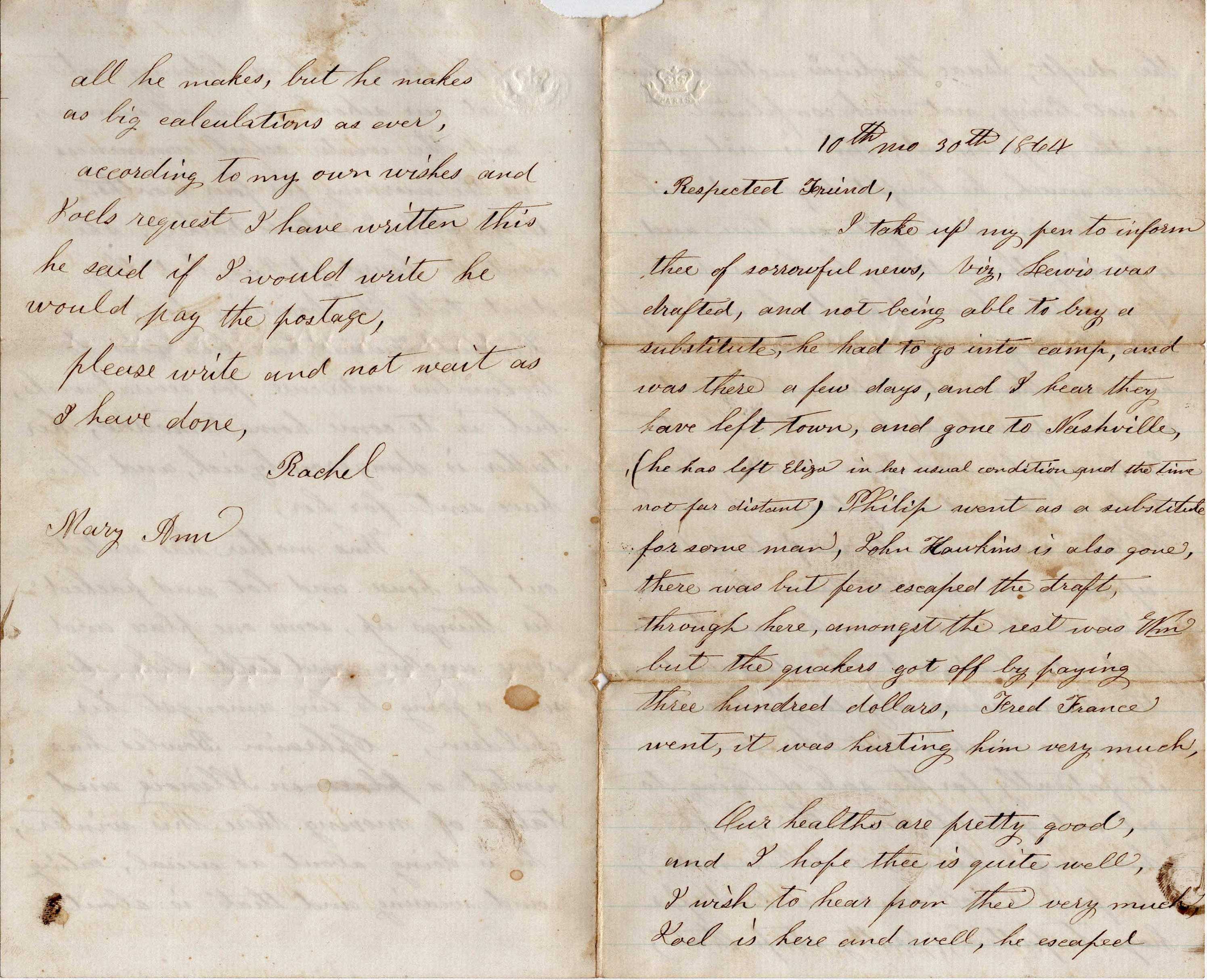
10th Month, 30th, 1864
Respected Friend,
I take up my pen to inform thee of sorrowful news—viz: Lewis [Wiseman] 1 was drafted, and not being able to buy a substitute, he had to go into camp and was there a few days, and I hear they have left town and gone to Nashville (he has left Eliza in her usual condition and the time is not far distant). Philip went as a substitute for some man. John Hawkins is also gone. There was but few escaped the draft through here. Amongst the rest was William but the Quakers got off by paying three hundred dollars. Fred France went. It was hurting him very much.
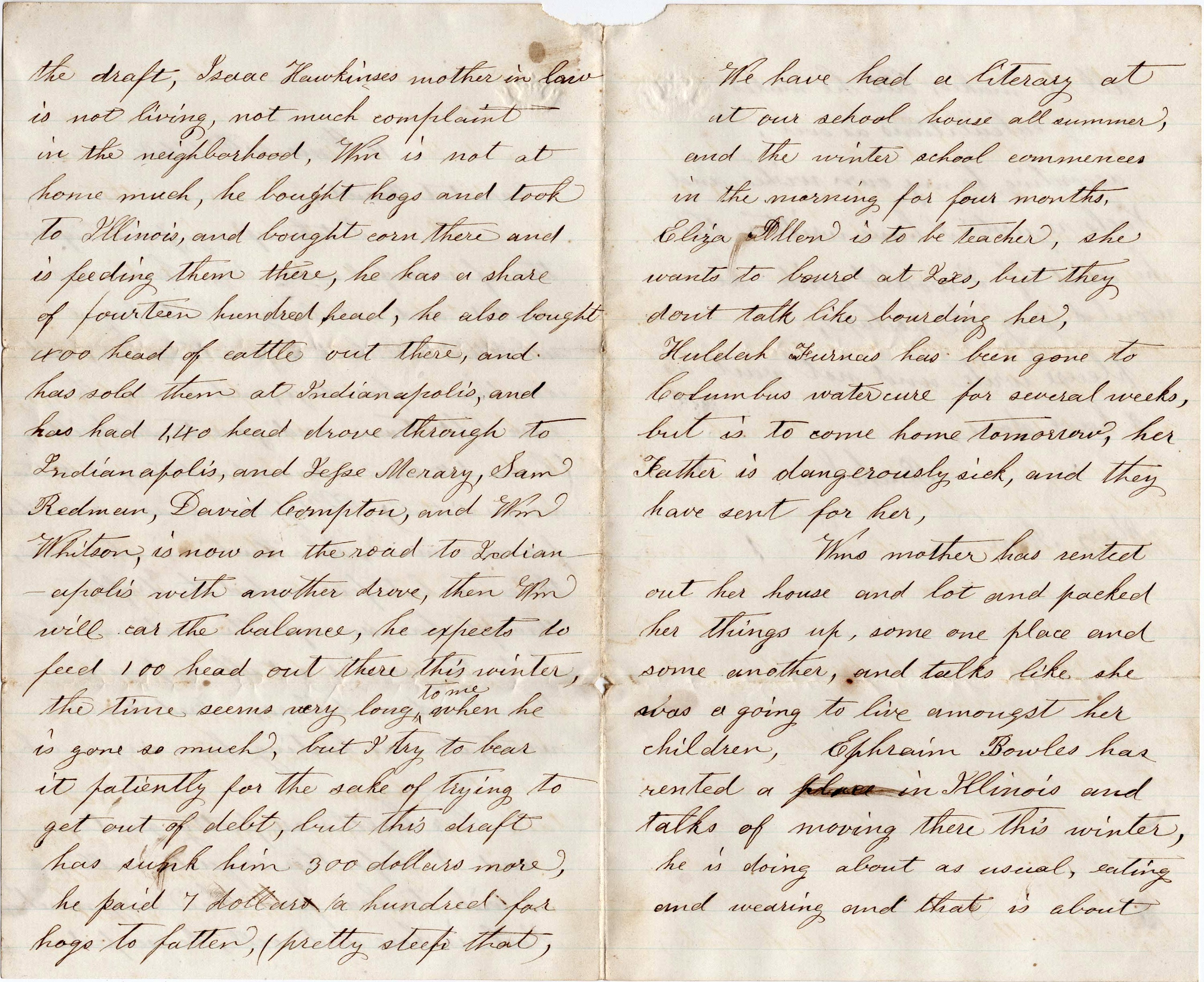
Our healths are pretty good and I hope thee is quite well. I wish to hear from thee very much. Joel is here and well. He escaped the draft. Isaac Hawkins’s mother-in-law is not living—not much complaint in the neighborhood. William is not at home much. He bought hogs and took to Illinois and bought corn there and is feeding them there. He has a share of fourteen hundred head. He also bought 400 head of cattle out there and has sold them at Indianapolis and has had 140 head drove through to Indianapolis, and Jesse Merary, Sam Redman, David Compton, and William Whitson, is now on the road to Indianapolis with another drove. Then William will car the balance. He expects to feed 100 head out there this winter. The time seems very long to me when he is gone so much but I try to bear it patiently for the sake of trying to get out of debt. But this draft has sunk him 300 dollars more. He paid 7 dollars a hundred for hogs to fatten (pretty steep that).
We have had a literary at our school house all summer and the winter school commences in the morning for four months. Eliza Allen is to be teacher. She wants to board at [ ‘s] but they don’t talk like boarding her. Huldah Furnas 2 has been gone to Columbus water cure 3 for several weeks but is to come home tomorrow. Her Father is dangerously sick and they have sent for her.
William’s mother has rented out her house and lot and packed her things up, some one place and some another, and talks like she was a going to live amongst her children. [Rev.] Ephraim Bowles 4 has rented a place in Illinois and talks of moving there this winter. He is doing about as usual, eating and wearing and that is about all he makes, but he makes as big calculations as ever.
According to my own wishes and Joel’s request, I have written this. He said if I would write, he would pay the postage. Please write and not wait as I have done. — Rachel
to Mary Ann
1 Lewis Wiseman of Decatur, Marion county, Indiana, was drafted and placed in the 29th Indiana Infantry.
2 Huldah (Jessup) Furnas (b. 1834) was the daughter of Alfred Jessup (1810-1865) and Betsy Jessup (1814-1864) of Hendricks county, Indiana. Huldah was the wife John W. Furnace (1835-1899) of Marion county, Indiana.
3 Dr. Shepard’s Water Cure Establishment in Columbus, Ohio, was a prominent 19th-century hydropathic facility located in the vicinity of what became known as Shepard Station. Established in 1853, it specialized in treating chronic and nervous diseases, particularly in women, using water-based therapies like wet sheet packs and baths.
4 Rev. Ephraim Bowles (1829-1914) was enumerated in Decatur, Marion county, Indiana in the 1860 US Census. In 1870, he was enumerated in Penn, Guthrie county, Iowa. Living next door to Ephraim in 1860 was 32 year-old Lewis Wiseman and his 30 year-old wife Eliza with a brood of children born every other year.
The following letter was written by Sarah (Walters) Alsbach (1812-1896), the wife of Rev. Michael Alsbach (1812-1886) of Benton, Elkhart county, Indiana. Sarah’s husband was licensed to preach in the Methodist Episcopal church by the Ohio Conference in 1855. He was ordained a deacon in 1857 and an elder in 1859. He transferred to the Indiana Conference in 1856 and was assigned to the Elkhart Circuit near Benton, Indiana. He lived on a farm seven miles southeast of Goshen and from this point, rode a circuit in Indiana and lower Michigan. At one time his circuit was 300 miles in length. During the Civil War, Sarah’s oldest son Henry served in the 74th Indiana Infantry and her family had to contend with Copperheads—southern sympathizers—on the home front that sometimes led to attacks on her husband. In 1863, her husband was reassigned to the Cicero Circuit and he was transferred to the new Michigan Conference. The family later moved to Illinois, Missouri, and Kansas.
Sarah wrote the letter to her sister Elizabeth (Walters) Cornelius (1820-18xx), the wife of William Cornelius (1816-1905), a farmer of Lewisburg, Union county, Pennsylvania. In her letter, Sarah devotes the greatest portion to her niece Mary Cornelius whom she addresses rather curtly on her discourteous letter writing. She ends her letter by writing, “We got your letter but I cannot say that I was glad to see it.”
T R A N S C R I P T I O N
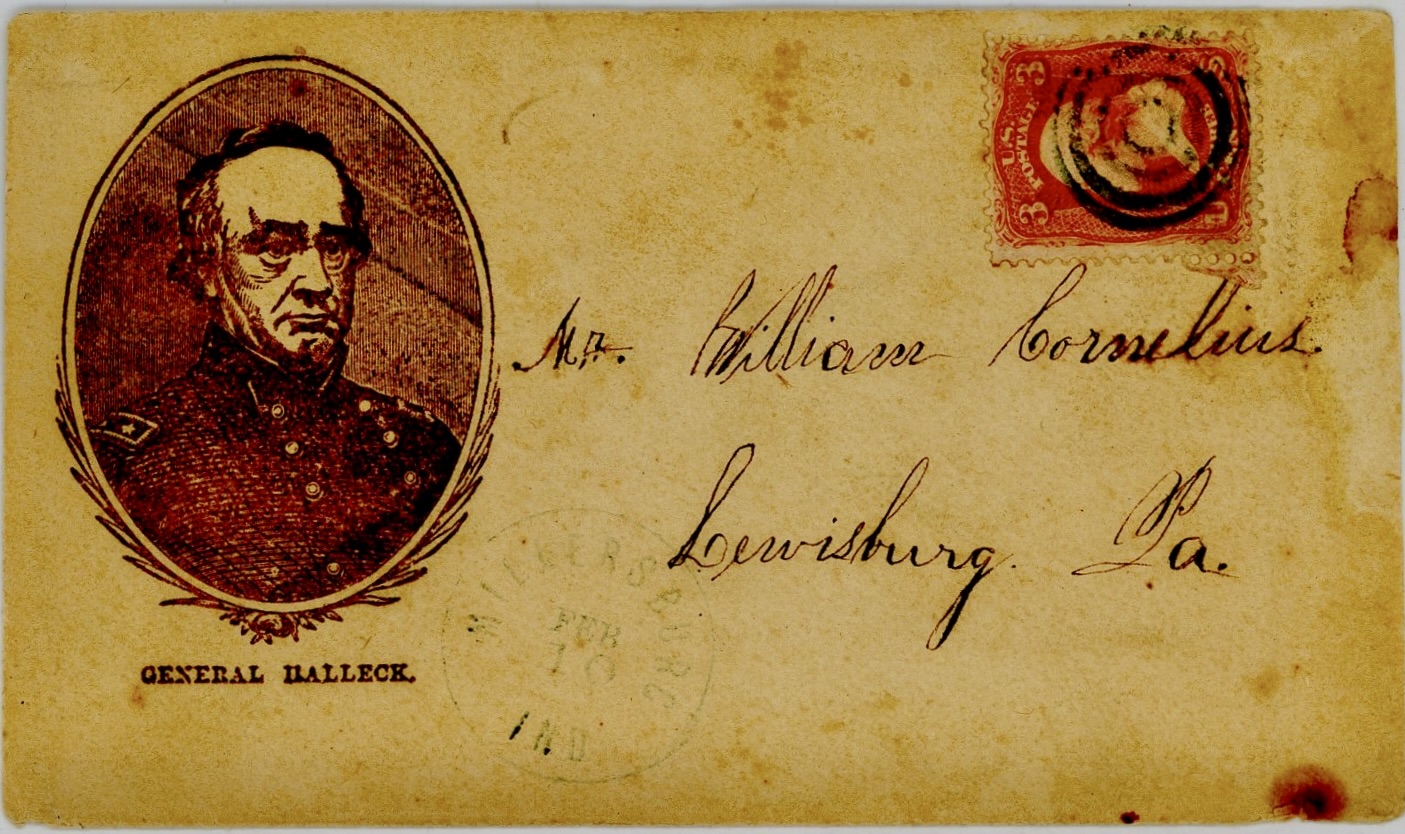
Addressed to Mr. William Cornelius, Lewisburg, Pennsylvania; postmarked Millersburg, Indiana
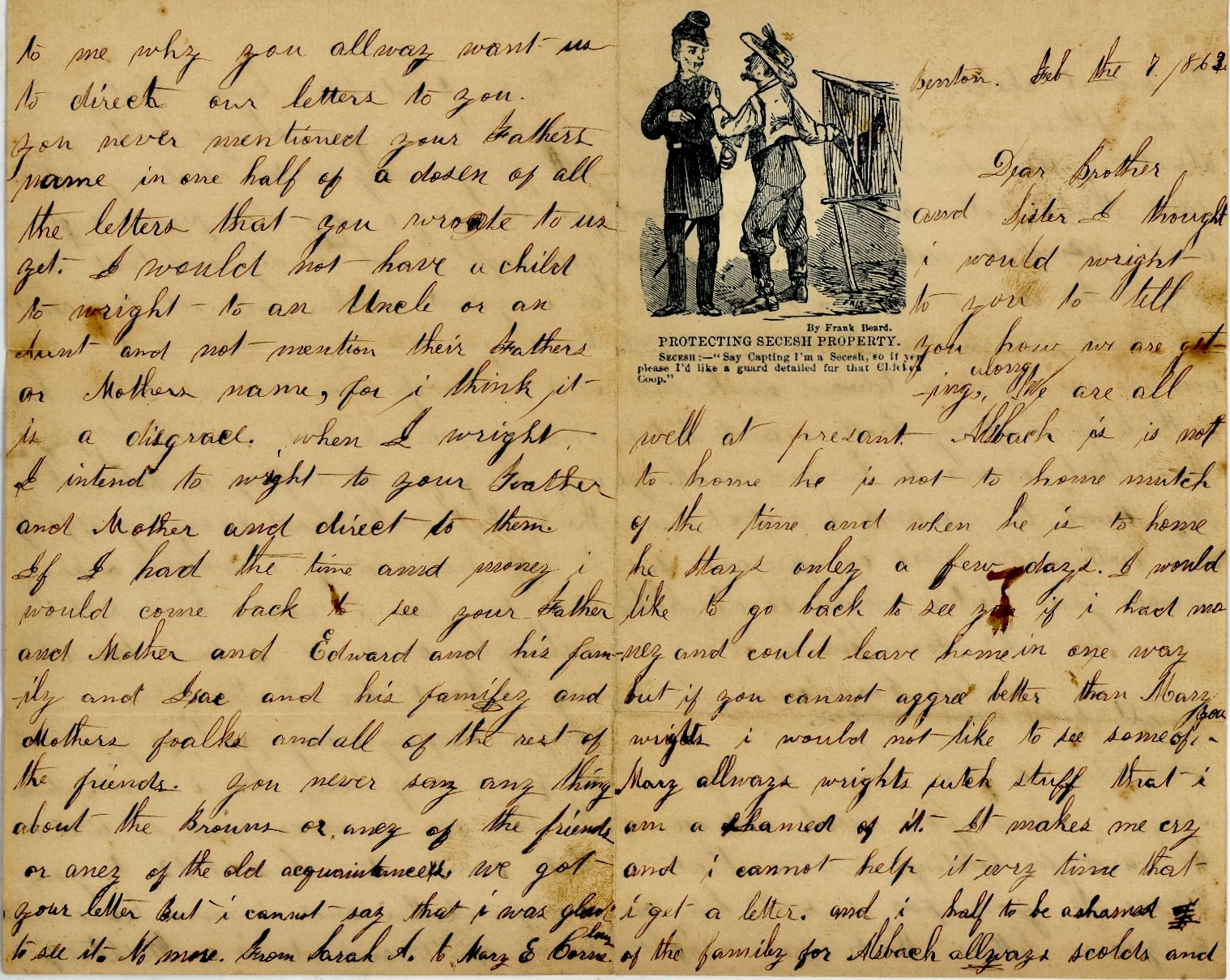
Benton [Indiana] February 7, 1863
Dear Brother and Sister,
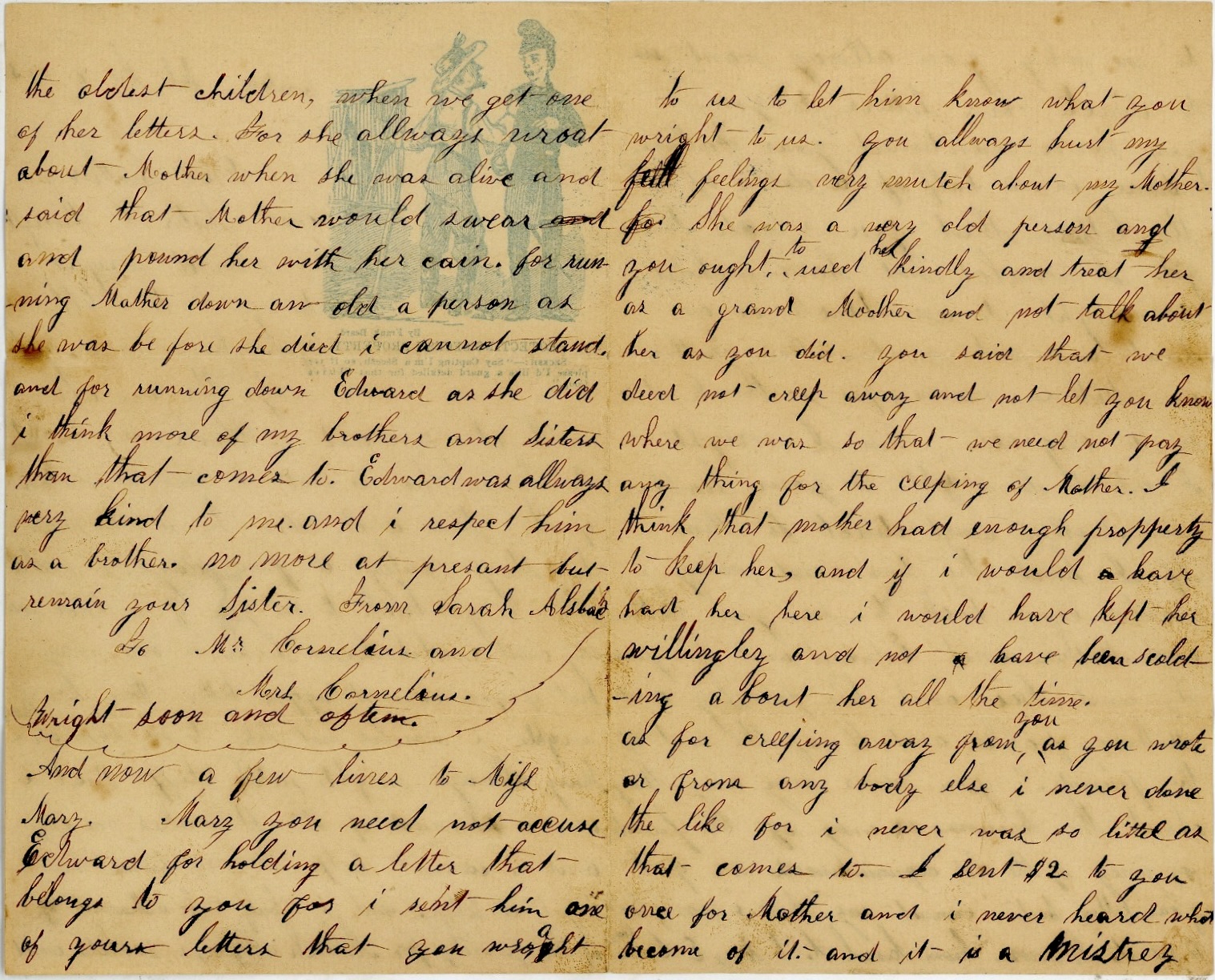
I thought I would write to you to tell you how we are getting along. We are all well at present. Alsbach is not to home. He is not to home much of the time and when he is to home, he stays only a few days. I would like to go back to see you if I had money and could leave home in one way, but if you cannot agree better than Mary writes, I would not like to see some of you. Mary always writes such stuff that I am ashamed of it. It makes me cry and I cannot help it every time that I get a letter and I have to be ashamed of the family for Alsbach always scolds and the oldest children when we get one of her letters. For she always wrote about Mother when she was alive and said that Mother would swear and pound her with her cane for running Mother down, an old person as she was before she died. I cannot stand [it]. And [also] for running down Edward as she did. I think more of my brothers and sisters than that comes to. Edward was always very kind to me and I respect him as a brother. No more at present but remain your sister. From Sarah Alsbach
To Mr. Cornelius and Mrs. Cornelius
Write soon and often.
And now a few lines to Miss Mary,
Mary you need not accuse Edward for holding a letter that belongs to you for I sent him one of your letters that you wrote to us to let him know what you write to us. You always hurt my feelings very much about my Mother. She was a very old person and you ought to used her kindly and treated her as a grandmother and not talk about her as you did. You said that we did not creep away and not let you know where we was so that you need not pay anything for the keeping of Mother. I think that Mother had enough property to keep her and if I would have had her here, I would have kept her willingly and not have been scolding about her all the time.
As for creeping away from you as you write, or from anybody else, I never done the like for I never was so little as that comes to. I sent $2 to you once for Mother and I never heard what become of it and it is a mystery to me why you always want us to direct our letters to you. You never mentioned your Father’s name in one half of a dozen of all the letters that you wrote to us yet. I would not have a child to write to an Uncle or an Aunt and not mention their Father’s or Mother’s name for I think it is disgrace. When I write, I intend to write to your Father and Mother and direct to them.
If I had the time and money, I would come back and see your Father and Mother and Edward and his family and Isaac and his family, and Mother’s folks and all of the rest of the friends. You never say anything about the Browns or any of the friends or any of the old acquaintances. We got your letter but I cannot say that I was glad to see it. No more.
The following letter was written by Uriah “Jasper” VanPelt (1846-1864), the son of Uriah VanPelt (1802-1846) and Elmira Daugherty (1809-1899) of Anderson, Madison county, Indiana. Jasper wrote the letter to his older brother, Francis (“Frank”) Marion VanPelt (1838-1930) who served as a sergeant, later a 2nd Lieutenant, in Co. G, 17th Indiana Infantry. In his letter, Jasper mentions two siblings, Mathilda (“Tillie”) VanPelt (b. 1842), and William (“Bill”) Parker VanPelt (1844-1931) who joined Co. H of the 142nd Indiana Infantry in October 1864 as a fife and drum musician.
Jasper later enlisted in the Co. F, 137th Indiana Infantry—a unit organized in May 1864 to serve 100 days guarding Sherman’s supply line through Tennessee & Alabama during his Atlanta Campaign. Jasper died of disease at Tullahoma, Tennessee, on 24 August 1864 and his body was taken home by his brother Frank to be buried in the family plot in Maplewood Cemetery.
Lt. Frank VanPelt, Co. G, 17th Indiana Infantry
I was requested to transcribe this letter by Bradford Douglas, a descendant of the VanPelt family, who wrote me the following: “I have a letter not year dated from my 2nd great grandfather’s brother [Jasper]. He would die from disease in Tullahoma, TN on Aug. 24, 1864. My 2nd great grandfather [Frank] was with Wilders Brigade 17th Ind Co. G as a 1st Lieutenant and had received leave to see his dying brother. He was with him when he died and was granted leave to take him back to Anderson, Indiana, where he is buried in the family plot. This letter was written to my great grandfather while he was in service during the civil war. Some I can read but in full is really hard. He signs it Jasper as their father’s name was Uriah as well.” — Bradford Douglas
T R A N S C R I P T I O N
[Anderson, Indiana] August 18th [1863]
Dear Brother,
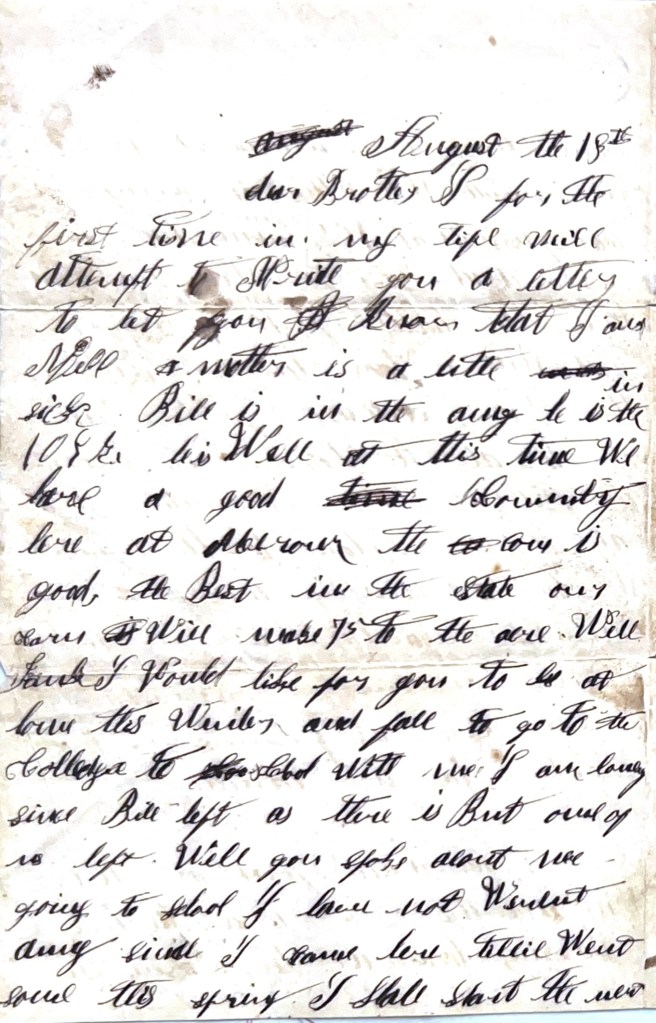
I for the first time in my life will attempt to write you a letter to let you know that I am well & Mother is a little sick. Bill is in the army. He is in the 109th. 1 He is well at this time. We have a good country [?] here at [ ]. The corn is good—the best in the State. Our corn will make 75 to the acre. Well, Frank, I would like for you to be at home this winter and fall to go to the College to school with me. I am lonely since Bill left.
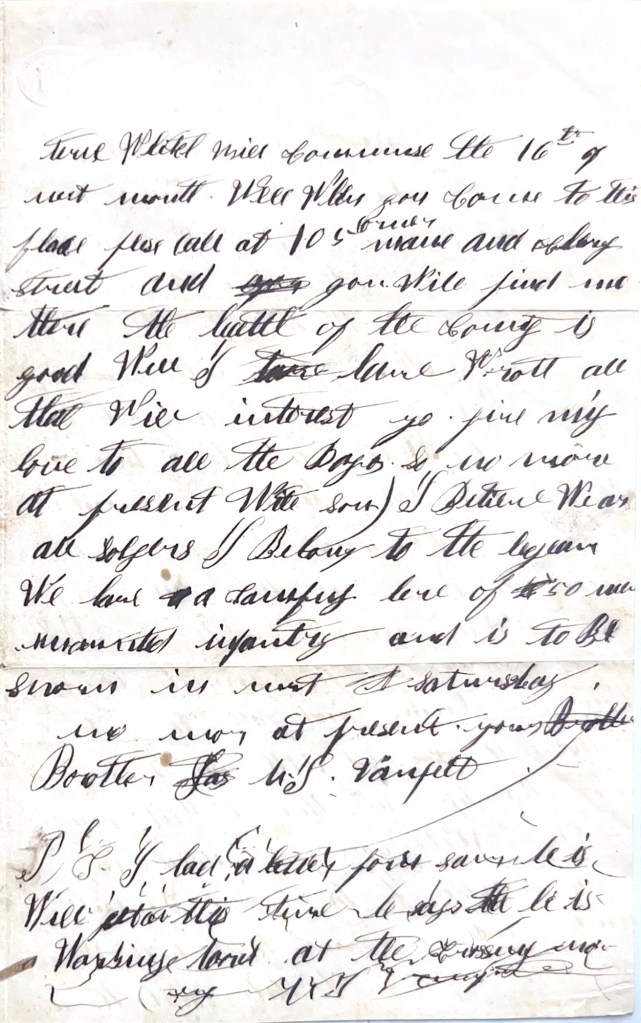
Well, you spoke about going to school. I have not went any since I came here. Tillie went some this spring. I shall start the next term. Winter [term] will commence the 16th of next month. Well, when you come to this place. please call at 105, corner of Main and College Street and you will find me there.
The cattle of the county is good. Well, I have wrote all that will interest you. Give my love to all the Boys. So no more at present. Write soon.
I believe we are all soldiers. I belong to the Legion. We have a company here of 50 men—mounted infantry—and is to be sworn in next Saturday. No more at present. Your brother, — Jas U. J. VanPelt
P. S. I had a letter from S___. He is well just at this time. He says he is W_____ at the [ ].
1 The only service record I can find for William P. VanPelt is the 142nd Indiana Infantry which he did not join until October 1864. His obituary claims that he served as a musician “throughout the war” as a member of the 115th Indiana Infantry. This regiment served for only 6 months beginning with the threat of Morgan’s Raiders, from August 1863 to February 1864. Though I don’t find him on the roster, my hunch is that he was with this regiment when the letter was written and that the letter was therefore written in August 1863 when Jasper was 17.
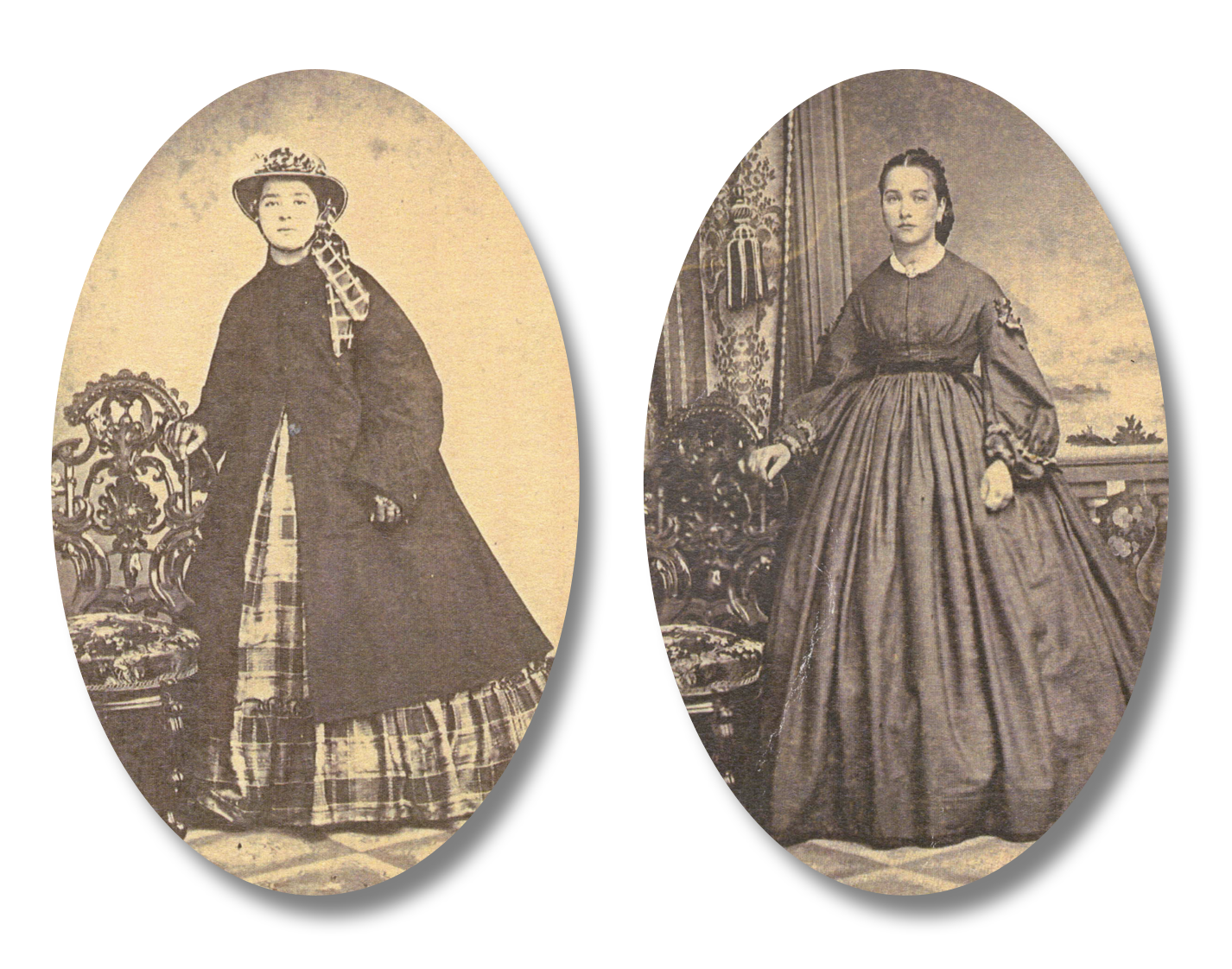
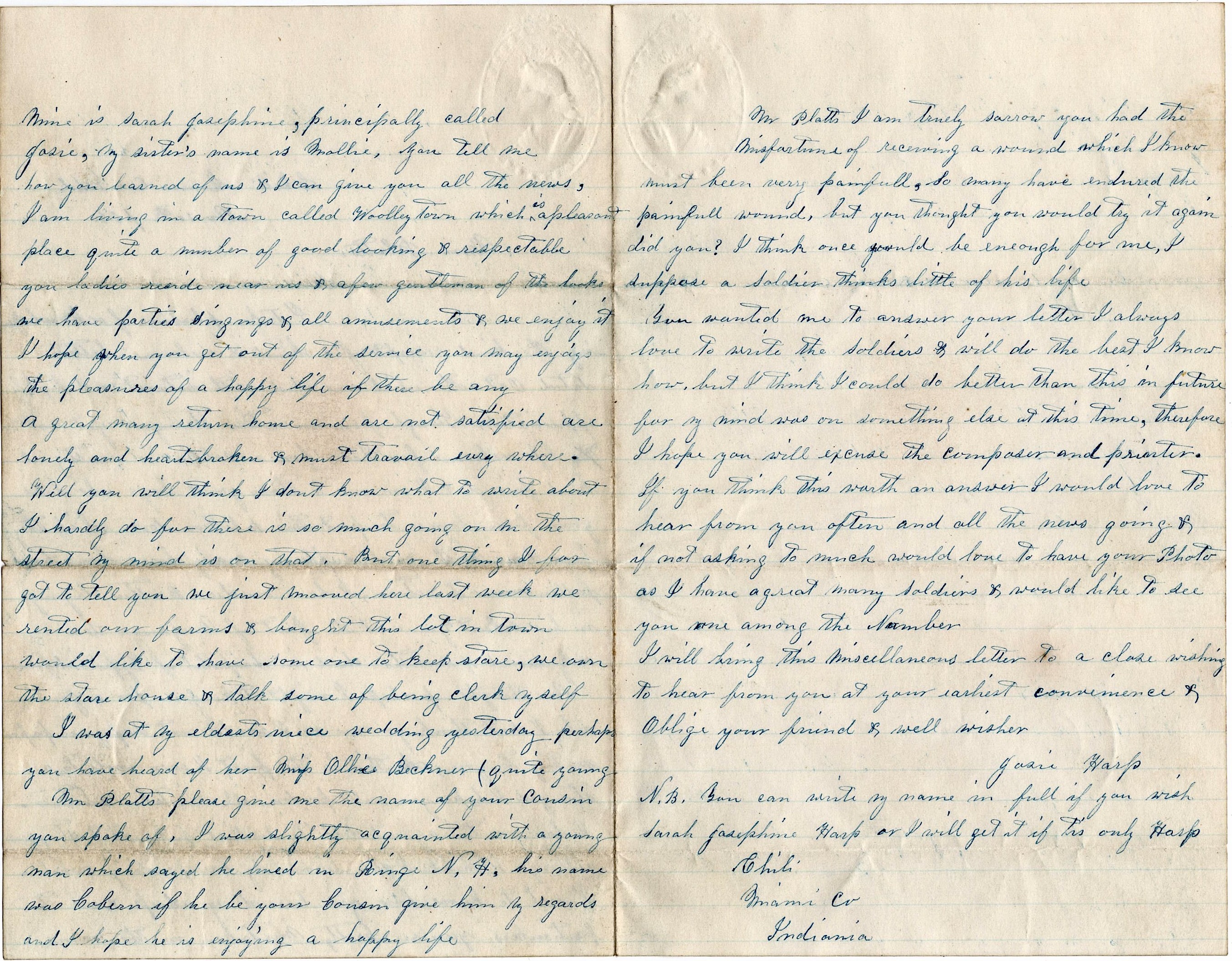
The following letter was written by Sarah Josephine (“Josie”) Harp (1845-1929), the daughter of Samuel Harvey Harp (1803-1890) and Jane P. Butler (1809-1881) of Chili, Miami county, Indiana. Though Sarah had several older siblings, the only other one mentioned in the letter was her younger sister Mary Jane (“Mollie”) Harp (1849-1893).
We learn from the letter that this was the first letter Josie ever wrote to Lt. George Platts of Co. H, 28th Michigan (1841-Aft1930) whom she referred to as “an entire stranger.” On-line family records inform us, however, that Josie and George ‘s awkward first exchange of letters blossomed into a relationship that resulted in their marriage on 5 November 1867. George was born and raised in New Hampshire but served in a Michigan regiment and after the couple were married, they eventually moved to Iowa where George became a general store keeper.
Josie Harp (left) and her younger sister Mollie. Both are cdv’s that date to about 1865.
T R A N S C R I P T I O N
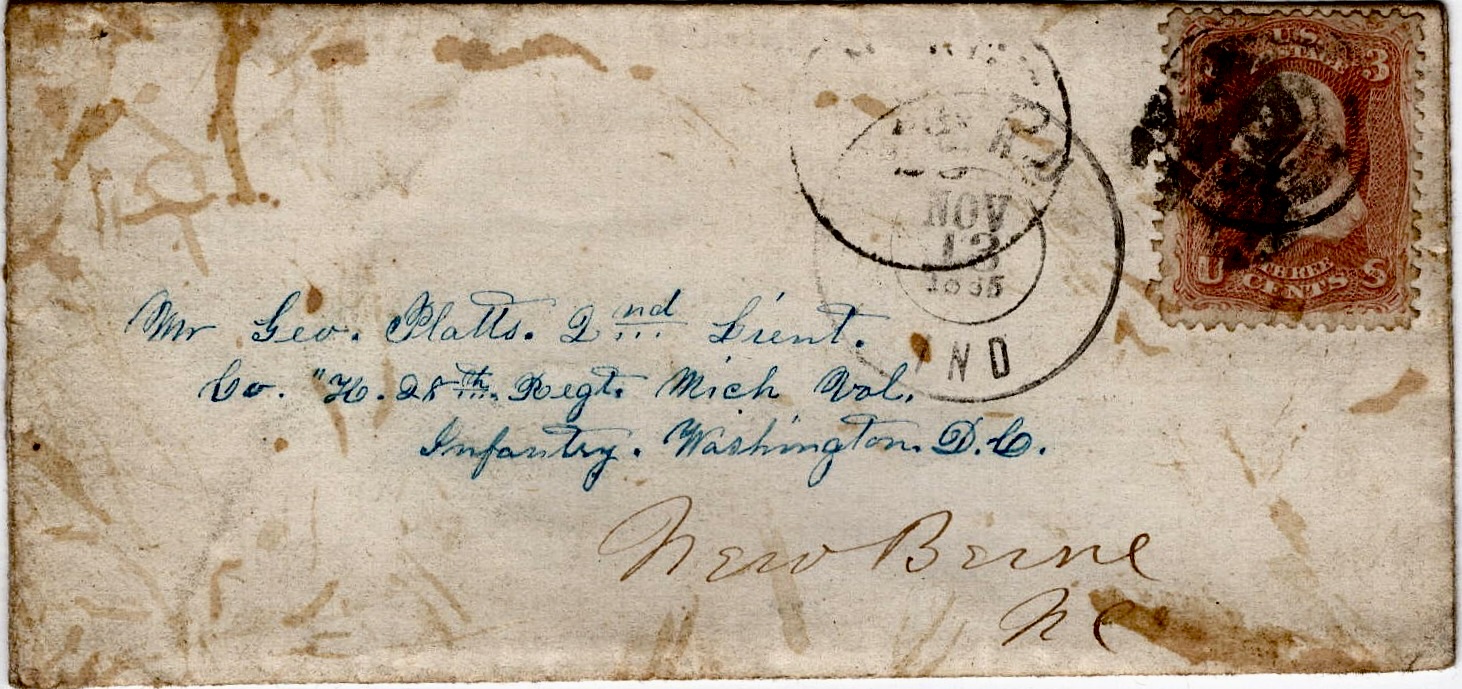
Addressed to Mr. George Platts, 2nd Lieutenant, Colonel. H, 28th Regt. Michigan Volunteer Infantry, Washington D. C.
Chili, Miami county, Indiana November 10th 1865
Mr. Platts,
Sir, I take pleasure of acknowledging the kind receipt of a kind & welcome letter dated October 20th which was read with interest and highly appreciated. Though from an entire stranger yet not less welcome for that, for a soldier is worthy a kind friend & I am one to those good boys who have gone from home to put this rebellion down which they have done with much suffering many brave boys have fallen never to return. I have one dear brother laying in his silent grave at the fort of Morganza, Louisiana. Only served 4 months. Died in hospital of typhoid fever.
You thought perhaps I might take you for a Johnny Reb. I don’t think you are or I would not disfigure paper writing to you. This is the first I ever wrote to a stranger. I hope you will pardon all mistakes whatever. I have written a great deal to soldiers but not to strangers although I think I can learn by corresponding awhile. I wish to know how you learned my address & all the particulars.
You are partly mistaken in the name. Mine is Sarah Josephine, principally called Josie. My sister’s name is Mollie. You tell me how you learned of us & I can give you all the news. I am living in a town called Wooleytown which is a pleasant place. Quite a number of good looking & respectable young ladies reside near & a few gentlemen of the books. We have parties, singings and amusements & we enjoy it. I hope when you get out of the service you may enjoy the pleasures of a happy life if there be any. A great many return home and are not satisfied, are lonely, and heart broken & must travail everywhere.
Well, you will think I don’t know what to write about. I hardly do for there is so much going on in the street, my mind is on that. But one thing I forgot to tell you, we just moved here last week. We rented our farm & bought this lot in town. Would like to have someone to keep store. We own the store house & talk some of being clerk myself.
I was at my eldest niece’s wedding yesterday. Perhaps you have heard of her—Miss Olivia Beckner (quite young). Mr. Platts, please give me the name of your cousin you spoke of. I was slightly acquainted with a young man which said he lived in Rindge, N. H. His name was Cobern. If he be your cousin, give him my regards and I hope he is enjoying a happy life.
Mr. Platts, I am truly sorry you had the misfortune of receiving a wound which I know must [have] been very painful. So many have endured the painful wound but you thought you would try it again, did you? I think once would be enough for me. I suppose a soldier thinks little of his life.
You wanted me to answer your letter. I always love to write the soldiers & will do the best I know how but I think I could do better that this in future for my mind was on something else at this time. Therefore, I hope you will excuse the composer and printer. If you think this worth an answer I would love to hear from you often and all the news going & if not asking too much, would love to have your photo as I have a great many soldiers & would like to see you one among the number.
I will bring this miscellaneous letter to a close wishing to hear from you at your earliest convenience & oblige your friend & well wisher. — Josie Harp
N. B. You can write my name in full if you wish—Sarah Josephine Harp, or I will get it if tis only Harp, Chili, Miami county, Indiana
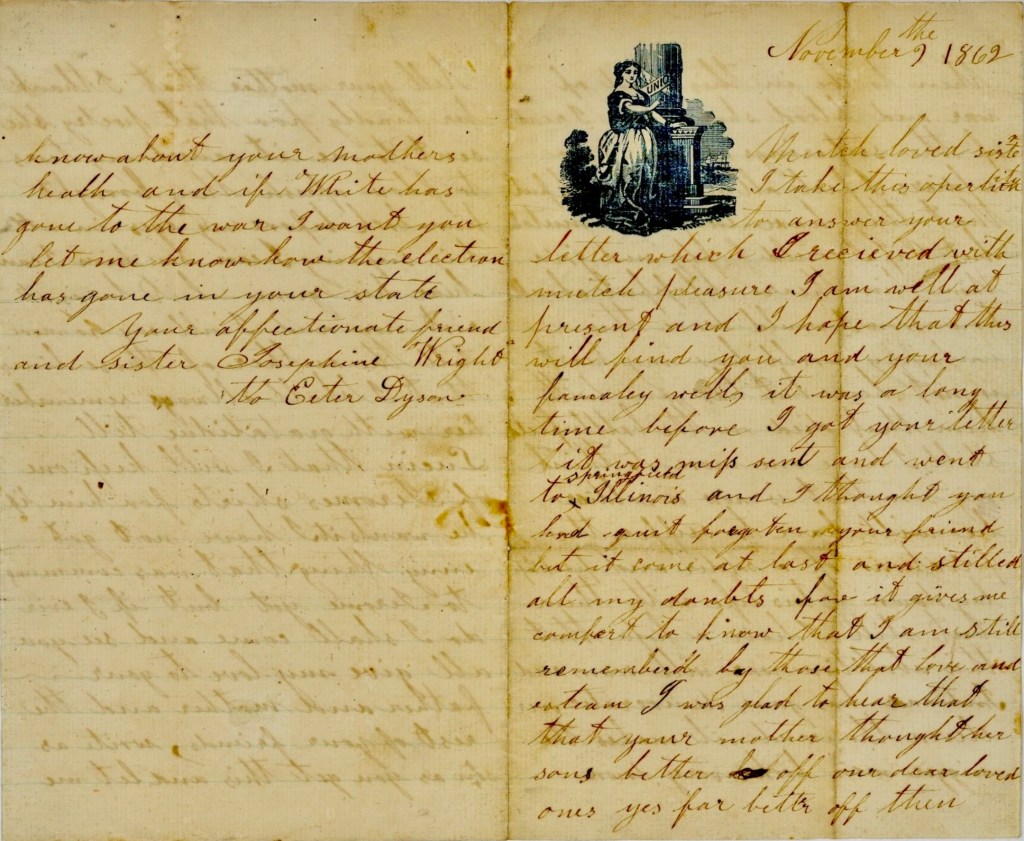
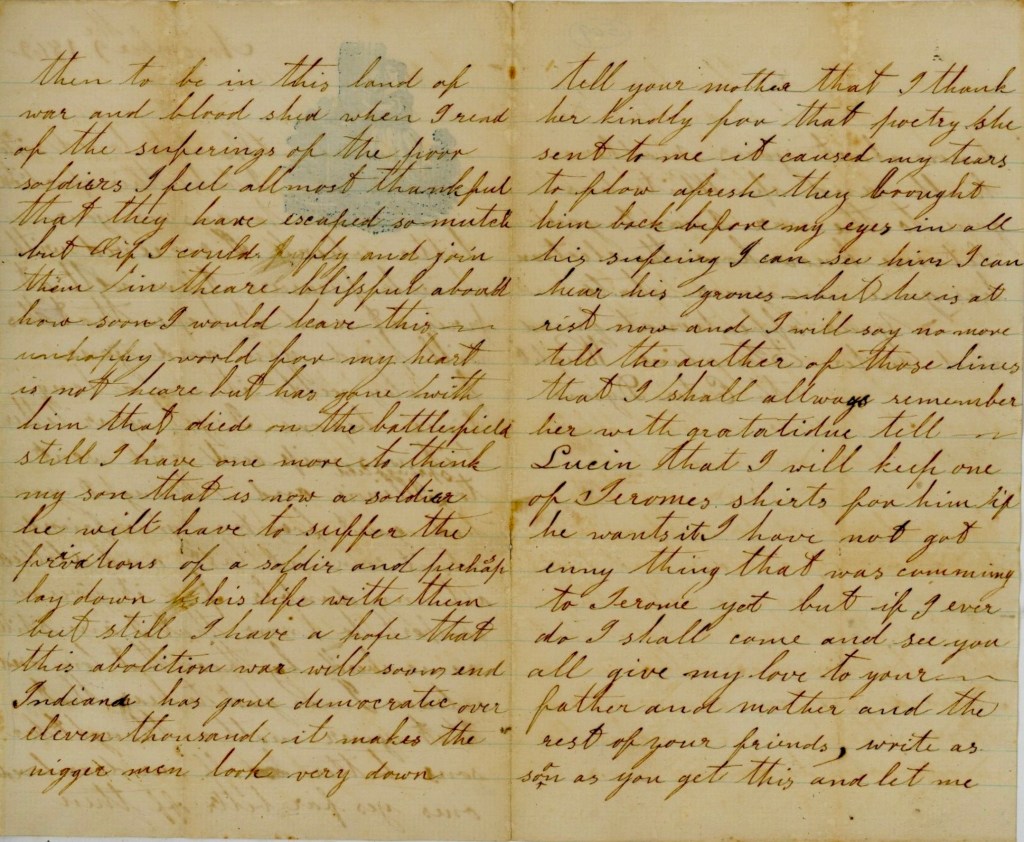
The following letter was written by Josephine (Green) Wright of Springfield Township, Lagrange county, Indiana, the widow of Pvt. Jerome [Gerome] Wright. Jerome was killed by a gunshot wound in the Battle of Shiloh on 6 April 1862 while serving in Co. H, 44th Indiana Infantry. Jerome was mustered into the regiment on 22 November 1861.
Josephine and Jerome were married at Eton Rapids, Michigan. At the time of their marriage in 1854, Jerome was 23 years old, and Josephine Green was 42 years old—almost twice his age. She had a son that she brought with her from her first marriage.
Transcription
[Lagrange county, Indiana] November 9, 1862
Much loved sister,
I take this opportunity to answer your letter which I received with much pleasure. I am well at present and I hope that this will find you and your family well. It was a long time before I got your letter. It was miss-sent and went to Springfield, Illinois, and I thought you had quit forgotten your friend. But it come at last and stilled all my doubts for it gives me comfort to know that I am still remembered by those that [I] love and esteem.
I was glad to hear that your mother thought her sons better off our dear loved ones. Yes, far better off than to be in this land of war and blood shed. When I read of the sufferings of the poor soldiers, I feel almost thankful that they have escaped so much. But O! if I could fly and join them in their blissful abode, how soon I would leave this unhappy world, for my heart is not here but has gone with him that died on the battlefield. Still I have one more to think [of]—my son that is now a soldier. He will have to suffer the privations of a soldier and perhaps lay down his life with them. But still I have a hope that this abolition war will soon end. Indiana has gone democratic over eleven thousand. It makes the nigger men look very down.
Tell your mother that I thank her kindly for that poetry she sent to me. It caused my tears to flow afresh. They brought him back before my eyes in all his suffering. I can see him. I can hear his groans. But he is at rest now and I will say no more. Tell the author of those lines that I shall always remember her with gratitude.
Tell Lucin that I will keep one of Jerome’s shirts for him if he wants it. I have not got anything that was coming to Jerome yet, but if I ever do, I shall come and see you all. Give my love to your father and mother and the rest of your friends. Write as soon as you get this and let me know about your mother’s heath and if White has gone to the war. I want you [to] let me know how the election has gone in your state.
Your affectionate friend and sister, Josephine Wright
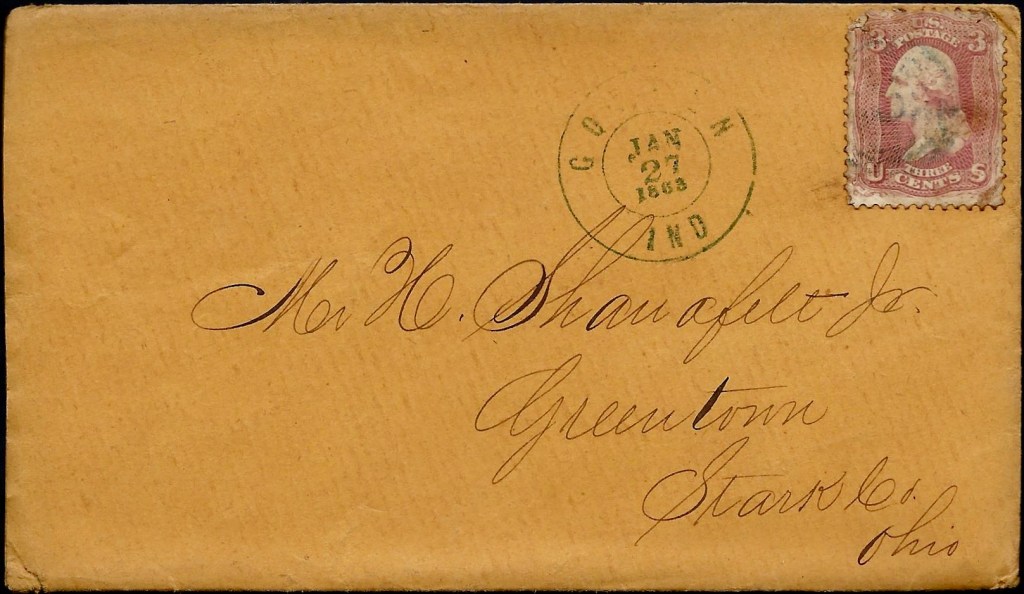
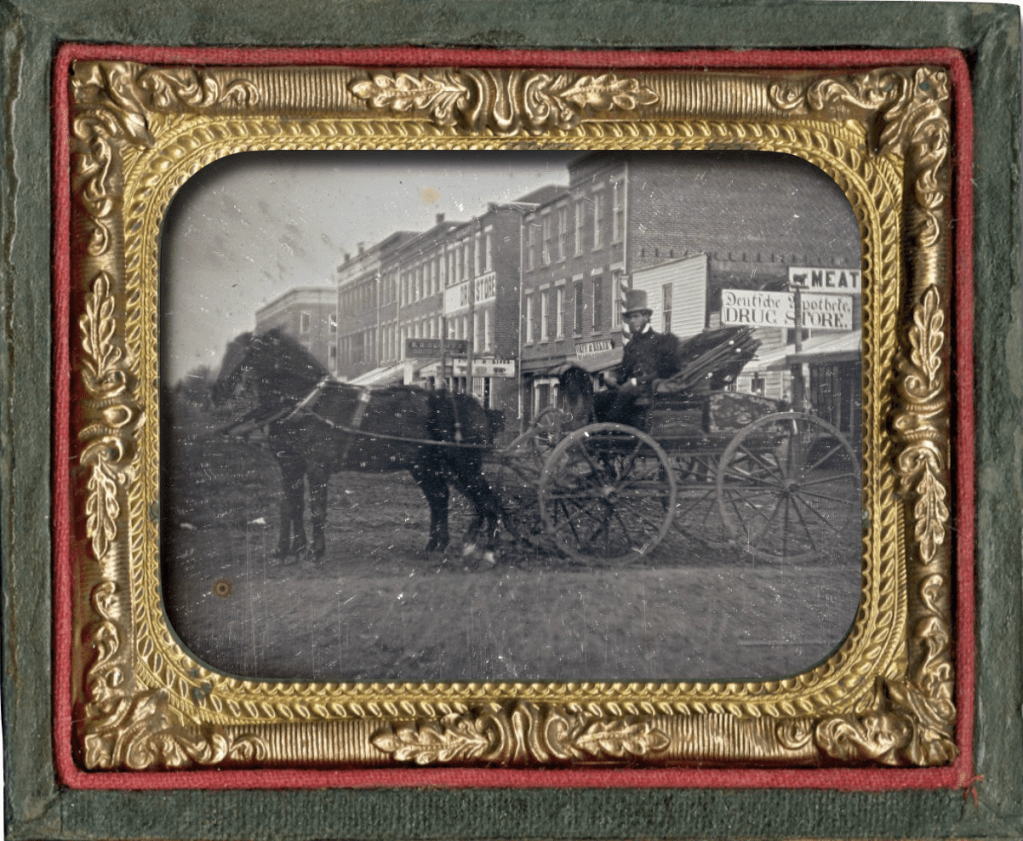
The following letter was written from Goshen, Elkhart county, Indiana by Joseph Murray Peters (1830-1917), a merchant druggist and the husband of Margaret Cunningham (1834-1893). Joseph was born in Lancaster, Pennsylvania, the son of John Peters (1792-1880) and Elizabeth Regina Murray (1794-1877).
Joseph wrote the letter to Henry Shanafelt, Jr. (1827-1893) of Greentown, Stark county, Ohio, who was the husband of Rosa F. Peters (1832-1917)—an older sister of Joseph’s.
The content of the letter is pretty much limited to weather and the economy so historians looking for war news will be disappointed in it but what is most surprising is the total absence of any war news—particularly as it affects the economy. One would not have a clue from this letter that the war had any impacts on this northern Indiana county and community.
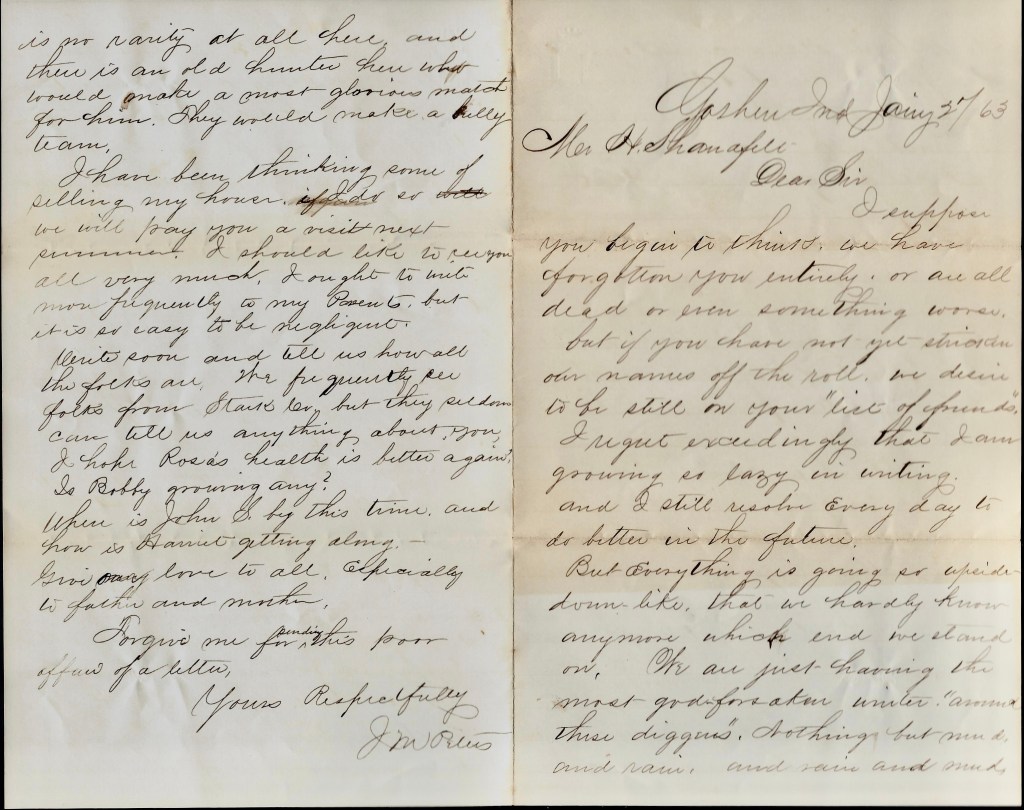
Transcription
Addressed to Mr. H. Shanafelt, Jr., Greentown, Stark county, Ohio
Goshen, Indiana January 27, 1863
Mr. H[enry] Shanafelt Dear Sir,
I suppose you begin to think we have forgotten you entirely or are all dead or even something worse, but if you have not yet stricken our names off the roll. We desire to be still on your “list of friends.” I regret exceedingly that I am growing so lazy in writing and I still resolve every day to do better in the future.
But everything is going so upside down like that we hardly know anymore which end we stand on. We are just having the most God-forsaken winter “around these diggens.” Nothing but mud and rain, and rain and mud. And from all accounts you are not faring much better in regard to the weather. We have not had a monthful of sleighing yet.
Times are getting somewhat dull perhaps in consequence of miserable roads, but trade has been very good all fall and winter. Merchants have been having a genuine old harvest. All kinds of produce has been bringing better prices than last winter and farmers have been more liberal in consequence. Wheat is selling now at $1.12 per bushel, corn 45, oats, 40, potatoes 50, pork 3.75 to 4.50, butter 14, eggs $1/dozen, lard 6, tallows 8, wood per cord 1.75 (best kind).
Our folks are only in tolerable health. Margaret had a spell of ague last week and Frank—by the way permit me to introduce you to Mr. Frank Harvey Peters who was five months old the 20th instant and usually one of the finest, fattest and happiest folks that ever blessed a home—but he too has been unwell for several days now. [ ] is probably teaching. Carrie is doing well, appearing quite healthy.
Maybe you are not aware that Grandmamma Cunningham is with us, She has been with us just two weeks tonight. She tok us entirely by surprise. Why can not some of my relatives come and see us. I think any of you would feel well paid after seeing the country and things in general. I think it would be just the place for you to sell goods and for George Guily to follow either coopering or farming. And last but not least, for old Pete to follow hunting. There’s plenty of game yet within a few miles of town—venison is no rarity at all here, and there is an old hunter here who would make a most glorious match for him. They would make a bully team.
I have been thinking some of selling my house. If I do so, we will pay you a visit next summer. I should like to see you all very much. I ought to write more frequently to my parents but it is so easy to be negligent. Write soon and tell us how all the folks are. We frequently see folks from Stark county but they seldom can tell us anything about you. I hope Rosa’s health is better again? Is Bobby growing any?
Where is John S. by this time, and how is Harriet getting along? Give love to all—especially father and mother. Forgive me for sending this poor affair of a letter. Yours respectfully, — J. M. Peters
The following are from a collection of letters found in an antique store by Cianna Lee who made them available for transcription and publication on Spared & Shared by express consent. They were written by Will Johnston, Jr. of Fort Wayne, Indiana to his friend Burritt K. Lawlin of New York City, both written during the American Civil War. The main topics pertain to recruiting and the drafts—a frequent topic among civilian males of military age. The content suggests that Will and Burritt were warm friends and grew up together in New York City.
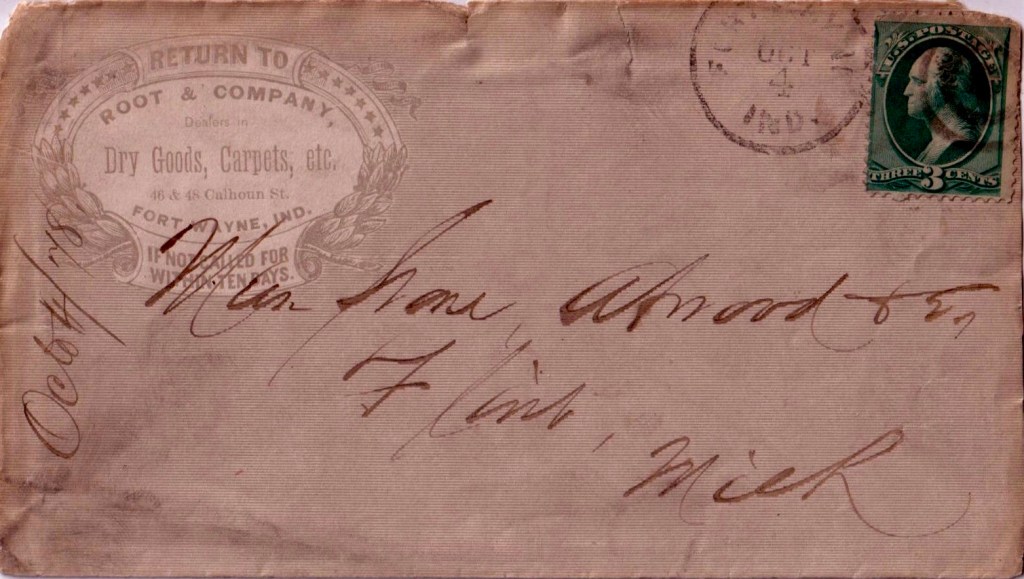
Root & Co. in Fort Wayne, Indiana
I could not confirm Will’s parentage but I did find evidence of him in Fort Wayne, Indiana, where he appears to have remained for some time. It appears that he was a junior partner in Root & Company—a wholesale and Retail Dealer in Dry Goods, Notions &c. located at 90 Columbia Street. In 1864, he was boarding at the Hamilton House. In 1866, he was boarding at the Aveline House. I also found a 28 year-old William Johnston, a native of New York, working as a clerk and insurance agent in Fort Wayne in the 1870 US Census.
Will wrote the letters to his friend, Burritt Keeler Lawlin (1843-1916), the son of sea captain Richard Edmonston Lawlin (1808-1861) and Maria Keeler (1816-1896) of New York City. He graduated in 1858 from the New York City Free Academy. It appears that Burritt lived with his widowed mother at their home at 180 W. 21st Street in New York City at the time these letters were addressed to him. Burritt was married in January 1864 to Louise Johnson Orrell (1843-1931). In the 1880 US Census, Burritt was enumerated in Brooklyn where he superintended a chemical works.
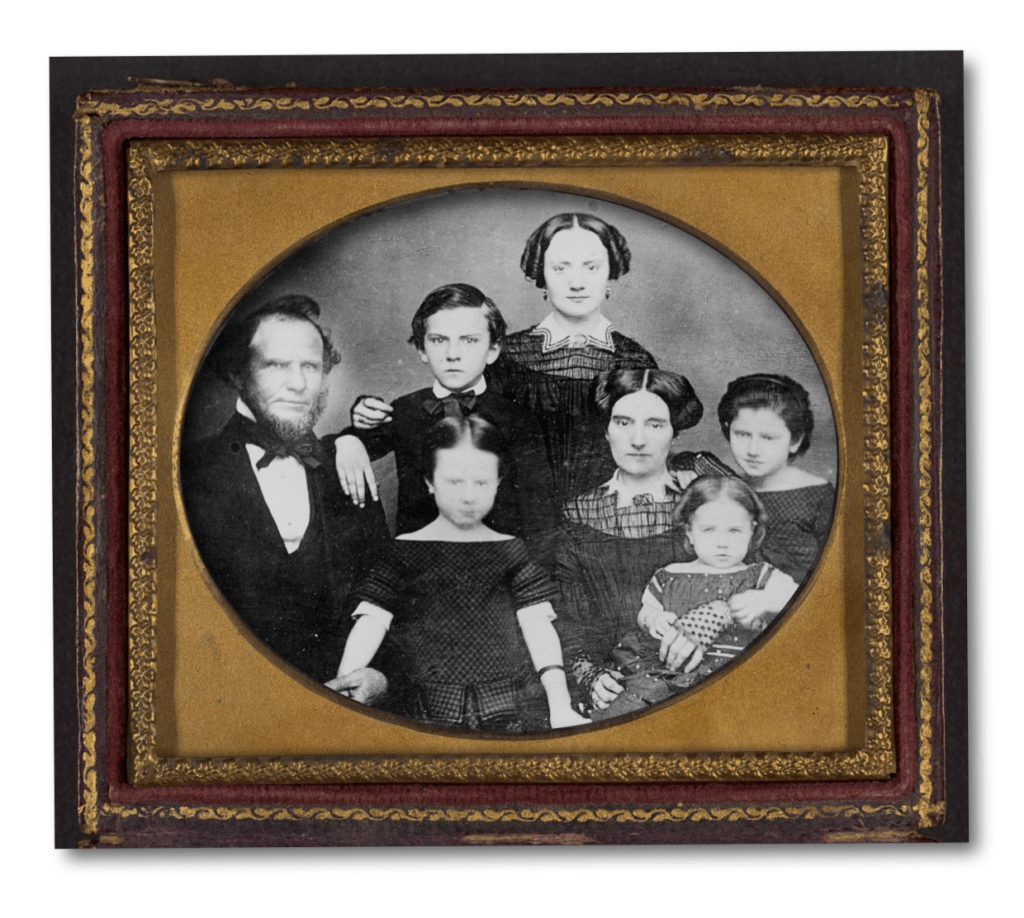
A stern-faced Burritt Keeler Lawlin stands between his sitting father and mother surrounded by his younger and old sisters. Circa 1850.
Letter 1
Fort Wayne, Indiana July 25, 1862
Old friend Burritt,
Your very interesting & lengthy letter of the 19th inst. came to hand on the 23rd and although considerable time has elapsed since I wrote you (May 7) and as I had commenced to entertain the opinion pretty freely that you were a bad egg in the way of corresponding, yet your reasons for the delay are quite acceptable & I excuse you freely, and exonerate you entirely for I know that you must have suffered considerably by the accident that occurred to you in the way of smashing your finger & I can assure you that I sympathize with you deeply in the loss of part of your hand, but at the same time I congratulate you that the same thing did not happen to your right hand, which would have been considerably worse, for then I would not have received a letter, for an awful long time. I would have had to wait until you had become proficient in left hand writing which I think would have been quite some time. But I am very, very happy to receive one from you at this late hour and hope that by the time you write again your left hand will be entirely healed.
Your description of the dissolution of the partnership heretofore existing between Coutant & Lawlin is very graphic as is also the selling out of your remaining interest in the concern. But I suppose you made it pay or else you would not have sold out. But Burritt, I think the smoking arrangement was a pretty good joke on the person that was so generous as to buy you out. I suppose you told him all about the smoking arrangements & the defect in the flue previous to the purchase—ahem. Yes, I guess so. But Burritt, you done well I think by selling out if that was your fix. So both you and John T had withdrawn from business & returned to your Country seats? John T did sent me a paper & there was an article in it that stated the object of his withdrawal from the firm was in consequence of business in Europe that required his services but that while gone and on the other side of the water, he would bear in mind the happy hours he had spent in the business and would work while there in whatever way he could for the interest of the paper—ahem—when decidedly good. So he has retired. He has gone to Europe to engross his mind in business & lo and behold, he is rusticating in a sweet little town in the centre of the state—Tuthill, Ulster Co. by name. Why Europe must have been condensed to a considerable extent since I last heard it spoken of. But so the world goes & my best wishes for John T wherever he is or wherever he goes—Europe or Tuthill.
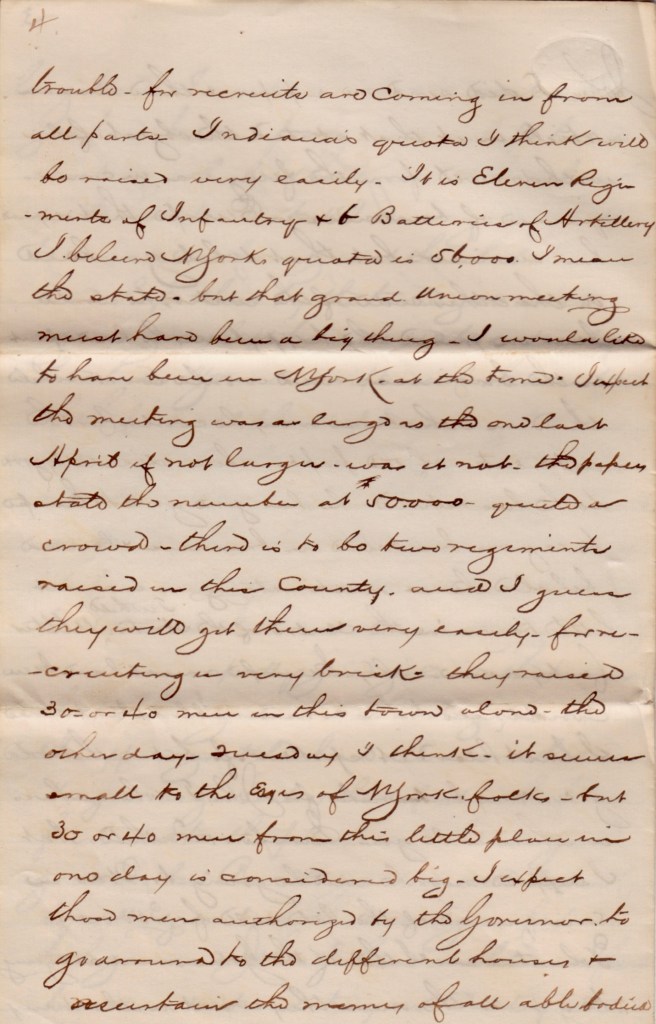
But I suppose now he will be going to war in consequence of the late call for 300,000 volunteers. I think the Government are going to get all the men they want without any trouble for recruits are coming in from all parts. Indiana’s quota I think will be raised very easily. It is eleven regiments of Infantry and 6 batteries of artillery. I believe the New York quota is 56,000—I mean the state. But that grand Union Meeting must have been a big thing. I would like to have been in New York at the time. I expect the meeting was as large as the one last April—if not larger, was it not? The papers state the number at 50,000. Quite a crowd.
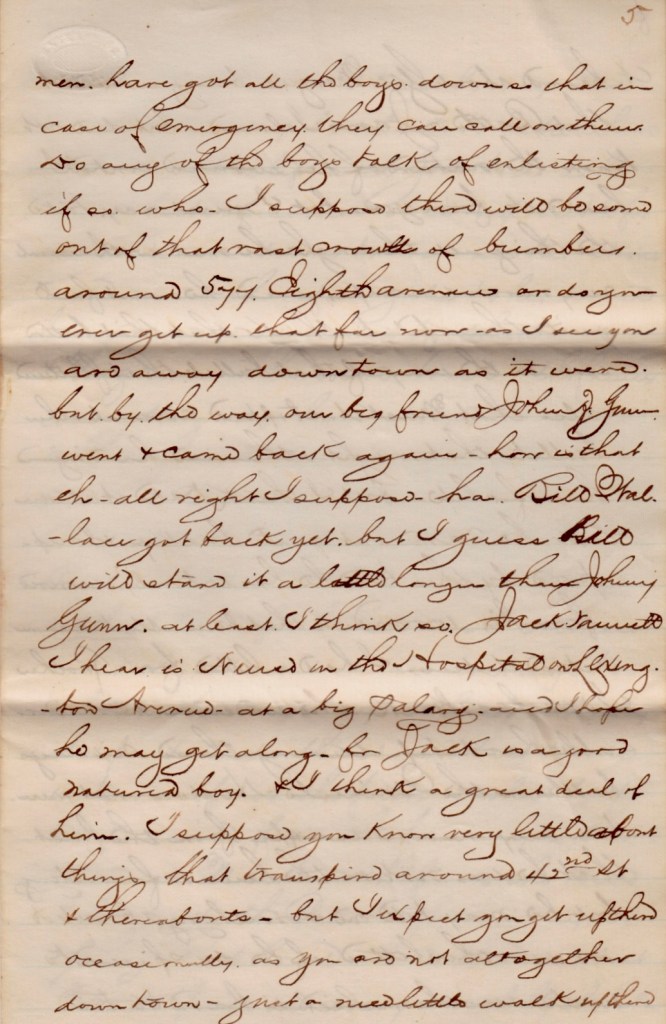
There is to be two regiments raised in the county and I guess they will get them very easily for recruiting is very brisk. They raised 30 or 40 men in this town alone the other day—Tuesday I think. It seems small to the eyes of New York folks but 30 or 40 men from this little place in one day is considered big. I expect those men authorized by the Governor to go around to the different houses and ascertain the names of all able bodied men have got all the boys down so that in case of emergency they can call on them.
Do any of the boys talk of enlisting? If so, who? I suppose there will be some out of that vast crowd of bummers around 577 Eighth Avenue or do you ever get up that far now as I see you are away downtown as it were. But by the way, our big friend John P. Gunn went and came back again. How is that, eh? All right I suppose. Has Bill Wallace got back yet? But I guess Bill will stand it a little longer than Johnny Gunn—at least I think so. Jack Yannett I hear is nurse in the hospital on Lexington Avenue at a big salary and I hope he may get along for Jack is a good-natured boy and I think a great deal of him. I suppose you know very little about things that transpired around 42nd Street and thereabouts, but I expect you get up there occasionally as you are not altogether down town. Just a nice little walk up there
I heard about Geo. Menzies being wounded at that Battle on James Island but did not know the nature of his wound until I heard it from you. But I must say, take the thing all through, he met with several very narrow escapes and he must feel quite thankful to think that that button was in the way of that bullet that flattened and also that musket stopped several other bullets that might otherwise have injured him for life. But I think, take it all in all, he came out quite lucky and I suppose by this time he has entirely recovered from his wound so that he is able to resume active duties.
I had a letter from brother Tom last week and he underwent considerable hardship during those six days battles on the Peninsula. He does not mention any narrow escapes from the fact that he was not in the humor for writing but he may tell me something about it in another letter—if he is spared to write another, which is hard to tell but I sincerely hope and trust he may and also that he may be spared to return home again. But it is left with God to do as He thinks best of course. It is impossible for us weak creatures to overrule His actions and must therefore yield to His kind Providence and abide by them.
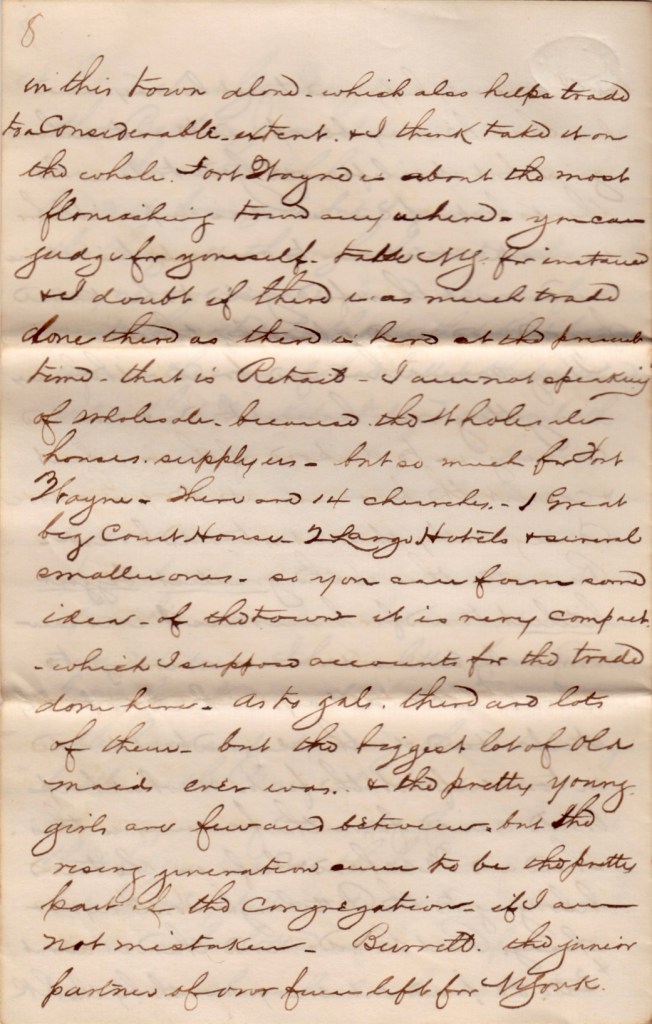
Things around here are brisk. The farms are getting over harvest time and now are coming in to dispose of their wheat and convert the proceeds into Dry Goods &c. Consequently it makes trade brisk. Burrett, this is the greatest, biggest, littlest town for business I ever saw. Our sales amount on an average to about $400 a day which is pretty steep and we do the second best trade in town—if not the first. And what helps trade, aside from the farmers, is this. There are machine shops in the town belonging to the Pittsburgh, Fort Wayne and Chicago Railroad and there is about $30,000 paid out every month by the R.R. in this town alone which also helps trade to a considerable extent. And I think, take it on the whole, Fort Wayne is about the most flourishing town anywhere. You can judge for yourself. Take New York for instance & I doubt if there was much trade done there as there is here at the present time—that is retail. I am not speaking of wholesale because the wholesale houses supply us.
But so much for Fort Wayne. There are 14 church, 1 great big court house, two large hotels, and several smaller ones. So you can form some idea of the town. It is very compact which I suppose accounts for the trade done here. As to gals, there are lots of them but the biggest lot of old maids ever was & the pretty young girls are few and between. But the rising generation seem to be the pretty part of the congregations, if I am not mistaken.
Burrett, the junior partner of our firm left for New York one week ago today to see the place & also his brother whom he has not seen since he left Germany eight years ago. He has become quite civilized since being out west and can talk very good English & puts on a good many airs for a German. But he left for New York & I gave him a letter of introduction to Alec. He said he would go there. Also one to Sam Houghton. But I suppose he has seen them both ‘ere this & made their acquaintance.
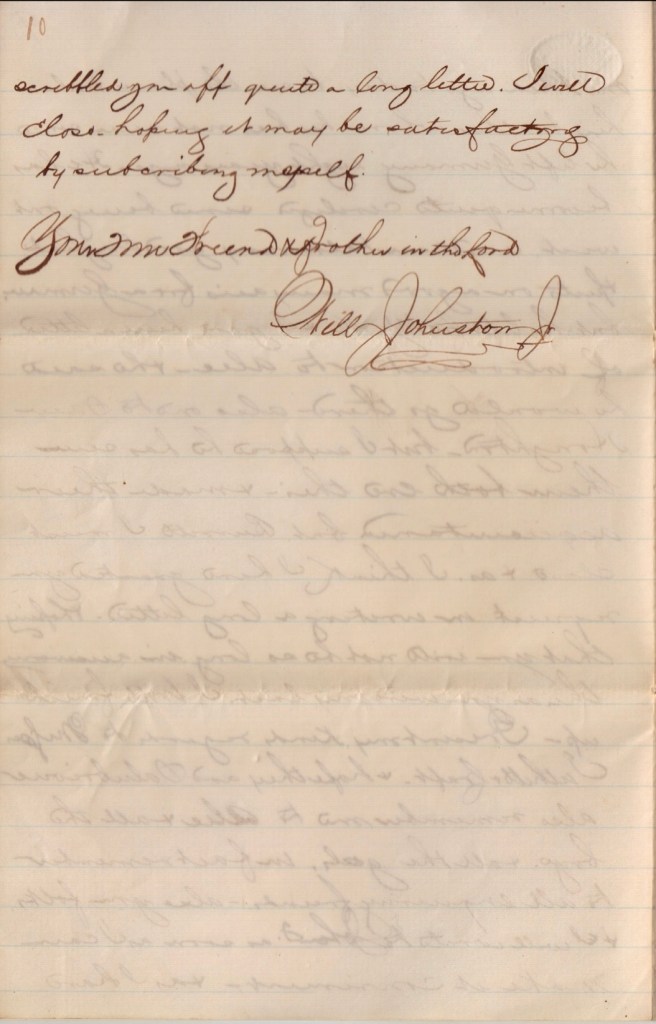
But Burritt, I must close & as I think I have granted your request in writing a long letter & hoping that you will not be so long in answering this as you were my last, II will finish up. Present my kind regards to Misses Tuthill & Craft & hope they are salubrious. Also remember me to Alec & all the boys & all the gals. In fact, remember [me] to all enquiring friends—also your folks, & I will write to John T as soon as I can make it convenient & as I have scribbled you off quite a long letter, I will close, hoping it may be satisfactory by subscribing myself your true friend & brother in the Lord, — Will Johnston Jr.
Letter 2
Fort Wayne, Indiana September 5, 1862
Friend Burritt,
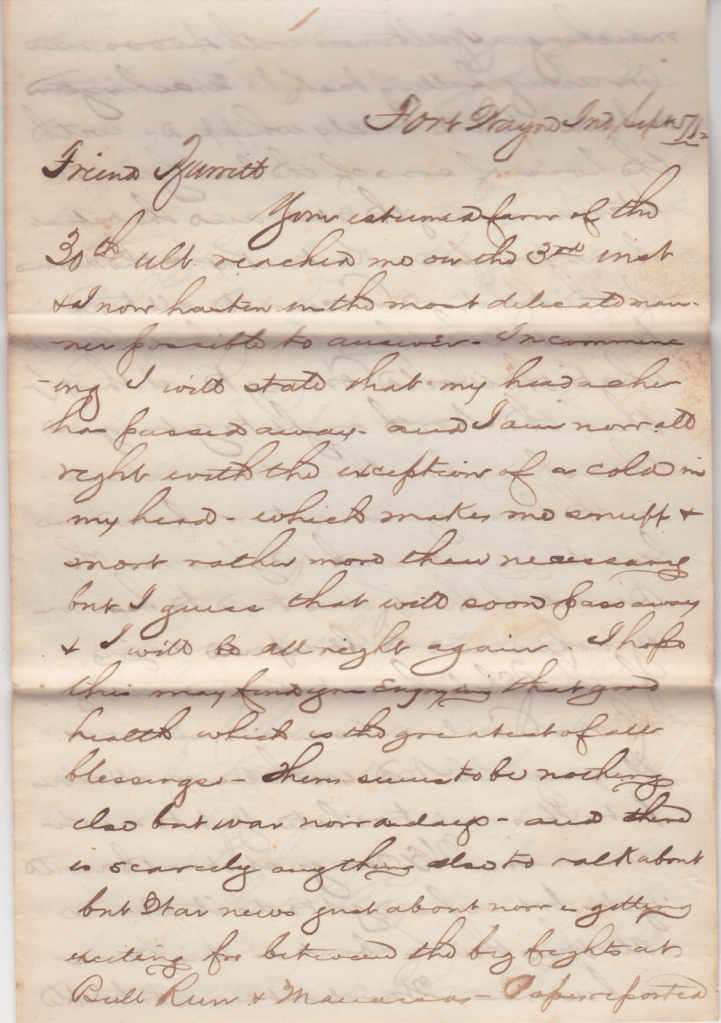
Your esteemed favor of the 30th ult. reached me on the 3rd inst. & I now hasten in the most delicate manner possible to answer. In commencing, I will state that my headache has passed away and I am now all right with the exception of a cold in my head which makes me snuff and snort rather more than necessary but I guess that will soon pass away & I will be all right again. I hope this may find you enjoying that good health which is the greatest of all blessings.
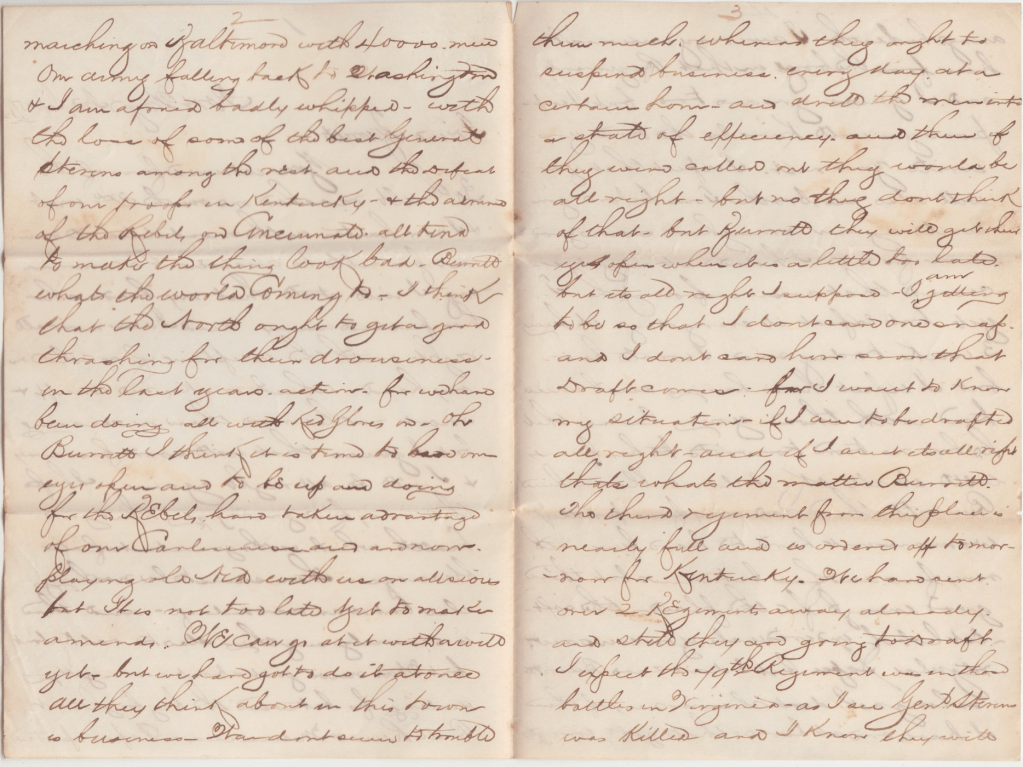
There seems to be nothing else but war now-a-days and there is scarcely anything else to talk about. But war news just about now is getting exciting for between the big fight at Bull Run & Manassas, papers reported marching on Baltimore with 40,000 men. Our army falling back to Washington and I am afraid badly whipped, with the loss of some of the best generals—Stevens among the rest—and the defeat of our troops in Kentucky & the arrival of the rebels on Cincinnati all tend to make the thing look bad. Burritt, what’s the world coming to? I think that the North ought to get a good thrashing for their drowsiness in the last year’s action for we have been doing all with gloves on. Oh Burritt, I think it is time to have our eyes open and to be up and doing for the Rebels have taken advantage of our carelessness and now playing Old Ned with us on all sides. But it is not too late yet to make amends. We can go at it with a will yet. But we have got to do it at once. All they think about in this town is business. War don’t seem to trouble them much whereas they ought to suspend business every day at a certain hour and drill the men into a state of efficiency and then if they were called out, the would be all right. But no, they don’t think of that. But Burritt, they will get their eyes opened when it’s a little too late. But it’s all right, I suppose. I am getting to be so that I don’t care one snap and I don’t care how soon that draft comes for I want to know my situation. If I am to be drafted, all right; and if I ain’t, it’s all right. That’s whats the matter.
Burritt, the third regiment from this place is nearly full and is ordered off tomorrow for Kentucky. We have sent over two regiments away already and still they are going to draft. I expect the 79th [New York] Regiment was in the battles in Virginia as I see Gen. Stevens was killed and I know they will avenge his death. I am very anxious to hear from the boys in that regiment and I guess you are too. But I suppose you will know by the time you write your next. I expect that you will also see brother Tom before you write again & may have some good news for me.
I have not as yet received that answer from John T. yet but I expect it every day—it being three weeks today since I wrote him. But I expect he is having suc a nice time with those young ladies that he has no time to write to his friends. Well, it’s all ok. I don’t blame him. Burritt, there are very few pretty women here to have fun with—very few and far between. But they’re good enough for the place. The softest lot of individuals you ever saw and regular saps. But I don’t care, Burritt, as long as I don’t claim any of them. I have one at home—that’s good enough.
Letter 3
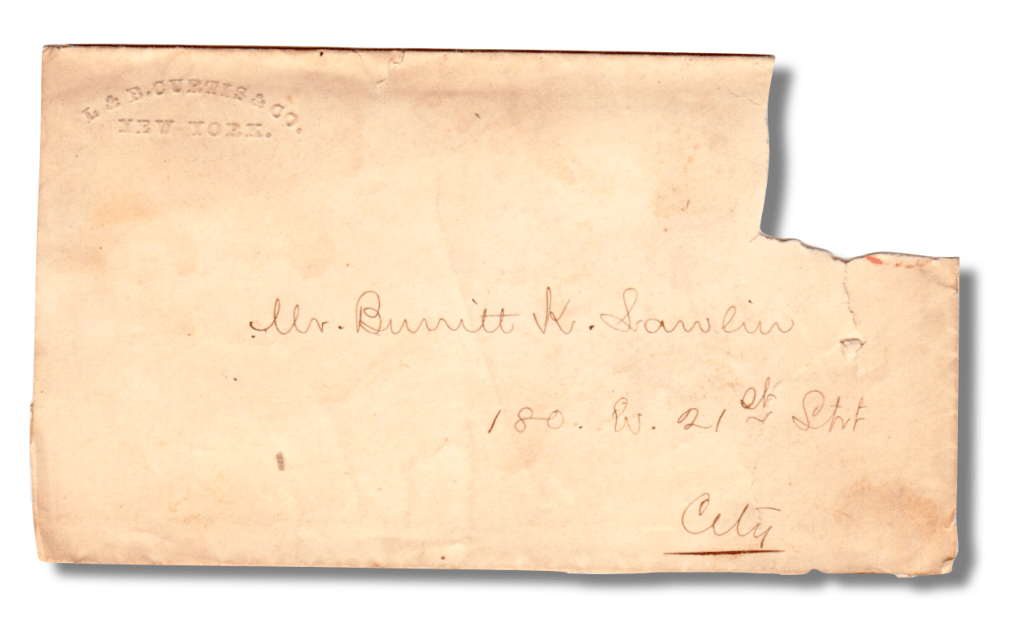
Addressed to Mr. Burritt K. Lawlin, 180 W. 21st Street, New York City
New York Store Fort Wayne, Indiana July 29, 1863
Friend B.K.,
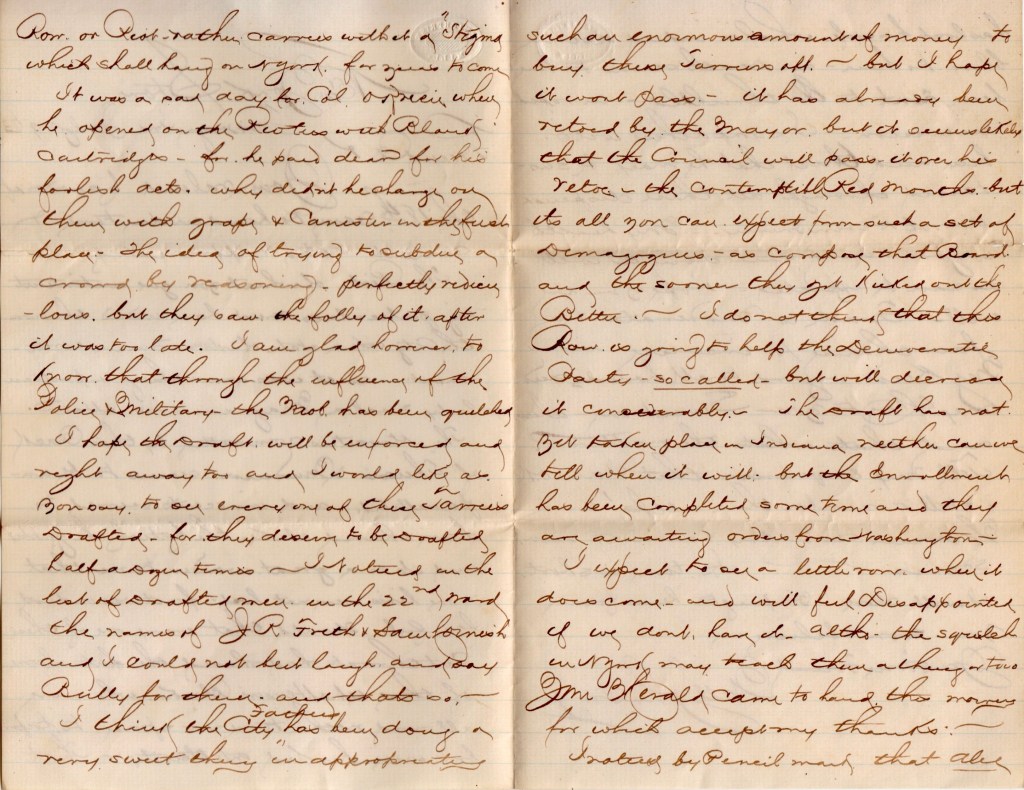
Your valued favor of the 18th came to hand in due time & contents noted & appreciated. The Riot of which you give such interesting particulars must have indeed thrown the City into a state of extraordinary excitement as it was a new thing & particularly such a magnanimous affair. The atrocities committed by this pack of thieves & murderers seems to be unparalleled and innocents seemed to have shared alike the fate of the guilty and it is a great wonder to me that more lives were not lost for it was indeed fearful. Would that every one of these cutthroats had shared the fate of some of those inoffensive Blacks who were allowed neither time nor space to prepare but were hurled into eternity. That row—or riot rather—carried with it a stigma which shall hang on New York for years to come.
It was a sad day for Col. [Henry F.] O’Brien 1 when he opened on the rioters with blank cartridges for he paid dear for his foolish acts. Why didn’t he charge on them with grape & canister in the first place? The idea of trying to subdue a crowd by reasoning—perfectly ridiculous. But they saw the folly of it after it was too late. I am glad however to know that through the influence of the police & military, the riot has been [s]quelched. I hope the Draft will be enforced and right away too and I would like as you say to see every one of these tarriers drafted for they deserve to be drafted half a dozen times.
I noticed on the list of drafted men in the 22nd Ward the names of J. R. Frith & Sam Cornish and I could not but laugh and say Bully for them and thats so. I think the City Fathers has been doing a very sweet thing in appropriating such an enormous amount of money to buy these tarriers off. But I hope it won’t pass. It has already been vetoed by the Mayor, but it seems likely that the council will pass it over his veto—the contemptible Red months. But it’s all you can expect from such a set of Demagogues as compose that Board and the sooner they get kicked out the better. I do not think that the row is going to help the Democratic Party—so called, but will decrease it considerably.
The Draft has not yet taken place in Indiana. Neither can we tell when it will but the enrollment has been completed some time and they are awaiting orders from Washington. I expect to see a little row when it does come and will feel disappointed if we don’t have it, altho the squelch in New York may teach them a thing or two.
Your [New York] Herald came to hand this morning for which accept my thanks. I noticed by pencil mark that Alec has lost his wife which is indeed a severe blow to him as death seems to have been sent to his thresh hold in rapid succession. I sympathize with him and trust that he may be sustained through all these dispensations of Divine mercy. My health is good and am doing as well as can be expected. Hope you are well. Trade is moderate & a fair chance for increase.
My Kind regards to all hands and my love to you, sweet one—ahem, and that’s whats the matter. Tell my enquirers that I am O.K. & still remember them altho’ in a Hoosier country & amidst new scenes. As time is short, I will close hoping to hear from you soon & believe me, your true friend— Will Johnston Jr.
1 As the Draft Riots in Manhattan spiraled into their second day of violence, Colonel Henry F O’Brien of the 11th New York Infantry, the Fire Zouaves, found himself in the sights of the rioters. O’Brien, an Irish immigrant, had been a captain in the 155th New York part of Corcoran’s Irish Legion. He had resigned in February of 1863 and at the time of the riot he and his family lived on Second Avenue between 33rd and 34th Streets. In the spring of 1863, O’Brien had been named colonel of the 11th and charged with rebuilding the decimated regiment by recruiting in Manhattan. Early in the day on the 14th, O’Brien’s home was targeted by the mob because of his support for the draft and recruiting efforts. After harassing the family, the rioters spared the house from being burned and moved on. In response, O’Brien led his truncated regiment to the relief of a group of NYPD officers who had been assailed and beaten by the mob on Second Avenue and 23rd Street. During the clash, a number of shots were fired and rioters and civilians killed including a child. After the mob ran away, O’Brien set off alone to find his family and ensure their safety. A group of rioters recognized the tall strong O’Brien in his army uniform and attacked him at 34th Street and Second Avenue. Initially able to drive several men away, he stumbled into a drug store just three doors down from his house. The mob returned in greater numbers clamoring to get at O’Brien. As the mob broke the store’s glass, the colonel strode out into the July sun and was pummeled by the mob. Beaten with clubs and kicked, he was burnt, dragged by his hair and feet over the cobblestones and half lynched. O’Brien, beaten and bloody, survived the mobs torture for hours. In the evening, someone summoned a priest to give the last rites. After they were concluded, the priest was chased off and O’Brien’s torture continued. At 8pm, having been dragged into his own backyard and stripped of his uniform, his torment came to an end as his body finally gave out. Two priests bore his broken body in a wheelbarrow to the morgue at Bellevue Hospital. Colonel O’Brien’s hours long torture was a testament to the fury of the mob. He was buried in a paupers grave and eventually moved to a plot in Cavalry Cemetery that remains unmarked to this day.
Brutal Murder of Col. Henry F. O’Brien
Letter 4
New York Store Fort Wayne, Indiana August 12, 1863
Friend B.K.,
I received your letter of Aug 3 in due time & as a few leisure moments present themselves, I thought I would seize the favored opportunity & make an attempt (at least) to answer your document of interested matter pertaining both to home & foreign relations.
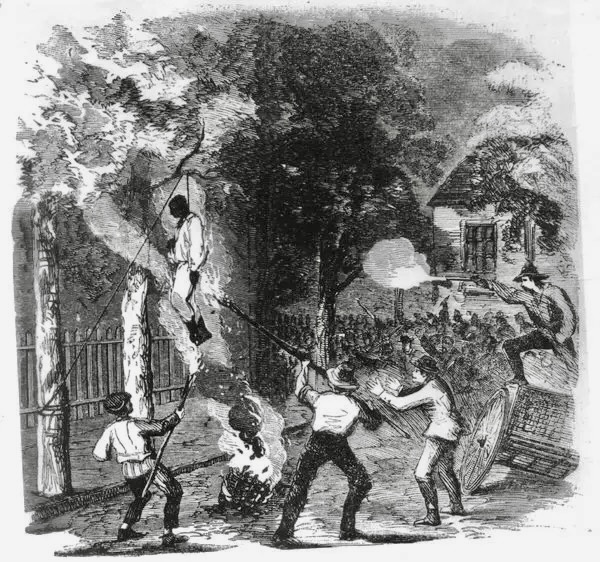
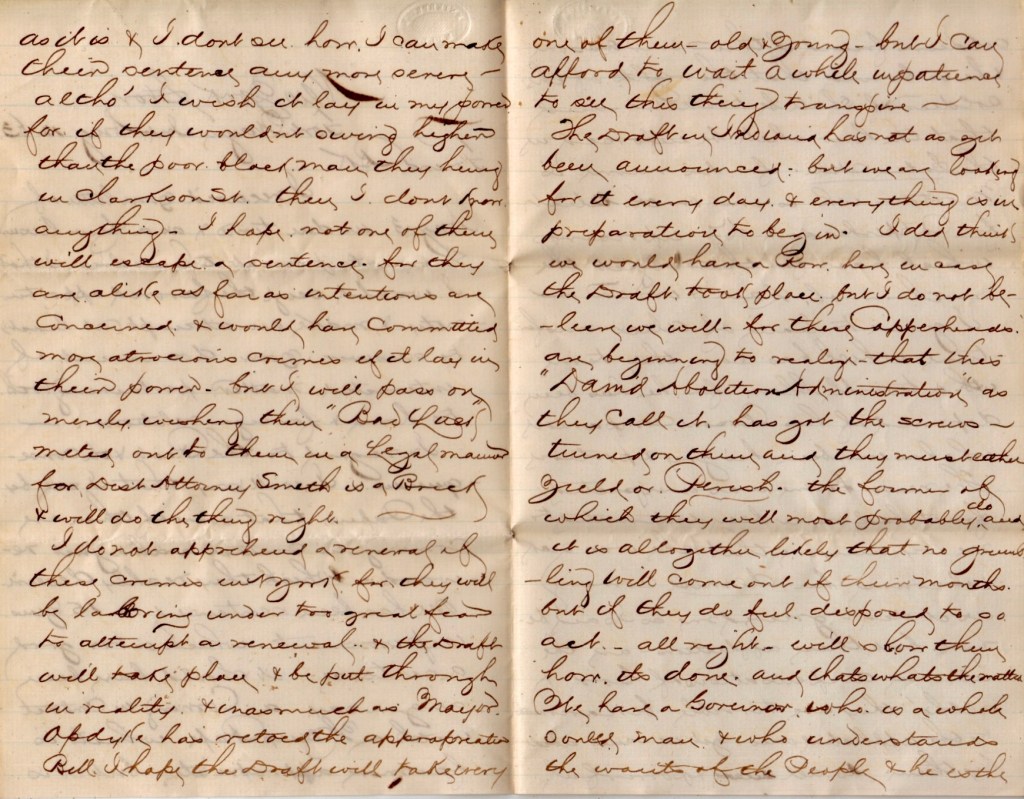
In regard to the [New York City Draft] Riot & the consequences, I will say that I see by the papers that some of them are coming in control with a just reward which they really deserve. One has been sentenced to 15 years imprisonment which is too good a sentence. It should have been, as you say, a coming in contact with a hemp rope which is far more appropriate, but it is as it is & I don’t see how I can make their sentence any more severe although I wish it lay in my power for if they wouldn’t swing higher than the poor black man they hung in Clarkson Street, then I don’t know anything. I hope not one of them will escape a sentence for they are alike as far as intentions are concerned & would have committed more atrocious crimes if it lay in their power. But I will pass on merely wishing them “Bad Luck” meted out to them in a legal manner for District Attorney Smith is a brick & will do the thing right.
One of the first victims to the insane fury of the rioters was a negro cartman residing in Carmine Street. A mob of men and boys seized this unfortunate man on Monday evening, and having beaten him until he was in a state of insensibility, dragged him to Clarkson Street, and hung him from a branch of one of the trees that shade the sidewalk by St. John’s Cemetery. The fiends did not stop here, however. Procuring long sticks, they tied rags and straw to the ends of them, and with these torches they danced round their victim, setting fire to his clothes, and burning him almost to a cinder. The remains of the wretched negro hung there till near daylight on Tuesday morning, when they were removed by the police. Harpers Weekly, 1 August 1863
I do not apprehend a renewal of these crimes in New York for they will be laboring under too great fear to attempt a renewal & the draft will take place & be put through in reality & inasmuch as Mayor [George] Opdyke has vetoed the Appropriation Bill, I hope the draft will take every one of them—old & young. But I can afford to wait a while in patience to see this thing transpire.
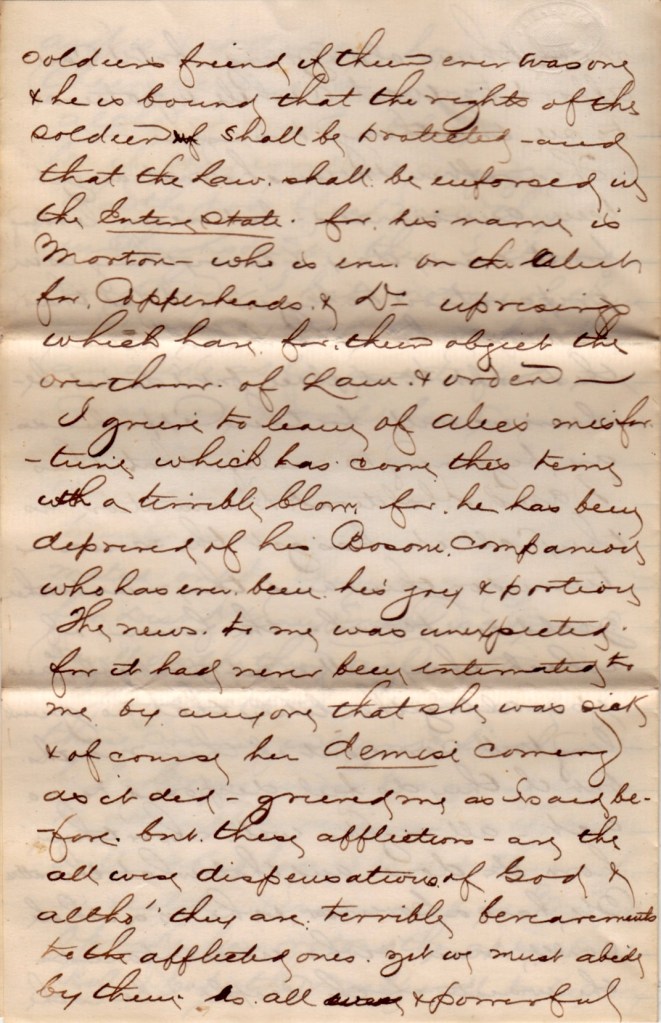
The draft in Indiana has not as yet been announced but we are looking for it every day & everything is in preparation to begin. I did think we would have a row here in case the draft took place, but I do not believe we will for these Copperheads are beginning to realize that this “Damned Abolition Administration”—as they call it—has got the screws turned on them and they must either yield or perish, the former of which they will most probably do and it is altogether likely that no grumbling will come out of their mouths. But if they do feel disposed to so act—all right. We’ll show them how it’s done and that’s whats the matter. We have a Governor who is a wholesome man & who understands the wants of the people & he is the soldiers friend if there ever was one & he is bound that the rights of the soldier shall be protected and that the law shall be enforced in the entire state for his name is [Oliver P.] Morton, who is ever on the alert for Copperheads & D[emocrat] uprisings which have for their object the overthrow of law & order.
I grieve to learn of Alec’s misfortune which has come this time with a terrible blow for he has been deprived of his bosom companion who has ever been his joy & portion. The news to me was unexpected for it had never been intimated to me by anyone that she was sick & of course her demise coming as it did grieved me as I said before but these afflictions are the all wise dispensations of God & although they are terrible bereavements to the afflicted ones, yet we must abide by them as all wise & powerful for we are not our own keepers. “The Lord gave & the Lord hath taken away.” Blessed be the name of the Lord.
One other thing troubles me and which you make the subject of your special remarks & that is Mr. Rankin’s intended departure from his congregation after a stay of a dozen years but my curiosity is excited as regards his destination for you say he would like to come West & I would like very well to have him too for he is one I would dearly long to see and hope if he does come West I may be thus privileged. I rather estimate that he is going to Illinois if at all but of course do not know for certain. Please ascertain if possible & report for I am anxious to know.
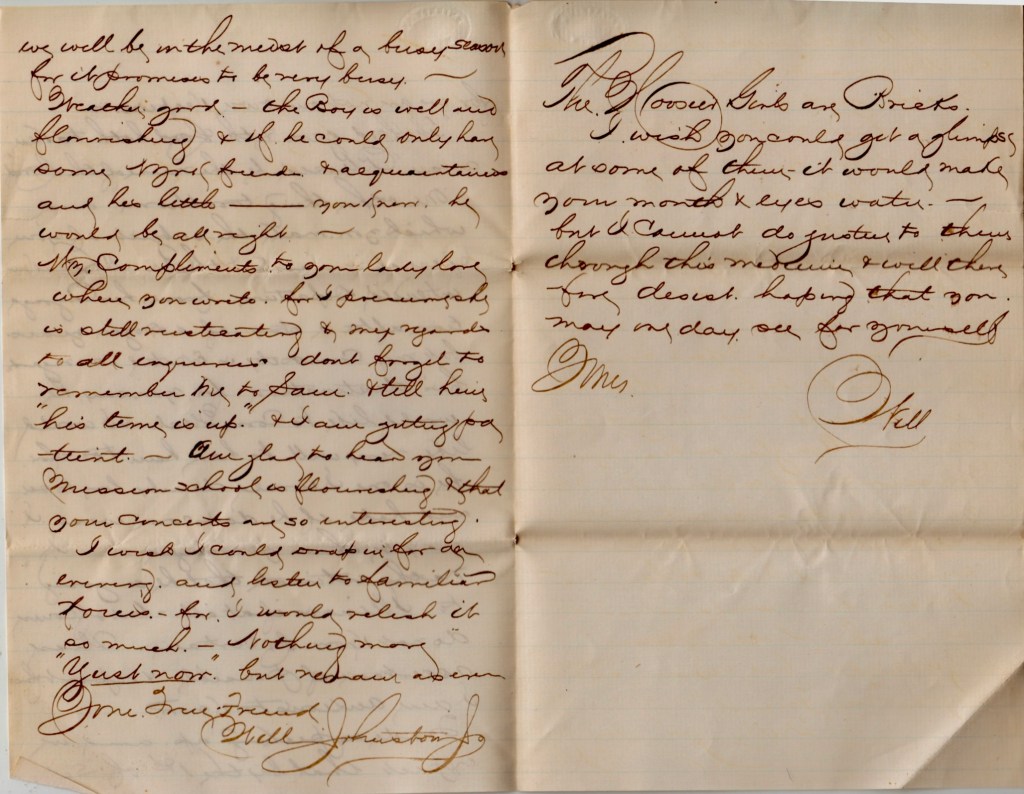
Trade is picking up and we expect that by the 1st of September we will be in the midst of a busy season for it promises to be very busy. Weather good. The boy is well and flourishing & if he could only have some New York friends & acquaintances and his little—-you know, he would be all right. My compliments to your lady love when you write for presume she is still rusticating & my regards to all enquirers. Don’t forget to remember me to Sam & tell him “his time is up” & I am getting [im]patient. Am glad to hear your Mission School is flourishing & that your concerts are so interesting. I wish I could drop in for an evening and listen to familiar voices for I would relish it so much. Nothing more “just now” but remain as ever your true friend, — Will Johnson, Jr.
The Hoosier girls are bricks. I wish you could get a glimpse at some of them. It would make your mouth & eyes water, but I cannot do justice to them through this medium & will therefore desist hoping that you may one day see for yourself. — Will
A later vintage envelope with the Root & Company emblem
The following letter was written by Lewis Francis Beers (1843-1910), the son of Andrew Beers (1797-1875) and Lucy B. West (1796-1861) of Leavenworth, Crawford county, Indiana. Lewis had several siblings but only two of them lived to be adults—Caroline (“Carrie”) Beers (1834-1914) who married Josiah Shaw (1829-1913) in 1855, and Edward M. Beers (18??-1891). Both are mentioned in this letter.
In spite of the 23 October 1862 date of this letter, previous owners have claimed it as describing Hines’ Raid, an exploratory mission led by Thomas Hines, on orders from Gen. John Hunt Morgan, into the state of Indiana in June 1863, laying the groundwork for Morgan’s Raid across the Ohio River into Indiana and Ohio. Reading Lewis’s letter carefully, however, it’s clear that the Confederates did not cross the river in October 1862 though they posed such a threat and caused considerable excitement among the Hoosier population in Crawford county. The rebels would return in June 1863 to make good on this threat.
Lewis enlisted on 28 January 1864 in Co. H, 13th Indiana Cavalry. He was discharged on 15 October 1864.
It should be noted that the original town that Lewis describes in this letter was virtually destroyed by the flood of 1937 and was subsequently relocated to higher ground. A few of the remaining abandoned buildings of the original town still stand. See Header (photo by Dan Davis).
Transcription
Addressed to Mr. Oliver Beers, Maple Grove, Otsego county, New York State
Leavenworth, [Crawford county] Indiana October 23, 1862
Mr. Oliver Beers,
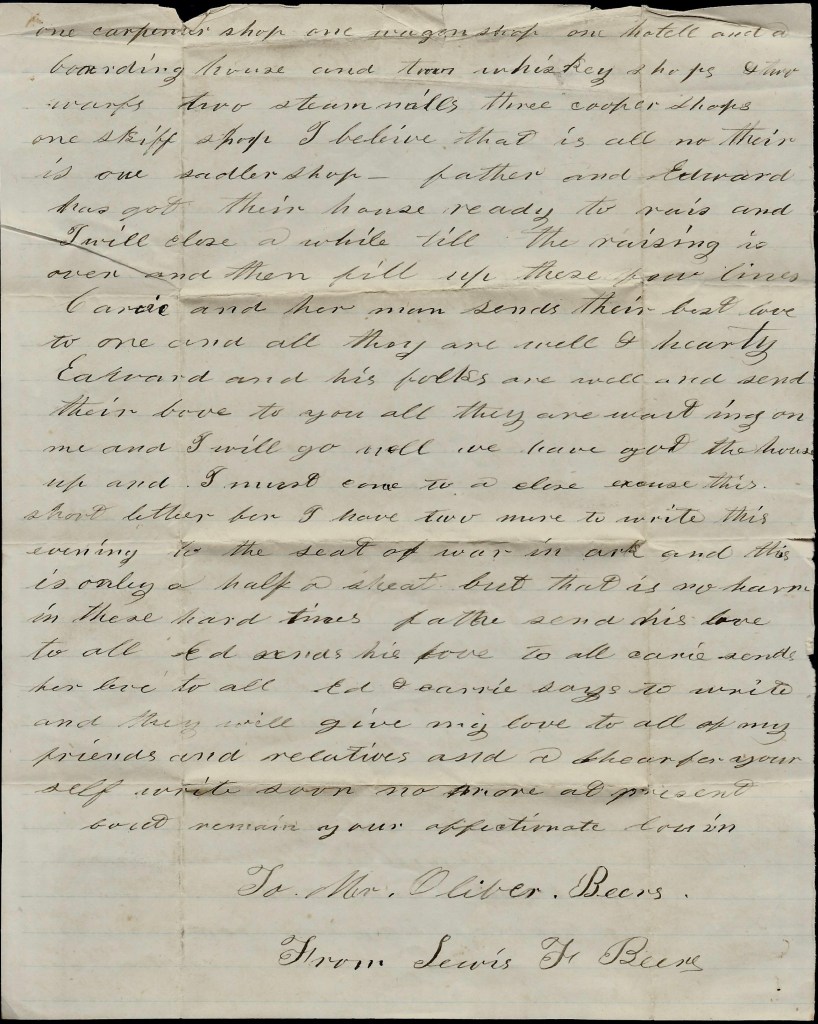
Dear cousin, I take the present hours in answering your kind & welcome letter of the 9th of October. I was glad to hear from you all & to hear that you were all well. Our little town has been considerable excited for several days. The rebels were about 50,000 in number at Elizabeth, Kentucky, which was about 40 miles from here and also 250 rebels had taken the town of Brandenburg, Kentucky, which is only 18 miles from here. But as luck have it they would not come down and try Col. Morgan’s Home Guards. The Guards were eager for a fight. There was about 300 soldiers here and one piece of artillery and plenty of shot and shell. All they had to do was to come on and we would help them to plenty of Lincoln’s powder & pills. That is all the war news I believe, except there is no draft in little Crawford. She is the banner county so far.
The weather is very cool for this time of year. It sleeted this morning the 23rd. The [Ohio] river is lower at the present time than it has been since 1852. There is no boats running except small ones. Father and Edward is to work on a house. You would hardly know our little town now. It has improved very fast for a one-horse town. It contains two churches, six stores and one drugstore, which is seven, two blacksmith’s shops, one carpenter’s shop. one wagon shop, one hotel, and a boarding house and two whiskey shops & two wharfs, two steam mills, three cooper shops, one skiff shop. I believe that is all. No, there is one saddler shop.
Carrie (Beers) Shaw (1834-1914)
Father and Edward has got their house ready to raise and I will close a while till the raising is over and then fill up these few lines.
Carrie and her man sends their best love to one and all. They are well & hearty. Edward and his folks are well and send their love to you all. They are waiting on me and I will go.
Well, we have got the house up and I must come to a close. Excuse this short letter for I have two more to write this evening to the seat of war in Arkansas and this is only a half sheet but that is no harm in these hard times. Father sends his love to all. Ed sends his love to all. Carrie sends her love to all. Ed & Carrie says to write and they will. Give my love to all of my friends and relatives and a share for yourself. Write soon. No more at present and remain your affectionate cousin, — from Lewis F. Beers
How Rosina might have looked in 1862 (Dick Valentinetti Collection)
The following letter was written by 15 year-old Rosina Markland, the daughter of George Markland (1794-1863) and Mary Nancy Nelson (1808-1864) of Jacksonville, Indiana. In her letter, Rosina speaks of her older brother Thomas “Garah” Markland (1836-1863) who served as a private in Co. D, 93rd Indiana Infantry and contracted a fever and died in the service at Lagrange, Tennessee on 13 January 1863. Se also mentions her sister Esther (1840-1913) who never married and lived with Rosina’s family. Rosina married George Philip Muret (1844-1921) in 1866 and eventually moved to Cowley county, Kansas.
Rosina write the letter to her sister Cynthia (Markland) Aldrich’s family who lived in Indianapolis. Cynthia (1834-1910) married John D. Aldrich (1839-1903), a master carpenter, in 1858 and their childrens’ names were Albert (b. 1859), James, (b. 1861), and Rosa (b. 1869).
Rosina penned her letter from Jacksonville, a small village near Centre Square in Jefferson township in Switzerland county, several miles inland from the Ohio River town of Vevay. This correspondence, crafted in the wake of Lee’s invasion of Maryland, captures the palpable unease gripping the civilian populations just north of the Ohio River. Compounded by the unsettling news of Braxton Bragg’s army advancing into Kentucky with intentions set on Cincinnati or Louisville, her words seethe with the tension and apprehension of the time.
Transcription
Addressed to Mr. John D. Aldrich, Indianapolis, Indiana
[Jacksonville, Switzerland county, Indiana] September 29, 1862
Dear Brother and Sister,
I received your letter on last Friday and was glad that you answered my letter so soon. We are all well but Mother has had the toothache but is better now. I wish you could come and eat peaches for they are beginning to get ripe now. Garah has been home on furlough but has gone back again and we have got a letter from him. He is well and likes camp life first rate. I received a letter from [cousin] Della Nelson last Friday. They are all well. Uncle John is in the army. Mother has been spinning but she is half done spinning. She has sat down to rest now.
Map of Jefferson township in Switzerland county, Indiana, showing Jacksonville at top of map and Vevay on the Ohio river.
There was an awful alarm the other night. The boys had to go to Vevay two nights to guard it for fear the rebels coming over and the next night they camped out at Center by the meeting house. Mother belongs to the Soldiers’ Aid Society. They meet at Mr. Ransom’s every Thursday afternoon and make things for the soldiers. I will have to quit and read for Mother. I have wrote a letter to Aunt Margaret today and will have to write one tomorrow to Della besides this one. It keeps me writing letters all the time for we get one from Gid every week.
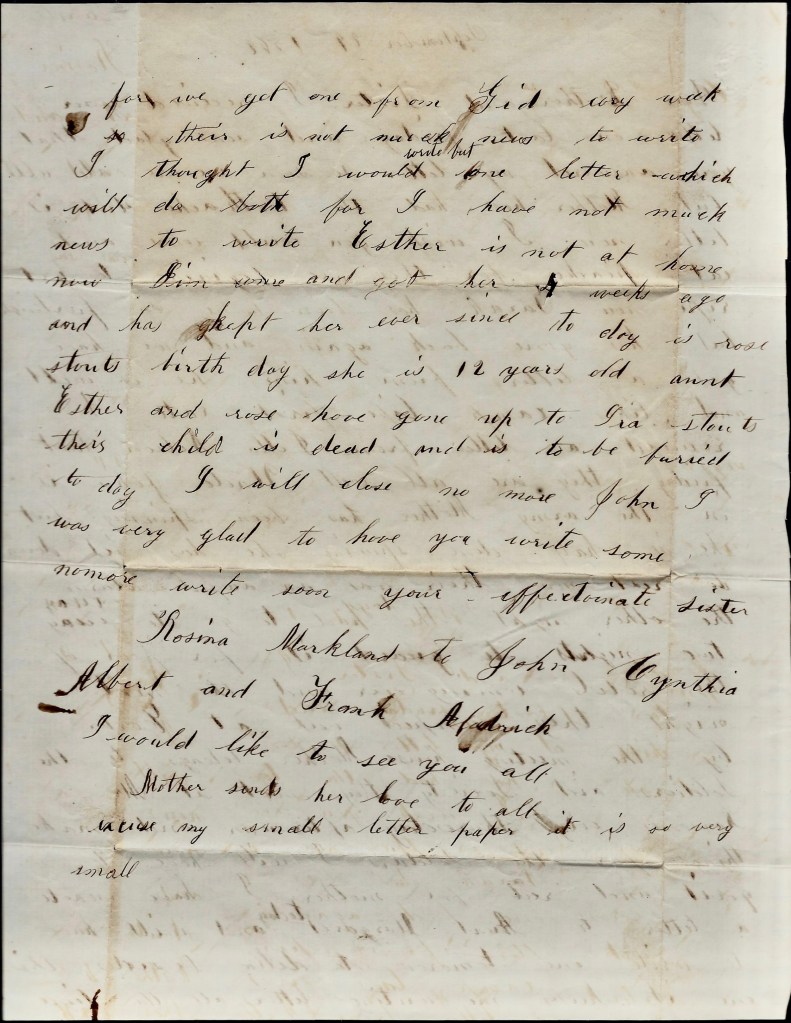
There is not much news to write. I thought I would write but one letter which will do both for I have not much news to write. Esther is not at home now. Jim came and got her 4 weeks ago and has kept her ever since. Today is Rose Stout’s birthday. She is 12 years old. Aunt Ether and Rose have gone up to Ira Stout’s. Their child is dead and is to be buried today.
I will close. No more. John, I was very glad to have you write some. No more. Write soon. Your affectionate sister, — Rosina Markland
To John, Cynthia, Albert & Frank Aldrich
I would like to see you all. Mother sends her love to all. Excuse y small letter paper. It is so very small.
The author of this letter has not been identified. His signature appears to read, “Wes Land” but I can find no one by that name, or similar name, in New Burlington, Indiana. Regardless of his identity, Wes provides his friend in the Iron Brigade some interesting news about the attempt to set up the draft in Indiana during the summer of 1863 and the resistance of the Copperheads.
Wes wrote the letter to his friend, William Harrison Campbell, a 23 year-old school teacher from Selma, Liberty Township, Delaware county, Indiana. Will enlisted in Co. K, 19th Indiana Infantry on 29 July 1861 as a first sergeant and was promoted to 2nd, then 1st Lieutenant during the war. The 19th Indiana was, of course, part of the famed Iron Brigade or “Black Hat” Brigade. He was discharged for medical disability in October 1863 on account of the wound he received at Gettysburg in his right hand.
Transcription
Addressed to Will H. Campbell. Co. K, 19th Indiana Vols., Washington D. C.
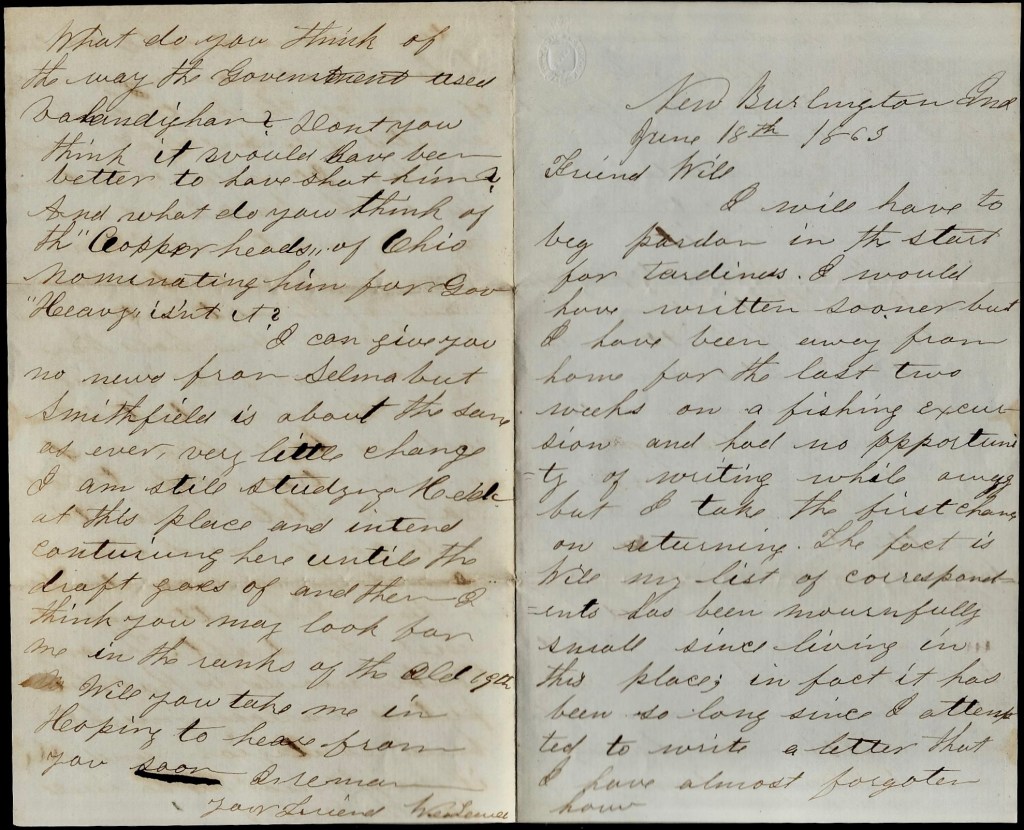
New Burlington, Indiana June 18th 1863
Friend Will,
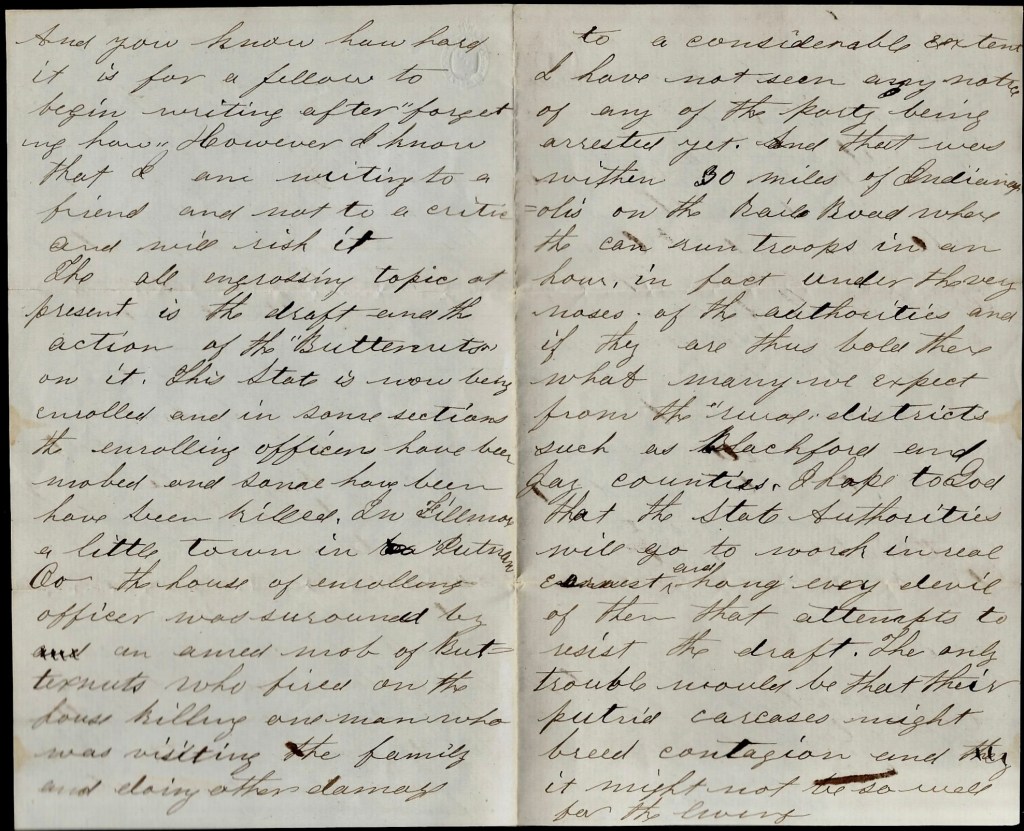
I will have to beg pardon in the start for tardiness. I would have written sooner but I have been away from home for the last two weeks on a fishing excursion and had no opportunity of writing while away. But I take the first chance on returning. The fact is, Will, my list of correspondents has been mournfully small since living in this place; in fact, it has been so long since I attempted to write a letter that I have almost forgotten how. And you know how hard it is for a fellow to begin writing after “forgetting how.” However, I know that I am writing to a friend and not to a critic and will risk it.
The all engrossing topic at present is the draft and the action of the “Butternuts” on it. This State is now being enrolled and in some sections the enrolling officers have been mobbed and some have been killed. In Fillmore—a little town in Putnam county—the house of the enrolling officer was surrounded by an armed mob of Butternuts who fired on the house killing one man who was visiting the family and doing some other damage to a considerable extent. I have not seen any notice of any of the party being arrested yet. And that was within thirty miles of Indianapolis on the railroad where they can run troops in an hour. In fact, under the very noses of the authorities, and if they are thus bold there, what may we expect from the rural districts such as Blackford and Jay counties?
I hope to God that the State Authorities will go to work in real earnest and hang every devil of them that attempts to resist the draft. The only trouble would be that their putrid carcasses might breed contagion and it might not be so well for the living.
What do you think of the way the Government used Vallandigham? Don’t you think it would have been better to have shot him? And what do you think of the “Copperheads” of Ohio nominating him for Governor? “Heavy,” isn’t it?
I can give you no news from Selma but Smithfield is about the same as ever—very little change. I am still studying H___ at this place and intend continuing here until the draft goes off and then I think you may look for me in the ranks of the Old 19th. Will you take me in? Hoping to hear from you soon, I remain your friend, — Wes Land





















 Spared & Shared 23