The following letter was written by Joel Slate (1800-1874). He was married to Mary Hale (1803-1874) in 1822 at Bernardson, Massachusetts. In 1860, they were enumerated in South English, Keokuk county, Iowa, where he farmed.
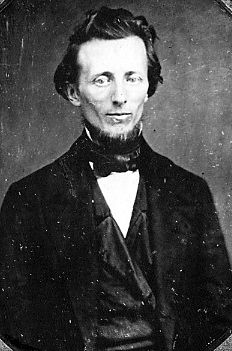
I could not find an image of Orra Slate but here is a great cdv of William T. Crozier of Co. K, 5th Iowa Infantry. (Iowa Civil War Images)
Joel’s letter conveys the sad intelligence of two son’s deaths in the service. The eldest son, Israel Bernard Slate (1827-1862) was a private in the 2nd Iowa Light Artillery. He died of disease on 18 September 1862 at Corinth, Mississippi. He was married to Mary E. Voorhies (b. 1830), had two young children named William and Amelia, and was enumerated in Adel, Dallas county, Iowa as a farmer in the 1860 US Census.
The other son was Orra Slate (1841-1862) who joined Co. F, 5th Iowa Infantry in July 1862. He was wounded at Iuka on 19 September 1862 and died on 5 October at Jackson, Tennessee.
Also mentioned is another son named Lorenzo D. Slate (1835-1923) who served in Co. H, 33rd Iowa Infantry, and a son-in-law, William H. Gore (1832-1906) who was a 2nd Lieutenant (later Captain) in Co. H, 33rd Iowa.
Joel also conveys the news that a nephew, son of of his brother Gideon Hurlbert Slate (1792-Aft1850), Lionel L. Slate (1837-1862) also died on 13 September 1862 at Jefferson Barracks in St. Louis. He was also on Co. F, 5th Iowa Infantry. Lionel’s brother Charley would also die some two weeks after this letter was written.
T R A N S C R I P T I O N
South English [Keokuk county, Iowa] November 11th 1862
Dear Brother & Sister,
I sit down to inform you of our situation. We are well but in trouble. We have lost two sons in the army. Bernard died September 15th of fever near Corinth, Mississippi. Orra died October 5th of a wound he received at the Battle of Iuka the 19th of September. He was shot in the right lung. The ball lodged in his back. He died a faithful Christian. Bernard left a wife & two children. They are 125 miles from here.
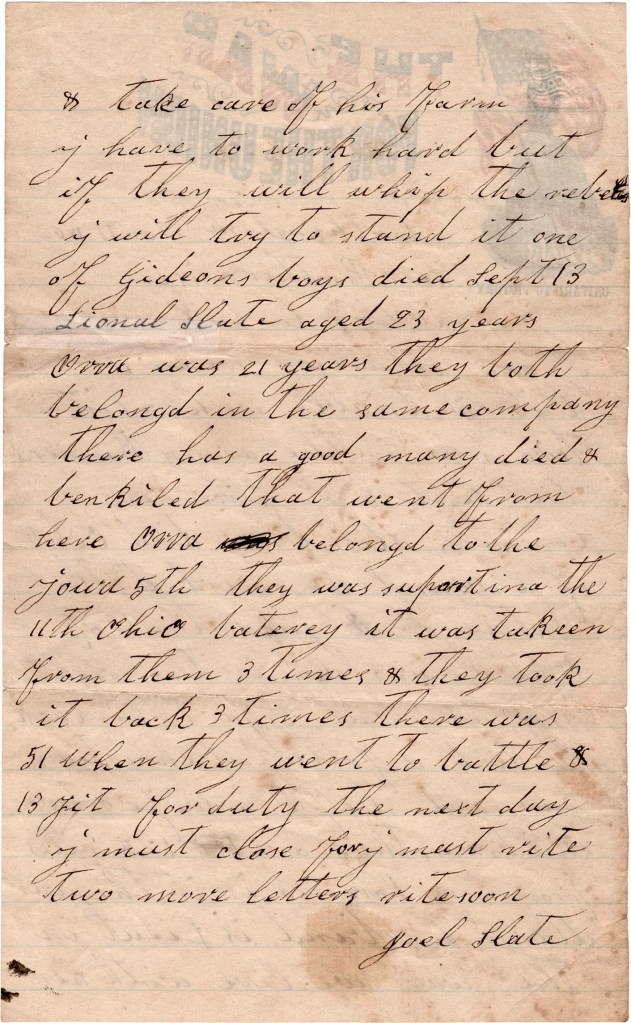
Lorenzo is in the war. Mary’s husband [William H. Gore] is Lieutenant in the war. We live here and take care of his farm. I have to work hard but if they will whip the rebels, I will try to stand it. One of Gideon’s boys died September 13th—Lionel Slate, aged 23 years.
Orra was 21 years. They both belonged in the same company. There has a good many died and been killed that went from here. Orra belonged to the Iowa 5th. They was supporting the 11th Ohio Battery. It was taken from them three times and they took it back three times. There was 51 when they went to battle & 13 fit for duty the next day. 1
I must close for I must write two more letters. Write soon. — Joel Slate
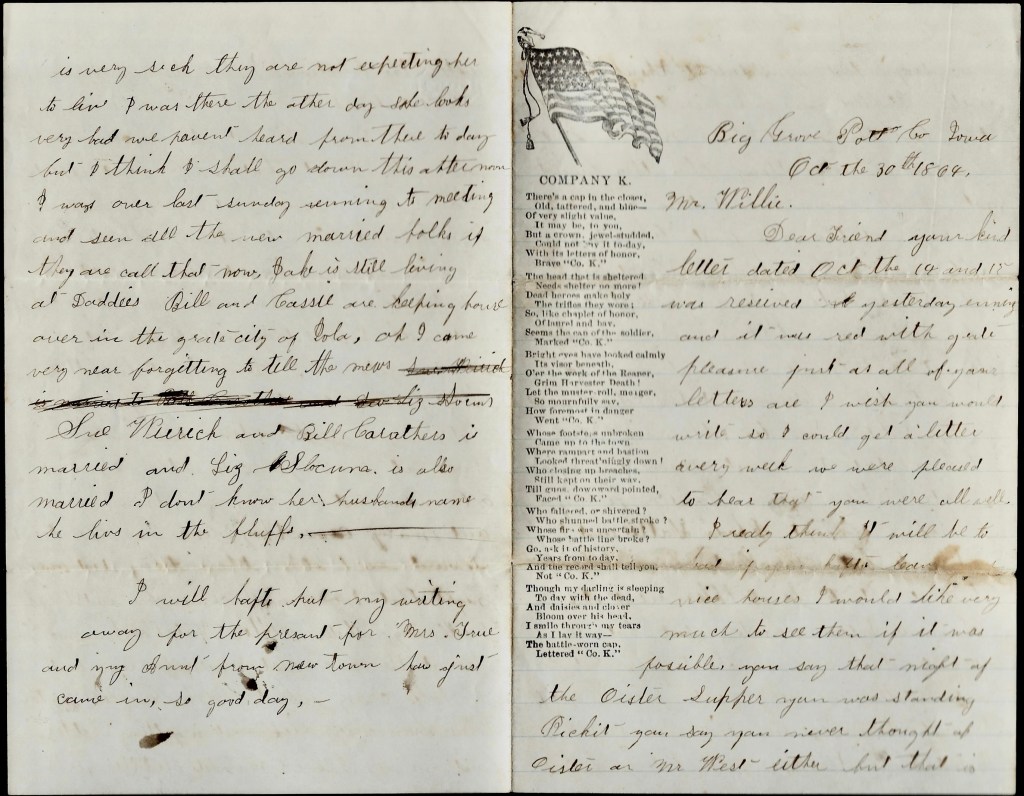
This letter was unsigned but datelined from a small community in Pottawattamie county, Iowa, named Big Grove. A county history informs us that Brig Grove was located in an immense grove from which it took its name until the railroad station and new town were designated as Oakland. A careful and more thoughtful diagnosis of the names mentioned in this letter might lead one to identify the author but I’ll leave that to someone else for want of time. I feel confident that the author was a female and most likely born in the late 1840s or 1850. She informs us that she was attending school at the time, in October 1864.
The letter was addressed to William Lyman, Jr. (1844-1930) who served in Co. C, 29th Iowa Infantry with his two older brothers—Maj. Joseph Lyman (18401890) and Pvt. Sereno Lyman (1842-1893). They were the sons of William Lyman (1814-1875) and Sarah Pierce (1820-1905) of Oakland, Pottawattamie county, Iowa.
The letter was written on patriotic stationery that included the verses of a poem entitled, “Company K” (see below). I’ve found a slight variation of it that was attributed to Ethel Lynn Eliot Beers (1827-1879). It was published in the 11 August 1863 issue of the New York Ledger, first column; there were numerous reprints in other papers but that appears to be the first publication. However, there is another source that claims the poem was “found in a book entitled Lyrics, Incidents, and Sketches of the Rebellion, compiled by Ledyard Bill, sold by subscription only, and published in 1864 by Smith and McDougal, New York. There is no authorship attributed, but the following note prefaces it: “Are there not many hearts that will feel the pangs of keenest pain on reading this? Alas! That so many brave soldiers’, noble companions’, affectionate brothers’, and dearest friends’ history, death, and memory, are all told in this sad, yet heroic verse.”
There’s a cap in the closet, Old, tattered, and blue, That would be little value, It may be, to you; But a crown jewel-studded Could not buy it to-day, With its letters of honor, Brave ‘Company K.’
The head that is sheltered Needs shelter no more; Dead heroes make holy The trifles they wore; so, like chaplet of honor of laurel and bay Seems the cap of the soldier, Marked ‘Company K.’
Bright eyes have looked calmly Its visor beneath O’er the work of the reaper, Whose harvester Death. Let the muster-roll meagre So mournfully say How foremost in danger Went ‘Company K’—
Whose footstep unbroken Came up to the town, Where rampart and bastion Looked threateningly down— Who, closing up breaches, Still kept on their way, Till guns, downward pointing, Faced ‘Company K.’
Who faltered or shivered? Who shunned battle stroke? Whose fire was uncertain? Whose battle line broke? Go ask it of History Years from today, And the record shall tell you, Not ‘Company K.’
Tho’ my darling is sleeping Today with the dead, And daisies and clover Bloom over his head, I smile thorough my tears As I lay it away, That battle-worn cap Lettered ‘Company K.’
Transcription
Addressed to Mr. Wm. Lyman, Jun., Co. C, 29th Reg. Iowa Volunteer. Infantry, Mobile, AL
Big Grove, Pottawattamie County, Iowa October 30, 1864
Mr. Willie,
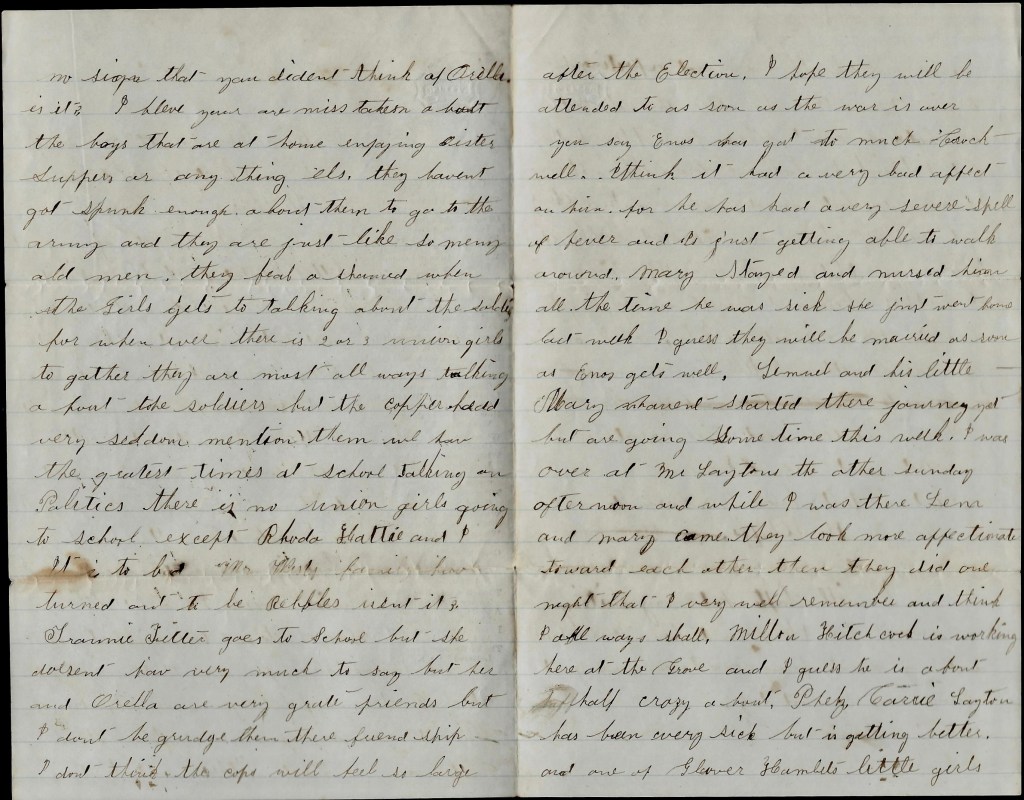
Dear friend, your kind letter dated October 14 and 15 was received yesterday evening and it was read with great pleasure just as all of your letters are. I wish you would write so I could get a letter every week. We were pleased to hear that you were all well, I really think it will be too bad if you have to leave your nice houses. I would like very much to see them if it was possible. You say that night of the oyster supper you was standing picket. You say you never thought of oyster or Mr. West either, but that is no sign that you didn’t think of Orella, 1 is it?
I believe you are mistaken about the boys that are at home enjoying oyster supper or anything else. They haven’t got spunk enough about them to go to the army and they are just like so many old men. They feel ashamed when the girls gets to talking about the soldiers for whenever there is two or three Union girls together, they are most always talking about the soldiers. But the Copperheads very seldom mention them. We have the greatest times at school talking on politics. There is no Union girls going to school except Rhonda, Hattie, and I. It is too bad Mr. West’s family have turned out to be Rebels, isn’t it?
Frannie Fetter 2 goes to school but she doesn’t have much to say, but her and Orella are very great friends. But I don’t begrudge them their friendship. I don’t think the Cops [Copperheads] will feel so large after the election. I hope they will be attended to as soon as the war is over.
You say Enos has got too much Crock. Well. I think it had a very bad effect on him for he has had a very severe spell of fever and is just getting able to walk around. Mary stayed and nursed him all the time he was sick. She just went home last week. I guess they will be married as soon as Enos gets well.
Lemuel [Layton] and his little Mary haven’t started their journey yet but are going some time this week. I was over at Mr. [Joshua] Layton’s the other Sunday afternoon and while I was there, Lem and Mary came. They look more affectionate toward each other than they did one night that I very well remember and think I always shall.
Milton Hitchcock is working here at the Grove and I guess he is about half crazy about Phebe. Carrie Layton has been very sick but is getting better and one of Glover Hamlet’s little girls is very sick. They are not expecting her to live. I was there the other day. She looks very bad. We haven’t heard from there today but I think I shall go down this afternoon. I was over last Sunday evening to meeting and seen all the new married folks as they are called that now. Jake is still living at Daddy’s. Bill and Cassie are keeping house over in the great city of Iola.
Oh, I came very near forgetting to tell the news—Sue Wierich and Bill Carothers is married 3 and Liz Slocum is also married [but] I don’t know her husband’s name. He lives in the bluffs.
I will have to put my writing away for the present for Mrs. True and my Aunt from Newtown has just come in, so goodbye. [unsigned]
1 Probably Orilla (Arellis Malinda) Myers (b. 1847), the daughter of blacksmith John Myers (1814-1900) and Sarah Dickson (1822-1870)of Pottawattamie county, Iowa. They were Mormons who relocated to Utah before 1870.
2 Frances (“Frannie”) Fetter (b. 1849) was the daughter of Jacob Lobingier Fetter (1820-1900) and Charlotte R. Palmer (1821-1897) of Pottawattamie county, Iowa.
3 William Henry Harrison Carothers (1839-1918) and Susan Katrina Weirich (1839-1918) were married on 10 September 1864 at Bellevue, Sarpy county, Nebraska.
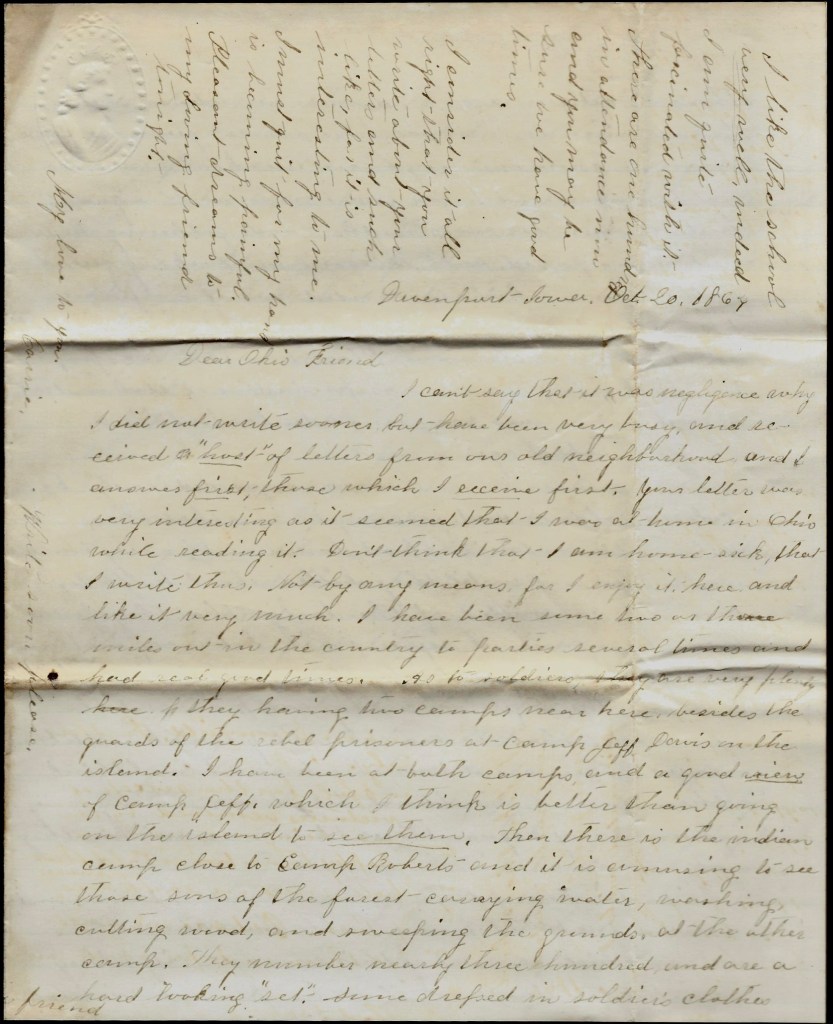
The following incredible and newsy letter was penned in October 1864 by “Carrie O.” whom I later determined to be Caroline Victoria Ozias (1843-1902). Caroline was born in Twin, Preble county, Ohio, the daughter of Peter Leo Ozias (1812-1893) and Rebecca Kesler (1818-1863). It seems she never married. She died of pneumonia when she was 59 years old.
We learn many things from Carrie’s letter but her post script suggests that she was attending school at the time and my hunch is that she was attending the Davenport Female College.
Carrie wrote the letter to her childhood friend, Sarah (“Sallie”) Rachel McQuiston (1843-1926), the daughter of David McQuiston and Margaret Hamilton of Preble county, Ohio.
Transcription
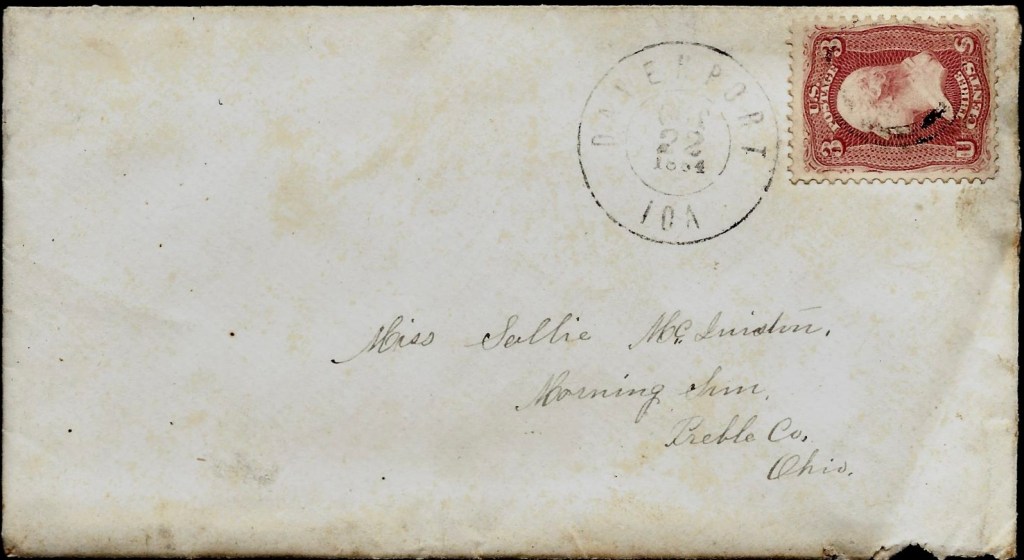
Addressed to Sallie McQuiston, Morning Sun, Preble county, Ohio
Davenport, Iowa October 20, 1864
Dear Ohio Friend,
I can’t say that it was negligence why I did not write sooner but have ben very busy and received a “host” of letters from our old neighborhood and I answer first those which I receive first. Your letter was very interesting as it seemed that I was at home in Ohio while reading it. Don’t think that I am homesick that I write thus—not by any means for I enjoy it here and like it very much. I have been some two or three miles out in the country to parties several times and had real good times.
As to soldiers, they are pretty plenty here, they having two camps near here, besides the guards of the rebel prisoners at Camp Jeff Davis on the island. 1 I have been at both camps, and a good view of Camp Jeff which I think is better than going on the island to see them.
Then there is the Indian camp close to Camp Roberts 2 and it is amusing to see those sons of the forest carrying water, washing, cutting wood, and sweeping the grounds at the other camp. They number nearly three hundred and are a hard looking “set”—some dressed in soldier’s clothes, others in citizen’s dress, and others in Indian stuff. They are prisoners brought here several years ago from Minnesota and the ring leaders are kept very close, not being allowed to go out even with a “guard.” 3 Quite a number were in the woods gathering hazelnuts as we passed, with a dignified looking “guard” with them which reminded me of a former teacher of mine who considered it his duty to prop himself up at some conspicuous place every noon to watch the pupils in their play, which was productive of evil instead of good, as he was very impudent about it.
108th USCT guarding prisoners at the Rock Island Prison in 1864
To my subject again, the rebs are guarded (partly) by colored soldiers 4 and you may be sure that their aristocratic southern blood boiled at the very thought and it was not until they killed about half a dozen that they submitted of the darkies that they forced them to submit. I rejoice in it, but imagine their feelings at being guarded by the race they always were taught to hate. The “sogers” in a large camp are not the same ones that we see when they come home to their friends. There are a number here whom I think their friends would not like to own. Being away from many acquaintances, they care not how they act.
We had a heavy draft in some parts of this county and I learned that my old friend Preble [county, Ohio] had the same. In Poweshiek Co. (west of this near Iowa City), they resisted the draft, killed a provost marshal [John Bashore] and several others. The man who shot the marshal was wounded and taken. A rope was put around his neck and he was forced to name his accomplices, about a dozen of whom are now in jail. General [N. B.] Baker went from here with some soldiers and Governor Stone hastened there. Upon the whole they had quite a time resisting this “abolition tyrant.” Pa was in Grinnell the same night the soldiers came. He said it looked very warlike for so small a place. The soldiers realized what northern traitors are and felt like giving them their just dues. A few of the butternuts hid among the bushes near where the marshal and several others were obliged to pass and shot at them, killing him. Then, not satisfied with that, they beat his head almost into a jelly. It caused quite an excitement for a time. Price was in the southern part of Iowa and it was rumored that he intended making his way through to the island and take the rebel prisoners. I think until he gets this far, he will deserve them. 5
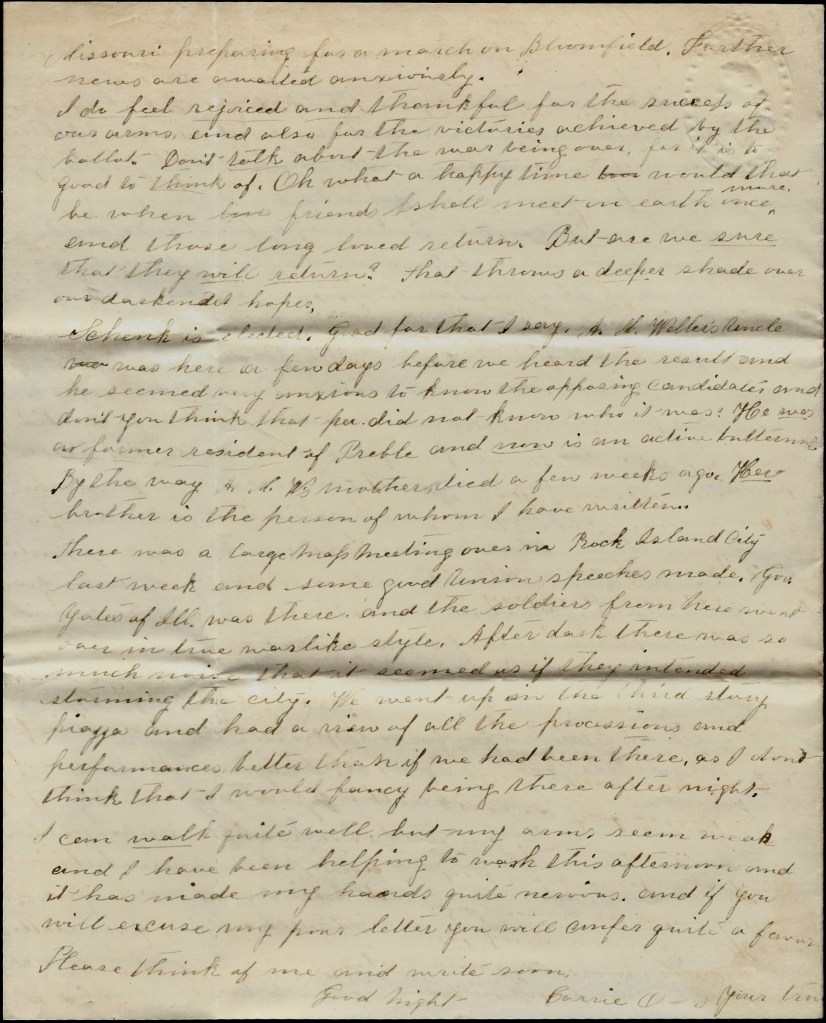
The guerrillas are in Davis County. They entered from Missouri one hundred and fifty strong mostly attired in Federal uniform. Soon after crossing the border they separated into bands and went plundering, murdering, and deceiving by the uniform. 6 The latest news is that four hundred citizens have congregated at Bloomfield and arming themselves to meet five hundred guerrillas reported to be at Memphis, Missouri, preparing for a march on Bloomfield. Further news are awaited anxiously.
I do feel rejoiced and thankful for the success of our arms and also for the victories achieved by the ballot. Don’t talk about the war being over for it is too good to think of. Oh! what a happy time would that be when friends shall meet on earth once more and those long loved return. But are we sure that they will return? That throws a deeper shade over our darkened hopes.
Schenk is elected. Good for that I say. A[ndrew] M. Weller’s Uncle was here a few days before we heard the result and he seemed very anxious to know the opposing candidates, and don’t you think that pa did not know who it was. He was a former resident of Preble [County, Ohio] and now is an active butternut. By the way, A. M. W.’s mother 7 died a few weeks ago. Her brother is the person of whom I have written.
There was a large mass meeting over in Rock Island City last week and some good Union speeches made. Governor Yates of Illinois was there and the soldiers from here went over in true warlike style. After dark there was so much noise that it seemed as if they intended storming the city. We went up in the third story piazza and had a view of all the processions and performances—better than if we had been there as I don’t think that I would fancy being there after night. I can walk quite well but my arms seem weak and I have been helping to wash this afternoon and it has made my hands quite nervous, and if you will excuse my poor letter, you will confer quite a favor.
Please think of me and write soon. Goodnight. — Carrie 0. Your true friend.
I like the school very well indeed. I am quite fascinated with it. There are one hundred in attendance now and you may be sure we have good times. I consider it all right that you write about your letters and such like, for it is interesting to me. I must quit for my hand is becoming painful. Pleasant dreams to my loving friend tonight. My love to you, — Carrie
Write soon please.
1 Though I have not heard of it being called “Camp Jeff Davis” before, it’s clear that Carrie is referring to the Rock Island Prison which was located on a government-owned island between Davenport, Iowa, and Moline, Illinois, in the Mississippi River.
2 Camp Roberts was the headquarters of the 8th and 9th Cavalry. It was established 14 July 1863 on Duck Creek near Oakdale. It was afterward called Camp Kinsman and the buildings were turned over to the orphans of soldiers and became the Davenport Orphan’s Home.
3 These Indians—part of the Minnesota Sioux—were among the nearly 300 that were rounded up after the Sioux Uprising in Minnesota in August 1862. They were brought to Davenport where they were confined in a prison area 200 feet square containing four buildings: two for prisoners to sleep in (no beds were provided), one for a hospital, and one for the guardhouse. It wasn’t until April 1866 that those who had survived were released.
4 It was the 108th USCT assigned the duty of guarding Revel Prisoners at the Rock Island Arsenal.
5 For more details on this Draft Resistance Incident in Poweshiek county, Iowa, readers are referred to a post by David Connon entitled, Draft Dilemma in Poweshiek County: The Murder of Marshals,” Emerging Civil War, March 29, 2018
6 In the book entitled, “The Confederate Invasion of Iowa,” author Russell Corder informs us that the raid took place in mid-October 1864. “Twelve young men, dressed in Federal uniforms, mounted on splendid horses, and armed with from two to seven revolvers each, entered Davis Co. near its southeast corner in the early morning with two prisoners, young men whom they had captured in Clark Co., in the Northeast corner of Missouri.”
7 Sarah (Higgins) Weller (1811-1864) died on 21 September 1864. She was buried in Roselawn Cemetery in Lewisburg, Preble county, Ohio.
The following letter was written by 31 year-old Henry Gleason Clark (1832-1907) to his older brother, Normal L. Clark (1830-1873). The brothers were the oldest sons of Samuel Clark (1799-1840) and Sabrah Cole (1806-1896). After their father died, their mother remarried to Lawrence McNamee (1805-1888) of Coleburg, Delaware county, Iowa.
As a young man, Henry went to California during the gold rush but returned to Clayton county, Iowa in 1853 and settled on a farm in Fayette county in 1860. He was married to Josephine Amelia Otis in 1859 and had at least three children.
Norman also went to California as a young man and never returned to live in Iowa. In 1861 he relocated to Idaho where he worked in the placer mines. He finally settled down and became the sheriff of Alturas county, Idaho. He died at age 43 in Rocky Bar, Elmore county, Idaho.
Transcription
Addressed to Norman L. Clark, Esq., Virginia City, Idaho Territory
Clermont, Fayette county, Iowa March 27th 1864
N. L. Clark,
Dear brother, I write this with the expectation of sending it through by a couple of Norwegians. I heard through a letter from James M. Potts written from Salt Lake that you were at Virginia City. I do not know that it is necessary to make any excuses for not writing before as I believe you now stand debtor on that score to more than one letter.
I hope I shall find timber enough in the incidents of three or four years life to make at least a presentable sheet. My social correspondence during that time has been very limited & you know one grows dull from want of practice in anything. About 4 years ago I overleaped that terrible Benedictine barrier and became what is generally termed a practical man. The natural cares incumbent upon my present life, such as spanking babies (for I have two of them), keeping up an establishment, and the minor items tend to bring out all the business faculties of a man, and use up the most of those leisure moments which he had formerly dedicated to social intercourse with our friends (as you will become fully convinced should you ever make the same step) though you may claim this is an objection, it has the redeeming trait of fixing our purposes and doing away with that vacillating mind which all Benedicts are cursed with.
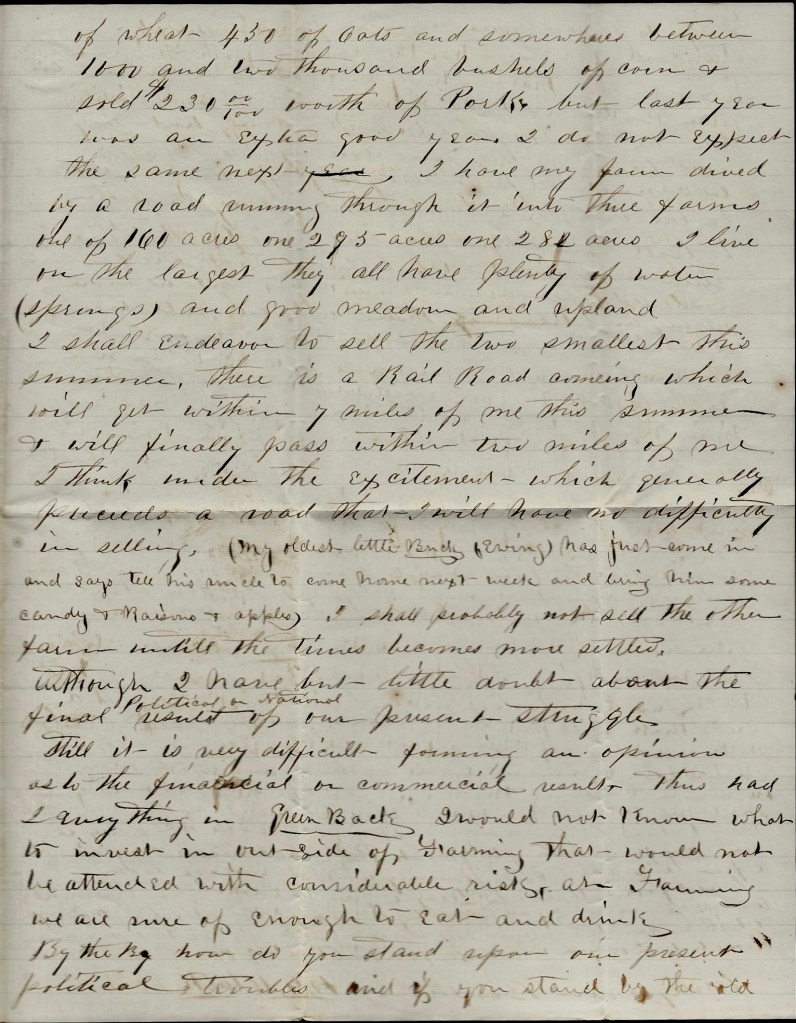
But enough of this. I do not propose to try to influence you to enter the matrimonial state, so will change the subject and commence anew upon my own occupation which is simply farming. This I know you do not envy me, but it has its pleasures as well as everything else. But even to wave these one cannot always consistently follow that which suits his own taste the best. I entered here for the purpose of making money on the investment and partly (for I then intended to go to California) vulgarly speaking, for the purpose of laying a nest egg to fall back on provided I failed in that expedition. I came up here for the purpose of improving ,y land so that I could sell it. I have since I came built two houses, broke up 250 acres, and fenced (or will have fenced this spring) about 450 acres. Am beginning to make some money on it. I got off from it last year (rent and all) 1400 bushels of wheat, 450 of oats, and somewhere between 1000 and two thousand bushels of corn & sold $230 worth of pork. But last year was an extra good year. I do not expect the same next.
I have my farm dived by a road running through it into three farms—one of 160 acres, one 295 acres, one 282 acres. I live on the largest, The all have plenty of water (springs) and good meadow and upland. I shall endeavor to sell the two smallest this summer. There is a railroad coming which will get within 7 miles of me this summer & will finally pass within two miles of me. I think under the excitement which generally precedes a road, that I will have no trouble in selling. I shall probably not sell the other farm until the times become more settled.
My oldest little buck (Ewing) has just come in and says tell his uncle to come home next week and bring him some candy and raisons and apples.
Although I have but little doubt about the final political and National result of our present struggle, still it is very difficult forming an opinion as to the financial or commercial result. Thus, had I everything in greenback, I would not known to invest in outside of farming that would not be attended with considerable risk. At farming, we are sure of enough to eat and drink. By the bye, how do you stand upon our present political troubles and if you stand by the old flag, who are your choice for the next standard bearer? Has the daring Path Finder Fremont ot that sturdy unconditional man Butler lost cast in your eyes? Some dislike them because they use too hard a club, but they are favorites here and among the soldiers. We cannot see the necessity of exposing ourselves to the bite of a serpent and using a feather to kill him when there is a good stout club convenient. We believe that the feather and red tape arrangement has cost us more money and men that would quell two rebellions.
Now for local news. I will begin with Uncle Amasa. Poor uncle. He is no better nor do I expect he ever will be. Better death a thousand times than to be in his situation. Mother has very good health. Has just returned from making us a long visit. Uncle Mc. came up after her. His health is also good. Baily and wife and two little girls were out here today. They are all well and prospering. Ben is at Vicksburg. Thinks hard of you because you do not write him. Write him by all means.
Sam is here and at Colesburg off and on. He starts next month to Massachusetts to accept a situation offered him in a factory. Uncle Charles is at Chatfield. I think he has lost much of his tack as a business man. Will trust any damned cuss that will put on a good face and then surse the whole worth as a damned set of thieving Yankees. Lute Glasgow died in Chatfield last summer. Uncle Ephraim and Aunt Mary are now in Colesburg. Uncle E. is so tight, he can’t hardly shut his eyes for fear he will lose a chance to make a penny.
Perry Perkins and wife are now stopping at Uncle Mc.’s. Reny is in very poor health. Jerrymah Page was arried again a few days ago. Potts family were all well the last I heard from them. McKeay is going to Idaho. Jim Simmons is worse off than nothing and don’t try to be any better. Old Dad Mallory & Wiltse have both married new wives. Give love to [ ] and a welcome home to both of you whenever you find time to come.
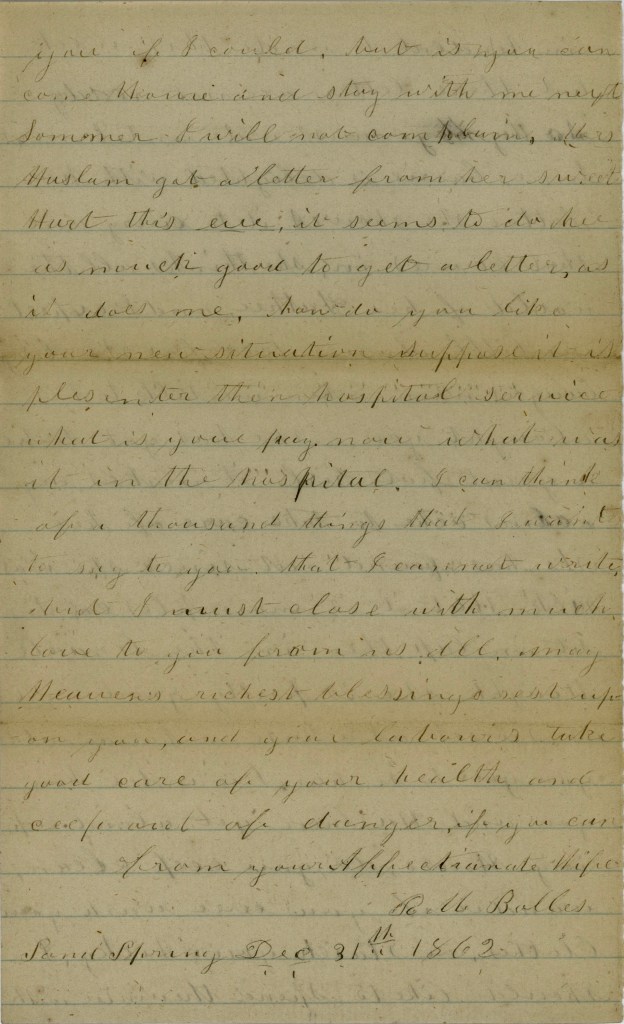
This letter was written by Rachel Maria (Crossman) Bolles (1823-1886), the wife of Lorenzo Bolles, Jr. (1822-1869). The couple were married in 1852. For both Rachel and Lorenzo, it was their second marriage. Lorenzo’s first wife, Ann Aurelia Ellsworth, died in 1852 after 7 years marriage. Fachel’s first husband, Pliney Merrick Sibley died in 1844 after two years marriage. The Bolles’ children included Mary Lucretia Bolles (1850-1931), Lorenzo Bolles (1854-1944), Carrie M. Bolles (1856-1940), and Anna Sophronia Bolles (1862-1938).
Rev. Lorenzo Bolles was a Methodist minister. At the time that Rev. Bolles enlisted as the chaplain of the 21st Iowa Infantry, he was serving as a minister and financial agent for a group of eastern Methodists who were planning to move wholesale onto 1,000 acres they had purchased in Iowa as a group. They had made arraignments for a “Colony House” where people could stay with their families until their farms or businesses were created and then they would move, allowing the next group of settlers a place to come to. A financial panic ended the project in the late 1850’s with only the first group of settlers making it to Iowa.
[Note: This letter is from the personal collection of Mike Huston and was transcribed and published on Spared & Shared by express consent.]
Transcription
Addressed to L. Bolles, Jr., St. Louis, Mo., 21st Reg. Iowa Volunteers, In the Field
Sand Spring [Iowa] December 31st 1862
My very dear husband,
Your dear, kind, long-looked for, and much wished-for letter of 19th was received last Friday eve. I read it three times before going to bed and again in the morn. I don’t know but I should have read it again but Harriet hadn’t laughed at me. I presume I shall read it several times more before I get another. That is the way I usually do. It is a little like talking with you to read over your letters. Oh, how I do want to see you this eve. I believe I should kiss you a thousand times. That you would enjoy, no doubt.
I do home that you will come home as soon as spring if it is only for a few weeks. It would be a great comfort to us all thought it would be very hard to have you go back.
I rejoice that the time of Emancipation is so near at hand, but the Lord only knows what the result will be. I hope it will bring the war to a close soon.
We are all quite well now. I have some cold. So has the babe, but we are both getting over it. Carrie is not as well as she was before being sick. She looks pale. Her skin is yet low. I am very choice of her—perhaps too much so though I let her go out to take the air every pleasant day. I feel the need of your council when the children are sick.
It has been very warm and pleasant for two weeks past. People are planting. I haven’t got our house plastered yet. Marsh got some lime off Mr. Spence but Mr. [Mylo] Byington could not work it. Martin brought me some today that was left of their house so perhaps it will be done if Mr. Byington does not go East. Mr. George Boing is here now. I suppose it will be decided whether he goes or stays. Mrs. [Anna L. Isham] Byington’s sister is to be married this week and come out here on a visit.
I haven’t seen Mrs. Byington for a long time. She has not visited me since you left. Has called several times. I sometimes think she has been talked to by our neighbors until she don’t like us as well as she used to. I was invited down there to a party two weeks ago but did not go. Parties are getting to be quite common though there is a certain few invited. Mrs. [Mary] Hubbard gave one last week for those that she thought had been slighted (this week she is have the other set). Her guests were Mr. Campdell and wife, Mr. [William Henry] Sherwood and wife, Reed and wife, Yarion and wife, Ompstead and wife, Mrs. [William] Haslem 1 and myself. She give me my choice to go in and visit with them or wait until the other set. Said she wanted very much that I should go then but if not, I must next time. I thought I could select my one company so I just stayed at home and shall do so this week if I happen to be invited but I don’t expect to be. Those parties have already caused some hard feelings.
Mrs. Battles was here last Sunday. She is feeling anxious about Benny. 2 He was in the battle at Fredericksburg. The other two have got their discharge and gone home. The wife of one of them was buried ten days before he got home. 3 Harriet has a letter from Lid. Her father wants you to write him what you are doing and what you think about the war and he will have it put into the Palmer Journal.
I enclose to you Mr. Claflin’s kind letter. He directed to St. Louis, then crossed it and directed to Sand Spring, Dubuque county. Mr. Spence said he was going to write to you last week.
The children intended to write this week but their letters are not ready so they must wait until next time. Carrie is delighted with her letter. She shows it to everyone that comes in. She thinks all the world of her father and I expect our little Annie does for she always laughs when we talk to her about you. She has got to be a great, fat girl. It makes my arms ache to take care of her. She has found out since she was sick that it is more pleasant to sit in lap than in the cradle though she is pretty good and as sweet as a rose. What would you give to see her. I wondered how you and Huslam get along keeping house. Do you keep clean? Wonder if you ever wash your clothes or starch your dicky. I should like to spend the winter with you if I could but if you can come home and stay with me next summer, I will not complain. Mrs. Haslem got a letter from her sweet heart this eve. It seems to do her much good to get a letter as it does me.
How do you like your new situation. Suppose it is pleasanter than hospital service. What is your pay now? What was it in the hospital? I can think of a thousand things that I want to say to you that I cannot write but I must close with much love to you from us all. May Heaven’s richest blessings rest upon you and your labors. Take good care of your health and keep out of danger if you can.
From your affectionate wife, — R. M. Bolles
1 Private William Haslem served in Co. K, 21st Iowa Infantry.
2 Benjamin (“Benny”) Battles (1839-1913) was the son of Otis Battles (1810-1890) and Sally Burt (1814-1882) who lived at Sand Spring, South Fork, Delaware county, Iowa at the time of the 1860 US Census. Benny enlisted in August 1861 in Co. G of the 18th Massachusetts Infantry. He was engaged with the Regiment in 1862 in the Peninsula Campaign, including the Siege of Yorktown, Second Bull Run, Antietam, Shepherdstown, and Fredericksburg. He was wounded in the right hand at the battle of Fredericksburg on Dec. 13, 1862 and hospitalized at Judiciary Square Hospital, Washington, DC for two weeks before being furloughed home. He was discharged due to disability with a Surgeon’s Certificate at Boston, MA on April 1, 1863.
3 The Battles other sons who served in the Union army included Otis L. Battles (1833-1906) and Nathaniel M. Battles (1836-1870). Otis was married in 1856 to Samantha Ann Barrows (1835-1911). Nathaniel was married to Celia A. Goodwin (1841-1862) who died on 13 October 1862 at Wareham, Massachusetts. Nathaniel—a cabinet maker—served in Co. H, 29th Massachusetts. He was discharged for disability on 21 October 1862.
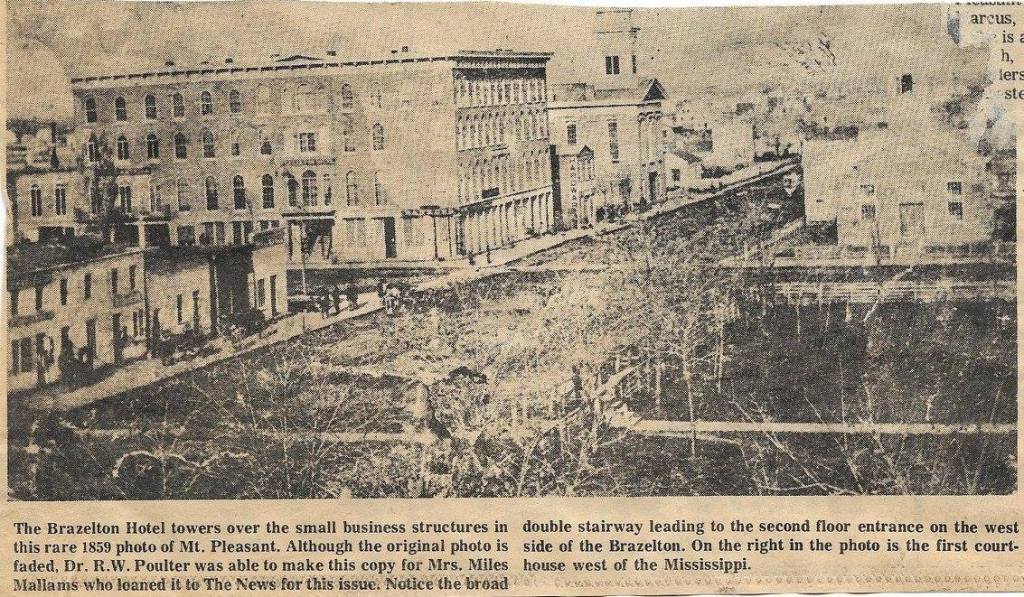
I can’t be certain of his identity but I believe this letter may have been written by Sanford Troop (b. 1832), a native of New York State, who’s brother was a merchant in Mt. Pleasant, Henry county, Iowa. They were enumerated together in the same household in the 1860 US Census at Mt. Pleasant. Perhaps he was a buyer for his brother’s store which would explain his knowledge of commodity prices and the necessity of his traveling around Iowa.
He wrote the letter to his cousin who I believe was Thomas “Kinyon” Terry (1834-1900 of Norwich, Chenango county, New York. Kinyon was married to Lucy “Elvira” Gleason (1842-1866) in 29 August 1861 in Broome county, New York.
Transcription
Iowa City, [Iowa] January 5th 1862
Dear Friend Kin,
Many weeks have passed since I wrote to you, yet you have never been forgotten. And now, without making any apologies, I will endeavor to reply to you last favor.
My letter to Elvira was perhaps as acceptable to you as her, & as you are both one, you may not think that I deserve a real chastising after all. I have been to Mt. Pleasant since writing to Elvira but they would not let me stay long so I’m again on my errand of mercy, destined to Monticello, Davenport, Dubuque, & McGregor. The weather has been beautiful and the traveling good & I feel thankful that I have been so wonderfully favored. Today it is snowing and we have the promise of sleighing. I suppose you have already been favored with sleigh rides as good perhaps as when I lived near you. I have had but one sleigh ride and that was on a sleigh drawn by oxen on bare ground & uphill at that. I made it pleasant, however, from the fact that a jolly number was in company with me.
I should like to know what you are doing. I have not heard from the East in a long time. Perhaps it is owing to my own negligence in writing. If you do not think me wholly unworthy of a letter, I should like well to hear from you & the friends. I know not whether Libbie is at home or away. If Olivia has a melodeon or piano, I have a beautiful piece of music that I would like to send her. You will please tell me. It has been published only about three weeks. Composed & arranged by an intimate acquaintance here in Mt. Pleasant, it was played at the Good Templars Supper a few evenings since, held at the City Hall in Mt. Pleasant with great applause. Mt. Pleasant is quite a place for amusement & something is most constantly going on to make it lively. The 4th Regiment of Cavalry are yet in camp and adds, I suppose, to its liveliness. 1
I find the farmers rather disheartened & well they might while stock and produce remain at the present prices. Beef is now selling at three dollars, pork at two dollars, corn at ten cents per bushel, and other grain in like proportion. At Washington ( a business railroad town), these that I mentioned are the current prices at present. Yet we are hoping for something better than this. How soon they may be realized, I know not.
Kin, I have not much news to write you today, but if I find something between here and Dubuque that I think will interest you, I will write you from that place. I would like to meet you now & have one of those good old chats. When will that time come? I am alone today, yet I am not lonely for I have become hardened and accustomed to this kind of life. When I leave Mt. Pleasant, it is very unpleasant, but in two or three weeks I forget it during my business hours. But when the day is past & I am quietly retired for the night, my thoughts go back to the land of my younger days. I think how pleasant they were. But now it makes me sad and lonely so I try to forget them.
Kin, you well know that if our leisure hours are all taken up, it serves to hide & dispel the little sad thoughts & troubles that arise. I must write you a few words more & then bid you goodbye for the present. you must write me ad tell me about all your folks at home. My best regards to them all. Give the sincere sentiments of your cousin, Sanford
[to] Kinyon
1 Co. D of the 4th Iowa Cavalry was raised in Mount Pleasant and the regiment was still encamped outside of town in January 1862. Sgt. (later Captain) Lot Abraham served in that regiment. I transcribed all of his war diaries on a website entitled, “My Own Dear Lot.” Here is the link to his diary from January-March 1862.















 Spared & Shared 23