
This beautifully written letter was penned by Cardella E. Brown (1841-1896) who was a clerk at the Connecticut Mutual Insurance Company in Hartford, Connecticut in 1860. His parents were divorced and he lived with his mother in Hartford while his father lived in New York City with his second wife and Cardella’s brother Gerald and sister Lulette, while Brown’s other brother Henry was employed as a printer in Boston.
In September, 1861, Brown was mustered in as a Corporal in Co. B of the 6th Connecticut Regiment. He served three years and muster rolls record that he was discharged in September 1864 as a Sergeant. It’s presumed that Cardella elected to stay with the army following his discharge to serve as a civilian in the commissary. Suffering from depression, Cardella shot himself in 1896 at the age of fifty-five, leaving a widow and three sons—one of whom was named Cardella Drake Brown (the “Drake,” no doubt, from his “Uncle Drake” who is mentioned in this letter.)
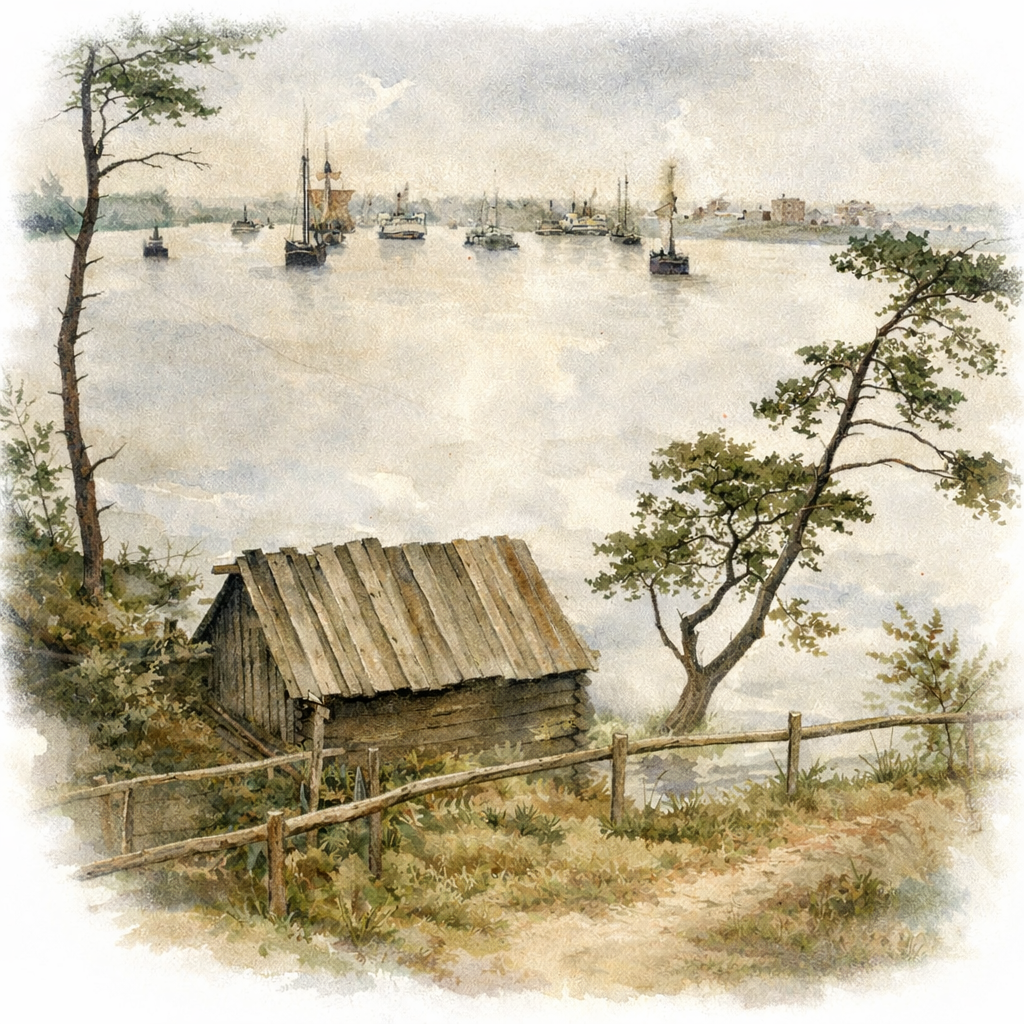
The Huntington library holds three volumes belonging to Cardella E. Brown. The first is a letterpress copybook containing approximately 100 outgoing personal letters Brown wrote from 1859 to 1861 while he was living in Hartford, Connecticut and working as a clerk at Connecticut Mutual Insurance Company. The letters are addressed to Brown’s parents, siblings, a cousin, and other family members and friends. The detailed and candid letters are written in a conversational tone devoid of usual epistolary formalities. The letters comment on a wide range of topics, including Brown’s personal life and sexuality, goings on in Hartford, and state and national politics of the 1860 election year. He talks in detail about Stephen A. Douglass, the anticipated secession of South Carolina, the Buchanan administration, and the hanging of John Brown. [Archived @ The Huntington]
T R A N S C R I P T I O N
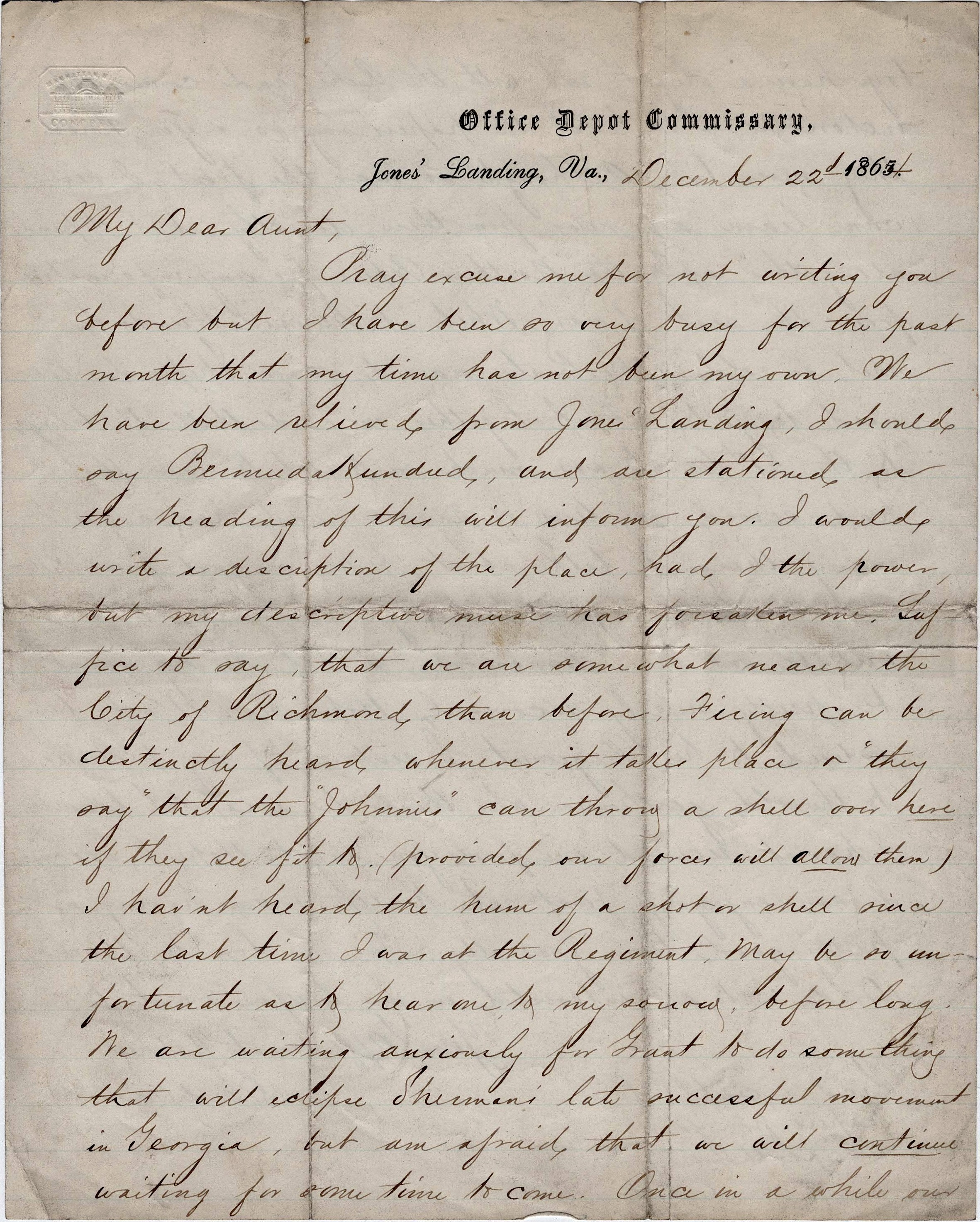
Office Depot Commissary
Jones’ Landing, Va.
December 22d 1864
My dear Aunt,
Pray excuse me for not writing you before but I have been so very busy for the last month that my time has not been my own. We have been relieved from Jones’ Landing—I should say Bermuda Hundred—and are stationed as the heading of this will inform you. I would write a desription of the place had I the power but my descriptive muse has forsaken me. Suffice to say that we are somewhat nearer the City of Richmond than before. Firing can be distinctly heard whenever it takes place & “they say” that the “Johnnies” can throw a shell over here if they see fit to (provided our forces will allow them). I haven’t heard the hum of a shot or shell since the last time I was at the Regiment. May be so unfortunate as to hear one to my sorrow before long.
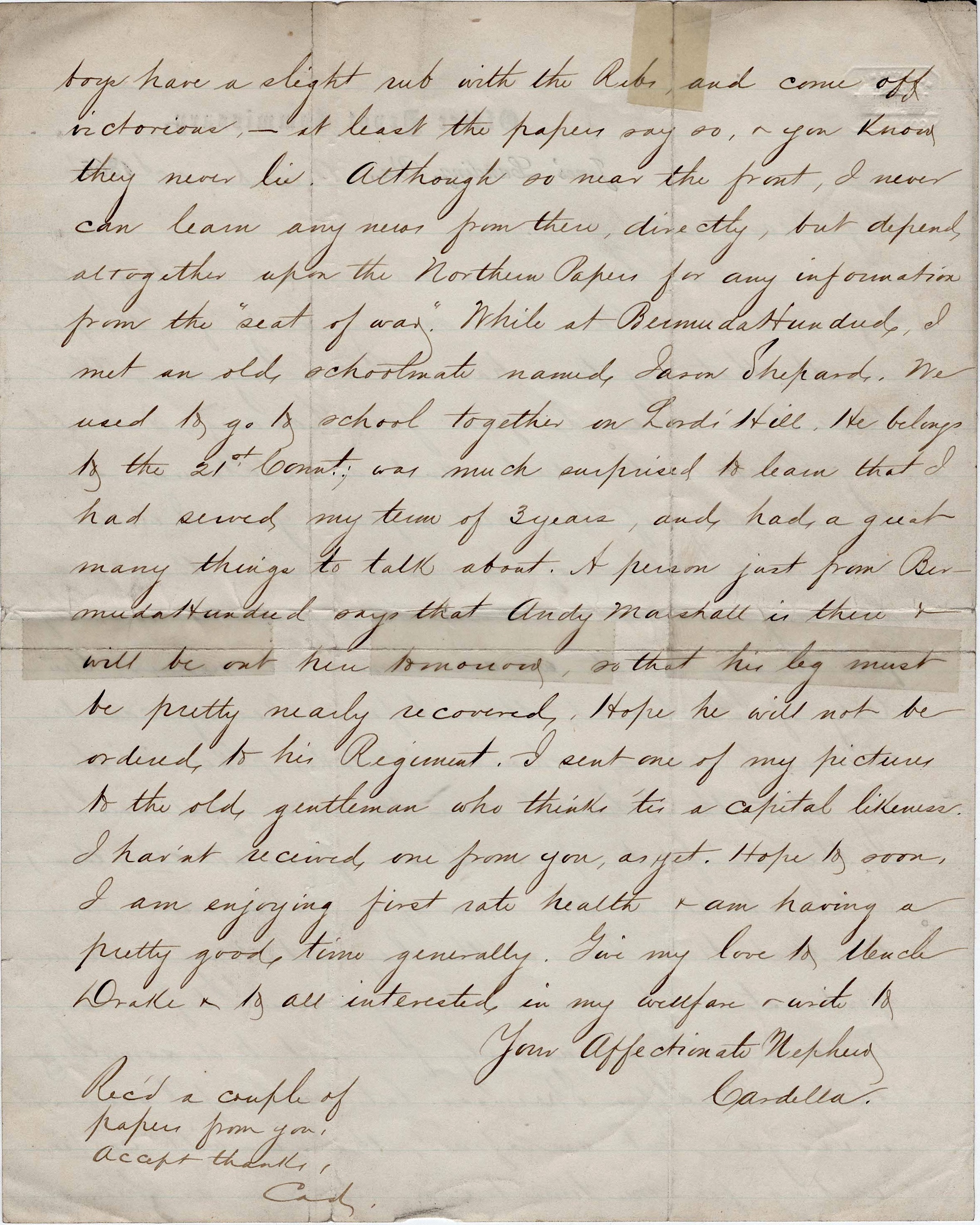
We are waiting anxiously for Grant to do something that will eclipse Sherman’s late successful movement in Georgia, but I am afraid that we will continue waiting for some time to come. Once in a while our boys have a slight rub with the Rebs and come off victorious—at least the papers say so, & you know they never lie. Although so near the front, I never can learn any news from there directly, but depend altogether upon the Northern papers for any information from the “seat of war.”
While at Bermuda Hundred, I met an old schoolmate named Jason Shepard. We used to go to school together on Lord’s Hill [in Hartford]. He belongs to the 21st Connecticut. Was much surprised to learn that I had served my term of three years and had a great many things to talk about. 1
A person just from Bermuda Hundred says that Andy Marshall is there & will be out here tomorrow, so that his leg must be pretty nearly recovered. Hope he will not be ordered to his Regiment. 2
I sent one of my pictures to the old gentleman who thinks tis a capital likeness. I haven’t received one from you as yet. Hope to soon. I am enjoying first rate health & am having a pretty good time generally. Give my love to Uncle Drake & to all interested in my welfare or write to your affectionate nephew, – Cardella
Received a couple of papers from you. Accept thanks, — Card.
1 Jason J. Shepard (1841-1916) served in Co. A of the 21st Connecticut Infantry from 5 September 1862 until 22 November 1863 when he was transferred to the US Signal Corps. He was discharged from th service in June 1865. He was born in western Massachusetts but in 1860 was residing in Hartford, Connecticut. After the war he married and settled in Hartford until late in life when he moved to California.
2 Andrew Marshall was the 2nd Lieutenant of Co. B, 6th Connecticut Infantry.
 Spared & Shared 23