
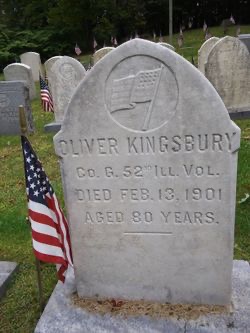
The following letter was written by Oliver Kingsbury (1821-1901) of St. Charles, Illinois, who married Almira Oratt (1832-Aft1900) in Kane county in 1858. The letter was written to his daughter Juliette who was born in 1848 so she must have been a daughter by a former marriage. In the 1860 US Census, Oliver was employed as an auctioneer.
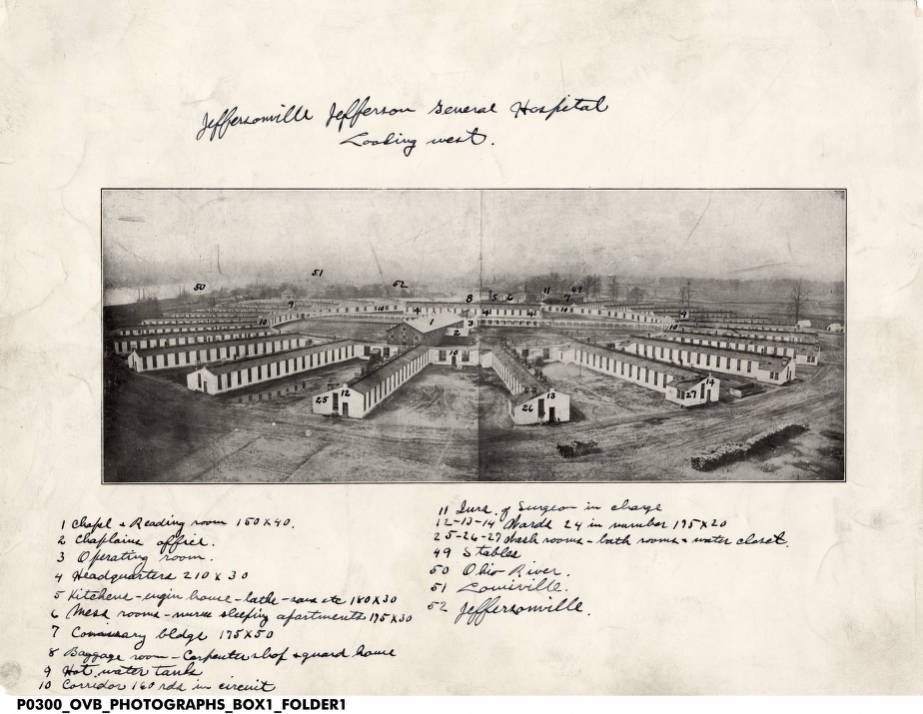
When Oliver was 40 years old, he enlisted in Co. G, 52nd Illinois Infantry. He remained in the service until 25 November 1864 when he mustered out at Springfield, Illinois. We learn from this letter that he was detached from his regiment and working as a nurse in the soldiers’ hospital at Jeffersonville, Indiana, and prior to that at the one in Paducah, Kentucky. His duties in preparing drugs at the hospitals gave him the experience and qualifications to hold out his shingle as a druggist in Lee Center, Oneida county, New York, after he was discharged from the service. By 1880, however, he had moved on to photography with a studio in Rome, New York.
Transcription
Joe Holt Hospital
Jeffersonville, Indiana
July 22d 1864
Dear daughter,
I received your kind letter dated the 17th and while I have a little leisure, send a few lines in answer. I do not know what you mean by Almira’s telling all the news concerning you for she seldom says a word about you. I suppose it is because she does not often see you. Sometimes she says she has not heard from you in some time and I do not know of anything she has written of you for perhaps six months—only that you was working this season and one year ago she hinted something about you having a beau by the name of Smith but knew nothing of it as I could find out. But as for information about you or anyone else, there is not much in most of her letters. Once in a while I hear something what is going on in town but I do not hear as much of you as I could wish. You have never said a word whether you was at work or how you get along with your work. I am not aware of anything meddling or out of the way in that time and she has never said anything as though there was any ill feeling between you. You surprised me by saying as you did about news, but it is all right perhaps. I hope you will write often and tell all that is worth telling. Give my respects to Peter and wife.
“We have so many doctors, some know something, and others know but little.”
Oliver Kingsbury, 52nd Illinois, Joe Holt Hospital, 22 July 1864
I have a good time here. I do nothing but make pills, put up powders, bitters, &c. half of the time and most of my leisure is spent studying medicine. There are plenty of books here. We have so many doctors, some know something, and others know but little. One doctor next door has hired a piano and we have plenty of music among us men, and as to women, we do without them as there are but 8 or 10 ill-looking Irish wash women, but they do not even eat when I do, but at the common table. They wash on the bank of the river where I have not been yet, as it is not on my route to bathe or to dinner. Two old maids boss the cooking for the low diet patients—nice women for all any of us know, but they hardly come out of their kitchen. Three or four soldiers help them. I think they are from St. Louis and sent by the sanitary commission. One Dutch [German] doctor has his wife and the doctor I was under at Paducah has his wife here. The balance—over six hundred—are soldiers and perhaps 20 men building and fixing about.
Have you seen the shawl I sent to St. Charles from Paducah? I did not know but you would like to have it, so I told Almira that if you wanted it, to let you have it as it was a relic of the battle of Paducah. She talks of selling it and I did not know whether you had seen it or not.
Your father, — O. Kingsbury


 Spared & Shared 23