Category Archives: John Hunt Morgan

1862: Waldo Spear to his Parents

The following letter was written by Waldo Spear (1843-1907), the son of Hiram Spear (1810-1872) and Lucy C. Ripley (1806-1893) of Springfield, Bradford county, Pennsylvania. Waldo enlisted in Co. C, 7th Pennsylvania Cavalry on 1 November 1861. He was taken prisoner at Gallatin on 25 August 1862 and was paroled due to his injuries. Following his release, he was detailed a courier of the 2nd Cavalry Division, Army of the Cumberland. He continued in this capacity until he was discharged in November 1864.
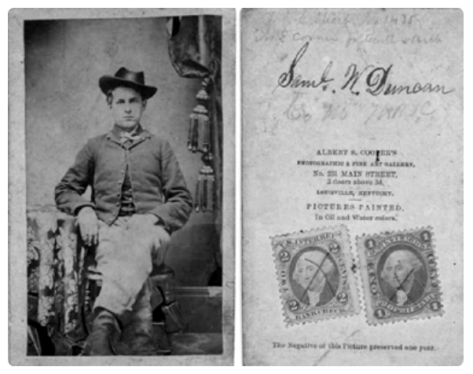
I could not find an image of Waldo but here is one of PVT. Samuel W. Duncan of Co. M, 7th Pennsylvania Cavalry (Photo Sleuth)

Waldo’s letter gives us an account of the Battle of Lebanon—a relatively small affair that took place in and near Lebanon, Tennessee on May 5, 1862. We learn that Waldo was not a witness to the event because he had been detailed to guard the baggage, but he relates how the regiment won the praise of General Ebenezer Dumont led the Union troopers into Lebanon and then pursued Colonel John Hunt Morgan’s Confederate cavalry all the way to the Tennessee river. Dumont’s force consisted of detachments from the 1st Kentucky Cavalry under Colonel Frank Lane Wolford, the 4th Kentucky Cavalry under Colonel Green Clay Smith, and the 7th Pennsylvania Cavalry under Colonel Wynkoop. Morgan’s force was the 2nd Kentucky Cavalry Regiment. Dumont surprised Morgan early on the morning of May 5, 1862. A 15-mile running battle ensued in which the Confederates were forced to retreat. During the fighting Confederate sympathizers in the town fired upon the Union Cavalry. Many of the remaining Confederates barricaded within the buildings surrendered when Dumont threatened to set the town on fire.

See also—1862: Waldo Spear to his Parents & Brothers.

Note: This letter is from the personal collection of Greg Herr and was transcribed and published on Spared & Shared by express consent.

Transcription

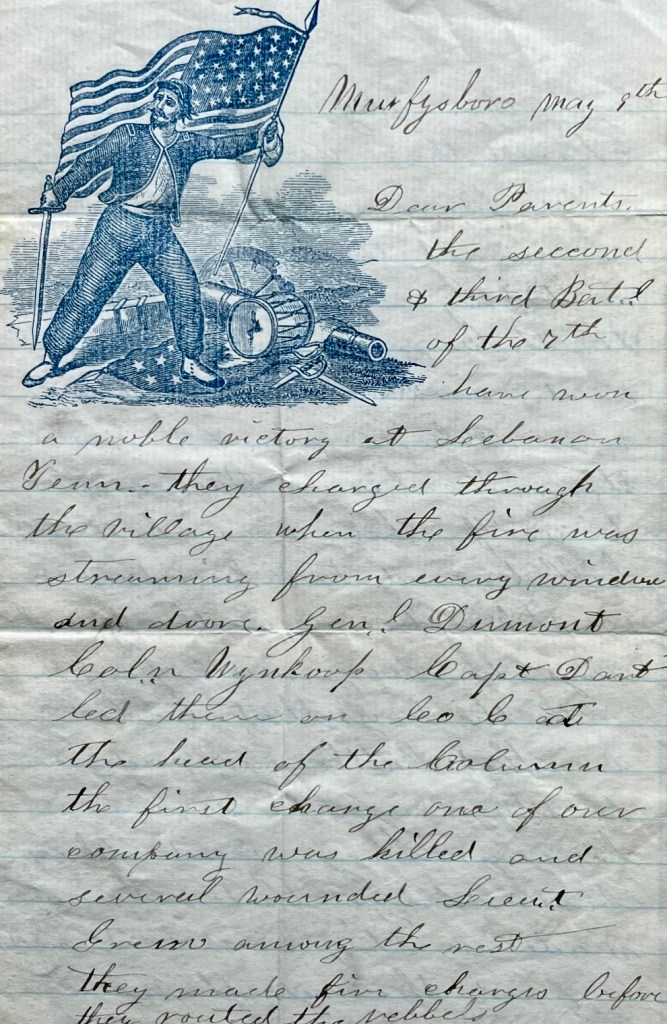
Murfreesboro [Tennessee]
May 9th, [1862]

Dear Parents,

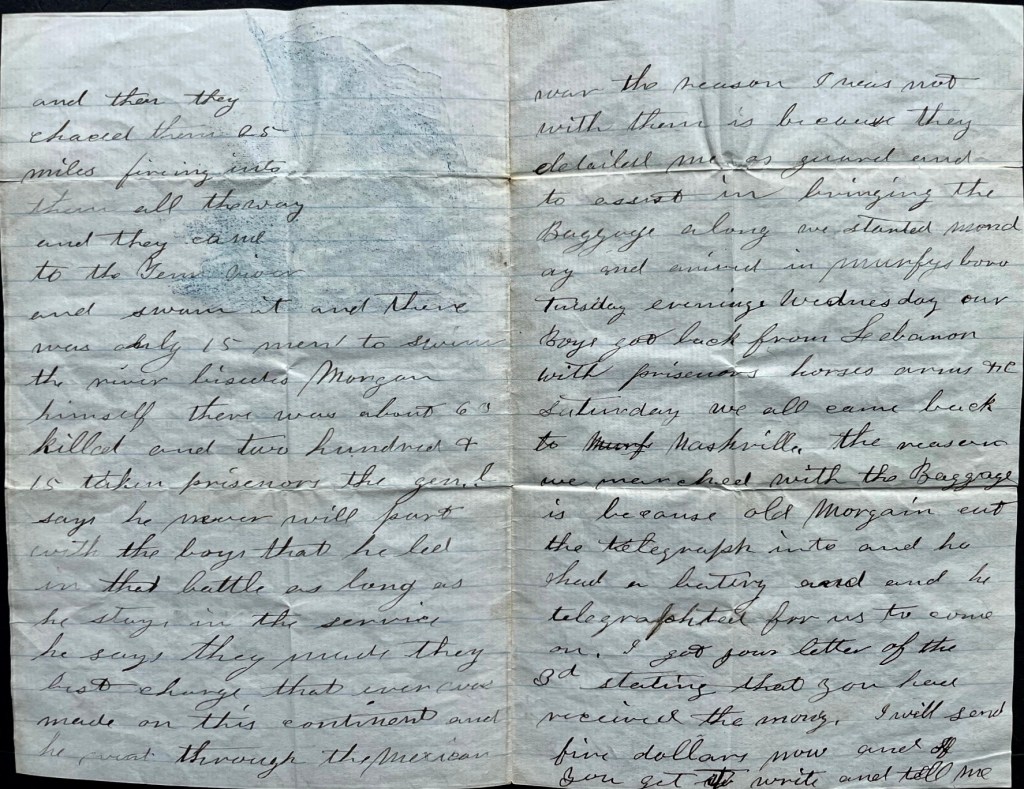
The second and third Battalion of the 7th have won a noble victory at Lebanon, Tennessee. They charged through the village when the fire was streaming from every window and door. Gen. Dumont, Colonel Wynkoop, Capt. Dartt led them on, Company C at the head of the column. The first charge one of our company was killed and several wounded—Lieut. Greir among the rest. They made five charges before they routed the rebels and then they chased them 25 miles, firing into them all the way and they came to the Tennessee River and swam it and there was only 15 men to swim the river besides Morgan himself. There was about 63 killed and two hundred & 15 taken prisoners. The General says he never will part with the boys that he led in that battle as long as he stays in the service. He says they made the best charge that ever was made on this continent and he went through the Mexican War.

The reason I was not with them is because they detailed me as guard and to assist in bringing the baggage along. We started Monday and arrived in Murfreesboro Tuesday evening. Wednesday our Boys got back from Lebanon with prisoners, horses, arms, &c. Saturday we all came back to Nashville. The reason we marched with the baggage is because Old Morgan cut the telegraph in two and he had a battery and he telegraphed for us to come on.

I got a letter of the 3rd stating that you have received the money. I will send five dollars now and if you get it, write and tell me. If I can get a paper, I will send it to you if it has an account of the battle in it. I am enjoying good health and living in hopes that we may see more fighting before the war is closed for I will not die in the battlefield unless I was born to.

This is the most even country I have ever seen. We saw one range of mountains just before we got to Murfreesboro. They must have been 30 miles from us at least. The forest trees are oak, spruce, and some maple. If you get any account of our battle in the papers, I wish you would send it. — Waldo Spear, Co. C, 7th Pennsylvania Vol. [Cavalry]. Camp Worth, Nashville.
1862: Warren B. Ewing to Victoria Ely

The following letter was written by Warren B. Ewing (1825-1876) a jeweler in Shelbyville, Shelby county, Kentucky. Born in Bourbon county, Ewing arrived in Shelbyville as a young man in the early 1840s to live and work with his brother-in-law James S. Sharrard. “Those who knew him well wrote of his refined nature, his musical talent, and his love of hunting and fishing.” In 1859-60, Ewing advertised as a goldsmith and silversmith, documenting is business of close to 20 years. Toward the end of his life, he lived in a furnished room in the rear of a hardware store on Main Street on the west side of the public square. He died a pauper on March 17, 1876, and was buried in an unmarked grave on the Atkisson lot at Grove Hill Cemetery, Shelbyville. Warren’s sister, Emeline, was the wife of James S. Sharrard who lived, by 1862, in Henderson, Kentucky.

Warren’s letter speaks of the first raid that Confederate raider John Hunt Morgan made into Kentucky in July 1862. With some 900 men, Morgan “swept in a wide arc through the state, during which he raided 17 towns, reportedly captured and paroled more than 1,200 Union troops, acquired several hundred horses, and destroyed huge amounts of Federal supplies. Morgan unnerved Kentucky’s Union military government, and President Abraham Lincoln received so many frantic appeals for help that he commented that ‘they are having a stampede in Kentucky.'” Though he was feared to be targeting Shelbyville, Kentucky, Morgan’s men rode into Paris instead and helped themselves to Federal supplies stored there and destroyed the rest. After Paris, Morgan stayed in the state just long enough to capture Winchester and Richmond.

Warren wrote the letter to 23 year-old Victoria (“Vic”) Ely (1839-1922), the daughter of William Masterson Ely (1808-1868) and Charlotte Robertson (1810-1881) of Milton, Trimble county, Kentucky. Warren’s relationship with her is unknown; perhaps she was a prior student at the Shelbyville Female College.

[Note: This letter is from the personal collection of Josh Branham and was transcribed and published on Spared & Shared by express consent.]

Transcription

Addressed to Miss Vic Ely, Milton, Kentucky

Shelbyville [Kentucky]
July 20, 1862

Miss Vic,

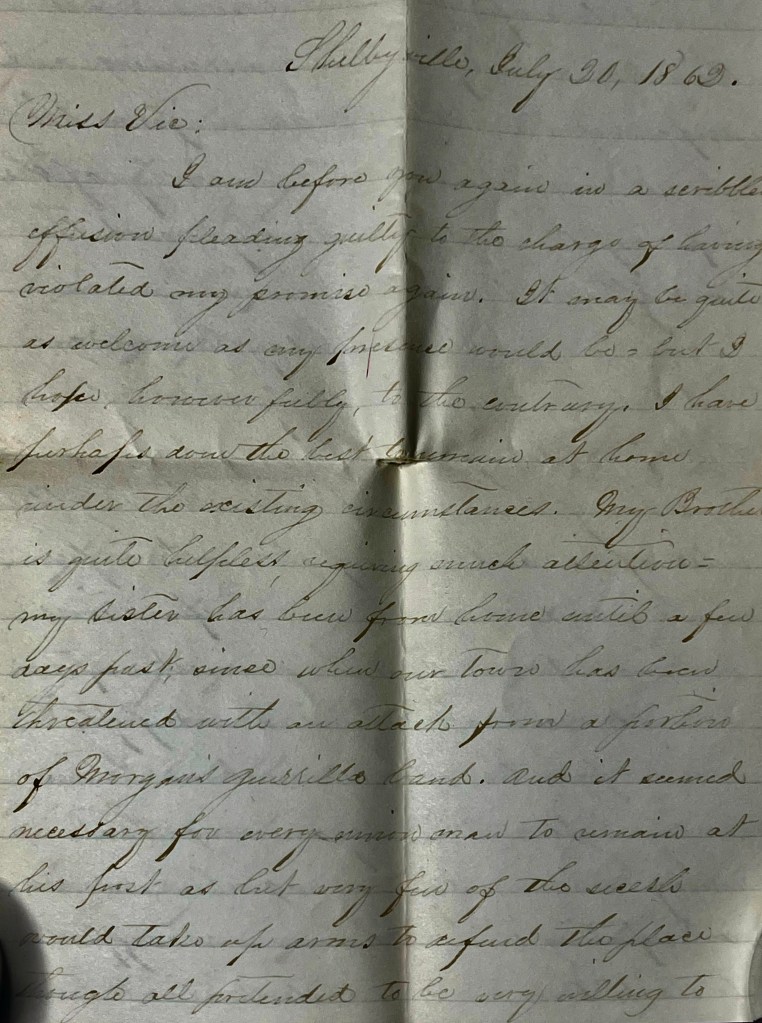
I am before you again in a scribble effusion pleading guilty to the charge of leaving violated my promise again. It may be quite as welcome as any pretense would be but I hope, however feebly, to the contrary. I have perhaps done the best to remain at home under the existing circumstances. My brother is quite helpless, requiring much attention. My sister has been from home until a few days past since which out town has been threatened with an attack from a portion of Morgan’s guerrilla band and it seemed necessary for every Union man to remain at his post as but very few of the secesh would take up arms to defend the place though all pretended to be very willing to do so. Some of them with but their shotguns fell into the ranks and remained firm until there was no further use for their remaining under arms, and are entitled to confidence. But those who lent their aid and influence to demoralizing and dispersing the aids who came in from the neighboring villages are not worthy of the respect of the negroes whom they regard the bone of contention.

The news reached us Sunday morning that Morgan was within thirty miles of us, threatening Frankfort, Lexington, and Shelbyville. A portion of his command were within eighteen miles of us and had a fight with a few home guards near Camden. Preparations were made to give them the warmest reception we could, receiving one hundred and fifty recruits from the villages around us between Sunday night and Monday morning. That no enemy came Monday morning when we were anticipating them, the men were suffered to stack their arms and stroll about town and the consequence was that many got drunk and were so demoralized when a breathless (almost_ courier came late in the afternoon with the news that twelve hundred cavalry were within six miles of and marching on Shelbyville, that they could not be managed. Several rumors followed soon after bringing the same tidings—men, too, who had been considered reliable.

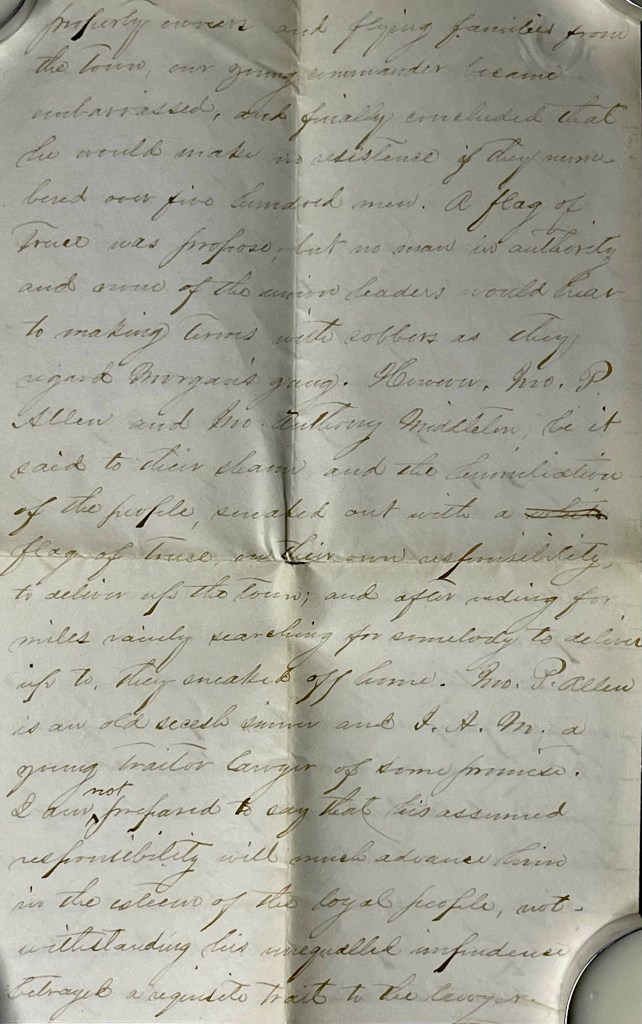
A general stampede of the hundreds of the country people who had been flocking in all day commenced. Sheer panic stricken Union men and [ ] secesh such property holders gathered about our commander imploring him to lay down his arms and save the town from destruction by an over-powerful foe. Next two companies from Mount Eden and Harrisville made a grand skedaddle, some of them leaving their arms and taking to the field and woods, leaving only our home guard and a small band from Simpsonville to meet the Allens and their Cossacks. Amid the prayers of the property owners and flying families from the town, our young commander became embarrassed and finally concluded that he would make no resistance if they numbered over five hundred men.

A flag of truce was proposed but no man in authority and none of the Union leaders would bear to making terms with robbers as they regard Morgan’s gang. However, Jno. P. Allen 1 and Jno. Anthony Middleton, 2 be it said to their shame and the humiliation of the people, sneaked out with a flag of truce on their own responsibility to deliver up the town, and after riding for miles vainly searching for somebody to deliver up to, they sneaked off home. Jno. P. Allen is an old secesh sinner and J. A. M[iddleton], a young traitor lawyer of some promise. I am not prepared to say that his assumed responsibility will much advance him in the esteem of the loyal people, notwithstanding his unequalled impudence & betrayal—a requisite trait to the lawyer.

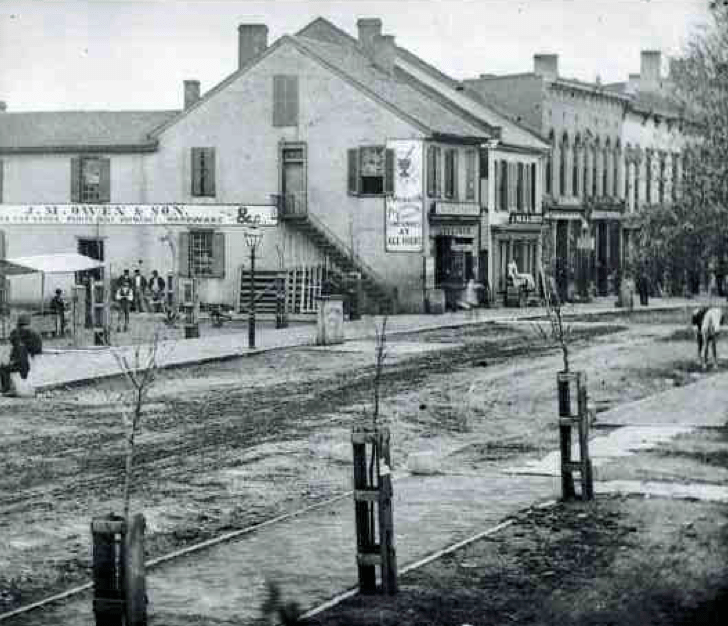
Shelbyville, Kentucky

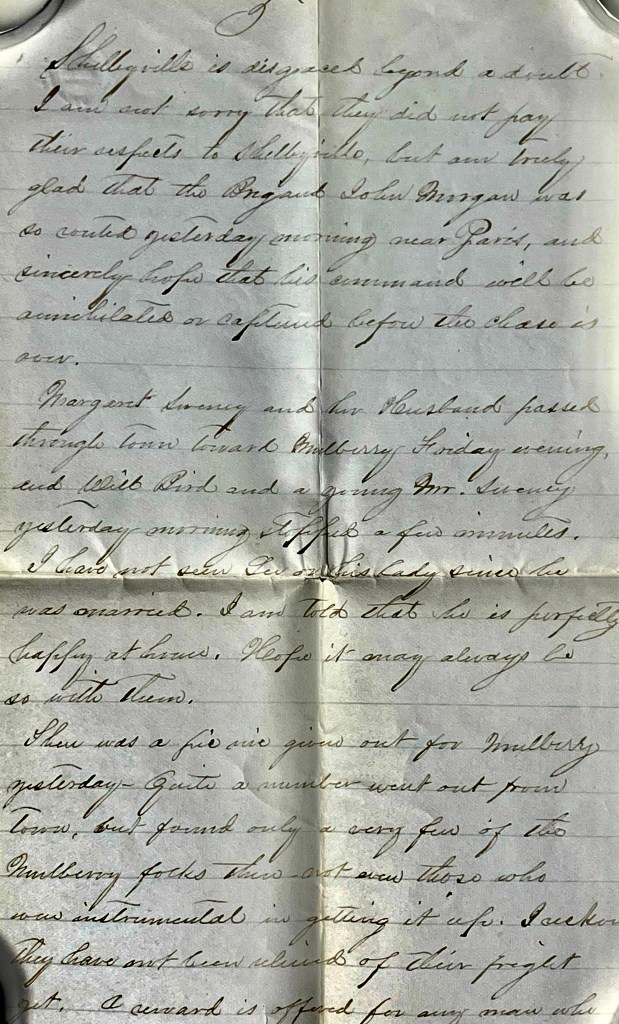
Shelbyville is disgraced beyond a doubt. I am not sorry that they did not pay their respects to Shelbyville, but am truly glad that the brigand John Morgan was so routed yesterday morning near Paris and sincerely hope that his command will be annihilated or captured before the chase is over.

Margaret Sorency and her husband passed through town toward Mulberry Friday evening and Will Bird and a young Mr. Sorency yesterday morning stopped a few minutes. I have not seen [ ] or his lady since he was married. I am told that he is perfectly happy at house. Hope it may always be so with them.

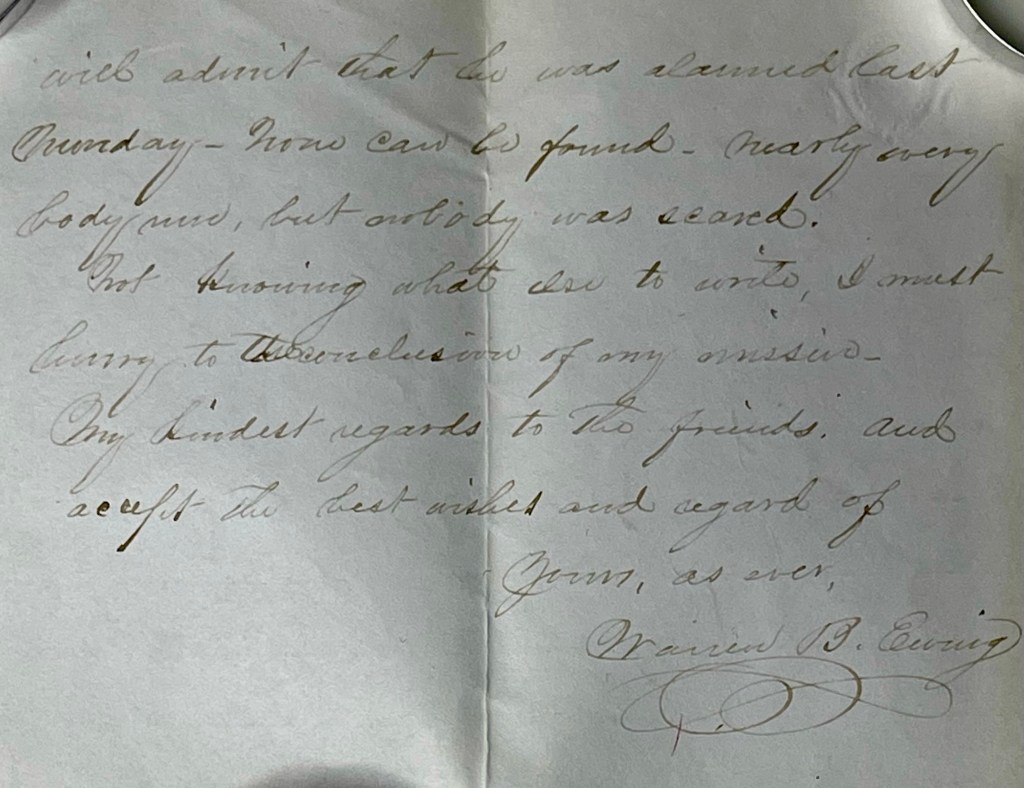
There was a picnic given out for Mulberry yesterday. Quite a number went out from town but found only a very few of the Mulberry folks there—not even those who was instrumental in getting it up. I reckon they have not been relieved of their fright yet. A reward is offered for any man who will admit that he was alarmed last Monday. None can be found—nearly everybody run, but nobody was scared.

Not knowing what else to write, I must hurry to the conclusion of my missive. My kindest regards to the friends and accept the best wishes and regard of yours, as ever, — Warren B. Ewing


1 Presumably John Polk Allen (1810-1887) of Shelbyville, Shelby county, Kentucky. In the 1860 US Census he was identified as a farmer with a Simpsonville Post office address.

2 John Anthony Middleton (1838-1883) was the son of David Fulton Middleton (1796-1878) and Elizabeth Yerkes Beattie (1805-1859) of Shelbyville, Kentucky.